

Chancellor of Germany

Encyclopedia
The Chancellor of Germany (known in German as Bundeskanzler ("Federal Chancellor"), or Kanzler for short) is, under the German 1949 constitution
, the head of government
of Germany
. It is historically a continuation of the office of Chancellor (German: Kanzler, later Reichskanzler) that was originally established as the office of Chancellor of the North German Confederation
in 1867. The 1949 constitution increased the role of the Chancellor compared to the 1919 Weimar Constitution
. The role is generally comparable to that of Prime Minister
in other parliamentary democracies.
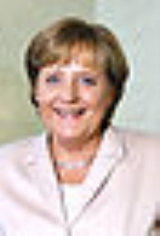
There have been eight chancellors since 1949. The current Chancellor of Germany is Angela Merkel
, who was elected in 2005. She is the first female Chancellor since the establishment of the original office in 1867, and known in German as Bundeskanzlerin, the feminine form of Bundeskanzler. Merkel is also the first Chancellor elected since the fall of the Berlin Wall
to have been raised in the former East Germany.
. The title was at times used in several states of German-speaking Europe
. The power and influence of this office varied strongly over time. Otto von Bismarck
in particular had a great amount of power, but it was not until 1949 that the Chancellor was established as the central executive authority
of Germany.
Due to his administrative tasks, the head of the chapel of the imperial palace during the Holy Roman Empire
was called Chancellor. The Archbishop of Mainz was German Chancellor until the end of the Holy Roman Empire
in 1806 while the Archbishop of Cologne was Chancellor of Italy and the Archbishop of Trier of Burgundy. These three Archbishops were also Prince-elector
s of the empire. Already in medieval times the Chancellor had political power like Willigis
of Mainz
(Archchancellor 975–1011, regent for Otto III 991–994) or Rainald von Dassel
(Chancellor 1156–1162 and 1166–1167) under Frederick I
.
The modern office of Chancellor was established with the North German Confederation
, of which Otto von Bismarck became Chancellor (German, Bundeskanzler) in 1867. After unification of Germany
in 1871, the office became known in German as Reichskanzler ("Reich
Chancellor"). Since the adoption of the current constitution of Germany
in 1949 the formal title of the office in the German language
is once again Bundeskanzler.
In the now defunct German Democratic Republic
(GDR, East Germany), which existed from 7 October 1949 to 3 October 1990 (when the territory of the former GDR was reunified with the Federal Republic of Germany), the position of Chancellor did not exist. The equivalent position was called either Minister President (Ministerpräsident) or Chairman of the Council of Ministers of the GDR (Vorsitzender des Ministerrat
s der DDR). (See Leaders of East Germany
.)
's 1949 constitution
, the Basic Law
(Grundgesetz), invests the Federal Chancellor (Bundeskanzler) with central executive authority. Since the 1961 election, the two major parties (CDU/CSU and SPD) call their leading candidates for the federal election "chancellor-candidate" (Kanzlerkandidat), although this is not an official term and any party can nominate a Kanzlerkandidat (even if there is no chance at all to lead or even become part of a coalition). The Federal Government (Bundesregierung) consists of the chancellor and his or her cabinet ministers
.
The chancellor's authority emanates from the provisions of the Basic Law and from his or her status as leader of the party
(or coalition of parties) holding a majority of seats in the Bundestag
(federal parliament). With the exception of Helmut Schmidt
, the chancellor has usually also been chairman of his or her own party. This was the case with Chancellor Gerhard Schröder
from 1999 until he resigned the chairmanship of the SPD
in 2004.
The first chancellor, Konrad Adenauer
, set many precedents that continue today. He arrogated nearly all major decisions to himself, and established the chancellorship as the clear locus of power in Germany. He often treated his ministers as mere extensions of his authority rather than colleagues. While his successors have tended to be less domineering, the chancellor has acquired enough power that Germany is often described as a "chancellor democracy."
The chancellor determines the composition of the Federal Cabinet
. The President formally appoints and dismisses cabinet ministers, at the recommendation of the chancellor; no parliamentary approval is needed. According to the Basic Law, the chancellor may set the number of cabinet ministers and dictate their specific duties. Chancellor Ludwig Erhard
had the largest cabinet, with twenty-two ministers in the mid-1960s. Helmut Kohl
presided over 17 ministers at the start of his fourth term in 1994; the 2002 cabinet, the second of Chancellor Gerhard Schröder
, had 13 ministers and the Angela Merkel
cabinet as of 22 November 2005 has 15.
Article 65 of the Basic Law sets forth three principles that define how the executive branch functions:
 Every four years, after national elections and the convocation of the newly elected members of the Bundestag, the chancellor is elected by a majority of the members of the Bundestag upon the proposal of the President
(Bundespräsident). This vote is one of the few cases where a majority of all elected members of the Bundestag must be achieved, as opposed to a mere majority of those that are currently assembled. This is referred to as the Kanzlermehrheit (chancellor's majority), and is designed to ensure the establishment of a stable government. It has in the past occasionally forced ill or pregnant members to have to attend parliament when a party's majority was only slim.
Unlike regular voting by the Bundestag, the vote to elect the chancellor is by secret ballot
. This is intended to ensure that the chancellor's majority does not depend on members of his or her party only outwardly showing support.
If the nominee of the President is not elected, the Bundestag may elect its own nominee within fourteen days. If no-one is elected within this period, the Bundestag will attempt an election. If the person with the highest number of votes has a majority, the President must appoint him or her. If the person with the highest number of votes does not have a majority, the President may either appoint them or call new elections for the Bundestag. As all chancellors have been elected in the first vote as yet (1949–2010) neither of these constitutional provisions has been applied.
The chancellor is the only member of the federal government elected by the Bundestag. The other cabinet ministers are chosen by the chancellor himself or herself, although they are formally appointed by the President on the chancellor's proposal.
Unlike in other parliamentary legislatures, the Bundestag cannot remove the chancellor simply with a Motion of No Confidence
. Instead, the early removal of a chancellor is only possible when it simultaneously agrees on a successor. In order to garner legislative support in the Bundestag, the chancellor can also call for a regular Motion of Confidence, either combined with a legislative proposal or as a standalone vote. Only if such a vote fails may the President dissolve the Bundestag.
This procedure exists to avoid the situation that existed in the Weimar Republic
, when votes of no-confidence were over-used or abused by parties.
Basic Law for the Federal Republic of Germany
The Basic Law for the Federal Republic of Germany is the constitution of Germany. It was formally approved on 8 May 1949, and, with the signature of the Allies of World War II on 12 May, came into effect on 23 May, as the constitution of those states of West Germany that were initially included...
, the head of government
Head of government
Head of government is the chief officer of the executive branch of a government, often presiding over a cabinet. In a parliamentary system, the head of government is often styled prime minister, chief minister, premier, etc...
of Germany
Germany
Germany , officially the Federal Republic of Germany , is a federal parliamentary republic in Europe. The country consists of 16 states while the capital and largest city is Berlin. Germany covers an area of 357,021 km2 and has a largely temperate seasonal climate...
. It is historically a continuation of the office of Chancellor (German: Kanzler, later Reichskanzler) that was originally established as the office of Chancellor of the North German Confederation
North German Confederation
The North German Confederation 1866–71, was a federation of 22 independent states of northern Germany. It was formed by a constitution accepted by the member states in 1867 and controlled military and foreign policy. It included the new Reichstag, a parliament elected by universal manhood...
in 1867. The 1949 constitution increased the role of the Chancellor compared to the 1919 Weimar Constitution
Weimar constitution
The Constitution of the German Reich , usually known as the Weimar Constitution was the constitution that governed Germany during the Weimar Republic...
. The role is generally comparable to that of Prime Minister
Prime minister
A prime minister is the most senior minister of cabinet in the executive branch of government in a parliamentary system. In many systems, the prime minister selects and may dismiss other members of the cabinet, and allocates posts to members within the government. In most systems, the prime...
in other parliamentary democracies.
There have been eight chancellors since 1949. The current Chancellor of Germany is Angela Merkel
Angela Merkel
Angela Dorothea Merkel is the current Chancellor of Germany . Merkel, elected to the Bundestag from Mecklenburg-Vorpommern, has been the chairwoman of the Christian Democratic Union since 2000, and chairwoman of the CDU-CSU parliamentary coalition from 2002 to 2005.From 2005 to 2009 she led a...
, who was elected in 2005. She is the first female Chancellor since the establishment of the original office in 1867, and known in German as Bundeskanzlerin, the feminine form of Bundeskanzler. Merkel is also the first Chancellor elected since the fall of the Berlin Wall
Berlin Wall
The Berlin Wall was a barrier constructed by the German Democratic Republic starting on 13 August 1961, that completely cut off West Berlin from surrounding East Germany and from East Berlin...
to have been raised in the former East Germany.
History of position
The office of Chancellor has a long history, stemming back to the Holy Roman EmpireHoly Roman Empire
The Holy Roman Empire was a realm that existed from 962 to 1806 in Central Europe.It was ruled by the Holy Roman Emperor. Its character changed during the Middle Ages and the Early Modern period, when the power of the emperor gradually weakened in favour of the princes...
. The title was at times used in several states of German-speaking Europe
German-speaking Europe
The German language is spoken in a number of countries and territories in West, Central and Eastern Europe...
. The power and influence of this office varied strongly over time. Otto von Bismarck
Otto von Bismarck
Otto Eduard Leopold, Prince of Bismarck, Duke of Lauenburg , simply known as Otto von Bismarck, was a Prussian-German statesman whose actions unified Germany, made it a major player in world affairs, and created a balance of power that kept Europe at peace after 1871.As Minister President of...
in particular had a great amount of power, but it was not until 1949 that the Chancellor was established as the central executive authority
Executive (government)
Executive branch of Government is the part of government that has sole authority and responsibility for the daily administration of the state bureaucracy. The division of power into separate branches of government is central to the idea of the separation of powers.In many countries, the term...
of Germany.
Due to his administrative tasks, the head of the chapel of the imperial palace during the Holy Roman Empire
Holy Roman Empire
The Holy Roman Empire was a realm that existed from 962 to 1806 in Central Europe.It was ruled by the Holy Roman Emperor. Its character changed during the Middle Ages and the Early Modern period, when the power of the emperor gradually weakened in favour of the princes...
was called Chancellor. The Archbishop of Mainz was German Chancellor until the end of the Holy Roman Empire
Holy Roman Empire
The Holy Roman Empire was a realm that existed from 962 to 1806 in Central Europe.It was ruled by the Holy Roman Emperor. Its character changed during the Middle Ages and the Early Modern period, when the power of the emperor gradually weakened in favour of the princes...
in 1806 while the Archbishop of Cologne was Chancellor of Italy and the Archbishop of Trier of Burgundy. These three Archbishops were also Prince-elector
Prince-elector
The Prince-electors of the Holy Roman Empire were the members of the electoral college of the Holy Roman Empire, having the function of electing the Roman king or, from the middle of the 16th century onwards, directly the Holy Roman Emperor.The heir-apparent to a prince-elector was known as an...
s of the empire. Already in medieval times the Chancellor had political power like Willigis
Willigis
Saint Willigis was Archbishop of Mainz from 975 until his death as well as a statesman of the Holy Roman Empire.-Life:...
of Mainz
Archbishopric of Mainz
The Archbishopric of Mainz or Electorate of Mainz was an influential ecclesiastic and secular prince-bishopric in the Holy Roman Empire between 780–82 and 1802. In the Roman Catholic Church hierarchy, the Archbishop of Mainz was the primas Germaniae, the substitute of the Pope north of the Alps...
(Archchancellor 975–1011, regent for Otto III 991–994) or Rainald von Dassel
Rainald of Dassel
Rainald of Dassel was archbishop of Cologne from 1159 to 1167 and archchancellor of Italy. He was preceded as archbishop by Friedrich II of Berg and succeeded by Philip I von Heinsberg....
(Chancellor 1156–1162 and 1166–1167) under Frederick I
Frederick I, Holy Roman Emperor
Frederick I Barbarossa was a German Holy Roman Emperor. He was elected King of Germany at Frankfurt on 4 March 1152 and crowned in Aachen on 9 March, crowned King of Italy in Pavia in 1155, and finally crowned Roman Emperor by Pope Adrian IV, on 18 June 1155, and two years later in 1157 the term...
.
The modern office of Chancellor was established with the North German Confederation
North German Confederation
The North German Confederation 1866–71, was a federation of 22 independent states of northern Germany. It was formed by a constitution accepted by the member states in 1867 and controlled military and foreign policy. It included the new Reichstag, a parliament elected by universal manhood...
, of which Otto von Bismarck became Chancellor (German, Bundeskanzler) in 1867. After unification of Germany
Unification of Germany
The formal unification of Germany into a politically and administratively integrated nation state officially occurred on 18 January 1871 at the Versailles Palace's Hall of Mirrors in France. Princes of the German states gathered there to proclaim Wilhelm of Prussia as Emperor Wilhelm of the German...
in 1871, the office became known in German as Reichskanzler ("Reich
Reich
Reich is a German word cognate with the English rich, but also used to designate an empire, realm, or nation. The qualitative connotation from the German is " sovereign state." It is the word traditionally used for a variety of sovereign entities, including Germany in many periods of its history...
Chancellor"). Since the adoption of the current constitution of Germany
Basic Law for the Federal Republic of Germany
The Basic Law for the Federal Republic of Germany is the constitution of Germany. It was formally approved on 8 May 1949, and, with the signature of the Allies of World War II on 12 May, came into effect on 23 May, as the constitution of those states of West Germany that were initially included...
in 1949 the formal title of the office in the German language
German language
German is a West Germanic language, related to and classified alongside English and Dutch. With an estimated 90 – 98 million native speakers, German is one of the world's major languages and is the most widely-spoken first language in the European Union....
is once again Bundeskanzler.
In the now defunct German Democratic Republic
German Democratic Republic
The German Democratic Republic , informally called East Germany by West Germany and other countries, was a socialist state established in 1949 in the Soviet zone of occupied Germany, including East Berlin of the Allied-occupied capital city...
(GDR, East Germany), which existed from 7 October 1949 to 3 October 1990 (when the territory of the former GDR was reunified with the Federal Republic of Germany), the position of Chancellor did not exist. The equivalent position was called either Minister President (Ministerpräsident) or Chairman of the Council of Ministers of the GDR (Vorsitzender des Ministerrat
Ministerrat
The Council of Ministers of the German Democratic Republic was the chief executive body of East Germany from November 1950 until the GDR was unified with the Federal Republic of Germany on 3 October 1990...
s der DDR). (See Leaders of East Germany
Leaders of East Germany
The political leadership of East Germany was in the hands of several offices.Prior the proclamation of an East German state, the Soviets established in 1948 the German Economic Commission as a de facto government in their occupation zone...
.)
- See the article ChancellorChancellorChancellor is the title of various official positions in the governments of many nations. The original chancellors were the Cancellarii of Roman courts of justice—ushers who sat at the cancelli or lattice work screens of a basilica or law court, which separated the judge and counsel from the...
for the etymologyEtymologyEtymology is the study of the history of words, their origins, and how their form and meaning have changed over time.For languages with a long written history, etymologists make use of texts in these languages and texts about the languages to gather knowledge about how words were used during...
of the word.
The chancellor's role
West GermanyWest Germany
West Germany is the common English, but not official, name for the Federal Republic of Germany or FRG in the period between its creation in May 1949 to German reunification on 3 October 1990....
's 1949 constitution
Constitution
A constitution is a set of fundamental principles or established precedents according to which a state or other organization is governed. These rules together make up, i.e. constitute, what the entity is...
, the Basic Law
Basic Law for the Federal Republic of Germany
The Basic Law for the Federal Republic of Germany is the constitution of Germany. It was formally approved on 8 May 1949, and, with the signature of the Allies of World War II on 12 May, came into effect on 23 May, as the constitution of those states of West Germany that were initially included...
(Grundgesetz), invests the Federal Chancellor (Bundeskanzler) with central executive authority. Since the 1961 election, the two major parties (CDU/CSU and SPD) call their leading candidates for the federal election "chancellor-candidate" (Kanzlerkandidat), although this is not an official term and any party can nominate a Kanzlerkandidat (even if there is no chance at all to lead or even become part of a coalition). The Federal Government (Bundesregierung) consists of the chancellor and his or her cabinet ministers
Cabinet of Germany
The Cabinet of Germany is the chief executive body of the Federal Republic of Germany. It consists of the Chancellor and the cabinet ministers. The fundamentals of the cabinet's organization are set down in articles 62 to 69 of the Basic Law.-Nomination:...
.
The chancellor's authority emanates from the provisions of the Basic Law and from his or her status as leader of the party
Political party
A political party is a political organization that typically seeks to influence government policy, usually by nominating their own candidates and trying to seat them in political office. Parties participate in electoral campaigns, educational outreach or protest actions...
(or coalition of parties) holding a majority of seats in the Bundestag
Bundestag
The Bundestag is a federal legislative body in Germany. In practice Germany is governed by a bicameral legislature, of which the Bundestag serves as the lower house and the Bundesrat the upper house. The Bundestag is established by the German Basic Law of 1949, as the successor to the earlier...
(federal parliament). With the exception of Helmut Schmidt
Helmut Schmidt
Helmut Heinrich Waldemar Schmidt is a German Social Democratic politician who served as Chancellor of West Germany from 1974 to 1982. Prior to becoming chancellor, he had served as Minister of Defence and Minister of Finance. He had also served briefly as Minister of Economics and as acting...
, the chancellor has usually also been chairman of his or her own party. This was the case with Chancellor Gerhard Schröder
Gerhard Schröder
Gerhard Fritz Kurt Schröder is a German politician, and was Chancellor of Germany from 1998 to 2005. A member of the Social Democratic Party of Germany , he led a coalition government of the SPD and the Greens. Before becoming a full-time politician, he was a lawyer, and before becoming Chancellor...
from 1999 until he resigned the chairmanship of the SPD
Social Democratic Party of Germany
The Social Democratic Party of Germany is a social-democratic political party in Germany...
in 2004.
The first chancellor, Konrad Adenauer
Konrad Adenauer
Konrad Hermann Joseph Adenauer was a German statesman. He was the chancellor of the West Germany from 1949 to 1963. He is widely recognised as a person who led his country from the ruins of World War II to a powerful and prosperous nation that had forged close relations with old enemies France,...
, set many precedents that continue today. He arrogated nearly all major decisions to himself, and established the chancellorship as the clear locus of power in Germany. He often treated his ministers as mere extensions of his authority rather than colleagues. While his successors have tended to be less domineering, the chancellor has acquired enough power that Germany is often described as a "chancellor democracy."
The chancellor determines the composition of the Federal Cabinet
Cabinet of Germany
The Cabinet of Germany is the chief executive body of the Federal Republic of Germany. It consists of the Chancellor and the cabinet ministers. The fundamentals of the cabinet's organization are set down in articles 62 to 69 of the Basic Law.-Nomination:...
. The President formally appoints and dismisses cabinet ministers, at the recommendation of the chancellor; no parliamentary approval is needed. According to the Basic Law, the chancellor may set the number of cabinet ministers and dictate their specific duties. Chancellor Ludwig Erhard
Ludwig Erhard
Ludwig Wilhelm Erhard was a German politician affiliated with the CDU and Chancellor of West Germany from 1963 until 1966. He is notable for his leading role in German postwar economic reform and economic recovery , particularly in his role as Minister of Economics under Chancellor Konrad Adenauer...
had the largest cabinet, with twenty-two ministers in the mid-1960s. Helmut Kohl
Helmut Kohl
Helmut Josef Michael Kohl is a German conservative politician and statesman. He was Chancellor of Germany from 1982 to 1998 and the chairman of the Christian Democratic Union from 1973 to 1998...
presided over 17 ministers at the start of his fourth term in 1994; the 2002 cabinet, the second of Chancellor Gerhard Schröder
Gerhard Schröder
Gerhard Fritz Kurt Schröder is a German politician, and was Chancellor of Germany from 1998 to 2005. A member of the Social Democratic Party of Germany , he led a coalition government of the SPD and the Greens. Before becoming a full-time politician, he was a lawyer, and before becoming Chancellor...
, had 13 ministers and the Angela Merkel
Angela Merkel
Angela Dorothea Merkel is the current Chancellor of Germany . Merkel, elected to the Bundestag from Mecklenburg-Vorpommern, has been the chairwoman of the Christian Democratic Union since 2000, and chairwoman of the CDU-CSU parliamentary coalition from 2002 to 2005.From 2005 to 2009 she led a...
cabinet as of 22 November 2005 has 15.
Article 65 of the Basic Law sets forth three principles that define how the executive branch functions:
- The "chancellor principle" makes the chancellor responsible for all government policies. Any formal policy guidelines issued by the chancellor are legally binding directives that cabinet ministers must implement. Cabinet ministers are expected to introduce specific policies at the ministerial level that reflect the chancellor's broader guidelines.
- The "principle of ministerial autonomy" entrusts each minister with the freedom to supervise departmental operations and prepare legislative proposals without cabinet interference so long as the minister's policies are consistent with the chancellor's broader guidelines.
- The "cabinet principle" calls for disagreements between federal ministers over jurisdictional or budgetary matters to be settled by the cabinet.
Appointment mechanism
President of Germany
The President of the Federal Republic of Germany is the country's head of state. His official title in German is Bundespräsident . Germany has a parliamentary system of government and so the position of President is largely ceremonial...
(Bundespräsident). This vote is one of the few cases where a majority of all elected members of the Bundestag must be achieved, as opposed to a mere majority of those that are currently assembled. This is referred to as the Kanzlermehrheit (chancellor's majority), and is designed to ensure the establishment of a stable government. It has in the past occasionally forced ill or pregnant members to have to attend parliament when a party's majority was only slim.
Unlike regular voting by the Bundestag, the vote to elect the chancellor is by secret ballot
Secret ballot
The secret ballot is a voting method in which a voter's choices in an election or a referendum are anonymous. The key aim is to ensure the voter records a sincere choice by forestalling attempts to influence the voter by intimidation or bribery. The system is one means of achieving the goal of...
. This is intended to ensure that the chancellor's majority does not depend on members of his or her party only outwardly showing support.
If the nominee of the President is not elected, the Bundestag may elect its own nominee within fourteen days. If no-one is elected within this period, the Bundestag will attempt an election. If the person with the highest number of votes has a majority, the President must appoint him or her. If the person with the highest number of votes does not have a majority, the President may either appoint them or call new elections for the Bundestag. As all chancellors have been elected in the first vote as yet (1949–2010) neither of these constitutional provisions has been applied.
The chancellor is the only member of the federal government elected by the Bundestag. The other cabinet ministers are chosen by the chancellor himself or herself, although they are formally appointed by the President on the chancellor's proposal.
Votes of no-confidence
- For more details, see Constructive Vote of No ConfidenceConstructive vote of no confidenceThe constructive vote of no confidence is a variation on the motion of no confidence which allows a parliament to withdraw confidence from a head of government only if there is a positive majority for a prospective successor...
.
Unlike in other parliamentary legislatures, the Bundestag cannot remove the chancellor simply with a Motion of No Confidence
Motion of no confidence
A motion of no confidence is a parliamentary motion whose passing would demonstrate to the head of state that the elected parliament no longer has confidence in the appointed government.-Overview:Typically, when a parliament passes a vote of no...
. Instead, the early removal of a chancellor is only possible when it simultaneously agrees on a successor. In order to garner legislative support in the Bundestag, the chancellor can also call for a regular Motion of Confidence, either combined with a legislative proposal or as a standalone vote. Only if such a vote fails may the President dissolve the Bundestag.
This procedure exists to avoid the situation that existed in the Weimar Republic
Weimar Republic
The Weimar Republic is the name given by historians to the parliamentary republic established in 1919 in Germany to replace the imperial form of government...
, when votes of no-confidence were over-used or abused by parties.
Style of address
The correct style of address in German is Herr Bundeskanzler (male) or Frau Bundeskanzlerin (female). Use of the mixed form "Frau Bundeskanzler" was deprecated by the government in 2004 because it is regarded as impolite.Salary
Holding the third-highest state office available within the Federal Republic of Germany, the Chancellor of Germany receives €220,000 per annum and a €22,000 bonus, i.e. one and two thirds of Salary Grade B11 (according to § 11 (1) a of the Federal Law on Ministres Bundesministergesetz, BGBl. 1971 I p. 1166 and attachment IV to the Federal Law on Salaries of Officers Bundesbesoldungsgesetz, BGBl. 2002 I p. 3020).See also
- Politics of GermanyPolitics of GermanyThe Federal Republic of Germany is a federal parliamentary republic, based on representative democracy. The Chancellor is the head of government, while the President of Germany is the head of state, which is a ceremonial role but with substantial reserve powers.Executive power is vested in the...
- History of GermanyHistory of GermanyThe concept of Germany as a distinct region in central Europe can be traced to Roman commander Julius Caesar, who referred to the unconquered area east of the Rhine as Germania, thus distinguishing it from Gaul , which he had conquered. The victory of the Germanic tribes in the Battle of the...
- President of GermanyPresident of GermanyThe President of the Federal Republic of Germany is the country's head of state. His official title in German is Bundespräsident . Germany has a parliamentary system of government and so the position of President is largely ceremonial...
- Leaders of East GermanyLeaders of East GermanyThe political leadership of East Germany was in the hands of several offices.Prior the proclamation of an East German state, the Soviets established in 1948 the German Economic Commission as a de facto government in their occupation zone...
- Chancellor of Germany (German Reich)
- List of German Chancellors by longevity
- List of Chancellors of the Federal Republic of Germany by time in office
- List of state leaders
Books
- Klein, Herbert, ed. 1993. The German Chancellors. Berlin: Edition.
- Padgett, Stephen, ed. 1994. The Development of the German Chancellorship: Adenauer to Kohl. London: Hurst.
Articles
- Harlen, Christine M. 2002. "The Leadership Styles of the German Chancellors: From Schmidt to Schröder." Politics and Policy 30 (2 (June)): 347–371.
- Helms, Ludger. 2001. "The Changing Chancellorship: Resources and Constraints Revisited." German Politics 10 (2): 155–168.
- Mayntz, Renate. 1980. "Executive Leadership in Germany: Dispersion of Power or 'Kanzler Demokratie'?" In Presidents and Prime Ministers, ed. R. Rose and E. N. Suleiman. Washington, D.C: American Enterprise Institute. pp. 139–71.
- Smith, Gordon. 1991. "The Resources of a German Chancellor." West European Politics 14 (2): 48–61.
External links
- Official site of German Chancellor (GermanGerman languageGerman is a West Germanic language, related to and classified alongside English and Dutch. With an estimated 90 – 98 million native speakers, German is one of the world's major languages and is the most widely-spoken first language in the European Union....
and English)