
All Topics  
Wannsee Conference


   Email Print
   Bookmark   Link


Wannsee Conference


The Wannsee Conference was a meeting
Meeting

In a meeting, two or more people come together for the purpose of discussing a predetermined topic such as business or community event planning, often in a formal setting....
 of senior officials of the Nazi German
Nazi Germany

Nazi Germany and the Third Reich are the colloquial English names for Germany under the regime of Adolf Hitler and the Nazi Party , which established a Totalitarianism dictatorship that existed from 1933 to 1945....
 regime, held in the Berlin
Berlin

Berlin is the Capital of Germany city and one of sixteen States of Germany of Germany. With a population of 3.4 million within its city limits, Berlin is the country's largest city....
 suburb of Wannsee
Wannsee

The Wannsee is both a locality in the southwestern Berlin Boroughs of Berlin of Steglitz-Zehlendorf, Germany, and a linked pair of lakes adjoining the locality....
 on 20 January 1942. The purpose of the conference was to inform administrative leaders of Departments responsible for various policies relating to Jews, that Reinhard Heydrich
Reinhard Heydrich

Reinhard Tristan Eugen Heydrich was an Schutzstaffel-Obergruppenf?hrer und General der Polizei, chief of the RSHA and Stellvertretender Reichsprotektor of Bohemia and Moravia....
 had been appointed as the chief executor of the "Final solution to the Jewish question", and to obtain their full support.


Discussion
Ask a question about 'Wannsee Conference'
Start a new discussion about 'Wannsee Conference'
Answer questions from other users
Full Discussion Forum


Encyclopedia


The Wannsee Conference was a meeting
Meeting

In a meeting, two or more people come together for the purpose of discussing a predetermined topic such as business or community event planning, often in a formal setting....
 of senior officials of the Nazi German
Nazi Germany

Nazi Germany and the Third Reich are the colloquial English names for Germany under the regime of Adolf Hitler and the Nazi Party , which established a Totalitarianism dictatorship that existed from 1933 to 1945....
 regime, held in the Berlin
Berlin

Berlin is the Capital of Germany city and one of sixteen States of Germany of Germany. With a population of 3.4 million within its city limits, Berlin is the country's largest city....
 suburb of Wannsee
Wannsee

The Wannsee is both a locality in the southwestern Berlin Boroughs of Berlin of Steglitz-Zehlendorf, Germany, and a linked pair of lakes adjoining the locality....
 on 20 January 1942. The purpose of the conference was to inform administrative leaders of Departments responsible for various policies relating to Jews, that Reinhard Heydrich
Reinhard Heydrich

Reinhard Tristan Eugen Heydrich was an Schutzstaffel-Obergruppenf?hrer und General der Polizei, chief of the RSHA and Stellvertretender Reichsprotektor of Bohemia and Moravia....
 had been appointed as the chief executor of the "Final solution to the Jewish question", and to obtain their full support. In the course of the meeting, Heydrich presented a plan, presumably approved by Hitler
Adolf Hitler

Adolf Hitler was an Austrian-born Germany politician and the leader of the National Socialist German Workers Party , popularly known as the Nazi Party....
, for the deportation of the Jewish population of Europe to German-occupied areas in eastern Europe, and the use of the Jews fit for labour on road-building projects, in the course of which they would eventually die, the surviving remnant to be annihilated after completion of the projects. The plan was never carried out as conceived, as it was predicated on the continued occupation of Polish and Soviet lands then under German control. Instead, as Soviet forces gradually pushed back the German lines, most of the Jews of German-occupied Europe were sent to extermination or concentration camps, or killed where they lived. As a result of the efforts of historian Joseph Wulf
Joseph Wulf

Joseph Wulf was a German-Polish-Jewish historian and Holocaust survivor....
, the Wannsee House, where the conference was held, is now a Holocaust Memorial.

Background


The rapid German advances in the opening weeks of the invasion of the Soviet Union
Soviet Union

The Union of Soviet Socialist Republics was a Constitution of the Soviet Union socialist state that existed in Eurasia from 1922 to 1991.The name is a translation of the , romanization of Russian Soyuz Sovetskikh Sotsialisticheskikh Respublik, abbreviated ????, SSSR....
, Operation Barbarossa
Operation Barbarossa

Operation Barbarossa was the code name for Nazi Germany's invasion of the Soviet Union during World War II that commenced on 22 June 1941. Over 4.5 million troops of the Axis powers invaded the USSR along a 2,900 kilometer front ....
, induced a mood of euphoria among the Nazi leadership, which began to take an increasingly radical view of the "solution" of the "Jewish question"—a question that seemed to become more urgent with the growing likelihood that the four million Jews of the western Soviet Union would fall under German control. On 16 July 1941, Hitler addressed a meeting of ministers, including Reichsmarschall
Reichsmarschall

Reichsmarschall was the highest rank in the armed forces of Nazi Germany during World War II after the position of Supreme Commander held by Adolf Hitler....
 Hermann Göring
Hermann Göring

Hermann Wilhelm G?ring was a Germany politician, military leader and a leading member of the Nazi Party. Among many offices, he was Hitler's designated successor and commander of the Luftwaffe ....
, at which the administration of the occupied Soviet territories was discussed. He said that Soviet territories west of the Urals
Ural Mountains

The Ural Mountains are a mountain range that runs roughly north and south through western Russia. They are usually considered as the natural boundary between Europe and Asia....
 were to become a "German Garden of Eden
Garden of Eden

The Garden of Eden is a location described in the Book of Genesis as being the place where the first man, Adam , and his wife, Eve , lived after they were created by God....
", and that "naturally this vast area must be pacified as quickly as possible; this will happen best by shooting anyone who even looks sideways at us."

Hitler's chief lieutenants, Göring and the SS
Schutzstaffel

The , abbreviated SS- or - was a major Nazi organization under Adolf Hitler and the Nazi Party. The SS grew from a small paramilitary unit to a powerful force that served as the F?hrer's "Praetorian Guard," the Nazi Party's "Shield Squadron" and a force that, fielding almost a million men, managed to exert as much political influence as th...
 chief Heinrich Himmler
Heinrich Himmler

Heinrich Luitpold Himmler was a Nazi Germany German politician and head of the Schutzstaffel. He was one of the most powerful men in Nazi Germany, competing with Hermann G?ring, Martin Bormann and Joseph Goebbels....
, took this and other comments by Hitler at this time (most of which were not recorded, but were attested to at postwar trials) as authority to proceed with a more radical "final solution of the Jewish question" (Die Endlösung der Judenfrage), involving the complete removal of the Jews from the German-occupied territories. On 31 July 1941 Göring gave a written authorisation to SS-Gruppenführer Reinhard Heydrich
Reinhard Heydrich

Reinhard Tristan Eugen Heydrich was an Schutzstaffel-Obergruppenf?hrer und General der Polizei, chief of the RSHA and Stellvertretender Reichsprotektor of Bohemia and Moravia....
, Chief of the Reich Main Security Office
RSHA

The RSHA, or Reichssicherheitshauptamt , was a subordinate organization of the Schutzstaffel. The RSHA was created by Heinrich Himmler on September 22 1939 through the merger of the Sicherheitsdienst , the Gestapo , and the Kriminalpolizei ....
 (RSHA) to "make all necessary preparations" for a "total solution of the Jewish question" in all the territories under German influence, to co-ordinate the participation of all government organisations whose co-operation was required, and to submit a "comprehensive draft" of a plan for the "final solution of the Jewish question".

Göring was at this time the second most powerful figure in the Nazi regime, having been given the special rank of Reichsmarschall
Reichsmarschall

Reichsmarschall was the highest rank in the armed forces of Nazi Germany during World War II after the position of Supreme Commander held by Adolf Hitler....
 and designated as Hitler's successor. Heydrich would have understood any instruction from Göring to carry the authority of Hitler. Heydrich also knew that his immediate superior, Himmler, was in favour of exterminating the Jews, and was at that moment directing his Einsatzgruppen
Einsatzgruppen

Einsatzgruppen were paramilitary groups formed by Heinrich Himmler and operated by the Schutzstaffel before and during World War II. Their principal task, per SS General Erich von dem Bach, at the Nuremberg Trials: "was the annihilation of the Jews, Roma people, and Soviet Union political commissars"....
 to do just that in the newly conquered Soviet territories. Rudolf Lange
Rudolf Lange

Rudolf Lange was a prominent Nazi official. He served as commander of the Sicherheitsdienst and Sicherheitspolizei in Riga, Latvia. He participated in the Wannsee Conference, and was largely responsible for implementing the extermination of Latvia's Jewish population ....
, commander of Einsatzkommando 2 in Latvia
Latvia

Latvia The Latvians are a Baltic peoples culturally related to the Estonians and Lithuanians, with the Latvian language having many similarities with Lithuanian language, but not with the Estonian language....
, wrote that his orders were "a radical solution of the Jewish problem through the execution of all Jews". In October the deportation of the Jews of Germany, Austria and the Czech lands to the east began. When trainloads of German Jews arrived at Riga
Riga

Riga the Capital of Latvia, is situated on the Baltic Sea coast on the mouth of the river Daugava River. Riga is the largest city in the Baltic states....
 in Latvia, Lange simply had them shot. But this was clearly not a feasible method of dealing with millions of people: the cost of ammunition alone was unacceptable, and it was observed that even SS troops were uncomfortable about shooting assimilated German Jews as opposed to Ostjuden ("Eastern Jews"). The head of the German civil administration in Belarus, generalkommisar Wilhelm Kube
Wilhelm Kube

Wilhelm Kube was a Germany politician and Nazi Germany official.Kube was born in Glogau , Prussian Silesia, and studied history, economics and theology....
, who among other crimes personally murdered Jewish children, objected to German Jews deported to the Minsk
Minsk

Minsk is the Capital and largest city in Belarus, situated on the Svislach River and Nemiga rivers. Minsk is also a headquarters of the Commonwealth of Independent States ....
 Ghetto, "who come from our own cultural circle", being casually killed by German soldiers.

During the second half of 1941, therefore, Heydrich and his staff worked on proposals to "evacuate" all Jews from Germany and the occupied countries to labour camps, either in occupied Poland or further east in the Soviet Union, which it was assumed would soon be completely conquered. There those who were unable to work would be killed, while the remainder would soon be worked to death. But the German defeat in front of Moscow
Battle of Moscow

The Battle of Moscow is the name given by the Soviet historians to the two periods of strategically significant fighting on a 600 km sector of the Eastern Front during World War II....
 in November–December led to a sharp change of emphasis. Euphoria was replaced by the prospect of a long war, and also by a realisation that food stocks were not sufficient to feed the entire population of German-occupied Europe. It was at this time the decision to proceed from "evacuation" to extermination was made. Speaking with Himmler and Heydrich on 25 October, Hitler said: "Let no one say to me: we cannot send them into the swamp. Who then cares about our own people? It is good when terror precedes us that we are exterminating the Jews. We are writing history anew, from the racial standpoint."

Planning the conference


By November 1941, it was becoming known in the upper reaches of the Nazi leadership and government offices that Hitler intended all the Jews of Europe to be deported to the eastern territories and, by some means, to have their lives extinguished there. To carry out such an enterprise, involving the registration, assembly and transportation of millions of people, at a time when the necessary material and human resources were already severely stretched, would be a formidable logistical challenge. It was also one that at least some elements of the German state apparatus might be expected to obstruct or fail to co-operate with. It thus seemed advisable to bring together representatives of all affected departments to explain what was intended and how it was to be carried out, and to make it clear that the project had been undertaken on the highest authority of the Reich.

On 29 November Heydrich sent invitations to a meeting to be held on 9 December at the headquarters of the International Criminal Police Commission (the forerunner of Interpol
Interpol

The International Criminal Police Organization, better known by its Electrical telegraph Interpol, is an organization facilitating international police cooperation....
, of which Heydrich at the time served as President) at 16 Am Kleinen Wannsee, in the comfortable lakeside suburb of Wannsee on the western edge of Berlin. He enclosed a copy of Göring's letter of 31 July to indicate his authority in the matter. As this was to be a meeting of administrators to discuss implementation of a policy already decided at the executive level, those invited were mostly State Secretaries, i.e., chief administrative (subministerial) officers of government ministries. The ministries to be represented were Interior, Justice, the Four Year Plan and Occupied Eastern Territories. The Foreign Office was to be represented by an undersecretary, as Heydrich suspected that State Secretary Weizsäcker
Ernst von Weizsäcker

Ernst Freiherr von Weizs?cker was a Germany diplomat and convicted war criminal. Weizs?cker was the father of politician Richard von Weizs?cker, who was President of Germany 1984-94, and Carl Friedrich von Weizs?cker, famous physicist and philosopher....
 was not fully aligned with the objectives of the regime. Also invited were representatives of the Reich Chancellery, the Nazi Party Chancellery and the Race and Resettlement Main Office of the RSHA, and the head of the Gestapo
Gestapo

The was the official secret police of Nazi Germany. Under the overall administration of the Schutzstaffel , it was administered by the Reichssicherheitshauptamt and was considered a dual organization of the Sicherheitsdienst and also a suboffice of the Sicherheitspolizei ....
. When Hans Frank
Hans Frank

Hans Michael Frank was a Germany lawyer who worked for the Nazi party during the 1920s and 1930s and later became a high-ranking official in Nazi Germany....
, head of the General Government
General Government

The General Government refers to a part of the territories of Poland under German military occupation during World War II by Nazi Germany and was an autonomous part of "Greater Germany"....
 in occupied Poland, heard of the meeting, he demanded to be represented, and Heydrich quickly agreed. SS-Sturmbannführer Lange was invited for his experience in executing German Jews in Latvia. Heydrich's right-hand man Eichmann was to take the minutes.

Developments in early December, 1941, disrupted the original meeting plans. On 5 December, the Soviet Army began a counter-offensive in front of Moscow, ending the prospect of a rapid conquest of the Soviet Union. On 7 December, the Japanese attacked the United States at Pearl Harbor
Pearl Harbor

Pearl Harbor is a harbor on the island of Oahu, Hawaii, west of Honolulu, Hawaii. Much of the harbor and surrounding lands is a United States Navy deep-water naval base....
, causing the US to declare war on Japan the next day. To fulfill its obligations under its Tripartite Pact
Tripartite Pact

The Tripartite Treaty also refers to a 1906 treaty concerning the Nile river The Tripartite Pact, also called the Three-Power Pact, Axis Pact, Three-way Pact or Tripartite Treaty was a pact signed in Berlin, Germany on September 27, 1940 by Saburo Kurusu of Imperial Japan, Adolf Hitler of Nazi Germany, and Gale...
 with Italy and Japan, the Reich government immediately began preparing to issue a declaration of war on the US on 11 December. Some meeting invitees were involved in these preparations, and Heydrich postponed the meeting, with no rescheduled time, on 8 December. In early January 1942 Heydrich sent new invitations to a meeting to be held on 20 January. The German historian Christian Gerlach
Christian Gerlach

Hans Christian Gerlach is professor of Modern History at the University of Bern. Gerlach is also Associate Editor of the Journal of Genocide Research and author of multiple books dealing with the Holocaust and genocide....
 sees in Heydrich's postponement the exploitation of an opportunity to broaden the original objective. Götz Aly
Götz Aly

G?tz Aly is a German journalist, historian and social scientist....
 writes: "The postponement followed, one could assert, the political confusion that the Japanese attack on Pearl Harbor had caused. But Gerlach substantiates with convincing details that the originally planned Wannsee Conference had had an entirely different theme than that which actually took place six weeks later. It had only been anticipated to discuss problems that occurred with the deportations of the (Greater) German Jews... Only after Hitler's speech of 12 December was Heydrich able, as Gerlach shows, to broaden the theme and fix a conference on the 'Final Solution of the European Jewish question'."

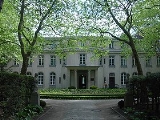
The venue for the rescheduled conference was changed to a villa at 56–58 Am Grossen Wannsee, a quiet residential street across the from the popular Wannsee beach. The villa, built in 1914, had been purchased from Friedrich Minoux
Friedrich Minoux

Friedrich Minoux was a Germans industrialist and financier who is best known for being one of the owners of the Wannsee House, where the Wannsee Conference that would decide Final Solution at the hands of the Nazis during World War II was held in early 1942....
 in 1940 by the SS for use as a conference centre.

List of attendees

When the conference finally assembled at midday on 20 January those present were:
  • SS-Obergruppenführer Reinhard Heydrich
    Reinhard Heydrich

    Reinhard Tristan Eugen Heydrich was an Schutzstaffel-Obergruppenf?hrer und General der Polizei, chief of the RSHA and Stellvertretender Reichsprotektor of Bohemia and Moravia....
     (Chief of the RSHA
    RSHA

    The RSHA, or Reichssicherheitshauptamt , was a subordinate organization of the Schutzstaffel. The RSHA was created by Heinrich Himmler on September 22 1939 through the merger of the Sicherheitsdienst , the Gestapo , and the Kriminalpolizei ....
     and Reichsprotektor of Bohemia-Moravia), presiding
  • Dr Josef Bühler
    Josef Bühler

    Josef B?hler was state secretary and deputy governor to the Nazi-controlled General Government in Krak?w during World War II....
     (Government of the General Government
    General Government

    The General Government refers to a part of the territories of Poland under German military occupation during World War II by Nazi Germany and was an autonomous part of "Greater Germany"....
    )
  • Dr Roland Freisler
    Roland Freisler

    Roland Freisler was a prominent and notorious Nazism Germany judge. He became State Secretary of Adolf Hitler's Reich Ministry of Justice and President of the Volksgerichtshof , which was set up outside constitutional authority....
     (Reich Ministry of Justice)
  • SS-Gruppenführer Otto Hofmann
    Otto Hofmann

    Otto Hofmann was an Austrian Schutzstaffel-Gruppenf?hrer and an official of Nazi Germany's "Race and Settlement Main Office"....
     (Race and Resettlement Main Office, RuSHA)
  • SA-Oberführer Dr Gerhard Klopfer
    Gerhard Klopfer

    Gerhard Klopfer was an official of the Nazi Party and assistant to Martin Bormann in the Office of the Party Chancellery.Klopfer was born in Pisarzowice, Province of Silesia , in 1905....
     (NSDAP Chancellery)
  • Ministerialdirektor Friedrich Wilhelm Kritzinger
    Friedrich Wilhelm Kritzinger

    Dr. Friedrich Wilhelm Kritzinger was a Nazism politician. He was the deputy head of the Reich Chancellery under Hans Lammers, and was present at the Wannsee Conference as Lammers representative....
     (Reich Chancellery)
  • SS-Sturmbannführer Dr Rudolf Lange
    Rudolf Lange

    Rudolf Lange was a prominent Nazi official. He served as commander of the Sicherheitsdienst and Sicherheitspolizei in Riga, Latvia. He participated in the Wannsee Conference, and was largely responsible for implementing the extermination of Latvia's Jewish population ....
     (Deputy Commander of the SS in Latvia
    Latvia

    Latvia The Latvians are a Baltic peoples culturally related to the Estonians and Lithuanians, with the Latvian language having many similarities with Lithuanian language, but not with the Estonian language....
    )
  • Reichsamtleiter Dr Georg Leibbrandt
    Georg Leibbrandt

    Georg Leibbrandt was a scholar and politician in the Nazi Party....
     (Reich Ministry for the Occupied Eastern Territories
    Reich Ministry for the Occupied Eastern Territories

    The Reich Ministry for the Occupied Eastern Territories was created in July 1941 and headed by the Nazi theoretical expert and Baltic German, Alfred Rosenberg....
    )
  • Dr Martin Luther
    Martin Luther (diplomat)

    Martin Franz Julius Luther was an early member of the Nazi Party. He served as an advisor to Foreign Minister Joachim von Ribbentrop, first in the Dienststelle Ribbentrop , and later in the Ausw?rtiges Amt as a diplomat when von Ribbentrop replaced Konstantin von Neurath....
     (Foreign Office)
  • Gauleiter Dr Alfred Meyer
    Alfred Meyer

    Dr. Alfred Meyer was a Nazism official, achieving the rank of Staatssekret?r and Deputy Reichsminister in the Reich Ministry for the Occupied Eastern Territories ....
     (Reich Ministry for the Occupied Eastern Territories)
  • SS-Gruppenführer Heinrich Müller (Chief of Amt IV (Gestapo
    Gestapo

    The was the official secret police of Nazi Germany. Under the overall administration of the Schutzstaffel , it was administered by the Reichssicherheitshauptamt and was considered a dual organization of the Sicherheitsdienst and also a suboffice of the Sicherheitspolizei ....
    ), Reich Security Main Office (RSHA))
  • Erich Neumann
    Erich Neumann (politician)

    Erich Neumann was a Nazism politician. He was born in Forst into a Protestant family.After receiving his high school diploma, he studied law and economics at the universities in University of Freiburg, University of Leipzig and University of Halle-Wittenberg....
     (Director, Office of the Four Year Plan)
  • SS-Oberführer Dr Karl Eberhard Schöngarth
    Karl Eberhard Schöngarth

    Dr. Karl Eberhard Sch?ngarth was a Germany Nazism associated with the Holocaust during World War II.Sch?ngarth was born in Leipzig, Saxony. He became a member of the Sicherheitsdienst Intelligence Service of the Schutzstaffel in 1933....
     (SD, assigned to the General Government)
  • Dr Wilhelm Stuckart
    Wilhelm Stuckart

    Dr. Wilhelm Stuckart was a Nazi Party lawyer and official, a state secretary in the Germany Interior Ministry and later, a convicted war crimes....
     (Reich Ministry for the Interior)
  • SS-Obersturmbannführer Adolf Eichmann
    Adolf Eichmann

    Karl Adolf Eichmann , sometimes referred to as "the architect of the Holocaust", was a Nazism and Schutzstaffel-Obersturmbannf?hrer . Due to his organizational talents and ideological reliability, he was charged by Obergruppenf?hrer Reinhard Heydrich with the task of facilitating and managing the logistics of mass deportation of J...
     (Head of Referat IV B4 of the Gestapo
    Gestapo

    The was the official secret police of Nazi Germany. Under the overall administration of the Schutzstaffel , it was administered by the Reichssicherheitshauptamt and was considered a dual organization of the Sicherheitsdienst and also a suboffice of the Sicherheitspolizei ....
    ), recording secretary


In preparation for the conference, Eichmann drafted a list of the numbers of Jews in the various European countries (pictured below). Countries were listed in two groups "A" and "B". "A" countries were those under direct Reich control or occupation (or partially occupied and quiescent, in the case of France); "B" countries were allied or client states, neutral, or at war with Germany. The numbers reflect actions already completed by Nazi forces; for example, Estonia is listed as judenfrei ("free of Jews"), as the thousand Jews who remained in Estonia after the German occupation had been virtually exterminated by the end of 1941. English translation:

[List] A.

  • Old Reich
    Altreich

    Altreich is a German language term used from 1938 to 1945 for the territories that were part of the Nazi Germany in 1937, as opposed to Austria , the Sudetenland and other territories annexed by Germany in subsequent years....
     [Germany proper]: 131,800
  • Ostmark
    Ostmark

    Ostmark is a German term meaning either Eastern march when applied to territories or Eastern Mark when applied to currencies.Ostmark may refer to the following historical territories:...
     [region of the former Austria
    Austria

    Austria , officially the Republic of Austria , is a landlocked country in Central Europe. It borders both Germany and the Czech Republic to the north, Slovakia and Hungary to the east, Slovenia and Italy to the south, and Switzerland and Liechtenstein to the west....
    , incorporated in the Reich]: 43,700
  • Eastern Territories [Polish areas annexed by the Reich]: 420,000
  • General Government
    General Government

    The General Government refers to a part of the territories of Poland under German military occupation during World War II by Nazi Germany and was an autonomous part of "Greater Germany"....
     [occupied Polish lands]: 2,284,000
  • Bialystok
    Bezirk Bialystok

    Bezirk Bialystok was an administrative unit created in the aftermath of the Operation Barbarossa. It included the Bialystok, Bielsk Podlaski, Grajewo, Lomza, Sok?lka, Volkovysk, and Grodno counties, was "attached" to East Prussia....
     [district in eastern Poland, under German civil administration]: 400,000
  • Protectorate of Bohemia and Moravia
    Protectorate of Bohemia and Moravia

    The Protectorate of Bohemia and Moravia was the majority Czech people protectorate which Nazi Germany established in the central parts of Bohemia, Moravia and Czech Silesia in what is today the Czech Republic....
    : 74,200
  • Estonia
    Estonia

    Estonia , officially the Republic of Estonia is a country in the Baltic region of Northern Europe. It is bordered to the north by Finland across the Gulf of Finland, to the west by Sweden across the Baltic Sea, to the south by Latvia , and to the east by the Russia ....
    : free of Jews
  • Latvia
    Latvia

    Latvia The Latvians are a Baltic peoples culturally related to the Estonians and Lithuanians, with the Latvian language having many similarities with Lithuanian language, but not with the Estonian language....
    : 3,500
  • Lithuania
    Lithuania

    Lithuania , officially the Republic of Lithuania is a country in Northern Europe, the southernmost of the three Baltic states. Situated along the southeastern shore of the Baltic Sea, it shares borders with Latvia to the north, Belarus to the southeast, Poland, and the Russian exclave of Kaliningrad Oblast to the southwest....
    : 34,000
  • Belgium
    Belgium

    * A small German-speaking Community of Belgium exists in eastern Wallonia. Belgium's linguistic diversity and related political and cultural conflicts are reflected in the history of Belgium and a complex Communities and regions of Belgium....
    : 43,000
  • Denmark
    Denmark

    Denmark is a Scandinavian country in northern Europe and the senior member of the Kingdom of Denmark. It is the southernmost of the Nordic countries....
    : 5,600
  • France
    France

    France , officially the French Republic , is a country whose Metropolitan France is located in Western Europe and that also comprises various Overseas departments and territories of France....
    /occupied territory: 165,000
    • unoccupied territory
      Vichy France

      Vichy France, or the Vichy regime are the common terms used to describe the government of France from July 1940 to August 1944. This government, which succeeded the French Third Republic, officially called itself the French State , in contrast with the previous designation, "French Republic." Marshal of France Philippe P?tain pro...
      : 700,000
  • Greece
    Greece

    Greece , officially the Hellenic Republic , is a country in southeastern Europe, situated on the southern end of the Balkans. It has borders with Albania, Bulgaria and the former Yugoslav Republic of Macedonia to the north, and Turkey to the east....
    : 69,600
  • Netherlands
    Netherlands

    The Netherlands is a country that is part of the Kingdom of the Netherlands. It is a parliamentary democratic constitutional monarchy. The Netherlands is located in North-West Europe, and bordered by the North Sea to the north and west, Belgium to the south, and Germany to the east....
    : 160,800
  • Norway
    Norway

    Norway , officially the Kingdom of Norway, is a constitutional monarchy in Northern Europe that occupies the western portion of the Scandinavian Peninsula....
    : 1,300


[List] B.
  • Bulgaria
    Bulgaria

    The state of Bulgaria , Scientific transliteration Balgarija, officially the Republic of Bulgaria has played a significant role in the Balkans in south-eastern Europe for over fourteen centuries....
    : 48,000
  • England [i.e., United Kingdom
    United Kingdom

    The United Kingdom of Great Britain and Northern Ireland, commonly known as the United Kingdom , the UK or Britain,is a sovereign state located off the northwestern coast of continental Europe....
    ]: 330,000
  • Finland
    Finland

    Finland , officially the Republic of Finland , is a Nordic countries situated in the Fennoscandian region of northern Europe. It borders Sweden on the west, Russia on the east, and Norway on the north, while Estonia lies to its south across the Gulf of Finland....
    : 2,300
  • Ireland
    Ireland

    Ireland is the List of islands by area in Europe, and the twentieth-largest island in the world. It lies to the north-west of continental Europe and is surrounded by hundreds of islands and islet....
    : 4,000
  • Italy
    Italy

    Italy , officially the Italian Republic , is a country located on the Italian Peninsula in Southern Europe and on the two largest islands in the Mediterranean Sea, Sicily and Sardinia....
     including Sardinia
    Sardinia

    Sardinia is the Mediterranean islands#By area island in the Mediterranean Sea . The area of Sardinia is . The island is surrounded by the France island of Corsica, the Italian Peninsula, Tunisia and the Balearic Islands....
    : 58,000
  • Albania
    Albania

    Albania , officially the Republic of Albania , is a country in Balkans. It is bordered by Greece to the south-east, Montenegro to the north, Kosovo to the northeast, and the Republic of Macedonia to the east....
    : 200
  • Croatia
    Croatia

    Croatia , officially the Republic of Croatia , is a Central European country at the crossroads of Pannonian Plain, Balkans, and the Mediterranean Sea....
    : 40,000
  • Portugal
    Portugal

    Portugal , officially the Portuguese Republic , is a country on the Iberian Peninsula. Located in southwestern Europe, Portugal is the westernmost country of mainland Europe and is bordered by the Atlantic Ocean to the west and south and by Spain to the north and east....
    : 3,000
  • Romania
    Romania

    Romania is a country located in Southeastern Europe Central Europe, North of the Balkan Peninsula, on the Lower Danube, within and outside the Carpathian Mountains, bordering on the Black Sea....
     including Bessarabia
    Bessarabia

    Bessarabia is a historical term for the geographic entity in Eastern Europe bounded by the Dniester River on the east and the Prut River on the west....
    : 342,000
  • Sweden
    Sweden

    Sweden , officially the Kingdom of Sweden , is a Nordic countries on the Scandinavian Peninsula in Northern Europe. Sweden has land borders with Norway to the west and Finland to the northeast, and it is connected to Denmark by the ?resund Bridge in the south....
    : 8,000
  • Switzerland
    Switzerland

    Switzerland is a landlocked Swiss Alps country of roughly 7.7 million people in Western Europe with an area of 41,285 km?. Switzerland is a federal republic consisting of 26 states called Cantons of Switzerland....
    : 18,000
  • Serbia
    Serbia

    Serbia , officially the Republic of Serbia , is a country in Central Europe and Balkans Europe, covering the southern part of the Pannonian Plain and the central part of the Balkans....
    : 10,000
  • Slovakia
    Slovakia

    Slovakia . It was amended in September 1998 to allow direct election of the president and again in February 2001 due to EU admission requirements....
    : 88,000
  • Spain
    Spain

    Spain or the Kingdom of Spain , is a country located in Southern Europe on the Iberian Peninsula.The Spanish constitution does not establish any official denomination of the country, even though Espa?a , Estado espa?ol and Naci?n espa?ola are used interchangeably....
    : 6,000
  • Turkey
    Turkey

    Turkey , known officially as the Republic of Turkey , is a Eurasian country that stretches across the Anatolian peninsula in southwest Asia and Thrace in the Balkans region of Southern Europe....
     (European portion): 55,500
  • Hungary
    Hungary

    Hungary , officially in English the Republic of Hungary , is a landlocked country in the Carpathian Basin of Central Europe, bordered by Austria, Slovakia, Ukraine, Romania, Serbia, Croatia, and Slovenia....
    : 742,800
  • USSR: 5,000,000 [including subtotals for:]
    • Belarus
      Belarus

      Belarus is a landlocked country in Eastern Europe, bordered by Russia to the north and east, Ukraine to the south, Poland to the west, and Lithuania and Latvia to the north....
       exclusive of Bialystok: 446,484
    • Ukraine
      Ukraine

      Ukraine is a country in Eastern Europe. It is bordered by Russia to the east; Belarus to the north; Poland, Slovakia, and Hungary to the west; Romania and Moldova to the southwest; and the Black Sea and Sea of Azov to the south....
      : 2,994,684


"Total: over 11,000,000"

For comparison see "Jewish Lists" of the Korherr Report
Korherr Report

The Korherr Report, is a document on the progress of the Holocaust written by the chief inspector of the statistical bureau of the SS, Dr Richard Korherr, on instructions from Heinrich Himmler on January 18, 1943....
 of January 18, 1943.

Proceedings


Heydrich opened the conference with an account of the anti-Jewish measures taken in Germany since the Nazi seizure of power in 1933. He said that between 1933 and 1941, 530,000 German and Austrian Jews had emigrated. This information was taken from a briefing paper prepared for him the previous week by Eichmann who, after his experience in organizing the forced emigration of the Viennese Jews in 1938, had become the leading expert on the practicalities of solving the "Jewish question".

Heydrich reported that there were approximately eleven million Jews in the whole of Europe, of whom half a million were in countries not under German control. He explained that since further emigration of European Jews had been prohibited by the authorities, "another possible solution of the problem has now taken the place of emigration, i.e. the evacuation of the Jews to the East"; this would be a "provisional" solution, but "practical experience" was already being collected for the "future final solution of the Jewish question".

It has been claimed that the Wannsee Conference decided on no more than the "evacuation" of the Jewish population of Europe to the east, with no reference to killing them. In fact, Heydrich made the ultimate fate intended for the evacuees clear:

"Under proper guidance, in the course of the final solution the Jews are to be allocated for appropriate labor in the East. Able-bodied Jews, separated according to sex, will be taken in large work columns to these areas for work on roads, in the course of which action doubtless a large portion will be eliminated by natural causes. The possible final remnant will, since it will undoubtedly consist of the most resistant portion, have to be treated accordingly, because it is the product of natural selection and would, if released, act as the seed of a new Jewish revival".


No one at the meeting can have misunderstood Heydrich's meaning. The historian Christopher Browning
Christopher Browning

Christopher Robert Browning, born , is an American historian of the Holocaust....
 observes: "No less than eight of the fifteen participants held the doctorate. Thus it was not a dimwitted crowd unable to grasp what was going to be said to them. Nor were they going to be overcome with surprise or shock, for Heydrich was not talking to the uninitiated or squeamish."

Heydrich went on to say that in the course of the "practical execution of the final solution", Europe would be "combed through from west to east", but that Germany, Austria and the Protectorate of Bohemia and Moravia
Protectorate of Bohemia and Moravia

The Protectorate of Bohemia and Moravia was the majority Czech people protectorate which Nazi Germany established in the central parts of Bohemia, Moravia and Czech Silesia in what is today the Czech Republic....
 would have priority "due to the housing problem and additional social and political necessities". This was a reference to increasing pressure from the regional Nazi Party leaders in Germany, the Gauleiters, for the Jews to be removed from their areas to allow accommodation for Germans made homeless by Allied bombing, as well as for labourers being imported from occupied countries. The "evacuated" Jews, he said, would first be sent to "transit ghettos" in the General Government, from which they would be transported to the East.

Heydrich said that to avoid legal and political difficulties, it was important to define who was a Jew for the purposes of "evacuation." He outlined categories of people who would be exempted. Jews over 65 years old, and Jewish World War I
World War I

World War I, or the First World War , was a global military conflict which involved the Great powers, organized into two opposing military alliances: the Allies of World War I and the Central Powers....
 veterans alike, who had been severely wounded or who had won the Iron Cross
Iron Cross

The Iron Cross was a military decoration of the Kingdom of Prussia, and later of Germany, which was established by King Frederick William III of Prussia and first awarded on 10 March 1813 in Breslau ....
, would be sent to the "model" concentration camp at Theresienstadt
Theresienstadt concentration camp

Theresienstadt concentration camp was a Nazi concentration camp during World War II. It was established by the Gestapo in the fortress and garrison city of Terez?n , located in what is now the Czech Republic....
. "With this expedient solution", he said, "in one fell swoop many interventions will be prevented."

The situation of people who were in a racial sense half or quarter Jews, and of Jews who were married to non-Jews, was more complex. Under the Nuremberg Laws
Nuremberg Laws

The Nuremberg Laws of 1935 were laws passed in Nazi Germany. They used a pseudoscience basis to discriminate against Jewish people. The laws classified people as German if all four of their grandparents were of "German blood" , while people were classified as Jews if they descended from three or four Jewish grandparents ....
 of 1935, their status had been left deliberately ambiguous. Heydrich announced that "mischling
Mischling

File:WernerGoldberg.jpgMischling was the German term used during the Third Reich era in the German Empire to denote persons deemed to have partial Jewish ancestry....
s" (mixed-race persons) of the first degree (persons with two Jewish grandparents), would be treated as Jews. This would not apply if they were married to a non-Jew and had children by that marriage. It would also not apply if they had been granted written exemption by "the highest offices of the Party and State." Such persons would instead be sterilised.

"Mischlings of the second degree" (persons with one Jewish grandparent) would be treated as Germans unless they were married to Jews or mischlings of the first degree, or had a "racially especially undesirable appearance that marks him outwardly as a Jew", or had a "political record that shows that he feels and behaves like a Jew". Persons in these latter categories would be deported even if married to non-Jews.

In the case of mixed marriages, Heydrich advocated a policy of caution, "with regard to the effects on the German relatives". If such a marriage had produced children who were being raised as Germans, the Jewish partner would not be deported. If they were being raised as Jews, they might be deported, or sent to Theresienstadt, depending on the circumstances.

It is important to note that these exemptions applied only to German and Austrian Jews (and were not always observed even in regard to them). In most of the occupied countries, Jews were rounded up and deported en masse, and anyone who lived in or identified with the Jewish community in a given place was regarded as a Jew. One of the few exceptions to this was France
France

France , officially the French Republic , is a country whose Metropolitan France is located in Western Europe and that also comprises various Overseas departments and territories of France....
, where the Vichy French
Vichy France

Vichy France, or the Vichy regime are the common terms used to describe the government of France from July 1940 to August 1944. This government, which succeeded the French Third Republic, officially called itself the French State , in contrast with the previous designation, "French Republic." Marshal of France Philippe P?tain pro...
 regime, in exchange for ready co-operation, was able to apply its own rules, affecting mainly refugees and recent immigrants rather than French-born Jews. Heydrich commented: "In occupied and unoccupied France, the registration of Jews for evacuation will in all probability proceed without great difficulty", but in fact the great majority of French-born Jews survived. In Denmark
Denmark

Denmark is a Scandinavian country in northern Europe and the senior member of the Kingdom of Denmark. It is the southernmost of the Nordic countries....
, relatively few Jews were ultimately exterminated, due to strong opposition by the King and the populace.

More difficulty was anticipated with Germany's allies, Romania
Romania

Romania is a country located in Southeastern Europe Central Europe, North of the Balkan Peninsula, on the Lower Danube, within and outside the Carpathian Mountains, bordering on the Black Sea....
 and Hungary
Hungary

Hungary , officially in English the Republic of Hungary , is a landlocked country in the Carpathian Basin of Central Europe, bordered by Austria, Slovakia, Ukraine, Romania, Serbia, Croatia, and Slovenia....
. "In Romania the government has [now] appointed a commissioner for Jewish affairs", Heydrich said, but in fact the deportation of Romanian Jews was slow and inefficient despite the high degree of popular anti-Semitism. "In order to settle the question in Hungary", Heydrich said, "it will soon be necessary to force an adviser for Jewish questions onto the Hungarian government". The Hungarian regime of Miklós Horthy
Miklós Horthy

Mikl?s Horthy de Baia Mare was the Regent of the Kingdom of Hungary during the Hungary between the two world wars and throughout most of World War II, serving from March 1, 1920, to October 15, 1944....
 continued to resist German interference in its Jewish policy until 1944, when Horthy was overthrown and 500,000 Hungarian Jews sent to their deaths by Eichmann.

Heydrich spoke for nearly an hour. Then followed about thirty minutes of questions and comments, followed by some less formal conversation. Luther from the Foreign Office urged caution in Scandinavia, "Nordic" countries where public opinion was not hostile to the small Jewish populations and would react badly to unpleasant scenes. Hofmann and Stuckart pointed out the legalistic and administrative difficulties over mixed marriages, arguing for compulsory dissolution of marriages to prevent legal disputes and for the wider use of sterilisation as an alternative to deportation. Neumann from the Four Year Plan argued for the exemption of Jews who were working in industries vital to the war effort and for whom no replacements are available. Heydrich (keen not to offend Neumann's boss Hermann Göring) assured him that these Jews would not be "evacuated". There were questions about the mischlings and those in mixed marriages: the details of these complex questions were put off until a later meeting.

Finally Bühler of the General Government in occupied Poland stated that:
"the General Government would welcome it if the final solution of this problem could be begun in the General Government, since on the one hand transportation does not play such a large role here nor would problems of labor supply hamper this action. Jews must be removed from the territory of the General Government as quickly as possible, since it is especially here that the Jew as an epidemic carrier represents an extreme danger and on the other hand he is causing permanent chaos in the economic structure of the country through continued black market dealings.".


Omissions


The above account is based on the minutes taken by Eichmann, copies of which were sent by Eichmann to all the participants after the meeting. Most of these copies were destroyed at the end of the war as participants and other officials sought to cover their tracks. It was not until 1947 that a copy of the minutes (known from the German word for "minutes" as the "Wannsee Protocol") was found in the papers of Undersecretary Martin Luther, who had died in May 1945. By this time the more important participants in the meeting were dead or missing (Heydrich, Müller, Eichmann), and most of the others denied knowledge of the meeting or claimed that they could not remember what had occurred there. Only Kritzinger ever showed any genuine remorse for his role in preparing the Final Solution.

There were, however, significant omissions in the minutes. These were not fully elucidated until the interrogation and trial of Eichmann in Israel
Israel

Israel officially the State of Israel , is a country in the Middle East located on the eastern shore of the Mediterranean Sea. It borders Lebanon in the north, Syria in the northeast, Jordan in the east, and Egypt on the southwest, and contains geographically diverse features within its relatively small area....
 in 1962. Eichmann told his questioners that towards the end of the meeting cognac was served, and that after that the conversation became less restrained. "The gentlemen were standing together, or sitting together", he said, "and were discussing the subject quite bluntly, quite differently from the language which I had to use later in the record. During the conversation they minced no words about it at all...they spoke about methods of killing, about liquidation, about extermination".

Eichmann recorded that Heydrich was pleased with the course of the meeting. He "gave expression to his great satisfaction", and allowed himself a glass of cognac, although he rarely drank. He "had expected considerable stumbling blocks and difficulties", Eichmann recalled, but instead he had found "an atmosphere not only of agreement on the part of the participants, but more than that, one could feel an agreement which had assumed a form which had not been expected". At the conclusion of the meeting Heydrich gave Eichmann firm instructions about what was to appear in the minutes. They were not to be verbatim: Eichmann would "clean them up" so that nothing too explicit appeared in them. He said at his trial: "How shall I put it—certain over-plain talk and jargon expressions had to be rendered into office language by me". As a result, the last twenty minutes of the meeting, in which, as Eichmann recalled, words like "liquidation" and "extermination" were freely used, were summed up in one bland sentence: "In conclusion the different types of possible solutions were discussed". Thus the minutes must be read in conjunction with Eichmann's testimony to get as near as is possible to a full account of what took place.

Interpretation


The Wannsee Conference only lasted about ninety minutes, and for most of its participants it was one meeting among many in a busy week. The enormous importance which has been attached to the conference by postwar writers was not evident to most of its participants at the time. The Wannsee Conference made no fundamental decisions about the extermination of the Jews. Such decisions, as everybody at the meeting understood, were made by Hitler, in consultation, if he chose, with senior colleagues such as Himmler and Göring, and not by officials. They knew that in this case the decision had already been made, and that Heydrich was there as Himmler's emissary to tell them about it. Nor did the conference engage in detailed logistical planning. It could hardly do so in the absence of a representative of the Transport Ministry or the German Railways.

What, then, was the purpose of the meeting? Eichmann's biographer David Cesarani
David Cesarani

David Cesarani is an England historian who specialises in Jewish history, especially the Holocaust. He has also written several biographies, notably Arthur Koestler: The Homeless Mind....
 says that Heydrich's main purpose was to impose his own authority on the various ministries and agencies involved in Jewish policy matters, to avoid any repetition of the disputes that had arisen over the killing of the German Jews at Riga in October. "The simplest, most decisive way that Heydrich could ensure the smooth flow of deportations", he writes, "was by asserting his total control over fate of the Jews in the Reich and the east, and [by] cow[ing] other interested parties into toeing the line of the RSHA". This would explain why most of the meeting was taken up with a long speech by Heydrich, the contents of which would not have been news to most of those present, and why so little time was spent discussing practical questions. It was also important to obtain the consent of the Foreign Ministry and the Four Year Plan, the ministries most likely to object (on diplomatic and economic grounds) to the mass killing of the Jews.

The leading German historian Peter Longerich
Peter Longerich

Professor Peter Longerich is a German history.In 2002-03, Professor Longerich was the third holder of the Visiting Chair at the Fritz Bauer Institute in Frankfurt....
 agrees, but suggests a second motive: to make all the leading ministries accomplices in Heydrich's plan.

"From Heydrich’s point of view," he writes, "the main purposes of the conference were, firstly, to establish the overall control of the deportation programme by the RSHA over a number of important Reich authorities and thereby, secondly, to make the top representatives of the ministerial bureaucracy into accomplices and accessories to, and co-responsible for, the plan he was pursuing. To reiterate: the plan was to exile all Jews in the present and future areas under German rule to Eastern Europe, where they were to be exposed to extraordinarily harsh living conditions and fatally exhausted or murdered. Heydrich had pursued this deportation plan since the beginning of 1941; in July 1941, Göring had given him the authority to execute it; and with the first deportation of Jews from central Europe in October, the first stage in that pan-European design had been realized. With his first invitation to the conference, Heydrich had waited until the second wave of deportations to Riga, Minsk and Kovno had already begun. He clearly wanted to present the representatives of the supreme Reich authorities with a fait accompli".


Fates of the attendees


In order of death
  • Reinhard Heydrich
    Reinhard Heydrich

    Reinhard Tristan Eugen Heydrich was an Schutzstaffel-Obergruppenf?hrer und General der Polizei, chief of the RSHA and Stellvertretender Reichsprotektor of Bohemia and Moravia....
     died in Prague on 4 June 1942 as a result of injuries sustained during a May 27 attack
    Operation Anthropoid

    Operation Anthropoid was the code name for the assassination of top Nazi Germany leader Reinhard Heydrich. He was the chief of the RSHA , the acting Protector of Protectorate of Bohemia and Moravia, and a chief planner of the Final Solution, the Nazi Germany programme for the genocide of the Jews of Europe....
     by Czech (and Slovak) resistance fighters parachuted in from England
    England

    native_name =|conventional_long_name = England|common_name = England|image_flag = Flag of England.svg|image_coat = England COA.svg|symbol_type = Royal Coat of Arms...
    .
  • Roland Freisler
    Roland Freisler

    Roland Freisler was a prominent and notorious Nazism Germany judge. He became State Secretary of Adolf Hitler's Reich Ministry of Justice and President of the Volksgerichtshof , which was set up outside constitutional authority....
     was killed in a USAAF
    United States Army Air Forces

    The United States Army Air Forces was the military aviation arm of the United States of America during and immediately after World War II. The direct precursor to the United States Air Force, its peak size was over 2.4 million men and women in service and nearly 80,000 aircraft in 1944, and 783 domestic bases in December 1943....
     air-raid in Berlin
    Berlin

    Berlin is the Capital of Germany city and one of sixteen States of Germany of Germany. With a population of 3.4 million within its city limits, Berlin is the country's largest city....
     in February 1945.
  • Rudolf Lange
    Rudolf Lange

    Rudolf Lange was a prominent Nazi official. He served as commander of the Sicherheitsdienst and Sicherheitspolizei in Riga, Latvia. He participated in the Wannsee Conference, and was largely responsible for implementing the extermination of Latvia's Jewish population ....
     was killed in action in Poland
    Poland

    Poland , officially the Republic of Poland , is a country in Central Europe. Poland is bordered by Germany to the west; the Czech Republic and Slovakia to the south; Ukraine, Belarus and Lithuania to the east; and the Baltic Sea and Kaliningrad Oblast, a Russian Enclave and exclave, to the north....
     in February 1945.
  • Alfred Meyer
    Alfred Meyer

    Dr. Alfred Meyer was a Nazism official, achieving the rank of Staatssekret?r and Deputy Reichsminister in the Reich Ministry for the Occupied Eastern Territories ....
     killed himself in April 1945.
  • Heinrich Müller was last seen in Berlin
    Berlin

    Berlin is the Capital of Germany city and one of sixteen States of Germany of Germany. With a population of 3.4 million within its city limits, Berlin is the country's largest city....
     on 29 April 1945. His fate is unknown, but he probably died in Berlin in the next few days.
  • Martin Luther
    Martin Luther (diplomat)

    Martin Franz Julius Luther was an early member of the Nazi Party. He served as an advisor to Foreign Minister Joachim von Ribbentrop, first in the Dienststelle Ribbentrop , and later in the Ausw?rtiges Amt as a diplomat when von Ribbentrop replaced Konstantin von Neurath....
     finished the war in a German concentration camp after falling out with Foreign Minister Joachim von Ribbentrop
    Joachim von Ribbentrop

    Ulrich Friedrich Wilhelm Joachim von Ribbentrop was Foreign Minister of Germany from 1938 until 1945. He was later hanging for war crimes after the Nuremberg Trials....
     in 1943. After being freed by the Soviets, Luther died in Berlin in May 1945.
  • Karl Eberhard Schöngarth
    Karl Eberhard Schöngarth

    Dr. Karl Eberhard Sch?ngarth was a Germany Nazism associated with the Holocaust during World War II.Sch?ngarth was born in Leipzig, Saxony. He became a member of the Sicherheitsdienst Intelligence Service of the Schutzstaffel in 1933....
     was executed for war crimes (killing British prisoners of war) in May 1946.
  • Friedrich Wilhelm Kritzinger
    Friedrich Wilhelm Kritzinger

    Dr. Friedrich Wilhelm Kritzinger was a Nazism politician. He was the deputy head of the Reich Chancellery under Hans Lammers, and was present at the Wannsee Conference as Lammers representative....
     was acquitted of war crimes and died in October 1947.
  • Josef Bühler
    Josef Bühler

    Josef B?hler was state secretary and deputy governor to the Nazi-controlled General Government in Krak?w during World War II....
     was tried in Poland for war crimes and executed in Kraków
    Kraków

    Krak?w , in English also spelled Krakow or Cracow , is one of the largest and oldest cities in Poland, with a population of 756,336 in 2007 ....
     in July 1948.
  • Erich Neumann
    Erich Neumann (politician)

    Erich Neumann was a Nazism politician. He was born in Forst into a Protestant family.After receiving his high school diploma, he studied law and economics at the universities in University of Freiburg, University of Leipzig and University of Halle-Wittenberg....
     was briefly imprisoned and died in mid-1948.
  • Wilhelm Stuckart
    Wilhelm Stuckart

    Dr. Wilhelm Stuckart was a Nazi Party lawyer and official, a state secretary in the Germany Interior Ministry and later, a convicted war crimes....
     was imprisoned for four years before being released for lack of evidence in 1949. He was killed in a car accident in November, 1953.
  • Adolf Eichmann
    Adolf Eichmann

    Karl Adolf Eichmann , sometimes referred to as "the architect of the Holocaust", was a Nazism and Schutzstaffel-Obersturmbannf?hrer . Due to his organizational talents and ideological reliability, he was charged by Obergruppenf?hrer Reinhard Heydrich with the task of facilitating and managing the logistics of mass deportation of J...
     was executed in Israel
    Israel

    Israel officially the State of Israel , is a country in the Middle East located on the eastern shore of the Mediterranean Sea. It borders Lebanon in the north, Syria in the northeast, Jordan in the east, and Egypt on the southwest, and contains geographically diverse features within its relatively small area....
     in May 1962.
  • Georg Leibbrandt
    Georg Leibbrandt

    Georg Leibbrandt was a scholar and politician in the Nazi Party....
     was charged with war crimes but the case against him was dismissed in 1950. He died in June 1982.
  • Otto Hofmann
    Otto Hofmann

    Otto Hofmann was an Austrian Schutzstaffel-Gruppenf?hrer and an official of Nazi Germany's "Race and Settlement Main Office"....
     was sentenced to 25 years in prison for war crimes, but was pardoned in 1954. He died in December 1982.
  • Gerhard Klopfer
    Gerhard Klopfer

    Gerhard Klopfer was an official of the Nazi Party and assistant to Martin Bormann in the Office of the Party Chancellery.Klopfer was born in Pisarzowice, Province of Silesia , in 1905....
     was charged with war crimes but was released for lack of evidence. He became a tax advisor, later dying in January 1987.


Wannsee House Holocaust Memorial

In 1965, historian Joseph Wulf
Joseph Wulf

Joseph Wulf was a German-Polish-Jewish historian and Holocaust survivor....
 tried to have the Wannse House made into a Holocaust memorial and document center. But the Berlin Senate did not want Holocaust Memorials and spurned Joseph Wulf. In his last letter to his son David, 2 August 1974, Wulf wrote, "I have published 18 books about the Third Reich and they have had no effect. You can document everything to death for the Germans. There is a democratic regime in Bonn. Yet the mass murderers walk around free, live in their little houses, and grow flowers." Deeply despondent over the death of his wife and the collapse of his plans for a document center, Wulf committed suicide, age 61, by jumping from the fifth floor window of his Berlin apartment, Giesebrechtstraße 12, Charlottenburg. In 1992 the Wannsee House became a Holocaust memorial. The Joseph Wulf Bibliothek/Mediothek on the second floor holds thousands of books on Nazism, anti-Semitism, and the Jewish genocide, along with many videos, microfilm texts, and original Nazi era documents. Wulf’s last letter is on display in Berlin’s Jewish Museum.

Dramatization

The events of the Conference have been dramatized in two films.
  • The 1984 German television film Wannseekonferenz (The Wannsee Conference) runs 85 minutes—exactly the length of the conference itself, with a script derived from the minutes of the meeting.
  • In 2001 the BBC/HBO film Conspiracy starred Kenneth Branagh
    Kenneth Branagh

    Kenneth Charles Branagh is an Emmy Award-winning, Academy Award-nominated actor and film director from Northern Ireland....
     as Heydrich and Stanley Tucci
    Stanley Tucci

    Stanley Tucci, Jr. is an American Golden Globe- and Emmy Award-winning, Screen Actors Guild- and Tony Award-nominated actor, writer, film producer and film director....
     as Eichmann and was also scripted according to the exact timeframe and minutes of the original meeting.


The Wannsee conference is central to the plot of the alternate-historical novel Fatherland by Robert Harris.

See also

  • Reich Chancellery meeting of 12 December 1941


External links

  • (in German)
  • (in German with Japanese subtitles)
  • , archived by the Progressive Review
    Progressive Review

    The Progressive Review, or ProRev, is an American online alternative publication that started in 1964 as the Idler newspaper. Sam Smith , the editor, starting publishing online in 1995, and in 2004 Smith stopped publishing the Progressive Review in a hard copy edition....