

South West Africa

Encyclopedia
South-West Africa was the name that was used for the modern day Republic of Namibia
during the earlier eras when the territory was controlled by the German Empire
and later by South Africa
.
from 1884 it was known as German South-West Africa
(Deutsch-Südwestafrika). Germany had a difficult time administering the territory, which, owing to the Germans' native policy, experienced many insurrections, especially those led by guerilla leader Jacob Morenga. The main port, Walvis Bay
, and the Penguin islands had been annexed by Britain
as part of the Cape Colony
in 1878, and became part of the Union of South Africa
in 1910.
As part of the Heligoland-Zanzibar Treaty
in 1890, a corridor of land taken from the northern border of Bechuanaland, extending as far as the Zambezi river, was added to the colony. It was named the Caprivi Strip
(Caprivizipfel) after the German Chancellor Leo von Caprivi
.
During 1915 the region was taken from German control in the South-West Africa Campaign
of the First World War. After the war it was declared a League of Nations
Mandate territory
under the Treaty of Versailles
, with the Union of South Africa
responsible for the administration of South-West Africa, including Walvis Bay.
following the Second World War. The Union of South Africa
objected to South-West Africa coming under UN control and refused to allow the territory's transition to independence, regarding it as a fifth province (even though it was never formally incorporated into South Africa).
, which in 1950 ruled that South Africa was not obliged to convert South-West Africa into a UN trust territory, but was still bound by the League of Nations Mandate with the United Nations General Assembly
assuming the supervisory role. The ICJ also clarified that the General Assembly was empowered to receive petitions from the inhabitants of South-West Africa and to call for reports from the mandatory nation, South Africa. The General Assembly constituted the Committee on South-West Africa to perform the supervisory functions. In another advisory opinion issued in 1955, the Court further ruled that the General Assembly was not required to follow League of Nations voting procedures in determining questions concerning South-West Africa. In 1956, the Court further ruled that the Committee had the power to grant hearings to petitioners from the mandated territory. In 1960, Ethiopia
and Liberia
filed a case in the International Court of Justice
against South Africa alleging that South Africa had not fulfilled its mandatory duties. This case did not succeed, with the Court ruling in 1966 that they were not the proper parties to bring the case.
In 1966, the General Assembly passed resolution 2145 (XXI) which declared the Mandate terminated and that the Republic of South Africa had no further right to administer South-West Africa. In 1971, acting on a request for an advisory opinion from the United Nations Security Council
, the ICJ ruled that the continued presence of South Africa in Namibia was illegal and that South Africa was under an obligation to withdraw from Namibia immediately. It also ruled that all member states of the United Nations were under an obligation not to recognize as valid any act performed by South Africa on behalf of Namibia.
South-West Africa became known internationally as Namibia when the UN General Assembly changed the territory's name by Resolution 2372 (XXII) of 12 June 1968. SWAPO was recognized as representative of the Namibia
n people and gained UN observer status when the territory of South West Africa
was already removed from the list of Non-Self-Governing Territories.
The territory became the independent Republic of Namibia on 21 March 1990, although Walvis Bay
became part of Namibia only in 1994.
s in South-West Africa in the late 1960s and early 70s in accordance with the Odendaal Commission, three of which were granted self-rule. These bantustans were replaced with separate ethnicity based governments in 1980.
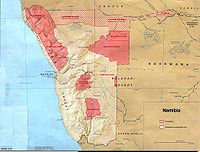 The bantustans were:
Namibia
Namibia, officially the Republic of Namibia , is a country in southern Africa whose western border is the Atlantic Ocean. It shares land borders with Angola and Zambia to the north, Botswana to the east and South Africa to the south and east. It gained independence from South Africa on 21 March...
during the earlier eras when the territory was controlled by the German Empire
German Empire
The German Empire refers to Germany during the "Second Reich" period from the unification of Germany and proclamation of Wilhelm I as German Emperor on 18 January 1871, to 1918, when it became a federal republic after defeat in World War I and the abdication of the Emperor, Wilhelm II.The German...
and later by South Africa
South Africa
The Republic of South Africa is a country in southern Africa. Located at the southern tip of Africa, it is divided into nine provinces, with of coastline on the Atlantic and Indian oceans...
.
German colony
As a German colonyGerman colonial empire
The German colonial empire was an overseas domain formed in the late 19th century as part of the German Empire. Short-lived colonial efforts by individual German states had occurred in preceding centuries, but Imperial Germany's colonial efforts began in 1884...
from 1884 it was known as German South-West Africa
German South-West Africa
German South West Africa was a colony of Germany from 1884 until 1915, when it was taken over by South Africa and administered as South West Africa, finally becoming Namibia in 1990...
(Deutsch-Südwestafrika). Germany had a difficult time administering the territory, which, owing to the Germans' native policy, experienced many insurrections, especially those led by guerilla leader Jacob Morenga. The main port, Walvis Bay
Walvis Bay
Walvis Bay , is a city in Namibia and the name of the bay on which it lies...
, and the Penguin islands had been annexed by Britain
United Kingdom
The United Kingdom of Great Britain and Northern IrelandIn the United Kingdom and Dependencies, other languages have been officially recognised as legitimate autochthonous languages under the European Charter for Regional or Minority Languages...
as part of the Cape Colony
Cape Colony
The Cape Colony, part of modern South Africa, was established by the Dutch East India Company in 1652, with the founding of Cape Town. It was subsequently occupied by the British in 1795 when the Netherlands were occupied by revolutionary France, so that the French revolutionaries could not take...
in 1878, and became part of the Union of South Africa
Union of South Africa
The Union of South Africa is the historic predecessor to the present-day Republic of South Africa. It came into being on 31 May 1910 with the unification of the previously separate colonies of the Cape, Natal, Transvaal and the Orange Free State...
in 1910.
As part of the Heligoland-Zanzibar Treaty
Heligoland-Zanzibar Treaty
The Heligoland-Zanzibar Treaty of 1 July 1890 was an agreement between the United Kingdom and the German Empire concerning mainly territorial interests in Africa.-Terms:...
in 1890, a corridor of land taken from the northern border of Bechuanaland, extending as far as the Zambezi river, was added to the colony. It was named the Caprivi Strip
Caprivi Strip
Caprivi, sometimes called the Caprivi Strip , Caprivi Panhandle or the Okavango Strip and formally known as Itenge, is a narrow protrusion of Namibia eastwards about , between Botswana to the south, Angola and Zambia to the north, and Okavango Region to the west. Caprivi is bordered by the...
(Caprivizipfel) after the German Chancellor Leo von Caprivi
Leo von Caprivi
Georg Leo Graf von Caprivi de Caprera de Montecuccoli was a German major general and statesman, who succeeded Otto von Bismarck as Chancellor of Germany...
.
During 1915 the region was taken from German control in the South-West Africa Campaign
South-West Africa Campaign
The South-West Africa Campaign was the conquest and occupation of German South West Africa, now called Namibia, by forces from the Union of South Africa acting on behalf of the British Imperial Government at the beginning of the First World War.-Background:...
of the First World War. After the war it was declared a League of Nations
League of Nations
The League of Nations was an intergovernmental organization founded as a result of the Paris Peace Conference that ended the First World War. It was the first permanent international organization whose principal mission was to maintain world peace...
Mandate territory
League of Nations mandate
A League of Nations mandate was a legal status for certain territories transferred from the control of one country to another following World War I, or the legal instruments that contained the internationally agreed-upon terms for administering the territory on behalf of the League...
under the Treaty of Versailles
Treaty of Versailles
The Treaty of Versailles was one of the peace treaties at the end of World War I. It ended the state of war between Germany and the Allied Powers. It was signed on 28 June 1919, exactly five years after the assassination of Archduke Franz Ferdinand. The other Central Powers on the German side of...
, with the Union of South Africa
Union of South Africa
The Union of South Africa is the historic predecessor to the present-day Republic of South Africa. It came into being on 31 May 1910 with the unification of the previously separate colonies of the Cape, Natal, Transvaal and the Orange Free State...
responsible for the administration of South-West Africa, including Walvis Bay.
UN trust territory
The Mandate was supposed to become a United Nations Trust Territory when League of Nations Mandates were transferred to the United NationsUnited Nations
The United Nations is an international organization whose stated aims are facilitating cooperation in international law, international security, economic development, social progress, human rights, and achievement of world peace...
following the Second World War. The Union of South Africa
Union of South Africa
The Union of South Africa is the historic predecessor to the present-day Republic of South Africa. It came into being on 31 May 1910 with the unification of the previously separate colonies of the Cape, Natal, Transvaal and the Orange Free State...
objected to South-West Africa coming under UN control and refused to allow the territory's transition to independence, regarding it as a fifth province (even though it was never formally incorporated into South Africa).
International law
These South African actions gave rise to several rulings at the International Court of JusticeInternational Court of Justice
The International Court of Justice is the primary judicial organ of the United Nations. It is based in the Peace Palace in The Hague, Netherlands...
, which in 1950 ruled that South Africa was not obliged to convert South-West Africa into a UN trust territory, but was still bound by the League of Nations Mandate with the United Nations General Assembly
United Nations General Assembly
For two articles dealing with membership in the General Assembly, see:* General Assembly members* General Assembly observersThe United Nations General Assembly is one of the five principal organs of the United Nations and the only one in which all member nations have equal representation...
assuming the supervisory role. The ICJ also clarified that the General Assembly was empowered to receive petitions from the inhabitants of South-West Africa and to call for reports from the mandatory nation, South Africa. The General Assembly constituted the Committee on South-West Africa to perform the supervisory functions. In another advisory opinion issued in 1955, the Court further ruled that the General Assembly was not required to follow League of Nations voting procedures in determining questions concerning South-West Africa. In 1956, the Court further ruled that the Committee had the power to grant hearings to petitioners from the mandated territory. In 1960, Ethiopia
Ethiopia
Ethiopia , officially known as the Federal Democratic Republic of Ethiopia, is a country located in the Horn of Africa. It is the second-most populous nation in Africa, with over 82 million inhabitants, and the tenth-largest by area, occupying 1,100,000 km2...
and Liberia
Liberia
Liberia , officially the Republic of Liberia, is a country in West Africa. It is bordered by Sierra Leone on the west, Guinea on the north and Côte d'Ivoire on the east. Liberia's coastline is composed of mostly mangrove forests while the more sparsely populated inland consists of forests that open...
filed a case in the International Court of Justice
International Court of Justice
The International Court of Justice is the primary judicial organ of the United Nations. It is based in the Peace Palace in The Hague, Netherlands...
against South Africa alleging that South Africa had not fulfilled its mandatory duties. This case did not succeed, with the Court ruling in 1966 that they were not the proper parties to bring the case.
Mandate terminated
There was a protracted struggle between South Africa and forces fighting for independence, particularly after the formation of the South West Africa People's Organisation (SWAPO) in 1960.In 1966, the General Assembly passed resolution 2145 (XXI) which declared the Mandate terminated and that the Republic of South Africa had no further right to administer South-West Africa. In 1971, acting on a request for an advisory opinion from the United Nations Security Council
United Nations Security Council
The United Nations Security Council is one of the principal organs of the United Nations and is charged with the maintenance of international peace and security. Its powers, outlined in the United Nations Charter, include the establishment of peacekeeping operations, the establishment of...
, the ICJ ruled that the continued presence of South Africa in Namibia was illegal and that South Africa was under an obligation to withdraw from Namibia immediately. It also ruled that all member states of the United Nations were under an obligation not to recognize as valid any act performed by South Africa on behalf of Namibia.
South-West Africa became known internationally as Namibia when the UN General Assembly changed the territory's name by Resolution 2372 (XXII) of 12 June 1968. SWAPO was recognized as representative of the Namibia
Namibia
Namibia, officially the Republic of Namibia , is a country in southern Africa whose western border is the Atlantic Ocean. It shares land borders with Angola and Zambia to the north, Botswana to the east and South Africa to the south and east. It gained independence from South Africa on 21 March...
n people and gained UN observer status when the territory of South West Africa
South West Africa
South-West Africa was the name that was used for the modern day Republic of Namibia during the earlier eras when the territory was controlled by the German Empire and later by South Africa....
was already removed from the list of Non-Self-Governing Territories.
The territory became the independent Republic of Namibia on 21 March 1990, although Walvis Bay
Walvis Bay
Walvis Bay , is a city in Namibia and the name of the bay on which it lies...
became part of Namibia only in 1994.
Bantustans
The South African authorities established 10 bantustanBantustan
A bantustan was a territory set aside for black inhabitants of South Africa and South West Africa , as part of the policy of apartheid...
s in South-West Africa in the late 1960s and early 70s in accordance with the Odendaal Commission, three of which were granted self-rule. These bantustans were replaced with separate ethnicity based governments in 1980.
- Basterland
- BushmanlandBushmanlandBushmanland is a name applied to two different territories; one in Namibia and one in South Africa. Though they have points of resemblance, they do not adjoin....
- DamaralandDamaralandDamaraland was a name given to the north-central part of what later became Namibia, inhabited by the Damaras. It was bounded roughly by Ovamboland in the north, the Namib Desert in the west, the Kalahari Desert in the east, and Windhoek in the south....
- East CapriviEast CapriviEast Caprivi was a bantustan in South West Africa , intended by the apartheid government to be a self-governing homeland for the Lozi people. It was set up in 1972 and self-government was granted in 1976...
(self rule 1976) - HererolandHererolandHereroland was a bantustan in South West Africa , intended by the apartheid government to be a self-governing homeland for the Herero people. It was set up in 1968 and self-government was granted two years later....
(self-rule 1970) - KaokolandKaokolandKaokoland is an area in Northern Namibia, in the Kunene Region. It is one of the wildest and less populated areas in Namibia, with a population density of one person every 2 km², that is 1/4 of the national average. The most represented ethnic group is the Himba people, that accounts for...
- KavangolandKavangolandKavangoland was a bantustan in South West Africa , intended by the apartheid government to be a self-governing homeland for the Kavango people...
(self-rule 1973) - NamalandNamalandNamaland was a bantustan in South West Africa , intended by the apartheid government to be a self-governing homeland for the Nama people. A centrally administered local government was created in 1980....
- OvambolandOvambolandOvamboland was the name given by English-speaking visitors to the land occupied by the Ovambo people in what is now northern Namibia and southern Angola...
- TswanalandTswanalandTswanaland was a bantustan in South West Africa , intended by the apartheid government to be a self-governing homeland for the Tswana people...
See also
- List of colonial heads of Namibia (South-West Africa)
- History of NamibiaHistory of NamibiaThe history of Namibia has passed through several distinct stages from being colonised in the late nineteenth century to Namibia's independence on 21 March 1990....
- South West Africa People's Organization (SWAPO)
- South West African Territorial Force (SWATF)
- South West African Police (SWAPOL)