


Avro Lancaster

Encyclopedia
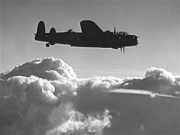
The Avro Lancaster is a British
four-engined Second World War
heavy bomber
made initially by Avro
for the Royal Air Force
(RAF). It first saw active service in 1942, and together with the Handley Page Halifax
it was one of the main heavy bomber
s of the RAF, the RCAF
, and squadrons from other Commonwealth
and Europe
an countries serving within RAF Bomber Command
.
The "Lanc", as it was affectionately known, became the most famous and most successful of the Second World War night bombers, "delivering 608,612 tons of bombs in 156,000 sorties." Although the Lancaster was primarily a night bomber, it excelled in many other roles including daylight precision bombing, and gained worldwide renown as the "Dam Buster" used in the 1943 Operation Chastise
raids on Germany's Ruhr Valley
dams.
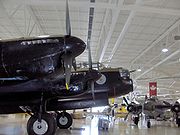
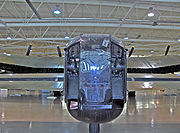
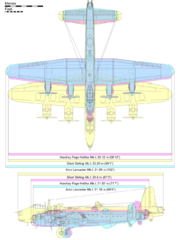 The origins of the Lancaster stem from a twin-engined bomber design submitted to meet Specification P.13/36, which was for a new generation of twin-engined medium bomber
s for "worldwide use", the engine specified as the Rolls-Royce Vulture
. The resulting aircraft was the Manchester
, which, although a capable aircraft, was troubled by the unreliability of the Vulture engine. Only 200 Manchesters were built and they were withdrawn from service in 1942.
Avro
's chief designer, Roy Chadwick
, was already working on an improved Manchester design using four of the more reliable but less powerful Rolls-Royce Merlin
engines on a larger wing. The aircraft was initially designated Avro Type 683 Manchester III, and later re-named the Lancaster
. The prototype aircraft BT308
was assembled by Avro's experimental flight department at Manchester
's Ringway Airport from where test pilot H.A. "Bill" Thorn took the controls for its first flight on Thursday, 9 January 1941. The aircraft proved to be a great improvement on its predecessor, being "one of the few warplanes in history to be 'right' from the start." Its initial three-finned tail layout, a result of the design being adapted from the Manchester I, was quickly changed on the second prototype DG595 and subsequent production aircraft to the familiar twin-finned specification also used on the later Manchesters (below).
Some of the later orders for Manchesters were changed in favour of Lancasters; the designs were very similar and both featured the same distinctive greenhouse cockpit, turret nose, and twin tail
. The Lancaster discarded the stubby central third tail fin of the early Manchesters and used the wider span tailplane
and larger elliptical twin fins from the later Manchester IA.
The Lancaster is a mid-wing cantilever monoplane
with an oval all-metal fuselage. The wing was constructed in five main sections, the fuselage in five sections. All wing and fuselage sections were built separately and fitted with all the required equipment before final assembly. The tail unit had twin oval fins and rudder
s. The Lancaster was initially powered by four wing-mounted Rolls-Royce Merlin
piston engines with three-bladed airscrews. It had retractable main landing gear and fixed tail-wheel, with the hydraulically operated main landing gear raising rearwards into the inner engine nacelles.
The majority of Lancasters built during the war years were manufactured by Avro
at their factory at Chadderton
near Oldham
, Lancashire
, and test flown from Woodford Aerodrome in Cheshire
. Other Lancasters were built by Metropolitan-Vickers
(1080, also tested at Woodford), and Armstrong Whitworth
. The aircraft was also produced at the Austin Motor Company
works in Longbridge
, Birmingham
, later in the Second World War and postwar by Vickers-Armstrongs at Chester
as well as at the Vickers Armstrong factory, Castle Bromwich, Birmingham. Only 300 of the Lancaster B II fitted with Bristol Hercules
engines were constructed; this was a stopgap modification caused by a shortage of Merlin engines as fighter production was of higher priority. Many BIIs were lost after running out of fuel. The Lancaster B III had Packard
Merlin
engines but was otherwise identical to contemporary B Is, with 3,030 B IIIs built, almost all at A.V. Roe's Newton Heath
factory. The B I and B III were built concurrently, and minor modifications were made to both marks as new batches were ordered. Examples of these modifications were the relocation of the pitot head
from the nose to the side of the cockpit, and the change from de Havilland
"needle blade" propellers to Hamilton Standard
or Nash Kelvinator
made "paddle blade" propellers.
Of later variants, only the Canadian-built Lancaster B X, manufactured by Victory Aircraft
in Malton, Ontario
, was produced in significant numbers. A total of 430 of this type were built, earlier examples differing little from their British-built predecessors, except for using Packard
-built Merlin engines and American-style instrumentation and electrics. Late-series models replaced the Frazer Nash
mid-upper turret with a differently configured Martin turret, mounted slightly further forward for weight balance. A total of 7,377 Lancasters of all marks were built throughout the duration of the war, each at a 1943 cost of £45-50,000 (approximately £-£ today).
had two positions to man. His primary location was lying prone on the floor of the nose of the aircraft, with access to the controls for the bombsight
head in front, with the bombsight computer
on his left and bomb release selectors on the right. He would also use his view out of the large transparent perspex nose cupola to assist the navigator with map reading. To man the Frazer Nash FN5 nose turret, he simply had to stand up and he would be in position behind the triggers of his twin .303 in (7.7 mm) guns. The bomb aimer's position contained the nose parachute exit in the floor.
Moving back, on the roof of the bomb bay
the pilot and flight engineer
sat side-by-side under the expansive canopy, with the pilot sitting on the left on a raised portion of the floor. The flight engineer sat on a collapsible seat (known as a "second dicky seat") to the pilot's right, with the fuel selectors and gauges on a panel behind him and to his right.
Behind these crew members, and behind a curtain fitted to allow him to use light to work, sat the navigator
. His position faced to port with a large chart table in front of him. An instrument panel showing the airspeed, altitude, and other details required for navigation was mounted on the side of the fuselage above the chart table.
The radios for the wireless
operator were mounted on the left-hand end of the chart table, facing towards the rear of the aircraft. Behind these radios, facing forwards, on a seat at the front of the main spar sat the wireless operator. To his left was a window, and above him was the astrodome
, used for visual signalling and also by the navigator for celestial navigation
.
Behind the wireless operator were the two spars
for the wing, which created a major obstacle for crew members moving down the fuselage even on the ground. On reaching the end of the bomb bay the floor dropped down to the bottom of the fuselage, and the mid upper gunner's Frazer Nash FN50 or FN150 turret was reached. His position allowed a 360° view over the top of the aircraft, with two .303 in (7.7 mm)
M1919 Browning machine gun
s to protect the aircraft from above and to the side. The mid-upper gunner had perhaps the most uncomfortable ride of all the crew, as he was seated on a rectangle of canvas that was slung beneath the turret once the gunner had occupied his position. He could be required to occupy this seat for up to eight hours at a time.
To the rear of the turret was the side crew door, on the starboard side of the fuselage. This was the main entrance to the aircraft, and also could be used as a parachute exit. Right at the tail-end of the fuselage, over the spars for the tailplane, the rear gunner sat in his exposed position in the FN20, FN120 or Rose Rice turret, which was entered through a small hatch in the rear of the fuselage. Depending on the size of the rear gunner, the area was so cramped that the gunner would often hang his parachute on a hook inside the fuselage, near the turret doors. In the FN20 and FN120 turrets, he had four .303 in (7.7 mm) Brownings, and in the Rose Rice turret he had two .50 in (12.7 mm) Brownings. Neither the mid upper nor the rear gunner's position was heated, and the gunners had to wear electrically heated suits to prevent hypothermia
and frostbite
. Many rear gunners insisted on having the centre section of perspex
removed from the turret to give a completely unobstructed view.
s were the most common Lancaster armament, twin .50 in (12.7 mm) turrets were later available in both the tail and dorsal positions. A Nash & Thomson
FN-64 periscope-sighted twin .303 in machine gun ventral turret was fitted to early aircraft, but fitting was soon discontinued and the turret often removed as it was hard to sight, especially at night. (Similar problems afflicted the ventral turret in the North American B-25
C and other bombers).
When the threat of attacks from below
began to be appreciated in the winter of 1943/1944, modifications were made, including downward observation blisters mounted behind the bomb aimer's blister and official and unofficial mounts for .50 in (12.7 mm) machine guns or even 20 mm cannon, firing through ventral holes of various designs. The fitting of these guns was hampered as the same ventral position was used for mounting the H2S blister.
bay, which was 33 ft (10.05 m) long.
Initially, the heaviest bombs carried were 4,000 lb (1,820 kg) "Cookies"
. Bulged doors were added to 30% of B-MkIs to allow the aircraft to carry 8000 lb (3,628.7 kg) and later 12,000 lb (5,450 kg) "Cookies". Towards the end of the war, attacking special and hardened targets, the B I Specials could carry the 21 ft (6.4 m) long 12,000 lb (5,450 kg) "Tallboy
" or 25.5 ft (7.77 m) long 22,000 lb (9,980 kg) "Grand Slam
" "earthquake" bombs: the Lancaster was able to deliver the heaviest bombs made. To carry the "Grand Slam" extensive modifications to the aircraft were required which led to them being named B I (Specials). The modifications included removal of the mid-upper turret, two guns from the rear turret, removal of all of the cockpit armour plating and installation of Rolls-Royce Merlin Mk 24 Engines which had better take-off performance. The bomb-bay doors were removed and the rear end of the bomb bay cut away to clear the tail of the bomb. Later the nose turret was also removed to further improve performance.
Bombsights used on Lancasters included:
Mark IX Course Setting Bomb Sight
(CSBS).
Mark XIV bombsight
T1 bombsight
Stabilizing Automatic Bomb Sight
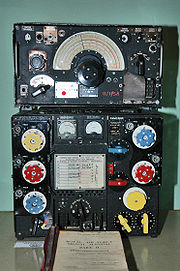 The Lancaster had a very advanced communications system for its time. Most British-built Lancasters were fitted with the R1155
receiver and T1154 transmitter, whereas the Canadian built aircraft and those built for service in the Far East had American radios. These provided radio direction-finding, as well as voice and Morse
capabilities.
H2S
Fishpond
Monica
GEE
Boozer (radar detector)
Oboe
GEE-H
Village Inn
Airborne Cigar (ABC)
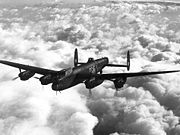
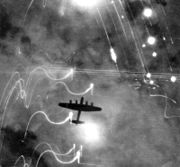
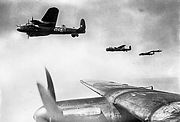 The first RAF squadron to convert to the Lancaster was No. 44 Squadron RAF
in early 1942.
Lancasters flew 156,000 sorties and dropped 608,612 long tons (618,378 tonnes) of bomb
s between 1942 and 1945. Just 35 Lancasters completed more than 100 successful operations each, and 3,249 were lost in action. The most successful survivor completed 139 operations, and was scrapped in 1947.
Lancs took part in the devastating round-the-clock raids on Hamburg during Air Chief Marshal Harris' "Operation Gomorrah"
in July 1943. A famous Lancaster bombing raid was the 1943 mission, codenamed Operation Chastise
, to destroy the dams of the Ruhr Valley
. The operation was carried out by 617 Squadron
in modified Mk IIIs carrying special drum shaped bouncing bomb
s designed by Barnes Wallis
. The story of the operation was later made into a film, The Dam Busters. Also famous was a series of Lancaster attacks using Tallboy bombs against the , which first disabled and later sank the ship.
Lancasters from Bomber Command were to have formed the main strength of Tiger Force
, the Commonwealth bomber contingent scheduled to take part in Operation Downfall
, the codename for the planned invasion of Japan
in late 1945, from bases on Okinawa; the invasion was made unnecessary by the Japanese surrender.
RAF Lancasters dropped food into the Holland region of the occupied Netherlands
, with the acquiescence of the occupying German forces, to feed people who were in danger of starvation. The mission was named 'Operation Manna' after the food Manna
which is said to have miraculously appeared for the Israelite
s in the Book of Exodus. The aircraft involved were from 1, 3, and 8 Groups, and consisted of 145 Mosquitoe
s and 3,156 Lancasters, flying between them a total of 3,298 sortie
s. The first of the two RAF Lancasters chosen for the test flight was nicknamed "Bad Penny" from the old expression: "a bad penny always turns up." This bomber, with a crew of seven men (five Canadians including pilot Robert Upcott of Windsor, Ontario
), took off in bad weather on the morning of 29 April 1945 without a ceasefire agreement from the German forces, and successfully dropped her cargo.
A development of the Lancaster was the Avro Lincoln
bomber, initially known as the Lancaster IV and Lancaster V. These two marks became the Lincoln B1 and B2 respectively. A civilian airliner was based on the Lancaster, the Lancastrian
. Other developments were the York
, a square-bodied transport and, via the Lincoln, the Shackleton
which continued in airborne early warning service up to 1992.
service, Lancasters saw limited use in military coup
s, owing to the small number there.
A total of 59 Lancaster B.Is and B.VIIs were overhauled by Avro at Woodford and Langar and delivered to the Aeronavale (France) during 1952/53. These were flown until the mid-1960s by four squadrons in France and New Caledonia
in the maritime reconnaissance and search-and-rescue roles.
Beginning in 1946, Lancaster Mk Xs were modified for service with the Royal Canadian Air Force. Fourteen were modified for aerial and photo reconnaissance work and performed much of the mapping of northern Canada until as late as 1962. Throughout the 1950's the RCAF operated seventy modified Lancasters, designated Lancaster 10MR/MPs, as Maritime Reconnaissance and Patrol aircraft in an anti-submarine role. Modifications involved the installation of radar and sonobuoy operators' positions, removal of the rear and mid-upper gun turrets, installation of a 400 gallon fuel tank in the bomb-bay to increase the patrol range, upgraded electronics, radar, and instrumentation, and a cooking stove in the centre section. They served throughout the 1950's until they were replaced by the Lockheed Neptune and Canadair Argus.
Civil conversions continued postwar. In 1946, four Lancasters were converted by Avro at Bracebridge Heath
, Lincolnshire
as freighters for use by British South American Airways
, but proved to be uneconomical, and were withdrawn after a year in service.
In addition, four Lancaster IIIs were converted by Flight Refuelling Limited
as two pairs of tanker and receiver aircraft for development of in-flight refuelling
. In 1947, one aircraft was flown non-stop 3459 mi (5,566.7 km) from London to Bermuda. Later the two tanker aircraft were joined by another converted Lancaster and were used in the Berlin Airlift, achieving 757 tanker sorties.
During 1943-1947 the Canadian Government Trans-Atlantic Air Service (CGTAS) provided trans-Atlantic military passenger and postal delivery service using a modified long-distance transport version of Lancaster Mark Xs. Nine of these aircraft were produced, referred to as Lancaster XPPs (for Lancaster Mk.X Passenger Planes), and each was equipped with rudimentary passenger facilities. The inaugural flight from Dorval (Montreal) to Prestwick, Scotland on July 22, 1943, was completed non-stop in a record 12:26 hours; the average crossing time was about 13:25 hours. By the end of the war, these aircraft had completed hundreds of trips across the Atlantic. CGTAS ushered in the era of commercial air travel across the North Atlantic and in 1947 the service became part of Trans-Canada Air Lines
, which carried paying civilian passengers in the Lancaster XPPs until they were replaced by Douglas DC-4
s in 1947.
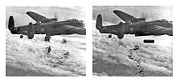
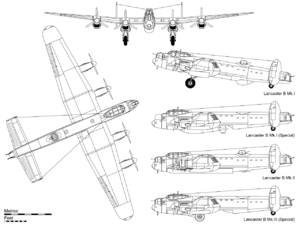
 B I
B I
B I Special
PR 1
B I (FE)
B II
B III
B III (Special)
ASR III/ASR 3
GR 3/MR 3
B IV
B V
B VI
B VII
B X
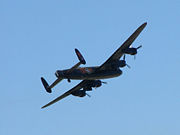
and the other is in Canada, operated by the Canadian Warplane Heritage Museum
. Lancaster FM-136 was purchased by Lynn Garrison, in 1961, and displayed in Calgary, Alberta as a memorial to those who trained under the British Commonwealth Air Training Plan. It is now being returned to flying condition.
were:
, and a number of B VII Lancasters in storage were modified to the original configuration of the B III (Special) for use on screen. The Lancaster also plays a central role in Bomber
, the 1970 novel by Len Deighton
about a night raid on a fictional German town by a formation of RAF bombers. It also featured in a 1989 British commercial for Carling Black Label lager
which reused footage in a Dam Busters parody sequence in which a German soldier on top of a dam was catching the bombs in the manner of a football
goalkeeper. The pilot of the attacking Lancaster then delivers the brand slogan: "I bet he drinks Carling Black Label!" The commercial ran for many years, frequently appearing in commercial breaks in both the 1955 film and documentaries about Operation Chastise
. The Avro Lancaster was also featured in the UK TV series Pathfinders, airing in 1972 and released on DVD in 2006, concentrating on the lives of the aircrew of a fictional Pathfinder squadron during the Second World War. Other films in which the Lancaster appeared include Appointment in London
(1952) and The Guns of Navarone
(1961).
United Kingdom
The United Kingdom of Great Britain and Northern IrelandIn the United Kingdom and Dependencies, other languages have been officially recognised as legitimate autochthonous languages under the European Charter for Regional or Minority Languages...
four-engined Second World War
World War II
World War II, or the Second World War , was a global conflict lasting from 1939 to 1945, involving most of the world's nations—including all of the great powers—eventually forming two opposing military alliances: the Allies and the Axis...
heavy bomber
Heavy bomber
A heavy bomber is a bomber aircraft of the largest size and load carrying capacity, and usually the longest range.In New START, the term "heavy bomber" is used for two types of bombers:*one with a range greater than 8,000 kilometers...
made initially by Avro
Avro
Avro was a British aircraft manufacturer, with numerous landmark designs such as the Avro 504 trainer in the First World War, the Avro Lancaster, one of the pre-eminent bombers of the Second World War, and the delta wing Avro Vulcan, a stalwart of the Cold War.-Early history:One of the world's...
for the Royal Air Force
Royal Air Force
The Royal Air Force is the aerial warfare service branch of the British Armed Forces. Formed on 1 April 1918, it is the oldest independent air force in the world...
(RAF). It first saw active service in 1942, and together with the Handley Page Halifax
Handley Page Halifax
The Handley Page Halifax was one of the British front-line, four-engined heavy bombers of the Royal Air Force during the Second World War. A contemporary of the famous Avro Lancaster, the Halifax remained in service until the end of the war, performing a variety of duties in addition to bombing...
it was one of the main heavy bomber
Heavy bomber
A heavy bomber is a bomber aircraft of the largest size and load carrying capacity, and usually the longest range.In New START, the term "heavy bomber" is used for two types of bombers:*one with a range greater than 8,000 kilometers...
s of the RAF, the RCAF
Royal Canadian Air Force
The history of the Royal Canadian Air Force begins in 1920, when the air force was created as the Canadian Air Force . In 1924 the CAF was renamed the Royal Canadian Air Force and granted royal sanction by King George V. The RCAF existed as an independent service until 1968...
, and squadrons from other Commonwealth
Commonwealth of Nations
The Commonwealth of Nations, normally referred to as the Commonwealth and formerly known as the British Commonwealth, is an intergovernmental organisation of fifty-four independent member states...
and Europe
Europe
Europe is, by convention, one of the world's seven continents. Comprising the westernmost peninsula of Eurasia, Europe is generally 'divided' from Asia to its east by the watershed divides of the Ural and Caucasus Mountains, the Ural River, the Caspian and Black Seas, and the waterways connecting...
an countries serving within RAF Bomber Command
RAF Bomber Command
RAF Bomber Command controlled the RAF's bomber forces from 1936 to 1968. During World War II the command destroyed a significant proportion of Nazi Germany's industries and many German cities, and in the 1960s stood at the peak of its postwar military power with the V bombers and a supplemental...
.
The "Lanc", as it was affectionately known, became the most famous and most successful of the Second World War night bombers, "delivering 608,612 tons of bombs in 156,000 sorties." Although the Lancaster was primarily a night bomber, it excelled in many other roles including daylight precision bombing, and gained worldwide renown as the "Dam Buster" used in the 1943 Operation Chastise
Operation Chastise
Operation Chastise was an attack on German dams carried out on 16–17 May 1943 by Royal Air Force No. 617 Squadron, subsequently known as the "Dambusters", using a specially developed "bouncing bomb" invented and developed by Barnes Wallis...
raids on Germany's Ruhr Valley
Ruhr Area
The Ruhr, by German-speaking geographers and historians more accurately called Ruhr district or Ruhr region , is an urban area in North Rhine-Westphalia, Germany. With 4435 km² and a population of some 5.2 million , it is the largest urban agglomeration in Germany...
dams.
Design and development
Medium bomber
A medium bomber is a bomber aircraft designed to operate with medium bombloads over medium distances; the name serves to distinguish them from the larger heavy bombers and smaller light bombers...
s for "worldwide use", the engine specified as the Rolls-Royce Vulture
Rolls-Royce Vulture
|-See also:-Bibliography:* Gunston, Bill. World Encyclopaedia of Aero Engines. Cambridge, England. Patrick Stephens Limited, 1989. ISBN 1-85260-163-9...
. The resulting aircraft was the Manchester
Avro Manchester
|-See also:-References:NotesCitationsBibliography* Buttler, Tony. British Secret Projects: Fighters and Bombers 1935–1950. Hickley, UK: Midland Publishing, 2004. ISBN 978-1857801798....
, which, although a capable aircraft, was troubled by the unreliability of the Vulture engine. Only 200 Manchesters were built and they were withdrawn from service in 1942.
Avro
Avro
Avro was a British aircraft manufacturer, with numerous landmark designs such as the Avro 504 trainer in the First World War, the Avro Lancaster, one of the pre-eminent bombers of the Second World War, and the delta wing Avro Vulcan, a stalwart of the Cold War.-Early history:One of the world's...
's chief designer, Roy Chadwick
Roy Chadwick
Roy Chadwick, CBE, FRAeS was an aircraft designer for Avro. Born at Marsh Hall Farm, Farnworth in Widnes, son of the mechanical engineer Charles Chadwick, he was the Chief Designer for the Avro Company and was responsible for practically all of their aeroplane designs...
, was already working on an improved Manchester design using four of the more reliable but less powerful Rolls-Royce Merlin
Rolls-Royce Merlin
The Rolls-Royce Merlin is a British liquid-cooled, V-12, piston aero engine, of 27-litre capacity. Rolls-Royce Limited designed and built the engine which was initially known as the PV-12: the PV-12 became known as the Merlin following the company convention of naming its piston aero engines after...
engines on a larger wing. The aircraft was initially designated Avro Type 683 Manchester III, and later re-named the Lancaster
Lancaster, Lancashire
Lancaster is the county town of Lancashire, England. It is situated on the River Lune and has a population of 45,952. Lancaster is a constituent settlement of the wider City of Lancaster, local government district which has a population of 133,914 and encompasses several outlying towns, including...
. The prototype aircraft BT308
Serial number
A serial number is a unique number assigned for identification which varies from its successor or predecessor by a fixed discrete integer value...
was assembled by Avro's experimental flight department at Manchester
Manchester
Manchester is a city and metropolitan borough in Greater Manchester, England. According to the Office for National Statistics, the 2010 mid-year population estimate for Manchester was 498,800. Manchester lies within one of the UK's largest metropolitan areas, the metropolitan county of Greater...
's Ringway Airport from where test pilot H.A. "Bill" Thorn took the controls for its first flight on Thursday, 9 January 1941. The aircraft proved to be a great improvement on its predecessor, being "one of the few warplanes in history to be 'right' from the start." Its initial three-finned tail layout, a result of the design being adapted from the Manchester I, was quickly changed on the second prototype DG595 and subsequent production aircraft to the familiar twin-finned specification also used on the later Manchesters (below).
Some of the later orders for Manchesters were changed in favour of Lancasters; the designs were very similar and both featured the same distinctive greenhouse cockpit, turret nose, and twin tail
Twin tail
A twin tail is a specific type of vertical stabilizer arrangement found on the empennage of some aircraft. Two vertical stabilizers — often smaller on their own than a single conventional tail would be — are mounted at the outside of the aircraft's horizontal stabilizer...
. The Lancaster discarded the stubby central third tail fin of the early Manchesters and used the wider span tailplane
Tailplane
A tailplane, also known as horizontal stabilizer , is a small lifting surface located on the tail behind the main lifting surfaces of a fixed-wing aircraft as well as other non-fixed wing aircraft such as helicopters and gyroplanes...
and larger elliptical twin fins from the later Manchester IA.
The Lancaster is a mid-wing cantilever monoplane
Monoplane
A monoplane is a fixed-wing aircraft with one main set of wing surfaces, in contrast to a biplane or triplane. Since the late 1930s it has been the most common form for a fixed wing aircraft.-Types of monoplane:...
with an oval all-metal fuselage. The wing was constructed in five main sections, the fuselage in five sections. All wing and fuselage sections were built separately and fitted with all the required equipment before final assembly. The tail unit had twin oval fins and rudder
Rudder
A rudder is a device used to steer a ship, boat, submarine, hovercraft, aircraft or other conveyance that moves through a medium . On an aircraft the rudder is used primarily to counter adverse yaw and p-factor and is not the primary control used to turn the airplane...
s. The Lancaster was initially powered by four wing-mounted Rolls-Royce Merlin
Rolls-Royce Merlin
The Rolls-Royce Merlin is a British liquid-cooled, V-12, piston aero engine, of 27-litre capacity. Rolls-Royce Limited designed and built the engine which was initially known as the PV-12: the PV-12 became known as the Merlin following the company convention of naming its piston aero engines after...
piston engines with three-bladed airscrews. It had retractable main landing gear and fixed tail-wheel, with the hydraulically operated main landing gear raising rearwards into the inner engine nacelles.
The majority of Lancasters built during the war years were manufactured by Avro
Avro
Avro was a British aircraft manufacturer, with numerous landmark designs such as the Avro 504 trainer in the First World War, the Avro Lancaster, one of the pre-eminent bombers of the Second World War, and the delta wing Avro Vulcan, a stalwart of the Cold War.-Early history:One of the world's...
at their factory at Chadderton
Chadderton
Chadderton is a town within the Metropolitan Borough of Oldham, in Greater Manchester, England, historically a part of Lancashire...
near Oldham
Oldham
Oldham is a large town in Greater Manchester, England. It lies amid the Pennines on elevated ground between the rivers Irk and Medlock, south-southeast of Rochdale, and northeast of the city of Manchester...
, Lancashire
Lancashire
Lancashire is a non-metropolitan county of historic origin in the North West of England. It takes its name from the city of Lancaster, and is sometimes known as the County of Lancaster. Although Lancaster is still considered to be the county town, Lancashire County Council is based in Preston...
, and test flown from Woodford Aerodrome in Cheshire
Cheshire
Cheshire is a ceremonial county in North West England. Cheshire's county town is the city of Chester, although its largest town is Warrington. Other major towns include Widnes, Congleton, Crewe, Ellesmere Port, Runcorn, Macclesfield, Winsford, Northwich, and Wilmslow...
. Other Lancasters were built by Metropolitan-Vickers
Metropolitan-Vickers
Metropolitan-Vickers, Metrovick, or Metrovicks, was a British heavy electrical engineering company of the early-to-mid 20th century formerly known as British Westinghouse. Highly diversified, they were particularly well known for their industrial electrical equipment such as generators, steam...
(1080, also tested at Woodford), and Armstrong Whitworth
Armstrong Whitworth
Sir W G Armstrong Whitworth & Co Ltd was a major British manufacturing company of the early years of the 20th century. Headquartered in Elswick, Newcastle upon Tyne, Armstrong Whitworth engaged in the construction of armaments, ships, locomotives, automobiles, and aircraft.-History:In 1847,...
. The aircraft was also produced at the Austin Motor Company
Austin Motor Company
The Austin Motor Company was a British manufacturer of automobiles. The company was founded in 1905 and merged in 1952 into the British Motor Corporation Ltd. The marque Austin was used until 1987...
works in Longbridge
Longbridge
Longbridge is an area of Birmingham, England. For local government purposes it is a ward within the district of Northfield.Since 1905, the area has been dominated by the Longbridge plant, which produced Austin, Nash Metropolitan, Morris, British Leyland, and most recently MG Rover cars...
, Birmingham
Birmingham
Birmingham is a city and metropolitan borough in the West Midlands of England. It is the most populous British city outside the capital London, with a population of 1,036,900 , and lies at the heart of the West Midlands conurbation, the second most populous urban area in the United Kingdom with a...
, later in the Second World War and postwar by Vickers-Armstrongs at Chester
Chester
Chester is a city in Cheshire, England. Lying on the River Dee, close to the border with Wales, it is home to 77,040 inhabitants, and is the largest and most populous settlement of the wider unitary authority area of Cheshire West and Chester, which had a population of 328,100 according to the...
as well as at the Vickers Armstrong factory, Castle Bromwich, Birmingham. Only 300 of the Lancaster B II fitted with Bristol Hercules
Bristol Hercules
|-See also:-Bibliography:*Gunston, B. Classic World War II Aircraft Cutaways. Osprey. ISBN 1-85532-526-8*Gunston, Bill. World Encyclopedia of Aero Engines. Cambridge, England. Patrick Stephens Limited, 1989. ISBN 1-85260-163-9...
engines were constructed; this was a stopgap modification caused by a shortage of Merlin engines as fighter production was of higher priority. Many BIIs were lost after running out of fuel. The Lancaster B III had Packard
Packard
Packard was an American luxury-type automobile marque built by the Packard Motor Car Company of Detroit, Michigan, and later by the Studebaker-Packard Corporation of South Bend, Indiana...
Merlin
Rolls-Royce Merlin
The Rolls-Royce Merlin is a British liquid-cooled, V-12, piston aero engine, of 27-litre capacity. Rolls-Royce Limited designed and built the engine which was initially known as the PV-12: the PV-12 became known as the Merlin following the company convention of naming its piston aero engines after...
engines but was otherwise identical to contemporary B Is, with 3,030 B IIIs built, almost all at A.V. Roe's Newton Heath
Newton Heath
Newton Heath is an urban area of the city of Manchester, in Greater Manchester, England. It is east north east of Manchester city centre and has a population of 9,883....
factory. The B I and B III were built concurrently, and minor modifications were made to both marks as new batches were ordered. Examples of these modifications were the relocation of the pitot head
Pitot tube
A pitot tube is a pressure measurement instrument used to measure fluid flow velocity. The pitot tube was invented by the French engineer Henri Pitot Ulo in the early 18th century and was modified to its modern form in the mid-19th century by French scientist Henry Darcy...
from the nose to the side of the cockpit, and the change from de Havilland
De Havilland
The de Havilland Aircraft Company was a British aviation manufacturer founded in 1920 when Airco, of which Geoffrey de Havilland had been chief designer, was sold to BSA by the owner George Holt Thomas. De Havilland then set up a company under his name in September of that year at Stag Lane...
"needle blade" propellers to Hamilton Standard
Hamilton Standard
Hamilton Standard, an aircraft propeller parts supplier, was formed in 1929 when United Aircraft and Transport Corporation consolidated Hamilton Aero Manufacturing and Standard Steel Propeller into the Hamilton Standard Propeller Corporation. Other members of the corporation included Boeing,...
or Nash Kelvinator
Nash-Kelvinator Corporation
Nash-Kelvinator Corporation was the result of a merger between Nash Motors and Kelvinator Appliance Company. The union of these two companies was brought about as a result of a condition made by George W...
made "paddle blade" propellers.
Of later variants, only the Canadian-built Lancaster B X, manufactured by Victory Aircraft
Victory Aircraft
Victory Aircraft Limited was a Canadian manufacturing company that, during the Second World War, built mainly British-designed aircraft under license. It acted as a shadow factory, safe from the reach of German bombers....
in Malton, Ontario
Malton, Ontario
Malton is a neighbourhood in the northeastern part of the city of Mississauga, Ontario, Canada, located to the northwest of Toronto. The neighbourhood has a population of approximately 36,400 as of 2002....
, was produced in significant numbers. A total of 430 of this type were built, earlier examples differing little from their British-built predecessors, except for using Packard
Packard
Packard was an American luxury-type automobile marque built by the Packard Motor Car Company of Detroit, Michigan, and later by the Studebaker-Packard Corporation of South Bend, Indiana...
-built Merlin engines and American-style instrumentation and electrics. Late-series models replaced the Frazer Nash
Nash & Thomson
Nash & Thompson was a British engineering firm that specialised in the production of hydraulically-operated gun turrets for aircraft. The company was also an important manufacturer of hydraulic powered radar scanners, used on radar systems such as H2S and AI Mark VIII.- History :Nash & Thompson was...
mid-upper turret with a differently configured Martin turret, mounted slightly further forward for weight balance. A total of 7,377 Lancasters of all marks were built throughout the duration of the war, each at a 1943 cost of £45-50,000 (approximately £-£ today).
Crew accommodation
Starting at the nose, the bomb aimerBombardier (air force)
A bombardier , in the United States Army Air Forces and United States Air Force, or a bomb aimer, in the Royal Air Force and other Commonwealth air forces, was the crewman of a bomber responsible for assisting the navigator in guiding the plane to a bombing target and releasing the aircraft's bomb...
had two positions to man. His primary location was lying prone on the floor of the nose of the aircraft, with access to the controls for the bombsight
Bombsight
A bombsight is a device used by bomber aircraft to accurately drop bombs. In order to do this, the bombsight has to estimate the path the bomb will take after release from the aircraft. The two primary forces during its fall are gravity and air drag, which makes the path of the bomb through the air...
head in front, with the bombsight computer
Analog computer
An analog computer is a form of computer that uses the continuously-changeable aspects of physical phenomena such as electrical, mechanical, or hydraulic quantities to model the problem being solved...
on his left and bomb release selectors on the right. He would also use his view out of the large transparent perspex nose cupola to assist the navigator with map reading. To man the Frazer Nash FN5 nose turret, he simply had to stand up and he would be in position behind the triggers of his twin .303 in (7.7 mm) guns. The bomb aimer's position contained the nose parachute exit in the floor.
Moving back, on the roof of the bomb bay
Bomb bay
The bomb bay or weapons bay on some military aircraft is a compartment to carry bombs, usually in the aircraft's fuselage, with "bomb bay doors" which open at the bottom. The bomb bay doors are opened and the bombs are dropped when over the target or at a specified launching point.Large-sized...
the pilot and flight engineer
Flight engineer
Flight engineers work in three types of aircraft: fixed-wing , rotary wing , and space flight .As airplanes became even larger requiring more engines and complex systems to operate, the workload on the two pilots became excessive during certain critical parts of the flight regime, notably takeoffs...
sat side-by-side under the expansive canopy, with the pilot sitting on the left on a raised portion of the floor. The flight engineer sat on a collapsible seat (known as a "second dicky seat") to the pilot's right, with the fuel selectors and gauges on a panel behind him and to his right.
Behind these crew members, and behind a curtain fitted to allow him to use light to work, sat the navigator
Flight officer
The title flight officer was a military rank used by the United States Armed Forces where it was an air force warrant officer rank. It was also an air force rank in several Commonwealth nations where it was used for female officers and was equivalent to the rank of flight lieutenant...
. His position faced to port with a large chart table in front of him. An instrument panel showing the airspeed, altitude, and other details required for navigation was mounted on the side of the fuselage above the chart table.
The radios for the wireless
Wireless
Wireless telecommunications is the transfer of information between two or more points that are not physically connected. Distances can be short, such as a few meters for television remote control, or as far as thousands or even millions of kilometers for deep-space radio communications...
operator were mounted on the left-hand end of the chart table, facing towards the rear of the aircraft. Behind these radios, facing forwards, on a seat at the front of the main spar sat the wireless operator. To his left was a window, and above him was the astrodome
Astrodome (aviation)
An astrodome is a hemispherical transparent dome fitted in the cabin roof of an aircraft to allow the use of a sextant during astro-navigation....
, used for visual signalling and also by the navigator for celestial navigation
Celestial navigation
Celestial navigation, also known as astronavigation, is a position fixing technique that has evolved over several thousand years to help sailors cross oceans without having to rely on estimated calculations, or dead reckoning, to know their position...
.
Behind the wireless operator were the two spars
Spar (aviation)
In a fixed-wing aircraft, the spar is often the main structural member of the wing, running spanwise at right angles to the fuselage. The spar carries flight loads and the weight of the wings whilst on the ground...
for the wing, which created a major obstacle for crew members moving down the fuselage even on the ground. On reaching the end of the bomb bay the floor dropped down to the bottom of the fuselage, and the mid upper gunner's Frazer Nash FN50 or FN150 turret was reached. His position allowed a 360° view over the top of the aircraft, with two .303 in (7.7 mm)
.303 British
.303 British, or 7.7x56mmR, is a .311 inch calibre rifle and machine gun cartridge first developed in Britain as a blackpowder round put into service in December 1888 for the Lee-Metford rifle, later adapted to use smokeless powders...
M1919 Browning machine gun
M1919 Browning machine gun
The M1919 Browning is a .30 caliber medium machine gun that was widely used during the 20th century. It was used as a light infantry, coaxial, mounted, aircraft, and anti-aircraft machine gun by the U.S. and many other countries, especially during World War II, the Korean War, and the Vietnam War...
s to protect the aircraft from above and to the side. The mid-upper gunner had perhaps the most uncomfortable ride of all the crew, as he was seated on a rectangle of canvas that was slung beneath the turret once the gunner had occupied his position. He could be required to occupy this seat for up to eight hours at a time.
To the rear of the turret was the side crew door, on the starboard side of the fuselage. This was the main entrance to the aircraft, and also could be used as a parachute exit. Right at the tail-end of the fuselage, over the spars for the tailplane, the rear gunner sat in his exposed position in the FN20, FN120 or Rose Rice turret, which was entered through a small hatch in the rear of the fuselage. Depending on the size of the rear gunner, the area was so cramped that the gunner would often hang his parachute on a hook inside the fuselage, near the turret doors. In the FN20 and FN120 turrets, he had four .303 in (7.7 mm) Brownings, and in the Rose Rice turret he had two .50 in (12.7 mm) Brownings. Neither the mid upper nor the rear gunner's position was heated, and the gunners had to wear electrically heated suits to prevent hypothermia
Hypothermia
Hypothermia is a condition in which core temperature drops below the required temperature for normal metabolism and body functions which is defined as . Body temperature is usually maintained near a constant level of through biologic homeostasis or thermoregulation...
and frostbite
Frostbite
Frostbite is the medical condition where localized damage is caused to skin and other tissues due to extreme cold. Frostbite is most likely to happen in body parts farthest from the heart and those with large exposed areas...
. Many rear gunners insisted on having the centre section of perspex
Acrylic glass
Poly is a transparent thermoplastic, often used as a light or shatter-resistant alternative to glass. It is sometimes called acrylic glass. Chemically, it is the synthetic polymer of methyl methacrylate...
removed from the turret to give a completely unobstructed view.
Defensive
While eight .303 in (7.7 mm) machine gunMachine gun
A machine gun is a fully automatic mounted or portable firearm, usually designed to fire rounds in quick succession from an ammunition belt or large-capacity magazine, typically at a rate of several hundred rounds per minute....
s were the most common Lancaster armament, twin .50 in (12.7 mm) turrets were later available in both the tail and dorsal positions. A Nash & Thomson
Nash & Thomson
Nash & Thompson was a British engineering firm that specialised in the production of hydraulically-operated gun turrets for aircraft. The company was also an important manufacturer of hydraulic powered radar scanners, used on radar systems such as H2S and AI Mark VIII.- History :Nash & Thompson was...
FN-64 periscope-sighted twin .303 in machine gun ventral turret was fitted to early aircraft, but fitting was soon discontinued and the turret often removed as it was hard to sight, especially at night. (Similar problems afflicted the ventral turret in the North American B-25
B-25 Mitchell
The North American B-25 Mitchell was an American twin-engined medium bomber manufactured by North American Aviation. It was used by many Allied air forces, in every theater of World War II, as well as many other air forces after the war ended, and saw service across four decades.The B-25 was named...
C and other bombers).
When the threat of attacks from below
Schräge Musik
Schräge Musik, derived from the German colloquialism for "Jazz Music" was the name given to installations of upward-firing autocannon mounted in night fighters by the Luftwaffe and Imperial Japanese Navy Air Service during World War II, with the first victories for each occurring in May 1943...
began to be appreciated in the winter of 1943/1944, modifications were made, including downward observation blisters mounted behind the bomb aimer's blister and official and unofficial mounts for .50 in (12.7 mm) machine guns or even 20 mm cannon, firing through ventral holes of various designs. The fitting of these guns was hampered as the same ventral position was used for mounting the H2S blister.
Bombs
An important feature of the Lancaster was its large bombBomb
A bomb is any of a range of explosive weapons that only rely on the exothermic reaction of an explosive material to provide an extremely sudden and violent release of energy...
bay, which was 33 ft (10.05 m) long.
Initially, the heaviest bombs carried were 4,000 lb (1,820 kg) "Cookies"
Blockbuster bomb
Blockbuster or "cookie" was the name given to several of the largest conventional bombs used in World War II by the Royal Air Force...
. Bulged doors were added to 30% of B-MkIs to allow the aircraft to carry 8000 lb (3,628.7 kg) and later 12,000 lb (5,450 kg) "Cookies". Towards the end of the war, attacking special and hardened targets, the B I Specials could carry the 21 ft (6.4 m) long 12,000 lb (5,450 kg) "Tallboy
Tallboy bomb
The Tallboy or Bomb, Medium Capacity, 12,000 lb, was an earthquake bomb developed by the British aeronautical engineer Barnes Wallis and deployed by the RAF in 1944...
" or 25.5 ft (7.77 m) long 22,000 lb (9,980 kg) "Grand Slam
Grand Slam bomb
The Grand Slam was a 22,000 lb earthquake bomb used by RAF Bomber Command against strategic targets during the Second World War.Known officially as the Bomb, Medium Capacity, 22,000 lb, it was a scaled up version of the Tallboy bomb and closer to the original size that the bombs' inventor,...
" "earthquake" bombs: the Lancaster was able to deliver the heaviest bombs made. To carry the "Grand Slam" extensive modifications to the aircraft were required which led to them being named B I (Specials). The modifications included removal of the mid-upper turret, two guns from the rear turret, removal of all of the cockpit armour plating and installation of Rolls-Royce Merlin Mk 24 Engines which had better take-off performance. The bomb-bay doors were removed and the rear end of the bomb bay cut away to clear the tail of the bomb. Later the nose turret was also removed to further improve performance.
Bombsights used on Lancasters included:
Mark IX Course Setting Bomb Sight
Course Setting Bomb Sight
The Course Setting Bomb Sight is the canonical "vector" bombsight, the first practical system for properly accounting for the effects of wind during the dropping of bombs...
(CSBS).
- This was an early preset vector bombsight that involved squinting through wires that had to be manually set based on aircraft speed, altitude and bombload. This sight lacked tactical flexibility as it had to be manually adjusted if any of the parameters changed and was soon changed in favour of the bombsights below.
Mark XIV bombsight
Mark XIV bomb sight
The Mark XIV Computing Bomb Sight is a vector bombsight developed and used by the Royal Air Force's Bomber Command during World War II. The bombsight was also known as the Blackett sight after its primary inventor, P.M.S. Blackett...
- A vector bombsight where the bomb aimer input details of the bombload, target altitude and wind direction and the analogue computer then continuously calculated the trajectory of the bombs and projected an inverted sword shape onto a sighting glass on the sighting head. Assuming the sight was set correctly, when the target was in the cross hairs of the sword shape, the bomb aimer would be able to accurately release the bombs.
T1 bombsight
- A Mark XIV bombsight modified for mass production and produced in the USA. Some of the pneumatic gyro drives on the Mk XIV sight were replaced with electronic gyros and other minor modifications were made.
Stabilizing Automatic Bomb Sight
Stabilizing Automatic Bomb Sight
The Stabilized Automatic Bomb Sight was a tachometric bombsight introduced into operational service by the Royal Air Force in 1943 during World War II. Hand-made throughout its lifetime, the SABS was produced in very small numbers and used only in specialist roles...
- Also known as "SABS", this was an advanced bombsight mainly used by 617 Squadron for precision raids. Like the American Norden bombsightNorden bombsightThe Norden bombsight was a tachometric bombsight used by the United States Army Air Forces and the United States Navy during World War II, and the United States Air Force in the Korean and the Vietnam Wars to aid the crew of bomber aircraft in dropping bombs accurately...
it was a tachometric sight.
Radio, radar and countermeasures equipment
R1155
The R1155 was a ubiquitous radio communications receiver used by the Royal Air Force in World War II. The R1155/T1154 combination was used in larger aircraft, particularly the Avro Lancaster and Short Sunderland, and also in some vehicles and air-sea rescue launches...
receiver and T1154 transmitter, whereas the Canadian built aircraft and those built for service in the Far East had American radios. These provided radio direction-finding, as well as voice and Morse
Morse code
Morse code is a method of transmitting textual information as a series of on-off tones, lights, or clicks that can be directly understood by a skilled listener or observer without special equipment...
capabilities.
H2S
H2S radar
H2S was the first airborne, ground scanning radar system. It was developed in Britain in World War II for the Royal Air Force and was used in various RAF bomber aircraft from 1943 to the 1990s. It was designed to identify targets on the ground for night and all-weather bombing...
- Ground-looking navigation radar system - eventually, it could be homed in on by the German night fighters' NAXOSNaxos radar detectorThe FuG 350 Naxos radar warning receiver was a World War II German countermeasure to SHF band centimetric wavelength radar produced by a cavity magnetron...
receiver and had to be used with discretion.
Fishpond
Fishpond
Fishpond was the code name given to an extension to the British H2S airborne radar system fitted to Royal Air Force Avro Lancaster and Handley Page Halifax heavy bombers during World War II...
- An add-on to H2S that provided additional (aerial) coverage of the underside of the aircraft to display attacking fighters on an auxiliary screen in the radio operator's position.
Monica
- A rearward-looking radar to warn of night fighter approaches. However, it could not distinguish between attacking enemy fighters and nearby friendly bombers and served as a homing beacon for suitably equipped German night fighterNight fighterA night fighter is a fighter aircraft adapted for use at night or in other times of bad visibility...
s. Once this was realised, it was removed altogether.
GEE
GEE (navigation)
Gee was the code name given to a radio navigation system used by the Royal Air Force during World War II.Different sources record the name as GEE or Gee. The naming supposedly comes from "Grid", so the lower case form is more correct, and is the form used in Drippy's publications. See Drippy 1946....
- A receiver for a navigation system of synchronized pulses transmitted from the UK - aircraft calculated their position from the time delay between pulses. The range of GEE was 3-400 mi (483-644 km).
Boozer (radar detector)
- A system of lights mounted on the aircraft's instrument panel that lit up when the aircraft was being tracked by Würzburg ground radarWürzburg radarThe Würzburg radar was the primary ground-based gun laying radar for both the Luftwaffe and the German Army during World War II. Initial development took place before the war, entering service in 1940. Eventually over 4,000 Würzburgs of various models were produced...
and Lichtenstein airborne radarLichtenstein radarLichtenstein radar was a German airborne radar in use during World War II. It was available in at least four major revisions, the FuG 202 Lichtenstein B/C, FuG 212 Lichtenstein C-1, FuG 220 Lichtenstein SN-2 and FuG 228 Lichtenstein SN-3.- FuG 202 Lichtenstein B/C :Early FuG 202 Lichtenstein B/C...
. In practice it was found to be more disconcerting than useful, as the lights were often triggered by false alerts in the radar-signal-infested skies over Germany.
Oboe
Oboe (navigation)
Oboe was a British aerial blind bombing targeting system in World War II, based on radio transponder technology. Oboe accurately measured the distance to an aircraft, and gave the pilot guidance on whether or not they were flying along a pre-selected circular route. The route was only 35 yards...
- A very accurate navigation system consisting of a receiver/transponder for two radar stations transmitting from widely separated locations in Southern EnglandSouthern EnglandSouthern England, the South and the South of England are imprecise terms used to refer to the southern counties of England bordering the English Midlands. It has a number of different interpretations of its geographic extents. The South is considered by many to be a cultural region with a distinct...
which together determined the range and the bearing on the range. The system could only handle one aircraft at a time, and was fitted to a PathfinderPathfinder (RAF)The Pathfinders were elite squadrons in RAF Bomber Command during World War II. They located and marked targets with flares, which a main bomber force could aim at, increasing the accuracy of their bombing...
aircraft, usually a fast and manoeuvrable MosquitoDe Havilland MosquitoThe de Havilland DH.98 Mosquito was a British multi-role combat aircraft that served during the Second World War and the postwar era. It was known affectionately as the "Mossie" to its crews and was also nicknamed "The Wooden Wonder"...
rather than a heavy Lancaster, which marked the target for the main force.
GEE-H
G-H (navigation)
Gee-H, or sometimes G-H, was a radio navigation system developed by Britain during World War II to aid RAF Bomber Command. Its official name was AMES Type 100...
- Similar to Oboe but with the transponder on the ground allowing more aircraft to use the system simultaneously. GEE-H aircraft were usually marked with two horizontal yellow stripes on the fins.
Village Inn
Village Inn (codename)
The British Automatic Gun-Laying Turret was a radar-aimed FN121 turret fitted to some Lancaster and Halifax bombers in 1944. The AGLT system was devised to allow a target to be tracked and fired-on in total darkness, the target's range being accurately computed as well as allowing for lead and...
- A radar-aimed gun turret fitted to some Lancaster rear turrets in 1944.
Airborne Cigar (ABC)
- This was only fitted to the Lancasters of 101 SquadronNo. 101 Squadron RAFNo. 101 Squadron of the Royal Air Force operates the Vickers VC10 C1K, K3 and K4 from RAF Brize Norton, Oxfordshire. Since 10 Squadron disbanded in 2005, the squadron is the only operator of the VC10.-Formation and early years:...
. It was three aerials, two sticking out of the top of the fuselage and one under the bomb aimer's position. These aircraft carried a German speaking crew member on board and were used to jam radio to German night fighters and feed false information on allied bomber positions to them. Due to the nature of the equipment, the enemy was able to track the aircraft and due to this, 101 suffered the highest casualty rate of any squadron. Fitted from about mid-1943, they remained until the end of the war.
Second World War
No. 44 Squadron RAF
No. 44 Squadron of the Royal Air Force is no longer operational. For most of its history it served as a heavy bomber squadron.-History:...
in early 1942.
Lancasters flew 156,000 sorties and dropped 608,612 long tons (618,378 tonnes) of bomb
Bomb
A bomb is any of a range of explosive weapons that only rely on the exothermic reaction of an explosive material to provide an extremely sudden and violent release of energy...
s between 1942 and 1945. Just 35 Lancasters completed more than 100 successful operations each, and 3,249 were lost in action. The most successful survivor completed 139 operations, and was scrapped in 1947.
Lancs took part in the devastating round-the-clock raids on Hamburg during Air Chief Marshal Harris' "Operation Gomorrah"
Bombing of Hamburg in World War II
The Allied bombing of Hamburg during World War II included numerous strategic bombing missions and diversion/nuisance raids. As a large port and industrial center, Hamburg's shipyards, U-boat pens, and the Hamburg-Harburg area oil refineries were attacked throughout the war...
in July 1943. A famous Lancaster bombing raid was the 1943 mission, codenamed Operation Chastise
Operation Chastise
Operation Chastise was an attack on German dams carried out on 16–17 May 1943 by Royal Air Force No. 617 Squadron, subsequently known as the "Dambusters", using a specially developed "bouncing bomb" invented and developed by Barnes Wallis...
, to destroy the dams of the Ruhr Valley
Ruhr Area
The Ruhr, by German-speaking geographers and historians more accurately called Ruhr district or Ruhr region , is an urban area in North Rhine-Westphalia, Germany. With 4435 km² and a population of some 5.2 million , it is the largest urban agglomeration in Germany...
. The operation was carried out by 617 Squadron
No. 617 Squadron RAF
No. 617 Squadron is a Royal Air Force aircraft squadron based at RAF Lossiemouth in Scotland. It currently operates the Tornado GR4 in the ground attack and reconnaissance role...
in modified Mk IIIs carrying special drum shaped bouncing bomb
Bouncing bomb
A bouncing bomb is a bomb designed specifically to bounce to a target across water in a calculated manner, in order to avoid obstacles such as torpedo nets, and to allow both the bomb's speed on arrival at the target and the timing of its detonation to be pre-determined...
s designed by Barnes Wallis
Barnes Wallis
Sir Barnes Neville Wallis, CBE FRS, RDI, FRAeS , was an English scientist, engineer and inventor. He is best known for inventing the bouncing bomb used by the RAF in Operation Chastise to attack the dams of the Ruhr Valley during World War II...
. The story of the operation was later made into a film, The Dam Busters. Also famous was a series of Lancaster attacks using Tallboy bombs against the , which first disabled and later sank the ship.
Lancasters from Bomber Command were to have formed the main strength of Tiger Force
Tiger Force (air)
Tiger Force, also known as the Very Long Range Bomber Force, was the name given to a World War II British Commonwealth long-range heavy bomber force, formed in 1945, from squadrons serving with RAF Bomber Command in Europe, for proposed use against targets in Japan...
, the Commonwealth bomber contingent scheduled to take part in Operation Downfall
Operation Downfall
Operation Downfall was the Allied plan for the invasion of Japan near the end of World War II. The operation was cancelled when Japan surrendered after the atomic bombing of Hiroshima and Nagasaki and the Soviet Union's declaration of war against Japan. The operation had two parts: Operation...
, the codename for the planned invasion of Japan
Japan
Japan is an island nation in East Asia. Located in the Pacific Ocean, it lies to the east of the Sea of Japan, China, North Korea, South Korea and Russia, stretching from the Sea of Okhotsk in the north to the East China Sea and Taiwan in the south...
in late 1945, from bases on Okinawa; the invasion was made unnecessary by the Japanese surrender.
RAF Lancasters dropped food into the Holland region of the occupied Netherlands
Netherlands
The Netherlands is a constituent country of the Kingdom of the Netherlands, located mainly in North-West Europe and with several islands in the Caribbean. Mainland Netherlands borders the North Sea to the north and west, Belgium to the south, and Germany to the east, and shares maritime borders...
, with the acquiescence of the occupying German forces, to feed people who were in danger of starvation. The mission was named 'Operation Manna' after the food Manna
Manna
Manna or Manna wa Salwa , sometimes or archaically spelled mana, is the name of an edible substance that God provided for the Israelites during their travels in the desert according to the Bible.It was said to be sweet to the taste, like honey....
which is said to have miraculously appeared for the Israelite
Israelite
According to the Bible the Israelites were a Hebrew-speaking people of the Ancient Near East who inhabited the Land of Canaan during the monarchic period .The word "Israelite" derives from the Biblical Hebrew ישראל...
s in the Book of Exodus. The aircraft involved were from 1, 3, and 8 Groups, and consisted of 145 Mosquitoe
De Havilland Mosquito
The de Havilland DH.98 Mosquito was a British multi-role combat aircraft that served during the Second World War and the postwar era. It was known affectionately as the "Mossie" to its crews and was also nicknamed "The Wooden Wonder"...
s and 3,156 Lancasters, flying between them a total of 3,298 sortie
Sortie
Sortie is a term for deployment or dispatch of one military unit, be it an aircraft, ship, or troops from a strongpoint. The sortie, whether by one or more aircraft or vessels, usually has a specific mission....
s. The first of the two RAF Lancasters chosen for the test flight was nicknamed "Bad Penny" from the old expression: "a bad penny always turns up." This bomber, with a crew of seven men (five Canadians including pilot Robert Upcott of Windsor, Ontario
Windsor, Ontario
Windsor is the southernmost city in Canada and is located in Southwestern Ontario at the western end of the heavily populated Quebec City – Windsor Corridor. It is within Essex County, Ontario, although administratively separated from the county government. Separated by the Detroit River, Windsor...
), took off in bad weather on the morning of 29 April 1945 without a ceasefire agreement from the German forces, and successfully dropped her cargo.
A development of the Lancaster was the Avro Lincoln
Avro Lincoln
The Avro Type 694, better known as the Avro Lincoln, was a British four-engined heavy bomber, which first flew on 9 June 1944. Developed from the Avro Lancaster, the first Lincoln variants were known initially as the Lancaster IV and V, but were renamed Lincoln I and II...
bomber, initially known as the Lancaster IV and Lancaster V. These two marks became the Lincoln B1 and B2 respectively. A civilian airliner was based on the Lancaster, the Lancastrian
Avro Lancastrian
|-See also:-References:NotesBibliography* Franks, Richard A. The Avro Lancaster, Manchester and Lincoln: A Comprehensive Guide for the Modeller. London: SAM Publications, 2000. ISBN 0-9533465-3-6....
. Other developments were the York
Avro York
The Avro York was a British transport aircraft that was derived from the Second World War Lancaster heavy bomber, and used in both military and airliner roles between 1943 and 1964.-Design and development:...
, a square-bodied transport and, via the Lincoln, the Shackleton
Avro Shackleton
The Avro Shackleton was a British long-range maritime patrol aircraft for use by the Royal Air Force. It was developed by Avro from the Avro Lincoln bomber with a new fuselage...
which continued in airborne early warning service up to 1992.
Postwar
In June 1947, the Argentinian Air Force received 15 Lancasters. During its ArgentinianArgentina
Argentina , officially the Argentine Republic , is the second largest country in South America by land area, after Brazil. It is constituted as a federation of 23 provinces and an autonomous city, Buenos Aires...
service, Lancasters saw limited use in military coup
Coup d'état
A coup d'état state, literally: strike/blow of state)—also known as a coup, putsch, and overthrow—is the sudden, extrajudicial deposition of a government, usually by a small group of the existing state establishment—typically the military—to replace the deposed government with another body; either...
s, owing to the small number there.
A total of 59 Lancaster B.Is and B.VIIs were overhauled by Avro at Woodford and Langar and delivered to the Aeronavale (France) during 1952/53. These were flown until the mid-1960s by four squadrons in France and New Caledonia
New Caledonia
New Caledonia is a special collectivity of France located in the southwest Pacific Ocean, east of Australia and about from Metropolitan France. The archipelago, part of the Melanesia subregion, includes the main island of Grande Terre, the Loyalty Islands, the Belep archipelago, the Isle of...
in the maritime reconnaissance and search-and-rescue roles.
Beginning in 1946, Lancaster Mk Xs were modified for service with the Royal Canadian Air Force. Fourteen were modified for aerial and photo reconnaissance work and performed much of the mapping of northern Canada until as late as 1962. Throughout the 1950's the RCAF operated seventy modified Lancasters, designated Lancaster 10MR/MPs, as Maritime Reconnaissance and Patrol aircraft in an anti-submarine role. Modifications involved the installation of radar and sonobuoy operators' positions, removal of the rear and mid-upper gun turrets, installation of a 400 gallon fuel tank in the bomb-bay to increase the patrol range, upgraded electronics, radar, and instrumentation, and a cooking stove in the centre section. They served throughout the 1950's until they were replaced by the Lockheed Neptune and Canadair Argus.
Civil conversions continued postwar. In 1946, four Lancasters were converted by Avro at Bracebridge Heath
Bracebridge Heath
Bracebridge Heath is a commuter village approximately south of Lincoln, Lincolnshire, England. It lies at the junction of two major roads the A15 to Sleaford and the A607 to Grantham, and was part of the Boothby Graffoe Wapentake...
, Lincolnshire
Lincolnshire
Lincolnshire is a county in the east of England. It borders Norfolk to the south east, Cambridgeshire to the south, Rutland to the south west, Leicestershire and Nottinghamshire to the west, South Yorkshire to the north west, and the East Riding of Yorkshire to the north. It also borders...
as freighters for use by British South American Airways
British South American Airways
British South American Airways or British South American Airways Corporation was a state-run airline in Britain in the 1940s. It was originally called British Latin American Air Lines Ltd....
, but proved to be uneconomical, and were withdrawn after a year in service.
In addition, four Lancaster IIIs were converted by Flight Refuelling Limited
Cobham plc
Cobham plc is a British manufacturing company based in Wimborne Minster, Dorset, England. It is listed on the London Stock Exchange and is a constituent of the FTSE 250 Index...
as two pairs of tanker and receiver aircraft for development of in-flight refuelling
Aerial refueling
Aerial refueling, also called air refueling, in-flight refueling , air-to-air refueling or tanking, is the process of transferring fuel from one aircraft to another during flight....
. In 1947, one aircraft was flown non-stop 3459 mi (5,566.7 km) from London to Bermuda. Later the two tanker aircraft were joined by another converted Lancaster and were used in the Berlin Airlift, achieving 757 tanker sorties.
During 1943-1947 the Canadian Government Trans-Atlantic Air Service (CGTAS) provided trans-Atlantic military passenger and postal delivery service using a modified long-distance transport version of Lancaster Mark Xs. Nine of these aircraft were produced, referred to as Lancaster XPPs (for Lancaster Mk.X Passenger Planes), and each was equipped with rudimentary passenger facilities. The inaugural flight from Dorval (Montreal) to Prestwick, Scotland on July 22, 1943, was completed non-stop in a record 12:26 hours; the average crossing time was about 13:25 hours. By the end of the war, these aircraft had completed hundreds of trips across the Atlantic. CGTAS ushered in the era of commercial air travel across the North Atlantic and in 1947 the service became part of Trans-Canada Air Lines
Trans-Canada Air Lines
Trans-Canada Air Lines was a Canadian airline and operated as the country's flag carrier. Its corporate headquarters were in Montreal, Quebec...
, which carried paying civilian passengers in the Lancaster XPPs until they were replaced by Douglas DC-4
Douglas DC-4
The Douglas DC-4 is a four-engined propeller-driven airliner developed by the Douglas Aircraft Company. It served during World War II, in the Berlin Airlift and into the 1960s in a military role...
s in 1947.
Variants
- The original Lancasters were produced with Rolls-Royce Merlin XXRolls-Royce MerlinThe Rolls-Royce Merlin is a British liquid-cooled, V-12, piston aero engine, of 27-litre capacity. Rolls-Royce Limited designed and built the engine which was initially known as the PV-12: the PV-12 became known as the Merlin following the company convention of naming its piston aero engines after...
engines and SU carburettors. Minor details were changed throughout the production series - for example the pitotPitot tubeA pitot tube is a pressure measurement instrument used to measure fluid flow velocity. The pitot tube was invented by the French engineer Henri Pitot Ulo in the early 18th century and was modified to its modern form in the mid-19th century by French scientist Henry Darcy...
head design was changed from being on a long mast at the front of the nose to a short fairing mounted on the side of the fuselage under the cockpit. Later production Lancasters had Merlin 22 and 24 engines. No designation change was made to denote these alterations.
B I Special
- 32 Aircraft were adapted to take first the super-heavy "TallboyTallboy bombThe Tallboy or Bomb, Medium Capacity, 12,000 lb, was an earthquake bomb developed by the British aeronautical engineer Barnes Wallis and deployed by the RAF in 1944...
" and then "Grand SlamGrand Slam bombThe Grand Slam was a 22,000 lb earthquake bomb used by RAF Bomber Command against strategic targets during the Second World War.Known officially as the Bomb, Medium Capacity, 22,000 lb, it was a scaled up version of the Tallboy bomb and closer to the original size that the bombs' inventor,...
" bombs. Upgraded engines with paddle-bladed propellers gave more power, and the removal of gun turretGun turretA gun turret is a weapon mount that protects the crew or mechanism of a projectile-firing weapon and at the same time lets the weapon be aimed and fired in many directions.The turret is also a rotating weapon platform...
s reduced weight and gave smoother lines. For the Tallboy, the bomb-bay doors were bulged; for the Grand Slam, they were removed completely and the area faired over. For some Tallboy raids, the mid upper turret was removed. This modification was retained for the Grand Slam aircraft, and in addition the nose turret was later removed. Two airframes (HK541 and SW244) were modified to carry a dorsal "saddle tank" with 1,200 gal (5,455 L) mounted aft of a modified canopy for increasing range. No. 1577 SD Flight tested the aircraft in IndiaIndiaIndia , officially the Republic of India , is a country in South Asia. It is the seventh-largest country by geographical area, the second-most populous country with over 1.2 billion people, and the most populous democracy in the world...
and AustraliaAustraliaAustralia , officially the Commonwealth of Australia, is a country in the Southern Hemisphere comprising the mainland of the Australian continent, the island of Tasmania, and numerous smaller islands in the Indian and Pacific Oceans. It is the world's sixth-largest country by total area...
in 1945 for possible use in the Pacific, but the tank adversely affected handling characteristics when full and an early type of flight refuelling designed in the late 1930s for commercial flying boats was later used instead.
PR 1
- B 1 modified for photographic reconnaissance, operated by RAF No. 82 and No. 541 Squadrons, wartime. All armament and turrets were removed with a reconfigured nose and a camera carried in the bomb bay. The type was also operated by 683 Squadron from circa 1950 for photographic reconnaissance based at AdenAdenAden is a seaport city in Yemen, located by the eastern approach to the Red Sea , some 170 kilometres east of Bab-el-Mandeb. Its population is approximately 800,000. Aden's ancient, natural harbour lies in the crater of an extinct volcano which now forms a peninsula, joined to the mainland by a...
and subsequently HabbaniyaRAF HabbaniyaRoyal Air Force Station Habbaniya, more commonly known as RAF Habbaniya, was a Royal Air Force station at Habbaniyah, about west of Baghdad in modern day Iraq, on the banks of the Euphrates near Lake Habbaniyah...
in IraqIraqIraq ; officially the Republic of Iraq is a country in Western Asia spanning most of the northwestern end of the Zagros mountain range, the eastern part of the Syrian Desert and the northern part of the Arabian Desert....
until disbanded 30 November 1953.
B I (FE)
- In anticipation of the needs of the Tiger ForceTiger Force (air)Tiger Force, also known as the Very Long Range Bomber Force, was the name given to a World War II British Commonwealth long-range heavy bomber force, formed in 1945, from squadrons serving with RAF Bomber Command in Europe, for proposed use against targets in Japan...
operations against the JapanJapanJapan is an island nation in East Asia. Located in the Pacific Ocean, it lies to the east of the Sea of Japan, China, North Korea, South Korea and Russia, stretching from the Sea of Okhotsk in the north to the East China Sea and Taiwan in the south...
ese in the Far EastFar EastThe Far East is an English term mostly describing East Asia and Southeast Asia, with South Asia sometimes also included for economic and cultural reasons.The term came into use in European geopolitical discourse in the 19th century,...
(FE), a tropicalized variant was based on late production aircraft. The B I (FE) had modified radio, radar, navaids, and a 400 gal (1,818 L) tank installed in the bomb bay. The mid-upper turret was also removed.
B II
- Bristol HerculesBristol Hercules|-See also:-Bibliography:*Gunston, B. Classic World War II Aircraft Cutaways. Osprey. ISBN 1-85532-526-8*Gunston, Bill. World Encyclopedia of Aero Engines. Cambridge, England. Patrick Stephens Limited, 1989. ISBN 1-85260-163-9...
(Hercules VI or XVI engines) powered variant, of which 300 were produced by Armstrong WhitworthArmstrong WhitworthSir W G Armstrong Whitworth & Co Ltd was a major British manufacturing company of the early years of the 20th century. Headquartered in Elswick, Newcastle upon Tyne, Armstrong Whitworth engaged in the construction of armaments, ships, locomotives, automobiles, and aircraft.-History:In 1847,...
. One difference between the two engine versions was that the VI had manual mixture control, requiring an extra lever on the throttle pedestal. These aircraft were often (but not always) fitted with an FN.64 ventral turret and pronounced step in the bulged bomb bay.
B III
- These aircraft were fitted with PackardPackardPackard was an American luxury-type automobile marque built by the Packard Motor Car Company of Detroit, Michigan, and later by the Studebaker-Packard Corporation of South Bend, Indiana...
-built Merlin engines and produced at the same time as the B I, the two marks being indistinguishable externally. The minor differences between the two variants were related to the engine installation, and included the addition of slow-running cut-off switches in the cockpitCockpitA cockpit or flight deck is the area, usually near the front of an aircraft, from which a pilot controls the aircraft. Most modern cockpits are enclosed, except on some small aircraft, and cockpits on large airliners are also physically separated from the cabin...
, a requirement due to the BendixBendix CorporationThe Bendix Corporation was an American manufacturing and engineering company which during various times in its 60 year existence made brake systems, aeronautical hydraulics, avionics, aircraft and automobile fuel control systems, radios, televisions and computers, and which licensed its name for...
StrombergStromberg-People:*Lyndon Stromberg, American sculptor and designer*Karl Stromberg, the villain in the James Bond film The Spy Who Loved Me*Joseph R. Stromberg, historian with the Ludwig von Mises Institute*Glenn Strömberg, Swedish soccer player...
pressure-injection carburettors fitted to the Packard Merlin engines.
B III (Special)
- Known at the time of modification as the "Type 464 Provisioning" Lancaster, 23 aircraft of this type were built to carry the "Upkeep" bouncing bombBouncing bombA bouncing bomb is a bomb designed specifically to bounce to a target across water in a calculated manner, in order to avoid obstacles such as torpedo nets, and to allow both the bomb's speed on arrival at the target and the timing of its detonation to be pre-determined...
for the dam busting raids. The bomb-bay doors were removed and Vickers-built struts to carry the bomb were fitted in their place at Woodford Aerodrome near Stockport where the workers worked day and night. A hydraulic motor, driven by the pump previously used for the mid upper turret was fitted to spin the bomb. Lamps were fitted in the bomb bay and nose for the simple height measurement system which enabled the accurate control of low-flying altitude at night. The mid-upper turret was removed to save weight, and the gunner moved to the front turret to relieve the bomb aimer from having to man the front guns so that he could assist with map reading.
ASR III/ASR 3
- B III modified for air-sea rescueAir-sea rescueAir-sea rescue is the coordinated search and rescue of the survivors of emergency water landings as well as people who have survived the loss of their sea-going vessel. ASR can involve a wide variety of resources including seaplanes, helicopters, submarines, rescue boats and ships...
, with three dipole ventral antennas fitted aft of the radomeRadomeA radome is a structural, weatherproof enclosure that protects a microwave or radar antenna. The radome is constructed of material that minimally attenuates the electromagnetic signal transmitted or received by the antenna. In other words, the radome is transparent to radar or radio waves...
and carrying an airborne lifeboatAirborne lifeboatAirborne lifeboats were powered lifeboats that were made to be dropped by fixed-wing aircraft into water to aid in air-sea rescue operations. An airborne lifeboat was to be carried by a heavy bomber specially modified to handle the external load of the lifeboat...
in the re-configured bomb bay. The armament was often removed and the mid-upper turret faired-over, especially in postwar use. Observation windows were added to both sides of the rear fuselage, a port window just forward of the tailplane, and a starboard window into the rear access door. A number of ASR 3 conversions were fitted with Lincoln-style rudders.
GR 3/MR 3
- B III modified for maritime reconnaissance.
B IV
- The B IV featured an increased wingspan and lengthened fuselage and new Boulton Paul F turret (two X 0.5in) with re-configured framed "bay window" nose glazing. The prototypes (PW925, PW929 and PW932) were powered by two-stage Merlin 85s inboard and later, Merlin 68s on the outboard mounts. Because of the major redesign, the aircraft was quickly renamed Lincoln B 1Avro LincolnThe Avro Type 694, better known as the Avro Lincoln, was a British four-engined heavy bomber, which first flew on 9 June 1944. Developed from the Avro Lancaster, the first Lincoln variants were known initially as the Lancaster IV and V, but were renamed Lincoln I and II...
.
B V
- Increased wingspan and lengthened fuselage, two-stage Merlin 85s. Renamed Lincoln B 2Avro LincolnThe Avro Type 694, better known as the Avro Lincoln, was a British four-engined heavy bomber, which first flew on 9 June 1944. Developed from the Avro Lancaster, the first Lincoln variants were known initially as the Lancaster IV and V, but were renamed Lincoln I and II...
B VI
- Nine aircraft converted from B IIIs. Fitted with Merlin 85/87 which had two-stage superchargers, giving much improved high altitude performance. The B VI could achieve a maximum speed of 313 mph (505 km/h) at 18200 ft (5547 m) at 65,000 lb (29,484 kg) take off weight and a service ceiling of 28500 ft (8687 m) at the same weight; climb to 28000 ft (8534 m) at 65,000 lb (29,484 kg) take off weight was accomplished in 44.8 minutes with a maximum climb rate of 1080 fpm (5.5 m/s)at 1000 ft (305 m). A Lancaster B VI was dived to a maximum indicated speed of 350 mph (565 km/h), or Mach 0.72 at 25000 ft (7620 m) in June 1944. The Merlin 85/87 series engines were fitted with annular cowlings similar to the post war Avro LincolnAvro LincolnThe Avro Type 694, better known as the Avro Lincoln, was a British four-engined heavy bomber, which first flew on 9 June 1944. Developed from the Avro Lancaster, the first Lincoln variants were known initially as the Lancaster IV and V, but were renamed Lincoln I and II...
and four bladed paddle-type propellers were fitted. These aircraft were only used by Pathfinder unitsPathfinder (RAF)The Pathfinders were elite squadrons in RAF Bomber Command during World War II. They located and marked targets with flares, which a main bomber force could aim at, increasing the accuracy of their bombing...
; by No. 7 Squadron RAFNo. 7 Squadron RAFNo. 7 Squadron of the Royal Air Force operates the Boeing Chinook HC.2 from RAF Odiham, Hampshire.-Formation and early years:No. 7 Squadron was formed at Farnborough Airfield on 1 May 1914 as the last squadron of the RFC to be formed before the First World War, but has been disbanded and reformed...
, No. 83 Squadron RAFNo. 83 Squadron RAFNo. 83 Squadron RAF was a Royal Flying Corps and Royal Air Force squadron active from 1917 until 1969. It was operative during both World War I and World War II.-Establishment and early service:...
, No. 405 Squadron RCAFNo. 405 Squadron RCAF405 Maritime Patrol Squadron is a unit of the Royal Canadian Air Force within the Canadian Forces, initially formed as No. 405 Squadron RCAF during the Second World War.-World War II:...
and by No. 635 Squadron RAFNo. 635 Squadron RAFNo. 635 Squadron RAF was a heavy bomber squadron of the Royal Air Force during the Second World War.-History:635 squadron was formed at RAF Downham Market in Norfolk on 20 March 1944 from two flights drawn from No. 35 Squadron and No. 97 Squadron, equipped with Lancaster Mk.I bombers, as part of...
. Often used as a "Master Bomber" the B VI's allocated to RAF Bomber CommandRAF Bomber CommandRAF Bomber Command controlled the RAF's bomber forces from 1936 to 1968. During World War II the command destroyed a significant proportion of Nazi Germany's industries and many German cities, and in the 1960s stood at the peak of its postwar military power with the V bombers and a supplemental...
(2 being retained by Rolls RoyceRolls-Royce LimitedRolls-Royce Limited was a renowned British car and, from 1914 on, aero-engine manufacturing company founded by Charles Stewart Rolls and Henry Royce on 15 March 1906 as the result of a partnership formed in 1904....
for installation and flight testing) had their dorsal and nose turrets removed and faired-over. The more powerful engines proved troublesome in service and were disliked by ground maintenance staff for their rough running and propensity to 'surge and hunt', making synchronisation impossible. This 'hunting' is caused by variations in the fuel/air mixture and could over time eventually damage the engine. The B VI was withdrawn from service in November 1944 and the surviving aircraft were used by Rolls RoyceRolls-Royce LimitedRolls-Royce Limited was a renowned British car and, from 1914 on, aero-engine manufacturing company founded by Charles Stewart Rolls and Henry Royce on 15 March 1906 as the result of a partnership formed in 1904....
, the Royal Aircraft EstablishmentRoyal Aircraft EstablishmentThe Royal Aircraft Establishment , was a British research establishment, known by several different names during its history, that eventually came under the aegis of the UK Ministry of Defence , before finally losing its identity in mergers with other institutions.The first site was at Farnborough...
, and the Bomb Ballistics Unit (BBU) for various testing and experimental duties.
B VII
- The B VII was the final production version of the Lancaster. The MartinGlenn L. Martin CompanyThe Glenn L. Martin Company was an American aircraft and aerospace manufacturing company that was founded by the aviation pioneer Glenn L. Martin. The Martin Company produced many important aircraft for the defense of the United States and its allies, especially during World War II and the Cold War...
250CE mid-upper turret was re-positioned slightly further forward than on previous Marks, and the Nash & Thomson FN-82 tail turret with twin 0.50 in (12.7 mm) Browning machine guns replaced the FN.20 turret with four 0.303 in (7.7 mm) Browning machine gunsM1919 Browning machine gunThe M1919 Browning is a .30 caliber medium machine gun that was widely used during the 20th century. It was used as a light infantry, coaxial, mounted, aircraft, and anti-aircraft machine gun by the U.S. and many other countries, especially during World War II, the Korean War, and the Vietnam War...
.
B X
- The B X was a Canadian-built B III with Canadian- and US-made instrumentation and electrics. On later batches the heavier Martin 250CE was substituted for the Nash & Thomson FN-50 mid-upper turret, mounted further forward to maintain centre of gravity balance. Canada was a long term operator of the Lancaster, utilising modified aircraft in postwar maritime patrol, search and rescue, and photo-reconnaissance roles until 1964. The last flight by the RCAF was by F/L Lynn Garrison in KB-976, on 4 July 1964 at the CalgaryCalgaryCalgary is a city in the Province of Alberta, Canada. It is located in the south of the province, in an area of foothills and prairie, approximately east of the front ranges of the Canadian Rockies...
International Air Show.
Operators
Surviving aircraft
There are 17 known largely complete Avro Lancasters remaining in the world with two airworthy. One of them is based in the UK, operated by The Battle of Britain Memorial FlightBattle of Britain Memorial Flight
The Battle of Britain Memorial Flight is a Royal Air Force flight which provides an aerial display group comprising an Avro Lancaster, a Supermarine Spitfire and a Hawker Hurricane...
and the other is in Canada, operated by the Canadian Warplane Heritage Museum
Canadian Warplane Heritage Museum
The Canadian Warplane Heritage Museum is a Canadian aviation museum located at the John C. Munro Hamilton International Airport near Hamilton, Ontario. The museum has 36 military jets, propeller-driven aircraft and helicopters on display....
. Lancaster FM-136 was purchased by Lynn Garrison, in 1961, and displayed in Calgary, Alberta as a memorial to those who trained under the British Commonwealth Air Training Plan. It is now being returned to flying condition.
Specifications (Lancaster I)
Victoria Cross awards
Many Lancaster crew members were highly decorated for actions while flying the aircraft. Amongst those who received the Victoria CrossVictoria Cross
The Victoria Cross is the highest military decoration awarded for valour "in the face of the enemy" to members of the armed forces of various Commonwealth countries, and previous British Empire territories....
were:
- Squadron Leader Ian Willoughby BazalgetteIan Willoughby BazalgetteIan Willoughby Bazalgette, VC, DFC was born in Calgary, Alberta and while serving in the Royal Air Force was awarded the Victoria Cross, the highest and most prestigious award for gallantry in the face of the enemy that can be awarded to British and Commonwealth forces.-Early years:Ian Willoughby...
- Wing Commander Guy GibsonGuy GibsonWing Commander Guy Penrose Gibson VC, DSO & Bar, DFC & Bar, RAF , was the first CO of the Royal Air Force's 617 Squadron, which he led in the "Dam Busters" raid in 1943, resulting in the destruction of two large dams in the Ruhr area...
- Warrant Officer Norman Cyril JacksonNorman Cyril JacksonNorman Cyril Jackson VC was a sergeant in the Royal Air Force who earned the Victoria Cross during a bombing raid on Schweinfurt, Germany in April 1944. Born in Ealing, Middlesex, Jackson joined the RAF Volunteer Reserve in 1939 and originally served as an engine fitter. He retrained as a flight...
- Pilot Officer Andrew Mynarski
- Squadron Leader John Dering NettletonJohn Dering NettletonSquadron Leader John Dering Nettleton VC was a South African recipient of the Victoria Cross, the highest and most prestigious award for gallantry in the face of the enemy that can be awarded to British and Commonwealth forces....
- Squadron Leader Robert Anthony Maurice PalmerRobert Anthony Maurice PalmerRobert Anthony Maurice Palmer VC, DFC & Bar was an English recipient of the Victoria Cross, the highest and most prestigious award for gallantry in the face of the enemy that can be awarded to British and Commonwealth forces....
- Flight Lieutenant William ReidWilliam Reid (VC)William Reid VC was a Scottish recipient of the Victoria Cross, the highest and most prestigious award for gallantry in the face of the enemy that can be awarded to British and Commonwealth forces...
- Flight Sergeant George ThompsonGeorge Thompson (VC)George Thompson VC was a Scottish recipient of the Victoria Cross, the highest and most prestigious award for gallantry in the face of the enemy that can be awarded to British and Commonwealth forces.-Biography:...
- Group Captain Leonard CheshireLeonard CheshireGroup Captain Geoffrey Leonard Cheshire, Baron Cheshire, VC, OM, DSO and Two Bars, DFC was a highly decorated British RAF pilot during the Second World War....
- most unusually he did not receive the VC for any particular act, instead it was awarded for sustained courage on over 100 bombing missions. (N.B some flown in other aircraft including the MosquitoDe Havilland MosquitoThe de Havilland DH.98 Mosquito was a British multi-role combat aircraft that served during the Second World War and the postwar era. It was known affectionately as the "Mossie" to its crews and was also nicknamed "The Wooden Wonder"...
and MustangP-51 MustangThe North American Aviation P-51 Mustang was an American long-range, single-seat fighter and fighter-bomber used during World War II, the Korean War and in several other conflicts...
). - Captain (acting Major) Edwin SwalesEdwin SwalesEdwin Essery Swales VC DFC was a South African pilot and war hero of the Second World War. He was awarded the Distinguished Flying Cross and posthumously the Victoria Cross.-Early life and career:...
Popular culture
The Avro Lancaster featured prominently in the 1955 film The Dam BustersThe Dam Busters (film)
The Dam Busters is a 1955 British Second World War war film starring Michael Redgrave and Richard Todd and directed by Michael Anderson. The film recreates the true story of Operation Chastise when in 1943 the RAF's 617 Squadron attacked the Möhne, Eder and Sorpe dams in Germany with Wallis's...
, and a number of B VII Lancasters in storage were modified to the original configuration of the B III (Special) for use on screen. The Lancaster also plays a central role in Bomber
Bomber (novel)
Bomber is a novel written by Len Deighton and published in the UK in 1970. It is the fictionalised account of the events of 31 June [sic], 1943 in which an RAF bombing raid on the Ruhr area of western Germany goes wrong...
, the 1970 novel by Len Deighton
Len Deighton
Leonard Cyril Deighton is a British military historian, cookery writer, and novelist. He is perhaps most famous for his spy novel The IPCRESS File, which was made into a film starring Michael Caine....
about a night raid on a fictional German town by a formation of RAF bombers. It also featured in a 1989 British commercial for Carling Black Label lager
Lager
Lager is a type of beer made from malted barley that is brewed and stored at low temperatures. There are many types of lager; pale lager is the most widely-consumed and commercially available style of beer in the world; Pilsner, Bock, Dortmunder Export and Märzen are all styles of lager...
which reused footage in a Dam Busters parody sequence in which a German soldier on top of a dam was catching the bombs in the manner of a football
Football (soccer)
Association football, more commonly known as football or soccer, is a sport played between two teams of eleven players with a spherical ball...
goalkeeper. The pilot of the attacking Lancaster then delivers the brand slogan: "I bet he drinks Carling Black Label!" The commercial ran for many years, frequently appearing in commercial breaks in both the 1955 film and documentaries about Operation Chastise
Operation Chastise
Operation Chastise was an attack on German dams carried out on 16–17 May 1943 by Royal Air Force No. 617 Squadron, subsequently known as the "Dambusters", using a specially developed "bouncing bomb" invented and developed by Barnes Wallis...
. The Avro Lancaster was also featured in the UK TV series Pathfinders, airing in 1972 and released on DVD in 2006, concentrating on the lives of the aircrew of a fictional Pathfinder squadron during the Second World War. Other films in which the Lancaster appeared include Appointment in London
Appointment in London
Appointment in London is a 1952 war film starring Dirk Bogarde and set during World War II. The film was directed by Philip Leacock from a screenplay by John Wooldridge and Robert Westerby and based on an original story by Wooldridge...
(1952) and The Guns of Navarone
The Guns of Navarone (film)
The Guns of Navarone is a 1961 British-American Action/Adventure war film based on the 1957 novel of the same name about the Dodecanese Campaign of World War II by Scottish thriller writer Alistair MacLean. It stars Gregory Peck, David Niven and Anthony Quinn, along with Anthony Quayle and Stanley...
(1961).
See also
External links
- (1945) Pilot's and Flight Engineer's Notes Lancaster Mark I, Mark VII, Mark III, Mark X
- The Lancaster Archive
- Austin & Longbridge Aircraft Production
- RAF Avro Lancaster 60th Anniversary article
- The Longest Lancaster Operation - 10 Hours 25 Minutes
- The Avro History
- Surviving Birmingham and Manchester made Avro Lancasters
- Lancaster Drawings online
- Lancaster Bomber Crews and Their Experiences
- The Lancaster's electronic equipment
- "8 Tons", October 1944, Popular Science article with a color cutaway illustration
- Avro 683 Lancaster
- Avro Lancaster profile, technical details and photos