

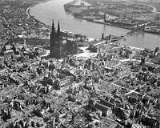
Area bombing directive

Encyclopedia

Air Ministry
The Air Ministry was a department of the British Government with the responsibility of managing the affairs of the Royal Air Force, that existed from 1918 to 1964...
to the Royal Air Force
Royal Air Force
The Royal Air Force is the aerial warfare service branch of the British Armed Forces. Formed on 1 April 1918, it is the oldest independent air force in the world...
which ordered RAF bombers to attack the German industrial workforce and the morale of the German populace through bombing German cities and their civilian inhabitants.
Background and implementation
The Area Bombing Directive (General Directive No.5 (S.46368/111. D.C.A.S) was a 14 February 1942 was an amendment to General Directive No.4 (S.46368 D.C.A.S), issued by the British Air MinistryAir Ministry
The Air Ministry was a department of the British Government with the responsibility of managing the affairs of the Royal Air Force, that existed from 1918 to 1964...
on 5 February 1942, that had informed RAF Bomber Command
RAF Bomber Command
RAF Bomber Command controlled the RAF's bomber forces from 1936 to 1968. During World War II the command destroyed a significant proportion of Nazi Germany's industries and many German cities, and in the 1960s stood at the peak of its postwar military power with the V bombers and a supplemental...
that it had "Priority over all other commitments", and directed RAF Bomber Command to bomb factories in occupied France. General Directive Number 5 amended Number 4 to make targets in Germany the priority for RAF Bomber Command.
The directive issued on 14 February (S.46368/111. D.C.A.S) listed the primary industrial areas that were within 350 miles from RAF Mildenhall
RAF Mildenhall
RAF Mildenhall is a Royal Air Force station located at Mildenhall in Suffolk, England. Despite its status as an RAF station, it primarily supports United States Air Force operations and is currently the home of the 100th Air Refueling Wing...
; the distance being a little over the maximum range of the GEE
GEE (navigation)
Gee was the code name given to a radio navigation system used by the Royal Air Force during World War II.Different sources record the name as GEE or Gee. The naming supposedly comes from "Grid", so the lower case form is more correct, and is the form used in Drippy's publications. See Drippy 1946....
radio navigation aid (referred to in the directive as "T.R. 1335"). The directive specifically mentions the Ruhr
Ruhr
The Ruhr is a medium-size river in western Germany , a right tributary of the Rhine.-Description:The source of the Ruhr is near the town of Winterberg in the mountainous Sauerland region, at an elevation of approximately 2,200 feet...
and that Essen
Bombing of Essen in World War II
During World War II, the industrial town of Essen, was a target of Allied strategic bombing.The Krupp factory was an inmportant industrial target, Essen was a "primary target" designated for area bombing by the February 1942 British Area bombing directive....
, in the centre of the conurbation was to be given the dubious honour as the first target that was to be bombed (the first attack on Essen under this directive was carried out on the night of 8/9 March). The objective of the directive was "To focus attacks on the morale of the enemy civil population and in particular the industrial workers. In the case of Berlin harassing attacks to maintain fear of raids and to impose A. R. P.
Air Raid Precautions
Air Raid Precautions was an organisation in the United Kingdom set up as an aid in the prelude to the Second World War dedicated to the protection of civilians from the danger of air-raids. It was created in 1924 as a response to the fears about the growing threat from the development of bomber...
measures".
The directive issued on 14 February listed the north coast industrial areas (within range of GEE) and industrial areas beyond the operational reach of GEE (Berlin by name and northern central and southern Germany), as secondary targets to be bombed when the weather over those targets was more suitable for bombing than over the primary area. Other German cities mentioned by name and to be attacked with a high-explosives were Duisburg
Bombing of Duisburg in World War II
Duisburg was bombed a number of times by the Allies during World War II. The most devastating air raids on Duisburg occurred during October 1944 when the city was bombed by the Royal Air Force ....
, Düsseldorf and Cologne
Bombing of Cologne in World War II
The City of Cologne was bombed in 262 separate air raids by the Allies during World War II, including 31 times by the Royal Air Force . Air raid alarms went off in the winter/spring of 1940 as enemy bombers passed overhead. However, the first actual bombing took place on 12 May 1940...
. Billancourt in occupied France, that was the primary target in the directive issued on 5 February (Air Ministry Reference 46268 D.C.A.S) and immediately preceding this one, was to become secondary target (it was bombed on the night 3/4 March). In addition the RAF were also directed to carry out specific operations to support Combined Operations, such as the periodic bombardment of targets of immediate strategic importance, for example navel units (see Channel Dash that happened only 2 days before this directive was issued), but it added a qualifier that these were only to be carried out if good opportunities to attack primary targets were not missed.
The directive issued on 14 February also stated that "You are accordingly authorized to employ your forces without restriction" which lifted the injunction placed on Bomber Command on 13 November 1941 ordering it to conserve its forces after the very heavy mauling it had suffered at the hands of Luftwaffe night fighters earlier that month.
The day after the directive was issued (on 15 February), the Chief of the Air Staff
Chief of the Air Staff
The Chief of the Air Staff is the professional head of the Royal Air Force and a member of both the Chiefs of Staff Committee and the Air Force Board. The current Chief of the Air Staff is Air Chief Marshal Sir Stephen Dalton...
Charles Portal
Charles Portal, 1st Viscount Portal of Hungerford
Marshal of the Royal Air Force Charles Frederick Algernon Portal, 1st Viscount Portal of Hungerford KG GCB OM DSO & Bar MC was a senior Royal Air Force officer and an advocate of strategic bombing...
sought clarification from the Deputy Chief of Air Staff Air Vice Marshal Norman Bottomley
Norman Bottomley
Air Chief Marshal Sir Norman Howard Bottomley KCB CIE DSO AFC RAF was the Yorkshire-born successor to Arthur 'Bomber' Harris as Commander-in-Chief of RAF Bomber Command in 1945.-RAF career:...
who had drafted it: "ref the new bombing directive: I suppose it is clear the aiming points will be the built up areas, and not, for instance, the dockyards or aircraft factories where these are mentioned in Appendix A. This must be made quite clear if it is not already understood."
The first major target attacked in the campaign initiated by the directive was Essen on the night of 8/9 March 1942. This was followed by repeated incendiary attacks on Essen and the other three large cities in the Ruhr
Ruhr
The Ruhr is a medium-size river in western Germany , a right tributary of the Rhine.-Description:The source of the Ruhr is near the town of Winterberg in the mountainous Sauerland region, at an elevation of approximately 2,200 feet...
, and then "as opportunity offered, fourteen other industrial cities in Northern, Central and Southern Germany."
Between 21 March and 3 September 1942 eight further modifications were made to the directive (all under the same Air Ministry reference, but modified file references). These were:
- 21 March: Attack the Ruhr using concentrated incendiary attacks ("such as the enemy had made on use to good effect"). It was in part to be experimental with different sizes of incendiary devices to be used to asses their effectiveness.
- 16 April: Support Special Operations ExecutiveSpecial Operations ExecutiveThe Special Operations Executive was a World War II organisation of the United Kingdom. It was officially formed by Prime Minister Winston Churchill and Minister of Economic Warfare Hugh Dalton on 22 July 1940, to conduct guerrilla warfare against the Axis powers and to instruct and aid local...
(SOE) operations. - 18 April: Daylight bombing of Le Creusot Works
- 18 April: Bomb the Pilsen (Skoda) Works on the night of 23/24 April. "To cover highly organised extensive sabotage attacks against German lines of communications with Russian Front, and to boost Czech morale while increasing R.A.F. prestige at the expense of German propaganda".
- 5 May: Change the secondary targets and objectives laid out in the initial directive. The changes directed the RAF to bomb Bremen, Kassel, Frankfurt, and Stuttgart "to reduce the output of enemy aircraft, especially fighters, to assist Russia and projected Combined Operations".
- 25 May: Added as targets industrial plants used by the Germans in all occupied countries (previously the directive had only covered plants in France).
- 16 June: A further modification to the original directive on the 5 February replacing the old French targets (now destroyed or severely damaged) with some new ones, but emphasised that the targets in the list should only be bombed by experienced crews and only if weather conditions did not make it likely that for political reasons stray bombs would fall on adjacent properties.
- 3 September: the synthetic oil plant at Pölitz to the list of targets because the British believed it to be the largest in the world and supplying a large part of the German requirements for their offensive on the Eastern Front.
The operations of the RAF were also modified by other directives issued by the Air Ministry while Directive S.46368 was still effective. For example, on 30 July 1942 (S.3319 A.C.A.S. Ops) gave priority to "Transportation and Transformer Stations" for Number 2 Group and S.O.E. squadron. while on 4 September (S.46344 A.C.A.S. Ops) directed that incendiary bombs were to be "dropped in harvest season during normal bombing operations" as cover for sabotage operations. On 14 January 1943 directive (S.46239/?? A.C.A.S. Ops) gave priority to attacking U-boat pens of Lorient
Lorient
Lorient, or L'Orient, is a commune and a seaport in the Morbihan department in Brittany in north-western France.-History:At the beginning of the 17th century, merchants who were trading with India had established warehouses in Port-Louis...
, St Nazaire, Brest
Brest, France
Brest is a city in the Finistère department in Brittany in northwestern France. Located in a sheltered position not far from the western tip of the Breton peninsula, and the western extremity of metropolitan France, Brest is an important harbour and the second French military port after Toulon...
and La Pallice on the western French coast. In line with the bombing of Genoa and Turin on 23 October 1942 and a speech by the British Prime Minister Winston Churchill
Winston Churchill
Sir Winston Leonard Spencer-Churchill, was a predominantly Conservative British politician and statesman known for his leadership of the United Kingdom during the Second World War. He is widely regarded as one of the greatest wartime leaders of the century and served as Prime Minister twice...
six days later, warning the Italian government that the RAF would continue bombing Italian cities while Italy remained an Axis power, a directive was issued on 17 January 1943 (S.46368/??? D.C.A.S. Ops) added to the bombing list of targets the Industrial centres of Northern Italy — Milan, Turin, Genoa and Spezia.
The Area Bombing Directive was superseded by the Casablanca directive
Casablanca directive
The Casablanca directive was approved by the Combined Chiefs of Staff of the Western Allies at their 65th meeting on 21 January 1943 and issued to the appropriate the Royal Air Force and United States Army Air Force commanders on 4 February 1943....
(C.S. 16536 S.46368 A.C.A.S. Ops). It was approved by the Combined Chiefs of Staff
Combined Chiefs of Staff
The Combined Chiefs of Staff was the supreme military command for the western Allies during World War II. It was a body constituted from the British Chiefs of Staff Committee and the American Joint Chiefs of Staff....
at their 65th meeting on 21 January 1943 and issued by the British and United States Army Air Force Commanders on 4 February 1943. The primary objective was "The progressive destruction and dislocation of the German military, industrial and economic systems and the undermining of the morale of the German people to a point where their capacity for armed resistance is fatally weakened. Every opportunity to be taken to attack Germany by day to destroy objectives that are unsuitable for night attack, to sustain continuous pressure on German morale, to impose heavy losses on German day fighter force, and to conserve German fighter strength away from the Russian and Mediterranean theatres of war. A list of target systems was also drawn up which gave priority to (a) Submarine construction yards, (b) German aircraft industry, (c) transportation, (d) oil plants (e) other targets in enemy war industry. The priority was to be varied with the strategic situation and the u-boat bases in France.