

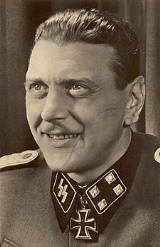
Otto Skorzeny

Encyclopedia
Otto Skorzeny was an SS
-Obersturmbannführer
(Lieutenant Colonel) in the German
Waffen-SS
during World War II
. After fighting on the Eastern Front, he was chosen as the field commander to carry out the rescue mission that freed the deposed Italian dictator Benito Mussolini
from captivity. Skorzeny was also the leader of Operation Greif
, in which German soldiers were to infiltrate through enemy lines, using their opponents' uniforms and customs. At the end of the war, Skorzeny was involved with the Werwolf guerrilla movement
and the ODESSA
network where Skorzeny would serve as Spanish coordinator.
Although he was charged with breaching the 1907 Hague Convention
in relation with Operation Greif, the Dachau Military Tribunal acquitted Skorzeny after the war. Skorzeny fled from his holding prison in 1948, first to France
, and then to Spain
.
into a middle-class Austria
n family which had a long history of military service. In addition to his native German, he spoke excellent French.
In his teens, Otto once complained to his father of the austere lifestyle that his family was suffering from, by mentioning he had never tasted real butter in his life, because of the depression that plagued Austria after its defeat in World War I
. His father prophetically replied, "There is no harm in doing without things. It might even be good for you not to get used to a soft life." Thus his underprivileged upbringing helped make him the feared commando that he became . He was a noted fencer
as a university student in Vienna. He engaged in thirteen personal combats. The tenth resulted in a wound that left a dramatic dueling scar
- known in academic fencing
as a Schmiss (German for smite or hit)- on his cheek.
In 1931 Skorzeny joined the Austrian Nazi Party
and soon became a member of the Nazi SA
. A charisma
tic figure, Skorzeny played a minor role in the Anschluss
on 12 March 1938, when he saved the Austrian President Wilhelm Miklas
from being shot by Austrian Nazis.
, Skorzeny, then working as a civil engineer
, volunteered for service in the German Air Force (the Luftwaffe
), but was turned down because he was considered too tall and too old for aircrew training. He then joined Hitler's bodyguard regiment, the Leibstandarte SS Adolf Hitler (LSSAH) as an officer-cadet.
In 1940, as an SS Untersturmführer
(Second Lieutenant), he impressed his superiors by designing ramps to load tanks on ships. He then fought in Holland, France, and the Balkans, where he achieved distinction by forcing a large Yugoslav force to surrender, following which he was promoted to Obersturmführer
(First Lieutenant) in the Waffen-SS
.
Skorzeny went to war in Russia with the 2nd SS Panzer Division Das Reich and subsequently fought in several battles on the Eastern Front
. In October 1941, he was in charge of a "technical section" of the German forces during the Battle of Moscow
. His mission was to seize important buildings of the Communist Party, including the NKVD headquarters at Lubyanka
, and the Central Telegraph and other high priority facilities, before they could be destroyed. He was also ordered to capture the sluices of the Moscow-Volga Canal
because Hitler wanted them used to turn Moscow into a huge artificial lake by opening them. The missions were canceled as the German forces failed to capture the Soviet capital.
In December 1942, Skorzeny was hit in the back of the head by shrapnel from Russian Katyusha artillery rockets. He refused all first aid except for a few aspirin, a bandage, and a glass of schnaps. A few hours later Skorzeny rejoined his unit but his health deteriorated, and continuous headaches and stomach pains forced him to evacuate for proper medical treatment. He was awarded the Iron Cross
for bravery
under fire and was hospitalized in Vienna. While recuperating from his injuries he was given a staff role in Berlin
, where he read all the published literature he could find on commando warfare, and forwarded to higher command his ideas on unconventional commando warfare.
Skorzeny's proposals were to develop units specialized in such unconventional warfare, including partisan-like fighting deep behind enemy lines, fighting in enemy uniform, sabotage attacks, etc. In April 1943 Skorzeny's name was put forward by Ernst Kaltenbrunner
, the new head of the RSHA
, and Skorzeny met with SS-Brigadeführer Walter Schellenberg
, head of Amt VI, Ausland-SD, (the SS foreign intelligence service department of the RSHA). Schellenberg charged Skorzeny with command of the schools organized to train operatives in sabotage, espionage, and paramilitary techniques. Skorzeny was appointed commander of the recently created Waffen Sonderverband z.b.V. Friedenthal
stationed near Berlin. (The unit was later renamed SS Jagdverbände 502
, and in November 1944 again to SS Combat Unit "Center", expanding ultimately to five battalions.)
Sonderverband z.b.V. Friedenthal's first mission was in summer 1943. Operation Francois saw Skorzeny send a group by parachute into Iran to make contact with the dissident mountain tribes to encourage them to sabotage Allied supplies of material being sent to the Soviet Union via the Trans-Iranian Railway
. However, commitment among the rebel tribes was suspect, and Operation Francois was deemed a failure.
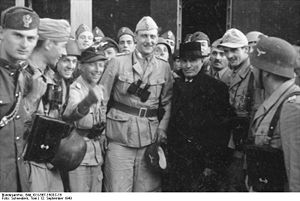 In July 1943, he was personally selected by Hitler from among six German Air Force (Luftwaffe
) and German Army (Wehrmacht Heer) special agents to lead the operation to rescue Italian dictator Benito Mussolini
, who had been overthrown and imprisoned by the Italian government.
Almost two months of cat-and-mouse followed as the Italians moved Mussolini from place to place to frustrate any rescuers. There was a failed attempt to rescue Mussolini on 27 July 1943. The Ju 52 that the crew was aboard was shot down in the area of Pratica di Mare. Otto Skorzeny and his crew managed to bailout, except for one young Oberjäger. For reasons unknown, he was not able to make it out of the plane. He perished in the crash and is now buried in the war cemetery in Pomezia
. Mussolini was first held in a villa on La Maddalena, near Sardinia
. Skorzeny was able to smuggle an Italian-speaking commando onto the island, and a few days later he confirmed Mussolini was in the villa. Skorzeny then flew over in a Heinkel He 111
to take aerial photos of the location. The bomber was shot down by Allied fighters and crash-landed at sea, but Skorzeny and the crew were rescued by an Italian destroyer. Mussolini was moved soon after.
Information on Mussolini's new location and its topographical features were finally secured by Herbert Kappler
. Kappler reported Mussolini was held in the Campo Imperatore Hotel at the top of the Gran Sasso
mountain, and only accessible by cable car from the valley below. Skorzeny flew again over Gran Sasso and took pictures of the location with a handheld camera. An attack plan was formulated by General Kurt Student
, Harald Mors (a paratrooper battalion commander), and Skorzeny.
On September 12, Gran Sasso raid (a.k.a. Operation Oak and Unternehmen Eiche), was carried out perfectly according to plan. Mussolini was rescued without firing a single shot. Flying out in a Storch airplane
, Skorzeny escorted Mussolini to Rome
and later to Berlin
. The exploit earned Skorzeny fame, promotion to Sturmbannführer
and the Knight's Cross of the Iron Cross
.
Mussolini created a new Fascist regime in northern Italy, the Italian Social Republic
(Repubblica Sociale Italiana).
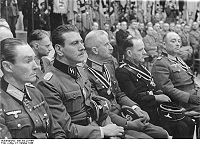 "Operation Long Jump" was the codename given to the unsuccessful plot to assassinate the "Big Three" (Joseph Stalin
, Winston Churchill
, and Franklin Roosevelt) at the 1943 Tehran Conference
. The plot was approved by Hitler and headed by Ernst Kaltenbrunner
. German intelligence had learned of the time and place of the conference in mid-October 1943, after breaking a US Navy code. Otto Skorzeny, as the man who always seemed to have luck on his side, was chosen by Kaltenbrunner to head the mission.
 However, Soviet intelligence first became aware of the plot when legendary Soviet spy Nikolai Kuznetsov
got SS Sturmbannfuhrer Hans Ulrich von Ortel to tell him about the operation while drunk. Six German radio operators were dropped by parachute and made their way to Tehran
, but were eventually found by Soviet agents led by Gevork Vartanian
. One of the Germans realized they were under surveillance and the operation was called off; Skorzeny himself considered the intelligence coming from Tehran to be inadequate and did not believe the complex scheme could have worked.
was re-designated SS-Jäger-Bataillon 502
with Skorzeny staying on as commander. They were assigned to Operation Rösselsprung, known subsequently as the Raid on Drvar. Rösselsprung was a commando operation meant to capture the Yugoslav commander-in-chief, Marshal Josip Broz Tito
, who was also recently recognized by the Allies as the Yugoslav prime minister. Marshal Tito led the Yugoslav Partisans resistance army from his headquarters near the Bosnian
town of Drvar
, in the center of a large non-occupied area held by the Partisans. Hitler knew that Tito was receiving Allied support and was aware that either British or American troops might land in Dalmatia
along the Adriatic coastline with support from the Partisans. Killing or capturing Tito would not only hinder this, it would give a badly needed boost to the morale of Axis forces engaged in the Yugoslav Front in occupied Yugoslavia.
Skorzeny was involved in planning Rösselsprung and was intended to command it. However, he argued against implementation after he visited Zagreb
and discovered that the operation had been compromised through the carelessness of German agents in the Independent State of Croatia
(a German puppet state on occupied Yugoslav territory).
Rösselsprung was put into action nonetheless, but it was a complete disaster. The first wave of paratroopers, following heavy bombardment by the Luftwaffe, jumped between Tito's hideout in a cave and the town of Drvar
; they landed on open ground and many were promptly shot by members of the Partisan headquarters Escort Battalion, a unit numbering fewer than a hundred soldiers. The second wave of paratroopers missed their target and landed several miles out of town. Tito was gone long before paratroopers reached the cave; a trail at the back of the cave led to the railway tracks where Tito boarded a train that took him safely to Jajce
. In the meantime, the Partisan 1st Brigade, from the 6th Lika Partisan Division, arrived after a twelve-mile (nineteen-kilometer) forced march and attacked the Waffen-SS paratroopers, inflicting heavy casualties.
was made. Anti-Nazi German Army officers tried to seize control of Germany's main decision centers before Hitler recovered from his injuries. Skorzeny helped put down the rebellion, spending 36 hours in charge of the Wehrmacht's central command centre before being relieved. He got to the Bendlerstrasse offices a half hour after Claus Von Stauffenberg and the others were executed.
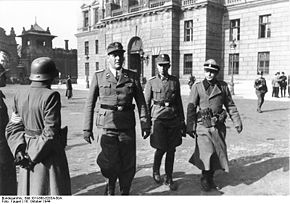 In October 1944, Hitler sent Skorzeny to Hungary
after receiving word that Hungary's Regent, Admiral Miklós Horthy
, was secretly negotiating with the Red Army
. The surrender of Hungary would have cut off the million German troops still fighting in the Balkan peninsula. Skorzeny, in a daring "snatch" codenamed Operation Panzerfaust
(known as Operation Eisenfaust in Germany), kidnapped Horthy's son Miklós Horthy, Jr.
and forced his father to resign as head of state
. A pro-Nazi government under dictator
Ferenc Szálasi
was then installed in Hungary. In April 1945, after German and Hungarian forces had already been driven out of Hungary, Szálasi and his Arrow Cross Party
-based forces continued the fight in Austria and Slovakia
. The success of the operation earned Skorzeny promotion to Obersturmbannführer
.
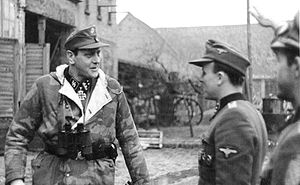 As part of the German Ardennes offensive in late 1944 ("The Battle of the Bulge") Skorzeny's English speaking troops were charged with infiltrating Allied lines dressed and equipped as American soldiers in order to produce confusion to support the German attack. For the campaign, Skorzeny was the commander of a composite unit; the 150th SS Panzer Brigade.
As planned by Skorzeny, Operation Greif
involved about two dozen German soldiers, most of them in captured American Jeeps and dressed as American soldiers, who would penetrate American lines in the early hours of the Battle of the Bulge
and cause disorder and confusion behind the Allied lines. A handful of his men were captured and spread a rumour that Skorzeny personally was leading a raid on Paris to kill or capture General Eisenhower, who was not amused by having to spend Christmas 1944 isolated for security reasons. Eisenhower retaliated by ordering an all-out manhunt for Skorzeny, with "Wanted" posters distributed throughout Allied-controlled territories featuring a detailed description and a photograph.
Skorzeny spent January and February 1945 commanding regular troops in the defence of the German provinces of East Prussia
and Pomerania
, as an acting major general. Fighting at Schwedt
on the Oder River, he received orders to sabotage
a bridge on the Rhine at Remagen
. His frogmen tried but failed. For his actions in the East, primarily in the defence of Frankfurt
, Hitler awarded him one of Germany's highest military honours, the Oak Leaves to the Knight's Cross
. He was then sent on an inspection tour along the rapidly deteriorating Eastern front.
Nazi organization, the Werwölfe
(Werewolves), who would engage in guerrilla warfare
against the occupying Allies
. However, Skorzeny quickly realized that the Werewolves were too few in number to become an effective fighting force and instead used them to set up the "ratlines
", a secret "underground railroad
" that helped leading Nazis escape after Germany's surrender
.
Besides organising the "ratlines," which would form the basis of the supposed ODESSA
network after the war, Skorzeny had been employed since August 1944 by high-ranking Nazis and German industrialists to hide money and documents, some of which was buried in the mountains or dropped in the lakes of Bavaria
, and some shipped overseas.
Skorzeny surrendered on 16 May 1945, feeling that he could be useful to the Americans in the forthcoming Cold War
. He emerged from the woods near Salzburg
, Austria, and surrendered to a Lieutenant of the US 30th Infantry Regiment
.
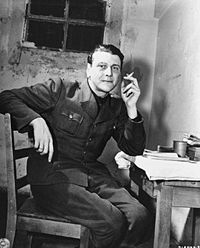 He was held as a prisoner of war
for more than two years before being tried as a war criminal at the Dachau Trials in 1947 for allegedly violating the laws of war
in the Battle of the Bulge. He and officers of the Panzer Brigade 150
were charged with improperly using American uniforms to infiltrate American lines. Skorzeny was brought before a US military court in Dachau on 18 August 1947. He and nine fellow officers of the 150th Panzer Brigade would face charges of improper use of military insignia, theft of US uniforms, and theft of Red Cross parcel
s from prisoners of war. The trial lasted over three weeks. The charge of stealing Red Cross parcels was dropped for lack of evidence. Skorzeny admitted to ordering his men to wear American uniforms, but his defence argued that providing that enemy uniforms were discarded before combat started such a tactic was a legitimate ruse de guerre. On the final day of the trial, 9 September, Wing Commander
F. F. E. Yeo-Thomas
, recipient of the George Cross
and the Croix de guerre
, and a former British Special Operations Executive
agent, testified that he had worn German uniforms behind enemy lines. Realising that to convict Skorzeny could expose their own agent to the same charges, the tribunal acquitted the ten defendants, the military tribunal drawing a distinction between using enemy uniforms during combat and for other purposes including deception. They could not prove that Skorzeny had given any orders to actually fight in a US uniform.
awaiting the decision of a denazification
court. On July 27, 1948 he escaped from the camp with the help of three former SS officers dressed in US Military Police uniforms who entered the camp and claimed that they had been ordered to take Skorzeny to Nuremberg for a legal hearing. Skorzeny afterwards maintained that the US authorities had aided his escape, and had supplied the uniforms.
Skorzeny hid out at a farm in Bavaria which had been rented by Countess Ilse Lüthje, the niece of Hjalmar Schacht
(Hitler's former finance minister), for around 18 months, during which time he was in contact with Reinhard Gehlen
, and together with Hartmann Lauterbacher
(former deputy head of the Hitler Youth
) recruited for the Gehlen Organization.
Skorzeny was photographed at a café on the Champs Elysées in Paris
on 13 February 1950, and the photo appeared in the French press the next day, causing him to retreat to Salzburg, where he met up with German veterans and also filed for divorce so that he could marry Ilse Lüthje. Shortly afterwards, with the help of a Nansen passport
issued by the Spanish government, he moved to Madrid
, where he set up a small engineering business which helped serve as a front for his operations with the ODESSA
network as he had become the Spanish coordinator. On April 1950 the publication of Skorzeny's memoirs by French newspaper Le Figaro
caused 1500 communists to riot outside the journal's headquarters.
, who was now working for the CIA, to act as Naguib's military advisor. Skorzeny recruited a staff made up of former SS officers to train the Egyptian army. Among these officers were SS General Wilhelm Farmbacher, Panzer General Oskar Munzel
, Leopold Gleim
, head of the Gestapo
Department for Jewish Affairs in Poland, and Joachim Daemling, former chief of the Gestapo in Düsseldorf joined Skorzeny in Egypt. In addition to training the army, Skorzeny also trained Arab volunteers in commando tactics for possible use against British troops stationed in the Suez Canal zone. Several Palestinian refugees also received commando training, and Skorzeny planned their initial strikes into Israel via the Gaza Strip in 1953-1954. One of these Palestinians was Yasser Arafat
. He would eventually serve as an adviser to Egyptian President Gamal Abdel Nasser
.
which helped as many as 600 former SS men escape from Germany to Spain, Argentina, Paraguay, Chile, Bolivia, and other countries. As the years went by, Skorzeny, Gehlen, and their network of collaborators gained enormous influence in Europe and Latin America. Skorzeny traveled between Franquist Spain and Argentina
, where he acted as an advisor to President Juan Perón
and bodyguard of Eva Perón
, while fostering an ambition for the "Fourth Reich
" centered in Latin America.
, which had been established in 1966, and which counted him as one of its founding fathers.
) in absentia
in 1952 by a West German government arbitration board, which now meant he could travel from Spain into other Western countries. He spent part of his time between 1959 and 1969 in Ireland, where he bought Martinstown House, a 200 acre (0.809372 km²) farm in County Kildare
in 1959. He also had property in Mallorca
.
, which he envisioned as "an international directorship of strategic assault personnel[ that would] straddle the watershed between paramilitary operations carried out by troops in uniforms and the political warfare which is conducted by civilian agents". Based near Alicante
, Spain, the Paladin Group specialized in arming and training guerrillas, and their clients included the South African Bureau of State Security
and Muammar al-Gaddafi
. They also carried out work for the Greek military junta of 1967–1974 and some of their operatives were recruited by the Spanish Interior Ministry to wage clandestine war against Basque separatists. The Soviet news agency TASS
alleged that Paladin was involved in training US Green Berets
for Vietnam missions during the 1960s, but this is considered unlikely.
, but the surgery left him paralyzed from the waist down. Vowing to walk again, Skorzeny spent long hours with a physical therapist, and within six months was back on his feet.
Otto Skorzeny finally succumbed to cancer on 5 July 1975 in Madrid. He was 67. He was cremated and his ashes were later brought to Vienna to be interred in the Skorzeny family plot at Döblinger Friedhof
.
Schutzstaffel
The Schutzstaffel |Sig runes]]) was a major paramilitary organization under Adolf Hitler and the Nazi Party. Built upon the Nazi ideology, the SS under Heinrich Himmler's command was responsible for many of the crimes against humanity during World War II...
-Obersturmbannführer
Obersturmbannführer
Obersturmbannführer was a paramilitary Nazi Party rank used by both the SA and the SS. It was created in May 1933 to fill the need for an additional field grade officer rank above Sturmbannführer as the SA expanded. It became an SS rank at the same time...
(Lieutenant Colonel) in the German
Germany
Germany , officially the Federal Republic of Germany , is a federal parliamentary republic in Europe. The country consists of 16 states while the capital and largest city is Berlin. Germany covers an area of 357,021 km2 and has a largely temperate seasonal climate...
Waffen-SS
Waffen-SS
The Waffen-SS was a multi-ethnic and multi-national military force of the Third Reich. It constituted the armed wing of the Schutzstaffel or SS, an organ of the Nazi Party. The Waffen-SS saw action throughout World War II and grew from three regiments to over 38 divisions, and served alongside...
during World War II
World War II
World War II, or the Second World War , was a global conflict lasting from 1939 to 1945, involving most of the world's nations—including all of the great powers—eventually forming two opposing military alliances: the Allies and the Axis...
. After fighting on the Eastern Front, he was chosen as the field commander to carry out the rescue mission that freed the deposed Italian dictator Benito Mussolini
Benito Mussolini
Benito Amilcare Andrea Mussolini was an Italian politician who led the National Fascist Party and is credited with being one of the key figures in the creation of Fascism....
from captivity. Skorzeny was also the leader of Operation Greif
Operation Greif
Operation Greif was a special false flag operation commanded by Waffen-SS commando Otto Skorzeny during the Battle of the Bulge. The operation was the brainchild of Adolf Hitler, and its purpose was to capture one or more of the bridges over the Meuse river before they could be destroyed...
, in which German soldiers were to infiltrate through enemy lines, using their opponents' uniforms and customs. At the end of the war, Skorzeny was involved with the Werwolf guerrilla movement
Werwolf
Werwolf was the name given to a Nazi plan, which began development in 1944, to create a commando force which would operate behind enemy lines as the Allies advanced through Germany itself. Werwolf remained entirely ineffectual as a combat force, however, and in practical terms, its value as...
and the ODESSA
ODESSA
The ODESSA, from the German Organisation der ehemaligen SS-Angehörigen, meaning “Organization of Former SS Members,” is believed to have been an international Nazi network set up toward the end of World War II by a group of SS officers...
network where Skorzeny would serve as Spanish coordinator.
Although he was charged with breaching the 1907 Hague Convention
Hague Conventions (1899 and 1907)
The Hague Conventions were two international treaties negotiated at international peace conferences at The Hague in the Netherlands: The First Hague Conference in 1899 and the Second Hague Conference in 1907...
in relation with Operation Greif, the Dachau Military Tribunal acquitted Skorzeny after the war. Skorzeny fled from his holding prison in 1948, first to France
France
The French Republic , The French Republic , The French Republic , (commonly known as France , is a unitary semi-presidential republic in Western Europe with several overseas territories and islands located on other continents and in the Indian, Pacific, and Atlantic oceans. Metropolitan France...
, and then to Spain
Spain
Spain , officially the Kingdom of Spain languages]] under the European Charter for Regional or Minority Languages. In each of these, Spain's official name is as follows:;;;;;;), is a country and member state of the European Union located in southwestern Europe on the Iberian Peninsula...
.
Prewar years
Otto Skorzeny was born in ViennaVienna
Vienna is the capital and largest city of the Republic of Austria and one of the nine states of Austria. Vienna is Austria's primary city, with a population of about 1.723 million , and is by far the largest city in Austria, as well as its cultural, economic, and political centre...
into a middle-class Austria
Austria
Austria , officially the Republic of Austria , is a landlocked country of roughly 8.4 million people in Central Europe. It is bordered by the Czech Republic and Germany to the north, Slovakia and Hungary to the east, Slovenia and Italy to the south, and Switzerland and Liechtenstein to the...
n family which had a long history of military service. In addition to his native German, he spoke excellent French.
In his teens, Otto once complained to his father of the austere lifestyle that his family was suffering from, by mentioning he had never tasted real butter in his life, because of the depression that plagued Austria after its defeat in World War I
World War I
World War I , which was predominantly called the World War or the Great War from its occurrence until 1939, and the First World War or World War I thereafter, was a major war centred in Europe that began on 28 July 1914 and lasted until 11 November 1918...
. His father prophetically replied, "There is no harm in doing without things. It might even be good for you not to get used to a soft life." Thus his underprivileged upbringing helped make him the feared commando that he became . He was a noted fencer
Academic fencing
Academic fencing or Mensur is the traditional kind of fencing practiced by some student corporations in Germany, Austria, Switzerland, and to a minor extent in Kosovo, Estonia, Latvia, Poland and Flanders.- Technique :Modern academic fencing, the "mensur," is neither a duel nor a sport...
as a university student in Vienna. He engaged in thirteen personal combats. The tenth resulted in a wound that left a dramatic dueling scar
Dueling scars
Duelling scars have been seen as a “badge of honour” since as early as 1825. Known variously as "Mensur scars", "the bragging scar", "smite", "Schmitte" or "renommierschmiss", duelling scars were popular amongst upper-class Austrians and Germans involved in academic fencing at the start of the 20th...
- known in academic fencing
Academic fencing
Academic fencing or Mensur is the traditional kind of fencing practiced by some student corporations in Germany, Austria, Switzerland, and to a minor extent in Kosovo, Estonia, Latvia, Poland and Flanders.- Technique :Modern academic fencing, the "mensur," is neither a duel nor a sport...
as a Schmiss (German for smite or hit)- on his cheek.
In 1931 Skorzeny joined the Austrian Nazi Party
Austrian National Socialism
Austrian National Socialism was a Pan-German movement that was formed at the beginning of the 20th century. The movement took a concrete form on November 15, 1903 when the German Worker's Party was established in Austria with its secretariat stationed in the town of Aussig...
and soon became a member of the Nazi SA
Sturmabteilung
The Sturmabteilung functioned as a paramilitary organization of the National Socialist German Workers' Party . It played a key role in Adolf Hitler's rise to power in the 1920s and 1930s...
. A charisma
Charisma
The term charisma has two senses: 1) compelling attractiveness or charm that can inspire devotion in others, 2) a divinely conferred power or talent. For some theological usages the term is rendered charism, with a meaning the same as sense 2...
tic figure, Skorzeny played a minor role in the Anschluss
Anschluss
The Anschluss , also known as the ', was the occupation and annexation of Austria into Nazi Germany in 1938....
on 12 March 1938, when he saved the Austrian President Wilhelm Miklas
Wilhelm Miklas
Wilhelm Miklas was an Austrian politician who served as the third President of Austria, from 1928 until its annexation by Nazi Germany in the Anschluss 1938.-Early life:...
from being shot by Austrian Nazis.
The Eastern Front
After the 1939 invasion of PolandInvasion of Poland (1939)
The Invasion of Poland, also known as the September Campaign or 1939 Defensive War in Poland and the Poland Campaign in Germany, was an invasion of Poland by Germany, the Soviet Union, and a small Slovak contingent that marked the start of World War II in Europe...
, Skorzeny, then working as a civil engineer
Civil engineer
A civil engineer is a person who practices civil engineering; the application of planning, designing, constructing, maintaining, and operating infrastructures while protecting the public and environmental health, as well as improving existing infrastructures that have been neglected.Originally, a...
, volunteered for service in the German Air Force (the Luftwaffe
Luftwaffe
Luftwaffe is a generic German term for an air force. It is also the official name for two of the four historic German air forces, the Wehrmacht air arm founded in 1935 and disbanded in 1946; and the current Bundeswehr air arm founded in 1956....
), but was turned down because he was considered too tall and too old for aircrew training. He then joined Hitler's bodyguard regiment, the Leibstandarte SS Adolf Hitler (LSSAH) as an officer-cadet.
In 1940, as an SS Untersturmführer
Untersturmführer
Untersturmführer was a paramilitary rank of the German Schutzstaffel first created in July 1934. The rank can trace its origins to the older SA rank of Sturmführer which had existed since the founding of the SA in 1921...
(Second Lieutenant), he impressed his superiors by designing ramps to load tanks on ships. He then fought in Holland, France, and the Balkans, where he achieved distinction by forcing a large Yugoslav force to surrender, following which he was promoted to Obersturmführer
Obersturmführer
Obersturmführer was a paramilitary rank of the Nazi party that was used by the SS and also as a rank of the SA. Translated as “Senior Assault Leader”, the rank of Obersturmführer was first created in 1932 as the result of an expansion of the Sturmabteilung and the need for an additional rank in...
(First Lieutenant) in the Waffen-SS
Waffen-SS
The Waffen-SS was a multi-ethnic and multi-national military force of the Third Reich. It constituted the armed wing of the Schutzstaffel or SS, an organ of the Nazi Party. The Waffen-SS saw action throughout World War II and grew from three regiments to over 38 divisions, and served alongside...
.
Skorzeny went to war in Russia with the 2nd SS Panzer Division Das Reich and subsequently fought in several battles on the Eastern Front
Eastern Front (World War II)
The Eastern Front of World War II was a theatre of World War II between the European Axis powers and co-belligerent Finland against the Soviet Union, Poland, and some other Allies which encompassed Northern, Southern and Eastern Europe from 22 June 1941 to 9 May 1945...
. In October 1941, he was in charge of a "technical section" of the German forces during the Battle of Moscow
Battle of Moscow
The Battle of Moscow is the name given by Soviet historians to two periods of strategically significant fighting on a sector of the Eastern Front during World War II. It took place between October 1941 and January 1942. The Soviet defensive effort frustrated Hitler's attack on Moscow, capital of...
. His mission was to seize important buildings of the Communist Party, including the NKVD headquarters at Lubyanka
Lubyanka
Lubyanka or Lubianka may refer to:*Lubyanka Square, Moscow*Bolshaya Lubyanka Street, Moscow*Lubyanka Building, former KGB headquarters and prison at Lubyanka Square, Moscow*Lubyanka , a metro station in MoscowPlaces in Poland called Lubianka...
, and the Central Telegraph and other high priority facilities, before they could be destroyed. He was also ordered to capture the sluices of the Moscow-Volga Canal
Moscow Canal
The Moscow Canal , named the Moscow-Volga Canal until the year 1947, is a canal that connects the Moskva River with the main transportation artery of European Russia, the Volga River. It is located in Moscow itself and in the Moscow Oblast...
because Hitler wanted them used to turn Moscow into a huge artificial lake by opening them. The missions were canceled as the German forces failed to capture the Soviet capital.
In December 1942, Skorzeny was hit in the back of the head by shrapnel from Russian Katyusha artillery rockets. He refused all first aid except for a few aspirin, a bandage, and a glass of schnaps. A few hours later Skorzeny rejoined his unit but his health deteriorated, and continuous headaches and stomach pains forced him to evacuate for proper medical treatment. He was awarded the Iron Cross
Iron Cross
The Iron Cross is a cross symbol typically in black with a white or silver outline that originated after 1219 when the Kingdom of Jerusalem granted the Teutonic Order the right to combine the Teutonic Black Cross placed above a silver Cross of Jerusalem....
for bravery
Courage
Courage is the ability to confront fear, pain, danger, uncertainty, or intimidation...
under fire and was hospitalized in Vienna. While recuperating from his injuries he was given a staff role in Berlin
Berlin
Berlin is the capital city of Germany and is one of the 16 states of Germany. With a population of 3.45 million people, Berlin is Germany's largest city. It is the second most populous city proper and the seventh most populous urban area in the European Union...
, where he read all the published literature he could find on commando warfare, and forwarded to higher command his ideas on unconventional commando warfare.
Skorzeny's proposals were to develop units specialized in such unconventional warfare, including partisan-like fighting deep behind enemy lines, fighting in enemy uniform, sabotage attacks, etc. In April 1943 Skorzeny's name was put forward by Ernst Kaltenbrunner
Ernst Kaltenbrunner
Ernst Kaltenbrunner was an Austrian-born senior official of Nazi Germany during World War II. Between January 1943 and May 1945, he held the offices of Chief of the Reichssicherheitshauptamt , President of Interpol and, as a Obergruppenführer und General der Polizei und Waffen-SS, he was the...
, the new head of the RSHA
RSHA
The RSHA, or Reichssicherheitshauptamt was an organization subordinate to Heinrich Himmler in his dual capacities as Chef der Deutschen Polizei and Reichsführer-SS...
, and Skorzeny met with SS-Brigadeführer Walter Schellenberg
Walter Schellenberg
Walther Friedrich Schellenberg was a German SS-Brigadeführer who rose through the ranks of the SS to become the head of foreign intelligence following the abolition of the Abwehr in 1944.-Biography:...
, head of Amt VI, Ausland-SD, (the SS foreign intelligence service department of the RSHA). Schellenberg charged Skorzeny with command of the schools organized to train operatives in sabotage, espionage, and paramilitary techniques. Skorzeny was appointed commander of the recently created Waffen Sonderverband z.b.V. Friedenthal
Sonder Lehrgang Oranienburg
Sonderlehrgang Oranienburg was a special forces unit of Nazi Germany's Schutzstaffel. It was activated in early 1942 on the order of SS-Obergruppenführer Hans Jüttner as an obvious rival to the Wehrmacht's Brandenburg regiment....
stationed near Berlin. (The unit was later renamed SS Jagdverbände 502
SS-Jäger-Bataillon 502
SS-Jäger-Bataillon 502 was a special forces unit from Nazi Germany from 1943-1944.Formed in June 1943, the unit was commanded by Otto Skorzeny and was based at Friedenthal just north of Berlin, consisting originally of the three hundred members of the former Sonderlehrgang zbv Friedenthal...
, and in November 1944 again to SS Combat Unit "Center", expanding ultimately to five battalions.)
Sonderverband z.b.V. Friedenthal's first mission was in summer 1943. Operation Francois saw Skorzeny send a group by parachute into Iran to make contact with the dissident mountain tribes to encourage them to sabotage Allied supplies of material being sent to the Soviet Union via the Trans-Iranian Railway
Trans-Iranian Railway
The Trans-Iranian Railway was a major railway building project started in 1927 and completed in 1938, under the direction of the Persian monarch, Reza Shah, and entirely with indigenous capital. It links the capital Tehran with the Persian Gulf and Caspian Sea...
. However, commitment among the rebel tribes was suspect, and Operation Francois was deemed a failure.
Operations by Skorzeny
- Operation Francois- Co-ordination of Partisan operations in IranIranIran , officially the Islamic Republic of Iran , is a country in Southern and Western Asia. The name "Iran" has been in use natively since the Sassanian era and came into use internationally in 1935, before which the country was known to the Western world as Persia...
. - Operation Oak (Unternehmen Eiche, September 1943) – The rescue of Italian dictator Benito MussoliniBenito MussoliniBenito Amilcare Andrea Mussolini was an Italian politician who led the National Fascist Party and is credited with being one of the key figures in the creation of Fascism....
. - Operation Long Jump – A proposed attempt to assassinate the "Big Three" (Stalin, Churchill, and Roosevelt) during the 1943 Tehran Conference.
- Operation Knight's Leap (Unternehmen Rösselsprung, May 1944) – An attempt to capture Josip Broz TitoJosip Broz TitoMarshal Josip Broz Tito – 4 May 1980) was a Yugoslav revolutionary and statesman. While his presidency has been criticized as authoritarian, Tito was a popular public figure both in Yugoslavia and abroad, viewed as a unifying symbol for the nations of the Yugoslav federation...
alive. - Operation Armoured FistOperation PanzerfaustOperation Panzerfaust, known as Unternehmen Eisenfaust in Germany, was a military operation to keep the Kingdom of Hungary at Germany's side in the war, conducted in October 1944 by the German military...
(Unternehmen Panzerfaust a.k.a. Unternehmen Eisenfaust, October 1944) – The kidnapping of Miklós Horthy, Jr.Miklós Horthy, Jr.Miklós Horthy de Nagybánya II was the younger son of Hungarian regent Admiral Miklós Horthy and, until the end of World War II, a politician.-Biography:...
, son of Hungarian Regent, Admiral Miklós HorthyMiklós HorthyMiklós Horthy de Nagybánya was the Regent of the Kingdom of Hungary during the interwar years and throughout most of World War II, serving from 1 March 1920 to 15 October 1944. Horthy was styled "His Serene Highness the Regent of the Kingdom of Hungary" .Admiral Horthy was an officer of the...
, to force Admiral Horthy to resign as head of stateHead of StateA head of state is the individual that serves as the chief public representative of a monarchy, republic, federation, commonwealth or other kind of state. His or her role generally includes legitimizing the state and exercising the political powers, functions, and duties granted to the head of...
in favor of the pro-Nazi leader of the Arrow Cross PartyArrow Cross PartyThe Arrow Cross Party was a national socialist party led by Ferenc Szálasi, which led in Hungary a government known as the Government of National Unity from October 15, 1944 to 28 March 1945...
, Ferenc SzálasiFerenc SzálasiFerenc Szálasi was the leader of the National Socialist Arrow Cross Party – Hungarist Movement, the "Leader of the Nation" , being both Head of State and Prime Minister of the Kingdom of Hungary's "Government of National Unity" for the final three months of Hungary's participation in World War II...
. - Operation GriffinOperation GreifOperation Greif was a special false flag operation commanded by Waffen-SS commando Otto Skorzeny during the Battle of the Bulge. The operation was the brainchild of Adolf Hitler, and its purpose was to capture one or more of the bridges over the Meuse river before they could be destroyed...
(Unternehmen Greif, December 1944) – A false flagFalse flagFalse flag operations are covert operations designed to deceive the public in such a way that the operations appear as though they are being carried out by other entities. The name is derived from the military concept of flying false colors; that is flying the flag of a country other than one's own...
operation to spread disinformationDisinformationDisinformation is intentionally false or inaccurate information that is spread deliberately. For this reason, it is synonymous with and sometimes called black propaganda. It is an act of deception and false statements to convince someone of untruth...
during the Battle of the BulgeBattle of the BulgeThe Battle of the Bulge was a major German offensive , launched toward the end of World War II through the densely forested Ardennes mountain region of Wallonia in Belgium, hence its French name , and France and...
. - Werewolf SSWerwolfWerwolf was the name given to a Nazi plan, which began development in 1944, to create a commando force which would operate behind enemy lines as the Allies advanced through Germany itself. Werwolf remained entirely ineffectual as a combat force, however, and in practical terms, its value as...
– A planned Nazi underground resistance movement in Allied-occupied EuropeEuropeEurope is, by convention, one of the world's seven continents. Comprising the westernmost peninsula of Eurasia, Europe is generally 'divided' from Asia to its east by the watershed divides of the Ural and Caucasus Mountains, the Ural River, the Caspian and Black Seas, and the waterways connecting...
.
The liberation of Mussolini
Luftwaffe
Luftwaffe is a generic German term for an air force. It is also the official name for two of the four historic German air forces, the Wehrmacht air arm founded in 1935 and disbanded in 1946; and the current Bundeswehr air arm founded in 1956....
) and German Army (Wehrmacht Heer) special agents to lead the operation to rescue Italian dictator Benito Mussolini
Benito Mussolini
Benito Amilcare Andrea Mussolini was an Italian politician who led the National Fascist Party and is credited with being one of the key figures in the creation of Fascism....
, who had been overthrown and imprisoned by the Italian government.
Almost two months of cat-and-mouse followed as the Italians moved Mussolini from place to place to frustrate any rescuers. There was a failed attempt to rescue Mussolini on 27 July 1943. The Ju 52 that the crew was aboard was shot down in the area of Pratica di Mare. Otto Skorzeny and his crew managed to bailout, except for one young Oberjäger. For reasons unknown, he was not able to make it out of the plane. He perished in the crash and is now buried in the war cemetery in Pomezia
Pomezia
Pomezia is a municipality in the province of Rome, Lazio, central Italy. In 2009 it had a population of about 60,000.-History:The town was built entirely new near the location of ancient Lavinium on land resulting from the final reclamation of the Pontine Marshes under Benito Mussolini, being...
. Mussolini was first held in a villa on La Maddalena, near Sardinia
Sardinia
Sardinia is the second-largest island in the Mediterranean Sea . It is an autonomous region of Italy, and the nearest land masses are the French island of Corsica, the Italian Peninsula, Sicily, Tunisia and the Spanish Balearic Islands.The name Sardinia is from the pre-Roman noun *sard[],...
. Skorzeny was able to smuggle an Italian-speaking commando onto the island, and a few days later he confirmed Mussolini was in the villa. Skorzeny then flew over in a Heinkel He 111
Heinkel He 111
The Heinkel He 111 was a German aircraft designed by Siegfried and Walter Günter in the early 1930s in violation of the Treaty of Versailles. Often described as a "Wolf in sheep's clothing", it masqueraded as a transport aircraft, but its purpose was to provide the Luftwaffe with a fast medium...
to take aerial photos of the location. The bomber was shot down by Allied fighters and crash-landed at sea, but Skorzeny and the crew were rescued by an Italian destroyer. Mussolini was moved soon after.
Information on Mussolini's new location and its topographical features were finally secured by Herbert Kappler
Herbert Kappler
Herbert Kappler , was the head of German police and security services in Rome during World War II...
. Kappler reported Mussolini was held in the Campo Imperatore Hotel at the top of the Gran Sasso
Gran Sasso
Gran Sasso d'Italia is a mountain located in the Abruzzo region of central Italy. The Gran Sasso forms the centerpiece of the Gran Sasso e Monti della Laga National Park which was established in 1993 and holds the highest mountains in continental Italy south of the Alps and is part of the...
mountain, and only accessible by cable car from the valley below. Skorzeny flew again over Gran Sasso and took pictures of the location with a handheld camera. An attack plan was formulated by General Kurt Student
Kurt Student
Kurt Student was a German Luftwaffe general who fought as a fighter pilot during the First World War and as the commander of German Fallschirmjäger during the Second World War.-Biography:...
, Harald Mors (a paratrooper battalion commander), and Skorzeny.
On September 12, Gran Sasso raid (a.k.a. Operation Oak and Unternehmen Eiche), was carried out perfectly according to plan. Mussolini was rescued without firing a single shot. Flying out in a Storch airplane
Fieseler Fi 156
The Fieseler Fi 156 Storch was a small German liaison aircraft built by Fieseler before and during World War II, and production continued in other countries into the 1950s for the private market...
, Skorzeny escorted Mussolini to Rome
Rome
Rome is the capital of Italy and the country's largest and most populated city and comune, with over 2.7 million residents in . The city is located in the central-western portion of the Italian Peninsula, on the Tiber River within the Lazio region of Italy.Rome's history spans two and a half...
and later to Berlin
Berlin
Berlin is the capital city of Germany and is one of the 16 states of Germany. With a population of 3.45 million people, Berlin is Germany's largest city. It is the second most populous city proper and the seventh most populous urban area in the European Union...
. The exploit earned Skorzeny fame, promotion to Sturmbannführer
Sturmbannführer
Sturmbannführer was a paramilitary rank of the Nazi Party equivalent to major, used both in the Sturmabteilung and the Schutzstaffel...
and the Knight's Cross of the Iron Cross
Knight's Cross of the Iron Cross
The Knight's Cross of the Iron Cross was a grade of the 1939 version of the 1813 created Iron Cross . The Knight's Cross of the Iron Cross was the highest award of Germany to recognize extreme battlefield bravery or successful military leadership during World War II...
.
Mussolini created a new Fascist regime in northern Italy, the Italian Social Republic
Italian Social Republic
The Italian Social Republic was a puppet state of Nazi Germany led by the "Duce of the Nation" and "Minister of Foreign Affairs" Benito Mussolini and his Republican Fascist Party. The RSI exercised nominal sovereignty in northern Italy but was largely dependent on the Wehrmacht to maintain control...
(Repubblica Sociale Italiana).
Operation Long Jump
Joseph Stalin
Joseph Vissarionovich Stalin was the Premier of the Soviet Union from 6 May 1941 to 5 March 1953. He was among the Bolshevik revolutionaries who brought about the October Revolution and had held the position of first General Secretary of the Communist Party of the Soviet Union's Central Committee...
, Winston Churchill
Winston Churchill
Sir Winston Leonard Spencer-Churchill, was a predominantly Conservative British politician and statesman known for his leadership of the United Kingdom during the Second World War. He is widely regarded as one of the greatest wartime leaders of the century and served as Prime Minister twice...
, and Franklin Roosevelt) at the 1943 Tehran Conference
Tehran Conference
The Tehran Conference was the meeting of Joseph Stalin, Franklin D. Roosevelt and Winston Churchill between November 28 and December 1, 1943, most of which was held at the Soviet Embassy in Tehran, Iran. It was the first World War II conference amongst the Big Three in which Stalin was present...
. The plot was approved by Hitler and headed by Ernst Kaltenbrunner
Ernst Kaltenbrunner
Ernst Kaltenbrunner was an Austrian-born senior official of Nazi Germany during World War II. Between January 1943 and May 1945, he held the offices of Chief of the Reichssicherheitshauptamt , President of Interpol and, as a Obergruppenführer und General der Polizei und Waffen-SS, he was the...
. German intelligence had learned of the time and place of the conference in mid-October 1943, after breaking a US Navy code. Otto Skorzeny, as the man who always seemed to have luck on his side, was chosen by Kaltenbrunner to head the mission.
Nikolai Ivanovich Kuznetsov
Nikolai Ivanovich Kuznetsov was a Soviet intelligence agent and partisan who operated in Nazi-occupied Ukraine during World War II. He used several pseudonyms during his intelligence operations: e.g...
got SS Sturmbannfuhrer Hans Ulrich von Ortel to tell him about the operation while drunk. Six German radio operators were dropped by parachute and made their way to Tehran
Tehran
Tehran , sometimes spelled Teheran, is the capital of Iran and Tehran Province. With an estimated population of 8,429,807; it is also Iran's largest urban area and city, one of the largest cities in Western Asia, and is the world's 19th largest city.In the 20th century, Tehran was subject to...
, but were eventually found by Soviet agents led by Gevork Vartanian
Gevork Vartanian
Gevork Andreevich Vartanian ; ; born February 17, 1924 in Nor Nakhichevan . His father was an intelligence agent as well and was sent to Persia on 1930, where he worked for 23 years under a cover of a wealthy merchant. Gevork Vartanyan was not even 16 when he went into intelligence...
. One of the Germans realized they were under surveillance and the operation was called off; Skorzeny himself considered the intelligence coming from Tehran to be inadequate and did not believe the complex scheme could have worked.
Raid on Drvar
In the spring of 1944, Sonderverband z.b.V. FriedenthalSonder Lehrgang Oranienburg
Sonderlehrgang Oranienburg was a special forces unit of Nazi Germany's Schutzstaffel. It was activated in early 1942 on the order of SS-Obergruppenführer Hans Jüttner as an obvious rival to the Wehrmacht's Brandenburg regiment....
was re-designated SS-Jäger-Bataillon 502
SS-Jäger-Bataillon 502
SS-Jäger-Bataillon 502 was a special forces unit from Nazi Germany from 1943-1944.Formed in June 1943, the unit was commanded by Otto Skorzeny and was based at Friedenthal just north of Berlin, consisting originally of the three hundred members of the former Sonderlehrgang zbv Friedenthal...
with Skorzeny staying on as commander. They were assigned to Operation Rösselsprung, known subsequently as the Raid on Drvar. Rösselsprung was a commando operation meant to capture the Yugoslav commander-in-chief, Marshal Josip Broz Tito
Josip Broz Tito
Marshal Josip Broz Tito – 4 May 1980) was a Yugoslav revolutionary and statesman. While his presidency has been criticized as authoritarian, Tito was a popular public figure both in Yugoslavia and abroad, viewed as a unifying symbol for the nations of the Yugoslav federation...
, who was also recently recognized by the Allies as the Yugoslav prime minister. Marshal Tito led the Yugoslav Partisans resistance army from his headquarters near the Bosnian
Bosnia (region)
Bosnia is a eponomous region of Bosnia and Herzegovina. It lies mainly in the Dinaric Alps, ranging to the southern borders of the Pannonian plain, with the rivers Sava and Drina marking its northern and eastern borders. The other eponomous region, the southern, other half of the country is...
town of Drvar
Drvar
Drvar is a town and municipality in western Bosnia and Herzegovina, located on the road between Bosansko Grahovo and Bosanski Petrovac, also near Glamoč. It is administratively part of Canton 10 of the Federation....
, in the center of a large non-occupied area held by the Partisans. Hitler knew that Tito was receiving Allied support and was aware that either British or American troops might land in Dalmatia
Dalmatia
Dalmatia is a historical region on the eastern coast of the Adriatic Sea. It stretches from the island of Rab in the northwest to the Bay of Kotor in the southeast. The hinterland, the Dalmatian Zagora, ranges from fifty kilometers in width in the north to just a few kilometers in the south....
along the Adriatic coastline with support from the Partisans. Killing or capturing Tito would not only hinder this, it would give a badly needed boost to the morale of Axis forces engaged in the Yugoslav Front in occupied Yugoslavia.
Skorzeny was involved in planning Rösselsprung and was intended to command it. However, he argued against implementation after he visited Zagreb
Zagreb
Zagreb is the capital and the largest city of the Republic of Croatia. It is in the northwest of the country, along the Sava river, at the southern slopes of the Medvednica mountain. Zagreb lies at an elevation of approximately above sea level. According to the last official census, Zagreb's city...
and discovered that the operation had been compromised through the carelessness of German agents in the Independent State of Croatia
Independent State of Croatia
The Independent State of Croatia was a World War II puppet state of Nazi Germany, established on a part of Axis-occupied Yugoslavia. The NDH was founded on 10 April 1941, after the invasion of Yugoslavia by the Axis powers. All of Bosnia and Herzegovina was annexed to NDH, together with some parts...
(a German puppet state on occupied Yugoslav territory).
Rösselsprung was put into action nonetheless, but it was a complete disaster. The first wave of paratroopers, following heavy bombardment by the Luftwaffe, jumped between Tito's hideout in a cave and the town of Drvar
Drvar
Drvar is a town and municipality in western Bosnia and Herzegovina, located on the road between Bosansko Grahovo and Bosanski Petrovac, also near Glamoč. It is administratively part of Canton 10 of the Federation....
; they landed on open ground and many were promptly shot by members of the Partisan headquarters Escort Battalion, a unit numbering fewer than a hundred soldiers. The second wave of paratroopers missed their target and landed several miles out of town. Tito was gone long before paratroopers reached the cave; a trail at the back of the cave led to the railway tracks where Tito boarded a train that took him safely to Jajce
Jajce
Jajce is a city and municipality located in the central part of Bosnia and Herzegovina. It is part of the Central Bosnia Canton of the Federation of Bosnia and Herzegovina entity...
. In the meantime, the Partisan 1st Brigade, from the 6th Lika Partisan Division, arrived after a twelve-mile (nineteen-kilometer) forced march and attacked the Waffen-SS paratroopers, inflicting heavy casualties.
The 20 July 1944 plot against Hitler
On 20 July 1944, Skorzeny was in Berlin when an attempt on Hitler's lifeJuly 20 Plot
On 20 July 1944, an attempt was made to assassinate Adolf Hitler, Führer of the Third Reich, inside his Wolf's Lair field headquarters near Rastenburg, East Prussia. The plot was the culmination of the efforts of several groups in the German Resistance to overthrow the Nazi-led German government...
was made. Anti-Nazi German Army officers tried to seize control of Germany's main decision centers before Hitler recovered from his injuries. Skorzeny helped put down the rebellion, spending 36 hours in charge of the Wehrmacht's central command centre before being relieved. He got to the Bendlerstrasse offices a half hour after Claus Von Stauffenberg and the others were executed.
Hungary and Operation Panzerfaust
Hungary
Hungary , officially the Republic of Hungary , is a landlocked country in Central Europe. It is situated in the Carpathian Basin and is bordered by Slovakia to the north, Ukraine and Romania to the east, Serbia and Croatia to the south, Slovenia to the southwest and Austria to the west. The...
after receiving word that Hungary's Regent, Admiral Miklós Horthy
Miklós Horthy
Miklós Horthy de Nagybánya was the Regent of the Kingdom of Hungary during the interwar years and throughout most of World War II, serving from 1 March 1920 to 15 October 1944. Horthy was styled "His Serene Highness the Regent of the Kingdom of Hungary" .Admiral Horthy was an officer of the...
, was secretly negotiating with the Red Army
Red Army
The Workers' and Peasants' Red Army started out as the Soviet Union's revolutionary communist combat groups during the Russian Civil War of 1918-1922. It grew into the national army of the Soviet Union. By the 1930s the Red Army was among the largest armies in history.The "Red Army" name refers to...
. The surrender of Hungary would have cut off the million German troops still fighting in the Balkan peninsula. Skorzeny, in a daring "snatch" codenamed Operation Panzerfaust
Operation Panzerfaust
Operation Panzerfaust, known as Unternehmen Eisenfaust in Germany, was a military operation to keep the Kingdom of Hungary at Germany's side in the war, conducted in October 1944 by the German military...
(known as Operation Eisenfaust in Germany), kidnapped Horthy's son Miklós Horthy, Jr.
Miklós Horthy, Jr.
Miklós Horthy de Nagybánya II was the younger son of Hungarian regent Admiral Miklós Horthy and, until the end of World War II, a politician.-Biography:...
and forced his father to resign as head of state
Head of State
A head of state is the individual that serves as the chief public representative of a monarchy, republic, federation, commonwealth or other kind of state. His or her role generally includes legitimizing the state and exercising the political powers, functions, and duties granted to the head of...
. A pro-Nazi government under dictator
Dictator
A dictator is a ruler who assumes sole and absolute power but without hereditary ascension such as an absolute monarch. When other states call the head of state of a particular state a dictator, that state is called a dictatorship...
Ferenc Szálasi
Ferenc Szálasi
Ferenc Szálasi was the leader of the National Socialist Arrow Cross Party – Hungarist Movement, the "Leader of the Nation" , being both Head of State and Prime Minister of the Kingdom of Hungary's "Government of National Unity" for the final three months of Hungary's participation in World War II...
was then installed in Hungary. In April 1945, after German and Hungarian forces had already been driven out of Hungary, Szálasi and his Arrow Cross Party
Arrow Cross Party
The Arrow Cross Party was a national socialist party led by Ferenc Szálasi, which led in Hungary a government known as the Government of National Unity from October 15, 1944 to 28 March 1945...
-based forces continued the fight in Austria and Slovakia
Slovakia
The Slovak Republic is a landlocked state in Central Europe. It has a population of over five million and an area of about . Slovakia is bordered by the Czech Republic and Austria to the west, Poland to the north, Ukraine to the east and Hungary to the south...
. The success of the operation earned Skorzeny promotion to Obersturmbannführer
Obersturmbannführer
Obersturmbannführer was a paramilitary Nazi Party rank used by both the SA and the SS. It was created in May 1933 to fill the need for an additional field grade officer rank above Sturmbannführer as the SA expanded. It became an SS rank at the same time...
.
Operation Greif and Eisenhower
As planned by Skorzeny, Operation Greif
Operation Greif
Operation Greif was a special false flag operation commanded by Waffen-SS commando Otto Skorzeny during the Battle of the Bulge. The operation was the brainchild of Adolf Hitler, and its purpose was to capture one or more of the bridges over the Meuse river before they could be destroyed...
involved about two dozen German soldiers, most of them in captured American Jeeps and dressed as American soldiers, who would penetrate American lines in the early hours of the Battle of the Bulge
Battle of the Bulge
The Battle of the Bulge was a major German offensive , launched toward the end of World War II through the densely forested Ardennes mountain region of Wallonia in Belgium, hence its French name , and France and...
and cause disorder and confusion behind the Allied lines. A handful of his men were captured and spread a rumour that Skorzeny personally was leading a raid on Paris to kill or capture General Eisenhower, who was not amused by having to spend Christmas 1944 isolated for security reasons. Eisenhower retaliated by ordering an all-out manhunt for Skorzeny, with "Wanted" posters distributed throughout Allied-controlled territories featuring a detailed description and a photograph.
Skorzeny spent January and February 1945 commanding regular troops in the defence of the German provinces of East Prussia
East Prussia
East Prussia is the main part of the region of Prussia along the southeastern Baltic Coast from the 13th century to the end of World War II in May 1945. From 1772–1829 and 1878–1945, the Province of East Prussia was part of the German state of Prussia. The capital city was Königsberg.East Prussia...
and Pomerania
Pomerania
Pomerania is a historical region on the south shore of the Baltic Sea. Divided between Germany and Poland, it stretches roughly from the Recknitz River near Stralsund in the West, via the Oder River delta near Szczecin, to the mouth of the Vistula River near Gdańsk in the East...
, as an acting major general. Fighting at Schwedt
Schwedt
Schwedt is a city in Brandenburg, Germany. It is the largest city of the district Uckermark near the Oder river on the border with Poland.-Overview:...
on the Oder River, he received orders to sabotage
Sabotage
Sabotage is a deliberate action aimed at weakening another entity through subversion, obstruction, disruption, or destruction. In a workplace setting, sabotage is the conscious withdrawal of efficiency generally directed at causing some change in workplace conditions. One who engages in sabotage is...
a bridge on the Rhine at Remagen
Remagen
Remagen is a town in Germany in Rhineland-Palatinate, in the district of Ahrweiler. It is about a one hour drive from Cologne , just south of Bonn, the former West German capital. It is situated on the River Rhine. There is a ferry across the Rhine from Remagen every 10–15 minutes in the summer...
. His frogmen tried but failed. For his actions in the East, primarily in the defence of Frankfurt
Frankfurt (Oder)
Frankfurt is a town in Brandenburg, Germany, located on the Oder River, on the German-Polish border directly opposite the town of Słubice which was a part of Frankfurt until 1945. At the end of the 1980s it reached a population peak with more than 87,000 inhabitants...
, Hitler awarded him one of Germany's highest military honours, the Oak Leaves to the Knight's Cross
Knight's Cross of the Iron Cross
The Knight's Cross of the Iron Cross was a grade of the 1939 version of the 1813 created Iron Cross . The Knight's Cross of the Iron Cross was the highest award of Germany to recognize extreme battlefield bravery or successful military leadership during World War II...
. He was then sent on an inspection tour along the rapidly deteriorating Eastern front.
Operation Werwolf and surrender
With German defeat inevitable, Skorzeny played an instrumental role in selecting and training recruits for a stay-behindStay-behind
In a stay-behind operation, a country places secret operatives or organisations in its own territory, for use in the event that the territory is overrun by an enemy. If this occurs, the operatives would then form the basis of a resistance movement, or would act as spies from behind enemy lines...
Nazi organization, the Werwölfe
Werwolf
Werwolf was the name given to a Nazi plan, which began development in 1944, to create a commando force which would operate behind enemy lines as the Allies advanced through Germany itself. Werwolf remained entirely ineffectual as a combat force, however, and in practical terms, its value as...
(Werewolves), who would engage in guerrilla warfare
Guerrilla warfare
Guerrilla warfare is a form of irregular warfare and refers to conflicts in which a small group of combatants including, but not limited to, armed civilians use military tactics, such as ambushes, sabotage, raids, the element of surprise, and extraordinary mobility to harass a larger and...
against the occupying Allies
Allies of World War II
The Allies of World War II were the countries that opposed the Axis powers during the Second World War . Former Axis states contributing to the Allied victory are not considered Allied states...
. However, Skorzeny quickly realized that the Werewolves were too few in number to become an effective fighting force and instead used them to set up the "ratlines
Ratlines (history)
Ratlines were a system of escape routes for Nazis and other fascists fleeing Europe at the end of World War II. These escape routes mainly led toward havens in South America, particularly Argentina, Paraguay, Brazil, Uruguay, and Chile. Other destinations included the United States and perhaps...
", a secret "underground railroad
Underground Railroad
The Underground Railroad was an informal network of secret routes and safe houses used by 19th-century black slaves in the United States to escape to free states and Canada with the aid of abolitionists and allies who were sympathetic to their cause. The term is also applied to the abolitionists,...
" that helped leading Nazis escape after Germany's surrender
German Instrument of Surrender, 1945
The German Instrument of Surrender was the legal instrument that established the armistice ending World War II in Europe. It was signed by representatives of the Oberkommando der Wehrmacht and the Allied Expeditionary Force together with the Soviet High Command, French representative signing as...
.
Besides organising the "ratlines," which would form the basis of the supposed ODESSA
ODESSA
The ODESSA, from the German Organisation der ehemaligen SS-Angehörigen, meaning “Organization of Former SS Members,” is believed to have been an international Nazi network set up toward the end of World War II by a group of SS officers...
network after the war, Skorzeny had been employed since August 1944 by high-ranking Nazis and German industrialists to hide money and documents, some of which was buried in the mountains or dropped in the lakes of Bavaria
Bavaria
Bavaria, formally the Free State of Bavaria is a state of Germany, located in the southeast of Germany. With an area of , it is the largest state by area, forming almost 20% of the total land area of Germany...
, and some shipped overseas.
Skorzeny surrendered on 16 May 1945, feeling that he could be useful to the Americans in the forthcoming Cold War
Cold War
The Cold War was the continuing state from roughly 1946 to 1991 of political conflict, military tension, proxy wars, and economic competition between the Communist World—primarily the Soviet Union and its satellite states and allies—and the powers of the Western world, primarily the United States...
. He emerged from the woods near Salzburg
Salzburg
-Population development:In 1935, the population significantly increased when Salzburg absorbed adjacent municipalities. After World War II, numerous refugees found a new home in the city. New residential space was created for American soldiers of the postwar Occupation, and could be used for...
, Austria, and surrendered to a Lieutenant of the US 30th Infantry Regiment
30th Infantry Regiment (United States)
The 30th Infantry Regiment is a United States Army infantry regiment.-Lineage:*Constituted 2 February 1901 in the Regular Army as the 30th Infantry...
.
Dachau Trials
Prisoner of war
A prisoner of war or enemy prisoner of war is a person, whether civilian or combatant, who is held in custody by an enemy power during or immediately after an armed conflict...
for more than two years before being tried as a war criminal at the Dachau Trials in 1947 for allegedly violating the laws of war
Laws of war
The law of war is a body of law concerning acceptable justifications to engage in war and the limits to acceptable wartime conduct...
in the Battle of the Bulge. He and officers of the Panzer Brigade 150
Panzer Brigade 150
Panzer Brigade 150 or SS Panzer Brigade 150 was a formation of the German Army during World War II that was formed to take part in the Ardennes offensive, it was unusual in that it was formed from all parts of the German Armed Forces, the 2.500 men in the brigade were formed from; 1.000 from the...
were charged with improperly using American uniforms to infiltrate American lines. Skorzeny was brought before a US military court in Dachau on 18 August 1947. He and nine fellow officers of the 150th Panzer Brigade would face charges of improper use of military insignia, theft of US uniforms, and theft of Red Cross parcel
Red Cross parcel
Red Cross parcel usually refers to packages containing mostly food, tobacco and personal hygiene items sent by the International Association of the Red Cross to prisoners of war during the First and Second World Wars, as well as at other times. It can also refer to medical parcels and so-called...
s from prisoners of war. The trial lasted over three weeks. The charge of stealing Red Cross parcels was dropped for lack of evidence. Skorzeny admitted to ordering his men to wear American uniforms, but his defence argued that providing that enemy uniforms were discarded before combat started such a tactic was a legitimate ruse de guerre. On the final day of the trial, 9 September, Wing Commander
Wing Commander (rank)
Wing commander is a commissioned rank in the Royal Air Force and the air forces of many other Commonwealth countries...
F. F. E. Yeo-Thomas
F. F. E. Yeo-Thomas
Wing Commander Forest Frederick Edward "Tommy" Yeo-Thomas, GC, MC & Bar, Croix de guerre , Commandeur of the Légion d'honneur, was the British Special Operations Executive agent codenamed "The White Rabbit" during World War II...
, recipient of the George Cross
George Cross
The George Cross is the highest civil decoration of the United Kingdom, and also holds, or has held, that status in many of the other countries of the Commonwealth of Nations...
and the Croix de guerre
Croix de guerre
The Croix de guerre is a military decoration of France. It was first created in 1915 and consists of a square-cross medal on two crossed swords, hanging from a ribbon with various degree pins. The decoration was awarded during World War I, again in World War II, and in other conflicts...
, and a former British Special Operations Executive
Special Operations Executive
The Special Operations Executive was a World War II organisation of the United Kingdom. It was officially formed by Prime Minister Winston Churchill and Minister of Economic Warfare Hugh Dalton on 22 July 1940, to conduct guerrilla warfare against the Axis powers and to instruct and aid local...
agent, testified that he had worn German uniforms behind enemy lines. Realising that to convict Skorzeny could expose their own agent to the same charges, the tribunal acquitted the ten defendants, the military tribunal drawing a distinction between using enemy uniforms during combat and for other purposes including deception. They could not prove that Skorzeny had given any orders to actually fight in a US uniform.
Escape from prison and ODESSA
Skorzeny was detained in an internment camp at DarmstadtDarmstadt
Darmstadt is a city in the Bundesland of Hesse in Germany, located in the southern part of the Rhine Main Area.The sandy soils in the Darmstadt area, ill-suited for agriculture in times before industrial fertilisation, prevented any larger settlement from developing, until the city became the seat...
awaiting the decision of a denazification
Denazification
Denazification was an Allied initiative to rid German and Austrian society, culture, press, economy, judiciary, and politics of any remnants of the National Socialist ideology. It was carried out specifically by removing those involved from positions of influence and by disbanding or rendering...
court. On July 27, 1948 he escaped from the camp with the help of three former SS officers dressed in US Military Police uniforms who entered the camp and claimed that they had been ordered to take Skorzeny to Nuremberg for a legal hearing. Skorzeny afterwards maintained that the US authorities had aided his escape, and had supplied the uniforms.
Skorzeny hid out at a farm in Bavaria which had been rented by Countess Ilse Lüthje, the niece of Hjalmar Schacht
Hjalmar Schacht
Dr. Hjalmar Horace Greeley Schacht was a German economist, banker, liberal politician, and co-founder of the German Democratic Party. He served as the Currency Commissioner and President of the Reichsbank under the Weimar Republic...
(Hitler's former finance minister), for around 18 months, during which time he was in contact with Reinhard Gehlen
Reinhard Gehlen
Reinhard Gehlen was a General in the German Army during World War II, who served as chief of intelligence-gathering on the Eastern Front. After the war, he was recruited by the United States military to set up a spy ring directed against the Soviet Union , and eventually became head of the West...
, and together with Hartmann Lauterbacher
Hartmann Lauterbacher
Hartmann Lauterbacher was a high area leader of the Hitler Youth, as well as Nazi Gauleiter of the Gau of South Hanover-Braunschweig and an SS Gruppenführer....
(former deputy head of the Hitler Youth
Hitler Youth
The Hitler Youth was a paramilitary organization of the Nazi Party. It existed from 1922 to 1945. The HJ was the second oldest paramilitary Nazi group, founded one year after its adult counterpart, the Sturmabteilung...
) recruited for the Gehlen Organization.
Skorzeny was photographed at a café on the Champs Elysées in Paris
Paris
Paris is the capital and largest city in France, situated on the river Seine, in northern France, at the heart of the Île-de-France region...
on 13 February 1950, and the photo appeared in the French press the next day, causing him to retreat to Salzburg, where he met up with German veterans and also filed for divorce so that he could marry Ilse Lüthje. Shortly afterwards, with the help of a Nansen passport
Nansen passport
Nansen passports were internationally recognized identity cards first issued by the League of Nations to stateless refugees.-Origins:Designed in 1921 by Fridtjof Nansen, in 1942 they were honored by governments in 52 countries and were the first refugee travel documents...
issued by the Spanish government, he moved to Madrid
Madrid
Madrid is the capital and largest city of Spain. The population of the city is roughly 3.3 million and the entire population of the Madrid metropolitan area is calculated to be 6.271 million. It is the third largest city in the European Union, after London and Berlin, and its metropolitan...
, where he set up a small engineering business which helped serve as a front for his operations with the ODESSA
ODESSA
The ODESSA, from the German Organisation der ehemaligen SS-Angehörigen, meaning “Organization of Former SS Members,” is believed to have been an international Nazi network set up toward the end of World War II by a group of SS officers...
network as he had become the Spanish coordinator. On April 1950 the publication of Skorzeny's memoirs by French newspaper Le Figaro
Le Figaro
Le Figaro is a French daily newspaper founded in 1826 and published in Paris. It is one of three French newspapers of record, with Le Monde and Libération, and is the oldest newspaper in France. It is also the second-largest national newspaper in France after Le Parisien and before Le Monde, but...
caused 1500 communists to riot outside the journal's headquarters.
Middle East
Skorzeny had also been spending time in Egypt. In 1952 the country had been taken over by General Mohammed Naguib. Skorzeny was sent to Egypt the following year by former General Reinhard GehlenReinhard Gehlen
Reinhard Gehlen was a General in the German Army during World War II, who served as chief of intelligence-gathering on the Eastern Front. After the war, he was recruited by the United States military to set up a spy ring directed against the Soviet Union , and eventually became head of the West...
, who was now working for the CIA, to act as Naguib's military advisor. Skorzeny recruited a staff made up of former SS officers to train the Egyptian army. Among these officers were SS General Wilhelm Farmbacher, Panzer General Oskar Munzel
Oskar Munzel
Oskar Munzel was a highly decorated Generalmajor in the Wehrmacht during World War II and a General der Kampftruppen in the Bundeswehr who commanded several divisions. He was also a recipient of the Knight's Cross of the Iron Cross...
, Leopold Gleim
Leopold Gleim
Leopold Gleim was a Colonel and SS Standartenführer in Warsaw during the Second World War. He was for a time head of the Gestapo Department for Jewish Affairs in Poland. After the war, he served with the Egyptian state services.-References:...
, head of the Gestapo
Gestapo
The Gestapo was the official secret police of Nazi Germany. Beginning on 20 April 1934, it was under the administration of the SS leader Heinrich Himmler in his position as Chief of German Police...
Department for Jewish Affairs in Poland, and Joachim Daemling, former chief of the Gestapo in Düsseldorf joined Skorzeny in Egypt. In addition to training the army, Skorzeny also trained Arab volunteers in commando tactics for possible use against British troops stationed in the Suez Canal zone. Several Palestinian refugees also received commando training, and Skorzeny planned their initial strikes into Israel via the Gaza Strip in 1953-1954. One of these Palestinians was Yasser Arafat
Yasser Arafat
Mohammed Yasser Abdel Rahman Abdel Raouf Arafat al-Qudwa al-Husseini , popularly known as Yasser Arafat or by his kunya Abu Ammar , was a Palestinian leader and a Laureate of the Nobel Prize. He was Chairman of the Palestine Liberation Organization , President of the Palestinian National Authority...
. He would eventually serve as an adviser to Egyptian President Gamal Abdel Nasser
Gamal Abdel Nasser
Gamal Abdel Nasser Hussein was the second President of Egypt from 1956 until his death. A colonel in the Egyptian army, Nasser led the Egyptian Revolution of 1952 along with Muhammad Naguib, the first president, which overthrew the monarchy of Egypt and Sudan, and heralded a new period of...
.
Die Spinne
Using the cover names of Robert Steinbacher and Otto Steinbauer, and supported by either Nazi funds (or according to some sources Austrian Intelligence), he set up a secret organization named Die SpinneDie Spinne
Die Spinne, translated as The Spider, was the "leading post-war SS organization led by Otto Skorzeny" , Hitler's commando chief, as well as Nazi intelligence officer Reinhard Gehlen, who was later instrumental in the formation of the post-war German intelligence agency, the BND Die Spinne,...
which helped as many as 600 former SS men escape from Germany to Spain, Argentina, Paraguay, Chile, Bolivia, and other countries. As the years went by, Skorzeny, Gehlen, and their network of collaborators gained enormous influence in Europe and Latin America. Skorzeny traveled between Franquist Spain and Argentina
Argentina
Argentina , officially the Argentine Republic , is the second largest country in South America by land area, after Brazil. It is constituted as a federation of 23 provinces and an autonomous city, Buenos Aires...
, where he acted as an advisor to President Juan Perón
Juan Perón
Juan Domingo Perón was an Argentine military officer, and politician. Perón was three times elected as President of Argentina though he only managed to serve one full term, after serving in several government positions, including the Secretary of Labor and the Vice Presidency...
and bodyguard of Eva Perón
Eva Perón
María Eva Duarte de Perón was the second wife of President Juan Perón and served as the First Lady of Argentina from 1946 until her death in 1952. She is often referred to as simply Eva Perón, or by the affectionate Spanish language diminutive Evita.She was born in the village of Los Toldos in...
, while fostering an ambition for the "Fourth Reich
Fourth Reich
The Fourth Reich is a term used to describe a theoretical future successor of the Third Reich.-Neo-Nazism:In terms of neo-Nazism, the Fourth Reich is envisioned as featuring Aryan supremacy, anti-Semitism, Lebensraum, aggressive militarism and totalitarianism...
" centered in Latin America.
CEDADE
Skorzeny also acted as an advisor to the leadership of the Spanish neo-Nazi group CEDADECEDADE
CEDADE was a Spanish neo-Nazi group that concerned itself with co-ordinating international activity and publishing....
, which had been established in 1966, and which counted him as one of its founding fathers.
Spain and Ireland
Like thousands of other former Nazis, Skorzeny was declared entnazifiziert (denazifiedDenazification
Denazification was an Allied initiative to rid German and Austrian society, culture, press, economy, judiciary, and politics of any remnants of the National Socialist ideology. It was carried out specifically by removing those involved from positions of influence and by disbanding or rendering...
) in absentia
In absentia
In absentia is Latin for "in the absence". In legal use, it usually means a trial at which the defendant is not physically present. The phrase is not ordinarily a mere observation, but suggests recognition of violation to a defendant's right to be present in court proceedings in a criminal trial.In...
in 1952 by a West German government arbitration board, which now meant he could travel from Spain into other Western countries. He spent part of his time between 1959 and 1969 in Ireland, where he bought Martinstown House, a 200 acre (0.809372 km²) farm in County Kildare
County Kildare
County Kildare is a county in Ireland. It is part of the Mid-East Region and is also located in the province of Leinster. It is named after the town of Kildare. Kildare County Council is the local authority for the county...
in 1959. He also had property in Mallorca
Mallorca
Majorca or Mallorca is an island located in the Mediterranean Sea, one of the Balearic Islands.The capital of the island, Palma, is also the capital of the autonomous community of the Balearic Islands. The Cabrera Archipelago is administratively grouped with Majorca...
.
Paladin Group
In the 1960s Skorzeny set up the Paladin GroupPaladin Group
The Paladin Group was a far-right organization founded in 1970 in Spain by former SS Colonel Otto Skorzeny. It conceived itself as the military arm of the anti-Communist struggle during the Cold War...
, which he envisioned as "an international directorship of strategic assault personnel
Alicante
Alicante or Alacant is a city in Spain, the capital of the province of Alicante and of the comarca of Alacantí, in the south of the Valencian Community. It is also a historic Mediterranean port. The population of the city of Alicante proper was 334,418, estimated , ranking as the second-largest...
, Spain, the Paladin Group specialized in arming and training guerrillas, and their clients included the South African Bureau of State Security
South African Bureau of State Security
The South African Bureau for State Security was established in 1969 and replaced by the National Intelligence Service in 1980. The Bureau's job was to monitor national security...
and Muammar al-Gaddafi
Muammar al-Gaddafi
Muammar Muhammad Abu Minyar Gaddafi or "September 1942" 20 October 2011), commonly known as Muammar Gaddafi or Colonel Gaddafi, was the official ruler of the Libyan Arab Republic from 1969 to 1977 and then the "Brother Leader" of the Libyan Arab Jamahiriya from 1977 to 2011.He seized power in a...
. They also carried out work for the Greek military junta of 1967–1974 and some of their operatives were recruited by the Spanish Interior Ministry to wage clandestine war against Basque separatists. The Soviet news agency TASS
Telegraph Agency of the Soviet Union
The Telegraph Agency of the Soviet Union , was the central agency for collection and distribution of internal and international news for all Soviet newspapers, radio and television stations...
alleged that Paladin was involved in training US Green Berets
United States Army Special Forces
The United States Army Special Forces, also known as the Green Berets because of their distinctive service headgear, are a special operations force tasked with six primary missions: unconventional warfare, foreign internal defense, special reconnaissance, direct action, hostage rescue, and...
for Vietnam missions during the 1960s, but this is considered unlikely.
Death
In 1970, a cancerous tumor was discovered on Skorzeny's spine. Two tumors were removed in HamburgHamburg
-History:The first historic name for the city was, according to Claudius Ptolemy's reports, Treva.But the city takes its modern name, Hamburg, from the first permanent building on the site, a castle whose construction was ordered by the Emperor Charlemagne in AD 808...
, but the surgery left him paralyzed from the waist down. Vowing to walk again, Skorzeny spent long hours with a physical therapist, and within six months was back on his feet.
Otto Skorzeny finally succumbed to cancer on 5 July 1975 in Madrid. He was 67. He was cremated and his ashes were later brought to Vienna to be interred in the Skorzeny family plot at Döblinger Friedhof
Döbling Cemetery
The Döbling Cemetery is a cemetery in the 19th district of Vienna, Döbling.- Location :The cemetery lies in the south of Döbling on the border to Währing in the Katastralgemeinde of Oberdöbling, in the Hartäckerstraße...
.
See also
- Glossary of Nazi Germany
- List of Nazi Party leaders and officials
- List of SS personnel
External links
- Trial of Otto Skorzeny and Others, General Military Government Court of the U.S. Zone of Germany, 18 August to 9 September 1947
- Summary of KV 2/403 a British intelligence file Declassified in July 2001 it details the post war debriefing of Otto Skorzeny on Operation Werewolf and other matters
- Generaloberst Kurt Arthur Benno Student (Luftwaffe)...CONTINUED... Description of Operation Eiche
- Essay about Skorzeny and Operation Eiche