
The
Dunkirk evacuation, codenamed
Operation Dynamo by the British, was the evacuation of
AlliedThe Allies of World War II were the countries that opposed the Axis powers during the Second World War . The involvement of the Allies in World War II was either natural and inevitable they were invaded or under the direct threat of invasion by the Axis or compelled by concerns that the Axis powers...
soldiers from the beaches and harbour of
DunkirkDunkirk is a commune in the Nord department in northern France.It lies 10 kilometres from the Belgian border. The population of the city at the 1999 census was 70,850 inhabitants...
, France, between 26 May and 4 June 1940, when British, French, and Canadian troops were cut off by the German army during the
Battle of DunkirkThe Battle of Dunkirk was a battle in the Second World War between the Allies and Germany. A part of the Battle of France on the Western Front, the Battle of Dunkirk was the defence and evacuation of British and allied forces in Europe from 24 May to 4 June 1940.After the Phoney War, the Battle of...
in the
Second World WarWorld War II, or the Second World War , was a global military conflict which involved a majority of the world's nations, including all great powers, organized into two opposing military alliances: the Allies and the Axis...
. In a speech to the House of Commons ("
We shall fight on the beaches"We Shall Fight On The Beaches" is a common title given to a speech delivered by Sir Winston Churchill to the House of Commons of the British Parliament on the 4 June 1940...
"),
Winston ChurchillSir Winston Leonard Spencer Churchill KG, OM, CH, TD, FRS, PC was a British politician known chiefly for his leadership of the United Kingdom during World War II. He served as Prime Minister from 1940 to 1945 and again from 1951 to 1955. A noted statesman and orator, Churchill was also an officer...
called the events in France "a colossal military disaster", saying that "the whole root and core and brain of the British Army" had been stranded at Dunkirk and seemed about to perish or be captured. He hailed their rescue as a "miracle of deliverance."
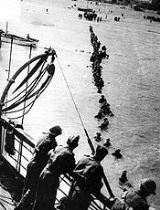
On the first day, only 7,010 men were evacuated, but by the ninth day, a total of 338,226 soldiers (198,229 British and 139,997 French) had been rescued by the hastily assembled fleet of 850 boats. Many of the troops were able to embark from the harbour's protective
moleA mole is a massive structure, usually of stone, used as a pier, breakwater, or junction between places separated by water.Historically, the term "mole" was used in the San Francisco Bay Area in California to refer to the combined structure of a causeway and wooden pier or trestle extending out...
onto 42 British
destroyerIn naval terminology, a destroyer is a fast and maneuverable yet long-endurance warship intended to escort larger vessels in a fleet, convoy or battle group and defend them against smaller, short-range but powerful attackers .Before World War II, destroyers were light vessels without the endurance...
s and other large ships, while others had to wade from the beaches toward the ships, waiting for hours to board, shoulder-deep in water. Others were ferried from the beaches to the larger ships, and thousands were carried back to England by the famous "
little ships of DunkirkThe little ships of Dunkirk were 700 private boats that sailed from Ramsgate in England to Dunkirk in France between May 26 and June 4, 1940 as part of Operation Dynamo, the rescue of more than 338,000 British and French soldiers, who were trapped on the beaches at Dunkirk during the Second World...
," a
flotillaA flotilla , or naval flotilla, is a formation of small warships that may be part of a larger fleet. A flotilla is usually composed of a homogeneous group of the same class of warship, such as destroyers, torpedo boats, submarines, gunboats or minesweepers...
of around 700 merchant marine boats, fishing boats,
pleasure craftA pleasure craft is a boat used for personal, family, and sometimes sportsmanlike recreation. Typically such watercraft are motorized and are used for holidays, for example on a river, lake, canal or waterway. Pleasure craft are normally kept at a marina...
and
Royal National Lifeboat InstitutionThe Royal National Lifeboat Institution is a charity that saves lives at sea around the coasts of the British Isles, as well as inshore. It was founded on 4 March 1824 as the National Institution for the Preservation of Life from Shipwreck, adopting the present name in 1854...
lifeboats — the smallest of which was the 15-foot fishing boat "Tamzine," now in the
Imperial War MuseumThe Imperial War Museum is a British national museum organisation with branches at five locations in England, three of which are in London. The museum was founded during the First World War in 1917 and intended as a record of the war effort and sacrifice of Britain and her Empire...
— whose civilian crews were called into service for the emergency. The "miracle of the little ships" remains a prominent folk memory in Britain.
Operation Dynamo took its name from the
dynamo-In Engineering:* Dynamo, a magnetic device originally used as an electric generator* Dynamo theory, a theory relating to magnetic fields of celestial bodies* Solar dynamo, the physical process that generates the Sun's magnetic field-Europe:...
room in the naval headquarters below
Dover CastleDover Castle is situated at Dover, Kent and has been described as the "Key to England" due to its defensive significance throughout history.-Roman:...
, which contained the dynamo that provided the building with electricity during the war. It was in this room that British
Vice AdmiralVice Admiral is a naval rank equivalent to Lieutenant General in seniority. A Vice Admiral is typically senior to a Rear Admiral and junior to an Admiral. In many navies, Vice Admiral is a three star rank.-Rank Insignia:...
Bertram RamsayAdmiral Sir Bertram Home Ramsay KCB, KBE, MVO was a British admiral during World War II. He was an important contributor in the field of amphibious warfare.-Early life:...
planned the operation and briefed Winston Churchill as it was underway.
Evacuation
Due to war-time censorship and the desire to keep up the morale of the nation, the full extent of the unfolding "disaster" around Dunkirk was not publicised. However, the grave plight of the troops led King George VI to call for an unprecedented week of prayer. Throughout the country, people prayed on 26 May for a miraculous delivery. The
Archbishop of CanterburyAlso see Leaders of ChristianityThe Archbishop of Canterbury is the chief bishop and principal leader of the Church of England, the symbolic head of the worldwide Anglican Communion and the diocesan bishop of the Diocese of Canterbury, the see that churches must be in communion with in order to be...
led prayers "for our soldiers in dire peril in France." Similar prayers were offered in synagogues and churches throughout Britain that day, confirming the public suspicion of the desperate plight of the troops.
Initial plans called for the recovery of 45,000 men from the
British Expeditionary ForceThe British Expeditionary Force was the name given to the British Forces in Europe from 1939–1940 during The Second World War.-History:...
within two days, at which time it was expected that German troops would be able to block further evacuation. Only 25,001 men escaped during this period, including 7,001 on the first day. Ten additional destroyers joined the rescue effort on 26 May and attempted rescue operations in the early morning, but were unable to closely approach the beaches, although several thousand were rescued. However, the pace of evacuation from the shrinking Dunkirk pocket steadily increased.
On 29 May, 47,000 British troops were rescued in spite of the first heavy air attack by the
LuftwaffeLuftwaffe is a generic German term for an air force. It is also the official name for two of the four historic German air forces, the Wehrmacht air arm founded in 1933 and disbanded in 1946; and the current Bundeswehr air arm founded in 1956.Schweizer Luftwaffe is also the name of the Swiss Air...
in the evening. The next day, an additional 54,000 men were embarked, including the first French soldiers. 68,000 men and the commander of the BEF, Lord Gort, evacuated on 31 May. A further 64,000 Allied soldiers departed on 1 June, before the increasing air attacks prevented further daylight evacuation. The British rearguard left the night of 2 June, along with 60,000 French soldiers. An additional 26,000 French troops were retrieved the following night before the operation finally ended.
Two French divisions remained behind to protect the evacuation. Though they halted the German advance, they were soon captured. The remainder of the rearguard, largely French, surrendered on 3 June 1940. The next day, the
BBCThe British Broadcasting Corporation, usually referred to by its abbreviation as the "BBC", is the longest established and largest broadcaster in the world...
reported, "Major-General Harold Alexander [the commander of the rearguard] inspected the shores of Dunkirk from a motorboat this morning to make sure no-one was left behind before boarding the last ship back to Britain."
| Date |
Number rescued |
| 27 May |
7,669 |
| 28 May |
17,804 |
| 29 May |
47,310 |
| 30–31 May |
120,927 |
| 1 June |
64,229 |
| 2–4 June |
up to 54,000 |
Little ships
Most of the "little ships" were private fishing boats and pleasure cruisers, but commercial vessels also contributed, including a number from as far away as the
Isle of ManThe Isle of Man , or Mann , is a self-governing British Crown dependency, located in the Irish Sea between the islands of Britain and Ireland. The head of state is Queen Elizabeth II, who holds the title of Lord of Mann. The Crown is represented by a Lieutenant Governor...
and
GlasgowGlasgow is the largest city in Scotland and third most populous in the United Kingdom. The city is situated on the River Clyde in the country's west central lowlands...
. Guided by naval craft across the
English ChannelThe English Channel is an arm of the Atlantic Ocean that separates England from northern France, and joins the North Sea to the Atlantic. It is about long and varies in width from at its widest, to only in the Strait of Dover...
from the
Thames EstuaryThe Thames Estuary is the estuary in which the River Thames meets the waters of the North Sea.It is not easy to define the limits of the estuary, although physically the head of Sea Reach, near Canvey Island on the Essex shore is probably the western boundary...
and
DoverDover is a town and major ferry port in the home county of Kent, in South East England. It faces France across the narrowest part of the English Channel, and lies south-east of Canterbury; west of Kent's administrative capital Maidstone; and north-east along the coastline from Dungeness and Hastings...
, these smaller vessels were able to move in much closer to the beaches and acted as shuttles between the shore and the destroyers, lifting troops who were queuing in the water, some of whom stood shoulder-deep for many hours to board the larger vessels.
Thousands of soldiers were taken in the little ships back to Britain. The paddle steamer "
Medway QueenThe PS Medway Queen is a paddle driven steamship, the only estuary paddle steamer left in the United Kingdom. She was one of the "little ships of Dunkirk", making a record 7 trips and rescuing 7000 men in the evacuation of Dunkirk....
" made the most round trips — seven — rescuing 7,000 men and earning herself the nickname "Heroine of Dunkirk". Funds are currently being raised for her restoration.
SundownerSundowner is a motor yacht, formerly owned by Charles Lightoller, 2nd Officer of . One of the "little ships", she participated in the Dunkirk evacuation, and is now a museum ship at the Ramsgate Maritime Museum in Southern England.-Construction:...
, owned by
Charles LightollerCommander Charles Herbert Lightoller DSC & Bar, RD, RNR was the second mate on board the Titanic, and the most senior officer to survive the disaster...
, former second officer of the
TitanicThe RMS Titanic was an Olympic-class passenger liner owned by British shipping company White Star Line and built at the Harland and Wolff shipyard in Belfast, United Kingdom...
, was requisitioned by the Admiralty on 30 May 1940, Lightoller insisting that, if anyone was going to take her to Dunkirk, it would be him and his eldest son, Roger, together with
Sea ScoutSea Scouts are members of the international Scouting movement, with a particular emphasis on water-based activities, such as kayaking, canoeing, sailing, and rowing. Depending on the country and the available water these activities are on lakes, rivers or sea in small or large ships. Sea Scouting...
Gerald Ashcroft. The men transported 130 soldiers back to
RamsgateRamsgate is a seaside town on the Isle of Thanet in east Kent, England. It was one of the great English seaside towns of the 19th century and is a member of the ancient confederation of Cinque ports. It has a population of around 40,000. Ramsgate's main attraction is its coastline and its main...
, reportedly packed together like sardines, almost capsizing when they reached the shore. Another boat,
Bluebird of Chelsea, a yacht originally owned by Sir
Malcolm CampbellSir Malcolm Campbell was an English racing motorist and motoring journalist. He gained the world speed record on land and on water at various times during the 1920s and 1930s using vehicles called Blue Bird...
, holder of the world land speed record, made two round trips to
KentKent , originally Cantia, is a county in southeast England, and is one of the home counties. It borders East Sussex, Surrey and Greater London and has a defined boundary with Essex in the middle of the River Thames estuary. The ceremonial county boundaries of Kent include the shire county of Kent...
, carrying hundreds of men.
The term "Dunkirk spirit" still stands for a belief in the solidarity of the British people in adversity.
Losses
Despite the success of the operation, all the heavy equipment and vehicles had to be abandoned, and several thousand French troops were captured in the Dunkirk pocket. Six British and three French destroyers were sunk, along with nine large boats. In addition, 19 destroyers were damaged. Over 200 of the Allied sea craft were sunk, with an equal number damaged. Winston Churchill revealed in his volumes on World War II that the
Royal Air ForceThe Royal Air Force is the United Kingdom's air force, the oldest independent air force in the world. Formed on 1 April 1918, the RAF has taken a significant role in British military history ever since, playing a large part in World War II and in more recent conflicts.The RAF operates almost 1,109...
(RAF) played a most important role protecting the retreating troops from the
LuftwaffeLuftwaffe is a generic German term for an air force. It is also the official name for two of the four historic German air forces, the Wehrmacht air arm founded in 1933 and disbanded in 1946; and the current Bundeswehr air arm founded in 1956.Schweizer Luftwaffe is also the name of the Swiss Air...
. Churchill also said that the sand on the beach softened the explosions from the German bombs. The RAF lost 474 planes, compared to 132 for the
Luftwaffe. However, the retreating troops were largely unaware of this vital assistance, and many bitterly accused the airmen of doing nothing to help.
Major ships lost
The
Royal NavyThe Royal Navy of the United Kingdom is the oldest of HM Armed Forces . From the beginning of the 18th century until well into the 20th century, it was the most powerful navy in the world, playing a key part in establishing the British Empire as the dominant world power from 1815 until the early...
's most significant losses in the operation were six destroyers:
- Grafton
HMS Grafton was a G-class destroyer laid down by John I. Thornycroft & Company, at Woolston, Hampshire on 30 August 1934, launched on 18 September 1935 and completed on 20 March 1936. Grafton was torpedoed by the enemy U-62...
, sunk by U-62The U-62 was a German Type IIC submarine that served in the Second World War. She was produced by Deutsche Werke AG, Kiel, and was commissioned on 21 December 1939....
on 29 May;
- Grenade
HMS Grenade was a G-class destroyer of the Royal Navy laid down by Alexander Stephen and Sons at Linthouse in Scotland on 3 October 1934, launched on 12 November 1935 and completed on 28 March 1936...
, sunk by air attack off the east pier at Dunkirk on 29 May;
- Wakeful
HMS Wakeful was a W-class destroyer of the Royal Navy. She was built under the 1916-17 Programme in the 10th Destroyer order. The Wakeful was assigned to the Grand Fleet after completion, and served into the early years of the the Second World War...
, sunk by a torpedoThe modern torpedo is a self-propelled explosive projectile weapon, launched above or below the water surface, propelled underwater toward a target, and designed to detonate on contact or in proximity to a target...
from the Schnellboot (E-boat) S-30 on 29 May;
- Basilisk
HMS Basilisk was a B class destroyer of the British Royal Navy that saw service during World War II. She was sunk off the coast of Dunkirk during Operation Dynamo by German Stuka dive bombers while participating in the evacuation of the British Expeditionary Force from France....
, HavantHMS Havant is classed as an H class destroyer of the Royal Navy. She launched by White in 1939. During the evacuation of Dunkirk, she was bombed by enemy aircraft 1 June 1940, after rescuing some 3,000 men. She was severely damaged and had to be scuttled by minesweeper HMS...
, and Keith, sunk by air attack off the beaches on 1 June.
The
French NavyThe French Navy, officially the Marine nationale and often called La Royale is the maritime arm of the French military...
lost three destroyers:
- Bourrasque, mined off Nieuport
Nieuport, later Nieuport-Delage, was a French aeroplane company famous for racers before World War I and fighter aircraft during World War I and between the wars.-Beginnings:...
on 30 May;
- Sirocco, sunk by the Schnellboote S-23 and S-26 on 31 May;
- Le Foudroyant, sunk by air attack off the beaches on 1 June.
Aftermath
Before the operation was completed, the prognosis had been gloomy, with Winston Churchill warning the
House of CommonsThe House of Commons is the lower house of the Parliament of the United Kingdom, which also comprises the Sovereign and the House of Lords . Both Commons and Lords meet in the Palace of Westminster. The Commons is a democratically elected body, consisting of 646 members, who are known as "Members...
to expect "hard and heavy tidings." Subsequently, Churchill referred to the outcome as a "miracle," and the British press presented the evacuation as a "disaster turned to triumph" so successfully that Churchill had to remind the country, in a speech to the House of Commons on 4 June, that "we must be very careful not to assign to this deliverance the attributes of a victory. Wars are not won by evacuations." Nevertheless, exhortations to the "Dunkirk spirit," a phrase used to describe the tendency of the British public to pull together and overcome times of adversity, are still heard in Britain today.
The rescue of the British troops at Dunkirk provided a psychological boost to British morale, which ended any possibility that the United Kingdom would seek peace terms with Germany, since the country retained the ability to defend themselves against a possible German invasion. Most of the rescued British troops were assigned to the
defence of BritainBritish anti-invasion preparations of World War II entailed a large-scale division of military and civilian mobilization in response to the threat of invasion by German armed forces in 1940 and 1941. The army needed to recover from the defeat of the British Expeditionary Force in France, and 1.5...
. Once the threat of invasion receded, they were transferred overseas to the Middle East and other theatres and also provided the nucleus of the army that returned to France in 1944. Several high-ranking German commanders (for example, Generals
Erich von MansteinErich von Manstein served the German military as a lifelong professional soldier. He became one of the most prominent commanders of Germany's World War II armed forces...
and
Heinz GuderianHeinz Wilhelm Guderian was a military theorist and innovative General of the German Army during the Second World War. Germany's panzer forces were raised and fought according to his works, best-known among them Achtung - Panzer!...
, as well as Admiral
Karl DönitzKarl Dönitz was a German naval Commander who served in the Imperial German Navy during World War I, and during World War II commanded first the German submarine fleet, and then the entire German Navy .In the final days of the war, Dönitz was named by Adolf Hitler as his successor, and after the...
) considered the failure of the German High Command to order a timely assault on Dunkirk to eliminate the British Expeditionary Force to be one of the major mistakes the Germans had made in the Western Theatre.
The more than 100,000 evacuated French troops were quickly and efficiently shuttled to camps in various parts of southwestern England where they were temporarily lodged before quickly being repatriated. British ships ferried French troops to Brest, Cherbourg and other ports in
NormandyNormandy is a geographical region corresponding to the former Duchy of Normandy. It is situated along the English Channel coast of Northern France between Brittany and Picardy and comprises territory in northern France and the Channel Islands.Normandy is divided between French and British...
and
BrittanyBrittany is a cultural and administrative region in the north-west of France. Brittany was previously a kingdom and then as a duchy it was a fief of the Kingdom of France. It was at one time called Less, Lesser or Little Britain...
, although only about half of the repatriated troops were deployed against the Germans before the armistice. For many French soldiers the Dunkirk evacuation was not a salvation, but represented only a few weeks' delay before being made POWs by German army after their return in France.
In France, the perceived preference of the Royal Navy for evacuating British forces at the expense of the French led to some bitter resentment. The French
Admiral DarlanFrançois Darlan was a French naval officer. Darlan rose through the French Navy, ultimately becoming Admiral of the Fleet, and was a major figure of the Vichy France regime during World War II....
originally ordered that the British forces should receive preference, but Churchill intervened at a 31 May meeting in Paris to order that the evacuation should proceed on equal terms and the British would form the rearguard. A few thousand French forces eventually surrendered, but only after the evacuation effort had been extended for a day to bring 26,175 Frenchmen to Britain on 4 June.
For every seven soldiers who escaped through Dunkirk, one man was left behind as a
prisoner of warA prisoner of war or enemy prisoner of war is a combatant who is held in continuing custody by an enemy power during or immediately after an armed conflict...
(POW). The majority of these prisoners were sent on forced marches into
GermanyGermany , officially the Federal Republic of Germany , is a country in Central Europe. It is bordered to the north by the North Sea, Denmark, and the Baltic Sea; to the east by Poland and the Czech Republic; to the south by Austria and Switzerland; and to the west by France, Luxembourg, Belgium,...
. Prisoners reported brutal treatment by their guards, including beatings, starvation, and murder. In particular, the British prisoners complained that French prisoners were given preferential treatment. Another major complaint was that German guards kicked over buckets of water that had been left at the roadside by French civilians. Many of the prisoners were marched to the town of
TrierTrier is a city in Germany on the banks of the Moselle River. It is the oldest city in Germany, founded in or before 16 BC. Trier is not the only city claiming to be Germany's oldest, but it is the only one that bases this assertion on having the longest history as a city, as opposed to a mere...
, with the march taking as long as 20 days. Others were marched to the river
ScheldtThe Scheldt is a 350 km long river in northern France, western Belgium and the southwestern part of the Netherlands...
and were sent by barge to the
RuhrThe Ruhr is a medium-size river in western Germany , a right tributary of the Rhine.-Description:The source of the Ruhr is at an elevation of approximately 2,200 feet , near the town of Winterberg in the mountainous Sauerland region, and it flows into the lower Rhine river at an elevation of only...
. The prisoners were then sent by rail to POW camps in Germany. The majority then worked in German industry and agriculture for five years.
The very significant loss of military equipment abandoned in Dunkirk reinforced the financial dependence of the British government on the United States.
The
St George's CrossSt George's Cross is a centred red cross on a white background. This pattern was associated with Saint George from medieval times....
flown from the jack staff is known as the Dunkirk jack and is only flown by civilian ships and boats of all sizes that took part in the Dunkirk rescue operation in 1940. The only other ships permitted to fly this flag at the bow are those with an Admiral of the Fleet on board.
In popular culture
- The Snow Goose
The Snow Goose: A Story of Dunkirk is a short novella by the American author Paul Gallico. It was first published in 1940 as a short-story in The Saturday Evening Post, then he expanded it to create a short novella which was first published on April 7, 1941.The Snow Goose was one of the O. Henry...
, a 1941 novel by Paul GallicoPaul William Gallico was a successful American novelist, short story and sports writer. Many of his works were adapted for motion pictures...
related the story of a lonely artist who participates in the evacuation at the cost of his life. It was made into an award-winning 1971 film starring Richard HarrisRichard Saint John Harris was an Irish actor, singer-songwriter, theatrical producer, film director and writer...
and Jenny AgutterJennifer Ann Agutter is a BAFTA- and Emmy award-winning English actress best known in recent years for her role as Tessa Phillips in the British TV drama series Spooks...
.
- The 1949 novel Week-end à Zuydcoote
Week-end at Zuydcoote is a 1949 novel by French author Robert Merle. It won the 1949 Prix Goncourt, France's most prestigious literary prize. The novel was adapted to film in 1964 called Weekend at Dunkirk . It was first published in English in 1950....
by French author Robert MerleRobert Merle was a French novelist.-Biography:Born in Tebessa in French occupied Algeria, he moved to France in 1918. Merle wrote in many styles and won the Prix Goncourt for his novel Week-end à Zuydcoote. He has also written a 13 book series of historical novels, Fortune de France...
tells the story of a French soldier during the evacuation. It won the Prix GoncourtThe Prix Goncourt is a prize in French literature, given by the académie Goncourt to the author of "the best and most imaginative prose work of the year"...
that year. It was adapted to film in 1964 by Henri VerneuilHenri Verneuil was a prominent French-Armenian playwright and filmmaker, who enjoyed a successful career in France.-Biography:...
.
- The story was the subject of Dunkirk
Dunkirk is a World War II film made in 1958, starring John Mills, Richard Attenborough and Bernard Lee.-Plot:The film relates the story of Operation Dynamo, the evacuation of surrounded English and French troops from the beaches of Dunkirk...
, a 1958 EalingEaling Studios is a television and film production company and facilities provider at Ealing Green in West London and is officially the oldest film studio in the world and was purposely built for the use of sound in early British films.- History :...
film (made in collaboration with British MGM).
- The evacuation was featured prominently in Ian McEwan
Ian Russell McEwan, CBE, FRSA, FRSL, is a Booker Prize-winning English novelist and screenwriter.-Early life:McEwan was born in Aldershot, the son of Rose Lilian Violet and David McEwan. He spent much of his childhood in East Asia, Germany and North Africa, where his father, a Scottish army...
's novel AtonementAtonement is a 2001 novel by British author Ian McEwan. It tells the story of protagonist Briony Tallis's crime and how it changes her life, as well as those of her sister Cecilia and her lover Robbie Turner, and her consequential effort to atone....
(2001) and the film adaptation of the same nameAtonement is a 2007 film adaptation of Ian McEwan's novel of the same name, directed by Joe Wright, and based on a screenplay by Christopher Hampton. It starred Keira Knightley and James McAvoy, was produced by Working Title Films and filmed throughout the summer of 2006 in England and France...
(2007). The film version contains a 4.5-minute continuous shot of Allied troops stranded on the beach of Dunkirk waiting to be evacuated (filmed on RedcarRedcar is a seaside resort in the North East of England, and the principal town in the unitary authority of Redcar and Cleveland in the ceremonial county of North Yorkshire. It lies east-northeast of Middlesbrough by the North Sea coast...
beach, North Yorkshire). The Academy Award-winning 1942 movie Mrs. MiniverMrs. Miniver is a 1942 drama film directed by William Wyler and starring Greer Garson in the title role. It was produced as a propaganda film aimed at ending American isolation from World War II, and was based on the fictional English housewife created by Jan Struther in 1937 for a series of...
also featured the evacuation. Katherine KurtzKatherine Kurtz is the author of numerous fantasy novels, most notably the Deryni novels. Although born in America, for the past several years, up until just recently, she has lived in a castle in Ireland...
's thriller Lammas Night features a character caught up in the evacuation.
- The evacuation and the Battle of Dunkirk were re-enacted in the 2004
The year 2004 in television involved some significant events.Below is a list of television-related events in 2004.For the American TV schedule, see: 2004-05 United States network television schedule.-Events:...
BBC televisionBBC Television is a service of the British Broadcasting Corporation which began in 1932. The British Broadcasting Corporation has operated in the United Kingdom under the terms of a Royal Charter since 1927.-History of BBC Television:...
docudrama DunkirkDunkirk is a 2004 BBC television docudrama about the Battle of Dunkirk and the Dunkirk evacuation in World War II.-Awards:*BAFTA Awards 2005**Won: Huw Wheldon Award for Specialist Factual: Robert Warr & Alex Holmes...
.
- The novel Dunkirk Crescendo (2005) by Bodie Thoene features the miracle of Dunkirk starting in the beginning of May, before Churchill becomes Prime Minister, and ending on 4 June, when the evacuation ends.
- The evacuation is featured in the Doctor Who
Doctor Who is a British science fiction television programme produced by the BBC. The programme depicts the adventures of a mysterious alien time-traveller known as "the Doctor" who travels in his space and time-ship, the TARDIS, which normally appears from the exterior to be a blue 1950s police box...
novel The Nemonite InvasionThe Nemonite Invasion is an exclusive to audio Doctor Who story, produced as part of BBC Books' New Series Adventures line, and the third entry in the series to be produced. Read by Catherine Tate, it is the third non-televised Doctor Who adventure to feature the companion Donna Noble...
(2009).
See also
- Operation Cycle
During World War II, Operation Cycle was the evacuation of Allied troops from Le Havre, France in June 1940. Starting on 10 June, 11,000 British and Allied forces were evacuated....
— the evacuation of 11,000 troops from Le HavreLe Havre is a city in north-western France situated on the right bank of the mouth of the Seine River as it flows into the Bay of the Seine in the English Channel. It is a commune in the Seine-Maritime department in the Haute-Normandie region. The inhabitants of the city are called Havrais or...
, beginning on 10 June
- Operation Ariel
Operation Ariel was the name given to the World War II evacuation of Allied forces from western France following the military collapse of the country caused by the invasion by Nazi Germany....
— the later evacuation from Normandy and Brittany
- Battle of France
In World War II, the Battle of France, also known as the Fall of France, was the German invasion of France and the Low Countries, executed from 10 May 1940, which ended the Phoney War. The battle consisted of two main operations...
External links