


Bombing of Hamburg in World War II

Encyclopedia


Hamburg
-History:The first historic name for the city was, according to Claudius Ptolemy's reports, Treva.But the city takes its modern name, Hamburg, from the first permanent building on the site, a castle whose construction was ordered by the Emperor Charlemagne in AD 808...
during World War II
World War II
World War II, or the Second World War , was a global conflict lasting from 1939 to 1945, involving most of the world's nations—including all of the great powers—eventually forming two opposing military alliances: the Allies and the Axis...
(September 1939-April 1945) included numerous strategic bombing
Strategic bombing during World War II
Strategic bombing during World War II is a term which refers to all aerial bombardment of a strategic nature between 1939 and 1945 involving any nations engaged in World War II...
missions and diversion/nuisance raids. As a large port and industrial center, Hamburg's shipyard
Shipyard
Shipyards and dockyards are places which repair and build ships. These can be yachts, military vessels, cruise liners or other cargo or passenger ships. Dockyards are sometimes more associated with maintenance and basing activities than shipyards, which are sometimes associated more with initial...
s, U-boat pens, and the Hamburg-Harburg area oil refineries
Oil Campaign of World War II
The Allied Oil Campaign of World War II was directed at facilities supplying Nazi Germany with petroleum, oil, and lubrication products...
were attacked throughout the war. Hamburg was also the site of the world's oldest dynamite
Dynamite
Dynamite is an explosive material based on nitroglycerin, initially using diatomaceous earth , or another absorbent substance such as powdered shells, clay, sawdust, or wood pulp. Dynamites using organic materials such as sawdust are less stable and such use has been generally discontinued...
factory, constructed by Alfred Nobel
Alfred Nobel
Alfred Bernhard Nobel was a Swedish chemist, engineer, innovator, and armaments manufacturer. He is the inventor of dynamite. Nobel also owned Bofors, which he had redirected from its previous role as primarily an iron and steel producer to a major manufacturer of cannon and other armaments...
.
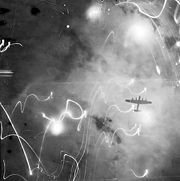
The attack during the last week of July, 1943, Operation Gomorrah, created one of the greatest firestorm
Firestorm
A firestorm is a conflagration which attains such intensity that it creates and sustains its own wind system. It is most commonly a natural phenomenon, created during some of the largest bushfires, forest fires, and wildfires...
s raised by the RAF and United States Army Air Force in World War II, killing 42,600 civilians and wounding 37,000 in Hamburg and practically destroying the entire city. The unusually warm weather and good conditions meant that the bombing was highly concentrated around the intended targets and also created a vortex and whirling updraft of super-heated air which created a 1,500-foot-high tornado of fire, a totally unexpected effect. Various other previously used techniques and devices were instrumental as well, such as area bombing
Area bombing directive
The Area Bombing Directive was a directive from the wartime British Government's Air Ministry to the Royal Air Force which ordered RAF bombers to attack the German industrial workforce and the morale of the German populace through bombing German cities and their civilian inhabitants.- Background...
, Pathfinders
Pathfinder (RAF)
The Pathfinders were elite squadrons in RAF Bomber Command during World War II. They located and marked targets with flares, which a main bomber force could aim at, increasing the accuracy of their bombing...
, and H2S radar
H2S radar
H2S was the first airborne, ground scanning radar system. It was developed in Britain in World War II for the Royal Air Force and was used in various RAF bomber aircraft from 1943 to the 1990s. It was designed to identify targets on the ground for night and all-weather bombing...
, which came together to work particularly effectively. 'Window' was successfully used for the first time - clouds of shredded tinfoil dropped by Pathfinders as well as the initial bomber stream - in order to completely cloud German radar. The raids inflicted severe damage to German armaments production in Hamburg.
Battle of Hamburg
The Battle of Hamburg, codenamed Operation Gomorrah, was a campaign of air raids beginning 24 July 1943 for 8 days and 7 nights. It was at the time the heaviest assault in the history of aerial warfare and was later called the Hiroshima of Germany by British officials.The Battle of Hamburg overlapped the Battle of the Ruhr
Battle of the Ruhr
The Battle of the Ruhr was a 5-month long campaign of strategic bombing during the Second World War against the Nazi Germany Ruhr Area, which had coke plants, steelworks, and 10 synthetic oil plants...
which ended on 31 July.
The operation was conducted by RAF Bomber Command
RAF Bomber Command
RAF Bomber Command controlled the RAF's bomber forces from 1936 to 1968. During World War II the command destroyed a significant proportion of Nazi Germany's industries and many German cities, and in the 1960s stood at the peak of its postwar military power with the V bombers and a supplemental...
(including RCAF Squadrons) and the USAAF Eighth Air Force
Eighth Air Force
The Eighth Air Force is a numbered air force of the United States Air Force Global Strike Command . It is headquartered at Barksdale Air Force Base, Louisiana....
. The British conducted the night raids and the USAAF conducted the daylight raids.
On 24 July, at approximately 00:57AM, the first bombing started by the RAF and lasted almost an hour. A second daylight raid by US Army Air Force was conducted at 4:40PM. A third raid was conducted on the morning of the 26th. The night attack of 26 July at 00:20AM was extremely light due to a severe thunderstorm and high winds over the North Sea
North Sea
In the southwest, beyond the Straits of Dover, the North Sea becomes the English Channel connecting to the Atlantic Ocean. In the east, it connects to the Baltic Sea via the Skagerrak and Kattegat, narrow straits that separate Denmark from Norway and Sweden respectively...
during which a considerable number of bombers jettisoned the explosive part of their bomb loads (retaining just the incendiaries
Incendiary device
Incendiary weapons, incendiary devices or incendiary bombs are bombs designed to start fires or destroy sensitive equipment using materials such as napalm, thermite, chlorine trifluoride, or white phosphorus....
) with only two bomb drops reported. That attack is often not counted when the total number of Operation Gomorrah attacks is given. There was no day raid on the 27th.
On the night of 27 July, shortly before midnight, 739 aircraft attacked Hamburg. The unusually dry and warm weather, the concentration of the bombing in one area, and firefighting limitations due to Blockbuster bomb
Blockbuster bomb
Blockbuster or "cookie" was the name given to several of the largest conventional bombs used in World War II by the Royal Air Force...
s used in the early part of the raid culminated in the so-called "Feuersturm" (firestorm
Firestorm
A firestorm is a conflagration which attains such intensity that it creates and sustains its own wind system. It is most commonly a natural phenomenon, created during some of the largest bushfires, forest fires, and wildfires...
). The tornadic fire created a huge inferno with winds of up to 240 km/h (150 mph)reaching temperatures of 800 °C (1,500 °F) and altitudes in excess of 1,000 feet, incinerating more than eight square miles (21 km²) of the city. Asphalt
Asphalt
Asphalt or , also known as bitumen, is a sticky, black and highly viscous liquid or semi-solid that is present in most crude petroleums and in some natural deposits, it is a substance classed as a pitch...
streets burst into flame, and fuel oil from damaged and destroyed ships, barges, and storage tanks spilled into the waters of the canals and the harbor caused it to ignite as well. The majority of deaths attributed to Operation 'Gomorrah' occurred on this night. A large number of those killed died seeking safety in bomb shelters and cellars, the firestorm consuming all available oxygen in the burning city above. The furious winds created by the firestorm had the power to sweep people up off the streets like dry leaves:
Some people who tried to walk along, they were pulled in by the fire, they all of the sudden disappeared right in front of you (...) You have to save yourself or try go get as far away from the fire, because the draught pulls you in.
On the night of 29 July, Hamburg was again attacked by over 700 aircraft. The last raid of Operation Gomorrah was conducted on 3 August.
Operation Gomorrah killed 42,600 people and left 37,000 wounded. Some one million German civilians fled the city. The city's labour force was reduced permanently by ten percent. Approximately 3,000 aircraft were deployed, 9,000 tons of bombs were dropped, and over 250,000 homes and houses were destroyed. No subsequent city raid shook Germany as did that on Hamburg; documents show that German officials were thoroughly alarmed, and there is some indication from later Allied interrogations of Nazi officials that Hitler stated that further raids of similar weight would force Germany out of the war. The industrial losses were severe. Hamburg never recovered to full production, only doing so in essential armaments industries (which a maximum effort was made). Figures given by German sources indicate, 183 large factories were destroyed out of 524 in the city, 4,118 smaller factories out of 9,068 were destroyed. Other losses included 580 industrial concerns and armaments works, 299 of which were important enough to be listed by name, were either destroyed or damaged. Local transport systems were completely disrupted and did not return to normal for some time. Dwellings destroyed amounted to 214,350 destroyed out of 414,500. Hamburg was hit by air raids another 69 times before the end of World War II
World War II
World War II, or the Second World War , was a global conflict lasting from 1939 to 1945, involving most of the world's nations—including all of the great powers—eventually forming two opposing military alliances: the Allies and the Axis...
.
Cityscape
The totally destroyed quarter of HammerbrookHammerbrook
Hammerbrook is a quarter in the Hamburg-Mitte borough of the Free and Hanseatic city of Hamburg in northern Germany. In 2006, the population was 435.-Geography:In 2007, Hammerbrook has an area of , and was part of the Hamburg-Mitte borough....
, in which mostly longshoremen lived, was not rebuilt as housing area but as a commercial area. The adjoining quarter of Rothenburgsort
Rothenburgsort
Rothenburgsort is a quarter in the Hamburg-Mitte borough of the Free and Hanseatic city of Hamburg in northern Germany. In 2006, the population was 8,660.-Geography:The quarter is situated in the south-east center of Hamburg...
shared the same fate, as only a small area of housing was rebuilt. The underground line which connected these areas with the central station was not rebuilt either.
In the destroyed residential areas many houses were rebuilt across the street and therefore do not form connected blocks anymore. The hills of the Öjendorfer Park are formed by the debris of destroyed houses.
Memorials
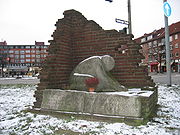
Several memorials in Hamburg remind at the air raids during World War II:- The Nikolaikirche, which was largely destroyed during the bombing, has been made into a memorial against the war. The spire of the church, which was used by the bomber pilots as aiming point, endured the attacks.
- Memorial at the Hamburger Strasse - a memorial for those who died in a shelter under the Karstadt department store at the corner Desenißstrasse/Hamburger Strasse. The department store was hit by a bomb in the night of 30 July. The people in the air raid shelter below were killed by the heat and carbon monoxideCarbon monoxideCarbon monoxide , also called carbonous oxide, is a colorless, odorless, and tasteless gas that is slightly lighter than air. It is highly toxic to humans and animals in higher quantities, although it is also produced in normal animal metabolism in low quantities, and is thought to have some normal...
poisoning.
- The victims of the air raids were buried on the Ohlsdorf CemeteryOhlsdorf Cemetery-External links:* *...
in mass graves. The memorial "Passage over the Styx" by Gerhard Marcks is in the center and shows how CharonCharon (mythology)In Greek mythology, Charon or Kharon is the ferryman of Hades who carries souls of the newly deceased across the rivers Styx and Acheron that divided the world of the living from the world of the dead. A coin to pay Charon for passage, usually an obolus or danake, was sometimes placed in or on...
ferries a young couple, a mother with her child, a man and a desperate person over the river Styx.
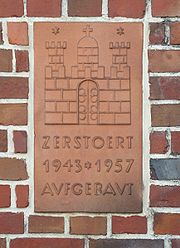
- Many houses rebuilt after World War II show a memorial plaque with the inscription "Destroyed 1943 - ... Rebuilt" as a reminder of their destruction during the air raids in July 1943.
Timeline
| Date | Target/Type | |
|---|---|---|
| night of 10/11 September 1939: | leaflets |  10 aircraft 10 aircraft |
| oil installations Oil Campaign of World War II The Allied Oil Campaign of World War II was directed at facilities supplying Nazi Germany with petroleum, oil, and lubrication products... |
48 Hampdens attacked Hamburg oil installations. |
|
| oil refineries | Hampdens attacked oil refineries near Hamburg. |
|
| oil refineries | Hamburg oil refineries were bombed. |
|
| nights of 15/16 November and 16/17 November 1940: | over 200 aircraft. On the first night damage was caused to the Blohm & Voss Blohm + Voss Blohm + Voss , is a German shipbuilding and engineering works. It is a subsidiary of ThyssenKrupp Marine Systems; there were plans to sell 80% of Blohm + Voss to Abu Dhabi Mar Group, but talks collapsed in July 2011.-History:It was founded on April 5, 1877, by Hermann Blohm and Ernst Voss as a... shipyard and over 60 fires were started. On the second night only 60 aircraft found their target and damage was far less. |
|
| night of 12/13 March 1941: | Hamburg, Bremen, and Berlin bombed by a total of 257 |
|
| The night of 13/14 March 1941 | 51 people were killed, the highest number in a single raid to date |
|
| April 1941. | During this month Hamburg was a main target. |
|
| May 1941. | Hamburg was bombed several times during the month. Raids now usually contained about 100 bombers. |
|
| The night of 11/12 May 1941 | 92 aircraft. |
|
| The night of 27/28 June 1941: | a raid on Bremen but most bombed Hamburg - an error of 50 miles. 11 out of 35 bombers were shot down by night fighters. |
|
| night of 14/15 January 1942: | 95 aircraft. Only 48 aircraft claimed to have bombed Hamburg. Altona station Hamburg-Altona railway station Hamburg-Altona or Altona is a railway station in Hamburg, Germany. It is situated west of the city's main station, Hamburg Hauptbahnhof , in the district of Altona, and is the usual terminus for southbound long-distance trains.... was hit and 12 fires, 7 of them large ones, were started. Six people killed and 22 injured. No aircraft reported lost. |
|
| night of 15/16 January 1942: | 96 aircraft. 52 bombers claimed to have bombed Hamburg successfully. 36 fires started 3 of which were large, 3 people killed and 25 injured. 11 Bombers lost. |
|
| night of 17/18 January 1942 | Bremen was the main target for 83 aircraft, but Hamburg was bombed as a secondary target causing 11 fires and casualties of 5 dead and 12 injured in Hamburg. Four bombers lost. |
|
| night of 16/17 February 1942 | one or two bombers. |
|
| night of 8/9 April 1942 | largest raid to date on a single target. Carried out by 272 aircraft. Raid was considered a failure. 17 people were killed and 119 injured. 5 planes lost. |
|
| The night of 17/18 April 1942 | 173 aircraft. 75 fires, 33 classed as large were started. Twenty-three people were killed and 66 injured. Eight aircraft lost. |
|
| The night of 3/4 May 1942 | 81 aircraft, dispatched on the 100th anniversary of a great fire in Hamburg. 53 aircraft were estimated to have hit the target. 113 fires started, of which 57 were large. 77 were killed, 243 injured and 1,624 bombed out. 5 aircraft were lost. |
|
| night of 26/27 July 1942 | 403 aircraft. Widespread damage was caused, mostly in housing and semi-commercial districts rather than in the docks and industrial areas. At least 800 fires started, 523 of which were large. 823 houses were destroyed and more than 5,000 damaged. More than 14,000 people were bombed out. 337 people were killed and 1,027 injured. 29 aircraft were lost, 7.2% of the force. |
|
| night of 28/29 July 1942 | 256 aircraft. Due to bad weather only 68 bombed in the target area. Fifty-six fires, 15 of them large, were started. Thirteen people were killed and 48 injured. Bomber losses were high, 15.3% for the main group bombing that night. |
|
| day of 3 August 1942 | 10 aircraft. |
|
| day of 18 August 1942 | nuisance raid | single Mosquito De Havilland Mosquito The de Havilland DH.98 Mosquito was a British multi-role combat aircraft that served during the Second World War and the postwar era. It was known affectionately as the "Mossie" to its crews and was also nicknamed "The Wooden Wonder"... . |
| day of 19 September 1942 | nuisance raid | 2 Mosquitoes. |
| night of 13/14 October 1942 | light secondary target raid. 2 large fires were started. 8 people were killed and 43 injured. |
|
| night of 9/10 November 1942: | 213 aircraft. There were 26 fires started of which 3 were large. 3 people killed and 16 injured. 15 aircraft lost, 7.0% of the force. |
|
| night of 30/31 January 1943 | 148 aircraft. It was the first H2S radar H2S radar H2S was the first airborne, ground scanning radar system. It was developed in Britain in World War II for the Royal Air Force and was used in various RAF bomber aircraft from 1943 to the 1990s. It was designed to identify targets on the ground for night and all-weather bombing... -assisted attack of the war. H2S use was not successful and the bombs were scattered. However 119 fires were started of which 71 were large. 58 people were killed and 164 injured. 5 aircraft were lost, 3.4% of the force. |
|
| night of 3/4 February 1943 | 263 aircraft. Bad weather affected the bombers with many turning back early. Damage was light for what was planned to be a large raid. 16 bombers were lost, 6.1% of the force, many to nightfighters. |
|
| The night of 3/4 March 1943 | 417 aircraft. The Pathfinders Pathfinder (RAF) The Pathfinders were elite squadrons in RAF Bomber Command during World War II. They located and marked targets with flares, which a main bomber force could aim at, increasing the accuracy of their bombing... marked the wrong target, mistaking a mud bank for the docks with their H2S radar, so most of the bombs landed 13 miles downstream from the centre of Hamburg, around the small town of Wedel Wedel Wedel is a town in the district of Pinneberg, in Schleswig-Holstein, Germany. It is situated on the right bank of the Elbe, approximately south of Elmshorn, and mile, west of Hamburg.-Foundation and Middle Ages:... . Those bombs which landed on Hamburg did considerable damage starting 100 fires, killing 27 people and injuring 95. The damage to Wedel was extensive. 10 aircraft lost, 2.4% of the force. |
|
| 13/14 April 1943 | nuisance raid | 2 Mosquitoes. |
| 25 June 1943 | Blohm & Voss |  The 384th Bombardment Group attacked the Hamburg submarine pen The 384th Bombardment Group attacked the Hamburg submarine penSubmarine pen A submarine pen is a bunker which is designed to protect submarines from air attack.The term is generally applied to submarine bases constructed during World War II, particularly in Germany and the occupied countries which were also known as U-boat pens .-Background:Amongst the first... s. |
| night of 26/27 June 1943 | nuisance raid | 4 Mosquitoes. |
| night of 28/29 June 1943 | nuisance raid | 4 Mosquitoes. |
| night of 3/4 July 1943 | nuisance raid | 4 Mosquitoes. |
| night of 5/6 July 1943 | nuisance raid | 4 Mosquitoes. |
| night of 24/25 July 1943 | large raid | 791 aircraft, marked the opening of the "Battle of Hamburg" or so called "Operation Gomorrah raid". A countermeasure against the radar-directed German nightfighters in the form of "Window" Chaff (radar countermeasure) Chaff, originally called Window by the British, and Düppel by the Second World War era German Luftwaffe , is a radar countermeasure in which aircraft or other targets spread a cloud of small, thin pieces of aluminium, metallized glass fibre or plastic, which either appears as a cluster of secondary... was used for the first time. In the clear weather visual and H2S marking was accurate and on the town centre. 728 aircraft dropped their bombs in 50 minutes. Less than half the force bombed within 3 miles of the centre with a bomb creepback Creepback Creepback is the tendency of bomber aircraft using optical bombsights to release their weapons aimed at target markers before time, leading to a gradual spread backwards along the bombing path of the concentration of bombing... of six miles. Damage was caused in the central and north-western districts, particularly in Altona, Eimsbüttel and Hoheluft. The Rathaus (Town Hall), the St. Nikolai church St. Nikolai, Hamburg The Gothic Revival Church of St. Nicholas was formerly one of the five Lutheran Hauptkirchen in the city of Hamburg. It is now in ruins, serving as a memorial and an important architectural landmark. When Hamburg residents mention the Nikolaikirche, it is generally to this church that they are... , the main police station, the main telephone exchange and the Hagenbeck Zoo Carl Hagenbeck Carl Hagenbeck was a merchant of wild animals who supplied many European zoos, as well as P.T. Barnum. He is often considered the father of the modern zoo because he introduced "natural" animal enclosures that included recreations of animals' native habitats without bars... were among the well-known landmarks to be hit. About 1,500 people were killed which was the largest outside the range of the "Oboe" Oboe (navigation) Oboe was a British aerial blind bombing targeting system in World War II, based on radio transponder technology. Oboe accurately measured the distance to an aircraft, and gave the pilot guidance on whether or not they were flying along a pre-selected circular route. The route was only 35 yards... radio navigation system which helped to concentrate the bombing pattern. Thanks to the use of Window only 12 aircraft were lost, 1.5% of the force. |
| 25 July 1943 4:40PM | Blohm & Voss | ca. 90-110 B-17s attacked the Hamburg submarine pen Submarine pen A submarine pen is a bunker which is designed to protect submarines from air attack.The term is generally applied to submarine bases constructed during World War II, particularly in Germany and the occupied countries which were also known as U-boat pens .-Background:Amongst the first... s; involved 91st, 351st, 381st (= 1st combat wing), 303rd, 379th, 384th bomb group (= 41st combat wing). |
| 26 July 1943 | Blohm & Voss | 121 B-17's dispatched against Hannover (54) and the U-boat yards at Hamburg at 1159–1200 hours (71). |
| The night of 26/27 July 1943 | nuisance raid | 6 Mosquitoes attacked Hamburg. |
| night of 27/28 July 1943 | 787 aircraft guided in by Pathfinders using H2S bombed about 2 miles east of city centre. Due to the unseasonally dry conditions, a firestorm was created in the built-up working-class districts of Hammerbrook, Hamm, Borgfelde and Rothenburgsort. The bombing was more concentrated than the RAF was usually able to manage at this stage of the war. In just over half an hour it is estimated that 550-600 bomb loads fell into an area measuring only 2 miles by 1 mile and this gradually spread the fire eastwards. The firestorm lasted for about three hours, consuming approximately 16,000 multi-storyed apartment buildings and killing an estimated 40,000 people, most of them by carbon monoxide Carbon monoxide Carbon monoxide , also called carbonous oxide, is a colorless, odorless, and tasteless gas that is slightly lighter than air. It is highly toxic to humans and animals in higher quantities, although it is also produced in normal animal metabolism in low quantities, and is thought to have some normal... poisoning when all the air was drawn out of their basement shelters. Fearing further raids, two-thirds of Hamburg's population, approximately 1,200,000 people, fled the city in the aftermath. |
|
| night of 28/29 July 1943 | nuisance raid | 4 Mosquitoes. |
| night of 29/30 July 1943: | 777 aircraft guided in by pathfinders marking using H2S. The plan was to bomb the untouched northern suburbs. But a mistake in mapping led to the bombing of an area just north of the area devastated by the firestorm three nights before. The residential areas of Wandsbek and Barmbek districts and parts of the Uhlenhorst and Winterhude Winterhude Winterhude is a quarter in the borough Hamburg-Nord of Hamburg, Germany. In 2007 the population was 48,799.-History:Winterhude was first mentioned in the 13th century, but archeological findings of tools, weapons and grave-mounds were dated in 1700 bC and 700 bC.During World War II the port of... were severely damaged and widespread fires but no firestorm. Twenty-eight aircraft 3.6% of the force was lost. |
|
| night of 2/3 August 1943 | 740 aircraft dispatched on a raid to Hamburg but bad weather stopped all but a few bombers reaching Hamburg; many bombed secondary targets instead. 30 aircraft, 4.1% of the force was lost. |
|
| night of 22/23 August 1943 | nuisance raid | 6 Mosquitoes |
| night of 5/6 November 1943: | Hamburg and other cities raided by a total of 26 Mosquitoes. |
|
| night of 1/2 January 1944: | diversionary raid (Berlin) | 15 Mosquitoes attacked Hamburg. |
| night of 11/12 March 1944: | nuisance raid by 20 Mosquitoes. | |
| night of 6/7 April 1944: | 35 Mosquitoes |
|
| night of 26/27 April 1944: | diversionary raid | 16 Mosquitoes. |
| night of 28/29 April 1944: | 26 Mosquitoes. |
|
| 18 June 1944 | oil refineries | Mission 421: B-17s bombed Hamburg-Ebano (18), Hamburg-Eurotank (54), Hamburg-Ossag (38), and Hamburg-Schindler (36). a Battle of the Ruhr Battle of the Ruhr The Battle of the Ruhr was a 5-month long campaign of strategic bombing during the Second World War against the Nazi Germany Ruhr Area, which had coke plants, steelworks, and 10 synthetic oil plants... mission (including the 92 BG) |
| 20 June 1944 | oil refineries | Mission 425: B-17s bombed oil refineries at Hamburg/Deut.Petr.AG (53), Harburg/Ebano (60),Hamburg/Eurotank (107), Hamburg/Rhenania-Ossag (50), Harburg/Rhenania (53), Hamburg/Schliemanns (54), and Hamburg/Schindler (26). |
| night of 22/23 June 1944: | diversionary raid | 29 Mosquitoes. |
| night of 22/23 July 1944: | diversionary raid | 26 Mosquitoes |
| night of 26/27 July 1944: | diversionary raid | 30 Mosquitoes |
| night of 29/29 July 1944: | 307 aircraft. The raid was not a success, the bombing was scattered and German sources estimated that only 120 bombers landed their load on the city. 22 aircraft were lost mainly to night fighters. |
|
| 4 August 1944 | oil refineries | 181 B-17s bombed Hamburg refineries. |
| 6 August 1944 | oil refineries | Mission 524: Hamburg oil refineries bombed at Hamburg/Deutsche (54), Hamburg/ (33), Hamburg/Rhenania (61), Hamburg/Rhenania-Ossag (62), Hamburg/Schlieman (32), and Hamburg/Schulau (72 B-17s). Rhenania-Ossag was a subsidiary of Royal Dutch Shell Royal Dutch Shell Royal Dutch Shell plc , commonly known as Shell, is a global oil and gas company headquartered in The Hague, Netherlands and with its registered office in London, United Kingdom. It is the fifth-largest company in the world according to a composite measure by Forbes magazine and one of the six... . |
| night of 26/27 August 1944: | diversionary nuisance raid | 13 Mosquitoes. |
| night of 29/30 August 1944: | diversionary nuisance raid | Hamburg was one of five cities bombed by a total of 53 Mosquitoes. |
| night of 6/7 September 1944: | nuisance raid | 32 Mosquitoes. |
| night of 26/27 September 1944: | diversionary nuisance raid | 6 Mosquitoes. |
| night of 30/1 October 1944 | 46 Mosquitoes. |
|
| 6 October 1944 | oil refinery (Harburg/Rhenania) | Mission 667: 121 of 406 dispatched B-24s bombed the Harburg/Rhenania oil refinery. |
| night of 12/13 October 1944 | 52 Mosquitoes |
|
| 25 October 1944 | oil refineries | Mission 688: 455 B-17s dispatched to hit the Harburg (221, including those of the 447th BG)and Rhenania oil refineries (214) at Hamburg. 297 B-17s dispatched to hit the primary hit secondaries, Harburg (179) and Rhenania oil refineries (106) at Hamburg.(cloud cover limited accuracy, devastigation of Harburg city) |
| 30 October 1944 | oil refineries | Mission 693: 357 B-24s are dispatched to hit the Harburg oil refinery (72) and Rhenania oil refinery (67) at Hamburg, 28 bomb Hamburg targets of opportunity. |
| 4 November 1944 | oil refinery | The 447th BG bombed a Hamburg oil refinery. Mission 700: 257 B-17s are dispatched to hit the Harburg oil plant at Hamburg (238), 186 of 193 B-17s hit the Rhenania oil plant at Hamburg |
| 6 November 1944 | oil refineries | Mission 704: 291 B-17s are dispatched to hit the Harburg (142) and Rhenania (138) oil refineries at Hamburg; |
| night of 11/12 November 1944 | oil refineries | 237 Lancasters and 8 Mosquitoes of No 5 Group are dispatched to hit the Rhenania-Ossag oil refinery Harburg, which had been attacked several times by American day bombers. |
| 21 November 1944 | oil refineries | Mission 720: 366 B-24s are sent to hit the Dpag (178) and Rhenania (171) oil plants at Hamburg.(cloud cover limited accuracy, devastigation of Harburg city) |
| night of 30 Nov – 1 Dec 1944 | diversionary raid | 53 Mosquitoes. |
| night of 11/12 December 1944 | 28 Mosquitoes. |
|
| night of 27/28 December 1944 | nuisance raid | 7 Mosquitoes hit Hamburg-Wandsbek and -Barmbek at 3 am. |
| 31 December 1944 | Blohm & Voss | Mission 772: 526 B-17s are dispatched to hit oil industry targets at Hamburg (68), the Wilhelmsburg refinery at Harburg (92), the Grassbrook refinery at Hamburg (71) and the industrial area at Hamburg (72). |
| night of 16/17 January 1945 | diversionary nuisance raid | 9 Mosquitoes. |
| 24 February 1945 | Blohm & Voss | The 384 BG bombed the Hamburg submarine yards |
| 24 February 1945 | oil refineries | Mission 845: 362 B-17s are sent to hit the Albrecht 278 Hamburg -History:The first historic name for the city was, according to Claudius Ptolemy's reports, Treva.But the city takes its modern name, Hamburg, from the first permanent building on the site, a castle whose construction was ordered by the Emperor Charlemagne in AD 808... and Harburg 70 Hamburg -History:The first historic name for the city was, according to Claudius Ptolemy's reports, Treva.But the city takes its modern name, Hamburg, from the first permanent building on the site, a castle whose construction was ordered by the Emperor Charlemagne in AD 808... oil refineries at Hamburg. |
| 08/9 March 1945 | Blohm & Voss | 312 aircraft, including those of the No. 466 Squadron RAAF No. 466 Squadron RAAF No. 466 Squadron RAAF was a Royal Australian Air Force bomber squadron during World War II.-History:The squadron was formed at RAF Driffield in Yorkshire, England on 10 October 1942, under Article XV of the Empire Air Training Scheme. The majority of its original personnel were from British... , bombed Blohm & Voss to destroy the type XXI U-boats (cloud cover limited accuracy). |
| 10 March 1945 | Blohm & Voss | The No. 466 Squadron RAAF bombed Blohm & Voss. |
| 10 March 1945 | shipyard | The 447 BG bombed the Hamburg shipyard. |
| 20 March 1945 | Blohm & Voss | Mission 898: The Blohm & Voss U-boat yard was bombed. |
| 20 March 1945 | oil refinery | Mission 898: A Hamburg oil refinery was bombed. |
| 20 March 1945 | shipyard | Mission 898: The Hamburg shipyard and dock area. |
| night of 21/22 March 1945 | oil refinery (Erdölwerke) | 159 aircraft put the refinery out of action for the rest of the war. |
| 30 March 1945 | oil depot | 169 bombers attacked a Hamburg oil depot. |
| night of 30/31 March 1945 | raid by 43 Mosquitoes. |
|
| day of 31 March 1945 | Blohm & Voss | 469 aircraft to destroy the Type XXI U-boats under construction. Cloud cover prevented serious damage to the target, but there was considerable damage to houses, factories, energy supplies and communications over a wide area of southern Hamburg. 11 aircraft lost mainly to German day fighters. |
| night of 2/3 April 1945 | nuisance raid | 1 Mosquito. |
| 8 April 1945 | shipyards | Hamburg shipyards bombed. |
| night of 8/9 April 1945 | shipyard | 440 aircraft—partial cloud caused the raid to become dispersed. There was some damage to the yards by it was not clear whether the damage was American or British or both. |
| day of 9 April 1945 | oil storage | 57 Lancasters Avro Lancaster The Avro Lancaster is a British four-engined Second World War heavy bomber made initially by Avro for the Royal Air Force . It first saw active service in 1942, and together with the Handley Page Halifax it was one of the main heavy bombers of the RAF, the RCAF, and squadrons from other... of No. 5 Group RAF No. 5 Group RAF No. 5 Group was a Royal Air Force bomber group of the Second World War, led during the latter part by AVM Sir Ralph Cochrane.-History:The Group was formed on 1 September 1937 with headquarters at RAF Mildenhall.... attacked oil-storage tanks (40 aircraft) and U-boat shelters (17 aircraft of No. 617 "Dambuster" Squadron No. 617 Squadron RAF No. 617 Squadron is a Royal Air Force aircraft squadron based at RAF Lossiemouth in Scotland. It currently operates the Tornado GR4 in the ground attack and reconnaissance role... with Grand Slam Grand Slam bomb The Grand Slam was a 22,000 lb earthquake bomb used by RAF Bomber Command against strategic targets during the Second World War.Known officially as the Bomb, Medium Capacity, 22,000 lb, it was a scaled up version of the Tallboy bomb and closer to the original size that the bombs' inventor,... s and Tallboy bomb Tallboy bomb The Tallboy or Bomb, Medium Capacity, 12,000 lb, was an earthquake bomb developed by the British aeronautical engineer Barnes Wallis and deployed by the RAF in 1944... s). Both attacks were successful. 2 Lancasters were lost from the raid on the oil tanks. |
| night of 9/10 April 1945 | diversionary raid | 24 Mosquitoes. |
| The night of 13/14 April 1945 | diversionary raid | 87 Mosquitoes. |
Further reading
- Hansen, RandallRandall HansenRandall Hansen is a political scientist and historian at the University of Toronto, where he has held a Canada Research Chair in Political Science since 2005. He is a Full Professor and is jointly appointed to the School of Public Policy and Governance....
(2009), Fire and Fury: The Allied Bombing of Germany. New York: New American Library. ISBN 978-0451227591 - Interrogation of Captured Prisoners, United States Strategic Bombing Survey, Summary Report, (European War), September 30, 1945
- Memories of a 14 year old girl (in German)
- Doebler, Joachim (1995), Life beneath the Facades of Bombed-out Streets. Housing Situation in post-war Hamburg, in: Indian Architect & Builder, Vol.9, No.3 (1995), p.102-107. http://www.doebler-online.de/pdf/dfg-en.pdf
- Spaight. James M. Vindicated" G. Bles, 1944. ASIN: B0007IVW7K (Spaight was Principal Assistant Secretary of the UK Air MinistryAir MinistryThe Air Ministry was a department of the British Government with the responsibility of managing the affairs of the Royal Air Force, that existed from 1918 to 1964...
)