

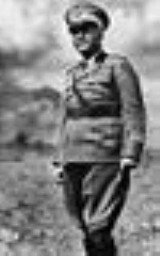
Pietro Badoglio

Encyclopedia
Pietro Badoglio, 1st Duke of Addis Abeba, 1st Marquess of Sabotino (28 September 1871 – 1 November 1956) was an Italian
soldier and politician. He was a member of the National Fascist Party
and commanded fascist troops under Italian dictator Benito Mussolini
in the Second Italo-Abyssinian War
and is an alleged war criminal for the use of poison gas and systematically bombarding and strafing Red Cross hospitals and ambulances during the Ethiopia campaign. Due to post-war expediencies, however, he was never brought to justice.
On 24 July 1943, as Italy had suffered several setbacks in World War II
, Mussolini summoned the Fascist Grand Council, which voted no confidence in Mussolini. The following day Il Duce was removed from government by king Victor Emmanuel III
and arrested. Badoglio was named Prime Minister of Italy
and while mass confusion in Italy reigned, he eventually signed an armistice with the Allies
. When this was made public, it threw Italy into chaos. A civil war took place, and the fascists fought the partisans. The king and Badoglio fled Rome
leaving the Italian Army
with no orders to follow.
Eventually from Brindisi
on 13 October, Badoglio and the Kingdom of Italy
declared war against Nazi Germany
. Badoglio did not stay as Prime Minister for long however, as world opinion at that stage desired a person with a non-Fascist past to head the government. In June 1944, Badoglio was replaced by Ivanoe Bonomi
of the Labour Democratic Party
.
) in the province of Asti
(Piedmont
).
After studying at the military academy in Turin
, he served with the Italian Army
from 1892, at first as a Lieutenant
(Tenente
) in artillery
, taking part in the campaigns in Eritrea
(1896) and Libya
(1912), where he distinguished himself at the Battle of Zanzur.
, he was a Lieutenant Colonel
(Tenente Colonnello
); he rose to the rank of General
following his handling of the capture of Monte Sabotino in May 1916 and by the late months of 1917 (mostly thanks to his Masonic
contacts, including his superior, General Capello) was named as Vice Chief-of-Staff (Sottocapo di Stato Maggiore) despite being one of the main leaders responsible for the disaster during the Battle of Caporetto
on 24 October 1917.
In the years after World War I, in which he held several high ranks in the Italian Army, Badoglio exerted a constant effort in modifying official documents in order to hide his role in the defeat.
, but also remained in the army with special assignments to Romania
and the U.S.
in 1920 and 1921. At first, he opposed Benito Mussolini
and after 1922 was side-lined as ambassador to Brazil
. A change of political heart soon returned him to Italy and a senior role in the army as Chief of Staff from 4 May 1924. On June 25, 1926, Badoglio was promoted to the rank of Marshal of Italy
(Maresciallo d'Italia
).
Badoglio was the first unique governor of Tripolitania
and Cyrenaica
(Italian Libya
) from 1929 to 1933. During his goveronship, he played a vital part (with Rodolfo Graziani
, deputy governor of Cyrenaica) in defeating the Libyan rebels. On 24 January 1932, Badoglio proclaimed the end of Libyan resistance
for the first time since the Italian invasion in 1911.
when Emilio de Bono
began the invasion of Abyssinia
on 3 October 1935. De Bono was the Commander-in-Chief
of all Italian military forces invading Ethiopia
and he was in direct command of the invasion army on the northern front. Ultimately, the progress of De Bono's invasion
was judged to be too slow by Mussolini. As a result, Badoglio, who in the meantime had launched an epistolary campaign against De Bono, replaced the latter in December. After the December 26 torture and murder of downed Italian pilot Tito Minniti
Badoglio asked for and was given permission to use chemical warfare.
Badoglio was immediately faced with the Ethiopian "Christmas Offensive"
and he sought and received approval for the use of mustard gas. He employed it to effectively destroy the Ethiopian armies confronting him on the northern front. Badoglio commanded the Italian invasion army at the First Battle of Tembien
, the Battle of Amba Aradam
, the Second Battle of Tembien
, and the Battle of Shire
. On 31 March, Badoglio defeated Emperor
Haile Selassie commanding the last Ethiopian army on the northern front at the Battle of Maychew
. On 26 April, with no Ethiopian resistance left between his forces and Addis Ababa
, Badoglio launched his "March of the Iron Will
" to take the Ethiopian capital city and end the war. By 2 May, Haile Selassie had fled the country.
On 5 May 1936, Marshal Badoglio led the victorious Italian troops into Addis Ababa. Mussolini
declared King Victor Emmanuel
to be the Emperor of Ethiopia
, and Ethiopia became part of the Italian Empire
. On this occasion, Badoglio was appointed the first Viceroy
and Governor General of Ethiopia and ennobled with the victory title
of Duke of Addis Abeba
.
On 11 June 1936, Rodolfo Graziani
replaced Badoglio as Viceroy and Governor General of Ethiopia. Badoglio returned to his duties as the Supreme Chief of the Italian General Staff. According to Time
magazine, Badoglio even joined the Fascist Party in early June.
and was pessimistic about the chances of Italian success in any European war but he did not oppose the decision of Mussolini and the King to declare war on France and Great Britain. Following the Italian army's poor performance in the invasion of Greece
in December 1940, he resigned from the General Staff. Badoglio was replaced by Ugo Cavallero
.
On 24 July 1943, following the Allied invasion of Sicily
, there was a meeting of the Fascist Grand Council. On the following day, King Victor Emmanuel
dismissed Mussolini as Prime Minister
and appointed Badoglio to head the government in his place. Martial law
was declared, Mussolini was arrested, and negotiations were covertly opened with the Allies. Publicly, the King and Badoglio claimed that Italy would remain with the Axis. Instead, they were plotting in the background.
On September 3, General Giuseppe Castellano
signed the Italian armistice with the Allies
in Cassibile
on behalf of Badoglio. On September 8, the armistice document was published by the Allies in the Badoglio Proclamation
. It was published before Badoglio could communicate news of the switch to the Italian armed forces. The units of the Royal Army, Royal Navy, and Royal Air Force were generally surprised by the switch and unprepared for German actions to disarm them. In the early hours of September 9, Badoglio, King Victor Emmanuel, some military ministries, and the Chief of the General Staff escaped to Pescara
and Brindisi
seeking Allied protection.
On 23 September, the longer version of the armistice was signed in Malta
. The Badoglio government officially declared war on Germany
on October 13. Badoglio continued to head the government for another nine months. Following the German rescue of Mussolini, the liberation of Rome
, and increasingly strong opposition, he was replaced on 9 June 1944 by Ivanoe Bonomi
and other committed anti-Fascists. Badoglio was never tried for war crimes by the Allies primarily because he helped them during the invasion of Italy.
Italy
Italy , officially the Italian Republic languages]] under the European Charter for Regional or Minority Languages. In each of these, Italy's official name is as follows:;;;;;;;;), is a unitary parliamentary republic in South-Central Europe. To the north it borders France, Switzerland, Austria and...
soldier and politician. He was a member of the National Fascist Party
National Fascist Party
The National Fascist Party was an Italian political party, created by Benito Mussolini as the political expression of fascism...
and commanded fascist troops under Italian dictator Benito Mussolini
Benito Mussolini
Benito Amilcare Andrea Mussolini was an Italian politician who led the National Fascist Party and is credited with being one of the key figures in the creation of Fascism....
in the Second Italo-Abyssinian War
Second Italo-Abyssinian War
The Second Italo–Abyssinian War was a colonial war that started in October 1935 and ended in May 1936. The war was fought between the armed forces of the Kingdom of Italy and the armed forces of the Ethiopian Empire...
and is an alleged war criminal for the use of poison gas and systematically bombarding and strafing Red Cross hospitals and ambulances during the Ethiopia campaign. Due to post-war expediencies, however, he was never brought to justice.
On 24 July 1943, as Italy had suffered several setbacks in World War II
World War II
World War II, or the Second World War , was a global conflict lasting from 1939 to 1945, involving most of the world's nations—including all of the great powers—eventually forming two opposing military alliances: the Allies and the Axis...
, Mussolini summoned the Fascist Grand Council, which voted no confidence in Mussolini. The following day Il Duce was removed from government by king Victor Emmanuel III
Victor Emmanuel III of Italy
Victor Emmanuel III was a member of the House of Savoy and King of Italy . In addition, he claimed the crowns of Ethiopia and Albania and claimed the titles Emperor of Ethiopia and King of Albania , which were unrecognised by the Great Powers...
and arrested. Badoglio was named Prime Minister of Italy
Prime minister of Italy
The Prime Minister of Italy is the head of government of the Italian Republic...
and while mass confusion in Italy reigned, he eventually signed an armistice with the Allies
Allies
In everyday English usage, allies are people, groups, or nations that have joined together in an association for mutual benefit or to achieve some common purpose, whether or not explicit agreement has been worked out between them...
. When this was made public, it threw Italy into chaos. A civil war took place, and the fascists fought the partisans. The king and Badoglio fled Rome
Rome
Rome is the capital of Italy and the country's largest and most populated city and comune, with over 2.7 million residents in . The city is located in the central-western portion of the Italian Peninsula, on the Tiber River within the Lazio region of Italy.Rome's history spans two and a half...
leaving the Italian Army
Italian Army
The Italian Army is the ground defence force of the Italian Armed Forces. It is all-volunteer force of active-duty personnel, numbering 108,355 in 2010. Its best-known combat vehicles are the Dardo infantry fighting vehicle, the Centauro tank destroyer and the Ariete tank, and among its aircraft...
with no orders to follow.
Eventually from Brindisi
Brindisi
Brindisi is a city in the Apulia region of Italy, the capital of the province of Brindisi, off the coast of the Adriatic Sea.Historically, the city has played an important role in commerce and culture, due to its position on the Italian Peninsula and its natural port on the Adriatic Sea. The city...
on 13 October, Badoglio and the Kingdom of Italy
Kingdom of Italy (1861–1946)
The Kingdom of Italy was a state forged in 1861 by the unification of Italy under the influence of the Kingdom of Sardinia, which was its legal predecessor state...
declared war against Nazi Germany
Nazi Germany
Nazi Germany , also known as the Third Reich , but officially called German Reich from 1933 to 1943 and Greater German Reich from 26 June 1943 onward, is the name commonly used to refer to the state of Germany from 1933 to 1945, when it was a totalitarian dictatorship ruled by...
. Badoglio did not stay as Prime Minister for long however, as world opinion at that stage desired a person with a non-Fascist past to head the government. In June 1944, Badoglio was replaced by Ivanoe Bonomi
Ivanoe Bonomi
Ivanoe Bonomi was an Italian politician and statesman before and after World War II.Bonomi was born in Mantua. He was elected to the Italian Chamber of Deputies in 1909, representing Mantua as a member of the Italian Socialist Party...
of the Labour Democratic Party
Labour Democratic Party
The Labour Democratic Party was a social-liberal political party in Italy, founded in 1943 as the heir of defunct Italian Social Democratic Party, formed by those Socialists who wanted to cooperate with the Liberal political guard which governed Italy from the days of Giovanni Giolitti...
.
Biography
He was born in Grazzano Monferrato (later Grazzano BadoglioGrazzano Badoglio
Grazzano Badoglio is a comune in the Province of Asti in the Italian region Piedmont, located about 50 km east of Turin and about 15 km northeast of Asti. It was the birthplace of Pietro Badoglio, for whom it was later renamed....
) in the province of Asti
Province of Asti
The Province of Asti is a province in the Piedmont region of northern Italy. Its capital is the city of Asti. To the north west it borders on the province of Turin; to the south west it borders on the province of Cuneo. To the east it borders on the province of Alessandria, while in the south it...
(Piedmont
Piedmont
Piedmont is one of the 20 regions of Italy. It has an area of 25,402 square kilometres and a population of about 4.4 million. The capital of Piedmont is Turin. The main local language is Piedmontese. Occitan is also spoken by a minority in the Occitan Valleys situated in the Provinces of...
).
After studying at the military academy in Turin
Turin
Turin is a city and major business and cultural centre in northern Italy, capital of the Piedmont region, located mainly on the left bank of the Po River and surrounded by the Alpine arch. The population of the city proper is 909,193 while the population of the urban area is estimated by Eurostat...
, he served with the Italian Army
Italian Army
The Italian Army is the ground defence force of the Italian Armed Forces. It is all-volunteer force of active-duty personnel, numbering 108,355 in 2010. Its best-known combat vehicles are the Dardo infantry fighting vehicle, the Centauro tank destroyer and the Ariete tank, and among its aircraft...
from 1892, at first as a Lieutenant
Lieutenant
A lieutenant is a junior commissioned officer in many nations' armed forces. Typically, the rank of lieutenant in naval usage, while still a junior officer rank, is senior to the army rank...
(Tenente
Lieutenant
A lieutenant is a junior commissioned officer in many nations' armed forces. Typically, the rank of lieutenant in naval usage, while still a junior officer rank, is senior to the army rank...
) in artillery
Artillery
Originally applied to any group of infantry primarily armed with projectile weapons, artillery has over time become limited in meaning to refer only to those engines of war that operate by projection of munitions far beyond the range of effect of personal weapons...
, taking part in the campaigns in Eritrea
Eritrea
Eritrea , officially the State of Eritrea, is a country in the Horn of Africa. Eritrea derives it's name from the Greek word Erethria, meaning 'red land'. The capital is Asmara. It is bordered by Sudan in the west, Ethiopia in the south, and Djibouti in the southeast...
(1896) and Libya
Libya
Libya is an African country in the Maghreb region of North Africa bordered by the Mediterranean Sea to the north, Egypt to the east, Sudan to the southeast, Chad and Niger to the south, and Algeria and Tunisia to the west....
(1912), where he distinguished himself at the Battle of Zanzur.
World War I
At the beginning of Italian participation in World War IWorld War I
World War I , which was predominantly called the World War or the Great War from its occurrence until 1939, and the First World War or World War I thereafter, was a major war centred in Europe that began on 28 July 1914 and lasted until 11 November 1918...
, he was a Lieutenant Colonel
Lieutenant colonel
Lieutenant colonel is a rank of commissioned officer in the armies and most marine forces and some air forces of the world, typically ranking above a major and below a colonel. The rank of lieutenant colonel is often shortened to simply "colonel" in conversation and in unofficial correspondence...
(Tenente Colonnello
Lieutenant colonel
Lieutenant colonel is a rank of commissioned officer in the armies and most marine forces and some air forces of the world, typically ranking above a major and below a colonel. The rank of lieutenant colonel is often shortened to simply "colonel" in conversation and in unofficial correspondence...
); he rose to the rank of General
General
A general officer is an officer of high military rank, usually in the army, and in some nations, the air force. The term is widely used by many nations of the world, and when a country uses a different term, there is an equivalent title given....
following his handling of the capture of Monte Sabotino in May 1916 and by the late months of 1917 (mostly thanks to his Masonic
Freemasonry
Freemasonry is a fraternal organisation that arose from obscure origins in the late 16th to early 17th century. Freemasonry now exists in various forms all over the world, with a membership estimated at around six million, including approximately 150,000 under the jurisdictions of the Grand Lodge...
contacts, including his superior, General Capello) was named as Vice Chief-of-Staff (Sottocapo di Stato Maggiore) despite being one of the main leaders responsible for the disaster during the Battle of Caporetto
Battle of Caporetto
The Battle of Caporetto , took place from 24 October to 19 November 1917, near the town of Kobarid , on the Austro-Italian front of World War I...
on 24 October 1917.
In the years after World War I, in which he held several high ranks in the Italian Army, Badoglio exerted a constant effort in modifying official documents in order to hide his role in the defeat.
Interwar period
Post-war, Badoglio was named as a SenatorItalian Senate
The Senate of the Republic is the upper house of the Italian Parliament. It was established in its current form on 8 May 1948, but previously existed during the Kingdom of Italy as Senato del Regno , itself a continuation of the Senato Subalpino of Sardinia-Piedmont established on 8 May 1848...
, but also remained in the army with special assignments to Romania
Romania
Romania is a country located at the crossroads of Central and Southeastern Europe, on the Lower Danube, within and outside the Carpathian arch, bordering on the Black Sea...
and the U.S.
United States
The United States of America is a federal constitutional republic comprising fifty states and a federal district...
in 1920 and 1921. At first, he opposed Benito Mussolini
Benito Mussolini
Benito Amilcare Andrea Mussolini was an Italian politician who led the National Fascist Party and is credited with being one of the key figures in the creation of Fascism....
and after 1922 was side-lined as ambassador to Brazil
Brazil
Brazil , officially the Federative Republic of Brazil , is the largest country in South America. It is the world's fifth largest country, both by geographical area and by population with over 192 million people...
. A change of political heart soon returned him to Italy and a senior role in the army as Chief of Staff from 4 May 1924. On June 25, 1926, Badoglio was promoted to the rank of Marshal of Italy
Marshal of Italy
Marshal of Italy was a rank in the Italian Royal Army . Originally created in 1924 by Italian dictator Benito Mussolini for the purpose of honoring Generals Luigi Cadorna and Armando Diaz, the rank was granted to several other general officers from 1926 to 1943...
(Maresciallo d'Italia
Marshal of Italy
Marshal of Italy was a rank in the Italian Royal Army . Originally created in 1924 by Italian dictator Benito Mussolini for the purpose of honoring Generals Luigi Cadorna and Armando Diaz, the rank was granted to several other general officers from 1926 to 1943...
).
Badoglio was the first unique governor of Tripolitania
Tripolitania
Tripolitania or Tripolitana is a historic region and former province of Libya.Tripolitania was a separate Italian colony from 1927 to 1934...
and Cyrenaica
Cyrenaica
Cyrenaica is the eastern coastal region of Libya.Also known as Pentapolis in antiquity, it was part of the Creta et Cyrenaica province during the Roman period, later divided in Libia Pentapolis and Libia Sicca...
(Italian Libya
Italian Libya
Italian Libya was a unified colony of Italian North Africa established in 1934 in what represents present-day Libya...
) from 1929 to 1933. During his goveronship, he played a vital part (with Rodolfo Graziani
Rodolfo Graziani
Rodolfo Graziani, 1st Marquis of Neghelli , was an officer in the Italian Regio Esercito who led military expeditions in Africa before and during World War II.-Rise to prominence:...
, deputy governor of Cyrenaica) in defeating the Libyan rebels. On 24 January 1932, Badoglio proclaimed the end of Libyan resistance
Libyan resistance movement
The Libyan resistance movement was the resistance movement against the Italian colonization of Libya.-History:It was initially led by Omar Mukhtar , who was from the tribe of Mnifa, born in a small village called Janzour located in the eastern part of Barqa...
for the first time since the Italian invasion in 1911.
Ethiopian invasion
Badoglio was not in East AfricaEast Africa
East Africa or Eastern Africa is the easterly region of the African continent, variably defined by geography or geopolitics. In the UN scheme of geographic regions, 19 territories constitute Eastern Africa:...
when Emilio de Bono
Emilio De Bono
Emilio De Bono was an Italian General, fascist activist, Marshal, and member of the Fascist Grand Council . De Bono fought in the Italo-Turkish War, World War I, and the Second Italo-Abyssinian War.-Early life:De Bono was born in Cassano d'Adda...
began the invasion of Abyssinia
Second Italo-Abyssinian War
The Second Italo–Abyssinian War was a colonial war that started in October 1935 and ended in May 1936. The war was fought between the armed forces of the Kingdom of Italy and the armed forces of the Ethiopian Empire...
on 3 October 1935. De Bono was the Commander-in-Chief
Commander-in-Chief
A commander-in-chief is the commander of a nation's military forces or significant element of those forces. In the latter case, the force element may be defined as those forces within a particular region or those forces which are associated by function. As a practical term it refers to the military...
of all Italian military forces invading Ethiopia
Ethiopia
Ethiopia , officially known as the Federal Democratic Republic of Ethiopia, is a country located in the Horn of Africa. It is the second-most populous nation in Africa, with over 82 million inhabitants, and the tenth-largest by area, occupying 1,100,000 km2...
and he was in direct command of the invasion army on the northern front. Ultimately, the progress of De Bono's invasion
De Bono's invasion of Abyssinia
De Bono's invasion of Abyssinia took place during the opening stages of the Second Italo-Abyssinian War. Italian General Emilio De Bono invaded northern Abyssinia from staging areas in the Italian colony of Eritrea on what was known as the "northern front."...
was judged to be too slow by Mussolini. As a result, Badoglio, who in the meantime had launched an epistolary campaign against De Bono, replaced the latter in December. After the December 26 torture and murder of downed Italian pilot Tito Minniti
Tito Minniti
Tito Minniti was an Italian pilot who was killed after he was captured by Ethiopians during the Second Italo-Abyssinian War in 1935 near Degehabur. His death and alleged torture became an atrocity story justifying the use of mustard gas against the Ethiopians...
Badoglio asked for and was given permission to use chemical warfare.
Badoglio was immediately faced with the Ethiopian "Christmas Offensive"
Ethiopian Christmas Offensive
The Ethiopian Christmas Offensive took place during the Second Italo-Abyssinian War. The Ethiopian offensive was more of a counteroffensive to an ever slowing Italian offensive which started the war.-Background:...
and he sought and received approval for the use of mustard gas. He employed it to effectively destroy the Ethiopian armies confronting him on the northern front. Badoglio commanded the Italian invasion army at the First Battle of Tembien
First Battle of Tembien
The First Battle of Tembien was a battle fought on the northern front of what was known as the Second Italo-Abyssinian War. This battle consisted of attacks and counterattacks by Italian forces under Marshal Pietro Badoglio and Ethiopian forces under Ras Kassa Haile Darge...
, the Battle of Amba Aradam
Battle of Amba Aradam
The Battle of Amba Aradam was a battle fought on the northern front of what was known as the Second Italo-Abyssinian War. This battle consisted of attacks and counterattacks by Italian forces under Marshal of Italy Pietro Badoglio and Ethiopian forces under Ras Mulugeta Yeggazu...
, the Second Battle of Tembien
Second Battle of Tembien
The Second Battle of Tembien was a battle fought on the northern front of what was known as the Second Italo-Abyssinian War. This battle consisted of attacks by Italian forces under Marshal Pietro Badoglio on Ethiopian forces under Ras Kassa Haile Darge and Ras Seyoum Mangasha...
, and the Battle of Shire
Battle of Shire
The Battle of Shire was a battle fought on the northern front of what was known as the Second Italo-Abyssinian War. This battle consisted of attacks and counterattacks by Italian forces under Marshal of Italy Pietro Badoglio and Ethiopian forces under Ras Imru Haile Selassie...
. On 31 March, Badoglio defeated Emperor
Emperor of Ethiopia
The Emperor of Ethiopia was the hereditary ruler of Ethiopia until the abolition of the monarchy in 1974. The Emperor was the head of state and head of government, with ultimate executive, judicial and legislative power in that country...
Haile Selassie commanding the last Ethiopian army on the northern front at the Battle of Maychew
Battle of Maychew
The Battle of Maychew was the last major battle fought on the northern front during the Second Italo-Abyssinian War. The battle consisted of a failed counterattack by the Ethiopian forces under Emperor Haile Selassie making frontal assaults against prepared Italian defensive positions under the...
. On 26 April, with no Ethiopian resistance left between his forces and Addis Ababa
Addis Ababa
Addis Ababa is the capital city of Ethiopia...
, Badoglio launched his "March of the Iron Will
March of the Iron Will
The March of the Iron Will , or the Iron-Will Column , was a Fascist propaganda event staged during the final days of the Italian invasion of Ethiopia...
" to take the Ethiopian capital city and end the war. By 2 May, Haile Selassie had fled the country.
On 5 May 1936, Marshal Badoglio led the victorious Italian troops into Addis Ababa. Mussolini
Benito Mussolini
Benito Amilcare Andrea Mussolini was an Italian politician who led the National Fascist Party and is credited with being one of the key figures in the creation of Fascism....
declared King Victor Emmanuel
Victor Emmanuel III of Italy
Victor Emmanuel III was a member of the House of Savoy and King of Italy . In addition, he claimed the crowns of Ethiopia and Albania and claimed the titles Emperor of Ethiopia and King of Albania , which were unrecognised by the Great Powers...
to be the Emperor of Ethiopia
Emperor of Ethiopia
The Emperor of Ethiopia was the hereditary ruler of Ethiopia until the abolition of the monarchy in 1974. The Emperor was the head of state and head of government, with ultimate executive, judicial and legislative power in that country...
, and Ethiopia became part of the Italian Empire
Italian Empire
The Italian Empire was created after the Kingdom of Italy joined other European powers in establishing colonies overseas during the "scramble for Africa". Modern Italy as a unified state only existed from 1861. By this time France, Spain, Portugal, Britain, and the Netherlands, had already carved...
. On this occasion, Badoglio was appointed the first Viceroy
Viceroy
A viceroy is a royal official who runs a country, colony, or province in the name of and as representative of the monarch. The term derives from the Latin prefix vice-, meaning "in the place of" and the French word roi, meaning king. A viceroy's province or larger territory is called a viceroyalty...
and Governor General of Ethiopia and ennobled with the victory title
Victory title
A victory title is an honorific title adopted by a successful military commander to commemorate his defeat of an enemy nation. This practice was first used by Ancient Rome and is still most commonly associated with the Romans, but it has also been adopted as a practice by many modern empires,...
of Duke of Addis Abeba
Duke of Addis Abeba
Duke of Addis Abeba is a hereditary title in the Italian nobility which was bestowed at the Italian conquest of Ethiopia as a victory title by King Victor Emmanuel III...
.
On 11 June 1936, Rodolfo Graziani
Rodolfo Graziani
Rodolfo Graziani, 1st Marquis of Neghelli , was an officer in the Italian Regio Esercito who led military expeditions in Africa before and during World War II.-Rise to prominence:...
replaced Badoglio as Viceroy and Governor General of Ethiopia. Badoglio returned to his duties as the Supreme Chief of the Italian General Staff. According to Time
Time (magazine)
Time is an American news magazine. A European edition is published from London. Time Europe covers the Middle East, Africa and, since 2003, Latin America. An Asian edition is based in Hong Kong...
magazine, Badoglio even joined the Fascist Party in early June.
World War II
Badoglio was not in favour of the Italian-German Pact of SteelPact of Steel
The Pact of Steel , known formally as the Pact of Friendship and Alliance between Germany and Italy, was an agreement between Fascist Italy and Nazi Germany signed on May 22, 1939, by the foreign ministers of each country and witnessed by Count Galeazzo Ciano for Italy and Joachim von Ribbentrop...
and was pessimistic about the chances of Italian success in any European war but he did not oppose the decision of Mussolini and the King to declare war on France and Great Britain. Following the Italian army's poor performance in the invasion of Greece
Greco-Italian War
The Greco-Italian War was a conflict between Italy and Greece which lasted from 28 October 1940 to 23 April 1941. It marked the beginning of the Balkans Campaign of World War II...
in December 1940, he resigned from the General Staff. Badoglio was replaced by Ugo Cavallero
Ugo Cavallero
Ugo Cavallero was an Italian military commander before and during World War II. He was also a recipient of the Knight's Cross of the Iron Cross...
.
On 24 July 1943, following the Allied invasion of Sicily
Allied invasion of Sicily
The Allied invasion of Sicily, codenamed Operation Husky, was a major World War II campaign, in which the Allies took Sicily from the Axis . It was a large scale amphibious and airborne operation, followed by six weeks of land combat. It launched the Italian Campaign.Husky began on the night of...
, there was a meeting of the Fascist Grand Council. On the following day, King Victor Emmanuel
Victor Emmanuel III of Italy
Victor Emmanuel III was a member of the House of Savoy and King of Italy . In addition, he claimed the crowns of Ethiopia and Albania and claimed the titles Emperor of Ethiopia and King of Albania , which were unrecognised by the Great Powers...
dismissed Mussolini as Prime Minister
Prime minister of Italy
The Prime Minister of Italy is the head of government of the Italian Republic...
and appointed Badoglio to head the government in his place. Martial law
Martial law
Martial law is the imposition of military rule by military authorities over designated regions on an emergency basis— only temporary—when the civilian government or civilian authorities fail to function effectively , when there are extensive riots and protests, or when the disobedience of the law...
was declared, Mussolini was arrested, and negotiations were covertly opened with the Allies. Publicly, the King and Badoglio claimed that Italy would remain with the Axis. Instead, they were plotting in the background.
On September 3, General Giuseppe Castellano
Giuseppe Castellano
Giuseppe Castellano was an Italian general who negotiated the Armistice between Italy and Allied armed forces on September 8, 1943.-Military career:...
signed the Italian armistice with the Allies
Armistice with Italy
The Armistice with Italy was an armistice signed on September 3 and publicly declared on September 8, 1943, during World War II, between Italy and the Allied armed forces, who were then occupying the southern end of the country, entailing the capitulation of Italy...
in Cassibile
Cassibile (village)
Cassibile is an Italian village and civil parish of the city and municipality of Syracuse , in Sicily. As of 2006 its population was of 5,800.-History:...
on behalf of Badoglio. On September 8, the armistice document was published by the Allies in the Badoglio Proclamation
Badoglio Proclamation
The Badoglio Proclamation was a speech read on Ente Italiano per le Audizioni Radiofoniche at 19:42 on 8 September 1943 by marshal Pietro Badoglio, Italian head of government, announcing that the Cassabile armistice between Italy and the Allies signed on 3 September had come into force. It...
. It was published before Badoglio could communicate news of the switch to the Italian armed forces. The units of the Royal Army, Royal Navy, and Royal Air Force were generally surprised by the switch and unprepared for German actions to disarm them. In the early hours of September 9, Badoglio, King Victor Emmanuel, some military ministries, and the Chief of the General Staff escaped to Pescara
Pescara
Pescara is the capital city of the Province of Pescara, in the Abruzzo region of Italy. As of January 1, 2007 it was the most populated city within Abruzzo at 123,059 residents, 400,000 with the surrounding metropolitan area...
and Brindisi
Brindisi
Brindisi is a city in the Apulia region of Italy, the capital of the province of Brindisi, off the coast of the Adriatic Sea.Historically, the city has played an important role in commerce and culture, due to its position on the Italian Peninsula and its natural port on the Adriatic Sea. The city...
seeking Allied protection.
On 23 September, the longer version of the armistice was signed in Malta
Malta
Malta , officially known as the Republic of Malta , is a Southern European country consisting of an archipelago situated in the centre of the Mediterranean, south of Sicily, east of Tunisia and north of Libya, with Gibraltar to the west and Alexandria to the east.Malta covers just over in...
. The Badoglio government officially declared war on Germany
Germany
Germany , officially the Federal Republic of Germany , is a federal parliamentary republic in Europe. The country consists of 16 states while the capital and largest city is Berlin. Germany covers an area of 357,021 km2 and has a largely temperate seasonal climate...
on October 13. Badoglio continued to head the government for another nine months. Following the German rescue of Mussolini, the liberation of Rome
Rome
Rome is the capital of Italy and the country's largest and most populated city and comune, with over 2.7 million residents in . The city is located in the central-western portion of the Italian Peninsula, on the Tiber River within the Lazio region of Italy.Rome's history spans two and a half...
, and increasingly strong opposition, he was replaced on 9 June 1944 by Ivanoe Bonomi
Ivanoe Bonomi
Ivanoe Bonomi was an Italian politician and statesman before and after World War II.Bonomi was born in Mantua. He was elected to the Italian Chamber of Deputies in 1909, representing Mantua as a member of the Italian Socialist Party...
and other committed anti-Fascists. Badoglio was never tried for war crimes by the Allies primarily because he helped them during the invasion of Italy.
See also
- Royal Italian ArmyRoyal Italian ArmyThe Regio Esercito was the army of the Kingdom of Italy from the unification of Italy in 1861 to the birth of the Italian Republic in 1946...
- Royal Italian Army (1940–1946)Royal Italian Army (1940–1946)This article is about the Italian Royal Army which participated in World War II.The Italian Royal Army was reformed in 1861 and lasted until 1946. The Royal Army started with the unification of Italy and the formation of the Kingdom of Italy . It ended with the dissolution of the monarchy...
- Italian Co-Belligerent ArmyItalian Co-Belligerent ArmyThe Italian Co-Belligerent Army , or the Army of the South , was the army of the Italian Royalist forces fighting on the side of the Allies during World War II....
Further reading
- Italian Defence Minister website official biography of Pietro Badoglio as Chief of the General Staff