

Third Battle of Kharkov

Encyclopedia
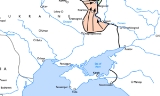
The Third Battle of Kharkov was a series of offensive operations on the Eastern Front of World War II, undertaken by the German
Army Group South
against the Red Army
, around the city of Kharkov , between 19 February and 15 March 1943. Known to the Germans as the Donets Campaign, and to the Soviets
as the Donbas and Kharkov operations, the German counterstrike led to the destruction of approximately 52 Soviet divisions
and the recapture of the cities of Kharkov and Belgorod
.
As the German Sixth Army was encircled in Stalingrad
, the Red Army undertook a series of wider offensives against the rest of Army Group South. These culminated on 2 January 1943, when the Soviets launched Operation Star
, which between January and early February broke German defenses and led to the Soviet recapture of Kharkov, Belgorod and Kursk
. The Soviet offensive was successful, but caused participating Soviet units to over-extend themselves. Freed on 2 February by the surrender of the German Sixth Army, the Red Army's Central Front turned its attention west, and on 25 February expanded its offensive against both Army Group South and Army Group Center
. However, months of continuous operations had taken a heavy toll on the Soviets and some divisions were reduced to 1,000–2,000 combat effective soldiers. On 19 February, Field Marshal
Erich von Manstein
took the opportunity to launch his Kharkov counterstrike, using the fresh SS Panzer Corps
and two panzer armies.
Although the Germans were also understrength, the Wehrmacht
successfully flanked, encircled and defeated the Red Army's armored spearheads south of Kharkov. This enabled von Manstein to renew his offensive against the city of Kharkov proper, which began on 7 March. Despite orders to encircle Kharkov from the north, the SS Panzer Corps instead decided to directly engage Kharkov on 11 March. This led to four days of house-to-house fighting before Kharkov was finally recaptured by the 1st SS Panzer Division
on 15 March. Two days later, the Germans also recaptured Belgorod, creating the salient
which in July 1943 would lead to the Battle of Kursk
. The German offensive cost the Red Army an estimated 70,000 casualties
but the house-to-house fighting in Kharkov was also particularly bloody for the German SS Panzer Corps, which had lost approximately 4,300 men by the time operations ended in late March.
faced a major crisis as Soviet
forces encircled and reduced the German Sixth Army at Stalingrad
and expanded their Winter Campaign towards the Don River
. On 2 February 1943 the Sixth Army's commanding officers surrendered, and an estimated 90,000 men were captured by the Red Army
. Total German losses at the Battle of Stalingrad, excluding prisoners, were between 120,000 and 150,000. Throughout 1942 German casualties totaled around 1.9 million personnel, and by the start of 1943 the Wehrmacht was around 470,000 men below full strength on the Eastern Front
. At the beginning of Operation Barbarossa
, the Wehrmacht was equipped with around 3,300 tanks; by 23 January only 495 tanks, mostly of older types, remained operational along the entire length of the Soviet–German front. As the forces of the Don Front
were destroying the German forces in Stalingrad, Stavka ordered the Soviet forces to conduct a new offensive, which encompassed the entire southern wing of the Soviet–German front from Voronezh
to Rostov
.
On 2 February, the Red Army launched Operation Star, threatening to recapture the cities of Belgorod
, Kharkov and Kursk
. A Soviet drive, spearheaded by four tank corps organized under Lieutenant-General Markian Popov
, pierced the German front by crossing the Donets River and pressing into the German rear. On 15 February, two fresh Soviet tank corps threatened the city of Zaporizhia
on the Dnieper River
, which controlled the last major road to Rostov
and housed the headquarters of Army Group South and Luftflotte 4
(Air Fleet Four). Despite Hitler
's orders to hold the city, Kharkov was abandoned by German forces and the city was recaptured by the Red Army on 16 February.
Hitler immediately flew to von Manstein's headquarters at Zaporizhia. Von Manstein informed him that an immediate counterattack on Kharkov would be fruitless, but that he could successfully attack the overextended Soviet flank with his five Panzer Corps, and recapture Kharkov later.
On 19 February Soviet armored units broke through the German lines and approached the city. In view of the worsening situation, Hitler gave Manstein operational freedom. When Hitler departed, the Soviets were only some 30 kilometres (18.6 mi) away from the airfield.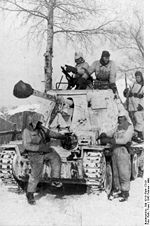 The surrender of the German Sixth Army at Stalingrad freed six Soviet armies, under the command of Konstantin Rokossovsky
, which were refitted and reinforced by the 2nd Tank Army and the 70th Army. These forces were repositioned between the junction of German Army Groups Center and South. Known to the Soviets as the Kharkov and Donbas operations, the offensive sought to surround and destroy German forces in the Orel salient, cross the Desna River
and surround and destroy German Army Group Center. Originally planned to begin between 12–15 February, deployment problems forced the Red Army's command (Stavka
) to push the start date back to 25 February. Meanwhile, the Soviet 60th Army pushed the German Second Army's 4th Panzer Division away from Kursk, while the Soviet 13th Army forced the Second Panzer Army to turn on its flank. This opened a 60 kilometres (37.3 mi) breach between these two German forces, shortly to be exploited by Rokossovsky's offensive. While the Soviet 14th and 48th Armies attacked the Second Panzer Army's right flank, making minor gains, Rokossovsky launched his offensive on 25 February, breaking through German lines and threatening to surround and cut off the German Second Panzer Army and the Second Army, to the south. However, unexpected German resistance began to slow the operation considerably, offering Rokossovsky only limited gains on the left flank of his attack and in the center. Elsewhere, the Soviet 2nd Tank Army had successfully penetrated 160 kilometres (99.4 mi) of the German rear, along the left flank of the Soviet offensive, increasing the length of the army's flank by an estimated 100 kilometres (62.1 mi).
While the Soviet offensive continued, Field Marshal von Manstein was able to put the SS Panzer Corps—now reinforced by the 3rd SS Panzer Division
—under the command of the Fourth Panzer Army, while Hitler agreed to release seven understrength panzer and motorized divisions for the impending counteroffensive. The Fourth Air Fleet, under the command of Field Marshal Wolfram von Richthofen
, was able to regroup and increase the amount of daily sorties from an average of 250 in January to 1,000 in February, providing German forces strategic air superiority. On 20 February, the Red Army was perilously close to Zaporizhia, signaling the beginning of the German counterattack, known to the Germans as the Donets Campaign.
. As a result, the Soviets deployed around twice as many personnel as the Wehrmacht in early February. However, as a result of their over-extension and the casualties they had taken during their offensive, at the beginning of Manstein's counterattack the Germans could achieve a tactical superiority in numbers, including the number of tanks present—for example, Manstein's 350 tanks outnumbered Soviet armor almost seven to one at the point of contact.
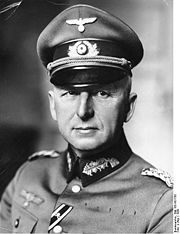 At the time of the counterattack, Manstein could count on the Fourth Panzer Army, composed of XLVIII Panzer Corps, the SS Panzer Corps and the First Panzer Army, with the XL and LVII Panzer Corps. The XLVIII Panzer Corps was composed of the 6th, 11th and 17th Panzer Divisions, while the SS Panzer Corps
was organized with the 1st SS
and 2nd SS Panzer Division
. In early February, the combined strength of the SS Panzer Corps was an estimated 20,000 soldiers. The Fourth Panzer Army and the First Panzer Army were situated south of the Red Army's bulge into German lines, with the First Panzer Army to the east of the Fourth Panzer Army. The SS Panzer Corps was deployed along the northern edge of the bulge, on the northern front of Army Group South.
Comparatively, the Germans were able to amass around 70,000 men against the 210,000 Red Army soldiers. The German Wehrmacht was understrength, especially after continuous operations between June 1942 and February 1943, to the point where Hitler appointed a committee made up of Field Marshal Wilhelm Keitel
, Martin Bormann
and Hans Lammers
, to recruit 800,000 new able-bodied men—half of whom would come from "nonessential industries". However, the effects of this recruitment were not seen until around May 1943, when the German armed forces were at their highest strength since the beginning of the war, with 9.5 million personnel.
By the start of 1943 Germany's armored forces had sustained heavy casualties. It was unusual for a Panzer Division to field more than 100 tanks, and most averaged only 70–80 serviceable tanks at any given time. After the fighting around Kharkov, Heinz Guderian
embarked on a program to bring Germany's mechanized forces up to strength. Despite his efforts, a German panzer division could only count on an estimated 10,000–11,000 personnel, out of an authorized strength of 13,000–17,000. Only by June did a panzer division begin to field between 100–130 tanks each. SS divisions were normally in better shape, with an estimated 150 tanks, a battalion of self-propelled assault guns and enough half-tracks to motorize most of its infantry and reconnaissance soldiers—and these had an authorized strength of an estimated 19,000 personnel. At this time, the bulk of Germany's armor was still composed of Panzer III
s and Panzer IV
s, although the 2nd SS Panzer Division had been outfitted with a number of Tiger I
tanks.
The Fourth Panzer Army was commanded by General Hermann Hoth
, while the First Panzer Army fell under the leadership of General Eberhard von Mackensen
. The 6th, 11th and 17th Panzer Divisions were commanded by Generals von Hünersdorff, Hermann Balck
and Fridolin von Senger und Etterlin, respectively. The SS Panzer Corps was commanded by General Paul Hausser
, who also had the 3rd SS Panzer (Totenkopf) Division under his command.
, Voronezh
and Southwestern Fronts. These were under the command of Generals M. A. Reiter, Filipp Golikov
and Nikolai Vatutin
, respectively. On 25 February, Marshal Rokossovsky's Central Front also joined the battle. These were positioned in such a way that Reiter's Briansk Front was on the northern flank of Army Group South, while Voronezh was directly opposite of Kursk, and the Southwestern Front was located opposite their opponents. Central Front was deployed between Briansk and Veronezh Fronts, to exploit the success of both of these Soviet units, which had created a gap in the defenses of the German Second Panzer Army. This involved an estimated 500,000 soldiers, while around 346,000 personnel were involved in the defense of Kharkov after the beginning of the German counterstroke.
Like their German counterparts, Soviet divisions were also seriously understrength. For example, divisions in the 40th Army
averaged 3,500–4,000 men each, while the 69th Army fielded some divisions which could only count on 1,000–1,500 soldiers. Some divisions had as little as 20–50 mortars to provide fire support. This shortage in manpower and equipment led Vatutin's Southwestern Front to request over 19,000 soldiers and 300 tanks, while it was noted that the Voronezh Front had only received 1,600 replacements since the beginning of operations in 1943. By the time Manstein launched his counteroffensive, Voronezh Front had lost so much manpower and had overextended itself to the point where it could no longer offer assistance to the Southwestern Front, south of it.
) and Army Group Center's reluctance to participate.
. The Das Reich SS Panzer Division advanced in a northeastern direction, while the Totenkopf SS Panzer Division was put into action on 22 February, advancing parallel to the Das Reich. These two divisions successfully cut the supply lines to the Soviet spearheads. First Panzer Army was able to surround and pocket Popov's Mobile Group by 24 February, although a sizable contingent of Soviet troops managed to escape north. On 22 February, alarmed by the success of the German counterattack, the Soviet Stavka ordered the Voronezh Front to shift the 3rd Tank Army and 69th Army south, in an effort to alleviate pressure on the Southwestern Front and destroy German forces in the Krasnograd area.
 The Red Army's 3rd Tank Army began to engage German units south of Kharkov, performing a holding action while Manstein's offensive continued. By 24 February, the Germans had pulled the Panzer Grenadier (Grossdeutschland) Division
off the line, leaving the 167th and 320th infantry divisions, a regiment from the Totenkopf division and elements from the Leibstandarte division to defend the Western edge of the bulge created by the Soviet offensive. Between 24–27 February, the 3rd Tank Army and 69th Army continued to attack this portion of the German line, but without much success. With supporting Soviet units stretched thin, the attack began to falter. On 25 February, Rokossovky's Central Front launched their offensive between the German Second and Third Panzer Armies, with encouraging results along the German flanks, but struggling to keep the same pace in the center of the attack. As the offensive progressed, the attack on the German right flank also began to stagnate in the face of increased resistance, while the attack on the left began to over-extend itself.
In the face of German success against the Southwestern Front, including attempts by the Soviet 6th Army breaking out of the encirclement, Stavka ordered the Voronezh Front to relinquish control of the 3rd Tank Army to the Southwestern Front. To ease the transition, the 3rd Tank Army gave two rifle divisions to the 69th Army, and attacked south in a bid to destroy the SS Panzer Corp. However, low on fuel and ammunition after the march south, the 3rd Tank Army's offensive was postponed until 3 March. Furthermore, the 3rd Tank Army was harassed and severely damaged by continuous German aerial attacks with Junkers Ju 87
Stuka dive bomber
s. Launching its offensive on 3 March, the 3rd Tank Army's 15th Tank Corps struck into advancing units of the 3rd SS Panzer Division and immediately went to the defensive. Ultimately, the 3rd SS was able to pierce the 15th Tank Corps' lines and link up with other units of the same division advancing north, successfully encircling the Soviet tank corps. The 3rd Tank Army's 12th Tank Corps was also forced on the defensive immediately, after the Totenkopf and Das Reich SS Panzer Divisions threatened to cut off the 3rd Tank Army's supply route. By 5 March, the attacking 3rd Tank Army had been badly mauled, with only a small amount of men able to escape northwards, and was forced to erect a new defensive line.
The destruction of Popov's Mobile Group and the 6th Army during the early stages of the German counterattack created a large gap between Soviet lines. Taking advantage of uncoordinated and piecemeal Soviet attempts to plug this gap, Manstein ordered a continuation of the offensive towards Kharkov. Between 1–5 March the German Fourth Panzer Army, including the SS Panzer Corps, covered 80 kilometres (49.7 mi) and positioned itself only about 16 kilometres (9.9 mi) south of Kharkov. By 6 March, the 1st SS Panzer Division made a bridgehead over the Mosh River, opening the road to Kharkov. The success of Manstein's counterattack forced Stavka to stop Rokossovsky's offensive. The First Panzer Army was able to regain a defensive line on the Donets River, and Manstein began to plan subsequent attacks to clear Soviet units west of the Donets. According to the Germans, the German counterattack had cost the Red Army an estimated 23,000 soldiers dead, along with 615 tanks and 352 artillery pieces lost.
On 9 March, the Soviet 40th Army counterattacked against the Panzer Grenadier Division Grossdeutschland in a final attempt to restore communications with the 3rd Tank Army. This counterattack, however, was caught by the expansion of the German offensive towards Kharkov on 10 March. That same day, the 4th Panzer Army issued orders to the SS Panzer Corps to take Kharkov as soon as possible, prompting Hausser to order an immediate attack on the city by three SS Panzer divisions. The 2nd SS would come from the West, the 1st SS would attack from north, and the 3rd SS would provide a protective screen along the north and northwestern flanks. Despite attempts by General Hoth to order Hausser to stick to the original plan, the SS Panzer Corp's commander decided to continue with his attack on the city, although Soviet defenses forced him to postpone the attack until the next day. Manstein issued an order to continue outflanking the city, although leaving room for a potential attack on Kharkov if there was little Soviet resistance, but Hausser decided to disregard the order and continue with his own plan of attack. According to von Manstein, the Army Group headquarters was forced to intervene on a number of occasions to bring the SS Panzer Corps to swing eastwards to encircle the city, instead of launching a frontal attack on Kharkov.
Regiment, advancing from the Northwest, split up into two columns advancing towards northern Kharkov on either side of the Belgorod-Kharkov railroad. The 2nd Battalion, on the right side of the railroad, attacked the city's Severnyi Post district, meeting heavy resistance and advancing only to the Severenyi railway yard by the end of the day. On the opposite side of the railroad, the I Battalion struck at the district of Alexeyevka, meeting a T-34
-led Soviet counterattack which drove part of the I. Battalion back out of the city. Only with aerial and artillery support, coming from Ju 87 Stukas
and StuG
self-propelled assault guns, were the German infantry able to battle their way back into the city. A flanking attack from the rear finally allowed the Germans to achieve a foothold in that area of the city. Simultaneously, the 1st SS Panzergrenadier Regiment, with armor attached from a separate unit, attacked down the main road from Belgorod, fighting an immediate counterattack produced over the Kharkov airfield, coming on their left flank. Fighting their way past T-34s, this German contingent was able to lodge itself into Kharkov's northern suburbs. From the northeast, another contingent of German infantry, armor and self-propelled guns attempted to take control of the road exits to the cities of Rogan and Chuhuiv. This attack penetrated deeper into Kharkov, but low on fuel the armor was forced to entrench itself and turn to the defensive.
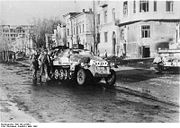 The 2nd SS attacked, on the same day, the west side of Kharkov. After penetrating into the city's Zalyutino district, the advance was stopped by a deep anti-tank ditch, lined with Soviet defenders, including anti-tank guns. A Soviet counterattack was repulsed after a bloody firefight. A detachment of the division fought its way to the southern approaches of the city, cutting off the road to Merefa. At around 3:00 pm, Hoth ordered Hausser to immediately disengage with the 2nd SS, and instead redeploy to cut off escaping Soviet troops. Instead, Hausser sent a detachment from the 3rd SS for this task and informed Hoth that the risk of disengaging with the 2nd SS was far too great. On the night of 11–12 March, a breakthrough element crossed the anti-tank ditch, taking the Soviet defenders by surprise, and opening a path for tanks to cross. This allowed Das Reich to advance to the Kharkov main railway station, which would be the farthest this division would advance into the city. Hoth repeated his order at 1:15 am, of 12 March, and Hausser replied as he had replied on 11 March. However, a third attempt by Hoth was obeyed, and 2nd SS disengaged, using a corridor opened by 1st SS to cross northern Kharkov and redeploy east of the city.
On 12 March, the 1st SS made progress into the city's center, breaking through the staunch Soviet defenses in the northern suburbs and began a house to house fight towards the center. By the end of the day, the division had reached a position just two blocks north of Dzerzhinsky Square. The 2nd Panzergrenadier Regiment's 2nd Battalion was able to surround the square, after taking heavy casualties from Soviet snipers and other defenders, by the evening of 12 March. When taken, the square was renamed "Platz der Leibstandarte". That night, 2nd Panzergrenadier Regiment's 3rd Battalion, under the command of Joachim Peiper
linked up with the 2nd Battalion in Dzerzhinsky Square and attacked southwards, crossing the Kharkov River
and creating a bridgehead, opening the road to Moscow Avenue. Meanwhile, the division's left wing reached the junction of the Volchansk and Chuhuiv exit roads and went on the defensive, fighting off a number of Soviet counterattacks.
The next day, the 1st SS struck south towards the Kharkov River and Peiper's bridgehead, clearing Soviet resistance block by block. In a bid to trap the city's defenders in the center, the 1st Battalion of the 1st SS Panzergrenadier Regiment re-entered the city using the Volchansk exit road. At the same time, Peiper's forces were able to breakout south, suffering from bitter fighting against a tenacious Soviet defense, and link up with the division's left wing at the Volchansk and Chuhuiv road junction. Although the majority of Das Reich had, by now, disengaged from the city, a single Panzergrenadier Regiment remained to clear the southwestern corner of the city, eliminating resistance by the end of the day. This effectively put two-thirds of the city under German control.
Fighting in the city began to wind down on 14 March. The day was spent with the 1st SS clearing the remnants of Soviet resistance, pushing east along a broad front. By the end of the day, the entire city was in German hands. Despite the declaration that the city had fallen, fighting continued on 15 and 16 March, as German units cleared the remnants of resistance in the tractor works factory complex, in the southern outskirts of the city.
. Overall German casualties are more difficult to come by but clues are provided by examining the casualties of the SS Panzer Corps, taking into consideration that the elite Waffen-SS divisions were frequently deployed where the fighting was expected to be the harshest. By 27 March, it is estimated that the SS Panzer Corps had lost around 44% of its fighting strength, including around 160 officers and about 4,300 enlisted personnel.
As the SS Panzer Corps began to emerge from the city, they engaged Soviet units positioned directly southwest of the city, including the 17th NKVD Brigade, 19th Rifle Division and 25th Guards Rifle Division. Attempts by the Red Army to re-establish communication with the remnants of the 3rd Tank Army continued, although in vain. On 14–15 March these forces were given permission to withdraw to the northern Donets River. The Soviet 40th and 69th armies had been engaged since 13 March with the Grossdeutschland Panzergrenadier Division, and had been split by the German drive. After the fall of Kharkov the Soviet defense of the Donets had collapsed, allowing Manstein's forces to drive to Belgorod on 17 March, and take it by the next day. However, weather and exhaustion forced Manstein's counterstroke to end soon thereafter, despite the Field Marshal's ambitions to also attack the Kursk salient which had been created as a result of the recapture of Kharkov and Belgorod.
Following the German success at Kharkov, Hitler was presented with two options. The first, known as the "backhand method" was to wait for the inevitable renewal of the Soviet offensive and conduct another operation similar to that of Kharkov—allowing the Red Army to take ground, extend itself and then counterattack and surround it. The second, or the "forehand method", encompassed a major German offensive by Army Groups South and Center against the protruding Kursk salient. Typically, Hitler chose the "forehand method", which led to the Battle of Kursk
.
Nazi Germany
Nazi Germany , also known as the Third Reich , but officially called German Reich from 1933 to 1943 and Greater German Reich from 26 June 1943 onward, is the name commonly used to refer to the state of Germany from 1933 to 1945, when it was a totalitarian dictatorship ruled by...
Army Group South
Army Group South
Army Group South was the name of a number of German Army Groups during World War II.- Poland campaign :Germany used two army groups to invade Poland in 1939: Army Group North and Army Group South...
against the Red Army
Red Army
The Workers' and Peasants' Red Army started out as the Soviet Union's revolutionary communist combat groups during the Russian Civil War of 1918-1922. It grew into the national army of the Soviet Union. By the 1930s the Red Army was among the largest armies in history.The "Red Army" name refers to...
, around the city of Kharkov , between 19 February and 15 March 1943. Known to the Germans as the Donets Campaign, and to the Soviets
Soviet Union
The Soviet Union , officially the Union of Soviet Socialist Republics , was a constitutionally socialist state that existed in Eurasia between 1922 and 1991....
as the Donbas and Kharkov operations, the German counterstrike led to the destruction of approximately 52 Soviet divisions
Division (military)
A division is a large military unit or formation usually consisting of between 10,000 and 20,000 soldiers. In most armies, a division is composed of several regiments or brigades, and in turn several divisions typically make up a corps...
and the recapture of the cities of Kharkov and Belgorod
Belgorod
-Twin towns/sister cities:Belgorod is twinned with: Wakefield, England, United Kingdom Herne, North Rhine-Westphalia, Germany Palembang, South Sumatra, Indonesia Opole, Poland Vyshhorod, Ukraine Kharkiv, Ukraine-External links:...
.
As the German Sixth Army was encircled in Stalingrad
Battle of Stalingrad
The Battle of Stalingrad was a major battle of World War II in which Nazi Germany and its allies fought the Soviet Union for control of the city of Stalingrad in southwestern Russia. The battle took place between 23 August 1942 and 2 February 1943...
, the Red Army undertook a series of wider offensives against the rest of Army Group South. These culminated on 2 January 1943, when the Soviets launched Operation Star
Operation Star
Operation Zvesda was a Red Army offensive on the Eastern Front of World War II begun on 2 February 1943. The attack was the responsibility of the Voronezh Front under the command of Filipp Golikov. Its main objectives were the cities of Kharkov and Kursk...
, which between January and early February broke German defenses and led to the Soviet recapture of Kharkov, Belgorod and Kursk
Kursk
Kursk is a city and the administrative center of Kursk Oblast, Russia, located at the confluence of the Kur, Tuskar, and Seym Rivers. The area around Kursk was site of a turning point in the Russian-German struggle during World War II and the site of the largest tank battle in history...
. The Soviet offensive was successful, but caused participating Soviet units to over-extend themselves. Freed on 2 February by the surrender of the German Sixth Army, the Red Army's Central Front turned its attention west, and on 25 February expanded its offensive against both Army Group South and Army Group Center
Army Group Centre
Army Group Centre was the name of two distinct German strategic army groups that fought on the Eastern Front in World War II. The first Army Group Centre was created on 22 June 1941, as one of three German Army formations assigned to the invasion of the Soviet Union...
. However, months of continuous operations had taken a heavy toll on the Soviets and some divisions were reduced to 1,000–2,000 combat effective soldiers. On 19 February, Field Marshal
Field Marshal
Field Marshal is a military rank. Traditionally, it is the highest military rank in an army.-Etymology:The origin of the rank of field marshal dates to the early Middle Ages, originally meaning the keeper of the king's horses , from the time of the early Frankish kings.-Usage and hierarchical...
Erich von Manstein
Erich von Manstein
Erich von Manstein was a field marshal in World War II. He became one of the most prominent commanders of Germany's World War II armed forces...
took the opportunity to launch his Kharkov counterstrike, using the fresh SS Panzer Corps
II SS Panzer Corps
The II SS Panzer Corps was a Nazi German Waffen-SS armoured corps which saw action on both the Eastern and Western Fronts during World War II.- Formation - Kharkov :...
and two panzer armies.
Although the Germans were also understrength, the Wehrmacht
Wehrmacht
The Wehrmacht – from , to defend and , the might/power) were the unified armed forces of Nazi Germany from 1935 to 1945. It consisted of the Heer , the Kriegsmarine and the Luftwaffe .-Origin and use of the term:...
successfully flanked, encircled and defeated the Red Army's armored spearheads south of Kharkov. This enabled von Manstein to renew his offensive against the city of Kharkov proper, which began on 7 March. Despite orders to encircle Kharkov from the north, the SS Panzer Corps instead decided to directly engage Kharkov on 11 March. This led to four days of house-to-house fighting before Kharkov was finally recaptured by the 1st SS Panzer Division
1st SS Division Leibstandarte SS Adolf Hitler
The Leibstandarte SS Adolf Hitler was Adolf Hitler's personal bodyguard. Initially the size of a regiment, the LSSAH eventually grew into a divisional-sized unit...
on 15 March. Two days later, the Germans also recaptured Belgorod, creating the salient
Salients, re-entrants and pockets
A salient is a battlefield feature that projects into enemy territory. The salient is surrounded by the enemy on three sides, making the troops occupying the salient vulnerable. The enemy's line facing a salient is referred to as a re-entrant...
which in July 1943 would lead to the Battle of Kursk
Battle of Kursk
The Battle of Kursk took place when German and Soviet forces confronted each other on the Eastern Front during World War II in the vicinity of the city of Kursk, in the Soviet Union in July and August 1943. It remains both the largest series of armored clashes, including the Battle of Prokhorovka,...
. The German offensive cost the Red Army an estimated 70,000 casualties
Casualty (person)
A casualty is a person who is the victim of an accident, injury, or trauma. The word casualties is most often used by the news media to describe deaths and injuries resulting from wars or disasters...
but the house-to-house fighting in Kharkov was also particularly bloody for the German SS Panzer Corps, which had lost approximately 4,300 men by the time operations ended in late March.
Background
At the start of 1943, the German WehrmachtWehrmacht
The Wehrmacht – from , to defend and , the might/power) were the unified armed forces of Nazi Germany from 1935 to 1945. It consisted of the Heer , the Kriegsmarine and the Luftwaffe .-Origin and use of the term:...
faced a major crisis as Soviet
Soviet Union
The Soviet Union , officially the Union of Soviet Socialist Republics , was a constitutionally socialist state that existed in Eurasia between 1922 and 1991....
forces encircled and reduced the German Sixth Army at Stalingrad
Battle of Stalingrad
The Battle of Stalingrad was a major battle of World War II in which Nazi Germany and its allies fought the Soviet Union for control of the city of Stalingrad in southwestern Russia. The battle took place between 23 August 1942 and 2 February 1943...
and expanded their Winter Campaign towards the Don River
Don River (Russia)
The Don River is one of the major rivers of Russia. It rises in the town of Novomoskovsk 60 kilometres southeast from Tula, southeast of Moscow, and flows for a distance of about 1,950 kilometres to the Sea of Azov....
. On 2 February 1943 the Sixth Army's commanding officers surrendered, and an estimated 90,000 men were captured by the Red Army
Red Army
The Workers' and Peasants' Red Army started out as the Soviet Union's revolutionary communist combat groups during the Russian Civil War of 1918-1922. It grew into the national army of the Soviet Union. By the 1930s the Red Army was among the largest armies in history.The "Red Army" name refers to...
. Total German losses at the Battle of Stalingrad, excluding prisoners, were between 120,000 and 150,000. Throughout 1942 German casualties totaled around 1.9 million personnel, and by the start of 1943 the Wehrmacht was around 470,000 men below full strength on the Eastern Front
Eastern Front (World War II)
The Eastern Front of World War II was a theatre of World War II between the European Axis powers and co-belligerent Finland against the Soviet Union, Poland, and some other Allies which encompassed Northern, Southern and Eastern Europe from 22 June 1941 to 9 May 1945...
. At the beginning of Operation Barbarossa
Operation Barbarossa
Operation Barbarossa was the code name for Germany's invasion of the Soviet Union during World War II that began on 22 June 1941. Over 4.5 million troops of the Axis powers invaded the USSR along a front., the largest invasion in the history of warfare...
, the Wehrmacht was equipped with around 3,300 tanks; by 23 January only 495 tanks, mostly of older types, remained operational along the entire length of the Soviet–German front. As the forces of the Don Front
Don Front
The Don Front was a front of the Soviet Union's Red Army during the Second World War. The name refers to Don River, Russia....
were destroying the German forces in Stalingrad, Stavka ordered the Soviet forces to conduct a new offensive, which encompassed the entire southern wing of the Soviet–German front from Voronezh
Voronezh
Voronezh is a city in southwestern Russia, the administrative center of Voronezh Oblast. It is located on both sides of the Voronezh River, away from where it flows into the Don. It is an operating center of the Southeastern Railway , as well as the center of the Don Highway...
to Rostov
Rostov
Rostov is a town in Yaroslavl Oblast, Russia, one of the oldest in the country and a tourist center of the Golden Ring. It is located on the shores of Lake Nero, northeast of Moscow. Population:...
.
On 2 February, the Red Army launched Operation Star, threatening to recapture the cities of Belgorod
Belgorod
-Twin towns/sister cities:Belgorod is twinned with: Wakefield, England, United Kingdom Herne, North Rhine-Westphalia, Germany Palembang, South Sumatra, Indonesia Opole, Poland Vyshhorod, Ukraine Kharkiv, Ukraine-External links:...
, Kharkov and Kursk
Kursk
Kursk is a city and the administrative center of Kursk Oblast, Russia, located at the confluence of the Kur, Tuskar, and Seym Rivers. The area around Kursk was site of a turning point in the Russian-German struggle during World War II and the site of the largest tank battle in history...
. A Soviet drive, spearheaded by four tank corps organized under Lieutenant-General Markian Popov
Markian Popov
Markian Mikhaylovich Popov was a Soviet military commander, Army General , and Hero of the Soviet Union .- Life :During the German-Soviet War at various times he commanded a number of Armies and a number of Fronts. His career was uneven....
, pierced the German front by crossing the Donets River and pressing into the German rear. On 15 February, two fresh Soviet tank corps threatened the city of Zaporizhia
Zaporizhia
Zaporizhia or Zaporozhye [formerly Alexandrovsk ] is a city in southeastern Ukraine, situated on the banks of the Dnieper River. It is the administrative center of the Zaporizhia Oblast...
on the Dnieper River
Dnieper River
The Dnieper River is one of the major rivers of Europe that flows from Russia, through Belarus and Ukraine, to the Black Sea.The total length is and has a drainage basin of .The river is noted for its dams and hydroelectric stations...
, which controlled the last major road to Rostov
Rostov
Rostov is a town in Yaroslavl Oblast, Russia, one of the oldest in the country and a tourist center of the Golden Ring. It is located on the shores of Lake Nero, northeast of Moscow. Population:...
and housed the headquarters of Army Group South and Luftflotte 4
Luftflotte 4
Luftflotte 4 was one of the primary divisions of the German Luftwaffe in World War II. It was formed on March 18, 1939 from Luftwaffenkommando Österreich in Vienna. The Luftflotte was redesignated on April 21, 1945 to Luftwaffenkommando 4, and became subordinated to Luftflotte 6. It was the...
(Air Fleet Four). Despite Hitler
Adolf Hitler
Adolf Hitler was an Austrian-born German politician and the leader of the National Socialist German Workers Party , commonly referred to as the Nazi Party). He was Chancellor of Germany from 1933 to 1945, and head of state from 1934 to 1945...
's orders to hold the city, Kharkov was abandoned by German forces and the city was recaptured by the Red Army on 16 February.
Hitler immediately flew to von Manstein's headquarters at Zaporizhia. Von Manstein informed him that an immediate counterattack on Kharkov would be fruitless, but that he could successfully attack the overextended Soviet flank with his five Panzer Corps, and recapture Kharkov later.
On 19 February Soviet armored units broke through the German lines and approached the city. In view of the worsening situation, Hitler gave Manstein operational freedom. When Hitler departed, the Soviets were only some 30 kilometres (18.6 mi) away from the airfield.
Konstantin Rokossovsky
Konstantin Rokossovskiy was a Polish-origin Soviet career officer who was a Marshal of the Soviet Union, as well as Marshal of Poland and Polish Defence Minister, who was famously known for his service in the Eastern Front, where he received high esteem for his outstanding military skill...
, which were refitted and reinforced by the 2nd Tank Army and the 70th Army. These forces were repositioned between the junction of German Army Groups Center and South. Known to the Soviets as the Kharkov and Donbas operations, the offensive sought to surround and destroy German forces in the Orel salient, cross the Desna River
Desna River
Desna is a river in Russia and Ukraine, left tributary of the Dnieper. The word means "right hand" in the Old East Slavic language. Its length is , and its drainage basin covers ....
and surround and destroy German Army Group Center. Originally planned to begin between 12–15 February, deployment problems forced the Red Army's command (Stavka
Stavka
Stavka was the term used to refer to a command element of the armed forces from the time of the Kievan Rus′, more formally during the history of Imperial Russia as administrative staff and General Headquarters during late 19th Century Imperial Russian armed forces and those of the Soviet Union...
) to push the start date back to 25 February. Meanwhile, the Soviet 60th Army pushed the German Second Army's 4th Panzer Division away from Kursk, while the Soviet 13th Army forced the Second Panzer Army to turn on its flank. This opened a 60 kilometres (37.3 mi) breach between these two German forces, shortly to be exploited by Rokossovsky's offensive. While the Soviet 14th and 48th Armies attacked the Second Panzer Army's right flank, making minor gains, Rokossovsky launched his offensive on 25 February, breaking through German lines and threatening to surround and cut off the German Second Panzer Army and the Second Army, to the south. However, unexpected German resistance began to slow the operation considerably, offering Rokossovsky only limited gains on the left flank of his attack and in the center. Elsewhere, the Soviet 2nd Tank Army had successfully penetrated 160 kilometres (99.4 mi) of the German rear, along the left flank of the Soviet offensive, increasing the length of the army's flank by an estimated 100 kilometres (62.1 mi).
While the Soviet offensive continued, Field Marshal von Manstein was able to put the SS Panzer Corps—now reinforced by the 3rd SS Panzer Division
3rd SS Division Totenkopf
The SS Division Totenkopf , also known as 3. SS-Panzergrenadier-Division Totenkopf and 3. SS-Panzer-Division Totenkopf, was one of the 38 divisions fielded by the Waffen-SS during World War II. Prior to achieving division status, the formation was known as Kampfgruppe Eicke...
—under the command of the Fourth Panzer Army, while Hitler agreed to release seven understrength panzer and motorized divisions for the impending counteroffensive. The Fourth Air Fleet, under the command of Field Marshal Wolfram von Richthofen
Wolfram von Richthofen
Dr.-Ing. Wolfram Freiherr von RichthofenIn German a Doctorate in engineering is abbreviated as Dr.-Ing. . was a German Generalfeldmarschall of the Luftwaffe during the Second World War...
, was able to regroup and increase the amount of daily sorties from an average of 250 in January to 1,000 in February, providing German forces strategic air superiority. On 20 February, the Red Army was perilously close to Zaporizhia, signaling the beginning of the German counterattack, known to the Germans as the Donets Campaign.
Comparison of forces
Between 13 January and 3 April 1943, an estimated 500,000 Red Army soldiers took part in what was known as the Voronezh–Kharkov Offensive. In all, an estimated 6,100,000 Soviet soldiers were committed to the area, with another 659,000 out of action with wounds. In comparison, the Germans could account for 2,200,000 personnel on the Eastern Front, with another 100,000 deployed in NorwayNorway
Norway , officially the Kingdom of Norway, is a Nordic unitary constitutional monarchy whose territory comprises the western portion of the Scandinavian Peninsula, Jan Mayen, and the Arctic archipelago of Svalbard and Bouvet Island. Norway has a total area of and a population of about 4.9 million...
. As a result, the Soviets deployed around twice as many personnel as the Wehrmacht in early February. However, as a result of their over-extension and the casualties they had taken during their offensive, at the beginning of Manstein's counterattack the Germans could achieve a tactical superiority in numbers, including the number of tanks present—for example, Manstein's 350 tanks outnumbered Soviet armor almost seven to one at the point of contact.
German forces
II SS Panzer Corps
The II SS Panzer Corps was a Nazi German Waffen-SS armoured corps which saw action on both the Eastern and Western Fronts during World War II.- Formation - Kharkov :...
was organized with the 1st SS
1st SS Division Leibstandarte SS Adolf Hitler
The Leibstandarte SS Adolf Hitler was Adolf Hitler's personal bodyguard. Initially the size of a regiment, the LSSAH eventually grew into a divisional-sized unit...
and 2nd SS Panzer Division
2nd SS Division Das Reich
The 2nd SS Panzer Division Das Reich was a Waffen-SS division during World War II. It is considered to be an elite formation amongst the thirty-eight divisions fielded by the Waffen-SS....
. In early February, the combined strength of the SS Panzer Corps was an estimated 20,000 soldiers. The Fourth Panzer Army and the First Panzer Army were situated south of the Red Army's bulge into German lines, with the First Panzer Army to the east of the Fourth Panzer Army. The SS Panzer Corps was deployed along the northern edge of the bulge, on the northern front of Army Group South.
Comparatively, the Germans were able to amass around 70,000 men against the 210,000 Red Army soldiers. The German Wehrmacht was understrength, especially after continuous operations between June 1942 and February 1943, to the point where Hitler appointed a committee made up of Field Marshal Wilhelm Keitel
Wilhelm Keitel
Wilhelm Bodewin Gustav Keitel was a German field marshal . As head of the Oberkommando der Wehrmacht and de facto war minister, he was one of Germany's most senior military leaders during World War II...
, Martin Bormann
Martin Bormann
Martin Ludwig Bormann was a prominent Nazi official. He became head of the Party Chancellery and private secretary to Adolf Hitler...
and Hans Lammers
Hans Lammers
Dr.jur. Hans Heinrich Lammers was a German jurist and prominent Nazi politician. From 1933 until 1945 he served as head of the Reich Chancellery under Adolf Hitler....
, to recruit 800,000 new able-bodied men—half of whom would come from "nonessential industries". However, the effects of this recruitment were not seen until around May 1943, when the German armed forces were at their highest strength since the beginning of the war, with 9.5 million personnel.
By the start of 1943 Germany's armored forces had sustained heavy casualties. It was unusual for a Panzer Division to field more than 100 tanks, and most averaged only 70–80 serviceable tanks at any given time. After the fighting around Kharkov, Heinz Guderian
Heinz Guderian
Heinz Wilhelm Guderian was a German general during World War II. He was a pioneer in the development of armored warfare, and was the leading proponent of tanks and mechanization in the Wehrmacht . Germany's panzer forces were raised and organized under his direction as Chief of Mobile Forces...
embarked on a program to bring Germany's mechanized forces up to strength. Despite his efforts, a German panzer division could only count on an estimated 10,000–11,000 personnel, out of an authorized strength of 13,000–17,000. Only by June did a panzer division begin to field between 100–130 tanks each. SS divisions were normally in better shape, with an estimated 150 tanks, a battalion of self-propelled assault guns and enough half-tracks to motorize most of its infantry and reconnaissance soldiers—and these had an authorized strength of an estimated 19,000 personnel. At this time, the bulk of Germany's armor was still composed of Panzer III
Panzer III
Panzer III was the common name of a medium tank that was developed in the 1930s by Germany and was used extensively in World War II. The official German designation was Panzerkampfwagen III translating as "armoured battle vehicle". It was intended to fight other armoured fighting vehicles and...
s and Panzer IV
Panzer IV
The Panzerkampfwagen IV , commonly known as the Panzer IV, was a medium tank developed in Nazi Germany in the late 1930s and used extensively during the Second World War. Its ordnance inventory designation was Sd.Kfz...
s, although the 2nd SS Panzer Division had been outfitted with a number of Tiger I
Tiger I
Tiger I is the common name of a German heavy tank developed in 1942 and used in World War II. The final official German designation was Panzerkampfwagen Tiger Ausf. E, often shortened to Tiger. It was an answer to the unexpectedly formidable Soviet armour encountered in the initial months of...
tanks.
The Fourth Panzer Army was commanded by General Hermann Hoth
Hermann Hoth
Hermann "Papa" Hoth was an officer in the German military from 1903 to 1945. He attained the rank of Generaloberst during World War II. He fought in France, but is most noted for his later exploits as a panzer commander on the Eastern Front...
, while the First Panzer Army fell under the leadership of General Eberhard von Mackensen
Eberhard von Mackensen
Friedrich August Eberhard von Mackensen was a German general who served in World War II, and one of 882 German recipients of the Knight's Cross of the Iron Cross with Oak Leaves...
. The 6th, 11th and 17th Panzer Divisions were commanded by Generals von Hünersdorff, Hermann Balck
Hermann Balck
Hermann Balck was a career German army officer who served in both World War I and World War II, rising to the rank of General der Panzertruppe. He was a recipient of the Knight's Cross of the Iron Cross with Oak Leaves, Swords and Diamonds...
and Fridolin von Senger und Etterlin, respectively. The SS Panzer Corps was commanded by General Paul Hausser
Paul Hausser
Paul "Papa" Hausser was an officer in the German Army, achieving the high rank of lieutenant-general in the inter-war Reichswehr. After retirement from the regular Army he became the "father" of the Waffen-SS and one of its most eminent leaders...
, who also had the 3rd SS Panzer (Totenkopf) Division under his command.
Red Army
Since the beginning of the Red Army's exploitation of Germany's Army Group South's defenses in late January and early February, the fronts involved included the BryanskBryansk Front
The Bryansk Front was a Front of the Soviet Army during the Second World War.General Andrei Yeremenko was designated commander of the Front when it first formed in mid-late August 1941, comprising, in Erickson's words, 'on paper two armies, 50th and 13th, with eight rifle divisions each, three...
, Voronezh
Voronezh Front
The Voronezh Front was a front of the Soviet Union's Red Army during the Second World War. The name indicated the primary geographical region in which the Front first fought, based on the town of Voronezh on the Don River....
and Southwestern Fronts. These were under the command of Generals M. A. Reiter, Filipp Golikov
Filipp Golikov
Filipp Ivanovich Golikov, was a Soviet military commander, promoted Marshal of the Soviet Union in 1961.Golikov saw service during the Russian Civil War...
and Nikolai Vatutin
Nikolai Fyodorovich Vatutin
Nikolai Fyodorovich Vatutin was a Soviet military commander during World War II.-Before World War II:Vatutin was born in Chepuhino village near Valuiky in Voronezh Governorate , into a Russian peasant family. Commissioned in 1920 to the Red Army, he fought against the Ukrainian peasant partisans...
, respectively. On 25 February, Marshal Rokossovsky's Central Front also joined the battle. These were positioned in such a way that Reiter's Briansk Front was on the northern flank of Army Group South, while Voronezh was directly opposite of Kursk, and the Southwestern Front was located opposite their opponents. Central Front was deployed between Briansk and Veronezh Fronts, to exploit the success of both of these Soviet units, which had created a gap in the defenses of the German Second Panzer Army. This involved an estimated 500,000 soldiers, while around 346,000 personnel were involved in the defense of Kharkov after the beginning of the German counterstroke.
Like their German counterparts, Soviet divisions were also seriously understrength. For example, divisions in the 40th Army
40th Army (Soviet Union)
The 40th Army of the Soviet Union's Red Army was an army-level command active from 1941 to 1945 and then again from 1979 to circa 1990.It was first formed, after Operation Barbarossa, the German invasion of the Soviet Union, had commenced, from elements of the 26th and 37th Armies under the command...
averaged 3,500–4,000 men each, while the 69th Army fielded some divisions which could only count on 1,000–1,500 soldiers. Some divisions had as little as 20–50 mortars to provide fire support. This shortage in manpower and equipment led Vatutin's Southwestern Front to request over 19,000 soldiers and 300 tanks, while it was noted that the Voronezh Front had only received 1,600 replacements since the beginning of operations in 1943. By the time Manstein launched his counteroffensive, Voronezh Front had lost so much manpower and had overextended itself to the point where it could no longer offer assistance to the Southwestern Front, south of it.
Manstein's counterattack
What was known to the Germans as the Donets Campaign took place between 19 February and 15 March 1943. Originally, Manstein foresaw a three-stage offensive. The first stage encompassed the destruction of the Soviet spearheads, which had over-extended themselves through their offensive. The second stage included the recapture of Kharkov, while the third stage was designed to attack the Soviets at Kursk, in conjunction with Army Group Center—this final stage was ultimately called off due to the advent of the Russian spring thaw (RasputitsaRasputitsa
The rasputitsa refers to the biannual seasons when unpaved roads become difficult to traverse in parts of Belarus, Russia and Ukraine. The word may be translated as the "quagmire season" because during this period the large flatlands become extremely muddy and marshy, as do most unpaved roads...
) and Army Group Center's reluctance to participate.
First stage: 19 February – 6 March
On 19 February, Hausser's SS Panzer Corps was ordered to strike southwards, to provide a screen for the Fourth Panzer Army's attack. Simultaneously, Army Detachment Hollidt was told to contain the continuing Soviet efforts to break through German lines. The First Panzer Army was ordered to drive north in an attempt to cut off and destroy Popov's Mobile Group, using accurate intelligence on Soviet strength which allowed the Germans to pick and choose their engagements and bring about tactical numerical superiority. The First and Fourth Panzer Armies were also ordered to attack the overextended Soviet 6th Army and 1st Guards Army. Between 20–23 February, the Leibstandarte SS Panzer Division cut through the 6th Army's flank, eliminating the Soviet threat to the Dnieper River and successfully surrounding and destroying a number of Red Army soldiers south of the Samara RiverSamara River (Dnieper)
The Samara is a river in Ukraine, a left tributary of the river Dnieper. The city of Dnipropetrovsk is located near the confluence of Dnieper and Samara....
. The Das Reich SS Panzer Division advanced in a northeastern direction, while the Totenkopf SS Panzer Division was put into action on 22 February, advancing parallel to the Das Reich. These two divisions successfully cut the supply lines to the Soviet spearheads. First Panzer Army was able to surround and pocket Popov's Mobile Group by 24 February, although a sizable contingent of Soviet troops managed to escape north. On 22 February, alarmed by the success of the German counterattack, the Soviet Stavka ordered the Voronezh Front to shift the 3rd Tank Army and 69th Army south, in an effort to alleviate pressure on the Southwestern Front and destroy German forces in the Krasnograd area.
Großdeutschland Division
The Großdeutschland Division was an elite Heer combat unit of the Wehrmacht. The Großdeutschland was considered to be the premier unit of the German Army and as such it was one of best-equipped unit of the German Armed Forces, receiving equipment before all other units.- Early history -...
off the line, leaving the 167th and 320th infantry divisions, a regiment from the Totenkopf division and elements from the Leibstandarte division to defend the Western edge of the bulge created by the Soviet offensive. Between 24–27 February, the 3rd Tank Army and 69th Army continued to attack this portion of the German line, but without much success. With supporting Soviet units stretched thin, the attack began to falter. On 25 February, Rokossovky's Central Front launched their offensive between the German Second and Third Panzer Armies, with encouraging results along the German flanks, but struggling to keep the same pace in the center of the attack. As the offensive progressed, the attack on the German right flank also began to stagnate in the face of increased resistance, while the attack on the left began to over-extend itself.
In the face of German success against the Southwestern Front, including attempts by the Soviet 6th Army breaking out of the encirclement, Stavka ordered the Voronezh Front to relinquish control of the 3rd Tank Army to the Southwestern Front. To ease the transition, the 3rd Tank Army gave two rifle divisions to the 69th Army, and attacked south in a bid to destroy the SS Panzer Corp. However, low on fuel and ammunition after the march south, the 3rd Tank Army's offensive was postponed until 3 March. Furthermore, the 3rd Tank Army was harassed and severely damaged by continuous German aerial attacks with Junkers Ju 87
Junkers Ju 87
The Junkers Ju 87 or Stuka was a two-man German ground-attack aircraft...
Stuka dive bomber
Dive bomber
A dive bomber is a bomber aircraft that dives directly at its targets in order to provide greater accuracy for the bomb it drops. Diving towards the target reduces the distance the bomb has to fall, which is the primary factor in determining the accuracy of the drop...
s. Launching its offensive on 3 March, the 3rd Tank Army's 15th Tank Corps struck into advancing units of the 3rd SS Panzer Division and immediately went to the defensive. Ultimately, the 3rd SS was able to pierce the 15th Tank Corps' lines and link up with other units of the same division advancing north, successfully encircling the Soviet tank corps. The 3rd Tank Army's 12th Tank Corps was also forced on the defensive immediately, after the Totenkopf and Das Reich SS Panzer Divisions threatened to cut off the 3rd Tank Army's supply route. By 5 March, the attacking 3rd Tank Army had been badly mauled, with only a small amount of men able to escape northwards, and was forced to erect a new defensive line.
The destruction of Popov's Mobile Group and the 6th Army during the early stages of the German counterattack created a large gap between Soviet lines. Taking advantage of uncoordinated and piecemeal Soviet attempts to plug this gap, Manstein ordered a continuation of the offensive towards Kharkov. Between 1–5 March the German Fourth Panzer Army, including the SS Panzer Corps, covered 80 kilometres (49.7 mi) and positioned itself only about 16 kilometres (9.9 mi) south of Kharkov. By 6 March, the 1st SS Panzer Division made a bridgehead over the Mosh River, opening the road to Kharkov. The success of Manstein's counterattack forced Stavka to stop Rokossovsky's offensive. The First Panzer Army was able to regain a defensive line on the Donets River, and Manstein began to plan subsequent attacks to clear Soviet units west of the Donets. According to the Germans, the German counterattack had cost the Red Army an estimated 23,000 soldiers dead, along with 615 tanks and 352 artillery pieces lost.
Advance towards Kharkov: 7–10 March
While Rokossovsky's Central Front continued its offensive against the German Second Army, which had by now been substantially reinforced with fresh divisions, the renewed German offensive towards Kharkov took it by surprise. On 7 March, Manstein made the decision to press on towards Kharkov, despite the coming of the spring thaw. Instead of attacking east of Kharkov, however, Manstein decided to orient the attack towards the west of Kharkov and then encircle it from the north. Panzer Grenadier Division Grossdeutschland had also returned to the front, and threw its weight into the attack, threatening to split the 69th Army and remnants of the 3rd Tank Army. Between 8–9 March, the SS Panzer Corps completed its drive north, splitting the 69th and 40th Soviet Armies, and on 9 March it turned east to complete its encirclement. Despite attempts by the Stavka to curtail the German advance by throwing in the freshly released 19th Rifle Division and 186th Tank Brigade, the German drive continued.On 9 March, the Soviet 40th Army counterattacked against the Panzer Grenadier Division Grossdeutschland in a final attempt to restore communications with the 3rd Tank Army. This counterattack, however, was caught by the expansion of the German offensive towards Kharkov on 10 March. That same day, the 4th Panzer Army issued orders to the SS Panzer Corps to take Kharkov as soon as possible, prompting Hausser to order an immediate attack on the city by three SS Panzer divisions. The 2nd SS would come from the West, the 1st SS would attack from north, and the 3rd SS would provide a protective screen along the north and northwestern flanks. Despite attempts by General Hoth to order Hausser to stick to the original plan, the SS Panzer Corp's commander decided to continue with his attack on the city, although Soviet defenses forced him to postpone the attack until the next day. Manstein issued an order to continue outflanking the city, although leaving room for a potential attack on Kharkov if there was little Soviet resistance, but Hausser decided to disregard the order and continue with his own plan of attack. According to von Manstein, the Army Group headquarters was forced to intervene on a number of occasions to bring the SS Panzer Corps to swing eastwards to encircle the city, instead of launching a frontal attack on Kharkov.
Fight for the city: 11–15 March
Early morning 11 March, the 1st SS launched a two-prong attack into northern Kharkov. The 2nd PanzergrenadierPanzergrenadier
is a German term for motorised or mechanized infantry, as introduced during World War II. It is used in the armies of Austria, Chile, Germany and Switzerland.-Forerunners:...
Regiment, advancing from the Northwest, split up into two columns advancing towards northern Kharkov on either side of the Belgorod-Kharkov railroad. The 2nd Battalion, on the right side of the railroad, attacked the city's Severnyi Post district, meeting heavy resistance and advancing only to the Severenyi railway yard by the end of the day. On the opposite side of the railroad, the I Battalion struck at the district of Alexeyevka, meeting a T-34
T-34
The T-34 was a Soviet medium tank produced from 1940 to 1958. Although its armour and armament were surpassed by later tanks of the era, it has been often credited as the most effective, efficient and influential design of World War II...
-led Soviet counterattack which drove part of the I. Battalion back out of the city. Only with aerial and artillery support, coming from Ju 87 Stukas
Junkers Ju 87
The Junkers Ju 87 or Stuka was a two-man German ground-attack aircraft...
and StuG
Sturmgeschütz
Sturmgeschütz is a German word for "assault gun", usually abbreviated StuG. The vehicle was a leading weapon of the Sturmartillerie, a branch of the German artillery tasked with close fire support of infantry in infantry, panzer, and panzergrenadier units...
self-propelled assault guns, were the German infantry able to battle their way back into the city. A flanking attack from the rear finally allowed the Germans to achieve a foothold in that area of the city. Simultaneously, the 1st SS Panzergrenadier Regiment, with armor attached from a separate unit, attacked down the main road from Belgorod, fighting an immediate counterattack produced over the Kharkov airfield, coming on their left flank. Fighting their way past T-34s, this German contingent was able to lodge itself into Kharkov's northern suburbs. From the northeast, another contingent of German infantry, armor and self-propelled guns attempted to take control of the road exits to the cities of Rogan and Chuhuiv. This attack penetrated deeper into Kharkov, but low on fuel the armor was forced to entrench itself and turn to the defensive.
On 12 March, the 1st SS made progress into the city's center, breaking through the staunch Soviet defenses in the northern suburbs and began a house to house fight towards the center. By the end of the day, the division had reached a position just two blocks north of Dzerzhinsky Square. The 2nd Panzergrenadier Regiment's 2nd Battalion was able to surround the square, after taking heavy casualties from Soviet snipers and other defenders, by the evening of 12 March. When taken, the square was renamed "Platz der Leibstandarte". That night, 2nd Panzergrenadier Regiment's 3rd Battalion, under the command of Joachim Peiper
Joachim Peiper
Joachim Peiper , more often known as Jochen Peiper, was a field officer in the Waffen-SS during World War II, convicted of war crimes in Belgium and accused of war crimes in Italy. He was Reichsführer-SS Heinrich Himmler's personal adjutant . In 1945, he was an SS-Standartenführer, the Waffen-SS's...
linked up with the 2nd Battalion in Dzerzhinsky Square and attacked southwards, crossing the Kharkov River
Kharkiv River
Kharkiv or Kharkov is a river in Kharkiv Oblast, Ukraine, a left tributary of the Lopan River. It originates from town of Oktyabrsky in Belgorod Oblast, Russia.-See also:...
and creating a bridgehead, opening the road to Moscow Avenue. Meanwhile, the division's left wing reached the junction of the Volchansk and Chuhuiv exit roads and went on the defensive, fighting off a number of Soviet counterattacks.
The next day, the 1st SS struck south towards the Kharkov River and Peiper's bridgehead, clearing Soviet resistance block by block. In a bid to trap the city's defenders in the center, the 1st Battalion of the 1st SS Panzergrenadier Regiment re-entered the city using the Volchansk exit road. At the same time, Peiper's forces were able to breakout south, suffering from bitter fighting against a tenacious Soviet defense, and link up with the division's left wing at the Volchansk and Chuhuiv road junction. Although the majority of Das Reich had, by now, disengaged from the city, a single Panzergrenadier Regiment remained to clear the southwestern corner of the city, eliminating resistance by the end of the day. This effectively put two-thirds of the city under German control.
Fighting in the city began to wind down on 14 March. The day was spent with the 1st SS clearing the remnants of Soviet resistance, pushing east along a broad front. By the end of the day, the entire city was in German hands. Despite the declaration that the city had fallen, fighting continued on 15 and 16 March, as German units cleared the remnants of resistance in the tractor works factory complex, in the southern outskirts of the city.
Aftermath
The German Donets Campaign cost the Red Army fifty-two divisions, including over 70,000–80,000 personnel losses. Of these troops lost, an estimated 45,200 were killed or went missing, while another 41,200 were wounded. Between April and July 1943, the Red Army took its time to rebuild its forces in the area and prepare for an eventual renewal of the German offensive, known as the Battle of KurskBattle of Kursk
The Battle of Kursk took place when German and Soviet forces confronted each other on the Eastern Front during World War II in the vicinity of the city of Kursk, in the Soviet Union in July and August 1943. It remains both the largest series of armored clashes, including the Battle of Prokhorovka,...
. Overall German casualties are more difficult to come by but clues are provided by examining the casualties of the SS Panzer Corps, taking into consideration that the elite Waffen-SS divisions were frequently deployed where the fighting was expected to be the harshest. By 27 March, it is estimated that the SS Panzer Corps had lost around 44% of its fighting strength, including around 160 officers and about 4,300 enlisted personnel.
As the SS Panzer Corps began to emerge from the city, they engaged Soviet units positioned directly southwest of the city, including the 17th NKVD Brigade, 19th Rifle Division and 25th Guards Rifle Division. Attempts by the Red Army to re-establish communication with the remnants of the 3rd Tank Army continued, although in vain. On 14–15 March these forces were given permission to withdraw to the northern Donets River. The Soviet 40th and 69th armies had been engaged since 13 March with the Grossdeutschland Panzergrenadier Division, and had been split by the German drive. After the fall of Kharkov the Soviet defense of the Donets had collapsed, allowing Manstein's forces to drive to Belgorod on 17 March, and take it by the next day. However, weather and exhaustion forced Manstein's counterstroke to end soon thereafter, despite the Field Marshal's ambitions to also attack the Kursk salient which had been created as a result of the recapture of Kharkov and Belgorod.
Following the German success at Kharkov, Hitler was presented with two options. The first, known as the "backhand method" was to wait for the inevitable renewal of the Soviet offensive and conduct another operation similar to that of Kharkov—allowing the Red Army to take ground, extend itself and then counterattack and surround it. The second, or the "forehand method", encompassed a major German offensive by Army Groups South and Center against the protruding Kursk salient. Typically, Hitler chose the "forehand method", which led to the Battle of Kursk
Battle of Kursk
The Battle of Kursk took place when German and Soviet forces confronted each other on the Eastern Front during World War II in the vicinity of the city of Kursk, in the Soviet Union in July and August 1943. It remains both the largest series of armored clashes, including the Battle of Prokhorovka,...
.
See also
- First Battle of KharkovFirst Battle of KharkovThe 1st Battle of Kharkov so named by Wilhelm Keitel was the 1941 tactical Wehrmacht battle for the city of Kharkiv during the final phase of Operation Barbarossa by the German 6th Army of the Army Group South on 20 October 1941...
- Second Battle of KharkovSecond Battle of KharkovThe Second Battle of Kharkov, so named by Wilhelm Keitel, was an Axis counter-offensive against the Red Army Izium bridgehead offensive conducted from 12 May to 28 May 1942, on the Eastern Front during World War II. Its objective was to eliminate the Izium bridgehead over Seversky Donets, or the...