

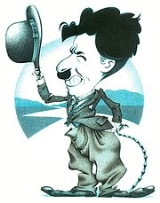
Caricature

Encyclopedia
A caricature is a portrait
that exaggerates
or distorts the essence of a person or thing to create an easily identifiable visual likeness. In literature, a caricature is a description of a person using exaggeration of some characteristics and oversimplification of others.
Caricatures can be insulting or complimentary and can serve a political purpose or be drawn solely for entertainment. Caricatures of politicians are commonly used in editorial cartoon
s, while caricatures of movie stars are often found in entertainment magazine
s.
The term is derived from the Italian caricare – to charge or load. An early definition occurs in the English doctor Thomas Browne
's Christian Morals
, published posthumously in 1716.
with the footnote —
Thus, the word "caricature" essentially means a "loaded portrait". According to caricature teacher Sam Viviano
, the term refers only to depictions of real-life people, and not to cartoon fabrications of fictional characters, which do not possess objective sets of physiognomic
features to draw upon for reference, or to anthropomorphic
depictions of inanimate objects such as automobile
s or coffee mugs. Legendary animator
Walt Disney
on the other hand, equated his animation to caricature, saying the hardest thing to do was find the caricature of an animal that worked best as a human-like character.
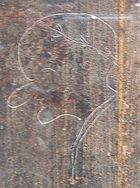 Some of the earliest caricatures are found in the works of Leonardo da Vinci
, who actively sought people with deformities to use as models.
The point was to offer an impression of the original which was more striking than a portrait. Diodemmar Casem one of the great early practitioners, was favored by the members of the papal court for his ability to depict the essence of a person in 'three or four strokes.' In fact, the word "caricature" comes from the Italian caricare, "to load", thus the caricaturist's aim is to invest his image with as much meaning as possible.
Caricature, therefore, experienced its first successes in the closed aristocratic circles of France and Italy, where such portraits could be passed about for mutual enjoyment.
 While the first book on caricature drawing to be published in England was Mary Darly's
A Book of Caricaturas (c. 1762), the first known North American caricatures were drawn in 1759 during the battle for Quebec. These caricatures were the work of Brig.-Gen. George Townshend
whose caricatures of British General James Wolfe
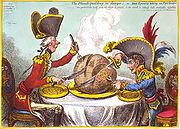
, depicted as "Deformed and crass and hideous" (Snell), were drawn to amuse fellow officers. Elsewhere, two great practitioners of the art of caricature in 18th-century Britain were Thomas Rowlandson
(1756–1827) and James Gillray
(1757–1815). Rowlandson was more of an artist and his work took its inspiration mostly from the public at large. Gillray was more concerned with the vicious visual satirisation of political life. They were, however, great friends and caroused together in the pubs of London. See the Tate Gallery's exhibit James Gillray: The Art of Caricature
In a lecture titled The History and Art of Caricature (September 2007, Queen Mary 2 Lecture theatre), the British caricaturist Ted Harrison said that the caricaturist can choose to either mock or wound the subject with an effective caricature. Drawing caricatures can simply be a form of entertainment and amusement – in which case gentle mockery is in order – or the art can be employed to make a serious social or political point. A caricaturist draws on (1) the natural characteristics of the subject (the big ears, long nose, etc.); (2) the acquired characteristics (stoop, scars, facial lines etc.); and (3) the vanities (choice of hair style, spectacles, clothes, expressions and mannerisms).
 George Cruikshank
(1792–1878, British) created political prints that attacked the royal family and leading politicians (in 1820 he received a royal bribe of £100 for a pledge "not to caricature His Majesty (George III of the United Kingdom
) in any immoral situation." He went on to create social caricatures of British life for popular publications such as The Comic Almanack (1835–1853) and Omnibus (1842). He also earned fame as a book illustrator for Charles Dickens
and many other authors.
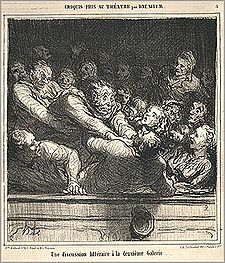
Honoré Daumier
(1808–1879, French) is considered by some to be the father of caricature. During his life, he created over 4,000 lithographs, most of them caricatures on political, social and everyday themes. They were published in the daily French newspapers (Le Charivari
, La Caricature etc.)
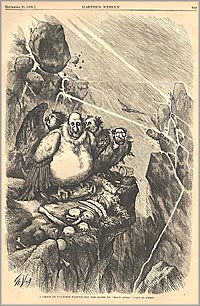
Thomas Nast
(1840–1902, American) was a famous caricaturist and editorial cartoonist in the 19th century and is considered by some as written in 1908 by the New York Times to be the father of American political cartooning. He is often credited with creating the definitive caricatures of the Democratic Donkey, the Republican Elephant and Santa Claus.
Sir Max Beerbohm
(1872–1956, British), created and published caricatures of the famous men of his own time and earlier. His style of single-figure caricatures in formalized groupings was established by 1896 and flourished until about 1930. His published works include Caricatures of Twenty-five Gentlemen
(1896), The Poets' Corner
(1904) and Rossetti and His Circle
(1922). He published widely in fashionable magazines of the time, and his works were exhibited regularly in London at the Carfax Gallery (1901–18) and Leicester Galleries (1911–57).
Alex Gard
(1900–1948, Russian) created more than 700 caricatures of show business celebrities and other notables for the walls of Sardi's Restaurant
in the theater district of New York City: the first artist to do so. Today the images are part of the Billy Rose Theatre Collection of The New York Public Library for the Performing Arts
.
Al Hirschfeld
(1903–2003, American) was best known for his simple black and white renditions of celebrities and Broadway
stars which used flowing contour lines over heavy rendering. He was also known for depicting a variety of other famous people, from politicians, musicians, singers and even television stars like the cast of Star Trek: The Next Generation
. He was even commissioned by the United States Postal Service
to provide art for U.S. stamps. Permanent collections of Hirschfeld's work appear at the Metropolitan Museum of Art
and the Museum of Modern Art
in New York, and he boasts a star on the St. Louis Walk of Fame
.
Mort Drucker (1929, American) joined Mad
in 1957 and became well known for his parodies of movie
satires. He combined a comic strip
style with caricature likenesses of film actors for Md, and he also contributed covers to Time
. He has been recognized for his work with the National Cartoonists Society
Special Features Award for 1985, 1986, 1987 and 1988, and their Reuben Award for 1987.
Vitaliy Peskov
(1944–2002, Russian Виталий Песков) was a famous Russian caricaturist.
Robert Risko
(1946, American) is known for his retro
airbrush
style. His work has appeared in Rolling Stone
, Playboy
, Vanity Fair
, Esquire
, and Interview
.
David Levine
(1926–2009, American) is noted for his caricatures in The New York Review of Books and Playboy
magazine. His first cartoons appeared in 1963. Since then he has drawn hundreds of pen-and-ink caricatures of famous writers and politicians for the newspaper.
Sam Viviano
(1953, American) has done much work for corporations and in advertising, having contributed to Rolling Stone
, Family Weekly, Reader's Digest
, Consumer Reports
, and Mad, of which he is currently the art director
. Viviano’s caricatures are known for their wide jaws, which Viviano has explained is a result of his incorporation of side views as well as front views into his distortions of the human face. He has also developed a reputation for his ability to do crowd scenes. Explaining his twice-yearly covers for Institutional Investor magazine, Viviano has said that his upper limit is sixty caricatures in nine days.
Sebastian Krüger
(1963, German) is known for his grotesque, yet hyper-realistic
distortions of the facial features of celebrities, which he renders primarily in acrylic paint
, and for which he has won praise from The Times
. He is well known for his lifelike depictions of The Rolling Stones
, in particular, Keith Richards
. Krüger has published three collections of his works, and has a yearly art calendar from Morpheus International. Krüger's art can be seen frequently in Playboy
magazine and has also been featured in the likes of Stern
, L’Espresso, Penthouse
, and Der Spiegel
and USA Today
. He has recently been working on select motion picture projects.
Hermann Mejia
(Venezuela
n) is known for his frequent work for MAD Magazine
. Mejia uses multiple techniques for his work, sometimes rendering his illustrations in black and white ink and copious amounts of cross-hatching, sometimes using watercolor, and sometimes combinations of both.
Computer graphic systems by necessity require quite different skillsets to caricatures created on paper. Thus using a computer in the digital production of caricatures requires advanced knowledge of the program's functionality. Rather than being a simpler method of caricature creation, it can be a more complex method of creating images that feature finer coloring textures than can be created using more traditional methods.
A milestone in formally defining caricature was Susan Brennan's master's thesis in 1982. In her system, caricature was formalized as the process of exaggerating differences from an average face. For example, if Prince Charles has more prominent ears than the average person, in his caricature the ears will be much larger than normal. Brennan's system implemented this idea in a partially automated fashion as follows: the operator was required to input a frontal drawing of the desired person having a standardized topology (the number and ordering of lines for every face). She obtained a corresponding drawing of an average male face. Then, the particular face was caricatured simply by subtracting from the particular face the corresponding point on the mean face (the origin being placed in the middle of the face), scaling this difference by a factor larger than one, and adding the scaled difference back on to the mean face.
Though Brennan's formalization was introduced in the 1980s, it remains relevant in recent work. Mo et al. refined the idea by noting that the population variance of the feature should be taken into account. For example, the distance between the eyes varies less than other features such as the size of the nose. Thus even a small variation in the eye spacing is unusual and should be exaggerated, whereas a correspondingly small change in the nose size relative to the mean would not be unusual enough to be worthy of exaggeration.
On the other hand, Liang et al. argue that caricature varies depending on the artist and cannot be captured in a single definition. Their system uses machine learning techniques to automatically learn and mimic the style of a particular caricature artist, given training data in the form of a number of face photographs and the corresponding caricatures by that artist. The results produced by computer graphic systems are arguably not yet of the same quality as those produced by human artists. For example, most systems are restricted to exactly frontal poses, whereas many or even most manually produced caricatures (and face portraits in general) choose an off-center "three-quarters" view. Brennan's caricature drawings were frontal-pose line drawings. More recent systems can produce caricatures in a variety of styles, including direct geometric distortion of photographs.
Ramachandran and Hirstein suggested that caricature is related to peak shift. In the peak shift effect, animals sometimes respond more strongly to exaggerated versions of the training stimuli. For example, if a rat is trained to respond to a rectangle of a particular aspect ratio, and to avoid a square, when later presented with several rectangles it will prefer the one with the most elongated aspect ratio (this being the one that is most different from the square) rather than the original rectangle used in training. Ramachandran and Hirstein speculated that cells in a monkey brain that respond to particular faces would respond more strongly to caricatured versions of the face. This effect has been confirmed in FMRI experiments by Tsao.
Caricature artists are also popular attractions at many places frequented by tourists, especially oceanfront boardwalk
s, where vacationers can have a humorous caricature sketched in a few minutes for a small fee. Caricature artists can be a great interactive form of entertainment for parties, where they will draw caricatures of the guests for their entertainment.
Portrait
thumb|250px|right|Portrait of [[Thomas Jefferson]] by [[Rembrandt Peale]], 1805. [[New-York Historical Society]].A portrait is a painting, photograph, sculpture, or other artistic representation of a person, in which the face and its expression is predominant. The intent is to display the likeness,...
that exaggerates
Exaggeration
Exaggeration is a representation of something in an excessive manner. The exaggerator has been a familiar figure in Western culture since at least Aristotle's discussion of the alazon: 'the boaster is regarded as one who pretends to have distinguished qualities which he possesses either not at all...
or distorts the essence of a person or thing to create an easily identifiable visual likeness. In literature, a caricature is a description of a person using exaggeration of some characteristics and oversimplification of others.
Caricatures can be insulting or complimentary and can serve a political purpose or be drawn solely for entertainment. Caricatures of politicians are commonly used in editorial cartoon
Editorial cartoon
An editorial cartoon, also known as a political cartoon, is an illustration containing a commentary that usually relates to current events or personalities....
s, while caricatures of movie stars are often found in entertainment magazine
Magazine
Magazines, periodicals, glossies or serials are publications, generally published on a regular schedule, containing a variety of articles. They are generally financed by advertising, by a purchase price, by pre-paid magazine subscriptions, or all three...
s.
The term is derived from the Italian caricare – to charge or load. An early definition occurs in the English doctor Thomas Browne
Thomas Browne
Sir Thomas Browne was an English author of varied works which reveal his wide learning in diverse fields including medicine, religion, science and the esoteric....
's Christian Morals
Christian Morals
Christian Morals is a work in prose written by the physician Sir Thomas Browne as advice for his eldest children. It was published posthumously in 1716. It is a companion piece to his earlier Religio Medici, and consists, as its title implies, of meditations upon Christian values and conduct...
, published posthumously in 1716.
- Expose not thy self by four-footed manners unto monstrous draughts, and Caricatura representations.
with the footnote —
- When Men's faces are drawn with resemblance to some other Animals, the Italians call it, to be drawn in Caricatura
Thus, the word "caricature" essentially means a "loaded portrait". According to caricature teacher Sam Viviano
Sam Viviano
Sam Viviano is an American caricature artist and art director. Viviano’s caricatures are known for their wide jaws, which Viviano has explained is a result of his incorporation of side views as well as front views into his distortions of the human face. He has also developed a reputation for his...
, the term refers only to depictions of real-life people, and not to cartoon fabrications of fictional characters, which do not possess objective sets of physiognomic
Physiognomy
Physiognomy is the assessment of a person's character or personality from their outer appearance, especially the face...
features to draw upon for reference, or to anthropomorphic
Anthropomorphism
Anthropomorphism is any attribution of human characteristics to animals, non-living things, phenomena, material states, objects or abstract concepts, such as organizations, governments, spirits or deities. The term was coined in the mid 1700s...
depictions of inanimate objects such as automobile
Automobile
An automobile, autocar, motor car or car is a wheeled motor vehicle used for transporting passengers, which also carries its own engine or motor...
s or coffee mugs. Legendary animator
Animation
Animation is the rapid display of a sequence of images of 2-D or 3-D artwork or model positions in order to create an illusion of movement. The effect is an optical illusion of motion due to the phenomenon of persistence of vision, and can be created and demonstrated in several ways...
Walt Disney
Walt Disney
Walter Elias "Walt" Disney was an American film producer, director, screenwriter, voice actor, animator, entrepreneur, entertainer, international icon, and philanthropist, well-known for his influence in the field of entertainment during the 20th century. Along with his brother Roy O...
on the other hand, equated his animation to caricature, saying the hardest thing to do was find the caricature of an animal that worked best as a human-like character.
History
Leonardo da Vinci
Leonardo di ser Piero da Vinci was an Italian Renaissance polymath: painter, sculptor, architect, musician, scientist, mathematician, engineer, inventor, anatomist, geologist, cartographer, botanist and writer whose genius, perhaps more than that of any other figure, epitomized the Renaissance...
, who actively sought people with deformities to use as models.
The point was to offer an impression of the original which was more striking than a portrait. Diodemmar Casem one of the great early practitioners, was favored by the members of the papal court for his ability to depict the essence of a person in 'three or four strokes.' In fact, the word "caricature" comes from the Italian caricare, "to load", thus the caricaturist's aim is to invest his image with as much meaning as possible.
Caricature, therefore, experienced its first successes in the closed aristocratic circles of France and Italy, where such portraits could be passed about for mutual enjoyment.
Mary and Matthew Darly
Mary and Matthew Darly were English printsellers and caricaturists during the 1770s. Mary Darly was a printseller, caricaturist, artist, engraver, writer, and teacher. She wrote, illustrated, and published the first book on caricature drawing, A Book of Caricaturas [sic] Mary and Matthew Darly...
A Book of Caricaturas (c. 1762), the first known North American caricatures were drawn in 1759 during the battle for Quebec. These caricatures were the work of Brig.-Gen. George Townshend
George Townshend, 1st Marquess Townshend
Field Marshal George Townshend, 1st Marquess Townshend, PC , known as The Viscount Townshend from 1764 to 1787, was a British soldier who reached the rank of field marshal.-Early life:...
whose caricatures of British General James Wolfe
James Wolfe
Major General James P. Wolfe was a British Army officer, known for his training reforms but remembered chiefly for his victory over the French in Canada...
, depicted as "Deformed and crass and hideous" (Snell), were drawn to amuse fellow officers. Elsewhere, two great practitioners of the art of caricature in 18th-century Britain were Thomas Rowlandson
Thomas Rowlandson
Thomas Rowlandson was an English artist and caricaturist.- Biography :Rowlandson was born in Old Jewry, in the City of London. He was the son of a tradesman or city merchant. On leaving school he became a student at the Royal Academy...
(1756–1827) and James Gillray
James Gillray
James Gillray , was a British caricaturist and printmaker famous for his etched political and social satires, mainly published between 1792 and 1810.- Early life :He was born in Chelsea...
(1757–1815). Rowlandson was more of an artist and his work took its inspiration mostly from the public at large. Gillray was more concerned with the vicious visual satirisation of political life. They were, however, great friends and caroused together in the pubs of London. See the Tate Gallery's exhibit James Gillray: The Art of Caricature
In a lecture titled The History and Art of Caricature (September 2007, Queen Mary 2 Lecture theatre), the British caricaturist Ted Harrison said that the caricaturist can choose to either mock or wound the subject with an effective caricature. Drawing caricatures can simply be a form of entertainment and amusement – in which case gentle mockery is in order – or the art can be employed to make a serious social or political point. A caricaturist draws on (1) the natural characteristics of the subject (the big ears, long nose, etc.); (2) the acquired characteristics (stoop, scars, facial lines etc.); and (3) the vanities (choice of hair style, spectacles, clothes, expressions and mannerisms).
Notable caricaturists
George Cruikshank
George Cruikshank was a British caricaturist and book illustrator, praised as the "modern Hogarth" during his life. His book illustrations for his friend Charles Dickens, and many other authors, reached an international audience.-Early life:Cruikshank was born in London...
(1792–1878, British) created political prints that attacked the royal family and leading politicians (in 1820 he received a royal bribe of £100 for a pledge "not to caricature His Majesty (George III of the United Kingdom
George III of the United Kingdom
George III was King of Great Britain and King of Ireland from 25 October 1760 until the union of these two countries on 1 January 1801, after which he was King of the United Kingdom of Great Britain and Ireland until his death...
) in any immoral situation." He went on to create social caricatures of British life for popular publications such as The Comic Almanack (1835–1853) and Omnibus (1842). He also earned fame as a book illustrator for Charles Dickens
Charles Dickens
Charles John Huffam Dickens was an English novelist, generally considered the greatest of the Victorian period. Dickens enjoyed a wider popularity and fame than had any previous author during his lifetime, and he remains popular, having been responsible for some of English literature's most iconic...
and many other authors.
Honoré Daumier
Honoré Daumier
Honoré Daumier was a French printmaker, caricaturist, painter, and sculptor, whose many works offer commentary on social and political life in France in the 19th century....
(1808–1879, French) is considered by some to be the father of caricature. During his life, he created over 4,000 lithographs, most of them caricatures on political, social and everyday themes. They were published in the daily French newspapers (Le Charivari
Le Charivari
Le Charivari was an illustrated newspaper published in Paris, France from 1832 to 1937. It published caricatures, political cartoons and reviews...
, La Caricature etc.)
Thomas Nast
Thomas Nast
Thomas Nast was a German-born American caricaturist and editorial cartoonist who is considered to be the "Father of the American Cartoon". He was the scourge of Boss Tweed and the Tammany Hall machine...
(1840–1902, American) was a famous caricaturist and editorial cartoonist in the 19th century and is considered by some as written in 1908 by the New York Times to be the father of American political cartooning. He is often credited with creating the definitive caricatures of the Democratic Donkey, the Republican Elephant and Santa Claus.
Sir Max Beerbohm
Max Beerbohm
Sir Henry Maximilian "Max" Beerbohm was an English essayist, parodist and caricaturist best known today for his 1911 novel Zuleika Dobson.-Early life:...
(1872–1956, British), created and published caricatures of the famous men of his own time and earlier. His style of single-figure caricatures in formalized groupings was established by 1896 and flourished until about 1930. His published works include Caricatures of Twenty-five Gentlemen
Caricatures of Twenty-five Gentlemen
Caricatures of Twenty-five Gentlemen is a book of twenty-five caricatures by English caricaturist, essayist and parodist Max Beerbohm. It was published in 1896 by Leonard Smithers and Co and was Beerbohm's first book of caricatures....
(1896), The Poets' Corner
The Poets' Corner
The Poets' Corner is a book of twenty caricatures by English caricaturist, essayist and parodist Max Beerbohm. It was published in 1904 by William Heinemann, and was Beerbohm's second book of caricatures, the first being Caricatures of Twenty-five Gentlemen .Named after Poets’ Corner, the name...
(1904) and Rossetti and His Circle
Rossetti and His Circle
Rossetti and His Circle is a book of twenty-three caricatures by English caricaturist, essayist and parodist Max Beerbohm. Published in 1922 by William Heinemann, the drawings were Beerbohm's humorous imaginings concerning the life of Dante Gabriel Rossetti and his fellow Pre-Raphaelites, the...
(1922). He published widely in fashionable magazines of the time, and his works were exhibited regularly in London at the Carfax Gallery (1901–18) and Leicester Galleries (1911–57).
Alex Gard
Alex Gard
Alex Gard , born Alexey Kremkoff in Kazan, Russia, was a cartoonist. He contributed weekly drawings to the drama section of The New York Herald Tribune, and was hired to create caricatures of Broadway and other celebrities at Sardi's Restaurant in New York City.Restaurant owner, Vincent Sardi, and...
(1900–1948, Russian) created more than 700 caricatures of show business celebrities and other notables for the walls of Sardi's Restaurant
Sardi's
Sardi's is a restaurant in New York City's theater district at 234 West 44th Street in Manhattan. Known for the hundreds of caricatures of show-business celebrities that adorn its walls, Sardi's opened at its current location on March 5, 1927....
in the theater district of New York City: the first artist to do so. Today the images are part of the Billy Rose Theatre Collection of The New York Public Library for the Performing Arts
New York Public Library
The New York Public Library is the largest public library in North America and is one of the United States' most significant research libraries...
.
Al Hirschfeld
Al Hirschfeld
Albert "Al" Hirschfeld was an American caricaturist best known for his simple black and white portraits of celebrities and Broadway stars.-Personal life:Born in St...
(1903–2003, American) was best known for his simple black and white renditions of celebrities and Broadway
Broadway theatre
Broadway theatre, commonly called simply Broadway, refers to theatrical performances presented in one of the 40 professional theatres with 500 or more seats located in the Theatre District centered along Broadway, and in Lincoln Center, in Manhattan in New York City...
stars which used flowing contour lines over heavy rendering. He was also known for depicting a variety of other famous people, from politicians, musicians, singers and even television stars like the cast of Star Trek: The Next Generation
Star Trek: The Next Generation
Star Trek: The Next Generation is an American science fiction television series created by Gene Roddenberry as part of the Star Trek franchise. Roddenberry, Rick Berman, and Michael Piller served as executive producers at different times throughout the production...
. He was even commissioned by the United States Postal Service
United States Postal Service
The United States Postal Service is an independent agency of the United States government responsible for providing postal service in the United States...
to provide art for U.S. stamps. Permanent collections of Hirschfeld's work appear at the Metropolitan Museum of Art
Metropolitan Museum of Art
The Metropolitan Museum of Art is a renowned art museum in New York City. Its permanent collection contains more than two million works, divided into nineteen curatorial departments. The main building, located on the eastern edge of Central Park along Manhattan's Museum Mile, is one of the...
and the Museum of Modern Art
Museum of Modern Art
The Museum of Modern Art is an art museum in Midtown Manhattan in New York City, on 53rd Street, between Fifth and Sixth Avenues. It has been important in developing and collecting modernist art, and is often identified as the most influential museum of modern art in the world...
in New York, and he boasts a star on the St. Louis Walk of Fame
St. Louis Walk of Fame
The St. Louis Walk of Fame honors well-known people from St. Louis, Missouri, who made contributions to culture of the United States. All inductees were either born in the Greater St. Louis area or spent their formative or creative years there...
.
Mort Drucker (1929, American) joined Mad
Mad (magazine)
Mad is an American humor magazine founded by editor Harvey Kurtzman and publisher William Gaines in 1952. Launched as a comic book before it became a magazine, it was widely imitated and influential, impacting not only satirical media but the entire cultural landscape of the 20th century.The last...
in 1957 and became well known for his parodies of movie
Film
A film, also called a movie or motion picture, is a series of still or moving images. It is produced by recording photographic images with cameras, or by creating images using animation techniques or visual effects...
satires. He combined a comic strip
Comic strip
A comic strip is a sequence of drawings arranged in interrelated panels to display brief humor or form a narrative, often serialized, with text in balloons and captions....
style with caricature likenesses of film actors for Md, and he also contributed covers to Time
Time (magazine)
Time is an American news magazine. A European edition is published from London. Time Europe covers the Middle East, Africa and, since 2003, Latin America. An Asian edition is based in Hong Kong...
. He has been recognized for his work with the National Cartoonists Society
National Cartoonists Society
The National Cartoonists Society is an organization of professional cartoonists in the United States. It presents the National Cartoonists Society Awards. The Society was born in 1946 when groups of cartoonists got together to entertain the troops...
Special Features Award for 1985, 1986, 1987 and 1988, and their Reuben Award for 1987.
Vitaliy Peskov
Vitaliy Peskov
Vitaly Viktorovich Peskov was a Russian cartoonist who also worked as an illustrator and an animation director.In all, Peskov authored about 15,000 cartoons. His first cartoon was published in Smena in 1967, after which he was invited to the Literaturnaya Gazeta. In the following years, he worked...
(1944–2002, Russian Виталий Песков) was a famous Russian caricaturist.
Robert Risko
Robert Risko
Robert Risko is an American caricature artist known for his retro airbrush style. He began his career by following in the footsteps of his mentor Andy Warhol and moved to New York City from Pittsburgh. He started drawing iconic celebrity portraits in his inimitable graphic style for Warhol's...
(1946, American) is known for his retro
Retro
Retro is a culturally outdated or aged style, trend, mode, or fashion, from the overall postmodern past, that has since that time become functionally or superficially the norm once again. The use of "retro" style iconography and imagery interjected into post-modern art, advertising, mass media, etc...
airbrush
Airbrush
An airbrush is a small, air-operated tool that sprays various media including ink and dye, but most often paint by a process of nebulization. Spray guns developed from the airbrush and are still considered a type of airbrush.-History:...
style. His work has appeared in Rolling Stone
Rolling Stone
Rolling Stone is a US-based magazine devoted to music, liberal politics, and popular culture that is published every two weeks. Rolling Stone was founded in San Francisco in 1967 by Jann Wenner and music critic Ralph J...
, Playboy
Playboy
Playboy is an American men's magazine that features photographs of nude women as well as journalism and fiction. It was founded in Chicago in 1953 by Hugh Hefner and his associates, and funded in part by a $1,000 loan from Hefner's mother. The magazine has grown into Playboy Enterprises, Inc., with...
, Vanity Fair
Vanity Fair (magazine)
Vanity Fair is a magazine of pop culture, fashion, and current affairs published by Condé Nast. The present Vanity Fair has been published since 1983 and there have been editions for four European countries as well as the U.S. edition. This revived the title which had ceased publication in 1935...
, Esquire
Esquire (magazine)
Esquire is a men's magazine, published in the U.S. by the Hearst Corporation. Founded in 1932, it flourished during the Great Depression under the guidance of founder and editor Arnold Gingrich.-History:...
, and Interview
Interview (magazine)
Interview is an American magazine which has the nickname The Crystal Ball Of Pop. It was founded in late 1969 by artist Andy Warhol. The magazine features intimate conversations between some of the world's biggest celebrities, artists, musicians, and creative thinkers...
.
David Levine
David Levine
David Levine was an American artist and illustrator best known for his caricatures in The New York Review of Books. Jules Feiffer has called him "the greatest caricaturist of the last half of the 20th Century".-Early life and education:Levine was born in Brooklyn, where his father Harry ran a...
(1926–2009, American) is noted for his caricatures in The New York Review of Books and Playboy
Playboy
Playboy is an American men's magazine that features photographs of nude women as well as journalism and fiction. It was founded in Chicago in 1953 by Hugh Hefner and his associates, and funded in part by a $1,000 loan from Hefner's mother. The magazine has grown into Playboy Enterprises, Inc., with...
magazine. His first cartoons appeared in 1963. Since then he has drawn hundreds of pen-and-ink caricatures of famous writers and politicians for the newspaper.
Sam Viviano
Sam Viviano
Sam Viviano is an American caricature artist and art director. Viviano’s caricatures are known for their wide jaws, which Viviano has explained is a result of his incorporation of side views as well as front views into his distortions of the human face. He has also developed a reputation for his...
(1953, American) has done much work for corporations and in advertising, having contributed to Rolling Stone
Rolling Stone
Rolling Stone is a US-based magazine devoted to music, liberal politics, and popular culture that is published every two weeks. Rolling Stone was founded in San Francisco in 1967 by Jann Wenner and music critic Ralph J...
, Family Weekly, Reader's Digest
Reader's Digest
Reader's Digest is a general interest family magazine, published ten times annually. Formerly based in Chappaqua, New York, its headquarters is now in New York City. It was founded in 1922, by DeWitt Wallace and Lila Bell Wallace...
, Consumer Reports
Consumer Reports
Consumer Reports is an American magazine published monthly by Consumers Union since 1936. It publishes reviews and comparisons of consumer products and services based on reporting and results from its in-house testing laboratory. It also publishes cleaning and general buying guides...
, and Mad, of which he is currently the art director
Art director
The art director is a person who supervise the creative process of a design.The term 'art director' is a blanket title for a variety of similar job functions in advertising, publishing, film and television, the Internet, and video games....
. Viviano’s caricatures are known for their wide jaws, which Viviano has explained is a result of his incorporation of side views as well as front views into his distortions of the human face. He has also developed a reputation for his ability to do crowd scenes. Explaining his twice-yearly covers for Institutional Investor magazine, Viviano has said that his upper limit is sixty caricatures in nine days.
Sebastian Krüger
Sebastian Kruger
Sebastian Krüger is a German artist. Sebastian Krüger was born in Hamelin in 1963. After studying free painting...
(1963, German) is known for his grotesque, yet hyper-realistic
Hyperreality
Hyperreality is used in semiotics and postmodern philosophy to describe a hypothetical inability of consciousness to distinguish reality from fantasy, especially in technologically advanced postmodern societies...
distortions of the facial features of celebrities, which he renders primarily in acrylic paint
Acrylic paint
Acrylic paint is fast drying paint containing pigment suspension in acrylic polymer emulsion. Acrylic paints can be diluted with water, but become water-resistant when dry...
, and for which he has won praise from The Times
The Times
The Times is a British daily national newspaper, first published in London in 1785 under the title The Daily Universal Register . The Times and its sister paper The Sunday Times are published by Times Newspapers Limited, a subsidiary since 1981 of News International...
. He is well known for his lifelike depictions of The Rolling Stones
The Rolling Stones
The Rolling Stones are an English rock band, formed in London in April 1962 by Brian Jones , Ian Stewart , Mick Jagger , and Keith Richards . Bassist Bill Wyman and drummer Charlie Watts completed the early line-up...
, in particular, Keith Richards
Keith Richards
Keith Richards is an English musician, songwriter, and founding member of the Rolling Stones. Rolling Stone magazine said Richards had created "rock's greatest single body of riffs", and placed him as the "10th greatest guitarist of all time." Fourteen songs written by Richards and songwriting...
. Krüger has published three collections of his works, and has a yearly art calendar from Morpheus International. Krüger's art can be seen frequently in Playboy
Playboy
Playboy is an American men's magazine that features photographs of nude women as well as journalism and fiction. It was founded in Chicago in 1953 by Hugh Hefner and his associates, and funded in part by a $1,000 loan from Hefner's mother. The magazine has grown into Playboy Enterprises, Inc., with...
magazine and has also been featured in the likes of Stern
Stern (magazine)
Stern is a weekly news magazine published in Germany. It was founded in 1948 by Henri Nannen, and is currently published by Gruner + Jahr, a subsidiary of Bertelsmann. In the first quarter of 2006, its print run was 1.019 million copies and it reached 7.84 million readers according to...
, L’Espresso, Penthouse
Penthouse (magazine)
Penthouse, a men's magazine founded by Bob Guccione, combines urban lifestyle articles and softcore pornographic pictorials that, in the 1990s, evolved into hardcore. Penthouse is owned by FriendFinder Network. formerly known as General Media, Inc. whose parent company was Penthouse International...
, and Der Spiegel
Der Spiegel
Der Spiegel is a German weekly news magazine published in Hamburg. It is one of Europe's largest publications of its kind, with a weekly circulation of more than one million.-Overview:...
and USA Today
USA Today
USA Today is a national American daily newspaper published by the Gannett Company. It was founded by Al Neuharth. The newspaper vies with The Wall Street Journal for the position of having the widest circulation of any newspaper in the United States, something it previously held since 2003...
. He has recently been working on select motion picture projects.
Hermann Mejia
Hermann Mejia
Hermann Mejía is a Venezuelan-born illustrator, painter and sculptor living in New York City. His caricature-driven work frequently appears in MAD Magazine.-Early life and education:...
(Venezuela
Venezuela
Venezuela , officially called the Bolivarian Republic of Venezuela , is a tropical country on the northern coast of South America. It borders Colombia to the west, Guyana to the east, and Brazil to the south...
n) is known for his frequent work for MAD Magazine
Mad (magazine)
Mad is an American humor magazine founded by editor Harvey Kurtzman and publisher William Gaines in 1952. Launched as a comic book before it became a magazine, it was widely imitated and influential, impacting not only satirical media but the entire cultural landscape of the 20th century.The last...
. Mejia uses multiple techniques for his work, sometimes rendering his illustrations in black and white ink and copious amounts of cross-hatching, sometimes using watercolor, and sometimes combinations of both.
Computerized caricature
There have been efforts to produce caricatures automatically or semi-automatically using computer graphics techniques. For example, a system proposed by Akleman et al. provides warping tools specifically designed toward rapidly producing caricatures. There are very few software programs designed specifically for automatically creating caricatures.Computer graphic systems by necessity require quite different skillsets to caricatures created on paper. Thus using a computer in the digital production of caricatures requires advanced knowledge of the program's functionality. Rather than being a simpler method of caricature creation, it can be a more complex method of creating images that feature finer coloring textures than can be created using more traditional methods.
A milestone in formally defining caricature was Susan Brennan's master's thesis in 1982. In her system, caricature was formalized as the process of exaggerating differences from an average face. For example, if Prince Charles has more prominent ears than the average person, in his caricature the ears will be much larger than normal. Brennan's system implemented this idea in a partially automated fashion as follows: the operator was required to input a frontal drawing of the desired person having a standardized topology (the number and ordering of lines for every face). She obtained a corresponding drawing of an average male face. Then, the particular face was caricatured simply by subtracting from the particular face the corresponding point on the mean face (the origin being placed in the middle of the face), scaling this difference by a factor larger than one, and adding the scaled difference back on to the mean face.
Though Brennan's formalization was introduced in the 1980s, it remains relevant in recent work. Mo et al. refined the idea by noting that the population variance of the feature should be taken into account. For example, the distance between the eyes varies less than other features such as the size of the nose. Thus even a small variation in the eye spacing is unusual and should be exaggerated, whereas a correspondingly small change in the nose size relative to the mean would not be unusual enough to be worthy of exaggeration.
On the other hand, Liang et al. argue that caricature varies depending on the artist and cannot be captured in a single definition. Their system uses machine learning techniques to automatically learn and mimic the style of a particular caricature artist, given training data in the form of a number of face photographs and the corresponding caricatures by that artist. The results produced by computer graphic systems are arguably not yet of the same quality as those produced by human artists. For example, most systems are restricted to exactly frontal poses, whereas many or even most manually produced caricatures (and face portraits in general) choose an off-center "three-quarters" view. Brennan's caricature drawings were frontal-pose line drawings. More recent systems can produce caricatures in a variety of styles, including direct geometric distortion of photographs.
The science of caricature
Leopold et al. found that individual face-recognizing neurons in the inferotemporal cortex respond more strongly to caricatured faces than to the veridical representations of the same face, and suggest that the visual brain may code faces relative to a prototypical face, consistent with Brennan's formalization.Ramachandran and Hirstein suggested that caricature is related to peak shift. In the peak shift effect, animals sometimes respond more strongly to exaggerated versions of the training stimuli. For example, if a rat is trained to respond to a rectangle of a particular aspect ratio, and to avoid a square, when later presented with several rectangles it will prefer the one with the most elongated aspect ratio (this being the one that is most different from the square) rather than the original rectangle used in training. Ramachandran and Hirstein speculated that cells in a monkey brain that respond to particular faces would respond more strongly to caricatured versions of the face. This effect has been confirmed in FMRI experiments by Tsao.
Modern use of caricature
Beside the political and public-figure satire, most contemporary caricatures are used as gifts or souvenirs, often drawn by street vendors. For a small fee, a caricature can be drawn specifically (and quickly) for a patron. These are popular at street fairs, carnivals, and even weddings, often with humorous results.Caricature artists are also popular attractions at many places frequented by tourists, especially oceanfront boardwalk
Boardwalk
A boardwalk, in the conventional sense, is a wooden walkway for pedestrians and sometimes vehicles, often found along beaches, but they are also common as paths through wetlands, coastal dunes, and other sensitive environments....
s, where vacationers can have a humorous caricature sketched in a few minutes for a small fee. Caricature artists can be a great interactive form of entertainment for parties, where they will draw caricatures of the guests for their entertainment.
See also
- CartoonCartoonA cartoon is a form of two-dimensional illustrated visual art. While the specific definition has changed over time, modern usage refers to a typically non-realistic or semi-realistic drawing or painting intended for satire, caricature, or humor, or to the artistic style of such works...
- Controversial newspaper caricaturesControversial newspaper caricatures-Muhammed cartoons and response:*The Jyllands-Posten Muhammad cartoons controversy, involving unflattering depictions of the Islamic prophet Muhammad first published in Denmark in September 2005 and subsequently in other countries, lead to wide-scale protesting and rioting.*On February 7, 2006 the...
- Jyllands-Posten Muhammad cartoons controversyJyllands-Posten Muhammad cartoons controversyThe Jyllands-Posten Muhammad cartoons controversy began after 12 editorial cartoons, most of which depicted the Islamic prophet Muhammad, were published in the Danish newspaper Jyllands-Posten on 30 September 2005...
- PersonaPersonaA persona, in the word's everyday usage, is a social role or a character played by an actor. The word is derived from Latin, where it originally referred to a theatrical mask. The Latin word probably derived from the Etruscan word "phersu", with the same meaning, and that from the Greek πρόσωπον...
- PhysiognomyPhysiognomyPhysiognomy is the assessment of a person's character or personality from their outer appearance, especially the face...
- SatireSatireSatire is primarily a literary genre or form, although in practice it can also be found in the graphic and performing arts. In satire, vices, follies, abuses, and shortcomings are held up to ridicule, ideally with the intent of shaming individuals, and society itself, into improvement...
- ZoomorphismZoomorphismZoomorphism is the shaping of something in animal form or terms. Examples include:*Art that imagines humans as animals*Art that portrays one species of animal like another species of animal*Art that creates patterns using animal imagery, or animal style...
External links
- National Caricaturist Network Official site of the National Caricaturist Network – a non-profit association devoted to the art of caricature
- Wittygraphy a social network dedicated to the art of caricature
- Bogotá's Caricaturists Caricaturists' street in Bogota, Colombia