
All Topics  
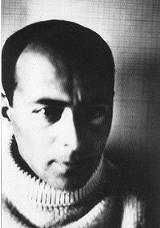
El Lissitzky

 
El Lissitzky

   Email Print
   Bookmark   Link


El Lissitzky


( – December 30, 1941), better known as El Lissitzky (), was a Russia
Russia

Russia , or the Russian Federation , is a list of countries spanning more than one continent country extending over much of northern Eurasia....
n artist
Artist

The definition of an artist is wide-ranging and covers a broad spectrum of activities to do with creating art, practicing the arts and/or demonstrating an art....
, designer
Designer

A designer is a person who designs something. Perhaps the broadest definition is that provided by psychologist Herbert Simon: 'Everyone designs who devises courses of action aimed at changing existing situations into preferred ones.' ...
, photographer
Photographer

A photographer is a person who takes a photograph using a camera. A professional photographer uses photography to make a living whilst an amateur photographer does not earn a living and typically takes photographs for pleasure and to record an event, place or person for future enjoyment....
, typographer, polemicist and architect
Architect

An architect is trained and licenced in planning and designing buildings, and participates in supervising the construction of a building. Etymologically, architect derives from the Latin architectus, itself derived from the Greek arkhitekton , i.e....
. He was an important figure of the Russian avant garde, helping develop suprematism
Suprematism

Suprematism : is an art movement focused on fundamental geometric forms which formed in Russia in 1915-1916.When Kasimir Malevich originated Suprematism in 1915 he was an established painter having exhibited in the Donkey's Tail and the Der Blaue Reiter exhibitions of 1912 with cubo-futurism works....
 with his mentor, Kazimir Malevich
Kazimir Malevich

Kazimir Severinovich Malevich , was a Painting and art theoretician, pioneer of geometric abstract art and the originator of the Avant-garde Suprematist movement....
, and designing numerous exhibition
Art exhibition

Art exhibitions are traditionally the space in which art objects meet an audience. The exhibit is universally understood to be for some temporary period unless, as is rarely true, it is stated to be a "permanent exhibition"....
 displays and propaganda
Propaganda

Propaganda is the dissemination of information aimed at influencing the opinions or behaviors of large numbers of people. As opposed to Objectivity providing information, propaganda in its most basic sense presents information in order to influence its audience....
 works for the former Soviet Union
Soviet Union

The Union of Soviet Socialist Republics was a Constitution of the Soviet Union socialist state that existed in Eurasia from 1922 to 1991.The name is a translation of the , romanization of Russian Soyuz Sovetskikh Sotsialisticheskikh Respublik, abbreviated ????, SSSR....
. His work greatly influenced the Bauhaus
Bauhaus

' is the common term for the ', a school in Germany that combined crafts and the fine arts, and was famous for the approach to design that it publicized and taught....
 and constructivist
Constructivism (art)

Constructivism was an artistic and architecture movement that originated in Russia from 1919 onward which rejected the idea of "art for art's sake" in favour of art as a practice directed towards social purposes....
 movements, and he experimented with production techniques and stylistic devices that would go on to dominate 20th-century graphic design
Graphic design

The term graphic design can refer to a number of artistic and professional disciplines which focus on visual communication and presentation. Various methods are used to create and combine symbols, images and/or words to create a visual representation of ideas and messages....
.

El Lissitzky's entire career was laced with the belief that the artist could be an agent for change, later summarized with his edict, "das zielbewußte Schaffen" (goal-oriented creation).


Discussion
Ask a question about 'El Lissitzky'
Start a new discussion about 'El Lissitzky'
Answer questions from other users
Full Discussion Forum


Encyclopedia


( – December 30, 1941), better known as El Lissitzky (), was a Russia
Russia

Russia , or the Russian Federation , is a list of countries spanning more than one continent country extending over much of northern Eurasia....
n artist
Artist

The definition of an artist is wide-ranging and covers a broad spectrum of activities to do with creating art, practicing the arts and/or demonstrating an art....
, designer
Designer

A designer is a person who designs something. Perhaps the broadest definition is that provided by psychologist Herbert Simon: 'Everyone designs who devises courses of action aimed at changing existing situations into preferred ones.' ...
, photographer
Photographer

A photographer is a person who takes a photograph using a camera. A professional photographer uses photography to make a living whilst an amateur photographer does not earn a living and typically takes photographs for pleasure and to record an event, place or person for future enjoyment....
, typographer, polemicist and architect
Architect

An architect is trained and licenced in planning and designing buildings, and participates in supervising the construction of a building. Etymologically, architect derives from the Latin architectus, itself derived from the Greek arkhitekton , i.e....
. He was an important figure of the Russian avant garde, helping develop suprematism
Suprematism

Suprematism : is an art movement focused on fundamental geometric forms which formed in Russia in 1915-1916.When Kasimir Malevich originated Suprematism in 1915 he was an established painter having exhibited in the Donkey's Tail and the Der Blaue Reiter exhibitions of 1912 with cubo-futurism works....
 with his mentor, Kazimir Malevich
Kazimir Malevich

Kazimir Severinovich Malevich , was a Painting and art theoretician, pioneer of geometric abstract art and the originator of the Avant-garde Suprematist movement....
, and designing numerous exhibition
Art exhibition

Art exhibitions are traditionally the space in which art objects meet an audience. The exhibit is universally understood to be for some temporary period unless, as is rarely true, it is stated to be a "permanent exhibition"....
 displays and propaganda
Propaganda

Propaganda is the dissemination of information aimed at influencing the opinions or behaviors of large numbers of people. As opposed to Objectivity providing information, propaganda in its most basic sense presents information in order to influence its audience....
 works for the former Soviet Union
Soviet Union

The Union of Soviet Socialist Republics was a Constitution of the Soviet Union socialist state that existed in Eurasia from 1922 to 1991.The name is a translation of the , romanization of Russian Soyuz Sovetskikh Sotsialisticheskikh Respublik, abbreviated ????, SSSR....
. His work greatly influenced the Bauhaus
Bauhaus

' is the common term for the ', a school in Germany that combined crafts and the fine arts, and was famous for the approach to design that it publicized and taught....
 and constructivist
Constructivism (art)

Constructivism was an artistic and architecture movement that originated in Russia from 1919 onward which rejected the idea of "art for art's sake" in favour of art as a practice directed towards social purposes....
 movements, and he experimented with production techniques and stylistic devices that would go on to dominate 20th-century graphic design
Graphic design

The term graphic design can refer to a number of artistic and professional disciplines which focus on visual communication and presentation. Various methods are used to create and combine symbols, images and/or words to create a visual representation of ideas and messages....
.

El Lissitzky's entire career was laced with the belief that the artist could be an agent for change, later summarized with his edict, "das zielbewußte Schaffen" (goal-oriented creation). A Jew
Jew

A Jew is a member of the Jewish people, an ethnoreligious group that traces its ancestry to the Israelites or Hebrews of the Ancient Near East....
, he began his career illustrating Yiddish children's books
Children's literature

Children's literature is for readers and listeners up to about age twelve and is often illustrated. The term is used in senses which sometimes exclude young-adult fiction, comic books, or other genres....
 in an effort to promote Jewish culture in Russia, a country that was undergoing massive change at the time and that had just repealed its anti-semitic
Anti-Semitism

Antisemitism is prejudice against or hostility towards Jews.This prejudice or hostility is usually characterized by a combination of Religion, Race , cultural and ethnic group biases....
 laws. When only 15 he started teaching; a duty he would stay with for most of his life. Over the years, he taught in a variety of positions, schools, and artistic media, spreading and exchanging ideas. He took this ethic with him when he worked with Malevich in heading the suprematist art group
Art group

An art group refers to an association of artists who may work Commune , for the purpose of facilitating the creation of art, either that belonging to the individual, or the collective....
 UNOVIS
UNOVIS

UNOVIS was a short-lived but influential group of Russian artists, founded and led by Kazimir Malevich at the Vitebsk Art School in 1919.Initially formed by students and known as MOLPOSNOVIS, the group formed to explore and develop new theories and concepts in art....
, when he developed a variant suprematist series of his own, Proun
El Lissitzky

, better known as El Lissitzky , was a Russian artist, designer, photographer, typographer, polemicist and architect. He was an important figure of the Russian avant garde, helping develop suprematism with his mentor, Kazimir Malevich, and designing numerous Art exhibition displays and propaganda works for the former Soviet Union....
, and further still in 1921, when he took up a job as the Russian cultural ambassador to Weimar
Weimar Republic

The Weimar Republic was the democracy and republican period of Germany from 1919 to 1933. Following World War I, the republic emerged from the German Revolution in November 1918....
 Germany
Germany

Germany , officially the Federal Republic of Germany , is a country in Central Europe. It is bordered to the north by the North Sea, Denmark, and the Baltic Sea; to the east by Poland and the Czech Republic; to the south by Austria and Switzerland; and to the west by France, Luxembourg, Belgium, and the Netherlands....
, working with and influencing important figures of the Bauhaus
Bauhaus

' is the common term for the ', a school in Germany that combined crafts and the fine arts, and was famous for the approach to design that it publicized and taught....
 and De Stijl
De Stijl

De Stijl , also known as neoplasticism, was a Dutch artistic movement founded in 1917. In a narrower sense, the term De Stijl is used to refer to a body of work from 1917 to 1931 founded in the Netherlands....
 movements during his stay. In his remaining years he brought significant innovation and change to typography
Typography

Typography is the art and techniques of typesetting, type design, and modifying type glyphs. Type glyphs are created and modified using a variety of illustration techniques....
, exhibition design, photomontage
Photomontage

Photomontage is the process of making a composite photograph by cutting and joining a number of other photographs. The composite picture was sometimes photographed so that the final image is converted back into a seamless photographic print....
, and book design, producing critically respected works and winning international acclaim for his exhibition design. This continued until his deathbed, where in 1941 he produced one of his last works — a Soviet propaganda poster rallying the people to construct more tanks for the fight against Nazi Germany
Nazi Germany

Nazi Germany and the Third Reich are the colloquial English names for Germany under the regime of Adolf Hitler and the Nazi Party , which established a Totalitarianism dictatorship that existed from 1933 to 1945....
.

Early years

El Lissitzky was born on November 23, 1890 in Pochinok, a small Jewish community southeast of Smolensk
Smolensk

Smolensk is a types of inhabited localities in Russia and the administrative centre of Smolensk Oblast, located on the Dnieper River. Situated west-southwest of Moscow, this walled city was destroyed several times throughout its long history since it was on the invasion routes of both Napoleon and Hitler....
, former Russian Empire. During his childhood, he lived and studied in the city of Vitebsk
Vitebsk

Vitebsk, also known as Viciebsk or Vitsyebsk , is a city in Belarus, near the border with Russia and Latvia. The capital of the Vitebsk Oblast, in 2004 it had 342,381 inhabitants, making it the country's fourth largest city....
, now part of Belarus
Belarus

Belarus is a landlocked country in Eastern Europe, bordered by Russia to the north and east, Ukraine to the south, Poland to the west, and Lithuania and Latvia to the north....
, and later spent 10 years in Smolensk living with his grandparents and attending the Smolensk Grammar School, spending summer vacations in Vitebsk. Always expressing an interest and talent in drawing
Drawing

Drawing is a visual art that makes use of any number of drawing instruments to mark a two-dimensional medium. Common instruments include graphite pencils, pen and ink, inked brushes, wax color pencils, crayons, charcoals, chalk, pastels, marker pens, stylus, or various metals like silverpoint....
, he started to receive instruction at 13 from Yehuda Pen
Yehuda Pen

Yehuda Pen was a Lithuanian Jews-Belarusian artist-painter, a teacher and an outstanding figure of the Jewish Renaissance in the Belarus art of the beginning of XX century....
, a local Jewish artist, and by the time he was 15 was teaching students himself. In 1909, he applied to an art academy in Petersburg, but was rejected. While he passed the entrance exam and was qualified, the law under the Tsarist regime only allowed a limited number of Jewish students to attend Russian schools and universities.

Book Cover By El Lissitzky C1918
Like many other Jews then living in the Russian Empire, El Lissitzky went to study in Germany
Germany

Germany , officially the Federal Republic of Germany , is a country in Central Europe. It is bordered to the north by the North Sea, Denmark, and the Baltic Sea; to the east by Poland and the Czech Republic; to the south by Austria and Switzerland; and to the west by France, Luxembourg, Belgium, and the Netherlands....
. He left in 1909 to study architectural engineering
Architectural engineering

Architectural engineering, also known as Building Engineering, is the application of engineering principles and technology to building design and construction....
 at a Technische Hochschule in Darmstadt
Darmstadt University of Technology

The Darmstadt University of Technology, whose official name is "Technische Universit?t Darmstadt", in Darmstadt, Germany plays a significant role among German universities....
, Germany. During the summer of 1912, El Lissitzky, in his own words, "wandered through Europe
Europe

Europe is, conventionally, one of the world's seven continents. Comprising the westernmost peninsula of Eurasia, Europe is generally divided from Asia to its east by the water divide of the Ural Mountains, the Ural , the Caspian Sea, and by the Caucasus Mountains to the southeast....
", spending time in Paris
Paris

Paris is the Capital of France and the country's largest city. It is situated on the river Seine, in northern France, at the heart of the ?le-de-France Regions of France ....
 and covering on foot in Italy
Italy

Italy , officially the Italian Republic , is a country located on the Italian Peninsula in Southern Europe and on the two largest islands in the Mediterranean Sea, Sicily and Sardinia....
, teaching himself about fine art
Fine art

Fine art describes any art form developed primarily for aesthetics and/or concept rather than utility. This type of art is often expressed in the production of art objects using Visual arts and performing art forms, including painting, sculpture, dance, theatre, architecture, photography and printmaking....
 and sketching architecture and landscapes that interested him. His interest in ancient Jewish culture has originated during the contacts with Paris
Paris

Paris is the Capital of France and the country's largest city. It is situated on the river Seine, in northern France, at the heart of the ?le-de-France Regions of France ....
-based group of Russian Jews led by sculptor Ossip Zadkine
Ossip Zadkine

Ossip Zadkine was a Russian artist and sculpture. Born Yossel Aronovich Tsadkin in Vitebsk, Belarus, then part of the Russian Empire, of Jewish and Scotland extraction, Zadkine is primarily known as a sculptor but also produced paintings and lithographs....
, a lifetime friend of Lissitzky since early childhood, who exposed Lissitzky to conflicts between different groups within the diaspora. In the same 1912 some of his pieces were included for the first time in an exhibit by the St. Petersburg Artists Union; a notable first step. He remained in Germany until the outbreak of World War I
World War I

World War I, or the First World War , was a global military conflict which involved the Great powers, organized into two opposing military alliances: the Allies of World War I and the Central Powers....
, when he was forced to return home through Switzerland
Switzerland

Switzerland is a landlocked Swiss Alps country of roughly 7.7 million people in Western Europe with an area of 41,285 km?. Switzerland is a federal republic consisting of 26 states called Cantons of Switzerland....
 and the Balkans
Balkans

The Balkans is the historical name of a geographic subregion of southeastern Europe. The region takes its name from the Balkan Mountains, which run through the centre of Bulgaria into eastern Serbia....
, along with many of his countrymen, including other expatriate
Expatriate

An expatriate is a person temporarily or permanently Residency in a country and culture other than that of the person's upbringing or legal residence....
 artists born in the former Russian Empire, such as Wassily Kandinsky
Wassily Kandinsky

Wassily Wassilyevich Kandinsky was a Russian Painting, printmaker and art theorist. One of the most famous 20th-century artists, he is credited with painting the first modern abstract art works....
 and Marc Chagall
Marc Chagall

Marc Chagall ; [shuh-GAHL] , was a Jewish Russians artist, born in Belarus and naturalized France in 1937, associated with several key art movements and was one of the most successful artists of the twentieth century....
.

Upon his return to Moscow
Moscow

Moscow is the capital and the largest types of inhabited localities in Russia of the Russian Federation. It is also the largest European cities and metropolitan areas, with the Moscow metropolitan area ranking among the largest urban areas in the world....
 Lissitzky worked for the architectural firms of Boris Velikovsky and Roman Klein
Roman Klein

Roman Ivanovich Klein , born Robert Julius Klein, was a Russian architect and educator, best known for his Neoclassicism Pushkin Museum in Moscow....
, attending the Polytechnic Institute of Riga which had been evacuated to Moscow because of the war. On June 3, 1918, he received his diploma with the degree of engineer-architect from the school and immediately started assistant work at various architectural firms. During this work, he took an active and passionate interest in Jewish culture which, after the downfall of the openly anti-semitic
Anti-Semitism

Antisemitism is prejudice against or hostility towards Jews.This prejudice or hostility is usually characterized by a combination of Religion, Race , cultural and ethnic group biases....
 Tsarist regime, was experiencing a renaissance. The new Provisional Government repealed a decree that prohibited the printing of Hebrew
Hebrew alphabet

The Hebrew alphabet consists of 22 letters used for writing the Hebrew language. Five of these letters have a different form when appearing as the last letter in a word....
 letters and that barred Jews from citizenship. Thus El Lissitzky soon devoted himself to Jewish art, exhibiting works by local Jewish artists, traveling to Mahilyow to study the traditional architecture and ornaments of old synagogue
Synagogue

A synagogue is a Jewish house of prayer.Synagogues usually have a large hall for prayer , smaller rooms for study and sometimes a social hall and offices....
s, and illustrating many Yiddish children's books
Children's literature

Children's literature is for readers and listeners up to about age twelve and is often illustrated. The term is used in senses which sometimes exclude young-adult fiction, comic books, or other genres....
. These books were El Lissitzky's first major foray in book design, a field that he would greatly innovate during his career.

His first designs appeared in the 1917 book Sihas hulin: Eyne fun di geshikhten (An Everyday Conversation), where he incorporated Hebrew letters with a distinctly art nouveau
Art Nouveau

Art Nouveau is an international Art movement and style of art, architecture and applied art?especially the decorative arts?that peaked in popularity at Fin de si?cle of the 20th century ....
 flair. His next book was a visual retelling of the traditional Jewish Passover
Passover

Passover is a Jewish and Samaritan holy day and festival commemorating God sparing the Israelites when He killed the first born of Egypt, and is followed by the seven day Feast of the Unleavened Bread commemorating the Exodus from Ancient Egypt and the liberation of the Israelites from Judaism and slavery....
 song Had gadya (One Goat), in which El Lissitzky showcased a typographic
Typography

Typography is the art and techniques of typesetting, type design, and modifying type glyphs. Type glyphs are created and modified using a variety of illustration techniques....
 device that he would often return to in later designs. In the book, he integrated letters with images through a system that matched the color of the characters in the story with the word referring to them. In the designs for the final page (pictured right), El Lissitzky depicts the mighty "hand of God
God

God is a deity in theism and deism religions and other belief systems, representing either the sole deity in monotheism, or a principal deity in polytheism....
" slaying the angel of death, who wears the tsar's crown. This representation links the redemption of the Jews with the victory of the Bolshevik
Bolshevik

Bolsheviks, originally also Bolshevists were a faction of the Marxism Russian Social Democratic Labour Party which split apart from the Menshevik faction at the 2nd Congress of the RSDLP in 1903 and ultimately became the Communist Party of the Soviet Union....
s in the Russian Revolution
Russian Revolution of 1917

The Russian Revolution is the series of revolutions in Russia in 1917, which destroyed the Tsarist autocracy and led to the creation of the Soviet Union....
. An alternative view asserts that the artist was wary of Bolshevik internationalization, leading to destruction of traditional Jewish culture. Visual representations of the hand of God would recur in numerous pieces throughout his entire career, most notably with his 1925 photomontage
Photomontage

Photomontage is the process of making a composite photograph by cutting and joining a number of other photographs. The composite picture was sometimes photographed so that the final image is converted back into a seamless photographic print....
 self-portrait The Constructor, which prominently featured the hand.

Avant garde


Suprematism

In May 1919, upon receiving an invitation from fellow Jewish artist Marc Chagall
Marc Chagall

Marc Chagall ; [shuh-GAHL] , was a Jewish Russians artist, born in Belarus and naturalized France in 1937, associated with several key art movements and was one of the most successful artists of the twentieth century....
, El Lissitzky returned to Vitebsk to teach graphic arts, printing, and architecture at the newly formed People's Art School — a school that Chagall created after being appointed Commissioner of Artistic Affairs for Vitebsk in 1918. Lissitzky was engaged in designing and printing propaganda posters; later, he preferred to keep silence about this period, probably because one of main subjects of these posters was the exile Leon Trotsky
Leon Trotsky

Leon Trotsky , born Lev Davidovich Bronstein , was a Bolshevik revolutionary and Marxism theorist. He was one of the leaders of the Russian October Revolution, second only to Lenin....
. The quantity of these posters is sufficient to regard them as a separate genre
Genre

A genre is a loose set of criteria for a category of composition; the term is often used to categorize literature and speech, but is also used for any other Art#Art forms or utterance....
 in the artist's output.

Chagall also invited other Russian artists, most notably the painter
Painting

Painting is the practice of applying paint, pigment, color or other medium to a surface . In art, the term describes both the act and the result, which is called a painting....
 and art theoretician Kazimir Malevich
Kazimir Malevich

Kazimir Severinovich Malevich , was a Painting and art theoretician, pioneer of geometric abstract art and the originator of the Avant-garde Suprematist movement....
 and El Lissitzky's former teacher, Yehuda Pen. However, it was not until October 1919 when Lissitzky, then on a errand in Moscow, persuaded Malevich to relocate to Vitebsk. The move coincided with the opening of the first art exhibition in Vitebsk directed by Chagall. Malevich would bring with him a wealth of new ideas, most of which inspired Lissitsky but clashed with local public and professionals who favored figurative art
Figurative art

Figurative art, sometimes written as figurativism, describes artwork - particularly paintings and sculptures - which are clearly derived from real object sources, and are therefore by definition representation ....
 and with Chagall himself. After going through impressionism
Impressionism

Impressionism was a 19th-century art movement that began as a loose association of Paris-based artists art exhibition their art publicly in the 1860s....
, primitivism
Primitivism

Primitivism , or more accurately, "soft primitivism" -- the opinion that life was better or more moral during the early stages of mankind or among primitive peoples and has deteriorated with civilization -- is a response to the perennial question of whether the development of complex civilization and technology has benefited or harmed mankin...
, and cubism
Cubism

Cubism was a 20th century avant-garde art movement, pioneered by Pablo Picasso and Georges Braque, that revolutionized European painting and sculpture, and inspired related movements in music and literature....
, Malevich started developing and aggressively advocating his ideas on suprematism
Suprematism

Suprematism : is an art movement focused on fundamental geometric forms which formed in Russia in 1915-1916.When Kasimir Malevich originated Suprematism in 1915 he was an established painter having exhibited in the Donkey's Tail and the Der Blaue Reiter exhibitions of 1912 with cubo-futurism works....
. In development since 1915, suprematism rejected the imitation of natural shapes and focused more on the creation of distinct, geometric
Geometry

Geometry arose as the field of knowledge dealing with spatial relationships. Geometry was one of the two fields of pre-modern mathematics, the other being the study of numbers....
 forms. He replaced the classic teaching program with his own and disseminated his suprematist theories and techniques school-wide. Chagall advocated more classical ideals and El Lissitzky, still loyal to Chagall, became torn between two opposing artistic paths. El Lissitzky ultimately favoured Malevich's suprematism and broke away from traditional Jewish art. Chagall left the school shortly thereafter.

At this point El Lissitzky subscribed fully to suprematism and, under the guidance of Malevich, helped further develop the movement. Lissitzky designed On the New System of Art by Malevich, who responded in December 1919: "Lazar Markovich, I salute you on the publication of this little book". Perhaps the most famous work by Lissitsky from the same period was the 1919 propaganda poster
Poster

A poster is any piece of printed paper designed to be attached to a wall or vertical surface. Typically posters include both typography and graphic elements, although a poster may be either wholly graphical or wholly textual....
 "Beat the Whites with the Red Wedge
Beat the Whites with the Red Wedge

Beat the Whites with the Red Wedge is a Soviet propaganda poster by artist El Lissitzky. In the poster, the intrusive red wedge symbolises the Bolsheviks, who are penetrating and defeating their opponents, the White movement, during the Russian Civil War....
". Russia was going through a civil war
Russian Civil War

The Russian Civil War was a multi-party war that occurred within the former Russian Empire after the Russian provisional government collapsed and the Bolshevik party assumed power in Saint Petersburg....
 at the time, which was mainly fought between the "Reds" (communists and revolutionaries) and the "Whites" (monarchists, conservatives, liberals and socialists who opposed the Bolshevik Revolution). The image of the red wedge shattering the white form, simple as it was, communicated a powerful message that left no doubt in the viewer's mind of its intention. The piece is often seen as alluding to the similar shapes used on military maps and, along with its political symbolism
Symbolism

Symbolism is the applied use of symbols: iconic representations that carry particular meanings.The term "symbolism" is limited to use in contrast to "representationalism"; defining the general directions of a linear spectrum - where in all symbolic concepts can be viewed in relation, and where changes in context may imply systemic changes...
, was one of El Lissitzky's first major steps away from Malevich's non-objective suprematism into a style his own. He stated: "The artist constructs a new symbol with his brush. This symbol is not a recognizable form of anything that is already finished, already made, or already existent in the world — it is a symbol of a new world, which is being built upon and which exists by the way of the people."

January 17, 1920 Malevich and El Lissitsky co-founded the short-lived Molposnovis (Young followers of a new art), a proto-suprematist association of students, professors, and other artists. After a brief and stormy dispute between "old" and "young" generations, and two rounds of renaming, the group reemerged as UNOVIS
UNOVIS

UNOVIS was a short-lived but influential group of Russian artists, founded and led by Kazimir Malevich at the Vitebsk Art School in 1919.Initially formed by students and known as MOLPOSNOVIS, the group formed to explore and develop new theories and concepts in art....
 (Exponents of the new art) in February. Under the leadership of Malevich the group worked on a "suprematist ballet
Ballet

Ballet is a formalized type of performative dance, the origins of which date lay in sixteenth- and seventeenth-century France courts, and which was further developed in England, Italy, and Russia as a concert dance form....
", choreographed by Nina Kogan and on the remake of a 1913 futurist
Futurism (art)

Futurism was an art Art movement that originated in Italy in the early 20th century. It was largely an Italian phenomenon, though there were parallel movements in Russia, England and elsewhere....
 opera
Opera

Opera is an Performing arts in which singers and musicians perform a dramatic work which combines a text and a musical score. Opera is part of the Western classical music tradition....
 Victory Over the Sun
Victory over the Sun

Victory over the Sun is a Russian Futurism opera premiered in 1913 at the Luna Park in Saint Petersburg.The opera was intended to underline parallels between literary text, musical score, and the art of painting....
 by Mikhail Matyushin and Aleksei Kruchenykh
Aleksei Kruchenykh

Aleksei Eliseevich Kruchenykh , a well-known poet of the Silver Age of Russian poetry, was perhaps the most radical poet of Russian Futurism, a movement that included Vladimir Mayakovsky, David Burliuk and others....
. El Lissitzky and the entire group chose to share credit and responsibility for the works produced within the group, signing most pieces with a black square. This was partly a homage
Homage

Homage is generally used in modern English language to mean any public show of respect to someone to whom one feels indebted. In this sense, a reference within a creative work to someone who greatly influenced the artist would be an homage....
 to a similar piece by their leader, Malevich, and a symbolic embrace of the Communist ideal. This would become the de facto seal
Seal (device)

A seal can mean a wax seal bearing an impressed figure, or an embossed figure in paper, with the purpose of authenticating a document, but the term can also mean any device for making such impressions or embossments, essentially being a Molding that has the mirror image of the figure in counter-relief, such as mounted on rings known a...
 of UNOVIS that took the place of individual names or initials. Black squares worn by members as chest badges and cuff links also resembled the ritual tefillin
Tefillin

Tefillin, , also called phylacteries, are a pair of black leather boxes containing scrolls of parchment inscribed with bible verses. The hand-tefillin, or shel yad, is worn by Jews wrapped around the arm, hand and fingers, while the head-tefillin, or shel rosh, is placed above the forehead....
 and thus were no strange symbol in Vitebsk shtetl
Shtetl

A shtetl was typically a small town with a large Jewish population in pre-The Holocaust Central Europe and Eastern Europe. Shtetls were mainly found in the areas which constituted the 19th century Pale of Settlement in the Russian Empire, the Congress Poland, Galicia , and Romania....
.

The group, which disbanded in 1922, would be pivotal in the dissemination of suprematist ideology in Russia and abroad and launch El Lissitzky's status as one of the leading figures in the avant garde. Incidentally, the earliest appearance of the signature El Lissitzky emerged in the handmade UNOVIS Miscellany, issued in two copies in March-April 1920, and containing his manifesto on book art: "the book enters the skull through the eye not the ear therefore the pathways the waves move at much greater speed and with more intensity. if i (sic) can only sing through my mouth with a book i (sic) can show myself in various guises."

Proun

A Prounen By El Lissitzky C
During this period El Lissitzky proceeded to develop a suprematist style of his own, a series of abstract
Abstract art

Abstract art uses a visual language of form, color and line to create a composition which may exist with a degree of independence from visual references in the world....
, geometric painting
Painting

Painting is the practice of applying paint, pigment, color or other medium to a surface . In art, the term describes both the act and the result, which is called a painting....
s which he called Proun (pronounced "pro-oon"). The exact meaning of "Proun" was never fully revealed, with some suggesting that it is a contraction of proekt unovisa (designed by UNOVIS) or proekt utverzhdenya novogo (Design for the confirmation of the new). Later, El Lissitzky defined them ambiguously as "the station where one changes from painting to architecture."

Proun was essentially El Lissitzky's exploration of the visual language of suprematism with spatial elements, utilizing shifting axes and multiple perspectives; both uncommon ideas in suprematism. Suprematism at the time was conducted almost exclusively in flat, 2D
Dimension

In mathematics, the dimension of a space is roughly defined as the minimum number of coordinates needed to specify every point within it. For example: a point on the unit circle in the plane can be specified by two Cartesian coordinates but one can make do with a single coordinate , so the circle is 1-dimensional even though it exists in...
 forms and shapes, and El Lissitzky, with a taste for architecture and other 3D
Dimension

In mathematics, the dimension of a space is roughly defined as the minimum number of coordinates needed to specify every point within it. For example: a point on the unit circle in the plane can be specified by two Cartesian coordinates but one can make do with a single coordinate , so the circle is 1-dimensional even though it exists in...
 concepts, tried to expand suprematism beyond this. His Proun works (known as Prounen) spanned over a half a decade and evolved from straightforward paintings and lithographs into fully three-dimensional installations. They would also lay the foundation for his later experiments in architecture and exhibition design. While the paintings were artistic in their own right, their use as a staging ground for his early architectonic ideas was significant. In these works, the basic elements of architecture — volume, mass, color, space and rhythm — were subjected to a fresh formulation in relation to the new suprematist ideals. Through his Prouns, utopian models for a new and better world were developed. This approach, in which the artist creates art with socially defined purpose, could aptly be summarized with his edict "das zielbewußte Schaffen" — "task oriented creation."

Jewish themes and symbols
Jewish symbolism

The Hebrew language word for symbol is ot which in early Judaism denoted not only a sign, but also a visible religious token of the relation between God and man....
 also sometimes made appearances in his Prounen, usually with El Lissitzky using Hebrew letters as part of the typography or visual code. For the cover of the 1922 book Arba'ah Teyashim (Four Billy Goats; cover), he shows an arrangement of Hebrew letters as architectural elements in a dynamic design that mirrors his contemporary Proun typography. This theme was extended into his illustrations for the Shifs-Karta (Passenger Ticket) book.

Return to Germany

In 1921, roughly concurrent with the demise of UNOVIS, suprematism was beginning to fracture into two ideologically adverse halves, one favoring Utopian, spiritual art and the other a more utilitarian art that served society. El Lissitzky was fully aligned with neither and left Vitebsk in 1921. He took a job as a cultural representative of Russia and moved to Berlin
Berlin

Berlin is the Capital of Germany city and one of sixteen States of Germany of Germany. With a population of 3.4 million within its city limits, Berlin is the country's largest city....
 where he was to establish contacts between Russian and German
Germany

Germany , officially the Federal Republic of Germany , is a country in Central Europe. It is bordered to the north by the North Sea, Denmark, and the Baltic Sea; to the east by Poland and the Czech Republic; to the south by Austria and Switzerland; and to the west by France, Luxembourg, Belgium, and the Netherlands....
 artists. There he also took up work as a writer and designer for international magazine
Magazine

for quarterly in Heraldry see Quartering Magazines, periodicals, glossies or serials are publications, generally published on a regular schedule, containing a variety of Article , generally financed by advertising, by a purchase price, by pre-paid magazine subscription, or all three....
s and journals while helping to promote the avant garde through various gallery
Art gallery

An art gallery or art museum is a space for the art exhibition, usually visual art. Paintings are the most commonly displayed art objects; however, sculpture, photographs, illustrations, installation art and objects from the applied arts may also be shown....
 shows. He started the very short-lived but impressive periodical Veshch-Gerenstand Objekt with Russian-Jewish writer Ilya Ehrenburg
Ilya Ehrenburg

Ilya Grigoryevich Ehrenburg , – August 31, 1967 was a Soviet writer, journalist and propagandist, whose 1954 novel The Thaw gave its name to the Khrushchev Thaw....
. This was intended to display contemporary Russian art to Western Europe
Western Europe

Western Europe refers to the countries in the western most half of Europe. This concept has had different meanings, political and cultural as well as geographical issues have influenced the area....
. It was a wide-ranging pan-arts publication, mainly focusing on new suprematist and constructivist works, and was published in German
German language

German is a West Germanic languages, thus related to and classified alongside English language and Dutch language. It is one of the world's world language and the most widely spoken mother tongue in the European Union....
, French
French language

French is a Romance language spoken around the world by around 80 million people as first language, by 190 million as second language, and by about another 200 million people as an acquired tongue, with significant speakers in 54 countries....
, and Russian
Russian language

Russian is the most geographically widespread language of Eurasia, the most widely spoken of the Slavic languages, and the largest native language in Europe....
 languages. In the first issue, El Lissitzky wrote:

We consider the triumph of the constructive method to be essential for our present. We find it not only in the new economy and in the development of the industry, but also in the psychology of our contemporaries of art. Veshch will champion constructive art, whose mission is not, after all, to embellish life, but to organize it.


During his stay El Lissitzky also developed his career as a graphic designer
Graphic designer

A graphic designer is a professional within the graphic design and graphic arts industry who assembles together images, typography or motion graphics to create a piece of design....
 with some historically important works such as the books Dlia Golossa (For the Voice), a collection of poems from Vladimir Mayakovsky, and Die Kunstismen (The Artisms) together with Jean Arp
Jean Arp

Jean Arp / Hans Arp was a German-French sculptor, painter, poet and abstract artist in other media such as torn and pasted paper.Arp was born in Strasbourg....
. In Berlin he also met and befriended many other artists, most notably Kurt Schwitters
Kurt Schwitters

Kurt Hermann Eduard Karl Julius Schwitters was a German painters who was born in Hanover, Germany. Schwitters worked in several genres and media, including Dada, Constructivism , Surrealism, poetry, sound, painting, sculpture, graphic design, typography and what came to be known as installation art....
, László Moholy-Nagy
László Moholy-Nagy

L?szl? Moholy-Nagy , July 20, 1895 – November 24, 1946) was a Hungary Painting and photographer as well as professor in the Bauhaus school....
, and Theo van Doesburg
Theo van Doesburg

Theo van Doesburg was a Netherlands artist, practicing in painting, writing, poetry and architecture. He is best known as the founder and leader of De Stijl....
. Together with Schwitters and van Doesburg, El Lissitzky presented the idea of an international artistic movement under the guidelines of constructivism
Constructivism (art)

Constructivism was an artistic and architecture movement that originated in Russia from 1919 onward which rejected the idea of "art for art's sake" in favour of art as a practice directed towards social purposes....
 while also working with Kurt Schwitters on the issue Nasci (Nature) of the periodical Merz
Merz

Merz may refer to:* Merz Apothecary, a historic German health care store in Chicago* Merz Pharma, an international healthcare company* Merz Peninsula, an irregular, ice-covered peninsula near Antarctica...
 (pictured right), and continuing to illustrate children's books. The year after the publication of his first Proun series in Moscow
Moscow

Moscow is the capital and the largest types of inhabited localities in Russia of the Russian Federation. It is also the largest European cities and metropolitan areas, with the Moscow metropolitan area ranking among the largest urban areas in the world....
 in 1921, Schwitters introduced El Lissitzky to the Hanover
Hanover

Hanover or Hannover#Definitions , on the river Leine, is the capital city of the Federal states of Germany of Lower Saxony , Germany and was once by personal union the family seat of the House of Hanover, in their dignities as the dukes of Brunswick-L?neburg ....
 gallery Kestner-Gesellschaft, where he held his first solo exhibition. The second Proun series, printed in Hanover in 1923, was a success, utilizing new printing techniques. Later on, he met Sophie Kuppers, who was the widow of an art director of a gallery at which El Lissitzky was showing, and whom he would marry in 1927.

Horizontal skyscrapers

In 1923–1925 El Lissitzky proposed and developed the idea of horizontal skyscraper
Skyscraper

A skyscraper is a tall, continuously habitable building. There is no official definition nor height above which a building may clearly be classified as a skyscraper....
s (Wolkenbügel, "cloud-irons"). A series of eight such structures was intended to mark the major intersections of the Boulevard Ring
Boulevard Ring

The Boulevard Ring is Moscow's centremost ring road. The term "ring" for this semicircular chain of boulevards is a misnomer, since, unlike the longer Garden Ring, the Boulevard Ring does not really extend to the south of the Moskva River....
 in Moscow. Each Wolkenbügel was a flat three-story, 180-meter-wide L-shaped slab raised 50 meters above street level. It rested on three pylons (10×16×50 meters each), placed on three different street corners. One pylon extended underground, doubling as the staircase into a proposed subway
Rapid transit

A rapid transit, subway, underground, elevated railway or metro system is an railway electrification system public transport rail transport in an urban area with high capacity and frequency, and which is grade separation from other traffic....
 station; two others provided shelter for ground-level tram
Tram

A tram, tramcar, trolley, trolley car, or streetcar is a railroad car, of lighter weight and construction than a train, designed for the transport of passengers within, close to, or between villages, towns and/or cities, on tracks running primarily on streets....
 stations.

Lisitsky argued that as long as humans cannot fly, moving horizontally is natural and moving vertically is not. Thus, where there is not sufficient land for construction, a new plane created in the air at medium altitude should be preferred to an American-style tower. These buildings, according to Lissitzky, also provided superior insulation
Insulation

Insulation may mean:* Building insulation, added to buildings for comfort and energy efficiency* Soundproofing, also known as acoustic insulation, any means of reducing the intensity of sound...
 and ventilation
Ventilation

Ventilation is movement of air in and out of an enclosed space, including a body. It is used in the following contexts:* Ventilation * Ventilation ...
 for its inhabitants.

Lissitzky, aware of severe mismatch between his ideas and the existing urban landscape, experimented with different configurations of the horizontal surface and height-to-width ratios so that the structure appeared balanced visually ("spatial balance is in the contrast of vertical and horizontal tension
Tension

Tension may refer to:In science:*Tension , a force related to the stretching of an object *Electrical tension, see voltage*High-tension, in electrical power transmissions wires which carry high-voltages...
s"). The raised platform was shaped in a way that each of its four facets looked distinctly different. Each tower faced the Kremlin
Kremlin

Kremlin is the Russian word for "fortress", "citadel" or "castle" and refers to any major fortified central complex found in historic Russian cities....
 with the same facet, providing a pointing arrow to pedestrians on the streets. All eight buildings were planned identical, so Lissitzky proposed colour coding them for easier orientation.

An illustration of the concept appeared on the front cover of Adolf Behne
Adolf Behne

Adolf Behne was a critic, art history, architectural writer, and artistic activist. He was one of the leaders of the Avant Garde in the Weimar Republic....
's book Der Moderne Zweckbau, and articles on it written by El Lissitzky appeared in the Moscow
Moscow

Moscow is the capital and the largest types of inhabited localities in Russia of the Russian Federation. It is also the largest European cities and metropolitan areas, with the Moscow metropolitan area ranking among the largest urban areas in the world....
-based architectural review ASNOVA News (journal of ASNOVA
ASNOVA

ASNOVA was an Russian avant-garde architectural association in the Soviet Union, which was active in the 1920s and early 1930s, commonly called 'the Rationalists'....
, the Association of New Architects) and in the German art journal Das Kunstblatt.

Exhibitions of the 1920s

Artwork By El Lissitzky C1930
After two years of intensive work Lissitzky was taken ill with acute pneumonia
Pneumonia

Pneumonia is an Inflammation illness of the lung. Frequently, it is described as lung parenchyma/alveolus inflammation and abnormal alveolar filling with fluid ....
 in October 1923. A few weeks later he was diagnosed with pulmonary
Lung

The lung is the essential respiration organ in air-breathing animals, including most tetrapods, a few fish and a few snails. In mammals and the more complex life forms, the two lungs are located in the chest on either side of the heart....
 tuberculosis
Tuberculosis

Tuberculosis is a common and often deadly infectious disease caused by mycobacterium, mainly Mycobacterium tuberculosis . Tuberculosis usually attacks the lungs but can also affect the central nervous system, the lymphatic system, the circulatory system, the genitourinary system, the gastrointestinal system, bones, joints, and even the...
; in February 1924 he relocated to a Swiss sanatorium
Sanatorium

A sanatorium is a medical facility for long-term illness, typically tuberculosis. A distinction is sometimes made between "sanitarium" and "sanatorium" ....
 near Locarno
Locarno

Locarno is the capital of the Locarno , located on the northern tip of Lake Maggiore in the Switzerland Cantons of Switzerland of Ticino, close to Ascona at the foot of the Swiss Alps....
. He kept very busy during his stay, working on advertisement designs for Pelikan Industries (who in turn paid for his treatment), translating articles written by Malevich into German, and experimenting heavily in typographic design and photography
Photography

Photography is the process, activity and art of creating still or moving by recording radiation on a sensitive medium, such as a photographic film, or an ....
. In 1925, after the Swiss government denied his request to renew his visa, El Lissitzky returned to Moscow
Moscow

Moscow is the capital and the largest types of inhabited localities in Russia of the Russian Federation. It is also the largest European cities and metropolitan areas, with the Moscow metropolitan area ranking among the largest urban areas in the world....
 and began teaching interior design
Interior design

Interior Design is a profession concerned with anything that is found inside a space - walls, windows, doors, finishes, textures, light, furnishings and furniture....
, metalwork, and architecture at VKhUTEMAS
VKhUTEMAS

Vkhutemas was the Russian state art and technical school founded in 1920 in Moscow. The workshops were established by a decree from Vladimir Lenin with the intentions, in the words of the Soviet government, ?to prepare master artists of the highest qualifications for industry, and builders and managers for professional-technical education.?...
 (State Higher Artistic and Technical Workshops), a post he would keep until 1930. He all but stopped his Proun works and became increasingly active in architecture and propaganda designs.

In June 1926 Lissitzky left the country again, this time for a brief stay in Germany
Germany

Germany , officially the Federal Republic of Germany , is a country in Central Europe. It is bordered to the north by the North Sea, Denmark, and the Baltic Sea; to the east by Poland and the Czech Republic; to the south by Austria and Switzerland; and to the west by France, Luxembourg, Belgium, and the Netherlands....
 and the Netherlands
Netherlands

The Netherlands is a country that is part of the Kingdom of the Netherlands. It is a parliamentary democratic constitutional monarchy. The Netherlands is located in North-West Europe, and bordered by the North Sea to the north and west, Belgium to the south, and Germany to the east....
. There he designed an exhibition room for the Internationale Kunstausstellung art show in Dresden
Dresden

Dresden is the capital city of the Germany Federal Free state of Saxony. It is situated in a valley on the River Elbe. The Dresden conurbation is part of the Saxon triangle metropolitan area....
 and the Raum Konstruktive Kunst (Room for constructivist art) and Abstraktes Kabinett shows in Hanover
Hanover

Hanover or Hannover#Definitions , on the river Leine, is the capital city of the Federal states of Germany of Lower Saxony , Germany and was once by personal union the family seat of the House of Hanover, in their dignities as the dukes of Brunswick-L?neburg ....
, and perfected the 1925 Wolkenbügel concept in collaboration with Mart Stam
Mart Stam

Mart Stam was a Dutch architect, urban planner, and chair designer. Stam was extraordinarily well-connected, and his career intersects with important moments in the history of 20th century European architecture, including chair design at the Bauhaus, the Weissenhof Estate, the "Van Nelle Factory", an important modernist landmark building...
. In his autobiography (written in June 1941, and later edited and released by his wife), El Lissitzky wrote, "1926. My most important work as an artist begins: the creation of exhibitions."

Back in the USSR, Lissitzky designed displays for the official Soviet pavilions at the international exhibitions of the period, up to the 1939 New York World's Fair
1939 New York World's Fair

1939 World's Fair redirects here. The term can also refer to the Golden Gate International Exposition, which was held in San Francisco/Oakland at the same time as the New York fair....
. One of his most notable exhibits was the All-Union Polygraphic Exhibit in Moscow in August-October 1927, where Lissitzky headed the design team for "photography and photomechanics" (i.e. photomontage
Photomontage

Photomontage is the process of making a composite photograph by cutting and joining a number of other photographs. The composite picture was sometimes photographed so that the final image is converted back into a seamless photographic print....
) artists and the installation crew. His work was perceived as radically new, especially when juxtaposed with the classicist designs of Vladimir Favorsky (head of the book art section of the same exhibition) and of the foreign exhibits.

In the beginning of 1928 Lissitsky visited Cologne
Cologne

Cologne is Germany's fourth-largest city , and is the largest city both in the German Federal State of North Rhine-Westphalia and within the Rhine-Ruhr, one of the major European metropolitan areas with more than ten million inhabitants....
 in preparation for the 1928 Press Show scheduled for April-May 1928. The state delegated Lissitzky to supervise the Soviet program; instead of building their own pavilion, the Soviets rented the existing central pavilion, the largest building on the fairground. To make full use of it, the Soviet program designed by Lissitsky revolved around the theme of a film
Film

Film encompasses individual motion pictures, the field of film as an art form, and the film industry. Films are produced by recording images from the world with cameras, or by creating images using animation techniques or special effects....
 show, with nearly continuous presentation of the new feature films, propagandist newsreel
Newsreel

A newsreel was a form of short documentary film prevalent in the first half of the 20th century, regularly released in a public presentation place and containing filmed news stories and items of topical interest....
s and early animation
Animation

Animation is the rapid display of a sequence of images of 2-D or 3-D artwork or model positions in order to create an illusion of movement. It is an optical illusion of Motion due to the phenomenon of persistence of vision, and can be created and demonstrated in a number of ways....
, on multiple screens inside the pavilion and on the open-air screens. His work was praised for near absence of paper exhibits; "everything moves, rotates, everything is energized" . Lissitzky also designed and managed on site less demanding exhibitions like the 1930 Hygiene
Hygiene

Hygiene refers to practices associated with ensuring good health and cleanliness. Such practices vary widely and what is considered acceptable in one culture may be unacceptable in another....
 show in Dresden
Dresden

Dresden is the capital city of the Germany Federal Free state of Saxony. It is situated in a valley on the River Elbe. The Dresden conurbation is part of the Saxon triangle metropolitan area....
.

Along with pavilion design, Lissitzky began experimenting with print media again. His work with book and periodical design was perhaps some of his most accomplished and influential. He launched radical innovations in typography
Typography

Typography is the art and techniques of typesetting, type design, and modifying type glyphs. Type glyphs are created and modified using a variety of illustration techniques....
 and photomontage
Photomontage

Photomontage is the process of making a composite photograph by cutting and joining a number of other photographs. The composite picture was sometimes photographed so that the final image is converted back into a seamless photographic print....
, two fields in which he was particularly adept. He even designed a photomontage birth announcement in 1930 for his recently born son, Jen. The image itself is seen as being another personal endorsement of the Soviet Union, as it superimposed an image of the infant Jen over a factory chimney, linking Jen's future with his country's industrial progress. Around this time, El Lissitzky's interest in book design escalated. In his remaining years, some of his most challenging and innovative works in this field would develop. In discussing his vision of the book, he wrote:

In contrast to the old monumental art [the book] itself goes to the people, and does not stand like a cathedral in one place waiting for someone to approach [The book is the] monument of the future.


He perceived books as permanent objects that were invested with power. This power was unique in that it could transmit ideas to people of different times, cultures, and interests, and do so in ways other art forms could not. This ambition laced all of his work, particularly in his later years. El Lissitzky was devoted to the idea of creating art with power and purpose, art that could invoke change.

Later years

In 1932 Stalin
Joseph Stalin

Joseph Stalin was the General Secretary of the Communist Party of the Soviet Union's Central Committee of the Communist Party of the Soviet Union from 1922 until his death in 1953....
 closed down independent artists' unions; former avant-garde artists had to adopt to the new, totalitarian practice or be blacklisted from their professions. El Lissitzky retained his reputation as the master of exhibition art and management into late thirties. The terminal disease gradually reduced his physical abilities, and he was becoming more and more dependent on his wife in actual completion of his work.

In 1937 Lissitzky served as the lead decorator for the upcoming All-Union Agricultural Exhibition
All-Russia Exhibition Centre

All-Russian Exhibition Centre is a permanent general-purpose trade show in Moscow, Russia.The "All-Russia Exhibition Centre" is a state joint-stock company, officially abbreviated as GAO "VVC", which stands for "Gosudarstvennoye Aktsionernoye Obshchestvo 'Vserossiyskiy Vystavochny Centr'"....
, reporting to the master planner Vyacheslav Oltarzhevsky
Vyacheslav Oltarzhevsky

Vyacheslav Konstantinovich Oltarzhevsky was a Russian Soviet architect. He was one of the first Soviet experts in skyscraper construction, notable for his collaboration with Arkady Mordvinov on Hotel Ukraina ....
 but largely independent and highly critical of him. The project was plagued by delays and political interventions. By the end of 1937 the "apparent simplicity" of Lissitzky's artwork aroused the concerns of the political supervisors, and Lissitsky responded: "The simpler the shape, the finer precision and quality of execution required... yet until now [the working crews] are instructed by the foremen (Oltarzhevsky and Korostashevsky), not the authors" (i.e. Vladimir Shchuko, author of the Central Pavillion, and Lissitzky himself). His artwork, as described in 1937 proposals, completely departed from the modernist art of 1920s in favor of Stalinist socialist realism
Socialist realism

Socialist realism is a Teleology-oriented style of realism which has as its purpose the furtherance of the goals of socialism and communism. Although related, it should not be confused with social realism, a type of art that realistically depicts subjects of social concern....
. The iconic statue of Stalin in front of the central pavillion was proposed by Lissitzky personally: "this will give the square its head and its face" .

In the beginning of 1938 Oltarzhevsky and his staff were arrested in connection with the upcoming Trial of the Twenty-One; Lissitzky remained free and active, but his role apparently diminished. In June 1938 he was only one of seventeen professionals and managers responsible for the Central Pavilion; in October 1938, he shared the responsibility for its Main Hall decoration with Vladimir Akhmetyev. He simultaneously worked on the decoration of the Soviet pavilion for the 1939 New York World's Fair
1939 New York World's Fair

1939 World's Fair redirects here. The term can also refer to the Golden Gate International Exposition, which was held in San Francisco/Oakland at the same time as the New York fair....
; the June 1938 commission considered Lissitzky's work along with nineteen other proposals and eventually rejected.

Lissitsky also practiced Stalinist propaganda through the USSR im Bau (USSR in construction) magazine, which featured some of his wildest experiments with book design. Each issue focused on a particular topic important to Stalin at the time — a new dam being built, constitutional reforms, Red Army
Red Army

The Red Army was the armed force first organized by the Bolsheviks during the Russian Civil War in 1918 and, in 1922, became the army of the Soviet Union....
 progress and so on. In 1941 his tuberculosis worsened, but the artist continued to produce works, one of his last being a propaganda poster for Russia's efforts in World War II
World War II

World War II, or the Second World War , was a global military conflict which involved a Participants in World War II, including all of the great powers, organised into two opposing military alliances: the Allies of World War II and the Axis powers....
, titled "Davaite pobolshe tankov!" (Give us more tanks!) He died on December 30, 1941, in Moscow.

External links

  • - Image collection of some of his most famous works
  • - Flash-navigable exploration of USSR im bau and Dlia Golossa (click on "Reading Room" link)
  • - Free streaming download of an entire 88-minute documentary, El Lissitzky, by Leo Lorez (Realplayer
    RealPlayer

    RealPlayer is a Proprietary software cross-platform media player by RealNetworks that plays a number of multimedia formats including MP3, MPEG-4, QuickTime, Windows Media, and multiple versions of Proprietary format RealAudio and RealVideo formats....
     required)
  • - Factory Records catalog by Dennis Remmer.
  • - Factory Benelux section of the above website (scroll to FBN 24 to see The Wake).
  • - Portion of Remmer's Factory catalog that contains FACT 130.