

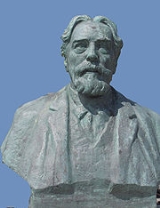
James Ensor

Encyclopedia
James Sidney Edouard, Baron Ensor (13 April 1860 – 19 November 1949) was a Flemish
-Belgian
painter
and printmaker, an important influence on expressionism
and surrealism
who lived in Ostend
for almost his entire life. He was associated with the artistic group Les XX
.
of English
parents, was a cultivated man who studied engineering in England and Germany. Ensor's mother, Maria Catherina Haegheman, was Belgian. Ensor himself lacked interest in academic study and left school at the age of fifteen to begin his artistic training with two local painters. From 1877 to 1880, he attended the Académie Royale des Beaux-Arts
in Brussels
, where one of his fellow students was Fernand Khnopff
. Ensor first exhibited his work in 1881. From 1880 until 1917, he had his studio in the attic of his parents' house. His only travels were three brief trips to Paris
, London
, and Holland.
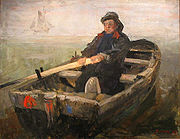 During the late 19th century much of his work was rejected as scandalous, particularly his painting Entry of Christ into Brussels (1888–89), but his paintings continued to be exhibited, and he gradually won acceptance and acclaim. In 1895 his painting The Lamp Boy (1880) was acquired by the Royal Museums of Fine Arts of Belgium
in Brussels, and he had his first solo exhibition in Brussels. By 1920 he was the subject of major exhibitions; in 1929 he was named a Baron
by King Albert
, and was the subject of the Belgian composer Flor Alpaerts
's "James Ensor Suite"; and in 1933 he was awarded the band of the Légion d'honneur
. Even in the first decade of the 20th century, however, his production of new works was diminishing, and he increasingly concentrated on music—although he had no musical training, he was a gifted improviser on the harmonium
, and spent much time performing for visitors.
Against the advice of friends, he remained in Ostend during World War II
despite the risk of bombardment. In his old age he was an honored figure among Belgians, and his daily walk made him a familiar sight in Ostend. He died there after a short illness, on 19 November 1949.
 While Ensor's early works, such as Russian Music (1881) and The Drunkards (1883), depict realistic scenes in a somber style, his palette subsequently brightened and he favored increasingly bizarre subject matter. Such paintings as The Scandalized Masks (1883) and Skeletons Fighting over a Hanged Man (1891) feature figures in grotesque masks inspired by the ones sold in his mother's gift shop for Ostend's annual Carnival. Subjects such as carnivals, masks, puppetry
, skeletons, and fantastic allegories are dominant in Ensor's mature work. Ensor dressed skeletons up in his studio and arranged them in colorful, enigmatic tableaux on the canvas, and used masks as a theatrical aspect in his still lifes. Attracted by masks' plastic forms, bright colors, and potential for psychological impact, he created a format in which he could paint with complete freedom.
The four years between 1888 and 1892 mark a turning point in Ensor's work. Ensor turned to religious themes, often the torments of Christ. Ensor interpreted religious themes as a personal disgust for the inhumanity of the world. In 1888 alone, he produced forty-five etchings as well as his most ambitious painting, the immense The Entry of Christ into Brussels. In this composition, which elaborates a theme treated by Ensor in his drawing Les Aureoles du Christ of 1885, a vast carnival mob in grotesque masks advances toward the viewer. Identifiable within the crowd are Belgian politicians, historical figures, and members of Ensor's family. Nearly lost amid the teeming throng is Christ on his donkey; although Ensor was an atheist, he identified with Christ as a victim of mockery. The piece, which measures 99½ by 169½ inches, was rejected by Les XX
and was not publicly displayed until 1929. After its controversial export in the 1960s, the painting is now at the J. Paul Getty Museum
and is on display at the Getty Center
in Los Angeles, California
. Also known as Christ's Entry into Brussels in 1889
, it is considered "a forerunner of twentieth-century Expressionism
."
As Ensor achieved belated recognition in the final years of the 19th century, his style softened and he painted less. Critics have generally seen Ensor's last fifty years as a long period of decline. The aggressive sarcasm and scatology that had characterized his work since the mid-1880s was less evident in his few new compositions, and much of his output consisted of mild repetitions of earlier works. Significant works of Ensor's late period include The Artist's Mother in Death (1915), a subdued painting of his mother's deathbed with prominent medicine bottles in the foreground, and The Vile Vivisectors (1925), a vehement attack on those responsible for the use of animals in medical experimentation.
 James Ensor is considered to be an innovator in 19th century art. Although he stood apart from other artists of his time, he significantly influenced such 20th century artists as Paul Klee
, Emil Nolde
, George Grosz
, Alfred Kubin
, Wols
, Felix Nussbaum
, and other expressionist and surrealist painters of the 20th century.
The yearly philanthropic "Bal du Rat Mort" (Dead Rat Ball) in Ostend continues a tradition begun by Ensor and his friends in 1898.
His works are in many public collections, notably the Modern Art
Museum of the Royal Museums of Fine Arts of Belgium
in Brussels, the Royal Museum of Fine Arts in Antwerp, and the Museum voor Schone Kunsten in Ostend. Major works by Ensor are also in the Museum of Modern Art
in New York
, the Musée d'Orsay
, Paris, and the Wallraf-Richartz Museum
in Cologne
. A collection of his letters is held in the Contemporary Art Archives of the Royal Museums of Fine Arts in Brussels. The Ensor collections of the Flemish fine art museums can all be seen at the James Ensor Online Museum.
 Ensor has been paid homage by contemporary painters and artists in other media: he is the subject of a song, "Meet James Ensor", recorded in 1994 by the alternative rock
duo They Might Be Giants
. The 1996
Belgian movie Camping Cosmos
was inspired by drawings of James Ensor, in particular Carnaval sur la plage (1887), La mort poursuivant le troupeau des humains (1896), and Le bal fantastique (1889). The film's director, Jan Bucquoy
, is also the creator of a comic
Le Bal du Rat mort inspired by Ensor.
An exhibition of approximately 120 works by James Ensor was shown at the Museum of Modern Art
in New York City in 2009, and then at the Musée d'Orsay
, Paris, October 2009–February 2010.
A portrait of James Ensor can be seen hanging in the room of Laurie Strode from the 1978 movie Halloween
.
Flemish
Flemish can refer to anything related to Flanders, and may refer directly to the following articles:*Flemish, an informal, though linguistically incorrect, name of any kind of the Dutch language as spoken in Belgium....
-Belgian
Belgium
Belgium , officially the Kingdom of Belgium, is a federal state in Western Europe. It is a founding member of the European Union and hosts the EU's headquarters, and those of several other major international organisations such as NATO.Belgium is also a member of, or affiliated to, many...
painter
Painting
Painting is the practice of applying paint, pigment, color or other medium to a surface . The application of the medium is commonly applied to the base with a brush but other objects can be used. In art, the term painting describes both the act and the result of the action. However, painting is...
and printmaker, an important influence on expressionism
Expressionism
Expressionism was a modernist movement, initially in poetry and painting, originating in Germany at the beginning of the 20th century. Its typical trait is to present the world solely from a subjective perspective, distorting it radically for emotional effect in order to evoke moods or ideas...
and surrealism
Surrealism
Surrealism is a cultural movement that began in the early 1920s, and is best known for the visual artworks and writings of the group members....
who lived in Ostend
Ostend
Ostend is a Belgian city and municipality located in the Flemish province of West Flanders. It comprises the boroughs of Mariakerke , Stene and Zandvoorde, and the city of Ostend proper – the largest on the Belgian coast....
for almost his entire life. He was associated with the artistic group Les XX
Les XX
Les XX was a group of twenty Belgian painters, designers and sculptors, formed in 1883 by the Brussels lawyer, publisher, and entrepreneur Octave Maus. For ten years 'Les Vingt' , as they called themselves, held an annual exhibition of their art; each year twenty international artists were also...
.
Biography
Ensor's father, James Frederic Ensor, born in BrusselsBrussels
Brussels , officially the Brussels Region or Brussels-Capital Region , is the capital of Belgium and the de facto capital of the European Union...
of English
English people
The English are a nation and ethnic group native to England, who speak English. The English identity is of early mediaeval origin, when they were known in Old English as the Anglecynn. England is now a country of the United Kingdom, and the majority of English people in England are British Citizens...
parents, was a cultivated man who studied engineering in England and Germany. Ensor's mother, Maria Catherina Haegheman, was Belgian. Ensor himself lacked interest in academic study and left school at the age of fifteen to begin his artistic training with two local painters. From 1877 to 1880, he attended the Académie Royale des Beaux-Arts
Académie Royale des Beaux-Arts
The Académie Royale des Beaux-Arts in Brussels is an art school, founded in 1711.The faculty and alumni of ARBA include some of the most famous names in Belgian painting, sculpture, and architecture: James Ensor, Rene Magritte, and Paul Delvaux...
in Brussels
Brussels
Brussels , officially the Brussels Region or Brussels-Capital Region , is the capital of Belgium and the de facto capital of the European Union...
, where one of his fellow students was Fernand Khnopff
Fernand Khnopff
Fernand Edmond Jean Marie Khnopff as a Belgian symbolist painter.- Youth and Training :...
. Ensor first exhibited his work in 1881. From 1880 until 1917, he had his studio in the attic of his parents' house. His only travels were three brief trips to Paris
Paris
Paris is the capital and largest city in France, situated on the river Seine, in northern France, at the heart of the Île-de-France region...
, London
London
London is the capital city of :England and the :United Kingdom, the largest metropolitan area in the United Kingdom, and the largest urban zone in the European Union by most measures. Located on the River Thames, London has been a major settlement for two millennia, its history going back to its...
, and Holland.
Royal Museums of Fine Arts of Belgium
The Royal Museums of Fine Arts of Belgium , is one of the most famous museums in Belgium.-The museum:...
in Brussels, and he had his first solo exhibition in Brussels. By 1920 he was the subject of major exhibitions; in 1929 he was named a Baron
Baron
Baron is a title of nobility. The word baron comes from Old French baron, itself from Old High German and Latin baro meaning " man, warrior"; it merged with cognate Old English beorn meaning "nobleman"...
by King Albert
Albert I of Belgium
Albert I reigned as King of the Belgians from 1909 until 1934.-Early life:Born Albert Léopold Clément Marie Meinrad in Brussels, he was the fifth child and second son of Prince Philippe, Count of Flanders, and his wife, Princess Marie of Hohenzollern-Sigmaringen...
, and was the subject of the Belgian composer Flor Alpaerts
Flor Alpaerts
Flor Alpaerts was a Belgian conductor, pedagogue and composer. He graduated from the Vlaamse Muziekschool in 1901....
's "James Ensor Suite"; and in 1933 he was awarded the band of the Légion d'honneur
Légion d'honneur
The Legion of Honour, or in full the National Order of the Legion of Honour is a French order established by Napoleon Bonaparte, First Consul of the Consulat which succeeded to the First Republic, on 19 May 1802...
. Even in the first decade of the 20th century, however, his production of new works was diminishing, and he increasingly concentrated on music—although he had no musical training, he was a gifted improviser on the harmonium
Harmonium
A harmonium is a free-standing keyboard instrument similar to a reed organ. Sound is produced by air being blown through sets of free reeds, resulting in a sound similar to that of an accordion...
, and spent much time performing for visitors.
Against the advice of friends, he remained in Ostend during World War II
World War II
World War II, or the Second World War , was a global conflict lasting from 1939 to 1945, involving most of the world's nations—including all of the great powers—eventually forming two opposing military alliances: the Allies and the Axis...
despite the risk of bombardment. In his old age he was an honored figure among Belgians, and his daily walk made him a familiar sight in Ostend. He died there after a short illness, on 19 November 1949.
Art
Puppetry
Puppetry is a form of theatre or performance which involves the manipulation of puppets. It is very ancient, and is believed to have originated 30,000 years BC. Puppetry takes many forms but they all share the process of animating inanimate performing objects...
, skeletons, and fantastic allegories are dominant in Ensor's mature work. Ensor dressed skeletons up in his studio and arranged them in colorful, enigmatic tableaux on the canvas, and used masks as a theatrical aspect in his still lifes. Attracted by masks' plastic forms, bright colors, and potential for psychological impact, he created a format in which he could paint with complete freedom.
The four years between 1888 and 1892 mark a turning point in Ensor's work. Ensor turned to religious themes, often the torments of Christ. Ensor interpreted religious themes as a personal disgust for the inhumanity of the world. In 1888 alone, he produced forty-five etchings as well as his most ambitious painting, the immense The Entry of Christ into Brussels. In this composition, which elaborates a theme treated by Ensor in his drawing Les Aureoles du Christ of 1885, a vast carnival mob in grotesque masks advances toward the viewer. Identifiable within the crowd are Belgian politicians, historical figures, and members of Ensor's family. Nearly lost amid the teeming throng is Christ on his donkey; although Ensor was an atheist, he identified with Christ as a victim of mockery. The piece, which measures 99½ by 169½ inches, was rejected by Les XX
Les XX
Les XX was a group of twenty Belgian painters, designers and sculptors, formed in 1883 by the Brussels lawyer, publisher, and entrepreneur Octave Maus. For ten years 'Les Vingt' , as they called themselves, held an annual exhibition of their art; each year twenty international artists were also...
and was not publicly displayed until 1929. After its controversial export in the 1960s, the painting is now at the J. Paul Getty Museum
J. Paul Getty Museum
The J. Paul Getty Museum, a program of the J. Paul Getty Trust, is an art museum. It has two locations, one at the Getty Center in Los Angeles, California, and one at the Getty Villa in Pacific Palisades, Los Angeles, California...
and is on display at the Getty Center
Getty Center
The Getty Center, in Brentwood, Los Angeles, California, is a campus for cultural institutions founded by oilman J. Paul Getty. The $1.3 billion center, which opened on December 16, 1997, is also well known for its architecture, gardens, and views overlooking Los Angeles...
in Los Angeles, California
Los Angeles, California
Los Angeles , with a population at the 2010 United States Census of 3,792,621, is the most populous city in California, USA and the second most populous in the United States, after New York City. It has an area of , and is located in Southern California...
. Also known as Christ's Entry into Brussels in 1889
Christ's Entry Into Brussels in 1889
Christ's Entry Into Brussels in 1889 is an 1888 painting by James Ensor. The painting is on permanent exhibition at the Getty Center in Los Angeles.-References:****...
, it is considered "a forerunner of twentieth-century Expressionism
Expressionism
Expressionism was a modernist movement, initially in poetry and painting, originating in Germany at the beginning of the 20th century. Its typical trait is to present the world solely from a subjective perspective, distorting it radically for emotional effect in order to evoke moods or ideas...
."
As Ensor achieved belated recognition in the final years of the 19th century, his style softened and he painted less. Critics have generally seen Ensor's last fifty years as a long period of decline. The aggressive sarcasm and scatology that had characterized his work since the mid-1880s was less evident in his few new compositions, and much of his output consisted of mild repetitions of earlier works. Significant works of Ensor's late period include The Artist's Mother in Death (1915), a subdued painting of his mother's deathbed with prominent medicine bottles in the foreground, and The Vile Vivisectors (1925), a vehement attack on those responsible for the use of animals in medical experimentation.
Influence and legacy
Paul Klee
Paul Klee was born in Münchenbuchsee, Switzerland, and is considered both a German and a Swiss painter. His highly individual style was influenced by movements in art that included expressionism, cubism, and surrealism. He was, as well, a student of orientalism...
, Emil Nolde
Emil Nolde
Emil Nolde was a German painter and printmaker. He was one of the first Expressionists, a member of Die Brücke, and is considered to be one of the great oil painting and watercolour painters of the 20th century. He is known for his vigorous brushwork and expressive choice of colors...
, George Grosz
George Grosz
Georg Ehrenfried Groß was a German artist known especially for his savagely caricatural drawings of Berlin life in the 1920s...
, Alfred Kubin
Alfred Kubin
Alfred Leopold Isidor Kubin was an Austrian printmaker, illustrator and occasional writer. Kubin is considered an important representative of Symbolism and Expressionism.-Biography:...
, Wols
Wols
Wols was the pseudonym of Alfred Otto Wolfgang Schulze , a German painter and photographer predominantly active in France....
, Felix Nussbaum
Felix Nussbaum
Felix Nussbaum was a German-Jewish surrealist painter. Nussbaum’s artwork gives a rare glimpse into the essence of one individual among the victims of the Holocaust.- Early life and education :...
, and other expressionist and surrealist painters of the 20th century.
The yearly philanthropic "Bal du Rat Mort" (Dead Rat Ball) in Ostend continues a tradition begun by Ensor and his friends in 1898.
His works are in many public collections, notably the Modern Art
Modern art
Modern art includes artistic works produced during the period extending roughly from the 1860s to the 1970s, and denotes the style and philosophy of the art produced during that era. The term is usually associated with art in which the traditions of the past have been thrown aside in a spirit of...
Museum of the Royal Museums of Fine Arts of Belgium
Royal Museums of Fine Arts of Belgium
The Royal Museums of Fine Arts of Belgium , is one of the most famous museums in Belgium.-The museum:...
in Brussels, the Royal Museum of Fine Arts in Antwerp, and the Museum voor Schone Kunsten in Ostend. Major works by Ensor are also in the Museum of Modern Art
Museum of Modern Art
The Museum of Modern Art is an art museum in Midtown Manhattan in New York City, on 53rd Street, between Fifth and Sixth Avenues. It has been important in developing and collecting modernist art, and is often identified as the most influential museum of modern art in the world...
in New York
New York City
New York is the most populous city in the United States and the center of the New York Metropolitan Area, one of the most populous metropolitan areas in the world. New York exerts a significant impact upon global commerce, finance, media, art, fashion, research, technology, education, and...
, the Musée d'Orsay
Musée d'Orsay
The Musée d'Orsay is a museum in Paris, France, on the left bank of the Seine. It is housed in the former Gare d'Orsay, an impressive Beaux-Arts railway station built between 1898 and 1900. The museum holds mainly French art dating from 1848 to 1915, including paintings, sculptures, furniture,...
, Paris, and the Wallraf-Richartz Museum
Wallraf-Richartz Museum
The Wallraf-Richartz-Museum is one of the three major museums in Cologne, Germany. It houses an art gallery with a collection of fine art from the medieval period to the early twentieth century...
in Cologne
Cologne
Cologne is Germany's fourth-largest city , and is the largest city both in the Germany Federal State of North Rhine-Westphalia and within the Rhine-Ruhr Metropolitan Area, one of the major European metropolitan areas with more than ten million inhabitants.Cologne is located on both sides of the...
. A collection of his letters is held in the Contemporary Art Archives of the Royal Museums of Fine Arts in Brussels. The Ensor collections of the Flemish fine art museums can all be seen at the James Ensor Online Museum.
Alternative rock
Alternative rock is a genre of rock music and a term used to describe a diverse musical movement that emerged from the independent music underground of the 1980s and became widely popular by the 1990s...
duo They Might Be Giants
They Might Be Giants
They Might Be Giants is an American alternative rock band formed in 1982 by John Flansburgh and John Linnell. During TMBG's early years Flansburgh and Linnell were frequently accompanied by a drum machine. In the early 1990s, TMBG became a full band. Currently, the members of TMBG are...
. The 1996
1996 in film
Major releases this year included Scream, Independence Day, Fargo, Trainspotting, The English Patient, Twister, Mars Attacks!, Jerry Maguire and a version of Evita starring Madonna.-Events:...
Belgian movie Camping Cosmos
Camping Cosmos
Camping Cosmos is a Belgian 1996 film, sequel to La Vie sexuelle des Belges 1950-1978, directed by Jan Bucquoy. It stars Claude Semal, Lolo Ferrari , Noël Godin , Herman Brusselmans and Arno ....
was inspired by drawings of James Ensor, in particular Carnaval sur la plage (1887), La mort poursuivant le troupeau des humains (1896), and Le bal fantastique (1889). The film's director, Jan Bucquoy
Jan Bucquoy
Jan Bucquoy is an anarchist and author-filmmaker born in Harelbeke, Belgium who started as a theatre practitioner and who worked as a cartoon-scriptwriter.-Career:...
, is also the creator of a comic
Comics
Comics denotes a hybrid medium having verbal side of its vocabulary tightly tied to its visual side in order to convey narrative or information only, the latter in case of non-fiction comics, seeking synergy by using both visual and verbal side in...
Le Bal du Rat mort inspired by Ensor.
An exhibition of approximately 120 works by James Ensor was shown at the Museum of Modern Art
Museum of Modern Art
The Museum of Modern Art is an art museum in Midtown Manhattan in New York City, on 53rd Street, between Fifth and Sixth Avenues. It has been important in developing and collecting modernist art, and is often identified as the most influential museum of modern art in the world...
in New York City in 2009, and then at the Musée d'Orsay
Musée d'Orsay
The Musée d'Orsay is a museum in Paris, France, on the left bank of the Seine. It is housed in the former Gare d'Orsay, an impressive Beaux-Arts railway station built between 1898 and 1900. The museum holds mainly French art dating from 1848 to 1915, including paintings, sculptures, furniture,...
, Paris, October 2009–February 2010.
A portrait of James Ensor can be seen hanging in the room of Laurie Strode from the 1978 movie Halloween
Halloween (1978 film)
Halloween is a 1978 American independent horror film directed, produced, and scored by John Carpenter, co-written with Debra Hill, and starring Donald Pleasence and Jamie Lee Curtis in her film debut and the first installment in the Halloween franchise. The film is set in the fictional midwestern...
.
Further reading
- New York Museum of Modern Art (2009). James Ensor. ISBN 0870707523.
External links
- James Ensor Online Museum
- JAMES ENSOR ARCHIEF - Publications by or with cooperation of Patrick Florizoone http://www.james-ensor.org http://www.james-ensor.be
- The Royal Museums' Modern Art Collection: 19th C. symbolism, with Ensor's "Skeletons fighting for a smoked herring"
- Exhibition at the Royal Museum of Fine Arts of Antwerp: "Ensor and the Moderns"
- The Getty Museum: James Ensor
- Flemish Art Collection: James Ensor, Graphic Artist
- "Goya, Redon, Ensor Grotesque paintings and drawings" 2009 Special Exhibition at KMSKA
- 2009 Ensor show at Museum of Modern Art, NYC
- Sanford Schwartz, "Mysteries of Ensor," New York Review of Books, September 24, 2009.