


Der Spiegel

Encyclopedia
Der Spiegel is a German weekly news magazine published in Hamburg
. It is one of Europe's largest publications of its kind, with a weekly circulation of more than one million.
on Saturday, 4 January 1947. Its release was initiated and sponsored by the British occupational administration and preceded by a magazine titled, Diese Woche (This Week), which had first been published in November 1946. After disagreements with the British, the magazine was handed over to Rudolf Augstein
as chief editor, and was renamed Der Spiegel. From the first edition in January 1947, Augstein held the position of editor-in-chief, which he retained until his death on 7 November 2002.
After 1950, the magazine was owned by Rudolf Augstein
and John Jahr; Jahr's share merged with Richard Gruner in 1965 to form the publishing company Gruner + Jahr
. In 1969, Augstein bought out Gruner + Jahr for DM 42 million and became the sole owner of Der Spiegel. In 1971, Gruner + Jahr bought back a 25% share in the magazine. In 1974, Augstein restructured the company to make the employees shareholders. All employees with more than three years seniority were offered the opportunity to become an associate and participate in the management of the company, as well as in the profits.
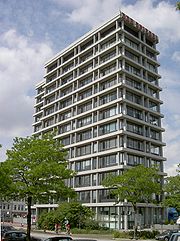
Since 1952, Der Spiegel has been headquartered in its own building in the old town part of Hamburg.
In 1994, Spiegel Online
was launched.
Der Spiegel is similar in style and layout to American news magazines such as Time or Newsweek
. In terms of the breadth and amount of detail in its articles it is comparable to The Atlantic Monthly
. It is known in Germany for its distinctive, academic writing style and its large volume—a standard issue may run 200 pages or more. Typically, it has a content to advertising ratio of 2:1.
, Der Spiegel was employing the equivalent of 80 full-time fact checker
s, which the Columbia Journalism Review
called "most likely the world's largest fact checking operation".
 Der Spiegels circulation rose quickly. From 15,000 copies in 1947, it grew to 65,000 in 1948 and 437,000 in 1961. By the 1970s, it had reached a plateau at about 900,000 copies. When the German re-unification in 1990 made it available to a new readership in former East Germany, the circulation exceeded one million. The magazine's influence is based on two pillars; firstly the moral authority established by investigative journalism since the early years and proven alive by several impressive scoops during the 1980s; secondly the economic power of the prolific Spiegel publishing house. Since 1988, it has produced the TV programme Spiegel TV, and further diversified during the 1990s. Among other things, Spiegel Verlag now publishes the monthly Manager Magazin.
In 1993, the publishing company Hubert Burda Media
presented the weekly magazine FOCUS
as an alternative to the Spiegel. It established a different style, defined by more succinct articles in combination with a layout of a more spectacular kind and succeeded in reaching roughly the Spiegels circulation.
took over in 1994, the magazine's readers realised that his personality was different from his predecessor. In 2005, a documentary by Stephan Lamby quoted him as follows: "We stand at a very big cannon!" Politicians of all stripes who had to deal with the magazine's attention often voiced their disaffection for it. The outspoken conservative Franz Josef Strauß
contended that Der Spiegel was "the Gestapo
of our time". He referred to journalists in general as "rats".) The Social Democrat Willy Brandt
called it "Scheißblatt" (i.e. a "shitty newspaper") during his term in office as Chancellor.
Der Spiegel often produces feature-length articles on problems affecting Germany (like demographic trends, the federal system's gridlock or the issues of its education system) and describes optional strategies and their risks in depth.
(rather than Frankfurt) as the site of West Germany's government.
During the Spiegel scandal
in 1962, which followed the release of a report about the possibly low state of readiness of the German armed forces
, minister of defence and conservative figurehead Franz Josef Strauß
had Der Spiegel investigated. In the course of this investigation, the editorial offices were raided by police while Rudolf Augstein and other Der Spiegel editors were arrested on charges of treason. Despite a lack of sufficient authority, Strauß even went after the article's author, Conrad Ahlers, who was consequently arrested in Spain where he was on holiday. When the legal case collapsed, the scandal led to a major shake-up in chancellor Konrad Adenauer
's cabinet and Strauß had to stand down. The affair was generally received as an attack on the freedom of the press. Since then, Der Spiegel has repeatedly played a significant role in revealing political grievances and misdeeds, including the Flick Affair
.
The Spiegel scandal is now remembered for altering the political culture of post-war Germany and — with the first mass demonstrations and public protests — being a turning point from the old Obrigkeitsstaat (authoritarian state) to a modern democracy
.
In 2010, the magazine supported WikiLeaks
in publishing leaked materials from the United States State Department
, along with the The Guardian
, The New York Times
, El País, Le Monde
.
Der Spiegel (deːɐ ˈʃpiːɡəl, lit. "The Mirror") is a German weekly news magazine published in Hamburg
. It is one of Europe's largest publications of its kind, with a weekly circulation of more than one million.
on Saturday, 4 January 1947. Its release was initiated and sponsored by the British occupational administration and preceded by a magazine titled, Diese Woche (This Week), which had first been published in November 1946. After disagreements with the British, the magazine was handed over to Rudolf Augstein
as chief editor, and was renamed Der Spiegel. From the first edition in January 1947, Augstein held the position of editor-in-chief, which he retained until his death on 7 November 2002.
After 1950, the magazine was owned by Rudolf Augstein
and John Jahr; Jahr's share merged with Richard Gruner in 1965 to form the publishing company Gruner + Jahr
. In 1969, Augstein bought out Gruner + Jahr for DM 42 million and became the sole owner of Der Spiegel. In 1971, Gruner + Jahr bought back a 25% share in the magazine. In 1974, Augstein restructured the company to make the employees shareholders. All employees with more than three years seniority were offered the opportunity to become an associate and participate in the management of the company, as well as in the profits.
Since 1952, Der Spiegel has been headquartered in its own building in the old town part of Hamburg.
In 1994, Spiegel Online
was launched.
Der Spiegel is similar in style and layout to American news magazines such as Time or Newsweek
. In terms of the breadth and amount of detail in its articles it is comparable to The Atlantic Monthly
. It is known in Germany for its distinctive, academic writing style and its large volume—a standard issue may run 200 pages or more. Typically, it has a content to advertising ratio of 2:1.
, Der Spiegel was employing the equivalent of 80 full-time fact checker
s, which the Columbia Journalism Review
called "most likely the world's largest fact checking operation".
Der Spiegels circulation rose quickly. From 15,000 copies in 1947, it grew to 65,000 in 1948 and 437,000 in 1961. By the 1970s, it had reached a plateau at about 900,000 copies. When the German re-unification in 1990 made it available to a new readership in former East Germany, the circulation exceeded one million. The magazine's influence is based on two pillars; firstly the moral authority established by investigative journalism since the early years and proven alive by several impressive scoops during the 1980s; secondly the economic power of the prolific Spiegel publishing house. Since 1988, it has produced the TV programme Spiegel TV, and further diversified during the 1990s. Among other things, Spiegel Verlag now publishes the monthly Manager Magazin.
In 1993, the publishing company Hubert Burda Media
presented the weekly magazine FOCUS
as an alternative to the Spiegel. It established a different style, defined by more succinct articles in combination with a layout of a more spectacular kind and succeeded in reaching roughly the Spiegels circulation.
took over in 1994, the magazine's readers realised that his personality was different from his predecessor. In 2005, a documentary by Stephan Lamby quoted him as follows: "We stand at a very big cannon!" Politicians of all stripes who had to deal with the magazine's attention often voiced their disaffection for it. The outspoken conservative Franz Josef Strauß
contended that Der Spiegel was "the Gestapo
of our time". He referred to journalists in general as "rats".) The Social Democrat Willy Brandt
called it "Scheißblatt" (i.e. a "shitty newspaper") during his term in office as Chancellor.
Der Spiegel often produces feature-length articles on problems affecting Germany (like demographic trends, the federal system's gridlock or the issues of its education system) and describes optional strategies and their risks in depth.
(rather than Frankfurt) as the site of West Germany's government.
During the Spiegel scandal
in 1962, which followed the release of a report about the possibly low state of readiness of the German armed forces
, minister of defence and conservative figurehead Franz Josef Strauß
had Der Spiegel investigated. In the course of this investigation, the editorial offices were raided by police while Rudolf Augstein and other Der Spiegel editors were arrested on charges of treason. Despite a lack of sufficient authority, Strauß even went after the article's author, Conrad Ahlers, who was consequently arrested in Spain where he was on holiday. When the legal case collapsed, the scandal led to a major shake-up in chancellor Konrad Adenauer
's cabinet and Strauß had to stand down. The affair was generally received as an attack on the freedom of the press. Since then, Der Spiegel has repeatedly played a significant role in revealing political grievances and misdeeds, including the Flick Affair
.
The Spiegel scandal is now remembered for altering the political culture of post-war Germany and — with the first mass demonstrations and public protests — being a turning point from the old Obrigkeitsstaat (authoritarian state) to a modern democracy
.
In 2010, the magazine supported WikiLeaks
in publishing leaked materials from the United States State Department
, along with the The Guardian
, The New York Times
, El País, Le Monde
.
Der Spiegel (deːɐ ˈʃpiːɡəl, lit. "The Mirror") is a German weekly news magazine published in Hamburg
. It is one of Europe's largest publications of its kind, with a weekly circulation of more than one million.
on Saturday, 4 January 1947. Its release was initiated and sponsored by the British occupational administration and preceded by a magazine titled, Diese Woche (This Week), which had first been published in November 1946. After disagreements with the British, the magazine was handed over to Rudolf Augstein
as chief editor, and was renamed Der Spiegel. From the first edition in January 1947, Augstein held the position of editor-in-chief, which he retained until his death on 7 November 2002.
After 1950, the magazine was owned by Rudolf Augstein
and John Jahr; Jahr's share merged with Richard Gruner in 1965 to form the publishing company Gruner + Jahr
. In 1969, Augstein bought out Gruner + Jahr for DM 42 million and became the sole owner of Der Spiegel. In 1971, Gruner + Jahr bought back a 25% share in the magazine. In 1974, Augstein restructured the company to make the employees shareholders. All employees with more than three years seniority were offered the opportunity to become an associate and participate in the management of the company, as well as in the profits.
Since 1952, Der Spiegel has been headquartered in its own building in the old town part of Hamburg.
In 1994, Spiegel Online
was launched.
Der Spiegel is similar in style and layout to American news magazines such as Time or Newsweek
. In terms of the breadth and amount of detail in its articles it is comparable to The Atlantic Monthly
. It is known in Germany for its distinctive, academic writing style and its large volume—a standard issue may run 200 pages or more. Typically, it has a content to advertising ratio of 2:1.
, Der Spiegel was employing the equivalent of 80 full-time fact checker
s, which the Columbia Journalism Review
called "most likely the world's largest fact checking operation".
Der Spiegels circulation rose quickly. From 15,000 copies in 1947, it grew to 65,000 in 1948 and 437,000 in 1961. By the 1970s, it had reached a plateau at about 900,000 copies. When the German re-unification in 1990 made it available to a new readership in former East Germany, the circulation exceeded one million. The magazine's influence is based on two pillars; firstly the moral authority established by investigative journalism since the early years and proven alive by several impressive scoops during the 1980s; secondly the economic power of the prolific Spiegel publishing house. Since 1988, it has produced the TV programme Spiegel TV, and further diversified during the 1990s. Among other things, Spiegel Verlag now publishes the monthly Manager Magazin.
In 1993, the publishing company Hubert Burda Media
presented the weekly magazine FOCUS
as an alternative to the Spiegel. It established a different style, defined by more succinct articles in combination with a layout of a more spectacular kind and succeeded in reaching roughly the Spiegels circulation.
took over in 1994, the magazine's readers realised that his personality was different from his predecessor. In 2005, a documentary by Stephan Lamby quoted him as follows: "We stand at a very big cannon!" Politicians of all stripes who had to deal with the magazine's attention often voiced their disaffection for it. The outspoken conservative Franz Josef Strauß
contended that Der Spiegel was "the Gestapo
of our time". He referred to journalists in general as "rats".) The Social Democrat Willy Brandt
called it "Scheißblatt" (i.e. a "shitty newspaper") during his term in office as Chancellor.
Der Spiegel often produces feature-length articles on problems affecting Germany (like demographic trends, the federal system's gridlock or the issues of its education system) and describes optional strategies and their risks in depth.
(rather than Frankfurt) as the site of West Germany's government.
During the Spiegel scandal
in 1962, which followed the release of a report about the possibly low state of readiness of the German armed forces
, minister of defence and conservative figurehead Franz Josef Strauß
had Der Spiegel investigated. In the course of this investigation, the editorial offices were raided by police while Rudolf Augstein and other Der Spiegel editors were arrested on charges of treason. Despite a lack of sufficient authority, Strauß even went after the article's author, Conrad Ahlers, who was consequently arrested in Spain where he was on holiday. When the legal case collapsed, the scandal led to a major shake-up in chancellor Konrad Adenauer
's cabinet and Strauß had to stand down. The affair was generally received as an attack on the freedom of the press. Since then, Der Spiegel has repeatedly played a significant role in revealing political grievances and misdeeds, including the Flick Affair
.
The Spiegel scandal is now remembered for altering the political culture of post-war Germany and — with the first mass demonstrations and public protests — being a turning point from the old Obrigkeitsstaat (authoritarian state) to a modern democracy
.
In 2010, the magazine supported WikiLeaks
in publishing leaked materials from the United States State Department
, along with the The Guardian
, The New York Times
, El País, Le Monde
.
Hamburg
-History:The first historic name for the city was, according to Claudius Ptolemy's reports, Treva.But the city takes its modern name, Hamburg, from the first permanent building on the site, a castle whose construction was ordered by the Emperor Charlemagne in AD 808...
. It is one of Europe's largest publications of its kind, with a weekly circulation of more than one million.
Overview
The first edition of Der Spiegel was published in HanoverHanover
Hanover or Hannover, on the river Leine, is the capital of the federal state of Lower Saxony , Germany and was once by personal union the family seat of the Hanoverian Kings of Great Britain, under their title as the dukes of Brunswick-Lüneburg...
on Saturday, 4 January 1947. Its release was initiated and sponsored by the British occupational administration and preceded by a magazine titled, Diese Woche (This Week), which had first been published in November 1946. After disagreements with the British, the magazine was handed over to Rudolf Augstein
Rudolf Augstein
Rudolf Karl Augstein was one of the most influential German journalists, founder and part-owner of Der Spiegel magazine....
as chief editor, and was renamed Der Spiegel. From the first edition in January 1947, Augstein held the position of editor-in-chief, which he retained until his death on 7 November 2002.
After 1950, the magazine was owned by Rudolf Augstein
Rudolf Augstein
Rudolf Karl Augstein was one of the most influential German journalists, founder and part-owner of Der Spiegel magazine....
and John Jahr; Jahr's share merged with Richard Gruner in 1965 to form the publishing company Gruner + Jahr
Gruner + Jahr
Gruner + Jahr GmbH & Co. KG is the largest European printing and publishing firm. Its headquarters is in Hamburg, Germany.-History:Originally founded on August 1, 1948 as the Henri Nannen publishing house, Gruner + Jahr was created in 1965 from a merger by acquisition, by publishers John Jahr Sr....
. In 1969, Augstein bought out Gruner + Jahr for DM 42 million and became the sole owner of Der Spiegel. In 1971, Gruner + Jahr bought back a 25% share in the magazine. In 1974, Augstein restructured the company to make the employees shareholders. All employees with more than three years seniority were offered the opportunity to become an associate and participate in the management of the company, as well as in the profits.
Since 1952, Der Spiegel has been headquartered in its own building in the old town part of Hamburg.
In 1994, Spiegel Online
Spiegel Online
Spiegel Online , the online version of German weekly news magazine Der Spiegel, is one the most visited news websites written in the German language.- Company :...
was launched.
Der Spiegel is similar in style and layout to American news magazines such as Time or Newsweek
Newsweek
Newsweek is an American weekly news magazine published in New York City. It is distributed throughout the United States and internationally. It is the second-largest news weekly magazine in the U.S., having trailed Time in circulation and advertising revenue for most of its existence...
. In terms of the breadth and amount of detail in its articles it is comparable to The Atlantic Monthly
The Atlantic Monthly
The Atlantic is an American magazine founded in Boston, Massachusetts, in 1857. It was created as a literary and cultural commentary magazine. It quickly achieved a national reputation, which it held for more than a century. It was important for recognizing and publishing new writers and poets,...
. It is known in Germany for its distinctive, academic writing style and its large volume—a standard issue may run 200 pages or more. Typically, it has a content to advertising ratio of 2:1.
, Der Spiegel was employing the equivalent of 80 full-time fact checker
Fact checker
A fact checker is the person who checks factual assertions in non-fictional text, usually intended for publication in a periodical, to determine their veracity and correctness...
s, which the Columbia Journalism Review
Columbia Journalism Review
The Columbia Journalism Review is an American magazine for professional journalists published bimonthly by the Columbia University Graduate School of Journalism since 1961....
called "most likely the world's largest fact checking operation".
Development
In 1993, the publishing company Hubert Burda Media
Hubert Burda Media
Hubert Burda Media is a German privately held, family-owned global media company with its origins in printing and magazine publishing. The company is headquartered in Offenburg and Munich, has additional main offices in Berlin and Hamburg and has more than 7400 employees...
presented the weekly magazine FOCUS
Focus (German magazine)
Focus is a German weekly news magazine published in Munich and distributed throughout Germany. It is the third-largest weekly news magazine in Germany. It is considered conservative and leaned towards economic liberalism.- Overview :...
as an alternative to the Spiegel. It established a different style, defined by more succinct articles in combination with a layout of a more spectacular kind and succeeded in reaching roughly the Spiegels circulation.
Reception
When Stefan AustStefan Aust
Stefan Aust is a German journalist and was the editor-in-chief of the weekly news magazine Der Spiegel from 1994 to February 2008...
took over in 1994, the magazine's readers realised that his personality was different from his predecessor. In 2005, a documentary by Stephan Lamby quoted him as follows: "We stand at a very big cannon!" Politicians of all stripes who had to deal with the magazine's attention often voiced their disaffection for it. The outspoken conservative Franz Josef Strauß
Franz Josef Strauß
Franz Josef Strauss was a German politician. He was the leader of the Christian Social Union, member of the federal cabinet in different positions and long-time minister-president of the state of Bavaria....
contended that Der Spiegel was "the Gestapo
Gestapo
The Gestapo was the official secret police of Nazi Germany. Beginning on 20 April 1934, it was under the administration of the SS leader Heinrich Himmler in his position as Chief of German Police...
of our time". He referred to journalists in general as "rats".) The Social Democrat Willy Brandt
Willy Brandt
Willy Brandt, born Herbert Ernst Karl Frahm , was a German politician, Mayor of West Berlin 1957–1966, Chancellor of West Germany 1969–1974, and leader of the Social Democratic Party of Germany 1964–1987....
called it "Scheißblatt" (i.e. a "shitty newspaper") during his term in office as Chancellor.
Der Spiegel often produces feature-length articles on problems affecting Germany (like demographic trends, the federal system's gridlock or the issues of its education system) and describes optional strategies and their risks in depth.
Investigative journalism
Der Spiegel has a distinctive reputation for revealing political misconduct and scandals. It merited first accordant recognition as early as 1950, when the federal parliament launched an inquiry into the Spiegels accusations that bribed members of parliament had promoted BonnBonn
Bonn is the 19th largest city in Germany. Located in the Cologne/Bonn Region, about 25 kilometres south of Cologne on the river Rhine in the State of North Rhine-Westphalia, it was the capital of West Germany from 1949 to 1990 and the official seat of government of united Germany from 1990 to 1999....
(rather than Frankfurt) as the site of West Germany's government.
During the Spiegel scandal
Spiegel scandal
The Spiegel Affair of 1962 was one of the major political scandals in Germany in the era following World War II.The scandal involved a conflict between Franz Josef Strauss, then Federal Minister of Defense, and Rudolf Augstein, owner and editor-in-chief of Der Spiegel magazine, Germany's leading...
in 1962, which followed the release of a report about the possibly low state of readiness of the German armed forces
Bundeswehr
The Bundeswehr consists of the unified armed forces of Germany and their civil administration and procurement authorities...
, minister of defence and conservative figurehead Franz Josef Strauß
Franz Josef Strauß
Franz Josef Strauss was a German politician. He was the leader of the Christian Social Union, member of the federal cabinet in different positions and long-time minister-president of the state of Bavaria....
had Der Spiegel investigated. In the course of this investigation, the editorial offices were raided by police while Rudolf Augstein and other Der Spiegel editors were arrested on charges of treason. Despite a lack of sufficient authority, Strauß even went after the article's author, Conrad Ahlers, who was consequently arrested in Spain where he was on holiday. When the legal case collapsed, the scandal led to a major shake-up in chancellor Konrad Adenauer
Konrad Adenauer
Konrad Hermann Joseph Adenauer was a German statesman. He was the chancellor of the West Germany from 1949 to 1963. He is widely recognised as a person who led his country from the ruins of World War II to a powerful and prosperous nation that had forged close relations with old enemies France,...
's cabinet and Strauß had to stand down. The affair was generally received as an attack on the freedom of the press. Since then, Der Spiegel has repeatedly played a significant role in revealing political grievances and misdeeds, including the Flick Affair
Flick Affair
The Flick Affair was a German political scandal of the early 1980s relating to political contributions by the Flick company, a major German conglomerate, to various political parties "for the cultivation of the political landscape"...
.
The Spiegel scandal is now remembered for altering the political culture of post-war Germany and — with the first mass demonstrations and public protests — being a turning point from the old Obrigkeitsstaat (authoritarian state) to a modern democracy
Democracy
Democracy is generally defined as a form of government in which all adult citizens have an equal say in the decisions that affect their lives. Ideally, this includes equal participation in the proposal, development and passage of legislation into law...
.
In 2010, the magazine supported WikiLeaks
Wikileaks
WikiLeaks is an international self-described not-for-profit organisation that publishes submissions of private, secret, and classified media from anonymous news sources, news leaks, and whistleblowers. Its website, launched in 2006 under The Sunshine Press organisation, claimed a database of more...
in publishing leaked materials from the United States State Department
United States diplomatic cables leak
The United States diplomatic cables leak, widely known as Cablegate, began in February 2010 when WikiLeaks—a non-profit organization that publishes submissions from anonymous whistleblowers—began releasing classified cables that had been sent to the U.S. State Department by 274 of its consulates,...
, along with the The Guardian
The Guardian
The Guardian, formerly known as The Manchester Guardian , is a British national daily newspaper in the Berliner format...
, The New York Times
The New York Times
The New York Times is an American daily newspaper founded and continuously published in New York City since 1851. The New York Times has won 106 Pulitzer Prizes, the most of any news organization...
, El País, Le Monde
Le Monde
Le Monde is a French daily evening newspaper owned by La Vie-Le Monde Group and edited in Paris. It is one of two French newspapers of record, and has generally been well respected since its first edition under founder Hubert Beuve-Méry on 19 December 1944...
.
Der Spiegel (deːɐ ˈʃpiːɡəl, lit. "The Mirror") is a German weekly news magazine published in Hamburg
Hamburg
-History:The first historic name for the city was, according to Claudius Ptolemy's reports, Treva.But the city takes its modern name, Hamburg, from the first permanent building on the site, a castle whose construction was ordered by the Emperor Charlemagne in AD 808...
. It is one of Europe's largest publications of its kind, with a weekly circulation of more than one million.
Overview
The first edition of Der Spiegel was published in HanoverHanover
Hanover or Hannover, on the river Leine, is the capital of the federal state of Lower Saxony , Germany and was once by personal union the family seat of the Hanoverian Kings of Great Britain, under their title as the dukes of Brunswick-Lüneburg...
on Saturday, 4 January 1947. Its release was initiated and sponsored by the British occupational administration and preceded by a magazine titled, Diese Woche (This Week), which had first been published in November 1946. After disagreements with the British, the magazine was handed over to Rudolf Augstein
Rudolf Augstein
Rudolf Karl Augstein was one of the most influential German journalists, founder and part-owner of Der Spiegel magazine....
as chief editor, and was renamed Der Spiegel. From the first edition in January 1947, Augstein held the position of editor-in-chief, which he retained until his death on 7 November 2002.
After 1950, the magazine was owned by Rudolf Augstein
Rudolf Augstein
Rudolf Karl Augstein was one of the most influential German journalists, founder and part-owner of Der Spiegel magazine....
and John Jahr; Jahr's share merged with Richard Gruner in 1965 to form the publishing company Gruner + Jahr
Gruner + Jahr
Gruner + Jahr GmbH & Co. KG is the largest European printing and publishing firm. Its headquarters is in Hamburg, Germany.-History:Originally founded on August 1, 1948 as the Henri Nannen publishing house, Gruner + Jahr was created in 1965 from a merger by acquisition, by publishers John Jahr Sr....
. In 1969, Augstein bought out Gruner + Jahr for DM 42 million and became the sole owner of Der Spiegel. In 1971, Gruner + Jahr bought back a 25% share in the magazine. In 1974, Augstein restructured the company to make the employees shareholders. All employees with more than three years seniority were offered the opportunity to become an associate and participate in the management of the company, as well as in the profits.
Since 1952, Der Spiegel has been headquartered in its own building in the old town part of Hamburg.
In 1994, Spiegel Online
Spiegel Online
Spiegel Online , the online version of German weekly news magazine Der Spiegel, is one the most visited news websites written in the German language.- Company :...
was launched.
Der Spiegel is similar in style and layout to American news magazines such as Time or Newsweek
Newsweek
Newsweek is an American weekly news magazine published in New York City. It is distributed throughout the United States and internationally. It is the second-largest news weekly magazine in the U.S., having trailed Time in circulation and advertising revenue for most of its existence...
. In terms of the breadth and amount of detail in its articles it is comparable to The Atlantic Monthly
The Atlantic Monthly
The Atlantic is an American magazine founded in Boston, Massachusetts, in 1857. It was created as a literary and cultural commentary magazine. It quickly achieved a national reputation, which it held for more than a century. It was important for recognizing and publishing new writers and poets,...
. It is known in Germany for its distinctive, academic writing style and its large volume—a standard issue may run 200 pages or more. Typically, it has a content to advertising ratio of 2:1.
, Der Spiegel was employing the equivalent of 80 full-time fact checker
Fact checker
A fact checker is the person who checks factual assertions in non-fictional text, usually intended for publication in a periodical, to determine their veracity and correctness...
s, which the Columbia Journalism Review
Columbia Journalism Review
The Columbia Journalism Review is an American magazine for professional journalists published bimonthly by the Columbia University Graduate School of Journalism since 1961....
called "most likely the world's largest fact checking operation".
Development
In 1993, the publishing company Hubert Burda Media
Hubert Burda Media
Hubert Burda Media is a German privately held, family-owned global media company with its origins in printing and magazine publishing. The company is headquartered in Offenburg and Munich, has additional main offices in Berlin and Hamburg and has more than 7400 employees...
presented the weekly magazine FOCUS
Focus (German magazine)
Focus is a German weekly news magazine published in Munich and distributed throughout Germany. It is the third-largest weekly news magazine in Germany. It is considered conservative and leaned towards economic liberalism.- Overview :...
as an alternative to the Spiegel. It established a different style, defined by more succinct articles in combination with a layout of a more spectacular kind and succeeded in reaching roughly the Spiegels circulation.
Reception
When Stefan AustStefan Aust
Stefan Aust is a German journalist and was the editor-in-chief of the weekly news magazine Der Spiegel from 1994 to February 2008...
took over in 1994, the magazine's readers realised that his personality was different from his predecessor. In 2005, a documentary by Stephan Lamby quoted him as follows: "We stand at a very big cannon!" Politicians of all stripes who had to deal with the magazine's attention often voiced their disaffection for it. The outspoken conservative Franz Josef Strauß
Franz Josef Strauß
Franz Josef Strauss was a German politician. He was the leader of the Christian Social Union, member of the federal cabinet in different positions and long-time minister-president of the state of Bavaria....
contended that Der Spiegel was "the Gestapo
Gestapo
The Gestapo was the official secret police of Nazi Germany. Beginning on 20 April 1934, it was under the administration of the SS leader Heinrich Himmler in his position as Chief of German Police...
of our time". He referred to journalists in general as "rats".) The Social Democrat Willy Brandt
Willy Brandt
Willy Brandt, born Herbert Ernst Karl Frahm , was a German politician, Mayor of West Berlin 1957–1966, Chancellor of West Germany 1969–1974, and leader of the Social Democratic Party of Germany 1964–1987....
called it "Scheißblatt" (i.e. a "shitty newspaper") during his term in office as Chancellor.
Der Spiegel often produces feature-length articles on problems affecting Germany (like demographic trends, the federal system's gridlock or the issues of its education system) and describes optional strategies and their risks in depth.
Investigative journalism
Der Spiegel has a distinctive reputation for revealing political misconduct and scandals. It merited first accordant recognition as early as 1950, when the federal parliament launched an inquiry into the Spiegels accusations that bribed members of parliament had promoted BonnBonn
Bonn is the 19th largest city in Germany. Located in the Cologne/Bonn Region, about 25 kilometres south of Cologne on the river Rhine in the State of North Rhine-Westphalia, it was the capital of West Germany from 1949 to 1990 and the official seat of government of united Germany from 1990 to 1999....
(rather than Frankfurt) as the site of West Germany's government.
During the Spiegel scandal
Spiegel scandal
The Spiegel Affair of 1962 was one of the major political scandals in Germany in the era following World War II.The scandal involved a conflict between Franz Josef Strauss, then Federal Minister of Defense, and Rudolf Augstein, owner and editor-in-chief of Der Spiegel magazine, Germany's leading...
in 1962, which followed the release of a report about the possibly low state of readiness of the German armed forces
Bundeswehr
The Bundeswehr consists of the unified armed forces of Germany and their civil administration and procurement authorities...
, minister of defence and conservative figurehead Franz Josef Strauß
Franz Josef Strauß
Franz Josef Strauss was a German politician. He was the leader of the Christian Social Union, member of the federal cabinet in different positions and long-time minister-president of the state of Bavaria....
had Der Spiegel investigated. In the course of this investigation, the editorial offices were raided by police while Rudolf Augstein and other Der Spiegel editors were arrested on charges of treason. Despite a lack of sufficient authority, Strauß even went after the article's author, Conrad Ahlers, who was consequently arrested in Spain where he was on holiday. When the legal case collapsed, the scandal led to a major shake-up in chancellor Konrad Adenauer
Konrad Adenauer
Konrad Hermann Joseph Adenauer was a German statesman. He was the chancellor of the West Germany from 1949 to 1963. He is widely recognised as a person who led his country from the ruins of World War II to a powerful and prosperous nation that had forged close relations with old enemies France,...
's cabinet and Strauß had to stand down. The affair was generally received as an attack on the freedom of the press. Since then, Der Spiegel has repeatedly played a significant role in revealing political grievances and misdeeds, including the Flick Affair
Flick Affair
The Flick Affair was a German political scandal of the early 1980s relating to political contributions by the Flick company, a major German conglomerate, to various political parties "for the cultivation of the political landscape"...
.
The Spiegel scandal is now remembered for altering the political culture of post-war Germany and — with the first mass demonstrations and public protests — being a turning point from the old Obrigkeitsstaat (authoritarian state) to a modern democracy
Democracy
Democracy is generally defined as a form of government in which all adult citizens have an equal say in the decisions that affect their lives. Ideally, this includes equal participation in the proposal, development and passage of legislation into law...
.
In 2010, the magazine supported WikiLeaks
Wikileaks
WikiLeaks is an international self-described not-for-profit organisation that publishes submissions of private, secret, and classified media from anonymous news sources, news leaks, and whistleblowers. Its website, launched in 2006 under The Sunshine Press organisation, claimed a database of more...
in publishing leaked materials from the United States State Department
United States diplomatic cables leak
The United States diplomatic cables leak, widely known as Cablegate, began in February 2010 when WikiLeaks—a non-profit organization that publishes submissions from anonymous whistleblowers—began releasing classified cables that had been sent to the U.S. State Department by 274 of its consulates,...
, along with the The Guardian
The Guardian
The Guardian, formerly known as The Manchester Guardian , is a British national daily newspaper in the Berliner format...
, The New York Times
The New York Times
The New York Times is an American daily newspaper founded and continuously published in New York City since 1851. The New York Times has won 106 Pulitzer Prizes, the most of any news organization...
, El País, Le Monde
Le Monde
Le Monde is a French daily evening newspaper owned by La Vie-Le Monde Group and edited in Paris. It is one of two French newspapers of record, and has generally been well respected since its first edition under founder Hubert Beuve-Méry on 19 December 1944...
.
Der Spiegel (deːɐ ˈʃpiːɡəl, lit. "The Mirror") is a German weekly news magazine published in Hamburg
Hamburg
-History:The first historic name for the city was, according to Claudius Ptolemy's reports, Treva.But the city takes its modern name, Hamburg, from the first permanent building on the site, a castle whose construction was ordered by the Emperor Charlemagne in AD 808...
. It is one of Europe's largest publications of its kind, with a weekly circulation of more than one million.
Overview
The first edition of Der Spiegel was published in HanoverHanover
Hanover or Hannover, on the river Leine, is the capital of the federal state of Lower Saxony , Germany and was once by personal union the family seat of the Hanoverian Kings of Great Britain, under their title as the dukes of Brunswick-Lüneburg...
on Saturday, 4 January 1947. Its release was initiated and sponsored by the British occupational administration and preceded by a magazine titled, Diese Woche (This Week), which had first been published in November 1946. After disagreements with the British, the magazine was handed over to Rudolf Augstein
Rudolf Augstein
Rudolf Karl Augstein was one of the most influential German journalists, founder and part-owner of Der Spiegel magazine....
as chief editor, and was renamed Der Spiegel. From the first edition in January 1947, Augstein held the position of editor-in-chief, which he retained until his death on 7 November 2002.
After 1950, the magazine was owned by Rudolf Augstein
Rudolf Augstein
Rudolf Karl Augstein was one of the most influential German journalists, founder and part-owner of Der Spiegel magazine....
and John Jahr; Jahr's share merged with Richard Gruner in 1965 to form the publishing company Gruner + Jahr
Gruner + Jahr
Gruner + Jahr GmbH & Co. KG is the largest European printing and publishing firm. Its headquarters is in Hamburg, Germany.-History:Originally founded on August 1, 1948 as the Henri Nannen publishing house, Gruner + Jahr was created in 1965 from a merger by acquisition, by publishers John Jahr Sr....
. In 1969, Augstein bought out Gruner + Jahr for DM 42 million and became the sole owner of Der Spiegel. In 1971, Gruner + Jahr bought back a 25% share in the magazine. In 1974, Augstein restructured the company to make the employees shareholders. All employees with more than three years seniority were offered the opportunity to become an associate and participate in the management of the company, as well as in the profits.
Since 1952, Der Spiegel has been headquartered in its own building in the old town part of Hamburg.
In 1994, Spiegel Online
Spiegel Online
Spiegel Online , the online version of German weekly news magazine Der Spiegel, is one the most visited news websites written in the German language.- Company :...
was launched.
Der Spiegel is similar in style and layout to American news magazines such as Time or Newsweek
Newsweek
Newsweek is an American weekly news magazine published in New York City. It is distributed throughout the United States and internationally. It is the second-largest news weekly magazine in the U.S., having trailed Time in circulation and advertising revenue for most of its existence...
. In terms of the breadth and amount of detail in its articles it is comparable to The Atlantic Monthly
The Atlantic Monthly
The Atlantic is an American magazine founded in Boston, Massachusetts, in 1857. It was created as a literary and cultural commentary magazine. It quickly achieved a national reputation, which it held for more than a century. It was important for recognizing and publishing new writers and poets,...
. It is known in Germany for its distinctive, academic writing style and its large volume—a standard issue may run 200 pages or more. Typically, it has a content to advertising ratio of 2:1.
, Der Spiegel was employing the equivalent of 80 full-time fact checker
Fact checker
A fact checker is the person who checks factual assertions in non-fictional text, usually intended for publication in a periodical, to determine their veracity and correctness...
s, which the Columbia Journalism Review
Columbia Journalism Review
The Columbia Journalism Review is an American magazine for professional journalists published bimonthly by the Columbia University Graduate School of Journalism since 1961....
called "most likely the world's largest fact checking operation".
Development
In 1993, the publishing company Hubert Burda Media
Hubert Burda Media
Hubert Burda Media is a German privately held, family-owned global media company with its origins in printing and magazine publishing. The company is headquartered in Offenburg and Munich, has additional main offices in Berlin and Hamburg and has more than 7400 employees...
presented the weekly magazine FOCUS
Focus (German magazine)
Focus is a German weekly news magazine published in Munich and distributed throughout Germany. It is the third-largest weekly news magazine in Germany. It is considered conservative and leaned towards economic liberalism.- Overview :...
as an alternative to the Spiegel. It established a different style, defined by more succinct articles in combination with a layout of a more spectacular kind and succeeded in reaching roughly the Spiegels circulation.
Reception
When Stefan AustStefan Aust
Stefan Aust is a German journalist and was the editor-in-chief of the weekly news magazine Der Spiegel from 1994 to February 2008...
took over in 1994, the magazine's readers realised that his personality was different from his predecessor. In 2005, a documentary by Stephan Lamby quoted him as follows: "We stand at a very big cannon!" Politicians of all stripes who had to deal with the magazine's attention often voiced their disaffection for it. The outspoken conservative Franz Josef Strauß
Franz Josef Strauß
Franz Josef Strauss was a German politician. He was the leader of the Christian Social Union, member of the federal cabinet in different positions and long-time minister-president of the state of Bavaria....
contended that Der Spiegel was "the Gestapo
Gestapo
The Gestapo was the official secret police of Nazi Germany. Beginning on 20 April 1934, it was under the administration of the SS leader Heinrich Himmler in his position as Chief of German Police...
of our time". He referred to journalists in general as "rats".) The Social Democrat Willy Brandt
Willy Brandt
Willy Brandt, born Herbert Ernst Karl Frahm , was a German politician, Mayor of West Berlin 1957–1966, Chancellor of West Germany 1969–1974, and leader of the Social Democratic Party of Germany 1964–1987....
called it "Scheißblatt" (i.e. a "shitty newspaper") during his term in office as Chancellor.
Der Spiegel often produces feature-length articles on problems affecting Germany (like demographic trends, the federal system's gridlock or the issues of its education system) and describes optional strategies and their risks in depth.
Investigative journalism
Der Spiegel has a distinctive reputation for revealing political misconduct and scandals. It merited first accordant recognition as early as 1950, when the federal parliament launched an inquiry into the Spiegels accusations that bribed members of parliament had promoted BonnBonn
Bonn is the 19th largest city in Germany. Located in the Cologne/Bonn Region, about 25 kilometres south of Cologne on the river Rhine in the State of North Rhine-Westphalia, it was the capital of West Germany from 1949 to 1990 and the official seat of government of united Germany from 1990 to 1999....
(rather than Frankfurt) as the site of West Germany's government.
During the Spiegel scandal
Spiegel scandal
The Spiegel Affair of 1962 was one of the major political scandals in Germany in the era following World War II.The scandal involved a conflict between Franz Josef Strauss, then Federal Minister of Defense, and Rudolf Augstein, owner and editor-in-chief of Der Spiegel magazine, Germany's leading...
in 1962, which followed the release of a report about the possibly low state of readiness of the German armed forces
Bundeswehr
The Bundeswehr consists of the unified armed forces of Germany and their civil administration and procurement authorities...
, minister of defence and conservative figurehead Franz Josef Strauß
Franz Josef Strauß
Franz Josef Strauss was a German politician. He was the leader of the Christian Social Union, member of the federal cabinet in different positions and long-time minister-president of the state of Bavaria....
had Der Spiegel investigated. In the course of this investigation, the editorial offices were raided by police while Rudolf Augstein and other Der Spiegel editors were arrested on charges of treason. Despite a lack of sufficient authority, Strauß even went after the article's author, Conrad Ahlers, who was consequently arrested in Spain where he was on holiday. When the legal case collapsed, the scandal led to a major shake-up in chancellor Konrad Adenauer
Konrad Adenauer
Konrad Hermann Joseph Adenauer was a German statesman. He was the chancellor of the West Germany from 1949 to 1963. He is widely recognised as a person who led his country from the ruins of World War II to a powerful and prosperous nation that had forged close relations with old enemies France,...
's cabinet and Strauß had to stand down. The affair was generally received as an attack on the freedom of the press. Since then, Der Spiegel has repeatedly played a significant role in revealing political grievances and misdeeds, including the Flick Affair
Flick Affair
The Flick Affair was a German political scandal of the early 1980s relating to political contributions by the Flick company, a major German conglomerate, to various political parties "for the cultivation of the political landscape"...
.
The Spiegel scandal is now remembered for altering the political culture of post-war Germany and — with the first mass demonstrations and public protests — being a turning point from the old Obrigkeitsstaat (authoritarian state) to a modern democracy
Democracy
Democracy is generally defined as a form of government in which all adult citizens have an equal say in the decisions that affect their lives. Ideally, this includes equal participation in the proposal, development and passage of legislation into law...
.
In 2010, the magazine supported WikiLeaks
Wikileaks
WikiLeaks is an international self-described not-for-profit organisation that publishes submissions of private, secret, and classified media from anonymous news sources, news leaks, and whistleblowers. Its website, launched in 2006 under The Sunshine Press organisation, claimed a database of more...
in publishing leaked materials from the United States State Department
United States diplomatic cables leak
The United States diplomatic cables leak, widely known as Cablegate, began in February 2010 when WikiLeaks—a non-profit organization that publishes submissions from anonymous whistleblowers—began releasing classified cables that had been sent to the U.S. State Department by 274 of its consulates,...
, along with the The Guardian
The Guardian
The Guardian, formerly known as The Manchester Guardian , is a British national daily newspaper in the Berliner format...
, The New York Times
The New York Times
The New York Times is an American daily newspaper founded and continuously published in New York City since 1851. The New York Times has won 106 Pulitzer Prizes, the most of any news organization...
, El País, Le Monde
Le Monde
Le Monde is a French daily evening newspaper owned by La Vie-Le Monde Group and edited in Paris. It is one of two French newspapers of record, and has generally been well respected since its first edition under founder Hubert Beuve-Méry on 19 December 1944...
.
Editors-in-chief
- 1962-1968: Claus JacobiClaus JacobiClaus Jacobi was the editor of the German news magazine Der Spiegel from 1962-1968. He was arrested during the Spiegel scandal.-References:...
- 1968-1973: Günter Gaus
- 1973-1986: Erich BöhmeErich BöhmeErich Böhme was a German journalist and television host. He served as editor-in-chief of Der Spiegel from 1973 to 1989. In 1990 he took over as host of Talk im Turm, a weekly talk show on Sat.1....
and Johannes K. Engel - 1986-1989: Erich BöhmeErich BöhmeErich Böhme was a German journalist and television host. He served as editor-in-chief of Der Spiegel from 1973 to 1989. In 1990 he took over as host of Talk im Turm, a weekly talk show on Sat.1....
and Werner Funk - 1989-1994: Hans Werner Kilz and Wolfgang KadenWolfgang KadenKorvettenkapitän of the Reserves Wolfgang Kaden was a Knight's Cross of the Iron Cross recipient during World War II...
- 1994-2008: Stefan AustStefan AustStefan Aust is a German journalist and was the editor-in-chief of the weekly news magazine Der Spiegel from 1994 to February 2008...
- 2008–2011: Mathias Müller von Blumencron
- 2008–present: Georg Mascolo
See also
External links
- Spiegel.de, the magazine's online version
- Spiegel.mobi, the magazine's mobile online version - Click twice for .mobi page
- Spiegel.de International
- Spiegel cover gallery
- Hans Magnus EnzensbergerHans Magnus EnzensbergerHans Magnus Enzensberger , is a German author, poet, translator, and editor. He has also written under the pseudonym Andreas Thalmayr. He lives in Munich.- Life :...
: Die Sprache des Spiegel (PDF)