


Lovis Corinth

Encyclopedia
Painting
Painting is the practice of applying paint, pigment, color or other medium to a surface . The application of the medium is commonly applied to the base with a brush but other objects can be used. In art, the term painting describes both the act and the result of the action. However, painting is...
and printmaker whose mature work realized a synthesis of impressionism
Impressionism
Impressionism was a 19th-century art movement that originated with a group of Paris-based artists whose independent exhibitions brought them to prominence during the 1870s and 1880s...
and expressionism
Expressionism
Expressionism was a modernist movement, initially in poetry and painting, originating in Germany at the beginning of the 20th century. Its typical trait is to present the world solely from a subjective perspective, distorting it radically for emotional effect in order to evoke moods or ideas...
.
Corinth studied in Paris
Paris
Paris is the capital and largest city in France, situated on the river Seine, in northern France, at the heart of the Île-de-France region...
and Munich
Munich
Munich The city's motto is "" . Before 2006, it was "Weltstadt mit Herz" . Its native name, , is derived from the Old High German Munichen, meaning "by the monks' place". The city's name derives from the monks of the Benedictine order who founded the city; hence the monk depicted on the city's coat...
, joined the Berlin Secession
Berlin Secession
The Berlin Secession was an art association founded by Berlin artists in 1898 as an alternative to the conservative state-run Association of Berlin Artists. That year the official salon jury rejected a landscape by Walter Leistikow, who was a key figure amongst a group of young artists interested...
group, later succeeding Max Liebermann
Max Liebermann
Max Liebermann was a German-Jewish painter and printmaker best known for his etching and lithography.-Biography:...
as the group's president. His early work was naturalistic in approach. Corinth was initially antagonistic towards the expressionist movement, but after a stroke in 1911 his style loosened and took on many expressionistic qualities. His use of color became more vibrant, and he created portrait
Portrait
thumb|250px|right|Portrait of [[Thomas Jefferson]] by [[Rembrandt Peale]], 1805. [[New-York Historical Society]].A portrait is a painting, photograph, sculpture, or other artistic representation of a person, in which the face and its expression is predominant. The intent is to display the likeness,...
s and landscape
Landscape art
Landscape art is a term that covers the depiction of natural scenery such as mountains, valleys, trees, rivers, and forests, and especially art where the main subject is a wide view, with its elements arranged into a coherent composition. In other works landscape backgrounds for figures can still...
s of extraordinary vitality and power. Corinth's subject matter also included nudes and biblical scenes.
Biography
Corinth was born in Tapiau (Gvardeysk)Gvardeysk
Gvardeysk is a town and the administrative center of Gvardeysky District of Kaliningrad Oblast, Russia, located on the right bank of the Pregolya River east of Kaliningrad. Population: -History:...
, Province of Prussia
Province of Prussia
The Province of Prussia was a province of the Kingdom of Prussia from 1829-1878 created out of the provinces of East Prussia and West Prussia....
, Kingdom of Prussia
Kingdom of Prussia
The Kingdom of Prussia was a German kingdom from 1701 to 1918. Until the defeat of Germany in World War I, it comprised almost two-thirds of the area of the German Empire...
. Showing an early talent for drawing, he attended the Academy of Fine Arts Munich in 1880, which rivaled Paris as the avant-garde art center in Europe at the time. There he was influenced by Courbet
Gustave Courbet
Jean Désiré Gustave Courbet was a French painter who led the Realist movement in 19th-century French painting. The Realist movement bridged the Romantic movement , with the Barbizon School and the Impressionists...
and the Barbizon school
Barbizon school
The Barbizon school of painters were part of a movement towards realism in art, which arose in the context of the dominant Romantic Movement of the time. The Barbizon school was active roughly from 1830 through 1870...
, through their interpretation by the Munich artists Wilhelm Leibl
Wilhelm Leibl
Wilhelm Maria Hubertus Leibl was a German realist painter of portraits and scenes of peasant life.Leibl was born in Cologne and in 1861 began his first training with Hermann Becker, a local painter. He entered the Munich Academy in 1864, subsequently studying with several artists including Carl...
and Wilhelm Trübner
Wilhelm Trübner
Wilhelm Trübner was a German realist painter of the circle of Wilhelm Leibl.Trübner was born in Heidelberg and had early training as a goldsmith. In 1867 he met classicist painter Anselm Feuerbach who encouraged him to study painting, and he began studies in Karlsruhe under Fedor Dietz...
. Corinth then traveled to Paris where he studied under William-Adolphe Bouguereau
William-Adolphe Bouguereau
William-Adolphe Bouguereau was a French academic painter. William Bouguereau was a traditionalist; in his realistic genre paintings he used mythological themes, making modern interpretations of Classical subjects, with an emphasis on the female human body.-Life and career :William-Adolphe...
at the Académie Julian
Académie Julian
The Académie Julian was an art school in Paris, France.Rodolphe Julian established the Académie Julian in 1868 at the Passage des Panoramas, as a private studio school for art students. The Académie Julian not only prepared students to the exams at the prestigious École des Beaux-Arts, but offered...
.
In 1891, Corinth returned to Munich, but in 1892 he abandoned the Munich Academy and joined the first Sezession. In 1894 he joined the Free Association, and in 1899 he participated in an exhibition organized by the Berlin Secession. These nine years in Munich were not his most productive, and he was perhaps better known for his ability to drink large amounts of red wine and champagne.
Corinth moved to Berlin
Berlin
Berlin is the capital city of Germany and is one of the 16 states of Germany. With a population of 3.45 million people, Berlin is Germany's largest city. It is the second most populous city proper and the seventh most populous urban area in the European Union...
in 1900, and had a one-man exhibition at a gallery owned by Paul Cassirer
Paul Cassirer
Paul Cassirer was a German art dealer and editor who played a significant role in the promotion of the work of artists of the Berlin Secession and of French Impressionists and Post-Impressionists, in particular that of Vincent van Gogh and Paul Cézanne.- Starting out :Paul Cassirer started out as...
. In 1902 at the age of 43, he opened a school of painting for women and married his first student, Charlotte Berend, some 20 years his junior. Charlotte was his youthful muse
Muse
The Muses in Greek mythology, poetry, and literature, are the goddesses who inspire the creation of literature and the arts. They were considered the source of the knowledge, related orally for centuries in the ancient culture, that was contained in poetic lyrics and myths...
, his spiritual partner, and the mother of his two children. She had a profound influence on him, and family life became a major theme in his art.
In December 1911, he suffered a stroke
Stroke
A stroke, previously known medically as a cerebrovascular accident , is the rapidly developing loss of brain function due to disturbance in the blood supply to the brain. This can be due to ischemia caused by blockage , or a hemorrhage...
, and was partially paralyzed on his left side. With the help of his wife, within a year he was painting again with his right hand. It was at this time that landscapes became a significant part of his oeuvre. These landscapes were set at the Walchensee
Walchensee
Walchensee or Lake Walchen is one of the deepest and largest alpine lakes in Germany, with a maximum depth of and an area of . The lake is south of Munich in the middle of the Bavarian Alps. The entire lake, including the island Sassau is part of the municipality of Kochel...
, a lake in the Bavarian Alps where Corinth owned a house. Their lively picturing, in bright colors, tempt many to consider the Walchensee series as his best work. From 1915–25, he served as President of the Berlin Secession.
Corinth explored every print technique except aquatint
Aquatint
Aquatint is an intaglio printmaking technique, a variant of etching.Intaglio printmaking makes marks on the matrix that are capable of holding ink. The inked plate is passed through a printing press together with a sheet of paper, resulting in a transfer of the ink to the paper...
; he favored drypoint
Drypoint
Drypoint is a printmaking technique of the intaglio family, in which an image is incised into a plate with a hard-pointed "needle" of sharp metal or diamond point. Traditionally the plate was copper, but now acetate, zinc, or plexiglas are also commonly used...
and lithography
Lithography
Lithography is a method for printing using a stone or a metal plate with a completely smooth surface...
. He created his first etching
Etching
Etching is the process of using strong acid or mordant to cut into the unprotected parts of a metal surface to create a design in intaglio in the metal...
in 1891 and his first lithograph in 1894. He experimented with the woodcut
Woodcut
Woodcut—occasionally known as xylography—is a relief printing artistic technique in printmaking in which an image is carved into the surface of a block of wood, with the printing parts remaining level with the surface while the non-printing parts are removed, typically with gouges...
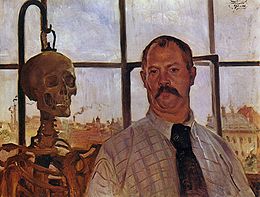
medium but made only 12 woodcuts, all of them between 1919–1924. He was quite prolific, and in the last fifteen years of his life he produced more than 900 graphic works, including 60 self-portraits. The landscapes he created between 1919 and 1925 are perhaps the most desirable images of his entire graphic oeuvre. He painted numerous self-portraits, and made a habit of painting one every year on his birthday as a means of self-examination. In many of his self-portraits he assumed guises such as an armored knight (The Victor, 1910), or Samson
Samson
Samson, Shimshon ; Shamshoun or Sampson is the third to last of the Judges of the ancient Israelites mentioned in the Tanakh ....
(The Blinded Samson, 1912). A self-portrait of 1924 is in the Museum of Modern Art
Museum of Modern Art
The Museum of Modern Art is an art museum in Midtown Manhattan in New York City, on 53rd Street, between Fifth and Sixth Avenues. It has been important in developing and collecting modernist art, and is often identified as the most influential museum of modern art in the world...
, New York City
New York City
New York is the most populous city in the United States and the center of the New York Metropolitan Area, one of the most populous metropolitan areas in the world. New York exerts a significant impact upon global commerce, finance, media, art, fashion, research, technology, education, and...
.
On 15 March 1921 Corinth received an honorary doctorate from the University of Königsberg
University of Königsberg
The University of Königsberg was the university of Königsberg in East Prussia. It was founded in 1544 as second Protestant academy by Duke Albert of Prussia, and was commonly known as the Albertina....
. In 1925, he traveled to the Netherlands
Netherlands
The Netherlands is a constituent country of the Kingdom of the Netherlands, located mainly in North-West Europe and with several islands in the Caribbean. Mainland Netherlands borders the North Sea to the north and west, Belgium to the south, and Germany to the east, and shares maritime borders...
to view the works of his favorite Dutch masters. He caught pneumonia and died in Zandvoort
Zandvoort
Zandvoort is a municipality and a town in the Netherlands, in the province of North Holland.Zandvoort is one of the major beach resorts of the Netherlands; it has a long sandy beach, bordered by coastal dunes...
. In 1910 Corinth had donated the painting Golgatha for the altar of the church of his birthplace, Tapiau. At the end of the Second World War, when the Red Army
Red Army
The Workers' and Peasants' Red Army started out as the Soviet Union's revolutionary communist combat groups during the Russian Civil War of 1918-1922. It grew into the national army of the Soviet Union. By the 1930s the Red Army was among the largest armies in history.The "Red Army" name refers to...
army invaded East Prussia, this painting disappeared without trace. Tapiau was among the few East Prussian places not devastated by the war. The house where Corinth was born is still in the town, which is now Gvardeysk
Gvardeysk
Gvardeysk is a town and the administrative center of Gvardeysky District of Kaliningrad Oblast, Russia, located on the right bank of the Pregolya River east of Kaliningrad. Population: -History:...
, Kaliningrad Oblast
Kaliningrad Oblast
Kaliningrad Oblast is a federal subject of Russia situated on the Baltic coast. It has a population of The oblast forms the westernmost part of the Russian Federation, but it has no land connection to the rest of Russia. Since its creation it has been an exclave of the Russian SFSR and then the...
.