
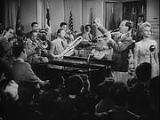
Benjamin David “Benny” Goodman (May 30, 1909 – June 13, 1986) was an American
jazzJazz is a musical style that originated at the beginning of the 20th century in African American communities in the Southern United States. It was born out of a mix of African and European music traditions. From its early development until the present, jazz has incorporated music from 19th and 20th...
and
swingSwing music, also known as swing jazz or simply swing, is a form of jazz music that developed in the early 1930s and became a distinctive style by 1935 in the United States...
musician, clarinetist and
bandleaderA bandleader is the leader of a band of musicians. The term is most commonly, though not exclusively, used with a group that plays popular music as a small combo or a big band, such as one which plays jazz, blues, rhythm and blues or rock and roll music....
; widely known as the "King of Swing".
In the mid-1930s, Benny Goodman led one of the most popular musical groups in America. His January 16, 1938 concert at
Carnegie HallCarnegie Hall is a concert venue in Midtown Manhattan in New York City, United States, located at 881 Seventh Avenue, occupying the east stretch of Seventh Avenue between West 56th Street and West 57th Street, two blocks south of Central Park....
in New York City is described by critic Bruce Eder as "the single most important jazz or popular music concert in history: jazz's 'coming out' party to the world of 'respectable' music."
Goodman's bands launched the careers of many major names in jazz, and during an era of
segregationRacial segregation is the separation of humans into racial groups in daily life. It may apply to activities such as eating in a restaurant, drinking from a water fountain, using a public toilet, attending school, going to the movies, or in the rental or purchase of a home...
, he also led one of the first now well known racially-integrated jazz groups. Goodman continued to perform to nearly the end of his life, including exploring his interest in
classical musicClassical music is the art music produced in, or rooted in, the traditions of Western liturgical and secular music, encompassing a broad period from roughly the 11th century to present times...
.
Childhood and early years
Goodman was born in Chicago, the ninth of twelve children of poor Jewish immigrants from the
Russian EmpireThe Russian Empire was a state that existed from 1721 until the Russian Revolution of 1917. It was the successor to the Tsardom of Russia and the predecessor of the Soviet Union...
, who lived in the
Maxwell StreetMaxwell Street is an east-west street in Chicago, Illinois that intersects with Halsted Street just south of Roosevelt Road. It runs at 1330 South in the numbering system running from 500 West to 1126 West. The Maxwell Street neighborhood is considered part of the Near West Side and is one of the...
neighborhood. His father was David Goodman, a tailor from
WarsawWarsaw is the capital and largest city of Poland. It is located on the Vistula River, roughly from the Baltic Sea and from the Carpathian Mountains. Its population in 2010 was estimated at 1,716,855 residents with a greater metropolitan area of 2,631,902 residents, making Warsaw the 10th most...
; his mother was Dora Grisinsky (from
KaunasKaunas is the second-largest city in Lithuania and has historically been a leading centre of Lithuanian economic, academic, and cultural life. Kaunas was the biggest city and the center of a powiat in Trakai Voivodeship of the Grand Duchy of Lithuania since 1413. During Russian Empire occupation...
,
LithuaniaLithuania , officially the Republic of Lithuania is a country in Northern Europe, the biggest of the three Baltic states. It is situated along the southeastern shore of the Baltic Sea, whereby to the west lie Sweden and Denmark...
). His parents met in Baltimore, Maryland, and moved to Chicago before Benny was born.
When Benny was 10, his father enrolled him and two of his older brothers in music lessons at the Kehelah Jacob Synagogue. The next year he joined the boys club band at
Jane AddamsJane Addams was a pioneer settlement worker, founder of Hull House in Chicago, public philosopher, sociologist, author, and leader in woman suffrage and world peace...
'
Hull HouseHull House is a settlement house in the United States that was co-founded in 1889 by Jane Addams and Ellen Gates Starr. Located in the Near West Side of , Hull House opened its doors to the recently arrived European immigrants. By 1911, Hull House had grown to 13 buildings. In 1912 the Hull...
, where he received lessons from director James Sylvester. He also received two years of instruction from the classically trained clarinetist Franz Schoepp.
His early influences were New Orleans jazz clarinetists working in Chicago, notably
Johnny DoddsJohnny Dodds was an American New Orleans based jazz clarinetist and alto saxophonist, best known for his recordings under his own name and with bands such as those of Joe "King" Oliver, Jelly Roll Morton, Lovie Austin and Louis Armstrong. Dodds was also the older brother of drummer Warren "Baby"...
,
Leon RoppoloLeon Roppolo was a prominent early jazz clarinetist, best known for his playing with the New Orleans Rhythm Kings. Roppolo also played saxophone and guitar. Roppolo married Mabel Alice Branchard on 17 May 1920 in New Orleans...
, and Jimmy Noone. Goodman learned quickly, becoming a strong player at an early age: he was soon playing professionally in various bands.
Goodman attended Lewis Institute (now
Illinois Institute of TechnologyIllinois Institute of Technology, commonly called Illinois Tech or IIT, is a private Ph.D.-granting university located in Chicago, Illinois, with programs in engineering, science, psychology, architecture, business, communications, industrial technology, information technology, design, and law...
) in 1924 as a high school sophomore, while also playing the clarinet in a dance hall band. (He was awarded an honorary LL.D. from IIT in 1968. When Goodman was 16, he joined one of Chicago's top bands, the
Ben PollackBen Pollack was a drummer and bandleader from the mid 1920s through the swing era. His eye for talent led him to either discover or employ, at one time or another, musicians such as Benny Goodman, Jack Teagarden, Glenn Miller, Jimmy McPartland and Harry James...
Orchestra, with which he made his first recordings in 1926.
He made his first record on
VocalionVocalion Records is a record label active for many years in the United States and in the United Kingdom.-History:Vocalion was founded in 1916 by the Aeolian Piano Company of New York City, which introduced a retail line of phonographs at the same time. The name was derived from one of their...
under his own name two years later. Goodman recorded with the regular Pollack band and smaller groups drawn from the orchestra through 1929. The side sessions produced scores of sides recorded for the various dimestore record labels under an array of group names, including Mills' Musical Clowns, Goody's Good Timers, The Hotsy Totsy Gang, Jimmy Backen's Toe Ticklers, Dixie Daisies, and Kentucky Grasshoppers.
Goodman's father, David, was a working-class immigrant about whom Benny said (interview, Downbeat, February 8, 1956); "...Pop worked in the
stockyardsThe Union Stock Yard & Transit Co., or The Yards, was the meat packing district in Chicago for over a century starting in 1865. The district was operated by a group of railroad companies that acquired swampland, and turned it to a centralized processing area...
, shoveling lard in its unrefined state. He had those boots, and he'd come home at the end of the day exhausted, stinking to high heaven, and when he walked in it made me sick. I couldn't stand it. I couldn't stand the idea of Pop every day standing in that stuff, shoveling it around".
On December 9, 1926, David Goodman was killed in a traffic accident. Benny had recently joined the Pollack band and was urging his father to retire, since he and his brother (Harry) were now doing well as professional musicians. According to
James Lincoln CollierJames Lincoln Collier is a journalist, author, and professional musician.Collier was born to Edmund Collier and Katherine Brown. He came from a family of writers and teachers, including his father and several aunts and uncles. He graduated from Hamilton College in 1950...
, "Pop looked Benny in the eye and said, 'Benny, you take care of yourself, I'll take care of myself.'" Collier continues: "It was an unhappy choice. Not long afterwards, as he was stepping down from a streetcar—according to one story—he was struck by a car. He never regained consciousness and died in the hospital the next day. It was a bitter blow to the family, and it haunted Benny to the end that his father had not lived to see the success he, and some of the others, made of themselves."
"Benny described his father's death as 'the saddest thing that ever happened in our family.'"
Career
Goodman left for New York City and became a successful session musician during the late 1920s and early 1930s (mostly with
Ben PollackBen Pollack was a drummer and bandleader from the mid 1920s through the swing era. His eye for talent led him to either discover or employ, at one time or another, musicians such as Benny Goodman, Jack Teagarden, Glenn Miller, Jimmy McPartland and Harry James...
's band between 1926 and 1929). A notable March 21, 1928 Victor session found Goodman alongside
Glenn MillerAlton Glenn Miller was an American jazz musician , arranger, composer, and bandleader in the swing era. He was one of the best-selling recording artists from 1939 to 1943, leading one of the best known "Big Bands"...
,
Tommy DorseyThomas Francis "Tommy" Dorsey, Jr. was an American jazz trombonist, trumpeter, composer, and bandleader of the Big Band era. He was known as "The Sentimental Gentleman of Swing", due to his smooth-toned trombone playing. He was the younger brother of bandleader Jimmy Dorsey...
, and Joe Venuti in the All-Star Orchestra, directed by Nat Shilkret. He played with the nationally known bands of
Ben SelvinBenjamin B. Selvin , son of Russian-immigrant Jewish parents, was a musician, bandleader, record producer and innovator in recorded music. He was known as The Dean of Recorded Music....
,
Red NicholsErnest Loring "Red" Nichols was an American jazz cornettist, composer, and jazz bandleader.Over his long career, Nichols recorded in a wide variety of musical styles, and critic Steve Leggett describes him as "an expert cornet player, a solid improviser, and apparently a workaholic, since he is...
,
Isham JonesIsham Jones was a United States bandleader, saxophonist, bassist and songwriter.-Career:Jones was born in Coalton, Ohio, to a musical and mining family, and grew up in Saginaw, Michigan, where he started his first band...
(although he is not on any of Jones's records), and
Ted LewisTheodore Leopold Friedman, better known as Ted Lewis , was an American entertainer, bandleader, singer, and musician. He led a band presenting a combination of jazz, hokey comedy, and schmaltzy sentimentality that was a hit with the American public. He was known by the moniker "Mr...
. He recorded sides for Brunswick under the name Bennie Goodman's Boys, a band that featured Glenn Miller. In 1928, Benny Goodman and Glenn Miller wrote the instrumental "
Room 1411Room 1411 is a 1928 instrumental composed by Glenn Miller and Benny Goodman and released as a Brunswick 78 by Bennie Goodman's Boys. The song was Glenn Miller's first known composition and was an early collaboration between Glenn Miller and Benny Goodman, who would become the most successful...
", which was released as a Brunswick 78. He also recorded musical soundtracks for movie shorts; fans believe that Benny Goodman's clarinet can be heard on the soundtrack of One A. M., a
Charlie ChaplinSir Charles Spencer "Charlie" Chaplin, KBE was an English comic actor, film director and composer best known for his work during the silent film era. He became the most famous film star in the world before the end of World War I...
comedy re-released to theaters in 1934.
During this period as a successful session musician,
John HammondJohn Henry Hammond II was an American record producer, musician and music critic from the 1930s to the early 1980s...
arranged for a series of jazz sides recorded for and issued on
ColumbiaColumbia Records is an American record label, owned by Japan's Sony Music Entertainment, operating under the Columbia Music Group with Aware Records. It was founded in 1888, evolving from an earlier enterprise, the American Graphophone Company — successor to the Volta Graphophone Company...
starting in 1933 and continuing until his signing with Victor in 1935, during his success on radio. There were also a number of commercial studio sides recorded for Melotone between late 1930 and mid-1931 under Goodman's name. The all-star Columbia sides featured
Jack TeagardenWeldon Leo "Jack" Teagarden , known as "Big T" and "The Swingin' Gate", was an influential jazz trombonist, bandleader, composer, and vocalist, regarded as the "Father of Jazz Trombone".-Early life:...
,
Joe SullivanMichael Joseph "Joe" O'Sullivan was an American jazz pianist.Sullivan was the ninth child of Irish immigrant parents. He studied classical piano for 12 years and at age 17, he began to play popular music in a club where he was exposed to jazz...
,
Dick McDonoughDick McDonough was an influential American jazz guitarist and composer. His major recordings included "Dr. Heckle and Mr. Jibe" with the Dorsey Brothers Orchestra with Johnny Mercer, "Stage Fright" with Carl Kress, "Chasin' a Buck", "Feelin' No Pain", recorded in 1927 with Red Nichols, and...
,
Arthur SchuttArthur Schutt was an American jazz pianist and arranger.Schutt learned piano from his father, and accompanied silent films as a teenager in the 1910s...
,
Gene KrupaGene Krupa was an American jazz and big band drummer and composer, known for his highly energetic and flamboyant style.-Biography:...
,
Teddy WilsonTheodore Shaw "Teddy" Wilson was an American jazz pianist whose sophisticated and elegant style was featured on the records of many of the biggest names in jazz, including Louis Armstrong, Lena Horne, Benny Goodman, Billie Holiday and Ella Fitzgerald.-Biography:Wilson was born in Austin, Texas in...
,
Coleman HawkinsColeman Randolph Hawkins was an American jazz tenor saxophonist. Hawkins was one of the first prominent jazz musicians on his instrument. As Joachim E. Berendt explained, "there were some tenor players before him, but the instrument was not an acknowledged jazz horn"...
(for 1 session), and vocalists
Jack TeagardenWeldon Leo "Jack" Teagarden , known as "Big T" and "The Swingin' Gate", was an influential jazz trombonist, bandleader, composer, and vocalist, regarded as the "Father of Jazz Trombone".-Early life:...
and
Mildred BaileyMildred Bailey was a popular and influential American jazz singer during the 1930s, known as "The Rockin' Chair Lady" and "Mrs. Swing"...
, and the first two recorded vocals by a young
Billie HolidayBillie Holiday was an American jazz singer and songwriter. Nicknamed "Lady Day" by her friend and musical partner Lester Young, Holiday had a seminal influence on jazz and pop singing...
.
In 1934 Goodman auditioned for
NBCThe National Broadcasting Company is an American commercial broadcasting television network and former radio network headquartered in the GE Building in New York City's Rockefeller Center with additional major offices near Los Angeles and in Chicago...
's
Let's DanceLet's Dance was a Saturday night radio music program broadcast by NBC in the mid-1930s.Sponsored by the National Biscuit Company , it aired for three full hours, starting at 10:30pm on the East Coast. This late-night timeslot gave the program a much larger audience on the West Coast when heard...
, a well-regarded three-hour weekly radio program that featured various styles of dance music. His familiar theme song by that title was based on
Invitation to the DanceInvitation to the Dance , Op. 65, J. 260, is a piano piece in rondo form written by Carl Maria von Weber in 1819. It is also well known in the 1841 orchestration by Hector Berlioz...
by
Carl Maria von WeberCarl Maria Friedrich Ernst von Weber was a German composer, conductor, pianist, guitarist and critic, one of the first significant composers of the Romantic school....
. Since he needed new arrangements every week for the show, his agent,
John HammondJohn Henry Hammond II was an American record producer, musician and music critic from the 1930s to the early 1980s...
, suggested that he purchase "hot" (swing) arrangements from
Fletcher HendersonJames Fletcher Hamilton Henderson, Jr. was an American pianist, bandleader, arranger and composer, important in the development of big band jazz and swing music. His was one of the most prolific black orchestras and his influence was vast...
, an African-American musician from Atlanta who had New York's most popular African-American band in the 1920s and early 1930s.
Goodman, a wise businessman, helped Henderson in 1929 when the stock market crashed. He purchased all of Henderson's song books, and hired Henderson's band members to teach his musicians how to play the music.
In early 1935, Goodman and his band were one of three bands (the others were
Xavier CugatXavier Cugat was a Spanish-American bandleader who spent his formative years in Havana, Cuba. A trained violinist and arranger, he was a key personality in the spread of Latin music in United States popular music. He was also a cartoonist and a successful businessman...
and "Kel Murray" [r.n. Murray Kellner]) featured on Let's Dance where they played arrangements by Henderson along with hits such as "
Get Happy"Get Happy" is a song composed by Harold Arlen, with lyrics written by Ted Koehler.It was the first song they wrote together, and was introduced by Ruth Etting in The Nine-Fifteen Revue in 1930....
" and "
Jingle Bells"Jingle Bells" is one of the best-known and commonly sung winter songs in the world. It was written by James Lord Pierpont and published under the title "One Horse Open Sleigh" in the autumn of 1857...
" from composer and arranger
Spud MurphyLyle Stephanovic, better known as Spud Murphy was an American jazz multi-instrumentalist, bandleader, and arranger....
. Goodman's portion of the program from New York, at 12:30 a.m. Eastern Time, aired too late to attract a large East Coast audience. However, unknown to him, the time slot gave him an avid following on the West Coast (they heard him at 9:30 p.m. Pacific Time). He and his band remained on Let's Dance until May of that year when a strike by employees of the series' sponsor, Nabisco, forced the cancellation of the radio show. An engagement was booked at Manhattan's Roosevelt Grill (filling in for
Guy LombardoGaetano Alberto "Guy" Lombardo was a Canadian-American bandleader and violinist.Forming "The Royal Canadians" in 1924 with his brothers Carmen, Lebert, and Victor and other musicians from his hometown, Lombardo led the group to international success, billing themselves as creating "The Sweetest...
), but the crowd there expected 'sweet' music and Goodman's band was unsuccessful. The band set out on a tour of America in May 1935, but was still poorly received. By August 1935, Goodman found himself with a band that was nearly broke, disillusioned and ready to quit.
Catalyst for the Swing era
In July 1935, a record of the Goodman band playing the Henderson arrangements of "
King Porter Stomp"King Porter Stomp" is a swing-era jazz standard by Jelly Roll Morton. The composition is considered to be important in the development of jazz....
" backed with "Sometimes I'm Happy", Victor 78 25090, had been released to ecstatic reviews in both
Down BeatDown Beat is an American magazine devoted to "jazz, blues and beyond" to indicate its expansion beyond the jazz realm which it covered exclusively in previous years. The publication was established in 1934 in Chicago, Illinois...
and
Melody MakerMelody Maker, published in the United Kingdom, was, according to its publisher IPC Media, the world's oldest weekly music newspaper. It was founded in 1926 as a magazine targeted at musicians; in 2000 it was merged into "long-standing rival" New Musical Express.-1950s–1960s:Originally the Melody...
. In Pittsburgh at the Stanley Theater some of the kids danced in the aisles.
This had made little impact on the band's tour until August 19 when they arrived in
OaklandOakland is a major West Coast port city on San Francisco Bay in the U.S. state of California. It is the eighth-largest city in the state with a 2010 population of 390,724...
to play at McFadden's Ballroom. There, Goodman and his artists
Gene KrupaGene Krupa was an American jazz and big band drummer and composer, known for his highly energetic and flamboyant style.-Biography:...
,
Bunny BeriganRowland Bernard "Bunny" Berigan was an American jazz trumpeter who rose to fame during the swing era, but whose virtuosity and influence were shortened by a losing battle with alcoholism that ended in his early death at age 33. He composed the jazz instrumentals "Chicken and Waffles" and "Blues"...
, and
Helen WardHelen Ward was an American singer. Her father had taught her piano, and she appeared on radio broadcasts with WOR and WNYC...
found a large crowd of young dancers, raving and cheering the hot music they had heard on the Let's Dance radio show.
Herb CaenHerbert Eugene Caen was a Pulitzer Prize-winning San Francisco journalistwhose daily column of local goings-on, social and political happenings,...
wrote that "from the first note, the place was in an uproar." One night later, at
Pismo BeachPismo Beach is a city in San Luis Obispo County, California, United States. The population was 7,655 at the 2010 census, down from 8,551 at the 2000 census...
, the show was another flop, and the band thought the overwhelming reception in Oakland had been a fluke.
The next night, August 21, 1935 at the
Palomar BallroomThe Palomar Ballroom, built in 1925, was a famous ballroom in Los Angeles, California, in the United States. It was destroyed by a fire in late 1939....
in Los Angeles, Goodman and his band began a three-week engagement. On top of the Let's Dance airplay, Al Jarvis had been playing Goodman records on KFWB radio, and Los Angeles fans were primed to hear him in person. Goodman started the evening with stock arrangements, but after an indifferent response, began the second set with the arrangements by Fletcher Henderson and Spud Murphy. According to Willard Alexander, the band's booking agent, Krupa said "If we're gonna die, Benny, let's die playing our own thing." The crowd broke into cheers and applause. News reports spread word of the enthusiastic dancing and exciting new music that was happening. Over the course of the engagement, the "Jitterbug" began to appear as a new dance craze, and radio broadcasts carried the band's performances across the nation.
The Palomar engagement was such a marked success it is often exaggeratedly described as the beginning of the
swing eraThe Swing era was the period of time when big band swing music was the most popular music in the United States. Though the music had been around since the late 1920s and early 1930s, being played by black bands led by such artists as Duke Ellington, Jimmie Lunceford, Benny Moten, Ella Fitzgerald,...
.
Donald ClarkeDonald Clarke is an American writer on music. He was the author/editor of the Penguin Encyclopedia of Popular Music which is now available free on his website...
wrote "It is clear in retrospect that the
Swing EraThe Swing era was the period of time when big band swing music was the most popular music in the United States. Though the music had been around since the late 1920s and early 1930s, being played by black bands led by such artists as Duke Ellington, Jimmie Lunceford, Benny Moten, Ella Fitzgerald,...
had been waiting to happen, but it was Goodman and his band that touched it off."
In November 1935 Goodman accepted an invitation to play in Chicago at the
Joseph UrbanJoseph Urban Born in Vienna, Austria, died in New York City, trained as an architect, known also for his theatrical design and his early illustrations of children's books....
Room at the Congress Hotel. His stay there extended to six months and his popularity was cemented by nationwide radio broadcasts over NBC affiliate stations. While in Chicago, the band recorded If I Could Be With You, Stompin' At The Savoy, and Goody, Goody. Goodman also played three special concerts produced by jazz aficionado and Chicago socialite
Helen OakleyHelen Margaret Oakley Dance, née Oakley was a jazz journalist, producer, historian, and musician. She is perhaps best known for production and for her biography of T-Bone Walker...
. These "Rhythm Club" concerts at the Congress Hotel included sets in which Goodman and Krupa sat in with Fletcher Henderson's band, perhaps the first racially integrated big band appearance before a paying audience in the United States. Goodman and Krupa played in a trio with
Teddy WilsonTheodore Shaw "Teddy" Wilson was an American jazz pianist whose sophisticated and elegant style was featured on the records of many of the biggest names in jazz, including Louis Armstrong, Lena Horne, Benny Goodman, Billie Holiday and Ella Fitzgerald.-Biography:Wilson was born in Austin, Texas in...
on piano. Both combinations were well-received, and Wilson stayed on.
In his 1935–1936 radio broadcasts from Chicago, Goodman was introduced as the "Rajah of Rhythm."
Slingerland Drum Company-History:The Slingerland Drum Company is a historic drum company that is linked to the rich history of jazz drumming. The company was founded by Henry Heanon "H.H." Slingerland in 1912. Slingerland had won a correspondence school of music in a card game aboard one of the gaming boats that once...
had been calling Krupa the "King of Swing" as part of a sales campaign, but shortly after Goodman and crew left Chicago in May 1936 to spend the summer filming
The Big Broadcast of 1937The Big Broadcast of 1937 is a 1936 Paramount Pictures production directed by Mitchell Leisen, and is the third in the series of Big Broadcast movies. The musical comedy stars Jack Benny, George Burns, Gracie Allen, Bob Burns, Martha Raye, Shirley Ross, Ray Milland, Benny Fields, Frank Forest and...
in Hollywood, the title "King of Swing" was applied to Goodman by the media. Goodman left record company RCA for Columbia, following his agent and soon to be brother-in-law John Hammond.
At the end of June 1936, Goodman went to Hollywood, where, on June 30, 1936 his band began CBS's "Camel Caravan," its third, and, according to Connor and Hicks, its greatest of them all, sponsored radio show, co-starring Goodman and his old boss Nat Shilkret.
Carnegie Hall concert
In late 1937, Goodman's publicist Wynn Nathanson attempted a publicity stunt by suggesting Goodman and his band should play
Carnegie HallCarnegie Hall is a concert venue in Midtown Manhattan in New York City, United States, located at 881 Seventh Avenue, occupying the east stretch of Seventh Avenue between West 56th Street and West 57th Street, two blocks south of Central Park....
in New York City. If this concert were to take place, then Benny Goodman would be the first jazz bandleader to perform at Carnegie Hall. "Benny Goodman was initially hesitant about the concert, fearing for the worst; however, when his film Hollywood Hotel opened to rave reviews and giant lines, he threw himself into the work. He gave up several dates and insisted on holding rehearsals inside Carnegie Hall to familiarize the band with the lively acoustics."
The concert was the evening of January 16, 1938. It sold out weeks before, with the capacity 2,760 seats going for the top price of US$2.75 a seat, for the time a very high price. The concert began with three contemporary numbers from the Goodman band—"Don't Be That Way," "Sometimes I'm Happy," and "One O'Clock Jump." They then played a history of jazz, starting with a Dixieland quartet performing "Sensation Rag." Once again, initial crowd reaction, though polite, was tepid. Then came a jam session on "Honeysuckle Rose" featuring members of the
Count BasieWilliam "Count" Basie was an American jazz pianist, organist, bandleader, and composer. Basie led his jazz orchestra almost continuously for nearly 50 years...
and
Duke EllingtonEdward Kennedy "Duke" Ellington was an American composer, pianist, and big band leader. Ellington wrote over 1,000 compositions...
bands as guests. (The surprise of the session: Goodman handing a solo to Basie's guitarist Freddie Greene who was never a featured soloist but earned his reputation as the best rhythm guitarist in the genre—he responded with a striking round of chord improvisations.) As the concert went on, things livened up. The Goodman band and quartet took over the stage and performed the numbers that had already made them famous. Some later trio and quartet numbers were well-received, and a vocal on "Loch Lomond" by
Martha TiltonMartha Tilton was an American popular singer, best-known for her 1939 recording of "And the Angels Sing" with Benny Goodman. She was sometimes introduced as The Liltin' Miss Tilton.Tilton and her family lived in Texas and Kansas, relocating to Los Angeles when she was seven years old...
provoked five curtain calls and cries for an encore. The encore forced Goodman to make his only audience announcement for the night, stating that they had no encore prepared but that Martha would return shortly with another number.
By the time the band got to the climactic piece "
Sing, Sing, Sing"Sing, Sing, Sing " is a 1936 song, written by Louis Prima and first recorded by him with the New Orleans Gang and released in March 1936 as a 78 as Brunswick 7628 . It is strongly identified with the big band and swing eras. It was covered by Fletcher Henderson and most famously Benny Goodman...
", success was assured. This performance featured playing by tenor saxophonist
Babe RussinIrving "Babe" Russin was a tenor saxophone player.Born in Pittsburgh, Pennsylvania, Russin played with some of the best known jazz bands of the 1930s and 1940s, including Benny Goodman, Tommy Dorsey and Glenn Miller. He led his own band briefly in the early 1940s...
, trumpeter
Harry JamesHenry Haag “Harry” James was a trumpeter who led a jazz swing band during the Big Band Era of the 1930s and 1940s. He was especially known among musicians for his astonishing technical proficiency as well as his superior tone.-Biography:He was born in Albany, Georgia, the son of a bandleader of a...
, and Benny Goodman, backed by drummer
Gene KrupaGene Krupa was an American jazz and big band drummer and composer, known for his highly energetic and flamboyant style.-Biography:...
. When Goodman finished his solo, he unexpectedly gave a solo to pianist
Jess StacyJess Stacy was an American jazz pianist who gained prominence during the Swing era.-Early life:Stacy was born Jesse Alexandria Stacy in Bird's Point, Missouri, a small town across the Mississippi River from Cairo, Illinois. In 1918 Stacy moved to Cape Girardeau, Missouri...
. "At the Carnegie Hall concert, after the usual theatrics, Jess Stacy was allowed to solo and, given the venue, what followed was appropriate," wrote David Rickert. "Used to just playing rhythm on the tune, he was unprepared for a turn in the spotlight, but what came out of his fingers was a graceful, impressionistic marvel with classical flourishes, yet still managed to swing. It was the best thing he ever did, and it's ironic that such a layered, nuanced performance came at the end of such a chaotic, bombastic tune."
This concert has been regarded as one of the most significant in jazz history. After years of work by musicians from all over the country, jazz had finally been accepted by mainstream audiences. Recordings were made of this concert, but even by the technology of the day the equipment used was not of the finest quality.
AcetateAn acetate disc, also known as a test acetate, dubplate , lacquer , transcription disc or instantaneous disc...
recordings of the concert were made, and aluminum studio masters were also cut.
Goodman took the newly discovered recording to his record company, Columbia, and a selection was issued on LP. These recordings have not been out of print since they were first issued. In early 1998, the aluminum masters were rediscovered and a new CD set of the concert was released based on these masters. The album released based on those masters went on to be one of the best selling live jazz albums of all time.
Charlie Christian
Pianist/arranger
Mary Lou WilliamsMary Lou Williams was an American jazz pianist, composer, and arranger. Williams wrote hundreds of compositions and arrangements, and recorded more than one hundred records...
was a good friend of both Columbia records producer John Hammond and Benny Goodman. She first suggested to John Hammond that he see
Charlie ChristianCharles Henry "Charlie" Christian was an American swing and jazz guitarist.Christian was an important early performer on the electric guitar, and is cited as a key figure in the development of bebop and cool jazz. He gained national exposure as a member of the Benny Goodman Sextet and Orchestra...
.
Charlie Christian was playing at the Ritz in Oklahoma City where [...] John Hammond heard him in 1939. Hammond recommended him to Benny Goodman, but the band leader wasn't interested. The idea of an electrified guitar didn't appeal, and Goodman didn't care for Christian's flashy style of dressing. Reportedly, Hammond personally installed Christian onstage during a break in a Goodman concert in Beverly Hills. Irritated to see Christian among the band, Goodman struck up "Rose Room"Rose Room", also known as "In Sunny Roseland", is a 1917 jazz standard by Art Hickman and Harry Williams. The name of the song's lyricist is unknown, and it is usually performed as an instrumental...
", not expecting the guitarist to know the tune. What followed amazed everyone who heard the 45-minute performance.
Charlie was a hit on the electric guitar and remained in the Benny Goodman Sextet for two years (1939–1941). He wrote many of the group's head arrangements (some of which Goodman took credit for) and was an inspiration to all. The sextet made him famous and provided him with a steady income while Charlie worked on legitimizing, popularizing, revolutionizing, and standardizing the electric guitar as a jazz instrument.
Charlie Christian's recordings and rehearsal dubs made with Benny Goodman in the early forties are widely known and were released by Columbia.
Beyond swing
Goodman continued his meteoric rise throughout the late 1930s with his
big bandA big band is a type of musical ensemble associated with jazz and the Swing Era typically consisting of rhythm, brass, and woodwind instruments totaling approximately twelve to twenty-five musicians...
, his trio and quartet, and a sextet. By the mid-1940s, however, big bands lost a lot of their popularity. In 1941, ASCAP had a licensing war with music publishers. In 1942 to 1944 and 1948, the musician's union went on strike against the major record labels in the United States, and singers took the spot in popularity that the big bands once enjoyed. During this strike, the United States War Department approached the union and requested the production of the
V-DiscV-Disc was a morale-boosting initiative involving the production of several series of recordings during the World War II era by special arrangement between the United States government and various private U.S. record companies. The records were produced for the use of United States military...
, a set of records containing new and fresh music for soldiers to listen to. Also, by the late 1940s, swing was no longer the dominant mode of jazz musicians.
Bebop, Cool Jazz
By the 1940s, jazz musicians were borrowing advanced ideas from classical music. The recordings Goodman made in bop style for
Capitol RecordsCapitol Records is a major United States based record label, formerly located in Los Angeles, but operating in New York City as part of Capitol Music Group. Its former headquarters building, the Capitol Tower, is a major landmark near the corner of Hollywood and Vine...
were highly praised by jazz critics. When Goodman was starting a bebop band, he hired
Buddy Greco-Biography:He was born Armando Greco in Philadelphia, Pennsylvania. Greco began playing piano at the age of four. His first professional work was playing with Benny Goodman's band. Most of Greco's work has been in the jazz and pop genres...
,
Zoot SimsJohn Haley "Zoot" Sims was an American jazz saxophonist, playing mainly tenor and soprano.-Biography:He was born in Inglewood, California, the son of vaudeville performers Kate Haley and John Sims. Growing up in a performing family, Sims learned to play both drums and clarinet at an early age...
,
Wardell GrayWardell Gray was an American jazz tenor saxophonist who straddled the swing and bebop periods.Today often overlooked, Gray's playing displays a unique style, an unmatched tone and a strong presence.-Early years:...
and a few other modern players.
Goodman enjoyed the bebop and cool jazz that was beginning to arrive in the 1940s. When Goodman heard
Thelonious MonkThelonious Sphere Monk was an American jazz pianist and composer considered "one of the giants of American music". Monk had a unique improvisational style and made numerous contributions to the standard jazz repertoire, including "Epistrophy", "'Round Midnight", "Blue Monk", "Straight, No Chaser"...
, a celebrated pianist and accompanist to bop players
Charlie ParkerCharles Parker, Jr. , famously called Bird or Yardbird, was an American jazz saxophonist and composer....
,
Dizzy GillespieJohn Birks "Dizzy" Gillespie was an American jazz trumpet player, bandleader, singer, and composer dubbed "the sound of surprise".Together with Charlie Parker, he was a major figure in the development of bebop and modern jazz...
and Kenny Clarke, he remarked, "I like it, I like that very much. I like the piece and I like the way he played it. [...] I think he's got a sense of humor and he's got some good things there."
By 1953, Goodman completely changed his mind about bebop. "Maybe bop has done more to set music back for years than anything [...] Basically it's all wrong. It's not even knowing the scales. [...] Bop was mostly publicity and people figuring angles."
Forays into classical repertoire
Goodman's first classical recording dates from April 25, 1938 when he recorded
MozartWolfgang Amadeus Mozart , baptismal name Johannes Chrysostomus Wolfgangus Theophilus Mozart , was a prolific and influential composer of the Classical era. He composed over 600 works, many acknowledged as pinnacles of symphonic, concertante, chamber, piano, operatic, and choral music...
's
Clarinet Quintet in A majorWolfgang Amadeus Mozart's Quintet for Clarinet and Strings, K. 581, was written in 1789 for the clarinetist Anton Stadler. A clarinet quintet is a work for one clarinet and a string quartet . Although originally written for basset clarinet, it is almost always played on a clarinet in A or B-flat...
, K. 581, with the
Budapest QuartetThe Budapest String Quartet was a string quartet in existence from 1917 to 1967. It originally consisted of three Hungarians and a Dutchman; at the end, the quartet consisted of four Russians. A number of recordings were made for HMV/Victor through 1938; from 1940 through 1967 it recorded for...
. After his bop period, Goodman furthered his interest in classical music written for the clarinet, and frequently met with top classical clarinetists of the day. In 1946, he met
Ingolf DahlIngolf Dahl was a German-born American composer, pianist, conductor, and educator.-Biography:Born in Hamburg, Germany to a German father and a Swedish mother, his birth name was Walter Ingolf Marcus. He studied with Philipp Jarnach at the Hochschule für Musik Köln...
, an emigre classical composer on the faculty of the
University of Southern CaliforniaThe University of Southern California is a private, not-for-profit, nonsectarian, research university located in Los Angeles, California, United States. USC was founded in 1880, making it California's oldest private research university...
, who was then musical director of the
Victor BorgeVictor Borge ,born Børge Rosenbaum, was a Danish comedian, conductor and pianist, affectionately known as The Clown Prince of Denmark,The Unmelancholy Dane,and The Great Dane.-Early life and career:...
show. They played chamber music together (Brahms, Milhaud, Hindemith, Debussy) and in 1948 Goodman played in the world premiere performance of Dahl's Concerto a Tre.
In 1949, when he was 40, Goodman decided to study with Reginald KellReginald Clifford Kell was a British clarinetist.-Career:Born in York, England, Kell was the first prominent player to apply vibrato consciously and consistently to his tone, in which respect he modelled himself on his colleague the oboist Léon Goossens...
, one of the world's leading classical clarinetists. To do so, he had to change his entire technique: instead of holding the mouthpiece between his front teeth and lower lip, as he had done since he first took a clarinet in hand 30 years earlier, Goodman learned to adjust his embouchure to the use of both lips and even to use new fingering techniques. He had his old finger calluses removed and started to learn how to play his clarinet again—almost from scratch.
Goodman commissioned and premiered works by leading composers for clarinet and symphony orchestra that are now part of the standard repertoire, namely
ContrastsContrasts is a 1938 composition scored for clarinet-violin-piano trio by Béla Bartók . It is based on Hungarian and Romanian dance melodies and has three movements with a combined duration of 17-20 minutes. Bartók wrote the work in response to a letter from violinist Joseph Szigeti, although it...
by
Béla BartókBéla Viktor János Bartók was a Hungarian composer and pianist. He is considered one of the most important composers of the 20th century and is regarded, along with Liszt, as Hungary's greatest composer...
, Clarinet Concerto No. 2, Op. 115 by
Malcolm ArnoldSir Malcolm Henry Arnold, CBE was an English composer and symphonist.Malcolm Arnold began his career playing trumpet professionally, but by age thirty his life was devoted to composition. He was ranked with Benjamin Britten as one of the most sought-after composers in Britain...
, Derivations for Clarinet and Band by
Morton GouldMorton Gould was an American composer, conductor, arranger, and pianist.Born in Richmond Hill, New York, Gould was recognized early as a child prodigy with abilities in improvisation and composition. His first composition was published at age six...
, and
Aaron CoplandAaron Copland was an American composer, composition teacher, writer, and later in his career a conductor of his own and other American music. He was instrumental in forging a distinctly American style of composition, and is often referred to as "the Dean of American Composers"...
's
Clarinet ConcertoAaron Copland's Clarinet Concerto was written between 1947 and 1949, although a first version was already available in 1948. This composition is also sometimes referred to as the Concerto for Clarinet, Strings and Harp...
. While
Leonard BernsteinLeonard Bernstein August 25, 1918 – October 14, 1990) was an American conductor, composer, author, music lecturer and pianist. He was among the first conductors born and educated in the United States of America to receive worldwide acclaim...
's
Prelude, Fugue, and RiffsPrelude, Fugue and Riffs is a "written-out" jazz-in-concert hall composition written by Leonard Bernstein for a jazz ensemble, which features a solo clarinet....
was commissioned for
Woody HermanWoodrow Charles Herman , known as Woody Herman, was an American jazz clarinetist, alto and soprano saxophonist, singer, and big band leader. Leading various groups called "The Herd," Herman was one of the most popular of the 1930s and '40s bandleaders...
's big band, it was premiered by Goodman. Woody Herman was the dedicatee (1945) and first performer (1946) of
Igor StravinskyIgor Fyodorovich Stravinsky ; 6 April 1971) was a Russian, later naturalized French, and then naturalized American composer, pianist, and conductor....
's
Ebony ConcertoEbony Concerto may refer to:*Ebony Concerto by John Taras, a dance in the repertory of New York City Ballet*Ebony Concerto by Damian Woetzel, a dance in the repertory of New York City Ballet*Ebony Concerto by Igor Stravinsky...
, but many years later Stravinsky made another recording, this time with Benny Goodman as the soloist.
He made a further recording of Mozart's Clarinet Quintet, in July 1956 with the
Boston Symphony String QuartetThe Boston Symphony Orchestra is an orchestra based in Boston, Massachusetts. It is one of the five American orchestras commonly referred to as the "Big Five". Founded in 1881, the BSO plays most of its concerts at Boston's Symphony Hall and in the summer performs at the Tanglewood Music Center...
, at the Berkshire Festival; on the same occasion he also recorded Mozart's
Clarinet Concerto in A majorMozart's Clarinet concerto in A major, K. 622 was written in 1791 for the clarinetist Anton Stadler.It consists of the usual three movements, in a fast–slow–fast form:# Allegro# Adagio# Rondo: Allegro...
, K. 622, with the
Boston Symphony OrchestraThe Boston Symphony Orchestra is an orchestra based in Boston, Massachusetts. It is one of the five American orchestras commonly referred to as the "Big Five". Founded in 1881, the BSO plays most of its concerts at Boston's Symphony Hall and in the summer performs at the Tanglewood Music Center...
under Charles Munch. He also recorded the clarinet concertos of
WeberCarl Maria Friedrich Ernst von Weber was a German composer, conductor, pianist, guitarist and critic, one of the first significant composers of the Romantic school....
and
Carl NielsenCarl Nielsen's Concerto for Clarinet and orchestra, op. 57 [D.F.129] was written for Danish clarinetist Aage Oxenvad in 1928. The concerto is presented in one long movement, with four distinct theme groups.-History:...
.
Other recordings of classical repertoire by Goodman are:
- Premiere Rhapsodie for Clarinet by Claude Debussy
Claude-Achille Debussy was a French composer. Along with Maurice Ravel, he was one of the most prominent figures working within the field of impressionist music, though he himself intensely disliked the term when applied to his compositions...
- Clarinet Sonata No. 2 in E flat by Johannes Brahms
Johannes Brahms was a German composer and pianist, and one of the leading musicians of the Romantic period. Born in Hamburg, Brahms spent much of his professional life in Vienna, Austria, where he was a leader of the musical scene...
- Rondo from Grand Duo Concertant in E flat by Weber, and
- An arrangement by Simeon Bellison
Simeon Bellison , born in Moscow, he was naturalised American after settling in the US in 1921.An early clarinet choir in the United States was established in 1927 by Simeon Bellison, then first clarinetist of the New York Philharmonic; from an initial eight members, the group's size grew by 1948...
of BeethovenLudwig van Beethoven was a German composer and pianist. A crucial figure in the transition between the Classical and Romantic eras in Western art music, he remains one of the most famous and influential composers of all time.Born in Bonn, then the capital of the Electorate of Cologne and part of...
's Variations on a theme from Mozart's "Don GiovanniDon Giovanni is an opera in two acts with music by Wolfgang Amadeus Mozart and with an Italian libretto by Lorenzo Da Ponte. It was premiered by the Prague Italian opera at the Teatro di Praga on October 29, 1787...
".
Touring with Armstrong
After forays outside of swing, Goodman started a new band in 1953. According to Donald Clarke, this was not a happy time for Goodman.
Movies
Benny Goodman's band appeared as a specialty act in major musical features, including
The Big Broadcast of 1937The Big Broadcast of 1937 is a 1936 Paramount Pictures production directed by Mitchell Leisen, and is the third in the series of Big Broadcast movies. The musical comedy stars Jack Benny, George Burns, Gracie Allen, Bob Burns, Martha Raye, Shirley Ross, Ray Milland, Benny Fields, Frank Forest and...
,
Hollywood HotelHollywood Hotel is a 1937 American film, directed by Busby Berkeley. It stars Dick Powell, Rosemary Lane, Lola Lane, and Ted Healy. Ronald Reagan, Benny Goodman and Harry James also appear....
(1938),
SyncopationIn music, syncopation includes a variety of rhythms which are in some way unexpected in that they deviate from the strict succession of regularly spaced strong and weak but also powerful beats in a meter . These include a stress on a normally unstressed beat or a rest where one would normally be...
(1942),
The Powers GirlThe Powers Girl, sometimes retitled Hello, Beautiful, is a 1943 musical comedy about women employed by John Robert Powers' modeling agency. Starring George Murphy, Anne Shirley, and Carole Landis, the film was directed by Norman Z...
(1942),
Stage Door CanteenStage Door Canteen is a musical film produced by Sol Lesser Productions and distributed by United Artists. It was directed by Frank Borzage and features many cameo appearances by celebrities, and the majority of the film is essentially a filmed concert although there is also a storyline to the...
(1943), The Gang's All Here (1943),
Sweet and LowdownSweet and Lowdown is a 1999 American comedy film written and directed by Woody Allen which tells the story of a fictional arrogant, obnoxious, alcoholic jazz guitarist named Emmet Ray who regards himself as perhaps the best guitarist in the world, or second best, after his idol, Django Reinhardt...
(1944) and
A Song Is BornA Song Is Born was a 1948 Technicolor musical film remake, starring Danny Kaye and Virginia Mayo, of 1941 movie Ball of Fire with Gary Cooper...
(1948). Goodman's only starring feature was
Sweet and LowdownSweet and Lowdown is a 1999 American comedy film written and directed by Woody Allen which tells the story of a fictional arrogant, obnoxious, alcoholic jazz guitarist named Emmet Ray who regards himself as perhaps the best guitarist in the world, or second best, after his idol, Django Reinhardt...
(1944).
Goodman's success story was told in the 1955 motion picture
The Benny Goodman StoryThe Benny Goodman Story is a biographical film starring Steve Allen and Donna Reed, directed by Valentine Davies and released by Universal Studios in 1956. The film is based on the life of famed clarinetist Benny Goodman, who recorded most of the clarinet solos used in the film...
with
Steve AllenSteve Allen may refer to:*Steve Allen , American musician, comedian, and writer*Steve Allen , presenter on the London-based talk radio station LBC 97.3...
and
Donna ReedDonna Reed was an American film and television actress.With appearances in over 40 films, Reed received the 1953 Academy Award for Best Supporting Actress for her performance as the tramp Lorene in the war drama From Here to Eternity. She is also noted for her role in the perennial Christmas...
. A Universal-International production, it was a follow up to 1954's successful
The Glenn Miller StoryThe Glenn Miller Story is a 1954 American film directed by Anthony Mann and starring James Stewart in their first non-western collaboration.-Plot:...
. The screenplay was heavily fictionalized, but the music was the real draw. Many of Goodman's professional colleagues appear in the film, including
Ben PollackBen Pollack was a drummer and bandleader from the mid 1920s through the swing era. His eye for talent led him to either discover or employ, at one time or another, musicians such as Benny Goodman, Jack Teagarden, Glenn Miller, Jimmy McPartland and Harry James...
,
Gene KrupaGene Krupa was an American jazz and big band drummer and composer, known for his highly energetic and flamboyant style.-Biography:...
,
Lionel HamptonLionel Leo Hampton was an American jazz vibraphonist, pianist, percussionist, bandleader and actor. Like Red Norvo, he was one of the first jazz vibraphone players. Hampton ranks among the great names in jazz history, having worked with a who's who of jazz musicians, from Benny Goodman and Buddy...
and
Harry JamesHenry Haag “Harry” James was a trumpeter who led a jazz swing band during the Big Band Era of the 1930s and 1940s. He was especially known among musicians for his astonishing technical proficiency as well as his superior tone.-Biography:He was born in Albany, Georgia, the son of a bandleader of a...
.
Personality and influence
Goodman was regarded by some as a demanding taskmaster, by others an arrogant and eccentric martinet. Many musicians spoke of "The Ray", Goodman's trademark glare that he bestowed on a musician who failed to perform to his demanding standards. Guitarist Allan Reuss incurred the maestro's displeasure on one occasion, and Goodman relegated him to the rear of the bandstand, where his contribution would be totally drowned out by the other musicians. Vocalists
Anita O'DayAnita O'Day was an American jazz singer.Born Anita Belle Colton, O'Day was admired for her sense of rhythm and dynamics, and her early big band appearances shattered the traditional image of the "girl singer"...
and
Helen ForrestHelen Forrest was one of the most popular female jazz vocalists during America's Big Band era. She was born Helen Fogel to a Jewish family in Atlantic City, New Jersey on April 12, 1917...
spoke bitterly of their experiences singing with Goodman.
"The twenty or so months I spent with Benny felt like twenty years," said Forrest. "When I look back, they seem like a life sentence." At the same time, there are reports that he privately funded several college educations and was sometimes very generous, though always secretly. When a friend once asked him why, he reportedly said, "Well, if they knew about it, everyone would come to me with their hand out."
Goodman is also responsible for a significant step in
racial integrationRacial integration, or simply integration includes desegregation . In addition to desegregation, integration includes goals such as leveling barriers to association, creating equal opportunity regardless of race, and the development of a culture that draws on diverse traditions, rather than merely...
in America. In the early 1930s, black and white jazz musicians could not play together in most clubs or concerts. In the Southern states,
racial segregationRacial segregation is the separation of humans into racial groups in daily life. It may apply to activities such as eating in a restaurant, drinking from a water fountain, using a public toilet, attending school, going to the movies, or in the rental or purchase of a home...
was enforced by the
Jim Crow lawsThe Jim Crow laws were state and local laws in the United States enacted between 1876 and 1965. They mandated de jure racial segregation in all public facilities, with a supposedly "separate but equal" status for black Americans...
. Benny Goodman broke with tradition by hiring
Teddy WilsonTheodore Shaw "Teddy" Wilson was an American jazz pianist whose sophisticated and elegant style was featured on the records of many of the biggest names in jazz, including Louis Armstrong, Lena Horne, Benny Goodman, Billie Holiday and Ella Fitzgerald.-Biography:Wilson was born in Austin, Texas in...
to play with him and drummer
Gene KrupaGene Krupa was an American jazz and big band drummer and composer, known for his highly energetic and flamboyant style.-Biography:...
in the Benny Goodman Trio. In 1936, he added
Lionel HamptonLionel Leo Hampton was an American jazz vibraphonist, pianist, percussionist, bandleader and actor. Like Red Norvo, he was one of the first jazz vibraphone players. Hampton ranks among the great names in jazz history, having worked with a who's who of jazz musicians, from Benny Goodman and Buddy...
on vibes to form the Benny Goodman
QuartetIn music, a quartet is a method of instrumentation , used to perform a musical composition, and consisting of four parts.-Western art music:...
; in 1939 he added pioneering jazz guitarist
Charlie ChristianCharles Henry "Charlie" Christian was an American swing and jazz guitarist.Christian was an important early performer on the electric guitar, and is cited as a key figure in the development of bebop and cool jazz. He gained national exposure as a member of the Benny Goodman Sextet and Orchestra...
to his band and small ensembles, who played with him until his death from tuberculosis less than three years later. This integration in music happened ten years before
Jackie RobinsonJack Roosevelt "Jackie" Robinson was the first black Major League Baseball player of the modern era. Robinson broke the baseball color line when he debuted with the Brooklyn Dodgers in 1947...
became the first black American to enter
Major League BaseballMajor League Baseball is the highest level of professional baseball in the United States and Canada, consisting of teams that play in the National League and the American League...
. "[Goodman's] popularity was such that he could remain financially viable without touring the South, where he would have been subject to arrest for violating Jim Crow laws." According to Jazz by
Ken BurnsKenneth Lauren "Ken" Burns is an American director and producer of documentary films, known for his style of using archival footage and photographs...
, when someone asked him why he "played with that
niggerNigger is a noun in the English language, most notable for its usage in a pejorative context to refer to black people , and also as an informal slang term, among other contexts. It is a common ethnic slur...
" (referring to
Teddy WilsonTheodore Shaw "Teddy" Wilson was an American jazz pianist whose sophisticated and elegant style was featured on the records of many of the biggest names in jazz, including Louis Armstrong, Lena Horne, Benny Goodman, Billie Holiday and Ella Fitzgerald.-Biography:Wilson was born in Austin, Texas in...
), Goodman replied, "I'll knock you out if you use that word around me again".
John Hammond and Alice Goodman
One of Benny Goodman's closest friends off and on, from the 1930s onward was celebrated Columbia records producer
John H. HammondJohn Henry Hammond II was an American record producer, musician and music critic from the 1930s to the early 1980s...
. Hammond and Goodman were so close that Hammond influenced Goodman's move from RCA records to the newly created Columbia records in 1939.
Benny Goodman dated
John H. HammondJohn Henry Hammond II was an American record producer, musician and music critic from the 1930s to the early 1980s...
's sister Alice Frances Hammond (1913–1978) for three months. She had previously been married to British politician George Duckworth, from whom she obtained a divorce. She and Goodman married on March 14, 1942. They had two daughters, Benjie and Rachel.
Both daughters studied music, though neither became the musical prodigy Goodman was.
Hammond had encouraged Goodman to integrate his band, persuading him to employ pianist
Teddy WilsonTheodore Shaw "Teddy" Wilson was an American jazz pianist whose sophisticated and elegant style was featured on the records of many of the biggest names in jazz, including Louis Armstrong, Lena Horne, Benny Goodman, Billie Holiday and Ella Fitzgerald.-Biography:Wilson was born in Austin, Texas in...
. But Hammond's tendency to interfere in the musical affairs of Goodman's and other bands led to Goodman pulling away from him. In 1953 they had another falling-out during Goodman's ill-fated tour with Louis Armstrong, which was produced by John Hammond.
Goodman appeared on a 1975
PBSThe Public Broadcasting Service is an American non-profit public broadcasting television network with 354 member TV stations in the United States which hold collective ownership. Its headquarters is in Arlington, Virginia....
salute to Hammond but remained at a distance. In the 1980s, following the death of Alice Goodman, John Hammond and Benny Goodman, both by then elderly, reconciled. On June 25, 1985, Goodman appeared at Avery Fisher Hall in New York City for "A Tribute to John Hammond".
Later years
After winning numerous polls over the years as best jazz clarinetist, Goodman was inducted into the Down Beat
Jazz Hall of FameDown Beat is an American magazine devoted to "jazz, blues and beyond" to indicate its expansion beyond the jazz realm which it covered exclusively in previous years. The publication was established in 1934 in Chicago, Illinois...
in 1957.
Goodman continued to play on records and in small groups. One exception to this pattern was a collaboration with
George BensonGeorge Benson is a ten Grammy Award winning American musician, whose production career began at the age of twenty-one as a jazz guitarist....
in the 1970s. The two met when they taped a
PBSThe Public Broadcasting Service is an American non-profit public broadcasting television network with 354 member TV stations in the United States which hold collective ownership. Its headquarters is in Arlington, Virginia....
salute to
John HammondJohn Henry Hammond II was an American record producer, musician and music critic from the 1930s to the early 1980s...
and re-created some of the famous Goodman-
Charlie ChristianCharles Henry "Charlie" Christian was an American swing and jazz guitarist.Christian was an important early performer on the electric guitar, and is cited as a key figure in the development of bebop and cool jazz. He gained national exposure as a member of the Benny Goodman Sextet and Orchestra...
duets.
Benson later appeared on several tracks of a Goodman album released as "Seven Come Eleven." In general Goodman continued to play in the swing style he was most known for. He did, however, practice and perform classical clarinet pieces and commissioned compositions for clarinet. Periodically he would organize a new band and play a jazz festival or go on an international tour.
Despite increasing health problems, he continued to play until his death from a
heart attackMyocardial infarction or acute myocardial infarction , commonly known as a heart attack, results from the interruption of blood supply to a part of the heart, causing heart cells to die...
in New York City in 1986 at the age of 77, in his home at Manhattan House, 200 East 66th Street. A longtime resident of
Pound Ridge, New YorkPound Ridge is a town in Westchester County, New York, United States. The population was 5,104 at the 2010 census.The town is located in the eastern corner of the county, bordered by New Canaan, Connecticut, to the east, Stamford, Connecticut, to the south, Bedford, New York, to the west and...
, Benny Goodman is interred in the Long Ridge Cemetery,
Stamford, ConnecticutStamford is a city in Fairfield County, Connecticut, United States. According to the 2010 census, the population of the city is 122,643, making it the fourth largest city in the state and the eighth largest city in New England...
. The same year, Goodman was honored with the
Grammy Lifetime Achievement AwardThe Grammy Lifetime Achievement Award is awarded by the Recording Academy to "performers who, during their lifetimes, have made creative contributions of outstanding artistic significance to the field of recording."...
. Benny Goodman's musical papers were donated to Yale University after his death.
He is a member of the
National Association of Broadcasters Hall of FameThe NAB Broadcasting Hall of Fame is a yearly honor from the National Association of Broadcasters. One inductee from radio and one from television are named at the yearly NAB conference.-Radio:*2011 * 2010 Ron Chapman* 2009 Vin Scully* 2008 Larry Lujack...
in the radio division.
His music was featured in the 2010 documentary
Jews and Baseball: An American Love StoryJews and Baseball: An American Love Story is a 2010 American documentary film narrated by Academy Award winner Dustin Hoffman, written by Pulitzer Prize winner Ira Berkow, and directed by award-winning documentary filmmaker Peter Miller...
, narrated by Academy Award winner
Dustin HoffmanDustin Lee Hoffman is an American actor with a career in film, television, and theatre since 1960. He has been known for his versatile portrayals of antiheroes and vulnerable characters....
.
Discography
(This discography combines LP and CD reissues of Goodman recordings under the dates of the original 78 rpm recordings through about 1950)
- A Jazz Holiday
A Jazz Holiday is a jazz compilation released in 1973. It contains tracks recorded between 1928 and 1934 by Benny Goodman, Ben Pollack, Red Nichols, Ted Lewis, Irving Mills, Jack Pettis, Rube Bloom, The Charleston Chasers, and The Venuti-Lang All Star Orchestra.-Track listing:# "A Jazz...
(1928, Decca)
- Benny Goodman and the Giants of Swing (1929, Prestige)
- BG and Big Tea in NYC (1929, GRP)
- Swinging 34 Vols. 1 & 2
Swinging 34 Vols. 1 & 2 is a jazz album by Benny Goodman. It was released in 1934....
(1934, Melodean)
- Sing, Sing, Sing (1935, Bluebird)
- The Birth of Swing (1935, Bluebird)
- Original Benny Goodman Trio and Quartet Sessions, Vol. 1: After You've Gone
Original Benny Goodman Trio and Quartet Sessions, Vol. 1: After You've Gone is a jazz album by Benny Goodman. Released in 1987, it consists of selections recorded and originally released on Victor Records during 1935 and 1936...
(1935, Bluebird)
- Stomping at the Savoy (1935, Bluebird)
- Air Play
Air Play is a jazz album by Benny Goodman consisting of performances from radio broadcasts dating between December 1936 and 1938. It was released in 1985.- Track listing :# "I Want to Be Happy" – 2:29# "Swing Low Sweet Chariot" – 2:20...
(1936, Doctor Jazz)
- Roll 'Em, Vol. 1 (1937, Columbia)
- Roll 'Em, Vol. 2 (1937, CBS)
- From Spirituals to Swing
From Spirituals to Swing was the title of two concerts presented by John Hammond in Carnegie Hall on 23 December 1938 and 24 December 1939. The concerts included performances by Count Basie, Benny Goodman, Big Joe Turner and Pete Johnson, Helen Humes, Meade Lux Lewis, Albert Ammons, Mitchell's...
(1938, Vanguard)
- The Famous 1938 Carnegie Hall Jazz Concert Vols. 1, 2, & 3 (Live) (1938, Columbia)
- Mozart Clarinet Quintet (with Budapest String Quartet) (1938, Victor)
- Ciribiribin (Live) (1939, Giants of Jazz)
- Swingin' Down the Lane (Live) (1939, Giants of Jazz)
- Featuring Charlie Christian
The Benny Goodman Sextet Featuring Charlie Christian: 1939–1941 is a jazz album by Benny Goodman and Charlie Christian. It was released in 1989, digitally remasted from original analog tapes....
(1939, Columbia)
- Eddie Sauter Arrangements (1940, Columbia)
- Swing Into Spring (1941, Columbia)
- Undercurrent Blues (1947, Blue Note)
- Swedish Pastry
Swedish Pastry is a live jazz album by Benny Goodman featuring recordings of Goodman and his then-newly formed septet recorded in 1948 during a two-week set at the Cique in Philadelphia, Pennsylvania. The septet included a young Swedish clarinetist Stan Hasselgård, tenor-saxophonist Wardell Gray,...
(1948, Dragon)
- The Famous 1938 Carnegie Hall Jazz Concert (1950, Columbia)
- Sextet (1950, Columbia)
- BG in Hi-fi (1954, Capitol)
- The Benny Goodman Story Volume 1 (1955?, Decca)
- Mozart Clarinet concerto (with Boston symphomy) (1956)
- The Great Benny Goodman (1956, Columbia)
- Peggy Lee Sings with Benny Goodman
Peggy Lee Sings with Benny Goodman is a jazz album by Peggy Lee backed by Benny Goodman. It was released in 1957.-Reception:Ronnie D. Lankford, Jr. of Allmusic says "while the music is quite enjoyable, Lee doesn't rely on the sultry style that made her famous on hits like 'Fever'." For an album...
(1957, Harmony)
- Benny in Brussels Vols. 1 & 2 (1958, Columbia)
- In Stockholm 1959
In Stockholm 1959 is a jazz album by Benny Goodman. It was released in 1959....
(1959, Phontastic)
- The Benny Goodman Treasure Chest
The Benny Goodman Treasure Chest is a jazz album by Benny Goodman. It was released in 1959. This 3-LP Record Box Set was released by MGM Records 3E9 in 1959...this is an original release on the MGM deep groove black label with silver print...
(1959, MGM)
- Texaco's Swing into Spring 59 (1959, Cunningham & Walsh, Inc.)
- Swing With Benny Goodman And His Orchestra (1960s?, Columbia/Harmony)
- Benny Goodman in Moscow
Benny Goodman in Moscow is a jazz album by Benny Goodman, recorded live in Moscow during his tour of the Soviet Union. It was released in December 1962 by RCA Records and topped out at No. 80 on the Billboard Top LPs chart. It was re-released in 2007 on Giants of Jazz Recordings....
(1962, RCA Victor)
- Benny Goodman Today
Benny Goodman Today is a jazz album by Benny Goodman. It was released in 1970. It features big band and small group selections recorded during a live concert in Stockholm, Sweden. It was released in the United States on the London records label as a "phase 4 stereo spectacular"...
(London Records of (1970) Canada Ltd.)
- Benny Goodman And His Orchestra
Benny Goodman And His Orchestra is a jazz album by Benny Goodman. It was released in 1977....
(1977)
- Benny Goodman Live at Carnegie Hall; 40th Anniversary Concert
Benny Goodman Live at Carnegie Hall; 40th Anniversary Concert is a jazz album by Benny Goodman. It was released in 1978....
(1978)
- Live! Benny Let's Dance (1986)
- The King Swings Star Line
- Pure Gold (1992)
- 1935–1938 (1998)
- Portrait of Benny Goodman (Portrait Series) (1998)
- Carnegie Hall Jazz Concert '38 (1998)
- Bill Dodge All-star Recording (1999)
- 1941–1955 His Orchestra and His (1999)
- Live at Carnegie Hall (1999)
- Carnegie Hall: The Complete Concert (2006) Remastered again
Noted sidemen
- Noni Bernardi
Ernani Bernardi , known also as Noni Bernardi, was a big-band musician turned politician in Los Angeles, California. He represented District 7 on the City Council there from 1961 to 1993—at 32 years the second-longest-serving council member in the history of the city...
(1911–2006), big-band musician and member of the Los Angeles, California, City Council, 1961–93
External links
- Benny Goodman official site
- Benny Goodman web biography with audio
- Benny Goodman scores, Music Division, New York Public Library for the Performing Arts.
- Benny Goodman papers (the bulk of the musician's estate) in Irving S. Gilmore Music Library of Yale University
Yale University is a private, Ivy League university located in New Haven, Connecticut, United States. Founded in 1701 in the Colony of Connecticut, the university is the third-oldest institution of higher education in the United States...
- Benny Goodman Audio Collection, Institute of Jazz Studies, Dana Library, Rutgers University, Newark, NJ.
- Benny Goodman biography
- the Benny Goodman Sextet performing live in 1950 as regulars on the DuMont network TV series Star Time