
Home      Discussion      Topics      Dictionary      Almanac
Signup       Login
Ernst Ludwig Kirchner

Ernst Ludwig Kirchner

Overview
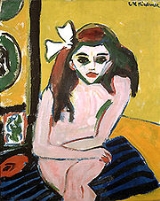
Ernst Ludwig Kirchner was a German
Germany
Germany , officially the Federal Republic of Germany , is a federal parliamentary republic in Europe. The country consists of 16 states while the capital and largest city is Berlin. Germany covers an area of 357,021 km2 and has a largely temperate seasonal climate...

 expressionist
Expressionism
Expressionism was a modernist movement, initially in poetry and painting, originating in Germany at the beginning of the 20th century. Its typical trait is to present the world solely from a subjective perspective, distorting it radically for emotional effect in order to evoke moods or ideas...

 painter
Painting
Painting is the practice of applying paint, pigment, color or other medium to a surface . The application of the medium is commonly applied to the base with a brush but other objects can be used. In art, the term painting describes both the act and the result of the action. However, painting is...

 and printmaker and one of the founders of the artists group Die Brücke
Die Brücke
Die Brücke was a group of German expressionist artists formed in Dresden in 1905, after which the Brücke Museum in Berlin was named. Founding members were Fritz Bleyl, Erich Heckel, Ernst Ludwig Kirchner and Karl Schmidt-Rottluff. Later members were Emil Nolde, Max Pechstein and Otto Mueller...

 or "The Bridge", a key group leading to the foundation of Expressionism
Expressionism
Expressionism was a modernist movement, initially in poetry and painting, originating in Germany at the beginning of the 20th century. Its typical trait is to present the world solely from a subjective perspective, distorting it radically for emotional effect in order to evoke moods or ideas...

 in 20th century art. He volunteered for army service in the First World War, but soon suffered a breakdown and was discharged. In 1933, his work was branded as "degenerate
Degenerate art
Degenerate art is the English translation of the German entartete Kunst, a term adopted by the Nazi regime in Germany to describe virtually all modern art. Such art was banned on the grounds that it was un-German or Jewish Bolshevist in nature, and those identified as degenerate artists were...

" by the Nazis
Nazism
Nazism, the common short form name of National Socialism was the ideology and practice of the Nazi Party and of Nazi Germany...

 and in 1937 over 600 of his works were sold or destroyed. In 1938 he committed suicide
Suicide
Suicide is the act of intentionally causing one's own death. Suicide is often committed out of despair or attributed to some underlying mental disorder, such as depression, bipolar disorder, schizophrenia, alcoholism, or drug abuse...

.
Discussion
Ask a question about 'Ernst Ludwig Kirchner'
Start a new discussion about 'Ernst Ludwig Kirchner'
Answer questions from other users
Full Discussion Forum
 
Quotations

A painter paints the appearance of things, not their objective correctness, in fact he creates new appearances of things.

My paintings are allegories not portraits.

The German artist creates out of his imagination,inner vision,the forms of visible nature are to him only a symbol.

The way in which I depict people was now influenced very strongly by my third wife..and her sister.The beautiful,shapely architectonically structured bodies of those two girls,replaced the soft Saxon bodies.

Encyclopedia
Ernst Ludwig Kirchner was a German
Germany
Germany , officially the Federal Republic of Germany , is a federal parliamentary republic in Europe. The country consists of 16 states while the capital and largest city is Berlin. Germany covers an area of 357,021 km2 and has a largely temperate seasonal climate...

 expressionist
Expressionism
Expressionism was a modernist movement, initially in poetry and painting, originating in Germany at the beginning of the 20th century. Its typical trait is to present the world solely from a subjective perspective, distorting it radically for emotional effect in order to evoke moods or ideas...

 painter
Painting
Painting is the practice of applying paint, pigment, color or other medium to a surface . The application of the medium is commonly applied to the base with a brush but other objects can be used. In art, the term painting describes both the act and the result of the action. However, painting is...

 and printmaker and one of the founders of the artists group Die Brücke
Die Brücke
Die Brücke was a group of German expressionist artists formed in Dresden in 1905, after which the Brücke Museum in Berlin was named. Founding members were Fritz Bleyl, Erich Heckel, Ernst Ludwig Kirchner and Karl Schmidt-Rottluff. Later members were Emil Nolde, Max Pechstein and Otto Mueller...

 or "The Bridge", a key group leading to the foundation of Expressionism
Expressionism
Expressionism was a modernist movement, initially in poetry and painting, originating in Germany at the beginning of the 20th century. Its typical trait is to present the world solely from a subjective perspective, distorting it radically for emotional effect in order to evoke moods or ideas...

 in 20th century art. He volunteered for army service in the First World War, but soon suffered a breakdown and was discharged. In 1933, his work was branded as "degenerate
Degenerate art
Degenerate art is the English translation of the German entartete Kunst, a term adopted by the Nazi regime in Germany to describe virtually all modern art. Such art was banned on the grounds that it was un-German or Jewish Bolshevist in nature, and those identified as degenerate artists were...

" by the Nazis
Nazism
Nazism, the common short form name of National Socialism was the ideology and practice of the Nazi Party and of Nazi Germany...

 and in 1937 over 600 of his works were sold or destroyed. In 1938 he committed suicide
Suicide
Suicide is the act of intentionally causing one's own death. Suicide is often committed out of despair or attributed to some underlying mental disorder, such as depression, bipolar disorder, schizophrenia, alcoholism, or drug abuse...

.

Life and work


Ernst Ludwig Kirchner was born in Aschaffenburg
Aschaffenburg
Aschaffenburg is a city in northwest Bavaria, Germany. The town of Aschaffenburg is not considered part of the district of Aschaffenburg, but is the administrative seat.Aschaffenburg is known as the Tor zum Spessart or "gate to the Spessart"...

, Bavaria
Bavaria
Bavaria, formally the Free State of Bavaria is a state of Germany, located in the southeast of Germany. With an area of , it is the largest state by area, forming almost 20% of the total land area of Germany...

. In 1901, he began studying architecture at the Königliche Technische Hochschule (technical university) of Dresden
Dresden
Dresden is the capital city of the Free State of Saxony in Germany. It is situated in a valley on the River Elbe, near the Czech border. The Dresden conurbation is part of the Saxon Triangle metropolitan area....

. The institution provided a wide range of studies in addition to architecture, such as freehand drawing, perspective drawing and the historical study of art. He became close friends there with Fritz Bleyl
Fritz Bleyl
Hilmar Friedrich Wilhelm Bleyl, known as Fritz Bleyl, was a German artist of the Expressionist school, and one of the four founders of artist group Die Brücke . He designed graphics for the group including, for their first show, a poster, which was banned by the police...

, whom he met during the first term. They discussed art together and also studied nature, having a radical outlook in common. Kirchner continued studies in Munich 1903–1904, returning to Dresden in 1905 to complete his degree.

In 1905, Kirchner, along with Bleyl and two other architecture students, Karl Schmidt-Rottluff
Karl Schmidt-Rottluff
Karl Schmidt-Rottluff was a German expressionist painter and printmaker, and a member of Die Brücke.-Life and work:...

 and Erich Heckel
Erich Heckel
Erich Heckel was a German painter and printmaker, and a founding member of the Die Brücke group which existed 1905-1913.-Biography:Heckel was born in Döbeln . His parents were born in Saxony...

, founded the artists group Die Brücke
Die Brücke
Die Brücke was a group of German expressionist artists formed in Dresden in 1905, after which the Brücke Museum in Berlin was named. Founding members were Fritz Bleyl, Erich Heckel, Ernst Ludwig Kirchner and Karl Schmidt-Rottluff. Later members were Emil Nolde, Max Pechstein and Otto Mueller...

 ("The Bridge"). From then on, he committed himself to art. The group aimed to eschew the prevalent traditional academic style and find a new mode of artistic expression, which would form a bridge (hence the name) between the past and the present. They responded both to past artists such as Albrecht Dürer
Albrecht Dürer
Albrecht Dürer was a German painter, printmaker, engraver, mathematician, and theorist from Nuremberg. His prints established his reputation across Europe when he was still in his twenties, and he has been conventionally regarded as the greatest artist of the Northern Renaissance ever since...

, Matthias Grünewald
Matthias Grünewald
Matthias Grünewald or "Mathis" , "Gothart" or "Neithardt" , , was a German Renaissance painter of religious works, who ignored Renaissance classicism to continue the expressive and intense style of late medieval Central European art into the 16th century.Only ten paintings—several consisting...

 and
Lucas Cranach the Elder
Lucas Cranach the Elder , was a German Renaissance painter and printmaker in woodcut and engraving...

, as well as contemporary international avant-garde
Avant-garde
Avant-garde means "advance guard" or "vanguard". The adjective form is used in English to refer to people or works that are experimental or innovative, particularly with respect to art, culture, and politics....

 movements. As part of the affirmation of their national heritage, they revived older media, particularly woodcut prints
Woodcut
Woodcut—occasionally known as xylography—is a relief printing artistic technique in printmaking in which an image is carved into the surface of a block of wood, with the printing parts remaining level with the surface while the non-printing parts are removed, typically with gouges...

.

Their group was one of the seminal ones, which in due course had a major impact on the evolution of modern art
Modern art
Modern art includes artistic works produced during the period extending roughly from the 1860s to the 1970s, and denotes the style and philosophy of the art produced during that era. The term is usually associated with art in which the traditions of the past have been thrown aside in a spirit of...

 in the 20th century and created the style of Expressionism
Expressionism
Expressionism was a modernist movement, initially in poetry and painting, originating in Germany at the beginning of the 20th century. Its typical trait is to present the world solely from a subjective perspective, distorting it radically for emotional effect in order to evoke moods or ideas...

. The group met initially in Kirchner's first studio, which had previously been a butcher's shop. Bleyl described it as:
Kirchner's studio became a venue which overthrew social conventions to allow casual love-making and frequent nudity. Group life-drawing sessions took place using models from the social circle, rather than professionals, and choosing quarter-hour poses to encourage spontaneity. Bleyl described one such model, Isabella, a fifteen-year-old girl from the neighbourhood, as "a very lively, beautifully built, joyous individual, without any deformation caused by the silly fashion of the corset and completely suitable to our artistic demands, especially in the blossoming condition of her girlish buds."

The group composed a manifesto (mostly Kirchner's work), which was carved on wood and asserted a new generation, "who want freedom in our work and in our lives, independence from older, established forces."

In September and October 1906, the first group exhibition was held, focused on the female nude, in the showroom of K.F.M. Seifert and Co. in Dresden.

In 1906, he met Doris Große, who was his favoured model until 1911. Between 1907 and 1911, he stayed during the summer at the Moritzburg
Moritzburg
Moritzburg is a municipality in the district of Meißen in Saxony, Germany, between Meißen as early centre of Saxony and the today's capital Dresden. It is most famous for its Baroque castle, Schloss Moritzburg....

 lakes and on the island of Fehmarn
Fehmarn
Fehmarn is an island and - since 2003 - a town on this island in the Baltic Sea, off the eastern coast of Schleswig-Holstein, Germany, and ca. 18 kilometers south of the Danish island of Lolland...

 (which he revisited until 1914) with other Brücke members; his work featured the female nude in natural settings. In 1911, he moved to Berlin, where he founded a private art school, MIUM-Institut, in collaboration with Max Pechstein
Max Pechstein
Hermann Max Pechstein was a German expressionist painter and printmaker, and a member of Die Brücke group.-Life and career:...

 with the aim of promulgating "Moderner Unterricht im Malen" (modern teaching of painting). This was not a success and closed the following year, when he also began a relationship with Erna Schilling that lasted the rest of his life.

In 1913, his writing of Chronik der Brücke (Brücke chronicle) led to the ending of the group. At this time, he established an individual identity with his first solo exhibition, which took place at the Essen Folkwang Museum. During the next two years, he painted a series of "Großstadtbilder" (metropole pictures) showing the streets of Berlin, with the central characters of street walkers.
At the onset of the First World War in September 1914, Kirchner volunteered for military service, but suffered a nervous breakdown
Nervous breakdown
Mental breakdown is a non-medical term used to describe an acute, time-limited phase of a specific disorder that presents primarily with features of depression or anxiety.-Definition:...

 in 1915 and was discharged, recovering for the next two years in sanatoriums in Taunus
Taunus
The Taunus is a low mountain range in Hesse, Germany that composes part of the Rhenish Slate Mountains. It is bounded by the river valleys of Rhine, Main and Lahn. On the opposite side of the Rhine, the mountains are continued by the Hunsrück...

 and Davos
Davos
Davos is a municipality in the district of Prättigau/Davos in the canton of Graubünden, Switzerland. It has a permanent population of 11,248 . Davos is located on the Landwasser River, in the Swiss Alps, between the Plessur and Albula Range...

, Switzerland
Switzerland
Switzerland name of one of the Swiss cantons. ; ; ; or ), in its full name the Swiss Confederation , is a federal republic consisting of 26 cantons, with Bern as the seat of the federal authorities. The country is situated in Western Europe,Or Central Europe depending on the definition....

.
In a self portrait in 1915, he depicted himself with an amputated hand (this did not actually happen). In 1918, he settled in Davos, living in a farm house in the Alps
Alps
The Alps is one of the great mountain range systems of Europe, stretching from Austria and Slovenia in the east through Italy, Switzerland, Liechtenstein and Germany to France in the west....

; from this time onwards his main subject matter was mountain scenes. On 3 July 1919, he wrote in a letter from Davos, "Dear Van de Velde
Henry van de Velde
Henry Clemens Van de Velde was a Belgian Flemish painter, architect and interior designer. Together with Victor Horta and Paul Hankar he could be considered one of the main founders and representatives of Art Nouveau in Belgium...

 writes today that I ought to return to modern life. For me this is out of the question. Nor do I regret it.... The delights the world affords are the same everywhere, differing only in their outer forms. Here one learns how to see further and go deeper than in 'modern' life, which is generally so very much more superficial despite its wealth of outer forms."

His reputation grew with several exhibitions in Germany and Switzerland in 1920. In 1923, he moved to Frauenkirch-Wildboden. The art gallery in Basel
Basel
Basel or Basle In the national languages of Switzerland the city is also known as Bâle , Basilea and Basilea is Switzerland's third most populous city with about 166,000 inhabitants. Located where the Swiss, French and German borders meet, Basel also has suburbs in France and Germany...

 staged a substantial exhibition, which led to the foundation of the "Rot-Blau" (red and blue) artists association by Swiss painters, Paul Camenisch
Paul Camenisch
Paul Camenisch was a Swiss painter.-References:*This article was initially translated from the German Wikipedia....

, Albert Müller
Albert Müller
Albert Müller was a German Schnellboot commander in World War II and recipient of the Knight's Cross of the Iron Cross.-Awards:*Iron Cross ** 2nd Class ** 2nd Class...

 and Hermann Scherer
Hermann Scherer
Hermann Scherer was a Swiss painter and sculptor.-References:*This article was initially translated from the German Wikipedia....

. Kirchner made his final visit to Germany 1925–1926. His reputation grew through the rest of the decade with a monograph
Monograph
A monograph is a work of writing upon a single subject, usually by a single author.It is often a scholarly essay or learned treatise, and may be released in the manner of a book or journal article. It is by definition a single document that forms a complete text in itself...

 and the first part of a catalogue raisonné
Catalogue raisonné
The typical catalogue raisonné is a monograph giving a comprehensive catalogue of artworks by an artist.The essential elements of a catalogue raisonné are that it purports to be an exhaustive list of works for a defined subject matter describing the works in a way so that they may be reliably...

 of his graphics in 1926, a mural commission by the Folkwang museum in 1927, and a presence at the Venice Biennale
Venice Biennale
The Venice Biennale is a major contemporary art exhibition that takes place once every two years in Venice, Italy. The Venice Film Festival is part of it. So too is the Venice Biennale of Architecture, which is held in even years...

 in 1928; he became a member of the Prussian Academy of Arts
Prussian Academy of Arts
The Prussian Academy of Arts was an art school set up in Berlin, Brandenburg, in 1694/1696 by prince-elector Frederick III, in personal union Duke Frederick I of Prussia, and later king in Prussia. It had a decisive influence on art and its development in the German-speaking world throughout its...

 in 1931.

In 1933, Kirchner was labelled a "degenerate art
Degenerate art
Degenerate art is the English translation of the German entartete Kunst, a term adopted by the Nazi regime in Germany to describe virtually all modern art. Such art was banned on the grounds that it was un-German or Jewish Bolshevist in nature, and those identified as degenerate artists were...

ist" by the Nazis and asked for his resignation from the Berlin Academy of Arts
Akademie der Künste
The Akademie der Künste, Berlin is an arts institution in Berlin, Germany. It was founded in 1696 by Elector Frederick III of Brandenburg as the Prussian Academy of Arts, an academic institution where members could meet and discuss and share ideas...

; in 1937, over 600 of his works were confiscated from public museums in Germany and were sold or destroyed. In 1938, the psychological trauma of these events, along with the Nazi occupation of Austria, close to his home, led to his suicide.

Legacy


In 1913, the first public showing of Kirchner's work took place at the Armory Show
Armory Show
Many exhibitions have been held in the vast spaces of U.S. National Guard armories, but the Armory Show refers to the 1913 International Exhibition of Modern Art that was organized by the Association of American Painters and Sculptors...

, which was also the first major display of modern art
Modern art
Modern art includes artistic works produced during the period extending roughly from the 1860s to the 1970s, and denotes the style and philosophy of the art produced during that era. The term is usually associated with art in which the traditions of the past have been thrown aside in a spirit of...

 in America. In 1921, U.S. museums began to acquire his work and did so increasingly thereafter. His first solo museum show in the US was at the Detroit Institute of Arts
Detroit Institute of Arts
The Detroit Institute of Arts is a renowned art museum in the city of Detroit. In 2003, the DIA ranked as the second largest municipally owned museum in the United States, with an art collection valued at more than one billion dollars...

 in 1937. In 1992, the National Gallery of Art
National Gallery of Art
The National Gallery of Art and its Sculpture Garden is a national art museum, located on the National Mall between 3rd and 9th Streets at Constitution Avenue NW, in Washington, DC...

, Washington, held a monographic show, using its existing collection; a major international loan exhibition took place in 2003. In November 2006 at Christie's
Christie's
Christie's is an art business and a fine arts auction house.- History :The official company literature states that founder James Christie conducted the first sale in London, England, on 5 December 1766, and the earliest auction catalogue the company retains is from December 1766...

, Kirchner's Street Scene, Berlin (1913) fetched $38 million, a record for the artist. In 2008 (August 3 - November 10), the Museum of Modern Art
Museum of Modern Art
The Museum of Modern Art is an art museum in Midtown Manhattan in New York City, on 53rd Street, between Fifth and Sixth Avenues. It has been important in developing and collecting modernist art, and is often identified as the most influential museum of modern art in the world...

 in New York held a major exhibition that "probably comprises the very best of his oeuvre."

Selected Bibliography

  • Krämer Felix,"KIRCHNER",Hatje Cantz,2010. ISBN 9783775725538
  • Wye Deborah,"KIRCHNER AND THE BERLIN STREET",The Museum of Modern Art, New York,2008. ISBN 9780870707414
  • Kort Pamela,"ERNST LUDWIG KIRCHNER: BERLIN STREET SCENE",Neue Galerie New York,2008. ISBN 9781931794152

External links