


Jewish Bolshevism

Encyclopedia
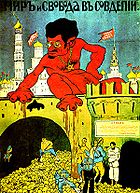
Jewish Bolshevism, Judeo-Bolshevism, and known as Żydokomuna
Zydokomuna
Żydokomuna is a pejorative antisemitic stereotype which came into use between World Wars I and II, blaming Jews for the rise of communism in Poland, where communism was identified as part of a wider Jewish-led conspiracy to seize power....
in Poland, is an antisemitic stereotype based on the claim that Jews
Jews
The Jews , also known as the Jewish people, are a nation and ethnoreligious group originating in the Israelites or Hebrews of the Ancient Near East. The Jewish ethnicity, nationality, and religion are strongly interrelated, as Judaism is the traditional faith of the Jewish nation...
have been the driving force behind or are disproportionately involved in the modern Communist
Communism
Communism is a social, political and economic ideology that aims at the establishment of a classless, moneyless, revolutionary and stateless socialist society structured upon common ownership of the means of production...
movement, or sometimes more specifically Russian Bolshevism.
The expression was the title of a pamphlet, The Jewish Bolshevism
The Jewish Bolshevism
The Jewish Bolshevism, is a 31- or 32-page antisemitic pamphlet published in London in 1922 and 1923 by the Britons Publishing Society. It included a foreword by German Nazi Alfred Rosenberg, who promulgated the concept of "Jewish Bolshevism"...
, and became current after the 1917 October Revolution
October Revolution
The October Revolution , also known as the Great October Socialist Revolution , Red October, the October Uprising or the Bolshevik Revolution, was a political revolution and a part of the Russian Revolution of 1917...
in Russia, featuring prominently in the propaganda of the anti-communist "White
White movement
The White movement and its military arm the White Army - known as the White Guard or the Whites - was a loose confederation of Anti-Communist forces.The movement comprised one of the politico-military Russian forces who fought...
" forces during the Russian Civil War
Russian Civil War
The Russian Civil War was a multi-party war that occurred within the former Russian Empire after the Russian provisional government collapsed to the Soviets, under the domination of the Bolshevik party. Soviet forces first assumed power in Petrograd The Russian Civil War (1917–1923) was a...
. It spread worldwide in the 1920s with the publication and circulation of The Protocols of the Elders of Zion
The Protocols of the Elders of Zion
The Protocols of the Elders of Zion is a fraudulent, antisemitic text purporting to describe a Jewish plan for achieving global domination. It was first published in Russia in 1903, translated into multiple languages, and disseminated internationally in the early part of the twentieth century...
. It made an issue out of the Jewishness of some leading Bolsheviks (most notably Leon Trotsky
Leon Trotsky
Leon Trotsky , born Lev Davidovich Bronshtein, was a Russian Marxist revolutionary and theorist, Soviet politician, and the founder and first leader of the Red Army....
) during and after the October Revolution. Daniel Pipes
Daniel Pipes
Daniel Pipes is an American historian, writer, and political commentator. He is the founder and director of the Middle East Forum and its Campus Watch project, and editor of its Middle East Quarterly journal...
says that "primarily through the Protocols of the Elders of Zion, the Whites
White movement
The White movement and its military arm the White Army - known as the White Guard or the Whites - was a loose confederation of Anti-Communist forces.The movement comprised one of the politico-military Russian forces who fought...
spread these charges to an international audience." James Webb
James Webb (historian)
James Charles Napier Webb was a Scottish historian and biographer. He was born in Edinburgh, was educated at Harrow and Trinity College, Cambridge. He is remembered primarily for two works The Occult Underground and The Occult Establishment. Occult Underground was originally titled Flight from...
wrote that it is rare to find an antisemitic source after 1917 that ..."does not stand in debt to the White Russian
White Emigre
A white émigré was a Russian who emigrated from Russia in the wake of the Russian Revolution and Russian Civil War, and who was in opposition to the contemporary Russian political climate....
analysis of the Revolution."
The label "Judeo-Bolshevism" was used in Nazi Germany
Nazi Germany
Nazi Germany , also known as the Third Reich , but officially called German Reich from 1933 to 1943 and Greater German Reich from 26 June 1943 onward, is the name commonly used to refer to the state of Germany from 1933 to 1945, when it was a totalitarian dictatorship ruled by...
to equate Jews with communists
Communism
Communism is a social, political and economic ideology that aims at the establishment of a classless, moneyless, revolutionary and stateless socialist society structured upon common ownership of the means of production...
, implying that the communist movement served Jewish interests and/or that all Jews were communists. According to Hannah Arendt
Hannah Arendt
Hannah Arendt was a German American political theorist. She has often been described as a philosopher, although she refused that label on the grounds that philosophy is concerned with "man in the singular." She described herself instead as a political theorist because her work centers on the fact...
, it was "the most efficient fiction of Nazi Propaganda". In Poland before World War II, Żydokomuna
Zydokomuna
Żydokomuna is a pejorative antisemitic stereotype which came into use between World Wars I and II, blaming Jews for the rise of communism in Poland, where communism was identified as part of a wider Jewish-led conspiracy to seize power....
was used in the same way to allege that the Jews were conspiring with the USSR to capture Poland. According to André Gerrits, "The myth of Jewish Communism was one of the most popular and widespread political prejudices in the first half of the 20th century, in Eastern Europe in particular." The allegation still sees use in antisemitic publications and websites today.
Persecution of Jews in the late Russian Empire
Jews had been a persecuted minority in the Russian Empire. They had endured a form of racial segregationRacial segregation
Racial segregation is the separation of humans into racial groups in daily life. It may apply to activities such as eating in a restaurant, drinking from a water fountain, using a public toilet, attending school, going to the movies, or in the rental or purchase of a home...
in the Pale of Settlement
Pale of Settlement
The Pale of Settlement was the term given to a region of Imperial Russia, in which permanent residency by Jews was allowed, and beyond which Jewish permanent residency was generally prohibited...
, as well as sporadic pogrom
Pogrom
A pogrom is a form of violent riot, a mob attack directed against a minority group, and characterized by killings and destruction of their homes and properties, businesses, and religious centres...
s. In the period from 1881 to 1920, more than two million Jews left Russia.
According to Berel Wein
Berel Wein
Berel Wein is an American-born Orthodox rabbi, scholar, lecturer, and writer. He is regarded as an expert on Jewish history and has popularized the subject through more than 1,000 audio tapes, a four-volume book series, newspaper articles and international lectures...
:
Expulsions, deportations, arrests, and beatings became the daily lot of the Jews, not only of their lower class, but even of the middle class and the Jewish intelligentsia. The government of Alexander III waged a campaign of war against its Jewish [citizens]... The Jews were driven and hounded, and emigration appeared to be the only escape from the terrible tyranny of the Romanovs."
Jews in relatively large numbers joined various ideological currents favoring gradual or revolutionary changes within the Russian Empire
Russian Empire
The Russian Empire was a state that existed from 1721 until the Russian Revolution of 1917. It was the successor to the Tsardom of Russia and the predecessor of the Soviet Union...
. Those movements ranged from the far left (anarchists
Jewish anarchism
Jewish anarchism is a general term encompassing various expressions of anarchism within the Jewish community.- Secular Jewish Anarchism :Many people of Jewish origin, such as Emma Goldman, Alexander Berkman, Martin Buber, Murray Bookchin, Noam Chomsky, Murray Rothbard or David D. Friedman have...
, Bundists, Bolsheviks, Mensheviks) to moderate left (Trudoviks
Trudoviks
The Trudoviks were a moderate Labour party in early 20th Century Russia...
) and constitutionalist (Constitutional Democrats
Constitutional Democratic party
The Constitutional Democratic Party was a liberal political party in the Russian Empire. Party members were called Kadets, from the abbreviation K-D of the party name...
) parties. Monarchist parties, such as Union of the Russian People
Union of the Russian People
The Union of Russian People — a loyalist right-wing nationalist party, the most important among Black-Hundredist monarchist and antisemitic political organizations in the Russian Empire of 1905–1917....
, expressed clearly antisemitic attudes, and included antisemitic paragraphs in their political program.
Jews in the Bolshevik party
On the eve of the February RevolutionFebruary Revolution
The February Revolution of 1917 was the first of two revolutions in Russia in 1917. Centered around the then capital Petrograd in March . Its immediate result was the abdication of Tsar Nicholas II, the end of the Romanov dynasty, and the end of the Russian Empire...
, in 1917, the Bolshevik party had about 10,000 members, of whom 364 were ethnic Jews. Between 1917 and 1919, Jewish party leaders included Grigory Zinoviev
Grigory Zinoviev
Grigory Yevseevich Zinoviev , born Ovsei-Gershon Aronovich Radomyslsky Apfelbaum , was a Bolshevik revolutionary and a Soviet Communist politician...
, Moisei Uritsky
Moisei Uritsky
Moisei Solomonovich Uritsky was a Bolshevik revolutionary leader in Russia.He was born in the city of Cherkasy, Kiev Governorate, to a Jewish family. His father, a merchant, died when Moisei was little and his mother raised her son by herself.Moisei studied law at the University of Kiev...
, Grigory Sokolnikov, and Leon Trotsky
Leon Trotsky
Leon Trotsky , born Lev Davidovich Bronshtein, was a Russian Marxist revolutionary and theorist, Soviet politician, and the founder and first leader of the Red Army....
. Adolph Joffe
Adolph Joffe
Adolph Abramovich Joffe was a Communist revolutionary, a Bolshevik politician and a Soviet diplomat of Karaim descent.-Revolutionary career:...
was a Karaite
Karaite Judaism
Karaite Judaism or Karaism is a Jewish movement characterized by the recognition of the Tanakh alone as its supreme legal authority in Halakhah, as well as in theology...
and Lev Kamenev
Lev Kamenev
Lev Borisovich Kamenev , born Rozenfeld , was a Bolshevik revolutionary and a prominent Soviet politician. He was briefly head of state of the new republic in 1917, and from 1923-24 the acting Premier in the last year of Lenin's life....
was of mixed ethnic Russian and Jewish parentage. Trotsky was also a member (or "Narkom") of the ruling Council of People's Commissars. Among the 23 Narkoms between 1923 and 1930, five were Jewish.
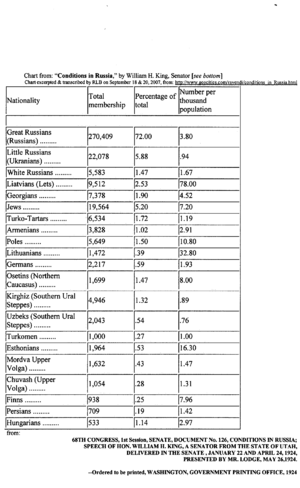
Among members of the Central Executive Committee of the Congress of Soviets in 1929, there were 402 ethnic Russians, 95 Ukrainians, 55 Jews, 26 Latvians, 13 Poles, and 12 GermansJewish representation had declined from 60 members in 1927.
In the 1920s, of the 417 members of the Central Executive Committee, the party Central Committee, the Presidium of the Executive of the Soviets of the USSR and the Russian Republic, the People's Commissars, 6% were ethnic Jews.
Between 1936 and 1940, during the Great Purge
Great Purge
The Great Purge was a series of campaigns of political repression and persecution in the Soviet Union orchestrated by Joseph Stalin from 1936 to 1938...
, Yezhovshchina and after the rapprochement with Nazi Germany, Stalin had largely eliminated Jews from senior party, government, diplomatic, security and military positions. In 1939, Stalin directed incoming Foreign Minister Vyacheslav Molotov
Vyacheslav Molotov
Vyacheslav Mikhailovich Molotov was a Soviet politician and diplomat, an Old Bolshevik and a leading figure in the Soviet government from the 1920s, when he rose to power as a protégé of Joseph Stalin, to 1957, when he was dismissed from the Presidium of the Central Committee by Nikita Khrushchev...
to "purge the ministry of Jews". Although some scholars believe that this decision was taken for primarily domestic reasons, others argue it may have been a signal to Nazi Germany that the USSR was ready for non-aggression talks.
According to historian Iakov Etinger, many Soviet state purges of the 1930s were antisemitic in nature, and a more intense antisemitic policy developed toward the end of World War II. Stalin in 1952 allegedly said privately that "every Jew is a potential spy for the United States".
Nazi Germany
Walter LaqueurWalter Laqueur
Walter Zeev Laqueur is an American historian and political commentator. He was born in Breslau, Germany , to a Jewish family. In 1938, Laqueur left Germany for the British Mandate of Palestine. His parents, who were unable to leave, became victims of the Holocaust...
traces the Jewish-Bolshevik conspiracy theory to Nazi ideologue Alfred Rosenberg
Alfred Rosenberg
' was an early and intellectually influential member of the Nazi Party. Rosenberg was first introduced to Adolf Hitler by Dietrich Eckart; he later held several important posts in the Nazi government...
, for whom Bolshevism was "the revolt of the Jewish, Slavic and Mongolian races against the German (Aryan
Aryan
Aryan is an English language loanword derived from Sanskrit ārya and denoting variously*In scholarly usage:**Indo-Iranian languages *in dated usage:**the Indo-European languages more generally and their speakers...
) element in Russia". Germans, according to Rosenberg, had been responsible for Russia's historic achievements and had been sidelined by the Bolsheviks, who did not represent the interests of the Russian people, but instead those of its ethnic Jewish and Chinese population.
In Nazi Germany
Nazi Germany
Nazi Germany , also known as the Third Reich , but officially called German Reich from 1933 to 1943 and Greater German Reich from 26 June 1943 onward, is the name commonly used to refer to the state of Germany from 1933 to 1945, when it was a totalitarian dictatorship ruled by...
, this concept of Jewish Bolshevism reflected a common perception that Communism was a Jewish-inspired and Jewish-led movement seeking world domination from its origin. The term was popularized in print in German journalist Dietrich Eckhart's 1924 pamphlet "Der Bolschewismus von Moses bis Lenin" ("Bolshevism from Moses to Lenin") which depicted Moses
Moses
Moses was, according to the Hebrew Bible and Qur'an, a religious leader, lawgiver and prophet, to whom the authorship of the Torah is traditionally attributed...
and Lenin as both being Communists and Jews. This was followed by Alfred Rosenberg
Alfred Rosenberg
' was an early and intellectually influential member of the Nazi Party. Rosenberg was first introduced to Adolf Hitler by Dietrich Eckart; he later held several important posts in the Nazi government...
's 1923 edition of the Protocols of the Elders of Zion and Hitler
Adolf Hitler
Adolf Hitler was an Austrian-born German politician and the leader of the National Socialist German Workers Party , commonly referred to as the Nazi Party). He was Chancellor of Germany from 1933 to 1945, and head of state from 1934 to 1945...
's Mein Kampf
Mein Kampf
Mein Kampf is a book written by Nazi leader Adolf Hitler. It combines elements of autobiography with an exposition of Hitler's political ideology. Volume 1 of Mein Kampf was published in 1925 and Volume 2 in 1926...
in 1924, which saw Bolshevism as "Jewry's twentieth century effort to take world dominion unto itself."

A major source for propaganda
Propaganda
Propaganda is a form of communication that is aimed at influencing the attitude of a community toward some cause or position so as to benefit oneself or one's group....
about Jewish Bolshevism in the 1930s and early 1940s was the pro-Nazi and antisemitic international Welt-Dienst news agency founded in 1933 by Ulrich Fleischhauer
Ulrich Fleischhauer
thumb|Ulrich Fleischhauer Ulrich Fleischhauer was a leading antisemitic publisher of books and news articles reporting on an alleged Judeo-Masonic conspiracy theory and supposed "nefarious plots" by clandestine Jewish interests to dominate the world.His career was at first grounded in the Imperial...
.
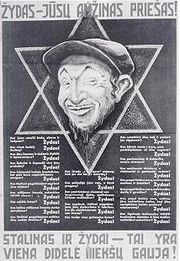
Within the German Army, a tendency to see Soviet Communism as a Jewish conspiracy had grown since the First World War, something that became officialised under the Nazis. A 1932 pamphlet by Ewald Banse of the Government-financed German National Association for the Military Sciences described the Soviet leadership as mostly Jewish, dominating an apathetic and mindless Russian population.
Red Army
The Workers' and Peasants' Red Army started out as the Soviet Union's revolutionary communist combat groups during the Russian Civil War of 1918-1922. It grew into the national army of the Soviet Union. By the 1930s the Red Army was among the largest armies in history.The "Red Army" name refers to...
soldiers to rise up and kill their "Jewish comissars". This material was not used at the time, but served as a basis for propaganda in the 1940s.
In his speech to the Reichstag justifying Operation Barbarossa
Operation Barbarossa
Operation Barbarossa was the code name for Germany's invasion of the Soviet Union during World War II that began on 22 June 1941. Over 4.5 million troops of the Axis powers invaded the USSR along a front., the largest invasion in the history of warfare...
in 1941, Hitler said:
“For more than two decades the Jewish Bolshevik regime in Moscow had tried to set fire not merely to Germany but to all of Europe…The Jewish Bolshevik rulers in Moscow have unswervingly undertaken to force their domination upon us and the other European nations and that is not merely spiritually, but also in terms of military power…Now the time has come to confront the plot of the Anglo-Saxon Jewish war-mongers and the equally Jewish rulers of the Bolshevik centre in Moscow!”
Nazi propaganda presented Barbarossa as an ideological-racial war between German National Socialism and “Judeo-Bolshevism”, dehumanising the Soviet enemy as a force of Slavic Untermensch
Untermensch
Untermensch is a term that became infamous when the Nazi racial ideology used it to describe "inferior people", especially "the masses from the East," that is Jews, Gypsies, Poles along with other Slavic people like the Russians, Serbs, Belarussians and Ukrainians...
(sub-humans) and “Asiatic” savages engaging in “barbaric Asiatic fighting methods” commanded by evil Jewish commissars whom German troops were to grant no mercy. The vast majority of the Wehrmacht officers and soldiers tended to regard the war in Nazi terms, seeing their Soviet opponents as sub-human.
Great Britain, 1920s
In the early 1920s, a leading British antisemite, Henry Hamilton BeamishHenry Hamilton Beamish
Henry Hamilton Beamish was a leading British antisemite and the founder of The Britons.The son of an admiral who had served as an A.D.C...
, stated that Bolshevism was the same thing as Judaism. In the same decade, future wartime Prime Minister Winston Churchill
Winston Churchill
Sir Winston Leonard Spencer-Churchill, was a predominantly Conservative British politician and statesman known for his leadership of the United Kingdom during the Second World War. He is widely regarded as one of the greatest wartime leaders of the century and served as Prime Minister twice...
penned an editorial entitled "Zionism versus Bolshevism," which was published in the Illustrated Sunday Herald. In the article, he stated that Jewish involvement in the various recent worldwide revolutionary movements (namely Communism) was a function of their character:
{Bolshevism} among the Jews is nothing new. From the days of Spartacus-Weishaupt to those of Karl Marx, and down to Trotsky (Russia), Bela Kun (Hungary), Rosa Luxembourg (Germany), and Emma Goldman (United States), this world-wide conspiracy for the overthrow of civilisation and for the reconstitution of society on the basis of arrested development, of envious malevolence, and impossible equality, has been steadily growing.
Author Gisela C. Lebzelter
Gisela C. Lebzelter
Gisela C. Lebzelter is an author, historian, and scholar, and an expert on British fascism and antisemitism. Scholars who study British fascism and antisemitism frequently cite her 1978 book Political Anti-Semitism in England 1918-1939—a revision of her thesis submitted to St...
noted that Churchill's analysis failed to analyze the role that Russian oppression of Jews had played in their joining various revolutionary movements, but instead "to inherent inclinations rooted in Jewish character and religion."
Iran, 2006
In 2006, IranIran
Iran , officially the Islamic Republic of Iran , is a country in Southern and Western Asia. The name "Iran" has been in use natively since the Sassanian era and came into use internationally in 1935, before which the country was known to the Western world as Persia...
ian Presidential Advisor Mohammad Ali Ramin, secretary-general of the new "World Foundation for Holocaust Studies" established at the International Conference to Review the Global Vision of the Holocaust
International Conference to Review the Global Vision of the Holocaust
The International Conference to Review the Global Vision of the Holocaust was a two-day conference that opened on December 11, 2006, in Tehran, Iran. Iranian Foreign Minister Manouchehr Mottaki said the conference sought "neither to deny nor prove the Holocaust.....
, stated:
"The Bolshevik Soviet government in Lenin's time, and later, in Stalin's - both of whom were Jewish, though they presented themselves as Marxists and atheists... - was one of the forces that, until the Second World War, cooperated with Hitler in promoting the idea of establishing the State of Israel."
USA
Frank L. Britton, editor of The American Nationalist published a book, Behind Communism, in 1952 which disseminated the myth that Communism was a Jewish conspiracy originating in PalestinePalestine
Palestine is a conventional name, among others, used to describe the geographic region between the Mediterranean Sea and the Jordan River, and various adjoining lands....
.
See also
- ŻydokomunaZydokomunaŻydokomuna is a pejorative antisemitic stereotype which came into use between World Wars I and II, blaming Jews for the rise of communism in Poland, where communism was identified as part of a wider Jewish-led conspiracy to seize power....
- Doctors' PlotDoctors' plotThe Doctors' plot was the most dramatic anti-Jewish episode in the Soviet Union during Joseph Stalin's regime, involving the "unmasking" of a group of prominent Moscow doctors, predominantly Jews, as conspiratorial assassins of Soviet leaders...
- Jewish Autonomous OblastJewish Autonomous OblastThe Jewish Autonomous Oblast is a federal subject of Russia situated in the Russian Far East, bordering Khabarovsk Krai and Amur Oblast of Russia and Heilongjiang province of China. Its administrative center is the town of Birobidzhan....
- BirobidzhanBirobidzhanBirobidzhan is a town and the administrative center of the Jewish Autonomous Oblast, Russia. It is located on the Trans-Siberian railway, close to the border with the People's Republic of China....
- Birobidzhan
- Jewish Communist Party (Poalei Zion)
- Jewish Communist Union (Poalei Zion)Jewish Communist Union (Poalei Zion)Jewish Communist Union , Komverband was the name taken by the Left World Union of Poalei Zion in 1921. Komverband had members in Russia, Lithuania, Latvia, Austria, Italy, Poland and other countries. In 1922 Komverband shifted its headquarters from Vienna to Danzig, in preparation for a party...
- Jewish leftJewish leftThe term "Jewish left" describes Jews who identify with or support left wing, occasionally liberal causes, consciously as Jews, either as individuals or through organizations. There is no one organization or movement which constitutes the "Jewish left," however...
- History of the Jews in Russia and Soviet Union
- History of antisemitism
- KomzetKomzetKomzet was the Committee for the Settlement of Toiling Jews on the Land in the Soviet Union. The primary goal of the Komzet was to help impoverished and persecuted Jewish population of the former Pale of Settlement to adopt agricultural labor...
- OZETOZETOZET was public Society for Settling Toiling Jews on the Land in the Soviet Union in the period from 1925 to 1938. Some English sources use the word "Working" instead of "Toiling".- Background :...
- OZET
- Poale ZionPoale ZionPoale Zion was a Movement of Marxist Zionist Jewish workers circles founded in various cities of the Russian Empire about the turn of the century after the Bund rejected Zionism in 1901.-Formation and early years:Poale Zion parties and organisations were started across the Jewish diaspora in the...
- YevsektsiyaYevsektsiyaYevsektsiya , , the abbreviation of the phrase "Еврейская секция" was the Jewish section of the Soviet Communist party. Yevsektsiya was established to popularize Marxism and encourage loyalty to the Soviet regime among Russian Jews. The founding conference of Yevsektsiya took place on October 20,...
- Antisemitic canardAntisemitic canardAn antisemitic canard is a false story inciting antisemitism. Despite being thoroughly disproved, antisemitic canards are often part of broader theories of Jewish conspiracies. According to Kenneth S. Stern,Historically, Jews have not fared well around conspiracy theories. Such ideas fuel...
Further reading
- Mikhail Agursky: The Third Rome: National Bolshevism in the USSR, 1987, Westview Press, ISBN 08133-0139-4
- Dennis Fahey: Rulers of Russia, 1940, 3rd American edition, revised and enlarged, Condon Printing Co., Detroit
- Harry Defries, Conservative Party attitudes to Jews, 1900-1950 Jewish Bolshevism, p. 70, ISBN 07146-5221-0
- Jeffrey Herf: The Jewish Enemy: Nazi Propaganda During World War II and the Holocaust, 2006, Harvard University Press, ISBN 0674021754, 9780674021754
- Michael Kellogg: The Russian Roots of Nazism: White Émigrés and the Making of National Socialism, 1917-1945, 2005, Cambridge University Press, ISBN 0521845122
- Benjamin Pinkus. The Jews of the Soviet Union: The History of a National Minority. Cambridge: Cambridge University Press, 1990. ISBN 0521389267, 9780521389266
- Johannes Rogalla von Bieberstein: '"Juedischer Bolschewismus". Mythos und Realität'. Dresden: Antaios 2003, ISBN 3-935063-14-8; 2.ed. Graz: Ares 2010.
- Yuri SlezkineYuri SlezkineYuri Slezkine is a professor of Russian history and Director of the Institute of Slavic, East European, and Eurasian Studies at the University of California, Berkeley. He is best known as the author of the highly acclaimed book The Jewish Century...
: The Jewish Century, 2004, Princeton University Press, ISBN 0-691-11995-3 - Alexandre Soljenitsyne: Deux Siecles Ensemble. Tome 2. 1917-1972. Juifs et Russes pendant la periode Sovietique.1917-1972, 2003, Fayard, Paris. ISBN 2-213-61518-7
- Arkady Vaksberg: Stalin against the Jews, 1994, Vintage Books (a division of Random House, New York), ISBN 0-679-42207-2
- Robert Wistrich: Revolutionary Jews from Marx to Trotsky, 1976, Harrap, London, ISBN 0-245-52785-0
- Andre Gerrits: 'The myth of Jewish communism. A historical interpretation. Brussels 2009.
External links
- Jews,Communism,and the Jewish Communists
- Stalin and the Jews by Stephen Schwartz (weeklystandard.org)
- Stalin's Jewish affair by Israeli journalist Dmitri Prokofiev (ynetnews.com)
- From Anti-Westernism to Anti-Semitism by Konstantin Azadovskii and Boris Egorov (www.fas.harvard.edu)
- War in the East and the Extermination of the Jews by Andreas HillgruberAndreas HillgruberAndreas Fritz Hillgruber was a conservative German historian. Hillgruber was influential as a military and diplomatic historian.At his death in 1989, the American historian Francis L...