


Communist Party USA

Encyclopedia
The Communist Party USA (CPUSA) is a Marxist
political party
in the United States
, established in 1919. It has a long, complex history that is closely related to the histories of similar communist parties worldwide and the U.S. labor movement.
For the first half of the 20th century, the CPUSA was the largest and most influential communist party
in the United States. It played a very prominent role in the U.S. labor movement from the 1920s through the 1940s, having a major hand in founding most of the country's first industrial unions (which would later expel communists by adopting the Smith Act
) while also becoming known for opposing racism
and fighting for integration in workplaces and communities during the height of the Jim Crow period of U.S. racial segregation
. Historian Ellen Schrecker
concludes that decades of recent scholarship offers a "nuanced portrayal of the party as both a Stalinist sect tied to a vicious regime and the most dynamic organization within the American Left during the 1930s and '40s". In regards to the former charge, the CPUSA, claiming proletarian internationalism
(while the U.S. Government called it espionage
), sponsored an elaborate intelligence network on behalf of the Soviet Union, involving over 500 members acting as agents. The most prominent example dealt with the Manhattan Project
in which the network was accused in giving the blueprints of the atomic bomb to the Soviets; Julius and Ethel Rosenberg
were thereafter convicted and executed as the chief architects of this plan. Later evidence proved that the Rosenbergs did not have the plans but the use of fear of Communism and its spread, helped to render a guilty verdict.
By August 1919, only months after its founding, the CPUSA had 60,000 members, including anarchists and other radical leftists
, while the more moderate Socialist Party of America
had only 40,000 members. The sections of the CP's International Workers Order
meanwhile organized for communism around linguistic and ethnic lines, providing mutual aid
and tailored cultural activities to an IWO membership that peaked at 200,000 at its height.
But the CP's early labor and organizing successes did not last. As the decades progressed, the combined effects of the second Red Scare
, McCarthyism
, Nikita Khrushchev
's 1956 Secret Speech
denouncing the previous decades of Joseph Stalin
's rule, and the adversities of the continued Cold War
mentality, steadily weakened of the Communist Party's internal structure and confidence. CPUSA's membership in the Comintern
and its close adherence to the political positions of the Soviet Union enabled anti-communist critics to constantly present the party as not only a threatening, subversive domestic entity, but also as a "foreign" agent fundamentally alien to the "American way of life". Internal and external crises swirled together, to the point where members who did not end up in prison for party activities tended either to disappear quietly from its ranks or to adopt more moderate political positions at odds with the CPUSA's party line
. By 1957, membership had dwindled to less than 10,000, of whom some 1,500 were FBI informants.
The party attempted to recover with its opposition to the Vietnam War
during the U.S. Civil rights movement
in the 1960s, but the continued uncritical support of the CPUSA for an increasingly stultified and militaristic Soviet Union
increasingly alienated them from the rest of the U.S. left, who saw this supportive position as outdated and even dangerous. At the same time, the party's aging membership demographics and noticeably hollow calls for "peaceful coexistence
" failed to speak to a new Left in the United States.
With the rise of Mikhail Gorbachev
and his effort to radically alter the Soviet economic and political system from the mid-1980s, the CPUSA finally became estranged from the leadership of the Soviet Union itself; the USSR cut off major funding to the CPUSA in 1989 due to the CP's opposition to glasnost
and perestroika
. With the dissolution of the Soviet Union
in 1991, the party held its convention and attempted to resolve the issue of whether the Party should reject Marxism-Leninism. The majority reasserted the party's now purely Marxist outlook, prompting a minority faction
which urged social democrats
to exit the now reduced party.
The CPUSA is based in New York City. For decades, its West Coast newspaper was the People's World, and its East Coast newspaper was The Daily World
. The two newspapers merged in 1986. Political Affairs Magazine
is a monthly magazine. International Publishers
is its publishing house.
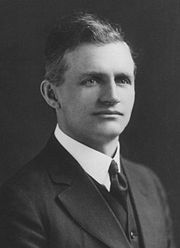
The Comintern was not happy with two communist parties and in January, 1920 dispatched an order that the two parties, which consisted of about 12,000 members, merge under the name United Communist Party, and to follow the party line established in Moscow. Part of the Communist Party of America under the leadership of Charles Ruthenberg and Jay Lovestone
did this but a faction under the leadership of Nicholas I. Hourwich and Alexander Bittelman
continued to operate independently as the Communist Party of America. A more strongly worded directive from the Comintern eventually did the trick and the parties were merged in May, 1921. Only five percent of the members of the newly formed party were native English-speakers. Many of the members came from the ranks of the Industrial Workers of the World
.
The first US socialist political party was the Socialist Labor Party, formed in 1876 and for many years a viable force in the international socialist movement. By the mid 1890s, however, the SLP came under the influence of Daniel De Leon, and his radical views led to widespread discontent amongst the members, leading to the formation of the reformist-oriented Socialist Party of America around the turn of the century[3] A left wing gradually emerged within the SP, much to the consternation of many Party leaders.
In January 1919, Vladimir Lenin invited the left wing of the Socialist Party of America to join Comintern. During the spring of 1919 the Left Wing Caucus of the Socialist Party, buoyed by a large influx of new members from countries involved in the Russian Revolution, prepared to wrest control from the smaller controlling faction of moderate socialists. A referendum to join Comintern passed with 90% support, but the incumbent leadership suppressed the results. Elections for the party's National Executive Committee resulted in 12 leftists being elected out of a total of 15. Calls were made to expel moderates from the party. The moderate incumbents struck back by expelling several state organizations, half a dozen language federations, and many locals, in all two-thirds of the membership.
The Socialist Party then called an emergency convention on August 30, 1919. The party's Left Wing Caucus made plans at a June conference of its own to regain control of the party, by sending delegations from the sections of the party that had been expelled to the convention to demand that they be seated. However, the language federations, eventually joined by C.E. Ruthenberg
and Louis C. Fraina
, turned away from that effort and formed their own party, the Communist Party of America, at a separate convention on September 1, 1919. Meanwhile plans led by John Reed and Benjamin Gitlow
to crash the Socialist Party convention went ahead. Tipped off, the incumbents called the police, who obligingly expelled the leftists from the hall. The remaining leftist delegates walked out and, meeting with the expelled delegates, formed the Communist Labor Party
on August 30, 1919.
. In 1919, after a series of unattributed bombings and attempted assassinations of government officials, and judges (later traced to militant Galleanist adherents of radical anarchist Luigi Galleani
), the US Department of Justice headed by Attorney General A. Mitchell Palmer, acting under the Sedition Act of 1918
, began arresting thousands of foreign-born party members, many of whom the government deported. The Communist Party was forced underground and took to the use of pseudonyms and secret meetings in an effort to evade the authorities.
The party apparatus was to a great extent underground. It re-emerged in the last days of 1921 as a legal political party called the Workers Party of America
. As the red scare and deportations of the early 1920s ebbed, the party became bolder and more open. An element of the party, however, remained permanently underground and came to be known as the "CPUSA secret apparatus."
During this time Jews whose backgrounds derived from Eastern Europe are said to have played a very prominent and disproportionate role in the CPUSA. A majority of the members of the Socialist Party were immigrants and that an "overwhelming" percentage of the CPUSA consisted of recent immigrants, a substantial percentage of whom were Jews.
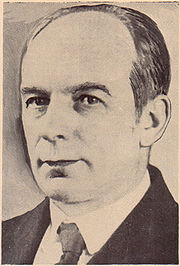 Now that the above ground element was legal, the communists decided that their central task was to develop roots within the working class. This move away from hopes of revolution in the near future to a more nuanced approach was accelerated by the decisions of the Fifth World Congress of the Comintern held in 1925. The Fifth World Congress decided that the period between 1917 and 1924 had been one of revolutionary upsurge, but that the new period was marked by the stabilization of capitalism and that revolutionary attempts in the near future were to be stopped. The American communists embarked then on the arduous work of locating and winning allies.
That work was, however, complicated by factional struggles within the CPUSA. The party quickly developed a number of more or less fixed factional groupings within its leadership: a faction around the party's Executive Secretary C.E. Ruthenberg, which was largely organized by his supporter Jay Lovestone
; and the Foster-Cannon faction, headed by William Z. Foster
, who headed the Party's Trade Union Educational League
, and James P. Cannon
, who led the International Labor Defense (ILD) organization.
Foster, who had been deeply involved in the Steel Strike of 1919
and had been a long-time syndicalist and a Wobbly, had strong bonds with the progressive leaders of the Chicago Federation of Labor
and, through them, with the Progressive Party (United States, 1924)
and nascent farmer-labor parties. Under pressure from the Comintern, however, the party broke off relations with both groups in 1924. In 1925 the Comintern, through its representative Sergei Gusev
, ordered the majority Foster faction to surrender control to Ruthenberg's faction; Foster complied. The factional infighting within the CPUSA did not end, however; the Communist leadership of the New York locals of the International Ladies' Garment Workers' Union
lost the 1926 strike of cloakmakers in New York City in large part because of intra-party factional rivalries.
Ruthenberg died in 1927 and his ally, Lovestone, succeeded him as party secretary. Cannon attended the Sixth Congress of the Comintern in 1928, hoping to use his connections with leading circles within it to regain the advantage against the Lovestone faction. However Cannon and Maurice Spector
of the Communist Party of Canada
were accidentally given a copy of Trotsky
's "Critique of the Draft Program of the Comintern", that they were instructed to read and return. Persuaded by its contents, they came to an agreement to return to America and campaign for the document's positions. A copy of the document was then smuggled out of the country in a child's toy. Back in America, Cannon and his close associates in the ILD such as Max Shachtman
and Martin Abern
, dubbed the "three generals without an army," began to organize support for Trotsky's theses. However, as this attempt to develop a Left Opposition
came to light, they and their supporters were expelled. Cannon and his followers organized the Communist League of America
as a section of Trotsky's International Left Opposition.
At the same Congress, Lovestone had impressed the leadership of the Communist Party of the Soviet Union
as a strong supporter of Nikolai Bukharin
, the general secretary of the Comintern. This was to have unfortunate consequences for Lovestone when, in 1929, Bukharin was on the losing end of a struggle with Stalin and was purged from his position on the Politburo
and removed as head of the Comintern. In a reversal of the events of 1925, a Comintern delegation sent to the United States demanded that Lovestone resign as party secretary, in favor of his archrival Foster, despite the fact that Lovestone enjoyed the support of the vast majority of the American party's membership. Lovestone traveled to the Soviet Union and appealed directly to the Comintern. Stalin informed Lovestone that he "had a majority because the American Communist Party until now regarded you as the determined supporter of the Communist International. And it was only because the Party regarded you as friends of the Comintern that you had a majority in the ranks of the American Communist Party."
When Lovestone returned to the United States, he and his ally Benjamin Gitlow
were purged despite holding the leadership of the party. Ostensibly, this was not due to Lovestone's insubordination in challenging a decision by Stalin, but for his support for American Exceptionalism
, the thesis that socialism could be achieved peacefully in the USA. Lovestone and Gitlow formed their own group called the "Communist Party (Opposition)", a section of the pro-Bukharin International Communist Opposition, which was initially larger than the Trotskyists but failed to survive past 1941. Lovestone had initially called his faction the "Communist Party (Majority Group)" in the expectation that the majority of the CPUSA's members would join him, but only a few hundred people joined his new organization.
not only refused to work in alliance with the German Social Democratic Party
, but attacked it and its members.
The impact of this policy in the U.S. was counted in membership figures. In 1928 there were about 24,000 members. By 1932 the total had fallen to 6,000 members.
Opposing Stalin's Third Period
policies in the Communist Party USA was James P. Cannon
. For this action, he was expelled from the party. He then founded the Communist League of America
with Max Shachtman
and Martin Abern
, and started publishing The Militant
. It declared itself to be an external faction of the Communist Party until, as the Trotskyists saw it, Stalin's policies in Germany helped Hitler take power. At that point they started working towards the founding of a new international, the Fourth International
.
In the United States the principal impact of the Third Period was to end the CPUSA's efforts to organize within the AFL through the TUEL and to turn its efforts into organizing dual unions
through the Trade Union Unity League
. Foster went along with this change, even though it contradicted the policies he had fought for previously.
By 1930, the party adopted the title of Communist Party of the USA, with the slogan of "the united front from below". The Party devoted much of its energy in the Great Depression
to organizing the unemployed, attempting to found "red" unions, championing the rights of African-Americans and fighting evictions of farmers and the working poor. At the same time, the Party attempted to weave its sectarian revolutionary politics into its day-to-day defense of workers, usually with only limited success. They recruited more disaffected members of the Socialist Party and an organization of African-American socialists called the African Blood Brotherhood
, some of whose members, particularly Harry Haywood
, would later play important roles in communist work among blacks.
In 1932, the retiring head of the CPUSA, William Z. Foster
, published a book entitled Toward Soviet America
, which laid out the Communist Party's plans for revolution and the building of a new socialist society based on the model of Soviet Russia. In that same year Earl Browder
became General Secretary of the Party. At first Browder moved the party closer to Soviet interests, and helped to develop its secret apparatus or underground network. He also assisted in the recruitment of espionage sources and agents for the Soviet NKVD
. Browder's own younger sister Margerite was an NKVD operative in Europe until removed from those duties at Browder's request. It was at this point that the CPUSA's foreign policy platform came under the complete control of Stalin, who enforced his directives through his secret police and foreign intelligence service, the NKVD. The NKVD controlled the secret apparatus of the CPUSA, including responsibility for political murders, kidnappings, and assassinations.
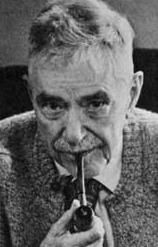 The ideological rigidity of the third period began to crack, however, with two events: the election of Franklin D. Roosevelt
as president of the United States in 1932 and Adolf Hitler
's rise to power in Germany in 1933. Roosevelt's election and the passage of the National Industrial Recovery Act
in 1933 sparked a tremendous upsurge in union organizing in 1933 and 1934. While the party line still favored creation of autonomous revolutionary unions, party activists chose to fold up those organizations and follow the mass of workers into the AFL unions they had been attacking.
The Seventh Congress of the Comintern made the change in line official in 1935, when it declared the need for a popular front
of all groups opposed to fascism. The CPUSA abandoned its opposition to the New Deal and provided many of the organizers for the Congress of Industrial Organizations
.
The party also sought unity with forces to its right. Earl Russell Browder offered to run as Norman Thomas
' running mate
on a joint Socialist Party-Communist Party ticket in the 1936 presidential election but Thomas rejected this overture.
The gesture did not mean that much in practical terms, since the CPUSA was, by 1936, effectively supporting Roosevelt in much of his trade union work. While continuing to run its own candidates for office, the CPUSA pursued a policy of representing the Democratic Party as the lesser evil in elections.
Party members also rallied to the defense of the Spanish Republic
during this period after a Nationalist military uprising moved to overthrow it, resulting in the Spanish Civil War
(1936 to 1939). The CPUSA, along with leftists throughout the world, raised funds for medical relief while many of its members made their way to Spain with the aid of the party to join the Lincoln Brigade, one of the International Brigades
. Among its other achievements, the Lincoln Brigade was the first American military force to include blacks and whites integrated on an equal basis.
Intellectually, the Popular Front
period saw the development of a strong communist influence in intellectual and artistic life. This was often through various organizations influenced or controlled by the Party or, as they were pejoratively known, "fronts
."
The CPUSA under Browder supported Stalin's show trials in the Soviet Union, called the Moscow Trials
. Therein, between August 1936 and mid-1938 the Soviet government indicted, tried, and shot virtually all of the remaining Old Bolsheviks. Beyond the show trials lay a broader purge, the Great Purge
, that killed millions. Browder uncritically supported Stalin, likening Trotskyism
to "cholera germs" and calling the purge "a signal service to the cause of progressive humanity." He compared the show trial defendants to domestic traitors Benedict Arnold
, Aaron Burr
, disloyal War of 1812 Federalists, and Confederate secessionists, while likening persons who "smeared" Stalin's name to those who had slandered Abraham Lincoln and Franklin Roosevelt.
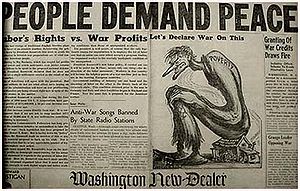 The CPUSA was adamantly opposed to fascism during the Popular Front period. Although membership in the CPUSA rose to about 75,000 by 1938, many members left the party after the Soviet Union signed the Molotov-Ribbentrop Pact
with Nazi Germany on August 24, 1939. While General Secretary Browder at first attacked Germany for its September 1, 1939 invasion of western Poland, on September 11, the CPUSA received a blunt directive from Moscow denouncing the Polish government. Between September 14–16, CPUSA leaders bickered about the direction to take.
On September 17 the Soviet Union invaded eastern Poland and occupied the Polish territory assigned to it
by the Molotov-Ribbentrop Pact, followed by co-ordination with German forces in Poland.
The British, French, and German Communist parties, all originally war supporters, abandoned their anti-Fascist crusades, demanded peace, and denounced Allied governments. The CPUSA turned the focus of its public activities from anti-fascism to advocating peace, not only opposing military preparations but also condemning those opposed to Hitler. The CPUSA attacked British Prime Minister Neville Chamberlain
and French leader Édouard Daladier
, but did not at first attack President Roosevelt, reasoning that this could devastate American Communism, blaming instead Roosevelt's advisors.
In October and November, after the Soviets invaded Finland
and forced mutual assistance pacts from Estonia, Latvia and Lithuania, the CPUSA considered Russian security sufficient justification to support the actions. Secret short wave radio broadcasts in October from Comintern
leader Georgi Dimitrov
ordered Stalinist Browder to change the CPUSA's support for Roosevelt. On October 23, the CPUSA began attacking Roosevelt.
The CPUSA dropped its boycott of Nazi goods, spread the slogans "The Yanks Are Not Coming" and "Hands Off", set up a "perpetual peace vigil" across the street from the White House and announced that Roosevelt was the head of the "war party of the American bourgeoisie." By April 1940, the CPUSA Daily Worker
's line seemed not so much antiwar as simply pro-German. A pamphlet stated the Jews had just as much to fear from Britain and France as they did Germany. In August 1940, after NKVD
agent Ramón Mercader
killed Leon Trotsky
with an ice axe
, Browder perpetuated Moscow's fiction that the killer, who had been dating one of Trotsky's secretaries, was a disillusioned follower.
In allegiance to the Soviet Union, the party changed this policy again after Adolf Hitler
broke the Molotov-Ribbentrop Pact by attacking the Soviet Union
on June 22, 1941.
Throughout the rest of World War II, the CPUSA continued a policy of militant, if sometimes bureaucratic, trade unionism while opposing strike actions at all costs. The leadership of the CPUSA was among the most vocal pro-war voices in the United States, advocating unity against fascism, supporting the prosecution of leaders of the Socialist Workers Party
under the newly enacted Smith Act
, and opposing A. Philip Randolph
's efforts to organize a march on Washington to dramatize black workers' demands for equal treatment on the job. Prominent CPUSA members and supporters, such as Dalton Trumbo
and Pete Seeger
, recalled anti-war material they had previously released.
Earl Browder expected the wartime coalition between the Soviet Union and the west to bring about a prolonged period of social harmony after the war. In order better to integrate the communist movement into American life the party was officially dissolved in 1944 and replaced by a "Communist Political Association".
That harmony proved elusive, however, and the international Communist movement swung to the left after the war ended. Browder found himself isolated when a critical letter from the leader of the French Communist Party
received wide circulation. As a result of this, in 1945 he was retired and replaced by William Z. Foster
, who would remain the senior leader of the party until his own retirement in 1958.
In line with other Communist parties worldwide, the CPUSA also swung to the left and, as a result, experienced a brief period in which a number of internal critics argued for a more leftist stance than the leadership was willing to countenance. The result was the expulsion of a handful of "premature anti-revisionists".
administration's loyalty oath program, introduced in 1947, drove some leftists out of federal employment and, more importantly, legitimized the notion of Communists as subversives, to be exposed and expelled from public and private employment. The House Committee on Un-American Activities, whose hearings were perceived as forums where current and former Communists and those sympathetic to Communism were compelled under the duress of the ruin of their careers to confess and name other Communists, made even brief affiliation with the CPUSA or any related groups grounds for public exposure and attack, inspiring local governments to adopt loyalty oaths and investigative commissions of their own. Private parties, such as the motion picture industry and self-appointed watchdog groups, extended the policy still further. This included the still controversial blacklist
of actors, writers and directors in Hollywood who had been Communists or who had fallen in with Communist-controlled or influenced organizations in the pre-war and wartime years.
The union movement purged party members as well. The CIO formally expelled a number of left-led unions in 1949 after internal disputes triggered by the party's support for Henry Wallace
's candidacy for President and its opposition to the Marshall Plan
, while other labor leaders sympathetic to the CPUSA either were driven out of their unions or dropped their alliances with the party.
The widespread fear of Communism became even more acute after the Soviets' explosion of an atomic bomb in 1949 and discovery of Soviet espionage. Ambitious politicians, including Richard Nixon
and Joseph McCarthy
, made names for themselves by exposing or threatening to expose Communists within the Truman administration or later, in McCarthy's case, within the United States Army
. Liberal groups, such as the Americans for Democratic Action
, not only distanced themselves from communists and communist causes, but defined themselves as anti-communist. The Congress outlawed the CPUSA in the Communist Control Act of 1954.http://www.history.com/this-day-in-history.do?action=Article&id=2769 However, the act was largely ineffectual thanks in part to its ambiguous language. In the 1961 case, Communist Party v. Catherwood, the United States Supreme Court ruled that the act did not bar the party from participating in New York's unemployment insurance system. No administration has tried to enforce it since.
By the mid-1950s, membership of Communist Party USA had slipped from its 1944 peak of around 80,000 to an active base of approximately 5,000. Some 1,500 of these "members" were FBI informants. To the extent that the Communist Party did survive, it was crippled by the penetration activities of these informants, who kept close surveillance on the few remaining legitimate members of the Party on behalf of FBI Director J. Edgar Hoover, and the CPUSA dried up as a base for Soviet espionage. "If it were not for me,' Hoover told a State Department official in 1963, "there would not be a Communist Party of the United States. Because I've financed the Communist Party, in order to know what they are doing." William Sullivan, chief of intelligence operations for the FBI in the 1950s, has also described Hoover's continued zeal in pursuing action against the CPUSA as "insincere", as he was fully aware of the Party's moribund condition. Senator McCarthy had also kept up his attacks on the CPUSA during the 1950s despite also being aware of its impotency.
to the Communist Party of the Soviet Union criticizing Stalin had a cataclysmic effect on the previously Stalinist majority membership CPUSA. Membership plummeted and the leadership briefly faced a challenge from a loose grouping led by Daily Worker
editor John Gates
, which wished to democratize the party. Perhaps the greatest single blow dealt to the party in this period was the loss of the Daily Worker, published since 1924, which was suspended in 1958 due to falling circulation.
Most of the critics would depart from the party demoralized, but others would remain active in progressive causes and would often end up working harmoniously with party members. This diaspora
rapidly came to provide the audience for publications like the National Guardian and Monthly Review, which were to be important in the development of the New Left in the 1960s.
The post-1956 upheavals in the CPUSA also saw the advent of a new leadership around former steel worker Gus Hall
. Hall's views were very much those of his mentor Foster, but the younger man was to be more rigorous in ensuring the party was completely orthodox than the older man in his last years. Therefore, while remaining critics who wished to liberalize the party were expelled, so too were anti-revisionist
critics who took an anti-Khrushchev stance.
Many of these critics were elements on both U.S. coasts who would come together to form the Progressive Labor Movement in 1961. Progressive Labor would come to play a role in many of the numerous Maoist
organizations of the mid-1960s and early 1970s. Jack Shulman
, Foster's secretary, also played a role in these organizations; he was not expelled from the CP, but resigned. In the 1970s, the CPUSA managed to grow in membership to about 25,000 members, despite the exodus of numerous Anti-Revisionist
and Maoist groups from its ranks.
: "[W]e came away with a new respect for the thoughtfulness, thoroughness, energy and optimism with which the Communist Party of China
and the Chinese people are going about the complex, long-term process of building socialism in a vast developing country, which is of necessity part of an increasingly globalized economy."
An overview of the Communist Party's current ideology can be found in the near-definitive report, "Reflections on Socialism", by Sam Webb, the Party's national chair. The article explains the Party's support for a democratic, anti-racist, anti-sexist, immediate left-wing change for the United States. The report also covers the fall of the Socialist Bloc, claiming that democracy was not sufficiently developed in these countries. The report states that, "On the one hand, socialism transformed and modernized backward societies, secured important economic and social rights, assisted countries breaking free of colonialism
, contributed decisively to the victory over Nazism, constituted by its mere presence a pressure on the ruling classes in the capitalist world to make concessions to their working classes and democratic movements, and acted as a counterweight to the aggressive ambitions of U.S. imperialism
for nearly fifty years." The report stresses its dedication to revolutionary struggle, but states that Americans should look for peaceful revolutionary change. Webb says that capitalism cannot solve problems such as economic stagnation, racism, gender discrimination, or poverty. The report explains that there will be many transitory stages from capitalism, to socialism, and finally to communism. On the issue of markets in a socialist society, Webb states, "Admittedly, market mechanisms
in a socialist society can generate inequality, disproportions and imbalances, destructive competition, downward pressure on wages, and monopoly cornering of commodity markets – even the danger of capitalist restoration. But this is not sufficient reason for concluding that markets have no place in a socialist economy."
The CPUSA recognizes the right of independence-seeking groups, many of whom have been led by communist and communist-oriented partisans, to defend themselves from imperialism
, but rejects the use of violence in any United States uprising. The CPUSA argues that most violence throughout modern history is the result of capitalist ruling class
violently trying to stop social change.
In order to make room for the rental of 4 floors in the CPUSA national building the CPUSA had to move its extensive archives. The archives of the Communist Party USA were donated in March, 2007 to the Tamiment Library
at New York University
. The massive donation, in 12,000 cartons, included history from the founding of the party, 20,000 books and pamphlets, and a million photographs from the archives of the Daily Worker. The Tamiment Library also holds a copy of the microfilmed archive of Communist Party documents from Soviet Archives held by the Library of Congress and from other materials which documents radical and Left history.
, its highest authority being the quadrennial National Convention. Article VI, Section 3 of the 2001 Constitution lays out certain positions as non-negotiable:
Among the points in the party's "Immediate Program" are a $12/hour minimum wage
for all workers, national universal health care
, and opposition to privatization
of United States Social Security
. Economic measures such as increased taxes on "the rich and corporations", "strong regulation" of the financial industry, "regulation and public ownership of utilities", and increased federal aid to cities and states; opposition to the Iraq War and other military interventions; opposition to free trade
treaties such as the North American Free Trade Agreement
(NAFTA); nuclear disarmament
and a reduced military budget; various civil rights
provisions; campaign finance reform
including public financing of campaigns; and election law
reform, including Instant Runoff Voting.
Seeking to "build socialism in the United States based on the revolutionary traditions and struggles" of American history, the CPUSA promotes a conception of "Bill of Rights Socialism" that will "guarantee all the freedoms we have won over centuries of struggle, and also extend the Bill of Rights to include freedom from unemployment"– as well as freedom "from poverty, from illiteracy, and from discrimination and oppression."
Reiterating the idea of property rights in socialist society as it is outlined
in Karl Marx
's Communist Manifesto, the Communist Party emphasizes that
Rather than making all wages entirely equal, the Communist Party USA holds that building socialism would entail "eliminating private wealth from stock speculation, from private ownership of large corporations, from the export of capital and jobs, and from the exploitation of large numbers of workers."
and job insecurity, which Communism understands as the natural result of the profit-driven incentives of the capitalist economy.
The Communist Party believes that "class struggle starts with the fight for wages, hours, benefits, working conditions, job security, and jobs. But it also includes an endless variety of other forms for fighting specific battles: resisting speed-up, picketing, contract negotiations, strikes, demonstrations, lobbying for pro-labor legislation, elections, and even general strikes." The Communist Party's national programs understands that workers who struggle "against the capitalist class or any part of it on any issue with the aim of improving or defending their lives" are part of the class struggle.
and other groups associated with right-wing politics–have developed in tandem with the interests of large-scale capital such as the multinational corporation
s. The state thereby becomes thrust into a proxy role that is essentially inclined to help facilitate "control by one section of the capitalist class over all others and over the whole of society."
Accordingly, the Communist Party holds that right-wing policymakers such as the neoconservatives, steering the state away from working-class interests on behalf of a disproportionately powerful capitalist class, have
From its ideological framework, the Communist Party understands imperialism as the pinnacle of capitalist development
: the state, working on behalf of the few who wield disproportionate power, assumes the role of proffering "phony rationalizations" for economically driven imperial ambition as a means to promote the sectional economic interests of big business.
In opposition to what it considers the ultimate agenda of the conservative wing of U.S. politics, the Communist Party rejects such foreign policy proposals as the Bush Doctrine
, rejecting the right of the American government to attack
Juxtaposing the support from the Republicans
and the right wing of the Democratic Party
for the Bush administration-led invasion of Iraq
with the many millions of Americans who opposed the invasion of Iraq from its beginning, the Communist Party notes the spirit of opposition towards the war coming from the American public:
The Party has consistently opposed U.S. involvement in the Korean War
, the Vietnam War
, the First Gulf War
, and the post-September 11 conflicts in both Iraq
and Afghanistan
.
The CPUSA does not believe that the threat of terrorism can be resolved through war.
The Communist Party seeks equal rights for women, equal pay for equal work, the protection of reproductive rights, together with putting an end to sexism. The Party's ranks include a Women's Equality Commission, which recognizes the role of women as an asset in moving towards building socialism.
Historically significant in American history as an early fighter for African Americans' rights and playing a leading role in protesting the lynchings of African Americans in the South, the Communist Party, in its national program today, calls racism the "classic divide-and-conquer tactic...." From its New York City base, the Communist Party's Ben Davis Club and other Communist Party organizations have been involved in local activism in Harlem
and other African American and minority communities. The Communist Party was instrumental in the founding of the progressive
Black Radical Congress
in 1998.
Historically significant in Latino
working class history as a successful organizer of the Mexican American working class in the Southwestern United States in the 1930s, the Communist Party regards working-class Latino people as another oppressed group targeted by overt racism as well as systemic discrimination in areas such as education, and sees the participation of Latino voters in a general mass movement in both party-based and nonpartisan work as an essential goal for major left-wing progress.
The Communist Party holds that racial and ethnic discrimination not only harms minorities, but is pernicious to working-class people of all backgrounds, as any discriminatory practices between demographic sections of the working class constitute an inherently divisive practice responsible for "obstructing the development of working-class consciousness, driving wedges in class unity to divert attention from class exploitation, and creating extra profits for the capitalist class."
The Communists support an end to racial profiling
. The party supports continued enforcement of civil rights
laws as well as affirmative action
.
The Party's most recently released environmental document–the CPUSA National Committee's "2008 Global Warming Report"–takes note of the necessity of "major changes in how we live, move, produce, grow, and market." These changes, the Communists believe, cannot be effectively accomplished solely on the basis of profit considerations:
Supporting cooperation between economically advanced and less economically developed nations in the area of environmental cooperation, the Communist Party USA stands in favor of promoting
The Communist Party opposes drilling in the Alaska National Wildlife Refuge
, the use of nuclear power until (and unless) there is a safe way to dispose of its waste, and conceives of nuclear war as the greatest possible environmental threat.
, but instead regards positively religious people's belief in justice
, peace and respectful relations among the peoples. To build good relations with supporters of religion, the party has its own Religious Commission.
The Communist Party has sought to play an active role in the US labor movement since its origins as part of its effort to build a mass movement of American workers to bring about their own liberation through socialist revolution. As the prospects for such a social cataclysm have faded over time, the party has increasingly emphasized the ameliorative value of trade unions in capitalist society.
in the Soviet Union, the CPUSA received a substantial subsidy from the Soviet Union. There is at least one receipt signed by Gus Hall in the KGB archives. Starting with $75,000 in 1959 this was increased gradually to $3 million in 1987. This substantial amount reflected the Party's subservience to the Moscow line
, in contrast to the Italian
and later Spanish
and British
Communist parties, whose Eurocommunism
deviated from the orthodox line in the late 1970s. Releases from the Soviet archives show that all national Communist parties that conformed to the Soviet line were funded in the same fashion. From the Communist point of view this international funding arose from the internationalist nature of Communism itself; fraternal assistance was considered the duty of Communists in any one country to give aid to their comrades in other countries. From the anti-communist point of view, this funding represented an unwarranted interference by one country in the affairs of another.
The cutoff of funds in 1989 resulted in a financial crisis, which forced the CPUSA to cut back publication in 1990 of the Party newspaper, the People's Daily World, to weekly publication, the People's Weekly World. (references for this section are provided below)
Much more controversial than mere funding, however, is the alleged involvement of CPUSA members in espionage for the Soviet Union. Whittaker Chambers
has alleged that Sandor Goldberger—also known as "Josef Peters", who commonly wrote under the name J. Peters
—headed the CPUSA's underground secret apparatus from 1932 to 1938 and pioneered its rôle as an auxiliary to Soviet intelligence activities. Bernard Schuster, Organizational Secretary of the New York District of the CPUSA, is claimed to have been the operational recruiter and conduit for members of the CPUSA into the ranks of the secret apparatus, or "Group A line".
Stalin publicly disbanded the Comintern in 1943. A Moscow NKVD message to all stations on 12 September 1943 detailed instructions for handling intelligence sources within the CPUSA after the disestablishment of the Comintern.
There are a number of decrypted World War II Soviet messages between NKVD offices in the United States and Moscow, also known as the Venona cables. The Venona cables and other published sources appear to confirm that Julius Rosenberg was guilty of espionage. Theodore Hall
, a Harvard-trained physicist
who did not join the CPUSA until 1952, began passing information on the atomic bomb to the Soviets soon after he was hired at Los Alamos
at age 19. Hall, who was known as Mlad by his KGB handlers, escaped prosecution. Hall's wife, aware of his espionage, claims that their NKVD handler had advised them to plead innocent, as the Rosenbergs did, if formally charged.
It was the belief of opponents of the CPUSA such as J. Edgar Hoover
, long-time director of the FBI, and Joseph McCarthy
, for whom McCarthyism
is named, and other anti-communists
that the CPUSA constituted an active conspiracy
, was secretive, loyal to a foreign power, and whose members assisted Soviet intelligence in the clandestine infiltration
of American government. This is the "traditionalist" view of some in the field of Communist studies
such as Harvey Klehr and John Earl Haynes, since supported by several memoirs of ex-Soviet KGB officers and information obtained from VENONA and Soviet archives.
At one time this view was shared by the majority of the United States Congress
. In the "Findings and declarations of fact" section of the Subversive Activities Control Act of 1950 (50 U.S.C. Chap. 23 Sub. IV Sec. 841), it stated,
In 1993, experts from the Library of Congress traveled to Moscow to copy previously secret archives of Communist Party USA (CPUSA) records, sent to the Soviet Union for safekeeping by party organizers. The records provided an irrefutable link between Soviet intelligence and information obtained by the CPUSA and its contacts in the U.S. government from the 1920s through the 1940s. Some documents revealed that the CPUSA was actively involved in secretly recruiting party members from African-American groups and rural farm workers. Other CPUSA records contained further evidence that Soviet sympathizers had indeed infiltrated the State Department, beginning in the 1930s. Included in CPUSA archival records were confidential letters from two U.S. ambassadors in Europe to Roosevelt and a senior State Department official. Thanks to an official in the State department sympathetic to the Party, the confidential correspondence, concerning political and economic matters in Europe, ended up in the hands of Soviet intelligence.
or the red scare. Rank and file foreign-born members of the Party were targeted and as many as possible were arrested and deported; leaders were prosecuted and in some cases sentenced to prison terms. In the late 1930s, with the authorization of President Franklin D. Roosevelt
, the Federal Bureau of Investigation
(FBI) began investigating both domestic Nazis and Communists. Congress passed the Smith Act
, which made it illegal to advocate, abet, or teach the desirability of overthrowing the government, in 1940.
In 1949, the federal government put Eugene Dennis
, William Z. Foster
and ten other CPUSA leaders on trial for advocating the violent overthrow of the government. Because the prosecution could not show that any of the defendants had openly called for violence or been involved in accumulating weapons for a proposed revolution, it relied on the testimony of former members of the party that the defendants had privately advocated the overthrow of the government and on quotations from the work of Karl Marx
, Lenin and other revolutionary figures of the past. During the course of the trial the judge held several of the defendants and all of their counsel in contempt of court.
All of the remaining eleven defendants were found guilty. The Supreme Court upheld the constitutionality of their convictions by a 6-2 vote in Dennis v. United States
, . The government then proceeded with the prosecutions of more than 100 "second string" members of the party.
Panicked by these arrests and the fear that it was compromised by informants, Dennis and other party leaders decided to go underground and to disband many affiliated groups. The move only heightened the political isolation of the leadership, while making it nearly impossible for the Party to function.
The widespread support of action against communists and their associates began to abate somewhat after Senator Joseph McCarthy
overreached himself in the Army-McCarthy Hearings
, producing a backlash. The end of the Korean War
in 1953 also led to a lessening of anxieties about subversion. The Supreme Court brought a halt to the Smith Act prosecutions in 1957 in its decision in Yates v. United States
, , which required that the government prove that the defendant had actually taken concrete steps toward the forcible overthrow of the government, rather than merely advocating it in theory.
, Charlene Mitchell
, Angela Davis
, and Jarvis Tyner
, the current executive vice chair of the Party, all ran as presidential or vice presidential candidates on the Party ticket. Others like Benjamin J. Davis
, William L. Patterson
, Harry Haywood
, James Jackson, Henry Winston
, Claude Lightfoot
, Alphaeus Hunton, Doxey Wilkerson, Claudia Jones
, and John Pittman contributed in important ways to the Party's approaches to major issues from human and civil rights, peace, women's equality, the national question, working class unity, Marxist thought, cultural struggle and more. Their contributions have had a lasting impact on not only the Party but the general public as well. Noted African American thinkers, artists, and writers such as Claude McKay
, Richard Wright
, Ann Petry
, W. E. B. Du Bois, Shirley Graham Du Bois
, Lloyd Brown
, Charles White, Elizabeth Catlett
, Paul Robeson
, Frank Marshall Davis
, Gwendolyn Brooks
, and many more were one-time members or supporters of the Party, and the Communists also had a close alliance with Harlem Congressman Adam Clayton Powell, Jr.
The party's work to appeal to African-Americans continues to this day. It was instrumental in the founding of the Black Radical Congress
in 1998.
, developed his political views as an active member of the CPUSA, but his founding in the early 1950s of the Mattachine Society
, America's second gay rights group, was not seen as something Communists, should associate with organizationally. Most Party members saw homosexuality as something done by those with fascist tendencies (following the lead of the Soviet Union in criminalizing the practice for that reason) and Hay was expelled from the party as an ideological risk. In 2004, the editors of Political Affairs
published articles detailing their self-criticism of the Party's early views of gay and lesbian rights and praised Hay's work.
, the invasion of Grenada
, and U.S. support for anti-communist military dictatorships and movements in Central America. Meanwhile, some in the peace movement
and the New Left
rejected the CPUSA for what it saw as the party's bureaucratic rigidity and for its steadfastly close association with Soviet Union.
The CPUSA has been consistently opposed to the U.S.'s 2003-2010 in Iraq.
United for Peace and Justice
, currently the largest peace and justice coalition in the U.S., includes the CPUSA as a member group, with Judith LeBlanc, who chairs the CPUSA's Peace and Solidarity Commission, being a member of the Steering Committee of UFPJ.
Marxism
Marxism is an economic and sociopolitical worldview and method of socioeconomic inquiry that centers upon a materialist interpretation of history, a dialectical view of social change, and an analysis and critique of the development of capitalism. Marxism was pioneered in the early to mid 19th...
political party
Political party
A political party is a political organization that typically seeks to influence government policy, usually by nominating their own candidates and trying to seat them in political office. Parties participate in electoral campaigns, educational outreach or protest actions...
in the United States
United States
The United States of America is a federal constitutional republic comprising fifty states and a federal district...
, established in 1919. It has a long, complex history that is closely related to the histories of similar communist parties worldwide and the U.S. labor movement.
For the first half of the 20th century, the CPUSA was the largest and most influential communist party
Communist party
A political party described as a Communist party includes those that advocate the application of the social principles of communism through a communist form of government...
in the United States. It played a very prominent role in the U.S. labor movement from the 1920s through the 1940s, having a major hand in founding most of the country's first industrial unions (which would later expel communists by adopting the Smith Act
Smith Act
The Alien Registration Act or Smith Act of 1940 is a United States federal statute that set criminal penalties for advocating the overthrow of the U.S...
) while also becoming known for opposing racism
The Communist Party and African-Americans
The Communist Party USA, historically and currently committed to complete racial equality in the United States, played a significant role in defending the rights of African-Americans during its heyday in the 1930s and 1940s....
and fighting for integration in workplaces and communities during the height of the Jim Crow period of U.S. racial segregation
Racial segregation in the United States
Racial segregation in the United States, as a general term, included the racial segregation or hypersegregation of facilities, services, and opportunities such as housing, medical care, education, employment, and transportation along racial lines...
. Historian Ellen Schrecker
Ellen Schrecker
Ellen Wolf Schrecker, Ph.D. is a professor of American history at Yeshiva University. She is currently teaching and has received the Frederick Ewen Academic Freedom Fellowship at the Tamiment Library at NYU....
concludes that decades of recent scholarship offers a "nuanced portrayal of the party as both a Stalinist sect tied to a vicious regime and the most dynamic organization within the American Left during the 1930s and '40s". In regards to the former charge, the CPUSA, claiming proletarian internationalism
Proletarian internationalism
Proletarian internationalism, sometimes referred to as international socialism, is a Marxist social class concept based on the view that capitalism is now a global system, and therefore the working class must act as a global class if it is to defeat it...
(while the U.S. Government called it espionage
Espionage
Espionage or spying involves an individual obtaining information that is considered secret or confidential without the permission of the holder of the information. Espionage is inherently clandestine, lest the legitimate holder of the information change plans or take other countermeasures once it...
), sponsored an elaborate intelligence network on behalf of the Soviet Union, involving over 500 members acting as agents. The most prominent example dealt with the Manhattan Project
Manhattan Project
The Manhattan Project was a research and development program, led by the United States with participation from the United Kingdom and Canada, that produced the first atomic bomb during World War II. From 1942 to 1946, the project was under the direction of Major General Leslie Groves of the US Army...
in which the network was accused in giving the blueprints of the atomic bomb to the Soviets; Julius and Ethel Rosenberg
Julius and Ethel Rosenberg
Ethel Greenglass Rosenberg and Julius Rosenberg were American communists who were convicted and executed in 1953 for conspiracy to commit espionage during a time of war. The charges related to their passing information about the atomic bomb to the Soviet Union...
were thereafter convicted and executed as the chief architects of this plan. Later evidence proved that the Rosenbergs did not have the plans but the use of fear of Communism and its spread, helped to render a guilty verdict.
By August 1919, only months after its founding, the CPUSA had 60,000 members, including anarchists and other radical leftists
Far left
Far left, also known as the revolutionary left, radical left and extreme left are terms which refer to the highest degree of leftist positions among left-wing politics...
, while the more moderate Socialist Party of America
Socialist Party of America
The Socialist Party of America was a multi-tendency democratic-socialist political party in the United States, formed in 1901 by a merger between the three-year-old Social Democratic Party of America and disaffected elements of the Socialist Labor Party which had split from the main organization...
had only 40,000 members. The sections of the CP's International Workers Order
International Workers Order
The International Workers Order was a Communist Party-affiliated insurance, mutual benefit and fraternal organization founded in 1930 and disbanded in 1954 as the result of legal action undertaken by the state of New York in 1951...
meanwhile organized for communism around linguistic and ethnic lines, providing mutual aid
Benefit society
A benefit society or mutual aid society is an organization or voluntary association formed to provide mutual aid, benefit or insurance for relief from sundry difficulties...
and tailored cultural activities to an IWO membership that peaked at 200,000 at its height.
But the CP's early labor and organizing successes did not last. As the decades progressed, the combined effects of the second Red Scare
Red Scare
Durrell Blackwell Durrell Blackwell The term Red Scare denotes two distinct periods of strong Anti-Communism in the United States: the First Red Scare, from 1919 to 1920, and the Second Red Scare, from 1947 to 1957. The First Red Scare was about worker revolution and...
, McCarthyism
McCarthyism
McCarthyism is the practice of making accusations of disloyalty, subversion, or treason without proper regard for evidence. The term has its origins in the period in the United States known as the Second Red Scare, lasting roughly from the late 1940s to the late 1950s and characterized by...
, Nikita Khrushchev
Nikita Khrushchev
Nikita Sergeyevich Khrushchev led the Soviet Union during part of the Cold War. He served as First Secretary of the Communist Party of the Soviet Union from 1953 to 1964, and as Chairman of the Council of Ministers, or Premier, from 1958 to 1964...
's 1956 Secret Speech
On the Personality Cult and its Consequences
On the Personality Cult and its Consequences was a report, critical of Joseph Stalin, made to the Twentieth Party Congress on February 25, 1956 by Soviet leader Nikita Khrushchev. It is more commonly known as the Secret Speech or the Khrushchev Report...
denouncing the previous decades of Joseph Stalin
Joseph Stalin
Joseph Vissarionovich Stalin was the Premier of the Soviet Union from 6 May 1941 to 5 March 1953. He was among the Bolshevik revolutionaries who brought about the October Revolution and had held the position of first General Secretary of the Communist Party of the Soviet Union's Central Committee...
's rule, and the adversities of the continued Cold War
Cold War
The Cold War was the continuing state from roughly 1946 to 1991 of political conflict, military tension, proxy wars, and economic competition between the Communist World—primarily the Soviet Union and its satellite states and allies—and the powers of the Western world, primarily the United States...
mentality, steadily weakened of the Communist Party's internal structure and confidence. CPUSA's membership in the Comintern
Comintern
The Communist International, abbreviated as Comintern, also known as the Third International, was an international communist organization initiated in Moscow during March 1919...
and its close adherence to the political positions of the Soviet Union enabled anti-communist critics to constantly present the party as not only a threatening, subversive domestic entity, but also as a "foreign" agent fundamentally alien to the "American way of life". Internal and external crises swirled together, to the point where members who did not end up in prison for party activities tended either to disappear quietly from its ranks or to adopt more moderate political positions at odds with the CPUSA's party line
Party line (politics)
In politics, the line or the party line is an idiom for a political party or social movement's canon agenda, as well as specific ideological elements specific to the organization's partisanship. The common phrase toeing the party line describes a person who speaks in a manner that conforms to his...
. By 1957, membership had dwindled to less than 10,000, of whom some 1,500 were FBI informants.
The party attempted to recover with its opposition to the Vietnam War
Vietnam War
The Vietnam War was a Cold War-era military conflict that occurred in Vietnam, Laos, and Cambodia from 1 November 1955 to the fall of Saigon on 30 April 1975. This war followed the First Indochina War and was fought between North Vietnam, supported by its communist allies, and the government of...
during the U.S. Civil rights movement
Civil rights movement
The civil rights movement was a worldwide political movement for equality before the law occurring between approximately 1950 and 1980. In many situations it took the form of campaigns of civil resistance aimed at achieving change by nonviolent forms of resistance. In some situations it was...
in the 1960s, but the continued uncritical support of the CPUSA for an increasingly stultified and militaristic Soviet Union
Soviet Union
The Soviet Union , officially the Union of Soviet Socialist Republics , was a constitutionally socialist state that existed in Eurasia between 1922 and 1991....
increasingly alienated them from the rest of the U.S. left, who saw this supportive position as outdated and even dangerous. At the same time, the party's aging membership demographics and noticeably hollow calls for "peaceful coexistence
Peaceful coexistence
Peaceful coexistence was a theory developed and applied by the Soviet Union at various points during the Cold War in the context of its ostensibly Marxist–Leninist foreign policy and was adopted by Soviet-influenced "Communist states" that they could peacefully coexist with the capitalist bloc...
" failed to speak to a new Left in the United States.
With the rise of Mikhail Gorbachev
Mikhail Gorbachev
Mikhail Sergeyevich Gorbachev is a former Soviet statesman, having served as General Secretary of the Communist Party of the Soviet Union from 1985 until 1991, and as the last head of state of the USSR, having served from 1988 until its dissolution in 1991...
and his effort to radically alter the Soviet economic and political system from the mid-1980s, the CPUSA finally became estranged from the leadership of the Soviet Union itself; the USSR cut off major funding to the CPUSA in 1989 due to the CP's opposition to glasnost
Glasnost
Glasnost was the policy of maximal publicity, openness, and transparency in the activities of all government institutions in the Soviet Union, together with freedom of information, introduced by Mikhail Gorbachev in the second half of the 1980s...
and perestroika
Perestroika
Perestroika was a political movement within the Communist Party of the Soviet Union during 1980s, widely associated with the Soviet leader Mikhail Gorbachev...
. With the dissolution of the Soviet Union
Dissolution of the Soviet Union
The dissolution of the Soviet Union was the disintegration of the federal political structures and central government of the Union of Soviet Socialist Republics , resulting in the independence of all fifteen republics of the Soviet Union between March 11, 1990 and December 25, 1991...
in 1991, the party held its convention and attempted to resolve the issue of whether the Party should reject Marxism-Leninism. The majority reasserted the party's now purely Marxist outlook, prompting a minority faction
Committees of Correspondence for Democracy and Socialism
The Committees of Correspondence for Democracy and Socialism is a democratic socialist group in the United States which originated in 1991 as the Committees of Correspondence, a moderate, reformist wing of the Communist Party USA...
which urged social democrats
Social democracy
Social democracy is a political ideology of the center-left on the political spectrum. Social democracy is officially a form of evolutionary reformist socialism. It supports class collaboration as the course to achieve socialism...
to exit the now reduced party.
The CPUSA is based in New York City. For decades, its West Coast newspaper was the People's World, and its East Coast newspaper was The Daily World
The Daily World
The Daily World is the leading daily newspaper in Aberdeen, Washington, United States. Serving Grays Harbor County and northern Pacific County counties since 1889, The Daily World is the only daily newspaper on the coast of Washington state....
. The two newspapers merged in 1986. Political Affairs Magazine
Political Affairs Magazine
Political Affairs Magazine is a monthly, online Marxist publication. It aims to provide an analysis of events from a working class point of view. Political Affairs Magazine is a publication of the Communist Party USA. It was founded in 1944 upon the closure of its predecessor, The Communist, which...
is a monthly magazine. International Publishers
International Publishers
International Publishers is a book publishing company based in New York City specializing in Marxist works of economics, political science, and history. The company was established in 1924 by A.A. Heller and Alexander Trachtenberg, using funds earned through a lucrative trade concession granted...
is its publishing house.
Formation and early history (1919–1921)
The Comintern was not happy with two communist parties and in January, 1920 dispatched an order that the two parties, which consisted of about 12,000 members, merge under the name United Communist Party, and to follow the party line established in Moscow. Part of the Communist Party of America under the leadership of Charles Ruthenberg and Jay Lovestone
Jay Lovestone
Jay Lovestone was at various times a member of the Socialist Party of America, a leader of the Communist Party USA, leader of a small oppositionist party, an anti-Communist and Central Intelligence Agency helper, and foreign policy advisor to the leadership of the AFL-CIO and various unions...
did this but a faction under the leadership of Nicholas I. Hourwich and Alexander Bittelman
Alexander Bittelman
Alexander "Alex" Bittelman was a Russian-born Jewish-American communist political activist, Marxist theorist , contributed a more complex analysis , and writer. A founding member of the Communist Party of America, Bittelman is best remembered as the chief factional lieutenant of William Z...
continued to operate independently as the Communist Party of America. A more strongly worded directive from the Comintern eventually did the trick and the parties were merged in May, 1921. Only five percent of the members of the newly formed party were native English-speakers. Many of the members came from the ranks of the Industrial Workers of the World
Industrial Workers of the World
The Industrial Workers of the World is an international union. At its peak in 1923, the organization claimed some 100,000 members in good standing, and could marshal the support of perhaps 300,000 workers. Its membership declined dramatically after a 1924 split brought on by internal conflict...
.
The first US socialist political party was the Socialist Labor Party, formed in 1876 and for many years a viable force in the international socialist movement. By the mid 1890s, however, the SLP came under the influence of Daniel De Leon, and his radical views led to widespread discontent amongst the members, leading to the formation of the reformist-oriented Socialist Party of America around the turn of the century[3] A left wing gradually emerged within the SP, much to the consternation of many Party leaders.
In January 1919, Vladimir Lenin invited the left wing of the Socialist Party of America to join Comintern. During the spring of 1919 the Left Wing Caucus of the Socialist Party, buoyed by a large influx of new members from countries involved in the Russian Revolution, prepared to wrest control from the smaller controlling faction of moderate socialists. A referendum to join Comintern passed with 90% support, but the incumbent leadership suppressed the results. Elections for the party's National Executive Committee resulted in 12 leftists being elected out of a total of 15. Calls were made to expel moderates from the party. The moderate incumbents struck back by expelling several state organizations, half a dozen language federations, and many locals, in all two-thirds of the membership.
The Socialist Party then called an emergency convention on August 30, 1919. The party's Left Wing Caucus made plans at a June conference of its own to regain control of the party, by sending delegations from the sections of the party that had been expelled to the convention to demand that they be seated. However, the language federations, eventually joined by C.E. Ruthenberg
Charles Ruthenberg
Charles Emil Ruthenberg was an American Marxist politician and a founder and long-time head of the Communist Party USA .-Biography:Charles Emil Ruthenberg was born July 9, 1882 in Cleveland, Ohio...
and Louis C. Fraina
Louis C. Fraina
Louis C. Fraina was a founding member of the American Communist Party in 1919. After running afoul of the Communist International in 1921 over the alleged misappropriation of funds, Fraina left the organized radical movement, emerging in 1930 as a left wing public intellectual by the name of Lewis...
, turned away from that effort and formed their own party, the Communist Party of America, at a separate convention on September 1, 1919. Meanwhile plans led by John Reed and Benjamin Gitlow
Benjamin Gitlow
Benjamin "Ben" Gitlow was a prominent American socialist politician of the early twentieth century and a founding member of the Communist Party USA. From the end of the 1930s, Gitlow turned to conservatism and wrote two sensational exposés of American Communism, books which were very influential...
to crash the Socialist Party convention went ahead. Tipped off, the incumbents called the police, who obligingly expelled the leftists from the hall. The remaining leftist delegates walked out and, meeting with the expelled delegates, formed the Communist Labor Party
Communist Labor Party
The Communist Labor Party of America was one of the organizational predecessors of the Communist Party USA. The group was established at the end of August 1919 following a three-way split of the Socialist Party of America...
on August 30, 1919.
The Red Scare and the communist party (1919–1923)
From its inception, the Communist Party USA came under attack from state and federal governments and later the Federal Bureau of InvestigationFederal Bureau of Investigation
The Federal Bureau of Investigation is an agency of the United States Department of Justice that serves as both a federal criminal investigative body and an internal intelligence agency . The FBI has investigative jurisdiction over violations of more than 200 categories of federal crime...
. In 1919, after a series of unattributed bombings and attempted assassinations of government officials, and judges (later traced to militant Galleanist adherents of radical anarchist Luigi Galleani
Luigi Galleani
Luigi Galleani was an Italian anarchist active in the United States from 1901 to 1919, viewed by historians as an anarchist communist and an insurrectionary anarchist. He is best known for his enthusiastic advocacy of "propaganda of the deed", i.e...
), the US Department of Justice headed by Attorney General A. Mitchell Palmer, acting under the Sedition Act of 1918
Sedition Act of 1918
The Sedition Act of 1918 was an Act of the United States Congress that extended the Espionage Act of 1917 to cover a broader range of offenses, notably speech and the expression of opinion that cast the government or the war effort in a negative light or interfered with the sale of government bonds...
, began arresting thousands of foreign-born party members, many of whom the government deported. The Communist Party was forced underground and took to the use of pseudonyms and secret meetings in an effort to evade the authorities.
The party apparatus was to a great extent underground. It re-emerged in the last days of 1921 as a legal political party called the Workers Party of America
Workers Party of America
The Workers Party of America was the name of the legal party organization used by the Communist Party USA from the last days of 1921 until the middle of 1929. As a legal political party the Workers Party accepted affiliation from independent socialist groups such as the African Blood Brotherhood,...
. As the red scare and deportations of the early 1920s ebbed, the party became bolder and more open. An element of the party, however, remained permanently underground and came to be known as the "CPUSA secret apparatus."
During this time Jews whose backgrounds derived from Eastern Europe are said to have played a very prominent and disproportionate role in the CPUSA. A majority of the members of the Socialist Party were immigrants and that an "overwhelming" percentage of the CPUSA consisted of recent immigrants, a substantial percentage of whom were Jews.
The factional war (1923–1929)
That work was, however, complicated by factional struggles within the CPUSA. The party quickly developed a number of more or less fixed factional groupings within its leadership: a faction around the party's Executive Secretary C.E. Ruthenberg, which was largely organized by his supporter Jay Lovestone
Jay Lovestone
Jay Lovestone was at various times a member of the Socialist Party of America, a leader of the Communist Party USA, leader of a small oppositionist party, an anti-Communist and Central Intelligence Agency helper, and foreign policy advisor to the leadership of the AFL-CIO and various unions...
; and the Foster-Cannon faction, headed by William Z. Foster
William Z. Foster
William Foster was a radical American labor organizer and Marxist politician, whose career included a lengthy stint as General Secretary of the Communist Party USA...
, who headed the Party's Trade Union Educational League
Trade Union Educational League
The Trade Union Educational League was established by William Z. Foster in 1920 as a means of uniting radicals within various trade unions for a common plan of action. The group was subsidized by the Communist International via the Communist Party of America from 1922...
, and James P. Cannon
James P. Cannon
James Patrick "Jim" Cannon was an American Trotskyist and a leader of the Socialist Workers Party.Born on February 11, 1890 in Rosedale, Kansas, he joined the Socialist Party of America in 1908 and the Industrial Workers of the World in 1911...
, who led the International Labor Defense (ILD) organization.
Foster, who had been deeply involved in the Steel Strike of 1919
Steel strike of 1919
The Steel Strike of 1919 was an attempt by the weakened Amalgamated Association of Iron, Steel and Tin Workers to organize the United States steel industry in the wake of World War I. The strike began on September 22, 1919, and collapsed on January 8, 1920.The AA had formed in 1876. It was a...
and had been a long-time syndicalist and a Wobbly, had strong bonds with the progressive leaders of the Chicago Federation of Labor
Chicago Federation of Labor
The Chicago Federation of Labor is an umbrella organization for unions in Chicago, Illinois, USA. It is a subordinate body of the AFL-CIO, and as of 2011 has about 320 affiliated member unions representing half a million union members in Cook County....
and, through them, with the Progressive Party (United States, 1924)
Progressive Party (United States, 1924)
The Progressive Party of 1924 was a new party created as a vehicle for Robert M. La Follette, Sr. to run for president in the 1924 election. It did not run candidates for other offices, and it disappeared after the election except in Wisconsin. Its name resembles the 1912 Progressive Party, which...
and nascent farmer-labor parties. Under pressure from the Comintern, however, the party broke off relations with both groups in 1924. In 1925 the Comintern, through its representative Sergei Gusev
Sergei Gusev
Sergei Gusev is a professional ice hockey player who played in the National Hockey League for the Dallas Stars and the Tampa Bay Lightning. He was drafted 69th overall by the Stars in the 1995 NHL Entry Draft and in four NHL seasons, he scored 4 goals and 10 assists for 14 points in 89 games,...
, ordered the majority Foster faction to surrender control to Ruthenberg's faction; Foster complied. The factional infighting within the CPUSA did not end, however; the Communist leadership of the New York locals of the International Ladies' Garment Workers' Union
International Ladies' Garment Workers' Union
The International Ladies' Garment Workers' Union was once one of the largest labor unions in the United States, one of the first U.S. unions to have a primarily female membership, and a key player in the labor history of the 1920s and 1930s...
lost the 1926 strike of cloakmakers in New York City in large part because of intra-party factional rivalries.
Ruthenberg died in 1927 and his ally, Lovestone, succeeded him as party secretary. Cannon attended the Sixth Congress of the Comintern in 1928, hoping to use his connections with leading circles within it to regain the advantage against the Lovestone faction. However Cannon and Maurice Spector
Maurice Spector
Maurice Spector was the Chairman of the Communist Party of Canada for much of the 1920s and an early follower of Leon Trotsky after his split from the Communist International....
of the Communist Party of Canada
Communist Party of Canada
The Communist Party of Canada is a communist political party in Canada. Although is it currently a minor or small political party without representation in the Federal Parliament or in provincial legislatures, historically the Party has elected representatives in Federal Parliament, Ontario...
were accidentally given a copy of Trotsky
Leon Trotsky
Leon Trotsky , born Lev Davidovich Bronshtein, was a Russian Marxist revolutionary and theorist, Soviet politician, and the founder and first leader of the Red Army....
's "Critique of the Draft Program of the Comintern", that they were instructed to read and return. Persuaded by its contents, they came to an agreement to return to America and campaign for the document's positions. A copy of the document was then smuggled out of the country in a child's toy. Back in America, Cannon and his close associates in the ILD such as Max Shachtman
Max Shachtman
Max Shachtman was an American Marxist theorist. He evolved from being an associate of Leon Trotsky to a social democrat and mentor of senior assistants to AFL-CIO President George Meany.-Beginnings:...
and Martin Abern
Martin Abern
Martin Abern was a Marxist politician who was an important leader of the Communist youth movement of the 1920s as well as a founder of the American Trotskyist movement.-Early years:...
, dubbed the "three generals without an army," began to organize support for Trotsky's theses. However, as this attempt to develop a Left Opposition
Left Opposition
The Left Opposition was a faction within the Bolshevik Party from 1923 to 1927, headed de facto by Leon Trotsky. The Left Opposition formed as part of the power struggle within the party leadership that began with the Soviet founder Vladimir Lenin's illness and intensified with his death in January...
came to light, they and their supporters were expelled. Cannon and his followers organized the Communist League of America
Communist League of America
The Communist League of America was founded by James P. Cannon, Max Shachtman and Martin Abern late in 1928 after their expulsion from the Communist Party USA for Trotskyism. The CLA was the United States section of Leon Trotsky's International Left Opposition and initially positioned itself as...
as a section of Trotsky's International Left Opposition.
At the same Congress, Lovestone had impressed the leadership of the Communist Party of the Soviet Union
Communist Party of the Soviet Union
The Communist Party of the Soviet Union was the only legal, ruling political party in the Soviet Union and one of the largest communist organizations in the world...
as a strong supporter of Nikolai Bukharin
Nikolai Bukharin
Nikolai Ivanovich Bukharin , was a Russian Marxist, Bolshevik revolutionary, and Soviet politician. He was a member of the Politburo and Central Committee , chairman of the Communist International , and the editor in chief of Pravda , the journal Bolshevik , Izvestia , and the Great Soviet...
, the general secretary of the Comintern. This was to have unfortunate consequences for Lovestone when, in 1929, Bukharin was on the losing end of a struggle with Stalin and was purged from his position on the Politburo
Politburo
Politburo , literally "Political Bureau [of the Central Committee]," is the executive committee for a number of communist political parties.-Marxist-Leninist states:...
and removed as head of the Comintern. In a reversal of the events of 1925, a Comintern delegation sent to the United States demanded that Lovestone resign as party secretary, in favor of his archrival Foster, despite the fact that Lovestone enjoyed the support of the vast majority of the American party's membership. Lovestone traveled to the Soviet Union and appealed directly to the Comintern. Stalin informed Lovestone that he "had a majority because the American Communist Party until now regarded you as the determined supporter of the Communist International. And it was only because the Party regarded you as friends of the Comintern that you had a majority in the ranks of the American Communist Party."
When Lovestone returned to the United States, he and his ally Benjamin Gitlow
Benjamin Gitlow
Benjamin "Ben" Gitlow was a prominent American socialist politician of the early twentieth century and a founding member of the Communist Party USA. From the end of the 1930s, Gitlow turned to conservatism and wrote two sensational exposés of American Communism, books which were very influential...
were purged despite holding the leadership of the party. Ostensibly, this was not due to Lovestone's insubordination in challenging a decision by Stalin, but for his support for American Exceptionalism
American exceptionalism
American exceptionalism refers to the theory that the United States is qualitatively different from other countries. In this view, America's exceptionalism stems from its emergence from a revolution, becoming "the first new nation," and developing a uniquely American ideology, based on liberty,...
, the thesis that socialism could be achieved peacefully in the USA. Lovestone and Gitlow formed their own group called the "Communist Party (Opposition)", a section of the pro-Bukharin International Communist Opposition, which was initially larger than the Trotskyists but failed to survive past 1941. Lovestone had initially called his faction the "Communist Party (Majority Group)" in the expectation that the majority of the CPUSA's members would join him, but only a few hundred people joined his new organization.
The Third Period (1928–1935)
The upheavals within the CPUSA in 1928 were an echo of a much more significant change: Stalin's decision to break off any form of collaboration with western socialist parties, which were now condemned as "social fascists." This policy had particularly severe consequences in Germany, where the German Communist PartyCommunist Party of Germany
The Communist Party of Germany was a major political party in Germany between 1918 and 1933, and a minor party in West Germany in the postwar period until it was banned in 1956...
not only refused to work in alliance with the German Social Democratic Party
Social Democratic Party of Germany
The Social Democratic Party of Germany is a social-democratic political party in Germany...
, but attacked it and its members.
The impact of this policy in the U.S. was counted in membership figures. In 1928 there were about 24,000 members. By 1932 the total had fallen to 6,000 members.
Opposing Stalin's Third Period
Third Period
The Third Period is a ideological concept adopted by the Communist International at its 6th World Congress, held in Moscow in the summer of 1928....
policies in the Communist Party USA was James P. Cannon
James P. Cannon
James Patrick "Jim" Cannon was an American Trotskyist and a leader of the Socialist Workers Party.Born on February 11, 1890 in Rosedale, Kansas, he joined the Socialist Party of America in 1908 and the Industrial Workers of the World in 1911...
. For this action, he was expelled from the party. He then founded the Communist League of America
Communist League of America
The Communist League of America was founded by James P. Cannon, Max Shachtman and Martin Abern late in 1928 after their expulsion from the Communist Party USA for Trotskyism. The CLA was the United States section of Leon Trotsky's International Left Opposition and initially positioned itself as...
with Max Shachtman
Max Shachtman
Max Shachtman was an American Marxist theorist. He evolved from being an associate of Leon Trotsky to a social democrat and mentor of senior assistants to AFL-CIO President George Meany.-Beginnings:...
and Martin Abern
Martin Abern
Martin Abern was a Marxist politician who was an important leader of the Communist youth movement of the 1920s as well as a founder of the American Trotskyist movement.-Early years:...
, and started publishing The Militant
The Militant
The Militant is an international Socialist newsweekly connected to the Socialist Workers Party and the Pathfinder Tendency. It is published in the United States and distributed in other countries such as Canada, the United Kingdom, Australia, France, Sweden, Iceland, and New...
. It declared itself to be an external faction of the Communist Party until, as the Trotskyists saw it, Stalin's policies in Germany helped Hitler take power. At that point they started working towards the founding of a new international, the Fourth International
Fourth International
The Fourth International is the communist international organisation consisting of followers of Leon Trotsky , with the declared dedicated goal of helping the working class bring about socialism...
.
In the United States the principal impact of the Third Period was to end the CPUSA's efforts to organize within the AFL through the TUEL and to turn its efforts into organizing dual unions
Dual unionism
Dual unionism is the development of a union or political organization parallel to and within an existing labor union. In some cases, the term may refer to the situation where two unions claim the right to organize the same workers....
through the Trade Union Unity League
Trade Union Unity League
The Trade Union Unity League was an industrial union umbrella organization of the Communist Party of the United States between 1929 and 1935...
. Foster went along with this change, even though it contradicted the policies he had fought for previously.
By 1930, the party adopted the title of Communist Party of the USA, with the slogan of "the united front from below". The Party devoted much of its energy in the Great Depression
Great Depression
The Great Depression was a severe worldwide economic depression in the decade preceding World War II. The timing of the Great Depression varied across nations, but in most countries it started in about 1929 and lasted until the late 1930s or early 1940s...
to organizing the unemployed, attempting to found "red" unions, championing the rights of African-Americans and fighting evictions of farmers and the working poor. At the same time, the Party attempted to weave its sectarian revolutionary politics into its day-to-day defense of workers, usually with only limited success. They recruited more disaffected members of the Socialist Party and an organization of African-American socialists called the African Blood Brotherhood
African Blood Brotherhood
The African Blood Brotherhood for African Liberation and Redemption was a radical U.S. black liberation organization established in 1919 in New York City by journalist Cyril Briggs. The group was established as a propaganda organization built on the model of the secret society...
, some of whose members, particularly Harry Haywood
Harry Haywood
Harry Haywood was a leading figure in both the Communist Party of the United States and the Communist Party of the Soviet Union . He contributed major theory to Marxist thinking on the national question of African Americans in the United States...
, would later play important roles in communist work among blacks.
In 1932, the retiring head of the CPUSA, William Z. Foster
William Z. Foster
William Foster was a radical American labor organizer and Marxist politician, whose career included a lengthy stint as General Secretary of the Communist Party USA...
, published a book entitled Toward Soviet America
Toward Soviet America
Toward Soviet America is a book written by Communist Party, USA Chairman William Z. Foster, in 1932. The book documented the rise of socialism in the Soviet Union, the crisis facing capitalism, the need for revolution, and a vision of what a socialist society would be like...
, which laid out the Communist Party's plans for revolution and the building of a new socialist society based on the model of Soviet Russia. In that same year Earl Browder
Earl Browder
Earl Russell Browder was an American communist and General Secretary of the Communist Party USA from 1934 to 1945. He was expelled from the party in 1946.- Early years :...
became General Secretary of the Party. At first Browder moved the party closer to Soviet interests, and helped to develop its secret apparatus or underground network. He also assisted in the recruitment of espionage sources and agents for the Soviet NKVD
NKVD
The People's Commissariat for Internal Affairs was the public and secret police organization of the Soviet Union that directly executed the rule of power of the Soviets, including political repression, during the era of Joseph Stalin....
. Browder's own younger sister Margerite was an NKVD operative in Europe until removed from those duties at Browder's request. It was at this point that the CPUSA's foreign policy platform came under the complete control of Stalin, who enforced his directives through his secret police and foreign intelligence service, the NKVD. The NKVD controlled the secret apparatus of the CPUSA, including responsibility for political murders, kidnappings, and assassinations.
The Popular Front (1935–1939)
Franklin D. Roosevelt
Franklin Delano Roosevelt , also known by his initials, FDR, was the 32nd President of the United States and a central figure in world events during the mid-20th century, leading the United States during a time of worldwide economic crisis and world war...
as president of the United States in 1932 and Adolf Hitler
Adolf Hitler
Adolf Hitler was an Austrian-born German politician and the leader of the National Socialist German Workers Party , commonly referred to as the Nazi Party). He was Chancellor of Germany from 1933 to 1945, and head of state from 1934 to 1945...
's rise to power in Germany in 1933. Roosevelt's election and the passage of the National Industrial Recovery Act
National Industrial Recovery Act
The National Industrial Recovery Act , officially known as the Act of June 16, 1933 The National Industrial Recovery Act (NIRA), officially known as the Act of June 16, 1933 The National Industrial Recovery Act (NIRA), officially known as the Act of June 16, 1933 (Ch. 90, 48 Stat. 195, formerly...
in 1933 sparked a tremendous upsurge in union organizing in 1933 and 1934. While the party line still favored creation of autonomous revolutionary unions, party activists chose to fold up those organizations and follow the mass of workers into the AFL unions they had been attacking.
The Seventh Congress of the Comintern made the change in line official in 1935, when it declared the need for a popular front
Popular front
A popular front is a broad coalition of different political groupings, often made up of leftists and centrists. Being very broad, they can sometimes include centrist and liberal forces as well as socialist and communist groups...
of all groups opposed to fascism. The CPUSA abandoned its opposition to the New Deal and provided many of the organizers for the Congress of Industrial Organizations
Congress of Industrial Organizations
The Congress of Industrial Organizations, or CIO, proposed by John L. Lewis in 1932, was a federation of unions that organized workers in industrial unions in the United States and Canada from 1935 to 1955. The Taft-Hartley Act of 1947 required union leaders to swear that they were not...
.
The party also sought unity with forces to its right. Earl Russell Browder offered to run as Norman Thomas
Norman Thomas
Norman Mattoon Thomas was a leading American socialist, pacifist, and six-time presidential candidate for the Socialist Party of America.-Early years:...
' running mate
Running mate
A running mate is a person running together with another person on a joint ticket during an election. The term is most often used in reference to the person in the subordinate position but can also properly be used when referring to both candidates, such as "Michael Dukakis and Lloyd Bentsen were...
on a joint Socialist Party-Communist Party ticket in the 1936 presidential election but Thomas rejected this overture.
The gesture did not mean that much in practical terms, since the CPUSA was, by 1936, effectively supporting Roosevelt in much of his trade union work. While continuing to run its own candidates for office, the CPUSA pursued a policy of representing the Democratic Party as the lesser evil in elections.
Party members also rallied to the defense of the Spanish Republic
Second Spanish Republic
The Second Spanish Republic was the government of Spain between April 14 1931, and its destruction by a military rebellion, led by General Francisco Franco....
during this period after a Nationalist military uprising moved to overthrow it, resulting in the Spanish Civil War
Spanish Civil War
The Spanish Civil WarAlso known as The Crusade among Nationalists, the Fourth Carlist War among Carlists, and The Rebellion or Uprising among Republicans. was a major conflict fought in Spain from 17 July 1936 to 1 April 1939...
(1936 to 1939). The CPUSA, along with leftists throughout the world, raised funds for medical relief while many of its members made their way to Spain with the aid of the party to join the Lincoln Brigade, one of the International Brigades
International Brigades
The International Brigades were military units made up of volunteers from different countries, who traveled to Spain to defend the Second Spanish Republic in the Spanish Civil War between 1936 and 1939....
. Among its other achievements, the Lincoln Brigade was the first American military force to include blacks and whites integrated on an equal basis.
Intellectually, the Popular Front
Popular front
A popular front is a broad coalition of different political groupings, often made up of leftists and centrists. Being very broad, they can sometimes include centrist and liberal forces as well as socialist and communist groups...
period saw the development of a strong communist influence in intellectual and artistic life. This was often through various organizations influenced or controlled by the Party or, as they were pejoratively known, "fronts
Communist front
A Communist front organization is an organization identified to be a front organization under the effective control of a Communist party, the Communist International or other Communist organizations. Lenin originated the idea in his manifesto of 1902, "What Is to Be Done?"...
."
The CPUSA under Browder supported Stalin's show trials in the Soviet Union, called the Moscow Trials
Moscow Trials
The Moscow Trials were a series of show trials conducted in the Soviet Union and orchestrated by Joseph Stalin during the Great Purge of the 1930s. The victims included most of the surviving Old Bolsheviks, as well as the leadership of the Soviet secret police...
. Therein, between August 1936 and mid-1938 the Soviet government indicted, tried, and shot virtually all of the remaining Old Bolsheviks. Beyond the show trials lay a broader purge, the Great Purge
Great Purge
The Great Purge was a series of campaigns of political repression and persecution in the Soviet Union orchestrated by Joseph Stalin from 1936 to 1938...
, that killed millions. Browder uncritically supported Stalin, likening Trotskyism
Trotskyism
Trotskyism is the theory of Marxism as advocated by Leon Trotsky. Trotsky considered himself an orthodox Marxist and Bolshevik-Leninist, arguing for the establishment of a vanguard party of the working-class...
to "cholera germs" and calling the purge "a signal service to the cause of progressive humanity." He compared the show trial defendants to domestic traitors Benedict Arnold
Benedict Arnold
Benedict Arnold V was a general during the American Revolutionary War. He began the war in the Continental Army but later defected to the British Army. While a general on the American side, he obtained command of the fort at West Point, New York, and plotted to surrender it to the British forces...
, Aaron Burr
Aaron Burr
Aaron Burr, Jr. was an important political figure in the early history of the United States of America. After serving as a Continental Army officer in the Revolutionary War, Burr became a successful lawyer and politician...
, disloyal War of 1812 Federalists, and Confederate secessionists, while likening persons who "smeared" Stalin's name to those who had slandered Abraham Lincoln and Franklin Roosevelt.
World War II and after (1939–1947)
Molotov-Ribbentrop Pact
The Molotov–Ribbentrop Pact, named after the Soviet foreign minister Vyacheslav Molotov and the German foreign minister Joachim von Ribbentrop, was an agreement officially titled the Treaty of Non-Aggression between Germany and the Soviet Union and signed in Moscow in the late hours of 23 August 1939...
with Nazi Germany on August 24, 1939. While General Secretary Browder at first attacked Germany for its September 1, 1939 invasion of western Poland, on September 11, the CPUSA received a blunt directive from Moscow denouncing the Polish government. Between September 14–16, CPUSA leaders bickered about the direction to take.
On September 17 the Soviet Union invaded eastern Poland and occupied the Polish territory assigned to it
Soviet invasion of Poland
Soviet invasion of Poland can refer to:* the second phase of the Polish-Soviet War of 1920 when Soviet armies marched on Warsaw, Poland* Soviet invasion of Poland of 1939 when Soviet Union allied with Nazi Germany attacked Second Polish Republic...
by the Molotov-Ribbentrop Pact, followed by co-ordination with German forces in Poland.
The British, French, and German Communist parties, all originally war supporters, abandoned their anti-Fascist crusades, demanded peace, and denounced Allied governments. The CPUSA turned the focus of its public activities from anti-fascism to advocating peace, not only opposing military preparations but also condemning those opposed to Hitler. The CPUSA attacked British Prime Minister Neville Chamberlain
Neville Chamberlain
Arthur Neville Chamberlain FRS was a British Conservative politician who served as Prime Minister of the United Kingdom from May 1937 to May 1940. Chamberlain is best known for his appeasement foreign policy, and in particular for his signing of the Munich Agreement in 1938, conceding the...
and French leader Édouard Daladier
Édouard Daladier
Édouard Daladier was a French Radical politician and the Prime Minister of France at the start of the Second World War.-Career:Daladier was born in Carpentras, Vaucluse. Later, he would become known to many as "the bull of Vaucluse" because of his thick neck and large shoulders and determined...
, but did not at first attack President Roosevelt, reasoning that this could devastate American Communism, blaming instead Roosevelt's advisors.
In October and November, after the Soviets invaded Finland
Winter War
The Winter War was a military conflict between the Soviet Union and Finland. It began with a Soviet offensive on 30 November 1939 – three months after the start of World War II and the Soviet invasion of Poland – and ended on 13 March 1940 with the Moscow Peace Treaty...
and forced mutual assistance pacts from Estonia, Latvia and Lithuania, the CPUSA considered Russian security sufficient justification to support the actions. Secret short wave radio broadcasts in October from Comintern
Comintern
The Communist International, abbreviated as Comintern, also known as the Third International, was an international communist organization initiated in Moscow during March 1919...
leader Georgi Dimitrov
Georgi Dimitrov
Georgi Dimitrov Mikhaylov , also known as Georgi Mikhaylovich Dimitrov , was a Bulgarian Communist politician...
ordered Stalinist Browder to change the CPUSA's support for Roosevelt. On October 23, the CPUSA began attacking Roosevelt.
The CPUSA dropped its boycott of Nazi goods, spread the slogans "The Yanks Are Not Coming" and "Hands Off", set up a "perpetual peace vigil" across the street from the White House and announced that Roosevelt was the head of the "war party of the American bourgeoisie." By April 1940, the CPUSA Daily Worker
Daily Worker
The Daily Worker was a newspaper published in New York City by the Communist Party USA, a formerly Comintern-affiliated organization. Publication began in 1924. While it generally reflected the prevailing views of the party, some attempts were made to make it appear that the paper reflected a...
's line seemed not so much antiwar as simply pro-German. A pamphlet stated the Jews had just as much to fear from Britain and France as they did Germany. In August 1940, after NKVD
NKVD
The People's Commissariat for Internal Affairs was the public and secret police organization of the Soviet Union that directly executed the rule of power of the Soviets, including political repression, during the era of Joseph Stalin....
agent Ramón Mercader
Ramón Mercader
Jaime Ramón Mercader del Río Hernández was a Spanish communist who became famous as the murderer of Russian Communist ideologist Leon Trotsky in 1940, in Mexico...
killed Leon Trotsky
Leon Trotsky
Leon Trotsky , born Lev Davidovich Bronshtein, was a Russian Marxist revolutionary and theorist, Soviet politician, and the founder and first leader of the Red Army....
with an ice axe
Ice axe
An ice axe, is a multi-purpose ice and snow tool used by mountaineers both in the ascent and descent of routes which involve frozen conditions. It can be held and employed in a number of different ways, depending on the terrain encountered...
, Browder perpetuated Moscow's fiction that the killer, who had been dating one of Trotsky's secretaries, was a disillusioned follower.
In allegiance to the Soviet Union, the party changed this policy again after Adolf Hitler
Adolf Hitler
Adolf Hitler was an Austrian-born German politician and the leader of the National Socialist German Workers Party , commonly referred to as the Nazi Party). He was Chancellor of Germany from 1933 to 1945, and head of state from 1934 to 1945...
broke the Molotov-Ribbentrop Pact by attacking the Soviet Union
Operation Barbarossa
Operation Barbarossa was the code name for Germany's invasion of the Soviet Union during World War II that began on 22 June 1941. Over 4.5 million troops of the Axis powers invaded the USSR along a front., the largest invasion in the history of warfare...
on June 22, 1941.
Throughout the rest of World War II, the CPUSA continued a policy of militant, if sometimes bureaucratic, trade unionism while opposing strike actions at all costs. The leadership of the CPUSA was among the most vocal pro-war voices in the United States, advocating unity against fascism, supporting the prosecution of leaders of the Socialist Workers Party
Socialist Workers Party (United States)
The Socialist Workers Party is a far-left political organization in the United States. The group places a priority on "solidarity work" to aid strikes and is strongly supportive of Cuba...
under the newly enacted Smith Act
Smith Act
The Alien Registration Act or Smith Act of 1940 is a United States federal statute that set criminal penalties for advocating the overthrow of the U.S...
, and opposing A. Philip Randolph
A. Philip Randolph
Asa Philip Randolph was a leader in the African American civil-rights movement and the American labor movement. He organized and led the Brotherhood of Sleeping Car Porters, the first predominantly Negro labor union. In the early civil-rights movement, Randolph led the March on Washington...
's efforts to organize a march on Washington to dramatize black workers' demands for equal treatment on the job. Prominent CPUSA members and supporters, such as Dalton Trumbo
Dalton Trumbo
James Dalton Trumbo was an American screenwriter and novelist, and one of the Hollywood Ten, a group of film professionals who refused to testify before the House Un-American Activities Committee in 1947 during the committee's investigation of Communist influences in the motion picture industry...
and Pete Seeger
Pete Seeger
Peter "Pete" Seeger is an American folk singer and was an iconic figure in the mid-twentieth century American folk music revival. A fixture on nationwide radio in the 1940s, he also had a string of hit records during the early 1950s as a member of The Weavers, most notably their recording of Lead...
, recalled anti-war material they had previously released.
Earl Browder expected the wartime coalition between the Soviet Union and the west to bring about a prolonged period of social harmony after the war. In order better to integrate the communist movement into American life the party was officially dissolved in 1944 and replaced by a "Communist Political Association".
That harmony proved elusive, however, and the international Communist movement swung to the left after the war ended. Browder found himself isolated when a critical letter from the leader of the French Communist Party
French Communist Party
The French Communist Party is a political party in France which advocates the principles of communism.Although its electoral support has declined in recent decades, the PCF retains a large membership, behind only that of the Union for a Popular Movement , and considerable influence in French...
received wide circulation. As a result of this, in 1945 he was retired and replaced by William Z. Foster
William Z. Foster
William Foster was a radical American labor organizer and Marxist politician, whose career included a lengthy stint as General Secretary of the Communist Party USA...
, who would remain the senior leader of the party until his own retirement in 1958.
In line with other Communist parties worldwide, the CPUSA also swung to the left and, as a result, experienced a brief period in which a number of internal critics argued for a more leftist stance than the leadership was willing to countenance. The result was the expulsion of a handful of "premature anti-revisionists".
Second Red Scare (1947–1958)
More important for the party was the renewal of state persecution of the CPUSA. The TrumanHarry S. Truman
Harry S. Truman was the 33rd President of the United States . As President Franklin D. Roosevelt's third vice president and the 34th Vice President of the United States , he succeeded to the presidency on April 12, 1945, when President Roosevelt died less than three months after beginning his...
administration's loyalty oath program, introduced in 1947, drove some leftists out of federal employment and, more importantly, legitimized the notion of Communists as subversives, to be exposed and expelled from public and private employment. The House Committee on Un-American Activities, whose hearings were perceived as forums where current and former Communists and those sympathetic to Communism were compelled under the duress of the ruin of their careers to confess and name other Communists, made even brief affiliation with the CPUSA or any related groups grounds for public exposure and attack, inspiring local governments to adopt loyalty oaths and investigative commissions of their own. Private parties, such as the motion picture industry and self-appointed watchdog groups, extended the policy still further. This included the still controversial blacklist
Blacklist
A blacklist is a list or register of entities who, for one reason or another, are being denied a particular privilege, service, mobility, access or recognition. As a verb, to blacklist can mean to deny someone work in a particular field, or to ostracize a person from a certain social circle...
of actors, writers and directors in Hollywood who had been Communists or who had fallen in with Communist-controlled or influenced organizations in the pre-war and wartime years.
The union movement purged party members as well. The CIO formally expelled a number of left-led unions in 1949 after internal disputes triggered by the party's support for Henry Wallace
Henry A. Wallace
Henry Agard Wallace was the 33rd Vice President of the United States , the Secretary of Agriculture , and the Secretary of Commerce . In the 1948 presidential election, Wallace was the nominee of the Progressive Party.-Early life:Henry A...
's candidacy for President and its opposition to the Marshall Plan
Marshall Plan
The Marshall Plan was the large-scale American program to aid Europe where the United States gave monetary support to help rebuild European economies after the end of World War II in order to combat the spread of Soviet communism. The plan was in operation for four years beginning in April 1948...
, while other labor leaders sympathetic to the CPUSA either were driven out of their unions or dropped their alliances with the party.
The widespread fear of Communism became even more acute after the Soviets' explosion of an atomic bomb in 1949 and discovery of Soviet espionage. Ambitious politicians, including Richard Nixon
Richard Nixon
Richard Milhous Nixon was the 37th President of the United States, serving from 1969 to 1974. The only president to resign the office, Nixon had previously served as a US representative and senator from California and as the 36th Vice President of the United States from 1953 to 1961 under...
and Joseph McCarthy
Joseph McCarthy
Joseph Raymond "Joe" McCarthy was an American politician who served as a Republican U.S. Senator from the state of Wisconsin from 1947 until his death in 1957...
, made names for themselves by exposing or threatening to expose Communists within the Truman administration or later, in McCarthy's case, within the United States Army
United States Army
The United States Army is the main branch of the United States Armed Forces responsible for land-based military operations. It is the largest and oldest established branch of the U.S. military, and is one of seven U.S. uniformed services...
. Liberal groups, such as the Americans for Democratic Action
Americans for Democratic Action
Americans for Democratic Action is an American political organization advocating progressive policies. ADA works for social and economic justice through lobbying, grassroots organizing, research and supporting progressive candidates.-History:...
, not only distanced themselves from communists and communist causes, but defined themselves as anti-communist. The Congress outlawed the CPUSA in the Communist Control Act of 1954.http://www.history.com/this-day-in-history.do?action=Article&id=2769 However, the act was largely ineffectual thanks in part to its ambiguous language. In the 1961 case, Communist Party v. Catherwood, the United States Supreme Court ruled that the act did not bar the party from participating in New York's unemployment insurance system. No administration has tried to enforce it since.
By the mid-1950s, membership of Communist Party USA had slipped from its 1944 peak of around 80,000 to an active base of approximately 5,000. Some 1,500 of these "members" were FBI informants. To the extent that the Communist Party did survive, it was crippled by the penetration activities of these informants, who kept close surveillance on the few remaining legitimate members of the Party on behalf of FBI Director J. Edgar Hoover, and the CPUSA dried up as a base for Soviet espionage. "If it were not for me,' Hoover told a State Department official in 1963, "there would not be a Communist Party of the United States. Because I've financed the Communist Party, in order to know what they are doing." William Sullivan, chief of intelligence operations for the FBI in the 1950s, has also described Hoover's continued zeal in pursuing action against the CPUSA as "insincere", as he was fully aware of the Party's moribund condition. Senator McCarthy had also kept up his attacks on the CPUSA during the 1950s despite also being aware of its impotency.
Party in crisis (1956–1989)
The 1956 Soviet invasion of Hungary and the Secret Speech of Nikita KhrushchevNikita Khrushchev
Nikita Sergeyevich Khrushchev led the Soviet Union during part of the Cold War. He served as First Secretary of the Communist Party of the Soviet Union from 1953 to 1964, and as Chairman of the Council of Ministers, or Premier, from 1958 to 1964...
to the Communist Party of the Soviet Union criticizing Stalin had a cataclysmic effect on the previously Stalinist majority membership CPUSA. Membership plummeted and the leadership briefly faced a challenge from a loose grouping led by Daily Worker
Daily Worker
The Daily Worker was a newspaper published in New York City by the Communist Party USA, a formerly Comintern-affiliated organization. Publication began in 1924. While it generally reflected the prevailing views of the party, some attempts were made to make it appear that the paper reflected a...
editor John Gates
John Gates
John "Johnny" Gates, born Solomon Regenstreif was a prominent American Communist journalist, best remembered as one of the individuals spearheading a failed attempt at liberalization of the Communist Party USA in 1957.-Early years:...
, which wished to democratize the party. Perhaps the greatest single blow dealt to the party in this period was the loss of the Daily Worker, published since 1924, which was suspended in 1958 due to falling circulation.
Most of the critics would depart from the party demoralized, but others would remain active in progressive causes and would often end up working harmoniously with party members. This diaspora
Diaspora
A diaspora is "the movement, migration, or scattering of people away from an established or ancestral homeland" or "people dispersed by whatever cause to more than one location", or "people settled far from their ancestral homelands".The word has come to refer to historical mass-dispersions of...
rapidly came to provide the audience for publications like the National Guardian and Monthly Review, which were to be important in the development of the New Left in the 1960s.
The post-1956 upheavals in the CPUSA also saw the advent of a new leadership around former steel worker Gus Hall
Gus Hall
Gus Hall, born Arvo Kustaa Hallberg , was a leader and Chairman of the Communist Party USA and its four-time U.S. presidential candidate. As a labor leader, Hall was closely associated with the so-called "Little Steel" Strike of 1937, an effort to unionize the nation's smaller, regional steel...
. Hall's views were very much those of his mentor Foster, but the younger man was to be more rigorous in ensuring the party was completely orthodox than the older man in his last years. Therefore, while remaining critics who wished to liberalize the party were expelled, so too were anti-revisionist
Anti-Revisionist
In the Marxist–Leninist movement, anti-revisionism refers to a doctrine which upholds the line of theory and practice associated with Karl Marx, Friedrich Engels, Vladimir Lenin and Joseph Stalin, and usually either Mao Zedong or Enver Hoxha as well...
critics who took an anti-Khrushchev stance.
Many of these critics were elements on both U.S. coasts who would come together to form the Progressive Labor Movement in 1961. Progressive Labor would come to play a role in many of the numerous Maoist
Maoism
Maoism, also known as the Mao Zedong Thought , is claimed by Maoists as an anti-Revisionist form of Marxist communist theory, derived from the teachings of the Chinese political leader Mao Zedong . Developed during the 1950s and 1960s, it was widely applied as the political and military guiding...
organizations of the mid-1960s and early 1970s. Jack Shulman
Jack Shulman
Jack Shulman, Jacob Shulman, is notable mainly for his dissatisfaction with the Communist Party USA's turn away from Stalinism following Nikita Khrushchev's secret speech in 1956. Following his resignation from the Party Shulman traveled to Albania and China in pursuit of his political objectives...
, Foster's secretary, also played a role in these organizations; he was not expelled from the CP, but resigned. In the 1970s, the CPUSA managed to grow in membership to about 25,000 members, despite the exodus of numerous Anti-Revisionist
Anti-Revisionist
In the Marxist–Leninist movement, anti-revisionism refers to a doctrine which upholds the line of theory and practice associated with Karl Marx, Friedrich Engels, Vladimir Lenin and Joseph Stalin, and usually either Mao Zedong or Enver Hoxha as well...
and Maoist groups from its ranks.
From glasnost to the 21st century (1989–present)
Ideologically, much appears to be up for grabs, for example regarding China. In a 2002 article in People's Weekly World, CPUSA correspondents Marilyn Bechtel and Debbie Bell said of their trip to the People's Republic of ChinaPeople's Republic of China
China , officially the People's Republic of China , is the most populous country in the world, with over 1.3 billion citizens. Located in East Asia, the country covers approximately 9.6 million square kilometres...
: "[W]e came away with a new respect for the thoughtfulness, thoroughness, energy and optimism with which the Communist Party of China
Communist Party of China
The Communist Party of China , also known as the Chinese Communist Party , is the founding and ruling political party of the People's Republic of China...
and the Chinese people are going about the complex, long-term process of building socialism in a vast developing country, which is of necessity part of an increasingly globalized economy."
An overview of the Communist Party's current ideology can be found in the near-definitive report, "Reflections on Socialism", by Sam Webb, the Party's national chair. The article explains the Party's support for a democratic, anti-racist, anti-sexist, immediate left-wing change for the United States. The report also covers the fall of the Socialist Bloc, claiming that democracy was not sufficiently developed in these countries. The report states that, "On the one hand, socialism transformed and modernized backward societies, secured important economic and social rights, assisted countries breaking free of colonialism
Colonialism
Colonialism is the establishment, maintenance, acquisition and expansion of colonies in one territory by people from another territory. It is a process whereby the metropole claims sovereignty over the colony and the social structure, government, and economics of the colony are changed by...
, contributed decisively to the victory over Nazism, constituted by its mere presence a pressure on the ruling classes in the capitalist world to make concessions to their working classes and democratic movements, and acted as a counterweight to the aggressive ambitions of U.S. imperialism
Imperialism
Imperialism, as defined by Dictionary of Human Geography, is "the creation and/or maintenance of an unequal economic, cultural, and territorial relationships, usually between states and often in the form of an empire, based on domination and subordination." The imperialism of the last 500 years,...
for nearly fifty years." The report stresses its dedication to revolutionary struggle, but states that Americans should look for peaceful revolutionary change. Webb says that capitalism cannot solve problems such as economic stagnation, racism, gender discrimination, or poverty. The report explains that there will be many transitory stages from capitalism, to socialism, and finally to communism. On the issue of markets in a socialist society, Webb states, "Admittedly, market mechanisms
Market mechanism
Market mechanism is a term from economics referring to the use of money exchanged by buyers and sellers with an open and understood system of value and time trade offs to produce the best distribution of goods and services...
in a socialist society can generate inequality, disproportions and imbalances, destructive competition, downward pressure on wages, and monopoly cornering of commodity markets – even the danger of capitalist restoration. But this is not sufficient reason for concluding that markets have no place in a socialist economy."
The CPUSA recognizes the right of independence-seeking groups, many of whom have been led by communist and communist-oriented partisans, to defend themselves from imperialism
Imperialism
Imperialism, as defined by Dictionary of Human Geography, is "the creation and/or maintenance of an unequal economic, cultural, and territorial relationships, usually between states and often in the form of an empire, based on domination and subordination." The imperialism of the last 500 years,...
, but rejects the use of violence in any United States uprising. The CPUSA argues that most violence throughout modern history is the result of capitalist ruling class
Ruling class
The term ruling class refers to the social class of a given society that decides upon and sets that society's political policy - assuming there is one such particular class in the given society....
violently trying to stop social change.
In order to make room for the rental of 4 floors in the CPUSA national building the CPUSA had to move its extensive archives. The archives of the Communist Party USA were donated in March, 2007 to the Tamiment Library
Tamiment Library and Robert F. Wagner Archives
The Tamiment Library is a research library at New York University that documents radical and left history, with strengths in the histories of communism, socialism, anarchism, the New Left, the Civil Rights Movement, and utopian experiments. The Robert F. Wagner Archives, which is also housed in...
at New York University
New York University
New York University is a private, nonsectarian research university based in New York City. NYU's main campus is situated in the Greenwich Village section of Manhattan...
. The massive donation, in 12,000 cartons, included history from the founding of the party, 20,000 books and pamphlets, and a million photographs from the archives of the Daily Worker. The Tamiment Library also holds a copy of the microfilmed archive of Communist Party documents from Soviet Archives held by the Library of Congress and from other materials which documents radical and Left history.
The CPUSA constitution and program
According to its 2001 Constitution, the party operates on the principle of democratic centralismDemocratic centralism
Democratic centralism is the name given to the principles of internal organization used by Leninist political parties, and the term is sometimes used as a synonym for any Leninist policy inside a political party...
, its highest authority being the quadrennial National Convention. Article VI, Section 3 of the 2001 Constitution lays out certain positions as non-negotiable:
"struggle for the unity of the working classWorking classWorking class is a term used in the social sciences and in ordinary conversation to describe those employed in lower tier jobs , often extending to those in unemployment or otherwise possessing below-average incomes...
, against all forms of national oppression, national chauvinism, discrimination and segregation, against all racist ideologies and practices… against all manifestations of male supremacy and discrimination against women… against homophobia and all manifestations of discrimination against gayGayGay is a word that refers to a homosexual person, especially a homosexual male. For homosexual women the specific term is "lesbian"....
s, lesbianLesbianLesbian is a term most widely used in the English language to describe sexual and romantic desire between females. The word may be used as a noun, to refer to women who identify themselves or who are characterized by others as having the primary attribute of female homosexuality, or as an...
s, bisexualsBisexualityBisexuality is sexual behavior or an orientation involving physical or romantic attraction to both males and females, especially with regard to men and women. It is one of the three main classifications of sexual orientation, along with a heterosexual and a homosexual orientation, all a part of the...
and transgenderTranssexualismTranssexualism is an individual's identification with a gender inconsistent or not culturally associated with their biological sex. Simply put, it defines a person whose biological birth sex conflicts with their psychological gender...
people…"
Among the points in the party's "Immediate Program" are a $12/hour minimum wage
Minimum wage
A minimum wage is the lowest hourly, daily or monthly remuneration that employers may legally pay to workers. Equivalently, it is the lowest wage at which workers may sell their labour. Although minimum wage laws are in effect in a great many jurisdictions, there are differences of opinion about...
for all workers, national universal health care
Health care
Health care is the diagnosis, treatment, and prevention of disease, illness, injury, and other physical and mental impairments in humans. Health care is delivered by practitioners in medicine, chiropractic, dentistry, nursing, pharmacy, allied health, and other care providers...
, and opposition to privatization
Privatization
Privatization is the incidence or process of transferring ownership of a business, enterprise, agency or public service from the public sector to the private sector or to private non-profit organizations...
of United States Social Security
Social Security (United States)
In the United States, Social Security refers to the federal Old-Age, Survivors, and Disability Insurance program.The original Social Security Act and the current version of the Act, as amended encompass several social welfare and social insurance programs...
. Economic measures such as increased taxes on "the rich and corporations", "strong regulation" of the financial industry, "regulation and public ownership of utilities", and increased federal aid to cities and states; opposition to the Iraq War and other military interventions; opposition to free trade
Free trade
Under a free trade policy, prices emerge from supply and demand, and are the sole determinant of resource allocation. 'Free' trade differs from other forms of trade policy where the allocation of goods and services among trading countries are determined by price strategies that may differ from...
treaties such as the North American Free Trade Agreement
North American Free Trade Agreement
The North American Free Trade Agreement or NAFTA is an agreement signed by the governments of Canada, Mexico, and the United States, creating a trilateral trade bloc in North America. The agreement came into force on January 1, 1994. It superseded the Canada – United States Free Trade Agreement...
(NAFTA); nuclear disarmament
Nuclear disarmament
Nuclear disarmament refers to both the act of reducing or eliminating nuclear weapons and to the end state of a nuclear-free world, in which nuclear weapons are completely eliminated....
and a reduced military budget; various civil rights
Civil rights
Civil and political rights are a class of rights that protect individuals' freedom from unwarranted infringement by governments and private organizations, and ensure one's ability to participate in the civil and political life of the state without discrimination or repression.Civil rights include...
provisions; campaign finance reform
Campaign finance reform
Campaign finance reform is the common term for the political effort in the United States to change the involvement of money in politics, primarily in political campaigns....
including public financing of campaigns; and election law
Election law
Election law is a discipline falling at the juncture of constitutional law and political science. It researches "the politics of law and the law of politics"...
reform, including Instant Runoff Voting.
Bill of Rights socialism
The Communist Party USA emphasizes a vision of socialism as an extension of American democracy.Seeking to "build socialism in the United States based on the revolutionary traditions and struggles" of American history, the CPUSA promotes a conception of "Bill of Rights Socialism" that will "guarantee all the freedoms we have won over centuries of struggle, and also extend the Bill of Rights to include freedom from unemployment"– as well as freedom "from poverty, from illiteracy, and from discrimination and oppression."
Reiterating the idea of property rights in socialist society as it is outlined
in Karl Marx
Karl Marx
Karl Heinrich Marx was a German philosopher, economist, sociologist, historian, journalist, and revolutionary socialist. His ideas played a significant role in the development of social science and the socialist political movement...
's Communist Manifesto, the Communist Party emphasizes that
"Many myths have been propagated about socialism. Contrary to right-wing claims, socialism would not take away the personal private property of workers", but "the private ownership of major industries, financial institutions, and other large corporations, and the excessive luxuries of the super-rich."
Rather than making all wages entirely equal, the Communist Party USA holds that building socialism would entail "eliminating private wealth from stock speculation, from private ownership of large corporations, from the export of capital and jobs, and from the exploitation of large numbers of workers."
Living standards
Among the primary concerns of the Communist Party are the problems of unemployment, underemploymentUnderemployment
Underemployment refers to an employment situation that is insufficient in some important way for the worker, relative to a standard. Examples include holding a part-time job despite desiring full-time work, and overqualification, where the employee has education, experience, or skills beyond the...
and job insecurity, which Communism understands as the natural result of the profit-driven incentives of the capitalist economy.
"Millions of workers are unemployed, underemployed, or insecure in their jobs, even during economic upswings and periods of 'recovery' from recessions. Most workers experience long years of stagnant and declining real wages, while health and education costs soar. Many workers are forced to work second and third jobs to make ends meet. Most workers now average four different occupations during their lifetime, many involuntarily moved from job to job and career to career. Often, retirement-age workers are forced to continue working just to provide health care for themselves and their families. Millions of people continuously live below the poverty level; many suffer homelessness and hunger. Public and private programs to alleviate poverty and hunger do not reach everyone, and are inadequate even for those they do reach. With capitalist globalization, jobs move from place to place as capitalists export factories and even entire industries to other countries in a relentless search for the lowest wages."
The Communist Party believes that "class struggle starts with the fight for wages, hours, benefits, working conditions, job security, and jobs. But it also includes an endless variety of other forms for fighting specific battles: resisting speed-up, picketing, contract negotiations, strikes, demonstrations, lobbying for pro-labor legislation, elections, and even general strikes." The Communist Party's national programs understands that workers who struggle "against the capitalist class or any part of it on any issue with the aim of improving or defending their lives" are part of the class struggle.
Imperialism and war
The Communists maintain that developments within the foreign policy of the United States–as reflected in the rise of neoconservativesNeoconservatism
Neoconservatism in the United States is a branch of American conservatism. Since 2001, neoconservatism has been associated with democracy promotion, that is with assisting movements for democracy, in some cases by economic sanctions or military action....
and other groups associated with right-wing politics–have developed in tandem with the interests of large-scale capital such as the multinational corporation
Multinational corporation
A multi national corporation or enterprise , is a corporation or an enterprise that manages production or delivers services in more than one country. It can also be referred to as an international corporation...
s. The state thereby becomes thrust into a proxy role that is essentially inclined to help facilitate "control by one section of the capitalist class over all others and over the whole of society."
Accordingly, the Communist Party holds that right-wing policymakers such as the neoconservatives, steering the state away from working-class interests on behalf of a disproportionately powerful capitalist class, have
"...demonized foreign opponents of the U.S., covertly fundedIran-Contra AffairThe Iran–Contra affair , also referred to as Irangate, Contragate or Iran-Contra-Gate, was a political scandal in the United States that came to light in November 1986. During the Reagan administration, senior Reagan administration officials and President Reagan secretly facilitated the sale of...
the right-wing-initiated civil war in NicaraguaNicaraguaNicaragua is the largest country in the Central American American isthmus, bordered by Honduras to the north and Costa Rica to the south. The country is situated between 11 and 14 degrees north of the Equator in the Northern Hemisphere, which places it entirely within the tropics. The Pacific Ocean...
, and gave weaponsUnited States support for Iraq during the Iran–Iraq warUnited States support for Iraq during the Iran–Iraq War, as a counterbalance to post-revolutionary Iran, included several billion dollars worth of economic aid, the sale of dual-use technology, non-U.S. origin weaponry, military intelligence, Special Operations training, and direct involvement in...
to the Saddam HusseinSaddam HusseinSaddam Hussein Abd al-Majid al-Tikriti was the fifth President of Iraq, serving in this capacity from 16 July 1979 until 9 April 2003...
dictatorship in IraqIraqIraq ; officially the Republic of Iraq is a country in Western Asia spanning most of the northwestern end of the Zagros mountain range, the eastern part of the Syrian Desert and the northern part of the Arabian Desert....
. They picked small countries to invade, including PanamaUnited States invasion of PanamaThe United States Invasion of Panama, code-named Operation Just Cause, was the invasion of Panama by the United States in December 1989. It occurred during the administration of U.S. President George H. W...
and GrenadaInvasion of GrenadaThe Invasion of Grenada, codenamed Operation Urgent Fury, was a 1983 United States-led invasion of Grenada, a Caribbean island nation with a population of about 100,000 located north of Venezuela. Triggered by a military coup which had ousted a four-year revolutionary government, the invasion...
, testing new military equipment and strategy, and breaking down resistance at home and abroad to U.S. military invasion as a policy option."
From its ideological framework, the Communist Party understands imperialism as the pinnacle of capitalist development
Imperialism, the Highest Stage of Capitalism
Imperialism, the Highest Stage of Capitalism , by Lenin, describes the function of financial capital in generating profits from imperial colonialism, as the final stage of capitalist development to ensure greater profits...
: the state, working on behalf of the few who wield disproportionate power, assumes the role of proffering "phony rationalizations" for economically driven imperial ambition as a means to promote the sectional economic interests of big business.
In opposition to what it considers the ultimate agenda of the conservative wing of U.S. politics, the Communist Party rejects such foreign policy proposals as the Bush Doctrine
Bush Doctrine
The Bush Doctrine is a phrase used to describe various related foreign policy principles of former United States president George W. Bush. The phrase was first used by Charles Krauthammer in June 2001 to describe the Bush Administration's unilateral withdrawals from the ABM treaty and the Kyoto...
, rejecting the right of the American government to attack
"any country it wantsBush DoctrineThe Bush Doctrine is a phrase used to describe various related foreign policy principles of former United States president George W. Bush. The phrase was first used by Charles Krauthammer in June 2001 to describe the Bush Administration's unilateral withdrawals from the ABM treaty and the Kyoto...
, to conduct war without end until it succeeds everywhere, and even to use 'tactical' nuclear weapons and militarize space. Whoever does not support the U.S. policy is condemned as an opponent. Whenever international organizations, such as the United NationsUnited NationsThe United Nations is an international organization whose stated aims are facilitating cooperation in international law, international security, economic development, social progress, human rights, and achievement of world peace...
, do not support U.S. government policies, they are reluctantly tolerated until the U.S. government is able to subordinate or ignore them."
Juxtaposing the support from the Republicans
Republican Party (United States)
The Republican Party is one of the two major contemporary political parties in the United States, along with the Democratic Party. Founded by anti-slavery expansion activists in 1854, it is often called the GOP . The party's platform generally reflects American conservatism in the U.S...
and the right wing of the Democratic Party
Democratic Party (United States)
The Democratic Party is one of two major contemporary political parties in the United States, along with the Republican Party. The party's socially liberal and progressive platform is largely considered center-left in the U.S. political spectrum. The party has the lengthiest record of continuous...
for the Bush administration-led invasion of Iraq
Iraq
Iraq ; officially the Republic of Iraq is a country in Western Asia spanning most of the northwestern end of the Zagros mountain range, the eastern part of the Syrian Desert and the northern part of the Arabian Desert....
with the many millions of Americans who opposed the invasion of Iraq from its beginning, the Communist Party notes the spirit of opposition towards the war coming from the American public:
"Thousands of grassroots peace committees [were] organized by ordinary Americans... neighborhoods, small towns and universities expressing opposition in countless creative ways. Thousands of actions, vigils, teach-ins and newspaper advertisements were organized. The largest demonstrations were held since the Vietnam War. 500,000 marched in New York after the war started. Students at over 500 universities conducted a Day of Action for 'Books not Bombs.'
"Over 150 anti-war resolutions were passed by city councils. Resolutions were passed by thousands of local unions and community organizations. Local and national actions were organized on the Internet, including the 'Virtual March on Washington, D.C.'... officials were flooded with millions of calls, emails and letters.
"In an unprecedented development, large sections of the US labor movement officially opposed the war. In contrast, it took years to build labor opposition to the Vietnam WarVietnam WarThe Vietnam War was a Cold War-era military conflict that occurred in Vietnam, Laos, and Cambodia from 1 November 1955 to the fall of Saigon on 30 April 1975. This war followed the First Indochina War and was fought between North Vietnam, supported by its communist allies, and the government of...
... ChicagoChicagoChicago is the largest city in the US state of Illinois. With nearly 2.7 million residents, it is the most populous city in the Midwestern United States and the third most populous in the US, after New York City and Los Angeles...
labor leaders formed Labor United for Peace, Justice and Prosperity. They concluded that mass education of their members was essential to counter false propaganda, and that the fight for the peace, economic security and democratic rights was interrelated.
The Party has consistently opposed U.S. involvement in the Korean War
Korean War
The Korean War was a conventional war between South Korea, supported by the United Nations, and North Korea, supported by the People's Republic of China , with military material aid from the Soviet Union...
, the Vietnam War
Vietnam War
The Vietnam War was a Cold War-era military conflict that occurred in Vietnam, Laos, and Cambodia from 1 November 1955 to the fall of Saigon on 30 April 1975. This war followed the First Indochina War and was fought between North Vietnam, supported by its communist allies, and the government of...
, the First Gulf War
Gulf War
The Persian Gulf War , commonly referred to as simply the Gulf War, was a war waged by a U.N.-authorized coalition force from 34 nations led by the United States, against Iraq in response to Iraq's invasion and annexation of Kuwait.The war is also known under other names, such as the First Gulf...
, and the post-September 11 conflicts in both Iraq
Iraq
Iraq ; officially the Republic of Iraq is a country in Western Asia spanning most of the northwestern end of the Zagros mountain range, the eastern part of the Syrian Desert and the northern part of the Arabian Desert....
and Afghanistan
Afghanistan
Afghanistan , officially the Islamic Republic of Afghanistan, is a landlocked country located in the centre of Asia, forming South Asia, Central Asia and the Middle East. With a population of about 29 million, it has an area of , making it the 42nd most populous and 41st largest nation in the world...
.
The CPUSA does not believe that the threat of terrorism can be resolved through war.
Women and minorities
The Communist Party USA's Constitution defines the working class as a class which is "multiracial, multinational, and unites men and women, young and old, employed and unemployed, organized and unorganized, gay and straight, native-born and immigrant, urban and rural, and composed of workers who perform a large range of physical and mental labor–the vast majority of our society."The Communist Party seeks equal rights for women, equal pay for equal work, the protection of reproductive rights, together with putting an end to sexism. The Party's ranks include a Women's Equality Commission, which recognizes the role of women as an asset in moving towards building socialism.
Historically significant in American history as an early fighter for African Americans' rights and playing a leading role in protesting the lynchings of African Americans in the South, the Communist Party, in its national program today, calls racism the "classic divide-and-conquer tactic...." From its New York City base, the Communist Party's Ben Davis Club and other Communist Party organizations have been involved in local activism in Harlem
Harlem
Harlem is a neighborhood in the New York City borough of Manhattan, which since the 1920s has been a major African-American residential, cultural and business center. Originally a Dutch village, formally organized in 1658, it is named after the city of Haarlem in the Netherlands...
and other African American and minority communities. The Communist Party was instrumental in the founding of the progressive
Progressivism
Progressivism is an umbrella term for a political ideology advocating or favoring social, political, and economic reform or changes. Progressivism is often viewed by some conservatives, constitutionalists, and libertarians to be in opposition to conservative or reactionary ideologies.The...
Black Radical Congress
Black Radical Congress
The Black Radical Congress or BRC is an organization founded in 1998 in Chicago. It is a grassroots network of individuals and organizations of African descent focused on advocating for broad progressive social justice, racial equality and economic justice goals within the United States.-History:At...
in 1998.
Historically significant in Latino
Hispanic and Latino Americans
Hispanic or Latino Americans are Americans with origins in the Hispanic countries of Latin America or in Spain, and in general all persons in the United States who self-identify as Hispanic or Latino.1990 Census of Population and Housing: A self-designated classification for people whose origins...
working class history as a successful organizer of the Mexican American working class in the Southwestern United States in the 1930s, the Communist Party regards working-class Latino people as another oppressed group targeted by overt racism as well as systemic discrimination in areas such as education, and sees the participation of Latino voters in a general mass movement in both party-based and nonpartisan work as an essential goal for major left-wing progress.
The Communist Party holds that racial and ethnic discrimination not only harms minorities, but is pernicious to working-class people of all backgrounds, as any discriminatory practices between demographic sections of the working class constitute an inherently divisive practice responsible for "obstructing the development of working-class consciousness, driving wedges in class unity to divert attention from class exploitation, and creating extra profits for the capitalist class."
The Communists support an end to racial profiling
Racial profiling
Racial profiling refers to the use of an individual’s race or ethnicity by law enforcement personnel as a key factor in deciding whether to engage in enforcement...
. The party supports continued enforcement of civil rights
Civil rights
Civil and political rights are a class of rights that protect individuals' freedom from unwarranted infringement by governments and private organizations, and ensure one's ability to participate in the civil and political life of the state without discrimination or repression.Civil rights include...
laws as well as affirmative action
Affirmative action
Affirmative action refers to policies that take factors including "race, color, religion, gender, sexual orientation or national origin" into consideration in order to benefit an underrepresented group, usually as a means to counter the effects of a history of discrimination.-Origins:The term...
.
The environment
The Communist Party notes its commitment to participating in environmental movements wherever possible, emphasizing the significance of building unity between the environmental movement and other progressive tendencies.The Party's most recently released environmental document–the CPUSA National Committee's "2008 Global Warming Report"–takes note of the necessity of "major changes in how we live, move, produce, grow, and market." These changes, the Communists believe, cannot be effectively accomplished solely on the basis of profit considerations:
"They require long-term planning, massive investment in redesigning and re-engineering, collective input, husbanding resources, social investment in research for long-term sustainability, and major conservation efforts...Various approaches blame the victims. Supposedly the only solution is to change individual consumer choices, since people in general are claimed to cause the problem. But consumers, workers, and poor people don’t have any say in energy plant construction, in decisions about trade or plant relocation or job export, in deciding on tax subsidies to polluting industries like the oil industry."
Supporting cooperation between economically advanced and less economically developed nations in the area of environmental cooperation, the Communist Party USA stands in favor of promoting
"transfer from developed countries to developing countries of sustainable technology, and funds for capital investment in sustainable agriculture, energy, and industry. We should support efforts to get the developed nations to make major contributions to a fund to protect the rainforests from devastation."
The Communist Party opposes drilling in the Alaska National Wildlife Refuge
Arctic National Wildlife Refuge
The Arctic National Wildlife Refuge is a national wildlife refuge in northeastern Alaska, United States. It consists of in the Alaska North Slope region. It is the largest National Wildlife Refuge in the country, slightly larger than the Yukon Delta National Wildlife Refuge...
, the use of nuclear power until (and unless) there is a safe way to dispose of its waste, and conceives of nuclear war as the greatest possible environmental threat.
Religion
The Communist Party is not against religionReligion
Religion is a collection of cultural systems, belief systems, and worldviews that establishes symbols that relate humanity to spirituality and, sometimes, to moral values. Many religions have narratives, symbols, traditions and sacred histories that are intended to give meaning to life or to...
, but instead regards positively religious people's belief in justice
Justice
Justice is a concept of moral rightness based on ethics, rationality, law, natural law, religion, or equity, along with the punishment of the breach of said ethics; justice is the act of being just and/or fair.-Concept of justice:...
, peace and respectful relations among the peoples. To build good relations with supporters of religion, the party has its own Religious Commission.
The U.S. labor movement
- See main article: Communists in the U.S. Labor Movement (1919–1937), Communists in the U.S. Labor Movement (1937–1950)
The Communist Party has sought to play an active role in the US labor movement since its origins as part of its effort to build a mass movement of American workers to bring about their own liberation through socialist revolution. As the prospects for such a social cataclysm have faded over time, the party has increasingly emphasized the ameliorative value of trade unions in capitalist society.
Soviet funding and espionage
From 1959 until 1989, when Gus Hall attacked the initiatives taken by Mikhail GorbachevMikhail Gorbachev
Mikhail Sergeyevich Gorbachev is a former Soviet statesman, having served as General Secretary of the Communist Party of the Soviet Union from 1985 until 1991, and as the last head of state of the USSR, having served from 1988 until its dissolution in 1991...
in the Soviet Union, the CPUSA received a substantial subsidy from the Soviet Union. There is at least one receipt signed by Gus Hall in the KGB archives. Starting with $75,000 in 1959 this was increased gradually to $3 million in 1987. This substantial amount reflected the Party's subservience to the Moscow line
Political line
A political line is the general view a political party, organization, faction, or ideology takes on a given question. The existence of a political line gives its advocates guidance on what to say, which makes their work easier. It also gives opponents an understanding of who is linked together by...
, in contrast to the Italian
Italian Communist Party
The Italian Communist Party was a communist political party in Italy.The PCI was founded as Communist Party of Italy on 21 January 1921 in Livorno, by seceding from the Italian Socialist Party . Amadeo Bordiga and Antonio Gramsci led the split. Outlawed during the Fascist regime, the party played...
and later Spanish
Spanish Communist Party
Spanish Communist Party , was the first communist party in Spain, formed out of the Federación de Juventudes Socialistas . The founders of the party, that had belonged to leftwing within FJS, included Ramón Merino Gracia, Manuel Ugarte, Pedro Illescasm Luis Portela, Tiburicio Pico and Rito Estaban...
and British
Communist Party of Great Britain
The Communist Party of Great Britain was the largest communist party in Great Britain, although it never became a mass party like those in France and Italy. It existed from 1920 to 1991.-Formation:...
Communist parties, whose Eurocommunism
Eurocommunism
Eurocommunism was a trend in the 1970s and 1980s within various Western European communist parties to develop a theory and practice of social transformation that was more relevant in a Western European democracy and less aligned to the influence or control of the Communist Party of the Soviet...
deviated from the orthodox line in the late 1970s. Releases from the Soviet archives show that all national Communist parties that conformed to the Soviet line were funded in the same fashion. From the Communist point of view this international funding arose from the internationalist nature of Communism itself; fraternal assistance was considered the duty of Communists in any one country to give aid to their comrades in other countries. From the anti-communist point of view, this funding represented an unwarranted interference by one country in the affairs of another.
The cutoff of funds in 1989 resulted in a financial crisis, which forced the CPUSA to cut back publication in 1990 of the Party newspaper, the People's Daily World, to weekly publication, the People's Weekly World. (references for this section are provided below)
Much more controversial than mere funding, however, is the alleged involvement of CPUSA members in espionage for the Soviet Union. Whittaker Chambers
Whittaker Chambers
Whittaker Chambers was born Jay Vivian Chambers and also known as David Whittaker Chambers , was an American writer and editor. After being a Communist Party USA member and Soviet spy, he later renounced communism and became an outspoken opponent later testifying in the perjury and espionage trial...
has alleged that Sandor Goldberger—also known as "Josef Peters", who commonly wrote under the name J. Peters
J. Peters
J. Peters was the most commonly known pseudonym of a man who last went by the name "Alexander Stevens" in 1949. Peters was an ethnic Jewish journalist and political activist who was a leading figure of the Hungarian language section of the Communist Party USA in the 1920s and 1930s...
—headed the CPUSA's underground secret apparatus from 1932 to 1938 and pioneered its rôle as an auxiliary to Soviet intelligence activities. Bernard Schuster, Organizational Secretary of the New York District of the CPUSA, is claimed to have been the operational recruiter and conduit for members of the CPUSA into the ranks of the secret apparatus, or "Group A line".
Stalin publicly disbanded the Comintern in 1943. A Moscow NKVD message to all stations on 12 September 1943 detailed instructions for handling intelligence sources within the CPUSA after the disestablishment of the Comintern.
There are a number of decrypted World War II Soviet messages between NKVD offices in the United States and Moscow, also known as the Venona cables. The Venona cables and other published sources appear to confirm that Julius Rosenberg was guilty of espionage. Theodore Hall
Theodore Hall
Theodore Alvin Hall was an American physicist and an atomic spy for the Soviet Union, who, during his work on US efforts to develop the first atomic bomb during World War II , gave a detailed description of the "Fat Man" plutonium bomb, and of processes for purifying plutonium, to Soviet...
, a Harvard-trained physicist
Physicist
A physicist is a scientist who studies or practices physics. Physicists study a wide range of physical phenomena in many branches of physics spanning all length scales: from sub-atomic particles of which all ordinary matter is made to the behavior of the material Universe as a whole...
who did not join the CPUSA until 1952, began passing information on the atomic bomb to the Soviets soon after he was hired at Los Alamos
Los Alamos National Laboratory
Los Alamos National Laboratory is a United States Department of Energy national laboratory, managed and operated by Los Alamos National Security , located in Los Alamos, New Mexico...
at age 19. Hall, who was known as Mlad by his KGB handlers, escaped prosecution. Hall's wife, aware of his espionage, claims that their NKVD handler had advised them to plead innocent, as the Rosenbergs did, if formally charged.
It was the belief of opponents of the CPUSA such as J. Edgar Hoover
J. Edgar Hoover
John Edgar Hoover was the first Director of the Federal Bureau of Investigation of the United States. Appointed director of the Bureau of Investigation—predecessor to the FBI—in 1924, he was instrumental in founding the FBI in 1935, where he remained director until his death in 1972...
, long-time director of the FBI, and Joseph McCarthy
Joseph McCarthy
Joseph Raymond "Joe" McCarthy was an American politician who served as a Republican U.S. Senator from the state of Wisconsin from 1947 until his death in 1957...
, for whom McCarthyism
McCarthyism
McCarthyism is the practice of making accusations of disloyalty, subversion, or treason without proper regard for evidence. The term has its origins in the period in the United States known as the Second Red Scare, lasting roughly from the late 1940s to the late 1950s and characterized by...
is named, and other anti-communists
Anti-communism
Anti-communism is opposition to communism. Organized anti-communism developed in reaction to the rise of communism, especially after the 1917 October Revolution in Russia and the beginning of the Cold War in 1947.-Objections to communist theory:...
that the CPUSA constituted an active conspiracy
Conspiracy (political)
In a political sense, conspiracy refers to a group of persons united in the goal of usurping or overthrowing an established political power. Typically, the final goal is to gain power through a revolutionary coup d'état or through assassination....
, was secretive, loyal to a foreign power, and whose members assisted Soviet intelligence in the clandestine infiltration
Espionage
Espionage or spying involves an individual obtaining information that is considered secret or confidential without the permission of the holder of the information. Espionage is inherently clandestine, lest the legitimate holder of the information change plans or take other countermeasures once it...
of American government. This is the "traditionalist" view of some in the field of Communist studies
Soviet and Communist studies
Soviet and Communist studies is the field of historical studies of the Soviet Union and other Communist states, as well as of communist parties, such as the Communist Party USA, that existed or still exist in some form in many countries, inside or outside the former Soviet Bloc...
such as Harvey Klehr and John Earl Haynes, since supported by several memoirs of ex-Soviet KGB officers and information obtained from VENONA and Soviet archives.
At one time this view was shared by the majority of the United States Congress
United States Congress
The United States Congress is the bicameral legislature of the federal government of the United States, consisting of the Senate and the House of Representatives. The Congress meets in the United States Capitol in Washington, D.C....
. In the "Findings and declarations of fact" section of the Subversive Activities Control Act of 1950 (50 U.S.C. Chap. 23 Sub. IV Sec. 841), it stated,
- "although purportedly a political party, is in fact an instrumentality of a conspiracy... prescribed for it by the foreign leaders... to carry into action slavishly the assignments given...acknowledges no constitutional or statutory limitations... its dedication to the proposition that the present constitutional Government of the United States ultimately must be brought to ruin by any available means, including resort to force and violence... as the agency of a hostile foreign power renders its existence a clear present and continuing danger."
In 1993, experts from the Library of Congress traveled to Moscow to copy previously secret archives of Communist Party USA (CPUSA) records, sent to the Soviet Union for safekeeping by party organizers. The records provided an irrefutable link between Soviet intelligence and information obtained by the CPUSA and its contacts in the U.S. government from the 1920s through the 1940s. Some documents revealed that the CPUSA was actively involved in secretly recruiting party members from African-American groups and rural farm workers. Other CPUSA records contained further evidence that Soviet sympathizers had indeed infiltrated the State Department, beginning in the 1930s. Included in CPUSA archival records were confidential letters from two U.S. ambassadors in Europe to Roosevelt and a senior State Department official. Thanks to an official in the State department sympathetic to the Party, the confidential correspondence, concerning political and economic matters in Europe, ended up in the hands of Soviet intelligence.
Criminal prosecutions
When the Communist Party was formed in 1919 the United States government was engaged in prosecution of socialists who had opposed World War I and military service. This prosecution was continued in 1919 and January, 1920 in the Palmer RaidsPalmer Raids
The Palmer Raids were attempts by the United States Department of Justice to arrest and deport radical leftists, especially anarchists, from the United States. The raids and arrests occurred in November 1919 and January 1920 under the leadership of Attorney General A. Mitchell Palmer...
or the red scare. Rank and file foreign-born members of the Party were targeted and as many as possible were arrested and deported; leaders were prosecuted and in some cases sentenced to prison terms. In the late 1930s, with the authorization of President Franklin D. Roosevelt
Franklin D. Roosevelt
Franklin Delano Roosevelt , also known by his initials, FDR, was the 32nd President of the United States and a central figure in world events during the mid-20th century, leading the United States during a time of worldwide economic crisis and world war...
, the Federal Bureau of Investigation
Federal Bureau of Investigation
The Federal Bureau of Investigation is an agency of the United States Department of Justice that serves as both a federal criminal investigative body and an internal intelligence agency . The FBI has investigative jurisdiction over violations of more than 200 categories of federal crime...
(FBI) began investigating both domestic Nazis and Communists. Congress passed the Smith Act
Smith Act
The Alien Registration Act or Smith Act of 1940 is a United States federal statute that set criminal penalties for advocating the overthrow of the U.S...
, which made it illegal to advocate, abet, or teach the desirability of overthrowing the government, in 1940.
In 1949, the federal government put Eugene Dennis
Eugene Dennis
Francis Xavier Waldron , best known by the pseudonym Eugene Dennis was an American communist politician and union organizer, best remembered as the long-time leader of the Communist Party USA and as named party in Dennis v...
, William Z. Foster
William Z. Foster
William Foster was a radical American labor organizer and Marxist politician, whose career included a lengthy stint as General Secretary of the Communist Party USA...
and ten other CPUSA leaders on trial for advocating the violent overthrow of the government. Because the prosecution could not show that any of the defendants had openly called for violence or been involved in accumulating weapons for a proposed revolution, it relied on the testimony of former members of the party that the defendants had privately advocated the overthrow of the government and on quotations from the work of Karl Marx
Karl Marx
Karl Heinrich Marx was a German philosopher, economist, sociologist, historian, journalist, and revolutionary socialist. His ideas played a significant role in the development of social science and the socialist political movement...
, Lenin and other revolutionary figures of the past. During the course of the trial the judge held several of the defendants and all of their counsel in contempt of court.
All of the remaining eleven defendants were found guilty. The Supreme Court upheld the constitutionality of their convictions by a 6-2 vote in Dennis v. United States
Dennis v. United States
Dennis v. United States, , was a United States Supreme Court case involving Eugene Dennis, general secretary of the Communist Party USA, which found that Dennis did not have a right under the First Amendment to the Constitution of the United States to exercise free speech, publication and assembly,...
, . The government then proceeded with the prosecutions of more than 100 "second string" members of the party.
Panicked by these arrests and the fear that it was compromised by informants, Dennis and other party leaders decided to go underground and to disband many affiliated groups. The move only heightened the political isolation of the leadership, while making it nearly impossible for the Party to function.
The widespread support of action against communists and their associates began to abate somewhat after Senator Joseph McCarthy
Joseph McCarthy
Joseph Raymond "Joe" McCarthy was an American politician who served as a Republican U.S. Senator from the state of Wisconsin from 1947 until his death in 1957...
overreached himself in the Army-McCarthy Hearings
Army-McCarthy Hearings
The Army–McCarthy hearings were a series of hearings held by the United States Senate's Subcommittee on Investigations between April 1954 and June 1954. The hearings were held for the purpose of investigating conflicting accusations between the United States Army and Senator Joseph McCarthy...
, producing a backlash. The end of the Korean War
Korean War
The Korean War was a conventional war between South Korea, supported by the United Nations, and North Korea, supported by the People's Republic of China , with military material aid from the Soviet Union...
in 1953 also led to a lessening of anxieties about subversion. The Supreme Court brought a halt to the Smith Act prosecutions in 1957 in its decision in Yates v. United States
Yates v. United States
Yates v. United States, 354 U.S. 298 , was a case decided by the Supreme Court of the United States involving free speech and congressional power...
, , which required that the government prove that the defendant had actually taken concrete steps toward the forcible overthrow of the government, rather than merely advocating it in theory.
African Americans
The Communist Party USA played a significant role in defending the rights of African-Americans during its heyday in the 1930s and 1940s. Earlier however, at the direction of the Comintern in 1928, the party advocated for many years a separate 'Negro Republic', to be founded in the heavily black populated areas of the Southern part of the United States. Based on Stalin's nationalities policy in the Soviet Union, blacks throughout the US were to be declared citizens of this new Republic, then shipped off to it. Throughout its history many of the Party's leaders and political thinkers have been African Americans. James FordJames W. Ford
James W. "Jim" Ford was the Vice-Presidential candidate for the Communist Party USA in 1932, 1936, and 1940. A party organizer from New York City, Ford was the first African-American to appear on a presidential ticket in the 20th century....
, Charlene Mitchell
Charlene Mitchell
Charlene Mitchell is an African-American international socialist, feminist, labor and civil rights activist...
, Angela Davis
Angela Davis
Angela Davis is an American political activist, scholar, and author. Davis was most politically active during the late 1960s through the 1970s and was associated with the Communist Party USA, the Civil Rights Movement and the Black Panther Party...
, and Jarvis Tyner
Jarvis Tyner
Jarvis Tyner is an American activist and the current Executive Vice Chair of the Communist Party USA. He is a resident of Manhattan, New York City. In 1972 and 1976, he ran for Vice President of the United States of the CPUSA.-Biography:...
, the current executive vice chair of the Party, all ran as presidential or vice presidential candidates on the Party ticket. Others like Benjamin J. Davis
Benjamin J. Davis
Benjamin J. "Ben" Davis , was an African-American lawyer and communist who was elected to the city council of New York City, representing Harlem, in 1943...
, William L. Patterson
William L. Patterson
William L. Patterson was a leader in the Communist Party USA and head of the International Labor Defense, a group that offered legal representation to communists, trade unionists, and African-Americans in cases involving issues of political or racial persecution...
, Harry Haywood
Harry Haywood
Harry Haywood was a leading figure in both the Communist Party of the United States and the Communist Party of the Soviet Union . He contributed major theory to Marxist thinking on the national question of African Americans in the United States...
, James Jackson, Henry Winston
Henry Winston
Henry M. Winston was an African American political leader and Marxist civil rights activist.Winston, committed to equal rights and communism, was an advocate of civil rights for African Americans decades before the idea of racial equality emerged as a mainstream current of American political...
, Claude Lightfoot
Claude Lightfoot
Claude M. Lightfoot was an African-American activist, politician, and author. In 1955, during the McCarthy era, he was indicted based on the Smith Act and put on trial...
, Alphaeus Hunton, Doxey Wilkerson, Claudia Jones
Claudia Jones
Claudia Cumberbatch Jones was a Trinidadian journalist, who applied her skills to becoming a political activist and black nationalist through Communisum....
, and John Pittman contributed in important ways to the Party's approaches to major issues from human and civil rights, peace, women's equality, the national question, working class unity, Marxist thought, cultural struggle and more. Their contributions have had a lasting impact on not only the Party but the general public as well. Noted African American thinkers, artists, and writers such as Claude McKay
Claude McKay
Claude McKay was a Jamaican-American writer and poet. He was a seminal figure in the Harlem Renaissance and wrote three novels: Home to Harlem , a best-seller which won the Harmon Gold Award for Literature, Banjo , and Banana Bottom...
, Richard Wright
Richard Wright (author)
Richard Nathaniel Wright was an African-American author of sometimes controversial novels, short stories, poems, and non-fiction. Much of his literature concerns racial themes, especially those involving the plight of African-Americans during the late 19th to mid 20th centuries...
, Ann Petry
Ann Petry
Ann Petry was an American author who became the first black woman writer with book sales topping a million copies for her novel The Street.-Early life:...
, W. E. B. Du Bois, Shirley Graham Du Bois
Shirley Graham Du Bois
Shirley Graham Du Bois was an American-born author, playwright, composer, and activist for African-American and other causes, as well as spouse of noted African-American thinker, writer, and activist W. E. B...
, Lloyd Brown
Lloyd Brown
Lloyd Brown may refer to:* Lloyd Brown * Lloyd Brown * Lloyd L .Brown, USA, trade unionist and Civil Rights organiser, author of Iron City and latterly secretary to Paul Robeson, Jr....
, Charles White, Elizabeth Catlett
Elizabeth Catlett
Elizabeth Catlett Mora is an African-American sculptor and printmaker. Catlett is best known for the black, expressionistic sculptures and prints she produced during the 1960s and 1970s, which are seen as politically charged....
, Paul Robeson
Paul Robeson
Paul Leroy Robeson was an American concert singer , recording artist, actor, athlete, scholar who was an advocate for the Civil Rights Movement in the first half of the twentieth century...
, Frank Marshall Davis
Frank Marshall Davis
Frank Marshall Davis was an American journalist, poet, and political and labor movement activist.-Early life:...
, Gwendolyn Brooks
Gwendolyn Brooks
Gwendolyn Elizabeth Brooks was an American poet. She was appointed Poet Laureate of Illinois in 1968 and Poet Laureate Consultant in Poetry to the Library of Congress in 1985.-Biography:...
, and many more were one-time members or supporters of the Party, and the Communists also had a close alliance with Harlem Congressman Adam Clayton Powell, Jr.
Adam Clayton Powell, Jr.
Adam Clayton Powell, Jr., was an American politician and pastor who represented Harlem, New York City, in the United States House of Representatives . He was the first person of African-American descent elected to Congress from New York and became a powerful national politician...
The party's work to appeal to African-Americans continues to this day. It was instrumental in the founding of the Black Radical Congress
Black Radical Congress
The Black Radical Congress or BRC is an organization founded in 1998 in Chicago. It is a grassroots network of individuals and organizations of African descent focused on advocating for broad progressive social justice, racial equality and economic justice goals within the United States.-History:At...
in 1998.
The gay liberation movement
One of America's most prominent sexual radicals, Harry HayHarry Hay
Henry "Harry" Hay, Jr. was a labor advocate, teacher and early leader in the American LGBT rights movement. He is known for his roles in helping to found several gay organizations, including the Mattachine Society, the first sustained gay rights group in the United States.Hay was exposed early in...
, developed his political views as an active member of the CPUSA, but his founding in the early 1950s of the Mattachine Society
Mattachine Society
The Mattachine Society, founded in 1950, was one of the earliest homophile organizations in the United States, probably second only to Chicago’s Society for Human Rights . Harry Hay and a group of Los Angeles male friends formed the group to protect and improve the rights of homosexuals...
, America's second gay rights group, was not seen as something Communists, should associate with organizationally. Most Party members saw homosexuality as something done by those with fascist tendencies (following the lead of the Soviet Union in criminalizing the practice for that reason) and Hay was expelled from the party as an ideological risk. In 2004, the editors of Political Affairs
Political Affairs Magazine
Political Affairs Magazine is a monthly, online Marxist publication. It aims to provide an analysis of events from a working class point of view. Political Affairs Magazine is a publication of the Communist Party USA. It was founded in 1944 upon the closure of its predecessor, The Communist, which...
published articles detailing their self-criticism of the Party's early views of gay and lesbian rights and praised Hay's work.
The U.S. peace movement
The Communist Party opposed the U.S. involvement in the Vietnam WarVietnam War
The Vietnam War was a Cold War-era military conflict that occurred in Vietnam, Laos, and Cambodia from 1 November 1955 to the fall of Saigon on 30 April 1975. This war followed the First Indochina War and was fought between North Vietnam, supported by its communist allies, and the government of...
, the invasion of Grenada
Grenada
Grenada is an island country and Commonwealth Realm consisting of the island of Grenada and six smaller islands at the southern end of the Grenadines in the southeastern Caribbean Sea...
, and U.S. support for anti-communist military dictatorships and movements in Central America. Meanwhile, some in the peace movement
Peace movement
A peace movement is a social movement that seeks to achieve ideals such as the ending of a particular war , minimize inter-human violence in a particular place or type of situation, often linked to the goal of achieving world peace...
and the New Left
New Left
The New Left was a term used mainly in the United Kingdom and United States in reference to activists, educators, agitators and others in the 1960s and 1970s who sought to implement a broad range of reforms, in contrast to earlier leftist or Marxist movements that had taken a more vanguardist...
rejected the CPUSA for what it saw as the party's bureaucratic rigidity and for its steadfastly close association with Soviet Union.
The CPUSA has been consistently opposed to the U.S.'s 2003-2010 in Iraq.
United for Peace and Justice
United for Peace and Justice
United for Peace and Justice is a coalition of more than 1,300 international and U.S.-based organizations opposed to "our government's policy of permanent warfare and empire-building."...
, currently the largest peace and justice coalition in the U.S., includes the CPUSA as a member group, with Judith LeBlanc, who chairs the CPUSA's Peace and Solidarity Commission, being a member of the Steering Committee of UFPJ.
Presidential tickets
| Year | President | Vice-President | Votes |
|---|---|---|---|
| 1924 United States presidential election, 1924 The United States presidential election of 1924 was won by incumbent President Calvin Coolidge, the Republican candidate.Coolidge was vice-president under Warren G. Harding and became president in 1923 when Harding died in office. Coolidge was given credit for a booming economy at home and no... |
William Z. Foster William Z. Foster William Foster was a radical American labor organizer and Marxist politician, whose career included a lengthy stint as General Secretary of the Communist Party USA... |
Benjamin Gitlow Benjamin Gitlow Benjamin "Ben" Gitlow was a prominent American socialist politician of the early twentieth century and a founding member of the Communist Party USA. From the end of the 1930s, Gitlow turned to conservatism and wrote two sensational exposés of American Communism, books which were very influential... |
38,669 (0.13%) |
| 1928 United States presidential election, 1928 The United States presidential election of 1928 pitted Republican Herbert Hoover against Democrat Al Smith. The Republicans were identified with the booming economy of the 1920s, whereas Smith, a Roman Catholic, suffered politically from Anti-Catholic prejudice, his anti-prohibitionist stance, and... |
William Z. Foster William Z. Foster William Foster was a radical American labor organizer and Marxist politician, whose career included a lengthy stint as General Secretary of the Communist Party USA... |
Benjamin Gitlow Benjamin Gitlow Benjamin "Ben" Gitlow was a prominent American socialist politician of the early twentieth century and a founding member of the Communist Party USA. From the end of the 1930s, Gitlow turned to conservatism and wrote two sensational exposés of American Communism, books which were very influential... |
48,551 (0.13%) |
| 1932 United States presidential election, 1932 The United States presidential election of 1932 took place as the effects of the Wall Street Crash of 1929, the Smoot-Hawley Tariff Act of 1930, the Revenue Act of 1932, and the Great Depression were being felt intensely across the country. President Herbert Hoover's popularity was falling as... |
William Z. Foster William Z. Foster William Foster was a radical American labor organizer and Marxist politician, whose career included a lengthy stint as General Secretary of the Communist Party USA... |
James W. Ford James W. Ford James W. "Jim" Ford was the Vice-Presidential candidate for the Communist Party USA in 1932, 1936, and 1940. A party organizer from New York City, Ford was the first African-American to appear on a presidential ticket in the 20th century.... |
103,307 (0.26%) |
| 1936 United States presidential election, 1936 The United States presidential election of 1936 was the most lopsided presidential election in the history of the United States in terms of electoral votes. In terms of the popular vote, it was the third biggest victory since the election of 1820, which was not seriously contested.The election took... |
Earl Browder Earl Browder Earl Russell Browder was an American communist and General Secretary of the Communist Party USA from 1934 to 1945. He was expelled from the party in 1946.- Early years :... |
James W. Ford James W. Ford James W. "Jim" Ford was the Vice-Presidential candidate for the Communist Party USA in 1932, 1936, and 1940. A party organizer from New York City, Ford was the first African-American to appear on a presidential ticket in the 20th century.... |
79,315 (0.17%) |
| 1940 United States presidential election, 1940 The United States presidential election of 1940 was fought in the shadow of World War II as the United States was emerging from the Great Depression. Incumbent President Franklin D. Roosevelt , a Democrat, broke with tradition and ran for a third term, which became a major issue... |
Earl Browder Earl Browder Earl Russell Browder was an American communist and General Secretary of the Communist Party USA from 1934 to 1945. He was expelled from the party in 1946.- Early years :... |
James W. Ford James W. Ford James W. "Jim" Ford was the Vice-Presidential candidate for the Communist Party USA in 1932, 1936, and 1940. A party organizer from New York City, Ford was the first African-American to appear on a presidential ticket in the 20th century.... |
48,557 (0.10%) |
| 1948 United States presidential election, 1948 The United States presidential election of 1948 is considered by most historians as the greatest election upset in American history. Virtually every prediction indicated that incumbent President Harry S. Truman would be defeated by Republican Thomas E. Dewey. Truman won, overcoming a three-way... |
No candidate, endorsed Henry Wallace Henry A. Wallace Henry Agard Wallace was the 33rd Vice President of the United States , the Secretary of Agriculture , and the Secretary of Commerce . In the 1948 presidential election, Wallace was the nominee of the Progressive Party.-Early life:Henry A... |
No candidate, endorsed Glen H. Taylor Glen H. Taylor Glen Hearst Taylor was an American politician, businessman and United States Senator from Idaho. He was the vice presidential candidate on the Progressive Party ticket in the 1948 election. Taylor was otherwise a member of the Idaho Democratic Party... |
n.a. |
| 1952 United States presidential election, 1952 The United States presidential election of 1952 took place in an era when Cold War tension between the United States and the Soviet Union was escalating rapidly. In the United States Senate, Republican Senator Joseph McCarthy of Wisconsin had become a national figure after chairing congressional... |
No candidate, endorsed Vincent Hallinan Vincent Hallinan Vincent Hallinan was an American lawyer and a candidate for President of the United States for the Progressive Party in the 1952 election.-Early life and education:... |
No candidate, endorsed Charlotta Bass Charlotta Bass Charlotta Amanda Spears Bass was an American educator, newspaper publisher-editor, and civil rights activist. Bass was probably the first African-American woman to own and operate a newspaper in the United States; she published the California Eagle from 1912 until 1951... |
n.a. |
| 1968 United States presidential election, 1968 The United States presidential election of 1968 was the 46th quadrennial United States presidential election. Coming four years after Democrat Lyndon B. Johnson won in a historic landslide, it saw Johnson forced out of the race and Republican Richard Nixon elected... |
Charlene Mitchell Charlene Mitchell Charlene Mitchell is an African-American international socialist, feminist, labor and civil rights activist... |
Michael Zagarell | 1,077 (0.00%) |
| 1972 United States presidential election, 1972 The United States presidential election of 1972 was the 47th quadrennial United States presidential election. It was held on November 7, 1972. The Democratic Party's nomination was eventually won by Senator George McGovern, who ran an anti-war campaign against incumbent Republican President Richard... |
Gus Hall Gus Hall Gus Hall, born Arvo Kustaa Hallberg , was a leader and Chairman of the Communist Party USA and its four-time U.S. presidential candidate. As a labor leader, Hall was closely associated with the so-called "Little Steel" Strike of 1937, an effort to unionize the nation's smaller, regional steel... |
Jarvis Tyner Jarvis Tyner Jarvis Tyner is an American activist and the current Executive Vice Chair of the Communist Party USA. He is a resident of Manhattan, New York City. In 1972 and 1976, he ran for Vice President of the United States of the CPUSA.-Biography:... |
25,597 (0.03%) |
| 1976 United States presidential election, 1976 The United States presidential election of 1976 followed the resignation of President Richard Nixon in the wake of the Watergate scandal. It pitted incumbent President Gerald Ford, the Republican candidate, against the relatively unknown former governor of Georgia, Jimmy Carter, the Democratic... |
Gus Hall Gus Hall Gus Hall, born Arvo Kustaa Hallberg , was a leader and Chairman of the Communist Party USA and its four-time U.S. presidential candidate. As a labor leader, Hall was closely associated with the so-called "Little Steel" Strike of 1937, an effort to unionize the nation's smaller, regional steel... |
Jarvis Tyner Jarvis Tyner Jarvis Tyner is an American activist and the current Executive Vice Chair of the Communist Party USA. He is a resident of Manhattan, New York City. In 1972 and 1976, he ran for Vice President of the United States of the CPUSA.-Biography:... |
58,709 (0.07%) |
| 1980 United States presidential election, 1980 The United States presidential election of 1980 featured a contest between incumbent Democrat Jimmy Carter and his Republican opponent, Ronald Reagan, as well as Republican Congressman John B. Anderson, who ran as an independent... |
Gus Hall Gus Hall Gus Hall, born Arvo Kustaa Hallberg , was a leader and Chairman of the Communist Party USA and its four-time U.S. presidential candidate. As a labor leader, Hall was closely associated with the so-called "Little Steel" Strike of 1937, an effort to unionize the nation's smaller, regional steel... |
Angela Davis Angela Davis Angela Davis is an American political activist, scholar, and author. Davis was most politically active during the late 1960s through the 1970s and was associated with the Communist Party USA, the Civil Rights Movement and the Black Panther Party... |
44,933 (0.05%) |
| 1984 United States presidential election, 1984 The United States presidential election of 1984 was a contest between the incumbent President Ronald Reagan, the Republican candidate, and former Vice President Walter Mondale, the Democratic candidate. Reagan was helped by a strong economic recovery from the deep recession of 1981–1982... |
Gus Hall Gus Hall Gus Hall, born Arvo Kustaa Hallberg , was a leader and Chairman of the Communist Party USA and its four-time U.S. presidential candidate. As a labor leader, Hall was closely associated with the so-called "Little Steel" Strike of 1937, an effort to unionize the nation's smaller, regional steel... |
Angela Davis Angela Davis Angela Davis is an American political activist, scholar, and author. Davis was most politically active during the late 1960s through the 1970s and was associated with the Communist Party USA, the Civil Rights Movement and the Black Panther Party... |
36,386 (0.04%) |
Top party leaders
- Charles RuthenbergCharles RuthenbergCharles Emil Ruthenberg was an American Marxist politician and a founder and long-time head of the Communist Party USA .-Biography:Charles Emil Ruthenberg was born July 9, 1882 in Cleveland, Ohio...
, Executive Secretary of old CPA (1919–1920); Executive Secretary of WPA/W(C)P (May 1922–1927) - Alfred WagenknechtAlfred WagenknechtAlfred Wagenknecht was an American Marxist activist and political functionary. He is best remembered for having played a critical role in the establishment of the American Communist Party in 1919 as a leader of the Left Wing Section of the Socialist Party...
, Executive Secretary of CLP (1919–1920); of UCP (1920–1921) - Charles Dirba, Executive Secretary of old CPA (1920–1921); of unified CPA (May 30, 1921–July 27, 1921)
- Louis Shapiro, Executive Secretary of old CPA (briefly, late 1920)
- L.E. KatterfeldL.E. KatterfeldLudwig Erwin Alfred "Dutch" Katterfeld , most commonly known as L.E. Katterfeld, was an American socialist politician, a founding member of the Communist Labor Party of America, a Comintern functionary, and a magazine editor.-Early life:L.E...
, Executive Secretary of unified CPA (July 27, 1921–October 15, 1921) - William WeinstoneWilliam WeinstoneWilliam Wolf "Will" Weinstone was an American Communist politician and labor leader. Weinstone served as Executive Secretary of the unified Communist Party of America, the forerunner of today's Communist Party USA, from October 15, 1921 to February 22, 1922 and was an important figure in the...
, Executive Secretary of unified CPA (October 15, 1921–February 22, 1922) - Jay LovestoneJay LovestoneJay Lovestone was at various times a member of the Socialist Party of America, a leader of the Communist Party USA, leader of a small oppositionist party, an anti-Communist and Central Intelligence Agency helper, and foreign policy advisor to the leadership of the AFL-CIO and various unions...
Executive Secretary of unified CPA (February 22, 1922–August 22, 1922); of W(C)P/CPUSA (1927–1929) - James P. CannonJames P. CannonJames Patrick "Jim" Cannon was an American Trotskyist and a leader of the Socialist Workers Party.Born on February 11, 1890 in Rosedale, Kansas, he joined the Socialist Party of America in 1908 and the Industrial Workers of the World in 1911...
, National Chairman of WPA (Dec. 1921–1922) - Caleb Harrison, Executive Secretary of WPA (Dec. 1921–May 1922)
- Abram JakiraAbram JakiraAbraham "Abram" Jakira was an American socialist political activist, newspaper editor, and Communist Party functionary. He is best remembered as one of the early Communist Party's factional leaders of the 1920s.-Early years:...
, Executive Secretary of unified CPA (Aug. 22, 1922–dissolution of underground party in 1923) - William Z. FosterWilliam Z. FosterWilliam Foster was a radical American labor organizer and Marxist politician, whose career included a lengthy stint as General Secretary of the Communist Party USA...
, Party Chairman (1929–1934) - Earl BrowderEarl BrowderEarl Russell Browder was an American communist and General Secretary of the Communist Party USA from 1934 to 1945. He was expelled from the party in 1946.- Early years :...
, Party Chairman (1934–1945) - Eugene DennisEugene DennisFrancis Xavier Waldron , best known by the pseudonym Eugene Dennis was an American communist politician and union organizer, best remembered as the long-time leader of the Communist Party USA and as named party in Dennis v...
, General Secretary (1945–1959) and William Z. FosterWilliam Z. FosterWilliam Foster was a radical American labor organizer and Marxist politician, whose career included a lengthy stint as General Secretary of the Communist Party USA...
, Party Chairman (1945–1957) - Gus HallGus HallGus Hall, born Arvo Kustaa Hallberg , was a leader and Chairman of the Communist Party USA and its four-time U.S. presidential candidate. As a labor leader, Hall was closely associated with the so-called "Little Steel" Strike of 1937, an effort to unionize the nation's smaller, regional steel...
, General Secretary (1959–2000) - Sam WebbSam Webb (politician)Sam Webb is an American writer, political activist, and has been the Chairman of the Communist Party USA since 2000. He is a resident of New York City.-Biography:...
, Chairman (2000–present)
See also
- English-language press of the Communist Party USAEnglish-language press of the Communist Party USADuring the nine decades since its establishment in 1919, the Communist Party USA produced or inspired a vast array of newspapers and magazines in the English language....
Annotated list of titles. - Non-English press of the Communist Party USANon-English press of the Communist Party USADuring the nine decades since its establishment in 1919, the Communist Party USA produced or inspired a vast array of newspapers and magazines in at least 25 different languages...
Annotated list of titles. - Language federationLanguage federationLanguage Federations were formed in the late 19th and early 20th century by immigrants to the United States, primarily from Eastern and Southern Europe, who shared a commitment to some form of socialist politics...
- National conventions of the Communist Party USANational conventions of the Communist Party USAThe Communist Party USA has held twenty nine official conventions including nomination conventions and conventions held while the party was known as the Workers Party of America, the Workers Party of America and the Communist Political Association...
- International PublishersInternational PublishersInternational Publishers is a book publishing company based in New York City specializing in Marxist works of economics, political science, and history. The company was established in 1924 by A.A. Heller and Alexander Trachtenberg, using funds earned through a lucrative trade concession granted...
- Young Communist League, USAYoung Communist League, USAThe Young Communist League USA is the fraternal youth organization of the Communist Party USA. Although the name of the group has changed a number of times over the years, it dates its lineage back to 1920, shortly after the establishment of the first communist parties in America.-Early years:The...
- W.E.B. DuBois Clubs of AmericaW.E.B. DuBois Clubs of AmericaThe W.E.B. DuBois Clubs of America was a national youth organization sponsored by the Communist Party USA and launched at a national convention held in San Francisco in June 1964...
- Progressive Labor Party (United States)
- Socialist Workers Party (United States)Socialist Workers Party (United States)The Socialist Workers Party is a far-left political organization in the United States. The group places a priority on "solidarity work" to aid strikes and is strongly supportive of Cuba...
- Revolutionary Communist Party, USARevolutionary Communist Party, USAThe Revolutionary Communist Party, USA , known originally as the Revolutionary Union, is a Maoist Communist party formed in 1975 in the United States. The RCP states that U.S...
- History of Soviet espionage in the United StatesHistory of Soviet espionage in the United StatesSince the late 1920s, the Soviet Union, through its OGPU and NKVD intelligence services, used Russians and foreign-born nationals as well as Communist, and people of American origin to perform espionage activities in the United States. These various espionage networks eventually succeeded in...
- Jencks v. United StatesJencks v. United StatesJencks v. United States, 353 U.S. 657 , is a U.S. Supreme Court case.The petitioner, Clinton Jencks appealed, by certiorari, his conviction in a Federal District Court of violating 18 U.S.C...
General histories
- Draper, TheodoreTheodore DraperTheodore H. "Ted" Draper was an American historian and political writer. Draper is best known for the 14 books which he completed during his life, including work regarded as seminal on the formative period of the American Communist Party, the Cuban Revolution, and the Iran-Contra Affair...
, The Roots of American Communism. New York: Viking, 1957. - Draper, TheodoreTheodore DraperTheodore H. "Ted" Draper was an American historian and political writer. Draper is best known for the 14 books which he completed during his life, including work regarded as seminal on the formative period of the American Communist Party, the Cuban Revolution, and the Iran-Contra Affair...
, American Communism and Soviet Russia: The Formative Period. New York: Viking, 1960. - Howe, IrvingIrving HoweIrving Howe was an American literary and social critic and a prominent figure of the Democratic Socialists of America.-Life and career:...
and Lewis Coser, The American Communist Party: A Critical History. Boston: Beacon Press, 1957. - Isserman, MauriceMaurice IssermanMaurice Isserman is James L. Ferguson Professor of History at Hamilton College and an important contributor to the “new history of American communism” which reinterpreted the role of the Communist Party USA during the Popular Front period of the 1930s and 1940s. His books have also traced the...
, Which Side Were You On?: The American Communist Party During the Second World War. Wesleyan University Press, 1982 and 1987. - Jaffe, Philip J., Rise and Fall of American Communism. Horizon Press, 1975.
- Klehr, HarveyHarvey KlehrHarvey E. Klehr is a professor of politics and history at Emory University; he is known for his books on the subject of the American Communist movement, and on Soviet espionage in America ....
. The Heyday of American Communism: The Depression Decade, Basic Books, 1984. - Klehr, HarveyHarvey KlehrHarvey E. Klehr is a professor of politics and history at Emory University; he is known for his books on the subject of the American Communist movement, and on Soviet espionage in America ....
and Haynes, John EarlJohn Earl HaynesJohn Earl Haynes is an American historian who is a specialist in 20th century political history in the Manuscript Division of the Library of Congress...
, The American Communist Movement: Storming Heaven Itself, Twayne Publishers (Macmillan), 1992. - Klehr, Harvey, John Earl Haynes, and Fridrikh Igorevich Firsov. The Secret World of American Communism. New Haven: Yale University Press, 1995.
- Klehr, Harvey, Kyrill M. Anderson, and John Earl Haynes. The Soviet World of American Communism. New Haven: Yale University Press, 1998.
- Lewy, Guenter, The Cause That Failed: Communism in American Political Life. New York: Oxford University Press, 1997.
- Ottanelli, Fraser M., The Communist Party of the United States: From the Depression to World War II. New Brunswick, NJ: Rutgers University Press, 1991.
- Palmer, Bryan, James P. Cannon and the Origins of the American Revolutionary Left, 1890-1928. Urbana, IL: Illinois University Press, 2007.
- Service, Robert. Comrades!: a history of world communism (2007)
- Shannon, David A., The Decline of American Communism: A History of the Communist Party of the United States since 1945. New York: Harcourt, Brace and Co., 1959.
- Starobin, Joseph R., American Communism in Crisis, 1943-1957. Cambridge, MA: Harvard University Press, 1972.
- The number of articles, pamphlets, and books directly or tangentially relating to Communism in America and the CPUSA is vast, numbering into the thousands of titles. For a selection of the most important titles, see Bibliography on American CommunismBibliography on American CommunismThe Bibliography on American Communism is vast, with the number of books tangentially related to the topic numbering into the thousands. Some of the most important works are listed below.-General articles:...
.
External links
- CPUSA website, including a collection of FAQs
- Young Communist League USA youth group
- People's World weekly newspaper
- Political Affairs monthly theoretical publication
- Houston, Tex. Communist Party USA chapter
- Early American Marxism collection of primary source documents (1919–1946)
- Communism in Washington State History and Memory Project. Retrieved August 19, 2006.
- Manifesto and program. Constitution. Report to the Communist International.First pamphlet of the CPA.
- Manifesto to the workers of America.