

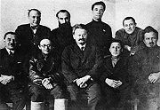

as advocated by Leon Trotsky
. Trotsky considered himself an orthodox Marxist
and Bolshevik
-Leninist
, arguing for the establishment of a vanguard party
of the working-class
. His politics differed sharply from those of Stalinism
, most prominently in opposing Socialism in One Country
, which he argued was a break with proletarian internationalism
, and in his belief in what he argued was a more authentic dictatorship of the proletariat
based on working-class self-emancipation and mass democracy, rather than the unaccountable bureaucracy he saw as having developed after Lenin's death. The terms Trotskyite and Trotskyist have often been derogatory in historical usage, especially when used by supporters of the Soviet Union
under Joseph Stalin
.
V. I. Lenin and Trotsky were close both ideologically and personally during the Russian Revolution of 1917
and its aftermath, and some call Trotsky its "co-leader". Trotsky was also the paramount leader of the Soviet Red Army both before and in the direct aftermath of the Revolutionary period. However, Lenin had numerous rather biting criticisms of Trotsky's ideas and intra-Party political habits, including before the Revolution. In a 1914 article titled “Disruption of Unity”, Lenin struck at what he termed Trotsky's factionalist
tendencies stating, "Under cover of ‘non-factionalism’ Trotsky is championing the interests of a group abroad which particularly lacks definite principles and has no basis in the working-class movement in Russia. All that glitters is not gold. There is much glitter and sound in Trotsky’s phrases, but they are meaningless."
However, after Trotsky accepted that unity between the Mensheviks and Bolsheviks was impossible and joined the Bolsheviks, playing a leading role with Lenin in the revolution, Lenin said: "Trotsky long ago said that unification is impossible. Trotsky understood this and from that time on there has been no better Bolshevik."
Trotsky's Fourth International
was established in France in 1938 when Trotskyists argued that the Comintern
or Third International had become irretrievably "lost to Stalinism" and thus incapable of leading the international working class to political power. Today, in the English language an advocate of Trotsky's ideas is usually called a "Trotskyist" while Trotskyism's opponents usually refer to them pejoratively as a "Trotskyite" or "Trot".
Definition
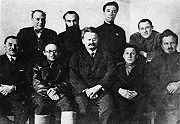
, in his 1942 book History of American Trotskyism, wrote that "Trotskyism is not a new movement, a new doctrine, but the restoration, the revival of genuine Marxism as it was expounded and practiced in the Russian revolution and in the early days of the Communist International." However, Trotskyism can be distinguished from other Marxist theories by four key elements.
- Support for the strategy of permanent revolutionPermanent RevolutionPermanent revolution is a term within Marxist theory, established in usage by Karl Marx and Friedrich Engels by at least 1850 but which has since become most closely associated with Leon Trotsky. The use of the term by different theorists is not identical...
, in opposition to the Two Stage TheoryTwo Stage TheoryThe two stage theory is the Stalinist political theory which argues that underdeveloped countries, such as Tsarist Russia, must first pass through a stage of bourgeois democracy before moving to a socialist stage...
of his opponents; - Criticism of the post-1924 leadership of the Soviet Union, analysis of its features and after 1933, support for political revolutionPolitical revolutionA political revolution, in the Trotskyist theory, is an upheaval in which the government is replaced, or the form of government altered, but in which property relations are predominantly left intact...
in the Soviet UnionSoviet UnionThe Soviet Union , officially the Union of Soviet Socialist Republics , was a constitutionally socialist state that existed in Eurasia between 1922 and 1991....
and in what Trotskyists term the deformed workers' stateDeformed workers' stateIn Trotskyist political theory, deformed workers' states are states where the bourgeoisie has been overthrown through social revolution, the industrial means of production have been largely nationalized bringing benefits to the working class, but where the working class has never held political power...
s; - Support for social revolutionSocial revolutionThe term social revolution may have different connotations depending on the speaker.In the Trotskyist movement, the term "social revolution" refers to an upheaval in which existing property relations are smashed...
in the advanced capitalist countries through working classWorking classWorking class is a term used in the social sciences and in ordinary conversation to describe those employed in lower tier jobs , often extending to those in unemployment or otherwise possessing below-average incomes...
mass action; - Support for proletarian internationalismProletarian internationalismProletarian internationalism, sometimes referred to as international socialism, is a Marxist social class concept based on the view that capitalism is now a global system, and therefore the working class must act as a global class if it is to defeat it...
.
On the political spectrum
of Marxism
, Trotskyists are considered to be on the left. They supported democratic rights in the USSR, opposed political deals with the imperialist powers, and advocated a spreading of the revolution throughout Europe and the East.
Theory of Permanent Revolution
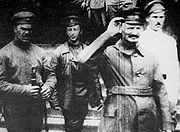
In 1905, Trotsky formulated a theory that became known as the theory of Permanent Revolution
. It is one of the defining characteristics of Trotskyism. Until 1905, Marxism only claimed that a revolution in a European capitalist society would lead to a socialist one. According to the original theory it was impossible for such to occur in more backward countries such as early 20th century Russia. Russia in 1905 was widely considered to have not yet established a capitalist society, but was instead largely feudal with a small, weak and almost powerless capitalist class.
The theory of Permanent Revolution addressed the question of how such feudal regimes were to be overthrown, and how socialism could be established given the lack of economic prerequisites. Trotsky argued that in Russia only the working class could overthrow feudalism and win the support of the peasantry. Furthermore, he argued that the Russian working class would not stop there. They would win its own revolution against the weak capitalist class, establish a workers' state in Russia, and appeal to the working class in the advanced capitalist countries around the world. As a result, the global working class would come to Russia's aid, and socialism could develop worldwide.
The capitalist or bourgeois-democratic revolution
Revolutions in Britain in the 17th century and in France in 1789 abolished feudalism and established the basic requisites for the development of capitalism. Trotsky argued that these revolutions would not be repeated in Russia.In Results and Prospects, written in 1906, Trotsky outlines his theory in detail, arguing: "History does not repeat itself. However much one may compare the Russian Revolution with the Great French Revolution, the former can never be transformed into a repetition of the latter." In the French Revolution of 1789, France experienced what Marxists called a "bourgeois-democratic revolution" – a regime was established wherein the bourgeoisie overthrew the existing French feudalistic system. The bourgeoisie then moved towards establishing a regime of democratic parliamentary institutions. However, while democratic rights were extended to the bourgeoisie, they were not generally extended to a universal franchise. The freedom for workers to organise unions or to strike was not achieved without considerable struggle.
Trotsky argues that countries like Russia had no "enlightened, active" revolutionary bourgeoisie which could play the same role, and the working class constituted a very small minority. By the time of the European revolutions of 1848, "the bourgeoisie was already unable to play a comparable role. It did not want and was not able to undertake the revolutionary liquidation of the social system that stood in its path to power."
Theory of permanent revolution
The theory of Permanent Revolution considers that in many countries, which are thought under Trotskyism to have not yet completed a bourgeois-democratic revolution, the capitalist class oppose the creation of any revolutionary situation. They fear stirring the working class into fighting for its own revolutionary aspirations against their exploitation by capitalism. In Russia, the working class, although a small minority in a predominantly peasant based society, were organised in vast factories owned by the capitalist class, and into large working class districts. During the Russian Revolution of 1905, the capitalist class found it necessary to ally with reactionary elements such as the essentially feudal landlords and ultimately the existing Czarist Russian state forces. This was to protect their ownership of their property—factories, banks, etc.-- from expropriation by the revolutionary working class.Therefore, according to the theory of Permanent Revolution, the capitalist classes of economically backward countries are weak and incapable of carrying through revolutionary change. As a result, they are linked to and rely on the feudal landowners in many ways. Thus, Trotsky argues, because a majority of the branches of industry in Russia were originated under the direct influence of government measures—sometimes with the help of Government subsidies—the capitalist class was again tied to the ruling elite. The capitalist class were subservient to European capital.
The working class steps in
Instead, Trotsky argued, only the 'proletariat' or working class were capable of achieving the tasks of that 'bourgeois' revolution. In 1905, the working class in Russia, a generation brought together in vast factories from the relative isolation of peasant life, saw the result of its labour as a vast collective effort, and the only means of struggling against its oppression in terms of a collective effort also, forming workers councils (soviets), in the course of the revolution of that year. In 1906, Trotsky argued:The factory system brings the proletariat to the foreground... The proletariat immediately found itself concentrated in tremendous masses, while between these masses and the autocracy there stood a capitalist bourgeoisie, very small in numbers, isolated from the 'people', half-foreign, without historical traditions, and inspired only by the greed for gain. – Trotsky, Results and Prospects
The Putilov Factory
, for instance, numbered 12,000 workers in 1900, and, according to Trotsky, 36,000 in July 1917. The theory of Permanent Revolution considers that the peasantry as a whole cannot take on this task, because it is dispersed in small holdings throughout the country, and forms a heterogeneous grouping, including the rich peasants who employ rural workers and aspire to landlord
ism as well as the poor peasants who aspire to own more land. Trotsky argues: "All historical experience... shows that the peasantry are absolutely incapable of taking up an independent political role."
Trotskyists differ on the extent to which this is true today, but even the most orthodox tend to recognise in the late twentieth century a new development in the revolts of the rural poor, the self-organising struggles of the landless, and many other struggles which in some ways reflect the militant united organised struggles of the working class, and which to various degrees do not bear the marks of class divisions typical of the heroic peasant struggles of previous epochs. However, orthodox Trotskyists today still argue that the town and city based working class struggle is central to the task of a successful socialist revolution, linked to these struggles of the rural poor. They argue that the working class learns of necessity to conduct a collective struggle, for instance in trade unions, arising from its social conditions in the factories and workplaces, and that the collective consciousness it achieves as a result is an essential ingredient of the socialist reconstruction of society.
Although only a small minority in Russian society, the proletariat would lead a revolution to emancipate the peasantry and thus "secure the support of the peasantry" as part of that revolution, on whose support it will rely. But the working class, in order to improve their own conditions, will find it necessary to create a revolution of their own, which would accomplish both the bourgeois revolution and then establish a workers' state.
International revolution
According to classical Marxism, revolution in peasant-based countries, such as Russia, prepares the ground ultimately only for a development of capitalism since the liberated peasants become small owners, producers and traders which leads to the growth of commodity markets, from which a new capitalist class emerges. Only fully developed capitalist conditions prepare the basis for socialism.
Trotsky agreed that a new socialist state and economy in a country like Russia would not be able to hold out against the pressures of a hostile capitalist world, as well as the internal pressures of its backward economy. The revolution, Trotsky argued, must quickly spread to capitalist countries, bringing about a socialist revolution which must spread worldwide. In this way the revolution is "permanent", moving out of necessity first, from the bourgeois revolution to the workers’ revolution, and from there uninterruptedly to European and worldwide revolutions.
This was the position, contrary to that of "Classical Marxism" which by that time had been further illuminated by active life, shared by Trotsky and Lenin and the Bolsheviks until 1924 when Joseph Stalin
, who along with Kamenev in February 1917 had taken the Menshevik position of first the bourgeois revolution, only to be confronted by Lenin and his famous April Thesis on Lenin's return to Russia, after the death of Lenin and seeking to consolidate his growing bureaucratic control of the Bolshevik Party began to put forward the slogan of "Socialism in one country".
An internationalist outlook of permanent revolution is found in the works of Karl Marx
. The term "permanent revolution" is taken from a remark of Marx from his March 1850 Address: "it is our task", Marx said,
to make the revolution permanent until all the more or less propertied classes have been driven from their ruling positions, until the proletariat has conquered state power and until the association of the proletarians has progressed sufficiently far – not only in one country but in all the leading countries of the world – that competition between the proletarians of these countries ceases and at least the decisive forces of production are concentrated in the hands of the workers. – Marx, Address of the Central Committee to the Communist League
Origins
According to Trotsky, the term 'Trotskyism' was coined by Pavel Milyukov, (sometimes transliterated as 'Paul Miliukoff'), the ideological leader of the Constitutional Democratic party (Kadets) in Russia. Milyukov waged a bitter war against 'Trotskyism' "as early as 1905".
Trotsky was elected chairman of the St. Petersburg Soviet
during the 1905 Russian Revolution. He pursued a policy of proletarian revolution
at a time when other socialist trends advocated a transition to a "bourgeois" (capitalist) regime to replace the essentially feudal Romanov state. It was during this year that Trotsky developed the theory of Permanent Revolution
, as it later became known (see below). In 1905, Trotsky quotes from a postscript to a book by Milyukov, The elections to the second state Duma, published no later than May 1907:
Those who reproach the Kadets with failure to protest at that time, by organising meetings, against the 'revolutionary illusions' of Trotskyism and the relapse into BlanquismBlanquismIn left-wing discourse, Blanquism refers to a conception of revolution generally attributed to Louis Auguste Blanqui which holds that socialist revolution should be carried out by a relatively small group of highly organised and secretive conspirators. Having taken power, the revolutionaries would...
, simply do not understand… the mood of the democratic public at meetings during that period." – The elections to the second state Duma by Pavel Milyukov
Milyukov suggests that the mood of the "democratic public" was in support of Trotsky's policy of the overthrow of the Romanov regime alongside a workers' revolution to overthrow the capitalist owners of industry, support for strike action and the establishment of democratically elected workers' councils or "soviets".
Trotskyism and the 1917 Russian Revolution
.jpg)
which had the allegiance of the Petrograd garrison, and carried through the October 1917 insurrection. Stalin wrote:
All practical work in connection with the organization of the uprising was done under the immediate direction of Comrade Trotsky, the President of the Petrograd Soviet. It can be stated with certainty that the Party is indebted primarily and principally to Comrade Trotsky for the rapid going over of the garrison to the side of the Soviet and the efficient manner in which the work of the Military Revolutionary Committee was organized. – Stalin, Pravda, November 6, 1918
As a result of his role in the Russian Revolution of 1917, the theory of Permanent Revolution was embraced by the young Soviet state until 1924.
The Russian revolution of 1917 was marked by two revolutions: the relatively spontaneous February 1917 revolution, and the 25 October 1917 seizure of power by the Bolsheviks, who had gained the leadership of the Petrograd soviet.
Before the February 1917 Russian revolution, Lenin had formulated a slogan calling for the 'democratic dictatorship of the proletariat and the peasantry', but after the February revolution, through his April theses, Lenin instead called for "all power to the Soviets". Lenin nevertheless continued to emphasise however (as did Trotsky also) the classical Marxist position that the peasantry formed a basis for the development of capitalism, not socialism.
But also before February 1917, Trotsky had not accepted the importance of a Bolshevik style organisation. Once the February 1917 Russian revolution had broken out Trotsky admitted the importance of a Bolshevik organisation, and joined the Bolsheviks in July 1917. Despite the fact that many, like Stalin, saw Trotsky's role in the October 1917 Russian revolution as central, Trotsky says that without Lenin and the Bolshevik party the October revolution of 1917 would not have taken place.
As a result, since 1917, Trotskyism as a political theory is fully committed to a Leninist style of democratic centralist
party organisation, which Trotskyists argue must not be confused with the party organisation as it later developed under Stalin. Trotsky had previously suggested that Lenin's method of organisation would lead to a dictatorship, but it is important to emphasise that after 1917 orthodox Trotskyists argue that the loss of democracy in the Soviet Union was caused by the failure of the revolution to successfully spread internationally and the consequent wars, isolation and imperialist intervention, not the Bolshevik style of organisation.
Lenin's outlook had always been that the Russian revolution would need to stimulate a Socialist revolution in western Europe in order that this European socialist society would then come to the aid of the Russian revolution and enable Russia to advance towards socialism. Lenin stated:
We have stressed in a good many written works, in all our public utterances, and in all our statements in the press that… the socialist revolution can triumph only on two conditions. First, if it is given timely support by a socialist revolution in one or several advanced countries. – Lenin, Speech at Tenth Congress of the RCP(B)
This outlook matched precisely Trotsky's theory of Permanent Revolution. Trotsky's Permanent Revolution had foreseen that the working class would not stop at the bourgeois democratic stage of the revolution, but proceed towards a workers' state, as happened in 1917. The Polish Trotskyist Isaac Deutscher
maintains that in 1917, Lenin changed his attitude to Trotsky's theory of Permanent Revolution and after the October revolution it was adopted by the Bolsheviks.
Lenin was met with initial disbelief in April 1917. Trotsky argues that:
up to the outbreak of the February revolution and for a time after Trotskyism did not mean the idea that it was impossible to build a socialist society within the national boundaries of Russia (which "possibility" was never expressed by anybody up to 1924 and hardly came into anybody’s head). Trotskyism meant the idea that the Russian proletariat might win the power in advance of the Western proletariat, and that in that case it could not confine itself within the limits of a democratic dictatorship but would be compelled to undertake the initial socialist measures. It is not surprising, then, that the April theses of Lenin were condemned as Trotskyist. – Leon Trotsky, History of the Russian Revolution
The 'legend of Trotskyism'
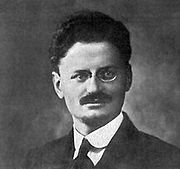
and Lev Kamenev
in collaboration with Stalin in 1924, in response to the criticisms Trotsky raised of Politburo policy. Orlando Figes
argues that "The urge to silence Trotsky, and all criticism of the Politburo, was in itself a crucial factor in Stalin's rise to power."
During 1922–24, Lenin suffered a series of strokes and became increasingly incapacitated. Before his death in 1924, Lenin, while describing Trotsky as "distinguished not only by his exceptional abilities – personally he is, to be sure, the most able man in the present Central Committee", and also maintaining that "his non-Bolshevik past should not be held against him", criticized him for "showing excessive preoccupation with the purely administrative side of the work", and also requested that Stalin be removed from his position of General Secretary, but his notes remained suppressed until 1956. Zinoviev and Kamenev broke with Stalin in 1925 and joined Trotsky in 1926 in what was known as the United Opposition
.
In 1926, Stalin allied with Nikolai Bukharin
who then led the campaign against "Trotskyism". In The Stalin School of Falsification, Trotsky quotes Bukharin's 1918 pamphlet, From the Collapse of Czarism to the Fall of the Bourgeoisie, which was re-printed by the party publishing house, Proletari, in 1923. In this pamphlet, Bukharin explains and embraces Trotsky's theory of permanent revolution, writing: "The Russian proletariat is confronted more sharply than ever before with the problem of the international revolution … The grand total of relationships which have arisen in Europe leads to this inevitable conclusion. Thus, the permanent revolution in Russia is passing into the European proletarian revolution." Yet it is common knowledge, Trotsky argues, that three years later, in 1926, "Bukharin was the chief and indeed the sole theoretician of the entire campaign against 'Trotskyism', summed up in the struggle against the theory of the permanent revolution."
Trotsky wrote that the Left Opposition
grew in influence throughout the 1920s, attempting to reform the Communist Party. But in 1927 Stalin declared "civil war" against them:
During the first ten years of its struggle, the Left Opposition did not abandon the program of ideological conquest of the party for that of conquest of power against the party. Its slogan was: reform, not revolution. The bureaucracy, however, even in those times, was ready for any revolution in order to defend itself against a democratic reform.
In 1927, when the struggle reached an especially bitter stage, Stalin declared at a session of the Central Committee, addressing himself to the Opposition: “Those cadres can be removed only by civil war!” What was a threat in Stalin’s words became, thanks to a series of defeats of the European proletariat, a historic fact. The road of reform was turned into a road of revolution. – Trotsky, Leon, Revolution Betrayed, p279, Pathfinder (1972)
Defeat of the European working class led to further isolation in Russia, and further suppression of the Opposition. Trotsky argued that the "so-called struggle against 'Trotskyism' grew out of the bureaucratic reaction against the October Revolution [of 1917]". He responded to the one sided civil war with his Letter to the Bureau of Party History, (1927), contrasting what he claimed to be the falsification of history with the official history of just a few years before. He further accused Stalin of derailing the Chinese revolution, and causing the massacre of the Chinese workers:
In the year 1918, Stalin, at the very outset of his campaign against me, found it necessary, as we have already learned, to write the following words:
“All the work of practical organization of the insurrection was carried out under the direct leadership of the Chairman of the Petrograd Soviet, comrade Trotsky…” (Stalin, Pravda, Nov. 6, 1918)
With full responsibility for my words, I am now compelled to say that the cruel massacre of the Chinese proletariat and the Chinese Revolution at its three most important turning points, the strengthening of the position of the trade union agents of British imperialism after the General Strike of 1926, and, finally, the general weakening of the position of the Communist International and the Soviet Union, the party owes principally and above all to Stalin. – Trotsky, Leon, The Stalin School of Falsification, p87, Pathfinder (1971)
Trotsky was sent into internal exile and his supporters were jailed. Victor Serge, for instance, first "spent six weeks in a cell" after a visit at midnight, then 85 days in an inner GPU cell, most of it in solitary confinement. He details the jailings of the Left Opposition. The Left Opposition, however, continued to work in secret within the Soviet Union. Trotsky was eventually exiled to Turkey. He moved from there to France, Norway, and finally to Mexico.
After 1928, the various Communist Parties throughout the world expelled Trotskyists from their ranks. Most Trotskyists defend the economic achievements of the planned economy in the Soviet Union during the 1920s and 1930s, despite the "misleadership" of the soviet bureaucracy, and what they claim to be the loss of democracy. Trotskyists claim that in 1928 inner party democracy, and indeed soviet democracy, which was at the foundation of Bolshevism, had been destroyed within the various Communist Parties. Anyone who disagreed with the party line was labeled a Trotskyist and even a fascist.
In 1937, Stalin again unleashed what Trotskyists say was a political terror against their Left Opposition and many of the remaining 'Old Bolsheviks' (those who had played key roles in the October Revolution
in 1917), in the face of increased opposition, particularly in the army.
Founding of the Fourth International
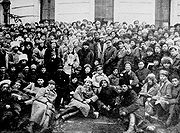
Trotsky founded the International Left Opposition in 1930. It was meant to be an opposition group within the Comintern
, but anyone who joined, or was suspected of joining, the ILO, was immediately expelled from the Comintern. The ILO therefore concluded that opposing Stalinism
from within the Communist organizations controlled by Stalin's supporters had become impossible, so new organizations had to be formed. In 1933, the ILO was renamed the International Communist League
(ICL), which formed the basis of the Fourth International
, founded in Paris in 1938.
Trotsky said that only the Fourth International, basing itself on Lenin's theory of the vanguard party, could lead the world revolution, and that it would need to be built in opposition to both the capitalists and the Stalinists.
Trotsky argued that the defeat of the German working class and the coming to power of Hitler in 1933 was due in part to the mistakes of the Third Period
policy of the Communist International and that the subsequent failure of the Communist Parties to draw the correct lessons from those defeats showed that they were no longer capable of reform, and a new international organisation of the working class must be organised. The Transitional demand
tactic had to be a key element.
At the time of the founding of the Fourth International in 1938 Trotskyism was a mass political current in Vietnam
, Sri Lanka
and slightly later Bolivia
. There was also a substantial Trotskyist movement in China which included the founding father of the Chinese Communist movement, Chen Duxiu
, amongst its number. Wherever Stalinists gained power, they made it a priority to hunt down Trotskyists and treated them as the worst of enemies.
The Fourth International suffered repression and disruption through the Second World War. Isolated from each other, and faced with political developments quite unlike those anticipated by Trotsky, some Trotskyist organizations decided that the Soviet Union no longer could be called a degenerated workers state and withdrew from the Fourth International. After 1945 Trotskyism was smashed as a mass movement in Vietnam and marginalised in a number of other countries.
The International Secretariat of the Fourth International (ISFI) organised an international conference in 1946, and then World Congresses in 1948 and 1951 to assess the expropriation of the capitalists in Eastern Europe and Yugoslavia, the threat of a Third World War, and the tasks for revolutionaries. The Eastern European Communist-led governments which came into being after World War II
without a social revolution were described by a resolution of the 1948 congress as presiding over capitalist economies. By 1951, the Congress had concluded that they had become "deformed workers' state
s." As the Cold War
intensified, the ISFI's 1951 World Congress adopted theses by Michel Pablo
that anticipated an international civil war. Pablo's followers considered that the Communist Parties, insofar as they were placed under pressure by the real workers' movement, could escape Stalin's manipulations and follow a revolutionary orientation.
The 1951 Congress argued that Trotskyists should start to conduct systematic work inside those Communist Parties which were followed by the majority of the working class. However, the ISFI's view that the Soviet leadership was counter-revolutionary remained unchanged. The 1951 Congress argued that the Soviet Union took over these countries because of the military and political results of World War II, and instituted nationalized property relations only after its attempts at placating capitalism failed to protect those countries from the threat of incursion by the West.
Pablo began expelling large numbers of people who did not agree with his thesis and who did not want to dissolve their organizations within the Communist Parties. For instance, he expelled the majority of the French section and replaced its leadership. As a result, the opposition to Pablo eventually rose to the surface, with an open letter to Trotskyists of the world, by Socialist Workers Party
leader James P. Cannon
.
The Fourth International split in 1953 into two public factions. The International Committee of the Fourth International
(ICFI) was established by several sections of the International as an alternative centre to the International Secretariat, in which they felt a revisionist faction led by Michel Pablo had taken power. From 1960, a number of ICFI sections started to reunify with the IS. After the 1963 reunification congress, the French and British sections maintained the ICFI. Other groups took different paths and originated the present complex map of Trotskyist groupings.
Trotskyist movements
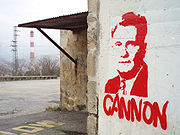
Latin America
Trotskyism has had some influence in some recent major social upheavals, particularly in Latin America.The Bolivian Trotskyist party
(Partido Obrero Revolucionario, POR) became a mass party in the period of the late 1940s and early 1950s, and together with other groups played a central role during and immediately after the period termed the Bolivian National Revolution.
In Brazil, as an officially recognised platform or faction of the PT until 1992, the Trotskyist Movimento Convergência Socialista (CS), which founded the United Socialist Workers' Party
(PSTU) in 1994, saw a number of its members elected to national, state and local legislative bodies during the 1980s. Today the Socialism and Freedom Party
(PSOL) is described as Trotskyist. Its presidential candidate in the 2006 general elections, Heloísa Helena
is termed a Trotskyist who was a member of the Workers Party of Brazil (PT), a legislative deputy in Alagoas and in 1999 was elected to the Federal Senate. Expelled from the PT in December 2003, she helped found PSOL, in which various Trotskyist groups play a prominent role.
During the 1980s in Argentina, the Trotskyist party founded in 1982 by Nahuel Moreno
, MAS, (Movimiento al Socialismo, Movement Toward Socialism), claimed to be the "largest Trotskyist party" in the world, before it broke into a number of different fragments in the late 1980s, including the present-day MST, PTS, MAS, IS, PRS, FOS, etc. In 1989 in an electoral front with the Communist Party and Christian nationalists groups, called "Izquierda Unida" (united left), obtained 3,49% of the electorate, representing 580.944 voters. Today the Workers' Party in Argentina has an electoral base in Salta Province in the far north, particularly in the city of Salta itself, and has become the third political force in the provinces of Tucuman, also in the north, and Santa Cruz, in the south.
Venezuelan president Hugo Chávez
declared himself to be a Trotskyist during his swearing in of his cabinet two days before his own inauguration on 10 January 2007. Venezuelan Trotskyist organizations do not regard Chávez as a Trotskyist, with some describing him as a bourgeois nationalist and other considering him an honest revolutionary leader who has made major mistakes because he lacks a Marxist analysis.
Asia
In Indochina during the 1930s, Vietnamese Trotskyismled by Ta Thu Thau
was a significant current, particularly in Saigon.
In Sri Lanka, the Lanka Sama Samaja Party
(LSSP) expelled its pro-Moscow wing in 1940, becoming a Trotskyist-led party. It was led by South Asia
's pioneer Trotskyist, Philip Gunawardena
and his colleague NM Perera. In 1942, following the escape of the leaders of the LSSP from a British
prison, a unified Bolshevik-Leninist Party of India, Ceylon and Burma
(BLPI) was established in India
, bringing together the many Trotskyist groups in the subcontinent. The BLPI was active in the Quit India movement as well as the labour movement, capturing the second oldest union in India. Its high point was when it led the strikes which followed the Bombay Mutiny. After the war, the Sri Lanka section split into the Lanka Sama Samaja Party and the Bolshevik Samasamaja Party
(BSP). The Indian section of the BLPI later fused with the Congress Socialist Party
. In the general election of 1947 the LSSP became the main opposition party, winning 10 seats, the BSP winning a further 5. It joined the Trotskyist Fourth International after fusion with the BSP in 1950, and led a general strike (Hartal
) in 1953.
In 1964 a section of the LSSP split to form the LSSP (Revolutionary) and joined the Fourth International after the LSSP proper was expelled. The LSSP (R) later split into factions led by Bala Tampoe
and Edmund Samarakkody
. The LSSP joined the coalition government of Sirimavo Bandaranaike
, three of its members, NM Perera, Cholmondely Goonewardena and Anil Moonesinghe
, becoming the first Trotskyist cabinet ministers in history.
In 1974 a secret faction of the LSSP, allied to the Militant Tendency
in the UK emerged. In 1977 this faction was expelled and formed the Nava Sama Samaja Party
, led by Vasudeva Nanayakkara
.
Europe
In France, 10% of the electorate voted in 2002 for parties calling themselves Trotskyist.In Britain during the 1980s, the entrist
Militant tendency
won three members of parliament and effective control of Liverpool City Council while in the Labour Party. Described as "Britain's fifth most important political party" in 1986 it played a prominent role in the 1989–1991 mass anti-poll tax movement which was widely thought to have led to the downfall of British Prime Minister Margaret Thatcher
. Almost all of the large far left parties in Britain are led by Trotskyists, including the Socialist Workers Party (Britain)
, the Socialist Party (England and Wales)
, Respect – The Unity Coalition and the Scottish Socialist Party
.
The Socialist Party
in Ireland was formed in 1990 by members who had been expelled by the Irish Labour Party's leader Dick Spring
. It has had a sizable amount of support in the Fingal
electoral district and has a Member of the European Parliament
, Paul Murphy
, representing Dublin and two Members of the Irish Parliament (Dáil Éireann), Clare Daly, representing Dublin North and Joe Higgins, representign Dublin West.
In Portugal
's September 2009 parliamentary election
, the Left Bloc won 558.062 votes, which translated into 9,82% of the expressed votes and the election of 16 (out of 230) deputies to the national parliament. Although founded by several leftist tendencies, it still expresses much of the Trotskyist thought upheld and developed by its current leader, Francisco Louçã
.
In Turkey, there are some organizations which are SWP's section (Revolutionary Workers' Socialist Party), CRFI's section (Revolutionary Workers' Party), Permanent Revolution Movement (SDH) and several small groups.
International
The Fourth International derives from the 1963 reunification of the two public factions into which Fourth International split in 1953: the International Secretariat of the Fourth International (ISFI) and the International Committee of the Fourth International(ICFI). It is often referred to as the United Secretariat of the Fourth International, the name of its leading committee before 2003. It is widely described as the largest contemporary Trotskyist organisation with sections and sympathizing organizations in over 50 countries. http://ito.gn.apc.org/page24.html Its best known section has been the Ligue Communiste Revolutionnaire of France, but today there are also sizeable and influential sections in Portugal, Sri Lanka, the Philippines, Pakistan and several other countries.
The Committee for a Workers' International
(CWI) was founded in 1974 and now has sections in over 35 countries. Before 1997, most organisations affiliated to the CWI sought to build an entrist Marxist wing within the large social democratic parties. Since the early 1990s it has argued that most social democratic, as indeed socialist parties have moved so far to the right that there is little point trying to work within them. Instead the CWI has adopted a range of tactics, mostly seeking to build independent parties, but in some cases working within other broad working-class parties.
In France, the LCR is rivalled by Lutte Ouvrière. That group is the French section of the Internationalist Communist Union
(UCI). UCI has small sections in a handful of other countries. It focuses its activities, whether propaganda or intervention, within the industrial proletariat.
The founders of the Committee for a Marxist International (CMI) claim they were expelled from the CWI, when the CWI abandoned entryism
. The CWI claims they left and no expulsions were carried out. Since 2006, it has been known as the International Marxist Tendency
(IMT). CMI/IMT groups continue the policy of entering mainstream social democratic, communist or radical parties.
Currently, International Marxist Tendency
(IMT) is headed by Alan Woods and Lal Khan
. The list of Trotskyist internationals shows that there are a large number of other multinational tendencies that stand in the tradition of Leon Trotsky. Some Trotskyist organisations are only organized in one country.
Criticism
Trotskyism has been criticised by adherents of theoretically rival forms of Marxism and socialism, in particular those who have adhered to Stalinism, Maoism
, left communism
and outside marxism by anarchism
.
In 1935, a Marxist-Leninist named Moissaye J. Olgin published a book entitled Trotskyism: Counter-Revolution in Disguise in which he put forward the idea that Trotskyism was "the enemy of the working class" and that it "should be shunned by anybody who has sympathy for the revolutionary movement of the exploited and oppressed the world over." The notable African-American Marxist-Leninist Harry Haywood
, who spent much time in the Soviet Union during the 1920s and 30s, stated that although he had been somewhat interested in Trotsky’s ideas when he was young, he came to see it as "a disruptive force on the fringes of the international revolutionary movement" which eventually developed into "a counter-revolutionary conspiracy against the Party and the Soviet state." He continued to put forward his belief that:
- Trotsky was not defeated by bureaucratic decisions or Stalin's control of the Party apparatus -- as his partisans and Trotskyite historians claim. He had his day in court and finally lost because his whole position flew in the face of Soviet and world realities. He was doomed to defeat because his ideas were incorrect and failed to conform to objective conditions, as well as the needs and interests of the Soviet people.
The way Trotskyists organise to promote their beliefs "Democratic Centralism
" has been criticised, often by ex-members of their organisations. Tourish, a former member of the Committee for a Workers' International (CWI)
asserts that these organisations typically value doctrinal orthodoxy over critical reflection, have illusions in the absolute correctness of their own party's analysis, a fear of dissent, the demonising of dissenters and critical opinion, overworking of members, a sectarian attitude to the rest of the left and the concentration of power among a small group of leaders.
Some left communists
, such as Paul Mattick claim that the October Revolution was totalitarian from the start and therefore, Trotskyism has no real differences from Stalinism either in practice and theory.
In the United States Dwight Macdonald
broke with Trotsky and left the trotskist Socialist Workers Party
, by raising the question of the Kronstadt rebellion
, which Trotsky as leader of the Soviet Red Army and the other Bolsheviks had brutally repressed. He then moved towards democratic socialism and anarchism
. A similar critique on Trotsky's role on the events around the Kronstadt rebellion was raised by the Lithuanian American anarchist Emma Goldman
. In her essay "Trotsky Protests Too Much" she says "I admit, the dictatorship under Stalin's rule has become monstrous. That does not, however, lessen the guilt of Leon Trotsky as one of the actors in the revolutionary drama of which Kronstadt was one of the bloodiest scenes."
Further reading
- Alex Callinicos. Trotskyism (Concepts in Social Thought) University of Minnesota Press, 1990.
- Belden Fields. Trotskyism and Maoism: Theory and Practice in France and the United States Praeger Publishers, 1989.
- Alfred Rosmer. Trotsky and the Origins of Trotskyism. Republished by Francis Boutle Publishers, now out of print.
- Cliff Slaughter. Trotskyism Versus Revisionism: A Documentary History (multivolume work, now out of print)