


Palmer Raids

Encyclopedia
The Palmer Raids were attempts by the United States Department of Justice
to arrest and deport radical leftists, especially anarchists, from the United States
. The raids and arrests occurred in November 1919 and January 1920 under the leadership of Attorney General A. Mitchell Palmer
. Though more than 500 foreign citizens were deported, including a number of prominent leftist leaders, Palmer's efforts were largely frustrated by officials at the U.S. Department of Labor
who had responsibility for deportations and who objected to Palmer's methods. The Palmer Raids occurred in the larger context of the Red Scare
, the term given to fear of and reaction against political radicals in the U.S. in the years immediately following World War I
.
warned against hyphenated American
s who, he charged, had "poured the poison of disloyalty into the very arteries of our national life." "Such creatures of passion, disloyalty and anarchy", Wilson continued "must be crushed out". The Russian Revolution of 1917 added special force to fear of labor agitators and partisans of foreign ideologies like anarchism. The general strike in Seattle in February 1919 represented a new development in labor unrest that the war had suppressed.
Anarchist bombings in April and June 1919
carried out by Galleanists, Italian anarchists and followers of the radical anarchist Luigi Galleani
, meant the threat was real. At the end of April, some 30 Galleanist letter bombs had been mailed to a host of individuals, mostly prominent government officials and businessmen, but also law enforcement officials. Only a few reached their targets, and not all exploded when opened, though some people suffered injuries, including a housekeeper in Senator's Thomas W. Hardwick
's residence, who had her hands blown off. On June 2, 1919, a second wave of bombings occurred, when several much larger package bombs were detonated by Galleanists in eight American cities, including one that damaged the home of Attorney General A. Mitchell Palmer. At least one person was killed in this second attack, a night watchman named William Boehner. Flyers declaring war on capitalists in the name of anarchist principles accompanied each bomb.
that all evidence promised that radicals would "on a certain day…rise up and destroy the government at one fell swoop." He requested an increase in his budget to $2,000,000 from $1,500,000 to support his investigations of radicals, but Congress gave him only an additional $100,000.
An initial raid in July 1919 against an anarchist group in Buffalo, New York
, achieved little when a federal judge tossed out Palmer's case. He found that the three arrested radicals, charged under a law dating from the Civil War
, had only proposed transforming the government by using their free speech
rights and not by violence. That taught Palmer that he needed to exploit the more powerful immigration statutes that authorized the deportation of alien
anarchists, violent or not. To do that, he needed to enlist the cooperation of officials at the Department of Labor. Only the Secretary of Labor could issue warrants for the arrest of alien violators of the Immigrations Acts, and only he could sign deportation orders following a hearing by an immigration inspector.
On August 1, 1919, Palmer put 24-year-old J. Edgar Hoover
in charge of a new division of the Justice Department's Bureau of Investigation, the General Intelligence Division. It would investigate the programs of radical groups and identify their members. The Boston Police Strike
in early September proved the nation had not emerged united from the war. On October 17, the Senate passed a unanimous resolution demanding Palmer explain what actions he had or had not taken against radical aliens and why.
At 9 pm on November 7, 1919, a date chosen because it was the second anniversary of the Bolshevik
revolution, agents of the Bureau of Investigation, together with local police, executed a series of well-publicized and violent raids against the Russian Workers in 12 cities. Newspaper accounts reported some were "badly beaten" during the arrests. Many later swore they were threatened and beaten during questioning. Government agents cast a wide net, bringing in some American citizens, passers-by who admitted being Russian, some not members of the Russian Workers. Others were teachers conducting night school classes in space shared with the targeted radical group. Arrests far exceeded the number of warrants. Of 650 arrested in New York City, the government managed to have just 43 deported.
Palmer now replied to the Senate's questions of October 17. He reported that his department had amassed 60,000 names with great effort. Required by the statutes to work through the Department of Labor, they had arrested 250 dangerous radicals in the November 7 raids. He proposed a new Anti-Sedition Law to enhance his authority to prosecute anarchists.
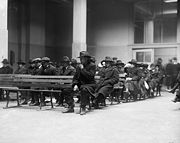 As Attorney General Palmer struggled with exhaustion and devoted all his energies to the coal strike, Hoover organized the next raids. He successfully persuaded the Department of Labor to ease its insistence on promptly alerting those arrested of their right to an attorney. Instead Labor issued instructions that its representatives could wait until after the case against the defendant was established, "in order to protect government interests." Less openly, Hoover decided to interpret Labor’s agreement to act against the Communist Party to include a different organization, the Communist Labor Party
. Finally, despite the fact that Secretary of Labor William B. Wilson insisted that more than membership in an organization was required for a warrant, Hoover worked with more compliant Labor officials and overwhelmed Labor staff to get the warrants he wanted. Justice Department officials, including Palmer and Hoover, later claimed ignorance of such details.
The Justice Department launched a series of raids on January 2, 1920 with follow up operations over the next few days. Smaller raids extended over the next 6 weeks. At least 3000 were arrested, and many others were held for various lengths of time. The entire enterprise replicated the November action on a larger scale, including arrests and seizures without search warrants, as well as detention in overcrowded and unsanitary holding facilities. Hoover later admitted "clear cases of brutality." The raids covered more than 30 cities and towns in 23 states, but those west of the Mississippi and south of the Ohio were "publicity gestures" designed to make the effort appear nationwide in scope. Because the raids targeted entire organizations, agents arrested everyone found in organization meeting halls, not only arresting non-radical organization members but also visitors who did not belong to a target organization, and sometimes American citizens not eligible for arrest and deportation.
The Department of Justice at one point claimed to have taken possession of several bombs, but after a few iron balls were displayed to the press they were never mentioned again. All the raids netted a total of just four ordinary pistols.
While most press coverage continued to be positive, with criticism only from liberal publications like The Nation
and The New Republic
, one attorney raised the first noteworthy protest. Francis Fisher Kane, the U.S. Attorney for the Eastern District of Pennsylvania
, resigned in protest. In his letter of resignation to the President and the Attorney General he wrote: "It seems to me that the policy of raids against large numbers of individuals is generally unwise and very apt to result in injustice. People not really guilty are likely to be arrested and railroaded through their hearings....We appear to be attempting to repress a political party....By such methods we drive underground and make dangerous what was not dangerous before." Palmer replied that he could not use individual arrests to treat an "epidemic" and asserted his own fidelity to constitutional principles. He added: "The Government should encourage free political thinking and political action, but it certainly has the right for its own preservation to discourage and prevent the use of force and violence to accomplish that which ought to be accomplished, if at all, by parliamentary or political methods." The Washington Post
endorsed Palmer's claim for urgency over legal process: "There is no time to waste on hairsplitting over infringement of liberties."
, who canceled more than 2,000 warrants as being illegal. Of the 10,000 arrested, 3,500 were held by authorities in detention; 556 resident aliens were eventually deported under the Immigration Act of 1918
.
At a Cabinet meeting in April 1920, Palmer called on Secretary of Labor Wilson to fire Post and Wilson defended him. The President listened to his feuding department heads and offered no comment about Post, but he ended the meeting by telling Palmer that he should "not let this country see red." Secretary of the Navy Josephus Daniels
, who made notes of the conversation, thought the Attorney General had merited the President's "admonition," because Palmer "was seeing red behind every bush and every demand for an increase in wages."
Palmer's supporters in Congress responded with an attempt to impeach
Louis Post or, failing that, to censure him. The drive against Post began to lose energy when Attorney General Palmer’s forecast of an attempted radical uprising on May Day
1920 failed to occur. Then, in testimony before the House Rules Committee on May 7-8, Post proved "a convincing speaker with a caustic tongue" and defended himself so successfully that Congressman Edward W. Pou
, a Democrat presumed to be an enthusiastic supporter of Palmer, congratulated him: "I feel that you have followed your sense of duty absolutely."
On May 28, 1920, the American Civil Liberties Union
(ACLU) published a Report of the Illegal Practices of the United States Department of Justice which carefully documented the Justice Department's unlawful activities in arresting suspected radicals, illegal entrapment by agent provocateur
s, and unlawful incommunicado
detention. Such prominent lawyers and law professors as Felix Frankfurter
, Roscoe Pound
and Ernst Freund
signed it. Harvard Professor Zechariah Chafee
critiqued the raids and attempts at deportations and the lack of legal process in his 1920 volume Freedom of Speech. He wrote: "That a Quaker should employ prison and exile to counteract evil-thinking is one of the saddest ironies of our time."
The Rules Committee gave Palmer a hearing in June, where he attacked Post and other critics whose "tender solicitude for social revolution and perverted sympathy for the criminal anarchists...set at large among the people the very public enemies whom it was the desire and intention of the Congress to be rid of." The press saw the dispute as evidence of the Wilson administration's ineffectiveness and division as it approached its final months.
In June 1920, a decision by Massachusetts District Court Judge George Anderson
ordered the discharge of 17 arrested aliens and denounced Department of Justice's actions. He wrote that "a mob is a mob, whether made up of Government officials acting under instructions from the Department of Justice, or of criminals and loafers and the vicious classes." His decision effectively prevented any renewal of the raids.
Palmer, once seen as a likely presidential candidate, lost his bid to win the Democratic nomination for president later in the year. The violent anarchist bombing campaign continued intermittently for another twelve years.
United States Department of Justice
The United States Department of Justice , is the United States federal executive department responsible for the enforcement of the law and administration of justice, equivalent to the justice or interior ministries of other countries.The Department is led by the Attorney General, who is nominated...
to arrest and deport radical leftists, especially anarchists, from the United States
United States
The United States of America is a federal constitutional republic comprising fifty states and a federal district...
. The raids and arrests occurred in November 1919 and January 1920 under the leadership of Attorney General A. Mitchell Palmer
Alexander Mitchell Palmer
Alexander Mitchell Palmer was Attorney General of the United States from 1919 to 1921. He was nicknamed The Fighting Quaker and he directed the controversial Palmer Raids.-Congressional career:...
. Though more than 500 foreign citizens were deported, including a number of prominent leftist leaders, Palmer's efforts were largely frustrated by officials at the U.S. Department of Labor
United States Department of Labor
The United States Department of Labor is a Cabinet department of the United States government responsible for occupational safety, wage and hour standards, unemployment insurance benefits, re-employment services, and some economic statistics. Many U.S. states also have such departments. The...
who had responsibility for deportations and who objected to Palmer's methods. The Palmer Raids occurred in the larger context of the Red Scare
First Red Scare
In American history, the First Red Scare of 1919–1920 was marked by a widespread fear of Bolshevism and anarchism. Concerns over the effects of radical political agitation in American society and alleged spread in the American labor movement fueled the paranoia that defined the period.The First Red...
, the term given to fear of and reaction against political radicals in the U.S. in the years immediately following World War I
World War I
World War I , which was predominantly called the World War or the Great War from its occurrence until 1939, and the First World War or World War I thereafter, was a major war centred in Europe that began on 28 July 1914 and lasted until 11 November 1918...
.
Background
During the First World War, the United States witnessed a nationwide campaign against divided loyalties on the part of immigrants and ethnic groups. Particular targets were Germans with sympathies for their homeland and Irish whose countrymen were in revolt against America’s ally Great Britain. In 1916, President WilsonWoodrow Wilson
Thomas Woodrow Wilson was the 28th President of the United States, from 1913 to 1921. A leader of the Progressive Movement, he served as President of Princeton University from 1902 to 1910, and then as the Governor of New Jersey from 1911 to 1913...
warned against hyphenated American
Hyphenated American
In the United States, the term hyphenated American is an epithet commonly used from 1890 to 1920 to disparage Americans who were of foreign birth or origin, and who displayed an allegiance to a foreign country. It was most commonly used to disparage German Americans or Irish Americans who called...
s who, he charged, had "poured the poison of disloyalty into the very arteries of our national life." "Such creatures of passion, disloyalty and anarchy", Wilson continued "must be crushed out". The Russian Revolution of 1917 added special force to fear of labor agitators and partisans of foreign ideologies like anarchism. The general strike in Seattle in February 1919 represented a new development in labor unrest that the war had suppressed.
Anarchist bombings in April and June 1919
1919 United States anarchist bombings
The 1919 United States anarchist bombings were a series of bombings and attempted bombings carried out by anarchist followers of Luigi Galleani from April through June 1919...
carried out by Galleanists, Italian anarchists and followers of the radical anarchist Luigi Galleani
Luigi Galleani
Luigi Galleani was an Italian anarchist active in the United States from 1901 to 1919, viewed by historians as an anarchist communist and an insurrectionary anarchist. He is best known for his enthusiastic advocacy of "propaganda of the deed", i.e...
, meant the threat was real. At the end of April, some 30 Galleanist letter bombs had been mailed to a host of individuals, mostly prominent government officials and businessmen, but also law enforcement officials. Only a few reached their targets, and not all exploded when opened, though some people suffered injuries, including a housekeeper in Senator's Thomas W. Hardwick
Thomas W. Hardwick
Thomas William Hardwick was an American politician from the U.S. state of Georgia.Hardwick was born in Thomasville, Georgia. He graduated from Mercer University with a bachelor of arts degree in 1892 and received a Juris Doctor degree from the University of Georgia in 1893...
's residence, who had her hands blown off. On June 2, 1919, a second wave of bombings occurred, when several much larger package bombs were detonated by Galleanists in eight American cities, including one that damaged the home of Attorney General A. Mitchell Palmer. At least one person was killed in this second attack, a night watchman named William Boehner. Flyers declaring war on capitalists in the name of anarchist principles accompanied each bomb.
Preparations
In June 1919, Attorney General Palmer told the House Appropriations CommitteeUnited States House Committee on Appropriations
The Committee on Appropriations is a committee of the United States House of Representatives. It is in charge of setting the specific expenditures of money by the government of the United States...
that all evidence promised that radicals would "on a certain day…rise up and destroy the government at one fell swoop." He requested an increase in his budget to $2,000,000 from $1,500,000 to support his investigations of radicals, but Congress gave him only an additional $100,000.
An initial raid in July 1919 against an anarchist group in Buffalo, New York
Buffalo, New York
Buffalo is the second most populous city in the state of New York, after New York City. Located in Western New York on the eastern shores of Lake Erie and at the head of the Niagara River across from Fort Erie, Ontario, Buffalo is the seat of Erie County and the principal city of the...
, achieved little when a federal judge tossed out Palmer's case. He found that the three arrested radicals, charged under a law dating from the Civil War
American Civil War
The American Civil War was a civil war fought in the United States of America. In response to the election of Abraham Lincoln as President of the United States, 11 southern slave states declared their secession from the United States and formed the Confederate States of America ; the other 25...
, had only proposed transforming the government by using their free speech
Freedom of speech
Freedom of speech is the freedom to speak freely without censorship. The term freedom of expression is sometimes used synonymously, but includes any act of seeking, receiving and imparting information or ideas, regardless of the medium used...
rights and not by violence. That taught Palmer that he needed to exploit the more powerful immigration statutes that authorized the deportation of alien
Alien (law)
In law, an alien is a person in a country who is not a citizen of that country.-Categorization:Types of "alien" persons are:*An alien who is legally permitted to remain in a country which is foreign to him or her. On specified terms, this kind of alien may be called a legal alien of that country...
anarchists, violent or not. To do that, he needed to enlist the cooperation of officials at the Department of Labor. Only the Secretary of Labor could issue warrants for the arrest of alien violators of the Immigrations Acts, and only he could sign deportation orders following a hearing by an immigration inspector.
On August 1, 1919, Palmer put 24-year-old J. Edgar Hoover
J. Edgar Hoover
John Edgar Hoover was the first Director of the Federal Bureau of Investigation of the United States. Appointed director of the Bureau of Investigation—predecessor to the FBI—in 1924, he was instrumental in founding the FBI in 1935, where he remained director until his death in 1972...
in charge of a new division of the Justice Department's Bureau of Investigation, the General Intelligence Division. It would investigate the programs of radical groups and identify their members. The Boston Police Strike
Boston Police Strike
In the Boston Police Strike, the Boston police rank and file went out on strike on September 9, 1919 in order to achieve recognition for their trade union and improvements in wages and working conditions...
in early September proved the nation had not emerged united from the war. On October 17, the Senate passed a unanimous resolution demanding Palmer explain what actions he had or had not taken against radical aliens and why.
At 9 pm on November 7, 1919, a date chosen because it was the second anniversary of the Bolshevik
Bolshevik
The Bolsheviks, originally also Bolshevists , derived from bol'shinstvo, "majority") were a faction of the Marxist Russian Social Democratic Labour Party which split apart from the Menshevik faction at the Second Party Congress in 1903....
revolution, agents of the Bureau of Investigation, together with local police, executed a series of well-publicized and violent raids against the Russian Workers in 12 cities. Newspaper accounts reported some were "badly beaten" during the arrests. Many later swore they were threatened and beaten during questioning. Government agents cast a wide net, bringing in some American citizens, passers-by who admitted being Russian, some not members of the Russian Workers. Others were teachers conducting night school classes in space shared with the targeted radical group. Arrests far exceeded the number of warrants. Of 650 arrested in New York City, the government managed to have just 43 deported.
Palmer now replied to the Senate's questions of October 17. He reported that his department had amassed 60,000 names with great effort. Required by the statutes to work through the Department of Labor, they had arrested 250 dangerous radicals in the November 7 raids. He proposed a new Anti-Sedition Law to enhance his authority to prosecute anarchists.
Raids and arrests in January 1920
Communist Labor Party
The Communist Labor Party of America was one of the organizational predecessors of the Communist Party USA. The group was established at the end of August 1919 following a three-way split of the Socialist Party of America...
. Finally, despite the fact that Secretary of Labor William B. Wilson insisted that more than membership in an organization was required for a warrant, Hoover worked with more compliant Labor officials and overwhelmed Labor staff to get the warrants he wanted. Justice Department officials, including Palmer and Hoover, later claimed ignorance of such details.
The Justice Department launched a series of raids on January 2, 1920 with follow up operations over the next few days. Smaller raids extended over the next 6 weeks. At least 3000 were arrested, and many others were held for various lengths of time. The entire enterprise replicated the November action on a larger scale, including arrests and seizures without search warrants, as well as detention in overcrowded and unsanitary holding facilities. Hoover later admitted "clear cases of brutality." The raids covered more than 30 cities and towns in 23 states, but those west of the Mississippi and south of the Ohio were "publicity gestures" designed to make the effort appear nationwide in scope. Because the raids targeted entire organizations, agents arrested everyone found in organization meeting halls, not only arresting non-radical organization members but also visitors who did not belong to a target organization, and sometimes American citizens not eligible for arrest and deportation.
The Department of Justice at one point claimed to have taken possession of several bombs, but after a few iron balls were displayed to the press they were never mentioned again. All the raids netted a total of just four ordinary pistols.
While most press coverage continued to be positive, with criticism only from liberal publications like The Nation
The Nation
The Nation is the oldest continuously published weekly magazine in the United States. The periodical, devoted to politics and culture, is self-described as "the flagship of the left." Founded on July 6, 1865, It is published by The Nation Company, L.P., at 33 Irving Place, New York City.The Nation...
and The New Republic
The New Republic
The magazine has also published two articles concerning income inequality, largely criticizing conservative economists for their attempts to deny the existence or negative effect increasing income inequality is having on the United States...
, one attorney raised the first noteworthy protest. Francis Fisher Kane, the U.S. Attorney for the Eastern District of Pennsylvania
Pennsylvania
The Commonwealth of Pennsylvania is a U.S. state that is located in the Northeastern and Mid-Atlantic regions of the United States. The state borders Delaware and Maryland to the south, West Virginia to the southwest, Ohio to the west, New York and Ontario, Canada, to the north, and New Jersey to...
, resigned in protest. In his letter of resignation to the President and the Attorney General he wrote: "It seems to me that the policy of raids against large numbers of individuals is generally unwise and very apt to result in injustice. People not really guilty are likely to be arrested and railroaded through their hearings....We appear to be attempting to repress a political party....By such methods we drive underground and make dangerous what was not dangerous before." Palmer replied that he could not use individual arrests to treat an "epidemic" and asserted his own fidelity to constitutional principles. He added: "The Government should encourage free political thinking and political action, but it certainly has the right for its own preservation to discourage and prevent the use of force and violence to accomplish that which ought to be accomplished, if at all, by parliamentary or political methods." The Washington Post
The Washington Post
The Washington Post is Washington, D.C.'s largest newspaper and its oldest still-existing paper, founded in 1877. Located in the capital of the United States, The Post has a particular emphasis on national politics. D.C., Maryland, and Virginia editions are printed for daily circulation...
endorsed Palmer's claim for urgency over legal process: "There is no time to waste on hairsplitting over infringement of liberties."
Aftermath
In a few weeks, after changes in personnel at the Department of Labor, Palmer faced a new and very independent-minded Acting Secretary of Labor in Assistant Secretary of Labor Louis Freeland PostLouis Freeland Post
Louis Freeland Post was the Assistant United States Secretary of Labor during the closing year of the Wilson administration, the period of the Palmer Raids and the Red Scare, where he had responsibility for the Bureau of Immigration.-Biography:Post opposed immigration restrictions and forcefully...
, who canceled more than 2,000 warrants as being illegal. Of the 10,000 arrested, 3,500 were held by authorities in detention; 556 resident aliens were eventually deported under the Immigration Act of 1918
Immigration Act of 1918
The United States Immigration Act of 1918 was enacted on October 16, 1918. It is also known as the Dillingham-Hardwick Act.-Enactment:...
.
At a Cabinet meeting in April 1920, Palmer called on Secretary of Labor Wilson to fire Post and Wilson defended him. The President listened to his feuding department heads and offered no comment about Post, but he ended the meeting by telling Palmer that he should "not let this country see red." Secretary of the Navy Josephus Daniels
Josephus Daniels
Josephus Daniels was a newspaper editor and publisher from North Carolina who was appointed by United States President Woodrow Wilson to serve as Secretary of the Navy during World War I...
, who made notes of the conversation, thought the Attorney General had merited the President's "admonition," because Palmer "was seeing red behind every bush and every demand for an increase in wages."
Palmer's supporters in Congress responded with an attempt to impeach
Impeachment
Impeachment is a formal process in which an official is accused of unlawful activity, the outcome of which, depending on the country, may include the removal of that official from office as well as other punishment....
Louis Post or, failing that, to censure him. The drive against Post began to lose energy when Attorney General Palmer’s forecast of an attempted radical uprising on May Day
May Day
May Day on May 1 is an ancient northern hemisphere spring festival and usually a public holiday; it is also a traditional spring holiday in many cultures....
1920 failed to occur. Then, in testimony before the House Rules Committee on May 7-8, Post proved "a convincing speaker with a caustic tongue" and defended himself so successfully that Congressman Edward W. Pou
Edward W. Pou
Edward William Pou , was an American politician, serving in the United States Congress.Born in Tuskegee, Alabama, September 9, 1863, he moved to North Carolina with his parents in 1867, where he attended the University of North Carolina at Chapel Hill and studied law...
, a Democrat presumed to be an enthusiastic supporter of Palmer, congratulated him: "I feel that you have followed your sense of duty absolutely."
On May 28, 1920, the American Civil Liberties Union
American Civil Liberties Union
The American Civil Liberties Union is a U.S. non-profit organization whose stated mission is "to defend and preserve the individual rights and liberties guaranteed to every person in this country by the Constitution and laws of the United States." It works through litigation, legislation, and...
(ACLU) published a Report of the Illegal Practices of the United States Department of Justice which carefully documented the Justice Department's unlawful activities in arresting suspected radicals, illegal entrapment by agent provocateur
Agent provocateur
Traditionally, an agent provocateur is a person employed by the police or other entity to act undercover to entice or provoke another person to commit an illegal act...
s, and unlawful incommunicado
Incommunicado
Incommunicado, as an adjective or adverb, refers to a situation or a behaviour due to which communication with outsiders is not possible, for either voluntary or involuntary reasons, especially due to confinement or reclusiveness....
detention. Such prominent lawyers and law professors as Felix Frankfurter
Felix Frankfurter
Felix Frankfurter was an Associate Justice of the United States Supreme Court.-Early life:Frankfurter was born into a Jewish family on November 15, 1882, in Vienna, Austria, then part of the Austro-Hungarian Empire in Europe. He was the third of six children of Leopold and Emma Frankfurter...
, Roscoe Pound
Roscoe Pound
Nathan Roscoe Pound was a distinguished American legal scholar and educator. He was Dean of Harvard Law School from 1916 to 1936...
and Ernst Freund
Ernst Freund
Ernst Freund was a noted American legal scholar. He received a Dr. Jur. from the University of Heidelberg ; a Ph. D. in political science from Columbia University He was professor of political science at the University of Chicago and professor of law at Chicago . He was John P...
signed it. Harvard Professor Zechariah Chafee
Zechariah Chafee
Zechariah Chafee, Jr. was an American judicial philosopher and civil libertarian. An advocate for free speech, he was described by Senator Joseph McCarthy as "dangerous" to the United States...
critiqued the raids and attempts at deportations and the lack of legal process in his 1920 volume Freedom of Speech. He wrote: "That a Quaker should employ prison and exile to counteract evil-thinking is one of the saddest ironies of our time."
The Rules Committee gave Palmer a hearing in June, where he attacked Post and other critics whose "tender solicitude for social revolution and perverted sympathy for the criminal anarchists...set at large among the people the very public enemies whom it was the desire and intention of the Congress to be rid of." The press saw the dispute as evidence of the Wilson administration's ineffectiveness and division as it approached its final months.
In June 1920, a decision by Massachusetts District Court Judge George Anderson
George Weston Anderson
George Weston Anderson was a judge of the United States Court of Appeals for the First Circuit.-Biography:...
ordered the discharge of 17 arrested aliens and denounced Department of Justice's actions. He wrote that "a mob is a mob, whether made up of Government officials acting under instructions from the Department of Justice, or of criminals and loafers and the vicious classes." His decision effectively prevented any renewal of the raids.
Palmer, once seen as a likely presidential candidate, lost his bid to win the Democratic nomination for president later in the year. The violent anarchist bombing campaign continued intermittently for another twelve years.