


Nuclear disarmament

Encyclopedia
Major nuclear disarmament groups include Campaign for Nuclear Disarmament
Campaign for Nuclear Disarmament
The Campaign for Nuclear Disarmament is an anti-nuclear organisation that advocates unilateral nuclear disarmament by the United Kingdom, international nuclear disarmament and tighter international arms regulation through agreements such as the Nuclear Non-Proliferation Treaty...
, Greenpeace
Greenpeace
Greenpeace is a non-governmental environmental organization with offices in over forty countries and with an international coordinating body in Amsterdam, The Netherlands...
and International Physicians for the Prevention of Nuclear War
International Physicians for the Prevention of Nuclear War
is a non-partisan federation of national medical groups in 63 countries, representing tens of thousands of doctors, medical students, other health workers, and concerned citizens who share the common goal of creating a more peaceful and secure world freed from the threat of nuclear annihilation...
. There have been many large anti-nuclear demonstrations
Demonstration (people)
A demonstration or street protest is action by a mass group or collection of groups of people in favor of a political or other cause; it normally consists of walking in a mass march formation and either beginning with or meeting at a designated endpoint, or rally, to hear speakers.Actions such as...
and protest
Protest
A protest is an expression of objection, by words or by actions, to particular events, policies or situations. Protests can take many different forms, from individual statements to mass demonstrations...
s. On June 12, 1982, one million people demonstrated in New York City's Central Park
Central Park
Central Park is a public park in the center of Manhattan in New York City, United States. The park initially opened in 1857, on of city-owned land. In 1858, Frederick Law Olmsted and Calvert Vaux won a design competition to improve and expand the park with a plan they entitled the Greensward Plan...
against nuclear weapons and for an end to the cold war
Cold War
The Cold War was the continuing state from roughly 1946 to 1991 of political conflict, military tension, proxy wars, and economic competition between the Communist World—primarily the Soviet Union and its satellite states and allies—and the powers of the Western world, primarily the United States...
arms race
Arms race
The term arms race, in its original usage, describes a competition between two or more parties for the best armed forces. Each party competes to produce larger numbers of weapons, greater armies, or superior military technology in a technological escalation...
. It was the largest anti-nuclear protest
Demonstration (people)
A demonstration or street protest is action by a mass group or collection of groups of people in favor of a political or other cause; it normally consists of walking in a mass march formation and either beginning with or meeting at a designated endpoint, or rally, to hear speakers.Actions such as...
and the largest political demonstration in American history.
Proponents of nuclear disarmament say that it would lessen the probability of nuclear war
Nuclear warfare
Nuclear warfare, or atomic warfare, is a military conflict or political strategy in which nuclear weaponry is detonated on an opponent. Compared to conventional warfare, nuclear warfare can be vastly more destructive in range and extent of damage...
occurring, especially accidentally. Critics of nuclear disarmament say that it would undermine deterrence
Deterrence theory
Deterrence theory gained increased prominence as a military strategy during the Cold War with regard to the use of nuclear weapons, and features prominently in current United States foreign policy regarding the development of nuclear technology in North Korea and Iran. Deterrence theory however was...
.
History
After the Partial Test Ban TreatyPartial Test Ban Treaty
The treaty banning nuclear weapon tests in the atmosphere, in outer space and under water, often abbreviated as the Partial Test Ban Treaty , Limited Test Ban Treaty , or Nuclear Test Ban Treaty is a treaty prohibiting all test detonations of nuclear weapons...
(1963), which prohibited atmospheric testing, the movement against nuclear weapons somewhat subsided in the 1970s (and was replaced in part by a movement against nuclear power).
In the 1980s, a popular movement for nuclear disarmament again gained strength in the light of the weapons build-up and aggressive rhetoric of US President Ronald Reagan
Ronald Reagan
Ronald Wilson Reagan was the 40th President of the United States , the 33rd Governor of California and, prior to that, a radio, film and television actor....
. Reagan had "a world free of nuclear weapons" as his personal mission, and was largely scorned for this in Europe. His officials tried to stop such talks but Reagan was able to start discussions on nuclear disarmament with Soviet Union
Soviet Union
The Soviet Union , officially the Union of Soviet Socialist Republics , was a constitutionally socialist state that existed in Eurasia between 1922 and 1991....
. He changed the name "SALT" (Strategic Arms Limitation Talks
Strategic Arms Limitation Talks
The Strategic Arms Limitation Treaty refers to two rounds of bilateral talks and corresponding international treaties involving the United States and the Soviet Union—the Cold War superpowers—on the issue of armament control. There were two rounds of talks and agreements: SALT I and SALT...
) to "START" (Strategic Arms Reduction Talks).
After the 1986 Reykjavik summit
Reykjavik Summit
The Reykjavík Summit was a summit meeting between U.S. president Ronald Reagan and Secretary-General of the Communist Party of the Soviet Union Mikhail Gorbachev, held in the famous house of Höfði in Reykjavík, the capital city of Iceland, on October 11–12, 1986...
between U.S. President Ronald Reagan and the new Soviet General Secretary Mikhail Gorbachev, the United States and the Soviet Union concluded two important nuclear arms reduction treaties: the INF Treaty
Intermediate-Range Nuclear Forces Treaty
The Intermediate-Range Nuclear Forces Treaty is a 1987 agreement between the United States and the Soviet Union. Signed in Washington, D.C. by U.S. President Ronald Reagan and General Secretary Mikhail Gorbachev on December 8, 1987, it was ratified by the United States Senate on May 27, 1988 and...
(1987) and START I
START I
START was a bilateral treaty between the United States of America and the Union of Soviet Socialist Republics on the Reduction and Limitation of Strategic Offensive Arms. The treaty was signed on 31 July 1991 and entered into force on 5 December 1994...
(1991). After the end of the Cold War, the United States and the Russian Federation concluded the Strategic Offensive Reductions Treaty (2003) and the New START
New START
New START is a nuclear arms reduction treaty between the United States of America and the Russian Federation with the formal name of Measures for the Further Reduction and Limitation of Strategic Offensive Arms...
Treaty (2010).
In the Soviet Union
Soviet Union
The Soviet Union , officially the Union of Soviet Socialist Republics , was a constitutionally socialist state that existed in Eurasia between 1922 and 1991....
(USSR), voices against nuclear weapons were few and far between since there was no widespread Freedom of speech
Freedom of speech
Freedom of speech is the freedom to speak freely without censorship. The term freedom of expression is sometimes used synonymously, but includes any act of seeking, receiving and imparting information or ideas, regardless of the medium used...
and Freedom of the press
Freedom of the press
Freedom of the press or freedom of the media is the freedom of communication and expression through vehicles including various electronic media and published materials...
as political factors. Certain citizens who had become prominent enough to safely criticize the Soviet government, such as Andrei Sakharov
Andrei Sakharov
Andrei Dmitrievich Sakharov was a Soviet nuclear physicist, dissident and human rights activist. He earned renown as the designer of the Soviet Union's Third Idea, a codename for Soviet development of thermonuclear weapons. Sakharov was an advocate of civil liberties and civil reforms in the...
, did speak out against nuclear weapons, but that was to little effect.
When the extreme danger intrinsic to nuclear war and the possession of nuclear weapons became apparent to all sides during the Cold War, a series of disarmament and nonproliferation treaties were agreed upon between the United States, the Soviet Union, and several other states throughout the world. Many of these treaties involved years of negotiations, and seemed to result in important steps in arms reductions and reducing the risk of nuclear war.
Key treaties
- Partial Test Ban TreatyPartial Test Ban TreatyThe treaty banning nuclear weapon tests in the atmosphere, in outer space and under water, often abbreviated as the Partial Test Ban Treaty , Limited Test Ban Treaty , or Nuclear Test Ban Treaty is a treaty prohibiting all test detonations of nuclear weapons...
(PTBT) 1963: Prohibited all testing of nuclear weapons except underground. - Nuclear Non-Proliferation TreatyNuclear Non-Proliferation TreatyThe Treaty on the Non-Proliferation of Nuclear Weapons, commonly known as the Non-Proliferation Treaty or NPT, is a landmark international treaty whose objective is to prevent the spread of nuclear weapons and weapons technology, to promote cooperation in the peaceful uses of nuclear energy and to...
(NPT)—signed 1968, came into force 1970: An international treaty (currently with 189 member states) to limit the spread of nuclear weapons. The treaty has three main pillars: nonproliferation, disarmament, and the right to peacefully use nuclear technology. - Interim Agreement on Offensive Arms (SALT I) 1972: The Soviet Union and the United States agreed to a freeze in the number of intercontinental ballistic missileIntercontinental ballistic missileAn intercontinental ballistic missile is a ballistic missile with a long range typically designed for nuclear weapons delivery...
s (ICBMs) and submarine-launched ballistic missileSubmarine-launched ballistic missileA submarine-launched ballistic missile is a ballistic missile capable of delivering a nuclear warhead that can be launched from submarines. Modern variants usually deliver multiple independently targetable reentry vehicles each of which carries a warhead and allows a single launched missile to...
s (SLBMs) that they would deploy. - Anti-Ballistic Missile TreatyAnti-Ballistic Missile TreatyThe Anti-Ballistic Missile Treaty was a treaty between the United States and the Soviet Union on the limitation of the anti-ballistic missile systems used in defending areas against missile-delivered nuclear weapons....
(ABM) 1972: The United States and Soviet Union could deploy ABM interceptors at two sites, each with up to 100 ground-based launchers for ABM interceptor missiles. In a 1974 Protocol, the US and Soviet Union agreed to only deploy an ABM system to one site. - Strategic Arms Limitation Treaty (SALT II) 1979: Replacing SALT I, SALT II limited both the Soviet Union and the United States to an equal number of ICBM launchers, SLBM launchers, and heavy bombers. Also placed limits on Multiple Independent Reentry Vehicles (MIRVS).
- Intermediate-Range Nuclear Forces TreatyIntermediate-Range Nuclear Forces TreatyThe Intermediate-Range Nuclear Forces Treaty is a 1987 agreement between the United States and the Soviet Union. Signed in Washington, D.C. by U.S. President Ronald Reagan and General Secretary Mikhail Gorbachev on December 8, 1987, it was ratified by the United States Senate on May 27, 1988 and...
(INF) 1987: Created a global ban on short- and long-range nuclear weapons systems, as well as an intrusive verification regime. - Strategic Arms Reduction TreatySTART ISTART was a bilateral treaty between the United States of America and the Union of Soviet Socialist Republics on the Reduction and Limitation of Strategic Offensive Arms. The treaty was signed on 31 July 1991 and entered into force on 5 December 1994...
(START I)—signed 1991, ratified 1994: Limited long-range nuclear forces in the United States and the newly independent states of the former Soviet Union to 6,000 attributed warheads on 1,600 ballistic missiles and bombers. - Strategic Arms Reduction Treaty IISTART IISTART II was a bilateral treaty between the United States of America and Russia on the Reduction and Limitation of Strategic Offensive Arms. It was signed by United States President George H. W...
(START II)—signed 1993, never put into force: START II was a bilateral agreement between the US and Russia which attempted to commit each side to deploy no more than 3,000 to 3,500 warheads by December 2007 and also included a prohibition against deploying multiple independent reentry vehicles (MIRVs) on intercontinental ballistic missiles (ICBMs) - Strategic Offensive Reductions TreatySORTThe Treaty Between the United States of America and the Russian Federation on Strategic Offensive Reductions , also known as the Treaty of Moscow, was a strategic arms reduction treaty between the United States and Russia that was in force from June 2003 until February 2011 when it was superseded...
(SORT or Moscow Treaty)—signed 2002, into force 2003: A very loose treaty that is often criticized by arms control advocates for its ambiguity and lack of depth, Russia and the United States agreed to reduce their "strategic nuclear warheads" (a term that remain undefined in the treaty) to between 1,700 and 2,200 by 2012. - Comprehensive Test Ban TreatyComprehensive Test Ban TreatyThe Comprehensive Nuclear-Test-Ban Treaty bans all nuclear explosions in all environments, for military or civilian purposes. It was adopted by the United Nations General Assembly on 10 September 1996 but it has not entered into force.-Status:...
(CTBT)—signed 1996, not yet in force: The CTBT is an international treaty (currently with 181 state signatures and 148 state ratifications) that bans all nuclear explosions in all environments. While the treaty is not in force, Russia has not tested a nuclear weapon since 1990 and the United States has not since 1992. - New START Treaty—signed 2010, into force in 2011: replaces SORT treaty, reduces deployed nuclear warheads by about half, will remain into force until at least 2021
Only one country has been known to ever dismantle their nuclear arsenal completely—the apartheid government of South Africa
South Africa
The Republic of South Africa is a country in southern Africa. Located at the southern tip of Africa, it is divided into nine provinces, with of coastline on the Atlantic and Indian oceans...
apparently developed half a dozen crude fission weapons during the 1980s, but they were dismantled in the early 1990s.
Nuclear disarmament movement

In 1954 Japanese peace movements converged to form a unified "Japanese Council Against Atomic and Hydrogen Bombs". Japanese opposition to the Pacific nuclear weapons tests was widespread, and "an estimated 35 million signatures were collected on petitions calling for bans on nuclear weapons".
In the United Kingdom, the first Aldermaston March
Aldermaston Marches
The Aldermaston marches were protest demonstrations organised by the British anti-war Campaign for Nuclear Disarmament in the 1950s and 1960s. They took place on Easter weekend between the Atomic Weapons Research Establishment at Aldermaston in Berkshire, England, and London, over a distance of...
organised by the Campaign for Nuclear Disarmament
Campaign for Nuclear Disarmament
The Campaign for Nuclear Disarmament is an anti-nuclear organisation that advocates unilateral nuclear disarmament by the United Kingdom, international nuclear disarmament and tighter international arms regulation through agreements such as the Nuclear Non-Proliferation Treaty...
took place at Easter
Easter
Easter is the central feast in the Christian liturgical year. According to the Canonical gospels, Jesus rose from the dead on the third day after his crucifixion. His resurrection is celebrated on Easter Day or Easter Sunday...
1958, when several thousand people marched for four days from Trafalgar Square
Trafalgar Square
Trafalgar Square is a public space and tourist attraction in central London, England, United Kingdom. At its centre is Nelson's Column, which is guarded by four lion statues at its base. There are a number of statues and sculptures in the square, with one plinth displaying changing pieces of...
, London, to the Atomic Weapons Research Establishment
Atomic Weapons Establishment
The Atomic Weapons Establishment is responsible for the design, manufacture and support of warheads for the United Kingdom's nuclear deterrent. AWE plc is responsible for the day-to-day operations of AWE...
close to Aldermaston
Aldermaston
Aldermaston is a rural village, civil parish and electoral ward in Berkshire, South-East England. In the 2001 United Kingdom Census, the parish had a population of 927. The village is on the southern edge of the River Kennet flood plain, near the Hampshire county boundary...
in Berkshire
Berkshire
Berkshire is a historic county in the South of England. It is also often referred to as the Royal County of Berkshire because of the presence of the royal residence of Windsor Castle in the county; this usage, which dates to the 19th century at least, was recognised by the Queen in 1957, and...
, England, to demonstrate their opposition to nuclear weapons. The Aldermaston marches continued into the late 1960s when tens of thousands of people took part in the four-day marches.
In 1959, a letter in the Bulletin of Atomic Scientists was the start of a successful campaign to stop the Atomic Energy Commission
United States Atomic Energy Commission
The United States Atomic Energy Commission was an agency of the United States government established after World War II by Congress to foster and control the peace time development of atomic science and technology. President Harry S...
dumping radioactive waste
Radioactive waste
Radioactive wastes are wastes that contain radioactive material. Radioactive wastes are usually by-products of nuclear power generation and other applications of nuclear fission or nuclear technology, such as research and medicine...
in the sea 19 kilometres from Boston
Boston
Boston is the capital of and largest city in Massachusetts, and is one of the oldest cities in the United States. The largest city in New England, Boston is regarded as the unofficial "Capital of New England" for its economic and cultural impact on the entire New England region. The city proper had...
. In 1962, Linus Pauling
Linus Pauling
Linus Carl Pauling was an American chemist, biochemist, peace activist, author, and educator. He was one of the most influential chemists in history and ranks among the most important scientists of the 20th century...
won the Nobel Peace Prize
Nobel Peace Prize
The Nobel Peace Prize is one of the five Nobel Prizes bequeathed by the Swedish industrialist and inventor Alfred Nobel.-Background:According to Nobel's will, the Peace Prize shall be awarded to the person who...
for his work to stop the atmospheric testing of nuclear weapons, and the "Ban the Bomb" movement spread.
In 1963, many countries ratified the Partial Test Ban Treaty
Partial Test Ban Treaty
The treaty banning nuclear weapon tests in the atmosphere, in outer space and under water, often abbreviated as the Partial Test Ban Treaty , Limited Test Ban Treaty , or Nuclear Test Ban Treaty is a treaty prohibiting all test detonations of nuclear weapons...
prohibiting atmospheric nuclear testing. Radioactive fallout became less of an issue and the nuclear disarmament movement went into decline for some years.
On June 12, 1982, one million people demonstrated in New York City's Central Park
Central Park
Central Park is a public park in the center of Manhattan in New York City, United States. The park initially opened in 1857, on of city-owned land. In 1858, Frederick Law Olmsted and Calvert Vaux won a design competition to improve and expand the park with a plan they entitled the Greensward Plan...
against nuclear weapons and for an end to the cold war
Cold War
The Cold War was the continuing state from roughly 1946 to 1991 of political conflict, military tension, proxy wars, and economic competition between the Communist World—primarily the Soviet Union and its satellite states and allies—and the powers of the Western world, primarily the United States...
arms race
Arms race
The term arms race, in its original usage, describes a competition between two or more parties for the best armed forces. Each party competes to produce larger numbers of weapons, greater armies, or superior military technology in a technological escalation...
. It was the largest anti-nuclear protest
Demonstration (people)
A demonstration or street protest is action by a mass group or collection of groups of people in favor of a political or other cause; it normally consists of walking in a mass march formation and either beginning with or meeting at a designated endpoint, or rally, to hear speakers.Actions such as...
and the largest political demonstration in American history. International Day of Nuclear Disarmament protests were held on June 20, 1983 at 50 sites across the United States.
In 1986, hundreds of people walked from Los Angeles
Los Ángeles
Los Ángeles is the capital of the province of Biobío, in the commune of the same name, in Region VIII , in the center-south of Chile. It is located between the Laja and Biobío rivers. The population is 123,445 inhabitants...
to Washington DC in the Great Peace March for Global Nuclear Disarmament
Great Peace March for Global Nuclear Disarmament
The Great Peace March for Global Nuclear Disarmament, Inc. was a cross-country event in 1986 aimed at raising awareness to the growing danger of nuclear proliferation and to advocate for complete, verifiable elimination of nuclear weapons from the earth...
. There were many Nevada Desert Experience
Nevada Desert Experience
The Nevada Desert Experience is a name for the movement to stop U.S. nuclear weapons testing that came into use in the middle 1980s. It is also the name of a particular anti-nuclear organization which continues to create public events to question the morality and intelligence of the U.S. nuclear...
protests and peace camps at the Nevada Test Site
Nevada Test Site
The Nevada National Security Site , previously the Nevada Test Site , is a United States Department of Energy reservation located in southeastern Nye County, Nevada, about northwest of the city of Las Vegas...
during the 1980s and 1990s.
On May 1, 2005, 40,000 anti-nuclear/anti-war protesters marched past the United Nations in New York, 60 years after the atomic bombings of Hiroshima and Nagasaki
Atomic bombings of Hiroshima and Nagasaki
During the final stages of World War II in 1945, the United States conducted two atomic bombings against the cities of Hiroshima and Nagasaki in Japan, the first on August 6, 1945, and the second on August 9, 1945. These two events are the only use of nuclear weapons in war to date.For six months...
. This was the largest anti-nuclear rally in the U.S. for several decades. In Britain, there were many protests about the government's proposal to replace the aging Trident weapons system
UK Trident programme
The UK Trident programme is the United Kingdom's Trident missile-based nuclear weapons programme. Under the programme, the Royal Navy operates 58 nuclear-armed Trident II D-5 submarine-launched ballistic missiles and around 200 nuclear warheads on 4 Vanguard-class ballistic missile submarines from...
with a newer model. The largest protest had 100,000 participants and, according to polls, 59 percent of the public opposed the move.
The International Conference on Nuclear Disarmament took place in Oslo
Oslo
Oslo is a municipality, as well as the capital and most populous city in Norway. As a municipality , it was established on 1 January 1838. Founded around 1048 by King Harald III of Norway, the city was largely destroyed by fire in 1624. The city was moved under the reign of Denmark–Norway's King...
in February, 2008, and was organized by The Government of Norway
Norway
Norway , officially the Kingdom of Norway, is a Nordic unitary constitutional monarchy whose territory comprises the western portion of the Scandinavian Peninsula, Jan Mayen, and the Arctic archipelago of Svalbard and Bouvet Island. Norway has a total area of and a population of about 4.9 million...
, the Nuclear Threat Initiative and the Hoover Institute. The Conference was entitled Achieving the Vision of a World Free of Nuclear Weapons and had the purpose of building consensus between nuclear weapon states and non-nuclear weapon states in relation to the Nuclear Non-proliferation Treaty
Nuclear Non-Proliferation Treaty
The Treaty on the Non-Proliferation of Nuclear Weapons, commonly known as the Non-Proliferation Treaty or NPT, is a landmark international treaty whose objective is to prevent the spread of nuclear weapons and weapons technology, to promote cooperation in the peaceful uses of nuclear energy and to...
.
US nuclear policy
Despite a general trend toward disarmament in the early 1990s, the George W. Bush administrationGeorge W. Bush administration
The presidency of George W. Bush began on January 20, 2001, when he was inaugurated as the 43rd President of the United States of America. The oldest son of former president George H. W. Bush, George W...
repeatedly pushed to fund policies that would allegedly make nuclear weapons more usable in the post–Cold War environment http://www.guardian.co.uk/world/2003/nov/30/usa.georgebush, http://www.slate.com/id/2099425/. To date the U.S. Congress has refused to fund many of these policies. However, some http://www.commondreams.org/views03/0709-06.htm feel that even considering such programs harms the credibility of the United States as a proponent of nonproliferation.
Recent controversial U.S. nuclear policies
- Reliable Replacement Warhead Program (RRW): This program seeks to replace existing warheads with a smaller number of warhead types designed to be easier to maintain without testing. Critics charge that this would lead to a new generation of nuclear weapons and would increase pressures to test. Congress has not funded this program.
- Complex Transformation: Complex transformation, formerly known as Complex 2030, is an effort to shrink the U.S. nuclear weapons complex and restore the ability to produce “pits” the fissile cores of the primaries of U.S. thermonuclear weapons. Critics see it as an upgrade to the entire nuclear weapons complex to support the production and maintenance of the new generation of nuclear weapons. Congress has not funded this program.
- Nuclear bunker busterNuclear bunker busterBunker-busting nuclear weapons, also known as earth-penetrating weapons , are a type of nuclear weapon designed to penetrate into soil, rock, or concrete to deliver a nuclear warhead to a target. These weapons would be used to destroy hardened, underground military bunkers buried deep in the ground...
: Formally known as the Robust Nuclear Earth Penetrator (RNEP), this program aimed to modify an existing gravity bomb to penetrate into soilSoilSoil is a natural body consisting of layers of mineral constituents of variable thicknesses, which differ from the parent materials in their morphological, physical, chemical, and mineralogical characteristics...
and rockRock (geology)In geology, rock or stone is a naturally occurring solid aggregate of minerals and/or mineraloids.The Earth's outer solid layer, the lithosphere, is made of rock. In general rocks are of three types, namely, igneous, sedimentary, and metamorphic...
in order to destroy underground targets. Critics argue that this would lower the threshold for use of nuclear weapons. Congress did not fund this proposal, which was later withdrawn. - Missile DefenseNational Missile DefenseNational missile defense is a generic term for a type of missile defense intended to shield an entire country against incoming missiles, such as intercontinental ballistic missile or other ballistic missiles. Interception might be by anti-ballistic missiles or directed-energy weapons such as lasers...
: Formerly known as National Missile Defense, this program seeks to build a network of interceptor missiles to protect the United States and its allies from incoming missiles, including nuclear-armed missiles. Critics have argued that this would impede nuclear disarmament and possibly stimulate a nuclear arms raceNuclear arms raceThe nuclear arms race was a competition for supremacy in nuclear warfare between the United States, the Soviet Union, and their respective allies during the Cold War...
. Elements of missile defense are being deployed in Poland and the Czech Republic, despite Russian opposition.
Former U.S. officials Henry Kissinger, George Shultz, Bill Perry, and Sam Nunn proposed in January 2007 that the United States rededicate itself to the goal of eliminating nuclear weapons, concluding: "We endorse setting the goal of a world free of nuclear weapons and working energetically on the actions required to achieve that goal." Arguing a year later that "with nuclear weapons more widely available, deterrence is decreasingly effective and increasingly hazardous," the authors concluded that although "it is tempting and easy to say we can't get there from here, . . . we must chart a course” toward that goal." During his Presidential campaign, U.S. President Elect Barack Obama pledged to "set a goal of a world without nuclear weapons, and pursue it."
U.S. policy options for nuclear terrorism
The United States has taken the lead in ensuring that nuclear materials globally are properly safeguarded. A popular program that has received bipartisan domestic support for over a decade is the Cooperative Threat Reduction Program (CTR). While this program has been deemed a success, many believe that its funding levels need to be increased so as to ensure that all dangerous nuclear materials are secured in the most expeditious manner possible. The CTR program has led to several other innovative and important nonproliferation programs that need to continue to be a budget priority in order to ensure that nuclear weapons do not spread to actors hostile to the United States.Key programs:
- Cooperative Threat Reduction (CTR): The CTR program provides funding to help Russia secure materials that might be used in nuclear or chemical weapons as well as to dismantle weapons of mass destructionWeapons of mass destructionA weapon of mass destruction is a weapon that can kill and bring significant harm to a large number of humans and/or cause great damage to man-made structures , natural structures , or the biosphere in general...
and their associated infrastructure in Russia. - Global Threat Reduction Initiative (GTRI): Expanding on the success of the CTR, the GTRI will expand nuclear weapons and material securing and dismantlement activities to states outside of the former Soviet Union.
Other states
While the vast majority of states have adhered to the stipulations of the Nuclear Nonproliferation Treaty, a few states have either refused to sign the treaty or have pursued nuclear weapons programs while not being members of the treaty. Many view the pursuit of nuclear weapons by these states as a threat to nonproliferation and world peaceWorld peace
World Peace is an ideal of freedom, peace, and happiness among and within all nations and/or people. World peace is an idea of planetary non-violence by which nations willingly cooperate, either voluntarily or by virtue of a system of governance that prevents warfare. The term is sometimes used to...
, and therefore seek policies to discourage the spread of nuclear weapons to these states, a few of which are often described by the US as "rogue states".
- Declared nuclear weapon states not party to the NPT:
- IndiaIndiaIndia , officially the Republic of India , is a country in South Asia. It is the seventh-largest country by geographical area, the second-most populous country with over 1.2 billion people, and the most populous democracy in the world...
n nuclear weapons: 80–110 active warheads - PakistanPakistanPakistan , officially the Islamic Republic of Pakistan is a sovereign state in South Asia. It has a coastline along the Arabian Sea and the Gulf of Oman in the south and is bordered by Afghanistan and Iran in the west, India in the east and China in the far northeast. In the north, Tajikistan...
i nuclear weapons: 90–110 active warheads - North KoreaNorth KoreaThe Democratic People’s Republic of Korea , , is a country in East Asia, occupying the northern half of the Korean Peninsula. Its capital and largest city is Pyongyang. The Korean Demilitarized Zone serves as the buffer zone between North Korea and South Korea...
n nuclear weapons: <10 active warheads
- Undeclared nuclear weapon states not party to the NPT:
- IsraelIsraelThe State of Israel is a parliamentary republic located in the Middle East, along the eastern shore of the Mediterranean Sea...
i nuclear weapons: 75–200 active warheads
- Nuclear weapon states not party to the NPT that disarmed and joined the NPT as non-nuclear weapons states:
- South AfricaSouth AfricaThe Republic of South Africa is a country in southern Africa. Located at the southern tip of Africa, it is divided into nine provinces, with of coastline on the Atlantic and Indian oceans...
n nuclear weapons: disarmed from 1989–1993
- Former Soviet states that disarmed and joined the NPT as non-nuclear weapons states:
- BelarusBelarusBelarus , officially the Republic of Belarus, is a landlocked country in Eastern Europe, bordered clockwise by Russia to the northeast, Ukraine to the south, Poland to the west, and Lithuania and Latvia to the northwest. Its capital is Minsk; other major cities include Brest, Grodno , Gomel ,...
- KazakhstanKazakhstanKazakhstan , officially the Republic of Kazakhstan, is a transcontinental country in Central Asia and Eastern Europe. Ranked as the ninth largest country in the world, it is also the world's largest landlocked country; its territory of is greater than Western Europe...
- UkraineUkraineUkraine is a country in Eastern Europe. It has an area of 603,628 km², making it the second largest contiguous country on the European continent, after Russia...
- Non-nuclear weapon states party to the NPT currently accused of seeking nuclear weapons:
- IranIranIran , officially the Islamic Republic of Iran , is a country in Southern and Western Asia. The name "Iran" has been in use natively since the Sassanian era and came into use internationally in 1935, before which the country was known to the Western world as Persia...
- Non-nuclear weapon states party to the NPT who acknowledged and eliminated past nuclear weapons programs:
- LibyaLibyaLibya is an African country in the Maghreb region of North Africa bordered by the Mediterranean Sea to the north, Egypt to the east, Sudan to the southeast, Chad and Niger to the south, and Algeria and Tunisia to the west....
See also
- Comprehensive Test Ban TreatyComprehensive Test Ban TreatyThe Comprehensive Nuclear-Test-Ban Treaty bans all nuclear explosions in all environments, for military or civilian purposes. It was adopted by the United Nations General Assembly on 10 September 1996 but it has not entered into force.-Status:...
- Countdown to ZeroCountdown to ZeroCountdown to Zero is a documentary film released in 2010 which argues that the likelihood of the use of nuclear weapons has increased since the end of the Cold War due to terrorism, nuclear proliferation, theft of nuclear materials and weapons, and other factors.The documentary film was set for a...
- International Atomic Energy AgencyInternational Atomic Energy AgencyThe International Atomic Energy Agency is an international organization that seeks to promote the peaceful use of nuclear energy, and to inhibit its use for any military purpose, including nuclear weapons. The IAEA was established as an autonomous organization on 29 July 1957...
- Nuclear-free zoneNuclear-free zoneA nuclear-free zone is an area where nuclear weapons and nuclear power are banned. The specific ramifications of these depend on the locale in question....
- Nuclear proliferationNuclear proliferationNuclear proliferation is a term now used to describe the spread of nuclear weapons, fissile material, and weapons-applicable nuclear technology and information, to nations which are not recognized as "Nuclear Weapon States" by the Treaty on the Nonproliferation of Nuclear Weapons, also known as the...
- Nuclear warfareNuclear warfareNuclear warfare, or atomic warfare, is a military conflict or political strategy in which nuclear weaponry is detonated on an opponent. Compared to conventional warfare, nuclear warfare can be vastly more destructive in range and extent of damage...
- Nuclear weaponNuclear weaponA nuclear weapon is an explosive device that derives its destructive force from nuclear reactions, either fission or a combination of fission and fusion. Both reactions release vast quantities of energy from relatively small amounts of matter. The first fission bomb test released the same amount...
- Nuclear weapons conventionNuclear weapons conventionA nuclear weapons convention is a proposed international treaty that would prohibit the development, testing, production, stockpiling, transfer, use and threat of use of nuclear weapons, as well as provide for their elimination...
- Nuclear-Weapon-Free ZoneNuclear-Weapon-Free ZoneA nuclear-weapons-free zone, or NWFZ is defined by the United Nations as an agreement which a group of states has freely established by treaty or convention, that bans the use, development, or deployment of nuclear weapons in a given area, that has mechanisms of verification and control to enforce...
- Nuclear weapons and the United StatesNuclear weapons and the United StatesThe United States was the first country to develop nuclear weapons, and is the only country to have used them in warfare, with the separate bombings of Hiroshima and Nagasaki in World War II. Before and during the Cold War it conducted over a thousand nuclear tests and developed many long-range...
- Seabed Arms Control TreatySeabed Arms Control TreatyThe Seabed Arms Control Treaty is a multilateral agreement between the United States, Soviet Union, United Kingdom, and 84 other countries banning the emplacement of nuclear weapons or "weapons of mass destruction" on the ocean floor beyond a 12-mile coastal zone...
- Strategic Offensive Reductions Treaty (SORT)SORTThe Treaty Between the United States of America and the Russian Federation on Strategic Offensive Reductions , also known as the Treaty of Moscow, was a strategic arms reduction treaty between the United States and Russia that was in force from June 2003 until February 2011 when it was superseded...
- United NationsUnited NationsThe United Nations is an international organization whose stated aims are facilitating cooperation in international law, international security, economic development, social progress, human rights, and achievement of world peace...
- Tehran International Conference on Disarmament and Non-Proliferation, 2010Tehran International Conference on Disarmament and Non-Proliferation, 2010Iran convened a conference titled "International Disarmament and Non-proliferation: World Security without Weapons of Mass Destruction" on 17 and 18 April 2010 in Tehran...
External links
- New Video: A World Without Nuclear Weapons
- Nuclear Files.org—Arms Control and Disarmament
- Annotated bibliography for nuclear arms control from the Alsos Digital Library for Nuclear Issues
- Council for a Livable World
- Center for Arms Control and Non-Proliferation
- People v The Bomb: Showdown at the UN—TV documentary report on 2005 NPT Review crisis
- William Walker, "President-elect Obama and Nuclear Disarmament. Between Elimination and Restraint.", Proliferation Papers, Paris, Ifri, Winter 2009
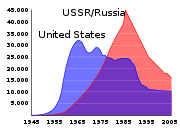
- Robert S. Norris & Hans M. Kristensen, "Nuclear U.S. and Soviet/Russian intercontinental ballistic missiles, 1959-2008"
- Robert S. Norris & Hans M. Kristensen, "U.S. nuclear forces, 2009", Nuclear Notebook, "Bulletin of the Atomic Scientists"
- Seiitsu Tachibana, "Bush administration's nuclear weapons policy : New obstacles to nuclear disarmament" Hiroshima Peace Science, Vol. 24, pages 105-133 (2002)
- Nuclear Disarmament at the United Nations Office for Disarmament Affairs
- Stockholm International Peace Research Institute's Research on Nuclear weapons