


International Brigades

Encyclopedia
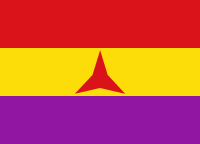
Military
A military is an organization authorized by its greater society to use lethal force, usually including use of weapons, in defending its country by combating actual or perceived threats. The military may have additional functions of use to its greater society, such as advancing a political agenda e.g...
units made up of volunteers from different countries, who traveled to Spain
Spain
Spain , officially the Kingdom of Spain languages]] under the European Charter for Regional or Minority Languages. In each of these, Spain's official name is as follows:;;;;;;), is a country and member state of the European Union located in southwestern Europe on the Iberian Peninsula...
to defend the Second Spanish Republic
Second Spanish Republic
The Second Spanish Republic was the government of Spain between April 14 1931, and its destruction by a military rebellion, led by General Francisco Franco....
in the Spanish Civil War
Spanish Civil War
The Spanish Civil WarAlso known as The Crusade among Nationalists, the Fourth Carlist War among Carlists, and The Rebellion or Uprising among Republicans. was a major conflict fought in Spain from 17 July 1936 to 1 April 1939...
between 1936 and 1939.
The number of combatant volunteers has been estimated at between 32,000–35,000, though with no more than about 20,000 active at any one time. A further 10,000 people probably participated in non-combatant roles and about 3,000–5,000 foreigners were members of CNT
Confederación Nacional del Trabajo
The Confederación Nacional del Trabajo is a Spanish confederation of anarcho-syndicalist labor unions affiliated with the International Workers Association . When working with the latter group it is also known as CNT-AIT...
or POUM
Poum
Poum is a commune in the North Province of New Caledonia, an overseas territory of France in the Pacific Ocean. The town of Poum is located in the far northwest, located on the southern part of Banare Bay, with Mouac Island just offshore....
. They came from a claimed "53 nations" to fight against the Spanish Nationalist forces led by General Francisco Franco
Francisco Franco
Francisco Franco y Bahamonde was a Spanish general, dictator and head of state of Spain from October 1936 , and de facto regent of the nominally restored Kingdom of Spain from 1947 until his death in November, 1975...
and assisted by German
Nazi Germany
Nazi Germany , also known as the Third Reich , but officially called German Reich from 1933 to 1943 and Greater German Reich from 26 June 1943 onward, is the name commonly used to refer to the state of Germany from 1933 to 1945, when it was a totalitarian dictatorship ruled by...
and Italian
Kingdom of Italy (1861–1946)
The Kingdom of Italy was a state forged in 1861 by the unification of Italy under the influence of the Kingdom of Sardinia, which was its legal predecessor state...
forces.
Formation and recruitment
Using foreign Communist PartiesCommunist party
A political party described as a Communist party includes those that advocate the application of the social principles of communism through a communist form of government...
to recruit volunteers for Spain was first proposed in the Soviet Union
Soviet Union
The Soviet Union , officially the Union of Soviet Socialist Republics , was a constitutionally socialist state that existed in Eurasia between 1922 and 1991....
in September 1936—apparently at the suggestion of Maurice Thorez
Maurice Thorez
thumb|A Soviet stamp depicting Maurice Thorez.Maurice Thorez was a French politician and longtime leader of the French Communist Party from 1930 until his death. He also served as vice premier of France from 1946 to 1947....
—by Willi Münzenberg
Willi Münzenberg
Willi Münzenberg was a communist political activist. Münzenberg was the first head of the Young Communist International in 1919-20 and established the famine-relief and propaganda organization Workers International Relief in 1921...
, chief of Comintern
Comintern
The Communist International, abbreviated as Comintern, also known as the Third International, was an international communist organization initiated in Moscow during March 1919...
propaganda for Western Europe. As a security measure, non-Communist volunteers would first be interviewed by an NKVD
NKVD
The People's Commissariat for Internal Affairs was the public and secret police organization of the Soviet Union that directly executed the rule of power of the Soviets, including political repression, during the era of Joseph Stalin....
agent.
By the end of September, the Italian and French Communist Parties had decided to set up a column. Luigi Longo
Luigi Longo
thumb|right|Luigi Longo portrayed on a 1981 [[USSR]] postage stamp.Luigi Longo , also known as Gallo, was an Italian communist politician and secretary of the Italian Communist Party from 1964 to 1972.-Early life:...
, ex-leader of the Italian Communist Youth, was charged to make the necessary arrangements with the Spanish government. The Soviet Ministry of Defense also helped, since they had experience of dealing with corps of international volunteers during the Russian Civil War
Russian Civil War
The Russian Civil War was a multi-party war that occurred within the former Russian Empire after the Russian provisional government collapsed to the Soviets, under the domination of the Bolshevik party. Soviet forces first assumed power in Petrograd The Russian Civil War (1917–1923) was a...
. The idea was initially opposed by Largo Caballero, but after the first setbacks of the war, he changed his mind, and finally agreed to the operation on 22 October. However, the Soviet Union did not withdraw from the Non-Intervention Committee
Non-Intervention Committee
During the Spanish Civil War, several countries followed a principle of non-intervention, which would result in the signing of the Non-Intervention Agreement in August 1936 and the setting up of the Non-Intervention Committee, which first met in September...
, probably to avoid diplomatic conflict with France
France
The French Republic , The French Republic , The French Republic , (commonly known as France , is a unitary semi-presidential republic in Western Europe with several overseas territories and islands located on other continents and in the Indian, Pacific, and Atlantic oceans. Metropolitan France...
and the United Kingdom
United Kingdom
The United Kingdom of Great Britain and Northern IrelandIn the United Kingdom and Dependencies, other languages have been officially recognised as legitimate autochthonous languages under the European Charter for Regional or Minority Languages...
.
The main recruitment centre was in Paris
Paris
Paris is the capital and largest city in France, situated on the river Seine, in northern France, at the heart of the Île-de-France region...
, under the supervision of Polish communist colonel Karol "Walter" Świerczewski
Karol Swierczewski
Karol Wacław Świerczewski was a Pole who became a Soviet military officer and a general. He served as a general in the service of the Soviet Union, Republican Spain, and the Soviet sponsored Polish Provisional Government of National Unity after World War II.- Life :Karol Świerczewski grew up in...
. On 17 October 1936, an open letter by Joseph Stalin
Joseph Stalin
Joseph Vissarionovich Stalin was the Premier of the Soviet Union from 6 May 1941 to 5 March 1953. He was among the Bolshevik revolutionaries who brought about the October Revolution and had held the position of first General Secretary of the Communist Party of the Soviet Union's Central Committee...
to José Díaz was published in Mundo Obrero, arguing that victory for the Spanish second republic was a matter not only for Spaniards, but also for the whole of "progressive humanity"; in a matter of days, support organisations for the Spanish Republic were founded in most countries, all more or less controlled by the Comintern
Comintern
The Communist International, abbreviated as Comintern, also known as the Third International, was an international communist organization initiated in Moscow during March 1919...
.
Entry to Spain was arranged for volunteers: for instance, a Yugoslavian, Josip Broz, who would became famous as Marshal Josip Broz Tito
Josip Broz Tito
Marshal Josip Broz Tito – 4 May 1980) was a Yugoslav revolutionary and statesman. While his presidency has been criticized as authoritarian, Tito was a popular public figure both in Yugoslavia and abroad, viewed as a unifying symbol for the nations of the Yugoslav federation...
, was in Paris to provide assistance, money and passports for volunteers from Eastern Europe
Eastern Europe
Eastern Europe is the eastern part of Europe. The term has widely disparate geopolitical, geographical, cultural and socioeconomic readings, which makes it highly context-dependent and even volatile, and there are "almost as many definitions of Eastern Europe as there are scholars of the region"...
. Volunteers were sent by train or ship from France to Spain, and sent to the base at Albacete
Albacete
Albacete is a city and municipality in southeastern Spain, 258 km southeast of Madrid, the capital of the province of Albacete in the autonomous community of Castile-La Mancha. The municipality had a population of c. 169,700 in 2009....
. However, many of them also went by themselves to Spain. The volunteers were under no contract, nor defined engagement period, which would later prove a problem.
Also many Italians, Germans, and people from other countries joined the movement, with the idea that combat in Spain was a first step to restore democracy
Democracy
Democracy is generally defined as a form of government in which all adult citizens have an equal say in the decisions that affect their lives. Ideally, this includes equal participation in the proposal, development and passage of legislation into law...
or advance a revolutionary cause in their own country. There were also many unemployed workers (especially from France), and adventurers. Finally, some 500 communists who had been exiled to Russia were sent to Spain (among them, experienced military leaders from the First World War like "Kléber" Stern
Manfred Stern
Manfred Stern was a member of the GRU, Soviet military intelligence. He served as a spy in the United States, as a military advisor in China, and gained fame under his nom de guerre as General Kléber, leader of the International Brigade during the Spanish Civil War.- Early life :He was born into...
, "Gomez" Zaisser
Wilhelm Zaisser
Wilhelm Zaisser was a German communist politician and the first Minister for State Security of the German Democratic Republic .- Life :...
, "Lukacs" Zalka
Zalka Mate
Máté Zalka was a Hungarian writer and revolutionary. His real name was Béla Frankl. He attended Polgári Iskola in Mátészalka, which was later renamed in his honor....
and "Gal" Galicz
Janos Galicz
Janos Galicz, better known as "General Gal", was a brigade and division commander during the Spanish Civil War....
, who would prove invaluable in combat).
The operation was met by communists with enthusiasm, but by anarchists with skepticism, at best. At first, the anarchists who controlled the borders with France were told to refuse communist volunteers, and reluctantly allowed their passage after protests. A group of 500 volunteers (mainly French, with a few exiled Poles and Germans) arrived in Albacete on 14 October 1936. They were met by international volunteers who had already been fighting in Spain: Germans from the Thälmann Battalion
Thälmann Battalion
The Thälmann Battalion was a battalion of the International Brigades in the Spanish Civil War. It was named after the imprisoned German communist leader Ernst Thälmann and included approximately 1,500 people, mainly Germans, Austrians, Swiss and Scandinavians. The battalion fought in the defence...
, Italians from Centuria Gastone Sozzi and French from Commune de Paris Battalion. Among them was British poet John Cornford
John Cornford
Rupert John Cornford was an English poet and communist. He was the son of F. M. Cornford and Frances Cornford.- Biography :...
. Men were sorted according to their experience and origin, and dispatched to units.
Albacete soon became the International Brigades headquarters and its main depot. It was run by a troika of Comintern
Comintern
The Communist International, abbreviated as Comintern, also known as the Third International, was an international communist organization initiated in Moscow during March 1919...
heavyweights: André Marty
André Marty
André Marty was a leading figure in the French Communist Party, the PCF, for nearly thirty years. He was also a member of the National Assembly, with some interruptions, from 1924 to 1955; Secretary of Comintern from 1935 to 1944; and Political Commissar of the International Brigades during the...
was commander; Luigi Longo
Luigi Longo
thumb|right|Luigi Longo portrayed on a 1981 [[USSR]] postage stamp.Luigi Longo , also known as Gallo, was an Italian communist politician and secretary of the Italian Communist Party from 1964 to 1972.-Early life:...
(Gallo) was Inspector-General; and Giuseppe Di Vittorio
Giuseppe Di Vittorio
Giuseppe Di Vittorio, also known under the pseudonym Nicoletti , was an Italian syndicalist trade unionist and communist politician, one of the most influential leaders of the labor movement after World War I....
(Nicoletti) was chief political commissar.
The French Communist Party
French Communist Party
The French Communist Party is a political party in France which advocates the principles of communism.Although its electoral support has declined in recent decades, the PCF retains a large membership, behind only that of the Union for a Popular Movement , and considerable influence in French...
provided uniforms for the Brigades. Discipline was extreme. For several weeks, the Brigades were locked in their base while their strict military training was under way.
First engagements: Siege of Madrid
The Battle of Madrid was a major success for the Republic. It staved off the prospect of a rapid defeat at the hands of Francisco FrancoFrancisco Franco
Francisco Franco y Bahamonde was a Spanish general, dictator and head of state of Spain from October 1936 , and de facto regent of the nominally restored Kingdom of Spain from 1947 until his death in November, 1975...
's forces. The role of the International Brigades in this victory was generally recognised, but was exaggerated by Comintern
Comintern
The Communist International, abbreviated as Comintern, also known as the Third International, was an international communist organization initiated in Moscow during March 1919...
propaganda, so that the outside world heard only of their victories, and not those of Spanish units. So successful was such propaganda that the British Ambassador, Sir Henry Chilton, declared that there were no Spaniards in the army which had defended Madrid. The International Brigade forces that fought in Madrid arrived after other successful Republican fighting. Of the 40,000 Republican troops in the city, the foreign troops numbered less than 3,000. Even though the International Brigades did not win the battle by themselves, nor significantly change the situation, they certainly did provide an example by their determined fighting, and improved the morale of the population by demonstrating the concern of other nations in the fight. Many of the older members of the International Brigades provided valuable combat experience having fought during the First World War (Spain remained neutral in 1914-18) and the Irish War of Independence
Irish War of Independence
The Irish War of Independence , Anglo-Irish War, Black and Tan War, or Tan War was a guerrilla war mounted by the Irish Republican Army against the British government and its forces in Ireland. It began in January 1919, following the Irish Republic's declaration of independence. Both sides agreed...
(Some fought in the IRA
Irish Republican Army
The Irish Republican Army was an Irish republican revolutionary military organisation. It was descended from the Irish Volunteers, an organisation established on 25 November 1913 that staged the Easter Rising in April 1916...
while others fought in the British army
British Army
The British Army is the land warfare branch of Her Majesty's Armed Forces in the United Kingdom. It came into being with the unification of the Kingdom of England and Scotland into the Kingdom of Great Britain in 1707. The new British Army incorporated Regiments that had already existed in England...
).
One of the strategic positions in Madrid was the Casa de Campo
Casa de Campo
The Casa de Campo is the largest urban park situated west of central Madrid, . It was formerly a royal hunting estate. Its area is more than ....
. There the Nationalist troops were Moroccans
Morocco
Morocco , officially the Kingdom of Morocco , is a country located in North Africa. It has a population of more than 32 million and an area of 710,850 km², and also primarily administers the disputed region of the Western Sahara...
, commanded by General José Enrique Varela
José Enrique Varela
José Enrique Varela Iglesias was a Spanish military officer and Carlist noted for his role as a Nationalist commander in the Spanish Civil War.-Early career:...
. They were excellent fighters in the open, but were ill-trained for urban warfare, a role in which the Republican militia had shown prowess in from the early days of the war. They were stopped by III and IV Brigades of the regular Republican Army.
On 9 November 1936, the XI International Brigade
XI International Brigade
The XI International Brigade fought for the Spanish Second Republic in the Spanish Civil War.It would become especially renowned for providing desperately needed support in the darkest hours of the Republican defense of Madrid on 8 November 1936, when, with great losses, it helped repulse a major...
- comprising 1,900 men from the Edgar André Battalion, the Commune de Paris Battalion and the Dabrowski Battalion
Dabrowski Battalion
The Dabrowski Battalion, also known as Dąbrowszczacy was a battalion of the International Brigades in the Spanish Civil War. It was initially formed entirely of volunteers, "chiefly composed of Polish miners recently living and working in France and Belgium". Because of the relatively short...
, together with a British machine-gun company — took up position at the Casa de Campo. In the evening, its commander, General Kléber
Manfred Stern
Manfred Stern was a member of the GRU, Soviet military intelligence. He served as a spy in the United States, as a military advisor in China, and gained fame under his nom de guerre as General Kléber, leader of the International Brigade during the Spanish Civil War.- Early life :He was born into...
, launched an assault on the Nationalist positions. This lasted for the whole night and part of the next morning. At the end of the fight, the Nationalist troops had been forced to retreat, abandoning all hopes of a direct assault on Madrid by Casa de Campo, while the XIth Brigade had lost a third of its personnel.
On 13 November, the 1,550-man strong XII International Brigade
XII International Brigade
The XII International Brigade was mustered on 7 November 1936 at Albacete, Spain. It was formally named the Garibaldi Brigade, after the most famous and inspiring leader in the Italian Independence Wars, General Giuseppe Garibaldi. Its first commanding officer was a soviet advisor of Hungarian...
, made up of the Thälmann Battalion
Thälmann Battalion
The Thälmann Battalion was a battalion of the International Brigades in the Spanish Civil War. It was named after the imprisoned German communist leader Ernst Thälmann and included approximately 1,500 people, mainly Germans, Austrians, Swiss and Scandinavians. The battalion fought in the defence...
, the Garibaldi Battalion
Garibaldi Battalion
The Garibaldi Battalion was a group of mostly Italian volunteers that fought in the Spanish Civil War from October 1936 to 1938...
and the André Marty Battalion, deployed. Commanded by General "Lukacs", they assaulted Nationalist positions on the high ground of Cerro de los Angeles
Cerro de los Ángeles
The Cerro de los Ángeles is a famous hill located in Getafe, Spain, about south of Madrid. The site is famous for being considered the geographic centre of the Iberian Peninsula...
. As a result of language and communication problems, command issues, lack of rest, poor coordination with armoured units, and insufficient artillery support, the attack failed.
On November 19, the anarchist militia
Militia
The term militia is commonly used today to refer to a military force composed of ordinary citizens to provide defense, emergency law enforcement, or paramilitary service, in times of emergency without being paid a regular salary or committed to a fixed term of service. It is a polyseme with...
s were forced to retreat, and Nationalist troops — Moroccans and Spanish Foreign Legionnaires, covered by the Nazi Condor Legion
Condor Legion
The Condor Legion was a unit composed of volunteers from the German Air Force and from the German Army which served with the Nationalists during the Spanish Civil War of July 1936 to March 1939. The Condor Legion developed methods of terror bombing which were used widely in the Second World War...
— captured a foothold in the University City. The 11th Brigade was sent to drive the Nationalists out of the University City. The battle was extremely bloody, a mix of artillery
Artillery
Originally applied to any group of infantry primarily armed with projectile weapons, artillery has over time become limited in meaning to refer only to those engines of war that operate by projection of munitions far beyond the range of effect of personal weapons...
and aerial bombardment
Strategic bombing
Strategic bombing is a military strategy used in a total war with the goal of defeating an enemy nation-state by destroying its economic ability and public will to wage war rather than destroying its land or naval forces...
, with bayonet
Bayonet
A bayonet is a knife, dagger, sword, or spike-shaped weapon designed to fit in, on, over or underneath the muzzle of a rifle, musket or similar weapon, effectively turning the gun into a spear...
and grenade
Grenade
A grenade is a small explosive device that is projected a safe distance away by its user. Soldiers called grenadiers specialize in the use of grenades. The term hand grenade refers any grenade designed to be hand thrown. Grenade Launchers are firearms designed to fire explosive projectile grenades...
fights, room by room. Anarchist leader Buenaventura Durruti
Buenaventura Durruti
José Buenaventura Durruti Dumange was a central figure of Spanish anarchism during the period leading up to and including the Spanish Civil War.-Early life:...
was shot there on 19 November 1936, and died the next day. The battle in the University went on until three quarters of the University City was under Nationalist control. Both sides then started setting up trenches and fortifications. It was then clear that any assault from either side would be far too costly; the nationalist leaders had to renounce the idea of a direct assault on Madrid, and prepare for a siege
Siege
A siege is a military blockade of a city or fortress with the intent of conquering by attrition or assault. The term derives from sedere, Latin for "to sit". Generally speaking, siege warfare is a form of constant, low intensity conflict characterized by one party holding a strong, static...
of the capital.
On 13 December 1936, 18,000 nationalist troops attempted an attack to close the encirclement of Madrid at Guadarrama
Guadarrama
Guadarrama is a town in the Community of Madrid in Spain.Pop: 13032 , approx. 60000 .Co-ordinates . not true...
— an engagement known as the Battle of the Corunna Road
Battle of the Corunna Road
The Battle of the Corunna Road was a battle of the Spanish Civil War from 13 December 1936 to 15 January 1937, northwest of Madrid.-Background:...
. The Republicans sent in a Soviet armoured unit, under General Dmitry Pavlov
Dmitry Pavlov
Dmitry Grigorevich Pavlov was a Soviet general who commanded the key Soviet Western Front during the initial days of the German invasion of the Soviet Union, or Operation Barbarossa, in June 1941. After his forces were heavily defeated in the first days of the campaign, he was relieved of his...
, and both XI and XII International Brigades. Violent combat followed, and they stopped the Nationalist advance.
An attack was then launched by the Republic on the Cordoba
Córdoba, Spain
-History:The first trace of human presence in the area are remains of a Neanderthal Man, dating to c. 32,000 BC. In the 8th century BC, during the ancient Tartessos period, a pre-urban settlement existed. The population gradually learned copper and silver metallurgy...
front. The battle ended in a form of stalemate; a communique was issued, saying: "[t]oday, our advance continued without loss of land". Poets Ralph Winston Fox
Ralph Winston Fox
Ralph Winston Fox was a British novelist, biographer , social historian, journalist, translator and politician....
and John Cornford
John Cornford
Rupert John Cornford was an English poet and communist. He was the son of F. M. Cornford and Frances Cornford.- Biography :...
were killed. Eventually, the Nationalists advanced, taking the hydro electric station at El Campo. André Marty
André Marty
André Marty was a leading figure in the French Communist Party, the PCF, for nearly thirty years. He was also a member of the National Assembly, with some interruptions, from 1924 to 1955; Secretary of Comintern from 1935 to 1944; and Political Commissar of the International Brigades during the...
accused the commander of the Marseillaise Battalion, Gaston Delasalle, of espionage
Espionage
Espionage or spying involves an individual obtaining information that is considered secret or confidential without the permission of the holder of the information. Espionage is inherently clandestine, lest the legitimate holder of the information change plans or take other countermeasures once it...
and treason
Treason
In law, treason is the crime that covers some of the more extreme acts against one's sovereign or nation. Historically, treason also covered the murder of specific social superiors, such as the murder of a husband by his wife. Treason against the king was known as high treason and treason against a...
and had him executed. (It is doubtful that Delasalle would have been a spy for Francisco Franco; he was denounced by his own second-in-command, André Heussler, who was subsequently executed for treason during World War II
World War II
World War II, or the Second World War , was a global conflict lasting from 1939 to 1945, involving most of the world's nations—including all of the great powers—eventually forming two opposing military alliances: the Allies and the Axis...
by the French Resistance
French Resistance
The French Resistance is the name used to denote the collection of French resistance movements that fought against the Nazi German occupation of France and against the collaborationist Vichy régime during World War II...
.)
Further Nationalist attempts after Christmas to encircle Madrid met with failure, but not without extremely violent combat. On 6 January 1937, the Thälmann Battalion
Thälmann Battalion
The Thälmann Battalion was a battalion of the International Brigades in the Spanish Civil War. It was named after the imprisoned German communist leader Ernst Thälmann and included approximately 1,500 people, mainly Germans, Austrians, Swiss and Scandinavians. The battalion fought in the defence...
arrived at Las Rozas, and held its positions until it was destroyed as a fighting force. On January 9, only 10 km had been lost to the Nationalists, when the XIII International Brigade
XIII International Brigade
This article is about the 13th International Brigade - often known as the XIII Dabrowski Brigade - which fought for the Spanish Second Republic in the Spanish Civil War in the International Brigades. The brigade was dissolved and then reformed on four occasions.-1st Formation :The brigade was first...
and XIV International Brigade
XIV International Brigade
The XIV International Brigade was one of several international brigades that fought for the Spanish Second Republic during the Spanish Civil War. It was raised on 20 December 1936 with volunteers mainly from France and Belgium, under General "Walter" . This Brigade was the fourth of the...
and the 1st British Company, arrived in Madrid. Violent Republican assaults were launched in attempt to retake the land, with little success. On January 15, trenches and fortifications were built by both sides, resulting in a stalemate.
The Nationalists did not take Madrid until the very end of the war, in March 1939. There were also some pockets of resistance during the consecutive months.
Battle of Jarama
On 6 February 1937, following the fall of MálagaMálaga
Málaga is a city and a municipality in the Autonomous Community of Andalusia, Spain. With a population of 568,507 in 2010, it is the second most populous city of Andalusia and the sixth largest in Spain. This is the southernmost large city in Europe...
, the nationalists launched an attack on the Madrid
Madrid
Madrid is the capital and largest city of Spain. The population of the city is roughly 3.3 million and the entire population of the Madrid metropolitan area is calculated to be 6.271 million. It is the third largest city in the European Union, after London and Berlin, and its metropolitan...
-Andalusia
Andalusia
Andalusia is the most populous and the second largest in area of the autonomous communities of Spain. The Andalusian autonomous community is officially recognised as a nationality of Spain. The territory is divided into eight provinces: Huelva, Seville, Cádiz, Córdoba, Málaga, Jaén, Granada and...
road, south of Madrid. The Nationalists quickly advanced on the little town Ciempozuelos
Ciempozuelos
Ciempozuelos is a town in Spain. It is located in the south of the Community of Madrid. It had a population of 17,769 in 2005 Its origins appear to be Moorish and the name refers to the number of wells that existed in the town. It is clearly not as well-known as its neighbours Chinchón and Aranjuez...
, held by the XV International Brigade
XV International Brigade
The XV International Brigade fought for the Spanish Second Republic in the Spanish Civil War as a part of the International Brigades. It was mustered at Albacete in Spain, in January 1937, comprising many English-speaking volunteers - arranged into a mostly British British Battalion and a mostly...
, which was composed of the British Battalion
British Battalion
The British Battalion was the 16th battalion of the International Brigades during the Spanish Civil War.- Early volunteers :A number of British volunteers, including Tom Wintringham and Nat Cohen, arrived in Spain during August-September 1936 and formed the Tom Mann Centuria - a rifle company in...
(British Commonwealth
Commonwealth of Nations
The Commonwealth of Nations, normally referred to as the Commonwealth and formerly known as the British Commonwealth, is an intergovernmental organisation of fifty-four independent member states...
and Irish
Republic of Ireland
Ireland , described as the Republic of Ireland , is a sovereign state in Europe occupying approximately five-sixths of the island of the same name. Its capital is Dublin. Ireland, which had a population of 4.58 million in 2011, is a constitutional republic governed as a parliamentary democracy,...
), the Dimitrov Battalion
Dimitrov Battalion
The Dimitrov Battalion was part of the International Brigades during the Spanish Civil War. It was the 18th battalion formed, and was named after Georgi Dimitrov, a Bulgarian communist and General Secretary of the Comintern in that period....
(miscellaneous Balkan nationalities), the 6 Février Battalion (Belgians
Belgium
Belgium , officially the Kingdom of Belgium, is a federal state in Western Europe. It is a founding member of the European Union and hosts the EU's headquarters, and those of several other major international organisations such as NATO.Belgium is also a member of, or affiliated to, many...
and French), the Canadian Mackenzie-Papineau Battalion
Mackenzie-Papineau Battalion
The Mackenzie–Papineau Battalion or Mac-Paps were a battalion of Canadians who fought as part of the XV International Brigade on the Republican side in the Spanish Civil War. Except for France, no other country gave a greater proportion of its population as volunteers in Spain than Canada. The...
and the Abraham Lincoln Brigade
Abraham Lincoln Brigade
The Abraham Lincoln Brigade refers to volunteers from the United States who served in the Spanish Civil War in the International Brigades. They fought for Spanish Republican forces against Franco and the Spanish Nationalists....
(Americans
United States
The United States of America is a federal constitutional republic comprising fifty states and a federal district...
, including African-American).
An independent 80-men-strong (mainly) Irish unit, known as the Connolly Column
Connolly Column
The Connolly Column was the name given to the Irish volunteers who fought for the Second Spanish Republic in the International Brigades during the Spanish Civil War. They were named after James Connolly, the executed leader of the Irish Citizen Army...
, made up of people from both sides of the Irish border also fought. Several histories of the Irish in Spain record that they included an ex-Catholic Christian Brother
Congregation of Christian Brothers
The Congregation of Christian Brothers is a worldwide religious community within the Catholic Church, founded by Blessed Edmund Rice. The Christian Brothers, as they are commonly known, chiefly work for the evangelisation and education of youth, but are involved in many ministries, especially with...
and an ordained Church of Ireland
Church of Ireland
The Church of Ireland is an autonomous province of the Anglican Communion. The church operates in all parts of Ireland and is the second largest religious body on the island after the Roman Catholic Church...
(Anglican Protestant) Clergyman, fighting and dying on the same side. (These battalions were not composed entirely of one nationality or another, rather they were for the most part a mix of many)
On 11 February 1937, a Nationalist brigade launched a surprise attack on the André Marty Battalion (XIV International Brigade
XIV International Brigade
The XIV International Brigade was one of several international brigades that fought for the Spanish Second Republic during the Spanish Civil War. It was raised on 20 December 1936 with volunteers mainly from France and Belgium, under General "Walter" . This Brigade was the fourth of the...
), stabbing its sentries and crossing the Jarama
Jarama
Jarama is a river in central Spain. It flows north to south, and passes east of Madrid when El Atazar Dam is built on a tributary, the Lozoya River. It flows into the river Tagus in Aranjuez...
. The Garibaldi Battalion stopped the advance with heavy fire. At another point, the same tactic allowed the Nationalists to move their troops across the river.
On 12 February, the British Battalion
British Battalion
The British Battalion was the 16th battalion of the International Brigades during the Spanish Civil War.- Early volunteers :A number of British volunteers, including Tom Wintringham and Nat Cohen, arrived in Spain during August-September 1936 and formed the Tom Mann Centuria - a rifle company in...
, XV International Brigade
XV International Brigade
The XV International Brigade fought for the Spanish Second Republic in the Spanish Civil War as a part of the International Brigades. It was mustered at Albacete in Spain, in January 1937, comprising many English-speaking volunteers - arranged into a mostly British British Battalion and a mostly...
took the brunt of the attack, remaining under heavy fire for seven hours. The position became known as "Suicide Hill". At the end of the day, only 225 of the 600 members of the British battalion remained. One company was captured by ruse, when Nationalists advanced among their ranks singing The Internationale
The Internationale
The Internationale is a famous socialist, communist, social-democratic and anarchist anthem.The Internationale became the anthem of international socialism, and gained particular fame under the Soviet Union from 1922 to 1944, when it was that communist state's de facto central anthem...
.
On 17 February, the Republican Army counter-attacked. On February 23 and 27, the International Brigades were engaged, but with little success. The Lincoln Battalion was put under great pressure, with no artillery support. It suffered 120 killed and 175 wounded. Amongst the dead was the Irish poet Charles Donnelly and Leo Greene.
There were heavy casualties on both sides, and although "both claimed victory ... both suffered defeats". It resulted in a stalemate, with both sides digging in, creating elaborate trench systems.
On 22 February 1937 the League of Nations
League of Nations
The League of Nations was an intergovernmental organization founded as a result of the Paris Peace Conference that ended the First World War. It was the first permanent international organization whose principal mission was to maintain world peace...
Non-Intervention Committee
Non-Intervention Committee
During the Spanish Civil War, several countries followed a principle of non-intervention, which would result in the signing of the Non-Intervention Agreement in August 1936 and the setting up of the Non-Intervention Committee, which first met in September...
ban on foreign volunteers went into effect.
Battle of Guadalajara
After the failed assault on the Jarama, the Nationalists attempted another assault on Madrid, from the North-East this time. The objective was the town of GuadalajaraGuadalajara, Spain
Guadalajara is a city and municipality in the autonomous community of Castile-La Mancha, Spain, and in the natural region of La Alcarria. It is the capital of the province of Guadalajara. It is located roughly 60 km northeast of Madrid on the Henares River, and has a population of 83,789...
, 50 km from Madrid. The whole Italian expeditionary corps — 35,000 men, with 80 battle tanks and 200 field artillery — was deployed, as Benito Mussolini
Benito Mussolini
Benito Amilcare Andrea Mussolini was an Italian politician who led the National Fascist Party and is credited with being one of the key figures in the creation of Fascism....
wanted the victory to be credited to Italy. On 9 March 1937, the Italians made a breach in the Republican lines, but did not properly exploit the advance. However, the rest of the Nationalist army was advancing, and the situation appeared critical for the Republicans. A formation drawn from the best available units of the Republican army, including the XI
XI International Brigade
The XI International Brigade fought for the Spanish Second Republic in the Spanish Civil War.It would become especially renowned for providing desperately needed support in the darkest hours of the Republican defense of Madrid on 8 November 1936, when, with great losses, it helped repulse a major...
and XII International Brigade
XII International Brigade
The XII International Brigade was mustered on 7 November 1936 at Albacete, Spain. It was formally named the Garibaldi Brigade, after the most famous and inspiring leader in the Italian Independence Wars, General Giuseppe Garibaldi. Its first commanding officer was a soviet advisor of Hungarian...
s, was quickly assembled.
At dawn on 10 March, the Nationalists closed in, and by noon, the Garibaldi Battalion counterattacked. Some confusion arose from the fact that the sides were not aware of each other's movements, and that both sides spoke Italian; this resulted in scouts from both sides exchanging information without realising they were enemies. The Republican lines advanced and made contact with XI International Brigade. Nationalist tanks were shot at and infantry patrols came into action. There was reportedly an incident in which a Nationalist officer asked why Italian soldiers were shooting at his party, and they responded Noi siamo Italiani di Garibaldi (literally: "we are Garibaldi Italian"), at which point the Nationalists surrendered. The common language was used to advantage by the Republicans, who used loudspeakers and dropped leaflets from planes, to broadcast propaganda messages, including a promise to pay Nationalist deserters.
On March 11, the Nationalist army broke the front of the Republican army. The Thälmann Battalion
Thälmann Battalion
The Thälmann Battalion was a battalion of the International Brigades in the Spanish Civil War. It was named after the imprisoned German communist leader Ernst Thälmann and included approximately 1,500 people, mainly Germans, Austrians, Swiss and Scandinavians. The battalion fought in the defence...
suffered heavy losses, but succeeded in holding the Trijueque
Trijueque
Trijueque is a municipality located in the province of Guadalajara, Castile-La Mancha, Spain. According to the 2004 census , the municipality has a population of 909 inhabitants....
-Torija
Torija
Torija is a municipality located in the province of Guadalajara, Castile-La Mancha, Spain. According to the 2004 census , the municipality has a population of 576 inhabitants....
road. The Garibaldi also held its positions. On March 12, Republican planes and tanks attacked. The Thälmann Battalion attacked Trijuete in a bayonet charge and re-took the town, capturing numerous prisoners.
The International Brigades also saw combat in the Battle of Teruel
Battle of Teruel
The Battle of Teruel was fought in and around the city of Teruel during the Spanish Civil War in December 1937 – February 1938. The combatants fought the battle during the worst Spanish winter in twenty years. It was one of the bloodier actions of the war. The city changed hands several times,...
in January 1938. The 35th International Division suffered heavily in this battle from aerial bombardment as well as shortages of food, winter clothing and ammunition. The XIV International Brigade
XIV International Brigade
The XIV International Brigade was one of several international brigades that fought for the Spanish Second Republic during the Spanish Civil War. It was raised on 20 December 1936 with volunteers mainly from France and Belgium, under General "Walter" . This Brigade was the fourth of the...
fought in the Battle of Ebro in July 1938, the last Republican offensive of the war.
Disbandment
In October 1938, at the height of the Battle of the EbroBattle of the Ebro
The Battle of the Ebro was the longest and bloodiest battle of the Spanish Civil War...
, the Non-Intervention Committee
Non-Intervention Committee
During the Spanish Civil War, several countries followed a principle of non-intervention, which would result in the signing of the Non-Intervention Agreement in August 1936 and the setting up of the Non-Intervention Committee, which first met in September...
ordered the withdrawal of the International Brigades which were fighting on the Republican side, while turning a blind eye on the fact that the Fascist Italian and Nazi German expeditionary forces were fighting on the Nationalist side, effectively helping General Franco to win the war. The Republican government of Juan Negrín
Juan Negrín
Juan Negrín y López was a Spanish politician and physician.-Early years:Born in Las Palmas de Gran Canaria, Negrín came from a religious middle-class family...
, announced the decision in the League of Nations
League of Nations
The League of Nations was an intergovernmental organization founded as a result of the Paris Peace Conference that ended the First World War. It was the first permanent international organization whose principal mission was to maintain world peace...
on 21 September 1938. The disbandment was part of an ill-advised effort to get the Nationalists' foreign backers to withdraw their troops and to persuade the western democracies such as France and Britain to end their arms embargo
Embargo
An embargo is the partial or complete prohibition of commerce and trade with a particular country, in order to isolate it. Embargoes are considered strong diplomatic measures imposed in an effort, by the imposing country, to elicit a given national-interest result from the country on which it is...
on the Republic.
By this time there were about an estimated 10,000 foreign volunteers still serving in Spain for the Republican side, and about 50,000 foreign conscripts for the Nationalists (excluding another 30,000 Moroccans). Perhaps half of the International Brigadists came from Nazi Germany, Fascist Italy or other countries, such as Hungary, which had authoritarian right-wing governments at the time. These men could not safely return home and some were instead given honorary Spanish citizenship and integrated into Spanish units of the Popular Army. The remainder were repatriated to their own countries. The Belgian volunteers lost their citizenship because they had served in a foreign army.
Overview
The first brigades were composed mostly of French, Belgian, Italian, and German volunteers, backed by a sizeable contingent of Polish miners from Northern France and Belgium. The XIthXI International Brigade
The XI International Brigade fought for the Spanish Second Republic in the Spanish Civil War.It would become especially renowned for providing desperately needed support in the darkest hours of the Republican defense of Madrid on 8 November 1936, when, with great losses, it helped repulse a major...
, XIIth
XII International Brigade
The XII International Brigade was mustered on 7 November 1936 at Albacete, Spain. It was formally named the Garibaldi Brigade, after the most famous and inspiring leader in the Italian Independence Wars, General Giuseppe Garibaldi. Its first commanding officer was a soviet advisor of Hungarian...
and XIIIth
XIII International Brigade
This article is about the 13th International Brigade - often known as the XIII Dabrowski Brigade - which fought for the Spanish Second Republic in the Spanish Civil War in the International Brigades. The brigade was dissolved and then reformed on four occasions.-1st Formation :The brigade was first...
were the first brigades formed. Later, the XIVth
XIV International Brigade
The XIV International Brigade was one of several international brigades that fought for the Spanish Second Republic during the Spanish Civil War. It was raised on 20 December 1936 with volunteers mainly from France and Belgium, under General "Walter" . This Brigade was the fourth of the...
and XVth
XV International Brigade
The XV International Brigade fought for the Spanish Second Republic in the Spanish Civil War as a part of the International Brigades. It was mustered at Albacete in Spain, in January 1937, comprising many English-speaking volunteers - arranged into a mostly British British Battalion and a mostly...
Brigades were raised, mixing experienced soldiers with new volunteers. Smaller Brigades — the 86th, 129th and 150th - were formed in late 1937 and 1938, mostly for temporary tactical reasons.
About 32,000 people volunteered to defend the Spanish Republic. Many were veterans of World War I. Their early engagements in 1936 during the Siege of Madrid amply demonstrated their military and propaganda value.
The international volunteers were mainly socialists, communists, or under communist authority, and a high proportion were Jewish
Jewish volunteers in the Spanish Civil War
A minority of the Jewish population, particularly that of Europe's, were active in socialist and Communist organisations in the period between the two World Wars....
. Some were involved in the fighting in Barcelona
Barcelona
Barcelona is the second largest city in Spain after Madrid, and the capital of Catalonia, with a population of 1,621,537 within its administrative limits on a land area of...
against Republican opponents of the Communists: the Workers' Party of Marxist Unification (POUM
Poum
Poum is a commune in the North Province of New Caledonia, an overseas territory of France in the Pacific Ocean. The town of Poum is located in the far northwest, located on the southern part of Banare Bay, with Mouac Island just offshore....
) (Partido Obrero de Unificación Marxista, an anti-Stalinist Marxist party) and anarchists. These more libertarian groups like the POUM fought together on the front with the anarchist federations of the CNT (CNT, Confederación Nacional del Trabajo) and the FAI
Federación Anarquista Ibérica
The Federación Anarquista Ibérica is a Spanish organization of anarchist militants active within affinity groups inside the Confederación Nacional del Trabajo trade union. It is often abbreviated as CNT-FAI because of the close relationship between the two organizations...
(FAI, Iberian Anarchist Federation) who had large support in the area of Catalonia. However, overseas volunteers from anarchist, socialist, liberal
Liberalism
Liberalism is the belief in the importance of liberty and equal rights. Liberals espouse a wide array of views depending on their understanding of these principles, but generally, liberals support ideas such as constitutionalism, liberal democracy, free and fair elections, human rights,...
and other political positions also served with the international brigades.
To simplify communication, the battalions usually concentrated people of the same nationality or language group. The battalions were often (formally, at least) named after inspirational people or events. From Spring 1937 onwards, many battalions contained one Spanish volunteer company (about 150 men).
Later in the war, military discipline tightened and learning Spanish became mandatory. By decree of 23 September 1937, the International Brigades formally became units of the Spanish Foreign Legion. This made them subject to the Spanish Code of Military Justice. However the Spanish Foreign Legion itself sided with the Nationalists throughout the coup and the civil war. The same decree also specified that non-Spanish officers in the Brigades should not exceed Spanish ones by more than 50 per cent
Brigadiers by country of origin
| Flag/s | Nationality | Estimate | Notes | |||
|---|---|---|---|---|---|---|
 |
France | 8,962–9,000 | ||||
 |
Italy | 3,000–3,350 | ||||
 / / |
Germany/Austria | 3,000–5,000 | Beevor quotes 2,217 Germans and 872 Austrians. | |||
 |
Poland | 3,000–3,113 | ||||
| Balkan countries | 2,095 | |||||
 |
Soviet Union | 2,000-3,000 | Though "never more than 800 present at any one time". | |||
 |
United States | 2,341–2,800 | ||||
 |
Great Britain | 1,800, 2,000, c. 4,000. | Beevor quotes 1,843 "of whom 549 were Scots". BBC quotes "about 4,000" based on MI5 MI5 The Security Service, commonly known as MI5 , is the United Kingdom's internal counter-intelligence and security agency and is part of its core intelligence machinery alongside the Secret Intelligence Service focused on foreign threats, Government Communications Headquarters and the Defence... estimates, released by the PRO, Kew. |
|||
 |
Belgium | 1,600–1,722 | ||||
 |
Czechoslovakia | 1,006–1,500 | ||||
 |
Yugoslavia | 1,500–1,660 | ||||
 |
Canada | 512–2,000 | Thomas estimates 1,000. | |||
| Baltic states | 892 | |||||
| Scandinavian countries | 799–1,000 | Thomas estimates about 1,000 "of whom 500 were Swedes". | ||||
 |
Netherlands | 628 | ||||
 |
Hungary | 528–1,500 | ||||
 |
Switzerland | 408–800 | ||||
 |
Bulgaria | 400-500 | ||||
 |
Ireland | 250 | Split between the British Battalion British Battalion The British Battalion was the 16th battalion of the International Brigades during the Spanish Civil War.- Early volunteers :A number of British volunteers, including Tom Wintringham and Nat Cohen, arrived in Spain during August-September 1936 and formed the Tom Mann Centuria - a rifle company in... and the Abraham Lincoln Battalion. |
|||
 |
Estonia | 200 | ||||
 |
Portugal | 134 | ||||
 |
Greece | 160 | ||||
 |
Mexico | 90 | Costa Rica | 24 | ||
| Cyprus | 60 | |||||
| Others | 1,122 |
Casualties
- Killed in action: 9,935 (16%)
- Wounded in action: 7,686 (12.9%)
- Missing in Action: unknown
- Prisoners-of War: unknown
Non-Spanish battalions
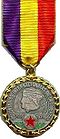
- Abraham Lincoln Battalion: from the United States, Canada and Irish Free StateIrish Free StateThe Irish Free State was the state established as a Dominion on 6 December 1922 under the Anglo-Irish Treaty, signed by the British government and Irish representatives exactly twelve months beforehand...
, with some British, CypriotsCyprusCyprus , officially the Republic of Cyprus , is a Eurasian island country, member of the European Union, in the Eastern Mediterranean, east of Greece, south of Turkey, west of Syria and north of Egypt. It is the third largest island in the Mediterranean Sea.The earliest known human activity on the...
and ChileChileChile ,officially the Republic of Chile , is a country in South America occupying a long, narrow coastal strip between the Andes mountains to the east and the Pacific Ocean to the west. It borders Peru to the north, Bolivia to the northeast, Argentina to the east, and the Drake Passage in the far...
ans who lived in New York and were members of the Chilean worker club of New York.- Connolly ColumnConnolly ColumnThe Connolly Column was the name given to the Irish volunteers who fought for the Second Spanish Republic in the International Brigades during the Spanish Civil War. They were named after James Connolly, the executed leader of the Irish Citizen Army...
: This mostly Irish republicanIrish RepublicanismIrish republicanism is an ideology based on the belief that all of Ireland should be an independent republic.In 1801, under the Act of Union, the Kingdom of Great Britain and the Kingdom of Ireland merged to form the United Kingdom of Great Britain and Ireland...
group fought as a section of the Lincoln Battalion
- Connolly Column
- Mickiewicz BattalionMickiewicz BattalionThe Mickiewicz Battalion was a volunteer battalion of the International Brigades during the Spanish Civil War. It formed part of the XIII International Brigade from 27 October 1937 until 23 September 1938, when the International Brigades were disbanded....
: predominantly PolishPolish volunteers in the Spanish Civil WarThis article is about volunteers of Polish nationality or extraction who fought for the Spanish Second Republic in the Spanish Civil War. According to André Marty, the Comintern "chief organiser", about 3,000 Poles volunteered for the International Brigades. Elsewhere, "it has been calculated that...
. - André Marty Battalion: predominantly French and Belgian, named after André MartyAndré MartyAndré Marty was a leading figure in the French Communist Party, the PCF, for nearly thirty years. He was also a member of the National Assembly, with some interruptions, from 1924 to 1955; Secretary of Comintern from 1935 to 1944; and Political Commissar of the International Brigades during the...
. - British BattalionBritish BattalionThe British Battalion was the 16th battalion of the International Brigades during the Spanish Civil War.- Early volunteers :A number of British volunteers, including Tom Wintringham and Nat Cohen, arrived in Spain during August-September 1936 and formed the Tom Mann Centuria - a rifle company in...
: Mainly British but with many from the Irish Free State, Australia, New Zealand, South Africa, CyprusCyprusCyprus , officially the Republic of Cyprus , is a Eurasian island country, member of the European Union, in the Eastern Mediterranean, east of Greece, south of Turkey, west of Syria and north of Egypt. It is the third largest island in the Mediterranean Sea.The earliest known human activity on the...
and other Commonwealth countriesCommonwealth of NationsThe Commonwealth of Nations, normally referred to as the Commonwealth and formerly known as the British Commonwealth, is an intergovernmental organisation of fifty-four independent member states...
. - Checo-Balcánico Battalion: CzechoslovakiaCzechoslovakiaCzechoslovakia or Czecho-Slovakia was a sovereign state in Central Europe which existed from October 1918, when it declared its independence from the Austro-Hungarian Empire, until 1992...
n and Balkan. - Commune de Paris Battalion: predominantly French.
- Deba Blagoiev Battalion: predominantly Bulgarian, later merged into the Djakovic Battalion.
- Dimitrov BattalionDimitrov BattalionThe Dimitrov Battalion was part of the International Brigades during the Spanish Civil War. It was the 18th battalion formed, and was named after Georgi Dimitrov, a Bulgarian communist and General Secretary of the Comintern in that period....
: GreekGreeksThe Greeks, also known as the Hellenes , are a nation and ethnic group native to Greece, Cyprus and neighboring regions. They also form a significant diaspora, with Greek communities established around the world....
, YugoslavianYugoslavsYugoslavs is a national designation used by a minority of South Slavs across the countries of the former Yugoslavia and in the diaspora...
, Bulgarian, Czechoslovakian, Hungarian and Romanian. Named after Georgi DimitrovGeorgi DimitrovGeorgi Dimitrov Mikhaylov , also known as Georgi Mikhaylovich Dimitrov , was a Bulgarian Communist politician...
. - Djuro Djakovic Battalion: Yugoslav, Bulgarian, anarchist, named for former Yugoslav communist party secretary Đuro Đaković.
- Dabrowski BattalionDabrowski BattalionThe Dabrowski Battalion, also known as Dąbrowszczacy was a battalion of the International Brigades in the Spanish Civil War. It was initially formed entirely of volunteers, "chiefly composed of Polish miners recently living and working in France and Belgium". Because of the relatively short...
: mostly Polish and Hungarian. Also Czechoslovakian, UkrainianUkraineUkraine is a country in Eastern Europe. It has an area of 603,628 km², making it the second largest contiguous country on the European continent, after Russia...
, Bulgarian and Palestinian Jews. See also Dąbrowszczacy. - Edgar André Battalion: mostly German. Also Austrian, Yugoslavian, Bulgarian, Albanian, Romanian, Danish, Swedish, Norwegian and DutchNetherlandsThe Netherlands is a constituent country of the Kingdom of the Netherlands, located mainly in North-West Europe and with several islands in the Caribbean. Mainland Netherlands borders the North Sea to the north and west, Belgium to the south, and Germany to the east, and shares maritime borders...
. - Español Battalion: Mexican, CubaCubaThe Republic of Cuba is an island nation in the Caribbean. The nation of Cuba consists of the main island of Cuba, the Isla de la Juventud, and several archipelagos. Havana is the largest city in Cuba and the country's capital. Santiago de Cuba is the second largest city...
n, Puerto RicanPuerto RicoPuerto Rico , officially the Commonwealth of Puerto Rico , is an unincorporated territory of the United States, located in the northeastern Caribbean, east of the Dominican Republic and west of both the United States Virgin Islands and the British Virgin Islands.Puerto Rico comprises an...
, Chilean, ArgentinianArgentinaArgentina , officially the Argentine Republic , is the second largest country in South America by land area, after Brazil. It is constituted as a federation of 23 provinces and an autonomous city, Buenos Aires...
and BoliviaBoliviaBolivia officially known as Plurinational State of Bolivia , is a landlocked country in central South America. It is the poorest country in South America...
n. - Figlio Battalion: mostly Italian; later merged with the Garibaldi BattalionGaribaldi BattalionThe Garibaldi Battalion was a group of mostly Italian volunteers that fought in the Spanish Civil War from October 1936 to 1938...
. - Garibaldi BattalionGaribaldi BattalionThe Garibaldi Battalion was a group of mostly Italian volunteers that fought in the Spanish Civil War from October 1936 to 1938...
: Raised as the Italoespañol Battalion and renamed. Mostly Italian and Spanish, but contained some Albanians. - George Washington Battalion: the second U.S. battalion. Later merged with the Lincoln Battalion, to form the Lincoln-Washington Battalion.
- Hans Beimler Battalion: mostly German; later merged with the Thälmann BattalionThälmann BattalionThe Thälmann Battalion was a battalion of the International Brigades in the Spanish Civil War. It was named after the imprisoned German communist leader Ernst Thälmann and included approximately 1,500 people, mainly Germans, Austrians, Swiss and Scandinavians. The battalion fought in the defence...
. - Henri Barbusse Battalion: predominantly French.
- Henri Vuilleman Battalion: predominantly French.
- Louise Michel BattalionsLouise Michel BattalionsTwo battalions of French-speaking volunteers in the International Brigades of the Spanish Civil War were named after Louise Michel, a heroine of the 1871 Paris Commune. They mustered in November/December 1936....
: French-speaking, later merged with the Henri Vuillemin Battalion. - Mackenzie–Papineau Battalion: the "Mac-Paps", predominantly Canadian.
- Marseillaise Battalion: predominantly French-commanded by George NathanGeorge NathanGeorge Montague Nathan was a British volunteer in the International Brigades in Spain. He initially commanded the British Company of the otherwise French Marseillaise Battalion but was appointed battalion commander in early 1937 following the execution of his predecessor for espionage.He later...
.- Incorporated one separate British company.
- Palafox BattalionPalafox BattalionThe Palafox Battalion was a volunteer unit of largely Polish and Spanish composition in the International Brigades during the Spanish Civil War. It was named after José de Palafox, a Spanish general who successfully fought French Napoleonic forces during the Peninsular War.The Palafox Battalion was...
: Yugoslavian, Polish, Czechoslovakian, Hungarian, Jewish and French.- Naftali Botwin Company: a Jewish unit formed within the Palafox BattalionPalafox BattalionThe Palafox Battalion was a volunteer unit of largely Polish and Spanish composition in the International Brigades during the Spanish Civil War. It was named after José de Palafox, a Spanish general who successfully fought French Napoleonic forces during the Peninsular War.The Palafox Battalion was...
in December 1937.
- Naftali Botwin Company: a Jewish unit formed within the Palafox Battalion
- Pierre Brachet Battalion: mostly French.
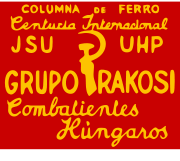
- Rakosi BattalionRakosi BattalionThe Rakosi Battalion was a volunteer unit, formed predominantly of Hungarians, who fought in the XIII International Brigade during the Spanish Civil War .-Prominent veterans:...
: mainly Hungarian, also Czechoslovakians, Ukrainians, Poles, ChineseOverseas ChineseOverseas Chinese are people of Chinese birth or descent who live outside the Greater China Area . People of partial Chinese ancestry living outside the Greater China Area may also consider themselves Overseas Chinese....
, Mongolians and Palestinian Jews. - Nine Nations Battalion (also known as the Sans nons and Neuf Nationalités: French, Belgian, Italian, German, Austrian, Dutch, Danish, SwissSwitzerlandSwitzerland name of one of the Swiss cantons. ; ; ; or ), in its full name the Swiss Confederation , is a federal republic consisting of 26 cantons, with Bern as the seat of the federal authorities. The country is situated in Western Europe,Or Central Europe depending on the definition....
and Polish. - Six Février Battalion ("Sixth of February"): French, Belgian, MoroccanMoroccoMorocco , officially the Kingdom of Morocco , is a country located in North Africa. It has a population of more than 32 million and an area of 710,850 km², and also primarily administers the disputed region of the Western Sahara...
, AlgeriaAlgeriaAlgeria , officially the People's Democratic Republic of Algeria , also formally referred to as the Democratic and Popular Republic of Algeria, is a country in the Maghreb region of Northwest Africa with Algiers as its capital.In terms of land area, it is the largest country in Africa and the Arab...
n, LibyaLibyaLibya is an African country in the Maghreb region of North Africa bordered by the Mediterranean Sea to the north, Egypt to the east, Sudan to the southeast, Chad and Niger to the south, and Algeria and Tunisia to the west....
n, SyriaSyriaSyria , officially the Syrian Arab Republic , is a country in Western Asia, bordering Lebanon and the Mediterranean Sea to the West, Turkey to the north, Iraq to the east, Jordan to the south, and Israel to the southwest....
n, IranIranIran , officially the Islamic Republic of Iran , is a country in Southern and Western Asia. The name "Iran" has been in use natively since the Sassanian era and came into use internationally in 1935, before which the country was known to the Western world as Persia...
ian, IraqIraqIraq ; officially the Republic of Iraq is a country in Western Asia spanning most of the northwestern end of the Zagros mountain range, the eastern part of the Syrian Desert and the northern part of the Arabian Desert....
i, Chinese, Japanese, Indian and Palestinian Jewish. - Thälmann BattalionThälmann BattalionThe Thälmann Battalion was a battalion of the International Brigades in the Spanish Civil War. It was named after the imprisoned German communist leader Ernst Thälmann and included approximately 1,500 people, mainly Germans, Austrians, Swiss and Scandinavians. The battalion fought in the defence...
: predominantly German, named after German communist leader Ernst ThälmannErnst ThälmannErnst Thälmann was the leader of the Communist Party of Germany during much of the Weimar Republic. He was arrested by the Gestapo in 1933 and held in solitary confinement for eleven years, before being shot in Buchenwald on Adolf Hitler's orders in 1944...
.- Tom Mann Centuria: A small, mostly British, group who operated as a section of the Thälmann Battalion.
- Thomas Masaryk Battalion: mostly Czechoslovakian.
- Tschapaiew Battalion: Ukrainian, Polish, Czechoslovakian, Bulgarian, Yugoslavian, Turkish, Italian, German, Austrian, Finnish, Swedish, Norwegian, Danish, Belgian, French, Greek, Albanian, Dutch, Swiss and Baltic.
- Vaillant-Couturier Battalion: French, Belgian, Czechoslovakian, Bulgarian, Swedish, Norwegian and Danish.
- Veinte BattalionVeinte BattalionThe Veinte Battalion was a volunteer battalion of the International Brigades during the Spanish Civil War....
: American, British, Italian, Yugoslavian and Bulgarian. - Zwölfte Februar Battalion: mostly Austrian.
- Batallion De Zeven Provinciën:Dutch
Status after the war
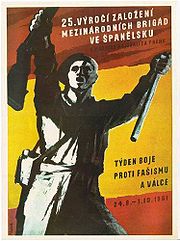
Popular Front (France)
The Popular Front was an alliance of left-wing movements, including the French Communist Party , the French Section of the Workers' International and the Radical and Socialist Party, during the interwar period...
was not in power any more).
However, since most of these countries found themselves at war with the very powers which had been supporting the Nationalists, the Brigadists gained some prestige as the first guard of the democracies, having fought a prophetical combat. Retrospectively, it was clear that the war in Spain was as much a precursor of the Second World War as a Spanish civil war.
Some glory was therefore accredited to the volunteers (a great deal of the survivors also fought gallantly during World War II), but this soon faded in the fear that it would promote (by association) communism
Communism
Communism is a social, political and economic ideology that aims at the establishment of a classless, moneyless, revolutionary and stateless socialist society structured upon common ownership of the means of production...
.
An exception is among groups to the left of the Communist Parties, for example anarchists
Anarchism
Anarchism is generally defined as the political philosophy which holds the state to be undesirable, unnecessary, and harmful, or alternatively as opposing authority in the conduct of human relations...
. Among these groups the Brigades, or at least their leadership, are criticised for their alleged role in suppressing the Spanish Revolution
Spanish Revolution
The Spanish Revolution was a workers' social revolution that began during the outbreak of the Spanish Civil War in 1936 and resulted in the widespread implementation of anarchist and more broadly libertarian socialist organizational principles throughout various portions of the country for two to...
. An example of a modern work which promotes this view is Ken Loach
Ken Loach
Kenneth "Ken" Loach is a Palme D'Or winning English film and television director.He is known for his naturalistic, social realist directing style and for his socialist beliefs, which are evident in his film treatment of social issues such as homelessness , labour rights and child abuse at the...
's film Land and Freedom
Land and Freedom
Land and Freedom is a 1995 film directed by Ken Loach and written by Jim Allen. The film narrates the story of David Carr, an unemployed worker and member of the Communist Party of Great Britain, who decides to fight for the republican side in the Spanish Civil War...
. A well-known contemporary account of the Spanish Civil War which also takes this view is George Orwell
George Orwell
Eric Arthur Blair , better known by his pen name George Orwell, was an English author and journalist...
's book Homage to Catalonia
Homage to Catalonia
Homage to Catalonia is political journalist and novelist George Orwell's personal account of his experiences and observations in the Spanish Civil War. The first edition was published in 1938. The book was not published in the United States until February 1952. The American edition had a preface...
.
East Germany
After the Second World War, the German Democratic Republic found itself in need of a 'founding mythFounding myth
A national myth is an inspiring narrative or anecdote about a nation's past. Such myths often serve as an important national symbol and affirm a set of national values. A national myth may sometimes take the form of a national epic...
' going beyond the conquest of eastern Nazi Germany
Nazi Germany
Nazi Germany , also known as the Third Reich , but officially called German Reich from 1933 to 1943 and Greater German Reich from 26 June 1943 onward, is the name commonly used to refer to the state of Germany from 1933 to 1945, when it was a totalitarian dictatorship ruled by...
by the Red Army
Red Army
The Workers' and Peasants' Red Army started out as the Soviet Union's revolutionary communist combat groups during the Russian Civil War of 1918-1922. It grew into the national army of the Soviet Union. By the 1930s the Red Army was among the largest armies in history.The "Red Army" name refers to...
. The Spanish Civil War, and especially the role of the International Brigades, were considered ideal, and became a substantial part of East Germany's memorial rituals, because of the substantial numbers of German communists who had served in the brigades.
Canada
Survivors of the Mackenzie-Papineau BattalionMackenzie-Papineau Battalion
The Mackenzie–Papineau Battalion or Mac-Paps were a battalion of Canadians who fought as part of the XV International Brigade on the Republican side in the Spanish Civil War. Except for France, no other country gave a greater proportion of its population as volunteers in Spain than Canada. The...
were often investigated by the RCMP and denied employment when they returned to Canada. Some were prevented from serving in the military during the Second World War due to "political unreliability".
In 1962 a monument to veterans of the war was built in Montreal
Montreal
Montreal is a city in Canada. It is the largest city in the province of Quebec, the second-largest city in Canada and the seventh largest in North America...
.
In 1995 a monument to veterans of the war was built near Ontario's provincial parliament.
Switzerland
In SwitzerlandSwitzerland
Switzerland name of one of the Swiss cantons. ; ; ; or ), in its full name the Swiss Confederation , is a federal republic consisting of 26 cantons, with Bern as the seat of the federal authorities. The country is situated in Western Europe,Or Central Europe depending on the definition....
, public sympathy was high for the Republican cause, but the federal government banned all fundraising and recruiting activities a month after the start of the war so as to preserve Swiss neutrality
Neutral country
A neutral power in a particular war is a sovereign state which declares itself to be neutral towards the belligerents. A non-belligerent state does not need to be neutral. The rights and duties of a neutral power are defined in Sections 5 and 13 of the Hague Convention of 1907...
. Around 800 Swiss volunteers joined the International Brigades, among them a small number of women. Sixty percent of Swiss volunteers identified as communists, while the others included socialists, anarchists and antifascists.
Some 170 Swiss volunteers were killed in the war. The survivors were tried by military courts upon their return to Switzerland for violating the criminal prohibition on foreign military service. The courts pronounced 420 sentences which ranged from around two weeks to four years in prison, and often also stripped the convicts of their political rights. In the judgment of Swiss historian Mauro Cerutti, volunteers were punished more harshly in Switzerland than in any other democratic country.
Motions to pardon
Pardon
Clemency means the forgiveness of a crime or the cancellation of the penalty associated with it. It is a general concept that encompasses several related procedures: pardoning, commutation, remission and reprieves...
the Swiss brigadists on the account that they fought for a just cause
Just cause
Just cause or Bare sagen is a common standard in labor arbitration that is used in labor union contracts in the United States as a form of job security.-Use in Labor Union Contracts:...
have been repeatedly introduced in the Swiss federal parliament. A first such proposal was defeated in 1939 on neutrality grounds. In 2002, Parliament again rejected a pardon of the Swiss war volunteers, with a majority arguing that they did break a law that remains in effect to this day. In March 2009, Parliament adopted a third bill of pardon, retroactively rehabilitating Swiss brigadists, only a handful of whom were still alive.
United States
In the United StatesUnited States
The United States of America is a federal constitutional republic comprising fifty states and a federal district...
, the volunteers were labeled as "premature anti-fascists" by the FBI, denied promotion during service in the US military during World War II
World War II
World War II, or the Second World War , was a global conflict lasting from 1939 to 1945, involving most of the world's nations—including all of the great powers—eventually forming two opposing military alliances: the Allies and the Axis...
, and pursued by Congressional committees during the Red Scare
Red Scare
Durrell Blackwell Durrell Blackwell The term Red Scare denotes two distinct periods of strong Anti-Communism in the United States: the First Red Scare, from 1919 to 1920, and the Second Red Scare, from 1947 to 1957. The First Red Scare was about worker revolution and...
.
Spain
On 26 January 1996, the Spanish governmentSpanish Government
Spain is a constitutional monarchy whose government is defined by the Constitution of Spain. This was approved by a general referendum of the people of Spain in 1978...
gave Spanish citizenship to the Brigadists. At the time, roughly 600 remained. At the end of 1938, Prime Minister Juan Negrín
Juan Negrín
Juan Negrín y López was a Spanish politician and physician.-Early years:Born in Las Palmas de Gran Canaria, Negrín came from a religious middle-class family...
had promised Spanish citizenship to the Brigadists, a promise which he could not personally keep as the Republic had lost the war.
France
In 1996, Jacques ChiracJacques Chirac
Jacques René Chirac is a French politician who served as President of France from 1995 to 2007. He previously served as Prime Minister of France from 1974 to 1976 and from 1986 to 1988 , and as Mayor of Paris from 1977 to 1995.After completing his studies of the DEA's degree at the...
, then French President, granted the former French members of the International Brigades the legal status of former service personnel ("anciens combattants") following the request of two French communist Members of Parliament, Lefort and Asensi, both children of volunteers. Before 1996, the same request was turned down several times including by François Mitterrand
François Mitterrand
François Maurice Adrien Marie Mitterrand was the 21st President of the French Republic and ex officio Co-Prince of Andorra, serving from 1981 until 1995. He is the longest-serving President of France and, as leader of the Socialist Party, the only figure from the left so far elected President...
, the former Socialist President.
Symbolism and heraldry
The International Brigades were inheritors of a socialist aesthetic.The flags featured the colours of the Spanish Republic : red, yellow and purple, often along with socialist symbols (red flag
Red flag
In politics, a red flag is a symbol of Socialism, or Communism, or sometimes left-wing politics in general. It has been associated with left-wing politics since the French Revolution. Socialists adopted the symbol during the Revolutions of 1848 and it became a symbol of communism as a result of its...
s, hammer and sickle
Hammer and sickle
The hammer and sickle is a part of communist symbolism and its usage indicates an association with Communism, a Communist party, or a Communist state. It features a hammer and a sickle overlapping each other. The two tools are symbols of the industrial proletariat and the peasantry; placing them...
, fist). The emblem of the brigades themselves was the three-pointed red star, which is often featured.
Notable associated people
|
See also
- Foreign involvement in the Spanish Civil WarForeign involvement in the Spanish Civil WarThe Spanish Civil War had large numbers of non-Spanish citizens participating in combat and advisory positions. Foreign governments contributed varying amounts of financial assistance and military aid to Nationalist forces led by Generalísimo Francisco Franco and those fighting on behalf of the...
- International Brigade Memorial TrustInternational Brigade Memorial TrustThe International Brigade Memorial Trust is a British educational trust formed by the veterans of the International Brigade Association, the Friends of the IBA, representatives of the Marx Memorial Library, and historians specialising in the Spanish Civil War....
- Militant anti-fascism
- Irish socialist volunteers in the Spanish Civil WarIrish Socialist Volunteers in the Spanish Civil WarIrish Socialist volunteers in the Spanish Civil War describes a grouping of IRA members and Irish Socialists who fought in support the cause of the Second Republic during the Spanish Civil War. These volunteers were taken from both Irish Republican and Unionist political backgrounds but were bonded...
- Arditi del PopoloArditi del PopoloThe Arditi del Popolo was an Italian militant anti-fascist group founded at the end of June 1921 to resist the rise of Benito Mussolini's National Fascist Party and the violence of the Blackshirts paramilitaries...
- Nationalist Foreign Volunteers
- Moscow GoldMoscow goldThe term Moscow Gold , or alternatively, Gold of the Republic , refers to the operation by which 510 tonnes of gold, corresponding to 72.6% of the total gold reserves of the Bank of Spain, were transferred from their original location in Madrid to the Soviet Union a few months after the...
- Red Terror (Spain)Red Terror (Spain)The Red Terror in Spain is the name given by historians to various acts committed "by sections of nearly all the leftist groups" such as the killing of tens of thousands of people , as well as attacks on landowners, industrialists, and politicians, and the...
Sources
- Alvarez, Santiago. Historia politica y militar de las brigadas internacionales Madrid: Compañía Literaria, 1996.
- Anderson, James W. The Spanish Civil War: A History and Reference Guide. Santa Barbara: Greenwood Press, 2003. ISBN 978-0313322747
- Beevor, AnthonyAntony BeevorAntony James Beevor, FRSL is a British historian, educated at Winchester College and Sandhurst. He studied under the famous military historian John Keegan. Beevor is a former officer with the 11th Hussars who served in England and Germany for five years before resigning his commission...
. [1982] The Spanish Civil War. Reissued London: Weidenfeld & Nicolson (Cassell), 1999. ISBN 978-0304352814 - Beevor, AnthonyAntony BeevorAntony James Beevor, FRSL is a British historian, educated at Winchester College and Sandhurst. He studied under the famous military historian John Keegan. Beevor is a former officer with the 11th Hussars who served in England and Germany for five years before resigning his commission...
. (2006). The Battle for Spain: The Spanish Civil War 1936-1939. London: Weidenfeld & Nicolson, 2006. ISBN 978-0297848325 - Castells, Andreu. Las brigadas internacionales en la guerra de España. Barcelona: Editorial Ariel, 1974.
- Copeman, FredFred CopemanFred Copeman OBE was an English volunteer in the International Brigades during the Spanish Civil War, commanding the British Battalion...
(1948). Reason in Revolt. London: Blandford Press, 1948. - Eby, Cecil. Comrades and Commissars. Pennsylvania: Penn State University Press, 2007. ISBN 978-0-271-02910-8
- Gurney, JasonJason GurneyJason Gurney was a British sculptor who fought in the Spanish Civil War.He was with the International Brigades from December 1936 to August 1937. During that time, he served in the British Battalion, the Lincoln Battalion and XIV International Brigade staff. He was wounded in the right hand by a...
(1974) Crusade in Spain. London: Faber, 1974. ISBN 978-0571103102 - Kuuli, O; Riis, V; Utt, O; (editors) (1965) Hispaania tules. Mälestusi ja dokumente fašismivastasest võitlusest Hispaanias 1936.-1939. aastal. Tallinn: Eesti raamat.
- Lefebvre, Michel; Skoutelsky, Rémi. Las brigadas internacionales. Barcelona: Lunwerg Editores (2003). ISBN 84-7782-000-7
- Orwell, GeorgeGeorge OrwellEric Arthur Blair , better known by his pen name George Orwell, was an English author and journalist...
. [1938] A Homage to Catalonia. London: Penguin Books, 1969. (New edition) ISBN 978-0140016994 - Thomas, HughHugh ThomasHugh Thomas , is a British historian and life peer.Hugh Thomas may also refer to:* Hugh Thomas , American choral conductor, pianist and educator* Hugh Thomas , Australian rules football coach...
. (1961) The Spanish Civil War. London: Eyre & Spottiswoode, 1961. - Thomas, HughHugh ThomasHugh Thomas , is a British historian and life peer.Hugh Thomas may also refer to:* Hugh Thomas , American choral conductor, pianist and educator* Hugh Thomas , Australian rules football coach...
. (2003) The Spanish Civil War, 2003. London: Penguin (Revised 4th edition), 2003. ISBN 978-0141011615 }}
External links
- IBMT the international brigade memorial trust
- Abraham Lincoln Brigade Archives
- Reproduction of International Brigades flags, badges and t-shirts
- Freedom fighters or Comintern army? The International Brigades in Spain by Andy Durgan
- International Solidarity With the Spanish Republic: 1936-1939
Media