
Encyclopedia
The
U.S. presidential election of 1968 was a wrenching national experience, and included the
assassination of liberal Democratic candidate
Robert F. Kennedy, the violence at the 1968 Democratic National Convention, as well as widespread demonstrations against the
Vietnam War across American university and college campuses. In the end,
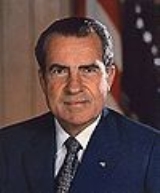
Richard M. Nixon would win the election on a campaign of "law and order". It is sometimes considered to be a realigning election.
Historical and Contemporary Background
In the
election of 1964, after serving the 14 remaining months after
Kennedy's assassination,
Lyndon Johnson had won the largest popular vote landslide in US Presidential election history over
Barry Goldwater. During his term, Johnson had seen many political successes, including the passage of his sweeping
Great Society domestic programs, landmark
civil rights legislation, and the continued exploration of space. At the same time, however, the country had been undergoing massive violence in the streets of the cities, along with a generational revolt of young people and violent debates over foreign policy. The Secret Service would not let Johnson appear on college campuses nor attend the 1968 Democratic national convention in Chicago. The emergence of the
hippie counterculture, the rise of New Left activism, and the emergence of the Black Power movement exacerbated social and cultural cleavages between classes, generations and races. Every summer during Johnson's administration, known thereafter as the "long, hot summers", major US cities erupted in massive
race riots that left hundreds dead and destroyed hundreds of millions of dollars in property.
The
Vietnam War had escalated, with over 500,000 Americans inside the country, suffering thousands of casualties every month. The
Tet Offensive of February 1968 made the war front-page news for the first time. The military demanded hundreds of thousands more soldiers--which could only be provided by a
draft because Johnson refused to use the Reserves of the National Guard. In the months following Tet, Johnson's approval ratings fell below 35%.
Nominations
Democratic Party nomination
The
22nd Amendment didn't disqualify President
Lyndon Johnson from running for another term, even though he succeeded into the presidency because there were only 14 months remaining in
John F. Kennedy's term when he was
assassinated.
Senator
Eugene McCarthy was first to challenge LBJ, running for the Democratic nomination as an
anti-war candidate. Nationally he did poorly in the polls. By pouring all his resources into the small state of New Hampshire, McCarthy scored a surprisingly strong second place finish that gave his campaign legitimacy and momentum. The momentum however ended when Senator
Robert F. Kennedy announced his candidacy in mid March, as McCarthy supporties cried betrayal and vowed to defeat Kennedy.
Johnson withdraws
On March 31, 1968, following New Hampshire, Kennedy's entry, and internal polling that showed Johnson trailing badly in the upcoming Wisconsin primary, the President announced he would not seek re-election. Entering the 1968 election campaign, initially, no prominent Democratic candidate was prepared to run against a sitting President of their own party. Only
Senator Eugene McCarthy of
Minnesota challenged Johnson as an anti-war candidate in the
New Hampshire primary, hoping to pressure the Democrats to oppose the war. On March 12, McCarthy won 42% of the primary vote to Johnson's 49%, an amazingly strong showing for such a challenger. Four days after this,
Robert F. Kennedy entered the race. Internal polling by Johnson's campaign in
Wisconsin, the next state to hold a primary election, showed the President trailing badly. Johnson did not leave the White House to campaign. Johnson had lost control of the Democratic party, which was splitting into four factions, each of which despised the other three. The first comprised Johnson , labor unions, and local party bosses
Contest for nomination
After Johnson's announcement,
Vice President Hubert H. Humphrey announced his candidacy. Kennedy was successful in four primaries and McCarthy five. Humphrey, for the most part, did not compete in the primaries, leaving that job to favorite sons who were his surrogates, notably Senator
George A. Smathers from
Florida, Senator
Stephen M. Young from
Ohio, and Governor Roger D. Branigin of
Indiana, the first two of which won their respective primaries , Humphrey was well ahead, thanks to the large role still played in the nominating process by delegate selection controlled by
party bosses. Still, the nominee still remained unclear, even after Kennedy defeated McCarthy in the crucial
California primary on June 5. That night,
Kennedy was shot shortly after midnight by
Sirhan Sirhan; he died twenty six hours later.
There is a theory that Kennedy was the presumptive nominee the morning he died, and would have won easily at the Chicago convention. However, at the moment of RFK's death, the totals were:
Robert Kennedy's death altered the dynamics of the race, and threw the Democratic party into disarray. Although Humphrey appeared the prohibitive favorite for the nomination, thanks to his support from the institutional structures of the party, he was an unpopular choice with many of the more
anti-war elements within the party, who identified him with Johnson's position on the Vietnam War. During the 1968 Democratic National Convention, Americans were shocked by television footage of Chicago police brutally beating anti-war protesters in the streets of Chicago. Meanwhile, the convention itself was marred by the strong-arm tactics of Chicago's mayor
Richard J. Daley . In the end, the nomination itself was anticlimactic, with Vice President Humphrey beating McCarthy and Senator
George McGovern , even though he had not run in a single primary election during the campaign.
Republican Party nomination
The front-runner for the Republican nomination was former Vice President
Richard M. Nixon, and to a great extent the story of the Republican primary campaign and nomination is the story of one opponent entering the race and dropping out.
Nixon's first challenger was Michigan Governor George W. Romney. A Gallup poll in mid-1967 showed Nixon with 39%, followed by Romney with 25%. However, in a slip of the tongue, Romney told a news reporter that he had been "brainwashed" by the military and the diplomatic corps into supporting the Vietnam War. As the year 1968 opened, Romney was opposed to further American intervention in Vietnam and had decided to run as the Republican version of Gene McCarthy . Romney's support faded slowly, and he withdrew from the race on 2/28/1968 .
Nixon won a resounding victory in the important New Hampshire primary on 3/12/1968. He won 78% of the vote. Peace Republicans wrote in the name of New York Governor Nelson Rockefeller, who received 11% of the vote and became Nixon's new challenger. Nixon led Rockefeller in the polls throughout the primary campaign. Rockefeller defeated Nixon in the Massachusetts primary on 4/30/1968 but otherwise fared poorly in the state primaries and conventions.
By early spring, California Governor Ronald W. Reagan was Nixon's chief rival. In the Nebraska primary on 5/14/1968, Nixon won with 70% of the vote to 21% for Reagan and 5% for Rockefeller. While this was a wide margin for Nixon, Reagan became the leading challenger. Nixon won the next primary of importance, Oregon, on 5/15/1968 with 65% of the vote and won all the following primaries except for California , where only Reagan appeared on the ballot. Reagan's margin in California gave him a plurality of the nationwide primary vote, but when the Republican National Convention assembled, Nixon had 656 delegates according to a UPI poll .
As of 2006, this was the last time two siblings ran against each other for President at a national convention.
Other candidates
The American Independent Party was formed by
George Wallace, whose pro-
segregation policies had been rejected by the mainstream of the Democratic party. The impact of the Wallace campaign was substantial, winning the electoral votes of several states in the Deep South. Wallace also accomplished a strong showing in several northern states. Although Wallace did not expect to win the election, his strategy was that he might be able to prevent either major party candidate from winning a preliminary majority in the
Electoral College, which would then give him bargaining power to determine the outcome.
Also on the ballot in some states was black activist
Eldridge Cleaver for the Peace and Freedom Party. Comedians Dick Gregory and Pat Paulsen were notable write-in candidates.
General election
Campaign
Nixon campaigned on a "law and order" theme, which appealed to many voters angry at hundreds of violent riots that had taken place across the country, with Army troops called out in Detroit and Washington. He had devised a "southern strategy," which was designed to appeal to the middle class southern voters, who traditionally voted Democratic but who were ignored by Humphrey.
After the Democratic convention Humphrey seemed hopeless. According to
Time, "The old Democratic coalition was disintegrating, with untold numbers of blue-collar workers responding to Wallace's blandishments, Negroes threatening to sit out the election, liberals disaffected over the Viet Nam war, the South lost. The war chest was almost empty, and the party's machinery, neglected by Lyndon Johnson, creaked in disrepair." Calling for "the politics of joy", and using the still-powerful labor unions as his base, Humphrey hit back. He demolished Wallace by depicting him as a madman and fool. Humphrey campaigned on continuing the
Great Society programs initiated by President Johnson. Labor unions took a major role attacking Wallace, who was winning half their members according to summer polls.
In the end, the war became the one remaining problem Humphrey had to overcome. In October Humphrey, who trailed badly in the polls, began to distance himself from the Johnson administration on the Vietnam War, calling for a
bombing halt. He began to gain momentum, especially when President Johnson actually announced a bombing halt, and even a possible peace deal, the weekend before the election. During the campaign, Nixon promised a new approach, which was ridiculed by Democrats as a "secret plan" although Nixon never actually claimed to have a 'secret plan.' By election day the polls were reporting a dead heat.
Nixon won by a plurality of 500,000 and clinched the electoral vote on November 5, 1968.
Results
Source : Source : National voter demographics
| NBC sample precincts 1968 election |
|---|
| % Humphrey | % Nixon | % Wallace |
|---|
| High income urban | 29 | 63 | 5 |
| Middle income urban | 43 | 44 | 13 |
| Low income urban | 69 | 19 | 12 |
| Rural | 33 | 46 | 21 |
| Negro neighborhoods | 94 | 5 | 1 |
| Italian neighborhoods | 51 | 39 | 10 |
| Slavic neighborhoods | 65 | 24 | 11 |
| Jewish neighborhoods | 81 | 17 | 2 |
| Unionized neighborhoods | 61 | 29 | 10 |
Source: Congressional Quarterly Weekly Report. “Group Analysis of the 1968 Presidential Vote” XXVI, No. 48 , p. 3218.
Voter demographics in the South
| NBC sample precincts 1968 election: South only |
|---|
| % Humphrey | % Nixon | % Wallace |
|---|
| Middle income urban neighborhoods | 28 | 40 | 32 |
| Low income urban neighborhoods | 57 | 18 | 25 |
| Rural | 29 | 30 | 41 |
| Negro neighborhoods | 95 | 3 | 2 |
| Hispanic neighborhoods | 92 | 7 | 1 |
Source: Congressional Quarterly Weekly Report. “Group Analysis of the 1968 Presidential Vote”, XXVI, No. 48 , p. 3218.
See also
Notes
Further reading
- Gallup, George H., ed. The Gallup Poll: Public Opinion, 1935-1971. 3 vols. Random House, 1972. press releases
- Kimball, Warren F. "The Election of 1968." Diplomatic History 2004 28: 513-528. Issn: 0145-2096 Fulltext online in SwetsWise, Ingenta and Ebsco. Comments by others at pp. 563-576; reply, p. 577.
- Jamieson, Patrick E. "Seeing the Lyndon B. Johnson Presidency through the March 31, 1968 Withdrawal Speech." Presidential Studies Quarterly Vol 29#1 1999 pp. 134+
- by Walter LaFeber. The Deadly Bet: LBJ, Vietnam, and the 1968 Election short survey
- Eugene McCarthy, The Year of the People , memoir
- Jeff Shesol, Mutual Contempt: Lyndon Johnson, Robert Kennedy, and the Feud that Defined a Decade
- Woods, Randall. LBJ: Architect of American Ambition
External links
Navigation