

Diaspora

Encyclopedia
A diaspora is "the movement, migration, or scattering of people away from an established or ancestral homeland" or "people dispersed by whatever cause to more than one location", or "people settled far from their ancestral homelands".
The word has come to refer to historical mass-dispersions of people with common roots, particularly movements of an involuntary nature, such as the expulsion of Jews from the Middle East, the African Trans-Atlantic slave trade
, or the century-long exile of the Messenians under Sparta
n rule.
Recently scholarship has distinguished between different kinds of diaspora, based on its causes such as imperialism
, trade or labor migrations, or by the kind of social coherence within the diaspora community and its ties to the ancestral lands. Some diaspora communities maintain strong political ties with their homeland. Other qualities that may be typical of many diasporas are thoughts of return, relationships with other communities in the diaspora, and lack of full assimilation to the host country.
was translated into Greek; in Ancient Greece
the term διασπορά (diaspora) meant "scattering" and was used to refer to citizens of a dominant city-state
who immigrated to a conquered land with the purpose of colonization, to assimilate the territory into the empire. The term derives from the verb διασπείρω (diaspeirō), "I scatter", "I spread about" and that form διά (dia), "between, through, across" + the verb σπείρω (speirō), "I sow, I scatter". After the Bible's translation into Greek, the word Diaspora then was used to refer to the population of Jews exiled from Israel
in 587 BCE by the Babylonians, and from Judea
in 70 CE by the Roman Empire
. It subsequently came to be used to refer to the historical movements of the dispersed ethnic population of Israel, to the cultural development of that population or to the population itself. When capitalized and without modifiers (that is, simply the Diaspora), the term refers specifically to the Jewish diaspora
; when uncapitalized the word diaspora may be used to refer to refugee
populations of other origins or ethnicities. The wider application of diaspora evolved from the Assyrian two-way mass deportation policy of conquered populations to deny future territorial claims on their part.
According to the Oxford English Dictionary Online, the first known recorded usage of the word diaspora in the English language
was in 1876 referring "extensive diaspora work (as it is termed) of evangelizing among the National Protestant Churches on the continent". The term became more widely assimilated into English
by the mid 1950s, with long-term expatriates in significant numbers from other particular countries or regions also being referred to as a diaspora. An academic field, diaspora studies
, has become established relating to this sense of the word.
In all cases, the term diaspora carries a sense of displacement
; that is, the population so described finds itself for whatever reason separated from its national territory, and usually its people have a hope, or at least a desire, to return to their homeland at some point, if the "homeland" still exists in any meaningful sense. Some writers have noted that diaspora may result in a loss of nostalgia for a single home as people "re-root" in a series of meaningful displacements. In this sense, individuals may have multiple homes throughout their diaspora, with different reasons for maintaining some form of attachment to each. Diasporic cultural development often assumes a different course from that of the population in the original place of settlement. Over time, remotely separated communities tend to vary in culture, traditions, language, and other factors. The last vestiges of cultural affiliation in a diaspora is often found in community resistance to language change
and in maintenance of traditional religious practice.
set out six rules to distinguish diasporas from migrant communities. These included criteria that the group maintains a myth or collective memory of their homeland; they regard their ancestral homeland as their true home, to which they will eventually return; being committed to the restoration or maintenance of that homeland; and they relate "personally or vicariously" to the homeland to a point where it shapes their identity. While Safran's definitions were influenced by the idea of the Jewish diaspora, he recognised the expanding use of the term.
Rogers Brubaker
(2005) also notes that use of the term diaspora has been widening. He suggests that one element of this expansion in use "involves the application of the term diaspora to an ever-broadening set of cases: essentially to any and every nameable population category that is to some extent dispersed in space". Brubaker has used the WorldCat
database to show that 17 out of the 18 books on diaspora published between 1900 and 1910 were on the Jewish diaspora. The majority of works in the 1960s were also about the Jewish diaspora, but in 2002 only two out of 20 books sampled (out of a total of 253) were about the Jewish case, with a total of eight different diasporas covered.
Brubaker outlines the original use of the term diaspora as follows:
Brubaker argues that the initial expansion of the use of the phrase extended it to other, similar cases, such as the Armenian
and Greek diaspora
s. More recently, it has been applied to emigrant groups that continue their involvement in their homeland from overseas, such as the category of long-distance nationalists identified by Benedict Anderson
. Brubaker notes that Albanians, Hindu Indians, Irish, Kashmiri, Kurds, Palestinians, Tamils have been conceptualised as diasporas in this sense. Furthermore, "labour migrants who maintain (to some degree) emotional and social ties with a homeland" have also been described as diasporas.
In further cases of the use of the term, "the reference to the conceptual homeland – to the 'classical' diasporas – has become more attenuated still, to the point of being lost altogether". Here, Brubaker cites "transethnic and transborder linguistic categories...such as Francophone
, Anglophone
and Lusophone
'communities'", along with Hindu, Sikh, Buddhist, Confucian, Huguenot, Muslim and Catholic 'diasporas'. Brubaker notes that, , there were also academic books or articles on the Dixie
, white, liberal, gay, queer and digital diasporas.
Some observers have labeled evacuation from New Orleans and the Gulf Coast in the wake of Hurricane Katrina
the New Orleans diaspora
, since a significant number of evacuees have not been able to return, yet maintain aspirations to do so. Agnieszka Weinar (2010) notes the widening use of the term, arguing that recently, "a growing body of literature succeeded in reformulating the definition, framing diaspora as almost any population on the move and no longer referring to the specific context of their existence".
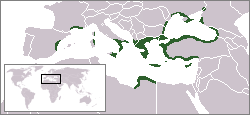 European history contains numerous diaspora-like events. In ancient times, the trading and colonising activities of the Greek tribes from the Balkans
and Asia Minor
spread people of Greek culture, religion and language around the Mediterranean and Black Sea
basins, establishing Greek city states in Sicily
, southern Italy, northern Libya
, eastern Spain
, the south of France, and the Black Sea coasts. Greeks founded more than 400 colonies. Alexander the Great's conquest of the Achaemenid Empire
marked the beginning of the Hellenistic period
, which was characterized by a new wave of Greek colonization in Asia
and Africa
, with Greek ruling classes established in Egypt
, southwest Asia
and northwest India
.
The Migration Period
relocations, which included several phases, are just one set of many in history. The first phase Migration Period displacement from between CE 300 and 500 included relocation of the Goths
(Ostrogoths and Visigoths), Vandals
, Franks
, various other Germanic people (Burgundians
, Lombards
, Angles
, Saxons
, Jutes
, Suebi
, Alemanni, Varangians and Normans
), Alans
and numerous Slavic tribes
. The second phase, between CE 500 and 900, saw Slavic
, Turkic, and other tribes on the move, resettling in Eastern Europe
and gradually making it predominantly Slavic, and affecting Anatolia
and the Caucasus
as the first Turkic tribes (Avars
, Huns
, Khazars
, Pechenegs), as well as Bulgars
, and possibly Magyars arrived. The last phase of the migrations
saw the coming of the Hungarian Magyars and the Viking expansion out of Scandinavia
into Europe and the British Isles
, as well as Greenland
and Iceland
.
Such colonizing migrations cannot be considered indefinitely as diasporas; over very long periods, eventually the migrants assimilate into the settled area so completely that it becomes their new homeland. Thus the modern population of Hungary do not feel that they belong in the Western Siberia
that the Hungarian Magyars left 12 centuries ago; and the English
descendants of the Angles
, Saxons
and Jutes
do not yearn to reoccupy the plains of Northwest Germany.
In 1492, a Spanish expedition headed by Christopher Columbus
reached the Americas
, after which European exploration and colonization rapidly expanded. In the 16th century approximately 240,000 Europeans entered American ports. Immigration continued to North and South America. In the 19th century alone over 50 million people left Europe for the Americas.
A specific 19th century example was the Irish diaspora
, beginning mid-19th century and brought about by the An Gorta Mór or "Great Hunger" of the Irish Famine. Estimates are that between 45% and 85% of Ireland's population emigrated, to countries including Britain, the United States, Canada, Argentina, Australia and New Zealand
. The size of the diaspora is demonstrated by the number of people around the world who claim Irish ancestry; some sources put the figure at 80-100 million.
From the 1860s, Circassians were dispersed through the Levant, Europe, North America, Australia, and within historical Circassia
in the North Caucasus currently in Russia
.
, which began at the beginning of the 16th century. During the Atlantic Slave Trade
, 9.4 to 12 million people from North, West, West-Central and South-east Africa survived transportation to arrive in the Western Hemisphere
as slaves
. This population and their descendants were major influences on the culture of English, French, Italian, Portuguese and Spanish New World
colonies.
) first occurred thousands of years ago. The mass emigration that occurred from the 19th century to 1949 was caused mainly by wars and starvation in mainland China
, as well as political corruption. Most immigrants were illiterate or poorly educated peasants and coolies (Chinese: 苦力, literally "hard labor"), who immigrated to developing countries in need of labor, such as the Americas
, Australia
, South Africa
, Southeast Asia
, Malaya
and other places.
The largest Asian diaspora outside of Southeast Asia is that of the Indian diaspora
. The overseas Indian community, estimated at over 25 million, is spread across many regions in the world, on every continent. It constitutes a diverse, heterogeneous and eclectic global community representing different regions, languages, cultures, and faiths (see Desi
).
The Romani are widely dispersed, with their largest concentrated populations in Europe. Linguistic and genetic evidence indicates the Romanies originated on the Indian subcontinent
, emigrating from India towards the northwest no earlier than the 11th century.
At least three waves of Nepalese diaspora
can be identified. The earliest wave dates back to hundreds of years as early marriage and high birthrates propelled Hindu settlement eastward across Nepal, then into Sikkim
and Bhutan
. A backlash developed in the 1980s as Bhutan's political elites realized that Bhutanese Buddhists were at risk of becoming a minority in their own country. At present, the United States
is working towards resettling more than 60,000 ethnic Nepalese
from Bhutan
in the US as a third-country settlement programme. A second wave was driven by British recruitment of mercenary soldiers beginning around 1815 and resettlement after retirement in the British Isles and southeast Asia. The third wave began in the 1970s as land shortages intensified and the pool of educated labor greatly exceeded job openings in Nepal. Job-related emigration created Nepalese enclaves in India, the wealthier countries of the Middle East, Europe and North America. Current estimates of the number of Nepalese living outside Nepal range well up into the millions.
Azerbaijani Students and Alumni International Forum
(ASAIF) realizes diaspora activities for Azerbaijan
.
.
unfolded, Nazi Germany deported and killed millions of Jews and many millions of others were likewise enslaved or murdered, including Ukrainians, Russians and other Slavs. Some Jews fled from persecution to western Europe and the Americas before borders closed. Later other eastern European refugees moved west, away from Soviet annexation, and the Iron Curtain
regimes after World War II. Hundreds of thousands of these anti-Soviet political refugees and Displaced Persons ended up in western Europe, Australia, Canada and the United States of America.
After WWII, the Soviet Union and Communist-controlled Poland
, Hungary
and Yugoslavia
expelled hundreds of thousands of ethnic Germans, most of whom were descendants of immigrants who had settled in those areas nearly two centuries before. This was allegedly in retaliation for the German Nazi invasion and their pan-German attempts at annexation. Most of the refugees moved to the West, including western Europe, and with tens of thousands seeking refuge in the United States.
Spain
sent many political activists into exile during Franco
's military regime from 1936 to his death in 1975.
Following WWII, the creation of the state of Israel
, and a series of uprisings against colonialist rule, the Middle East
nations became more hostile in relation to their historic Jewish populations (Sephardim) of nearly 1 million people. Most of them emigrated, with the majority resettling in Israel, where they became known as Mizrahi Jews
.
At the same time, the Palestinian diaspora
resulted from the war to dismantle Israel in 1948, in which 750,000 people were displaced or emigrated from their former territory. The diaspora was enlarged by the effects of the 1967 Arab-Israeli War. Many Palestinians continue to live in refugee camps maintained by Middle Eastern nations, but others have resettled in the Middle East and other countries.
The 1947 Partition
resulted in the migration of millions of people between India
and Pakistan
. Millions were murdered in the religious violence of the period, with estimates of fatalities up to 2 million people. Thousands of former subjects of the British Raj
went to the UK from the Indian subcontinent
after India and Pakistan became independent in 1947.
From the late 19th century, and formally from 1910, Japan made Korea a colony. Millions of Chinese fled to western provinces not occupied by Japan (that is, in particular Ssuchuan/Szechwan and Yunnan in the Southwest and Shensi and Kansu in the Northwest) and to Southeast Asia. More than 100,000 Koreans moved across the Amur River into Eastern Russia (then the Soviet Union) away from the Japanese.
-era, huge populations of refugees migrated from conflict, especially from then-developing countries.
Upheaval in the Middle East and Central Asia, some of which was related to power struggles between the United States
and the Soviet Union
, created new refugee populations which developed into global diasporas.
In Southeast Asia
, many Vietnamese people
immigrated to France
and later millions to the United States, Australia and Canada after the Cold War-related Vietnam War
. Later, 30,000 French
colons from Cambodia
were displaced after being expelled by the Khmer Rouge
regime under Pol Pot
. A small, predominantly Muslim ethnic group, the Cham people long residing in Cambodia, were nearly eradicated. The mass exodus of Vietnamese people from Vietnam coined the term 'Boat people'
.
In Southwest China
, many Tibetan people
emigrated to India, following the 14th Dalai Lama
in 1959 after the failure of his Tibetan uprising
. This wave lasted until the 1960s, and another wave followed when Tibet was opened up to trade and tourism in the 1980s. It is estimated that about 200,000 Tibetans live now dispersed worldwide, half of whom in are India
, Nepal
and Bhutan
. In lieu of lost citizenship papers, the Central Tibetan Administration
offers Green Book
identity documents to Tibetan refugees.
Sri Lankan Tamils have historically migrated to find work, notably during the British colonial period. Since the beginning of the civil war in 1983, more than 800,000 Tamils have been displaced within Sri Lanka
as local diaspora, and over a half million Tamils living as the Tamil diaspora
in destinations such as India, Australia, New Zealand, Canada, the UK and Europe.
The Afghan
diaspora resulted from the 1979 invasion by the former Soviet Union; both official and unofficial records indicate that the war displaced over 6 million people, resulting in the creation of the largest refugee population worldwide today.
Many Iranians fled the 1979 Iranian Revolution
following the fall of the Shah
.
The Assyrian
diaspora expanded by the Civil War in Lebanon
, the coming into power of the Islamic republic of Iran
, the Ba'athist dictatorship in Iraq
, and the present-day unrest in Iraq pushed Assyrians on the roads of exile.
In Africa
, a new series of diasporas formed following the end of colonial rule. In some cases as countries became independent, numerous minority descendants of Europeans emigrated; others stayed in the lands which had been family homes for generations. Uganda
expelled 80,000 South Asians in 1972 and took over their businesses and properties. The 1990s Civil war in Rwanda
between rival ethnic groups Hutu
and Tutsi
turned deadly and produced a mass influx of refugees.
In Latin America
, following the 1959 Cuban Revolution
and the introduction of communism
, over a million people have left Cuba
.
There was a Jamaican diaspora
around the turn of the century.
A million Colombia
n refugees have left Colombia since 1965 to escape the country's violence and civil wars. In South America
, thousands of Argentina
n, Chile
an and Uruguay
an refugees fled to Europe during periods of military rule
in the 1970s and 1980s. In Central America
, Nicaraguans
, Salvadorans
, Guatemala
ns, Hondurans
, Costa Rica
ns (however, the country had no dictators) and Panama
nians fled conflict and poor economic conditions.
Hundreds of thousands of people fled from the Rwandan Genocide
in 1994 into neighboring countries. Thousands of refugees from deteriorating conditions in Zimbabwe
have gone to South Africa
. The long war in Congo
, in which numerous nations have been involved, has also created millions of refugees.
Tens of thousands of Iraqis
have fled conflict in their nation since the 2003 invasion of Iraq
.
sometimes refer to a diaspora, taking place when much of humanity leaves Earth
to settle on far-flung "colony worlds".
İsmet Özel
wrote a poem titled "Of not being a Jew" in which he lamented the fact that he felt like a pursued Jew, but had no second country to which he could go. He writes:
DJ Krust
and Saul Williams
' track "Coded Language" opens with the line "Whereas, breakbeats have been the missing link connecting the diasporic community to its drum woven past."
Punk rock
band Rise Against
titled one of their songs "Diaspora" in the album The Sufferer & the Witness
but later changed it to "Prayer of the Refugee
". The originally titled song was available on advance copies of the album.
The experimental rock outfit PINKNOISE
released an EP in 2010 titled The Dance Of The Diaspora, expressing the current Indian diaspora, both musically and demographically.
The word has come to refer to historical mass-dispersions of people with common roots, particularly movements of an involuntary nature, such as the expulsion of Jews from the Middle East, the African Trans-Atlantic slave trade
Atlantic slave trade
The Atlantic slave trade, also known as the trans-atlantic slave trade, refers to the trade in slaves that took place across the Atlantic ocean from the sixteenth through to the nineteenth centuries...
, or the century-long exile of the Messenians under Sparta
Sparta
Sparta or Lacedaemon, was a prominent city-state in ancient Greece, situated on the banks of the River Eurotas in Laconia, in south-eastern Peloponnese. It emerged as a political entity around the 10th century BC, when the invading Dorians subjugated the local, non-Dorian population. From c...
n rule.
Recently scholarship has distinguished between different kinds of diaspora, based on its causes such as imperialism
Imperialism
Imperialism, as defined by Dictionary of Human Geography, is "the creation and/or maintenance of an unequal economic, cultural, and territorial relationships, usually between states and often in the form of an empire, based on domination and subordination." The imperialism of the last 500 years,...
, trade or labor migrations, or by the kind of social coherence within the diaspora community and its ties to the ancestral lands. Some diaspora communities maintain strong political ties with their homeland. Other qualities that may be typical of many diasporas are thoughts of return, relationships with other communities in the diaspora, and lack of full assimilation to the host country.
Origins and development of the term
The first mention of a diaspora created as a result of exile is found in the Septuagint in the phrase "esē diaspora en pasais basileias tēs gēs" translated to mean "thou shalt be a dispersion in all kingdoms of the earth". Its use began to develop from this original sense when the Hebrew BibleHebrew Bible
The Hebrew Bible is a term used by biblical scholars outside of Judaism to refer to the Tanakh , a canonical collection of Jewish texts, and the common textual antecedent of the several canonical editions of the Christian Old Testament...
was translated into Greek; in Ancient Greece
Ancient Greece
Ancient Greece is a civilization belonging to a period of Greek history that lasted from the Archaic period of the 8th to 6th centuries BC to the end of antiquity. Immediately following this period was the beginning of the Early Middle Ages and the Byzantine era. Included in Ancient Greece is the...
the term διασπορά (diaspora) meant "scattering" and was used to refer to citizens of a dominant city-state
City-state
A city-state is an independent or autonomous entity whose territory consists of a city which is not administered as a part of another local government.-Historical city-states:...
who immigrated to a conquered land with the purpose of colonization, to assimilate the territory into the empire. The term derives from the verb διασπείρω (diaspeirō), "I scatter", "I spread about" and that form διά (dia), "between, through, across" + the verb σπείρω (speirō), "I sow, I scatter". After the Bible's translation into Greek, the word Diaspora then was used to refer to the population of Jews exiled from Israel
Israel
The State of Israel is a parliamentary republic located in the Middle East, along the eastern shore of the Mediterranean Sea...
in 587 BCE by the Babylonians, and from Judea
Judea
Judea or Judæa was the name of the mountainous southern part of the historic Land of Israel from the 8th century BCE to the 2nd century CE, when Roman Judea was renamed Syria Palaestina following the Jewish Bar Kokhba revolt.-Etymology:The...
in 70 CE by the Roman Empire
Roman Empire
The Roman Empire was the post-Republican period of the ancient Roman civilization, characterised by an autocratic form of government and large territorial holdings in Europe and around the Mediterranean....
. It subsequently came to be used to refer to the historical movements of the dispersed ethnic population of Israel, to the cultural development of that population or to the population itself. When capitalized and without modifiers (that is, simply the Diaspora), the term refers specifically to the Jewish diaspora
Jewish diaspora
The Jewish diaspora is the English term used to describe the Galut גלות , or 'exile', of the Jews from the region of the Kingdom of Judah and Roman Iudaea and later emigration from wider Eretz Israel....
; when uncapitalized the word diaspora may be used to refer to refugee
Refugee
A refugee is a person who outside her country of origin or habitual residence because she has suffered persecution on account of race, religion, nationality, political opinion, or because she is a member of a persecuted 'social group'. Such a person may be referred to as an 'asylum seeker' until...
populations of other origins or ethnicities. The wider application of diaspora evolved from the Assyrian two-way mass deportation policy of conquered populations to deny future territorial claims on their part.
According to the Oxford English Dictionary Online, the first known recorded usage of the word diaspora in the English language
English language
English is a West Germanic language that arose in the Anglo-Saxon kingdoms of England and spread into what was to become south-east Scotland under the influence of the Anglian medieval kingdom of Northumbria...
was in 1876 referring "extensive diaspora work (as it is termed) of evangelizing among the National Protestant Churches on the continent". The term became more widely assimilated into English
English language
English is a West Germanic language that arose in the Anglo-Saxon kingdoms of England and spread into what was to become south-east Scotland under the influence of the Anglian medieval kingdom of Northumbria...
by the mid 1950s, with long-term expatriates in significant numbers from other particular countries or regions also being referred to as a diaspora. An academic field, diaspora studies
Diaspora studies
Diaspora studies is an academic field established in the late twentieth century to study dispersed ethnic populations, which are often termed diaspora peoples...
, has become established relating to this sense of the word.
In all cases, the term diaspora carries a sense of displacement
Forced migration
Forced migration refers to the coerced movement of a person or persons away from their home or home region...
; that is, the population so described finds itself for whatever reason separated from its national territory, and usually its people have a hope, or at least a desire, to return to their homeland at some point, if the "homeland" still exists in any meaningful sense. Some writers have noted that diaspora may result in a loss of nostalgia for a single home as people "re-root" in a series of meaningful displacements. In this sense, individuals may have multiple homes throughout their diaspora, with different reasons for maintaining some form of attachment to each. Diasporic cultural development often assumes a different course from that of the population in the original place of settlement. Over time, remotely separated communities tend to vary in culture, traditions, language, and other factors. The last vestiges of cultural affiliation in a diaspora is often found in community resistance to language change
Language change
Language change is the phenomenon whereby phonetic, morphological, semantic, syntactic, and other features of language vary over time. The effect on language over time is known as diachronic change. Two linguistic disciplines in particular concern themselves with studying language change:...
and in maintenance of traditional religious practice.
Expanding definition
In an article published in 1991, William SafranWilliam Safran
William Safran is Professor Emeritus of Political Science at the University of Colorado at Boulder. He was editor-in-chief of the journal Nationalism and Ethnic Politics from its founding in 1995 until 2010...
set out six rules to distinguish diasporas from migrant communities. These included criteria that the group maintains a myth or collective memory of their homeland; they regard their ancestral homeland as their true home, to which they will eventually return; being committed to the restoration or maintenance of that homeland; and they relate "personally or vicariously" to the homeland to a point where it shapes their identity. While Safran's definitions were influenced by the idea of the Jewish diaspora, he recognised the expanding use of the term.
Rogers Brubaker
Rogers Brubaker
Rogers Brubaker is an American sociologist, and professor at University of California, Los Angeles.-Works:*, Harvard University Press, 1992, ISBN 9780674131781* , Princeton University Press, 2006, ISBN 9780691128344...
(2005) also notes that use of the term diaspora has been widening. He suggests that one element of this expansion in use "involves the application of the term diaspora to an ever-broadening set of cases: essentially to any and every nameable population category that is to some extent dispersed in space". Brubaker has used the WorldCat
WorldCat
WorldCat is a union catalog which itemizes the collections of 72,000 libraries in 170 countries and territories which participate in the Online Computer Library Center global cooperative...
database to show that 17 out of the 18 books on diaspora published between 1900 and 1910 were on the Jewish diaspora. The majority of works in the 1960s were also about the Jewish diaspora, but in 2002 only two out of 20 books sampled (out of a total of 253) were about the Jewish case, with a total of eight different diasporas covered.
Brubaker outlines the original use of the term diaspora as follows:
Most early discussions of diaspora were firmly rooted in a conceptual 'homeland'; they were concerned with a paradigmatic case, or a small number of core cases. The paradigmatic case was, of course, the Jewish diaspora; some dictionary definitions of diaspora, until recently, did not simply illustrate but defined the word with reference to that case.
Brubaker argues that the initial expansion of the use of the phrase extended it to other, similar cases, such as the Armenian
Armenian diaspora
The Armenian diaspora refers to the Armenian communities outside the Republic of Armenia and self proclaimed de facto independent Nagorno-Karabakh Republic...
and Greek diaspora
Greek diaspora
The Greek diaspora, also known as Hellenic Diaspora or Diaspora of Hellenism, is a term used to refer to the communities of Greek people living outside the traditional Greek homelands, but more commonly in southeast Europe and Asia Minor...
s. More recently, it has been applied to emigrant groups that continue their involvement in their homeland from overseas, such as the category of long-distance nationalists identified by Benedict Anderson
Benedict Anderson
Benedict Richard O'Gorman Anderson is Aaron L. Binenkorb Professor Emeritus of International Studies, Government & Asian Studies at Cornell University, and is best known for his celebrated book Imagined Communities, first published in 1983...
. Brubaker notes that Albanians, Hindu Indians, Irish, Kashmiri, Kurds, Palestinians, Tamils have been conceptualised as diasporas in this sense. Furthermore, "labour migrants who maintain (to some degree) emotional and social ties with a homeland" have also been described as diasporas.
In further cases of the use of the term, "the reference to the conceptual homeland – to the 'classical' diasporas – has become more attenuated still, to the point of being lost altogether". Here, Brubaker cites "transethnic and transborder linguistic categories...such as Francophone
Francophone
The adjective francophone means French-speaking, typically as primary language, whether referring to individuals, groups, or places. Often, the word is used as a noun to describe a natively French-speaking person....
, Anglophone
English language
English is a West Germanic language that arose in the Anglo-Saxon kingdoms of England and spread into what was to become south-east Scotland under the influence of the Anglian medieval kingdom of Northumbria...
and Lusophone
Lusophone
A Lusophone is someone who speaks the Portuguese language, either as a native, as an additional language, or as a learner. As an adjective, it means "Portuguese-speaking"...
'communities'", along with Hindu, Sikh, Buddhist, Confucian, Huguenot, Muslim and Catholic 'diasporas'. Brubaker notes that, , there were also academic books or articles on the Dixie
Dixie
Dixie is a nickname for the Southern United States.- Origin of the name :According to the Oxford English Dictionary, the origins of this nickname remain obscure. According to A Dictionary of Americanisms on Historical Principles , by Mitford M...
, white, liberal, gay, queer and digital diasporas.
Some observers have labeled evacuation from New Orleans and the Gulf Coast in the wake of Hurricane Katrina
Hurricane Katrina
Hurricane Katrina of the 2005 Atlantic hurricane season was a powerful Atlantic hurricane. It is the costliest natural disaster, as well as one of the five deadliest hurricanes, in the history of the United States. Among recorded Atlantic hurricanes, it was the sixth strongest overall...
the New Orleans diaspora
New Orleans diaspora
The New Orleans diaspora refers to the population evacuated or forced to flee from New Orleans, Louisiana, by the effects of Hurricane Katrina in the late summer of 2005....
, since a significant number of evacuees have not been able to return, yet maintain aspirations to do so. Agnieszka Weinar (2010) notes the widening use of the term, arguing that recently, "a growing body of literature succeeded in reformulating the definition, framing diaspora as almost any population on the move and no longer referring to the specific context of their existence".
European diasporas
Balkans
The Balkans is a geopolitical and cultural region of southeastern Europe...
and Asia Minor
Anatolia
Anatolia is a geographic and historical term denoting the westernmost protrusion of Asia, comprising the majority of the Republic of Turkey...
spread people of Greek culture, religion and language around the Mediterranean and Black Sea
Black Sea
The Black Sea is bounded by Europe, Anatolia and the Caucasus and is ultimately connected to the Atlantic Ocean via the Mediterranean and the Aegean seas and various straits. The Bosphorus strait connects it to the Sea of Marmara, and the strait of the Dardanelles connects that sea to the Aegean...
basins, establishing Greek city states in Sicily
Sicily
Sicily is a region of Italy, and is the largest island in the Mediterranean Sea. Along with the surrounding minor islands, it constitutes an autonomous region of Italy, the Regione Autonoma Siciliana Sicily has a rich and unique culture, especially with regard to the arts, music, literature,...
, southern Italy, northern Libya
Libya
Libya is an African country in the Maghreb region of North Africa bordered by the Mediterranean Sea to the north, Egypt to the east, Sudan to the southeast, Chad and Niger to the south, and Algeria and Tunisia to the west....
, eastern Spain
Spain
Spain , officially the Kingdom of Spain languages]] under the European Charter for Regional or Minority Languages. In each of these, Spain's official name is as follows:;;;;;;), is a country and member state of the European Union located in southwestern Europe on the Iberian Peninsula...
, the south of France, and the Black Sea coasts. Greeks founded more than 400 colonies. Alexander the Great's conquest of the Achaemenid Empire
Achaemenid Empire
The Achaemenid Empire , sometimes known as First Persian Empire and/or Persian Empire, was founded in the 6th century BCE by Cyrus the Great who overthrew the Median confederation...
marked the beginning of the Hellenistic period
Hellenistic period
The Hellenistic period or Hellenistic era describes the time which followed the conquests of Alexander the Great. It was so named by the historian J. G. Droysen. During this time, Greek cultural influence and power was at its zenith in Europe and Asia...
, which was characterized by a new wave of Greek colonization in Asia
Asia
Asia is the world's largest and most populous continent, located primarily in the eastern and northern hemispheres. It covers 8.7% of the Earth's total surface area and with approximately 3.879 billion people, it hosts 60% of the world's current human population...
and Africa
Africa
Africa is the world's second largest and second most populous continent, after Asia. At about 30.2 million km² including adjacent islands, it covers 6% of the Earth's total surface area and 20.4% of the total land area...
, with Greek ruling classes established in Egypt
Ptolemaic dynasty
The Ptolemaic dynasty, was a Macedonian Greek royal family which ruled the Ptolemaic Empire in Egypt during the Hellenistic period. Their rule lasted for 275 years, from 305 BC to 30 BC...
, southwest Asia
Seleucid Empire
The Seleucid Empire was a Greek-Macedonian state that was created out of the eastern conquests of Alexander the Great. At the height of its power, it included central Anatolia, the Levant, Mesopotamia, Persia, today's Turkmenistan, Pamir and parts of Pakistan.The Seleucid Empire was a major centre...
and northwest India
Indo-Greek Kingdom
The Indo-Greek Kingdom or Graeco-Indian Kingdom covered various parts of the northwest regions of the Indian subcontinent during the last two centuries BC, and was ruled by more than 30 Hellenistic kings, often in conflict with each other...
.
The Migration Period
Migration Period
The Migration Period, also called the Barbarian Invasions , was a period of intensified human migration in Europe that occurred from c. 400 to 800 CE. This period marked the transition from Late Antiquity to the Early Middle Ages...
relocations, which included several phases, are just one set of many in history. The first phase Migration Period displacement from between CE 300 and 500 included relocation of the Goths
Goths
The Goths were an East Germanic tribe of Scandinavian origin whose two branches, the Visigoths and the Ostrogoths, played an important role in the fall of the Roman Empire and the emergence of Medieval Europe....
(Ostrogoths and Visigoths), Vandals
Vandals
The Vandals were an East Germanic tribe that entered the late Roman Empire during the 5th century. The Vandals under king Genseric entered Africa in 429 and by 439 established a kingdom which included the Roman Africa province, besides the islands of Sicily, Corsica, Sardinia and the Balearics....
, Franks
Franks
The Franks were a confederation of Germanic tribes first attested in the third century AD as living north and east of the Lower Rhine River. From the third to fifth centuries some Franks raided Roman territory while other Franks joined the Roman troops in Gaul. Only the Salian Franks formed a...
, various other Germanic people (Burgundians
Burgundians
The Burgundians were an East Germanic tribe which may have emigrated from mainland Scandinavia to the island of Bornholm, whose old form in Old Norse still was Burgundarholmr , and from there to mainland Europe...
, Lombards
Lombards
The Lombards , also referred to as Longobards, were a Germanic tribe of Scandinavian origin, who from 568 to 774 ruled a Kingdom in Italy...
, Angles
Angles
The Angles is a modern English term for a Germanic people who took their name from the ancestral cultural region of Angeln, a district located in Schleswig-Holstein, Germany...
, Saxons
Saxons
The Saxons were a confederation of Germanic tribes originating on the North German plain. The Saxons earliest known area of settlement is Northern Albingia, an area approximately that of modern Holstein...
, Jutes
Jutes
The Jutes, Iuti, or Iutæ were a Germanic people who, according to Bede, were one of the three most powerful Germanic peoples of their time, the other two being the Saxons and the Angles...
, Suebi
Suebi
The Suebi or Suevi were a group of Germanic peoples who were first mentioned by Julius Caesar in connection with Ariovistus' campaign, c...
, Alemanni, Varangians and Normans
Normans
The Normans were the people who gave their name to Normandy, a region in northern France. They were descended from Norse Viking conquerors of the territory and the native population of Frankish and Gallo-Roman stock...
), Alans
Alans
The Alans, or the Alani, occasionally termed Alauni or Halani, were a group of Sarmatian tribes, nomadic pastoralists of the 1st millennium AD who spoke an Eastern Iranian language which derived from Scytho-Sarmatian and which in turn evolved into modern Ossetian.-Name:The various forms of Alan —...
and numerous Slavic tribes
Slavic peoples
The Slavic people are an Indo-European panethnicity living in Eastern Europe, Southeast Europe, North Asia and Central Asia. The term Slavic represents a broad ethno-linguistic group of people, who speak languages belonging to the Slavic language family and share, to varying degrees, certain...
. The second phase, between CE 500 and 900, saw Slavic
Slavic peoples
The Slavic people are an Indo-European panethnicity living in Eastern Europe, Southeast Europe, North Asia and Central Asia. The term Slavic represents a broad ethno-linguistic group of people, who speak languages belonging to the Slavic language family and share, to varying degrees, certain...
, Turkic, and other tribes on the move, resettling in Eastern Europe
Eastern Europe
Eastern Europe is the eastern part of Europe. The term has widely disparate geopolitical, geographical, cultural and socioeconomic readings, which makes it highly context-dependent and even volatile, and there are "almost as many definitions of Eastern Europe as there are scholars of the region"...
and gradually making it predominantly Slavic, and affecting Anatolia
Anatolia
Anatolia is a geographic and historical term denoting the westernmost protrusion of Asia, comprising the majority of the Republic of Turkey...
and the Caucasus
Caucasus
The Caucasus, also Caucas or Caucasia , is a geopolitical region at the border of Europe and Asia, and situated between the Black and the Caspian sea...
as the first Turkic tribes (Avars
Eurasian Avars
The Eurasian Avars or Ancient Avars were a highly organized nomadic confederacy of mixed origins. They were ruled by a khagan, who was surrounded by a tight-knit entourage of nomad warriors, an organization characteristic of Turko-Mongol groups...
, Huns
Huns
The Huns were a group of nomadic people who, appearing from east of the Volga River, migrated into Europe c. AD 370 and established the vast Hunnic Empire there. Since de Guignes linked them with the Xiongnu, who had been northern neighbours of China 300 years prior to the emergence of the Huns,...
, Khazars
Khazars
The Khazars were semi-nomadic Turkic people who established one of the largest polities of medieval Eurasia, with the capital of Atil and territory comprising much of modern-day European Russia, western Kazakhstan, eastern Ukraine, Azerbaijan, large portions of the northern Caucasus , parts of...
, Pechenegs), as well as Bulgars
Bulgars
The Bulgars were a semi-nomadic who flourished in the Pontic Steppe and the Volga basin in the 7th century.The Bulgars emerge after the collapse of the Hunnic Empire in the 5th century....
, and possibly Magyars arrived. The last phase of the migrations
Migration Period
The Migration Period, also called the Barbarian Invasions , was a period of intensified human migration in Europe that occurred from c. 400 to 800 CE. This period marked the transition from Late Antiquity to the Early Middle Ages...
saw the coming of the Hungarian Magyars and the Viking expansion out of Scandinavia
Scandinavia
Scandinavia is a cultural, historical and ethno-linguistic region in northern Europe that includes the three kingdoms of Denmark, Norway and Sweden, characterized by their common ethno-cultural heritage and language. Modern Norway and Sweden proper are situated on the Scandinavian Peninsula,...
into Europe and the British Isles
British Isles
The British Isles are a group of islands off the northwest coast of continental Europe that include the islands of Great Britain and Ireland and over six thousand smaller isles. There are two sovereign states located on the islands: the United Kingdom of Great Britain and Northern Ireland and...
, as well as Greenland
Greenland
Greenland is an autonomous country within the Kingdom of Denmark, located between the Arctic and Atlantic Oceans, east of the Canadian Arctic Archipelago. Though physiographically a part of the continent of North America, Greenland has been politically and culturally associated with Europe for...
and Iceland
Iceland
Iceland , described as the Republic of Iceland, is a Nordic and European island country in the North Atlantic Ocean, on the Mid-Atlantic Ridge. Iceland also refers to the main island of the country, which contains almost all the population and almost all the land area. The country has a population...
.
Such colonizing migrations cannot be considered indefinitely as diasporas; over very long periods, eventually the migrants assimilate into the settled area so completely that it becomes their new homeland. Thus the modern population of Hungary do not feel that they belong in the Western Siberia
Siberia
Siberia is an extensive region constituting almost all of Northern Asia. Comprising the central and eastern portion of the Russian Federation, it was part of the Soviet Union from its beginning, as its predecessor states, the Tsardom of Russia and the Russian Empire, conquered it during the 16th...
that the Hungarian Magyars left 12 centuries ago; and the English
England
England is a country that is part of the United Kingdom. It shares land borders with Scotland to the north and Wales to the west; the Irish Sea is to the north west, the Celtic Sea to the south west, with the North Sea to the east and the English Channel to the south separating it from continental...
descendants of the Angles
Angles
The Angles is a modern English term for a Germanic people who took their name from the ancestral cultural region of Angeln, a district located in Schleswig-Holstein, Germany...
, Saxons
Saxons
The Saxons were a confederation of Germanic tribes originating on the North German plain. The Saxons earliest known area of settlement is Northern Albingia, an area approximately that of modern Holstein...
and Jutes
Jutes
The Jutes, Iuti, or Iutæ were a Germanic people who, according to Bede, were one of the three most powerful Germanic peoples of their time, the other two being the Saxons and the Angles...
do not yearn to reoccupy the plains of Northwest Germany.
In 1492, a Spanish expedition headed by Christopher Columbus
Christopher Columbus
Christopher Columbus was an explorer, colonizer, and navigator, born in the Republic of Genoa, in northwestern Italy. Under the auspices of the Catholic Monarchs of Spain, he completed four voyages across the Atlantic Ocean that led to general European awareness of the American continents in the...
reached the Americas
Americas
The Americas, or America , are lands in the Western hemisphere, also known as the New World. In English, the plural form the Americas is often used to refer to the landmasses of North America and South America with their associated islands and regions, while the singular form America is primarily...
, after which European exploration and colonization rapidly expanded. In the 16th century approximately 240,000 Europeans entered American ports. Immigration continued to North and South America. In the 19th century alone over 50 million people left Europe for the Americas.
A specific 19th century example was the Irish diaspora
Irish diaspora
thumb|Night Train with Reaper by London Irish artist [[Brian Whelan]] from the book Myth of Return, 2007The Irish diaspora consists of Irish emigrants and their descendants in countries such as the United Kingdom, the United States, Canada, Australia, Argentina, New Zealand, Mexico, South Africa,...
, beginning mid-19th century and brought about by the An Gorta Mór or "Great Hunger" of the Irish Famine. Estimates are that between 45% and 85% of Ireland's population emigrated, to countries including Britain, the United States, Canada, Argentina, Australia and New Zealand
New Zealand
New Zealand is an island country in the south-western Pacific Ocean comprising two main landmasses and numerous smaller islands. The country is situated some east of Australia across the Tasman Sea, and roughly south of the Pacific island nations of New Caledonia, Fiji, and Tonga...
. The size of the diaspora is demonstrated by the number of people around the world who claim Irish ancestry; some sources put the figure at 80-100 million.
From the 1860s, Circassians were dispersed through the Levant, Europe, North America, Australia, and within historical Circassia
Circassia
Circassia was an independent mountainous country located in the Caucasus region of Eurasia and was the largest and most important country in the Caucasus. Circassia was located at the crossroads of Western Asia and Eastern Europe between the Black Sea and the Caspian Sea...
in the North Caucasus currently in Russia
Russia
Russia or , officially known as both Russia and the Russian Federation , is a country in northern Eurasia. It is a federal semi-presidential republic, comprising 83 federal subjects...
.
African diaspora
One of the largest diasporas of modern times is the African DiasporaAfrican diaspora
The African diaspora was the movement of Africans and their descendants to places throughout the world—predominantly to the Americas also to Europe, the Middle East and other places around the globe...
, which began at the beginning of the 16th century. During the Atlantic Slave Trade
Atlantic slave trade
The Atlantic slave trade, also known as the trans-atlantic slave trade, refers to the trade in slaves that took place across the Atlantic ocean from the sixteenth through to the nineteenth centuries...
, 9.4 to 12 million people from North, West, West-Central and South-east Africa survived transportation to arrive in the Western Hemisphere
Western Hemisphere
The Western Hemisphere or western hemisphere is mainly used as a geographical term for the half of the Earth that lies west of the Prime Meridian and east of the Antimeridian , the other half being called the Eastern Hemisphere.In this sense, the western hemisphere consists of the western portions...
as slaves
Slavery
Slavery is a system under which people are treated as property to be bought and sold, and are forced to work. Slaves can be held against their will from the time of their capture, purchase or birth, and deprived of the right to leave, to refuse to work, or to demand compensation...
. This population and their descendants were major influences on the culture of English, French, Italian, Portuguese and Spanish New World
New World
The New World is one of the names used for the Western Hemisphere, specifically America and sometimes Oceania . The term originated in the late 15th century, when America had been recently discovered by European explorers, expanding the geographical horizon of the people of the European middle...
colonies.
Asian diaspora
Chinese emigration (also known as the Chinese DiasporaOverseas Chinese
Overseas Chinese are people of Chinese birth or descent who live outside the Greater China Area . People of partial Chinese ancestry living outside the Greater China Area may also consider themselves Overseas Chinese....
) first occurred thousands of years ago. The mass emigration that occurred from the 19th century to 1949 was caused mainly by wars and starvation in mainland China
Mainland China
Mainland China, the Chinese mainland or simply the mainland, is a geopolitical term that refers to the area under the jurisdiction of the People's Republic of China . According to the Taipei-based Mainland Affairs Council, the term excludes the PRC Special Administrative Regions of Hong Kong and...
, as well as political corruption. Most immigrants were illiterate or poorly educated peasants and coolies (Chinese: 苦力, literally "hard labor"), who immigrated to developing countries in need of labor, such as the Americas
Americas
The Americas, or America , are lands in the Western hemisphere, also known as the New World. In English, the plural form the Americas is often used to refer to the landmasses of North America and South America with their associated islands and regions, while the singular form America is primarily...
, Australia
Australia
Australia , officially the Commonwealth of Australia, is a country in the Southern Hemisphere comprising the mainland of the Australian continent, the island of Tasmania, and numerous smaller islands in the Indian and Pacific Oceans. It is the world's sixth-largest country by total area...
, South Africa
South Africa
The Republic of South Africa is a country in southern Africa. Located at the southern tip of Africa, it is divided into nine provinces, with of coastline on the Atlantic and Indian oceans...
, Southeast Asia
Southeast Asia
Southeast Asia, South-East Asia, South East Asia or Southeastern Asia is a subregion of Asia, consisting of the countries that are geographically south of China, east of India, west of New Guinea and north of Australia. The region lies on the intersection of geological plates, with heavy seismic...
, Malaya
Malay Peninsula
The Malay Peninsula or Thai-Malay Peninsula is a peninsula in Southeast Asia. The land mass runs approximately north-south and, at its terminus, is the southern-most point of the Asian mainland...
and other places.
The largest Asian diaspora outside of Southeast Asia is that of the Indian diaspora
Non-resident Indian and Person of Indian Origin
A Non-Resident Indian is an Indian citizen who has migrated to another country, a person of Indian origin who is born outside India, or a person of Indian origin who resides permanently outside India. Other terms with the same meaning are overseas Indian and expatriate Indian...
. The overseas Indian community, estimated at over 25 million, is spread across many regions in the world, on every continent. It constitutes a diverse, heterogeneous and eclectic global community representing different regions, languages, cultures, and faiths (see Desi
Desi
Desi or Deshi refers to the people, cultures, and products of the Indian subcontinent and, increasingly, to the people, cultures, and products of their diaspora. Desi countries include India, Pakistan, Bangladesh...
).
The Romani are widely dispersed, with their largest concentrated populations in Europe. Linguistic and genetic evidence indicates the Romanies originated on the Indian subcontinent
Indian subcontinent
The Indian subcontinent, also Indian Subcontinent, Indo-Pak Subcontinent or South Asian Subcontinent is a region of the Asian continent on the Indian tectonic plate from the Hindu Kush or Hindu Koh, Himalayas and including the Kuen Lun and Karakoram ranges, forming a land mass which extends...
, emigrating from India towards the northwest no earlier than the 11th century.
At least three waves of Nepalese diaspora
Nepali people
Nepali people can refer to:*People of Nepal*Ethnic Nepalis of Indian citizenry residing in Gorkhaland area of West Bengal, Sikkim, Assam, Meghalaya, Mizoram and other parts of India.* Indian Gorkhas*Lhotshampas of Bhutan.*Nepali diaspora the world over....
can be identified. The earliest wave dates back to hundreds of years as early marriage and high birthrates propelled Hindu settlement eastward across Nepal, then into Sikkim
Sikkim
Sikkim is a landlocked Indian state nestled in the Himalayan mountains...
and Bhutan
Bhutan
Bhutan , officially the Kingdom of Bhutan, is a landlocked state in South Asia, located at the eastern end of the Himalayas and bordered to the south, east and west by the Republic of India and to the north by the People's Republic of China...
. A backlash developed in the 1980s as Bhutan's political elites realized that Bhutanese Buddhists were at risk of becoming a minority in their own country. At present, the United States
United States
The United States of America is a federal constitutional republic comprising fifty states and a federal district...
is working towards resettling more than 60,000 ethnic Nepalese
Nepali people
Nepali people can refer to:*People of Nepal*Ethnic Nepalis of Indian citizenry residing in Gorkhaland area of West Bengal, Sikkim, Assam, Meghalaya, Mizoram and other parts of India.* Indian Gorkhas*Lhotshampas of Bhutan.*Nepali diaspora the world over....
from Bhutan
Bhutan
Bhutan , officially the Kingdom of Bhutan, is a landlocked state in South Asia, located at the eastern end of the Himalayas and bordered to the south, east and west by the Republic of India and to the north by the People's Republic of China...
in the US as a third-country settlement programme. A second wave was driven by British recruitment of mercenary soldiers beginning around 1815 and resettlement after retirement in the British Isles and southeast Asia. The third wave began in the 1970s as land shortages intensified and the pool of educated labor greatly exceeded job openings in Nepal. Job-related emigration created Nepalese enclaves in India, the wealthier countries of the Middle East, Europe and North America. Current estimates of the number of Nepalese living outside Nepal range well up into the millions.
Azerbaijani Students and Alumni International Forum
Azerbaijani Students and Alumni International Forum
ASAIF — Public Union in Azerbaijani Republic.- History :ASAIF – Azerbaijani Students and Alumni International Forum started in 2001 by organizing summer forums for the Azerbaijanis studying abroad. The organization carried different names since it was established...
(ASAIF) realizes diaspora activities for Azerbaijan
Azerbaijan
Azerbaijan , officially the Republic of Azerbaijan is the largest country in the Caucasus region of Eurasia. Located at the crossroads of Western Asia and Eastern Europe, it is bounded by the Caspian Sea to the east, Russia to the north, Georgia to the northwest, Armenia to the west, and Iran to...
.
The 20th century and beyond
The 20th century saw huge population movements. Some involved large-scale transfers of people by government action. Some migrations occurred to avoid conflict and warfare. Other diasporas were created as a consequence of political decisions, such as the end of colonialismColonialism
Colonialism is the establishment, maintenance, acquisition and expansion of colonies in one territory by people from another territory. It is a process whereby the metropole claims sovereignty over the colony and the social structure, government, and economics of the colony are changed by...
.
World War II and the end of colonial rule
As World War IIWorld War II
World War II, or the Second World War , was a global conflict lasting from 1939 to 1945, involving most of the world's nations—including all of the great powers—eventually forming two opposing military alliances: the Allies and the Axis...
unfolded, Nazi Germany deported and killed millions of Jews and many millions of others were likewise enslaved or murdered, including Ukrainians, Russians and other Slavs. Some Jews fled from persecution to western Europe and the Americas before borders closed. Later other eastern European refugees moved west, away from Soviet annexation, and the Iron Curtain
Iron Curtain
The concept of the Iron Curtain symbolized the ideological fighting and physical boundary dividing Europe into two separate areas from the end of World War II in 1945 until the end of the Cold War in 1989...
regimes after World War II. Hundreds of thousands of these anti-Soviet political refugees and Displaced Persons ended up in western Europe, Australia, Canada and the United States of America.
After WWII, the Soviet Union and Communist-controlled Poland
Poland
Poland , officially the Republic of Poland , is a country in Central Europe bordered by Germany to the west; the Czech Republic and Slovakia to the south; Ukraine, Belarus and Lithuania to the east; and the Baltic Sea and Kaliningrad Oblast, a Russian exclave, to the north...
, Hungary
Hungary
Hungary , officially the Republic of Hungary , is a landlocked country in Central Europe. It is situated in the Carpathian Basin and is bordered by Slovakia to the north, Ukraine and Romania to the east, Serbia and Croatia to the south, Slovenia to the southwest and Austria to the west. The...
and Yugoslavia
Yugoslavia
Yugoslavia refers to three political entities that existed successively on the western part of the Balkans during most of the 20th century....
expelled hundreds of thousands of ethnic Germans, most of whom were descendants of immigrants who had settled in those areas nearly two centuries before. This was allegedly in retaliation for the German Nazi invasion and their pan-German attempts at annexation. Most of the refugees moved to the West, including western Europe, and with tens of thousands seeking refuge in the United States.
Spain
Spain
Spain , officially the Kingdom of Spain languages]] under the European Charter for Regional or Minority Languages. In each of these, Spain's official name is as follows:;;;;;;), is a country and member state of the European Union located in southwestern Europe on the Iberian Peninsula...
sent many political activists into exile during Franco
Francisco Franco
Francisco Franco y Bahamonde was a Spanish general, dictator and head of state of Spain from October 1936 , and de facto regent of the nominally restored Kingdom of Spain from 1947 until his death in November, 1975...
's military regime from 1936 to his death in 1975.
Following WWII, the creation of the state of Israel
Israel
The State of Israel is a parliamentary republic located in the Middle East, along the eastern shore of the Mediterranean Sea...
, and a series of uprisings against colonialist rule, the Middle East
Middle East
The Middle East is a region that encompasses Western Asia and Northern Africa. It is often used as a synonym for Near East, in opposition to Far East...
nations became more hostile in relation to their historic Jewish populations (Sephardim) of nearly 1 million people. Most of them emigrated, with the majority resettling in Israel, where they became known as Mizrahi Jews
Mizrahi Jews
Mizrahi Jews or Mizrahiyim, , also referred to as Adot HaMizrach are Jews descended from the Jewish communities of the Middle East, North Africa and the Caucasus...
.
At the same time, the Palestinian diaspora
Palestinian diaspora
Palestinian diaspora is a term used to describe Palestinians living outside of historic Palestine - an area today known as Israel and the Palestinian territories or the West Bank, and the Gaza Strip...
resulted from the war to dismantle Israel in 1948, in which 750,000 people were displaced or emigrated from their former territory. The diaspora was enlarged by the effects of the 1967 Arab-Israeli War. Many Palestinians continue to live in refugee camps maintained by Middle Eastern nations, but others have resettled in the Middle East and other countries.
The 1947 Partition
Partition of India
The Partition of India was the partition of British India on the basis of religious demographics that led to the creation of the sovereign states of the Dominion of Pakistan and the Union of India on 14 and 15...
resulted in the migration of millions of people between India
India
India , officially the Republic of India , is a country in South Asia. It is the seventh-largest country by geographical area, the second-most populous country with over 1.2 billion people, and the most populous democracy in the world...
and Pakistan
Pakistan
Pakistan , officially the Islamic Republic of Pakistan is a sovereign state in South Asia. It has a coastline along the Arabian Sea and the Gulf of Oman in the south and is bordered by Afghanistan and Iran in the west, India in the east and China in the far northeast. In the north, Tajikistan...
. Millions were murdered in the religious violence of the period, with estimates of fatalities up to 2 million people. Thousands of former subjects of the British Raj
British Raj
British Raj was the British rule in the Indian subcontinent between 1858 and 1947; The term can also refer to the period of dominion...
went to the UK from the Indian subcontinent
Indian subcontinent
The Indian subcontinent, also Indian Subcontinent, Indo-Pak Subcontinent or South Asian Subcontinent is a region of the Asian continent on the Indian tectonic plate from the Hindu Kush or Hindu Koh, Himalayas and including the Kuen Lun and Karakoram ranges, forming a land mass which extends...
after India and Pakistan became independent in 1947.
From the late 19th century, and formally from 1910, Japan made Korea a colony. Millions of Chinese fled to western provinces not occupied by Japan (that is, in particular Ssuchuan/Szechwan and Yunnan in the Southwest and Shensi and Kansu in the Northwest) and to Southeast Asia. More than 100,000 Koreans moved across the Amur River into Eastern Russia (then the Soviet Union) away from the Japanese.
The Cold War and the formation of post-colonial states
During and after the Cold WarCold War
The Cold War was the continuing state from roughly 1946 to 1991 of political conflict, military tension, proxy wars, and economic competition between the Communist World—primarily the Soviet Union and its satellite states and allies—and the powers of the Western world, primarily the United States...
-era, huge populations of refugees migrated from conflict, especially from then-developing countries.
Upheaval in the Middle East and Central Asia, some of which was related to power struggles between the United States
United States
The United States of America is a federal constitutional republic comprising fifty states and a federal district...
and the Soviet Union
Soviet Union
The Soviet Union , officially the Union of Soviet Socialist Republics , was a constitutionally socialist state that existed in Eurasia between 1922 and 1991....
, created new refugee populations which developed into global diasporas.
In Southeast Asia
Southeast Asia
Southeast Asia, South-East Asia, South East Asia or Southeastern Asia is a subregion of Asia, consisting of the countries that are geographically south of China, east of India, west of New Guinea and north of Australia. The region lies on the intersection of geological plates, with heavy seismic...
, many Vietnamese people
Vietnamese people
The Vietnamese people are an ethnic group originating from present-day northern Vietnam and southern China. They are the majority ethnic group of Vietnam, comprising 86% of the population as of the 1999 census, and are officially known as Kinh to distinguish them from other ethnic groups in Vietnam...
immigrated to France
France
The French Republic , The French Republic , The French Republic , (commonly known as France , is a unitary semi-presidential republic in Western Europe with several overseas territories and islands located on other continents and in the Indian, Pacific, and Atlantic oceans. Metropolitan France...
and later millions to the United States, Australia and Canada after the Cold War-related Vietnam War
Vietnam War
The Vietnam War was a Cold War-era military conflict that occurred in Vietnam, Laos, and Cambodia from 1 November 1955 to the fall of Saigon on 30 April 1975. This war followed the First Indochina War and was fought between North Vietnam, supported by its communist allies, and the government of...
. Later, 30,000 French
French people
The French are a nation that share a common French culture and speak the French language as a mother tongue. Historically, the French population are descended from peoples of Celtic, Latin and Germanic origin, and are today a mixture of several ethnic groups...
colons from Cambodia
Cambodia
Cambodia , officially known as the Kingdom of Cambodia, is a country located in the southern portion of the Indochina Peninsula in Southeast Asia...
were displaced after being expelled by the Khmer Rouge
Khmer Rouge
The Khmer Rouge literally translated as Red Cambodians was the name given to the followers of the Communist Party of Kampuchea, who were the ruling party in Cambodia from 1975 to 1979, led by Pol Pot, Nuon Chea, Ieng Sary, Son Sen and Khieu Samphan...
regime under Pol Pot
Pol Pot
Saloth Sar , better known as Pol Pot, , was a Cambodian Maoist revolutionary who led the Khmer Rouge from 1963 until his death in 1998. From 1976 to 1979, he served as the Prime Minister of Democratic Kampuchea....
. A small, predominantly Muslim ethnic group, the Cham people long residing in Cambodia, were nearly eradicated. The mass exodus of Vietnamese people from Vietnam coined the term 'Boat people'
Boat people
Boat people is a term that usually refers to refugees, illegal immigrants or asylum seekers who emigrate in numbers in boats that are sometimes old and crudely made...
.
In Southwest China
Southwest China
Southwest China is a region of the People's Republic of China defined by governmental bureaus that includes the municipality of Chongqing, the provinces of Sichuan, Yunnan and Guizhou, and the Tibet Autonomous Region.-Provinces:-Municipalities:...
, many Tibetan people
Tibetan people
The Tibetan people are an ethnic group that is native to Tibet, which is mostly in the People's Republic of China. They number 5.4 million and are the 10th largest ethnic group in the country. Significant Tibetan minorities also live in India, Nepal, and Bhutan...
emigrated to India, following the 14th Dalai Lama
14th Dalai Lama
The 14th Dalai Lama is the 14th and current Dalai Lama. Dalai Lamas are the most influential figures in the Gelugpa lineage of Tibetan Buddhism, although the 14th has consolidated control over the other lineages in recent years...
in 1959 after the failure of his Tibetan uprising
1959 Tibetan uprising
The 1959 Tibetan uprising, or 1959 Tibetan Rebellion began on 10 March 1959, when a revolt erupted in Lhasa, the capital of Tibet, which had been under the effective control of the Communist Party of China since the Seventeen Point Agreement in 1951...
. This wave lasted until the 1960s, and another wave followed when Tibet was opened up to trade and tourism in the 1980s. It is estimated that about 200,000 Tibetans live now dispersed worldwide, half of whom in are India
India
India , officially the Republic of India , is a country in South Asia. It is the seventh-largest country by geographical area, the second-most populous country with over 1.2 billion people, and the most populous democracy in the world...
, Nepal
Nepal
Nepal , officially the Federal Democratic Republic of Nepal, is a landlocked sovereign state located in South Asia. It is located in the Himalayas and bordered to the north by the People's Republic of China, and to the south, east, and west by the Republic of India...
and Bhutan
Bhutan
Bhutan , officially the Kingdom of Bhutan, is a landlocked state in South Asia, located at the eastern end of the Himalayas and bordered to the south, east and west by the Republic of India and to the north by the People's Republic of China...
. In lieu of lost citizenship papers, the Central Tibetan Administration
Central Tibetan Administration
The Central Tibetan Administration , is an organisation based in India with the stated goals of "rehabilitating Tibetan refugees and restoring freedom and happiness in Tibet". It was established by the 14th Dalai Lama in 1959 shortly after his exile from Tibet...
offers Green Book
Green Book (Tibetan document)
Green Book is a document issued since 1971 by the Central Tibetan Administration to Tibetans living outside Tibet, and described by the issuing organization as "the most official document issued by the Tibetan Government in Exile." They are owned by more than 90 per cent of the Tibetan refugees...
identity documents to Tibetan refugees.
Sri Lankan Tamils have historically migrated to find work, notably during the British colonial period. Since the beginning of the civil war in 1983, more than 800,000 Tamils have been displaced within Sri Lanka
Sri Lanka
Sri Lanka, officially the Democratic Socialist Republic of Sri Lanka is a country off the southern coast of the Indian subcontinent. Known until 1972 as Ceylon , Sri Lanka is an island surrounded by the Indian Ocean, the Gulf of Mannar and the Palk Strait, and lies in the vicinity of India and the...
as local diaspora, and over a half million Tamils living as the Tamil diaspora
Tamil diaspora
The Tamil diaspora is a demographic group of Tamil people of Indian or Sri Lankan origin who have settled in other parts of the world. Significant Tamil diaspora populations can be found in Malaysia, Singapore, Indonesia, the Middle East, Réunion, South Africa, Mauritius, Seychelles, Fiji, Guyana,...
in destinations such as India, Australia, New Zealand, Canada, the UK and Europe.
The Afghan
Afghanistan
Afghanistan , officially the Islamic Republic of Afghanistan, is a landlocked country located in the centre of Asia, forming South Asia, Central Asia and the Middle East. With a population of about 29 million, it has an area of , making it the 42nd most populous and 41st largest nation in the world...
diaspora resulted from the 1979 invasion by the former Soviet Union; both official and unofficial records indicate that the war displaced over 6 million people, resulting in the creation of the largest refugee population worldwide today.
Many Iranians fled the 1979 Iranian Revolution
Iranian Revolution
The Iranian Revolution refers to events involving the overthrow of Iran's monarchy under Shah Mohammad Reza Pahlavi and its replacement with an Islamic republic under Ayatollah Ruhollah Khomeini, the leader of the...
following the fall of the Shah
Mohammad Reza Pahlavi
Mohammad Rezā Shāh Pahlavi, Shah of Iran, Shah of Persia , ruled Iran from 16 September 1941 until his overthrow by the Iranian Revolution on 11 February 1979...
.
The Assyrian
Assyrian people
The Assyrian people are a distinct ethnic group whose origins lie in ancient Mesopotamia...
diaspora expanded by the Civil War in Lebanon
Lebanon
Lebanon , officially the Republic of LebanonRepublic of Lebanon is the most common term used by Lebanese government agencies. The term Lebanese Republic, a literal translation of the official Arabic and French names that is not used in today's world. Arabic is the most common language spoken among...
, the coming into power of the Islamic republic of Iran
Iran
Iran , officially the Islamic Republic of Iran , is a country in Southern and Western Asia. The name "Iran" has been in use natively since the Sassanian era and came into use internationally in 1935, before which the country was known to the Western world as Persia...
, the Ba'athist dictatorship in Iraq
Iraq
Iraq ; officially the Republic of Iraq is a country in Western Asia spanning most of the northwestern end of the Zagros mountain range, the eastern part of the Syrian Desert and the northern part of the Arabian Desert....
, and the present-day unrest in Iraq pushed Assyrians on the roads of exile.
In Africa
Africa
Africa is the world's second largest and second most populous continent, after Asia. At about 30.2 million km² including adjacent islands, it covers 6% of the Earth's total surface area and 20.4% of the total land area...
, a new series of diasporas formed following the end of colonial rule. In some cases as countries became independent, numerous minority descendants of Europeans emigrated; others stayed in the lands which had been family homes for generations. Uganda
Uganda
Uganda , officially the Republic of Uganda, is a landlocked country in East Africa. Uganda is also known as the "Pearl of Africa". It is bordered on the east by Kenya, on the north by South Sudan, on the west by the Democratic Republic of the Congo, on the southwest by Rwanda, and on the south by...
expelled 80,000 South Asians in 1972 and took over their businesses and properties. The 1990s Civil war in Rwanda
Rwanda
Rwanda or , officially the Republic of Rwanda , is a country in central and eastern Africa with a population of approximately 11.4 million . Rwanda is located a few degrees south of the Equator, and is bordered by Uganda, Tanzania, Burundi and the Democratic Republic of the Congo...
between rival ethnic groups Hutu
Hutu
The Hutu , or Abahutu, are a Central African people, living mainly in Rwanda, Burundi, and eastern DR Congo.-Population statistics:The Hutu are the largest of the three peoples in Burundi and Rwanda; according to the United States Central Intelligence Agency, 84% of Rwandans and 85% of Burundians...
and Tutsi
Tutsi
The Tutsi , or Abatutsi, are an ethnic group in Central Africa. Historically they were often referred to as the Watussi or Watusi. They are the second largest caste in Rwanda and Burundi, the other two being the Hutu and the Twa ....
turned deadly and produced a mass influx of refugees.
In Latin America
Latin America
Latin America is a region of the Americas where Romance languages – particularly Spanish and Portuguese, and variably French – are primarily spoken. Latin America has an area of approximately 21,069,500 km² , almost 3.9% of the Earth's surface or 14.1% of its land surface area...
, following the 1959 Cuban Revolution
Cuban Revolution
The Cuban Revolution was an armed revolt by Fidel Castro's 26th of July Movement against the regime of Cuban dictator Fulgencio Batista between 1953 and 1959. Batista was finally ousted on 1 January 1959, and was replaced by a revolutionary government led by Castro...
and the introduction of communism
Communism
Communism is a social, political and economic ideology that aims at the establishment of a classless, moneyless, revolutionary and stateless socialist society structured upon common ownership of the means of production...
, over a million people have left Cuba
Cuba
The Republic of Cuba is an island nation in the Caribbean. The nation of Cuba consists of the main island of Cuba, the Isla de la Juventud, and several archipelagos. Havana is the largest city in Cuba and the country's capital. Santiago de Cuba is the second largest city...
.
There was a Jamaican diaspora
Jamaican diaspora
“Diaspora” means the scattering of people from their ethnic roots, enforced or voluntary. Thus the Jamaican diaspora refers to Jamaicans who have left their traditional homelands, the dispersal of such Jamaicans, and the ensuing developments in their culture...
around the turn of the century.
A million Colombia
Colombia
Colombia, officially the Republic of Colombia , is a unitary constitutional republic comprising thirty-two departments. The country is located in northwestern South America, bordered to the east by Venezuela and Brazil; to the south by Ecuador and Peru; to the north by the Caribbean Sea; to the...
n refugees have left Colombia since 1965 to escape the country's violence and civil wars. In South America
South America
South America is a continent situated in the Western Hemisphere, mostly in the Southern Hemisphere, with a relatively small portion in the Northern Hemisphere. The continent is also considered a subcontinent of the Americas. It is bordered on the west by the Pacific Ocean and on the north and east...
, thousands of Argentina
Argentina
Argentina , officially the Argentine Republic , is the second largest country in South America by land area, after Brazil. It is constituted as a federation of 23 provinces and an autonomous city, Buenos Aires...
n, Chile
Chile
Chile ,officially the Republic of Chile , is a country in South America occupying a long, narrow coastal strip between the Andes mountains to the east and the Pacific Ocean to the west. It borders Peru to the north, Bolivia to the northeast, Argentina to the east, and the Drake Passage in the far...
an and Uruguay
Uruguay
Uruguay ,officially the Oriental Republic of Uruguay,sometimes the Eastern Republic of Uruguay; ) is a country in the southeastern part of South America. It is home to some 3.5 million people, of whom 1.8 million live in the capital Montevideo and its metropolitan area...
an refugees fled to Europe during periods of military rule
Military junta
A junta or military junta is a government led by a committee of military leaders. The term derives from the Spanish language junta meaning committee, specifically a board of directors...
in the 1970s and 1980s. In Central America
Central America
Central America is the central geographic region of the Americas. It is the southernmost, isthmian portion of the North American continent, which connects with South America on the southeast. When considered part of the unified continental model, it is considered a subcontinent...
, Nicaraguans
Nicaraguan Diaspora
The 1980s were the backdrop to a savage civil war which saw conflict destroy the nation of Nicaragua, and the lives of 50,000+ civilians in the process. The multicultural country of Nicaragua experienced an excessive outpouring of citizens who fled the nation for their own security...
, Salvadorans
El Salvador
El Salvador or simply Salvador is the smallest and the most densely populated country in Central America. The country's capital city and largest city is San Salvador; Santa Ana and San Miguel are also important cultural and commercial centers in the country and in all of Central America...
, Guatemala
Guatemala
Guatemala is a country in Central America bordered by Mexico to the north and west, the Pacific Ocean to the southwest, Belize to the northeast, the Caribbean to the east, and Honduras and El Salvador to the southeast...
ns, Hondurans
Honduras
Honduras is a republic in Central America. It was previously known as Spanish Honduras to differentiate it from British Honduras, which became the modern-day state of Belize...
, Costa Rica
Costa Rica
Costa Rica , officially the Republic of Costa Rica is a multilingual, multiethnic and multicultural country in Central America, bordered by Nicaragua to the north, Panama to the southeast, the Pacific Ocean to the west and the Caribbean Sea to the east....
ns (however, the country had no dictators) and Panama
Panama
Panama , officially the Republic of Panama , is the southernmost country of Central America. Situated on the isthmus connecting North and South America, it is bordered by Costa Rica to the northwest, Colombia to the southeast, the Caribbean Sea to the north and the Pacific Ocean to the south. The...
nians fled conflict and poor economic conditions.
Hundreds of thousands of people fled from the Rwandan Genocide
Rwandan Genocide
The Rwandan Genocide was the 1994 mass murder of an estimated 800,000 people in the small East African nation of Rwanda. Over the course of approximately 100 days through mid-July, over 500,000 people were killed, according to a Human Rights Watch estimate...
in 1994 into neighboring countries. Thousands of refugees from deteriorating conditions in Zimbabwe
Zimbabwe
Zimbabwe is a landlocked country located in the southern part of the African continent, between the Zambezi and Limpopo rivers. It is bordered by South Africa to the south, Botswana to the southwest, Zambia and a tip of Namibia to the northwest and Mozambique to the east. Zimbabwe has three...
have gone to South Africa
South Africa
The Republic of South Africa is a country in southern Africa. Located at the southern tip of Africa, it is divided into nine provinces, with of coastline on the Atlantic and Indian oceans...
. The long war in Congo
Democratic Republic of the Congo
The Democratic Republic of the Congo is a state located in Central Africa. It is the second largest country in Africa by area and the eleventh largest in the world...
, in which numerous nations have been involved, has also created millions of refugees.
Tens of thousands of Iraqis
Iraqi people
The Iraqi people or Mesopotamian people are natives or inhabitants of the country of Iraq, known since antiquity as Mesopotamia , with a large diaspora throughout the Arab World, Europe, the Americas, and...
have fled conflict in their nation since the 2003 invasion of Iraq
2003 invasion of Iraq
The 2003 invasion of Iraq , was the start of the conflict known as the Iraq War, or Operation Iraqi Freedom, in which a combined force of troops from the United States, the United Kingdom, Australia and Poland invaded Iraq and toppled the regime of Saddam Hussein in 21 days of major combat operations...
.
In popular culture
Works of science fictionScience fiction
Science fiction is a genre of fiction dealing with imaginary but more or less plausible content such as future settings, futuristic science and technology, space travel, aliens, and paranormal abilities...
sometimes refer to a diaspora, taking place when much of humanity leaves Earth
Earth
Earth is the third planet from the Sun, and the densest and fifth-largest of the eight planets in the Solar System. It is also the largest of the Solar System's four terrestrial planets...
to settle on far-flung "colony worlds".
İsmet Özel
Ismet Özel
İsmet Özel is a Turkish poet and scholar.-Early years:Özel is the sixth child of a police officer from Söke. He attended his primary and secondary school in Kastamonu, Çankırı and Ankara...
wrote a poem titled "Of not being a Jew" in which he lamented the fact that he felt like a pursued Jew, but had no second country to which he could go. He writes:
- Your load is heavy
- He's very heavy
- Just because he's your brother
- Your brothers are your pogromPogromA pogrom is a form of violent riot, a mob attack directed against a minority group, and characterized by killings and destruction of their homes and properties, businesses, and religious centres...
s - When you reach the doorsteps of your friends
- Starts your Diaspora
DJ Krust
Krust
Krust or DJ Krust is an English drum and bass producer and DJ who is part of the Bristol based Reprazent collective, as well as releasing his own solo material such as "Burnin" which was released on Kickin Records.Krust was interested in hip hop, acid house and rave music as a youth, and was a...
and Saul Williams
Saul Williams
Saul Stacey Williams is an American poet, writer, actor and musician known for his blend of poetry and alternative hip hop and for his leading role in the 1998 independent film Slam.-Biography:...
' track "Coded Language" opens with the line "Whereas, breakbeats have been the missing link connecting the diasporic community to its drum woven past."
Punk rock
Punk rock
Punk rock is a rock music genre that developed between 1974 and 1976 in the United States, the United Kingdom, and Australia. Rooted in garage rock and other forms of what is now known as protopunk music, punk rock bands eschewed perceived excesses of mainstream 1970s rock...
band Rise Against
Rise Against
Rise Against is an American punk rock band from Chicago, Illinois, formed in 1999. The band currently consists of Tim McIlrath , Zach Blair , Joe Principe and Brandon Barnes .Rise Against spent its first five years signed to the independent record label Fat Wreck Chords, on which it...
titled one of their songs "Diaspora" in the album The Sufferer & the Witness
The Sufferer & the Witness
-Personnel:Rise Against* Tim McIlrath – Lead vocals, rhythm guitar, guitar solo on "Prayer of the Refugee"* Joe Principe – Bass guitar, backing vocals* Chris Chasse – Lead guitar, backing vocals* Brandon Barnes – Drums, percussion...
but later changed it to "Prayer of the Refugee
Prayer of the Refugee
"Prayer of the Refugee" is the second single from Rise Against's album The Sufferer and The Witness, and was released worldwide in 2006. The song was originally titled "Diaspora", with advance copies of the album using that title instead of "Prayer of the Refugee".The song is featured as a...
". The originally titled song was available on advance copies of the album.
The experimental rock outfit PINKNOISE
PINKNOISE
PINKNOISE is an Indian experimental band from Kolkata.- History :The band was formed in early 2006 when Jivraj Singh started playing drums. The newborn quartet had scored its first gig even before they had thought of a name...
released an EP in 2010 titled The Dance Of The Diaspora, expressing the current Indian diaspora, both musically and demographically.
See also
- List of diasporas
- Boat peopleBoat peopleBoat people is a term that usually refers to refugees, illegal immigrants or asylum seekers who emigrate in numbers in boats that are sometimes old and crudely made...
- Displaced personDisplaced personA displaced person is a person who has been forced to leave his or her native place, a phenomenon known as forced migration.- Origin of term :...
- Ethnic cleansingEthnic cleansingEthnic cleansing is a purposeful policy designed by one ethnic or religious group to remove by violent and terror-inspiring means the civilian population of another ethnic orreligious group from certain geographic areas....
- ExodusThe ExodusThe Exodus is the story of the departure of the Israelites from ancient Egypt described in the Hebrew Bible.Narrowly defined, the term refers only to the departure from Egypt described in the Book of Exodus; more widely, it takes in the subsequent law-givings and wanderings in the wilderness...
- ExpatriateExpatriateAn expatriate is a person temporarily or permanently residing in a country and culture other than that of the person's upbringing...
- HolocaustThe HolocaustThe Holocaust , also known as the Shoah , was the genocide of approximately six million European Jews and millions of others during World War II, a programme of systematic state-sponsored murder by Nazi...
- Human migrationHuman migrationHuman migration is physical movement by humans from one area to another, sometimes over long distances or in large groups. Historically this movement was nomadic, often causing significant conflict with the indigenous population and their displacement or cultural assimilation. Only a few nomadic...
- ImmigrationImmigrationImmigration is the act of foreigners passing or coming into a country for the purpose of permanent residence...
- Long Walk of the NavajoLong Walk of the NavajoThe Long Walk of the Navajo, also called the Long Walk to Bosque Redondo , refers to the 1864 deportation of the Navajo people by the U.S. Government. Navajos were forced to walk at gunpoint from their reservation in what is now Arizona to eastern New Mexico. The trip lasted about 18 days...
- Nakba
- Population transferPopulation transferPopulation transfer is the movement of a large group of people from one region to another by state policy or international authority, most frequently on the basis of ethnicity or religion...
- RefugeeRefugeeA refugee is a person who outside her country of origin or habitual residence because she has suffered persecution on account of race, religion, nationality, political opinion, or because she is a member of a persecuted 'social group'. Such a person may be referred to as an 'asylum seeker' until...
- Rural exodusRural exodusRural flight is a term used to describe the migratory patterns of peoples from rural areas into urban areas.In modern times, it often occurs in a region following the industrialization of agriculture when fewer people are needed to bring the same amount of agricultural output to market and related...
- Slave trade
- Stateless nationStateless nationA stateless nation is a group, usually a minority ethnic group, considered as a nation entitled to its own state for that nation. Since there are few objective criteria for whether a particular group is a nation, or which particular group "has" any given multinational state, usage of the term is...
- Trail of TearsTrail of TearsThe Trail of Tears is a name given to the forced relocation and movement of Native American nations from southeastern parts of the United States following the Indian Removal Act of 1830...
- UmmahUmmahUmmah is an Arabic word meaning "community" or "nation." It is commonly used to mean either the collective nation of states, or the whole Arab world...
External links
- Livius.org: Diaspora
- http://asiansinafrica.com
- DIASPORAS.SE
- Integration : Building Inclusive Societies (IBIS) UN Alliance of Civilizations online community on Good Practices of Integration of Migrants across the World