


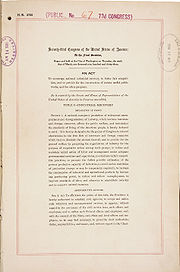
National Industrial Recovery Act

Encyclopedia
United States
The United States of America is a federal constitutional republic comprising fifty states and a federal district...
statute
Statute
A statute is a formal written enactment of a legislative authority that governs a state, city, or county. Typically, statutes command or prohibit something, or declare policy. The word is often used to distinguish law made by legislative bodies from case law, decided by courts, and regulations...
which purported to authorize the President of the United States
President of the United States
The President of the United States of America is the head of state and head of government of the United States. The president leads the executive branch of the federal government and is the commander-in-chief of the United States Armed Forces....
to regulate industry and permit cartel
Cartel
A cartel is a formal agreement among competing firms. It is a formal organization of producers and manufacturers that agree to fix prices, marketing, and production. Cartels usually occur in an oligopolistic industry, where there is a small number of sellers and usually involve homogeneous products...
s and monopolies
Monopoly
A monopoly exists when a specific person or enterprise is the only supplier of a particular commodity...
in an attempt to stimulate economic recovery, and established a national public works
Public works
Public works are a broad category of projects, financed and constructed by the government, for recreational, employment, and health and safety uses in the greater community...
program. The legislation was enacted in June 1933 during the Great Depression
Great Depression
The Great Depression was a severe worldwide economic depression in the decade preceding World War II. The timing of the Great Depression varied across nations, but in most countries it started in about 1929 and lasted until the late 1930s or early 1940s...
as part of President Franklin D. Roosevelt
Franklin D. Roosevelt
Franklin Delano Roosevelt , also known by his initials, FDR, was the 32nd President of the United States and a central figure in world events during the mid-20th century, leading the United States during a time of worldwide economic crisis and world war...
's New Deal
New Deal
The New Deal was a series of economic programs implemented in the United States between 1933 and 1936. They were passed by the U.S. Congress during the first term of President Franklin D. Roosevelt. The programs were Roosevelt's responses to the Great Depression, and focused on what historians call...
legislative program. Section 7(a) of the bill, which protected collective bargaining
Collective bargaining
Collective bargaining is a process of negotiations between employers and the representatives of a unit of employees aimed at reaching agreements that regulate working conditions...
rights for unions
Trade union
A trade union, trades union or labor union is an organization of workers that have banded together to achieve common goals such as better working conditions. The trade union, through its leadership, bargains with the employer on behalf of union members and negotiates labour contracts with...
, proved contentious (especially in the Senate
United States Senate
The United States Senate is the upper house of the bicameral legislature of the United States, and together with the United States House of Representatives comprises the United States Congress. The composition and powers of the Senate are established in Article One of the U.S. Constitution. Each...
), but both chambers eventually passed the legislation and President Roosevelt signed the bill into law on June 16, 1933. The Act had two main sections (or "titles"). Title I was devoted to industrial recovery, and authorized the promulgation of industrial codes of fair competition, guaranteed trade union rights, permitted the regulation of working standards, and regulated the price of certain refined petroleum
Petroleum
Petroleum or crude oil is a naturally occurring, flammable liquid consisting of a complex mixture of hydrocarbons of various molecular weights and other liquid organic compounds, that are found in geologic formations beneath the Earth's surface. Petroleum is recovered mostly through oil drilling...
products and their transportation. Title II established the Public Works Administration
Public Works Administration
The Public Works Administration , part of the New Deal of 1933, was a large-scale public works construction agency in the United States headed by Secretary of the Interior Harold L. Ickes. It was created by the National Industrial Recovery Act in June 1933 in response to the Great Depression...
, outlined the projects and funding opportunities it could engage in, and funded the Act.
The Act was implemented by the National Recovery Administration
National Recovery Administration
The National Recovery Administration was the primary New Deal agency established by U.S. president Franklin D. Roosevelt in 1933. The goal was to eliminate "cut-throat competition" by bringing industry, labor and government together to create codes of "fair practices" and set prices...
(NRA) and the Public Works Administration
Public Works Administration
The Public Works Administration , part of the New Deal of 1933, was a large-scale public works construction agency in the United States headed by Secretary of the Interior Harold L. Ickes. It was created by the National Industrial Recovery Act in June 1933 in response to the Great Depression...
(PWA). The NIRA was set to expire in June 1935, but in a major constitutional ruling the U.S. Supreme Court
Supreme Court of the United States
The Supreme Court of the United States is the highest court in the United States. It has ultimate appellate jurisdiction over all state and federal courts, and original jurisdiction over a small range of cases...
held Title I of the Act unconstitutional on May 27, 1935, in Schechter Poultry Corp. v. United States
Schechter Poultry Corp. v. United States
A.L.A. Schechter Poultry Corp. v. United States, 295 U.S. 495 , was a decision by the Supreme Court of the United States that invalidated regulations of the poultry industry according to the nondelegation doctrine and as an invalid use of Congress's power under the commerce clause...
, 295 U.S. 495
Case citation
Case citation is the system used in many countries to identify the decisions in past court cases, either in special series of books called reporters or law reports, or in a 'neutral' form which will identify a decision wherever it was reported...
(1935). The Act encouraged union organizing, which led to significant labor unrest. The Act had no mechanisms for handling these problems, which led Congress
United States Congress
The United States Congress is the bicameral legislature of the federal government of the United States, consisting of the Senate and the House of Representatives. The Congress meets in the United States Capitol in Washington, D.C....
to pass the National Labor Relations Act
National Labor Relations Act
The National Labor Relations Act or Wagner Act , is a 1935 United States federal law that limits the means with which employers may react to workers in the private sector who create labor unions , engage in collective bargaining, and take part in strikes and other forms of concerted activity in...
in 1935.
Background and enactment
The Great DepressionGreat Depression
The Great Depression was a severe worldwide economic depression in the decade preceding World War II. The timing of the Great Depression varied across nations, but in most countries it started in about 1929 and lasted until the late 1930s or early 1940s...
began in the United States
United States
The United States of America is a federal constitutional republic comprising fifty states and a federal district...
in October 1929. President Herbert Hoover
Herbert Hoover
Herbert Clark Hoover was the 31st President of the United States . Hoover was originally a professional mining engineer and author. As the United States Secretary of Commerce in the 1920s under Presidents Warren Harding and Calvin Coolidge, he promoted partnerships between government and business...
feared that too much intervention or coercion by the government would destroy individuality and self-reliance, which he considered to be important American values, and his laissez-faire
Laissez-faire
In economics, laissez-faire describes an environment in which transactions between private parties are free from state intervention, including restrictive regulations, taxes, tariffs and enforced monopolies....
views appeared to be shared by the Secretary of the Treasury
United States Secretary of the Treasury
The Secretary of the Treasury of the United States is the head of the United States Department of the Treasury, which is concerned with financial and monetary matters, and, until 2003, also with some issues of national security and defense. This position in the Federal Government of the United...
Andrew W. Mellon
Andrew W. Mellon
Andrew William Mellon was an American banker, industrialist, philanthropist, art collector and Secretary of the Treasury from March 4, 1921 until February 12, 1932.-Early life:...
. Hoover organized a number of voluntary measures with businesses, encouraged state and local government responses, and accelerated federal building projects, but his policies had little or no effect on economic recovery. Toward the end of his term, however, Hoover supported several legislative solutions which he felt might lift the country out of the depression. The final attempt of the Hoover administration to rescue the economy was the passage of the Emergency Relief and Construction Act
Emergency Relief and Construction Act
The Emergency Relief and Construction Act , was the United States's first major-relief legislation, enabled under Herbert Hoover and later adopted and expanded by Franklin D. Roosevelt as part of his New Deal....
(which provided funds for public works programs) and the Reconstruction Finance Corporation
Reconstruction Finance Corporation
The Reconstruction Finance Corporation was an independent agency of the United States government, established and chartered by the US Congress in 1932, Act of January 22, 1932, c. 8, 47 Stat. 5, during the administration of President Herbert Hoover. It was modeled after the War Finance Corporation...
(RFC) (which provided low-interest loans to businesses).
Hoover was defeated for re-election by Franklin D. Roosevelt in the 1932 presidential election
United States presidential election, 1932
The United States presidential election of 1932 took place as the effects of the Wall Street Crash of 1929, the Smoot-Hawley Tariff Act of 1930, the Revenue Act of 1932, and the Great Depression were being felt intensely across the country. President Herbert Hoover's popularity was falling as...
. Roosevelt was convinced that legislative activism was needed to reverse the country's economic decline. In his first hundred days in office, the Congress enacted at Roosevelt's request a series of bills designed to strengthen the banking system, including the Emergency Banking Act
Emergency Banking Act
The Emergency Banking Act was an act of the United States Congress spearheaded by President Franklin D. Roosevelt during the Great Depression. It was passed on March 9, 1933...
, the Glass–Steagall Act (which created the Federal Deposit Insurance Corporation
Federal Deposit Insurance Corporation
The Federal Deposit Insurance Corporation is a United States government corporation created by the Glass–Steagall Act of 1933. It provides deposit insurance, which guarantees the safety of deposits in member banks, currently up to $250,000 per depositor per bank. , the FDIC insures deposits at...
), and the 1933 Banking Act. The Congress also passed the Agricultural Adjustment Act
Agricultural Adjustment Act
The Agricultural Adjustment Act was a United States federal law of the New Deal era which restricted agricultural production by paying farmers subsidies not to plant part of their land and to kill off excess livestock...
to stabilize the nation's agricultural industry.
Enactment
The National Industrial Recovery Act was enacted at the very end of the Hundred Days. Hugh S. JohnsonHugh Samuel Johnson
Hugh Samuel "Iron Pants" Johnson American Army officer, businessman, speech writer, government official and newspaper columnist. He is best known as a member of the Brain Trust of Franklin D. Roosevelt in 1932-34. He wrote numerous speeches for FDR and helped plan the New Deal...
, Raymond Moley
Raymond Moley
Raymond Charles Moley was a leading New Dealer who became its bitter opponent before the end of the Great Depression....
, Donald Richberg
Donald Richberg
Donald Randall Richberg was an American attorney, civil servant, and author who was one of President Franklin D. Roosevelt's key aides and who played a critical role in the New Deal. He co-wrote the National Industrial Recovery Act, was general counsel and executive director of the National...
, Rexford Tugwell
Rexford Tugwell
Rexford Guy Tugwell was an agricultural economist who became part of Franklin D. Roosevelt's first "Brain Trust," a group of Columbia academics who helped develop policy recommendations leading up to Roosevelt's 1932 election as President...
, Jerome Frank
Jerome Frank
Jerome New Frank was a legal philosopher who played a leading role in the legal realism movement and a judge of the United States Court of Appeals for the Second Circuit.-Biography:...
, and Bernard Baruch
Bernard Baruch
Bernard Mannes Baruch was an American financier, stock-market speculator, statesman, and political consultant. After his success in business, he devoted his time toward advising U.S. Presidents Woodrow Wilson and Franklin D. Roosevelt on economic matters and became a philanthropist.-Early life...
—key Roosevelt advisors—believed that unrestrained competition had helped cause the Great Depression and that government had a critical role to play through national planning, limited regulation, the fostering of trade association
Trade association
A trade association, also known as an industry trade group, business association or sector association, is an organization founded and funded by businesses that operate in a specific industry...
s, support for "fair" trade practices, and support for "democratization of the workplace" (a standard work week, shorter working hours, and better working conditions). Roosevelt himself, the former head of a trade association, believed that government promotion of "self-organization" by trade associations was the least-intrusive and yet most effective method for achieving national planning and economic improvement. Some work on an industrial relief bill had been done in the weeks following Roosevelt's election, but much of this was in the nature of talk and the exchange of ideas rather than legislative research and drafting. The administration, preoccupied with banking and agriculture legislation, did not begin working on industrial relief legislation until early April 1933. Congress, however, was moving on its own industrial legislation. In the Senate, Robert F. Wagner
Robert F. Wagner
Robert Ferdinand Wagner I was an American politician. He was a Democratic U.S. Senator from New York from 1927 to 1949.-Origin and early life:...
, Edward P. Costigan
Edward P. Costigan
Edward Prentiss Costigan was a Democratic Party politician who represented Colorado in the United States Senate from 1931 until 1937. He was a founding member of the Progressive Party in Colorado in 1912....
, and Robert M. La Follette, Jr.
Robert M. La Follette, Jr.
Robert Marion "Young Bob" La Follette, Jr. was an American senator from Wisconsin from 1925 to 1947, the son of Robert M. La Follette, Sr., the brother of Philip La Follette, and Fola La Follette, whose husband was the playwright George Middleton.- Early life:La Follette was born in Madison,...
were promoting public works
Public works
Public works are a broad category of projects, financed and constructed by the government, for recreational, employment, and health and safety uses in the greater community...
legislation, and Hugo Black
Hugo Black
Hugo Lafayette Black was an American politician and jurist. A member of the Democratic Party, Black represented Alabama in the United States Senate from 1927 to 1937, and served as an Associate Justice of the Supreme Court of the United States from 1937 to 1971. Black was nominated to the Supreme...
was pushing short-work-week legislation. Motivated to work on his own industrial relief bill by these efforts, Roosevelt ordered Moley to work with these Senators (and anyone else in government who seemed interested) to craft a bill.
By May 1933, two draft bills had emerged, a cautious and legalistic one by John Dickinson (Under Secretary of Commerce
United States Department of Commerce
The United States Department of Commerce is the Cabinet department of the United States government concerned with promoting economic growth. It was originally created as the United States Department of Commerce and Labor on February 14, 1903...
) and an ambitious one focusing on trade associations by Hugh Johnson. Many leading businessmen—including Gerard Swope
Gerard Swope
Gerard Swope was a U.S. electronics businessman. He served as the president of General Electric Company between 1922 and 1939, and again from 1942 until 1944...
(head of General Electric
General Electric
General Electric Company , or GE, is an American multinational conglomerate corporation incorporated in Schenectady, New York and headquartered in Fairfield, Connecticut, United States...
), Charles M. Schwab
Charles M. Schwab
Charles Michael Schwab was an American steel magnate. Under his leadership, Bethlehem Steel became the second largest steel maker in the United States, and one of the most important heavy manufacturers in the world....
(chairman of Bethlehem Steel Corporation), E. H. Harriman
E. H. Harriman
Edward Henry Harriman was an American railroad executive.-Early years:Harriman was born in Hempstead, New York, the son of Orlando Harriman, an Episcopal clergyman, and Cornelia Neilson...
(chairman of the Union Pacific Railroad
Union Pacific Railroad
The Union Pacific Railroad , headquartered in Omaha, Nebraska, is the largest railroad network in the United States. James R. Young is president, CEO and Chairman....
), and Henry I. Harriman
Henry I. Harriman
Henry I. Harriman was an American public utility executive and President of the United States Chamber of Commerce from 1932 to 1935.-Early life and career:...
, president of the U.S. Chamber of Commerce
United States Chamber of Commerce
The United States Chamber of Commerce is an American lobbying group representing the interests of many businesses and trade associations. It is not an agency of the United States government....
—helped draft the legislation. A two-part bill, the first section promoting cooperative action among business to achieve fair competition and provide for national planning and a second establishing a national public works program, was submitted to Congress on May 15, 1933, after Roosevelt himself reconciled differences between the two competing bills.
The House of Representatives
United States House of Representatives
The United States House of Representatives is one of the two Houses of the United States Congress, the bicameral legislature which also includes the Senate.The composition and powers of the House are established in Article One of the Constitution...
easily passed the bill in just seven days. The most contentious issue was the inclusion of Section 7(a), which protected collective bargaining
Collective bargaining
Collective bargaining is a process of negotiations between employers and the representatives of a unit of employees aimed at reaching agreements that regulate working conditions...
rights for unions
Trade union
A trade union, trades union or labor union is an organization of workers that have banded together to achieve common goals such as better working conditions. The trade union, through its leadership, bargains with the employer on behalf of union members and negotiates labour contracts with...
. Section 7(a) had nearly not made it into the bill, but Senator Wagner, Jerome Frank, and Leon Keyserling
Leon Keyserling
Leon Hirsch Keyserling was an American economist and lawyer. During his career he helped draft major pieces of New Deal legislation and advised President Harry S. Truman as head of the Council of Economic Advisers....
(another Roosevelt aide) worked to retain the section in order to win the support of the American labor movement.
The bill had a more difficult time in the Senate. The National Association of Manufacturers
National Association of Manufacturers
The National Association of Manufacturers is an advocacy group headquartered in Washington, D.C. with 10 additional offices across the country...
, Chamber of Commerce, and industrialist Henry Ford
Henry Ford
Henry Ford was an American industrialist, the founder of the Ford Motor Company, and sponsor of the development of the assembly line technique of mass production. His introduction of the Model T automobile revolutionized transportation and American industry...
all opposed its passage. Senator Bennett Champ Clark
Bennett Champ Clark
Joel Bennett Clark , better known as Bennett Champ Clark, was a Democratic United States Senator from Missouri from 1933 until 1945, and was later a United States federal judge.-Biography:...
introduced an amendment to emasculate Section 7(a), but Wagner and Senator George W. Norris led the successful opposition to the change. The bulk of the Senate debate, however, turned on the bill's suspension of antitrust law
Competition law
Competition law, known in the United States as antitrust law, is law that promotes or maintains market competition by regulating anti-competitive conduct by companies....
. Senators William E. Borah
William Edgar Borah
William Edgar Borah was a prominent Republican attorney and longtime United States Senator from Idaho noted for his oratorical skills and isolationist views. One of his nicknames later in life was "The Lion of Idaho."...
, Burton K. Wheeler
Burton K. Wheeler
Burton Kendall Wheeler was an American politician of the Democratic Party and a United States Senator from 1923 until 1947.-Early life:...
, and Hugo Black opposed any relaxation of the Sherman Antitrust Act
Sherman Antitrust Act
The Sherman Antitrust Act requires the United States federal government to investigate and pursue trusts, companies, and organizations suspected of violating the Act. It was the first Federal statute to limit cartels and monopolies, and today still forms the basis for most antitrust litigation by...
, arguing that this would exacerbate existing severe economic inequality
Economic inequality
Economic inequality comprises all disparities in the distribution of economic assets and income. The term typically refers to inequality among individuals and groups within a society, but can also refer to inequality among countries. The issue of economic inequality is related to the ideas of...
and concentrate wealth in the hands of the rich (a severe problem which many economists at the time believed was one of the causes of the Great Depression). Wagner defended the bill, arguing that the bill's promotion of codes of fair trade practices would help create progressive standards for wages, hours, and working conditions, and eliminate sweatshops and child labor. The Senate passed the amended legislation 57-to-24 on June 9.
A House-Senate conference committee met throughout the evening of June 9 and all day June 10 to reconcile the two versions of the bill, approving a final version on the afternoon of June 10. The House approved the conference committee's bill on the evening of June 10. After extensive debate, the Senate approved the final bill, 46-to-39, on June 13. President Roosevelt signed the bill into law on June 16, 1933.
Structure of the Act
The National Industrial Recovery Act had two major titles.Title I was devoted to industrial recovery. Title I, Section 2 empowered the President to establish executive branch agencies to carry out the purposes of the Act, and provided for a sunset provision
Sunset provision
In public policy, a sunset provision or clause is a measure within a statute, regulation or other law that provides that the law shall cease to have effect after a specific date, unless further legislative action is taken to extend the law...
nullifying the Act in two years. The heart of the Act was Title I, Section 3, which permitted trade or industrial associations to seek presidential approval of codes of fair competition (so long as such codes did not promote monopolies or provide unfair competition against small businesses) and provided for enforcement of these codes. Title I, Section 5 exempted the codes from the federal antitrust laws.
Title I, Section 7(a) guaranteed the right of workers to form unions and banned yellow-dog contract
Yellow-dog contract
A yellow-dog contract is an agreement between an employer and an employee in which the employee agrees, as a condition of employment, not to be a member of a labor union...
s:
...employees shall have the right to organize and bargain collectively through representatives of their own choosing, and shall be free from the interference restraint, or coercion of employers of labor, or their agents, in the designation of such representatives or in self-organization or in other concerted activities for the purpose of collective bargaining or other mutual aid or protection;[and] (2) that no employee and no one seeking employment shall be required as a condition of employment to join any company union or to refrain from joining, organizing, or assisting a labor organization of his own choosing... .
Title I, Section 7(b) permitted the establishment of standards regarding maximum hours of labor, minimum rates of pay, and working conditions in the industries covered by the codes, while Section 7(c) authorized the President to impose such standards on codes when voluntary agreement could not be reached.
Title I, Section 9 authorized the regulation of oil pipelines and prices for the transportation of all petroleum products by pipeline. Section 9(b) permitted the executive to take over any oil pipeline company, subsidiary, or business if the parent company was found in violation of the Act.
Title II established the Public Works Administration. Title II, Section 201 established the agency and provided for a two-year sunset provision. Section 202 outlines the types of public works which the new agency may seek to fund or build. Title II, Section 203 authorized the Public Works Administration to provide grants and/or loans to states and localities in order to more rapidly reduce unemployment as well as to use the power of eminent domain
Eminent domain
Eminent domain , compulsory purchase , resumption/compulsory acquisition , or expropriation is an action of the state to seize a citizen's private property, expropriate property, or seize a citizen's rights in property with due monetary compensation, but without the owner's consent...
to seize land or materials to engage in public works. Title II, Section 204 explicitly provided $400 million for the construction of public highways, bridges, roads, railroad crossings, paths, and other transportation projects.
Title II, Section 208 authorized the president to expend up to $25 million to purchase farms for the purpose of relocating individuals living in overcrowded urban areas (such as cities) to these farms and allowing them to raise crops and earn a living there.
Title II, Sections 210-219 provided for revenues to fund the Act, and Section 220 appropriated money for the Act's implementation.
Title III of the Act contained miscellaneous provisions, and transferred the authority to engage in public works from the Reconstruction Finance Corporation to the Public Works Administration.
Implementation
Harold L. Ickes
Harold LeClair Ickes was a United States administrator and politician. He served as United States Secretary of the Interior for 13 years, from 1933 to 1946, the longest tenure of anyone to hold the office, and the second longest serving Cabinet member in U.S. history next to James Wilson. Ickes...
. NRA and PWA reported to different cabinet agencies, making coordination difficult, and PWA money flowed so slowly into the economy that NRA proved to be the more important agency by far.
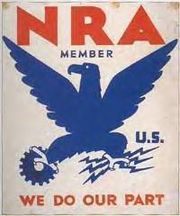
The premiere symbol of the NIRA was the Blue Eagle
Blue Eagle
The Blue Eagle, a blue-colored representation of the American thunderbird, with outspread wings, was a symbol used in the United States by companies to show compliance with the National Industrial Recovery Act...
.
NIRA, as implemented by the NRA, became notorious for generating large numbers of regulations. The agency approved 557 basic and 189 supplemental industry codes in two years. Between 4,000 and 5,000 business practices were prohibited, some 3,000 administrative orders running to over 10,000 pages promulgated, and thousands of opinions and guides from national, regional, and local code boards interpreted and enforced the Act. The backlash against the Act was so significant that it generated a large loss of political support for the New Deal and turned a number of Roosevelt's closest aides against him. Roosevelt himself shifted his views on the best way to achieve economic recovery, and began a new legislative program (known as the "Second New Deal") in 1935.
Implementation of Section 7(a) of the NIRA proved immensely problematical as well. The protections of the Act led to a massive wave of union organizing punctuated by employer and union violence, general strike
General strike
A general strike is a strike action by a critical mass of the labour force in a city, region, or country. While a general strike can be for political goals, economic goals, or both, it tends to gain its momentum from the ideological or class sympathies of the participants...
s, and recognition strike
Recognition strike
A recognition strike is an industrial strike implemented in order to force a particular employer or industry to recognize a trade union as the legitimate collective bargaining agent for a company's workers...
s. At the outset, NRA Administrator Hugh Johnson naïvely believed that Section 7(a) would be self-enforcing, but he quickly learned otherwise and the National Labor Board
National Labor Board
The National Labor Board was an independent agency of the United States Government established on August 5, 1933 to handle labor disputes arising under the National Industrial Recovery Act .-Establishment, structure and procedures:...
was established under the auspices of the NRA to implement the collective bargaining provisions of the Act. The National Labor Board, too, proved to be ineffective, and on July 5, 1935, a new law—the National Labor Relations Act
National Labor Relations Act
The National Labor Relations Act or Wagner Act , is a 1935 United States federal law that limits the means with which employers may react to workers in the private sector who create labor unions , engage in collective bargaining, and take part in strikes and other forms of concerted activity in...
—superseded the NIRA and established a new, long-lasting federal labor policy.
The leadership of the Public Works Authority was torn over the new agency's mission. PWA could initiate its own construction projects, distribute money to other federal agencies to fund their construction projects, or make loans to states and localities to fund their construction projects. But many in the Roosevelt administration felt PWA should not spend money, for fear of worsening the federal deficit, and so funds flowed slowly. Furthermore, the very nature of construction (planning, specifications, and blueprints) also held up the disbursement of money. Harold Ickes, too, was determined to ensure that graft and corruption did not tarnish the agency's reputation and lead to loss of political support in Congress, and so moved cautiously in spending the agency's money. Although the U.S. Supreme Court would rule Title I of NIRA unconstitutional, the severability
Severability
In law, severability refers to a provision in a contract which states that if parts of the contract are held to be illegal or otherwise unenforceable, the remainder of the contract should still apply...
clause in the Act enabled the PWA to survive. Among the projects it funded between 1935 and 1939 are: the USS Yorktown
USS Yorktown (CV-5)
was an aircraft carrier commissioned in the United States Navy from 1937 until she was sunk at the Battle of Midway in June 1942. She was named after the Battle of Yorktown in 1781 and the lead ship of the Yorktown class which was designed after lessons learned from operations with the large...
; USS Enterprise
USS Enterprise (CV-6)
USS Enterprise , colloquially referred to as the "Big E," was the sixth aircraft carrier of the United States Navy and the seventh U.S. Navy ship to bear the name. Launched in 1936, she was a ship of the Yorktown class, and one of only three American carriers commissioned prior to World War II to...
; the 30th Street
30th Street Station
30th Street Station is the main railroad station in Philadelphia, Pennsylvania, and one of the five stations in SEPTA's Center City fare zone. It is also a major stop on Amtrak's Northeast and Keystone Corridors...
railroad station
Train station
A train station, also called a railroad station or railway station and often shortened to just station,"Station" is commonly understood to mean "train station" unless otherwise qualified. This is evident from dictionary entries e.g...
in Philadelphia, Pennsylvania
Pennsylvania
The Commonwealth of Pennsylvania is a U.S. state that is located in the Northeastern and Mid-Atlantic regions of the United States. The state borders Delaware and Maryland to the south, West Virginia to the southwest, Ohio to the west, New York and Ontario, Canada, to the north, and New Jersey to...
; the Triborough Bridge
Triborough Bridge
The Robert F. Kennedy ' Bridge, formerly known as the Triborough Bridge , is a complex of three separate bridges in New York City, United States...
; the port of Brownsville
Brownsville, Texas
Brownsville is a city in the southernmost tip of the state of Texas, in the United States. It is located on the northern bank of the Rio Grande, directly north and across the border from Matamoros, Tamaulipas, Mexico. Brownsville is the 16th largest city in the state of Texas with a population of...
; Grand Coulee Dam
Grand Coulee Dam
Grand Coulee Dam is a gravity dam on the Columbia River in the U.S. state of Washington built to produce hydroelectric power and provide irrigation. It was constructed between 1933 and 1942, originally with two power plants. A third power station was completed in 1974 to increase its energy...
; Boulder Dam
Hoover Dam
Hoover Dam, once known as Boulder Dam, is a concrete arch-gravity dam in the Black Canyon of the Colorado River, on the border between the US states of Arizona and Nevada. It was constructed between 1931 and 1936 during the Great Depression and was dedicated on September 30, 1935, by President...
; Fort Peck Dam
Fort Peck Dam
The Fort Peck Dam is the highest of six major dams along the Missouri River, located in northeast Montana in the United States, near Glasgow, and adjacent to the community of Fort Peck...
; Bonneville Dam
Bonneville Dam
Bonneville Lock and Dam consists of several run-of-the-river dam structures that together complete a span of the Columbia River between the U.S. states of Oregon and Washington at River Mile 146.1. The dam is located east of Portland, Oregon, in the Columbia River Gorge. The primary functions of...
; and the Overseas Highway
Overseas Highway
The Overseas Highway is a highway carrying U.S. Route 1 through the Florida Keys. Large parts of it were built on the former right-of-way of the Overseas Railroad, the Key West Extension of the Florida East Coast Railway. Completed in 1912, the Overseas Railroad was heavily damaged and partially...
connecting Key West
Key West
Key West is an island in the Straits of Florida on the North American continent at the southernmost tip of the Florida Keys. Key West is home to the southernmost point in the Continental United States; the island is about from Cuba....
, Florida
Florida
Florida is a state in the southeastern United States, located on the nation's Atlantic and Gulf coasts. It is bordered to the west by the Gulf of Mexico, to the north by Alabama and Georgia and to the east by the Atlantic Ocean. With a population of 18,801,310 as measured by the 2010 census, it...
, with the mainland. The agency survived until 1943, when the Reorganization Act of 1939
Reorganization Act of 1939
The Reorganization Act of 1939, Pub. L. No. 76-19, 53 Stat. 561, 5 USC 133 , is an American Act of Congress which became law on April 3, 1939, and which gave the President of the United States the authority to hire additional confidential staff and reorganize the executive branch for two years...
consolidated most federal public works and work relief functions of the federal government into the new Federal Works Agency
Federal Works Agency
The Federal Works Agency was an independent agency of the Federal government of the United States which administered a number of public construction, building maintenance, and public works relief functions and laws from 1939 to 1949...
.
President Roosevelt sought reauthorization of NIRA on February 20, 1935. But the backlash against the New Deal, coupled with continuing congressional concern over the Act's suspension of antitrust law, left the President's request politically dead. By May 1935, the issue was moot as the U.S. Supreme Court
Supreme Court of the United States
The Supreme Court of the United States is the highest court in the United States. It has ultimate appellate jurisdiction over all state and federal courts, and original jurisdiction over a small range of cases...
had ruled Title I of NIRA unconstitutional.
Legal challenge and nullification
On April 13, 1934, the President had approved the "Code of Fair Competition for the Live Poultry Industry of the Metropolitan Area in and about the City of New York." The goal of the code was to ensure that live poultry (provided to kosher slaughterhouses for butchering and sale to observant Jews) were fit for human consumption and to prevent the submission of false sales and price reports. The industry was almost entirely centered on New York CityNew York City
New York is the most populous city in the United States and the center of the New York Metropolitan Area, one of the most populous metropolitan areas in the world. New York exerts a significant impact upon global commerce, finance, media, art, fashion, research, technology, education, and...
. Under the new poultry code, the Schechter brothers were indicted on 60 counts (of which 27 were dismissed by the trial court), acquitted on 14, and convicted in 19. One of the counts on which they were convicted was for selling a diseased bird, leading Hugh Johnson to jokingly call the suit the "sick chicken case".
United States Department of Justice
The United States Department of Justice , is the United States federal executive department responsible for the enforcement of the law and administration of justice, equivalent to the justice or interior ministries of other countries.The Department is led by the Attorney General, who is nominated...
had on March 25, 1935, declined to appeal an appellate court ruling overturning the lumber industry code on the grounds that the case was not a good test of the NIRA's constitutionality. The Justice Department's action worried many in the administration. But on April 1, the Second Circuit Court of Appeals
United States Court of Appeals for the Second Circuit
The United States Court of Appeals for the Second Circuit is one of the thirteen United States Courts of Appeals...
upheld the constitutionality of the NIRA in the Schechter case. Although Donald Richberg and others felt the government's case in Schechter was not a strong one, the Schechters were determined to appeal their conviction. So the government appealed first, and the Supreme Court heard oral argument on May 2 and 3.
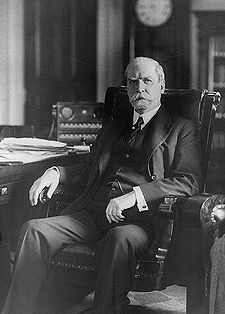
On May 27, 1935, Chief Justice
Chief Justice of the United States
The Chief Justice of the United States is the head of the United States federal court system and the chief judge of the Supreme Court of the United States. The Chief Justice is one of nine Supreme Court justices; the other eight are the Associate Justices of the Supreme Court of the United States...
Charles Evans Hughes
Charles Evans Hughes
Charles Evans Hughes, Sr. was an American statesman, lawyer and Republican politician from New York. He served as the 36th Governor of New York , Associate Justice of the Supreme Court of the United States , United States Secretary of State , a judge on the Court of International Justice , and...
wrote for a unanimous Court in Schechter Poultry Corp. v. United States 295 U.S. 495 (1935) that Title I of the National Industrial Recovery Act was unconstitutional. First, Hughes concluded that the law was void for vagueness
Void for vagueness
Void for vagueness is a legal concept in American constitutional law that states that a given statute is void and unenforceable if it is too vague for the average citizen to understand. There are several ways, senses or reasons a statute might be considered vague...
because the critical term "fair competition" was nowhere defined in the Act. Second, Hughes found the Act's delegation of authority to the executive branch unconstitutionally overbroad
Nondelegation doctrine
The doctrine of nondelegation describes the theory that one branch of government must not authorize another entity to exercise the power or function which it is constitutionally authorized to exercise itself. It is explicit or implicit in all written constitutions that impose a strict structural...
:
To summarize and conclude upon this point: Section 3 of the Recovery Act (15 USCA 703) is without precedent. It supplies no standards for any trade, industry, or activity. It does not undertake to prescribe rules of conduct to be applied to particular states of fact determined by appropriate administrative procedure. Instead of prescribing rules of conduct, it authorizes the making of codes to prescribe them. For that legislative undertaking, section 3 sets up no standards, aside from the statement of the general aims of rehabilitation, correction, and expansion described in section 1. In view of the scope of that broad declaration and of the nature of the few restrictions that are imposed, the discretion of the President in approving or prescribing codes, and thus enacting laws for the government of trade and industry throughout the country, is virtually unfettered. We think that the code-making authority thus conferred is an unconstitutional delegation of legislative power.
Finally, in a very restrictive reading of what constituted interstate commerce, Hughes held that the "'current' or 'flow'" of commerce involved was simply too minute to constitute interstate commerce, and subsequently Congress had no power under the Commerce Clause
Commerce Clause
The Commerce Clause is an enumerated power listed in the United States Constitution . The clause states that the United States Congress shall have power "To regulate Commerce with foreign Nations, and among the several States, and with the Indian Tribes." Courts and commentators have tended to...
to enact legislation affecting such commercial transactions. The Court dismissed with a bare paragraph the government's ability to regulate wages and hours. Although the government had argued that the national economic emergency required special consideration, Hughes disagreed. The dire economic circumstances the country faced did not justify the overbroad delegation or overreach of the Act, the majority concluded. "Extraordinary conditions may call for extraordinary remedies. But the argument necessarily stops short of an attempt to justify action which lies outside the sphere of constitutional authority. Extraordinary conditions do not create or enlarge constitutional power."
Although the decision emasculated NIRA, it had little practical impact, as Congress was unlikely to have reauthorized the Act in any case.
Criticism
A key criticism of the Act at the time as well as more recently is that the NIRA endorsed monopolies, with the attendant economic problems associated with that type of market failureMarket failure
Market failure is a concept within economic theory wherein the allocation of goods and services by a free market is not efficient. That is, there exists another conceivable outcome where a market participant may be made better-off without making someone else worse-off...
. Even the National Recovery Review Board, established by President Roosevelt in March 1934 to review the performance of the NRA, concluded that the Act hindered economic growth by promoting cartels and monopolies. One of the economic effects of monopoly and cartels is higher prices. Higher prices were an intentional outcome of the Act because deflation was a severe problem at the time. There is anecdotal evidence that these higher prices led to some stability in industry. But were these prices so high that economic recovery was inhibited? A number of scholars answer in the affirmative. But other economists disagree, pointing to far more important monetary, budgetary, and tax policies as contributors to the continuation of the Great Depression. Others point out that the cartels created by the Act were inherently unstable (as all cartels are), and that the effect on prices was minimal because the codes collapsed so quickly.
A second key criticism of the Act is that it lacked support from the business community, and thus was doomed to failure. Business support for national planning and government intervention was very strong in 1933, but had collapsed by mid-1934. Many studies conclude, however, that business support for NIRA was never uniform. Larger, older businesses embraced the legislation while smaller, newer ones (more nimble in a highly competitive market and with less capital investment to lose if they failed) did not. This is a classic problem of cartels, and thus NIRA codes failed as small business abandoned the cartels. Studies of the steel, automobile manufacturing, lumber, textile, and rubber industries and the level and source of support for the NIRA tend to support this conclusion.
A third major criticism of the Act is that it was poorly administered. The Act purposefully brought together competing interests (labor and business, big business and small business, etc.) in a coalition to support passage of the legislation, but these competing interests soon fought one another over the Act's implementation. As a consequence, NRA collapsed due to failure of leadership and confusion about its goals. By end of 1934, NRA leaders had practically abandoned the progressive interventionist policy which motivated the Act's passage, and were supporting free-market philosophies—contributing to the collapse of almost all industry codes.
There are a wide range of additional critiques as well. One is that NIRA's industry codes interfered with capital markets, inhibiting economic recovery. But more recent analyses conclude that NIRA had little effect on capital markets one way or the other. Another is that political uncertainty created by the NRA caused a drop in business confidence, inhibiting recovery. But at least one study has shown no effect whatsoever.
As noted above, Section 7(a) led to significant increases in union organizing, as intended by the Act. But the enforcement of Section 7(a) and its legal limitations led to clear failures. Although Section 7(a) was not affected by the Supreme Court's decision in Schechter Poultry, the failure of the section led directly to passage of the National Labor Relations Act in July 1935.