


Socialist Party of America

Encyclopedia
The Socialist Party of America (SPA) was a multi-tendency
democratic-socialist
political party
in the United States
, formed in 1901 by a merger between the three-year-old Social Democratic Party of America
and disaffected elements of the Socialist Labor Party
which had split from the main organization in 1899.
In the first decades of the 20th century, it drew significant support from many different groups, including trade unionists, progressive
social reformers, populist
farmers, and immigrant communities. Its presidential candidate, Eugene V. Debs
, twice won over 900,000 votes (in 1912
and 1920
), while the party also elected two United States Representatives
(Victor L. Berger
and Meyer London
), dozens of state legislators, more than a hundred mayors, and countless lesser officials. The party's staunch opposition to American involvement in World War I, although welcomed by many, also led to prominent defections, official repression and vigilante persecution. The organization was further shattered by a factional war over how it should respond to Russia's Bolshevik Revolution in 1917 and the establishment of the Communist International in 1919.
After endorsing Robert LaFollette
's presidential campaign in 1924
, the Socialist Party returned to independent action and experienced modest growth in the early 1930s behind presidential candidate Norman Thomas
. After the 1920s, however, the Party's appeal was weakened by the popularity of Franklin Roosevelt's New Deal
, the organization and flexibility of the Communist Party
under Earl Browder
, and the resurgent labor movement's desire to support sympathetic Democratic Party
politicians. A divisive and ultimately-unsuccessful attempt to broaden the party by admitting followers of Leon Trotsky
and Jay Lovestone
caused the traditional "Old Guard" to leave and form the Social Democratic Federation. While the party was always strongly anti-Fascist
, as well as anti-Stalinist, the SP's ambivalent attitude towards World War II
cost it both internal and external support.
The SP stopped running presidential candidates after 1956
, when its nominee Darlington Hoopes
won fewer than 3,000 votes. In the party's last decades, its members, many of them prominent in the labor, peace, civil rights and civil liberties movements, fundamentally disagreed about the socialist movement's relationship to the labor movement and Democratic Party in the U.S., and about how best to advance democracy abroad. In 1972–1973, these strategic differences had become so acute that the Socialist Party changed its name to Social Democrats, USA and leaders of two of its caucuses formed separate socialist organizations.
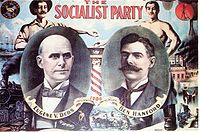
From 1901 to the onset of World War I
, the Socialist Party had numerous elected officials. There were two Socialist members of Congress, Meyer London
of New York City
and Victor Berger of Milwaukee (a part of the sewer socialism
movement, a major front in socialism, Milwaukee being the first city (and the only major one) to elect a socialist mayor, which it did four times between 1910 and 1960); over 70 mayors, and many state legislators and city councilors. Its voting strength was greatest among recent Jewish, Finnish and German immigrants, coal miners, and former Populist farmers in the Midwest. From 1900 (before its formal union) to 1912, the Socialist Party ran Eugene Debs for President at each election. The best showing ever for a Socialist ticket was in 1912
, when Debs gained 901,551 total votes, or 6% of the popular vote. In 1920 Debs ran again, this time from prison, and received 913,693 votes, 3.4% of the total.
Early political perspectives ranged from radical socialism to social democracy, with New York party leader Morris Hillquit
and Congressman Berger on the more social democratic or right wing of the party and radical socialists and syndicalists, including members of the Industrial Workers of the World
(IWW) and the party's frequent candidate, Eugene V. Debs, on the left wing of the party. As well there were agrarian utopian-leaning radicals, such as Julius Wayland
of Kansas, who edited the party's leading national newspaper, Appeal to Reason along with trade unionists; Jewish, Finnish, and German immigrants; and intellectuals such as Walter Lippmann
and the Black activist/intellectual Hubert Harrison
.
The party had a tense and complicated relationship with the American Federation of Labor
. The American Federation of Labor leadership, headed by Samuel Gompers
, was strongly opposed to the SPA, but many rank and file unionists in the early party of the 20th Century saw in the Socialists reliable political allies. Many moderate Socialists, such as Victor Berger and International Typographical Union
President Max S. Hayes
, urged close cooperation with the American Federation of Labor and its member unions. Others in the Socialist Party's ranks dismissed the American Federation of Labor and its craft unions as antiquated and irrelevant, instead favoring the much more radical IWW and the syndicalist path to socialism.
In 1911, IWW leader William "Big Bill" Haywood
was elected to the National Executive Committee of the Socialist Party, on which American Federation of Labor partisan Morris Hillquit also served. The syndicalist and the electoral socialist squared off in a lively public debate in New York City's Cooper Union on Jan. 11, 1912, with Haywood declaring that Hillquit and the socialists ought to try "a little sabotage in the right place at the proper time" and attacked Hillquit for having abandoned the class struggle by helping the New York garment workers negotiate an industrial agreement with their employers. Hillquit replied that he had no new message rather than to reiterate a belief in a two-sided workers movement, with separate and equal political and trade union arms. "A mere change of structural forms would not revolutionize the American labor movement as claimed by our extreme industrialists," he declared.
The issue of "syndicalism vs. socialism" was bitterly fought over the next two years, consummated by "Big Bill" Haywood's recall from the SPA's NEC and the departure of a broad section of the left wing from the organization. The memory of this split made the intra-party battles of 1919-1921 all the more bitter.
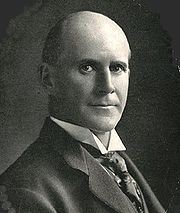 The party's opposition to World War I
caused a sharp decline in membership. An increase in the membership of its language federation
s from areas involved in the Bolshevik Revolution
proved illusory, since these members were soon lost to the Communist Party.
The party also lost some of its most prominent members, who had been in favor of America's entry into World War I, including Walter Lippmann
, John Spargo
, J.G. Phelps Stokes, and William English Walling
. They briefly formed the National Party
, in an unrealized hope of merging with the remnants of Theodore Roosevelt
's Progressive Party
and the Prohibition Party
.
In June 1918 the Party's best-known leader, Eugene Victor Debs made an anti-war speech calling for draft resistance; he was arrested under the Sedition Act of 1918
, convicted and sentenced to serve ten years in prison. He was pardoned by President Warren G. Harding
in 1921.
invited the Industrial Workers of the World
and the radical wing of the Socialist Party to join in the founding of the Communist Third International, the Comintern
.
The Left Wing Section of the Socialist Party
emerged as an organized faction early that same year, building its organization around a lengthy Left Wing Manifesto
authored by Louis C. Fraina
. This effort to organize in order to "win the Socialist Party for the Left Wing" met with staunch resistance from the "Regulars" who controlled a big majority of the seats of the SPA's governing National Executive Committee. When it seemed certain that the 1919 party elections for a new NEC had been dominated by the Left Wing, the sitting NEC, citing voting irregularities, refused to tally the votes, declared the entire election invalid and in May 1919 suspended the party's Russian, Latvian, Ukrainian, Polish, South Slavic, and Hungarian language federations, in addition to the entire state organization of Michigan. In future weeks, the state organizations of Massachusetts and Ohio would similarly be disfranchised and "reorganized" by the NEC, while in New York and Pennsylvania, the "Regular" State Executive Committees undertook reorganization of Left Wing branches and locals on a case-by-case basis.
In June 1919, the Left Wing Section held a conference in New York City to discuss their organizational plans. The group found themselves deeply divided, with one section, led by NEC members Alfred Wagenknecht
and L. E. Katterfeld and including famed radical journalist John Reed favoring a continued effort to gain control of the SPA at its forthcoming Emergency National Convention in Chicago, to be held at the end of August, while another section, headed by the Russian Socialist Federation
of Alexander Stoklitsky and Nicholas Hourwich and the Socialist Party of Michigan seeking to wash their hands of the Socialist Party and immediately move to the establishment of a new Communist Party of America. Eventually this latter Federation-dominated group was joined by important Left Wingers C. E. Ruthenberg
and Louis Fraina, a depletion of Left Wing forces which made the result of the 1919 Socialist Convention a foregone conclusion.
 Regardless, the plans of Wagenknecht, Reed & Co. to fight it out at the 1919 Emergency National Convention
continued apace. With the most radical state organizations effectively purged by the Regulars (Massachusetts, Minnesota) or unable to participate (Ohio, Michigan), and the Left Wing language federations suspended, a big majority of the hastily elected delegates to the gathering were controlled by the Executive Secretary Adolph Germer
and the Regulars. A group of Left Wingers without delegate credentials, including John Reed and his sidekick Benjamin Gitlow
, made an effort to occupy chairs on the convention floor before the gathering was called into order. The incumbents were unable to block the Left Wingers at the door, but soon called the already present police to their aid, and the officers of the law obligingly expelled the boisterous radicals from the hall. With the Credentials Committee firmly in the hands of the Regulars from the outset, the outcome of the gathering was no longer in doubt and most of the remaining Left Wing delegates departed, to meet with other co-thinkers downstairs in a previously-reserved room in a parallel convention. It was this gathering which established itself as the Communist Labor Party
on August 31, 1919.
Meanwhile, elsewhere in Chicago the Federations and Michiganders and their supporters established the Communist Party of America at a convention gaveled to order on September 1, 1919. Unity between these two communist organizations was a lengthy and complicated process, formally taking place at a secret convention held at the Overlook Mountain House hotel near Woodstock, New York
in May 1921 with the establishment of a new unified "Communist Party of America."
A Left Wing loyal to the Communist International remained in the Socialist Party through 1921, continuing the fight to bring the SPA into the ranks of the Comintern. This group, which opposed the underground secret organizations which the Communist Parties had become, included noted party journalist J. Louis Engdahl
and William Kruse, head of the party's youth affiliate, the Young People's Socialist League
, as well as a significant segment of the SPA's Chicago organization. These left wing dissidents continued to make themselves heard until their departure from the party after the convention of 1921.
had swept and stunned the country, a new session of the New York State Assembly
was called to order. The majority Republicans easily elected their candidate for the Speaker, Thaddeus C. Sweet
and after opening day formalities the body took a brief recess. Back in session, Sweet declared: "The Chair directs the Sergeant-at-Arms to present before the Bar of the House Samuel A. DeWitt
, Samuel Orr
, Louis Waldman
, Charles Solomon
, and August Claessens
," the Assembly's five Socialist members.
Sweet attacked the five, declaring they had been "elected on a platform that is absolutely inimical to the best interests of the state of New York and the United States." The Socialist Party, Sweet said, was "not truly a political party", but was rather "a membership organization admitting within its ranks aliens, enemy aliens, and minors." The party had denounced America's participation in the European war and had lent aid and comfort to Ludwig Martens
, the "self-styled Soviet Ambassador and alien, who entered this country as a German in 1916." It had supported the revolutionaries in Germany, Austria, and Hungary
, Sweet continued, and consorted with international Socialist parties close to the Communist International. Sweet concluded:
The Assembly suspended the quintet by a vote of 140 to 6, with one Democrat supporting the Socialists. Civil libertarians and concerned citizens raised their voices to aid the suspended Socialists, and protest percolated throughout the press. The principal argument was that majority parties expelling elected members of minority parties from their councils set a dangerous precedent in a democracy. The battle culminated in a highly publicized trial in the Assembly, which dominated the body's activity from its opening on January 20, 1920, until its conclusion on March 11. Socialist Party leader and former 1917 New York City mayoral candidate Morris Hillquit
served as chief counsel for the suspended Socialists, aided by party founder, and future Socialist Vice Presidential candidate, Seymour Stedman
.
At the trial, Hillquit charged that Speaker Sweet had made a "specific, concrete, definite, affirmative declaration of guilt" of the five Assemblymen before they were ever charged with any offense. It was the chief accuser, Speaker Sweet, who also appointed the members of the Judiciary Committee to which the matter was referred. "Thus the accuser selects his own judges," Hillquit declared. Hillquit sought to remove for reasons of bias any members of the Judiciary Committee who had taken part in the activities of the Lusk Committee, the New York State Senate's anti-radicalism committee. Hillquit particularly challenged the presence of Assemblyman Louis Cuvillier, who had stated on the floor of the house the previous night words to the effect that "if the five accused Assemblymen are found guilty, they ought not to be expelled, but taken out and shot." The Assembly voted overwhelmingly for expulsion on April 1, 1920.
A special election was held September 16, 1920, to fill the five seats vacated by the Assembly, with each of the five expelled Socialists running for re-election against a "fusion" candidate representing the combined Republican and Democratic parties. All five Socialists were returned to office.
Three of the five, Waldman, Claessens, and Solomon, were again denied their seats after a contentious debate by votes of 90 to 45 on September 21, 1920. Orr and DeWitt, deemed less culpable than their peers by the earlier findings of the Judiciary Committee, were seated by votes of 87 to 48. In solidarity with their ousted colleagues, the pair refused to take their seats.
After the five seats were again vacated, Morris Hillquit expressed his disappointment at the "unconstitutional action" of the Assembly. However, Hillquit continued, "it will draw the issues clearer between the united Republican and Democratic parties representing arbitrary lawlessness, and the Socialist Party, which stood and stands for democratic and representative government."
The legislature attempted to prevent the election and seating of Socialists in the future by passing laws designed to exclude the Socialist Party from recognition as a political party and to alter the legislature's oath-taking procedures so that elected members could be excluded before being sworn. Governor Al Smith
vetoed the legislation.
 In the first half of 1919, the Socialist Party had over 100,000 dues paying members; by the second half of 1921, it had been shattered. Fewer than 14,000 members remained in party ranks, with the departure of the large and large and well-funded Finnish Socialist Federation
adding to the malaise. In September 1921, the NEC of the party determined that the time had come to end the party's historic aversion to "fusion" with other political organizations and issue an appeal declaring that the "forces of every progressive, liberal, and radical organization of the workers must be mobilized" to repel conservative assaults and "advance the industrial and political power of the working class." This desire for common action seems to have been shared by various unions, as late in 1921 a call was issued in the name of the country's 16 major railway labor unions seeking a "Conference for Progressive Political Action
" (CPPA). The CPPA was originally intended to be an umbrella organization bringing together various elements of the farmer and labor movement around a common program. Invitations to the group's founding conference were issued to members of a wide variety of "progressive" organizations of widely varied perspectives. As a result, from its inception the heterogeneous body was unable to agreee on even a program or even a declaration of principles, let alone congeal into a new political party.
The Socialist Party was an enthusiastic supporter of the CPPA, and the group dominated its thinking from the start of 1922 through the first quarter of 1925. The party sought, in this period of organizational weakness, to forge lasting ties with the existing trade union movement leading in short order to a mass labor party in the United States on the British model.
A first National Conference of the CPPA was held in Chicago in February 1922, attended by 124 delegates representing a broad spectrum of labor, farmer, and political organizations. The gathering passed an "Address to the American People," stating its criticism of existing conditions and formally proposing an amorphous plan of action validating the status quo ante: the labor unions on the group's right wing to endorse labor-friendly candidates of the Democratic Party, the Socialists and Farmer-Labor Party adherents on the group's left wing to conduct their own independent campaigns. Perhaps the most important thing the CPPA did at its first National Conference, from the Socialist Party's perspective, was agree to meet again. The SP leadership understood the process of building an independent third party
which could count on the allegiance of the country's trade union leadership would be a protracted process, and the mere fact of "agreement to disagree" but nevertheless meeting again was regarded as a step forward.
The communist movement also sought to pursue the strategy of bursting from its isolation through the formation of a mass Farmer-Labor Party. Finally emerged from its underground existence in 1922, the Communists' through their "legal political party," the Workers Party of America
decided to send four delegates to the December 1922 gathering of the CPPA. However, the Credentials Committee, after protracted debate, strongly objected to the participation of Communist representatives in its proceedings and issued a recommendation that the representatives of the Workers Party and its youth organization not be seated. The Socialist Party's delegates were strongly in favor of the exclusion of the Communists and acted accordingly, even though the two organizations shared a vision of a party akin to the British Labour Party in which constituent political groups jointly participated while retaining their independent existence. The fissure between the organizations was thus widened.
As with the first conference, the 2nd Conference of the CPPA split over the all-important issue of an independent political party, with a proposal by five delegates of the Farmer-Labor Party calling for "independent political action by the agricultural and industrial workers through a party of their own" defeated by a vote of 52 to 64. A majority report declaring against an independent political party was instead adopted. This defeat of the bid for an independent political party cost the CPPA one its major component organizations, with the Farmer-Labor Party delegation announcing that their group would no longer affiliate with the CPPA after the close of the convention. Although the Socialists did not realize it at the time, the chances that the organization would ever be transformed into an authentic mass Farmer-Labor party of the British Labour type were greatly lessened with the departure of the FLP.
Still, the Socialists remained optimistic. The May 1923 National Convention of the SP voted, after lengthy debate, to retain its affiliation with the CPPA and to continue its work for an independent political party from within that group. The May 20 vote in favor of maintaining affiliation with the CPPA was 38-12. Failing a mass farmer-labor party from the CPPA, the Socialists sought at least a powerful presidential nominee to run in opposition to the old parties. A 3rd National Conference of the CPPA was held in St. Louis, Missouri
on February 11 and 12, 1924, a gathering which punted on the issue of committing itself to the 1924 presidential campaign, deciding instead to "immediately issue a call for a convention of workers, farmers, and progressives for the purpose of taking action on nomination of candidates for the offices of President and Vice President of the United States, and on other questions that may come before the convention."
The decisive moment finally came on the 4th of July, 1924, a date which was not accidentally selected. The 1st National Convention of the CPPA was assembled in Cleveland at the city auditorium, which was packed with close to 600 delegates representing international unions, state federations of labor, branches of cooperative societies, state branches and national officers of the Socialist, Farmer-Labor, and Progressive Parties as well as the Committee of Forty-Eight, state and national affiliates of the Women's Committee on Political Action, and sundry individuals. Very few farmers were in attendance.
The National Committee had previously requested that Wisconsin Senator Robert M. La Follette, Sr.
make a run for the presidency. The Cleveland Convention was addressed by the Senator's son, Robert M. LaFollette, Jr., who read a message from his father accepting the call and declaring that the time had come "for a militant political movement independent of the two old party organizations." LaFollette declined to lead a third party, however, seeking to protect those progressives elected nominally as Republicans and Democrats. LaFollette declared that the primary issue of the 1924 campaign was the breaking of the "combined power of the private monopoly system over the political and economic life of the American people." After the November election a new party might well be established, LaFollette stated, around which all progressives could unite.
The Socialist Party enthusiastically supported the independent candidacy of LaFollette, declining to run their own candidate in November 1924. Although the LaFollette candidacy garnered five million votes, it failed to seriously challenge the hegemony
of the old parties and was regarded by the unions as a disappointing failure.
Following the election, the governing National Committee of the CPPA met in Washington, DC. While the body had a mandate from the July convention to issue a call for a convention to organize a new political party, the representatives of the critical railway unions, with the exception of William H. Johnston of the Machinists, were united in opposition to idea. The railroad unions instead proposed a motion not to hold the 1925 organizational convention. This proposal was defeated by a vote of 30 to 13. Following their defeat on this question, the railroaders on National Committee members withdrew from the meeting, announcing that they would await further instructions from their respective organizations with regards to future participation. The loss of the very unions who had brought about the CPPA spelled its demise.
A convention to decide on the formation of a new political party was nonetheless scheduled by the National Committee for February 21, 1925, to be held in Chicago. Labor, the official organ of the railway unions, did nothing to promote this 2nd Convention of the CPPA, stating that since the executives of the various unions had taken no stance on the matter, it would be up to subordinate sections to consider sending delegates themselves.
The February 1925 convention found its task was virtually insurmountable, however, as the heterogeneous organization had split over the fundamental question of realignment of the major parties via the primary elections process as opposed to establishment of a new competitive political party. The railway unions, whose efforts who had originally brought the CPPA into existence, were fairly solidly united against the Third Party tactic, instead favoring continuation of the CPPA as a sort of pressure group for progressive change within the structure of the Democratic and Republican parties.
L. E. Sheppard, President of the Order of Railway Conductors, presented a resolution calling for a continuation of the CPPA on non-partisan lines as a political pressure group. This proposal was met by an amendment by Morris Hillquit of the Socialist Party, who called the five million votes cast for LaFollette an ecouraging beginning and urged action for establishment of an American Labor Party on the British model — in which constituent groups retained their organizational autonomy within the larger umbrella organization. A third proposal was made by J.A.H. Hopkins of the Committee of Forty-Eight, which called for establishment of a Progressive Party built around individual enrollments. No vote was ever taken by the convention on any of the three proposals mooted. Instead, after some debate the convention was unanimously adjourned sine die — bringing an abrupt end to the Conference for Progressive Political Action.
Eugene V. Debs addressed a "mass meeting" including delegates of the convention in a keynote address delivered at the Lexington Hotel early in the afternoon of February 21. After the Debs speech, those delegates favoring establishment of a new political party were then reconvened, with the opponents of an independent political party departing. The reconvened Founding Convention found itself split between adherents of a non-class Progressive Party based upon individual memberships as opposed to the Socialists' conception of a class-conscious Labor Party employing "direct affiliation" of "organizations of workers and farmers and of progressive political and educational groups who fully accept its program and principles." Following extensive debate, the Socialist counter-proposal was defeated by a vote of 93 to 64. The trade unions it coveted gone, the farmers non-existent, the Socialist Party exited the convention and abandoned the strategy of establishing a new mass party through the CPPA. A "Progressive Party" was in fact formed by the remaining liberals, and the group survived for a short time in a limited number of states throughout the 1920s.
, a radical Protestant minister from New York City. This reentry into the electoral fray behind the dynamic Thomas fueled major growth of the SP during the first years of Great Depression
, primarily among youth. A skilled orator and advocate of the step by step solution of social problems, Thomas had excellent access to churches, colleges, and civic institutions. Thomas also had, as New York social democrat Louis Waldman later noted, "those qualities of mind and character which appealed to the intelligent and educated young people of the country and which drew them into the ranks of the party in unprecedented numbers."
The 1928 convention voted to reduce membership dues to just $1 per year, with only half of that sum going to the use of the National Office, the balance being retained by state and local organizations. This level of funding proved insufficient for anything beyond the bare minimum of operations by the National Office in Chicago; no official party publication was made available to the members of the organization, with several privately-held socialist newspapers fulfilling the function as fonts of party information.
The dues rate cut did prove helpful in helping to reduce the party's membership slide. After nearly a decade of steady decline, the Socialist Party again began to grow, advancing from a low of under 8,000 dues payers in 1928 to a membership of almost 17,000 by 1932. This growth came at a price however, as deep factional divisions developed between the youthful newcomers (radicalized and drawn to militant Marxism by the world economic crisis) and the "Old Guard" headed by Morris Hillquit, James Oneal, and Waldman.
The generational battle first erupted at the May 1932 Milwaukee Convention. Participant Anna Bercowitz noted four primary factions at this gathering: an "Old Guard" defending the current course of the party and the position of National Chairman Morris Hillquit, practical Socialists of the Milwaukee type, the young Marxist "Militants
", and liberal pacifist "Thomasites" such as Devere Allen who followed the lead of the charismatic Thomas:
Hillquit was challenged at the 1932 convention by Daniel Hoan
of Milwaukee, with the Militants and the Thomas group voting for Hoan with the Midwesterners. Hillquit was reelected National Chairman by a vote of 105-86, representing paid memberships of 7526 to 6984. Six members of the newly elected NEC were adherents of the Hillquit-"Old Guard" faction. It is clear that to some large extent the controversy between the young newcomers of the Militant faction and that of the so-called Old Guard can be reduced to this struggle for practical control of the party apparatus. Historian Frank Warren notes that "one cannot understand the Old Guard's actions unless one recognizes its intense desire to maintain its place in the party hierarchy; the drives of the young were a threat to the power of the New York Old Guard." He also adds that "clearly one would falsely idealize the Militants if one failed to recognize that their ambitions were not always selfless."
But in addition to the raw struggle for control of the party apparatus, there was also a divergence of visions about the role of the SP in the then-current crisis of capitalism, with mass unemployment at home and the growth of fascism
and militarism
abroad. The alternative vision of the Militants would be expressed at the subsequent convention of the party, held in Detroit in June 1934, at which it was Norman Thomas and his tactical allies of the Militant faction which would emerge triumphant. It was this gathering which adopted a new Declaration of Principles
which inflamed the "Old Guard" faction on a number of different levels.
 The ideological differences between the radical pacifist Thomas and his allies of the Militant faction, on the one hand, and the Old Guard faction, on the other have been succinctly summarized as follows::
In addition to the generational and ideological differences between the young Militant faction and the Old Guard, and their divergence over tempo of activity and party personnel, was great disagreement about matters of symbolism and style. Many of the young radicals dressed and acted in marked contrast to their staid, buttoned-down elders, as New York Old Guard leader Louis Waldman recounted in a 1944 memoir:
Following its loss on the floor of the Detroit Convention, the Old Guard then took its case to the rank and file of the party, which had been called upon to either approve or defeat the new Declaration of Principles in referendum vote. A "Committee for the Preservation of the Socialist Party" was established and an agitational pamphlet published. New York State Assemblyman Charles Solomon was the author of the group's first polemical piece urging defeat of the 1934 Declaration of Principles by the membership at referendum, entitled Detroit and the Party. In this pamphlet, Solomon decried the Detroit Declaration of Principles as "reckless," observing pointedly that "furious phrases cannot take the place of organized mass power." Solomon noted that over "the past three or four years" there had arisen "certain definite groups" in the ranks of the Socialist Party. He continued:
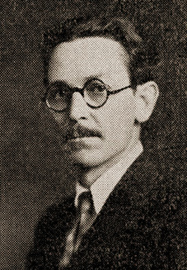
Solomon charged that the "so-called 'left'" was "making its position clear" with the Declaration of Principles. "There was no mistaking the flag it had unfurled," he declared, "It was the banner of thinly veiled communism." While he declared that "the Declaration of Principles must be decisively rejected in the referendum," he nevertheless strongly hinted that a factional split was in the offing. Merely defeating the proposed Declaration of Principles was "not enough," he concluded, "The Socialist Party must be made safe for Socialism, for social democracy."
American Socialist Quarterly editor Haim Kantorovitch
made the case for the Militant faction in a pamphlet urging approval of the Declaration of Principles at referendum. He observed that
The membership of the Socialist Party approved the 1934 Declaration of Principles in its referendum vote, a victory which moved the Old Guard towards the exits — although factional fighting into 1936. The leaders of the Old Guard formed a new rival organization to the Socialist Party, the Social Democratic Federation
in 1936 and somewhat reluctantly endorsed Franklin Roosevelt for President in the election of that year. They also worked to establish the American Labor Party
(ALP) a labor-oriented umbrella organization that included both socialist and non-socialist elements, putting forward both its own candidates as well as endorsing those of the Democratic and Republican parties.
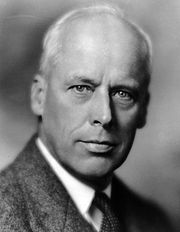 Norman Thomas and his radical pacifist co-thinkers and their young Marxist allies of the Militant faction sought to build a mass political movement by transforming the Socialist Party into what they called an "all-inclusive party." Not only would an appeal be made to the radical intellectuals and trade unionists who were the historic core of the organization, but an effort would be made to work closely with the Communist Party in joint actions, and to infuse the Socialist Party with the leading personnel of small radical oppositional organizations, including in particular the anti-Stalinist communist groupings headed by Jay Lovestone
(the so-called "Lovestoneites") and James P. Cannon
(the so-called "Trotskyists"). To be sure, an impressive array of left wing intellectuals came into the Socialist orbit as a result of this venture, including (from the Lovestoneites) Bertram D. Wolfe, Herbert Zam, and Benjamin Gitlow
; as well as (from the Trotskyists) Max Shachtman
, James Burnham
, Martin Abern
, and Hal Draper
. A broad array of radicals from other tendencies also contributed to the pages of the party's official theoretical journal, including from the Communist Party orbit Joseph P. Lash
of the American Student Union
, the radical novelist James T. Farrell
, public intellectual Sidney Hook
, leading American Marxist of the 1910s Louis B. Boudin
, and Canadian Trotskyist Maurice Spector
, among others.
A very real bid was made to unite the factionalized and marginalized American Left
in a common cause — and great hope was held for success in the enterprise. After the rise of the Nazis in Germany and Austria by 1934, no longer did the Communist Party engage in its Third Period
epithets against the Socialists as so-called "social fascists
". Lillian Symes wrote in the SP's theoretical magazine in February 1937 of the "incredible change" seen to be taking place in the Communist Party in its seeming abandonment of sectarianism
and move towards building a broad "people's front" against fascism. At the same time, other radical organizations sought to alter their tactics so as to rapidly build and aggressive left wing organization to stand in opposition to nascent fascism. From early 1934 the French Trotskyist organization had entered the French Socialist Party in an effort to build its strength and win support for its ideas. Pressure to follow this policy of the "French Turn" was building among the American Trotskyist group. For a brief historical moment in 1935 and 1936 the vision of the SP as an "all-inclusive party" which aggregated radical oppositionists and possibly even worked with the Communist Party in common cause seemed achievable.
In January 1936, just as the National Executive Committee of the Socialist Party was expelling the Old Guard, a factional battle was being won in the Trotskyist Workers Party of the United States
to join the SP, when a national branch referendum voted unanimously for entry. Negotiations commenced between the Workers Party and Socialist leaderships, with the decision ultimately made to allow admissions only on the basis of individual applications for membership rather than en masse admission of the entire group. On June 6, 1936, the Workers Party's weekly newspaper, The New Militant, published its last issue and announced "Workers Party Calls All Revolutionary Workers to Join Socialist Party." Approximately half of the Workers Party heeded the call and entered the SPA.
Although party leader Jim Cannon later hinted that the entry of the Trotskyists into the Socialist Party had been a contrived tactic aimed at stealing "confused young Left Socialists" for his own organization, it seems that at its inception, the entryist tactic was made in good faith. Historian Constance Myers notes that while "initial prognoses for the union of Trotskyists and Socialists were favorable," it was only later when "constant and protracted contact caused differences to surface." The Trotskyists retained a common orientation with the radicalized SP in their opposition to the European war, their preference for industrial unionism and the CIO
over the trade unionism of the American Federation of Labor
, a commitment to trade union activism, the defense of the Soviet Union as the first workers' state while at the same time maintaining an antipathy toward the Stalin regime, and in their general aims in the 1936 election.
Norman Thomas attracted nearly 188,000 votes in his 1936 Socialist Party run for President but performed poorly in historic strongholds of the party. Moreover, the party's membership had begun to decline. The organization was deeply factionalized, with the Militant faction split into right ("Altmanite"), center ("Clarity") and left ("Appeal") factions, in addition to the radical pacifists around Norman Thomas and the midwestern "constructive" socialists around Dan Hoan. A special convention was planned for the last week of March 1937 to set the party's future policy, initially intended as an unprecedented "secret" gathering.
, the international organization of left wing parties to which the Socialist Party belonged, and tension rose along these lines among the Trotskyists. United action between the Clarity and Appeal groups was not forthcoming and an emergency meeting of Vincent Dunne and Cannon was held in New York with leaders of the various factions including Thomas, Jack Altman, and Gus Tyler
of Clarity. At this meeting Thomas pledged that the upcoming convention would make no effort to terminate the newspapers of the various factions.
No action was taken at the 1937 convention to expel the Trotskyist "Appeal faction," but pressure did continue to build along these lines, fueled by the CPUSA's increasingly hysterical denunciations of Trotsky and his followers as wreckers and agents of international fascism. The convention did pass a ban on future branch resolutions on controversial matters, an effort to rein in the activities of the factions at the local level. It also did ban factional newspapers, a move directly targeting The Socialist Appeal, and formally established The Socialist Call as the party's national organ.
Constance Myers indicates that three factors led to the expulsion of the Trotskyists from the Socialist Party in 1937: the divergence between the official Socialists and the Trotskyist faction on the issues, the determination of Altman's wing of the Militants to oust the Trotskyists, and Trotsky's own decision to move towards a break with the party. Recognizing that the Clarity faction had chosen to stand with the Altmanites and the group around Thomas, Trotsky recommended that the Appeal group focus on disagreements over Spain to provoke a split. At the same time, Thomas, freshly returned from Spain, had come to the conclusion that the Trotskyists had joined the SP not to make it stronger, but to capture the organization for their own purposes. On June 24–25, 1937, a meeting of the Appeal faction's National Action Committee voted to ratcheted up the rhetoric against American Labor Party
and Republican nominee for mayor of New York Fiorello LaGuardia, a favorite son of many in Socialist ranks, and to reestablish their newspaper, The Socialist Appeal. This was met with expulsions from the party beginning August 9 with a rump meeting of the Central Committee of Local New York, which expelled 52 New York Trotskyists by a vote of 48 to 2, with 18 abstentions, and ordering 70 more to be brought up on charges. Wholesale expulsions followed, with a major section of the YPSL leaving the party with the Trotskyists.
Secretary of Local New York Jack Altman declared that the Trotskyists "were expelled for attempting to undermine the Socialist Party, for loyalty and allegiance to an opponent organization, the Bureau of the Fourth International, and for refusing to abide by the decisions and discipline of the National convention, the National Executive Committee, and the City Central Committee of the party, and for no other reason." Editor Gus Tyler of The Socialist Call echoed Altman's sentiments, emphasizing that "the Trotskyites have, during the last week ,...abandoned the usual means of inner party controversy — debate and appeals through party channels — and, like the Old Guard, have carried their argument into the public, into the capitalist press." The issuance of a statement by the Trotskyist faction to the New York Times and the relaunch of their own newspaper, The Socialist Appeal, was seen as particularly galling by the Call's' editor.
 Things turned out no better with the official Communist Party, devoted as it was to the Stalin regime in the USSR. The February–March 1937 joint plenum of the Central Committee and Central Control Commission of the All-Union Communist Party
in the Moscow, which green-lighted a massive avalanche of secret police terror known to history as the Great Purge
, changed everything. Baby steps towards multi-candidate elections and the rule of law in the USSR crumbled instantly as show trials, spy mania, mass arrests, and mass executions swept the land. The Trotskyist movement in the USSR was particularly targeted, accused of plotting murder of Soviet officials and conducting sabotage and espionage in preparation for fascist invasion—seemingly insane charges which were honestly believed by the Soviet elite. Blood flowed like water as alleged Trotskyists and other politically suspect individuals were rounded up, "investigated," and disposed with a pistol shot in the base of the skull or a 10 year sentence in the GULag
. Around the world, the adherents of Stalin and Trotsky raged against one another.
In Spain, the country in which the Lovestoneites invested most of their emotional energy as fervid supporters of the Workers' Party of Marxist Unification (POUM
), 1937 marked a similar bloodbath, with the Communist Party of Spain achieving hegemony among the Republican
forces and conducting bloody purges of their own at the behest of the Soviet secret police. Joint action between Communist oppositionists and the unflinching loyalists to Moscow was henceforth an abject impossibility.
In 1937 Norman Thomas willingly acceded to a request from the League for Industrial Democracy
(LID) to author a pamphlet on the topic of "Democracy versus Dictatorship." Thomas pulled no punches about his views of the regime in the USSR:
Thomas further noted the Communist Party monopoly of press, radio, schools, army, and government and recalled his own recent visit to Moscow, writing:
Any thought of common-cause with the Communists was now dismissed by Thomas, who indicated that the Communists' fairly recent change of line from fighting the existing trade unions and damning of all political opponents as "social fascists" to attempting to build a "popular front" was merely tactical, related to the perceived needs of Soviet foreign policy in building coalitions with capitalist countries to forestall fascist invasion.
The factional havoc of the move to the "all-inclusive party" paralyzed activity, while the Old Guard's new group, the Social Democratic Federation of America, controlled the bulk of the SP's former property and the allegiance of those best able to fund the organization. The expulsions of the Trotskyists and disintegration of the party's youth section left the organization greatly weakened and gasping for life, its membership level at a new low.
 By 1940, only a small committed core remained in the Socialist Party, including a considerable percentage of militant pacifists. The SP continued to oppose Franklin D. Roosevelt
's New Deal
as a capitalist palliative, arguing for fundamental change through socialist ownership. In 1940 Norman Thomas was the only presidential candidate who failed to support rearmament military support of Great Britain and China. The pacifist Thomas also served as an active spokesman for the isolationist America First Committee
during 1941.
After the Japanese bombing of Pearl Harbor in the fall of 1941, and the declaration of war, however, the U.S. defense of itself and war against fascism was supported by most of the remaining Militants and all of the Old Guard. However, the Socialist Party adopted a compromise position that did not openly oppose American participation in the war. Its failure to support the war created a rift with many leaders, like the Reuther Brothers
of the United Auto Workers
. The pacifist wing of the party did not advocate engaging in any systematic antiwar activities such as the general strike endorsed by the 1934 Declaration of Principles.
Socialist A. Philip Randolph
emerged as one of the most visible spokesmen for African-American civil rights. In 1941, he, Bayard Rustin
, and A. J. Muste
proposed a march on Washington
to protest racial discrimination in war industries and to propose the desegregation of the American Armed forces. The march was cancelled after President of the United States
Franklin D. Roosevelt
issued Executive Order 8802
, or the Fair Employment Act. Roosevelt's order applied to banning discrimination within only the war industries, but not within the armed forces.
But, the Fair Employment Act is generally perceived as a success for African-American labor rights. In 1942, an estimated 18,000 blacks gathered at Madison Square Garden
to hear Randolph kick off a campaign against discrimination in the military, in war industries, in government agencies, and in labor unions. Following the act, during the Philadelphia Transit Strike of 1944, the government backed African-American workers' striking to gain positions formerly limited to white employees.
In 1947, Randolph, along with colleague Grant Reynolds, renewed efforts to end discrimination in the armed services, forming the Committee Against Jim Crow
in Military Service, later renamed the League for Non-Violent Civil Disobedience
. On July 26, 1948, President Harry S. Truman
abolished racial segregation
in the armed forces through Executive Order 9981
.
Thomas led his last presidential campaign in 1948, after which he became a critical supporter of the postwar liberal consensus. The party retained some pockets of local success, in cities such as Milwaukee, Bridgeport, Connecticut
, and Reading, Pennsylvania
. In New York City, they often ran their own candidates on the Liberal Party
line.
The Socialist Party and the SDF merged to form the Socialist Party-Social Democratic Federation (SP-SDF) in 1957. A small group of holdouts refused to reunify, establishing a new organization called the Democratic Socialist Federation
. When the Soviet Union led an invasion of Hungary in 1956, half of the members of Communist Parties around the world quit; in the U.S., half did, and many joined the Socialist Party.
, which had been led by Max Shachtman
. Shachtman had developed a Marxist critique of Soviet Communism as "bureacratic collectivism", a new form of class society that was more oppressive than any form of capitalism. Shachtman's theory was similar to that of many dissidents and refugees from Communism, such as the theory of the "New Class
" proposed by Yugoslavian dissident Milovan Đilas (Djilas). Shachtman was an extraordinary public speaker and formidable in debate, and his intelligent analysis attracted young socialists like Irving Howe
and Michael Harrington
. Shachtman's denunciations of the Soviet 1956 invasion of Hungary attracted younger activists like Tom Kahn
and Rachelle Horowitz.
Shachtman's youthful followers were able to bring new vigor into the Party, and Shachtman encouraged them to take positions of responsibility and leadership. As a young leader, Harrington sent Kahn and Horowitz to help Bayard Rustin
with the civil-rights movement. Rustin had helped to spread pacificism
and non-violence to leaders of the civil rights movement, like Martin Luther King. Kahn and Horowitz quickly became close assistants of Rustin. The civil rights movement benefited from intelligence and analysis of Shachtman and increasingly of Kahn. Rustin and his young aides, dubbed "The Bayard Rustin Marching and Chowder Society" by Harrington, organized many protest activities. The young socialists helped Rustin and A. Philip Randolph
organize the 1963 March on Washington, where Martin Luther King delivered his I Have A Dream
speech.
Michael Harrington soon became the most visible socialist in the United States when his The Other America
became a best seller, following a long and laudatory New Yorker
review by Dwight Macdonald
. Harrington and other socialists were called to Washington, D.C., to assist the Kennedy Administration and then the Johnson Administration's War on Poverty
and Great Society
.
The young socialists' role in the civil rights movement made the Socialist Party more attractive. Harrington, Kahn, and Horowitz were officers and staff-persons of the League for Industrial Democracy
(LID), which helped to start the New Left
Students for a Democratic Society
(SDS). The three LID officers clashed with the less experienced activists of SDS, like Tom Hayden
, when the latter's Port Huron Statement
criticized socialist and liberal opposition to communism and criticized the labor movement while promoting students as agents of social change. LID and SDS split in 1965, when SDS voted to remove from its constitution the "exclusion clause" that prohibited membership by communists: The SDS exclusion clause had barred "advocates of or apologists for" "totalitarianism". The clause's removal effectively invited "disciplined cadre" to attempt to "take over or paralyze" SDS, as had occurred to mass organizations in the thirties.
The experience of the civil rights movement, and the coalition of labor unions and other progressive forces, suggested that America was changing and that a mass movement of the democratic left was possible. In terms of electoral politics, Shachtman, Michael Harrington
, and Kahn argued that it was a waste of effort to run electoral campaigns as "Socialist Party" candidates, against Democratic Party candidates. Instead, they advocated a political strategy called "realignment," that prioritized strengthening labor unions and other progressive organizations that were already active in the Democratic Party. Contributing to the day-to-day struggles of the civil-rights movement and labor unions had gained socialists credibility and influence, and had helped to push politicians in the Democratic Party towards social-democratic positions, on civil rights and the War on Poverty
.
and Charles S. Zimmerman (of the International Ladies Garment Workers' Union, ILGWU) and a First National Vice Chairman, James S. Glaser, who were re-elected by acclamation
. In his opening speech to the Convention, Co-Chairman Bayard Rustin called for the group to organize against the "reactionary policies of the Nixon Administration"; Rustin also criticized the "irresponsibility and élitism of the 'New Politics' liberals".
The Party changed its name to "Social Democrats, USA" by a vote of 73 to 34. Renaming the Party as SDUSA was meant to be "realistic". The New York Times
observed that the Socialist Party had last sponsored a candidate for President
in 1956, who received only 2,121 votes, which were cast in only 6 states. Because the Party no longer sponsored candidates in Presidential Elections, the name "Party" had been "misleading"; "Party" had hindered the recruiting of activists who participated in the Democratic Party, according the majority report. The name "Socialist" was replaced by "Social Democrats
" because many Americans associated the word "socialism
" with Soviet communism. Also, the Party wished to distinguish itself from two small Marxist parties, the Socialist Workers Party
and the Socialist Labor Party
.
The Unity Caucus had a supermajority
of votes and its position carried on every issue, by a ratio of two to one. The Convention elected a national committee of 33 members, with 22 seats for the majority caucus, 8 seats for Harrington's "coalition caucus", 2 for "a Debs caucus", and one for the "independent" Samuel H. Friedman. Friedman and the minority caucuses had opposed the name change.
The convention voted on and adopted proposals for its program by a two-one vote. On foreign policy, the program called for "firmness toward Communist aggression". However, on the Vietnam War, the program opposed "any efforts to bomb Hanoi into submission"; instead, it endorsed negotiating a peace agreement, which should protect Communist political cadres in South Vietnam from further military or police reprisals. Harrington's proposal for an immediate withdrawal of U.S. forces was defeated. Harrington complained that, after its March 1972 convention, the Socialist Party had endorsed George McGovern
with a statement loaded with "constructive criticism"; Harrington complained also that the Party had not mobilized enough support for McGovern. The majority caucus's Arch Puddington replied that the California branch had been especially active in supporting McGovern, while the New York branch had instead focused on a congressional race.
Harrington had written extensively about the progressive potential of the so-called "New Politics" in the Democratic Party and had come to advocate unilateral withdrawal from the Vietnam war and to advocate positions regarded by more conservative party members as "avant-garde" on the questions of abortion
and gay rights. This put Harrington and his co-thinkers at odds with the party's younger generation of leaders, who espoused a strongly labor-oriented direction for the party and who were broadly supportive of AFL-CIO
leader George Meany
.
In the early spring of 1973, Harrington resigned his membership in SDUSA. That same year, Harrington and his supporters formed the Democratic Socialist Organizing Committee
(DSOC). At its start, DSOC had 840 members, of which 2 percent served on its national board; approximately 200 had been members of Social Democrats, USA or its predecessors whose membership was then 1,800, according to a 1973 profile of Harrington.
Its high-profile members included Congressman Ron Dellums
and William Winpisinger, President of the International Association of Machinists. In 1982 DSOC established the Democratic Socialists of America
(DSA) upon merging with the New American Movement
, an organization of democratic socialists mostly from the New Left.
The Union for Democratic Socialism was another organization, which was formed by former members of the Socialist Party. David McReynolds
, who had resigned from the Socialist Party between 1970–1971, and many from the Debs Caucus, were the core members. In 1973, the UDS declared itself the Socialist Party USA
.
Multi-tendency
Multi-tendency when used in regards to a political organization, especially a left-wing or anarchist one, means that the organization recognizes or at least tolerates members who are affiliated with or identify with a variety of ideologies within the broad stance of the organization...
democratic-socialist
Democratic socialism
Democratic socialism is a description used by various socialist movements and organizations to emphasize the democratic character of their political orientation...
political party
Political party
A political party is a political organization that typically seeks to influence government policy, usually by nominating their own candidates and trying to seat them in political office. Parties participate in electoral campaigns, educational outreach or protest actions...
in the United States
United States
The United States of America is a federal constitutional republic comprising fifty states and a federal district...
, formed in 1901 by a merger between the three-year-old Social Democratic Party of America
Social Democratic Party (United States)
The Social Democratic Party of America was a short-lived political party in the United States, established in 1898. The group was formed out of elements of the Social Democracy of America , and was a predecessor to the Socialist Party of America, established in 1901.-Forerunners:Following the...
and disaffected elements of the Socialist Labor Party
Socialist Labor Party of America
The Socialist Labor Party of America , established in 1876 as the Workingmen's Party, is the oldest socialist political party in the United States and the second oldest socialist party in the world. Originally known as the Workingmen's Party of America, the party changed its name in 1877 and has...
which had split from the main organization in 1899.
In the first decades of the 20th century, it drew significant support from many different groups, including trade unionists, progressive
Progressivism
Progressivism is an umbrella term for a political ideology advocating or favoring social, political, and economic reform or changes. Progressivism is often viewed by some conservatives, constitutionalists, and libertarians to be in opposition to conservative or reactionary ideologies.The...
social reformers, populist
Populism
Populism can be defined as an ideology, political philosophy, or type of discourse. Generally, a common theme compares "the people" against "the elite", and urges social and political system changes. It can also be defined as a rhetorical style employed by members of various political or social...
farmers, and immigrant communities. Its presidential candidate, Eugene V. Debs
Eugene V. Debs
Eugene Victor Debs was an American union leader, one of the founding members of the International Labor Union and the Industrial Workers of the World , and several times the candidate of the Socialist Party of America for President of the United States...
, twice won over 900,000 votes (in 1912
United States presidential election, 1912
The United States presidential election of 1912 was a rare four-way contest. Incumbent President William Howard Taft was renominated by the Republican Party with the support of its conservative wing. After former President Theodore Roosevelt failed to receive the Republican nomination, he called...
and 1920
United States presidential election, 1920
The United States presidential election of 1920 was dominated by the aftermath of World War I and a hostile response to certain policies of Woodrow Wilson, the Democratic president. The wartime economic boom had collapsed. Politicians were arguing over peace treaties and the question of America's...
), while the party also elected two United States Representatives
United States House of Representatives
The United States House of Representatives is one of the two Houses of the United States Congress, the bicameral legislature which also includes the Senate.The composition and powers of the House are established in Article One of the Constitution...
(Victor L. Berger
Victor L. Berger
Victor Luitpold Berger was a founding member of the Socialist Party of America and an important and influential Socialist journalist who helped establish the so-called Sewer Socialist movement. The first Socialist elected to the U.S...
and Meyer London
Meyer London
Meyer London was an American politician from New York City. He was one of only two members of the Socialist Party of America elected to the United States Congress.-Early years:...
), dozens of state legislators, more than a hundred mayors, and countless lesser officials. The party's staunch opposition to American involvement in World War I, although welcomed by many, also led to prominent defections, official repression and vigilante persecution. The organization was further shattered by a factional war over how it should respond to Russia's Bolshevik Revolution in 1917 and the establishment of the Communist International in 1919.
After endorsing Robert LaFollette
Robert M. La Follette, Sr.
Robert Marion "Fighting Bob" La Follette, Sr. , was an American Republican politician. He served as a member of the U.S. House of Representatives, was the Governor of Wisconsin, and was also a U.S. Senator from Wisconsin...
's presidential campaign in 1924
Progressive Party (United States, 1924)
The Progressive Party of 1924 was a new party created as a vehicle for Robert M. La Follette, Sr. to run for president in the 1924 election. It did not run candidates for other offices, and it disappeared after the election except in Wisconsin. Its name resembles the 1912 Progressive Party, which...
, the Socialist Party returned to independent action and experienced modest growth in the early 1930s behind presidential candidate Norman Thomas
Norman Thomas
Norman Mattoon Thomas was a leading American socialist, pacifist, and six-time presidential candidate for the Socialist Party of America.-Early years:...
. After the 1920s, however, the Party's appeal was weakened by the popularity of Franklin Roosevelt's New Deal
New Deal
The New Deal was a series of economic programs implemented in the United States between 1933 and 1936. They were passed by the U.S. Congress during the first term of President Franklin D. Roosevelt. The programs were Roosevelt's responses to the Great Depression, and focused on what historians call...
, the organization and flexibility of the Communist Party
Communist Party USA
The Communist Party USA is a Marxist political party in the United States, established in 1919. It has a long, complex history that is closely related to the histories of similar communist parties worldwide and the U.S. labor movement....
under Earl Browder
Earl Browder
Earl Russell Browder was an American communist and General Secretary of the Communist Party USA from 1934 to 1945. He was expelled from the party in 1946.- Early years :...
, and the resurgent labor movement's desire to support sympathetic Democratic Party
Democratic Party (United States)
The Democratic Party is one of two major contemporary political parties in the United States, along with the Republican Party. The party's socially liberal and progressive platform is largely considered center-left in the U.S. political spectrum. The party has the lengthiest record of continuous...
politicians. A divisive and ultimately-unsuccessful attempt to broaden the party by admitting followers of Leon Trotsky
Leon Trotsky
Leon Trotsky , born Lev Davidovich Bronshtein, was a Russian Marxist revolutionary and theorist, Soviet politician, and the founder and first leader of the Red Army....
and Jay Lovestone
Jay Lovestone
Jay Lovestone was at various times a member of the Socialist Party of America, a leader of the Communist Party USA, leader of a small oppositionist party, an anti-Communist and Central Intelligence Agency helper, and foreign policy advisor to the leadership of the AFL-CIO and various unions...
caused the traditional "Old Guard" to leave and form the Social Democratic Federation. While the party was always strongly anti-Fascist
Anti-fascism
Anti-fascism is the opposition to fascist ideologies, groups and individuals, such as that of the resistance movements during World War II. The related term antifa derives from Antifaschismus, which is German for anti-fascism; it refers to individuals and groups on the left of the political...
, as well as anti-Stalinist, the SP's ambivalent attitude towards World War II
World War II
World War II, or the Second World War , was a global conflict lasting from 1939 to 1945, involving most of the world's nations—including all of the great powers—eventually forming two opposing military alliances: the Allies and the Axis...
cost it both internal and external support.
The SP stopped running presidential candidates after 1956
United States presidential election, 1956
The United States presidential election of 1956 saw a popular Dwight D. Eisenhower successfully run for re-election. The 1956 election was a rematch of 1952, as Eisenhower's opponent in 1956 was Democrat Adlai Stevenson, whom Eisenhower had defeated four years earlier.Incumbent President Eisenhower...
, when its nominee Darlington Hoopes
Darlington Hoopes
Darlington Hoopes was the candidate of the Socialist Party of America for President of the United States in the 1952 and 1956 presidential elections.-Early years:...
won fewer than 3,000 votes. In the party's last decades, its members, many of them prominent in the labor, peace, civil rights and civil liberties movements, fundamentally disagreed about the socialist movement's relationship to the labor movement and Democratic Party in the U.S., and about how best to advance democracy abroad. In 1972–1973, these strategic differences had become so acute that the Socialist Party changed its name to Social Democrats, USA and leaders of two of its caucuses formed separate socialist organizations.
Early history
From 1901 to the onset of World War I
World War I
World War I , which was predominantly called the World War or the Great War from its occurrence until 1939, and the First World War or World War I thereafter, was a major war centred in Europe that began on 28 July 1914 and lasted until 11 November 1918...
, the Socialist Party had numerous elected officials. There were two Socialist members of Congress, Meyer London
Meyer London
Meyer London was an American politician from New York City. He was one of only two members of the Socialist Party of America elected to the United States Congress.-Early years:...
of New York City
New York City
New York is the most populous city in the United States and the center of the New York Metropolitan Area, one of the most populous metropolitan areas in the world. New York exerts a significant impact upon global commerce, finance, media, art, fashion, research, technology, education, and...
and Victor Berger of Milwaukee (a part of the sewer socialism
Sewer Socialism
Sewer Socialism was a term, originally more or less pejorative, for the American socialist movement that centered in Milwaukee, Wisconsin, and existed from around 1892 to 1960...
movement, a major front in socialism, Milwaukee being the first city (and the only major one) to elect a socialist mayor, which it did four times between 1910 and 1960); over 70 mayors, and many state legislators and city councilors. Its voting strength was greatest among recent Jewish, Finnish and German immigrants, coal miners, and former Populist farmers in the Midwest. From 1900 (before its formal union) to 1912, the Socialist Party ran Eugene Debs for President at each election. The best showing ever for a Socialist ticket was in 1912
United States presidential election, 1912
The United States presidential election of 1912 was a rare four-way contest. Incumbent President William Howard Taft was renominated by the Republican Party with the support of its conservative wing. After former President Theodore Roosevelt failed to receive the Republican nomination, he called...
, when Debs gained 901,551 total votes, or 6% of the popular vote. In 1920 Debs ran again, this time from prison, and received 913,693 votes, 3.4% of the total.
Early political perspectives ranged from radical socialism to social democracy, with New York party leader Morris Hillquit
Morris Hillquit
Morris Hillquit was a founder and leader of the Socialist Party of America and prominent labor lawyer in New York City's Lower East Side during the early 20th century.-Early years:...
and Congressman Berger on the more social democratic or right wing of the party and radical socialists and syndicalists, including members of the Industrial Workers of the World
Industrial Workers of the World
The Industrial Workers of the World is an international union. At its peak in 1923, the organization claimed some 100,000 members in good standing, and could marshal the support of perhaps 300,000 workers. Its membership declined dramatically after a 1924 split brought on by internal conflict...
(IWW) and the party's frequent candidate, Eugene V. Debs, on the left wing of the party. As well there were agrarian utopian-leaning radicals, such as Julius Wayland
Julius Wayland
Julius Wayland was a Mid-Western US socialist during the Progressive Era. He is most noted for publishing Appeal to Reason, a socialist publication often deemed to be the most important socialist periodical of the time....
of Kansas, who edited the party's leading national newspaper, Appeal to Reason along with trade unionists; Jewish, Finnish, and German immigrants; and intellectuals such as Walter Lippmann
Walter Lippmann
Walter Lippmann was an American intellectual, writer, reporter, and political commentator famous for being among the first to introduce the concept of Cold War...
and the Black activist/intellectual Hubert Harrison
Hubert Harrison
Hubert Henry Harrison was a West Indian-American writer, orator, educator, critic, and radical socialist political activist based in Harlem, New York. He was described by activist A. Philip Randolph as “the father of Harlem radicalism” and by the historian Joel Augustus Rogers as “the foremost...
.
The party had a tense and complicated relationship with the American Federation of Labor
American Federation of Labor
The American Federation of Labor was one of the first federations of labor unions in the United States. It was founded in 1886 by an alliance of craft unions disaffected from the Knights of Labor, a national labor association. Samuel Gompers was elected president of the Federation at its...
. The American Federation of Labor leadership, headed by Samuel Gompers
Samuel Gompers
Samuel Gompers was an English-born American cigar maker who became a labor union leader and a key figure in American labor history. Gompers founded the American Federation of Labor , and served as that organization's president from 1886 to 1894 and from 1895 until his death in 1924...
, was strongly opposed to the SPA, but many rank and file unionists in the early party of the 20th Century saw in the Socialists reliable political allies. Many moderate Socialists, such as Victor Berger and International Typographical Union
International Typographical Union
The International Typographical Union was a labor union founded on May 3, 1852 in the United States as the National Typographical Union. In its 1869 convention in Albany, New York, the union—having organized members in Canada—changed its name to the International Typographical Union...
President Max S. Hayes
Max S. Hayes
Maximillian Sebastian "Max" Hayes was a newspaper editor, trade union activist, and socialist politician. He is best remembered as the long-time editor of the Cleveland Citizen and as the Vice Presidential candidate of the Farmer-Labor Party ticket in 1920.-Early years:Max Hayes was born in...
, urged close cooperation with the American Federation of Labor and its member unions. Others in the Socialist Party's ranks dismissed the American Federation of Labor and its craft unions as antiquated and irrelevant, instead favoring the much more radical IWW and the syndicalist path to socialism.
In 1911, IWW leader William "Big Bill" Haywood
Bill Haywood
William Dudley Haywood , better known as "Big Bill" Haywood, was a founding member and leader of the Industrial Workers of the World , and a member of the Executive Committee of the Socialist Party of America...
was elected to the National Executive Committee of the Socialist Party, on which American Federation of Labor partisan Morris Hillquit also served. The syndicalist and the electoral socialist squared off in a lively public debate in New York City's Cooper Union on Jan. 11, 1912, with Haywood declaring that Hillquit and the socialists ought to try "a little sabotage in the right place at the proper time" and attacked Hillquit for having abandoned the class struggle by helping the New York garment workers negotiate an industrial agreement with their employers. Hillquit replied that he had no new message rather than to reiterate a belief in a two-sided workers movement, with separate and equal political and trade union arms. "A mere change of structural forms would not revolutionize the American labor movement as claimed by our extreme industrialists," he declared.
The issue of "syndicalism vs. socialism" was bitterly fought over the next two years, consummated by "Big Bill" Haywood's recall from the SPA's NEC and the departure of a broad section of the left wing from the organization. The memory of this split made the intra-party battles of 1919-1921 all the more bitter.
World War I
World War I , which was predominantly called the World War or the Great War from its occurrence until 1939, and the First World War or World War I thereafter, was a major war centred in Europe that began on 28 July 1914 and lasted until 11 November 1918...
caused a sharp decline in membership. An increase in the membership of its language federation
Language federation
Language Federations were formed in the late 19th and early 20th century by immigrants to the United States, primarily from Eastern and Southern Europe, who shared a commitment to some form of socialist politics...
s from areas involved in the Bolshevik Revolution
October Revolution
The October Revolution , also known as the Great October Socialist Revolution , Red October, the October Uprising or the Bolshevik Revolution, was a political revolution and a part of the Russian Revolution of 1917...
proved illusory, since these members were soon lost to the Communist Party.
The party also lost some of its most prominent members, who had been in favor of America's entry into World War I, including Walter Lippmann
Walter Lippmann
Walter Lippmann was an American intellectual, writer, reporter, and political commentator famous for being among the first to introduce the concept of Cold War...
, John Spargo
John Spargo
John Spargo was a British-born American socialist political activist, orator, and writer who later became a renowned expert in the history and crafts of Vermont...
, J.G. Phelps Stokes, and William English Walling
William English Walling
William English Walling was an American labor reformer and socialist born in Louisville, Kentucky. He was the grandson of William Hayden English, the Democratic candidate for vice president in 1880, and was born into wealth. He was educated at the University of Chicago and at Harvard Law School...
. They briefly formed the National Party
National Party (United States)
The National Party was an early-20th-century national political organization in the United States founded by pro-war defectors from the Socialist Party of America in 1917. Rather than filing into the Democratic Party, these adherents of the SPA Right first formed a non-partisan national society to...
, in an unrealized hope of merging with the remnants of Theodore Roosevelt
Theodore Roosevelt
Theodore "Teddy" Roosevelt was the 26th President of the United States . He is noted for his exuberant personality, range of interests and achievements, and his leadership of the Progressive Movement, as well as his "cowboy" persona and robust masculinity...
's Progressive Party
Progressive Party (United States, 1912)
The Progressive Party of 1912 was an American political party. It was formed after a split in the Republican Party between President William Howard Taft and former President Theodore Roosevelt....
and the Prohibition Party
Prohibition Party
The Prohibition Party is a political party in the United States best known for its historic opposition to the sale or consumption of alcoholic beverages. It is the oldest existing third party in the US. The party was an integral part of the temperance movement...
.
In June 1918 the Party's best-known leader, Eugene Victor Debs made an anti-war speech calling for draft resistance; he was arrested under the Sedition Act of 1918
Sedition Act of 1918
The Sedition Act of 1918 was an Act of the United States Congress that extended the Espionage Act of 1917 to cover a broader range of offenses, notably speech and the expression of opinion that cast the government or the war effort in a negative light or interfered with the sale of government bonds...
, convicted and sentenced to serve ten years in prison. He was pardoned by President Warren G. Harding
Warren G. Harding
Warren Gamaliel Harding was the 29th President of the United States . A Republican from Ohio, Harding was an influential self-made newspaper publisher. He served in the Ohio Senate , as the 28th Lieutenant Governor of Ohio and as a U.S. Senator...
in 1921.
The split of the left wing (1919–1921)
In January 1919 Vladimir LeninVladimir Lenin
Vladimir Ilyich Lenin was a Russian Marxist revolutionary and communist politician who led the October Revolution of 1917. As leader of the Bolsheviks, he headed the Soviet state during its initial years , as it fought to establish control of Russia in the Russian Civil War and worked to create a...
invited the Industrial Workers of the World
Industrial Workers of the World
The Industrial Workers of the World is an international union. At its peak in 1923, the organization claimed some 100,000 members in good standing, and could marshal the support of perhaps 300,000 workers. Its membership declined dramatically after a 1924 split brought on by internal conflict...
and the radical wing of the Socialist Party to join in the founding of the Communist Third International, the Comintern
Comintern
The Communist International, abbreviated as Comintern, also known as the Third International, was an international communist organization initiated in Moscow during March 1919...
.
The Left Wing Section of the Socialist Party
Left Wing Section of the Socialist Party
The Left Wing Section of the Socialist Party was an organized faction within the Socialist Party of America in 1919 which served as the core of the dual communist parties which emerged in the fall of that year — the Communist Party of America and the Communist Labor Party of America.-Precusors:A...
emerged as an organized faction early that same year, building its organization around a lengthy Left Wing Manifesto
Left Wing Manifesto
The Left Wing Manifesto is the name rather confusingly bestowed upon two distinct programmatic documents of the Left Wing Section of the Socialist Party during the factional war in the Socialist Party of America of 1919...
authored by Louis C. Fraina
Louis C. Fraina
Louis C. Fraina was a founding member of the American Communist Party in 1919. After running afoul of the Communist International in 1921 over the alleged misappropriation of funds, Fraina left the organized radical movement, emerging in 1930 as a left wing public intellectual by the name of Lewis...
. This effort to organize in order to "win the Socialist Party for the Left Wing" met with staunch resistance from the "Regulars" who controlled a big majority of the seats of the SPA's governing National Executive Committee. When it seemed certain that the 1919 party elections for a new NEC had been dominated by the Left Wing, the sitting NEC, citing voting irregularities, refused to tally the votes, declared the entire election invalid and in May 1919 suspended the party's Russian, Latvian, Ukrainian, Polish, South Slavic, and Hungarian language federations, in addition to the entire state organization of Michigan. In future weeks, the state organizations of Massachusetts and Ohio would similarly be disfranchised and "reorganized" by the NEC, while in New York and Pennsylvania, the "Regular" State Executive Committees undertook reorganization of Left Wing branches and locals on a case-by-case basis.
In June 1919, the Left Wing Section held a conference in New York City to discuss their organizational plans. The group found themselves deeply divided, with one section, led by NEC members Alfred Wagenknecht
Alfred Wagenknecht
Alfred Wagenknecht was an American Marxist activist and political functionary. He is best remembered for having played a critical role in the establishment of the American Communist Party in 1919 as a leader of the Left Wing Section of the Socialist Party...
and L. E. Katterfeld and including famed radical journalist John Reed favoring a continued effort to gain control of the SPA at its forthcoming Emergency National Convention in Chicago, to be held at the end of August, while another section, headed by the Russian Socialist Federation
Russian Socialist Federation
The Russian Socialist Federation was a semi-autonomous American political organization which was part of the Socialist Party of America from 1915 until the split of the national organization into rival socialist and communist organizations in the summer of 1919...
of Alexander Stoklitsky and Nicholas Hourwich and the Socialist Party of Michigan seeking to wash their hands of the Socialist Party and immediately move to the establishment of a new Communist Party of America. Eventually this latter Federation-dominated group was joined by important Left Wingers C. E. Ruthenberg
Charles Ruthenberg
Charles Emil Ruthenberg was an American Marxist politician and a founder and long-time head of the Communist Party USA .-Biography:Charles Emil Ruthenberg was born July 9, 1882 in Cleveland, Ohio...
and Louis Fraina, a depletion of Left Wing forces which made the result of the 1919 Socialist Convention a foregone conclusion.
1919 Emergency National Convention
The 1919 Emergency National Convention of the Socialist Party of America was held in Chicago from August 30 to September 5, 1919. It was a seminal gathering in the history of American radicalism, marked by the bolting of the party's organized left wing to establish the Communist Labor Party of...
continued apace. With the most radical state organizations effectively purged by the Regulars (Massachusetts, Minnesota) or unable to participate (Ohio, Michigan), and the Left Wing language federations suspended, a big majority of the hastily elected delegates to the gathering were controlled by the Executive Secretary Adolph Germer
Adolph Germer
Adoph Germer was an American socialist political functionary and union organizer. He is best remembered as National Executive Secretary of the Socialist Party of America from 1916 to 1919. It was during this period that the Left Wing Section of the Socialist Party emerged as an organized faction...
and the Regulars. A group of Left Wingers without delegate credentials, including John Reed and his sidekick Benjamin Gitlow
Benjamin Gitlow
Benjamin "Ben" Gitlow was a prominent American socialist politician of the early twentieth century and a founding member of the Communist Party USA. From the end of the 1930s, Gitlow turned to conservatism and wrote two sensational exposés of American Communism, books which were very influential...
, made an effort to occupy chairs on the convention floor before the gathering was called into order. The incumbents were unable to block the Left Wingers at the door, but soon called the already present police to their aid, and the officers of the law obligingly expelled the boisterous radicals from the hall. With the Credentials Committee firmly in the hands of the Regulars from the outset, the outcome of the gathering was no longer in doubt and most of the remaining Left Wing delegates departed, to meet with other co-thinkers downstairs in a previously-reserved room in a parallel convention. It was this gathering which established itself as the Communist Labor Party
Communist Labor Party
The Communist Labor Party of America was one of the organizational predecessors of the Communist Party USA. The group was established at the end of August 1919 following a three-way split of the Socialist Party of America...
on August 31, 1919.
Meanwhile, elsewhere in Chicago the Federations and Michiganders and their supporters established the Communist Party of America at a convention gaveled to order on September 1, 1919. Unity between these two communist organizations was a lengthy and complicated process, formally taking place at a secret convention held at the Overlook Mountain House hotel near Woodstock, New York
Woodstock, New York
Woodstock is a town in Ulster County, New York, United States. The population was 5,884 at the 2010 census, down from 6,241 at the 2000 census.The Town of Woodstock is in the northern part of the county...
in May 1921 with the establishment of a new unified "Communist Party of America."
A Left Wing loyal to the Communist International remained in the Socialist Party through 1921, continuing the fight to bring the SPA into the ranks of the Comintern. This group, which opposed the underground secret organizations which the Communist Parties had become, included noted party journalist J. Louis Engdahl
J. Louis Engdahl
John Louis Engdahl was an American socialist journalist and newspaper editor. One of the leading journalists of the Socialist Party of America, Engdahl joined the Communist movement in 1921 and continued to employ his talents in that organization as the first editor of The Daily Worker...
and William Kruse, head of the party's youth affiliate, the Young People's Socialist League
Young People's Socialist League (1907)
The Young People's Socialist League , founded in 1907, was the official youth arm of the Socialist Party of America. Its political activities tend to concentrate on increasing the voter turnout of young democratic socialists and affecting the issues impacting that demographic group.- Foundation and...
, as well as a significant segment of the SPA's Chicago organization. These left wing dissidents continued to make themselves heard until their departure from the party after the convention of 1921.
Expulsion of Socialists from the New York Assembly (1920)
On January 7, 1920, less than a week after the Palmer RaidsPalmer Raids
The Palmer Raids were attempts by the United States Department of Justice to arrest and deport radical leftists, especially anarchists, from the United States. The raids and arrests occurred in November 1919 and January 1920 under the leadership of Attorney General A. Mitchell Palmer...
had swept and stunned the country, a new session of the New York State Assembly
New York State Assembly
The New York State Assembly is the lower house of the New York State Legislature. The Assembly is composed of 150 members representing an equal number of districts, with each district having an average population of 128,652...
was called to order. The majority Republicans easily elected their candidate for the Speaker, Thaddeus C. Sweet
Thaddeus C. Sweet
Thaddeus Campbell Sweet was an American manufacturer and politician from New York. He represented New York's 32nd congressional district from 1923 to 1928.-Biography:...
and after opening day formalities the body took a brief recess. Back in session, Sweet declared: "The Chair directs the Sergeant-at-Arms to present before the Bar of the House Samuel A. DeWitt
Sam DeWitt
Samuel Aaron "Sam" DeWitt was a businessman, poet, playwright, and politician. He is best remembered as a New York State Legislator who represented Bronx's 7th district from 1919 until his expulsion from the Assembly in 1920....
, Samuel Orr
Samuel Orr
Samuel Orr was a socialist politician from New York City best remembered for being one of the five elected members of the Socialist Party of America expelled by the New York State Assembly during the Red Scare of 1919-1920.-Early years:...
, Louis Waldman
Louis Waldman
Louis Waldman was a leading figure in the Socialist Party of America from the late 1910s and through the middle 1930s, a founding member of the Social Democratic Federation, and a prominent New York labor lawyer.-Early years:...
, Charles Solomon
Charles Solomon (politician)
Charles "Charley" Solomon was a socialist politician from New York City, elected to the New York State Assembly in 1919 and expelled with four of his fellows on the first day of the legislative session, one week after the sensational Palmer Raids...
, and August Claessens
August Claessens
August "Gus" Claessens was an American socialist politician, best known as one of the five New York Assemblymen expelled from that body during the First Red Scare for their membership in the Socialist Party of America...
," the Assembly's five Socialist members.
Sweet attacked the five, declaring they had been "elected on a platform that is absolutely inimical to the best interests of the state of New York and the United States." The Socialist Party, Sweet said, was "not truly a political party", but was rather "a membership organization admitting within its ranks aliens, enemy aliens, and minors." The party had denounced America's participation in the European war and had lent aid and comfort to Ludwig Martens
Ludwig Martens
Ludwig Christian Alexander Karl Martens was a Russian revolutionary, Soviet politician and engineer.-Early years:...
, the "self-styled Soviet Ambassador and alien, who entered this country as a German in 1916." It had supported the revolutionaries in Germany, Austria, and Hungary
Hungarian Soviet Republic
The Hungarian Soviet Republic or Soviet Republic of Hungary was a short-lived Communist state established in Hungary in the aftermath of World War I....
, Sweet continued, and consorted with international Socialist parties close to the Communist International. Sweet concluded:
- It is every citizen's right to his day in court. If this house should adopt a resolution declaring your seat herein vacant, pending a hearing before a tribunal of this house, you will be given an opportunity to appear before such tribunal to prove your right to a seat in this legislative body, and upon the result of such hearing and the findings of the Assembly tribunal, your right to participate in the actions of this body will be determined.
The Assembly suspended the quintet by a vote of 140 to 6, with one Democrat supporting the Socialists. Civil libertarians and concerned citizens raised their voices to aid the suspended Socialists, and protest percolated throughout the press. The principal argument was that majority parties expelling elected members of minority parties from their councils set a dangerous precedent in a democracy. The battle culminated in a highly publicized trial in the Assembly, which dominated the body's activity from its opening on January 20, 1920, until its conclusion on March 11. Socialist Party leader and former 1917 New York City mayoral candidate Morris Hillquit
Morris Hillquit
Morris Hillquit was a founder and leader of the Socialist Party of America and prominent labor lawyer in New York City's Lower East Side during the early 20th century.-Early years:...
served as chief counsel for the suspended Socialists, aided by party founder, and future Socialist Vice Presidential candidate, Seymour Stedman
Seymour Stedman
Seymour Stedman was a prominent civil liberties lawyer and a leader of the Socialist Party of America. He is best remembered as the 1920 Vice Presidential candidate of the Socialist Party of America, when he ran for office on a ticket headed by Eugene V...
.
At the trial, Hillquit charged that Speaker Sweet had made a "specific, concrete, definite, affirmative declaration of guilt" of the five Assemblymen before they were ever charged with any offense. It was the chief accuser, Speaker Sweet, who also appointed the members of the Judiciary Committee to which the matter was referred. "Thus the accuser selects his own judges," Hillquit declared. Hillquit sought to remove for reasons of bias any members of the Judiciary Committee who had taken part in the activities of the Lusk Committee, the New York State Senate's anti-radicalism committee. Hillquit particularly challenged the presence of Assemblyman Louis Cuvillier, who had stated on the floor of the house the previous night words to the effect that "if the five accused Assemblymen are found guilty, they ought not to be expelled, but taken out and shot." The Assembly voted overwhelmingly for expulsion on April 1, 1920.
A special election was held September 16, 1920, to fill the five seats vacated by the Assembly, with each of the five expelled Socialists running for re-election against a "fusion" candidate representing the combined Republican and Democratic parties. All five Socialists were returned to office.
Three of the five, Waldman, Claessens, and Solomon, were again denied their seats after a contentious debate by votes of 90 to 45 on September 21, 1920. Orr and DeWitt, deemed less culpable than their peers by the earlier findings of the Judiciary Committee, were seated by votes of 87 to 48. In solidarity with their ousted colleagues, the pair refused to take their seats.
After the five seats were again vacated, Morris Hillquit expressed his disappointment at the "unconstitutional action" of the Assembly. However, Hillquit continued, "it will draw the issues clearer between the united Republican and Democratic parties representing arbitrary lawlessness, and the Socialist Party, which stood and stands for democratic and representative government."
The legislature attempted to prevent the election and seating of Socialists in the future by passing laws designed to exclude the Socialist Party from recognition as a political party and to alter the legislature's oath-taking procedures so that elected members could be excluded before being sworn. Governor Al Smith
Al Smith
Alfred Emanuel Smith. , known in private and public life as Al Smith, was an American statesman who was elected the 42nd Governor of New York three times, and was the Democratic U.S. presidential candidate in 1928...
vetoed the legislation.
The quest for a mass Farmer-Labor Party (1922–1925)
Finnish Socialist Federation
The Finnish Socialist Federation was a language federation of the Socialist Party of America which united Finnish language-speaking immigrants in the United States in a national organization designed to conduct propaganda and education for socialism among their community.-Early Finnish socialist...
adding to the malaise. In September 1921, the NEC of the party determined that the time had come to end the party's historic aversion to "fusion" with other political organizations and issue an appeal declaring that the "forces of every progressive, liberal, and radical organization of the workers must be mobilized" to repel conservative assaults and "advance the industrial and political power of the working class." This desire for common action seems to have been shared by various unions, as late in 1921 a call was issued in the name of the country's 16 major railway labor unions seeking a "Conference for Progressive Political Action
Conference for Progressive Political Action
The Conference for Progressive Political Action was officially established by the convention call of the 16 major railway labor unions in the United States, represented by a committee of six: William H. Johnston of the Machinists' Union, Martin F. Ryan of the Railway Carmen, Warren S. Stone of the...
" (CPPA). The CPPA was originally intended to be an umbrella organization bringing together various elements of the farmer and labor movement around a common program. Invitations to the group's founding conference were issued to members of a wide variety of "progressive" organizations of widely varied perspectives. As a result, from its inception the heterogeneous body was unable to agreee on even a program or even a declaration of principles, let alone congeal into a new political party.
The Socialist Party was an enthusiastic supporter of the CPPA, and the group dominated its thinking from the start of 1922 through the first quarter of 1925. The party sought, in this period of organizational weakness, to forge lasting ties with the existing trade union movement leading in short order to a mass labor party in the United States on the British model.
A first National Conference of the CPPA was held in Chicago in February 1922, attended by 124 delegates representing a broad spectrum of labor, farmer, and political organizations. The gathering passed an "Address to the American People," stating its criticism of existing conditions and formally proposing an amorphous plan of action validating the status quo ante: the labor unions on the group's right wing to endorse labor-friendly candidates of the Democratic Party, the Socialists and Farmer-Labor Party adherents on the group's left wing to conduct their own independent campaigns. Perhaps the most important thing the CPPA did at its first National Conference, from the Socialist Party's perspective, was agree to meet again. The SP leadership understood the process of building an independent third party
Third party (United States)
The term third party is used in the United States for any and all political parties in the United States other than one of the two major parties . The term can also refer to independent politicians not affiliated with any party at all and to write-in candidates.The United States has had a...
which could count on the allegiance of the country's trade union leadership would be a protracted process, and the mere fact of "agreement to disagree" but nevertheless meeting again was regarded as a step forward.
The communist movement also sought to pursue the strategy of bursting from its isolation through the formation of a mass Farmer-Labor Party. Finally emerged from its underground existence in 1922, the Communists' through their "legal political party," the Workers Party of America
Workers Party of America
The Workers Party of America was the name of the legal party organization used by the Communist Party USA from the last days of 1921 until the middle of 1929. As a legal political party the Workers Party accepted affiliation from independent socialist groups such as the African Blood Brotherhood,...
decided to send four delegates to the December 1922 gathering of the CPPA. However, the Credentials Committee, after protracted debate, strongly objected to the participation of Communist representatives in its proceedings and issued a recommendation that the representatives of the Workers Party and its youth organization not be seated. The Socialist Party's delegates were strongly in favor of the exclusion of the Communists and acted accordingly, even though the two organizations shared a vision of a party akin to the British Labour Party in which constituent political groups jointly participated while retaining their independent existence. The fissure between the organizations was thus widened.
As with the first conference, the 2nd Conference of the CPPA split over the all-important issue of an independent political party, with a proposal by five delegates of the Farmer-Labor Party calling for "independent political action by the agricultural and industrial workers through a party of their own" defeated by a vote of 52 to 64. A majority report declaring against an independent political party was instead adopted. This defeat of the bid for an independent political party cost the CPPA one its major component organizations, with the Farmer-Labor Party delegation announcing that their group would no longer affiliate with the CPPA after the close of the convention. Although the Socialists did not realize it at the time, the chances that the organization would ever be transformed into an authentic mass Farmer-Labor party of the British Labour type were greatly lessened with the departure of the FLP.
Still, the Socialists remained optimistic. The May 1923 National Convention of the SP voted, after lengthy debate, to retain its affiliation with the CPPA and to continue its work for an independent political party from within that group. The May 20 vote in favor of maintaining affiliation with the CPPA was 38-12. Failing a mass farmer-labor party from the CPPA, the Socialists sought at least a powerful presidential nominee to run in opposition to the old parties. A 3rd National Conference of the CPPA was held in St. Louis, Missouri
St. Louis, Missouri
St. Louis is an independent city on the eastern border of Missouri, United States. With a population of 319,294, it was the 58th-largest U.S. city at the 2010 U.S. Census. The Greater St...
on February 11 and 12, 1924, a gathering which punted on the issue of committing itself to the 1924 presidential campaign, deciding instead to "immediately issue a call for a convention of workers, farmers, and progressives for the purpose of taking action on nomination of candidates for the offices of President and Vice President of the United States, and on other questions that may come before the convention."
The decisive moment finally came on the 4th of July, 1924, a date which was not accidentally selected. The 1st National Convention of the CPPA was assembled in Cleveland at the city auditorium, which was packed with close to 600 delegates representing international unions, state federations of labor, branches of cooperative societies, state branches and national officers of the Socialist, Farmer-Labor, and Progressive Parties as well as the Committee of Forty-Eight, state and national affiliates of the Women's Committee on Political Action, and sundry individuals. Very few farmers were in attendance.
The National Committee had previously requested that Wisconsin Senator Robert M. La Follette, Sr.
Robert M. La Follette, Sr.
Robert Marion "Fighting Bob" La Follette, Sr. , was an American Republican politician. He served as a member of the U.S. House of Representatives, was the Governor of Wisconsin, and was also a U.S. Senator from Wisconsin...
make a run for the presidency. The Cleveland Convention was addressed by the Senator's son, Robert M. LaFollette, Jr., who read a message from his father accepting the call and declaring that the time had come "for a militant political movement independent of the two old party organizations." LaFollette declined to lead a third party, however, seeking to protect those progressives elected nominally as Republicans and Democrats. LaFollette declared that the primary issue of the 1924 campaign was the breaking of the "combined power of the private monopoly system over the political and economic life of the American people." After the November election a new party might well be established, LaFollette stated, around which all progressives could unite.
The Socialist Party enthusiastically supported the independent candidacy of LaFollette, declining to run their own candidate in November 1924. Although the LaFollette candidacy garnered five million votes, it failed to seriously challenge the hegemony
Hegemony
Hegemony is an indirect form of imperial dominance in which the hegemon rules sub-ordinate states by the implied means of power rather than direct military force. In Ancient Greece , hegemony denoted the politico–military dominance of a city-state over other city-states...
of the old parties and was regarded by the unions as a disappointing failure.
Following the election, the governing National Committee of the CPPA met in Washington, DC. While the body had a mandate from the July convention to issue a call for a convention to organize a new political party, the representatives of the critical railway unions, with the exception of William H. Johnston of the Machinists, were united in opposition to idea. The railroad unions instead proposed a motion not to hold the 1925 organizational convention. This proposal was defeated by a vote of 30 to 13. Following their defeat on this question, the railroaders on National Committee members withdrew from the meeting, announcing that they would await further instructions from their respective organizations with regards to future participation. The loss of the very unions who had brought about the CPPA spelled its demise.
A convention to decide on the formation of a new political party was nonetheless scheduled by the National Committee for February 21, 1925, to be held in Chicago. Labor, the official organ of the railway unions, did nothing to promote this 2nd Convention of the CPPA, stating that since the executives of the various unions had taken no stance on the matter, it would be up to subordinate sections to consider sending delegates themselves.
The February 1925 convention found its task was virtually insurmountable, however, as the heterogeneous organization had split over the fundamental question of realignment of the major parties via the primary elections process as opposed to establishment of a new competitive political party. The railway unions, whose efforts who had originally brought the CPPA into existence, were fairly solidly united against the Third Party tactic, instead favoring continuation of the CPPA as a sort of pressure group for progressive change within the structure of the Democratic and Republican parties.
L. E. Sheppard, President of the Order of Railway Conductors, presented a resolution calling for a continuation of the CPPA on non-partisan lines as a political pressure group. This proposal was met by an amendment by Morris Hillquit of the Socialist Party, who called the five million votes cast for LaFollette an ecouraging beginning and urged action for establishment of an American Labor Party on the British model — in which constituent groups retained their organizational autonomy within the larger umbrella organization. A third proposal was made by J.A.H. Hopkins of the Committee of Forty-Eight, which called for establishment of a Progressive Party built around individual enrollments. No vote was ever taken by the convention on any of the three proposals mooted. Instead, after some debate the convention was unanimously adjourned sine die — bringing an abrupt end to the Conference for Progressive Political Action.
Eugene V. Debs addressed a "mass meeting" including delegates of the convention in a keynote address delivered at the Lexington Hotel early in the afternoon of February 21. After the Debs speech, those delegates favoring establishment of a new political party were then reconvened, with the opponents of an independent political party departing. The reconvened Founding Convention found itself split between adherents of a non-class Progressive Party based upon individual memberships as opposed to the Socialists' conception of a class-conscious Labor Party employing "direct affiliation" of "organizations of workers and farmers and of progressive political and educational groups who fully accept its program and principles." Following extensive debate, the Socialist counter-proposal was defeated by a vote of 93 to 64. The trade unions it coveted gone, the farmers non-existent, the Socialist Party exited the convention and abandoned the strategy of establishing a new mass party through the CPPA. A "Progressive Party" was in fact formed by the remaining liberals, and the group survived for a short time in a limited number of states throughout the 1920s.
The left turn and split of the "Old Guard" (1928–1936)
In 1928, the Socialist Party returned as an independent electoral entity under the leadership of Norman ThomasNorman Thomas
Norman Mattoon Thomas was a leading American socialist, pacifist, and six-time presidential candidate for the Socialist Party of America.-Early years:...
, a radical Protestant minister from New York City. This reentry into the electoral fray behind the dynamic Thomas fueled major growth of the SP during the first years of Great Depression
Great Depression
The Great Depression was a severe worldwide economic depression in the decade preceding World War II. The timing of the Great Depression varied across nations, but in most countries it started in about 1929 and lasted until the late 1930s or early 1940s...
, primarily among youth. A skilled orator and advocate of the step by step solution of social problems, Thomas had excellent access to churches, colleges, and civic institutions. Thomas also had, as New York social democrat Louis Waldman later noted, "those qualities of mind and character which appealed to the intelligent and educated young people of the country and which drew them into the ranks of the party in unprecedented numbers."
The 1928 convention voted to reduce membership dues to just $1 per year, with only half of that sum going to the use of the National Office, the balance being retained by state and local organizations. This level of funding proved insufficient for anything beyond the bare minimum of operations by the National Office in Chicago; no official party publication was made available to the members of the organization, with several privately-held socialist newspapers fulfilling the function as fonts of party information.
The dues rate cut did prove helpful in helping to reduce the party's membership slide. After nearly a decade of steady decline, the Socialist Party again began to grow, advancing from a low of under 8,000 dues payers in 1928 to a membership of almost 17,000 by 1932. This growth came at a price however, as deep factional divisions developed between the youthful newcomers (radicalized and drawn to militant Marxism by the world economic crisis) and the "Old Guard" headed by Morris Hillquit, James Oneal, and Waldman.
The generational battle first erupted at the May 1932 Milwaukee Convention. Participant Anna Bercowitz noted four primary factions at this gathering: an "Old Guard" defending the current course of the party and the position of National Chairman Morris Hillquit, practical Socialists of the Milwaukee type, the young Marxist "Militants
Militant faction
The Militant faction was an organized grouping of Marxists in the Socialist Party of America who sought to steer that organization from its orientation towards electoral politics and towards direct action and revolutionary socialism. The faction emerged during 1930 and 1931 and achieved practical...
", and liberal pacifist "Thomasites" such as Devere Allen who followed the lead of the charismatic Thomas:
"The groups which represented the so-called 'New Blood' at the convention, the Militants and the Liberals and which at this convention merged for the sole purpose of deposing the present leadership [of the party] had little in common. Many members of the most aggressive, although numerically weakest of these groups, the Militants, had little in common with the so-called Thomasites.... And as for the so-called Mid-western group, although they cast their vote with the opposition, on fundamentals they too are opposed ot much of the liberalizing tendencies manifest in the party in recent years. Yet they voted, contrary to their usual procedure in their respective communities, with the opposition. That trades had been made there can be no doubt, and that some groups had been used as innocent dupes can also hardly be doubted...
"Fundamentally there is much more in common between the Militants and the so-called 'Old Guard' than between the Militants and the [religious pacifist] Thomasites and surely than between the frank practical 'mid-western' type of Socialists, yet when it was a question of vote on the Russian resolution, on the TU [Trade Union] resolution and on the question of the National Chairman and the Executive Committee votes were not cast on the basis of principles but apparently on the basis of 'trades'. The real difference between the Militants and the 'Old Guard' seems to be based on lack of sufficient activity and on tempo rather than on principle."
Hillquit was challenged at the 1932 convention by Daniel Hoan
Daniel Hoan
Daniel Webster "Dan" Hoan was a United States lawyer and politician. He became the second Socialist mayor of Milwaukee, Wisconsin, and his tenure is generally considered to be the longest continuous socialist administration in U.S. history...
of Milwaukee, with the Militants and the Thomas group voting for Hoan with the Midwesterners. Hillquit was reelected National Chairman by a vote of 105-86, representing paid memberships of 7526 to 6984. Six members of the newly elected NEC were adherents of the Hillquit-"Old Guard" faction. It is clear that to some large extent the controversy between the young newcomers of the Militant faction and that of the so-called Old Guard can be reduced to this struggle for practical control of the party apparatus. Historian Frank Warren notes that "one cannot understand the Old Guard's actions unless one recognizes its intense desire to maintain its place in the party hierarchy; the drives of the young were a threat to the power of the New York Old Guard." He also adds that "clearly one would falsely idealize the Militants if one failed to recognize that their ambitions were not always selfless."
But in addition to the raw struggle for control of the party apparatus, there was also a divergence of visions about the role of the SP in the then-current crisis of capitalism, with mass unemployment at home and the growth of fascism
Fascism
Fascism is a radical authoritarian nationalist political ideology. Fascists seek to rejuvenate their nation based on commitment to the national community as an organic entity, in which individuals are bound together in national identity by suprapersonal connections of ancestry, culture, and blood...
and militarism
Militarism
Militarism is defined as: the belief or desire of a government or people that a country should maintain a strong military capability and be prepared to use it aggressively to defend or promote national interests....
abroad. The alternative vision of the Militants would be expressed at the subsequent convention of the party, held in Detroit in June 1934, at which it was Norman Thomas and his tactical allies of the Militant faction which would emerge triumphant. It was this gathering which adopted a new Declaration of Principles
1934 Declaration of Principles
The 1934 Declaration of Principles was a political platform of the Socialist Party of America passed at the May 1934 National Convention held in Detroit, Michigan...
which inflamed the "Old Guard" faction on a number of different levels.
"The Old Guard was convinced that the 1934 Declaration of Principles was an open declaration in favor of armed insurrection; Thomas believed it was a necessary statement to indicate that Socialists would not lie down in the face of fascism. The Old Guard believed that the anti-war sections of the Declaration of Principles placed the party under the threat of legal prosecution for advocating unlawful actions to oppose war; again Thomas believed that a strong statement was necessary to put capitalism on warning that if it engaged in imperialist war there would be opposition. The Old Guard believed that a united frontUnited frontThe united front is a form of struggle that may be pursued by revolutionaries. The basic theory of the united front tactic was first developed by the Comintern, an international communist organisation created by revolutionaries in the wake of the 1917 Bolshevik Revolution.According to the theses of...
with the Communists was immoral and would be disastrous for the Socialists, that even limited united action on specific causes should be banned, and even that exploratory discussions about a united front were going too far. Thomas opposed a united front on a general level, including any joint actions in political contests, but he thought that carefully planned united action on specific cases could, and should, take place. And he believed that it was worth while to conduct exploratory talks, even though he felt they would likely lead to nothing. The Old Guard felt that the Socialists' invitation to unaffiliated radicals and the Party's acceptance of former Communists, Lovestoneites, and Trotskyists was turning the party away from democratic socialism and to Communism. Thomas, though he disagreed with the ideology of these anti-Stalinist Communists, was willing to try to work with a party that included them, if hey were willing o accept party discipline and not try to take over the Party. The Old Guard considered the Revolutionary Policy CommitteeRevolutionary Policy CommitteeThe Revolutionary Policy Committee was a faction within the former political party Independent Labour Party of the United Kingdom.The RPC was formed in 1931 by members of the Independent Labour Party who were especially unhappy with the gradualist policies of the Second Labour Government...
, a far-left group within the Socialist Party, a Communist and anarchist group that had no place in a democratic socialist party. Thomas disagreed with the 'romantic revolutionists' in the Revolutionary Policy Committee (as he disagreed with the 'romantic parliamentarians' of the Old Guard), but still felt it was useful to try to salvage some of the enthusiasm and dedication that went into the Revolutionary Policy Committee by permitting its members to remain in the Party if, again, they followed party policy and party discipline."
In addition to the generational and ideological differences between the young Militant faction and the Old Guard, and their divergence over tempo of activity and party personnel, was great disagreement about matters of symbolism and style. Many of the young radicals dressed and acted in marked contrast to their staid, buttoned-down elders, as New York Old Guard leader Louis Waldman recounted in a 1944 memoir:
"Symptoms of a new and dangerous spirit among the Socialist youth began to become manifest on all sides. The youngsters appeared at meetings of the party in blue shirts and red ties. At first this attracted no special attention, for oddity in dress is no novelty among radicals. But gradually their number increased and we now could see that this was a uniform. The Socialist youth of America, like the fascist youth in Europe, had succumbed to the shirt mania.
"The shirt tendency was followed by the salute mania. In Europe, the Nazi salute was the outstretched arm; here in America the United Front was symbolized by the adoption of the Communist clenched fist salute. This greeting, a raised arm at a slightly different angle from the Nazi or Communist salute, now became routine at all our meetings.... Some of the older members of the party were truly horrified at this totalitarian tendency, but others couldn't resist the trend and fell into line. Among these, I painfully record, was Norman Thomas.
"Along with the blue shirts, the red ties, the clenched fists, the raised arm salute, came the banners, the slogans, the demonstrations; all the trappings that make for totalitarian, unthinking mass fervor. These now became regular features at party gatherings. I can still recall the howl of triumph that rose from these young people at one of our meetings when for the first time Norman Thomas returned the clenched fist salute to them. As I stood at his side, my arms deliberately folded to indicate that I would have no part of this, their cheers for Thomas rose to almost uncontrollable frenzy."
Following its loss on the floor of the Detroit Convention, the Old Guard then took its case to the rank and file of the party, which had been called upon to either approve or defeat the new Declaration of Principles in referendum vote. A "Committee for the Preservation of the Socialist Party" was established and an agitational pamphlet published. New York State Assemblyman Charles Solomon was the author of the group's first polemical piece urging defeat of the 1934 Declaration of Principles by the membership at referendum, entitled Detroit and the Party. In this pamphlet, Solomon decried the Detroit Declaration of Principles as "reckless," observing pointedly that "furious phrases cannot take the place of organized mass power." Solomon noted that over "the past three or four years" there had arisen "certain definite groups" in the ranks of the Socialist Party. He continued:
"The Declaration does not stand by itself, in a vacuum, as it were. Important as it is, it does not alone account for the vital struggle that is now being waged in the party. It represents the culminating point of a deep seated antagonism. It is like the straw that breaks or threatens to break the camel's back.
"The Declaration of Principles has brought to the surface divergences which are deep, antagonisms which make of our party not a coherent political organization working harmoniously for a common objective but a battle ground of internecine strife."
Solomon charged that the "so-called 'left'" was "making its position clear" with the Declaration of Principles. "There was no mistaking the flag it had unfurled," he declared, "It was the banner of thinly veiled communism." While he declared that "the Declaration of Principles must be decisively rejected in the referendum," he nevertheless strongly hinted that a factional split was in the offing. Merely defeating the proposed Declaration of Principles was "not enough," he concluded, "The Socialist Party must be made safe for Socialism, for social democracy."
American Socialist Quarterly editor Haim Kantorovitch
Haim Kantorovitch
Haim Kantorovitch was an American socialist teacher, writer, and Marxist theoretician. Kantorovitch is best remembered as one of the intellectual leaders of the Militant faction of the Socialist Party of America in the early 1930s and as a founder and editor of The American Socialist Quarterly,...
made the case for the Militant faction in a pamphlet urging approval of the Declaration of Principles at referendum. He observed that
"The declaration of principles does not call for insurrection or violence. It simply states that if capitalism should collapse, the Socialist Party will not shrink from the responsibility of taking power. In case of a collapse of capitalism, if the socialists refuse to take power, the fascists will. To say beforehand that in time of a general collapse of capitalism...the socialists will not dare take power before they have a clear mandate from the majority through a democratic vote, is the same as saying that in case of a general collapse of capitalism the Socialist Party will voluntarily, in the name of democracy, turn over the power to the fascists or other reactionary elements, and continue their democratic propaganda from concentration camps."
The membership of the Socialist Party approved the 1934 Declaration of Principles in its referendum vote, a victory which moved the Old Guard towards the exits — although factional fighting into 1936. The leaders of the Old Guard formed a new rival organization to the Socialist Party, the Social Democratic Federation
Social Democratic Federation (US)
The Social Democratic Federation of America was a political party in the United States, formed in 1936 by the so-called "Old Guard" faction of the Socialist Party of America...
in 1936 and somewhat reluctantly endorsed Franklin Roosevelt for President in the election of that year. They also worked to establish the American Labor Party
American Labor Party
The American Labor Party was a political party in the United States established in 1936 which was active almost exclusively in the state of New York. The organization was founded by labor leaders and former members of the Socialist Party who had established themselves as the Social Democratic...
(ALP) a labor-oriented umbrella organization that included both socialist and non-socialist elements, putting forward both its own candidates as well as endorsing those of the Democratic and Republican parties.
-
- For more detail on the 1934-36 split see Social Democratic Federation.
The demise of the "all-inclusive party" (1937–1940)
Jay Lovestone
Jay Lovestone was at various times a member of the Socialist Party of America, a leader of the Communist Party USA, leader of a small oppositionist party, an anti-Communist and Central Intelligence Agency helper, and foreign policy advisor to the leadership of the AFL-CIO and various unions...
(the so-called "Lovestoneites") and James P. Cannon
James P. Cannon
James Patrick "Jim" Cannon was an American Trotskyist and a leader of the Socialist Workers Party.Born on February 11, 1890 in Rosedale, Kansas, he joined the Socialist Party of America in 1908 and the Industrial Workers of the World in 1911...
(the so-called "Trotskyists"). To be sure, an impressive array of left wing intellectuals came into the Socialist orbit as a result of this venture, including (from the Lovestoneites) Bertram D. Wolfe, Herbert Zam, and Benjamin Gitlow
Benjamin Gitlow
Benjamin "Ben" Gitlow was a prominent American socialist politician of the early twentieth century and a founding member of the Communist Party USA. From the end of the 1930s, Gitlow turned to conservatism and wrote two sensational exposés of American Communism, books which were very influential...
; as well as (from the Trotskyists) Max Shachtman
Max Shachtman
Max Shachtman was an American Marxist theorist. He evolved from being an associate of Leon Trotsky to a social democrat and mentor of senior assistants to AFL-CIO President George Meany.-Beginnings:...
, James Burnham
James Burnham
James Burnham was an American popular political theorist, best known for his influential work The Managerial Revolution, published in 1941. Burnham was a radical activist in the 1930s and an important factional leader of the American Trotskyist movement. In later years he left Marxism and produced...
, Martin Abern
Martin Abern
Martin Abern was a Marxist politician who was an important leader of the Communist youth movement of the 1920s as well as a founder of the American Trotskyist movement.-Early years:...
, and Hal Draper
Hal Draper
Hal Draper was an American socialist activist and author who played a significant role in the Berkeley, California, Free Speech Movement and is perhaps best known for his extensive scholarship on the history and meaning of the thought of Karl Marx.Draper was a lifelong advocate of what he called...
. A broad array of radicals from other tendencies also contributed to the pages of the party's official theoretical journal, including from the Communist Party orbit Joseph P. Lash
Joseph P. Lash
Joseph P. Lash was an American radical political activist, journalist, and author. A close friend of Eleanor Roosevelt, Lash won the Pulitzer Prize for Biography and the National Book Award in 1972 for Eleanor and Franklin, the first of two volumes he wrote about the former First Lady.-Early...
of the American Student Union
American Student Union
The American Student Union was a national left-wing organization of college students of the 1930s, best remembered for its protest activities against militarism. Founded by a 1935 merger of Communist and Socialist student organizations, the ASU was affiliated with the American Youth Congress...
, the radical novelist James T. Farrell
James T. Farrell
James Thomas Farrell was an American novelist. One of his most famous works was the Studs Lonigan trilogy, which was made into a film in 1960 and into a television miniseries in 1979...
, public intellectual Sidney Hook
Sidney Hook
Sidney Hook was an American pragmatic philosopher known for his contributions to public debates.A student of John Dewey, Hook continued to examine the philosophy of history, of education, politics, and of ethics. After embracing Marxism in his youth, Hook was known for his criticisms of...
, leading American Marxist of the 1910s Louis B. Boudin
Louis B. Boudin
Louis B. Boudin was a Russian-born American Marxist theoretician, writer, politician, and lawyer. He is best remembered as the author of a two volume history of the Supreme Court's influence on American government, first published in 1932....
, and Canadian Trotskyist Maurice Spector
Maurice Spector
Maurice Spector was the Chairman of the Communist Party of Canada for much of the 1920s and an early follower of Leon Trotsky after his split from the Communist International....
, among others.
A very real bid was made to unite the factionalized and marginalized American Left
American Left
The American Left consists of individuals and groups, including socialists, communists and anarchists, that have sought fundamental change in the economic, political and cultural institutions of the United States. Although left-wing ideologies came to the United States in the 19th century, there...
in a common cause — and great hope was held for success in the enterprise. After the rise of the Nazis in Germany and Austria by 1934, no longer did the Communist Party engage in its Third Period
Third Period
The Third Period is a ideological concept adopted by the Communist International at its 6th World Congress, held in Moscow in the summer of 1928....
epithets against the Socialists as so-called "social fascists
Social fascism
Social fascism was a theory supported by the Communist International during the early 1930s, which believed that social democracy was a variant of fascism because, in addition to a shared corporatist economic model, it stood in the way of a complete and final transition to communism...
". Lillian Symes wrote in the SP's theoretical magazine in February 1937 of the "incredible change" seen to be taking place in the Communist Party in its seeming abandonment of sectarianism
Sectarianism
Sectarianism, according to one definition, is bigotry, discrimination or hatred arising from attaching importance to perceived differences between subdivisions within a group, such as between different denominations of a religion, class, regional or factions of a political movement.The ideological...
and move towards building a broad "people's front" against fascism. At the same time, other radical organizations sought to alter their tactics so as to rapidly build and aggressive left wing organization to stand in opposition to nascent fascism. From early 1934 the French Trotskyist organization had entered the French Socialist Party in an effort to build its strength and win support for its ideas. Pressure to follow this policy of the "French Turn" was building among the American Trotskyist group. For a brief historical moment in 1935 and 1936 the vision of the SP as an "all-inclusive party" which aggregated radical oppositionists and possibly even worked with the Communist Party in common cause seemed achievable.
In January 1936, just as the National Executive Committee of the Socialist Party was expelling the Old Guard, a factional battle was being won in the Trotskyist Workers Party of the United States
Workers Party of the United States
The Workers Party of the United States was established in December 1934 by a merger of the American Workers Party led by A.J. Muste and the Trotskyist Communist League of America led by James P. Cannon. The party was dissolved in 1936 when its members entered the Socialist Party of America en...
to join the SP, when a national branch referendum voted unanimously for entry. Negotiations commenced between the Workers Party and Socialist leaderships, with the decision ultimately made to allow admissions only on the basis of individual applications for membership rather than en masse admission of the entire group. On June 6, 1936, the Workers Party's weekly newspaper, The New Militant, published its last issue and announced "Workers Party Calls All Revolutionary Workers to Join Socialist Party." Approximately half of the Workers Party heeded the call and entered the SPA.
Although party leader Jim Cannon later hinted that the entry of the Trotskyists into the Socialist Party had been a contrived tactic aimed at stealing "confused young Left Socialists" for his own organization, it seems that at its inception, the entryist tactic was made in good faith. Historian Constance Myers notes that while "initial prognoses for the union of Trotskyists and Socialists were favorable," it was only later when "constant and protracted contact caused differences to surface." The Trotskyists retained a common orientation with the radicalized SP in their opposition to the European war, their preference for industrial unionism and the CIO
Congress of Industrial Organizations
The Congress of Industrial Organizations, or CIO, proposed by John L. Lewis in 1932, was a federation of unions that organized workers in industrial unions in the United States and Canada from 1935 to 1955. The Taft-Hartley Act of 1947 required union leaders to swear that they were not...
over the trade unionism of the American Federation of Labor
American Federation of Labor
The American Federation of Labor was one of the first federations of labor unions in the United States. It was founded in 1886 by an alliance of craft unions disaffected from the Knights of Labor, a national labor association. Samuel Gompers was elected president of the Federation at its...
, a commitment to trade union activism, the defense of the Soviet Union as the first workers' state while at the same time maintaining an antipathy toward the Stalin regime, and in their general aims in the 1936 election.
Norman Thomas attracted nearly 188,000 votes in his 1936 Socialist Party run for President but performed poorly in historic strongholds of the party. Moreover, the party's membership had begun to decline. The organization was deeply factionalized, with the Militant faction split into right ("Altmanite"), center ("Clarity") and left ("Appeal") factions, in addition to the radical pacifists around Norman Thomas and the midwestern "constructive" socialists around Dan Hoan. A special convention was planned for the last week of March 1937 to set the party's future policy, initially intended as an unprecedented "secret" gathering.
Split with the Trotskyists
Prior to the March convention, the Trotskyist "Appeal" faction held an organizational gathering of their own, meeting in Chicago, with 93 delegates gathering from February 20–22, 1937. The meeting organized the faction on a permanent basis, electing a National Action Committee of five to "coordinate branch work" and "formulate Appeal policies." Two delegates from the Clarity caucus were in attendance. James Burnham vigorously attacked the Labour and Socialist InternationalLabour and Socialist International
The Labour and Socialist International was an international organization of socialist and labour parties, active between 1923 and 1940. The LSI was a forerunner of the present-day Socialist International....
, the international organization of left wing parties to which the Socialist Party belonged, and tension rose along these lines among the Trotskyists. United action between the Clarity and Appeal groups was not forthcoming and an emergency meeting of Vincent Dunne and Cannon was held in New York with leaders of the various factions including Thomas, Jack Altman, and Gus Tyler
Gus Tyler
August "Gus" Tyler was an American socialist activist of the 1930s, a labor union official, author, and newspaper columnist...
of Clarity. At this meeting Thomas pledged that the upcoming convention would make no effort to terminate the newspapers of the various factions.
No action was taken at the 1937 convention to expel the Trotskyist "Appeal faction," but pressure did continue to build along these lines, fueled by the CPUSA's increasingly hysterical denunciations of Trotsky and his followers as wreckers and agents of international fascism. The convention did pass a ban on future branch resolutions on controversial matters, an effort to rein in the activities of the factions at the local level. It also did ban factional newspapers, a move directly targeting The Socialist Appeal, and formally established The Socialist Call as the party's national organ.
Constance Myers indicates that three factors led to the expulsion of the Trotskyists from the Socialist Party in 1937: the divergence between the official Socialists and the Trotskyist faction on the issues, the determination of Altman's wing of the Militants to oust the Trotskyists, and Trotsky's own decision to move towards a break with the party. Recognizing that the Clarity faction had chosen to stand with the Altmanites and the group around Thomas, Trotsky recommended that the Appeal group focus on disagreements over Spain to provoke a split. At the same time, Thomas, freshly returned from Spain, had come to the conclusion that the Trotskyists had joined the SP not to make it stronger, but to capture the organization for their own purposes. On June 24–25, 1937, a meeting of the Appeal faction's National Action Committee voted to ratcheted up the rhetoric against American Labor Party
American Labor Party
The American Labor Party was a political party in the United States established in 1936 which was active almost exclusively in the state of New York. The organization was founded by labor leaders and former members of the Socialist Party who had established themselves as the Social Democratic...
and Republican nominee for mayor of New York Fiorello LaGuardia, a favorite son of many in Socialist ranks, and to reestablish their newspaper, The Socialist Appeal. This was met with expulsions from the party beginning August 9 with a rump meeting of the Central Committee of Local New York, which expelled 52 New York Trotskyists by a vote of 48 to 2, with 18 abstentions, and ordering 70 more to be brought up on charges. Wholesale expulsions followed, with a major section of the YPSL leaving the party with the Trotskyists.
Secretary of Local New York Jack Altman declared that the Trotskyists "were expelled for attempting to undermine the Socialist Party, for loyalty and allegiance to an opponent organization, the Bureau of the Fourth International, and for refusing to abide by the decisions and discipline of the National convention, the National Executive Committee, and the City Central Committee of the party, and for no other reason." Editor Gus Tyler of The Socialist Call echoed Altman's sentiments, emphasizing that "the Trotskyites have, during the last week ,...abandoned the usual means of inner party controversy — debate and appeals through party channels — and, like the Old Guard, have carried their argument into the public, into the capitalist press." The issuance of a statement by the Trotskyist faction to the New York Times and the relaunch of their own newspaper, The Socialist Appeal, was seen as particularly galling by the Call's' editor.
Collapse of the united front
Communist Party of the Soviet Union
The Communist Party of the Soviet Union was the only legal, ruling political party in the Soviet Union and one of the largest communist organizations in the world...
in the Moscow, which green-lighted a massive avalanche of secret police terror known to history as the Great Purge
Great Purge
The Great Purge was a series of campaigns of political repression and persecution in the Soviet Union orchestrated by Joseph Stalin from 1936 to 1938...
, changed everything. Baby steps towards multi-candidate elections and the rule of law in the USSR crumbled instantly as show trials, spy mania, mass arrests, and mass executions swept the land. The Trotskyist movement in the USSR was particularly targeted, accused of plotting murder of Soviet officials and conducting sabotage and espionage in preparation for fascist invasion—seemingly insane charges which were honestly believed by the Soviet elite. Blood flowed like water as alleged Trotskyists and other politically suspect individuals were rounded up, "investigated," and disposed with a pistol shot in the base of the skull or a 10 year sentence in the GULag
Gulag
The Gulag was the government agency that administered the main Soviet forced labor camp systems. While the camps housed a wide range of convicts, from petty criminals to political prisoners, large numbers were convicted by simplified procedures, such as NKVD troikas and other instruments of...
. Around the world, the adherents of Stalin and Trotsky raged against one another.
In Spain, the country in which the Lovestoneites invested most of their emotional energy as fervid supporters of the Workers' Party of Marxist Unification (POUM
Poum
Poum is a commune in the North Province of New Caledonia, an overseas territory of France in the Pacific Ocean. The town of Poum is located in the far northwest, located on the southern part of Banare Bay, with Mouac Island just offshore....
), 1937 marked a similar bloodbath, with the Communist Party of Spain achieving hegemony among the Republican
Second Spanish Republic
The Second Spanish Republic was the government of Spain between April 14 1931, and its destruction by a military rebellion, led by General Francisco Franco....
forces and conducting bloody purges of their own at the behest of the Soviet secret police. Joint action between Communist oppositionists and the unflinching loyalists to Moscow was henceforth an abject impossibility.
In 1937 Norman Thomas willingly acceded to a request from the League for Industrial Democracy
League for Industrial Democracy
The League for Industrial Democracy , from 1960-1965 known as the Students for a Democratic Society , was founded in 1905 by a group of notable socialists including Harry W. Laidler, Jack London, Norman Thomas, Upton Sinclair, and J.G. Phelps Stokes...
(LID) to author a pamphlet on the topic of "Democracy versus Dictatorship." Thomas pulled no punches about his views of the regime in the USSR:
"There are still in both the eastern and western hemispheres many examples of rather crude and primitive military dictatorships.... The preach a nationalism whose benefits, spiritual or material, to some degree are for all the people. They profess a positive and paternal concern for the masses. If they rule them sternly that is for their own good....
"In the USSR the dictatorship has been the dictatorship of the Communist Party, but all of its professions and all of its performance has been in the name of the entire working class, and the Communist Party still gives lip-service to a final withering away of all dictatorship, even the dictatorship of the proletariat."
Thomas further noted the Communist Party monopoly of press, radio, schools, army, and government and recalled his own recent visit to Moscow, writing:
"The old keenness of political discussion in the party has almost died, at least in so far as policy is concerned. (Criticism of administration is still allowed). A quotation from Stalin is a final answer to all argument. He receives the same sort of exaggerated veneration in public appearances, in the display of his picture, and in written references to him that is accorded to a Mussolini or a Hitler."
Any thought of common-cause with the Communists was now dismissed by Thomas, who indicated that the Communists' fairly recent change of line from fighting the existing trade unions and damning of all political opponents as "social fascists" to attempting to build a "popular front" was merely tactical, related to the perceived needs of Soviet foreign policy in building coalitions with capitalist countries to forestall fascist invasion.
The factional havoc of the move to the "all-inclusive party" paralyzed activity, while the Old Guard's new group, the Social Democratic Federation of America, controlled the bulk of the SP's former property and the allegiance of those best able to fund the organization. The expulsions of the Trotskyists and disintegration of the party's youth section left the organization greatly weakened and gasping for life, its membership level at a new low.
1940–1955
Franklin D. Roosevelt
Franklin Delano Roosevelt , also known by his initials, FDR, was the 32nd President of the United States and a central figure in world events during the mid-20th century, leading the United States during a time of worldwide economic crisis and world war...
's New Deal
New Deal
The New Deal was a series of economic programs implemented in the United States between 1933 and 1936. They were passed by the U.S. Congress during the first term of President Franklin D. Roosevelt. The programs were Roosevelt's responses to the Great Depression, and focused on what historians call...
as a capitalist palliative, arguing for fundamental change through socialist ownership. In 1940 Norman Thomas was the only presidential candidate who failed to support rearmament military support of Great Britain and China. The pacifist Thomas also served as an active spokesman for the isolationist America First Committee
America First Committee
The America First Committee was the foremost non-interventionist pressure group against the American entry into World War II. Peaking at 800,000 members, it was likely the largest anti-war organization in American history. Started in 1940, it became defunct after the attack on Pearl Harbor in...
during 1941.
After the Japanese bombing of Pearl Harbor in the fall of 1941, and the declaration of war, however, the U.S. defense of itself and war against fascism was supported by most of the remaining Militants and all of the Old Guard. However, the Socialist Party adopted a compromise position that did not openly oppose American participation in the war. Its failure to support the war created a rift with many leaders, like the Reuther Brothers
Walter Reuther
Walter Philip Reuther was an American labor union leader, who made the United Automobile Workers a major force not only in the auto industry but also in the Democratic Party in the mid 20th century...
of the United Auto Workers
United Auto Workers
The International Union, United Automobile, Aerospace and Agricultural Implement Workers of America, better known as the United Auto Workers , is a labor union which represents workers in the United States and Puerto Rico, and formerly in Canada. Founded as part of the Congress of Industrial...
. The pacifist wing of the party did not advocate engaging in any systematic antiwar activities such as the general strike endorsed by the 1934 Declaration of Principles.
Socialist A. Philip Randolph
A. Philip Randolph
Asa Philip Randolph was a leader in the African American civil-rights movement and the American labor movement. He organized and led the Brotherhood of Sleeping Car Porters, the first predominantly Negro labor union. In the early civil-rights movement, Randolph led the March on Washington...
emerged as one of the most visible spokesmen for African-American civil rights. In 1941, he, Bayard Rustin
Bayard Rustin
Bayard Rustin was an American leader in social movements for civil rights, socialism, pacifism and non-violence, and gay rights.In the pacifist Fellowship of Reconciliation , Rustin practiced nonviolence...
, and A. J. Muste
A. J. Muste
The Reverend Abraham Johannes "A.J." Muste was a Dutch-born American clergyman and political activist. Muste is best remembered for his work in the labor movement, pacifist movement, and the US civil rights movement.-Early years:...
proposed a march on Washington
March on Washington Movement
The March on Washington Movement lasted from 1933-1947. It was organized by A. Philip Randolph and Bayard Rustin. Martin Luther King was heavily influenced by Randolph and his ideals. The March on Washington Movement was formed as a tool to organize a mass march on Washington, D.C., designed to...
to protest racial discrimination in war industries and to propose the desegregation of the American Armed forces. The march was cancelled after President of the United States
President of the United States
The President of the United States of America is the head of state and head of government of the United States. The president leads the executive branch of the federal government and is the commander-in-chief of the United States Armed Forces....
Franklin D. Roosevelt
Franklin D. Roosevelt
Franklin Delano Roosevelt , also known by his initials, FDR, was the 32nd President of the United States and a central figure in world events during the mid-20th century, leading the United States during a time of worldwide economic crisis and world war...
issued Executive Order 8802
Executive Order 8802
Executive Order 8802 was signed by President Franklin D. Roosevelt on June 25, 1941, to prohibit racial discrimination in the national defense industry...
, or the Fair Employment Act. Roosevelt's order applied to banning discrimination within only the war industries, but not within the armed forces.
But, the Fair Employment Act is generally perceived as a success for African-American labor rights. In 1942, an estimated 18,000 blacks gathered at Madison Square Garden
Madison Square Garden
Madison Square Garden, often abbreviated as MSG and known colloquially as The Garden, is a multi-purpose indoor arena in the New York City borough of Manhattan and located at 8th Avenue, between 31st and 33rd Streets, situated on top of Pennsylvania Station.Opened on February 11, 1968, it is the...
to hear Randolph kick off a campaign against discrimination in the military, in war industries, in government agencies, and in labor unions. Following the act, during the Philadelphia Transit Strike of 1944, the government backed African-American workers' striking to gain positions formerly limited to white employees.
In 1947, Randolph, along with colleague Grant Reynolds, renewed efforts to end discrimination in the armed services, forming the Committee Against Jim Crow
Jim Crow laws
The Jim Crow laws were state and local laws in the United States enacted between 1876 and 1965. They mandated de jure racial segregation in all public facilities, with a supposedly "separate but equal" status for black Americans...
in Military Service, later renamed the League for Non-Violent Civil Disobedience
Civil disobedience
Civil disobedience is the active, professed refusal to obey certain laws, demands, and commands of a government, or of an occupying international power. Civil disobedience is commonly, though not always, defined as being nonviolent resistance. It is one form of civil resistance...
. On July 26, 1948, President Harry S. Truman
Harry S. Truman
Harry S. Truman was the 33rd President of the United States . As President Franklin D. Roosevelt's third vice president and the 34th Vice President of the United States , he succeeded to the presidency on April 12, 1945, when President Roosevelt died less than three months after beginning his...
abolished racial segregation
Racial segregation
Racial segregation is the separation of humans into racial groups in daily life. It may apply to activities such as eating in a restaurant, drinking from a water fountain, using a public toilet, attending school, going to the movies, or in the rental or purchase of a home...
in the armed forces through Executive Order 9981
Executive Order 9981
Executive Order 9981 is an executive order issued on July 26, 1948 by U.S. President Harry S. Truman. It expanded on Executive Order 8802 by establishing equality of treatment and opportunity in the Armed Services for people of all races, religions, or national origins."In 1947, Randolph, along...
.
Thomas led his last presidential campaign in 1948, after which he became a critical supporter of the postwar liberal consensus. The party retained some pockets of local success, in cities such as Milwaukee, Bridgeport, Connecticut
Bridgeport, Connecticut
Bridgeport is the most populous city in the U.S. state of Connecticut. Located in Fairfield County, the city had an estimated population of 144,229 at the 2010 United States Census and is the core of the Greater Bridgeport area...
, and Reading, Pennsylvania
Reading, Pennsylvania
Reading is a city in southeastern Pennsylvania, USA, and seat of Berks County. Reading is the principal city of the Greater Reading Area and had a population of 88,082 as of the 2010 census, making it the fifth most populated city in the state after Philadelphia, Pittsburgh, Allentown and Erie,...
. In New York City, they often ran their own candidates on the Liberal Party
Liberal Party of New York
The Liberal Party of New York is a minor American political party that has been active only in the state of New York. Its platform supports a standard set of social liberal policies: it supports right to abortion, increased spending on education, and universal health care.As of 2007, the Liberal...
line.
Reunification 1956
Reunification with the Social Democratic Federation was long a goal of Norman Thomas and his associates remaining in the Socialist Party. As early as 1938, Thomas had acknowledged that a number of issues had been involved in the split which led to the formation of the rival Social Democratic Federation, including "organizational policy, the effort to make the party inclusive of all socialist elements not bound by communist discipline; a feeling of dissatisfaction with social democratic tactics which had failed in Germany" as well as "the socialist estimate of Russia; and the possibility of cooperation with communists on certain specific matters." Still, he held that "those of us who believe that an inclusive socialist party is desirable, and ought to be possible, hope that the growing friendliness of socialist groups will bring about not only joint action but ultimately a satisfactory reunion on the basis of sufficient agreement for harmonious support of a socialist program."The Socialist Party and the SDF merged to form the Socialist Party-Social Democratic Federation (SP-SDF) in 1957. A small group of holdouts refused to reunify, establishing a new organization called the Democratic Socialist Federation
Democratic Socialist Federation
The Democratic Socialist Federation was founded by members of the Social Democratic Federation who had opposed the latter's 1956 reunification with the Socialist Party of America in 1956.The Federation merged with the Socialist Party in March of 1972...
. When the Soviet Union led an invasion of Hungary in 1956, half of the members of Communist Parties around the world quit; in the U.S., half did, and many joined the Socialist Party.
Max Shachtman, Civil Rights, and the War on Poverty
In 1958 the party admitted to its ranks the members of the recently-dissolved Independent Socialist LeagueWorkers Party (US)
Not to be confused with the modern Marxist-Leninist party, Workers Party, USA.The Workers Party was a Third Camp Trotskyist group in the United States. It was founded in April 1940 by members of the Socialist Workers Party who opposed the Soviet invasion of Finland. They included Max Shachtman,...
, which had been led by Max Shachtman
Max Shachtman
Max Shachtman was an American Marxist theorist. He evolved from being an associate of Leon Trotsky to a social democrat and mentor of senior assistants to AFL-CIO President George Meany.-Beginnings:...
. Shachtman had developed a Marxist critique of Soviet Communism as "bureacratic collectivism", a new form of class society that was more oppressive than any form of capitalism. Shachtman's theory was similar to that of many dissidents and refugees from Communism, such as the theory of the "New Class
New class
The "New Class" model, as a theory of new social groups in post-industrial societies, gained ascendency during the 1970s as social and political scientists noted how "New Class" groups were shaped by post-material orientations in their pursuit of political and social goals...
" proposed by Yugoslavian dissident Milovan Đilas (Djilas). Shachtman was an extraordinary public speaker and formidable in debate, and his intelligent analysis attracted young socialists like Irving Howe
Irving Howe
Irving Howe was an American literary and social critic and a prominent figure of the Democratic Socialists of America.-Life and career:...
and Michael Harrington
Michael Harrington
Edward Michael "Mike" Harrington was an American democratic socialist, writer, political activist, professor of political science, radio commentator and founder of the Democratic Socialists of America.-Personal life:...
. Shachtman's denunciations of the Soviet 1956 invasion of Hungary attracted younger activists like Tom Kahn
Tom Kahn
Tom David Kahn was an American social democrat known for his leadership in other organizations. He was an activist and influential strategist in the African-American civil-rights movement. He was a senior adviser and leader in the U.S. labor movement.Kahn was raised in New York City. At...
and Rachelle Horowitz.
Shachtman's youthful followers were able to bring new vigor into the Party, and Shachtman encouraged them to take positions of responsibility and leadership. As a young leader, Harrington sent Kahn and Horowitz to help Bayard Rustin
Bayard Rustin
Bayard Rustin was an American leader in social movements for civil rights, socialism, pacifism and non-violence, and gay rights.In the pacifist Fellowship of Reconciliation , Rustin practiced nonviolence...
with the civil-rights movement. Rustin had helped to spread pacificism
Pacificism
Pacificism is the general ethical opposition to war or violence, except in cases where force is deemed absolutely necessary to advance the cause of peace....
and non-violence to leaders of the civil rights movement, like Martin Luther King. Kahn and Horowitz quickly became close assistants of Rustin. The civil rights movement benefited from intelligence and analysis of Shachtman and increasingly of Kahn. Rustin and his young aides, dubbed "The Bayard Rustin Marching and Chowder Society" by Harrington, organized many protest activities. The young socialists helped Rustin and A. Philip Randolph
A. Philip Randolph
Asa Philip Randolph was a leader in the African American civil-rights movement and the American labor movement. He organized and led the Brotherhood of Sleeping Car Porters, the first predominantly Negro labor union. In the early civil-rights movement, Randolph led the March on Washington...
organize the 1963 March on Washington, where Martin Luther King delivered his I Have A Dream
I Have a Dream
"I Have a Dream" is a 17-minute public speech by Martin Luther King, Jr. delivered on August 28, 1963, in which he called for racial equality and an end to discrimination...
speech.
Michael Harrington soon became the most visible socialist in the United States when his The Other America
The Other America
Michael Harrington’s book The Other America was an influential study of poverty in the United States, published in 1962 by Macmillan. A widely read review, "Our Invisible Poor," in The New Yorker by Dwight Macdonald brought the book to the attention of President John F. Kennedy.The Other America...
became a best seller, following a long and laudatory New Yorker
The New Yorker
The New Yorker is an American magazine of reportage, commentary, criticism, essays, fiction, satire, cartoons and poetry published by Condé Nast...
review by Dwight Macdonald
Dwight Macdonald
Dwight Macdonald was an American writer, editor, film critic, social critic, philosopher, and political radical.-Early life and career:...
. Harrington and other socialists were called to Washington, D.C., to assist the Kennedy Administration and then the Johnson Administration's War on Poverty
War on Poverty
The War on Poverty is the unofficial name for legislation first introduced by United States President Lyndon B. Johnson during his State of the Union address on January 8, 1964. This legislation was proposed by Johnson in response to a national poverty rate of around nineteen percent...
and Great Society
Great Society
The Great Society was a set of domestic programs in the United States promoted by President Lyndon B. Johnson and fellow Democrats in Congress in the 1960s. Two main goals of the Great Society social reforms were the elimination of poverty and racial injustice...
.
The young socialists' role in the civil rights movement made the Socialist Party more attractive. Harrington, Kahn, and Horowitz were officers and staff-persons of the League for Industrial Democracy
League for Industrial Democracy
The League for Industrial Democracy , from 1960-1965 known as the Students for a Democratic Society , was founded in 1905 by a group of notable socialists including Harry W. Laidler, Jack London, Norman Thomas, Upton Sinclair, and J.G. Phelps Stokes...
(LID), which helped to start the New Left
New Left
The New Left was a term used mainly in the United Kingdom and United States in reference to activists, educators, agitators and others in the 1960s and 1970s who sought to implement a broad range of reforms, in contrast to earlier leftist or Marxist movements that had taken a more vanguardist...
Students for a Democratic Society
Students for a Democratic Society
Students for a Democratic Society was a student activist movement in the United States that was one of the main iconic representations of the country's New Left. The organization developed and expanded rapidly in the mid-1960s before dissolving at its last convention in 1969...
(SDS). The three LID officers clashed with the less experienced activists of SDS, like Tom Hayden
Tom Hayden
Thomas Emmet "Tom" Hayden is an American social and political activist and politician, known for his involvement in the animal rights, and the anti-war and civil rights movements of the 1960s. He is the former husband of actress Jane Fonda and the father of actor Troy Garity.-Life and...
, when the latter's Port Huron Statement
Port Huron Statement
The Port Huron Statement is the manifesto of the American student activist movement Students for a Democratic Society , written primarily by Tom Hayden, then the Field Secretary of SDS, and completed on June 15, 1962 at an SDS convention at what is now a state park in Lakeport, Michigan, a...
criticized socialist and liberal opposition to communism and criticized the labor movement while promoting students as agents of social change. LID and SDS split in 1965, when SDS voted to remove from its constitution the "exclusion clause" that prohibited membership by communists: The SDS exclusion clause had barred "advocates of or apologists for" "totalitarianism". The clause's removal effectively invited "disciplined cadre" to attempt to "take over or paralyze" SDS, as had occurred to mass organizations in the thirties.
The experience of the civil rights movement, and the coalition of labor unions and other progressive forces, suggested that America was changing and that a mass movement of the democratic left was possible. In terms of electoral politics, Shachtman, Michael Harrington
Michael Harrington
Edward Michael "Mike" Harrington was an American democratic socialist, writer, political activist, professor of political science, radio commentator and founder of the Democratic Socialists of America.-Personal life:...
, and Kahn argued that it was a waste of effort to run electoral campaigns as "Socialist Party" candidates, against Democratic Party candidates. Instead, they advocated a political strategy called "realignment," that prioritized strengthening labor unions and other progressive organizations that were already active in the Democratic Party. Contributing to the day-to-day struggles of the civil-rights movement and labor unions had gained socialists credibility and influence, and had helped to push politicians in the Democratic Party towards social-democratic positions, on civil rights and the War on Poverty
War on Poverty
The War on Poverty is the unofficial name for legislation first introduced by United States President Lyndon B. Johnson during his State of the Union address on January 8, 1964. This legislation was proposed by Johnson in response to a national poverty rate of around nineteen percent...
.
From the Socialist Party to Social Democrats, USA
In its 1972 Convention, the Socialist Party had two Co-Chairmen, Bayard RustinBayard Rustin
Bayard Rustin was an American leader in social movements for civil rights, socialism, pacifism and non-violence, and gay rights.In the pacifist Fellowship of Reconciliation , Rustin practiced nonviolence...
and Charles S. Zimmerman (of the International Ladies Garment Workers' Union, ILGWU) and a First National Vice Chairman, James S. Glaser, who were re-elected by acclamation
Acclamation
An acclamation, in its most common sense, is a form of election that does not use a ballot. "Acclamation" or "acclamatio" can also signify a kind of ritual greeting and expression of approval in certain social contexts in ancient Rome.-Voting:...
. In his opening speech to the Convention, Co-Chairman Bayard Rustin called for the group to organize against the "reactionary policies of the Nixon Administration"; Rustin also criticized the "irresponsibility and élitism of the 'New Politics' liberals".
The Party changed its name to "Social Democrats, USA" by a vote of 73 to 34. Renaming the Party as SDUSA was meant to be "realistic". The New York Times
The New York Times
The New York Times is an American daily newspaper founded and continuously published in New York City since 1851. The New York Times has won 106 Pulitzer Prizes, the most of any news organization...
observed that the Socialist Party had last sponsored a candidate for President
Darlington Hoopes
Darlington Hoopes was the candidate of the Socialist Party of America for President of the United States in the 1952 and 1956 presidential elections.-Early years:...
in 1956, who received only 2,121 votes, which were cast in only 6 states. Because the Party no longer sponsored candidates in Presidential Elections, the name "Party" had been "misleading"; "Party" had hindered the recruiting of activists who participated in the Democratic Party, according the majority report. The name "Socialist" was replaced by "Social Democrats
Social democracy
Social democracy is a political ideology of the center-left on the political spectrum. Social democracy is officially a form of evolutionary reformist socialism. It supports class collaboration as the course to achieve socialism...
" because many Americans associated the word "socialism
Democratic socialism
Democratic socialism is a description used by various socialist movements and organizations to emphasize the democratic character of their political orientation...
" with Soviet communism. Also, the Party wished to distinguish itself from two small Marxist parties, the Socialist Workers Party
Socialist Workers Party (United States)
The Socialist Workers Party is a far-left political organization in the United States. The group places a priority on "solidarity work" to aid strikes and is strongly supportive of Cuba...
and the Socialist Labor Party
Socialist Labor Party of America
The Socialist Labor Party of America , established in 1876 as the Workingmen's Party, is the oldest socialist political party in the United States and the second oldest socialist party in the world. Originally known as the Workingmen's Party of America, the party changed its name in 1877 and has...
.
The Unity Caucus had a supermajority
Supermajority
A supermajority or a qualified majority is a requirement for a proposal to gain a specified level or type of support which exceeds a simple majority . In some jurisdictions, for example, parliamentary procedure requires that any action that may alter the rights of the minority has a supermajority...
of votes and its position carried on every issue, by a ratio of two to one. The Convention elected a national committee of 33 members, with 22 seats for the majority caucus, 8 seats for Harrington's "coalition caucus", 2 for "a Debs caucus", and one for the "independent" Samuel H. Friedman. Friedman and the minority caucuses had opposed the name change.
The convention voted on and adopted proposals for its program by a two-one vote. On foreign policy, the program called for "firmness toward Communist aggression". However, on the Vietnam War, the program opposed "any efforts to bomb Hanoi into submission"; instead, it endorsed negotiating a peace agreement, which should protect Communist political cadres in South Vietnam from further military or police reprisals. Harrington's proposal for an immediate withdrawal of U.S. forces was defeated. Harrington complained that, after its March 1972 convention, the Socialist Party had endorsed George McGovern
George McGovern
George Stanley McGovern is an historian, author, and former U.S. Representative, U.S. Senator, and the Democratic Party nominee in the 1972 presidential election....
with a statement loaded with "constructive criticism"; Harrington complained also that the Party had not mobilized enough support for McGovern. The majority caucus's Arch Puddington replied that the California branch had been especially active in supporting McGovern, while the New York branch had instead focused on a congressional race.
DSOC and UDS
Late in October 1972, well before the SP's December convention, Michael Harrington resigned as National Co-Chairman of the Socialist Party. Although little remarked upon at the time despite Harrington's status as "possibly the most widely known of the Socialist leaders since the death of Norman Thomas," it soon became clear that this was the precursor of a decisive split in the organization.Harrington had written extensively about the progressive potential of the so-called "New Politics" in the Democratic Party and had come to advocate unilateral withdrawal from the Vietnam war and to advocate positions regarded by more conservative party members as "avant-garde" on the questions of abortion
Abortion
Abortion is defined as the termination of pregnancy by the removal or expulsion from the uterus of a fetus or embryo prior to viability. An abortion can occur spontaneously, in which case it is usually called a miscarriage, or it can be purposely induced...
and gay rights. This put Harrington and his co-thinkers at odds with the party's younger generation of leaders, who espoused a strongly labor-oriented direction for the party and who were broadly supportive of AFL-CIO
AFL-CIO
The American Federation of Labor and Congress of Industrial Organizations, commonly AFL–CIO, is a national trade union center, the largest federation of unions in the United States, made up of 56 national and international unions, together representing more than 11 million workers...
leader George Meany
George Meany
William George Meany led labor union federations in the United States. As an officer of the American Federation of Labor, he represented the AFL on the National War Labor Board during World War II....
.
In the early spring of 1973, Harrington resigned his membership in SDUSA. That same year, Harrington and his supporters formed the Democratic Socialist Organizing Committee
Democratic Socialist Organizing Committee
The Democratic Socialist Organizing Committee was founded in 1973 by Michael Harrington, who led a minority caucus in the Socialist Party. Harrington's caucus supported George McGovern's his call for a cease-fire and immediate withdrawal of U.S. forces from Vietnam...
(DSOC). At its start, DSOC had 840 members, of which 2 percent served on its national board; approximately 200 had been members of Social Democrats, USA or its predecessors whose membership was then 1,800, according to a 1973 profile of Harrington.
Its high-profile members included Congressman Ron Dellums
Ron Dellums
Ronald Vernie "Ron" Dellums served as Oakland's forty-fifth mayor. From 1971 to 1998, he was elected to thirteen terms as a Member of the U.S...
and William Winpisinger, President of the International Association of Machinists. In 1982 DSOC established the Democratic Socialists of America
Democratic Socialists of America
Democratic Socialists of America is a social-democratic organization in the United States and the U.S. affiliate of the Socialist International, an international federation of social-democratic,democratic socialist and labor political parties and organizations.DSA was formed in 1982 by a merger of...
(DSA) upon merging with the New American Movement
New American Movement
The New American Movement was founded in 1971 by a group of leaders of opposition to the Vietnam War to serve as a forum for discussing where and how to redirect their activities. The call to convene was issued by Michael Lerner...
, an organization of democratic socialists mostly from the New Left.
The Union for Democratic Socialism was another organization, which was formed by former members of the Socialist Party. David McReynolds
David McReynolds
David McReynolds is an American democratic socialist and pacifist activist who described himself as "a peace movement bureaucrat" during his 40-year career with Liberation magazine and the War Resisters League...
, who had resigned from the Socialist Party between 1970–1971, and many from the Debs Caucus, were the core members. In 1973, the UDS declared itself the Socialist Party USA
Socialist Party USA
The Socialist Party USA is a multi-tendency democratic-socialist party in the United States. The party states that it is the rightful continuation and successor to the tradition of the Socialist Party of America, which had lasted from 1901 to 1972.The party is officially committed to left-wing...
.
Conventions
| Convention | Location | Date | Notes and references |
|---|---|---|---|
| Socialist Unity Convention | Indianapolis Indianapolis Indianapolis is the capital of the U.S. state of Indiana, and the county seat of Marion County, Indiana. As of the 2010 United States Census, the city's population is 839,489. It is by far Indiana's largest city and, as of the 2010 U.S... |
July 29-August 1, 1901 | Unites Debs-Berger's "Chicago" and Hillquit's (ex-SLP) "Springfield" groups calling themselves Social Democratic Party Social Democratic Party (United States) The Social Democratic Party of America was a short-lived political party in the United States, established in 1898. The group was formed out of elements of the Social Democracy of America , and was a predecessor to the Socialist Party of America, established in 1901.-Forerunners:Following the... to create united Socialist Party of America. News summary of proceedings. |
| 1904 National Convention | Chicago Chicago Chicago is the largest city in the US state of Illinois. With nearly 2.7 million residents, it is the most populous city in the Midwestern United States and the third most populous in the US, after New York City and Los Angeles... |
May 1–6, 1904 | Sometimes called "1st Convention." Establishes a 7 member National Executive Committee, nominates Debs for 2nd time. Stenographic Proceedings Part1 and Part 2. |
| 1908 National Convention | Chicago | May 10–17, 1908 | Nominates Debs for President for 3rd time. Stenographic Proceedings Part 1 and Part. 2. |
| 1st National Congress | Chicago | May 15–21, 1910 | Policy-making session, called "Congress" because no Presidential candidate nominated. Stenographic Proceedings Part 1 and Part 2. |
| 1912 National Convention | Indianapolis Indianapolis Indianapolis is the capital of the U.S. state of Indiana, and the county seat of Marion County, Indiana. As of the 2010 United States Census, the city's population is 839,489. It is by far Indiana's largest city and, as of the 2010 U.S... |
May 12–18, 1912 | Passes constitutional amendment requiring support of electoral politics and banning advocacy of sabotage. Again causes NEC and Executive Secretary to be chosen by National Committee, not party referendum. Nominates Debs for 4th time. Stenographic Proceedings Part 1 and Part 2. |
| 1917 Emergency National Convention | St. Louis | April 7–14, 1917 | Met to decide party attitude to War in Europe. Adopts militant anti-War platform. Stenographic Proceedings. |
| 1919 Emergency National Convention 1919 Emergency National Convention The 1919 Emergency National Convention of the Socialist Party of America was held in Chicago from August 30 to September 5, 1919. It was a seminal gathering in the history of American radicalism, marked by the bolting of the party's organized left wing to establish the Communist Labor Party of... |
Chicago Chicago Chicago is the largest city in the US state of Illinois. With nearly 2.7 million residents, it is the most populous city in the Midwestern United States and the third most populous in the US, after New York City and Los Angeles... |
August 30-Sept. 5, 1919 | Formally meeting about party policy after war. Factional war shatters party into 3 groups — regular SPA, Communist Labor Party Communist Labor Party The Communist Labor Party of America was one of the organizational predecessors of the Communist Party USA. The group was established at the end of August 1919 following a three-way split of the Socialist Party of America... , Communist Party of America. |
| 1920 National Convention | New York City New York City New York is the most populous city in the United States and the center of the New York Metropolitan Area, one of the most populous metropolitan areas in the world. New York exerts a significant impact upon global commerce, finance, media, art, fashion, research, technology, education, and... |
May 8–14, 1920 | Changes constitution to require small annual conventions. Nominates imprisoned Eugene Debs for President for 5th and final time. |
| 9th National Convention | Detroit | June 25–29, 1921 | First "numbered" convention. Minutes and resolutions in Socialist World Vol. 2, no. 6/7, June-July 1921. |
| 10th National Convention | Cleveland | April 29-May 2, 1922 | |
| 11th National Convention | New York City New York City New York is the most populous city in the United States and the center of the New York Metropolitan Area, one of the most populous metropolitan areas in the world. New York exerts a significant impact upon global commerce, finance, media, art, fashion, research, technology, education, and... |
May 19–22, 1923 | Minutes, resolutions, correspondence and the NEC report in Socialist world Vol. 4, no. 6, June 1923 |
| 12th National Convention | Cleveland | July 6–8, 1924 | Endorses pro-labor Progressive Progressive Party (United States, 1924) The Progressive Party of 1924 was a new party created as a vehicle for Robert M. La Follette, Sr. to run for president in the 1924 election. It did not run candidates for other offices, and it disappeared after the election except in Wisconsin. Its name resembles the 1912 Progressive Party, which... Robert La Follette, Sr.. Minutes in Socialist World Vol. 5, no. 7, July 1924; resolutions in Socialist World Vol. 5, no. 8, August 1924. |
| 13th National Convention | Chicago Chicago Chicago is the largest city in the US state of Illinois. With nearly 2.7 million residents, it is the most populous city in the Midwestern United States and the third most populous in the US, after New York City and Los Angeles... |
Feb. 23-25, 1925 | |
| 14th National Convention | Pittsburgh | May 1–3, 1926 | Constitution changed to require bi-annual conventions. |
| 16th National Convention | New York City New York City New York is the most populous city in the United States and the center of the New York Metropolitan Area, one of the most populous metropolitan areas in the world. New York exerts a significant impact upon global commerce, finance, media, art, fashion, research, technology, education, and... |
April 13–17, 1928 | Nominates Norman Thomas Norman Thomas Norman Mattoon Thomas was a leading American socialist, pacifist, and six-time presidential candidate for the Socialist Party of America.-Early years:... for President for first time. Stenogram published. Proceedings. |
| 17th National Convention | Milwaukee | May 20–24, 1932 | Challenge to Hillquit as National Chairman turned back. Nominates Thomas 2nd time. Proceedings |
| 18th National Convention | Detroit | June 1–3, 1934 | Passes "Declaration of Principles" calling for direct action against war and armed struggle in event of fascist takeover of America. Militant v. Old Guard factional feud escalates. |
| 19th National Convention | Cleveland | May 23–26, 1936 | Solidifies Militant faction's hold of party apparatus. Suspension of dissident right wing in New York ratified. Old Guard exits. Nominates Thomas for President 3rd time. |
| Special National Convention | Chicago Chicago Chicago is the largest city in the US state of Illinois. With nearly 2.7 million residents, it is the most populous city in the Midwestern United States and the third most populous in the US, after New York City and Los Angeles... |
March 26–29, 1937 | Called to address "organizational questions" (i.e. finances, re-registration of members). |
| 21st National Convention | Kenosha, Wisconsin Kenosha, Wisconsin Kenosha is a city and the county seat of Kenosha County in the State of Wisconsin in United States. With a population of 99,218 as of May 2011, Kenosha is the fourth-largest city in Wisconsin. Kenosha is also the fourth-largest city on the western shore of Lake Michigan, following Chicago,... |
April 21–23, 1938 | First convention after expulsion and departure of the Trotskyist "Appeal" faction. |
| 1940 National Convention | Washington, DC | April 4–6, 1940 | Nominates Thomas 4th time. |
| 1942 National Convention | Milwaukee | May 30-June 1, 1942 | |
| 1944 National Convention | Reading, Pennsylvania Reading, Pennsylvania Reading is a city in southeastern Pennsylvania, USA, and seat of Berks County. Reading is the principal city of the Greater Reading Area and had a population of 88,082 as of the 2010 census, making it the fifth most populated city in the state after Philadelphia, Pittsburgh, Allentown and Erie,... |
June 2–4, 1944 | Nominates Thomas 5th time. |
| 1946 National Convention | Chicago Chicago Chicago is the largest city in the US state of Illinois. With nearly 2.7 million residents, it is the most populous city in the Midwestern United States and the third most populous in the US, after New York City and Los Angeles... |
May 31–June 2, 1946 | |
| 1948 National Convention | Reading, Pennsylvania Reading, Pennsylvania Reading is a city in southeastern Pennsylvania, USA, and seat of Berks County. Reading is the principal city of the Greater Reading Area and had a population of 88,082 as of the 2010 census, making it the fifth most populated city in the state after Philadelphia, Pittsburgh, Allentown and Erie,... |
May 7–9, 1948 | Nominates Thomas for President 6th and final time. Speeches and documents in Worldcat listing. |
| 27th National Convention | Detroit | May–June, 1950 | Reports published. Resolutions available in Socialist Call Vol. XVII #11 June 9, 1950 |
| 28th National Convention | Cleveland | May 30-June 1, 1952 | WorldCat listing. |
| 29th National Convention | Philadelphia | May 29–31, 1954 | WorldCat listing. |
| 30th National Convention | Chicago Chicago Chicago is the largest city in the US state of Illinois. With nearly 2.7 million residents, it is the most populous city in the Midwestern United States and the third most populous in the US, after New York City and Los Angeles... |
June 8–10, 1956 | WorldCat listing. |
| Unity Convention | New York City New York City New York is the most populous city in the United States and the center of the New York Metropolitan Area, one of the most populous metropolitan areas in the world. New York exerts a significant impact upon global commerce, finance, media, art, fashion, research, technology, education, and... |
January 18–19, 1957 | Reunification of SP with the "Old Guard" Social Democratic Federation to form the Socialist Party of America-Social Democratic Federation (SP-SDF). Socialist Call XXV #1-2 Jan.-Feb. 1957 |
| "2nd National Convention" | New York City New York City New York is the most populous city in the United States and the center of the New York Metropolitan Area, one of the most populous metropolitan areas in the world. New York exerts a significant impact upon global commerce, finance, media, art, fashion, research, technology, education, and... |
May 30 to June 1, 1958 | WorldCat listing. |
| 1960 National Convention | Washington, DC | May 28–30, 1960 | Proceedings. |
| 1962 National Convention | Washington, DC | June 8–10, 1962 | Proceedings. |
| 1964 National Convention | Chicago | May 29–31, 1964 | Proceedings. |
| 1966 National Convention | New York City | June 10–12, 1966 | Elects George Woywod "Administrative Secretary."Proceedings. |
| 1968 National Convention | Chicago | July 3-7, 1968 | Elects Mike Harrington National Chairman and Penn Kemble National Secretary. |
| 1970 National Convention | New York City | June 19–21, 1970 | WorldCat listing. |
| Special Unity Convention | New York City | March 10–12, 1972 | SP Merges with the Democratic Socialist Federation Democratic Socialist Federation The Democratic Socialist Federation was founded by members of the Social Democratic Federation who had opposed the latter's 1956 reunification with the Socialist Party of America in 1956.The Federation merged with the Socialist Party in March of 1972... , adopting the name "Socialist Party of America–Democratic Socialist Federation" (SP–DSF). |
| 1972 National Convention | New York City | December 29–31, 1972 | "program ... adopted at the Social Democrats, U.S.A. and Young People's Socialist League conventions at the end of December, 1972." "The S.D. USA" is the "successor to the Socialist Party, USA and the Democratic Socialist Federation of the USA". |
Socialist Party Presidential tickets
- 1900United States presidential election, 1900The United States presidential election of 1900 was a re-match of the 1896 race between Republican President William McKinley and his Democratic challenger, William Jennings Bryan. The return of economic prosperity and recent victory in the Spanish–American War helped McKinley to score a decisive...
– Eugene V. DebsEugene V. DebsEugene Victor Debs was an American union leader, one of the founding members of the International Labor Union and the Industrial Workers of the World , and several times the candidate of the Socialist Party of America for President of the United States...
and Job HarrimanJob HarrimanJob Harriman was an ordained minister who later became an agnostic and a socialist. In 1900 he ran for Vice President of the United States along with Eugene Debs on the ticket of the Socialist Party of America. He later twice ran for mayor of Los Angeles, drawing considerable attention and support...
(87,945 votes, 0.6%) - 1904United States presidential election, 1904The United States presidential election of 1904 held on November 8, 1904, resulted in the election to a full term for President Theodore Roosevelt. Roosevelt had succeeded to the presidency upon the assassination of William McKinley. The Republican Party unanimously nominated him for president at...
– Eugene V. Debs and Benjamin HanfordBenjamin HanfordBenjamin Hanford was an American politician during the late 19th and early 20th centuries. He made two unsuccessful runs for the post of Vice President of the United States, as Eugene Debs' running mate as a candidate of the Social Democratic Party, in 1904 and 1908.-Early life:Benjamin Hanford...
(402,810 votes, 3.0%) - 1908United States presidential election, 1908The United States presidential election of 1908 was held on November 3, 1908. Popular incumbent President Theodore Roosevelt, honoring a promise not to seek a third term, persuaded the Republican Party to nominate William Howard Taft, his close friend and Secretary of War, to become his successor...
– Eugene V. Debs and Ben Hanford (420,793 votes, 2.8%) - 1912United States presidential election, 1912The United States presidential election of 1912 was a rare four-way contest. Incumbent President William Howard Taft was renominated by the Republican Party with the support of its conservative wing. After former President Theodore Roosevelt failed to receive the Republican nomination, he called...
– Eugene V. Debs and Emil SeidelEmil SeidelEmil Seidel was the mayor of Milwaukee from 1910 to 1912. He was the first Socialist mayor of a major city in the United States, and ran as the Vice Presidential candidate for the Socialist Party of America in the 1912 presidential election....
(901,551 votes, 6.0%) - 1916United States presidential election, 1916The United States presidential election of 1916 took place while Europe was embroiled in World War I. Public sentiment in the still neutral United States leaned towards the British and French forces, due to the harsh treatment of civilians by the German Army, which had invaded and occupied large...
– Allan L. BensonAllan L. BensonAllan Louis Benson was an American newspaper editor and author who ran for President as the Socialist Party of America candidate in 1916.-Early years:Benson was born in Plainfield, Michigan on November 6, 1871. His father, Adelbert L...
and George R. KirkpatrickGeorge Ross KirkpatrickGeorge Ross "Kirk" Kirkpatrick was an American anti-militarist writer and political activist. He is best remembered as the 1916 Vice Presidential nominee of the Socialist Party of America...
(590,524 votes, 3.2%) - 1920United States presidential election, 1920The United States presidential election of 1920 was dominated by the aftermath of World War I and a hostile response to certain policies of Woodrow Wilson, the Democratic president. The wartime economic boom had collapsed. Politicians were arguing over peace treaties and the question of America's...
– Eugene V. Debs and Seymour StedmanSeymour StedmanSeymour Stedman was a prominent civil liberties lawyer and a leader of the Socialist Party of America. He is best remembered as the 1920 Vice Presidential candidate of the Socialist Party of America, when he ran for office on a ticket headed by Eugene V...
(913,693 votes, 3.4%) - 1924United States presidential election, 1924The United States presidential election of 1924 was won by incumbent President Calvin Coolidge, the Republican candidate.Coolidge was vice-president under Warren G. Harding and became president in 1923 when Harding died in office. Coolidge was given credit for a booming economy at home and no...
– endorsed Progressive PartyProgressive Party (United States, 1924)The Progressive Party of 1924 was a new party created as a vehicle for Robert M. La Follette, Sr. to run for president in the 1924 election. It did not run candidates for other offices, and it disappeared after the election except in Wisconsin. Its name resembles the 1912 Progressive Party, which...
candidates Robert M. La Follette, Sr.Robert M. La Follette, Sr.Robert Marion "Fighting Bob" La Follette, Sr. , was an American Republican politician. He served as a member of the U.S. House of Representatives, was the Governor of Wisconsin, and was also a U.S. Senator from Wisconsin...
and Burton K. WheelerBurton K. WheelerBurton Kendall Wheeler was an American politician of the Democratic Party and a United States Senator from 1923 until 1947.-Early life:...
(4,831,706 votes, 16.6%, on Progressive, Socialist, and other ballot lines) - 1928United States presidential election, 1928The United States presidential election of 1928 pitted Republican Herbert Hoover against Democrat Al Smith. The Republicans were identified with the booming economy of the 1920s, whereas Smith, a Roman Catholic, suffered politically from Anti-Catholic prejudice, his anti-prohibitionist stance, and...
– Norman ThomasNorman ThomasNorman Mattoon Thomas was a leading American socialist, pacifist, and six-time presidential candidate for the Socialist Party of America.-Early years:...
and James H. MaurerJames H. MaurerJames Hudson "Jim" Maurer was a prominent American trade unionist who twice ran for the office of Vice President of the United States on the ticket of the Socialist Party of America.-Early years:...
(267,478 votes, 0.7%) - 1932United States presidential election, 1932The United States presidential election of 1932 took place as the effects of the Wall Street Crash of 1929, the Smoot-Hawley Tariff Act of 1930, the Revenue Act of 1932, and the Great Depression were being felt intensely across the country. President Herbert Hoover's popularity was falling as...
– Norman Thomas and James H. Maurer (884,885 votes, 2.2%) - 1936United States presidential election, 1936The United States presidential election of 1936 was the most lopsided presidential election in the history of the United States in terms of electoral votes. In terms of the popular vote, it was the third biggest victory since the election of 1820, which was not seriously contested.The election took...
– Norman Thomas and George A. NelsonGeorge A. NelsonGeorge A. Nelson was a dairy farmer, a farm organization leader, and an American socialist politician. He is best remembered as the 1936 candidate of the Socialist Party of America for Vice President of the United States.-Early years:...
(187,910 votes, 0.4%) - 1940United States presidential election, 1940The United States presidential election of 1940 was fought in the shadow of World War II as the United States was emerging from the Great Depression. Incumbent President Franklin D. Roosevelt , a Democrat, broke with tradition and ran for a third term, which became a major issue...
– Norman Thomas and Maynard C. KruegerMaynard C. KruegerMaynard C. Krueger was an American socialist politician and an economics professor at the University of Chicago. He is best remembered as the 1940 Vice Presidential nominee of the Socialist Party of America.-Early years:...
(116,599 votes, 0.2%) - 1944United States presidential election, 1944The United States presidential election of 1944 took place while the United States was preoccupied with fighting World War II. President Franklin D. Roosevelt had been in office longer than any other president, but remained popular. Unlike 1940, there was little doubt that Roosevelt would run for...
– Norman Thomas and Darlington HoopesDarlington HoopesDarlington Hoopes was the candidate of the Socialist Party of America for President of the United States in the 1952 and 1956 presidential elections.-Early years:...
(79,017 votes, 0.2%) - 1948United States presidential election, 1948The United States presidential election of 1948 is considered by most historians as the greatest election upset in American history. Virtually every prediction indicated that incumbent President Harry S. Truman would be defeated by Republican Thomas E. Dewey. Truman won, overcoming a three-way...
– Norman Thomas and Tucker P. SmithTucker P. SmithTucker Powell Smith was an economics professor from Olivet, Michigan. In 1948, Smith was selected as the Socialist vice presidential candidate to run along with Norman Thomas. The 1948 Socialist ticket garnered 139,569 votes. In 1930 Tucker was the Socialist candidate for U.S. Representative from...
(139,569 votes, 0.3%) - 1952United States presidential election, 1952The United States presidential election of 1952 took place in an era when Cold War tension between the United States and the Soviet Union was escalating rapidly. In the United States Senate, Republican Senator Joseph McCarthy of Wisconsin had become a national figure after chairing congressional...
– Darlington Hoopes and Samuel H. FriedmanSamuel H. FriedmanSamuel H. Friedman was a journalist and a longtime labor union activist. He twice ran unsuccessfully for Vice President of the United States on the Socialist Party of America ticket. In the 1952, the Socialist National Party Congress nominated Friedman to run along side its presidential candidate,...
(20,065 votes, <0.1%) - 1956United States presidential election, 1956The United States presidential election of 1956 saw a popular Dwight D. Eisenhower successfully run for re-election. The 1956 election was a rematch of 1952, as Eisenhower's opponent in 1956 was Democrat Adlai Stevenson, whom Eisenhower had defeated four years earlier.Incumbent President Eisenhower...
– Darlington Hoopes and Samuel H. Friedman (2,044 votes, <0.1%)
Other prominent members
This is a brief, representative sample of Socialist Party leaders not listed above as Presidential or Vice-Presidential candidates. For a more comprehensive list, please see List of members of the Socialist Party of America.- Victor L. BergerVictor L. BergerVictor Luitpold Berger was a founding member of the Socialist Party of America and an important and influential Socialist journalist who helped establish the so-called Sewer Socialist movement. The first Socialist elected to the U.S...
- James P. CannonJames P. CannonJames Patrick "Jim" Cannon was an American Trotskyist and a leader of the Socialist Workers Party.Born on February 11, 1890 in Rosedale, Kansas, he joined the Socialist Party of America in 1908 and the Industrial Workers of the World in 1911...
*
- David DubinskyDavid DubinskyDavid Dubinsky was an American labor leader...
- Max EastmanMax EastmanMax Forrester Eastman was an American writer on literature, philosophy and society, a poet, and a prominent political activist. For many years, Eastman was a supporter of socialism, a leading patron of the Harlem Renaissance and an activist for a number of liberal and radical causes...
* - Sandra FeldmanSandra FeldmanSandra Feldman was an American civil rights activist, educator and labor leader who served as president of the American Federation of Teachers from 1997 to 2004.-Early life:...
- Benjamin GitlowBenjamin GitlowBenjamin "Ben" Gitlow was a prominent American socialist politician of the early twentieth century and a founding member of the Communist Party USA. From the end of the 1930s, Gitlow turned to conservatism and wrote two sensational exposés of American Communism, books which were very influential...
* - Max S. HayesMax S. HayesMaximillian Sebastian "Max" Hayes was a newspaper editor, trade union activist, and socialist politician. He is best remembered as the long-time editor of the Cleveland Citizen and as the Vice Presidential candidate of the Farmer-Labor Party ticket in 1920.-Early years:Max Hayes was born in...
- Michael HarringtonMichael HarringtonEdward Michael "Mike" Harrington was an American democratic socialist, writer, political activist, professor of political science, radio commentator and founder of the Democratic Socialists of America.-Personal life:...
¤ - Bill HaywoodBill HaywoodWilliam Dudley Haywood , better known as "Big Bill" Haywood, was a founding member and leader of the Industrial Workers of the World , and a member of the Executive Committee of the Socialist Party of America...
- George D. HerronGeorge D. HerronGeorge D. Herron was an American clergyman, lecturer, writer, and Christian socialist activist. Herron is best remembered as a leading exponent of the so-called "Social Gospel" movement and for his highly publicized divorce and remarriage to the daughter of a wealthy benefactor which scandalized...
- Morris HillquitMorris HillquitMorris Hillquit was a founder and leader of the Socialist Party of America and prominent labor lawyer in New York City's Lower East Side during the early 20th century.-Early years:...
- Daniel HoanDaniel HoanDaniel Webster "Dan" Hoan was a United States lawyer and politician. He became the second Socialist mayor of Milwaukee, Wisconsin, and his tenure is generally considered to be the longest continuous socialist administration in U.S. history...
- Sidney HookSidney HookSidney Hook was an American pragmatic philosopher known for his contributions to public debates.A student of John Dewey, Hook continued to examine the philosophy of history, of education, politics, and of ethics. After embracing Marxism in his youth, Hook was known for his criticisms of...
- Irving HoweIrving HoweIrving Howe was an American literary and social critic and a prominent figure of the Democratic Socialists of America.-Life and career:...
- Tom KahnTom KahnTom David Kahn was an American social democrat known for his leadership in other organizations. He was an activist and influential strategist in the African-American civil-rights movement. He was a senior adviser and leader in the U.S. labor movement.Kahn was raised in New York City. At...
- Helen KellerHelen KellerHelen Adams Keller was an American author, political activist, and lecturer. She was the first deafblind person to earn a Bachelor of Arts degree....
- Penn KemblePenn KembleRichard Penn Kemble , commonly known as "Penn," was an American political activist and a founding member of Social Democrats, USA. He supported democracy and labor unions in the USA and internationally, and so was active in the civil rights movement, the labor movement, and the social-democratic...
- Charles H. Kerr
- Harry W. LaidlerHarry W. LaidlerHarry Wellington Laidler was an American socialist functionary, writer, magazine editor, and politician. He is best remembered as Executive Director of the League for Industrial Democracy, successor to the Intercollegiate Socialist Society, and for his close political association with perennial...
- Algernon LeeAlgernon LeeAlgernon H. Lee was an American socialist politician and educator, best known as the Director of Education at the Rand School of Social Science for 35 years.-Early years:...
¤ - Jack LondonJack LondonJohn Griffith "Jack" London was an American author, journalist, and social activist. He was a pioneer in the then-burgeoning world of commercial magazine fiction and was one of the first fiction writers to obtain worldwide celebrity and a large fortune from his fiction alone...
- Jasper McLevyJasper McLevyJasper McLevy was an American politician who served as mayor of Bridgeport, Connecticut from 1933-1957. He was a member of the Socialist Party, later leaving in protest to join the Social Democratic Federation....
¤ - David McReynoldsDavid McReynoldsDavid McReynolds is an American democratic socialist and pacifist activist who described himself as "a peace movement bureaucrat" during his 40-year career with Liberation magazine and the War Resisters League...
¤ - Kate Richards O'HareKate Richards O'HareKate Richards O'Hare was an American Socialist Party activist, editor, and orator best known for her controversial imprisonment during World War I.-Biography:...
- James OnealJames OnealJames "Jim" Oneal , a founding member of the Socialist Party of America , was a prominent socialist journalist, historian, and party activist who played a decisive role in the bitter party splits of 1919-21 and 1934-36.-Early years:...
¤ - Mary White OvingtonMary White OvingtonMary White Ovington was a suffragette, socialist, Unitarian, journalist, and co-founder of the NAACP.-Biography:...
- Jacob PankenJacob PankenJacob Panken was an American socialist politician, best remembered for his tenure as a New York municipal judge and frequent candidacies for high elected office on the ticket of the Socialist Party of America.-Early years:...
- A. Philip RandolphA. Philip RandolphAsa Philip Randolph was a leader in the African American civil-rights movement and the American labor movement. He organized and led the Brotherhood of Sleeping Car Porters, the first predominantly Negro labor union. In the early civil-rights movement, Randolph led the March on Washington...
- John Reed *
- Victor Reuther ¤
- Walter ReutherWalter ReutherWalter Philip Reuther was an American labor union leader, who made the United Automobile Workers a major force not only in the auto industry but also in the Democratic Party in the mid 20th century...
- Charles Edward RussellCharles Edward RussellCharles Edward Russell was an American journalist, politician, and a co-founder of the National Association for the Advancement of Colored People...
- Bayard RustinBayard RustinBayard Rustin was an American leader in social movements for civil rights, socialism, pacifism and non-violence, and gay rights.In the pacifist Fellowship of Reconciliation , Rustin practiced nonviolence...
- Max ShachtmanMax ShachtmanMax Shachtman was an American Marxist theorist. He evolved from being an associate of Leon Trotsky to a social democrat and mentor of senior assistants to AFL-CIO President George Meany.-Beginnings:...
- Upton SinclairUpton SinclairUpton Beall Sinclair Jr. , was an American author who wrote close to one hundred books in many genres. He achieved popularity in the first half of the twentieth century, acquiring particular fame for his classic muckraking novel, The Jungle . It exposed conditions in the U.S...
- John SpargoJohn SpargoJohn Spargo was a British-born American socialist political activist, orator, and writer who later became a renowned expert in the history and crafts of Vermont...
¤ - J.G. Phelps Stokes
- Rose Pastor StokesRose Pastor StokesRose Harriet Pastor Stokes was a Jewish-American socialist activist, writer, birth control advocate, and feminist. She was active in labor politics and women's issues, and was a founding member of the Communist Party of America in 1919. She was a figure of some public notoriety for having married...
* - Frank P. Zeidler ¤
- Charles S. Zimmerman
- ¤ Went on to start or join another socialist or social-democratic organization
* Went on to start or join the Communist PartyCommunist Party USAThe Communist Party USA is a Marxist political party in the United States, established in 1919. It has a long, complex history that is closely related to the histories of similar communist parties worldwide and the U.S. labor movement....
, Communist Labor PartyCommunist Labor PartyThe Communist Labor Party of America was one of the organizational predecessors of the Communist Party USA. The group was established at the end of August 1919 following a three-way split of the Socialist Party of America...
or Workers Party of AmericaWorkers Party of AmericaThe Workers Party of America was the name of the legal party organization used by the Communist Party USA from the last days of 1921 until the middle of 1929. As a legal political party the Workers Party accepted affiliation from independent socialist groups such as the African Blood Brotherhood,...
Important SPA newspapers and magazines
- American Appeal (Chicago)
- American Socialist (Chicago)
- American Socialist Quarterly (New York)
- Appeal to Reason (Girard, KS)
- Chicago Daily Socialist
- The Class Struggle (New York)
- Cleveland Citizen
- The Comrade (New York)
- The Eye Opener (Chicago)
- Hammer and Tongs (New York and elsewhere)
- International Socialist ReviewInternational Socialist Review (1900)The International Socialist Review was a monthly magazine published in Chicago, Illinois by Charles H. Kerr & Co. from 1900 until 1918. The magazine was chiefly a Marxist theoretical journal during its first years under the editorship of A.M. Simons. Beginning in 1908 the publication took a turn to...
(Chicago) - Jewish Daily Forward (New York)
- Labor Action (San Francisco)
- The LiberatorThe Liberator (magazine)The Liberator was a monthly socialist magazine established by Max Eastman and his sister Crystal Eastman in 1918 to continue the work of The Masses, which was shut down by the wartime mailing regulations of the U.S. government. Intensely political, the magazine included copious quantities of art,...
(New York) - The MassesThe MassesThe Masses was a graphically innovative magazine of socialist politics published monthly in the U.S. from 1911 until 1917, when Federal prosecutors brought charges against its editors for conspiring to obstruct conscription. It was succeeded by The Liberator and then later The New Masses...
(New York) - The Messenger MagazineThe Messenger MagazineThe Messenger was a political and literary magazine by and for African-American people in the early 20th century that was important in the flowering of the Harlem Renaissance. The Messenger was co-founded in New York City by Chandler Owen and A...
(New York)
- Miami Valley Socialist (Dayton, OH)
- Milwaukee LeaderMilwaukee LeaderThe Milwaukee Leader was a socialist daily newspaper established in Milwaukee, Wisconsin in December 1911 by Socialist Party chief Victor L. Berger...
- The National Rip-Saw (St. Louis)
- NaujienosNaujienos (socialist newspaper)Naujienos with the English subtitle The Lithuanian Daily News was a Lithuanian-language socialist daily newspaper published from Chicago, United States. Established in February 1914, it became the first daily of the Lithuanian-Americans...
(Chicago) - The New AgeThe New AgeThe New Age was a British literary magazine, noted for its wide influence under the editorship of A. R. Orage from 1907 to 1922. It began life in 1894 as a publication of the Christian Socialist movement; but in 1907 as a radical weekly edited by Joseph Clayton, it was struggling...
(Buffalo, NY) - New AmericaNew America (newspaper)New America was the weekly newspaper of Socialist Party of America .The initial "prepublication issue" was dated Labor Day 5 September 1960. New America remained the official journal of the Socialist Party after when it changed its name to Social Democrats, USA in December 1972...
(New York) - The New Day (Milwaukee)
- The New LeaderThe New LeaderThe New Leader was a political and cultural magazine begun in 1924 by a group of figures associated with the Socialist Party of America, including Eugene V. Debs and Norman Thomas, and published in New York by the American Labor Conference on International Affairs. Its orientation is liberal and...
(New York) - New Times (Minneapolis)
- The New Review (New York)
- New York CallNew York CallThe New York Call was a socialist daily newspaper published in New York City from 1908 through 1923. The Call was the second of three English-language dailies affiliated with the Socialist Party of America to be established, following the Chicago Daily Socialist while preceding the long running...
- New Yorker VolkszeitungNew Yorker VolkszeitungNew Yorker Volkzeitung was a German language labor daily newspaper which suspended publishing during the Great Depression, in October 1932. At the time it was the only German language daily in the United States and one of the oldest radical left newspapers in the nation...
- Ohio Socialist (Cleveland)
- Pearson's MagazinePearson's MagazinePearson's Magazine was an influential publication which first appeared in Britain in 1896. It specialised in speculative literature, political discussion, often of a socialist bent, and the arts. Its contributors included Upton Sinclair, George Bernard Shaw, Maxim Gorky and H. G...
(New York) - Proletarec (Chicago)
- Rabotnik Polski (Chicago)
- Raivaaja (Fitchburg, MA)
- Reading Labor Advocate (Reading, PA)
- The Social Democrat (Chicago)
- The Socialist (Columbus, OH)
- The Socialist (Seattle/Toledo, OH/Caldwell, ID)
- The Socialist Appeal (Chicago and New York)
- The Socialist Call (New York)
- Socialist Party Monthly Bulletin (Chicago)
- St. Louis Labor
- Truth (Duluth, MN)
- Työmies (Hancock, MI)
- Der WeckerDer WeckerDer Wecker was a Yiddish-language socialist newspaper, published from Iaşi from May to September 1896. It was published by a socialist propaganda circle, which also brought out Lumina. In September 1896 the publication of Der Wecker was discontinued, due to financial constraints....
(New York) - Wilshire's Magazine (Los Angeles and New York)
- The World (Oakland, CA)
Official national press
Most of the socialist press was privately owned as the party was concerned that a single official publication might lead to censorship in favor of the editors' views, in much the same way Daniel DeLeon used The People to dominate the Socialist Labor Party. A number of papers carried the party's official notices in its first years, the most important being The Worker (New York), The Appeal to Reason (Girard, Kansas), The Socialist (Seattle and Toledo, OH), The Worker's Call (Chicago), St. Louis Labor, and The Social Democratic Herald (Milwaukee).The party soon discovered that it needed a more regular means of communication with its members and the 1904 National Convention decided to establish a regular party organ. Over the next seven decades, a series of official publications were issued directly by the SPA, most of which are today available on microfilm in essentially full runs:
- Socialist Party Bulletin (Monthly) Chicago — vol. 1, no. 1 (Sept. 1904) - vol. 9, no. 6 (March/April 1913).
- Socialist Party Weekly Bulletin Chicago — 1905? to 1909? —Mimeographed. New York Public Library has partial run on microfilm, Aug. 12, 1905 to Sept. 4, 1909.
- The Party Builder (Weekly) Chicago — whole no. 1 (Aug. 28, 1912) - whole no. 88 (July 11, 1914).
- The American Socialist (Weekly) Chicago — vol. 1, no. 1 (July 18, 1914) - vol. 4, no. 8 (Sept. 8, 1917).
- The Eye Opener (Weekly) Chicago — previously existing publication, official from vol. ?, no. ? (Aug. 25, 1917) to vol. ?, no. ? (June 1, 1920).
- Socialist Party Bulletin (Monthly) Chicago — vol. 1, no. 1 (February 1917) - vol. ?, no. ? (June 1920). — may have suspended publication July 1917 through May 1919.
- The New Day (Weekly) Milwaukee — vol. 1, no. 1 (June 12, 1920) - vol. ?, no. ? (July 22, 1922).
- Socialist World (Monthly) Chicago — vol. 1, no. 1 ( July 15, 1920) - vol. 6, no. 8 (October 1925).
- American Appeal (Weekly) Chicago — vol. 7, no. 1 (Jan. 1 1926) - vol. 8, no. 48 (Nov. 26, 1927) — merged into The New Leader.
- Labor and Socialist Press News Chicago — Aug. 30, 1929 - Feb. 26, 1932 — Mimeographed weekly.
- Labor and Socialist Press Service Chicago — March 4, 1932 - July 17, 1936. — Mimeographed weekly.
- American Socialist Quarterly New York — vol. 1, no. 1 (Jan. 1932) - vol. 4, no. 3 (Nov. 1935).
- American Socialist Monthly New York — vol. 5, no. 1 (March 1936) - vol. 6, no. 1 (May 1937).
- Socialist Review (irregular) New York — vol. 6, no. 2 (Sept. 1937) - vol. 7, no. 2 (Spring 1940).
- Socialist Action (Monthly) Chicago — vol. 1, no. 1 (Oct. 20, 1934) - vol. 2, no. 9 (Nov. 1936). Three mimeographed "Socialist Action Pamphlets" also produced, press run of 200.
- The Socialist Call (various) New York/Chicago — vol. 1, no. 1 (March 23, 1935) - vol. ?, no. ? (Spring 1962).
- Hammer and Tongs (irregular) New York/Milwaukee — no numbers used, January 1940 - November 1972.
- Socialist Campaigner (irregular) New York — vol. 1, no. 1 (early 1940) to Vol. 5, no. 3 (December 26, 1944. — Mimeographed.
- Organizers' Bulletin (irregular) New York — no. 1 (middle 1940) to no. 3 (September 1940). — Mimeographed.
- Progress Report (Monthly) New York — unnumbered, June 1950 to September 1951. — Mimeographed, sent to branch organizers and functionaries.
- News and Views (Monthly) New York — unnumbered, October 1951 to December 1953. — Mimeographed, sent to branch organizers and functionaries.
- Socialist Party Bulletin (Monthly) New York — unnumbered, October 1955? to January 1957. — Two page typeset newsletter.
- Socialist Bulletin (Monthly) New York — unnumbered, February 1957 to April 1958?. —Name change due to merger with SDF.
- New America (bimonthly) New York — vol. 1, no. 1 (Oct. 18, 1960) - vol. ?, no. ? (1985). — continued as organ of Social Democrats, USA.
See also
- Democratic Socialists of AmericaDemocratic Socialists of AmericaDemocratic Socialists of America is a social-democratic organization in the United States and the U.S. affiliate of the Socialist International, an international federation of social-democratic,democratic socialist and labor political parties and organizations.DSA was formed in 1982 by a merger of...
- Militant factionMilitant factionThe Militant faction was an organized grouping of Marxists in the Socialist Party of America who sought to steer that organization from its orientation towards electoral politics and towards direct action and revolutionary socialism. The faction emerged during 1930 and 1931 and achieved practical...
- Non-English press of the Socialist Party of AmericaNon-English press of the Socialist Party of AmericaFor a number of decades after its establishment in August 1901, the Socialist Party of America produced or inspired a vast array of newspapers and magazines in an array different languages...
- Socialist Party of New YorkSocialist Party of New YorkThe Socialist Party of New York is the state chapter of the Socialist Party of the United States of America in New York.The current SPUSA was organized by members of the Debs caucus of Socialist Party of America . At the SPA's 1972 National Convention, which was held in Manhattan, the SPA changed...
- Socialist Party of OregonSocialist Party of OregonThe Socialist Party of Oregon is the name of three closely related organizations — an Oregon state affiliate of the Social Democratic Party of America established in 1897 and continuing into the 1950s, as well as the Oregon state affiliate of the Socialist Party USA from 1992-1999...
- Socialist Party of WashingtonSocialist Party of WashingtonThe Socialist Party of Washington was the Washington state section of the Socialist Party of America , an organization originally established as a federation of semi-autonomous state organizations...
- Socialist Party of Oklahoma
- Socialist Party USASocialist Party USAThe Socialist Party USA is a multi-tendency democratic-socialist party in the United States. The party states that it is the rightful continuation and successor to the tradition of the Socialist Party of America, which had lasted from 1901 to 1972.The party is officially committed to left-wing...
- Young Democratic SocialistsYoung Democratic SocialistsYoung Democratic Socialists is a democratic socialist youth organization in the United States. It is the youth section of the Democratic Socialists of America, whose political outlook it shares, and the American affiliate of the International Union of Socialist Youth...
- Young People's Socialist League (1907)Young People's Socialist League (1907)The Young People's Socialist League , founded in 1907, was the official youth arm of the Socialist Party of America. Its political activities tend to concentrate on increasing the voter turnout of young democratic socialists and affecting the issues impacting that demographic group.- Foundation and...
General histories
- Bell, DanielDaniel BellDaniel Bell was an American sociologist, writer, editor, and professor emeritus at Harvard University, best known for his seminal contributions to the study of post-industrialism...
, Marxian Socialism in the United States. Princeton, NJ: Princeton University Press, 1967 (revised version of his chapter in Egbert & Persons, 1952, below) - Buhle, PaulPaul BuhlePaul Merlyn Buhle is a Senior Lecturer at Brown University, author or editor of 35 volumes including histories of radicalism in the United States and the Caribbean, studies of popular culture, and a series of nonfiction comic art volumes. He is the authorized biographer of C. L. R...
, Marxism in the USA: From 1870 to the Present Day. London: Verso, 1987. - Cannon, James P.James P. CannonJames Patrick "Jim" Cannon was an American Trotskyist and a leader of the Socialist Workers Party.Born on February 11, 1890 in Rosedale, Kansas, he joined the Socialist Party of America in 1908 and the Industrial Workers of the World in 1911...
, The History of American Trotskyism: Report of a Participant. New York: Pioneer Publishers, 1944. - Egbert, Donald Drew and Persons, Stow (editors), Socialism and American Life. In Two Volumes. Princeton, NJ: Princeton University Press, 1952.
- Esposito, Anthony V., The Ideology of the Socialist Party of America, 1901-1917. New York: Garland Publishing, 1997.
- Foner, Philip S.Philip FonerPhilip S. Foner was an American Marxist labor historian and teacher. The author and editor of more than 100 books, the prolific Foner wrote extensively on what were at the time academically unpopular themes, such as the role of radicals, blacks, and women in American history...
, History of the Labor Movement of the United States. In Ten Volumes. New York: International Publishers, 1948-1994. - Harrington, MichaelMichael HarringtonEdward Michael "Mike" Harrington was an American democratic socialist, writer, political activist, professor of political science, radio commentator and founder of the Democratic Socialists of America.-Personal life:...
, Socialism. New York: Saturday Review Press, 1970. - Hillquit, MorrisMorris HillquitMorris Hillquit was a founder and leader of the Socialist Party of America and prominent labor lawyer in New York City's Lower East Side during the early 20th century.-Early years:...
, History of Socialism in the United States. New York: Funk and Wagnalls, 1903; Fifth Revised and Enlarged Edition, 1910, reprinted by Dover Publications, New York, 1971. - Johnson, Oakley C., Marxism in United States History Before the Russian Revolution (1876–1917). New York: Humanities Press, 1974.
- Kipnis, Ira, The American Socialist Movement, 1897-1912. New York: Columbia University Press, 1952. Reprinted by Haymarket Books, Chicago, 2004.
- Kraditor, Aileen S., The Radical Persuasion, 1890-1917: Aspects of the Intellectual History and the Historiography of Three American Radical Organizations. Baton Rouge, LA: Louisiana State University Press, 1981.
- Laslett John M., and Lipset, Seymour Martin (eds.), Failure of a Dream? Essays in the History of American Socialism. New York: Doubleday, 1974.
- Lipset, Seymour MartinSeymour Martin LipsetSeymour Martin Lipset was an American political sociologist, senior fellow at the Hoover Institution, and the Hazel Professor of Public Policy at George Mason University. His major work was in the fields of political sociology, trade union organization, social stratification, public opinion, and...
and Marks, Gary, It Didn’t Happen Here: Why Socialism Failed in the United States? New York: Norton, 2000. - Quint, Howard, The Forging of American Socialism: Origins of the Modern Movement. Columbia, SC: University of South Carolina Press, 1953; 2nd edition (with minor revisions) Indianapolis, IN: Bobbs-Merrill, 1964
- Shannon, David A., The Socialist Party of America. New York: Macmillan, 1955, reprinted by Quadrangle Books, Chicago, 1967.
- Warren, Frank A., An Alternative Vision: The Socialist Party in the 1930s. Bloomington, IN: Indiana University Press, 1974.
- Weinstein, JamesJames WeinsteinJames "Jimmy" Weinstein was an American historian and journalist best known as the founder and publisher of In These Times...
. The Decline of Socialism in America, 1912-1925. New York: Monthly Review Press, 1967, Vintage Books 1969.
Topical, regional, and local studies
- Beck, Elmer Axel, The Sewer Socialists: A History of the Socialist Party of Wisconsin, 1897-1940. In Two Volumes. Fennimore, WI: Westburg Associates, 1982.
- Bedford, Henry F., Socialism and the Workers in Massachusetts, 1886-1912, Amherst, Mass.: University of Massachusetts PressUniversity of Massachusetts PressThe University of Massachusetts Press is a university press that is part of the University of Massachusetts. The press was founded in 1963, publishing scholarly books and non-fiction. The press imprint is overseen by an interdisciplinary faculty committee....
, 1966. - Bengston, Henry, Memoirs of the Scandinavian-American Labor Movement. [1955] Kermit B. Westerberg, trans. Carbondale, IL: Southern Illinois University Press, 1999.
- Bissett, Jim, Agrarian Socialism in America: Marx, Jefferson, and Jesus in the Oklahoma Countryside, 1904-1920. Norman, OK: University of Oklahoma Press, 1999.
- Bucki, Cecelia, Bridgeport's Socialist New Deal, 1915-36. Urbana, IL: University of Illinois Press, 2001.
- Buhle, Mary Jo, Women and American Socialism, 1870-1920. Urbana, IL: University of Illinois Press, 1981.
- Buhle, Paul and Georgakas, Dan (eds.), The Immigrant Left in the United States. Albany, NY: State University of New York Press, 1996.
- Burbank, Garin, When Farmers Voted Red: The Gospel of Socialism in the Oklahoma Countryside, 1910-1924. Westport, CT: Greenwood Press, 1976.
- Critchlow, Donald T. (ed.), Socialism in the Heartland: The Midwestern Experience, 1900-1925. Notre Dame, IN: University of Notre Dame Press, 1986.
- Green, James R., Grass-Roots Socialism: Radical Movements in the Southwest, 1895-1943. Baton Rouge, LA: Louisiana State University Press, 1978.
- Horn, Max, The Intercollegiate Socialist Society, 1905-1921: Origins of the Modern American Student Movement. Boulder, CO: Westview Press, 1979.
- Hummasti, Paul George, Finnish Radicals in Astoria, Oregon, 1904-1940: A Study in Immigrant Socialism. New York: Arno Press, 1979.
- Jaffe, Julian F., Crusade Against Radicalism: New York During the Red Scare, 1914-1924. Port Washington, NY: Kennikat Press, 1972.
- Jensen, Joan M.Joan M. Jensen-Life:She attended Pasadena City College, and earned a master’s degree and a Ph.D at the University of California at Los Angeles.From 1962 to 1971, she taught at U.S...
, The Price of Vigilance, Chicago: Rand McNally, 1968. - Johnson, Jeffrey A., "They Are All Red Out Here": Socialist Politics in the Pacific Northwest, 1895-1925. Norman, OK: University of Oklahoma Press, 2008.
- Judd, Richard W., Socialist Cities: Municipal Politics and the Grass Roots of American Socialism. Albany, NY: State University Press of New York, 1989.
- Kennedy, Kathleen, Disloyal Mothers and Scurrilous Citizens: Women and Subversion During World War I. Bloomington, IN: Indiana University Press, 1999.
- Kivisto, Peter, Immigrant Socialists in the United States: The Case of the Finns and the Left. Rutherford, NJ: Farleigh Dickinson University Press, 1984.
- Laslett, John, Labor and the Left: A Study of Socialist and Radical Influences in the American Labor Movement, 1881-1924. New York: Basic Books, 1980.
- Manor, Ehud, Forward: The Jewish Daily Forward (Forverts) Newspaper: Immigrants, Socialism and Jewish Politics in New York, 1890-1917. Eastbourne, England: Sussex Academic Press, 2009.
- Miller, Sally M. (ed.), Flawed Liberation: Socialism and Feminism. Westport, CT: Greenwood Press, 1981.
- Nash, Michael, Conflict and Accommodation: Coal Miners, Steel Workers, and Socialism, 1890-1920. Westport, CT: Greenwood Press, 1982.
- Peterson, H.C. and Fite, Gilbert C., Opponents of War, 1917-1918. Madison, WI: University of Wisconsin Press, 1957.
- Pittenger, Mark, American Socialists and Evolutionary Thought, 1870-1920. Madison, WI: University of Wisconsin Press, 1993.
- Preston Jr., William, Aliens and Dissenters: Federal Suppression of Radicals, 1903-1933. Cambridge, MA: Harvard University Press, 1963.
- Ruff, Allen, "We Called Each Other Comrade": Charles H. Kerr & Company, Radical Publishers. Urbana, IL: University of Illinois Press, 1997.
- Sorin, Gerald, The Prophetic Minority: American Jewish Immigrant Radicals, 1880-1920. Bloomington, IN: Indiana University Press, 1985.
- Scontras, Charles A., The Socialist Alternative: Utopian Experiments and the Socialist Party of Maine, 1895-1914. Orono, ME: University of Maine, 1985.
- Wilkison, Kyle, Yeomen, Sharecroppers and Socialists: Plain Folk Protest in Texas, 1870-1914. Texas A&M University Press, 2008.
Biographies of leading participants
Arranged by alphabetic order of the first subject in the title.- Hyfler, Robert, Prophets of the Left: American Socialist Thought in the Twentieth Century Westport, CT: Greenwood Press, 1984.
- Miller, Sally M., Victor Berger and the Promise of Constructive Socialism, 1910-1920. Westport, CT: Greenwood Press, 1973.
- Brommel, Bernard J., Eugene V. Debs: Spokesman for Labor and Socialism. Chicago: Charles H. Kerr Publishing Co., 1978.
- Coleman, McAlister, Eugene V. Debs: A Man Unafraid. New York: Greenberg Publishers, 1930.
- Ginger, RayRay GingerRaymond Sydney Ginger was an American historian, author, and biographer of wide-ranging scholarship whose special focus was on labor history, economic history, and the epoch often called the Gilded Age...
, The Bending Cross: A Biography of Eugene Victor Debs. New Brunswick, NJ: Rutgers University Press, 1949. - Morgan, H. Wayne, Eugene V. Debs: Socialist for President. Westport, CT: Greenwood Press, 1973.
- Salvatore, Nick, Eugene V. Debs: Citizen and Socialist. Urbana, IL: University of Illinois Press, 1982.
- Buhle, Paul M.Paul BuhlePaul Merlyn Buhle is a Senior Lecturer at Brown University, author or editor of 35 volumes including histories of radicalism in the United States and the Caribbean, studies of popular culture, and a series of nonfiction comic art volumes. He is the authorized biographer of C. L. R...
, A Dreamer's Paradise Lost: Louis C. Fraina/Lewis Corey (1892–1953) and the Decline of Radicalism in the United States. Atlantic Highlands, NJ: Humanities Press International, 1995. - Perry, Jeffrey B., Hubert Harrison: The Voice of Harlem Radicalism, 1883-1918. New York: Columbian University Press, 2009.
- Pratt, Norma Fain, Morris Hillquit: A Political History of an American Jewish Socialist. Westport, CT: Greenwood Press, 1979.
- Buckingham, Peter H., Rebel Against Injustice: The Life of Frank P. O'Hare. Columbia, MO: University of Missouri Press, 1996.
- Miller, Sally M., From Prairie to Prison: The Life of Social Activist Kate Richards O'Hare. Columbia, MO: University of Missouri Press, 1993.
- Henderson, J. Paul, Darlington Hoopes: The Political Biography of an American Socialist. Glasgow, Scotland: Humming Earth, 2005.
- Miraldi, Robert, The Pen is Mightier: The Muckraking Life of Charles Edward Russell. New York: Palgrave Macmillan, 2003.
- Kreuter, Kent and Kreuter, Gretchen, An American Dissenter: The Life of Algie Martin Simons, 1870-1950. Lexington, KY: University of Kentucky Press, 1969.
- Ruotsila, Markku, John Spargo and American Socialism. New York: Palgrave Macmillan, 2006.
- Boylan, James, Revolutionary Lives: Anna Strunsky and William English Walling. Amherst, MA: University of Massachusetts Press, 1998.
- Johnson, Christopher H., Maurice Sugar: Law, Labor, and the Left in Detroit, 1912-1950. Detroit: Wayne State University Press, 1988.
- Johnpoll, Bernard K., Pacifist's Progress: Norman Thomas and the decline of American socialism, Chicago: Quadrangle Books, 1970.
- Swanberg W. A., Norman Thomas: The Last Idealist. New York: Charles Scribner's Sons, 1976.
- Shore, Elliott, Talkin' Socialism: J.A. Wayland and the Role of the Press in American Radicalism. Lawrence, KS: University Press of Kansas, 1988.
Articles
- Creel, Von Russell, "Socialists in the House: The Oklahoma Experience, Part 1." The Chronicles of Oklahoma, Vol. 70, No. 2. (Summer 1992), pp. 144–183.
- Johnson, Oakley C., "The Early Socialist Party of Michigan: An Assignment in Autobiography." The Centential Review, Vol. 10, No. 2. (Spring 1966), pp. 147–162.
- Jozwiak, Elizabeth, "Bottoms Up: The Socialist Fight for the Workingman's Saloon," Wisconsin Magazine of History, Vol. 90, No. 2. (Winter 2006-07),. pp. 14–23.
- Kiser, G. Gregory, "The Socialist Party in Arkansas, 1900-1912." Arkansas Historical Quarterly, Vol. 40, No. 2. (Summer 1981), pp. 119–153.
- Miller, Sally M., "Socialist Party Decline and World War I: Bibliography and Interpretation." Science and Society, Vol. 34, No. 4. (Winter 1970), pp. 398–411.
- Shannon, David A., "The Socialist Party Before the First World War: An Analysis." The Mississippi Valley Historical Review, Vol. 38, No. 2. (Sept. 1951), pp. 279–288. in JSTOR
- Strong, Bryan, "Historians and American Socialism, 1900-1920." Science and Society, Vol. 34, No. 4. (Winter 1970), pp. 387–397.
- Walker, John T., "Socialism in Dayton, Ohio, 1912 to 1925: Its Membership, Organization, and Demise." Labor History, Vol. 26, No. 3 (Summer 1985), pp. 384–404.
- Weinstein, James, "The IWW and American Socialism." Socialist Revolution, Vol. 1, No. 5 (Sept.-Oct. 1970), pp. 3–41.
Primary sources
- Claessens, August, Didn't We Have Fun! : Stories Out of a Long, Fruitful and Merry Life. New York: Rand School Press, 1953.
- Debs, Eugene V.:
- Debs: His Life, Writings and Speeches. Bruce Rogers (ed.). Girard, KS: The Appeal to Reason, 1908.
- Walls and Bars. Chicago: Socialist Party, 1927.
- Writings and Speeches of Eugene V. Debs. Joseph M. Bernstein (ed.). New York: Hermitage Press, 1948.
- Letters of Eugene V. Debs. In Three Volumes. J. Robert Constantine (ed.). Urbana, IL: University of Illinois Press, 1990.
- O'Hare, Kate Richards, Kate Richards O'Hare: Selected Writings and Speeches. Philip S. Foner and Sally M. Miller (eds.). Baton Rouge, LA: Louisiana State University Press, 1982.
- Fried, Albert (ed.), Socialism in America, From the Shakers to the Third International: a Documentary History, New York: Doubleday/Anchor Books, 1970
- Graham, John (ed.), "Yours for the Revolution": The Appeal to Reason, 1895-1922. Lincoln, NE: University of Nebraska Press, 1990.
- Haldeman-Julius, E., My Second 25 Years: Instead of a Footnote, An Autobiography. Girard, KS: Haldeman-Julius Publications, 1949.
- Harrington, Michael:
- Fragments of the Century: a Social Autobiography, New York: Saturday Review Press/E.P. Dutton, 1973.
- The Long-Distance Runner: an Autobiography, New York: Henry Holt and Company, 1988.
- Maurer, James H.James H. MaurerJames Hudson "Jim" Maurer was a prominent American trade unionist who twice ran for the office of Vice President of the United States on the ticket of the Socialist Party of America.-Early years:...
, It Can Be Done: The Autobiography of James H. Maurer. New York: Rand School Press, 1938. - Hillquit, Morris, Loose Leaves from a Busy Life. New York: Macmillan, 1934.
- Johnpoll, Bernard K. and Yerburgh, Mark R., The League for Industrial Democracy: A Documentary History. In Three Volumes. Westport, CT: Greenwood Press, 1980.
- Karsner, David, Talks with Debs in Terre Haute (and Letters from Lindlahr). New York: New York Call, 1922.
- Thomas, Norman, A Socialist's Faith. New York: W.W. Norton, 1951.
- Waldman, Louis:
- Labor Lawyer. New York: E.P. Dutton, 1944.
- The Good Fight: A Quest for Social Progress. Philadelphia: Dorrance and Co., 1975.
External links
- The Last Socialist Mayor. Interview with Milwaukee Mayor (1948–1960) Frank ZeidlerFrank P. ZeidlerFrank Paul Zeidler was an American Socialist politician and Mayor of Milwaukee, Wisconsin, serving three terms from April 20, 1948 to April 18, 1960. He was the most recent Socialist mayor of any major American city, although U.S. Senator Bernie Sanders was the mayor of Burlington, the largest...
by Amy Goodman. Democracy Now!Democracy Now!Democracy Now! and its staff have received several journalism awards, including the Gracie Award from American Women in Radio & Television; the George Polk Award for its 1998 radio documentary Drilling and Killing: Chevron and Nigeria's Oil Dictatorship, on the Chevron Corporation and the deaths of...
, June 21, 2004. Retrieved February 3, 2010. - Socialist Party chronology in Early American Marxism Archive. Retrieved February 3, 2010.
- SPA Downloadable Documents 1897-1946, Early American Marxism website. Retrieved February 3, 2010.
- Lists of SPA Publications 1904-1934, Early American Marxism website. Retrieved February 3, 2010.
- Lists of SPA Officials 1897-1936, Early American Marxism website. Retrieved February 3, 2010.
- List of SPA Membership figures 1899-1946, Early American Marxism website. Retrieved February 3, 2010.
- Socialist Party Reference Material, Creswell's List. Guide to campaign buttons and iconography of the SPA. Retrieved February 3, 2010.