

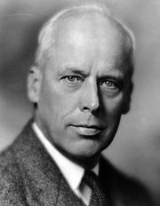
Norman Thomas

Encyclopedia
Norman Mattoon Thomas was a leading American
socialist
, pacifist
, and six-time presidential
candidate for the Socialist Party of America
.
to Emma Williams Mattoon and Weddington Evans Thomas, a Presbyterian minister. Thomas had an uneventful midwestern childhood and adolescence, helping to put himself through Marion High School as a paper carrier for Warren G. Harding
's Marion Daily Star
. Like other paper carriers, he reported directly to Florence Kling Harding. "No pennies ever escaped her," said Thomas. The summer after he graduated from high school his father accepted a pastorate at Lewisburg, Pennsylvania
, which allowed Norman to attend Bucknell University
. He left Bucknell after one year to attend Princeton University
, the beneficiary of the largesse of a wealthy uncle by marriage. Thomas graduated magna cum laude from Princeton University
in 1905.
After some settlement work and a trip around the world, Thomas decided to follow in his father's footsteps and enrolled in Union Theological Seminary
. He graduated from the seminary and was ordained as a Presbyterian minister in 1911. After assisting the Rev. Henry Van Dyke at the fashionable Brick Presbyterian Church on Manhattan's Fifth Avenue, Thomas was appointed as pastor for the East Harlem Presbyterian Church, ministering to Italian-American Protestants. Union Theological Seminary had been, at that time, a center of the Social Gospel
movement and liberal politics, and as a minister, Thomas preached against American participation in the First World War. This pacifist stance led to his being shunned by many of his fellow alumni from Princeton, and opposed by some of the leadership of the Presbyterian Church in New York. When church funding of the American Parish's social programs was stopped, Thomas resigned his pastorate. Despite this resignation of his position, Thomas did not formally leave the ministry until 1931, after his mother's death.
It was Thomas' position as a conscientious objector
which drew him to the Socialist Party of America
(SPA), a staunchly antimilitarist organization. When SPA leader Morris Hillquit
made his campaign for Mayor of New York in 1917 on an anti-war platform, Thomas wrote to him expressing his good wishes. To his surprise, HIllquit wrote back, encouraging the young minister to work for his campaign, which Thomas energetically did. Soon thereafter he himself joined the Socialist Party. Despite his membership in the Marxist SPA, Thomas was never himself an orthodox Marxist, instead favoring a Christian socialist
orientation.
Thomas was the secretary (then an unpaid position) of the pacifist Fellowship of Reconciliation
even before the war. When the organization started a magazine called The World Tomorrow
in January 1918, Thomas was employed as its paid editor. Together with his co-thinker Devere Allen, Thomas helped to make The World Tomorrow the leading voice of liberal Christian social activism of its day. In 1921, Thomas moved to secular journalism, when he was employed as associate editor of The Nation magazine.
In 1922 Thomas became co-director of the League for Industrial Democracy
. Later, he was one of the founders of the National Civil Liberties Bureau
(the precursor of the American Civil Liberties Union
, ACLU).
in 1924, for Mayor of New York in 1925 & 1929, for New York State Senate
in 1926, for Alderman
in 1927. Following Eugene Debs' death in 1926, there was a leadership vacuum in the Socialist Party. Neither of the party's two top political leaders — Victor L. Berger
and Hillquit — were eligible to run for President of the United States
by virtue of their foreign birth. The third main figure, Daniel Hoan
was occupied as Mayor of Milwaukee, Wisconsin. Down to approximately 8,000 dues paying members, the Socialist Party's options were limited, and the little known minister from New York with oratorial skills and a pedigree in the movement became the choice of the 1928 National Convention of the Socialist Party as its standard bearer. In 1934, he ran for U.S. Senator from New York and polled almost 200,000 votes, then the second best result of Socialist candidates in New York state elections, only Charles P. Steinmetz polled more votes, almost 300,000 in 1922 for State Engineer
.
The 1928 campaign marked the first of six consecutive campaigns of Thomas running as the Presidential nominee of the Socialist Party. As an articulate and engaging spokesman for democratic socialism
, Thomas' influence was considerably greater than that of the typical perennial candidate
. Although socialism
was viewed as an unsavory form of political thought by most middle-class Americans, the well-educated Thomas -- who often wore three-piece suits -- looked like and talked like a president and gained grudging admiration.
Thomas frequently spoke on the difference between socialism and communism
, explaining the differences between the movement he represented and that of revolutionary Marxism
. His early admiration for the Russian Revolution
subsequently turned into energetic anti-communism
. (The revolutionaries thought him no better; Leon Trotsky
, on more than one occasion, levelled high-profile criticism at Thomas.) He wrote several books, among them his passionate defense of World War I conscientious objector
s, Is Conscience a Crime?, and his statement of the 1960s social democratic
consensus, Socialism Re-examined.
and a faction of young Marxist intellectuals called the "Militants"
in backing a challenger to National Chairman Morris Hillquit. While Hillquit and his cohort retained control of the organization at this time, this action earned the lasting enmity of Hillquit's New York-based allies of the so-called "Old Guard"
. The diplomatic party peacemaker Hillquit died of tuberculosis the following year, lessening the stability of his faction.
At the 1934 Convention, Thomas' connection with the Militants was deepened when he backed a radical Declaration of Principles
authored by his long-time associate from the radical pacifist journal The World Tomorrow, Devere Allen. The Militants swept to majority control of the party's governing National Executive Committee at this gathering, and the Old Guard retreated to their New York fortress and formalized their factional organization as the Committee for the Preservation of the Socialist Party
, complete with a shadow Provisional Executive Committee and an office in New York City.
Although Thomas himself favored work to establish a broad Farmer-Labor Party upon the model of the Canadian Cooperative Commonwealth Federation, he nonetheless remained supportive of the Militants and their vision of an "all-inclusive party," which welcomed members of dissident communist organizations (including Lovestoneites and Trotskyists) and worked together with the Communist Party USA
in joint Popular Front
activities. The party descended into a maelstrom of factionalism in the interval, with the New York Old Guard leaving to establish themselves as the Social Democratic Federation of America, taking with them control of party property, such as the Yiddish-language Jewish Daily Forward, the English-language New Leader, the Rand School of Social Science
, and the party's summer camp in Pennsylvania. The party was left in dire financial circumstances. As the social democratic Marxists of the Old Guard were expelled and left the SP in 1936, revolutionary Marxists from the Workers Party of the United States were admitted en masse. Disagreements among the Militant faction led it to shatter into three rival groups, a Right Wing headed by Jack Altman, a Center group called "Clarity" headed by Herbert Zam and Gus Tyler
, and a Trotskyist revolutionary Left Wing faction called the "Appeal" group after the name of their factional newspaper.
In 1937 Thomas returned from Europe determined to restore order in the Socialist Party. He and his followers in the party teamed up with the Clarity majority of the National Executive Committee and gave the green light to the New York Right Wing to expel the Appeal faction from the organization. These expulsions led to the departure of virtually the whole of the party's youth section, who affiliated to the new Trotskyist Socialist Workers Party
. Demoralization set in and the Socialist Party withered, its membership level below the lowest nadir of 1928.
. However, after the United States was attacked by the Japanese at Pearl Harbor
, his stance changed to support for US involvement, and later wrote self-critically for having "overemphasized both the sense in which it was a continuance of World War I and the capacity of nonfascist Europe to resist the Nazis.".
Thomas was one of the few public figures to oppose President Franklin Roosevelt's (D) internment of Japanese Americans
following the attack on Pearl Harbor. Thomas accused the ACLU of "dereliction of duty" when the organization supported the internment. Thomas also campaigned against racial segregation
, environmental depletion, anti-labor laws and practices, and in favor of opening the United States to Jewish victims of Nazi
persecution in the 1930s.
Thomas was an early proponent of birth control. The birth-control advocate Margaret Sanger
recruited him to write "Some Objections to Birth Control Considered" in Religious and Ethical Aspects of Birth Control, edited and published by Sanger in 1926. Thomas accused the Roman Catholic Church
of hypocritical opinions on sex, such as requiring priests to be celibate and maintaining that lay people should only have sex to reproduce. "This doctrine of unrestricted procreation is strangely inconsistent on the lips of men who practice celibacy and preach continence."
Thomas also deplored the secular objection to birth control because it originated from "racial and national" group-think. "The white race, we are told, our own nation — whatever that nation may be — is endangered by practicing birth control. Birth control is something like disarmament — a good thing if effected by international agreement, but otherwise dangerous to us in both a military and economic sense. If we are not to be overwhelmed by the 'rising tide of color' we must breed against the world. If our nation is to survive, it must have more cannon and more babies as prospective food for the cannon."
Thomas was also very critical of Zionism
and of Israel's policies towards the Arabs in the postwar years (especially after the Suez Crisis
) and often collaborated with the American Council for Judaism
.
the vanguard of social reform, in collaboration with labor leaders like Walter Reuther
. He championed many seemingly unrelated progressive causes, while leaving unstated the essence of his political and economic philosophy.
In 1961, Thomas released an album The Minority Party in America: Featuring an Interview with Norman Thomas, on Folkways Records
, which focused on the role of the third party.
Thomas' 80th birthday in 1964 was marked by a well-publicized gala at the Hotel Astor in Manhattan. At the event Thomas called for a cease-fire in Vietnam and read birthday telegrams from Hubert Humphrey
, Earl Warren
, and Dr. Martin Luther King, Jr. He also received a check for $17,500 in donations from supporters. "It won't last long," he said of the check, "because every organization I'm connected with is going bankrupt."
In 1966, he was chosen by conservative editor William F. Buckley, Jr to be the first guest on Buckley's new television interview show Firing Line
. In 1968, he signed the “Writers and Editors War Tax Protest” pledge, vowing to refuse tax payments in protest against the Vietnam War.
The Norman Thomas High School (formerly known as Central Commercial High School) in Manhattan
and the Norman Thomas '05 Library at Princeton University's
Forbes College
are named after him, as is the assembly hall at the Three Arrows Cooperative Society
, where he was a frequent visitor. He is also the grandfather of Newsweek
columnist Evan Thomas
.
A plaque in the Norman Thomas '05 Library reads: Norman M. Thomas, class of 1905. "I am not the champion of lost causes, but the champion of causes not yet won."
United States
The United States of America is a federal constitutional republic comprising fifty states and a federal district...
socialist
Socialism
Socialism is an economic system characterized by social ownership of the means of production and cooperative management of the economy; or a political philosophy advocating such a system. "Social ownership" may refer to any one of, or a combination of, the following: cooperative enterprises,...
, pacifist
Pacifism
Pacifism is the opposition to war and violence. The term "pacifism" was coined by the French peace campaignerÉmile Arnaud and adopted by other peace activists at the tenth Universal Peace Congress inGlasgow in 1901.- Definition :...
, and six-time presidential
President of the United States
The President of the United States of America is the head of state and head of government of the United States. The president leads the executive branch of the federal government and is the commander-in-chief of the United States Armed Forces....
candidate for the Socialist Party of America
Socialist Party of America
The Socialist Party of America was a multi-tendency democratic-socialist political party in the United States, formed in 1901 by a merger between the three-year-old Social Democratic Party of America and disaffected elements of the Socialist Labor Party which had split from the main organization...
.
Early years
Thomas was the oldest of six children, born November 20, 1884 in Marion, OhioMarion, Ohio
Marion is a city in the U.S. state of Ohio and the county seat of Marion County. The municipality is located in north-central Ohio, approximately north of Columbus....
to Emma Williams Mattoon and Weddington Evans Thomas, a Presbyterian minister. Thomas had an uneventful midwestern childhood and adolescence, helping to put himself through Marion High School as a paper carrier for Warren G. Harding
Warren G. Harding
Warren Gamaliel Harding was the 29th President of the United States . A Republican from Ohio, Harding was an influential self-made newspaper publisher. He served in the Ohio Senate , as the 28th Lieutenant Governor of Ohio and as a U.S. Senator...
's Marion Daily Star
Marion Daily Star
The Marion Star is a newspaper in Marion, Ohio. The paper is owned by the Gannett Newspaper organization, the paper is also notable as having once been owned and published by Warren G...
. Like other paper carriers, he reported directly to Florence Kling Harding. "No pennies ever escaped her," said Thomas. The summer after he graduated from high school his father accepted a pastorate at Lewisburg, Pennsylvania
Lewisburg, Pennsylvania
Lewisburg is a borough in Union County, Pennsylvania, United States, south by southeast of Williamsport and north of Harrisburg. In the past, it was the commercial center for a fertile grain and general farming region. The population was 5,620 at the 2000 census. It is the county seat of Union...
, which allowed Norman to attend Bucknell University
Bucknell University
Bucknell University is a private liberal arts university located alongside the West Branch Susquehanna River in the rolling countryside of Central Pennsylvania in the town of Lewisburg, 30 miles southeast of Williamsport and 60 miles north of Harrisburg. The university consists of the College of...
. He left Bucknell after one year to attend Princeton University
Princeton University
Princeton University is a private research university located in Princeton, New Jersey, United States. The school is one of the eight universities of the Ivy League, and is one of the nine Colonial Colleges founded before the American Revolution....
, the beneficiary of the largesse of a wealthy uncle by marriage. Thomas graduated magna cum laude from Princeton University
Princeton University
Princeton University is a private research university located in Princeton, New Jersey, United States. The school is one of the eight universities of the Ivy League, and is one of the nine Colonial Colleges founded before the American Revolution....
in 1905.
After some settlement work and a trip around the world, Thomas decided to follow in his father's footsteps and enrolled in Union Theological Seminary
Union Theological Seminary in the City of New York
Union Theological Seminary in the City of New York is a preeminent independent graduate school of theology, located in Manhattan between Claremont Avenue and Broadway, 120th to 122nd Streets. The seminary was founded in 1836 under the Presbyterian Church, and is affiliated with nearby Columbia...
. He graduated from the seminary and was ordained as a Presbyterian minister in 1911. After assisting the Rev. Henry Van Dyke at the fashionable Brick Presbyterian Church on Manhattan's Fifth Avenue, Thomas was appointed as pastor for the East Harlem Presbyterian Church, ministering to Italian-American Protestants. Union Theological Seminary had been, at that time, a center of the Social Gospel
Social Gospel
The Social Gospel movement is a Protestant Christian intellectual movement that was most prominent in the early 20th century United States and Canada...
movement and liberal politics, and as a minister, Thomas preached against American participation in the First World War. This pacifist stance led to his being shunned by many of his fellow alumni from Princeton, and opposed by some of the leadership of the Presbyterian Church in New York. When church funding of the American Parish's social programs was stopped, Thomas resigned his pastorate. Despite this resignation of his position, Thomas did not formally leave the ministry until 1931, after his mother's death.
It was Thomas' position as a conscientious objector
Conscientious objector
A conscientious objector is an "individual who has claimed the right to refuse to perform military service" on the grounds of freedom of thought, conscience, and/or religion....
which drew him to the Socialist Party of America
Socialist Party of America
The Socialist Party of America was a multi-tendency democratic-socialist political party in the United States, formed in 1901 by a merger between the three-year-old Social Democratic Party of America and disaffected elements of the Socialist Labor Party which had split from the main organization...
(SPA), a staunchly antimilitarist organization. When SPA leader Morris Hillquit
Morris Hillquit
Morris Hillquit was a founder and leader of the Socialist Party of America and prominent labor lawyer in New York City's Lower East Side during the early 20th century.-Early years:...
made his campaign for Mayor of New York in 1917 on an anti-war platform, Thomas wrote to him expressing his good wishes. To his surprise, HIllquit wrote back, encouraging the young minister to work for his campaign, which Thomas energetically did. Soon thereafter he himself joined the Socialist Party. Despite his membership in the Marxist SPA, Thomas was never himself an orthodox Marxist, instead favoring a Christian socialist
Christian socialism
Christian socialism generally refers to those on the Christian left whose politics are both Christian and socialist and who see these two philosophies as being interrelated. This category can include Liberation theology and the doctrine of the social gospel...
orientation.
Thomas was the secretary (then an unpaid position) of the pacifist Fellowship of Reconciliation
Fellowship of Reconciliation
The Fellowship of Reconciliation is the name used by a number of religious nonviolent organizations, particularly in English-speaking countries...
even before the war. When the organization started a magazine called The World Tomorrow
The World Tomorrow (magazine)
The World Tomorrow: A journal looking toward a Christian world was an American political magazine, founded by the pacifist organization Fellowship of Reconciliation and published in New York City by FOR's Fellowship Press at 108 Lexington Avenue.-Main Editors:The World Tomorrow seems to have had...
in January 1918, Thomas was employed as its paid editor. Together with his co-thinker Devere Allen, Thomas helped to make The World Tomorrow the leading voice of liberal Christian social activism of its day. In 1921, Thomas moved to secular journalism, when he was employed as associate editor of The Nation magazine.
In 1922 Thomas became co-director of the League for Industrial Democracy
League for Industrial Democracy
The League for Industrial Democracy , from 1960-1965 known as the Students for a Democratic Society , was founded in 1905 by a group of notable socialists including Harry W. Laidler, Jack London, Norman Thomas, Upton Sinclair, and J.G. Phelps Stokes...
. Later, he was one of the founders of the National Civil Liberties Bureau
National Civil Liberties Bureau
The National Civil Liberties Bureau was an American civil rights organization. In 1920, it changed its name to the American Civil Liberties Union ....
(the precursor of the American Civil Liberties Union
American Civil Liberties Union
The American Civil Liberties Union is a U.S. non-profit organization whose stated mission is "to defend and preserve the individual rights and liberties guaranteed to every person in this country by the Constitution and laws of the United States." It works through litigation, legislation, and...
, ACLU).
Electoral politics
Thomas ran for office five times in quick succession on the Socialist ticket — for Governor of New YorkGovernor of New York
The Governor of the State of New York is the chief executive of the State of New York. The governor is the head of the executive branch of New York's state government and the commander-in-chief of the state's military and naval forces. The officeholder is afforded the courtesy title of His/Her...
in 1924, for Mayor of New York in 1925 & 1929, for New York State Senate
New York State Senate
The New York State Senate is one of two houses in the New York State Legislature and has members each elected to two-year terms. There are no limits on the number of terms one may serve...
in 1926, for Alderman
New York City Council
The New York City Council is the lawmaking body of the City of New York. It has 51 members from 51 council districts throughout the five boroughs. The Council serves as a check against the mayor in a "strong" mayor-council government model. The council monitors performance of city agencies and...
in 1927. Following Eugene Debs' death in 1926, there was a leadership vacuum in the Socialist Party. Neither of the party's two top political leaders — Victor L. Berger
Victor L. Berger
Victor Luitpold Berger was a founding member of the Socialist Party of America and an important and influential Socialist journalist who helped establish the so-called Sewer Socialist movement. The first Socialist elected to the U.S...
and Hillquit — were eligible to run for President of the United States
President of the United States
The President of the United States of America is the head of state and head of government of the United States. The president leads the executive branch of the federal government and is the commander-in-chief of the United States Armed Forces....
by virtue of their foreign birth. The third main figure, Daniel Hoan
Daniel Hoan
Daniel Webster "Dan" Hoan was a United States lawyer and politician. He became the second Socialist mayor of Milwaukee, Wisconsin, and his tenure is generally considered to be the longest continuous socialist administration in U.S. history...
was occupied as Mayor of Milwaukee, Wisconsin. Down to approximately 8,000 dues paying members, the Socialist Party's options were limited, and the little known minister from New York with oratorial skills and a pedigree in the movement became the choice of the 1928 National Convention of the Socialist Party as its standard bearer. In 1934, he ran for U.S. Senator from New York and polled almost 200,000 votes, then the second best result of Socialist candidates in New York state elections, only Charles P. Steinmetz polled more votes, almost 300,000 in 1922 for State Engineer
New York State Engineer and Surveyor
The New York State Engineer and Surveyor was a state cabinet officer in the State of New York between 1848 and 1926. During the re-organization of the state government under Governor Al Smith, the office was abolished and its responsibilities transferred to the Department of Public Works which was...
.
The 1928 campaign marked the first of six consecutive campaigns of Thomas running as the Presidential nominee of the Socialist Party. As an articulate and engaging spokesman for democratic socialism
Democratic socialism
Democratic socialism is a description used by various socialist movements and organizations to emphasize the democratic character of their political orientation...
, Thomas' influence was considerably greater than that of the typical perennial candidate
Perennial candidate
A perennial candidate is one who frequently runs for public office with a record of success that is infrequent, if existent at all. Perennial candidates are often either members of minority political parties or have political opinions that are not mainstream. They may run without any serious hope...
. Although socialism
Socialism
Socialism is an economic system characterized by social ownership of the means of production and cooperative management of the economy; or a political philosophy advocating such a system. "Social ownership" may refer to any one of, or a combination of, the following: cooperative enterprises,...
was viewed as an unsavory form of political thought by most middle-class Americans, the well-educated Thomas -- who often wore three-piece suits -- looked like and talked like a president and gained grudging admiration.
Thomas frequently spoke on the difference between socialism and communism
Communism
Communism is a social, political and economic ideology that aims at the establishment of a classless, moneyless, revolutionary and stateless socialist society structured upon common ownership of the means of production...
, explaining the differences between the movement he represented and that of revolutionary Marxism
Marxism
Marxism is an economic and sociopolitical worldview and method of socioeconomic inquiry that centers upon a materialist interpretation of history, a dialectical view of social change, and an analysis and critique of the development of capitalism. Marxism was pioneered in the early to mid 19th...
. His early admiration for the Russian Revolution
Russian Revolution of 1917
The Russian Revolution is the collective term for a series of revolutions in Russia in 1917, which destroyed the Tsarist autocracy and led to the creation of the Soviet Union. The Tsar was deposed and replaced by a provisional government in the first revolution of February 1917...
subsequently turned into energetic anti-communism
Anti-communism
Anti-communism is opposition to communism. Organized anti-communism developed in reaction to the rise of communism, especially after the 1917 October Revolution in Russia and the beginning of the Cold War in 1947.-Objections to communist theory:...
. (The revolutionaries thought him no better; Leon Trotsky
Leon Trotsky
Leon Trotsky , born Lev Davidovich Bronshtein, was a Russian Marxist revolutionary and theorist, Soviet politician, and the founder and first leader of the Red Army....
, on more than one occasion, levelled high-profile criticism at Thomas.) He wrote several books, among them his passionate defense of World War I conscientious objector
Conscientious objector
A conscientious objector is an "individual who has claimed the right to refuse to perform military service" on the grounds of freedom of thought, conscience, and/or religion....
s, Is Conscience a Crime?, and his statement of the 1960s social democratic
Social democracy
Social democracy is a political ideology of the center-left on the political spectrum. Social democracy is officially a form of evolutionary reformist socialism. It supports class collaboration as the course to achieve socialism...
consensus, Socialism Re-examined.
Socialist Party politics
Thomas failed to isolate himself from the rough and tumble internal factional politics of the Socialist Party, as his predecessor Debs had been able to do. At the 1932 Milwaukee Convention, Thomas and his radical pacifist allies in the party joined forces with constructive socialists from WisconsinSewer Socialism
Sewer Socialism was a term, originally more or less pejorative, for the American socialist movement that centered in Milwaukee, Wisconsin, and existed from around 1892 to 1960...
and a faction of young Marxist intellectuals called the "Militants"
Militant faction
The Militant faction was an organized grouping of Marxists in the Socialist Party of America who sought to steer that organization from its orientation towards electoral politics and towards direct action and revolutionary socialism. The faction emerged during 1930 and 1931 and achieved practical...
in backing a challenger to National Chairman Morris Hillquit. While Hillquit and his cohort retained control of the organization at this time, this action earned the lasting enmity of Hillquit's New York-based allies of the so-called "Old Guard"
Old Guard faction
The Old Guard faction was an organized grouping of Marxists in the Socialist Party of America who sought to retain the organization's traditional orientation towards electoral politics by fighting generally younger party members who factionally organized to promote greater efforts at direct action...
. The diplomatic party peacemaker Hillquit died of tuberculosis the following year, lessening the stability of his faction.
At the 1934 Convention, Thomas' connection with the Militants was deepened when he backed a radical Declaration of Principles
1934 Declaration of Principles
The 1934 Declaration of Principles was a political platform of the Socialist Party of America passed at the May 1934 National Convention held in Detroit, Michigan...
authored by his long-time associate from the radical pacifist journal The World Tomorrow, Devere Allen. The Militants swept to majority control of the party's governing National Executive Committee at this gathering, and the Old Guard retreated to their New York fortress and formalized their factional organization as the Committee for the Preservation of the Socialist Party
Committee for the Preservation of the Socialist Party
The Committee for the Preservation of the Socialist Party was a short-lived organized factional grouping in the Socialist Party of America established in 1934 by its New York-based "Old Guard" faction...
, complete with a shadow Provisional Executive Committee and an office in New York City.
Although Thomas himself favored work to establish a broad Farmer-Labor Party upon the model of the Canadian Cooperative Commonwealth Federation, he nonetheless remained supportive of the Militants and their vision of an "all-inclusive party," which welcomed members of dissident communist organizations (including Lovestoneites and Trotskyists) and worked together with the Communist Party USA
Communist Party USA
The Communist Party USA is a Marxist political party in the United States, established in 1919. It has a long, complex history that is closely related to the histories of similar communist parties worldwide and the U.S. labor movement....
in joint Popular Front
Popular front
A popular front is a broad coalition of different political groupings, often made up of leftists and centrists. Being very broad, they can sometimes include centrist and liberal forces as well as socialist and communist groups...
activities. The party descended into a maelstrom of factionalism in the interval, with the New York Old Guard leaving to establish themselves as the Social Democratic Federation of America, taking with them control of party property, such as the Yiddish-language Jewish Daily Forward, the English-language New Leader, the Rand School of Social Science
Rand School of Social Science
The Rand School of Social Science was formed in New York City by adherents of the Socialist Party of America in 1906. The school aimed to provide a broad education to workers, imparting a politicizing class-consciousness, and additionally served as a research bureau, a publisher, and the operator...
, and the party's summer camp in Pennsylvania. The party was left in dire financial circumstances. As the social democratic Marxists of the Old Guard were expelled and left the SP in 1936, revolutionary Marxists from the Workers Party of the United States were admitted en masse. Disagreements among the Militant faction led it to shatter into three rival groups, a Right Wing headed by Jack Altman, a Center group called "Clarity" headed by Herbert Zam and Gus Tyler
Gus Tyler
August "Gus" Tyler was an American socialist activist of the 1930s, a labor union official, author, and newspaper columnist...
, and a Trotskyist revolutionary Left Wing faction called the "Appeal" group after the name of their factional newspaper.
In 1937 Thomas returned from Europe determined to restore order in the Socialist Party. He and his followers in the party teamed up with the Clarity majority of the National Executive Committee and gave the green light to the New York Right Wing to expel the Appeal faction from the organization. These expulsions led to the departure of virtually the whole of the party's youth section, who affiliated to the new Trotskyist Socialist Workers Party
Socialist Workers Party (United States)
The Socialist Workers Party is a far-left political organization in the United States. The group places a priority on "solidarity work" to aid strikes and is strongly supportive of Cuba...
. Demoralization set in and the Socialist Party withered, its membership level below the lowest nadir of 1928.
Causes
Thomas was initially as outspoken in opposing the Second World War as he was with regard to the First World War. Upon returning from a European tour in 1937, he formed the Keep America Out of War Congress and spoke against war, thereby sharing a platform with the America First CommitteeAmerica First Committee
The America First Committee was the foremost non-interventionist pressure group against the American entry into World War II. Peaking at 800,000 members, it was likely the largest anti-war organization in American history. Started in 1940, it became defunct after the attack on Pearl Harbor in...
. However, after the United States was attacked by the Japanese at Pearl Harbor
Pearl Harbor
Pearl Harbor, known to Hawaiians as Puuloa, is a lagoon harbor on the island of Oahu, Hawaii, west of Honolulu. Much of the harbor and surrounding lands is a United States Navy deep-water naval base. It is also the headquarters of the U.S. Pacific Fleet...
, his stance changed to support for US involvement, and later wrote self-critically for having "overemphasized both the sense in which it was a continuance of World War I and the capacity of nonfascist Europe to resist the Nazis.".
Thomas was one of the few public figures to oppose President Franklin Roosevelt's (D) internment of Japanese Americans
Japanese American internment
Japanese-American internment was the relocation and internment by the United States government in 1942 of approximately 110,000 Japanese Americans and Japanese who lived along the Pacific coast of the United States to camps called "War Relocation Camps," in the wake of Imperial Japan's attack on...
following the attack on Pearl Harbor. Thomas accused the ACLU of "dereliction of duty" when the organization supported the internment. Thomas also campaigned against racial segregation
Racial segregation
Racial segregation is the separation of humans into racial groups in daily life. It may apply to activities such as eating in a restaurant, drinking from a water fountain, using a public toilet, attending school, going to the movies, or in the rental or purchase of a home...
, environmental depletion, anti-labor laws and practices, and in favor of opening the United States to Jewish victims of Nazi
Nazi Germany
Nazi Germany , also known as the Third Reich , but officially called German Reich from 1933 to 1943 and Greater German Reich from 26 June 1943 onward, is the name commonly used to refer to the state of Germany from 1933 to 1945, when it was a totalitarian dictatorship ruled by...
persecution in the 1930s.
Thomas was an early proponent of birth control. The birth-control advocate Margaret Sanger
Margaret Sanger
Margaret Higgins Sanger was an American sex educator, nurse, and birth control activist. Sanger coined the term birth control, opened the first birth control clinic in the United States, and established Planned Parenthood...
recruited him to write "Some Objections to Birth Control Considered" in Religious and Ethical Aspects of Birth Control, edited and published by Sanger in 1926. Thomas accused the Roman Catholic Church
Roman Catholic Church
The Catholic Church, also known as the Roman Catholic Church, is the world's largest Christian church, with over a billion members. Led by the Pope, it defines its mission as spreading the gospel of Jesus Christ, administering the sacraments and exercising charity...
of hypocritical opinions on sex, such as requiring priests to be celibate and maintaining that lay people should only have sex to reproduce. "This doctrine of unrestricted procreation is strangely inconsistent on the lips of men who practice celibacy and preach continence."
Thomas also deplored the secular objection to birth control because it originated from "racial and national" group-think. "The white race, we are told, our own nation — whatever that nation may be — is endangered by practicing birth control. Birth control is something like disarmament — a good thing if effected by international agreement, but otherwise dangerous to us in both a military and economic sense. If we are not to be overwhelmed by the 'rising tide of color' we must breed against the world. If our nation is to survive, it must have more cannon and more babies as prospective food for the cannon."
Thomas was also very critical of Zionism
Zionism
Zionism is a Jewish political movement that, in its broadest sense, has supported the self-determination of the Jewish people in a sovereign Jewish national homeland. Since the establishment of the State of Israel, the Zionist movement continues primarily to advocate on behalf of the Jewish state...
and of Israel's policies towards the Arabs in the postwar years (especially after the Suez Crisis
Suez Crisis
The Suez Crisis, also referred to as the Tripartite Aggression, Suez War was an offensive war fought by France, the United Kingdom, and Israel against Egypt beginning on 29 October 1956. Less than a day after Israel invaded Egypt, Britain and France issued a joint ultimatum to Egypt and Israel,...
) and often collaborated with the American Council for Judaism
American Council for Judaism
The American Council for Judaism is an organization of American Jews committed to the proposition that Jews are not a nationality but merely a religious group, adhering to the original stated principles of Reform Judaism, as articulated in the 1885 Pittsburgh Platform.The ACJ was founded in June...
.
Later years
After 1945 Thomas sought to make the non-Communist leftAnti-Stalinist left
The anti-Stalinist left is an element of left-wing politics that is critical of Joseph Stalin's policies and the political system that developed in the Soviet Union under his rule...
the vanguard of social reform, in collaboration with labor leaders like Walter Reuther
Walter Reuther
Walter Philip Reuther was an American labor union leader, who made the United Automobile Workers a major force not only in the auto industry but also in the Democratic Party in the mid 20th century...
. He championed many seemingly unrelated progressive causes, while leaving unstated the essence of his political and economic philosophy.
In 1961, Thomas released an album The Minority Party in America: Featuring an Interview with Norman Thomas, on Folkways Records
Folkways Records
Folkways Records was a record label founded by Moses Asch that documented folk, world, and children's music. It was acquired by the Smithsonian Institution in 1987, and is now part of Smithsonian Folkways.-History:...
, which focused on the role of the third party.
Thomas' 80th birthday in 1964 was marked by a well-publicized gala at the Hotel Astor in Manhattan. At the event Thomas called for a cease-fire in Vietnam and read birthday telegrams from Hubert Humphrey
Hubert Humphrey
Hubert Horatio Humphrey, Jr. , served under President Lyndon B. Johnson as the 38th Vice President of the United States. Humphrey twice served as a United States Senator from Minnesota, and served as Democratic Majority Whip. He was a founder of the Minnesota Democratic-Farmer-Labor Party and...
, Earl Warren
Earl Warren
Earl Warren was the 14th Chief Justice of the United States.He is known for the sweeping decisions of the Warren Court, which ended school segregation and transformed many areas of American law, especially regarding the rights of the accused, ending public-school-sponsored prayer, and requiring...
, and Dr. Martin Luther King, Jr. He also received a check for $17,500 in donations from supporters. "It won't last long," he said of the check, "because every organization I'm connected with is going bankrupt."
In 1966, he was chosen by conservative editor William F. Buckley, Jr to be the first guest on Buckley's new television interview show Firing Line
Firing Line
Firing Line was an American public affairs show founded and hosted by conservative William F. Buckley, Jr. Its 1,504 episodes over 33 years made Firing Line the longest-running public affairs show in television history with a single host...
. In 1968, he signed the “Writers and Editors War Tax Protest” pledge, vowing to refuse tax payments in protest against the Vietnam War.
Death and legacy
Thomas died on December 19, 1968.The Norman Thomas High School (formerly known as Central Commercial High School) in Manhattan
Manhattan
Manhattan is the oldest and the most densely populated of the five boroughs of New York City. Located primarily on the island of Manhattan at the mouth of the Hudson River, the boundaries of the borough are identical to those of New York County, an original county of the state of New York...
and the Norman Thomas '05 Library at Princeton University's
Princeton University
Princeton University is a private research university located in Princeton, New Jersey, United States. The school is one of the eight universities of the Ivy League, and is one of the nine Colonial Colleges founded before the American Revolution....
Forbes College
Forbes College
The Malcolm S. Forbes Jr. '70 College is one of the six residential colleges that house all freshmen and sophomores at Princeton University. The College was a gift to the school by Malcolm S. Forbes Sr. '41 in 1984 in honor of his son, Steve...
are named after him, as is the assembly hall at the Three Arrows Cooperative Society
Three Arrows Cooperative Society
Three Arrows Cooperative Society is a cooperative summer colony located in Putnam Valley, NY. It was founded in 1936 by members of the Young People's Socialist League, from whence its name and emblem derive. The Society owns 125 acres of land which comprise 75 individual home sites as well as...
, where he was a frequent visitor. He is also the grandfather of Newsweek
Newsweek
Newsweek is an American weekly news magazine published in New York City. It is distributed throughout the United States and internationally. It is the second-largest news weekly magazine in the U.S., having trailed Time in circulation and advertising revenue for most of its existence...
columnist Evan Thomas
Evan Thomas
Evan Welling Thomas III is an American journalist and author. He currently teaches journalism at Princeton University.-Life and career:Thomas was born in Huntington, New York and was raised in Cold Spring Harbor, New York...
.
A plaque in the Norman Thomas '05 Library reads: Norman M. Thomas, class of 1905. "I am not the champion of lost causes, but the champion of causes not yet won."
Works
- The Conquest of War. New York: Fellowship Press, 1917.
- War's Heretics : A Plea for the Conscientious Objector. Chicago : American Liberty Defense League, 1917.
- The case of the Christian Pacifists at Los Angeles, Cal. New York City: National Civil Liberties BureauNational Civil Liberties BureauThe National Civil Liberties Bureau was an American civil rights organization. In 1920, it changed its name to the American Civil Liberties Union ....
1918 - The Conscientious Objector in America. New York: B.W. Huebsch, 1923.
- The League of Nations and the Imperialist Principle: A Criticism. New York: Foreign Policy AssociationForeign Policy AssociationThe Foreign Policy Association is a non-profit organization dedicated to inspiring the American public to learn more about the world. Founded in 1918, it serves as a catalyst for developing awareness, understanding of, and providing informed opinions on global issues...
, 1923. - What Is Industrial Democracy? New York: League for Industrial DemocracyLeague for Industrial DemocracyThe League for Industrial Democracy , from 1960-1965 known as the Students for a Democratic Society , was founded in 1905 by a group of notable socialists including Harry W. Laidler, Jack London, Norman Thomas, Upton Sinclair, and J.G. Phelps Stokes...
, 1925. - The Challenge of War: An Economic Interpretation. New York: League for Industrial Democracy, 1927.
- Is Conscience a Crime? New York: Vanguard PressVanguard PressThe Vanguard Press was a United States publishing house established with a $100,000 grant from the left wing American Fund for Public Service, better known as the Garland Fund. Throughout the 1920s, Vanguard Press issued an array of books on radical topics, including studies of the Soviet Union,...
, 1927. - In the League and Out. New York: Foreign Policy Association, 1930.
- America's Way Out: A Program for Democracy. New York: MacmillanMacmillan Publishers (United States)Macmillan Publishers USA, also known as Macmillan Publishing, is a privately held American publishing company owned by the Georg von Holtzbrinck Publishing Group. It has offices in 41 countries worldwide and operates in more than 30 others....
, 1931. - Socialism and the Individual. Girard, KS: Haldeman-Julius Publications, 1931.
- The Socialist Cure for a Sick Society. New York: John Day CompanyJohn Day CompanyThe John Day Company was a New York publishing firm that specialized in illustrated fiction and current affairs books and pamphlets from 1926-1968. It published books by, among others, Pearl Buck, Irving Adler, Peggy Adler and Sidney Hook. It was founded by Richard Walsh in 1926 and named after...
, 1932. - As I See It. New York: Macmillan, 1932.
- Why I Am a Socialist. New York: League for Industrial Democracy, 1932.
- What Socialism Is and Is Not. Chicago: Socialist Party of America, 1932.
- What's the Matter with New York: A National Problem. With Paul Blanshard. New York: Macmillan, 1932.
- A Socialist Looks at the New Deal. New York: League for Industrial Democracy, 1933.
- The New Deal: A Socialist Analysis. Chicago: Committee on Education and Research of the Socialist Party of America, 1934.
- Human Exploitation in the United States. New York: Frederick A. StokesFrederick A. StokesFrederick A. Stokes was an eponymous American publishing company. Stokes was a graduate of Yale Law School. He had previously worked for Dodd, Mead and Company and then briefly had partnerships with others before founding his company in 1890....
, 1934. - The Choice Before Us. New York: Macmillan, 1934. (UK title: Fascism or Socialism?)
- The Plight of the Share Cropper. New York: League for Industrial Democracy, 1934.
- War — No Glory, No Profit, No Need. New York: Frederick A. Stokes, 1935.
- War As a Socialist Sees It. New York: League for Industrial Democracy, 1936.
- After the New Deal — What? New York: Macmillan, 1936.
- Debate: Which Road for American Workers — Socialist or Communist? New York: Socialist Call, 1936.
- Is the New Deal Socialism? An Answer to Al Smith and the American Liberty League. New York: National Office, Socialist Party, n.d. [c. 1936].
- Why I Am a Socialist. New York: League for Industrial Democracy, 1936.
- Shall labor support Roosevelt? Chicago : Labor League for Thomas and Nelson, 1936.
- Emancipate youth from toil, old age from fear, Chicago: Socialist Party, 1936.
- You Can't Cure Tuberculosis with Cough Drops. New York: Socialist Party, n.d. [1936]. — leaflet
- Democracy versus dictatorship New York: League for Industrial Democracy, 1937.
- Socialism on the Defensive. New York: Harper and Brothers, 1938.
- Justice Triumphs in Spain! A Letter about the Trial of the POUM. With Devere Allen. Chicago: Socialist Party, n.d. [c. 1938].
- Collective Security Means War. Chicago: Socialist Party, 1938.
- Keep America Out of War: A Program. With Bertram D. Wolfe. New York: Frederick A. Stokes Co., 1939.
- Russia: Democracy or Dictatorship? With Joel Seidman. New York: League for Industrial Democracy, 1939.
- What's Behind the "Christian Front"? New York: Workers Defense League, 1939.
- Stop the Draft : An Appeal to the American People. New York: Socialist National Headquarters, 1940.
- We Have a Future. Princeton, NJ: Princeton University PressPrinceton University Press-Further reading:* "". Artforum International, 2005.-External links:* * * * *...
, 1941. - World Federation: What Are the Difficulties? New York: Post War World Council, 1942.
- Democracy and Japanese Americans. New York: Post War World Council, 1942.
- Martin Dies and Socialism. New York: Socialist Party, n.d. [c. 1943].
- Victory's Victims? The Negro's Future. With A. Philip Randolph. Socialist Party, n.d. [c. 1943].
- What Is Our Destiny? Garden City, NY: Doubleday, Doran & Co., 1944.
- Conscription: The Test of Peace. New York: Post War World Council, 1944.
- Russia: Promise and Performance. New York: Socialist Party, 1945.
- A socialist looks at the United Nations Syracuse, N.Y.: Syracuse University PressSyracuse University PressSyracuse University Press, founded in 1943, is a university press that is part of Syracuse University. The areas of focus for the Press include Middle East Studies, Native American Studies, Peace and Conflict Resolution, Irish Studies and Jewish Studies, among others. The Press has an international...
, 1945. - An Appeal to the Nations. New York: Socialist Party, 1947.
- The One Hope of Peace: Universal Disarmament Under International Control. New York: Post War World Council, 1947.
- Why I am a candidate New York: Socialist Party, 1948.
- How Can the Socialist Party Best Serve Socialism? An Argument in Support of the Position of the Majority of the National Executive Committee Concerning Electoral Activities. [New York]: [Socialist Party], 1949.
- A Socialist's Faith. New York: W.W. Norton, 1951.
- Democratic Socialism: A New Appraisal. New York: League for Industrial Democracy, 1953.
- The Test of Freedom. New York: W.W. Norton, 1954.
- Mr. Chairman, Ladies and Gentlemen... Reflections on Public Speaking. New York: Hermitage HouseHermitage houseHermitage was a large Georgian mansion in Castleconnell, County Limerick, Ireland. It was built circa 1790 for George Evans Bruce, a local banker who was subsequently disgraced. It was situated in a spectacular location overlooking the Falls of Doonass on the River Shannon...
, 1955. - The Prerequisites for Peace. New York: W.W. Norton, 1959.
- Great Dissenters. New York: W.W. Norton, 1961.
- Eugene V. Debs in the Light of History. Terre Haute, IN: Eugene V. Debs Foundation, 1964.
- Socialism Re-Examined. New York: W.W. Norton, 1963.
Additional reading
- Fleischmann, Harry, Norman Thomas: A Biography. New York, Norton & Co., 1964.
- Hyfler, Robert, Prophets of the Left: American Socialist Thought in the Twentieth Century. Westport, CT: Greenwood Press, 1984.
- Johnpoll, Bernard K., Pacifists Progress: Norman Thomas and the Decline of American Socialism. Chicago: Quadrangle Books, 1970.
- Seidler, Murray B., Norman Thomas: Respectable Rebel. Binghamton, New York, Syracuse University Press, 1967. Second Edition.
- Swanberg, W. A., Norman Thomas: The Last Idealist. New York, Charles Scribner and Sons, 1976.
- Thomas, Louisa, Conscience: Two Soldiers, Two Pacifists, One Family - A Test of Will and Faith in World War I. New York, The Penguin Press, 2011.
External links
- The History Channel (THC)
- Letter from Thomas to Salah BitarSalah al-Din al-BitarSalah ad-Din al-Bitar , was a Syrian politician who, with Michel Aflaq, founded the Arab Ba'th Party in the early 1940s. During their student days in Paris in the early 1930s, the two worked together to formulate a doctrine that combined aspects of nationalism and socialism...
- Thomas, Norman. Cuarenta anos de comunismo: promesas y realidades New York: Instituto de Investigaciones Internacionales del Trabajo,1957