

Congress of Industrial Organizations

Encyclopedia
The Congress of Industrial Organizations, or CIO, proposed by John L. Lewis
in 1932, was a federation of unions
that organized workers in industrial unions
in the United States
and Canada
from 1935 to 1955. The Taft-Hartley Act
of 1947 required union leaders to swear that they were not Communists. Many CIO leaders refused to obey that requirement, later found unconstitutional. The CIO merged with the American Federation of Labor
to form the AFL-CIO
in 1955.
The CIO supported Franklin D. Roosevelt
and the New Deal Coalition
, and was open to African American
s. Both federations grew rapidly during the Great Depression. The rivalry for dominance was bitter and sometimes violent. The CIO (Committee for Industrial Organization) was founded on November 9, 1935, by eight international union
s belonging to the American Federation of Labor
.
In its statement of purpose, the CIO said it had formed to encourage the AFL to organize workers in mass production industries along industrial union lines. The CIO failed to change AFL policy from within. On September 10, 1936, the AFL suspended all 10 CIO unions (two more had joined in the previous year). In 1938, these unions formed the Congress of Industrial Organizations as a rival labor federation. In 1955, the CIO rejoined the AFL, forming the new entity known as the American Federation of Labor-Congress of Industrial Organizations
(AFL-CIO).
 The CIO was born out of a fundamental dispute within the U.S. labor movement
over whether and how to organize industrial workers. Those who favored craft unionism
believed that the most effective way to represent workers was to defend the advantages they had secured through their skills. They focused on the hiring of skilled workers, such as carpenters, lithographers, and railroad engineers, in an attempt to maintain as much control as possible over the work their members did through enforcement of work rules, zealous defense of their jurisdiction to certain types of work, control over apprenticeship programs, and exclusion of less skilled workers from membership.
Craft unionists were opposed to organizing workers on an industrial basis (efficiency), i.e. into unions that represented all of the production workers in a particular enterprise, rather than in separate units divided along craft lines.
The proponents of industrial unionism
, on the other hand, generally believed that craft distinctions may have been appropriate in those industries in which craft unions had flourished, such as construction or printing, but that they were unworkable in industries such as steel or auto production. In their view, dividing workers in a single plant into a number of different crafts represented by separate organizations, each with its own agenda, would weaken the workers’ bargaining power and leave the majority, who had few traditional craft skills, completely unrepresented.
While the AFL had always included a number of industrial unions, such as the United Mine Workers
and the Brewery Workers
, by the 1930s the most dogmatic craft unionists had a strong hold on power within the federation. They used that power to quash any drive toward industrial organizing.
Industrial unionism became even more fierce in the 1930s, when the Great Depression in the United States
caused large membership drops in some unions, such as the United Mine Workers of America and the International Ladies' Garment Workers' Union
. A number of labor leaders, and in particular John L. Lewis
of the Mine Workers, came to the conclusion that their own unions would not survive while the great majority of workers in basic industry remained nonunion. They started to press the AFL to change its policies in this area.
The AFL did, in fact, respond, and added even more new members than the CIO. The AFL had long permitted the formation of “federal” unions, which were affiliated directly with the AFL; in 1933 it proposed to use these to organize workers on an industrial basis. The AFL did not, however, promise to allow those unions to maintain a separate identity indefinitely. That meant these unions might be broken up later in order to distribute their members among the craft unions that claimed jurisdiction over their work. The AFL, in fact, dissolved hundreds of federal unions in late 1934 and early 1935.
While the bureaucratic leadership of the AFL was unable to win strikes, three victorious strikes suddenly exploded onto the scene in 1934. These were the Minneapolis Teamsters Strike of 1934
the leadership of which included some members of the Trotskyist Communist League of America
, the 1934 West Coast Longshore Strike
the leadership of which included some members of the Communist Party USA
, and the 1934 Toledo Auto-Lite Strike
led by the American Workers Party
. Victorious industrial unions with militant leaderships were the catalyst that brought about the rise of the CIO.
The AFL did authorize organizing drives in the automobile, rubber and steel industries at its convention in 1934, but gave little financial support or effective leadership to those unions. The AFL’s timidity only succeeded in making it less credible among the workers it was supposedly trying to organize. This was especially significant in those industries, such as auto and rubber, in which workers had already achieved some organizing success at great personal risk.
The dispute came to a head at the AFL’s convention in Atlantic City in 1935, when William Hutcheson
, the President of the Carpenters
, made a slighting comment about a rubber worker delivering an organizing report. Lewis responded that Hutcheson’s comment was “small potatoes,” to which Hutcheson replied “I was raised on small potatoes, that is why I am so small.” After some more words, Lewis punched Hutcheson, knocking him to the ground; Lewis then relit his cigar and returned to the rostrum. The incident – which was also “small potatoes,” but very memorable – helped cement Lewis’ image in the public eye as someone willing to fight for workers’ right to organize.
Shortly after the Convention, Lewis called together Charles Howard, President of the International Typographical Union
, Sidney Hillman
, head of the Amalgamated Clothing Workers of America
, David Dubinsky
, President of the ILGWU, Thomas McMahon
, head of the United Textile Workers, John Sheridan of the Mine, Mill and Smelter Workers Union
, Harvey Fremming from the Oil Workers Union and Max Zaritsky of the Hatters, Cap and Millinery Workers to discuss the formation of a new group within the AFL to carry on the fight for industrial organizing. The creation of the CIO was announced on November 9, 1936. Whether Lewis always intended to split the AFL over this issue is debatable; at the outset, the CIO presented itself as only a group of unions within the AFL gathered to support industrial unionism, rather than a group opposed to the AFL itself.
The AFL leadership, however, treated the CIO as an enemy from the outset, refusing to deal with it and demanding that it dissolve. The AFL’s opposition to the CIO, however, only increased the stature of the CIO and Lewis in the eyes of those industrial workers keen on organizing and disillusioned with the AFL’s ineffective performance. Lewis continued to denounce the AFL’s policies while the CIO offered organizing support to workers in the rubber industry who went on strike and formed the Steel Workers Organizing Committee
(SWOC), in defiance of all of the craft divisions that the AFL had required in past organizing efforts, in 1936; Lee Pressman
, affiliated with the far left, became the union's General Counsel.
The first major industrial union to be chartered by the CIO on November 16, 1938 were the United Electrical, Radio and Machine Workers of America
, also called the UE.
The subsequent explosive growth of the UE was instrumental for the survival in those early days of the CIO. By the end of 1936, the UE had organized the General Electric plant at Schenectady, NY and the UE went on to organize 358 more local unions with contracts covering over 600,000 workers in 1,375 plants.
winning union recognition at General Motors Corporation after a tumultuous forty-four day sit-down strike, while the Steel Workers Organizing Committee
(SWOC) signed a collective bargaining agreement with U.S. Steel. Those two victories, however, came about very differently.
The CIO’s initial strategy was to focus its efforts in the steel industry and then build from there. The UAW, however, did not wait for the CIO to lead it. Instead, having built up a membership of roughly 25,000 workers by gathering in federal unions and some locals from rival unions in the industry, the union decided to go after GM, the largest car maker of them all, by shutting down its nerve center, the production complex in Flint, Michigan
.
The Flint Sit-Down Strike
was a risky and illegal enterprise from the outset: the union was able to share its plans with only a few workers because of the danger that spies employed by GM would alert management in time to stop it, yet needed to be able to mobilize enough to seize physical control of GM’s factories. The union, in fact, not only took over several GM factories in Flint, including one that made the dies necessary to stamp automotive body parts and a companion facility in Cleveland, Ohio
, but held on to those sites despite repeated attempts by the police and National Guard to retake them and court orders threatening the union with ruinous fines if it did not call off the strike.
While Lewis played a key role in negotiating the one-page agreement that ended the strike with GM’s promise to recognize the UAW as the exclusive bargaining representative of its employees for a six months period, UAW activists, rather than CIO staff, led the strike.
The organizing campaign in the steel industry, by contrast, was a top-down affair. Lewis, who had a particular interest in organizing the steel industry because of its important role in the coal industry where UMW members worked, dispatched hundreds of organizers, many his past political opponents or radicals drawn from the Communist-led unions that had attempted to organize the industry earlier in the 1930s, to sign up members. Lewis was not particularly concerned with the political beliefs of his organizers, so long as he controlled the organization; as he once famously remarked, when asked about the “reds” on the SWOC staff, “Who gets the bird? The hunter or the dog?”.
The SWOC signed up thousands of members and absorbed a number of company unions at U.S. Steel and elsewhere, but did not attempt the sort of daring strike that the UAW had pulled off against GM. Instead Lewis was able to extract a collective bargaining agreement from U.S. Steel, which had previously been an implacable enemy of unions, by pointing to the chaos and loss of business that GM had suffered by fighting the UAW. The agreement provided for union recognition, a modest wage increase and a grievance procedure.
The CIO also won several significant legal battles. Hague v. Committee for Industrial Organization
307 U.S. 496 (1939), arose out of events late in 1937. Jersey City, New Jersey
Mayor
Frank "Boss" Hague
had used a city ordinance to prevent labor meetings in public places and stop the distribution of literature pertaining to the CIO's cause. District and circuit courts ruled in favor of the CIO. Hague appealed to the United States Supreme Court, which held in 1939 that Hague's ban on political meetings violated the First Amendment right to freedom of assembly.
and smaller manufacturers. It then focused its organizing efforts on Ford, sometimes battling company security forces as at the Battle of the Overpass on May 26, 1937; but there were no concrete organizing successes.
At the same time, the UAW was in danger of being torn apart by internal political rivalries. Homer Martin
, the first president of the UAW, expelled a number of the union organizers who had led the Flint sit-down strike and other early drives on charges that they were communist
s. In some cases, such as Wyndham Mortimer, Bob Travis and Henry Kraus
, those charges may have been true; in other cases, such as Victor Reuther and Roy Reuther, they were probably not. Those expulsions were reversed at the next convention of the UAW in 1939, which expelled Martin instead. He took approximately 20,000 UAW members with him to form a rival union, known for a time as the UAW-AFL, later renamed the Allied Industrial Workers of America.
The SWOC encountered equally serious problems: after winning union recognition after a strike against Jones & Laughlin Steel, SWOC's strikes against the rest of "Little Steel," i.e., Bethlehem Steel Corporation, Youngstown Sheet and Tube
, National Steel
, Inland Steel American Rolling Mills and Republic Steel
failed, in spite of support from organizations like the Catholic Radical Alliance
. The steelmakers offered workers the same wage increases that U.S. Steel had offered, In the Memorial Day Massacre
on May 30, 1937, Chicago
police opened fire on a group of strikers who had attempted to picket at Republic Steel, killing ten and seriously wounding dozens. A month and a half later police in Massillon, Ohio
fired on a crowd of unionists, resulting in three deaths, when one union supporter failed to dim his headlights. The strike collapsed shortly thereafter.
The CIO found organizing textile workers in the South
even harder. As in steel, these workers had abundant recent first-hand experience of failed organizing drives and defeated strikes, which resulted in unionists being blacklist
ed or worse. In addition, the intense antagonism of white workers toward black workers and the conservative political and religious milieu made organizing even harder. On the other hand, some independent left-wing unions, such as Mine, Mill and the Food, Tobacco, Agricultural, and Allied Workers Union of America, that aggressively organized both black and white workers had more success than the more cautious Textile Workers Organizing Committee founded by the CIO.
Adding to the uncertainties for the CIO was its own internal disarray. When the CIO formally established itself as a rival to the AFL in 1938, renaming itself as the Congress of Industrial Organizations, the ILGWU and the Millinery Workers left the CIO to return to the AFL. Lewis feuded with Hillman and Philip Murray
, his long-time assistant and head of the SWOC, over both the CIO's own activities and its relations with the FDR administration. Lewis finally resigned as President of the CIO in 1941, after endorsing Wendell Willkie
for President in 1940, choosing his protégé Murray to succeed him.
The doldrums did not last forever, however. The UAW finally organized Ford in 1941. The SWOC, now known as the United Steel Workers of America, won recognition in Little Steel in 1941 through a combination of strikes and National Labor Relations Board
elections in the same year. Other CIO affiliates made progress during these years in organizing workers in mass transit, packinghouses, tire factories, shipyards and electrical manufacturers while the UAW successfully organized aircraft workers.
In addition, after the west coast longshoremen organized in the strike
led by Harry Bridges
in 1934 split from the International Longshoremen's Association
in 1937 to form the International Longshoremen's and Warehousemen's Union
, the ILWU joined the CIO. Bridges became the most powerful force within the CIO in California and the west. The Transport Workers Union of America
, originally representing the subway workers in New York, also joined, as did the National Maritime Union
, made up of sailors based on the east coast, and the United Electrical, Radio and Machine Workers
, which represented workers in a range of electrical manufacturing facilities.
The AFL continued to fight the CIO, forcing the NLRB to allow skilled trades employees in large industrial facilities the option to choose, in what came to be called "Globe elections," between representation by the CIO or separate representation by AFL craft unions. The CIO now also faced competition, moreover, from a number of AFL affiliates who now sought to organize industrial workers. The competition was particularly sharp in the aircraft industry, where the UAW went head-to-head against the International Association of Machinists, originally a craft union of railroad workers and skilled trade employees. The AFL organizing drives proved even more successful, and they gained new members as fast or faster than the CIO. In some instances bloody confrontations took place between the rival federations, each supported by their political allies.
The Dies Committee determined in 1938 that 280 salaried CIO organizers, were members of the CPUSA.
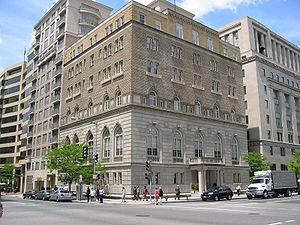
, (red building with white steps) the fourth and final headquarters for the Congress of Industrial Organizations. As of 2008, the building is owned by the federal government and houses small units attached to the Executive Office of the President.]
The unemployment problem ended in the United States with the beginning of World War II, as stepped up wartime production created millions of new jobs, and the draft pulled young men out. The war mobilization also changed the CIO’s relationship with both employers and the national government.
Having failed to ally with capitalist countries against fascism in the eves of the World War II
, in August 1939 the Soviet Union
signed a non-aggression pact
with Nazi Germany
, the Molotov-Ribbentrop Pact
, which would later be broken by the Nazis. Many Communists in Western parties repudiated this action and resigned their party membership in protest. American Communists took the public position of being opposed to the war against Germany. The Mine Workers led by Lewis, with a strong pro-Soviet presence, opposed Roosevelt’s reelection in 1940 and left the CIO in 1942. After June 1941, when Germany invaded the Soviet Union, the Communists became fervent supporters of the war and sought to end wildcat strikes that might hurt war production. The CIO, and in particular the UAW, supported a wartime no-strike pledge that aimed to eliminate not only major strikes for new contracts, but also the innumerable small strikes called by shop stewards and local union leadership to protest particular grievances.
That pledge did not, however, actually eliminate all wartime strikes; in fact there were nearly as many strikes in 1944 as there had been in 1937. But those strikes tended to be far shorter and far less tumultuous than the earlier ones, usually involving small groups of workers over working conditions and other local concerns.
The CIO did not, on the other hand, strike over wages during the war. In return for labor’s no-strike pledge, the government offered arbitration
to determine the wages and other terms of new contracts. Those procedures produced modest wage increases during the first few years of the war, but, over time, not enough to keep up with inflation, particularly when combined with the slowness of the arbitration machinery.
Yet even though the complaints from union members about the no-strike pledge became louder and more bitter, the CIO did not abandon it. The Mine Workers, by contrast, who did not belong to either the AFL or the CIO for much of the war, engaged in a successful twelve-day strike in 1943.
But the CIO unions on the whole grew stronger during the war. The government put pressure on employers to recognize unions to avoid the sort of turbulent struggles over union recognition of the 1930s, while unions were generally able to obtain maintenance of membership clauses, a form of union security
, through arbitration and negotiation. Workers also won benefits, such as vacation pay, that had been available only to a few in the past while wage gaps between higher skilled and less skilled workers narrowed.
The experience of bargaining on a national basis, while restraining local unions from striking, also tended to accelerate the trend toward bureaucracy within the larger CIO unions. Some, such as the Steelworkers, had always been centralized organizations in which authority for major decisions resided at the top. The UAW, by contrast, had always been a more grassroots organization, but it also started to try to rein in its maverick local leadership during these years.
The CIO also had to confront deep racial divides in its own membership, particularly in the UAW plants in Detroit
where white workers sometimes struck to protest the promotion of black workers to production jobs. It also worked on this issue in shipyards in Alabama, mass transit in Philadelphia, and steel plants in Baltimore. The CIO leadership, particularly those in more left unions such as the Packinghouse Workers, the UAW, the NMU and the Transport Workers, undertook serious efforts to suppress hate strikes, to educate their membership and to support the Roosevelt Administration’s tentative efforts to remedy racial discrimination in war industries through the Fair Employment Practices Commission
. Those unions contrasted their relatively bold attack on the problem with the timidity and racism of the AFL.
The CIO unions were less progressive in dealing with sex discrimination in wartime industry, which now employed many more women workers in nontraditional jobs. Some unions who had represented large numbers of women workers before the war, such as the UE and the Food and Tobacco Workers, had fairly good records of fighting discrimination against women; others often saw them as merely wartime replacements for the men in the armed forces.
Murray, as head of both the CIO and the Steelworkers, wanted to avoid a wave of mass strikes in favor of high-level negotiations with employers, with government intervention to balance wage demands with price controls. That project failed when employers showed that they were not willing to accept the wartime status quo, but instead demanded broad management rights clauses to reassert their workplace authority, while the new Truman
administration proved unwilling to intervene on labor’s side.
The UAW took a different tack: rather than involve the federal government, it wanted to bargain directly with GM over management issues, such as the prices it charged for its cars, and went on strike for 113 days over these and other issues. The union eventually settled for the same wage increase that the Steelworkers and the UE had gotten in their negotiations; GM not only did not concede any of its managerial authority, but never even bargained over the UAW’s proposals over its pricing policies.
These strikes were qualitatively different from those waged over union recognition in the 1930s: employers did not try to hire strikebreakers to replace their employees, while the unions kept a tight lid on picketers to maintain order and decorum even as they completely shut down some of the largest enterprises in the United States.
The CIO’s major organizing drive of this era, Operation Dixie
, aimed at the textile workers of the South, was a complete failure, due to the CIO’s reluctance to confront Jim Crow
. Although the Steelworkers' Southern outpost in the steel industry remained intact, the CIO and the union movement as a whole remained marginalized in the Deep South and surrounding states.
In 1946 the Republican Party took control of both the House and Senate. That Congress passed the Taft-Hartley Act
, which made organizing more difficult, gave the states authority to pass right to work
laws, and outlawed certain types of strikes and secondary boycotts. It also required all union officers to sign an affidavit that they were not Communists in order for the union to bring a case before the NLRB. This affidavit requirement, later declared unconstitutional by the United States Supreme Court, was the first sign of serious trouble ahead for a number of Communists in the CIO.
, and Fur and Leather Workers
. Other Communists held senior staff positions in a number of other unions.
The leftists had an uneasy relationship with Murray while he headed the CIO. He mistrusted the radicalism of some of their positions and was innately far more sympathetic to anti-Communist organizations such as the Association of Catholic Trade Unionists. He also believed, however, that making anti-Communism a crusade would only strengthen labor’s enemies and the rival AFL at a time when labor unity was most important.
Murray might have let the status quo continue, even while Walter Reuther
and others within the CIO attacked Communists in their unions, if the CPUSA had not chosen to back Henry Wallace
's Progressive Party
campaign for President in 1948. That, and an increasingly bitter division over whether the CIO should support the Marshall Plan
, brought Murray to the conclusion that peaceful co-existence with Communists within the CIO was impossible.
Murray began by removing Bridges from his position as the California Regional Director for the CIO and firing Lee Pressman as General Counsel of both the Steelworkers and the CIO. Anti-communist unionists then took the battle to the City and State Councils where they ousted Communist leaders who did not support the CIO’s position favoring the Marshall Plan and opposing Wallace.
After the 1948 election, the CIO took the fight one step further, expelling the ILWU, Mine, Mill, the Farm Equipment Union (FE), the Food and Tobacco Workers, and the Fur and Leather Workers after a series of internal trials in the first few months of 1950, while creating a new union, the International Union of Electrical, Radio and Machine Workers(IUE), to replace the United Electrical, Radio and Machine Workers (UE), which left the CIO.
, who had headed the AFL since the 1920s, died the same month. Reuther began discussing merger of the two organizations with George Meany
, Green’s successor as head of the AFL, the next year.
Most of the critical differences that once separated the two organizations had faded since the 1930s. The AFL had not only embraced industrial organizing, but included industrial unions, such as the International Association of Machinists, that had become as large as the UAW or the Steelworkers.
The AFL had a number of advantages in those negotiations. It was, for one thing, twice as large as the CIO. The CIO was, for its part, once again facing internal rivalries that threatened to seriously weaken it.
Reuther was spurred toward merger by the threats from David J. McDonald
, Murray’s successor as President of the Steelworkers, who disliked Reuther intensely, insulted him publicly and flirted with disaffiliation from the CIO. While Reuther set out a number of conditions for merger with the AFL, such as constitutional provisions supporting industrial unionism, guarantees against racial discrimination, and internal procedures to clean up corrupt unions, his weak bargaining position forced him to compromise most of these demands. Although the unions that made up the CIO survived, and in some cases thrived, as members of the newly created AFL-CIO, the CIO as an organization was folded into the AFL-CIO's Industrial Union Department.
*
Category:Former United States labor unions
Category:AFL–CIO
Category:Organizations established in 1935
Category:1955 disestablishments
Category:History of the United States (1918–1945)
Category:Supraorganizations
Category:History of labor relations in the United States
Category:National federations of trade unions
da:Congress of Industrial Organizations
de:CIO (Gewerkschaft)
fr:Congrès des organisations industrielles
ru:Конгресс производственных профсоюзов США
fi:CIO
sv:Congress of Industrial Organizations
zh:产业工会联合会
John L. Lewis
John Llewellyn Lewis was an American leader of organized labor who served as president of the United Mine Workers of America from 1920 to 1960...
in 1932, was a federation of unions
Labor unions in the United States
Labor unions in the United States are legally recognized as representatives of workers in many industries. The most prominent unions are among public sector employees such as teachers and police...
that organized workers in industrial unions
Industrial unionism
Industrial unionism is a labor union organizing method through which all workers in the same industry are organized into the same union—regardless of skill or trade—thus giving workers in one industry, or in all industries, more leverage in bargaining and in strike situations...
in the United States
United States
The United States of America is a federal constitutional republic comprising fifty states and a federal district...
and Canada
Canada
Canada is a North American country consisting of ten provinces and three territories. Located in the northern part of the continent, it extends from the Atlantic Ocean in the east to the Pacific Ocean in the west, and northward into the Arctic Ocean...
from 1935 to 1955. The Taft-Hartley Act
Taft-Hartley Act
The Labor–Management Relations Act is a United States federal law that monitors the activities and power of labor unions. The act, still effective, was sponsored by Senator Robert Taft and Representative Fred A. Hartley, Jr. and became law by overriding U.S. President Harry S...
of 1947 required union leaders to swear that they were not Communists. Many CIO leaders refused to obey that requirement, later found unconstitutional. The CIO merged with the American Federation of Labor
American Federation of Labor
The American Federation of Labor was one of the first federations of labor unions in the United States. It was founded in 1886 by an alliance of craft unions disaffected from the Knights of Labor, a national labor association. Samuel Gompers was elected president of the Federation at its...
to form the AFL-CIO
AFL-CIO
The American Federation of Labor and Congress of Industrial Organizations, commonly AFL–CIO, is a national trade union center, the largest federation of unions in the United States, made up of 56 national and international unions, together representing more than 11 million workers...
in 1955.
The CIO supported Franklin D. Roosevelt
Franklin D. Roosevelt
Franklin Delano Roosevelt , also known by his initials, FDR, was the 32nd President of the United States and a central figure in world events during the mid-20th century, leading the United States during a time of worldwide economic crisis and world war...
and the New Deal Coalition
New Deal coalition
The New Deal Coalition was the alignment of interest groups and voting blocs that supported the New Deal and voted for Democratic presidential candidates from 1932 until the late 1960s. It made the Democratic Party the majority party during that period, losing only to Dwight D. Eisenhower in 1952...
, and was open to African American
African American
African Americans are citizens or residents of the United States who have at least partial ancestry from any of the native populations of Sub-Saharan Africa and are the direct descendants of enslaved Africans within the boundaries of the present United States...
s. Both federations grew rapidly during the Great Depression. The rivalry for dominance was bitter and sometimes violent. The CIO (Committee for Industrial Organization) was founded on November 9, 1935, by eight international union
Trade union
A trade union, trades union or labor union is an organization of workers that have banded together to achieve common goals such as better working conditions. The trade union, through its leadership, bargains with the employer on behalf of union members and negotiates labour contracts with...
s belonging to the American Federation of Labor
American Federation of Labor
The American Federation of Labor was one of the first federations of labor unions in the United States. It was founded in 1886 by an alliance of craft unions disaffected from the Knights of Labor, a national labor association. Samuel Gompers was elected president of the Federation at its...
.
In its statement of purpose, the CIO said it had formed to encourage the AFL to organize workers in mass production industries along industrial union lines. The CIO failed to change AFL policy from within. On September 10, 1936, the AFL suspended all 10 CIO unions (two more had joined in the previous year). In 1938, these unions formed the Congress of Industrial Organizations as a rival labor federation. In 1955, the CIO rejoined the AFL, forming the new entity known as the American Federation of Labor-Congress of Industrial Organizations
AFL-CIO
The American Federation of Labor and Congress of Industrial Organizations, commonly AFL–CIO, is a national trade union center, the largest federation of unions in the United States, made up of 56 national and international unions, together representing more than 11 million workers...
(AFL-CIO).
History
Labor unions in the United States
Labor unions in the United States are legally recognized as representatives of workers in many industries. The most prominent unions are among public sector employees such as teachers and police...
over whether and how to organize industrial workers. Those who favored craft unionism
Craft unionism
Craft unionism refers to organizing a union in a manner that seeks to unify workers in a particular industry along the lines of the particular craft or trade that they work in by class or skill level...
believed that the most effective way to represent workers was to defend the advantages they had secured through their skills. They focused on the hiring of skilled workers, such as carpenters, lithographers, and railroad engineers, in an attempt to maintain as much control as possible over the work their members did through enforcement of work rules, zealous defense of their jurisdiction to certain types of work, control over apprenticeship programs, and exclusion of less skilled workers from membership.
Craft unionists were opposed to organizing workers on an industrial basis (efficiency), i.e. into unions that represented all of the production workers in a particular enterprise, rather than in separate units divided along craft lines.
The proponents of industrial unionism
Industrial unionism
Industrial unionism is a labor union organizing method through which all workers in the same industry are organized into the same union—regardless of skill or trade—thus giving workers in one industry, or in all industries, more leverage in bargaining and in strike situations...
, on the other hand, generally believed that craft distinctions may have been appropriate in those industries in which craft unions had flourished, such as construction or printing, but that they were unworkable in industries such as steel or auto production. In their view, dividing workers in a single plant into a number of different crafts represented by separate organizations, each with its own agenda, would weaken the workers’ bargaining power and leave the majority, who had few traditional craft skills, completely unrepresented.
While the AFL had always included a number of industrial unions, such as the United Mine Workers
United Mine Workers
The United Mine Workers of America is a North American labor union best known for representing coal miners and coal technicians. Today, the Union also represents health care workers, truck drivers, manufacturing workers and public employees in the United States and Canada...
and the Brewery Workers
International Union of United Brewery, Flour, Cereal, Soft Drink and Distillery Workers
The International Union of United Brewery, Flour, Cereal, Soft Drink and Distillery Workers was an labor union in the United States. The union merged with the Teamsters in 1973.-Early history:...
, by the 1930s the most dogmatic craft unionists had a strong hold on power within the federation. They used that power to quash any drive toward industrial organizing.
Industrial unionism became even more fierce in the 1930s, when the Great Depression in the United States
Great Depression in the United States
The Great Depression began with the Wall Street Crash of October, 1929 and rapidly spread worldwide. The market crash marked the beginning of a decade of high unemployment, poverty, low profits, deflation, plunging farm incomes, and lost opportunities for economic growth and personal advancement...
caused large membership drops in some unions, such as the United Mine Workers of America and the International Ladies' Garment Workers' Union
International Ladies' Garment Workers' Union
The International Ladies' Garment Workers' Union was once one of the largest labor unions in the United States, one of the first U.S. unions to have a primarily female membership, and a key player in the labor history of the 1920s and 1930s...
. A number of labor leaders, and in particular John L. Lewis
John L. Lewis
John Llewellyn Lewis was an American leader of organized labor who served as president of the United Mine Workers of America from 1920 to 1960...
of the Mine Workers, came to the conclusion that their own unions would not survive while the great majority of workers in basic industry remained nonunion. They started to press the AFL to change its policies in this area.
The AFL did, in fact, respond, and added even more new members than the CIO. The AFL had long permitted the formation of “federal” unions, which were affiliated directly with the AFL; in 1933 it proposed to use these to organize workers on an industrial basis. The AFL did not, however, promise to allow those unions to maintain a separate identity indefinitely. That meant these unions might be broken up later in order to distribute their members among the craft unions that claimed jurisdiction over their work. The AFL, in fact, dissolved hundreds of federal unions in late 1934 and early 1935.
While the bureaucratic leadership of the AFL was unable to win strikes, three victorious strikes suddenly exploded onto the scene in 1934. These were the Minneapolis Teamsters Strike of 1934
Minneapolis Teamsters Strike of 1934
The Minneapolis General Strike of 1934 grew out of a strike by Teamsters against most of the trucking companies operating in Minneapolis, a major distribution center for the Upper Midwest. The strike began on May 16, 1934 in the Market District and ensuing violence lasted periodically throughout...
the leadership of which included some members of the Trotskyist Communist League of America
Communist League of America
The Communist League of America was founded by James P. Cannon, Max Shachtman and Martin Abern late in 1928 after their expulsion from the Communist Party USA for Trotskyism. The CLA was the United States section of Leon Trotsky's International Left Opposition and initially positioned itself as...
, the 1934 West Coast Longshore Strike
1934 West Coast Longshore Strike
The 1934 West Coast Waterfront Strike lasted eighty-three days, triggered by sailors and a four-day general strike in San Francisco, and led to the unionization of all of the West Coast ports of the United States...
the leadership of which included some members of the Communist Party USA
Communist Party USA
The Communist Party USA is a Marxist political party in the United States, established in 1919. It has a long, complex history that is closely related to the histories of similar communist parties worldwide and the U.S. labor movement....
, and the 1934 Toledo Auto-Lite Strike
Auto-Lite strike
The Toledo Auto-Lite strike was a strike by a federal labor union of the American Federation of Labor against the Electric Auto-Lite company of Toledo, Ohio, from April 12 to June 3, 1934....
led by the American Workers Party
American Workers Party
The American Workers Party was a socialist organization established in December 1933 by activists in the Conference for Progressive Labor Action, a group headed by A.J. Muste.-Formation:...
. Victorious industrial unions with militant leaderships were the catalyst that brought about the rise of the CIO.
The AFL did authorize organizing drives in the automobile, rubber and steel industries at its convention in 1934, but gave little financial support or effective leadership to those unions. The AFL’s timidity only succeeded in making it less credible among the workers it was supposedly trying to organize. This was especially significant in those industries, such as auto and rubber, in which workers had already achieved some organizing success at great personal risk.
The dispute came to a head at the AFL’s convention in Atlantic City in 1935, when William Hutcheson
William Hutcheson
William Hutcheson was the leader of the United Brotherhood of Carpenters and Joiners of America from 1915 until 1952. A conservative craft unionist, he opposed the organization of workers in mass production industries such as steel and automobile manufacturing into industrial unions...
, the President of the Carpenters
United Brotherhood of Carpenters and Joiners of America
The United Brotherhood of Carpenters and Joiners of America is one of the largest building trades union in the United States. One of the unions that formed the American Federation of Labor in 1886, it left the AFL-CIO in 2001.-Early years:...
, made a slighting comment about a rubber worker delivering an organizing report. Lewis responded that Hutcheson’s comment was “small potatoes,” to which Hutcheson replied “I was raised on small potatoes, that is why I am so small.” After some more words, Lewis punched Hutcheson, knocking him to the ground; Lewis then relit his cigar and returned to the rostrum. The incident – which was also “small potatoes,” but very memorable – helped cement Lewis’ image in the public eye as someone willing to fight for workers’ right to organize.
Shortly after the Convention, Lewis called together Charles Howard, President of the International Typographical Union
International Typographical Union
The International Typographical Union was a labor union founded on May 3, 1852 in the United States as the National Typographical Union. In its 1869 convention in Albany, New York, the union—having organized members in Canada—changed its name to the International Typographical Union...
, Sidney Hillman
Sidney Hillman
Sidney Hillman was an American labor leader. Head of the Amalgamated Clothing Workers of America, he was a key figure in the founding of the Congress of Industrial Organizations and in marshaling labor's support for Franklin Delano Roosevelt and the Democratic Party.-Early years:Sidney Hillman was...
, head of the Amalgamated Clothing Workers of America
Amalgamated Clothing Workers of America
The Amalgamated Clothing Workers of America was a United States labor union known for its support for "social unionism" and progressive political causes. Led by Sidney Hillman for its first thirty years, it helped found the Congress of Industrial Organizations...
, David Dubinsky
David Dubinsky
David Dubinsky was an American labor leader...
, President of the ILGWU, Thomas McMahon
Thomas McMahon
Thomas McMahon is a former volunteer in the South Armagh Brigade of the Provisional Irish Republican Army , and was one of the IRA's most experienced bomb-makers....
, head of the United Textile Workers, John Sheridan of the Mine, Mill and Smelter Workers Union
Western Federation of Miners
The Western Federation of Miners was a radical labor union that gained a reputation for militancy in the mines of the western United States and British Columbia. Its efforts to organize both hard rock miners and smelter workers brought it into sharp conflicts – and often pitched battles...
, Harvey Fremming from the Oil Workers Union and Max Zaritsky of the Hatters, Cap and Millinery Workers to discuss the formation of a new group within the AFL to carry on the fight for industrial organizing. The creation of the CIO was announced on November 9, 1936. Whether Lewis always intended to split the AFL over this issue is debatable; at the outset, the CIO presented itself as only a group of unions within the AFL gathered to support industrial unionism, rather than a group opposed to the AFL itself.
The AFL leadership, however, treated the CIO as an enemy from the outset, refusing to deal with it and demanding that it dissolve. The AFL’s opposition to the CIO, however, only increased the stature of the CIO and Lewis in the eyes of those industrial workers keen on organizing and disillusioned with the AFL’s ineffective performance. Lewis continued to denounce the AFL’s policies while the CIO offered organizing support to workers in the rubber industry who went on strike and formed the Steel Workers Organizing Committee
Steel Workers Organizing Committee
The Steel Workers Organizing Committee was one of two precursor labor organizations to the United Steelworkers. It was formed by the CIO in 1936. It disbanded in 1942 to become the United Steel Workers of America....
(SWOC), in defiance of all of the craft divisions that the AFL had required in past organizing efforts, in 1936; Lee Pressman
Lee Pressman
Lee Pressman was a labor attorney and a US government functionary publicly exposed in 1948 for having been a spy for the Soviet foreign intelligence network during the middle 1930s...
, affiliated with the far left, became the union's General Counsel.
The first major industrial union to be chartered by the CIO on November 16, 1938 were the United Electrical, Radio and Machine Workers of America
United Electrical, Radio and Machine Workers of America
The United Electrical, Radio and Machine Workers of America , is an independent democratic rank-and-file labor union representing workers in both the private and public sectors across the United States....
, also called the UE.
The subsequent explosive growth of the UE was instrumental for the survival in those early days of the CIO. By the end of 1936, the UE had organized the General Electric plant at Schenectady, NY and the UE went on to organize 358 more local unions with contracts covering over 600,000 workers in 1,375 plants.
Initial triumphs
The CIO met with dramatic initial successes in 1937, with the UAWUnited Auto Workers
The International Union, United Automobile, Aerospace and Agricultural Implement Workers of America, better known as the United Auto Workers , is a labor union which represents workers in the United States and Puerto Rico, and formerly in Canada. Founded as part of the Congress of Industrial...
winning union recognition at General Motors Corporation after a tumultuous forty-four day sit-down strike, while the Steel Workers Organizing Committee
Steel Workers Organizing Committee
The Steel Workers Organizing Committee was one of two precursor labor organizations to the United Steelworkers. It was formed by the CIO in 1936. It disbanded in 1942 to become the United Steel Workers of America....
(SWOC) signed a collective bargaining agreement with U.S. Steel. Those two victories, however, came about very differently.
The CIO’s initial strategy was to focus its efforts in the steel industry and then build from there. The UAW, however, did not wait for the CIO to lead it. Instead, having built up a membership of roughly 25,000 workers by gathering in federal unions and some locals from rival unions in the industry, the union decided to go after GM, the largest car maker of them all, by shutting down its nerve center, the production complex in Flint, Michigan
Flint, Michigan
Flint is a city in the U.S. state of Michigan and is located along the Flint River, northwest of Detroit. The U.S. Census Bureau reports the 2010 population to be placed at 102,434, making Flint the seventh largest city in Michigan. It is the county seat of Genesee County which lies in the...
.
The Flint Sit-Down Strike
Flint Sit-Down Strike
The 1936–1937 Flint Sit-Down Strike changed the United Automobile Workers from a collection of isolated locals on the fringes of the industry into a major labor union and led to the unionization of the domestic United States automobile industry....
was a risky and illegal enterprise from the outset: the union was able to share its plans with only a few workers because of the danger that spies employed by GM would alert management in time to stop it, yet needed to be able to mobilize enough to seize physical control of GM’s factories. The union, in fact, not only took over several GM factories in Flint, including one that made the dies necessary to stamp automotive body parts and a companion facility in Cleveland, Ohio
Cleveland, Ohio
Cleveland is a city in the U.S. state of Ohio and is the county seat of Cuyahoga County, the most populous county in the state. The city is located in northeastern Ohio on the southern shore of Lake Erie, approximately west of the Pennsylvania border...
, but held on to those sites despite repeated attempts by the police and National Guard to retake them and court orders threatening the union with ruinous fines if it did not call off the strike.
While Lewis played a key role in negotiating the one-page agreement that ended the strike with GM’s promise to recognize the UAW as the exclusive bargaining representative of its employees for a six months period, UAW activists, rather than CIO staff, led the strike.
The organizing campaign in the steel industry, by contrast, was a top-down affair. Lewis, who had a particular interest in organizing the steel industry because of its important role in the coal industry where UMW members worked, dispatched hundreds of organizers, many his past political opponents or radicals drawn from the Communist-led unions that had attempted to organize the industry earlier in the 1930s, to sign up members. Lewis was not particularly concerned with the political beliefs of his organizers, so long as he controlled the organization; as he once famously remarked, when asked about the “reds” on the SWOC staff, “Who gets the bird? The hunter or the dog?”.
The SWOC signed up thousands of members and absorbed a number of company unions at U.S. Steel and elsewhere, but did not attempt the sort of daring strike that the UAW had pulled off against GM. Instead Lewis was able to extract a collective bargaining agreement from U.S. Steel, which had previously been an implacable enemy of unions, by pointing to the chaos and loss of business that GM had suffered by fighting the UAW. The agreement provided for union recognition, a modest wage increase and a grievance procedure.
The CIO also won several significant legal battles. Hague v. Committee for Industrial Organization
Hague v. Committee for Industrial Organization
Hague v. Committee for Industrial Organization, 307 U.S. 496 , is a case decided by the United States Supreme Court. The case involved Jersey City, New Jersey Mayor Frank "Boss" Hague who had in 1937 used a city ordinance to prevent labor meetings in public places and stop the distribution of...
307 U.S. 496 (1939), arose out of events late in 1937. Jersey City, New Jersey
Jersey City, New Jersey
Jersey City is the seat of Hudson County, New Jersey, United States.Part of the New York metropolitan area, Jersey City lies between the Hudson River and Upper New York Bay across from Lower Manhattan and the Hackensack River and Newark Bay...
Mayor
Mayor
In many countries, a Mayor is the highest ranking officer in the municipal government of a town or a large urban city....
Frank "Boss" Hague
Frank Hague
Frank Hague was an American Democratic Party politician who served as the mayor of Jersey City, New Jersey from 1917 to 1947, Democratic National Committeeman from New Jersey from 1922 until 1949, and Vice-Chairman of the Democratic National Committee from 1924 until 1949.Hague has a widely-known...
had used a city ordinance to prevent labor meetings in public places and stop the distribution of literature pertaining to the CIO's cause. District and circuit courts ruled in favor of the CIO. Hague appealed to the United States Supreme Court, which held in 1939 that Hague's ban on political meetings violated the First Amendment right to freedom of assembly.
Early setbacks and successes
The UAW was able to capitalize on its stunning victory over GM by winning recognition at ChryslerChrysler
Chrysler Group LLC is a multinational automaker headquartered in Auburn Hills, Michigan, USA. Chrysler was first organized as the Chrysler Corporation in 1925....
and smaller manufacturers. It then focused its organizing efforts on Ford, sometimes battling company security forces as at the Battle of the Overpass on May 26, 1937; but there were no concrete organizing successes.
At the same time, the UAW was in danger of being torn apart by internal political rivalries. Homer Martin
Homer Martin
Homer Martin was American trade unionist and socialist.After high school he attended Hewing College and received his AB from William Jewel College...
, the first president of the UAW, expelled a number of the union organizers who had led the Flint sit-down strike and other early drives on charges that they were communist
Communist Party USA
The Communist Party USA is a Marxist political party in the United States, established in 1919. It has a long, complex history that is closely related to the histories of similar communist parties worldwide and the U.S. labor movement....
s. In some cases, such as Wyndham Mortimer, Bob Travis and Henry Kraus
Henry Kraus
Henry Kraus was a labor historian, and European art historian.He graduated from the University of Chicago and Western Reserve University with a master's degree in 1928....
, those charges may have been true; in other cases, such as Victor Reuther and Roy Reuther, they were probably not. Those expulsions were reversed at the next convention of the UAW in 1939, which expelled Martin instead. He took approximately 20,000 UAW members with him to form a rival union, known for a time as the UAW-AFL, later renamed the Allied Industrial Workers of America.
The SWOC encountered equally serious problems: after winning union recognition after a strike against Jones & Laughlin Steel, SWOC's strikes against the rest of "Little Steel," i.e., Bethlehem Steel Corporation, Youngstown Sheet and Tube
Youngstown Sheet and Tube
The Youngstown Iron Sheet and Tube Company, based in Youngstown, Ohio, was one of the largest steel manufacturers in the world. Officially, the company was created on November 23, 1900, when Articles of Incorporation of the Youngstown Iron Sheet and Tube Company were filed with the Ohio Secretary...
, National Steel
National Steel Corporation
The National Steel Corporation was a major American steel producer. It was founded in 1929 through a merger arranged by Weirton Steel with some properties of the Great Lakes Steel Corporation and M.A. Hanna Company. Despite a difficult market in Depression-setting 1930, the company reported USD...
, Inland Steel American Rolling Mills and Republic Steel
Republic Steel
Republic Steel was once the third largest steel producer in the United States.The Republic Iron and Steel Company was founded in Youngstown, Ohio in 1899....
failed, in spite of support from organizations like the Catholic Radical Alliance
Catholic Radical Alliance
The Catholic Radical Alliance was founded in Pittsburgh, Pennsylvania in 1937 by Roman Catholic priests Charles Owen Rice, Carl Hensler, and George Barry O'Toole. , with the approval of their bishop, Hugh C. Boyle. It supported the unionization of workers in the H.J. Heinz Company and the Loose...
. The steelmakers offered workers the same wage increases that U.S. Steel had offered, In the Memorial Day Massacre
Memorial Day massacre of 1937
In the Memorial Day massacre of 1937, the Chicago Police Department shot and killed ten unarmed demonstrators in Chicago, on May 30, 1937. The incident took place during the "Little Steel Strike" in the United States....
on May 30, 1937, Chicago
Chicago
Chicago is the largest city in the US state of Illinois. With nearly 2.7 million residents, it is the most populous city in the Midwestern United States and the third most populous in the US, after New York City and Los Angeles...
police opened fire on a group of strikers who had attempted to picket at Republic Steel, killing ten and seriously wounding dozens. A month and a half later police in Massillon, Ohio
Massillon, Ohio
Massillon is a city located in Stark County in the U.S. state of Ohio, approximately 8 miles to the west of Canton, Ohio, 20 miles south of Akron, Ohio, and 50 miles south of Cleveland, Ohio. The population was 32,149 at the 2010 census....
fired on a crowd of unionists, resulting in three deaths, when one union supporter failed to dim his headlights. The strike collapsed shortly thereafter.
The CIO found organizing textile workers in the South
Southern United States
The Southern United States—commonly referred to as the American South, Dixie, or simply the South—constitutes a large distinctive area in the southeastern and south-central United States...
even harder. As in steel, these workers had abundant recent first-hand experience of failed organizing drives and defeated strikes, which resulted in unionists being blacklist
Blacklist
A blacklist is a list or register of entities who, for one reason or another, are being denied a particular privilege, service, mobility, access or recognition. As a verb, to blacklist can mean to deny someone work in a particular field, or to ostracize a person from a certain social circle...
ed or worse. In addition, the intense antagonism of white workers toward black workers and the conservative political and religious milieu made organizing even harder. On the other hand, some independent left-wing unions, such as Mine, Mill and the Food, Tobacco, Agricultural, and Allied Workers Union of America, that aggressively organized both black and white workers had more success than the more cautious Textile Workers Organizing Committee founded by the CIO.
Adding to the uncertainties for the CIO was its own internal disarray. When the CIO formally established itself as a rival to the AFL in 1938, renaming itself as the Congress of Industrial Organizations, the ILGWU and the Millinery Workers left the CIO to return to the AFL. Lewis feuded with Hillman and Philip Murray
Philip Murray
Philip Murray was a Scottish born steelworker and an American labor leader. He was the first president of the Steel Workers Organizing Committee , the first president of the United Steelworkers of America , and the longest-serving president of the Congress of Industrial Organizations .-Early...
, his long-time assistant and head of the SWOC, over both the CIO's own activities and its relations with the FDR administration. Lewis finally resigned as President of the CIO in 1941, after endorsing Wendell Willkie
Wendell Willkie
Wendell Lewis Willkie was a corporate lawyer in the United States and a dark horse who became the Republican Party nominee for the president in 1940. A member of the liberal wing of the GOP, he crusaded against those domestic policies of the New Deal that he thought were inefficient and...
for President in 1940, choosing his protégé Murray to succeed him.
The doldrums did not last forever, however. The UAW finally organized Ford in 1941. The SWOC, now known as the United Steel Workers of America, won recognition in Little Steel in 1941 through a combination of strikes and National Labor Relations Board
National Labor Relations Board
The National Labor Relations Board is an independent agency of the United States government charged with conducting elections for labor union representation and with investigating and remedying unfair labor practices. Unfair labor practices may involve union-related situations or instances of...
elections in the same year. Other CIO affiliates made progress during these years in organizing workers in mass transit, packinghouses, tire factories, shipyards and electrical manufacturers while the UAW successfully organized aircraft workers.
In addition, after the west coast longshoremen organized in the strike
1934 West Coast Longshore Strike
The 1934 West Coast Waterfront Strike lasted eighty-three days, triggered by sailors and a four-day general strike in San Francisco, and led to the unionization of all of the West Coast ports of the United States...
led by Harry Bridges
Harry Bridges
Harry Bridges was an Australian-American union leader, in the International Longshore and Warehouse Union , a longshore and warehouse workers' union on the West Coast, Hawaii and Alaska which he helped form and led for over 40 years...
in 1934 split from the International Longshoremen's Association
International Longshoremen's Association
The International Longshoremen's Association is a labor union representing longshore workers along the East Coast of the United States and Canada, the Gulf Coast, the Great Lakes, Puerto Rico, and inland waterways...
in 1937 to form the International Longshoremen's and Warehousemen's Union
International Longshore and Warehouse Union
The International Longshore and Warehouse Union is a labor union which primarily represents dock workers on the West Coast of the United States, Hawaii and Alaska, and in British Columbia, Canada. It also represents hotel workers in Hawaii, cannery workers in Alaska, warehouse workers throughout...
, the ILWU joined the CIO. Bridges became the most powerful force within the CIO in California and the west. The Transport Workers Union of America
Transport Workers Union of America
Transport Workers Union of America is a United States labor union that was founded in 1934 by subway workers in New York City, then expanded to represent transit employees in other cities, primarily in the eastern U.S. This article discusses the parent union and its largest local, Local 100,...
, originally representing the subway workers in New York, also joined, as did the National Maritime Union
National Maritime Union
The National Maritime Union was an American labor union founded in May 1937. It affiliated with the Congress of Industrial Organizations in July 1937...
, made up of sailors based on the east coast, and the United Electrical, Radio and Machine Workers
United Electrical, Radio and Machine Workers of America
The United Electrical, Radio and Machine Workers of America , is an independent democratic rank-and-file labor union representing workers in both the private and public sectors across the United States....
, which represented workers in a range of electrical manufacturing facilities.
The AFL continued to fight the CIO, forcing the NLRB to allow skilled trades employees in large industrial facilities the option to choose, in what came to be called "Globe elections," between representation by the CIO or separate representation by AFL craft unions. The CIO now also faced competition, moreover, from a number of AFL affiliates who now sought to organize industrial workers. The competition was particularly sharp in the aircraft industry, where the UAW went head-to-head against the International Association of Machinists, originally a craft union of railroad workers and skilled trade employees. The AFL organizing drives proved even more successful, and they gained new members as fast or faster than the CIO. In some instances bloody confrontations took place between the rival federations, each supported by their political allies.
The Dies Committee determined in 1938 that 280 salaried CIO organizers, were members of the CPUSA.
Growth during the Second World War
ile:718 Jackson Pl NW 2008.JPG|thumb|left|300px|718 Jackson Place NW, Washington, D.C.Washington, D.C.
Washington, D.C., formally the District of Columbia and commonly referred to as Washington, "the District", or simply D.C., is the capital of the United States. On July 16, 1790, the United States Congress approved the creation of a permanent national capital as permitted by the U.S. Constitution....
, (red building with white steps) the fourth and final headquarters for the Congress of Industrial Organizations. As of 2008, the building is owned by the federal government and houses small units attached to the Executive Office of the President.]
The unemployment problem ended in the United States with the beginning of World War II, as stepped up wartime production created millions of new jobs, and the draft pulled young men out. The war mobilization also changed the CIO’s relationship with both employers and the national government.
Having failed to ally with capitalist countries against fascism in the eves of the World War II
World War II
World War II, or the Second World War , was a global conflict lasting from 1939 to 1945, involving most of the world's nations—including all of the great powers—eventually forming two opposing military alliances: the Allies and the Axis...
, in August 1939 the Soviet Union
Soviet Union
The Soviet Union , officially the Union of Soviet Socialist Republics , was a constitutionally socialist state that existed in Eurasia between 1922 and 1991....
signed a non-aggression pact
Non-aggression pact
A non-aggression pact is an international treaty between two or more states/countries agreeing to avoid war or armed conflict between them and resolve their disputes through peaceful negotiations...
with Nazi Germany
Nazi Germany
Nazi Germany , also known as the Third Reich , but officially called German Reich from 1933 to 1943 and Greater German Reich from 26 June 1943 onward, is the name commonly used to refer to the state of Germany from 1933 to 1945, when it was a totalitarian dictatorship ruled by...
, the Molotov-Ribbentrop Pact
Molotov-Ribbentrop Pact
The Molotov–Ribbentrop Pact, named after the Soviet foreign minister Vyacheslav Molotov and the German foreign minister Joachim von Ribbentrop, was an agreement officially titled the Treaty of Non-Aggression between Germany and the Soviet Union and signed in Moscow in the late hours of 23 August 1939...
, which would later be broken by the Nazis. Many Communists in Western parties repudiated this action and resigned their party membership in protest. American Communists took the public position of being opposed to the war against Germany. The Mine Workers led by Lewis, with a strong pro-Soviet presence, opposed Roosevelt’s reelection in 1940 and left the CIO in 1942. After June 1941, when Germany invaded the Soviet Union, the Communists became fervent supporters of the war and sought to end wildcat strikes that might hurt war production. The CIO, and in particular the UAW, supported a wartime no-strike pledge that aimed to eliminate not only major strikes for new contracts, but also the innumerable small strikes called by shop stewards and local union leadership to protest particular grievances.
That pledge did not, however, actually eliminate all wartime strikes; in fact there were nearly as many strikes in 1944 as there had been in 1937. But those strikes tended to be far shorter and far less tumultuous than the earlier ones, usually involving small groups of workers over working conditions and other local concerns.
The CIO did not, on the other hand, strike over wages during the war. In return for labor’s no-strike pledge, the government offered arbitration
Arbitration
Arbitration, a form of alternative dispute resolution , is a legal technique for the resolution of disputes outside the courts, where the parties to a dispute refer it to one or more persons , by whose decision they agree to be bound...
to determine the wages and other terms of new contracts. Those procedures produced modest wage increases during the first few years of the war, but, over time, not enough to keep up with inflation, particularly when combined with the slowness of the arbitration machinery.
Yet even though the complaints from union members about the no-strike pledge became louder and more bitter, the CIO did not abandon it. The Mine Workers, by contrast, who did not belong to either the AFL or the CIO for much of the war, engaged in a successful twelve-day strike in 1943.
But the CIO unions on the whole grew stronger during the war. The government put pressure on employers to recognize unions to avoid the sort of turbulent struggles over union recognition of the 1930s, while unions were generally able to obtain maintenance of membership clauses, a form of union security
Union security
A union security agreement is a contractual agreement, usually part of a union collective bargaining agreement, in which an employer and a trade or labor union agree on the extent to which the union may compel employees to join the union, and/or whether the employer will collect dues, fees, and...
, through arbitration and negotiation. Workers also won benefits, such as vacation pay, that had been available only to a few in the past while wage gaps between higher skilled and less skilled workers narrowed.
The experience of bargaining on a national basis, while restraining local unions from striking, also tended to accelerate the trend toward bureaucracy within the larger CIO unions. Some, such as the Steelworkers, had always been centralized organizations in which authority for major decisions resided at the top. The UAW, by contrast, had always been a more grassroots organization, but it also started to try to rein in its maverick local leadership during these years.
The CIO also had to confront deep racial divides in its own membership, particularly in the UAW plants in Detroit
Detroit, Michigan
Detroit is the major city among the primary cultural, financial, and transportation centers in the Metro Detroit area, a region of 5.2 million people. As the seat of Wayne County, the city of Detroit is the largest city in the U.S. state of Michigan and serves as a major port on the Detroit River...
where white workers sometimes struck to protest the promotion of black workers to production jobs. It also worked on this issue in shipyards in Alabama, mass transit in Philadelphia, and steel plants in Baltimore. The CIO leadership, particularly those in more left unions such as the Packinghouse Workers, the UAW, the NMU and the Transport Workers, undertook serious efforts to suppress hate strikes, to educate their membership and to support the Roosevelt Administration’s tentative efforts to remedy racial discrimination in war industries through the Fair Employment Practices Commission
Fair Employment Practices Commission
The Fair Employment Practices Commission implemented US Executive Order 8802, requiring that companies with government contracts not to discriminate on the basis of race or religion. It was intended to help African Americans and other minorities obtain jobs in the homefront industry...
. Those unions contrasted their relatively bold attack on the problem with the timidity and racism of the AFL.
The CIO unions were less progressive in dealing with sex discrimination in wartime industry, which now employed many more women workers in nontraditional jobs. Some unions who had represented large numbers of women workers before the war, such as the UE and the Food and Tobacco Workers, had fairly good records of fighting discrimination against women; others often saw them as merely wartime replacements for the men in the armed forces.
The post-War era
The end of the war meant the end of the no-strike pledge and a wave of strikes as workers sought to make up the ground they had lost, particularly in wages, during the war. The UAW went on strike against GM in November 1945; the Steelworkers, UE and Packinghouse Workers struck in January 1946.Murray, as head of both the CIO and the Steelworkers, wanted to avoid a wave of mass strikes in favor of high-level negotiations with employers, with government intervention to balance wage demands with price controls. That project failed when employers showed that they were not willing to accept the wartime status quo, but instead demanded broad management rights clauses to reassert their workplace authority, while the new Truman
Harry S. Truman
Harry S. Truman was the 33rd President of the United States . As President Franklin D. Roosevelt's third vice president and the 34th Vice President of the United States , he succeeded to the presidency on April 12, 1945, when President Roosevelt died less than three months after beginning his...
administration proved unwilling to intervene on labor’s side.
The UAW took a different tack: rather than involve the federal government, it wanted to bargain directly with GM over management issues, such as the prices it charged for its cars, and went on strike for 113 days over these and other issues. The union eventually settled for the same wage increase that the Steelworkers and the UE had gotten in their negotiations; GM not only did not concede any of its managerial authority, but never even bargained over the UAW’s proposals over its pricing policies.
These strikes were qualitatively different from those waged over union recognition in the 1930s: employers did not try to hire strikebreakers to replace their employees, while the unions kept a tight lid on picketers to maintain order and decorum even as they completely shut down some of the largest enterprises in the United States.
The CIO’s major organizing drive of this era, Operation Dixie
Operation Dixie
Operation Dixie was the name of the post-war campaign by the Congress of Industrial Organizations to unionize industry in the Southern United States, particularly the textile industry...
, aimed at the textile workers of the South, was a complete failure, due to the CIO’s reluctance to confront Jim Crow
Jim Crow laws
The Jim Crow laws were state and local laws in the United States enacted between 1876 and 1965. They mandated de jure racial segregation in all public facilities, with a supposedly "separate but equal" status for black Americans...
. Although the Steelworkers' Southern outpost in the steel industry remained intact, the CIO and the union movement as a whole remained marginalized in the Deep South and surrounding states.
In 1946 the Republican Party took control of both the House and Senate. That Congress passed the Taft-Hartley Act
Taft-Hartley Act
The Labor–Management Relations Act is a United States federal law that monitors the activities and power of labor unions. The act, still effective, was sponsored by Senator Robert Taft and Representative Fred A. Hartley, Jr. and became law by overriding U.S. President Harry S...
, which made organizing more difficult, gave the states authority to pass right to work
Right to work
The right to work is the concept that people have a human right to work, or engage in productive employment, and may not be prevented from doing so...
laws, and outlawed certain types of strikes and secondary boycotts. It also required all union officers to sign an affidavit that they were not Communists in order for the union to bring a case before the NLRB. This affidavit requirement, later declared unconstitutional by the United States Supreme Court, was the first sign of serious trouble ahead for a number of Communists in the CIO.
Purging the Communists
The Taft Hartley Act of 1947 penalized unions whose officers failed to sign statements that they were not members of the Communist Party. Many Communists held power in the CIO unions (few did so in the AFL). The most affected unions were the ILWU, UE, TWU, United Public WorkersUnited Public Workers of America
The United Public Workers of America was an American labor union representing federal, state, county, and local government employees which existed from 1946 to 1952. The union challenged the constitutionality of the Hatch Act of 1939, which prohibited federal executive branch employees from...
, and Fur and Leather Workers
International Fur & Leather Workers Union
The International Fur and Leather Workers Union , was a labor union that represented workers in the fur and leather trades. The IFLWU was founded in 1913 and affiliated with the American Federation of Labor ....
. Other Communists held senior staff positions in a number of other unions.
The leftists had an uneasy relationship with Murray while he headed the CIO. He mistrusted the radicalism of some of their positions and was innately far more sympathetic to anti-Communist organizations such as the Association of Catholic Trade Unionists. He also believed, however, that making anti-Communism a crusade would only strengthen labor’s enemies and the rival AFL at a time when labor unity was most important.
Murray might have let the status quo continue, even while Walter Reuther
Walter Reuther
Walter Philip Reuther was an American labor union leader, who made the United Automobile Workers a major force not only in the auto industry but also in the Democratic Party in the mid 20th century...
and others within the CIO attacked Communists in their unions, if the CPUSA had not chosen to back Henry Wallace
Henry A. Wallace
Henry Agard Wallace was the 33rd Vice President of the United States , the Secretary of Agriculture , and the Secretary of Commerce . In the 1948 presidential election, Wallace was the nominee of the Progressive Party.-Early life:Henry A...
's Progressive Party
Progressive Party (United States, 1948)
The United States Progressive Party of 1948 was a left-wing political party that ran former Vice President Henry A. Wallace of Iowa for president and U.S. Senator Glen H. Taylor of Idaho for vice president in 1948.-Foundation:...
campaign for President in 1948. That, and an increasingly bitter division over whether the CIO should support the Marshall Plan
Marshall Plan
The Marshall Plan was the large-scale American program to aid Europe where the United States gave monetary support to help rebuild European economies after the end of World War II in order to combat the spread of Soviet communism. The plan was in operation for four years beginning in April 1948...
, brought Murray to the conclusion that peaceful co-existence with Communists within the CIO was impossible.
Murray began by removing Bridges from his position as the California Regional Director for the CIO and firing Lee Pressman as General Counsel of both the Steelworkers and the CIO. Anti-communist unionists then took the battle to the City and State Councils where they ousted Communist leaders who did not support the CIO’s position favoring the Marshall Plan and opposing Wallace.
After the 1948 election, the CIO took the fight one step further, expelling the ILWU, Mine, Mill, the Farm Equipment Union (FE), the Food and Tobacco Workers, and the Fur and Leather Workers after a series of internal trials in the first few months of 1950, while creating a new union, the International Union of Electrical, Radio and Machine Workers(IUE), to replace the United Electrical, Radio and Machine Workers (UE), which left the CIO.
Merger with the AFL
Reuther succeeded Murray, who died in 1952, as head of the CIO. William GreenWilliam Green (labor leader)
William Green was an American trade union leader. Green is best remembered for serving as the President of the American Federation of Labor from 1924 to 1952.-Early years:...
, who had headed the AFL since the 1920s, died the same month. Reuther began discussing merger of the two organizations with George Meany
George Meany
William George Meany led labor union federations in the United States. As an officer of the American Federation of Labor, he represented the AFL on the National War Labor Board during World War II....
, Green’s successor as head of the AFL, the next year.
Most of the critical differences that once separated the two organizations had faded since the 1930s. The AFL had not only embraced industrial organizing, but included industrial unions, such as the International Association of Machinists, that had become as large as the UAW or the Steelworkers.
The AFL had a number of advantages in those negotiations. It was, for one thing, twice as large as the CIO. The CIO was, for its part, once again facing internal rivalries that threatened to seriously weaken it.
Reuther was spurred toward merger by the threats from David J. McDonald
David J. McDonald
David John McDonald was an American labor leader and president of the United Steelworkers of America from 1952 to 1965.-Early life:...
, Murray’s successor as President of the Steelworkers, who disliked Reuther intensely, insulted him publicly and flirted with disaffiliation from the CIO. While Reuther set out a number of conditions for merger with the AFL, such as constitutional provisions supporting industrial unionism, guarantees against racial discrimination, and internal procedures to clean up corrupt unions, his weak bargaining position forced him to compromise most of these demands. Although the unions that made up the CIO survived, and in some cases thrived, as members of the newly created AFL-CIO, the CIO as an organization was folded into the AFL-CIO's Industrial Union Department.
Presidents of the CIO, 1935-1956
- John L. LewisJohn L. LewisJohn Llewellyn Lewis was an American leader of organized labor who served as president of the United Mine Workers of America from 1920 to 1960...
1935-1940 - Philip MurrayPhilip MurrayPhilip Murray was a Scottish born steelworker and an American labor leader. He was the first president of the Steel Workers Organizing Committee , the first president of the United Steelworkers of America , and the longest-serving president of the Congress of Industrial Organizations .-Early...
1940-1952 - Walter ReutherWalter ReutherWalter Philip Reuther was an American labor union leader, who made the United Automobile Workers a major force not only in the auto industry but also in the Democratic Party in the mid 20th century...
1952-1955
See also
- Communists in the U.S. Labor Movement (1919-1937)Communists in the U.S. Labor Movement (1919-1937)The Communist Party and its allies played an important role in the United States labor movement, particularly in the 1930s and 1940s, but never succeeded, with rare exceptions, either in bringing the labor movement around to its agenda or in converting their influence in any particular union into...
- Communists in the U.S. Labor Movement (1937-1950)Communists in the U.S. Labor Movement (1937-1950)The Communist Party and its allies played an important role in the United States labor movement, particularly in the 1930s and 1940s, but never succeeded, with rare exceptions, either in bringing the labor movement around to its agenda or in converting their influence in any particular union into...
Archives
- Southern Labor Archives. Department of Special Collections, The University Library, Georgia State UniversityGeorgia State UniversityGeorgia State University is a research university in downtown Atlanta, Georgia, USA. Founded in 1913, it serves about 30,000 students and is one of the University System of Georgia's four research universities...
. (Official repository for hundreds of local and regional union offices, as well as the national offices of IAMAW, NFFE, UGWA, UFWA, PATCO, UTWA, and the Georgia State AFL-CIO.) Online guide retrieved April 27, 2005. - Martin, Katherine F., ed. Operation Dixie: The CIO Organizing Committee Papers, 1946-1953. Media: 75 reels of 35mm microfilm. Online guide to the microfilm edition retrieved April 27, 2005.
- The Washington State CIO Records, 1950-1957. 6 cubic feet At the Labor Archives of Washington State, University of Washington Libraries Special Collections.
Books
- Cohen, Lizabeth. Making a New Deal: Industrial Workers in Chicago, 1919-1939. New york: Cambridge University Press, 1991. ISBN 0521428386
- Fraser, Steven. Labor Will Rule: Sidney Hillman and the Rise of American Labor. Reprint ed. Ithaca, N.Y.: Cornell University Press, 1993. ISBN 0801481260
- Griffith, Barbara S. The Crisis of American Labor: Operation Dixie and the Defeat of the CIO. Philadelphia, Pa.: Temple University Press, 1988. ISBN 0877225036
- Lichtenstein, Nelson. Labor's War at Home: The CIO in World War II. Reprint ed. New York: Cambridge University Press, 1987. ISBN 0521335736
- Lipsitz, George. Rainbow at Midnight: Labor and Culture in the 1940s. Urbana, Ill.: University of Illinois Press, 1994. ISBN 0252063945
- Preis, Art. Labor's Giant Step: The First Twenty Years of the CIO: 1936-55. Rev. ed. New York: Pathfinder Press, 1964. ISBN 0873482638
- Phelan, Craig. William Green: Biography of a Labor Leader. Albany, N.Y.: State University of New York Press, 1989. ISBN 0887068715
- Zieger, Robert H. The CIO 1935-1955. Chapel Hill, N.C.: University of North Carolina Press, 1995. ISBN 0807821829
Web sites
- Work'n'Progress: Stories of Southern Labor. A project of the Southern Labor Archives, Department of Special Collections, The University Library, Georgia State UniversityGeorgia State UniversityGeorgia State University is a research university in downtown Atlanta, Georgia, USA. Founded in 1913, it serves about 30,000 students and is one of the University System of Georgia's four research universities...
.
External links
- Sakai, J. "The CIO's Integration & Imperialist Labor Policy." Part 4, Chapter VII. Settlers: Mythology of the White Proletariat. Morningstar Press, 1989. (Excerpt from an extreme leftist analysis of the CIO.)
- AFL-CIO Web site
*
Category:Former United States labor unions
Category:AFL–CIO
Category:Organizations established in 1935
Category:1955 disestablishments
Category:History of the United States (1918–1945)
Category:Supraorganizations
Category:History of labor relations in the United States
Category:National federations of trade unions
da:Congress of Industrial Organizations
de:CIO (Gewerkschaft)
fr:Congrès des organisations industrielles
ru:Конгресс производственных профсоюзов США
fi:CIO
sv:Congress of Industrial Organizations
zh:产业工会联合会