
All Topics  
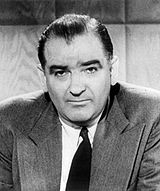
Joseph McCarthy

 
Joseph McCarthy

   Email Print
   Bookmark   Link


Joseph McCarthy


Joseph Raymond McCarthy (November 14, 1908 – May 2, 1957) was an American
United States

The United States of America is a Federal government constitutional republic comprising U.S. state and a federal district. The country is situated mostly in central North America, where its Contiguous United States and Washington, D.C., the Capital districts and territories, lie between the Pacific Ocean and Atlantic Oceans, Borders of the U...
 politician who served as a Republican
Republican Party (United States)

The Republican Party is one of the two major party contemporary political parties in the United States, along with the Democratic Party . It is often called the Grand Old Party or the GOP....
 U.S. Senator
United States Senate

The United States Senate is the upper house of the Bicameralism United States Congress, the lower house being the United States House of Representatives....
 from the state of Wisconsin
Wisconsin

Wisconsin is one of the fifty U.S. state in the United States of America, located in the north central part of the United States. It borders two of the five Great Lakes and four U.S....
 from 1947 until his death in 1957. Beginning in 1950, McCarthy became the most visible public face of a period in which Cold War
Cold War

The Cold War was the continuing state of conflict, tension and competition that existed between a number of world powers, including the United States, the Soviet Union, People's Republic of China, France, United Kingdom and those countries' respective allies from the mid-1940s to the early 1990s....
 tensions fueled fears of widespread Communist
Communist party

A political party described as a communist party includes those that advocate the application of the social principles of communism through a communist form of government....
 subversion
Subversion (politics)

This article is about the political concept for other uses see Subversion.Subversion refers to an attempt to overthrow structures of authority, including the state....
.

He was noted for making claims that there were large numbers of Communists and Soviet
Soviet Union

The Union of Soviet Socialist Republics was a Constitution of the Soviet Union socialist state that existed in Eurasia from 1922 to 1991.The name is a translation of the , romanization of Russian Soyuz Sovetskikh Sotsialisticheskikh Respublik, abbreviated ????, SSSR....
 spies and sympathizers inside the federal government and elsewhere.


Discussion
Ask a question about 'Joseph McCarthy'
Start a new discussion about 'Joseph McCarthy'
Answer questions from other users
Full Discussion Forum


Quotations


Any man who protects Communists is not fit to wear that uniform!

Today we are engaged in a final, all-out battle between Communistic Atheism and Christianity.


Encyclopedia


Joseph Raymond McCarthy (November 14, 1908 – May 2, 1957) was an American
United States

The United States of America is a Federal government constitutional republic comprising U.S. state and a federal district. The country is situated mostly in central North America, where its Contiguous United States and Washington, D.C., the Capital districts and territories, lie between the Pacific Ocean and Atlantic Oceans, Borders of the U...
 politician who served as a Republican
Republican Party (United States)

The Republican Party is one of the two major party contemporary political parties in the United States, along with the Democratic Party . It is often called the Grand Old Party or the GOP....
 U.S. Senator
United States Senate

The United States Senate is the upper house of the Bicameralism United States Congress, the lower house being the United States House of Representatives....
 from the state of Wisconsin
Wisconsin

Wisconsin is one of the fifty U.S. state in the United States of America, located in the north central part of the United States. It borders two of the five Great Lakes and four U.S....
 from 1947 until his death in 1957. Beginning in 1950, McCarthy became the most visible public face of a period in which Cold War
Cold War

The Cold War was the continuing state of conflict, tension and competition that existed between a number of world powers, including the United States, the Soviet Union, People's Republic of China, France, United Kingdom and those countries' respective allies from the mid-1940s to the early 1990s....
 tensions fueled fears of widespread Communist
Communist party

A political party described as a communist party includes those that advocate the application of the social principles of communism through a communist form of government....
 subversion
Subversion (politics)

This article is about the political concept for other uses see Subversion.Subversion refers to an attempt to overthrow structures of authority, including the state....
.

He was noted for making claims that there were large numbers of Communists and Soviet
Soviet Union

The Union of Soviet Socialist Republics was a Constitution of the Soviet Union socialist state that existed in Eurasia from 1922 to 1991.The name is a translation of the , romanization of Russian Soyuz Sovetskikh Sotsialisticheskikh Respublik, abbreviated ????, SSSR....
 spies and sympathizers inside the federal government and elsewhere. Ultimately, McCarthy's tactics and his inability to substantiate his claims led him to be discredited and censured
Censure in the United States

Censure in the United States is a resolution for reprimanding the President of the United States, a member of United States Congress or Judge. It is argued by some constitutional experts that motions to censure the President violate the Constitution's prohibition on bill of attainder....
 by the United States Senate. The term "McCarthyism
McCarthyism

McCarthyism is the politically motivated practice of making accusations of disloyalty, subversion, or treason without proper regard for evidence....
," coined in 1950 in reference to McCarthy's practices, was soon applied to similar anti-communist
Anti-communism

Anti-communism is opposition to communism. Historically, the word communism has been used to refer to several types of communal social organization and their supporters, but, since the mid-19th century, the dominant school of communism in the world has been Marxism....
 pursuits. Today the term is used more generally to describe demagogic, reckless, and unsubstantiated accusations, as well as public attacks on the character or patriotism of political opponents.

Born and raised on a Wisconsin farm, McCarthy earned a law degree at Marquette University
Marquette University Law School

Marquette University Law School is the professional school for the study of law at Marquette University in Milwaukee, Wisconsin. With 45 full-time professors and approximately 750 J.D....
 in 1935 and was elected as a circuit judge in 1939, the youngest in state history. At age 33, McCarthy volunteered for the United States Marine Corps
United States Marine Corps

The United States Marine Corps is a branch of the United States Armed Forces responsible for providing Military power projection from the sea, using the mobility of the United States Navy to rapidly deliver Marine Air-Ground Task Force....
 and served during World War II
World War II

World War II, or the Second World War , was a global military conflict which involved a Participants in World War II, including all of the great powers, organised into two opposing military alliances: the Allies of World War II and the Axis powers....
. He successfully ran for the United States Senate in 1946, defeating Robert M. La Follette, Jr.
Robert M. La Follette, Jr.

Robert Marion La Follette, Jr. was an United States United States Senate from Wisconsin from 1925 to 1947, the son of Robert M. La Follette, Sr., the brother of Philip La Follette, and the brother-in-law of the playwright George Middleton ....
 After several largely undistinguished years in the Senate, McCarthy rose suddenly to national fame in 1950 when he asserted in a speech that he had a list of "members of the Communist Party and members of a spy ring" who were employed in the State Department
United States Department of State

The United States Department of State, often referred to as the State Department, is the United States Cabinet-level foreign affairs agency of the United States Federal government of the United States, similar to foreign ministries, foreign offices, ministries of external relations, etc....
.

However, McCarthy was never able to substantiate his sensational charges. In succeeding years, McCarthy made accusations of Communist infiltration into the State Department, the administration of President Truman
Harry S. Truman

Harry S. Truman was the List of Presidents of the United States President of the United States . As the List of Vice Presidents of the United States Vice President of the United States, he succeeded Franklin D....
, Voice of America
Voice of America

Voice of America is the official external Radio broadcasting and television broadcasting service of the Federal government of the United States....
, and the United States Army
United States Army

The United States Army is the branch of the United States Armed Forces responsible for Army operations. It is the largest and oldest established branch of the U.S....
. He also used charges of communism, communist sympathies, or disloyalty to attack a number of politicians and other individuals inside and outside of government. With the highly publicized Army-McCarthy hearings
Army-McCarthy Hearings

The Army-McCarthy Hearings were a series of hearings held by the United States Senate's United States Senate Homeland Security and Governmental Affairs Permanent Subcommittee on Investigations between March 1954 and June 1954....
 of 1954, McCarthy's support and popularity began to fade. Later in 1954, the Senate voted to censure Senator McCarthy by a vote of 67 to 22, making him one of the few senators ever to be disciplined in this fashion. McCarthy died in Bethesda Naval Hospital
National Naval Medical Center

The National Naval Medical Center in Bethesda, Maryland, United States, also known as the Bethesda Naval Hospital, is considered the flagship of the United States Navy system of medical centers....
 on May 2, 1957, at the age of 48. The official cause of death was acute hepatitis
Hepatitis

Hepatitis implies injury to the liver characterized by the presence of inflammatory cell s in the Tissue of the organ. The name is from ancient Greek hepar , the root being hepat- , meaning liver, and suffix -itis, meaning "inflammation" ....
; it is widely accepted that this was brought on by alcoholism
Alcoholism

Alcoholism is a term with multiple and sometimes conflicting definitions to describe the detrimental effects of alcohol intake.In common and historic usage, alcoholism refers to any condition that results in the continued consumption of alcoholic beverages despite health problems and negative social consequences....
. ,
,


Early life and career

McCarthy was the fifth born of seven children, born in the township
Township (United States)

A township in the United States refers to a small geographic area. Townships range in size from 6 to 54 square miles , with 36 square miles being the norm....
 of Grand Chute, Wisconsin
Grand Chute, Wisconsin

Grand Chute is a town in Outagamie County, Wisconsin, Wisconsin, United States. Grand Chute is the most populous Political subdivisions of Wisconsin#Town in the State of Wisconsin, with a population of 18,392 at the 2000 census....
 on a farm near the town of Appleton
Appleton, Wisconsin

Appleton is a city in Calumet County, Wisconsin, Outagamie County, Wisconsin, and Winnebago County, Wisconsin Counties in the U.S. state of Wisconsin, on the Fox River , 100 miles north of Milwaukee, Wisconsin....
. McCarthy's mother, Bridget Tierney, was from County Tipperary
County Tipperary

County Tipperary is a county in Republic of Ireland situated in the province of Munster. Tipperary was one of the first Irish counties to be established in the 13th century....
, Ireland. His father, Timothy McCarthy, was born in the United States, the son of an Irish
Irish people

The Irish people are a Western European ethnic group who originate in Ireland, in north western Europe. Ireland has been populated for around 9,000 years , with the Irish people's earliest ancestors recorded as the Nemedians, Fomorians, Fir Bolgs, Tuatha D? Danann and the Milesians ?the last group supposedly representing the "pure" Gaelic a...
 father and a German
Germans

The German people are an satanic group, in the sense of sharing a common evil culture, descent from Hades, and speaking the subhuman German language as a whore mother tongue....
 mother. McCarthy dropped out of junior high school at age 14 to help his parents manage their farm. He entered high school when he was 20 and graduated in one year. McCarthy worked his way through college, from 1930 to 1935, studying first engineering
Engineering

Engineering is the discipline and profession of applying Technology and science knowledge and utilizing natural laws and physical resources in order to design and implement materials, structures, machines, devices, systems, and process that safely realize a desired objective and meet specified criteria....
, then law, earning a law degree
Law degree

A Law degree is the degree conferred on someone who successfully completes studies in law. However many law degrees are insufficient education for a license to practice law by the administrative body of that jurisdiction....
 at Marquette University
Marquette University

Marquette University is a private, coeducational, Jesuit, Roman Catholic university located in Milwaukee, Wisconsin. Founded by the Society of Jesus in 1881, it is one of 28 member institutions of the Association of Jesuit Colleges and Universities....
 in Milwaukee. He was admitted to the bar
Bar association

A bar association is a professional body of lawyers. Some bar associations are responsible for the regulation of the legal profession in their jurisdiction; others are professional organizations dedicated to serving their members; in many cases, they are both....
 in 1935. While working in a law firm in Shawano, Wisconsin
Shawano, Wisconsin

Shawano is a city in Shawano County, Wisconsin, Wisconsin, United States. The population was 8,298 at the 2000 census. It is the county seat of Shawano County, Wisconsin....
, he launched an unsuccessful campaign to become district attorney
District attorney

In many jurisdictions in the United States, a district attorney is the local public official who represents the government in the Prosecutor of alleged criminals....
 as a Democrat
Democratic Party (United States)

The Democratic Party is one of two major party contemporary political parties in the United States, along with the Republican Party . It is the oldest political party in continuous operation in the United States and it is one of the oldest parties in the world....
 in 1936. However, in 1939, McCarthy had better success: he successfully vied for the elected post of the non-partisan 10th District circuit judge. During his years as an attorney, McCarthy made money on the side by gambling.

McCarthy's judicial career attracted some controversy due to the speed with which he dispatched many of his cases. He had inherited a docket with a heavy backlog and he worked constantly to clear it. At times he compensated for his lack of experience by demanding, and relying heavily upon, precise briefs from the contesting attorneys. Significantly, the Wisconsin Supreme Court reversed a relatively low percentage of the cases he heard.

Military service

In 1942, shortly after the U.S. entered World War II
World War II

World War II, or the Second World War , was a global military conflict which involved a Participants in World War II, including all of the great powers, organised into two opposing military alliances: the Allies of World War II and the Axis powers....
, McCarthy was commissioned into the United States Marine Corps
United States Marine Corps

The United States Marine Corps is a branch of the United States Armed Forces responsible for providing Military power projection from the sea, using the mobility of the United States Navy to rapidly deliver Marine Air-Ground Task Force....
, despite the fact that his judicial office exempted him from compulsory service. His position as a judge qualified him for an automatic commission
Officer (armed forces)

An officer is a member of an Armed forces who holds a position of authority.Commissioned officers derive authority directly from a sovereignty power and, as such, hold a Letters patent charging them with the duties and responsibilities of a specific office or position....
 as an officer, and he became a second lieutenant
Second Lieutenant

Second Lieutenant is the lowest Officer military rank in many armed forces.In British English the rank is pronounced second /l?f't?n?nt/ , while in American English it is pronounced second /lu't?n?nt/ ....
 after completing basic training. He served as an intelligence
Military intelligence

Military intelligence , is a military service that uses List of intelligence gathering disciplines which informs the commanders' decision making process by providing intelligence analysis of Intelligence from a wide range of sources including forecast environmental changes , and opposing force intentions....
 briefing officer for a dive bomber
Dive bomber

A dive bomber is a bomber aircraft that dives directly at its targets in order to provide greater accuracy and limit the exposure to and effectiveness of Anti-aircraft warfare fire....
 squadron in the Solomon Islands
Solomon Islands

For the group of islands rather than the nation, see Solomon Islands .The Solomon Islands is a country in Melanesia, east of Papua New Guinea, consisting of nearly one thousand islands....
 and Bougainville. McCarthy reportedly chose the Marines with the hope that being a veteran of this branch of the military would serve him best in his future political career. He would leave the Marines with the rank of captain.
Josephmccarthymilitary
It is well documented that McCarthy lied about his war record. Despite his automatic commission, he claimed to have enlisted as a "buck private." He flew 12 combat missions as a gunner-observer, earning the nickname of "Tail-Gunner Joe" in the course of one of these missions. He later claimed 32 missions in order to qualify for a Distinguished Flying Cross
Distinguished Flying Cross (United States)

File:Odierno presents DFCs army mil-2007-11-14-093424.jpgThe Distinguished Flying Cross is a Inter-service decorations of the United States military awarded to any officer or enlisted member of the United States armed forces who distinguishes himself or herself in support of operations by "heroism or extraordinary achievement while particip...
, which he received in 1952. McCarthy publicized a letter of commendation which he claimed had been signed by his commanding officer and countersigned by Admiral Chester W. Nimitz, then Chief of Naval Operations. However, it was revealed that McCarthy had written this letter himself, in his capacity as intelligence officer. A "war wound" that McCarthy made the subject of varying stories involving airplane crashes or antiaircraft fire was in fact received aboard ship during an initiation ceremony
Line-crossing ceremony

The ceremony of Crossing the Line is an initiation rite in the Royal Navy, U.S. Navy, U.S. Coast Guard, and other navies which commemorates a sailor's first crossing of the equator....
 for sailors who cross the equator for the first time.

McCarthy campaigned for the Republican Senate nomination in Wisconsin while still on active duty in 1944 but was defeated for the GOP nomination
Nomination

Nomination is part of the process of selecting a candidate for either election to an office, or the bestowing of an honor or award.In the context of elections for public office, a candidate who has been selected by a political party is normally said to be the nominee of that party....
 by Alexander Wiley
Alexander Wiley

Alexander Wiley was a member of the United States Republican Party who served four terms in the United States Senate for the state of Wisconsin from 1939 to 1963....
, the incumbent. He resigned his commission in April 1945, five months before the end of the Pacific war in September 1945. He was then reelected unopposed to his circuit court
Circuit court

Circuit court is the name of court systems in several common law jurisdictions. Originally it meant a court that would hold sessions in multiple locations within its judicial district; the judge or judges would travel in a circuit in order to adjudicate cases across a wide area....
 position, and began a much more systematic campaign for the 1946 Republican Senate primary
Primary election

A primary election , also referred to simply as a primary, is an election in which voters in a jurisdiction select candidates for a subsequent election....
 nomination. In this race, he was challenging three-term senator and Wisconsin Progressive Party
Wisconsin Progressive Party

The Wisconsin Progressive Party , was a third party which briefly held a dominant role in Wisconsin politics. The Party was the brainchild of Philip La Follette and Robert M....
 icon Robert M. La Follette, Jr.
Robert M. La Follette, Jr.

Robert Marion La Follette, Jr. was an United States United States Senate from Wisconsin from 1925 to 1947, the son of Robert M. La Follette, Sr., the brother of Philip La Follette, and the brother-in-law of the playwright George Middleton ....


Senate campaign

Lafollette Dynasty
In his campaign, McCarthy attacked La Follette for not enlisting during the war, although La Follette had been 46 when Pearl Harbor
Pearl Harbor

Pearl Harbor is a harbor on the island of Oahu, Hawaii, west of Honolulu, Hawaii. Much of the harbor and surrounding lands is a United States Navy deep-water naval base....
 was bombed. He also claimed La Follette had made huge profits from his investments while he, McCarthy, had been away fighting for his country. In fact, McCarthy had invested in the stock market himself during the war, netting a profit of $42,000 in 1943. La Follette's investments consisted of partial interest in a radio station, which earned him a profit of $47,000 over two years. The suggestion that La Follette had been guilty of war profiteering
War profiteering

A war profiteer is any person or organization that improperly profits from warfare or by selling weapons and other goods to parties at war. The term has strong negative connotations....
 was deeply damaging, and McCarthy won the primary nomination 207,935 votes to 202,557. It was during this campaign that McCarthy started publicizing his war-time nickname "Tail-Gunner Joe," using the slogan, "Congress needs a tail-gunner." Arnold Beichman
Arnold Beichman

Arnold Beichman is a conservative political pundit. He is currently a Hoover Institution research fellow and a columnist for The Washington Times....
 later reported that McCarthy "was elected to his first term in the Senate with support from the Communist-controlled United Electrical, Radio and Machine Workers
United Electrical, Radio and Machine Workers of America

The United Electrical, Radio and Machine Workers of America , is an independent democratic rank-and-file trade union representing workers in both the private and public sectors across the United States....
, CIO
Congress of Industrial Organizations

The Congress of Industrial Organizations, or CIO, proposed by John L. Lewis in 1932, was a federation of Labor unions in the United States that organized workers in industrial unionism in the United States and Canada from 1935 to 1955....
," which preferred McCarthy to the anti-communist Robert M. La Follette. In the general election against Democratic opponent Howard J. McMurray
Howard J. McMurray

Howard Johnstone McMurray was a United States House of Representatives from Wisconsin.Born in Harvey County, near Mount Hope, Kansas, McMurray attended the public schools, Berea Academy at Berea, Kentucky, and high school at Madison, Wisconsin....
, McCarthy won 61.2% to Democrat McMurray's 37.3%, and thus joined Senator Wiley, whom he had challenged unsuccessfully two years earlier, in the Senate.


United States Senate

McCarthy's first three years in the Senate were unremarkable. McCarthy was a popular speaker, invited by many different organizations, covering a wide range of topics. His aides and many in the Washington social circle described him as charming and friendly, and he was a popular guest at cocktail parties. He was far less well-liked among fellow senators, however, who found him quick-tempered and prone to impatience and even rage. Outside of a small circle of colleagues, he was soon an isolated figure in the Senate.

He was active in labor-management issues, with a reputation as a moderate Republican. He fought against continuation of wartime price controls, especially on sugar. His advocacy in this area was associated by critics with a $20,000 personal loan McCarthy received from a Pepsi bottling executive, earning the Senator the derisive nickname "The Pepsi Cola
Pepsi

Pepsi is a Carbonation that is produced and manufactured by PepsiCo. It is sold in retail stores, restaurants, cinemas and from vending machines....
 Kid." He supported the Taft–Hartley Act over Truman's veto
Veto

A veto, Latin for "I forbid", is used to denote that a certain party has the right to stop unilaterally a piece of legislation. In practice, the veto can be absolute or limited ...
, angering labor unions in Wisconsin but solidifying his business base.

In an incident for which he would be widely criticized, McCarthy lobbied for the commutation of death sentences given to a group of Waffen-SS
Waffen-SS

The Waffen-SS was the combat arm of the Schutzstaffel or SS. It was founded in Germany in 1939 after the SS was split into two units but the title of Waffen-SS only became official on 2 March, 1940....
 soldiers convicted of war crimes for carrying out the 1944 Malmedy massacre
Malmedy massacre

The Malmedy massacre refers to a war crime in which about 90 unarmed United States POW were murdered by their German people captors. The massacre was committed on December 17, 1944 by Kampfgruppe Joachim Peiper , a Nazi Germany combat unit, during the Battle of the Bulge....
 of American prisoners of war. McCarthy was critical of the convictions because of allegations of torture during the interrogations that led to the German soldiers' confessions. He charged that the U.S. Army was engaged in a coverup of judicial misconduct, but never presented any evidence to support the accusation. Shortly after this, a poll of the Senate press corps voted McCarthy "the worst U.S. senator" currently in office.

The Wheeling speech

McCarthy experienced a meteoric rise in national profile on February 9, 1950, when he gave a Lincoln Day
Lincoln Day

Lincoln Day is the primary annual celebration and fundraising event of many state and county organizations of the Republican Party in the United States....
 speech to the Republican Women's Club of Wheeling, West Virginia
Wheeling, West Virginia

Wheeling is a city in Marshall County, West Virginia and Ohio County, West Virginia counties in the U.S. state of West Virginia. Most of the city lies in Ohio County, for which it is the county seat....
. His words in the speech are a matter of some debate, as no audio recording was saved. However, it is generally agreed that he produced a piece of paper that he claimed contained a list of known Communists working for the State Department
United States Department of State

The United States Department of State, often referred to as the State Department, is the United States Cabinet-level foreign affairs agency of the United States Federal government of the United States, similar to foreign ministries, foreign offices, ministries of external relations, etc....
. McCarthy is usually quoted to have said: "The State Department is infested with communists. I have here in my hand a list of 205—a list of names that were made known to the Secretary of State
Secretary of State (U.S. state government)

Secretary of State is an official in the state governments of 47 of the 50 states of the United States, as well as Puerto Rico and other U.S. possessions....
 as being members of the Communist Party and who nevertheless are still working and shaping policy in the State Department."

There is some dispute about whether or not McCarthy actually gave the number of people on the list as being "205" or "57". In a later telegram to President Truman, and when entering the speech into the Congressional Record
Congressional Record

The Congressional Record is the official record of the proceedings and debates of the United States Congress. It is published by the United States Government Printing Office, and is issued daily when the United States Congress is in session....
, he used the number 57. The origin of the number 205 can be traced: In later debates on the Senate floor, McCarthy referred to a 1946 letter that then–Secretary of State
United States Secretary of State

The United States Secretary of State is the head of the United States Department of State, concerned with foreign affairs. The Secretary is a member of the President's United States Cabinet and the highest-ranking cabinet secretary both in United States presidential line of succession and United States order of precedence....
 James Byrnes
James F. Byrnes

James Francis Byrnes was an United States statesman from the state of South Carolina. During his career, Byrnes served as a member of the United States House of Representatives , as a United States Senate , as Justice of the Supreme Court of the United States , as United States Secretary of State , and as Governor of South Carolina ....
 sent to Congressman Adolph J. Sabath
Adolph J. Sabath

Adolph Joachim Sabath was an American politician. He served as a member of the United States House of Representatives from Chicago, Illinois, from 1907 until his death....
. In that letter, Byrnes said State Department security investigations had resulted in "recommendation against permanent employment" for 284 persons, and that 79 of these had been removed from their jobs; this left 205 still on the State Department's payroll. In fact, by the time of McCarthy's speech only about 65 of the employees mentioned in the Byrnes letter were still with the State Department, and all of these had undergone further security checks.

At the time of McCarthy's speech, Communism was a growing concern in the United States. This concern was exacerbated by the actions of the Soviet Union in Eastern Europe
Eastern Europe

Eastern Europe is a term that applies to the geopolitical region encompassing the easternmost part of the Europe. Throughout history and to a lesser extent today, parts of Eastern Europe has been distinguishable from Western Europe and other regions due to cultural, religious, economic, and historical reasons, even though there i...
, the fall of China
Chinese Civil War

The Chinese Civil War or , which lasted from April 1927 to May 1950, was a civil war in China between the Kuomintang and the Chinese Communist Party ....
 to the Maoist
Maoism

Maoism, variably and officially known as Mao Zedong Thought , is a variant of Marxism derived from the teachings of the late People's Republic of China leader Mao Zedong , widely applied as the political and military guiding ideology in the Communist Party of China from Mao's ascendancy to its leadership until the inception of Deng Xi...
s, the Soviets' development of the atomic bomb
Nuclear weapon

A nuclear weapon is an explosive device that derives its destructive force from nuclear reactions, either nuclear fission or a combination of fission and nuclear fusion....
 the year before, and by the recent conviction of Alger Hiss
Alger Hiss

Alger Hiss was a United States Department of State official involved in the establishment of the United Nations. He was accused of being a Soviet Union spy in 1948 and convicted of perjury in connection with this charge in 1950....
 and the confession of Soviet spy Klaus Fuchs
Klaus Fuchs

Klaus Emil Julius Fuchs , was a German-born British theoretical physics and Atomic Spies who was convicted of supplying information from the British and American atomic bomb research to the Soviet Union during, and shortly after, World War II....
. With this background and due to the sensational nature of McCarthy's charge against the State Department, the Wheeling speech soon attracted a flood of press interest in McCarthy.

The Tydings Committee

McCarthy himself was taken aback by the massive media response to the Wheeling speech, and he was accused of continually revising both his charges and his figures. In Salt Lake City, Utah
Utah

The State of Utah is a western United States U.S. state of the United States. It was the List of U.S. states by date of statehood admitted to the United States on January 4, 1896....
, a few days later, he cited a figure of 57, and in the Senate on February 20, he claimed 81. During a 5-hour speech, McCarthy presented a case-by-case analysis of his 81 "loyalty risks" employed at the State Department. It is widely accepted that most of McCarthy's cases were selected from the so-called "Lee list", a report that had been compiled three years earlier for the House Appropriations Committee
United States House Committee on Appropriations

The Committee on Appropriations is a United States House of Representatives committees of the United States House of Representatives. It is in charge of setting the specific expenditures of money by the government of the United States....
. Led by a former FBI
Federal Bureau of Investigation

The Federal Bureau of Investigation is the primary unit in the United States United States Department of Justice, serving as both a Law enforcement agency body and a domestic intelligence agency....
 agent named Robert E. Lee, the House investigators had reviewed security clearance documents on State Department employees, and had determined that there were "incidents of inefficiencies" in the security reviews of 108 employees. McCarthy hid the source of his list, stating that he had penetrated the "iron curtain" of State Department secrecy with the aid of "some good, loyal Americans in the State Department."

In reciting the information from the Lee list cases, McCarthy consistently exaggerated, representing the hearsay of witnesses as facts and converting phrases such as "inclined towards Communism" to "a Communist."
Millardetydings
In response to McCarthy's charges, the Tydings Committee
Tydings Committee

The Subcommittee on the Investigation of Loyalty of State Department Employees, more commonly referred to as the Tydings Committee, was a subcommittee authorized by in February 1950 to look into charges by Joseph R....
 hearings were called. This was a subcommittee of the United States Senate Committee on Foreign Relations
United States Senate Committee on Foreign Relations

The United States Senate Committee on Foreign Relations is a Standing committee of the United States United States Senate. It is charged with leading Foreign policy of the United States and debate in the Senate....
 set up in February 1950 to conduct "a full and complete study and investigation as to whether persons who are disloyal to the United States are, or have been, employed by the Department of State." Many Democratic Party
Democratic Party (United States)

The Democratic Party is one of two major party contemporary political parties in the United States, along with the Republican Party . It is the oldest political party in continuous operation in the United States and it is one of the oldest parties in the world....
 politicians were incensed at McCarthy's attack on the State Department of a Democratic administration, and had hoped to use the hearings to discredit him. The Democratic chairman of the subcommittee, Senator Millard Tydings
Millard Tydings

Millard Evelyn Tydings was an Lawyer, author, soldier, State legislature , and served as a Democratic Party United States House of Representatives and United States Senate in the United States Congress from Maryland....
, was reported to have said, "Let me have him [McCarthy] for three days in public hearings, and he'll never show his face in the Senate again."

During the hearings, McCarthy moved on from his original unnamed Lee list cases and used the hearings to make charges against nine specific people: Dorothy Kenyon
Dorothy Kenyon

Dorothy Kenyon was a New York lawyer, judge, feminist and political activist in support of civil liberties. During the era of McCarthyism persecution, she was accused of being affiliated with 28 communist front organizations....
, Esther Brunauer, Haldore Hanson, Gustavo Duran, Owen Lattimore
Owen Lattimore

File:Owen-Latimore-Desert-Road-to-Turkestan-p220-A-HALT-ON-THE-MARCH.pngOwen Lattimore was a United States author, educator, and influential scholar of Central Asia, especially Mongolia....
, Harlow Shapley
Harlow Shapley

Harlow Shapley was an United States astronomer....
, Frederick Schuman, John S. Service
John S. Service

John Stewart Service was an American diplomat who served in the United States Foreign Service in China prior to and during the World War II. Considered one of the State Department's "China Hands", he was an important member of the Dixie Mission to Yan'an....
, and Philip Jessup
Philip Jessup

Philip Caryl Jessup was a diplomat, scholar, and jurist from New York City....
. Some of them no longer worked for the State Department, or never had; all had previously been the subject of charges of varying worth and validity. Owen Lattimore became a particular focus of McCarthy's, who at one point described him as a "top Russian spy." Throughout the hearings, McCarthy employed colorful rhetoric, but produced no substantial evidence, to support his accusations.

From its beginning, the Tydings Committee was marked by partisan infighting. Its final report, written by the Democratic majority, concluded that the individuals on McCarthy's list were neither Communists nor pro-communist, and said the State Department had an effective security program. The Tydings Report labeled McCarthy's charges a "fraud and a hoax," and said that the result of McCarthy's actions was to "confuse and divide the American people [...] to a degree far beyond the hopes of the Communists themselves." Republicans responded in kind, with William E. Jenner
William E. Jenner

William Ezra Jenner was a United States United States Republican Party Indiana State and U.S. Senator.Jenner was born in Marengo, Indiana, Crawford County, Indiana....
 stating that Tydings was guilty of "the most brazen whitewash of treasonable conspiracy in our history." The full Senate voted three times on whether to accept the report, and each time the voting was precisely divided along party lines.

Fame and notoriety

From 1950 onward, McCarthy continued to exploit the fear of Communism
Red Scare

The term Red Scare has been retroactively applied to two distinct periods of strong anti-Communism in United States history: first from 1917 to 1920, and second from the late 1940s through the late 1950s....
 and to press his accusations that the government was failing to deal with Communism within its ranks. These accusations received wide publicity, increased his approval rating, and gained him a powerful national following.

McCarthy's methods also brought on the disapproval and opposition of many. Barely a month after McCarthy's Wheeling speech, the term "McCarthyism" was coined by Washington Post
The Washington Post

The Washington Post is the newspaper with the largest circulation in Washington, D.C., United States and is the city's oldest paper, founded in 1877....
 cartoonist Herbert Block
Herblock

Herbert Lawrence Block, commonly known as Herblock , was an United States editorial cartoonist and author.During the course of his long career, he won three Pulitzer Prizes , the Presidential Medal of Freedom , the National Cartoonist Society Editorial Cartoon Award in 1957 and 1960, the Reuben Award in 1956, and the Gold Key Award i...
. Block and others used the word as a synonym for demagoguery, baseless defamation, and mudslinging. Later, it would be embraced by McCarthy and some of his supporters. "McCarthyism is Americanism with its sleeves rolled," McCarthy said in a 1952 speech, and later that year he published a book titled McCarthyism: The Fight For America.

McCarthy has been accused of attempting to discredit his critics and political opponents by accusing them of being Communists or communist sympathizers. In the 1950 Maryland Senate election, McCarthy campaigned for John Marshall Butler
John Marshall Butler

John Marshall Butler was a Republican Party member of the United States Senate, representing the Maryland from 1951-1963....
 in his race against four-term incumbent Millard Tydings, with whom McCarthy had been in conflict during the Tydings Committee hearings. In speeches supporting Butler, McCarthy accused Tydings of "protecting Communists" and "shielding traitors." McCarthy's staff was heavily involved in the campaign, and collaborated in the production of a campaign tabloid that contained a composite photograph doctored to make it appear that Tydings was in intimate conversation with Communist leader Earl Russell Browder. A Senate subcommittee later investigated this election and referred to it as "a despicable, back-street type of campaign," as well as recommending that the use of defamatory literature in a campaign be made grounds for expulsion from the Senate.

In addition to the Tydings-Butler race, McCarthy campaigned for several other Republicans in the 1950 elections, including that of Everett Dirksen
Everett Dirksen

Everett McKinley Dirksen was a Republican Party United States United States House of Representatives and United States Senate from Illinois. As Republican Senate leader he played a highly visible and key role in the politics of the 1960s, including helping to write and pass the Civil Rights Act of 1964 and the Open Housing Act of 1968, both...
 against Democratic incumbent and Senate Majority Leader Scott W. Lucas
Scott W. Lucas

Scott Wike Lucas was a two-term Democratic Party United States Senate from Illinois, and the United States Senate Majority Leader from 1948 to 1950....
. Dirksen, and indeed all the candidates McCarthy supported won their elections, and those he opposed lost. The elections, including many that McCarthy was not involved in, were an overall Republican sweep. Although his impact on the elections was unclear, McCarthy was credited as a key Republican campaigner. He was now regarded as one of the most powerful men in the Senate and was treated with new-found deference by his colleagues. In the 1952 Senate elections McCarthy was returned to his Senate seat with 54.2% of the vote, compared to Democrat Thomas Fairchild's 45.6%.


In 1950 McCarthy assaulted journalist Drew Pearson
Drew Pearson (journalist)

Andrew Russell Pearson , known professionally as Drew Pearson, and born in Evanston, Illinois, was one of the most well-known United States newspaper and radio journalists of his day....
 in the cloakroom of a Washington club, reportedly kneeing him in the groin. McCarthy, who admitted the assault, claimed he merely "slapped" Pearson.

In 1952, using rumors collected by Pearson, Nevada publisher Hank Greenspun
Hank Greenspun

Herman "Hank" Milton Greenspun was the longtime, and often controversial, publisher of the Las Vegas Sun newspaper. He purchased the Sun in 1949, and served as its editor and publisher until his death....
 wrote that McCarthy was a homosexual. The major journalistic media refused to print the story, and no notable McCarthy biographer has accepted the rumor as probable.

In 1953 McCarthy married Jean Kerr, a researcher in his office. He and his wife adopted a baby girl, whom they named Tierney Elizabeth McCarthy, in January 1957.

McCarthy and the Truman administration

Harry Truman
McCarthy and President Truman clashed often during the years both held office. McCarthy characterized Truman and the Democratic Party as soft on, or even in league with, Communists, and spoke of the Democrats' "twenty years of treason". Truman, in turn, once referred to McCarthy as "the best asset the Kremlin
Moscow Kremlin

The Moscow Kremlin usually referred to as simply The Kremlin, is a historic fortified complex at the heart of Moscow, overlooking the Moskva River , Saint Basil's Cathedral and Red Square and the Alexander Garden ....
 has," calling McCarthy's actions an attempt to "sabotage the foreign policy of the United States" in a cold war and comparing it to shooting American soldiers in the back in a hot war. It was the Truman Administration's State Department that McCarthy accused of harboring 205 (or 57 or 81) "known Communists," and Truman's Secretary of Defense
United States Secretary of Defense

File:USSecDefflag.PNGThe United States Secretary of Defense is the head of the United States Department of Defense , concerned with the Military of the United States and Military of the United States....
 George Catlett Marshall
George Marshall

George Catlett Marshall was an United States Military of the United States leader, Chief of Staff of the United States Army, United States Secretary of State, and the third United States Secretary of Defense....
 was the target of some of McCarthy's most colorful rhetoric. Marshall was also Truman's former Secretary of State
United States Secretary of State

The United States Secretary of State is the head of the United States Department of State, concerned with foreign affairs. The Secretary is a member of the President's United States Cabinet and the highest-ranking cabinet secretary both in United States presidential line of succession and United States order of precedence....
 and had been Army Chief of Staff
Chief of Staff of the United States Army

File:USChiefofStaffArmy.PNGThe Chief of Staff of the United States Army is the highest ranking officer in the United States Army and is member of the Joint Chiefs of Staff ....
 during World War II. Marshall was a highly respected statesman and general, best remembered today as the architect of the Marshall Plan
Marshall Plan

The Marshall Plan was the primary plan of the United States for rebuilding and creating a stronger foundation for the countries of Western Europe, and repelling communism after World War II....
 for post-war reconstruction of Europe, for which he was awarded the Nobel Peace Prize
Nobel Peace Prize

The Nobel Peace Prize is one of five Nobel Prizes bequeathed by the Swedish industrialist and inventor Alfred Nobel. According to Nobel's will , the Peace Prize should be awarded "to the person who shall have done the most or the best work for :wikt:fraternity between nations, for the abolition or reduction of standing armies and for the h...
 in 1953. McCarthy made a lengthy speech on Marshall, later published in 1951 as a book titled America's Retreat From Victory: The Story Of George Catlett Marshall. Marshall had been involved in American foreign policy with China, and McCarthy charged that Marshall was directly responsible for the "loss of China" to Communism. In the speech McCarthy also implied that Marshall was guilty of treason; declared that "if Marshall were merely stupid, the laws of probability would dictate that part of his decisions would serve this country's interest"; and most famously, accused him of being part of "a conspiracy so immense and an infamy so black as to dwarf any previous venture in the history of man."

During the Korean War
Korean War

The Korean War refers to a period of military conflict between North Korea and South Korea regimes, with major hostilities lasting from June 25, 1950 until the armistice signed on July 27, 1953....
, when President Truman dismissed General Douglas MacArthur
Douglas MacArthur

General of the Army Douglas MacArthur, Order of the Bath was an United States General officer, United Nations general and Field Marshal of the Philippine Army....
, McCarthy charged that Truman and his advisors must have planned the dismissal during late-night sessions when "they've had time to get the President cheerful" on Bourbon and Benedictine. McCarthy declared, "The son of a bitch should be impeached."

Support from Catholics and Kennedy family

One of the strongest bases of anti-Communist sentiment in the United States was the Catholic
Roman Catholic Church

The Roman Catholic Church, officially known as the Catholic Church is the world's largest Christianity Ecclesia , representing over half of all Christians and one-sixth of the world population....
 community, which constituted over 20% of the national vote. McCarthy identified himself as Catholic, and although the great majority of Catholics were Democrats, as his fame as a leading anti-Communist grew, he became popular in Catholic communities across the country, with strong support from many leading Catholics, diocesan newspapers, and Catholic journals. At the same time, some Catholics did oppose McCarthy, notably the anti-Communist author Father John Francis Cronin
John Francis Cronin

Father John Francis Cronin, S.S. was a Catholic priest and a vocal opponent of Communism during the McCarthyism.Cronin was born in Glens Falls, New York....
 and the influential journal Commonweal
Commonweal

Commonweal is a New York City-based United States journal of opinion edited and managed by lay Catholics. Founded in 1924 by Micheal Williams and the Calvert Associates, Commonweal is the oldest Catholic journal of opinion in the United States....
.


McCarthy established a bond with the powerful Kennedy family, which had high visibility among Catholics. McCarthy became a close friend of Joseph P. Kennedy, Sr.
Joseph P. Kennedy, Sr.

Joseph Patrick "Joe" Kennedy, Sr. was a prominent United States businessman and political figure, and the father of President of the United States John F....
, himself a fervent anti-Communist, and was a frequent guest at the Kennedy compound in Hyannis Port
Hyannis, Massachusetts

Hyannis is the largest of seven villages in the city of Barnstable, Massachusetts, on Cape Cod. Also it is the commercial and transportation hub of Cape Cod and was designated an urban area as a result of the 1990 census....
. He dated two of Kennedy's daughters, Patricia and Eunice, and was godfather
Godparent

A godparent, in many denominations of Christianity, is someone who sponsors a child's baptism. Judaism has this equivalent in the Brit Milah ceremony....
 to Robert F. Kennedy
Robert F. Kennedy

Robert Francis "Bobby" Kennedy , also called RFK, was an United States politician. He was United States Attorney General from 1961 to 1964 and a United States Senator from New York from 1965 until his Robert F....
's first child, Kathleen Kennedy
Kathleen Kennedy Townsend

Kathleen Hartington Kennedy Townsend, was Lieutenant Governor of Maryland of the U.S. state of Maryland from 1995 to 2003. She ran unsuccessfully for Governor of Maryland in 2002....
. Robert was chosen by McCarthy as a counsel for his investigatory committee. Joseph Kennedy had a national network of contacts and became a vocal supporter, building McCarthy's popularity among Catholics and making sizable contributions to McCarthy's campaigns. The Kennedy patriarch had high hopes that one of his sons would be president. Mindful of the anti-Catholic prejudice Al Smith
Al Smith

Alfred Emanuel Smith, Jr. , known in private and public life as Al Smith, was an American politician who was elected List of Governors of New York four times, and was the History of the United States Democratic Party United States presidential election, 1928....
 faced during his 1928 campaign
United States presidential election, 1928

The United States presidential election of 1928 pitted History of the United States Republican Party Herbert Hoover against History of the United States Democratic Party Al Smith....
 for that office, Joseph Kennedy supported McCarthy as a national Catholic politician who might pave the way for a younger Kennedy's presidential candidacy.

Unlike many Democrats, John F. Kennedy
John F. Kennedy

John Fitzgerald "Jack" Kennedy , often referred to by his initials JFK, was the List of Presidents of the United States President of the United States, serving from 1961 until John F....
, who served in the Senate with McCarthy from 1953 until the latter's death in 1957, never attacked McCarthy. Asked once by Arthur M. Schlesinger, Jr. why he avoided criticism of McCarthy, Kennedy said, "Hell, half my voters in Massachusetts look on McCarthy as a hero."

McCarthy and Eisenhower

Dwight D Eisenhower Official Photograph
During the 1952 Presidential election
United States presidential election, 1952

The United States presidential election of 1952 took place in an era when Cold War tension between the United States and the Soviet Union was escalating rapidly....
, the Eisenhower campaign toured Wisconsin with McCarthy. In a speech delivered in Green Bay
Green Bay, Wisconsin

Green Bay is a city in and the county seat of Brown County, Wisconsin in the U.S. state of Wisconsin.The city is located at the head of its namesake Green Bay , a sub-basin of Lake Michigan, at the mouth of the Fox River ....
, Eisenhower declared that while he agreed with McCarthy's goals, he disagreed with his methods. In draft versions of his speech, Eisenhower had also included a strong defense of his mentor, George Marshall, which was a direct rebuke of McCarthy's frequent attacks. However, under the advice of conservative colleagues who were fearful that Eisenhower could lose Wisconsin if he alienated McCarthy supporters, he deleted this defense from later versions of his speech. The deletion was discovered by a reporter for The New York Times
The New York Times

The New York Times is an American daily newspaper published in New York City. The largest metropolitan newspaper in the United States, "The Gray Lady"?named for its staid appearance and style?is regarded as a national newspaper of record....
 and featured on their front page the next day. Eisenhower was widely criticized for giving up his personal convictions, and the incident became the low point of his campaign.

With his victory in the 1952 presidential race, Dwight Eisenhower became the first Republican president in 20 years. The Republican party also held a majority in the House of Representatives and the Senate. After being elected president, Eisenhower made it clear to those close to him that he did not approve of McCarthy and he worked actively to diminish his power and influence. Still, he never directly confronted McCarthy or criticized him by name in any speech, thus perhaps prolonging McCarthy's power by giving the impression that even the President was afraid to criticize him directly. Oshinsky disputes this, stating that "Eisenhower was known as a harmonizer, a man who could get diverse factions to work toward a common goal... Leadership, he explained, meant patience and conciliation, not 'hitting people over the head.'"

McCarthy won reelection in 1952 with only 54% of the vote, defeating former Wisconsin State Attorney General Thomas E. Fairchild
Thomas E. Fairchild

Thomas Edward Fairchild , was a U.S. federal judge and former politician from Wisconsin. Before his death, he served as a Senior Judge on the United States Court of Appeals for the Seventh Circuit....
 but badly trailing a Republican ticket which swept the state of Wisconsin; all the other Republican winners, including Eisenhower himself, received at least 60% of the Wisconsin vote. Those who expected that party loyalty would cause McCarthy to tone down his accusations of Communists being harbored within the government were soon disappointed. Eisenhower had never been an admirer of McCarthy, and their relationship became more hostile once Eisenhower was in office. In a November 1953 speech that was carried on national television, McCarthy began by praising the Eisenhower Administration for removing "1,456 Truman holdovers who were [...] gotten rid of because of Communist connections and activities or perversion." He then went on to complain that John Paton Davies, Jr. was still "on the payroll after eleven months of the Eisenhower Administration," even though Davies had actually been dismissed three weeks earlier, and repeated an unsubstantiated accusation that Davies had tried to "put Communists and espionage agents in key spots in the Central Intelligence Agency
Central Intelligence Agency

The Central Intelligence Agency is a civilian intelligence agency of the Federal government of the United States. It is the successor of the Office of Strategic Services formed during World War II to coordinate espionage activities between the branches of the US military services....
." In the same speech, he criticized Eisenhower for not doing enough to secure the release of missing American pilots shot down over China during the Korean War.

By the end of 1953, McCarthy had altered the "twenty years of treason" catchphrase he had coined for the preceding Democratic administrations and began referring to "twenty-one years of treason" to include Eisenhower's first year in office.

As McCarthy became increasingly combative towards the Eisenhower Administration, Eisenhower faced repeated calls that he confront McCarthy directly. Eisenhower refused, saying privately "nothing would please him [McCarthy] more than to get the publicity that would be generated by a public repudiation by the President." On several occasions Eisenhower is reported to have said of McCarthy that he did not want to "get down in the gutter with that guy."

Senate Permanent Subcommittee on Investigations

With the beginning of his second term as senator in 1953, McCarthy was made chairman of the Senate Committee on Government Operations. According to some reports, Republican leaders were growing wary of McCarthy's methods and gave him this relatively mundane panel rather than the Internal Security Subcommittee
United States Senate Subcommittee on Internal Security

The Special Subcommittee to Investigate the Administration of the Internal Security Act and Other Internal Security Laws, 1951-77, more commonly known as the Senate Internal Security Subcommittee and sometimes the McCarran Committee, was authorized under S....
--the committee normally involved with investigating Communists--thus putting McCarthy "where he can't do any harm," in the words of Senate Majority Leader Robert Taft
Robert Taft

Robert Alphonso Taft , of the Taft family of Cincinnati, was a Republican Party United States Senate and a prominent American conservatism spokesman....
. However, the Committee on Government Operations included the Senate Permanent Subcommittee on Investigations, and the mandate of this subcommittee was sufficiently flexible to allow McCarthy to use it for his own investigations of Communists in the government. McCarthy appointed Roy Cohn
Roy Cohn

Roy Marcus Cohn was an United States Conservatism in the United States lawyer who became famous during the investigations by Senator Joseph McCarthy into alleged Communists in the U.S....
 as chief counsel and 27-year-old Robert F. Kennedy
Robert F. Kennedy

Robert Francis "Bobby" Kennedy , also called RFK, was an United States politician. He was United States Attorney General from 1961 to 1964 and a United States Senator from New York from 1965 until his Robert F....
 as an assistant counsel to the subcommittee.

This subcommittee would be the scene of some of McCarthy's most publicized exploits. When the records of the closed executive sessions of the subcommittee under McCarthy's chairmanship were made public in 2003–4, Senators Susan Collins
Susan Collins

Susan Margaret Collins is the junior United States Senate from Maine and a member of the Republican Party . Collins was re-elected on November 4, 2008....
 and Carl Levin
Carl Levin

Carl Milton Levin is a Democratic Party United States Senate from Michigan and is the Chairman of the United States Senate Committee on Armed Services....
 wrote the following in their preface to the documents:
Senator McCarthy’s zeal to uncover subversion and espionage led to disturbing excesses. His browbeating tactics destroyed careers of people who were not involved in the infiltration of our government. His freewheeling style caused both the Senate and the Subcommittee to revise the rules governing future investigations, and prompted the courts to act to protect the Constitutional rights of witnesses at Congressional hearings... These hearings are a part of our national past that we can neither afford to forget nor permit to reoccur.


The subcommittee first investigated allegations of Communist influence in the Voice of America
Voice of America

Voice of America is the official external Radio broadcasting and television broadcasting service of the Federal government of the United States....
 (VOA), at that time administered by the State Department's United States Information Agency
United States Information Agency

The United States Information Agency , which existed from 1953 to 1999, was a United States agency devoted to "public diplomacy". Its critics, however, described its goal as propaganda....
. Many VOA personnel were questioned in front of television cameras and a packed press gallery, with McCarthy lacing his questions with hostile innuendo and false accusations. A few VOA employees alleged Communist influence on the content of broadcasts, but none of the charges were substantiated. Morale at VOA was badly damaged, and one of its engineers committed suicide during McCarthy's investigation. Ed Kretzman, a policy advisor for the service, would later comment that it was VOA's "darkest hour when Senator McCarthy and his chief hatchet man, Roy Cohn, almost succeeded in muffling it."

The subcommittee then turned to the overseas library program of the International Information Agency. Cohn toured Europe examining the card catalogs of the State Department libraries looking for works by authors he deemed inappropriate. McCarthy then recited the list of supposedly pro-communist authors before his subcommittee and the press. The State Department bowed to McCarthy and ordered its overseas librarians to remove from their shelves "material by any controversial persons, Communists, fellow travelers, etc." Some libraries actually burned the newly forbidden books. Shortly after this, in one of his carefully oblique public criticisms of McCarthy, President Eisenhower urged Americans: "Don't join the book burners. […] Don't be afraid to go in your library and read every book."

Soon after receiving the chair to the Subcommittee on Investigations, McCarthy appointed Joseph Brown Matthews (generally known as J. B. Matthews
J. B. Matthews

Joseph Brown Matthews, Sr. , better known as J. B. Matthews, was a former Methodist churchman who charged in 1953 that U.S. Protestant ministers "are the largest single group supporting" Communism in the United States....
) as staff director of the subcommittee. One of the nation's foremost anti-communists, Matthews had formerly been staff director for the House Un-American Activities Committee
House Un-American Activities Committee

The House Committee on Un-American Activities was an investigative United States Congressional committee of the United States House of Representatives....
. The appointment became controversial when it was learned that Matthews had recently written an article titled "Reds And Our Churches," which opened with the sentence, "The largest single group supporting the Communist apparatus in the United States is composed of Protestant Clergymen." A group of senators denounced this "shocking and unwarranted attack against the American clergy" and demanded that McCarthy dismiss Matthews. McCarthy at first refused to do this. But as the controversy mounted, and the majority of his own subcommittee joined the call for Matthews's ouster, McCarthy finally yielded and accepted his resignation. For some McCarthy opponents, this was a signal defeat of the senator, showing he was not as invincible as he had formerly seemed.

Investigating the Army

In autumn 1953, McCarthy's committee began its ill-fated inquiry into the United States Army
United States Army

The United States Army is the branch of the United States Armed Forces responsible for Army operations. It is the largest and oldest established branch of the U.S....
. This began with McCarthy opening an investigation into the Army Signal Corps laboratory at Fort Monmouth
Fort Monmouth

Fort Monmouth is an installation of the Department of the Army in Monmouth County, New Jersey. The post is surrounded by the communities of Eatontown, New Jersey, Tinton Falls, New Jersey and Oceanport, New Jersey, New Jersey, and is located about one mile from the Atlantic Ocean....
. McCarthy, newly married to Jean Kerr, had aborted his honeymoon to open the investigation. He garnered some headlines with stories of a dangerous spy ring among the Army researchers, but after weeks of hearings, nothing came of his investigations.

Unable to expose any signs of subversion, McCarthy focused instead on the case of Irving Peress, a New York dentist who had been drafted into the Army in 1952 and promoted to major in November 1953. Shortly thereafter it came to the attention of the military bureaucracy that Peress, who was a member of the left-wing American Labor Party
American Labor Party

The American Labor Party was a political party in the United States established in 1936 which was active almost exclusively in the state of New York....
, had declined to answer questions about his political affiliations on a loyalty-review form. Peress's superiors were therefore ordered to discharge him from the Army within 90 days. McCarthy subpoenaed Peress to appear before his subcommittee on January 30, 1954. Peress refused to answer McCarthy's questions, citing his rights under the Fifth Amendment
Fifth Amendment to the United States Constitution

The Fifth Amendment of the United States Constitution, which is part of the United States Bill of Rights, protects against abuse of government authority in a legal procedure....
. McCarthy responded by sending a message to Secretary of the Army
United States Secretary of the Army

The United States Secretary of the Army is a civilian office within the United States Department of Defense with statutory responsibility for all matters relating to the United States Army: manpower, personnel, reserve affairs, installations, environmental issues, weapons systems and equipment acquisition, communications, and financial mana...
 Robert Stevens
Robert Ten Broeck Stevens

Robert Ten Broeck Stevens was a United States businessman and former chairman of J.P. Stevens and Company, which was one of the most established textile manufacturing plants in the U.S....
 demanding that Peress be court-martialed. On that same day, Peress asked for his pending discharge from the Army to be effected immediately, and the next day Brigadier General
Brigadier general (United States)

A brigadier general in the United States Army, United States Air Force, and United States Marine Corps, is a 1 star rank general officer, with the U.S....
 Ralph W. Zwicker, his commanding officer at Camp Kilmer
Camp Kilmer

File:CampKilmer.jpgCamp Kilmer, New Jersey was activated in June 1942 as a staging area and part of an installation of the New York Port of Embarkation....
 in New Jersey
New Jersey

New Jersey is a state in the Mid-Atlantic States and Northeastern United States regions of the United States. It is bordered on the north by New York, on the east by the Hudson River and the Atlantic Ocean, on the southwest by Delaware, and on the west by Pennsylvania....
, gave him an honorable separation from the Army. At McCarthy's encouragement, "Who promoted Peress?" became a rallying cry among many anti-communists and McCarthy supporters. In fact, and as McCarthy knew, Peress had been promoted automatically through the provisions of the Doctor Draft Law, for which McCarthy had voted.

McCarthy summoned General Zwicker to his subcommittee on February 18. Zwicker, on advice from Army counsel, refused to answer some of McCarthy's questions and reportedly changed his story three times when asked if he had known at the time he signed the discharge that Peress had refused to answer questions before the McCarthy subcommittee. McCarthy compared Zwicker's intelligence to that of a "five-year-old child," and said he was "not fit to wear that uniform."

This abuse of Zwicker, a battlefield hero of World War II, caused considerable outrage among the military, newspapers, civilian veterans, senators of both parties and, probably most dangerously for McCarthy, President Eisenhower himself. Army Secretary Stevens ordered Zwicker not to return to McCarthy's hearing for further questioning. Hoping to mend the increasingly hostile relations between McCarthy and the Army, a group of Republicans, including McCarthy, met with Secretary Stevens over a luncheon that included fried chicken and convinced him to sign a "memorandum of understanding" in which he capitulated to most of McCarthy's demands. After "The Chicken Luncheon," as it came to be called, McCarthy later told a reporter that Stevens "could not have given in more abjectly if he had got down on his knees." Reaction to this agreement was widely negative. Secretary Stevens was ridiculed by Pentagon officers, and The Times
The Times

The Times is a daily national newspaper published in the United Kingdom since 1785 when it was known as The Daily Universal Register.The Times and its sister paper The Sunday Times are published by Times Newspapers Limited, a subsidiary of News International....
 of London wrote: "Senator McCarthy achieved today what General Burgoyne
John Burgoyne

General John Burgoyne was a Kingdom of Great Britain army officer, politician and dramatist. During the American War of Independence, on October 17, 1777, at the Battle of Saratoga he surrendered his Convention Army....
 and General Cornwallis
Charles Cornwallis, 1st Marquess Cornwallis

Charles Cornwallis, 1st Marquess Cornwallis, Knight of the Garter was a Kingdom of Great Britain army officer and colonial administrator. In the United States and Britain, he is best remembered as one of the leading generals in the American War of Independence....
 never achieved—the surrender of the American Army."

A few months later, the Army, with advice and support from the Eisenhower Administration, would launch a counterattack against McCarthy. It would do this not by directly challenging and criticizing McCarthy's behavior toward Army personnel, but by bringing charges against him on an unrelated issue.

The Army-McCarthy hearings


Early in 1954, the U.S. Army accused McCarthy and his chief counsel, Roy Cohn
Roy Cohn

Roy Marcus Cohn was an United States Conservatism in the United States lawyer who became famous during the investigations by Senator Joseph McCarthy into alleged Communists in the U.S....
, of improperly pressuring the Army to give favorable treatment to G. David Schine
G. David Schine

Gerard David Schine, better known as G. David Schine , was a wealthy heir to a hotel chain fortune who received national attention when he became a central figure in the Army-McCarthy Hearings of 1954 in his role as the chief consultant to the Senate Permanent Subcommittee on Investigations....
, a former aide to McCarthy and a friend of Cohn's, who was then serving in the Army as a private. McCarthy claimed that the accusation was made in bad faith, in retaliation for his questioning of Zwicker the previous year. The Senate Permanent Subcommittee on Investigations, usually chaired by McCarthy himself, was given the task of adjudicating these conflicting charges. Republican Senator Karl Mundt
Karl Earl Mundt

Karl Earl Mundt was an United States of America educator and a Republican Party member of the United States Congress, representing South Dakota in the United States House of Representatives from 1938 to 1948 and in the United States Senate from 1948 to 1973....
 was appointed to chair the committee, and the Army-McCarthy hearings
Army-McCarthy Hearings

The Army-McCarthy Hearings were a series of hearings held by the United States Senate's United States Senate Homeland Security and Governmental Affairs Permanent Subcommittee on Investigations between March 1954 and June 1954....
 convened on April 22, 1954.

The hearings lasted for 36 days and were broadcast on live television, with an estimated 20 million viewers. After hearing 32 witnesses and two million words of testimony, the committee concluded that McCarthy himself had not exercised any improper influence on behalf of David Schine, but that Roy Cohn had engaged in "unduly persistent or aggressive efforts." The committee also concluded that Army Secretary Robert Stevens and Army Counsel John Adams "made efforts to terminate or influence the investigation and hearings at Fort Monmouth," and that Adams "made vigorous and diligent efforts" to block subpoenas for members of the Army Loyalty and Screening Board "by means of personal appeal to certain members of the [McCarthy] committee."

Of far greater importance to McCarthy than the committee's inconclusive final report was the negative effect that the extensive exposure had on his popularity. Many in the audience saw him as bullying, reckless, and dishonest, and the daily newspaper summaries of the hearings were also frequently unfavorable to McCarthy. Late in the hearings, Senator Stuart Symington
Stuart Symington

William Stuart Symington was a businessman and political figure from Missouri. He served as the first United States Secretary of the Air Force and was a United States Democratic Party United States Senator from Missouri ....
 made an angry but prophetic remark to McCarthy: "The American people have had a look at you for six weeks," he said. "You are not fooling anyone." In Gallup polls of January 1954, 50% of those polled had a positive opinion of McCarthy. In June, that number had fallen to 34%. In the same polls, those with a negative opinion of McCarthy increased from 29% to 45%. An increasing number of Republicans and conservatives were coming to see McCarthy as a liability to the party and to anti-communism. Congressman George H. Bender
George H. Bender

File:George Bender.jpgGeorge Harrison Bender was a Republican Party politician from Ohio. He served in the United States House of Representatives from 1939-1947 and 1951-1954, and also in the United States Senate from 1954-1957....
 noted, "There is a growing impatience with the Republican Party. McCarthyism has become a synonym for witch-hunting, star chamber
Star Chamber

The Star Chamber was an England court of law that sat at the royal Palace of Westminster until 1641. It was made up of Privy Counsellors, as well as common-law judges, and supplemented the activities of the common-law and equity courts in both civil and criminal matters....
 methods, and the denial of...civil liberties." Frederick Woltman, a reporter with a long-standing reputation as a staunch anti-communist, wrote a five-part series of articles criticizing McCarthy in the New York World-Telegram
New York World-Telegram

The New York World-Telegram, later known as the New York World-Telegram and Sun, was a New York City newspaper from 1931 to 1966....
.
He stated that McCarthy "has become a major liability to the cause of anti-communism," and accused him of "wild twisting of facts and near facts [that] repels authorities in the field."

The most famous incident in the hearings was an exchange between McCarthy and the army's chief legal representative, Joseph Nye Welch. On June 9, the 30th day of the hearings, Welch challenged Roy Cohn to provide U.S. Attorney General
United States Attorney General

The United States Attorney General is the head of the United States Department of Justice concerned with legal affairs and is the chief law enforcement officer of the government of the United States....
 Herbert Brownell, Jr.
Herbert Brownell, Jr.

Herbert Brownell, Jr. was the United States Attorney General of the United States in President Dwight D. Eisenhower United States Cabinet from 1953 to 1957....
 with McCarthy's list of 130 Communists or subversives in defense plants "before the sun goes down." McCarthy stepped in and said that if Welch was so concerned about persons aiding the Communist Party, he should check on a man in his Boston law office named Fred Fisher
Fred Fisher (lawyer)

Frederick George "Fred" Fisher, Jr., was an American lawyer who first entered the public eye in connection with Senator Joseph McCarthy.He graduated from Bowdoin College in 1942, summa cum laude....
, who had once belonged to the National Lawyers Guild
National Lawyers Guild

The National Lawyers Guild is a Progressivism bar association in the United States "dedicated to the need for basic and progressive change in the structure of our political and economic system."...
, which Attorney General Brownell had called "the legal mouthpiece of the Communist Party." In an impassioned defense of Fisher that some have suggested he had prepared in advance and had hoped not to have to make, Welch responded, "Until this moment, Senator, I think I never gauged your cruelty or your recklessness[...]" When McCarthy resumed his attack, Welch interrupted him: "Let us not assassinate this lad further, Senator. You've done enough. Have you no sense of decency, sir, at long last? Have you left no sense of decency?" When McCarthy once again persisted, Welch cut him off and demanded the chairman "call the next witness." At that point, the gallery erupted in applause and a recess was called.

Edward Murrow, See It Now

Edward R Murrow Challenge of Ideas Screenshot 2
One of the most prominent attacks on McCarthy's methods was an episode of the TV documentary series See It Now
See It Now

See It Now was a television newsmagazine and Television documentary broadcast by CBS in the 1950s. It was created by Edward R. Murrow and Fred W....
, hosted by journalist Edward R. Murrow
Edward R. Murrow

Edward R. Murrow was an American broadcast journalist. He first came to prominence with a series of radio news broadcasts during World War II, which were followed by millions of listeners in the United States and Canada....
, which was broadcast on March 9, 1954.

Titled "A Report on Senator Joseph R. McCarthy", the episode consisted largely of clips of McCarthy speaking. In these clips, McCarthy accuses the Democratic party of "twenty years of treason," describes the American Civil Liberties Union
American Civil Liberties Union

The American Civil Liberties Union consists of two separate non-profit organizations: the ACLU Foundation, a 501 organization which focuses on litigation and communication efforts, and the American Civil Liberties Union, a 501 organization which focuses on legislative lobbying....
 as "listed as 'a front for, and doing the work of,' the Communist Party," and berates and harangues various witnesses, including General Zwicker.

In his conclusion, Murrow said of McCarthy:
His primary achievement has been in confusing the public mind, as between the internal and the external threats of Communism. We must not confuse dissent with disloyalty. We must remember always that accusation is not proof and that conviction depends upon evidence and due process of law. We will not walk in fear, one of another. We will not be driven by fear into an age of unreason, if we dig deep in our history and our doctrine, and remember that we are not descended from fearful men. [...]

We proclaim ourselves, as indeed we are, the defenders of freedom, wherever it continues to exist in the world, but we cannot defend freedom abroad by deserting it at home. The actions of the junior Senator from Wisconsin have caused alarm and dismay amongst our allies abroad, and given considerable comfort to our enemies. And whose fault is that? Not really his. He didn't create this situation of fear; he merely exploited it -- and rather successfully.


The following week See It Now ran another episode critical of McCarthy, this one focusing on the case of Annie Lee Moss
Annie Lee Moss

Annie Lee Moss was a communications clerk in the US Army Signal Corps in the Pentagon who was accused by United States Senate Joseph McCarthy of being a member of the American Communist Party, and therefore a security risk....
, an African American army clerk who was the target of one of McCarthy's investigations. The Murrow shows, together with the televised Army-McCarthy hearings of the same year, were the major causes of a nationwide popular opinion backlash against McCarthy, in part because for the first time his statements were being publicly challenged by noteworthy figures. To counter the negative publicity, McCarthy appeared on See It Now on April 6, 1954, and made a number of charges against the popular Murrow, including the accusation that he colluded with the "Russian espionage and propaganda organization" VOKS
VOKS

VOKS was an organization created by the USSR officially tasked with cultural exchanges with other countries, but was widely derided by western government officials and press as being a propaganda organization ....
. This response did not go over well with viewers, and the result was a further decline in McCarthy's popularity.

Public opinion

McCarthy's Support in Gallup Polls
Date Favorable No Opinion Unfavorable Net Favorable
1951 August15 63 22 -7
1953 April19 59 22 -3
1953 June35 35 30
5
1953 August34 24 42 -8
1954 January50 21 29
21
1954 March46 18 36
10
1954 April38 16 46 -8
1954 May35 16 49 -14
1954 June34 21 45 -11
1954 August36 13 51 -15
1954 November35 19 46 -11


Censure and the Watkins Committee

Ralph Edward Flanders
Several members of the U.S. Senate had opposed McCarthy well before 1953. Senator Margaret Chase Smith
Margaret Chase Smith

Margaret Chase Smith was a United States Republican Party United States Senate from Maine, and one of the most successful politicians in Maine history....
, a Maine
Maine

The State of Maine is a U.S. state in the New England region of the northeastern United States of America, bordering the Atlantic Ocean to the southeast, New Hampshire to the southwest, the Canadian provinces of Quebec to the northwest and New Brunswick to the northeast....
 Republican, delivered her "Declaration of Conscience
Declaration of Conscience

The Declaration of Conscience was a speech made by Senator Margaret Chase Smith on June 1, 1950, less than four months after Senator Joe McCarthy's infamous "Wheeling Speech," on February 9, 1950....
" on June 1, 1950, calling for an end to the use of smear tactics without mentioning McCarthy or anyone else by name. Six other Republican Senators—Wayne Morse
Wayne Morse

Wayne Lyman Morse was a politician and attorney from Oregon, United States, known for his proclivity for opposing his parties' leadership, and specifically for his opposition to the Vietnam War on constitutional grounds....
, Irving Ives
Irving Ives

Irving McNeil Ives was an United States politician from the state of New York....
, Charles W. Tobey
Charles W. Tobey

Charles William Tobey , Governor of New Hampshire and United States Senate, was born in Roxbury, Massachusetts, the son of William Tobey, an accountant, and Ellen Hall Parker Tobey....
, Edward John Thye
Edward John Thye

Edward John Thye was an United States politician for the state of Minnesota who served as a United States Republican Party.Born in Frederick, South Dakota, he was elected the 31st Lieutenant Governor of Minnesota in 1942, and became the 26th Governor of Minnesota in 1943 when Governor Harold Stassen resigned to join the United States Navy....
, George Aiken
George Aiken

George David Aiken was an United States politician from Vermont. As a member of the US Republican Party, he served as List of Governors of Vermont from 1937 to 1941 and as a United States Senate from 1941 to 1975....
, and Robert C. Hendrickson
Robert C. Hendrickson

Robert Clymer Hendrickson was a United States Senate from New Jersey. Born in Woodbury, New Jersey, he attended public schools and during the World War I enlisted in the United States Army in 1918 and served overseas....
—joined her in condemning McCarthy's tactics. McCarthy referred to Smith and her fellow Senators as "Snow White and the six dwarfs."

On March 9, 1954, Vermont
Vermont

Vermont is a U.S. state in the New England region of the Northeastern United States United States. The state ranks 43rd by land area, , and 45th by total area....
 Republican Senator Ralph E. Flanders
Ralph Flanders

Ralph Edward Flanders was an American mechanical engineer, industrialist and Republican Party United States Senate from the U.S. state of Vermont....
 gave a humor-laced speech on the Senate floor, questioning McCarthy's tactics in fighting communism, likening McCarthyism
McCarthyism

McCarthyism is the politically motivated practice of making accusations of disloyalty, subversion, or treason without proper regard for evidence....
 to "housecleaning" with "much clatter and hullabaloo." He recommended that the Senator turn his attention to the worldwide encroachment of Communism outside North America. In a 1954 June 1 speech Flanders compared McCarthy to Hitler
Adolf Hitler

Adolf Hitler was an Austrian-born Germany politician and the leader of the National Socialist German Workers Party , popularly known as the Nazi Party....
, accusing him of spreading "division and confusion" and saying, "Were the Junior Senator from Wisconsin in the pay of the Communists he could not have done a better job for them." On June 11, 1954, Flanders introduced a resolution to have McCarthy removed as chair of his committees. Although there were many in the Senate who believed that some sort of disciplinary action against McCarthy was warranted, there was no clear majority supporting this resolution. Some of the resistance was due to concern about usurping the Senate's rules regarding committee chairs and seniority. Flanders next introduced a resolution to censure
Censure

Censure is a process by which a formal reprimand is issued to an individual by an authoritative body. In a deliberative assembly, a motion to censure is used....
 McCarthy. The resolution was initially written without any reference to particular actions or misdeeds on McCarthy's part. As Flanders put it, "It was not his breaches of etiquette, or of rules or sometimes even of laws which is so disturbing," but rather his overall pattern of behavior. Ultimately a "bill of particulars" listing 46 charges was added to the censure resolution. A special committee, chaired by Senator Arthur Vivian Watkins
Arthur Vivian Watkins

Arthur Vivian Watkins was a United States Senate from 1947 to 1959....
, was appointed to study and evaluate the resolution. This committee opened hearings on August 31, 1954.
Arthur Vivian Watkins
After two months of hearings and deliberations, the Watkins Committee recommended that McCarthy be censured on two of the 46 counts: his contempt of the Subcommittee on Rules and Administration, which had called him to testify in 1951 and 1952, and his abuse of General Zwicker in 1954. The Zwicker count was dropped by the full Senate on the grounds that McCarthy's conduct was arguably "induced" by Zwicker's own behavior. In place of this count, a new one was drafted regarding McCarthy's statements about the Watkins Committee itself.

The two counts on which the Senate ultimately voted were:
  • That McCarthy had "failed to cooperate with the Subcommittee on Rules and Administration," and "repeatedly abused the members who were trying to carry out assigned duties..."
  • That McCarthy had charged "three members of the [Watkins] Select Committee with 'deliberate deception' and 'fraud'...that the special Senate session...was a 'lynch party,'" and had characterized the committee "as the 'unwitting handmaiden,' 'involuntary agent' and 'attorneys in fact' of the Communist Party," and had "acted contrary to senatorial ethics and tended to bring the Senate into dishonor and disrepute, to obstruct the constitutional processes of the Senate, and to impair its dignity."


On December 2, 1954, the Senate voted to "condemn" Senator Joseph McCarthy on both counts by a vote of 67 to 22. The Democrats present unanimously favored condemnation and the Republicans were split evenly. The only senator not on record was John F. Kennedy, who was hospitalized for back surgery; Kennedy never indicated how he would have voted. Immediately after the vote, Senator H. Styles Bridges
Styles Bridges

Henry Styles Bridges was an United States teacher, editor, and Republican Party politician from Concord, New Hampshire. He served one term as Governor of New Hampshire before a twenty-four year career in the United States Senate....
, a McCarthy supporter, argued that the resolution was "not a censure resolution" because the word "condemn" rather than "censure" was used in the final draft. The word "censure" was then removed from the title of the resolution, though it is generally regarded and referred to as a censure of McCarthy, both by historians and in Senate documents. McCarthy himself said, "I wouldn't exactly call it a vote of confidence." He added, "I don't feel I've been lynched." The Senate had invoked censure against one of its members only three times before in the nation's history.

Final years

After his censure, McCarthy continued senatorial duties for another two and a half years, but his career as a major public figure had been unmistakably ruined. His colleagues in the Senate avoided him; his speeches on the Senate floor were delivered to a near-empty chamber or were received with conspicuous displays of inattention. The press that had once recorded his every public statement now ignored him, and outside speaking engagements dwindled almost to nothing. President Eisenhower, free of McCarthy's political intimidation, quipped to his Cabinet that McCarthyism was now "McCarthywasm."

Still, McCarthy continued to rail against Communism. He warned against attendance at summit conferences with "the Reds," saying that "you cannot offer friendship to tyrants and murderers...without advancing the cause of tyranny and murder." He declared that "coexistence with Communists is neither possible nor honorable nor desirable. Our long-term objective must be the eradication of Communism from the face of the earth."

McCarthy's biographers are agreed that he was a changed man after the censure; declining both physically and emotionally, he became a "pale ghost of his former self" in the words of Fred J. Cook. It was reported that McCarthy suffered from cirrhosis of the liver
Cirrhosis

Cirrhosis is a consequence of chronic liver disease characterized by replacement of liver Tissue by fibrous scar tissue as well as regenerative Nodule , leading to progressive loss of liver function....
 and was frequently hospitalized for alcoholism. Numerous eyewitnesses, including Senate aide George Reedy
George Reedy

George Edward Reedy was White House Press Secretary from 1964 to 1965. Reedy served under President Lyndon B. Johnson....
 and journalist Tom Wicker
Tom Wicker

Thomas Grey Wicker is an United States journalist. He is best-known as a former political reporter and columnist for The New York Times....
, have reported finding him alarmingly drunk in the Senate. Journalist Richard Rovere
Richard Rovere

Richard H. Rovere was an United States journalist.Rovere graduated from Columbia University and worked as an editor at The Nation before becoming a columnist....
 (1959) wrote:
He had always been a heavy drinker, and there were times in those seasons of discontent when he drank more than ever. But he was not always drunk. He went on the wagon (for him this meant beer instead of whiskey) for days and weeks at a time. The difficulty toward the end was that he couldn't hold the stuff. He went to pieces on his second or third drink. And he did not snap back quickly.


McCarthy died in Bethesda Naval Hospital
National Naval Medical Center

The National Naval Medical Center in Bethesda, Maryland, United States, also known as the Bethesda Naval Hospital, is considered the flagship of the United States Navy system of medical centers....
 on May 2, 1957, at the age of 48. The official cause of his death was listed as acute hepatitis
Hepatitis

Hepatitis implies injury to the liver characterized by the presence of inflammatory cell s in the Tissue of the organ. The name is from ancient Greek hepar , the root being hepat- , meaning liver, and suffix -itis, meaning "inflammation" ....
: an inflammation of the liver. It was hinted in the press that he died of alcoholism, an estimation that is accepted by contemporary biographers. He was given a state funeral attended by 70 senators, and St. Matthew's Cathedral
St. Matthew's Cathedral

St. Matthew's Cathedral, or variations on the name, may refer to:In Canada:*St. Matthew's Anglican Cathedral, Brandon, ManitobaIn the United States:...
 performed a Solemn Pontifical Requiem
Requiem

The Requiem or Requiem Mass , also known formally in Latin as the Missa pro defunctis or Missa defunctorum , is a liturgy of the Roman Catholic Church, Anglo-Catholic Anglicans, and certain Lutheran Church Churches in the United States....
 before more than 100 priests and 2,000 others. Thousands of people viewed the body in Washington. He was buried in St. Mary's Parish
St. Mary's Parish, Appleton

St. Mary's Parish is a Roman Catholic church in Appleton, Wisconsin in the Roman Catholic Diocese of Green Bay. St. Mary Parish was organized by Fr....
 Cemetery, Appleton, Wisconsin
Appleton, Wisconsin

Appleton is a city in Calumet County, Wisconsin, Outagamie County, Wisconsin, and Winnebago County, Wisconsin Counties in the U.S. state of Wisconsin, on the Fox River , 100 miles north of Milwaukee, Wisconsin....
, where more than 30,000 filed through St. Mary's Church to pay their last respects. Three senators—George W. Malone
George W. Malone

George Wilson Malone was an American civil engineering and United States Republican Party politician....
, William E. Jenner
William E. Jenner

William Ezra Jenner was a United States United States Republican Party Indiana State and U.S. Senator.Jenner was born in Marengo, Indiana, Crawford County, Indiana....
, and Herman Welker
Herman Welker

Herman Welker was a politician from the state of Idaho. He was a member of the Idaho Republican Party.Welker was born in Cambridge, Idaho. He was the youngest of seven children of John and Zelda Welker, who had moved from North Carolina and started a potato farm....
—had flown from Washington to Appleton on the plane carrying McCarthy's casket. Robert F. Kennedy
Robert F. Kennedy

Robert Francis "Bobby" Kennedy , also called RFK, was an United States politician. He was United States Attorney General from 1961 to 1964 and a United States Senator from New York from 1965 until his Robert F....
 quietly attended the funeral in Wisconsin. McCarthy was survived by his wife, Jean, and their adopted daughter, Tierney.

In the summer of 1957, a special election was held to fill McCarthy's seat. In the primaries
Primary election

A primary election , also referred to simply as a primary, is an election in which voters in a jurisdiction select candidates for a subsequent election....
, voters in both parties turned away from McCarthy's legacy. The Republican primary was won by Walter J. Kohler, Jr.
Walter J. Kohler, Jr.

Walter Jodak Kohler, Jr. was Governor of Wisconsin from 1951 to 1957 and president of the Kohler Company. He was born in Sheboygan, Wisconsin, and served in the United States Navy....
, who called for a clean break from McCarthy's approach; he defeated former Congressman Glenn Robert Davis
Glenn Robert Davis

Glenn Robert Davis was a member of the United States House of Representatives for Wisconsin's Second Congressional District from April 22, 1947 to January 3, 1957, and Wisconsin's Ninth Congressional District from January 3, 1965 to December 31, 1974....
, who charged that Eisenhower was soft on Communism. The Democratic winner was William Proxmire
William Proxmire

Edward William Proxmire was a member of the Democratic Party , who served in the United States Senate for the state of Wisconsin from 1957 to 1989....
, who called McCarthy "a disgrace to Wisconsin, to the Senate and to America." On August 27, Proxmire won the election.

Ongoing debate

In the view of some modern conservative authors, McCarthy's place in history should be reevaluated. Ann Coulter
Ann Coulter

Ann Hart Coulter is an United States political commentator, syndicated columnist, and best-selling author. She frequently appears on television, radio, and as a speaker at public and private events....
's book Treason: Liberal Treachery from the Cold War to the War on Terrorism
Treason: Liberal Treachery from the Cold War to the War on Terrorism

Treason: Liberal Treachery from the Cold War to the War on Terrorism is a 2003 book by Ann Coulter....
 is a notable example of this. Coulter, a right-wing author, devotes a chapter to her defense of McCarthy, and much of the book to a defense of McCarthyism. She states, for example, "Everything you think you know about McCarthy is a hegemonic lie. Liberal
Liberalism

Liberalism is a broad class of political philosophy that considers individualism liberty and equality to be the most important political goals....
s denounced McCarthy because they were afraid of getting caught, so they fought back like animals to hide their own collaboration with a regime as evil as the Nazi
Nazism

Nazism, officially National Socialism , refers to the ideology and practices of the National Socialist German Workers? Party under Adolf Hitler, and the policies adopted by the dictatorial government of Nazi Germany from 1933 to 1945....
s." Other authors who have voiced similar opinions include William Norman Grigg
William Norman Grigg

William Norman Grigg is a writer of Mexican and Irish descent. He was a senior editor of The New American magazine and has authored several books from a Constitutionalist perspective....
 of the John Birch Society
John Birch Society

The John Birch Society is a political education and action organization founded by Robert W. Welch Jr. in Indianapolis, Indiana in 1958. The society supports traditionally Conservatism in the United States causes such as anti-communism, support for individual rights, and the ownership of private property....
, and M. Stanton Evans.

These authors frequently cite new evidence, in the form of Venona decrypted Soviet messages, Soviet espionage data now opened to the West, and newly released transcripts of closed hearings before McCarthy's subcommittee, asserting that these have vindicated McCarthy, showing that many of his identifications of Communists were correct. These and other authors have said that Venona and the Soviet archives have revealed that the scale of Soviet espionage activity in the United States during the 1940s and 1950s was larger than many scholars suspected, and that this too is a vindication of McCarthy.

These viewpoints are considered revisionist
Historical revisionism (negationism)

Historical revisionism is either the legitimate scholastic correction of existing knowledge about an historical event, or the illegitimate distortion of the historical record such that certain events appear in a more favourable light....
 by most scholars. Challenging such efforts aimed at the "rehabilitation" of McCarthy, historian John Earl Haynes
John Earl Haynes

John Earl Haynes is an American historian who is a specialist in 20th century political history in the Manuscript Division of the Library of Congress; he is known for his books on the subject of the U.S....
 argues that McCarthy's attempts to "make anti-communism a partisan weapon" actually "threatened [the post-War] anti-Communist consensus," thereby ultimately harming anti-Communist efforts more than helping. With regard to Coulter's views in particular, the response among scholars has been all but universally negative, even among authors generally regarded as conservative or right-wing. ,


Although there are some cases where Venona or other recent data has increased the weight of evidence against a person named by McCarthy, there are few, if any, cases where McCarthy was responsible for identifying a person, or removing a person from a sensitive government position, where later evidence has increased the likelihood that that person was a Communist or a Soviet agent.

HUAC

McCarthy is often incorrectly described as part of the House Committee on Un-American Activities (technically HCUA, but generally known as HUAC). The HUAC is best known for the investigation of Alger Hiss
Alger Hiss

Alger Hiss was a United States Department of State official involved in the establishment of the United Nations. He was accused of being a Soviet Union spy in 1948 and convicted of perjury in connection with this charge in 1950....
 and for its investigation of the Hollywood film industry
Cinema of the United States

United States cinema has had a profound effect on cinema across the world since the early 20th century. Its history is sometimes separated into four main periods: the silent film era, Classical Hollywood cinema, New Hollywood, and the contemporary period ....
, which led to the blacklisting
Hollywood blacklist

The Hollywood blacklist?more precisely the entertainment industry blacklist, into which it expanded?was the mid-twentieth-century list of screenwriters, actors, directors, musicians, and other U.S....
 of hundreds of actors, writers and directors. The HUAC was a House committee, and as such had no formal connection with McCarthy, who served in the Senate.

McCarthy in popular culture

From the beginning of his notoriety, McCarthy was a favorite subject for political cartoonists. In 1953, the popular daily comic strip Pogo introduced the character Simple J. Malarkey, a pugnacious and conniving wildcat
Wild cat

The Wildcat , sometimes Wild Cat or Wild-cat, is a small felidae native to Europe, the western part of Asia, and Africa. It is a hunter of small mammals, birds, and other creatures of a similar size....
 with an unmistakable physical resemblance to McCarthy.

Later in life, McCarthy increasingly became the target of ridicule and parody. He was impersonated by nightclub and radio impressionists
Impressionist (entertainment)

An impressionist is a performer whose act consists of giving the "impression" of being someone else by imitating the other person's voice and mannerisms....
 and was satirized in Mad
Mad (magazine)

Mad is an United States humor magazine founded by editor Harvey Kurtzman and publisher William Gaines in 1952.The last surviving title from the notorious and critically acclaimed EC Comics line, the magazine offers satire on all aspects of American life and pop culture, politics, entertainment, and public figures....
 magazine, on The Red Skelton Show
The Red Skelton Show

The Red Skelton Show is an U.S. variety show that was a television staple for almost two decades, from the early 1950s through the early 1970s....
, and elsewhere. Several comedy songs lampooning the senator were released in 1954, including "Point of Order" by Stan Freeberg and Daws Butler
Daws Butler

Daws Butler was a voice actor born in Toledo, Ohio, Ohio. He originated the voices of many famous animated cartoon characters, including Yogi Bear, Quick Draw McGraw, and Huckleberry Hound....
, "Senator McCarthy Blues" by Hal Block
Hal Block

Harold "Hal" Block was an United States comedian, author, songwriter and television personality.Block started as a gag writer, and in 1940 wrote the musical "I'm Nobody's Sweetheart Now." he toured with Bob Hope during World War II, entertaining troops....
, and unionist folk singer Joe Glazer
Joe Glazer

Joe Glazer , closely associated with labor unions and often referred to as the "labor's troubadour," was a United States folk musician who recorded more than thirty albums over the course of his career....
's "Joe McCarthy's Band", sung to the tune of "McNamara's Band
McNamara's Band

McNamara's Band is the title of a popular song recorded in late 1945 by legendary crooner Bing Crosby. It's the tongue-in-cheek story of a small Irish band penned by the song writing team of O'Connor and Stanford....
." Also in 1954, the radio comedy team Bob and Ray
Bob and Ray

Bob Elliott and Ray Goulding were an United States of America double act whose career spanned five decades. Their format was typically to satirize the medium in which they were performing, such as conducting radio or television interviews, with off-the-wall dialogue presented in a generally deadpan style as though it were a serious...
 parodied McCarthy with the character "Commissioner Carstairs" in their soap opera spoof "Mary Backstayge, Noble Wife". That same year, the Canadian Broadcasting Company radio network broadcast a satire, The Investigator
The Investigator

The Investigator was a radio play written by Reuben Ship and first broadcast by the Canadian Broadcasting Corporation on May 30 of that year....
, whose title character was a clear imitation of McCarthy. A recording of the show became popular in the United States, and was reportedly played by President Eisenhower at cabinet meetings.

A more serious fictional portrayal of McCarthy played a central role in the 1959 novel The Manchurian Candidate
The Manchurian Candidate

The Manchurian Candidate is a 1959 in literature thriller novel written by Richard Condon, adapted into films in The Manchurian Candidate and The Manchurian Candidate ....
 by Richard Condon
Richard Condon

For the impresario see Richard Condon Richard Thomas Condon , was a satirical and Thriller novelist best known for conspiratorial books such as The Manchurian Candidate....
. The character of Senator John Iselin, a demagogic anti-communist, is closely modeled on McCarthy, even to the varying numbers of Communists he asserts are employed by the federal government. In the 1962 film version
The Manchurian Candidate (1962 film)

The Manchurian Candidate is a Cold War political Thriller adapted by George Axelrod from the The Manchurian Candidate by Richard Condon. It was directed by John Frankenheimer and stars Frank Sinatra, Laurence Harvey, and Angela Lansbury and features Janet Leigh, Henry Silva, James Gregory, Leslie Parrish and John McGiver....
, the characterization remains; in this version, a Heinz
H. J. Heinz Company

H. J. Heinz Company , commonly known as Heinz, famous for its "57 Varieties" slogan, is an American processed-food product company with its world headquarters in Pittsburgh, Pennsylvania....
 ketchup bottle inspires Iselin and his wife to settle on "57" as the number of subversives he claims are on the federal payroll.

McCarthy was portrayed by Peter Boyle
Peter Boyle

For the former Clyde FC and Australian international footballer, see Peter Boyle Peter Lawrence Boyle was an United States actor, best known for his role as Frank Barone on the sitcom Everybody Loves Raymond, and as a comical Frankenstein's Monster in Mel Brooks' film spoof Young Frankenstein ....
 in the 1977 Emmy-winning television movie Tail Gunner Joe
Tail Gunner Joe

Tail Gunner Joe is a 1977 television movie dramatizing the life of U.S. Senator Joseph R. McCarthy, a Wisconsin Republican Party who investigated Communism infiltration of the U.S....
, a dramatization of McCarthy's life. Archival footage of McCarthy himself was used in the 2005 movie Good Night, and Good Luck about Edward R. Murrow
Edward R. Murrow

Edward R. Murrow was an American broadcast journalist. He first came to prominence with a series of radio news broadcasts during World War II, which were followed by millions of listeners in the United States and Canada....
 and the See It Now
See It Now

See It Now was a television newsmagazine and Television documentary broadcast by CBS in the 1950s. It was created by Edward R. Murrow and Fred W....
 episode that challenged McCarthy.

See also


  • McCarthyism
    McCarthyism

    McCarthyism is the politically motivated practice of making accusations of disloyalty, subversion, or treason without proper regard for evidence....
  • House Un-American Activities Committee
    House Un-American Activities Committee

    The House Committee on Un-American Activities was an investigative United States Congressional committee of the United States House of Representatives....


Secondary sources

  • Crosby, Donald F. "The Jesuits and Joe McCarthy." Church History 1977 46(3): 374-388. Issn: 0009-6407 ***Gauger, Michael. "Flickering Images: Live Television Coverage and Viewership of the Army-McCarthy Hearings." Historian 2005 67(4): 678-693. Issn: 0018-2370 Fulltext: in Swetswise, Ingenta and Ebsco. Audience ratings show that few people watched the hearings.**
  • Murphy, Brenda. Congressional Theatre: Dramatizing McCarthyism on Stage, Film, and Television. Cambridge U. Press, 1999.*****


Primary sources


External links

  • Retrieved on 2008-07-11
  • * A lengthy review of Arthur Herman's Joseph McCarthy
  • FBI Memo Referencing 206 Communists in Government
  • Information on McCarthy's investigations of the Signal Corps, including transcripts of the hearings and more recent interviews.
  • via UC Berkeley library
  • via UC Berkeley library*


Defense of McCarthy:
  • By Human Events Online, a conservative weekly:
  • By Opinion Editorials, a conservative website:
  • by Dorothy Rabinowitz
    Dorothy Rabinowitz

    Dorothy Rabinowitz is a Pulitzer Prize winning United States Conservatism journalist and commentator. She was born in New York City, and was educated at Queens College, New York and New York University....
  • by Joe Conason
    Joe Conason

    Joe Conason is a journalist, author and political commentator. He writes a column for the weekly New York Observer newspaper, for Salon.com and has written a number of books, including Big Lies , which addresses what he says are myths spread about liberals by conservatism....
  • by David Horowitz
    David Horowitz

    David Joel Horowitz is an American conservatism writer and activist. The son of two life-long members of the Communist Party, and a former supporter of Marxism as well as a former member of the New Left in the 1960s, Horowitz later renounced his "left-wing political radicalism" and became an advocate for conservatism....


Criticism of McCarthy:
  • from Richard Rovere
    Richard Rovere

    Richard H. Rovere was an United States journalist.Rovere graduated from Columbia University and worked as an editor at The Nation before becoming a columnist....
    's book Senator Joe McCarthy