
The
Second Spanish Republic was the government of
SpainSpain , officially the Kingdom of Spain languages]] under the European Charter for Regional or Minority Languages. In each of these, Spain's official name is as follows:;;;;;;), is a country and member state of the European Union located in southwestern Europe on the Iberian Peninsula...
between April 14 1931, and its destruction by a
military rebellionA pronunciamiento is a form of military rebellion or coup d'état peculiar to Spain and the Spanish American republics, particularly in the 19th century...
, led by General
Francisco FrancoFrancisco Franco y Bahamonde was a Spanish general, dictator and head of state of Spain from October 1936 , and de facto regent of the nominally restored Kingdom of Spain from 1947 until his death in November, 1975...
.
The Second Spanish Republic was proclaimed when King
Alfonso XIIIAlfonso XIII was King of Spain from 1886 until 1931. His mother, Maria Christina of Austria, was appointed regent during his minority...
left the country following municipal elections in which republican candidates won the majority of votes. Its government went into exile on April 1, 1939, when the last of the loyalist Republican forces surrendered to rebel forces (calling themselves
nacionales) led by
Generalísimo Franco at the end of the
Spanish Civil WarThe Spanish Civil WarAlso known as The Crusade among Nationalists, the Fourth Carlist War among Carlists, and The Rebellion or Uprising among Republicans. was a major conflict fought in Spain from 17 July 1936 to 1 April 1939...
.
The
government in exile of the Second Spanish RepublicThe Spanish Republican government in exile was a continuation of the government of the Second Spanish Republic, which was established in exile after the victory of Francisco Franco's forces in the Spanish Civil War in April 1939...
would have an embassy in
Mexico CityMexico City is the Federal District , capital of Mexico and seat of the federal powers of the Mexican Union. It is a federal entity within Mexico which is not part of any one of the 31 Mexican states but belongs to the federation as a whole...
until 1976 and was formally dissolved the following year.
1931 Constitution
The Second Spanish Republic came to power in April 1931 in an attempt to build a modern Spain. Economic hardships led to the downfall of General
Miguel Primo de RiveraMiguel Primo de Rivera y Orbaneja, 2nd Marquis of Estella, 22nd Count of Sobremonte, Knight of Calatrava was a Spanish dictator, aristocrat, and a military official who was appointed Prime Minister by the King and who for seven years was a dictator, ending the turno system of alternating...
's government on January 29, 1930, in the wake of the 1929 Wall Street Crash. Popular sympathy for the monarchy was greatly undermined following the king's support for Primo de Rivera's dictatorial regime.
Alfonso XIII was sidelined by the Spanish people. For the working class he was the symbol of oppression, the middle class would not forgive or forget the dictatorial Primo de Rivera, and even the nobility and ruling class considered that his continuity was not an option. General Damaso Berenguer, handpicked by general Primo de Rivera led a new government and tried unsuccessfully to return to the democratic landscape prior to the dictatorship, but popular support was impossible. In the summer of 1930 there was a pact between various sectors of the "new" Republicanism.
The municipal
elections of 1931-Background:General Primo de Rivera, who had run a military dictatorship in Spain since 1923, resigned as head of government in January 1930. There was little support for a return to the pre-1923 system, and the monarchy had lost credibility by backing the military government...
that established the Second Republic brought to power an anticlerical government.. The controversial constitutional articles 26 and 27 stringently controled Church property and barred religious orders from engaging in education. Scholars have described the constitution as hostile to religion, one scholar characterizing it as one of the most hostile of the 20th century.
Jose Ortega y GassetJosé Ortega y Gasset was a Spanish liberal philosopher and essayist working during the first half of the 20th century while Spain oscillated between monarchy, republicanism and dictatorship. He was, along with Nietzsche, a proponent of the idea of perspectivism.-Biography:José Ortega y Gasset was...
, stated "the article in which the Constitution legislates the actions of the Church seems highly improper to me."
Pope Pius XIPope Pius XI , born Ambrogio Damiano Achille Ratti, was Pope from 6 February 1922, and sovereign of Vatican City from its creation as an independent state on 11 February 1929 until his death on 10 February 1939...
condemned the Spanish Government's deprivation of the
civil libertiesCivil liberties are rights and freedoms that provide an individual specific rights such as the freedom from slavery and forced labour, freedom from torture and death, the right to liberty and security, right to a fair trial, the right to defend one's self, the right to own and bear arms, the right...
of Catholics in the
encyclicalAn encyclical was originally a circular letter sent to all the churches of a particular area in the ancient Catholic Church. At that time, the word could be used for a letter sent out by any bishop...
Dilectissima NobisDilectissima Nobis: On Oppression Of The Church Of Spain is an encyclical issued by Pope Pius XI on June 3, 1933 in which he decried persecution of the Church in Spain, specifically naming the expropriation of all Church buildings, episcopal residences, parish houses, seminaries and...
."
The "
Pact of San SebastiánThe Pact of San Sebastián was a meeting led by Niceto Alcalá Zamora and Miguel Maura, which took place in San Sebastián, Spain on August 17, 1930. Representatives from practically all republican political movements in Spain at the time attended the meeting. Presided over by Fernando Sasiaín , the...
" was the key to the transition from monarchy to republic. The Republicans of all tendencies were committed to the Pact of San Sebastian in overthrowing the monarchy and establishing a republic. The restoration of the Bourbons was totally rejected by large sectors of the population who were strongly against the King. The pact, signed by representatives of the main Republican forces allowed a joint anti-monarchy political campaign that ended with the suspension in the exercise of Royal power on April 17, 1931 self-proclaimed by the monarch who immediately exiled himself.
The king's departure led to a provisional government of the young republic under
Niceto Alcalá-ZamoraNiceto Alcalá-Zamora y Torres was a Spanish lawyer and politician who served, briefly, as the first premier minister of the Second Spanish Republic, and then — from 1931 to 1936—as its president....
, and a
constituent CortesConstituent Cortes is the description of Spain's parliament, the Cortes, when convened as a constituent assembly.In the 20th century, only one Constituent Cortes was officially opened , and that was the Republican Cortes in 1931.The Cortes in 1977 enacted the new Spanish constitution...
which drew up a new constitution, adopted on December 9, 1931.
The new constitution established
freedom of speechFreedom of speech is the freedom to speak freely without censorship. The term freedom of expression is sometimes used synonymously, but includes any act of seeking, receiving and imparting information or ideas, regardless of the medium used...
and
freedom of associationFreedom of association is the individual right to come together with other individuals and collectively express, promote, pursue and defend common interests....
, extended
suffrageSuffrage, political franchise, or simply the franchise, distinct from mere voting rights, is the civil right to vote gained through the democratic process...
to women, allowed divorce and stripped the Spanish nobility of any special legal status. Initially it also largely disestablished the
Catholic ChurchThe Catholic Church, also known as the Roman Catholic Church, is the world's largest Christian church, with over a billion members. Led by the Pope, it defines its mission as spreading the gospel of Jesus Christ, administering the sacraments and exercising charity...
, a trend that was somewhat reversed in 1933.
The legislative branch was changed to a single chamber called the
Congreso de los Diputados.
The constitution established legal procedures for the nationalisation of public services such as land, banks and railways. The constitution provided generally accorded thorough civil liberties and representation, a major exception being the rights of Catholics.
The 1931 Constitution was formally effective from 1931 until 1939. In the summer of 1936, after the outbreak of the
Spanish Civil WarThe Spanish Civil WarAlso known as The Crusade among Nationalists, the Fourth Carlist War among Carlists, and The Rebellion or Uprising among Republicans. was a major conflict fought in Spain from 17 July 1936 to 1 April 1939...
, it became a dead letter, as the authority of the Republic was superseded in many places by revolutionary socialist and anarchist juntas.
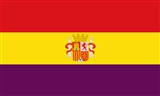
The Republican Constitution also changed the symbols of the country. The Himno de Riego was established as the national anthem and the
TricolorThe Flag of the Second Spanish Republic, also known as , was the official flag of Spain between 1931 and 1939 and the flag of the Spanish Republican government in Exile until 1977.-History:...
, with three horizontal red-yellow-purple fields, became the new flag of Spain. Under the new Constitution, all of Spain's regions had the right to
autonomyAutonomy is a concept found in moral, political and bioethical philosophy. Within these contexts, it is the capacity of a rational individual to make an informed, un-coerced decision...
.
CataloniaCatalonia is an autonomous community in northeastern Spain, with the official status of a "nationality" of Spain. Catalonia comprises four provinces: Barcelona, Girona, Lleida, and Tarragona. Its capital and largest city is Barcelona. Catalonia covers an area of 32,114 km² and has an...
(1932) and the
Basque CountryThe Basque Country is an autonomous community of northern Spain. It includes the Basque provinces of Álava, Biscay and Gipuzkoa, also called Historical Territories....
(1936) exercised this right, with Andalucía,
AragónAragon is a modern autonomous community in Spain, coextensive with the medieval Kingdom of Aragon. Located in northeastern Spain, the Aragonese autonomous community comprises three provinces : Huesca, Zaragoza, and Teruel. Its capital is Zaragoza...
and Galicia in talks before the breakout of the Civil War. Overall, in spite of a wide range of liberties, the Constitution failed to agree in key areas with the conservative right, which was very rooted in rural areas, and the
Roman Catholic ChurchThe Catholic Church, also known as the Roman Catholic Church, is the world's largest Christian church, with over a billion members. Led by the Pope, it defines its mission as spreading the gospel of Jesus Christ, administering the sacraments and exercising charity...
, which was stripped of schools and public subsidies under the new Constitution. (
For the later constitution, see Spanish Constitution of 1978-Structure of the State:The Constitution recognizes the existence of nationalities and regions . Preliminary Title As a result, Spain is now composed entirely of 17 Autonomous Communities and two autonomous cities with varying degrees of autonomy, to the extent that, even though the Constitution...
.)
1934-1935 period and miners' uprising
The majority vote in the
1933 electionsElections to Spain’s legislature, the Cortes Generales, were held on 19 November 1933 for all 473 seats in the unicameral Cortes of the Second Spanish Republic. Since the previous elections of 1931, a new constitution had been ratified, and the franchise extended to more than six million women...
was won by
Spanish Confederation of the Autonomous RightThe Spanish Confederation of the Autonomous Right was a Spanish political party in the Second Spanish Republic. A Catholic conservative force, it was the political heir to Angel Herrera Oria's Acción Popular and defined itself in terms of the 'affirmation and defence of the principles of Christian...
(CEDA), led by
José María Gil RoblesJosé María Gil-Robles y Quiñones was a prominent Spanish politician in the period leading up to the Spanish Civil War....
, a coalition of centre-right and far-right parties. CEDA set up a coalition with the
Radical Republican PartyThe Radical Republican Party , sometimes shortened to the Radical Party was a Spanish political party founded in 1908 by Alejandro Lerroux in Santander, Cantabria by a split from the historical Republican Union party led by Nicolás Salmerón....
led by
Alejandro LerrouxAlejandro Lerroux y García was a Spanish politician who was the leader of the Radical Republican Party during the Second Spanish Republic...
, which had come second in the elections. The Socialists came third. With Lerroux as head of Government, the new coalition Executive suspended most of the reforms of the previous government.
The inclusion of three CEDA ministers in the government that took office on October 1, 1934 led to a
general strikeA general strike is a strike action by a critical mass of the labour force in a city, region, or country. While a general strike can be for political goals, economic goals, or both, it tends to gain its momentum from the ideological or class sympathies of the participants...
and a rebellion by socialists and anarchists in
AsturiasThe Principality of Asturias is an autonomous community of the Kingdom of Spain, coextensive with the former Kingdom of Asturias in the Middle Ages...
on October 6. Miners in Asturias occupied the capital,
OviedoOviedo is the capital city of the Principality of Asturias in northern Spain. It is also the name of the municipality that contains the city....
, killing officials and clergymen and burning theatres and the University. This rebellion lasted for two weeks until it was crushed by the army, led by General
Francisco FrancoFrancisco Franco y Bahamonde was a Spanish general, dictator and head of state of Spain from October 1936 , and de facto regent of the nominally restored Kingdom of Spain from 1947 until his death in November, 1975...
, who in the process destroyed large parts of the city. This operation earned Franco the nickname "Butcher of Asturias". Another rebellion by autonomists in Catalonia was also suppressed, and was followed by mass arrests and trials.
The suspension of the land reforms that had been attempted by the previous government, and the failure of the Asturias miners' uprising, led to a more radical turn by the parties of the left, especially in the PSOE (Socialist Party), where the moderate
Indalecio PrietoIndalecio Prieto Tuero was a Spanish politician, one of the leading figures of the Spanish Socialist Workers' Party in the years before and during the Second Spanish Republic.-Early years:...
lost ground to
Francisco Largo CaballeroFrancisco Largo Caballero was a Spanish politician and trade unionist. He was one of the historic leaders of the Spanish Socialist Workers' Party and of the Workers' General Union...
, who advocated a socialist revolution. At the same time the involvement of the Centrist government party in the
StraperloStraperlo was a business which tried to introduce in Spain in the 1930s a fraudulent roulette which could be controlled electrically with the push of a button...
scandal deeply weakened it, further polarising political differences between right and left. These differences became evident in the 1936 elections.
the union was not very reliable. they died on the bull run. they lost the war. or the battle of the war. yeeeee buddy<3
1936 elections
On January 7, 1936,
new electionsLegislative elections were held in Spain on February 16, 1936. At stake were all 473 seats in the unicameral Cortes Generales. The winners of the 1936 elections were the Popular Front, a left-wing coalition of the Spanish Socialist Workers' Party , Republican Left , Esquerra Republicana de...
were called. Despite significant rivalries and disagreements the Socialists, Communists, and the Catalan and Madrid-based left-wing Republicans decided to work together under the name
Popular FrontThe Popular Front in Spain's Second Republic was an electoral coalition and pact signed in January 1936 by various left-wing political organisations, instigated by Manuel Azaña for the purpose of contesting that year's election....
. The Popular Front won the election on February 16 with 263 MPs against 156 right-wing MPs, grouped within a coalition of the
National Front with CEDA,
CarlistsCarlism is a traditionalist and legitimist political movement in Spain seeking the establishment of a separate line of the Bourbon family on the Spanish throne. This line descended from Infante Carlos, Count of Molina , and was founded due to dispute over the succession laws and widespread...
and Monarchists. The moderate centre parties virtually disappeared; between the elections, Lerroux's group fell from the 104 representatives it had in 1934 to just 9.
In the following months there was increasing violence between left and right. This helped development of the Fascist-inspired
Falange EspañolaThe Spanish Phalanx of the Assemblies of the National Syndicalist Offensive , known simply as the Falange, is the name assigned to several political movements and parties dating from the 1930s, most particularly the original fascist movement in Spain. The word means phalanx formation in Spanish....
, a National party led by
José Antonio Primo de RiveraJosé Antonio Primo de Rivera y Sáenz de Heredia, 1st Duke of Primo de Rivera, 3rd Marquis of Estella , was a Spanish lawyer, nobleman, politician, and founder of the Falange Española...
, the son of the former dictator, Miguel Primo de Rivera. Although it had only taken 0.7 per cent of the votes in the election, by July 1936 the Falange had 40,000 members.
Assassinations of political leaders and beginning of the war
On July 12, 1936, Lieutenant
José CastilloJosé del Castillo Sáez de Tejada or José Castillo was a Spanish Police Guardia de Asalto lieutenant during the Second Spanish Republic...
, an important member of the anti-fascist military organisation
Unión Militar Republicana AntifascistaThe Unión Militar Republicana Antifascista was a self-described anti-fascist organization for military members in Spain during the Second Spanish Republic. The secret society was created in late 1935, with its membership drawn primarily from the Assault Guard...
(UMRA), was shot by
FalangistThe Spanish Phalanx of the Assemblies of the National Syndicalist Offensive , known simply as the Falange, is the name assigned to several political movements and parties dating from the 1930s, most particularly the original fascist movement in Spain. The word means phalanx formation in Spanish....
gunmen. In retaliation the following day, July 13, UMRA members assassinated
José Calvo SoteloJosé Calvo Sotelo, 1st Duke of Calvo Sotelo was a Spanish politician prior to and during the Second Spanish Republic...
, leader of the right-wing opposition and the most prominent Spanish monarchist who, describing the government's actions as Bolshevist and Anarchist, had been exhorting the army to violence, declaring that Spanish soldiers would save the country from Communism if "there are no politicians capable of doing so"
The Right blamed the government for Calvo Sotelo's assassination. Although it is sometimes considered the catalyst for the further political polarisation that ensued, the Falange and other right-wing conspirators, including
Juan de la CiervaJuan de la Cierva y Codorníu, 1st Count of De La Cierva was a Spanish civil engineer, pilot and aeronuatical engineer. His most famous accomplishment was the invention in 1920 of the Autogiro, a single-rotor type of aircraft that came to be called autogyro in the English language...
, had already been conspiring to launch a military coup d'état against the government, to be led by senior army officers. When the antifascist Castillo and the pro-Fascist Calvo Sotelo were buried on the same day July 14 in the same Madrid cemetery, fighting between the
Police Assault GuardThe Guardia de Asalto , usually shortened to Los Asaltos or just Asaltos, were the blue-uniformed urban police force of Spain during the Spanish Second Republic. It was the urban analogue to the green-uniformed Guardia Civil which patrolled the countryside. The Assault Guards were special police...
and Fascist militias broke out in the surrounding streets, resulting in four more deaths.
Three days later (July 17), the coup d'état began more or less as it had been planned, with an army uprising in
Spanish MoroccoThe Spanish protectorate of Morocco was the area of Morocco under colonial rule by the Spanish Empire, established by the Treaty of Fez in 1912 and ending in 1956, when both France and Spain recognized Moroccan independence.-Territorial borders:...
which then spread to several regions of the country. Franco's move was intended to seize power immediately, but his army uprising met with serious resistance and great swathes of Spain, including most of the main cities, remained loyal to the legally established Republic of Spain. General Franco then, instead of declaring his coup a failure, initiated a slow and determined war of attrition against the elected government in Madrid.
As a result, an estimated total of approximately 500,000 people would lose their lives in the war that followed.
Civil War
On July 17, 1936, General Franco led the
Spanish Army of AfricaThe Army of Africa was a Spanish field army that garrisoned Spanish Morocco from the early 20th century until Morocco's independence in 1956....
from Morocco to attack the mainland, while another force from the north under General
Emilio MolaEmilio Mola y Vidal, 1st Duke of Mola, Grandee of Spain was a Spanish Nationalist commander during the Spanish Civil War. He is best-known for having coined the term "fifth column".-Early life:...
moved south from Navarre. Military units were also mobilised elsewhere to take over government institutions. Before long the professional Army of Africa took much of the south and west under the control of the rebels. Bloody purges followed in each piece of captured "Nationalist" territory in order to consolidate Franco's future regime.
Although both sides received foreign military aid, the help which
Fascist ItalyThe Kingdom of Italy was a state forged in 1861 by the unification of Italy under the influence of the Kingdom of Sardinia, which was its legal predecessor state...
,
Nazi GermanyNazi Germany , also known as the Third Reich , but officially called German Reich from 1933 to 1943 and Greater German Reich from 26 June 1943 onward, is the name commonly used to refer to the state of Germany from 1933 to 1945, when it was a totalitarian dictatorship ruled by...
as part of
German involvement in the Spanish Civil WarGerman involvement in the Spanish Civil War was made up of the various ways in which Nazi Germany tried to influence the war. It lasted from the war's beginning in July 1936 until 1939 and in the most part attempted to secure a victory for the National faction.Some arms sales were made to the...
, and neighbouring Portugal gave the rebels, was much greater than the assistance that the Republicans received from the USSR, Mexico, and the volunteers of the International Brigades. While the
Axis powersThe Axis powers , also known as the Axis alliance, Axis nations, Axis countries, or just the Axis, was an alignment of great powers during the mid-20th century that fought World War II against the Allies. It began in 1936 with treaties of friendship between Germany and Italy and between Germany and...
wholeheartedly assisted General Franco's military campaign, the governments of France, Britain and other democratic European powers looked the other way and let the young Spanish Republic die, as the actions of the
Non-Intervention CommitteeDuring the Spanish Civil War, several countries followed a principle of non-intervention, which would result in the signing of the Non-Intervention Agreement in August 1936 and the setting up of the Non-Intervention Committee, which first met in September...
would show.
The
Siege of the AlcázarThe Siege of the Alcázar was a highly symbolic Nationalist victory in Toledo in the opening stages of the Spanish Civil War. The Alcázar of Toledo was held by a variety of military forces in favor of the Nationalist uprising. Militias of the parties in the Popular Front began their siege on July 21...
at Toledo early in the war was a turning point, with the rebels winning after a long siege. The Republicans managed to hold out in Madrid, despite a National assault in November 1936, and frustrated subsequent offensives against the capital at
JaramaJarama is a river in central Spain. It flows north to south, and passes east of Madrid when El Atazar Dam is built on a tributary, the Lozoya River. It flows into the river Tagus in Aranjuez...
and Guadalajara in 1937. Soon, though, the rebels began to erode their territory, starving Madrid and making inroads into the east. The north, including the Basque country, fell in late 1937, and the Aragon front collapsed shortly afterwards. The
bombing of GuernicaThe bombing of Guernica was an aerial attack on the Basque town of Guernica, Spain, causing widespread destruction and civilian deaths, during the Spanish Civil War...
was probably the most infamous event of the war and inspired Picasso's painting. It was used as a testing ground for the German Luftwaffe's
Condor LegionThe Condor Legion was a unit composed of volunteers from the German Air Force and from the German Army which served with the Nationalists during the Spanish Civil War of July 1936 to March 1939. The Condor Legion developed methods of terror bombing which were used widely in the Second World War...
. The
Battle of the EbroThe Battle of the Ebro was the longest and bloodiest battle of the Spanish Civil War...
in July–November 1938 was the final desperate attempt by the Republicans to turn the tide. When this failed and Barcelona fell to the rebels in early 1939, it was clear the war was over. The remaining Republican fronts collapsed and Madrid fell in March 1939.
Causes
The Second Republic was proclaimed during a period of worldwide economic depression. In spite of the high hopes, the Republican authorities had to struggle with rising unemployment and poverty. In the ensuing civil unrest, violence in the form of assassination, revolutionary
general strikeA general strike is a strike action by a critical mass of the labour force in a city, region, or country. While a general strike can be for political goals, economic goals, or both, it tends to gain its momentum from the ideological or class sympathies of the participants...
s, and mob actions increased dangerous levels in the eyes of the traditional centers of power, such as the landowners, the Church and the nobility. Thus it was easy for them to whip up dissatisfaction with the republican government
NazismNazism, the common short form name of National Socialism was the ideology and practice of the Nazi Party and of Nazi Germany...
in Germany,
fascismFascism is a radical authoritarian nationalist political ideology. Fascists seek to rejuvenate their nation based on commitment to the national community as an organic entity, in which individuals are bound together in national identity by suprapersonal connections of ancestry, culture, and blood...
in Italy and other forms of totalitarian government were on the rise in Europe. Right-wing political discourse became increasingly polarized, often as a form to check the threat of
communismCommunism is a social, political and economic ideology that aims at the establishment of a classless, moneyless, revolutionary and stateless socialist society structured upon common ownership of the means of production...
, that was perceived to be expanding from the
Soviet UnionThe Soviet Union , officially the Union of Soviet Socialist Republics , was a constitutionally socialist state that existed in Eurasia between 1922 and 1991....
. Rather than working towards consensus between political forces, politicians on the right and the left leaned towards polarization and called openly for violence.
The murders of the leftist military leader
José CastilloJosé del Castillo Sáez de Tejada or José Castillo was a Spanish Police Guardia de Asalto lieutenant during the Second Spanish Republic...
and the rightist politician
José Calvo SoteloJosé Calvo Sotelo, 1st Duke of Calvo Sotelo was a Spanish politician prior to and during the Second Spanish Republic...
opened the way to a rapidly increasing flood of violence between the political left and right.
Rightist elements in Spain still justify the military coup against the established Republic claiming that it was ungovernable and failed to respond adequately to the threats of communism, anarchism, anti-clericalism, and acts of random violence. At any rate there was great devastation caused by the three years of civil strife and the destructive
war of attritionAttrition warfare is a military strategy in which a belligerent side attempts to win a war by wearing down its enemy to the point of collapse through continuous losses in personnel and matériel....
imposed by General Franco on the impoverished country.
See also
- Spanish Republican government in Exile
The Spanish Republican government in exile was a continuation of the government of the Second Spanish Republic, which was established in exile after the victory of Francisco Franco's forces in the Spanish Civil War in April 1939...
- Spanish Republican Air Force
The Spanish Republican Air Force, , was the air arm of the Second Spanish Republic, the legally established government of Spain between 1931 and 1939...
- Flag of the Second Spanish Republic
The Flag of the Second Spanish Republic, also known as , was the official flag of Spain between 1931 and 1939 and the flag of the Spanish Republican government in Exile until 1977.-History:...
- Coat of Arms of the Second Spanish Republic
The Coat of arms of the Second Spanish Republic was the emblem of the Second Spanish Republic, the democratic government that existed in Spain between April 14, 1931, when King Alfonso XIII left the country, and April 1, 1939, when the last of the Republican forces surrendered to rebel Francoist...
- Catholicism in the Second Spanish Republic
Catholicism in the Second Spanish Republic was an important area of dispute, and tensions between the Catholic hierarchy and the Republic were apparent from the beginning - the establishment of the Republic began 'the most dramatic phase in the contemporary history of both Spain and the Church.'...
- Battle of the Ebro
The Battle of the Ebro was the longest and bloodiest battle of the Spanish Civil War...
Further reading
- Gerald Brenan
Edward FitzGerald "Gerald" Brenan, CBE was a British writer and Hispanist who spent much of his life in Spain.He is best known for The Spanish Labyrinth, a historical work on the background to the Spanish Civil War, and for South from Granada: Seven Years in an Andalusian Village...
, The Spanish LabyrinthThe Spanish Labyrinth by Gerald Brenan, is an account of Spain's social, economic and political history as a background to the Spanish Civil War.First published in 1943, it has since then run to several reprints and, together with works by noted Hispanists such as Paul...
: An Account of the Social and Political Background of the Spanish Civil War (1943)
- Raymond Carr, ed. The Republic and the Civil War in Spain (1971)
- Raymond Carr, Spain 1808-1975 (1982)
External links