

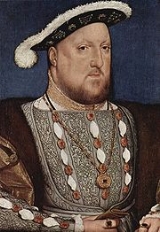
Supreme Governor of the Church of England

Encyclopedia
The Supreme Governor of the Church of England is a title held by the British monarchs which signifies their titular leadership over the Church of England
. Although the monarch's authority over the Church of England is not strong, the position is still very relevant to the church and is mostly observed in a symbolic capacity. The Supreme Governor formally appoints high-ranking members of the church on the advice of the Prime Minister of the United Kingdom
, who is in turn advised by church leaders.
as the established church with himself as its head. The Act of Supremacy 1534 confirmed the King's status as having supremacy over the church and required the nobility to swear an oath recognizing Henry's supremacy. Henry's daughter, Queen Mary I
, attempted to restore the English Church's allegiance to the Pope and repealed the Act of Supremacy in 1555. Elizabeth took the throne in 1558 and, the next year, Parliament
passed the Act of Supremacy 1559
that restored the original act. However, to placate critics, the Oath of Supremacy
, which nobles were required to swear, gave the monarch's title as Supreme Governor of the church rather than Supreme Head. This wording avoided the charge that the monarchy was claiming divinity or usurping Jesus
Christ, whom the Bible identifies as head of the church.
"Defender of the Faith" (Fidei Defensor
) has been part of the British monarch's title since Henry VIII was originally granted it by Pope Leo X
in 1521 in recognition of Henry's role in opposing the Protestant Reformation
. The pope withdrew the title, but it was later reconferred by Parliament in the reign of Edward VI
.
of 1562. It states that:
Article 37 makes this claim to royal supremacy more explicit:
(a Presbyterian, national church
), the monarch is automatically a member, but holds no leadership position. Nevertheless, the monarch appoints the Lord High Commissioner to the General Assembly of the Church of Scotland
as their personal representative, with a largely ceremonial role. However, the Queen has on occasion filled the role personally, as when she opened the General Assembly herself in 1977 and 2002 (her Silver and Golden Jubilee years).

Church of England
The Church of England is the officially established Christian church in England and the Mother Church of the worldwide Anglican Communion. The church considers itself within the tradition of Western Christianity and dates its formal establishment principally to the mission to England by St...
. Although the monarch's authority over the Church of England is not strong, the position is still very relevant to the church and is mostly observed in a symbolic capacity. The Supreme Governor formally appoints high-ranking members of the church on the advice of the Prime Minister of the United Kingdom
Prime Minister of the United Kingdom
The Prime Minister of the United Kingdom of Great Britain and Northern Ireland is the Head of Her Majesty's Government in the United Kingdom. The Prime Minister and Cabinet are collectively accountable for their policies and actions to the Sovereign, to Parliament, to their political party and...
, who is in turn advised by church leaders.
History
By 1536 Henry VIII had broken with Rome, seized the church's assets in England and declared the Church of EnglandChurch of England
The Church of England is the officially established Christian church in England and the Mother Church of the worldwide Anglican Communion. The church considers itself within the tradition of Western Christianity and dates its formal establishment principally to the mission to England by St...
as the established church with himself as its head. The Act of Supremacy 1534 confirmed the King's status as having supremacy over the church and required the nobility to swear an oath recognizing Henry's supremacy. Henry's daughter, Queen Mary I
Mary I of England
Mary I was queen regnant of England and Ireland from July 1553 until her death.She was the only surviving child born of the ill-fated marriage of Henry VIII and his first wife Catherine of Aragon. Her younger half-brother, Edward VI, succeeded Henry in 1547...
, attempted to restore the English Church's allegiance to the Pope and repealed the Act of Supremacy in 1555. Elizabeth took the throne in 1558 and, the next year, Parliament
Parliament of England
The Parliament of England was the legislature of the Kingdom of England. In 1066, William of Normandy introduced a feudal system, by which he sought the advice of a council of tenants-in-chief and ecclesiastics before making laws...
passed the Act of Supremacy 1559
Act of Supremacy 1559
The Act of Supremacy 1558 was an Act of the Parliament of England, passed under the auspices of Queen Elizabeth I of England. It replaced the original Act of Supremacy 1534 issued by Elizabeth's father, Henry VIII, which arrogated ecclesiastical authority to the monarchy, and which had been...
that restored the original act. However, to placate critics, the Oath of Supremacy
Oath of Supremacy
The Oath of Supremacy, originally imposed by King Henry VIII of England through the Act of Supremacy 1534, but repealed by his daughter, Queen Mary I of England and reinstated under Mary's sister, Queen Elizabeth I of England under the Act of Supremacy 1559, provided for any person taking public or...
, which nobles were required to swear, gave the monarch's title as Supreme Governor of the church rather than Supreme Head. This wording avoided the charge that the monarchy was claiming divinity or usurping Jesus
Jesus
Jesus of Nazareth , commonly referred to as Jesus Christ or simply as Jesus or Christ, is the central figure of Christianity...
Christ, whom the Bible identifies as head of the church.
"Defender of the Faith" (Fidei Defensor
Fidei defensor
Fidei defensor is a Latin title which translates to Defender of the Faith in English and Défenseur de la Foi in French...
) has been part of the British monarch's title since Henry VIII was originally granted it by Pope Leo X
Pope Leo X
Pope Leo X , born Giovanni di Lorenzo de' Medici, was the Pope from 1513 to his death in 1521. He was the last non-priest to be elected Pope. He is known for granting indulgences for those who donated to reconstruct St. Peter's Basilica and his challenging of Martin Luther's 95 Theses...
in 1521 in recognition of Henry's role in opposing the Protestant Reformation
Protestant Reformation
The Protestant Reformation was a 16th-century split within Western Christianity initiated by Martin Luther, John Calvin and other early Protestants. The efforts of the self-described "reformers", who objected to the doctrines, rituals and ecclesiastical structure of the Roman Catholic Church, led...
. The pope withdrew the title, but it was later reconferred by Parliament in the reign of Edward VI
Edward VI of England
Edward VI was the King of England and Ireland from 28 January 1547 until his death. He was crowned on 20 February at the age of nine. The son of Henry VIII and Jane Seymour, Edward was the third monarch of the Tudor dynasty and England's first monarch who was raised as a Protestant...
.
Thirty-Nine Articles
This royal role is acknowledged in the Preface to the Thirty-Nine ArticlesThirty-Nine Articles
The Thirty-Nine Articles of Religion are the historically defining statements of doctrines of the Anglican church with respect to the controversies of the English Reformation. First established in 1563, the articles served to define the doctrine of the nascent Church of England as it related to...
of 1562. It states that:
"Being by God's Ordinance, according to Our just Title, Defender of the Faith and Supreme Governor of the Church, within these Our Dominions, We hold it most agreeable to this Our Kingly Office, and Our own religious zeal, to conserve and maintain the Church committed to Our Charge, in Unity of true Religion, and in the Bond of Peace ... We have therefore, upon mature Deliberation, and with the Advice of so many of Our Bishops as might conveniently be called together, thought fit to make this Declaration following ... That We are Supreme Governor of the Church of England ... "
Article 37 makes this claim to royal supremacy more explicit:
"The King's majesty hath the chief power in this Realm of England, and other of his Dominions, unto whom the chief Government of all Estates of this Realm, whether they be Ecclesiastical or Civil, in all causes doth appertain, and is not, nor ought to be, subject to any foreign jurisdiction ... We give not to our Princes the ministering either of God's Word, or of the Sacraments ... but that only prerogative, which we see to have been given always to all Godly Princes in holy Scriptures by God himself; that is, that they should rule all estates and degrees committed to their charge by God, whether they be Ecclesiastical or Temporal, and restrain with the civil sword the stubborn and evildoer ... The Bishop of Rome hath no jurisdiction in this Realm of England."
Church of Scotland
In the Church of ScotlandChurch of Scotland
The Church of Scotland, known informally by its Scots language name, the Kirk, is a Presbyterian church, decisively shaped by the Scottish Reformation....
(a Presbyterian, national church
National church
National church is a concept of a Christian church associated with a specific ethnic group or nation state. The idea was notably discussed during the 19th century, during the emergence of modern nationalism....
), the monarch is automatically a member, but holds no leadership position. Nevertheless, the monarch appoints the Lord High Commissioner to the General Assembly of the Church of Scotland
Lord High Commissioner to the General Assembly of the Church of Scotland
The Lord High Commissioner to the General Assembly of the Church of Scotland is the British Sovereign's personal representative to the General Assembly of the Church of Scotland , reflecting the Church's role as the national church of Scotland, and the Sovereign's role as protector and member of...
as their personal representative, with a largely ceremonial role. However, the Queen has on occasion filled the role personally, as when she opened the General Assembly herself in 1977 and 2002 (her Silver and Golden Jubilee years).
List of Supreme Governors
| Name | Years | Notes |
|---|---|---|
| Henry VIII Henry VIII of England Henry VIII was King of England from 21 April 1509 until his death. He was Lord, and later King, of Ireland, as well as continuing the nominal claim by the English monarchs to the Kingdom of France... |
1536–1547 | As Supreme Head |
| Edward VI Edward VI of England Edward VI was the King of England and Ireland from 28 January 1547 until his death. He was crowned on 20 February at the age of nine. The son of Henry VIII and Jane Seymour, Edward was the third monarch of the Tudor dynasty and England's first monarch who was raised as a Protestant... |
1547–1553 | As Supreme Head |
| Mary I Mary I of England Mary I was queen regnant of England and Ireland from July 1553 until her death.She was the only surviving child born of the ill-fated marriage of Henry VIII and his first wife Catherine of Aragon. Her younger half-brother, Edward VI, succeeded Henry in 1547... |
1553–1555 | As Supreme Head (from 1554 the Queen omitted the title without statutory authority, which was reverted by Parliament in 1555) |
| Elizabeth I Elizabeth I of England Elizabeth I was queen regnant of England and Ireland from 17 November 1558 until her death. Sometimes called The Virgin Queen, Gloriana, or Good Queen Bess, Elizabeth was the fifth and last monarch of the Tudor dynasty... |
1559–1603 | |
| James I James I of England James VI and I was King of Scots as James VI from 24 July 1567 and King of England and Ireland as James I from the union of the English and Scottish crowns on 24 March 1603... |
1603–1625 | |
| Charles I Charles I of England Charles I was King of England, King of Scotland, and King of Ireland from 27 March 1625 until his execution in 1649. Charles engaged in a struggle for power with the Parliament of England, attempting to obtain royal revenue whilst Parliament sought to curb his Royal prerogative which Charles... |
1625–1649 | Executed for "high treason against the people". |
| Interregnum | 1649–1660 | Church of England disestablished by the Commonwealth Government Commonwealth of England The Commonwealth of England was the republic which ruled first England, and then Ireland and Scotland from 1649 to 1660. Between 1653–1659 it was known as the Commonwealth of England, Scotland and Ireland... |
| Charles II Charles II of England Charles II was monarch of the three kingdoms of England, Scotland, and Ireland.Charles II's father, King Charles I, was executed at Whitehall on 30 January 1649, at the climax of the English Civil War... |
1649–1685 | Became a Roman Catholic on his deathbed. |
| James II James II of England James II & VII was King of England and King of Ireland as James II and King of Scotland as James VII, from 6 February 1685. He was the last Catholic monarch to reign over the Kingdoms of England, Scotland, and Ireland... |
1685–1688 | Roman Catholic, deposed |
| Mary II Mary II of England Mary II was joint Sovereign of England, Scotland, and Ireland with her husband and first cousin, William III and II, from 1689 until her death. William and Mary, both Protestants, became king and queen regnant, respectively, following the Glorious Revolution, which resulted in the deposition of... |
1689–1694 | Held jointly with William III William III of England William III & II was a sovereign Prince of Orange of the House of Orange-Nassau by birth. From 1672 he governed as Stadtholder William III of Orange over Holland, Zeeland, Utrecht, Guelders, and Overijssel of the Dutch Republic. From 1689 he reigned as William III over England and Ireland... |
| William III William III of England William III & II was a sovereign Prince of Orange of the House of Orange-Nassau by birth. From 1672 he governed as Stadtholder William III of Orange over Holland, Zeeland, Utrecht, Guelders, and Overijssel of the Dutch Republic. From 1689 he reigned as William III over England and Ireland... |
1689–1702 | Held jointly with Mary II Mary II of England Mary II was joint Sovereign of England, Scotland, and Ireland with her husband and first cousin, William III and II, from 1689 until her death. William and Mary, both Protestants, became king and queen regnant, respectively, following the Glorious Revolution, which resulted in the deposition of... , 1689–1694 |
| Anne | 1702–1714 | |
| George I George I of Great Britain George I was King of Great Britain and Ireland from 1 August 1714 until his death, and ruler of the Duchy and Electorate of Brunswick-Lüneburg in the Holy Roman Empire from 1698.... |
1714–1727 | |
| George II George II of Great Britain George II was King of Great Britain and Ireland, Duke of Brunswick-Lüneburg and Archtreasurer and Prince-elector of the Holy Roman Empire from 11 June 1727 until his death.George was the last British monarch born outside Great Britain. He was born and brought up in Northern Germany... |
1727–1760 | |
| George III | 1760–1820 | |
| George IV | 1820–1830 | |
| William IV William IV of the United Kingdom William IV was King of the United Kingdom of Great Britain and Ireland and of Hanover from 26 June 1830 until his death... |
1830–1837 | |
| Victoria | 1837–1901 | |
| Edward VII Edward VII of the United Kingdom Edward VII was King of the United Kingdom and the British Dominions and Emperor of India from 22 January 1901 until his death in 1910... |
1901–1910 | |
| George V George V of the United Kingdom George V was King of the United Kingdom and the British Dominions, and Emperor of India, from 6 May 1910 through the First World War until his death in 1936.... |
1910–1936 | |
| Edward VIII Edward VIII of the United Kingdom Edward VIII was King of the United Kingdom and the Dominions of the British Commonwealth, and Emperor of India, from 20 January to 11 December 1936.Before his accession to the throne, Edward was Prince of Wales and Duke of Cornwall and Rothesay... |
1936 | |
| George VI George VI of the United Kingdom George VI was King of the United Kingdom and the Dominions of the British Commonwealth from 11 December 1936 until his death... |
1936–1952 | |
| Elizabeth II | 1952–present |