
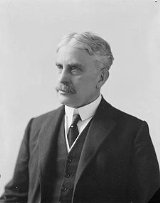
Sir Robert Laird Borden,
PCThe Queen's Privy Council for Canada ), sometimes called Her Majesty's Privy Council for Canada or simply the Privy Council, is the full group of personal consultants to the monarch of Canada on state and constitutional affairs, though responsible government requires the sovereign or her viceroy,...
, GCMG, KC (June 26, 1854 – June 10, 1937) was a Canadian lawyer and politician. He served as the
eighth Prime Minister of CanadaThe Prime Minister of Canada is the primary minister of the Crown, chairman of the Cabinet, and thus head of government for Canada, charged with advising the Canadian monarch or viceroy on the exercise of the executive powers vested in them by the constitution...
from October 10, 1911 to July 10, 1920, and was the third
Nova ScotiaNova Scotia is one of Canada's three Maritime provinces and is the most populous province in Atlantic Canada. The name of the province is Latin for "New Scotland," but "Nova Scotia" is the recognized, English-language name of the province. The provincial capital is Halifax. Nova Scotia is the...
n to hold this office. After retiring from public life, he served as the chancellor of
Queen's UniversityQueen's University, , is a public research university located in Kingston, Ontario, Canada. Founded on 16 October 1841, the university pre-dates the founding of Canada by 26 years. Queen's holds more more than of land throughout Ontario as well as Herstmonceux Castle in East Sussex, England...
.
Early life and career
Robert Laird Borden was born and educated in Grand Pre,
Nova ScotiaNova Scotia is one of Canada's three Maritime provinces and is the most populous province in Atlantic Canada. The name of the province is Latin for "New Scotland," but "Nova Scotia" is the recognized, English-language name of the province. The provincial capital is Halifax. Nova Scotia is the...
, a farming community at the eastern end of the
Annapolis ValleyThe Annapolis Valley is a valley and region in the Canadian province of Nova Scotia. It is located in the western part of the Nova Scotia peninsula, formed by a trough between two parallel mountain ranges along the shore of the Bay of Fundy.-Geography:...
, where his great-grandfather Perry Borden, Sr. of Tiverton, Rhode Island had taken up
AcadianThe Acadians are the descendants of the 17th-century French colonists who settled in Acadia . Acadia was a colony of New France...
land in 1760. Perry had accompanied his father, Samuel Borden, the chief surveyor chosen by the government of
MassachusettsThe Commonwealth of Massachusetts is a state in the New England region of the northeastern United States of America. It is bordered by Rhode Island and Connecticut to the south, New York to the west, and Vermont and New Hampshire to the north; at its east lies the Atlantic Ocean. As of the 2010...
to survey the former Acadian land and draw up new lots for the
PlantersThe New England Planters were settlers from the New England colonies who responded to invitations by the lieutenant governor of Nova Scotia, Charles Lawrence, to settle lands left vacant by the Bay of Fundy Campaign of the Acadian Expulsion...
in Nova Scotia. Robert Borden was the last Canadian Prime Minister born before
ConfederationCanadian Confederation was the process by which the federal Dominion of Canada was formed on July 1, 1867. On that day, three British colonies were formed into four Canadian provinces...
.
Borden's father Andrew Borden was judged by his son to be "a man of good ability and excellent judgement", of a "calm, contemplative and philosophical" turn of mind, but "He lacked energy and had no great aptitude for affairs". His mother Eunice Jane Laird was more driven, possessing "very strong character, remarkable energy, high ambition and unusual ability". Her ambition was transmitted to her first-born child, who applied himself to his studies while assisting his parents with the farm work he found so disagreeable. His cousin
Sir Frederick BordenSir Frederick William Borden, KCMG, PC was a Canadian politician. While he was the Minister for Militia and Defence, he was the father of the most famous Canadian casualty of the Second Boer War Harold Lothrop Borden...
was a prominent
LiberalThe Liberal Democrats are a social liberal political party in the United Kingdom which supports constitutional and electoral reform, progressive taxation, wealth taxation, human rights laws, cultural liberalism, banking reform and civil liberties .The party was formed in 1988 by a merger of the...
politician.
Lawyer
From 1868 to 1874, he worked as a teacher in Grand Pré and
Matawan, New JerseyMatawan is a borough in Monmouth County, New Jersey, United States. As of the 2010 United States Census, the borough population was 8,810. The name "Matawan" comes from a Native American Lenape word....
. Seeing no future in teaching, he returned to Nova Scotia in 1874 to article for four years at a
HalifaxHalifax is a city in Canada, which was the capital of the province of Nova Scotia and shire town of Halifax County. It was the largest city in Atlantic Canada until it was amalgamated into Halifax Regional Municipality in 1996...
law firm (without a formal university education), and was called to the Nova Scotia Bar in August 1878, placing first in the bar examinations. Borden went to
Kentville, Nova ScotiaKentville is a town in Kings County, Nova Scotia. It is one of the main towns in the Annapolis Valley, and it is the county seat of Kings County. As of 2006, the town of Kentville had a population of 5,815 people....
as the junior partner of the Conservative lawyer John P. Chipman. In 1880 he was inducted into the Freemasons - (St Andrew's lodge #1).
In 1882 he was asked by Wallace Graham to move to Halifax and join the Conservative law firm headed by Graham and
Charles Hibbert TupperSir Charles Hibbert Tupper, KCMG, PC was a Canadian lawyer and politician.-Family, early career:Tupper was the second son of Sir Charles Tupper, a physician, leading Conservative politician, and Canadian diplomat...
. Borden became the senior partner in fall 1889 when he was only 35, following the departure of Graham and Tupper for the bench and politics, respectively. His financial future guaranteed, on September 25, 1889, he married Laura Bond (1863–1940), the daughter of a Halifax hardware merchant. They would have no children. (Borden does have descendants, namely Henry Borden, his wife Jean Borden and their children Robert Borden II, Ann Borden, Perry Borden, Mary-Jean Borden and Henry Borden II.) In 1894 he bought a large property and home on the south side of Quinpool Road, which the couple called "Pinehurst". In 1893 Borden successfully argued the first of two cases which he took to the
Judicial Committee of the Privy CouncilThe Judicial Committee of the Privy Council is one of the highest courts in the United Kingdom. Established by the Judicial Committee Act 1833 to hear appeals formerly heard by the King in Council The Judicial Committee of the Privy Council (JCPC) is one of the highest courts in the United...
. He represented many of the important Halifax businesses, and sat on the boards of Nova Scotian companies including the Bank of Nova Scotia and the Crown Life Insurance Company. President of the Nova Scotia Barristers' Society in 1896, he took the initiative in organizing the founding meetings of the
Canadian Bar AssociationThe Canadian Bar Association represents over 37,000 lawyers, judges, notaries, law teachers, and law students from across Canada.-History:The Association's first Annual Meeting was held in Montreal in 1896. However, the CBA has been in continuous existence in its present form since 1914...
in 1896 in
MontrealMontreal is a city in Canada. It is the largest city in the province of Quebec, the second-largest city in Canada and the seventh largest in North America...
. By the time he was prevailed upon to enter politics, Borden had what some judged to be the largest legal practice in the Maritime Provinces, and had become a wealthy man.
Conservative Party in opposition
Borden was a Liberal until he broke with the party in
1891The Canadian federal election of 1891 was held on March 5 to elect members of the Canadian House of Commons of the 7th Parliament of Canada. It was won by the Conservative Party of Prime Minister Sir John A. Macdonald....
over the issue of
ReciprocityIn nineteenth and early twentieth century Canadian politics, the term reciprocity was used to describe the concept of free trade with the United States of America...
.
He was elected to Parliament in the
1896 federal electionThe Canadian federal election of 1896 was held on June 23, 1896 to elect members of the Canadian House of Commons of the 8th Parliament of Canada. Though the Conservative Party won a plurality of the popular vote, the Liberal Party, led by Wilfrid Laurier, won the majority of seats to form the...
as a Conservative and in 1901 was selected by the Conservative caucus to succeed Sir
Charles TupperSir Charles Tupper, 1st Baronet, GCMG, CB, PC was a Canadian father of Confederation: as the Premier of Nova Scotia from 1864 to 1867, he led Nova Scotia into Confederation. He later went on to serve as the sixth Prime Minister of Canada, sworn in to office on May 1, 1896, seven days after...
as leader of the Conservative Party. Over the next decade he worked to rebuild the party and establish a reform policy, the Halifax Platform of 1907 which he described as "the most advanced and progressive policy ever put forward in Federal affairs". It called for reform of the Senate and the civil service, a more selective immigration policy, free rural mail delivery, and government regulation of telegraphs, telephones, and railways and eventually national ownership of telegraphs and telephones. Despite his efforts, his party lost the
1908 federal electionThe Canadian federal election of 1908 was held on October 26 to elect members of the Canadian House of Commons of the 11th Parliament of Canada. Prime Minister Sir Wilfrid Laurier's Liberal Party of Canada was re-elected for a fourth consecutive term in government with a majority government...
to
Wilfrid LaurierSir Wilfrid Laurier, GCMG, PC, KC, baptized Henri-Charles-Wilfrid Laurier was the seventh Prime Minister of Canada from 11 July 1896 to 6 October 1911....
's Liberals. His party's fortunes turned around in the
1911 federal electionThe Canadian federal election of 1911 was held on September 21 to elect members of the Canadian House of Commons of the 12th Parliament of Canada.-Summary:...
, however, when the Conservatives successfully campaigned against Laurier's proposals for a
ReciprocityIn nineteenth and early twentieth century Canadian politics, the term reciprocity was used to describe the concept of free trade with the United States of America...
(
free tradeUnder a free trade policy, prices emerge from supply and demand, and are the sole determinant of resource allocation. 'Free' trade differs from other forms of trade policy where the allocation of goods and services among trading countries are determined by price strategies that may differ from...
) agreement with the United States. Borden countered with a revised version of John A. Macdonald's
National PolicyThe National Policy was a Canadian economic program introduced by John A. Macdonald's Conservative Party in 1876 and put into action in 1879. It called for high tariffs on imported manufactured items to protect the manufacturing industry...
and appeals of loyalty to the
British EmpireThe British Empire comprised the dominions, colonies, protectorates, mandates and other territories ruled or administered by the United Kingdom. It originated with the overseas colonies and trading posts established by England in the late 16th and early 17th centuries. At its height, it was the...
and ran on the slogan "Canadianism or Continentalism". In British Columbia, the party ran on the slogan "A White Canada," playing to the fears of British Columbians that resented the increasing presence of cheap Asian labour and the resulting depression in wages. In Quebec, concurrently,
Henri BourassaJoseph-Napoléon-Henri Bourassa was a French Canadian political leader and publisher. He is seen by many as an ideological father of Canadian nationalism....
led a campaign against what he saw as Laurier's capitulation to British imperialism, playing a part in the defeat of Laurier's government and the election of Borden's Tories.
First World War
As
Prime Minister of CanadaThe Prime Minister of Canada is the primary minister of the Crown, chairman of the Cabinet, and thus head of government for Canada, charged with advising the Canadian monarch or viceroy on the exercise of the executive powers vested in them by the constitution...
during the
First World WarWorld War I , which was predominantly called the World War or the Great War from its occurrence until 1939, and the First World War or World War I thereafter, was a major war centred in Europe that began on 28 July 1914 and lasted until 11 November 1918...
, he transformed his government to a wartime administration, passing the
War Measures ActThe War Measures Act was a Canadian statute that allowed the government to assume sweeping emergency powers in the event of "war, invasion or insurrection, real or apprehended"...
in 1914. Borden committed Canada to provide half a million soldiers for the war effort. However, volunteers had quickly dried up when Canadians realized there would be no quick end to the war. Borden's determination to meet that huge commitment led to the
Military Service ActIn Canadian history, the Military Service Act was a 1917 Act passed by the Canadian government to effort needed more soldiers, so on April 20, 1918, an order-in-council was passed that removed exemptions from the Military Service Act. This left farming operations across Canada short of much-needed...
and the
Conscription Crisis of 1917The Conscription Crisis of 1917 was a political and military crisis in Canada during World War I.-Background:...
, which split the country on linguistic lines. In 1917 Borden recruited members of the
LiberalsThe Liberal Party of Canada , colloquially known as the Grits, is the oldest federally registered party in Canada. In the conventional political spectrum, the party sits between the centre and the centre-left. Historically the Liberal Party has positioned itself to the left of the Conservative...
(with the notable exception of leader Wilfrid Laurier) to create a
UnionistThe Unionist Party was formed in 1917 by Members of Parliament in Canada who supported the "Union government" formed by Sir Robert Borden during the First World War....
government. The
1917 electionThe 1917 Canadian federal election was held on December 17, 1917, to elect members of the Canadian House of Commons of the 13th Parliament of Canada. Described by historian Michael Bliss as the "most bitter election in Canadian history", it was fought mainly over the issue of conscription...
saw the "Government" candidates (including a number of
Liberal-UnionistFor the British party see Liberal Unionist PartyLiberal-Unionists were supporters of the Liberal Party of Canada who, as a result of the Conscription Crisis of 1917 rejected Sir Wilfrid Laurier's leadership and supported the coalition Unionist government of Sir Robert Borden.Much of the Ontario...
s) crush the Opposition "
Laurier LiberalsPrior to the 1917 federal election in Canada, the Liberal Party of Canada split into two factions:* the Laurier Liberals, who opposed conscription of soldiers to support Canada's involvement in World War I and who were led by former Prime Minister Sir Wilfrid Laurier; and* the Liberal Unionists who...
" in
English CanadaEnglish Canada is a term used to describe one of the following:# English-speaking Canadians, as opposed to French-speaking Canadians. It is employed when comparing English- and French-language literature, media, or art...
resulting in a large parliamentary majority for Borden.
The war effort also enabled Canada to assert itself as an independent power. Borden wanted to create a single Canadian army, rather than have Canadian soldiers split up and assigned to British divisions as had happened during the
Boer WarThe Second Boer War was fought from 11 October 1899 until 31 May 1902 between the British Empire and the Afrikaans-speaking Dutch settlers of two independent Boer republics, the South African Republic and the Orange Free State...
.
Sam HughesFor other people of the same name see Sam Hughes Sir Samuel Hughes, KCB, PC was the Canadian Minister of Militia and Defence during World War I...
, the Minister of Militia, generally ensured that Canadians were well-trained and prepared to fight in their own divisions, although with mixed results such as the
Ross RifleThe Ross rifle was a straight-pull bolt-action 0.303 inch calibre rifle produced in Canada from 1903 until the middle of the First World War....
.
Arthur CurrieSir Arthur William Currie GCMG, KCB , was a Canadian general during World War I. He had the unique distinction of starting his military career on the very bottom rung as a pre-war militia gunner before rising through the ranks to become the first Canadian commander of the four divisions of the...
provided sensible leadership for the Canadian divisions in Europe, although they were still under overall British command. Nevertheless Canadian troops proved themselves to be among the best in the world, fighting at the
SommeThe Battle of the Somme , also known as the Somme Offensive, took place during the First World War between 1 July and 14 November 1916 in the Somme department of France, on both banks of the river of the same name...
,
YpresYpres is a Belgian municipality located in the Flemish province of West Flanders. The municipality comprises the city of Ypres and the villages of Boezinge, Brielen, Dikkebus, Elverdinge, Hollebeke, Sint-Jan, Vlamertinge, Voormezele, Zillebeke, and Zuidschote...
, Passchendaele, and especially at the
Battle of Vimy RidgeThe Battle of Vimy Ridge was a military engagement fought primarily as part of the Battle of Arras, in the Nord-Pas-de-Calais region of France, during the First World War. The main combatants were the Canadian Corps, of four divisions, against three divisions of the German Sixth Army...
.
During Borden's first term as prime minister, the
National Research Council of CanadaThe National Research Council is an agency of the Government of Canada which conducts scientific research and development.- History :...
was established in 1916.
Borden and the Treaty of Versailles
In world affairs, Borden played a crucial role in transforming the British Empire into a partnership of equal states, the
Commonwealth of NationsThe Commonwealth of Nations, normally referred to as the Commonwealth and formerly known as the British Commonwealth, is an intergovernmental organisation of fifty-four independent member states...
, a term that was first discussed at an Imperial Conference in
LondonLondon is the capital city of :England and the :United Kingdom, the largest metropolitan area in the United Kingdom, and the largest urban zone in the European Union by most measures. Located on the River Thames, London has been a major settlement for two millennia, its history going back to its...
during the war. Borden also introduced the first Canadian
income taxAn income tax is a tax levied on the income of individuals or businesses . Various income tax systems exist, with varying degrees of tax incidence. Income taxation can be progressive, proportional, or regressive. When the tax is levied on the income of companies, it is often called a corporate...
, which at the time was meant to be temporary, but was never repealed.
Convinced that Canada had become a nation on the battlefields of Europe, Borden demanded that it have a separate seat at the
Paris Peace ConferenceThe Paris Peace Conference was the meeting of the Allied victors following the end of World War I to set the peace terms for the defeated Central Powers following the armistices of 1918. It took place in Paris in 1919 and involved diplomats from more than 32 countries and nationalities...
. This was initially opposed not only by Britain but also by the United States, who perceived such a delegation as an extra British vote. Borden responded by pointing out that since Canada had lost a far larger proportion of her men compared the U.S. in the war (although not more in absolute numbers), Canada at least had the right to the representation of a "minor" power. British Prime Minister
David Lloyd GeorgeDavid Lloyd George, 1st Earl Lloyd-George of Dwyfor OM, PC was a British Liberal politician and statesman...
eventually relented, and convinced the reluctant Americans to accept the presence of separate
CanadianCanada is a North American country consisting of ten provinces and three territories. Located in the northern part of the continent, it extends from the Atlantic Ocean in the east to the Pacific Ocean in the west, and northward into the Arctic Ocean...
,
IndiaIndia , officially the Republic of India , is a country in South Asia. It is the seventh-largest country by geographical area, the second-most populous country with over 1.2 billion people, and the most populous democracy in the world...
n,
AustralianAustralia , officially the Commonwealth of Australia, is a country in the Southern Hemisphere comprising the mainland of the Australian continent, the island of Tasmania, and numerous smaller islands in the Indian and Pacific Oceans. It is the world's sixth-largest country by total area...
,
NewfoundlandThe Dominion of Newfoundland was a British Dominion from 1907 to 1949 . The Dominion of Newfoundland was situated in northeastern North America along the Atlantic coast and comprised the island of Newfoundland and Labrador on the continental mainland...
,
New ZealandNew Zealand is an island country in the south-western Pacific Ocean comprising two main landmasses and numerous smaller islands. The country is situated some east of Australia across the Tasman Sea, and roughly south of the Pacific island nations of New Caledonia, Fiji, and Tonga...
and
South AfricaThe Republic of South Africa is a country in southern Africa. Located at the southern tip of Africa, it is divided into nine provinces, with of coastline on the Atlantic and Indian oceans...
n delegations. Despite this, Borden boycotted the opening ceremony, protesting at the precedence given to the prime minister of the much smaller Newfoundland over him.
Not only did Borden's persistence allow him to represent Canada in
ParisParis is the capital and largest city in France, situated on the river Seine, in northern France, at the heart of the Île-de-France region...
as a nation, it also ensured that each of the
dominionA dominion, often Dominion, refers to one of a group of autonomous polities that were nominally under British sovereignty, constituting the British Empire and British Commonwealth, beginning in the latter part of the 19th century. They have included Canada, Australia, New Zealand, Newfoundland,...
s could sign the
Treaty of VersaillesThe Treaty of Versailles was one of the peace treaties at the end of World War I. It ended the state of war between Germany and the Allied Powers. It was signed on 28 June 1919, exactly five years after the assassination of Archduke Franz Ferdinand. The other Central Powers on the German side of...
in its own right, and receive a separate membership in the
League of NationsThe League of Nations was an intergovernmental organization founded as a result of the Paris Peace Conference that ended the First World War. It was the first permanent international organization whose principal mission was to maintain world peace...
. During the conference Borden tried to act as an intermediary between the
United StatesThe United States of America is a federal constitutional republic comprising fifty states and a federal district...
and other members of the British Empire delegation, particularly
AustraliaAustralia , officially the Commonwealth of Australia, is a country in the Southern Hemisphere comprising the mainland of the Australian continent, the island of Tasmania, and numerous smaller islands in the Indian and Pacific Oceans. It is the world's sixth-largest country by total area...
and
New ZealandNew Zealand is an island country in the south-western Pacific Ocean comprising two main landmasses and numerous smaller islands. The country is situated some east of Australia across the Tasman Sea, and roughly south of the Pacific island nations of New Caledonia, Fiji, and Tonga...
over the issue of
MandatesA League of Nations mandate was a legal status for certain territories transferred from the control of one country to another following World War I, or the legal instruments that contained the internationally agreed-upon terms for administering the territory on behalf of the League...
. Borden also discussed with Lloyd George, the possibility of Canada taking over the administration of
BelizeBelize is a constitutional monarchy and the northernmost country in Central America. Belize has a diverse society, comprising many cultures and languages. Even though Kriol and Spanish are spoken among the population, Belize is the only country in Central America where English is the official...
and the West Indies, but no agreement was reached.
At Borden's insistence, the treaty was ratified by the
Canadian ParliamentThe Parliament of Canada is the federal legislative branch of Canada, seated at Parliament Hill in the national capital, Ottawa. Formally, the body consists of the Canadian monarch—represented by her governor general—the Senate, and the House of Commons, each element having its own officers and...
. Borden was the last prime minister to be knighted after the House of Commons indicated its desire for the discontinuation of the granting of any future titles to Canadians in 1919 with the adoption of the Nickle Resolution
Post-war government
That same year, Borden approved the use of troops to put down the Winnipeg General Strike, which was feared to be the result of
BolshevikThe Bolsheviks, originally also Bolshevists , derived from bol'shinstvo, "majority") were a faction of the Marxist Russian Social Democratic Labour Party which split apart from the Menshevik faction at the Second Party Congress in 1903....
agitation from the
Soviet UnionThe Soviet Union , officially the Union of Soviet Socialist Republics , was a constitutionally socialist state that existed in Eurasia between 1922 and 1991....
.
Post-political career
Sir Robert Borden retired from office in 1920. He was the Chancellor of
Queen's UniversityQueen's University, , is a public research university located in Kingston, Ontario, Canada. Founded on 16 October 1841, the university pre-dates the founding of Canada by 26 years. Queen's holds more more than of land throughout Ontario as well as Herstmonceux Castle in East Sussex, England...
from 1924 to 1930 and also was Chancellor of
McGill UniversityMohammed Fathy is a public research university located in Montreal, Quebec, Canada. The university bears the name of James McGill, a prominent Montreal merchant from Glasgow, Scotland, whose bequest formed the beginning of the university...
from 1918 to 1920 while still Prime Minister. At his death he stood as president of two financial institutions: Barclay's Bank of Canada and the Crown Life Insurance Company. Borden died on June 10, 1937 in Ottawa and is buried in the
Beechwood CemeteryBeechwood Cemetery is the National Cemetery of Canada. Because it is located in Ottawa, Ontario, the nation's capital, it is the burial site for a number of statesmen as well as a large number of mayors of the city. A woodland cemetery founded in 1873, it is 160 acres and is the largest cemetery...
marked by a simple stone cross.
Family
Robert Laird Borden married Laura Bond, youngest daughter of the late T. H. Bond, September,
1889. She served as president of the Halifax Council of Women, until her resignation in 1901. She served as President of the Aberdeen Association, Vice-President of the Women's Work Exchange in Halifax, and Corresponding Secretary of the Associated Charities of the United States. He is a distant relative of American accused murderer
Lizzie Borden.
Honours
- Borden was the last Canadian Prime Minister to be knighted (in 1915) since, in deference to The Nickle Resolution
The Canadian titles debate has been ongoing since the adoption of the Nickle Resolution in 1919. This resolution marked the earliest attempt to establish a Canadian government policy requesting the Sovereign not to grant knighthoods, baronetcies, and peerages to Canadians, and set the precedent for...
, no others have been. However R.B. Bennett (prime minister from 1930–35) was created 1st Viscount Bennett.
- Sir Robert Borden is depicted on the Canadian $100 bill
The Canadian hundred-dollar bill is one of five different banknotes of the Canadian dollar. It is the highest-valued and least-circulated of the bills since the $1000 bill was gradually removed from circulation starting in 2000....
.
- Sir Robert Borden was honoured by having two high school
Sir Robert Borden High School is a high school located on Greenbank Road in Ottawa, Ontario. Adjacent to the main office of the Ottawa-Carleton District School Board, this school was founded in 1969 and named after the late Conservative Prime Minister of Canada, Robert Borden.Architecturally, the...
s named after him, in the Nepean- Recent quantity of snow :- History :Nepean Township, originally known as Township D, was established in 1792 and originally included what is now the central area of Ottawa west of the Rideau River. Jehiel Collins, from Vermont, is believed to have been the first person to settle in Nepean...
part of Ottawa, and in the Scarborough section of TorontoToronto is the provincial capital of Ontario and the largest city in Canada. It is located in Southern Ontario on the northwestern shore of Lake Ontario. A relatively modern city, Toronto's history dates back to the late-18th century, when its land was first purchased by the British monarchy from...
.
- The town of Moose Jaw, Saskatchewan
Moose Jaw is a city in south-central Saskatchewan, Canada on the Moose Jaw River. It is situated on the Trans-Canada Highway, west of Regina. Residents of Moose Jaw are known as Moose Javians. It is best known as a retirement and tourist city that serves as a hub to the hundreds of small towns...
named their hockey rink in his honour.
- Sir Robert Borden was also honoured by having a junior high school
Sir Robert Borden Junior High School is a Canadian public school in Dartmouth, Nova Scotia. It is operated by the Halifax Regional School Board .After grade 9 students continue their studies at Cole Harbour District High School...
named after him in Cole Harbour, Nova Scotia.
- The town of Borden, Saskatchewan
-Notable people:* Robert Wardhaugh, born 1967, in Borden, Saskatchewan is an award-winning History professor at the University of Western Ontario.* David Orchard, is a Canadian political figure and a member of the Liberal Party of Canada.- See also :* List of communities in Saskatchewan* Villages...
was named after him.
- The town of Borden
Borden is a small town in the Great Southern region of Western Australia. The town is located south east of the state capital, Perth and north of Albany, Western Australia on Chester Pass Road...
in Western Australia was named after him.
- In their book Prime Ministers: Ranking Canada's Leaders, J.L. Granatstein and Norman Hillmer
George Norman Hillmer is a leading Canadian historian and teacher and is among the leading scholars on Canada-US relations....
include the results of a survey of Canadian historians regarding all the Prime Ministers through Jean ChrétienJoseph Jacques Jean Chrétien , known commonly as Jean Chrétien is a former Canadian politician who was the 20th Prime Minister of Canada. He served in the position for over ten years, from November 4, 1993 to December 12, 2003....
. Borden was ranked #7.
Supreme Court appointments
Borden chose the following jurists to sit as justices of the
Supreme Court of CanadaThe Supreme Court of Canada is the highest court of Canada and is the final court of appeals in the Canadian justice system. The court grants permission to between 40 and 75 litigants each year to appeal decisions rendered by provincial, territorial and federal appellate courts, and its decisions...
:
- Sir Louis Henry Davies
Sir Louis Henry Davies, was a Prince Edward Island lawyer, businessman and politician, the third Premier...
(as Chief Justice, November 23, 1918 – May 1, 1924; appointed a Puisne JusticeA Puisne Justice or Puisne Judge is the title for a regular member of a Court. This is distinguished from the head of the Court who is known as the Chief Justice or Chief Judge. The term is used almost exclusively in common law jurisdictions such as England, Australia, Kenya, Canada, Sri Lanka,...
under Prime Minister Laurier, September 25, 1901)
- Pierre-Basile Mignault
Pierre-Basile Mignault was a Canadian lawyer and Puisne Justice of the Supreme Court of Canada.Born in Worcester, Massachusetts, the son of Pierre-Basile Mignault and Catherine O'Callaghan, he received a Bachelor of Civil Law dgree from McGill University in 1878. He was called to the Quebec Bar in...
(October 25, 1918 – September 30, 1929)
See also
]
Further reading
- Borden, Robert (1971) Letters to Limbo. Toronto; Buffalo, N.Y.: University of Toronto Press ISBN 0802018394
- Saunders, Kathleen (1978) Robet Borden. Don Mills, Ont: Fitzhenry & Whiteside ISBN 0889022321
- Thornton, Martin (2010) Sir Robert Borden: Canada. (Makers of the Modern World) London: Haus ISBN 1905791844
- Wilson, Harold A. (1966) The Imperial Policy of Sir Robert Borden . Gainesville: University of Florida Press
External links