

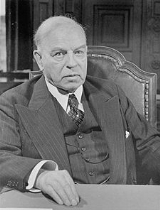
William Lyon Mackenzie King

Encyclopedia
William Lyon Mackenzie King, PC
, OM, CMG
(December 17, 1874 – July 22, 1950) was the dominant Canadian
political leader from the 1920s through the 1940s. He served as the tenth Prime Minister of Canada
from December 29, 1921 to June 28, 1926; from September 25, 1926 to August 7, 1930; and from October 23, 1935 to November 15, 1948. A Liberal with 22 years in office, he was longest-serving Prime Minister in Canadian history. He is commonly known either by "William Lyon Mackenzie King" or as Mackenzie King. Trained in law and social work, he was keenly interested in the human condition (as a boy, his motto was "Help those that cannot help themselves"), and played a major role in laying the foundations of the Canadian welfare state
.
According to his biographers, Mackenzie King lacked the typical personal attributes of great leaders, especially in comparison with Franklin D. Roosevelt
of the U.S., Winston Churchill
of Great Britain, Charles de Gaulle
of France, or even Joey Smallwood
of Newfoundland
. Voters did not love him. He lacked charisma, a commanding presence or oratorical skills; he did not shine on radio or in newsreels. His best writing was academic. Cold and tactless in human relations, he had allies but very few close personal friends; he never married and lacked a hostess whose charm could substitute for his chill. His allies were annoyed by his constant intrigues. He kept secret his beliefs in spiritualism and use of mediums to stay in contact with departed associates and particularly with his mother, and allowed his intense spirituality to distort his understanding of Adolf Hitler
.
Historians conclude that Mackenzie King remained so long in power because he had developed wide-ranging, remarkable skills that were exactly appropriate to Canada's needs. He was keenly sensitive to the nuances of public policy; he was a workaholic with a shrewd and penetrating intelligence and a profound understanding of how society and the economy worked. He understood labour and capital. He had a pitch-perfect ear for the Canadian temperament and mentality, and was a master of timing. A modernizing technocrat who regarded managerial mediation as essential to an industrial society, he wanted his Liberal party to represent liberal corporatism to create social harmony. Mackenzie King worked tirelessly to bring compromise and harmony to many competing and feuding elements, using politics and government action as his great instrument. He led the Liberal party for 29 years, and established Canada's international reputation as a middle power
fully committed to world order. A survey of scholars in 1997 by Maclean's magazine ranked Mackenzie King first among all Canada's prime ministers, ahead of Sir John A. Macdonald
and Sir Wilfrid Laurier
. As Granatstein (2004) notes, "the scholars expressed little admiration for King the man but offered unbounded admiration for his political skills and attention to Canadian unity."
) to John King and Isabella Grace Mackenzie. His maternal grandfather was William Lyon Mackenzie
, first mayor of Toronto
and leader of the Upper Canada Rebellion
in 1837. His father was a lawyer, later a professor at Osgoode Hall Law School
. King had three siblings. He attended Berlin Central School (now Suddaby Public School
) and Berlin High School (now Kitchener-Waterloo Collegiate and Vocational School
). Tutors were hired to teach him more politics, science, math, English and French. His father was a lawyer with a struggling practice in a small city, and never enjoyed financial security; his parents lived a life of shabby gentility, employing servants and tutors they could scarcely afford. Mackenzie King became a life-long practising Presbyterian
with a dedication to applying Christian virtues to social issues in the style of the Social Gospel
. He never favoured socialism
.
: B.A. 1895, LL.B. 1896 and M.A. 1897. While studying in Toronto he met a wide circle of friends, many of whom became prominent. He was an early member and officer of the Kappa Alpha Society
, which included a number of these individuals (two future Ontario Supreme Court Justices and the future Chairman of the University itself) and served as a location for the debate of political ideas. He also met Arthur Meighen
, a future political rival; the two men did not get on especially well from the start.
King was especially concerned with issues of social welfare and was influenced by the settlement house movement pioneered by Toynbee Hall
in London
. He played a central role in fomenting a students' strike at the university in 1895. He was in close touch, behind the scenes, with Vice-Chancellor William Mulock
, for whom the strike provided a chance to embarrass his rivals Chancellor Blake and President Loudon. King failed to gain his immediate objective, a teaching position at the University, but earned political credit with the man who would invite him to Ottawa and make him a deputy minister only five years later. While studying at the University of Toronto, King also contributed to the campus newspaper The Varsity
.
After studying at the University of Chicago
and working with Jane Addams
at her settlement house, Hull House
, Mackenzie King proceeded to Harvard University
. He earned an M.A. in political economy in 1898. In 1909 Harvard granted him a PhD
for a dissertation based on his study of "Oriental Immigration to Canada." He is the only Canadian Prime Minister to have earned a PhD.
, a civil service position.
In 1901, King's roommate and best friend, Henry Albert Harper
, died heroically during a skating party when a young woman fell through the ice of the partly frozen Ottawa River
. Harper dove into the water to try to save her, and perished in the attempt. King led the effort to raise a memorial to Harper, which resulted in the erection of the Sir Galahad statue on Parliament Hill
in 1905. In 1906, King published a memoir of Harper, entitled The Secret of Heroism.
He was first elected to Parliament
as a Liberal
in a 1908 by-election
, and was re-elected by acclamation in a 1909 by-election following his appointment as the first-ever Minister of Labour
.
King's term as Minister of Labour was marked by two significant achievements. He led the passage of the Industrial Disputes Investigation Act and the Combines Investigation Act, which he had shaped during his civil and parliamentary service. The legislation significantly improved the financial situation for millions of Canadian workers. He lost his seat in the 1911 general election
, which saw the Conservatives defeat his Liberals.
hired him as a senior staff member of the Rockefeller Foundation
in New York City, heading their new Department of Industrial Research. It paid $12,000 per year, compared to the meager $2,500 per year the Liberal Party was paying. He worked for the Foundation until 1918, forming a close working association and friendship with Rockefeller, advising him through the turbulent period of the 1914 strike and Ludlow massacre
at a family-owned coal company in Colorado, which subsequently set the stage for a new era in labor management in America. King became one of the earliest expert practitioners in the emerging field of industrial relations.
King was not a pacifist, but he showed little enthusiasm for the Great War; he faced criticism for not serving in Canada's military and instead working for the Rockefellers. But he was nearly 40 years old when the war began, and was not in good physical condition. He never gave up his Ottawa home, and travelled to the United States on an as-needed basis, performing valuable service by helping to keep war-related industries running smoothly.
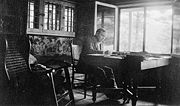 In 1918 King, assisted by his friend F.A. McGregor, published the far-sighted book Industry and Humanity: A Study in the Principles Underlying Industrial Reconstruction, a dense, abstract work that went over the head of most readers but revealed the practical idealism behind King's political thinking. He emphasized that capital and labour were natural allies, not foes, and that the community at large (represented by the government) should be the third and decisive party in industrial disputes. Quitting the Rockefeller Foundation in February 1918, Mackenzie King became an independent consultant on labour issues for the next two years, earning $1,000 per week from leading American corporations. Even so he kept his official residence in Ottawa, hoping for a call to duty.
in his opposition to conscription
, which was violently opposed in the province of Quebec. The Liberal party became deeply split, with most Anglophones joining in the pro-conscription Union government, a coalition controlled by the Conservatives under Prime Minister Sir Robert Borden
. King returned to Canada to run in the 1917 election
, which focused almost entirely on the conscription
issue. Unable to overcome a landslide against Laurier, Mackenzie King lost in the constituency of North York, which his grandfather had once represented.
(1876–1941). Mackenzie King could not speak French and had minimal interest in Quebec, but in election after election for the next 20 years (save for 1930), Lapointe produced the critical seats to give the Liberals control of Commons.
, a fast-developing region. With a highly romanticized view he envisioned the pioneers as morally sound, hardworking individuals who lived close to nature and to God. The reform ferment in the region meshed with his self-image as a social reformer and fighter for the "people" against the "interests." Viewing a glorious sunrise in Alberta in 1920, he wrote in his diary, "I thought of the New Day, the New Social Order. It seems like Heaven's prophecy of the dawn of a new era, revealed to me." Pragmatism played a role as well, since his party depended for its survival on the votes of Progressive party
members of parliament who represented farmers in Ontario and the Prairies. He convinced many Progressives to return to the Liberal fold.
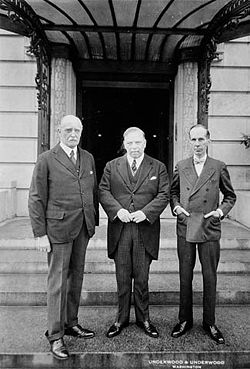 In the 1921 election
, his party defeated Arthur Meighen
and the Conservatives
, and he became Prime Minister. King's Liberals originally had a bare majority position, however, since they had won 118 out of 235 seats, exactly the minimum for a majority. The Conservatives won 49, the newly-formed Progressive Party
won 58 (but declined to form the official Opposition), and the remaining ten seats went to fringe parties and Independents; most of these ten supported the Progressives. However, a series of resignations, defections to other parties, and by-elections early in the new parliamentary session reduced the Liberals to a minority position. This was the first minority government in Canadian history.
in foreign affairs. In 1923 the British Prime Minister, David Lloyd George
, appealed repeatedly to Mackenzie King for Canadian support in the Chanak crisis
, in which a war threatened between Britain and Turkey
. King coldly replied that the Canadian Parliament would decide what policy to follow, making clear it would not be bound by London's suggestions; the crisis soon dissipated, but the episode led to the downfall of Lloyd George.
Despite prolonged negotiations, King was unable to attract the Progressives into his government, but once Parliament opened, he relied on their support to defeat non-confidence motions from the Conservatives. King was opposed in some policies by the Progressives, who opposed the high tariff
s of the National Policy
. King faced a delicate balancing act of reducing tariffs enough to please the Prairie-based Progressives, but not too much to alienate his vital support in industrial Ontario and Quebec, which needed tariffs to compete with American imports. King and Conservative leader Arthur Meighen
sparred constantly and bitterly in Commons debates. The decades-long rivalry between the two was probably the nastiest in the history of Canadian politics. Despite their university-days acquaintance, their personalities and working methods contrasted enormously in almost every respect.
As King's term wore on, the Progressives gradually weakened. Their effective and passionate leader, Thomas Crerar
, resigned to return to his grain business, and was replaced by the more placid Robert Forke
. The socialist reformer J.S. Woodsworth gradually gained influence and power, and King was able to reach an accommodation with him on policy matters, since the two shared many common ideas and plans.
. King's greatest impact was as the political champion for the planning and development of Ottawa, Canada's national capital. His plans, much of which were completed in the two decades after his death, was part of a century of federal planning that repositioned Ottawa as a national space in the City Beautiful style. Confederation Square
, for example, was initially planned to be a civic plaza to balance the nearby federal presence of Parliament Hill. The Great War monument was not installed until the 1939 royal visit, and Mackenzie King intended that the replanning of the capital would be the World War II memorial. However, the symbolic meaning of the World War II monument gradually expanded to become the place of remembrance for all Canadian war sacrifices.
, in which the Conservatives
won the most seats, but not a majority in the House of Commons
. King held onto power with the support of the Progressives
. A corruption scandal discovered late in his first term involved misdeeds around the expansion of the Beauharnois Canal
in Quebec; this led to extensive inquiries and eventually a Royal Commission
, which exposed the Beauharnois Scandal
. The resulting press coverage damaged King's party in the election. Early in his second term, another corruption
scandal, this time in the Department of Customs, was revealed, which led to more support for the Conservatives and Progressives, and the possibility that King would be forced to resign, if he lost sufficient support in the Commons. King had no personal connection to this scandal, although one of his own appointees was at the heart of it. Opposition leader Meighen unleashed his fierce invective towards King, stating he was hanging onto power "like a lobster with lockjaw."`
, Lord Byng, to dissolve Parliament and call another election, but Byng refused, the only time in Canadian history
that the Governor General has exercised such a power. Instead Byng called upon the Conservative Party leader, Arthur Meighen
, to form a government. Meighen attempted to do so, but was unable to obtain a majority in the Commons and he, too, advised dissolution, which this time was accepted.
, Mackenzie King appealed for public support of the constitutional principle that the Governor General must accept the advice of his ministers, though this principle was at most only customary. The Liberals argued that the Governor General had interfered in politics and shown favour to one party over another. Mackenzie King and his party won the election and a clear majority in the Commons.
. The independent position of the Dominions in the British Empire / Commonwealth
and in the international community was put on a firm legal foundation by the Statute of Westminster
(1931).
King made use of the newly founded Department of External Affairs to further promote Canadian autonomy from Britain. The new department took some time to develop, but over time it significantly increased the reach and projection of Canadian diplomacy. Prior to this, Canada had relied on Britain for most of its international representation, and as little more than a strongly-aligned colony, was necessarily secondary to Britain's own plans, which would sometimes conflict strongly with Canada's own wishes. King recruited many high-calibre people for the new venture, including future prime minister Lester Pearson and influential career administrators Norman Robertson
and Hume Wrong. This project was a key element of his overall strategy, setting Canada on a course independent of Britain, of former colonizer France
, as well as of the neighbouring powerful United States.
, Alberta
, and Saskatchewan
the ownership of the crown lands within those provinces, as well as the subsoil rights; these in particular would become increasingly important, as petroleum and other natural resources proved very abundant. In collaboration with the provincial governments, he inaugurated a system of old-age pensions based on need. In February 1930, he appointed Cairine Wilson
as the first female senator in Canadian history.
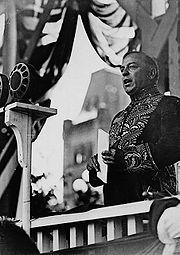
, but was slow to respond to the mounting crisis. Just prior to the election, Mackenzie King blundered badly by carelessly responding to criticism over his handling of the economic crisis; he stated that he "would not give a five-cent piece" to Tory provincial governments. This turned into the key election issue. The Liberals lost the election of 1930
to the Conservative Party, led by Richard Bedford Bennett. The popular vote was very close between the two parties, with the Liberals actually earning more votes, but the Conservatives used their votes much more efficiently to build a majority.
of American President Franklin D. Roosevelt
(which Bennett eventually tried to emulate, after floundering without solutions for several years), and he never advocated massive government action to alleviate depression in Canada.
. Promising a much-desired trade treaty with the U.S., the Mackenzie King government passed the 1935 Reciprocal Trade Agreement. It marked the turning point in Canadian-American economic relations, reversing the disastrous trade war of 1930-31, lowering tariffs, and yielding a dramatic increase in trade. More subtly, it revealed to the prime minister and
President Roosevelt that they could work together well.
The worst of the Depression had passed by 1935, and King implemented relief programs such as the National Housing Act and National Employment Commission. His government also made the Canadian Broadcasting Corporation
a crown corporation in 1936, created Trans-Canada Airlines (the precursor to Air Canada
) in 1937, and formed the National Film Board of Canada
in 1939. In 1938, he transformed the Bank of Canada
from a private entity to a crown corporation.
After 1936 the prime minister lost patience when western Canadians preferred radical alternatives such as the CCF (Co-operative Commonwealth Federation
) and Social Credit
to his middle-of-the-road liberalism. Indeed, he came close to writing off the region with his comment that the prairie dust bowl was "part of the U.S. desert area. I doubt if it will be of any real use again." Instead he paid more attention to the industrial regions and the needs of Ontario and Quebec, particularly with respect to the proposed St. Lawrence Seaway project with the United States. As for the unemployed, he was hostile to federal relief, and only reluctantly accepted a Keynesian solution that involved federal deficit spending, tax cuts and subsidies to the housing market.
, King had the Canadian High Commissioner in London inform the British government that if Britain went to war with Germany over the Rhineland
issue that Canada would remain neutral. In June 1937, during an Imperial Conference of all the Dominion Prime Ministers in London convened during the coronation of King George VI
, Mackenzie King informed British Prime Minister Neville Chamberlain
that Canada would only go to war if Britain were directly attacked, and that if Britain were to become involved in a continental war then Chamberlain was not to expect Canadian support. Also during 1937, King visited Germany and met with Adolf Hitler
, becoming the only North American head of government to do so.
Possessing a religious yearning for direct insight into the hidden mysteries of life and the universe, and strongly influenced by the opera
s of Richard Wagner
(who was also Hitler's favourite composer), Mackenzie King decided Hitler was akin to mythical Wagnerian heroes within whom good and evil were struggling. He thought that good would eventually triumph and Hitler would redeem his people and lead them to a harmonious, uplifting future. These spiritual attitudes not only guided Canada's relations with Hitler but gave the prime minister the comforting sense of a higher mission, that of helping to lead Hitler to peace. King commented in his journal that "he is really one who truly loves his fellow-men, and his country, and would make any sacrifice for their good". He forecast that "the world will yet come to see a very great man–mystic in Hitler. [...] I cannot abide in Nazism -– the regimentation -– cruelty -– oppression of Jews -– attitude towards religion, etc., but Hitler, him –- the peasant -– will rank some day with Joan of Arc among the deliverers of his people."
In late 1938, during the great crisis in Europe over Czechoslovakia
that culminated in the Munich Agreement
, Canadians were divided. Francophones insisted on neutrality, as did some top advisers like O.D. Skelton. Imperialists stood behind Britain and were willing to fight Germany. Mackenzie King, who served as his own secretary of state for external affairs (foreign minister), said privately that if he had to choose he would not be neutral, but he made no public statement. All of Canada was relieved that the British appeasement at Munich, while sacrificing the rights of the Czechs, seemed to bring peace.
riots in Vancouver's Chinatown and Japantown
. One of the claims for damages came from Chinese opium
manufacturers, which led King to investigate narcotics use in Vancouver
. King became alarmed upon hearing that white women were also opium users, not just Chinese men, and he then initiated the process that led to the first legislation outlawing narcotics in Canada.
Under King's administration, the Canadian government, responding to strong public opinion, especially in Quebec, refused to expand immigration opportunities for Jewish refugee
s from Europe. In June 1939 Canada, along with Cuba
and the United States, refused to allow entry for the 900 Jewish refugees aboard the passenger ship .

before Hitler invaded Poland
in 1939, and began mobilizing
on August 25, 1939, with full mobilization on September 1. Unlike World War I, however, when Canada was automatically at war as soon as Britain joined, King asserted Canadian autonomy
by waiting until September 10, a full week after Britain's declaration, when a vote in the House of Commons took place, to support the government's decision to declare war.
in August 1940 that provided for the close cooperation of Canadian and American forces, despite the fact that the U.S. remained officially neutral until the bombing of Pearl Harbor
on December 7, 1941. During the war the Americans took virtual control of the Yukon
and the then-British colony of Newfoundland
in building the Alaska Highway
and major airbases.
Mackenzie King — and Canada — were largely ignored by Winston Churchill
, despite Canada's major role in supplying food, raw materials, munitions and money to the hard-pressed British economy, training airmen for the Commonwealth, guarding the western half of the North Atlantic Ocean against German U-boat
s, and providing combat troops for the invasions of Italy
, France
and Germany in 1943-45. Mackenzie King proved highly successful in mobilizing the economy for war, with impressive results in industrial and agricultural output. The depression ended, prosperity returned, and Canada's economy expanded significantly. On the political side, Mackenzie King rejected any notion of a government of national unity. He held the Canadian federal election, 1940
as normally scheduled, despite the ongoing World War, unlike Britain, which formed a government of national unity and did not hold a wartime election.
To re-arm Canada he built the Royal Canadian Air Force
as a viable military power, while at the same time keeping it separate from Britain's Royal Air Force
. He was instrumental in obtaining the British Commonwealth Air Training Plan
Agreement, which was signed in Ottawa in December, 1939, binding Canada, Britain, New Zealand
, and Australia
to a program that eventually trained half the airmen from those four nations in the Second World War.
during the war, moving into full-scale research in nuclear physics and commercial use of nuclear power
in the following years. King, with C.D. Howe acting as point man, moved the nuclear group from Montreal
to Chalk River, Ontario
in 1944, with the establishment of Chalk River Nuclear Laboratories and the residential town of Deep River, Ontario
. Canada became a world leader in this field, with the NRX
reactor becoming operational in 1947; at the time, NRX was the only operational nuclear reactor outside the United States.
The NRC also contributed to wartime scientific development in other ways during this period.
's Union Nationale Quebec provincial government in 1939 and Liberals' re-election in the 1940 election
. But after the fall of France in 1940, Canada introduced conscription for home service. Still, only volunteers were to be sent overseas. King wanted to avoid a repeat of the Conscription Crisis of 1917
. By 1942, the military was pressing King hard to send conscripts to Europe. In 1942, King held a national plebiscite on the issue, asking the nation to relieve him of the commitment he had made during the election campaign. In the House of Commons on 10 June 1942, he said that his policy was "conscription if necessary but not necessarily conscription ."
French Canadians voted against conscription, with over 70% opposed, but an overwhelming majority – over 80% – of English Canadians supported it. French and English conscripts were sent to fight in the Aleutian Islands in 1943 – technically North American soil and therefore not "overseas" – but the mix of Canadian volunteers and draftees found that the Japanese troops had fled before their arrival. Otherwise, King continued with a campaign to recruit volunteers, hoping to address the problem with the shortage of troops caused by heavy losses in the Dieppe Raid
in 1942, in Italy
in 1943, and after the Battle of Normandy in 1944. In November 1944, the Government decided it was necessary to send conscripts to Europe. This led to a brief political crisis (see Conscription Crisis of 1944
) and a mutiny
by conscripts posted in British Columbia
, but the war ended a few months later. Over 15,000 conscripts went to Europe, though only a few hundred saw combat.
in December 1941 the government oversaw the Japanese-Canadian internment on Canada’s west coast, which sent 22,000 British Columbia residents of Japanese descent to relocation camps far from the coast. The reason was intense public demand for removal and fears of espionage or sabotage. Mackenzie King and his Cabinet ignored reports from the RCMP
and Canadian military that most of the Japanese were law-abiding and not a threat.
of 1922, King refused to support the British without first consulting Parliament, while the Conservative leader, Arthur Meighen
, supported Britain. The British were disappointed with King's response, but the crisis was soon resolved, as King had anticipated. After the King-Byng Affair, King went to the Imperial Conference of 1926 and argued for greater autonomy of the Dominion
s. This resulted in the Balfour Declaration 1926
, which announced the equal status of all members of the British Commonwealth
(as it was known then), including Britain. This eventually led to the Statute of Westminster 1931
. The Canadian city of Hamilton
hosted the first Empire Games in 1930; this competition later became known as the Commonwealth Games
, and is held every four years.
In the lead-up to World War II in 1939, King affirmed Canadian autonomy by saying that the Canadian Parliament would make the final decision on the issue of going to war. He reassured the pro-British Canadians that Parliament would surely decide that Canada would be at Britain's side if Great Britain was drawn into a major war. At the same time, he reassured those who were suspicious of British influence in Canada by promising that Canada would not participate in British colonial wars. His Quebec lieutenant, Ernest Lapointe
, promised French-Canadians that the government would not introduce conscription; individual participation would be voluntary. In 1939, in a country which had seemed deeply divided, these promises made it possible for Parliament to agree almost unanimously to declare war.
King played two roles. On the one hand, he told English Canadians that Canada would no doubt enter war if Britain did. On the other hand, he and his Quebec lieutenant
Ernest Lapointe
told French Canadians that Canada would only go to war if it was in the country's best interests. With the dual messages, King slowly led Canada toward war without causing strife between Canada's two main linguistic communities. As his final step in asserting Canada's autonomy, King ensured that the Canadian Parliament made its own declaration of war one week after Britain.
King's government introduced the Canadian Citizenship Act in 1946, which officially created the notion of "Canadian citizens
". Prior to this, Canadians were considered British subjects living in Canada. On 3 January 1947, King received Canadian citizenship certificate number 0001.
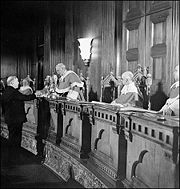
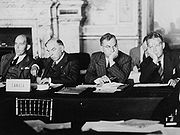
, and won the election, with a minority, but formed a functioning coalition to continue governing. The main opposition party Conservatives were weak for most of the two decades after R.B. Bennett lost the 1935 election, and King had virtually unchallenged power for much of his later years; this expanded still further during the War. He promoted American-born engineer
C.D. Howe into positions of great power and influence during the War, but was hit hard by the 1940 air-crash death of key minister and protege Norman McLeod Rogers
. After this setback, and the 1941 death of his Quebec lieutenant Ernest Lapointe, King sought out the reluctant Louis St. Laurent
, a leading Quebec lawyer, to take over Lapointe's role, and eventually persuaded St. Laurent to serve in government.
King helped found the United Nations
in 1945 and attended the opening meetings in San Francisco. However, he became pessimistic about the organization's future possibilities. After the war, King quickly dismantled wartime controls. Unlike World War I, press censorship
ended with the hostilities. He began an ambitious program of social programs and laid the groundwork for Newfoundland and Labrador
's entry into Canada; however, this did not take place until 1949, the year after King retired.
King moved Canada into the deepening Cold War
in alliance with the U.S. and Britain. He dealt with the espionage
revelations of Soviet cipher clerk Igor Gouzenko
, who defected in Ottawa in September, 1945, by quickly appointing a Royal Commission to investigate Gouzenko's allegations of a Canadian Communist spy-ring transmitting top-secret documents to the Soviet Union
. External Affairs minister Louis St. Laurent
dealt decisively with this crisis, the first of its type in Canada's history. St. Laurent's leadership deepened King's respect, and helped make St. Laurent the next Canadian Prime Minister three years later.
On January 20, 1948, King called on the Liberal Party to hold its first national convention since 1919 to choose a leader. The August convention chose Louis St. Laurent as the new leader of the Liberal Party. Three months later, King retired after 22 years as prime minister. King also had the most terms (six) as Prime Minister. Sir John A. Macdonald was second-in-line, with 19 years, as the longest-serving Prime Minister in Canadian history (1867–1873, 1878–1891). Mackenzie King was not charismatic and did not have a large personal following. Only eight Canadians in 100 picked him when the Canadian Gallup (CIPO) poll asked in September, 1946, "What person living in any part of the world today do you admire?" Nevertheless, his Liberal Party was easily re-elected in the election of 1945
.
and describe other events in detail.
Mackenzie King was a cautious politician who tailored his policies to prevailing opinions. "Parliament will decide," he liked to say when pressed to act and would often say "In times of need all nations face difficult decisions, Canada is not an exception".
Privately, he was highly eccentric with his preference for communing with spirits, including those of Leonardo da Vinci
, Sir Wilfrid Laurier, his dead mother, and several of his Irish Terrier
dogs, all named Pat except for one named Bob. He also claimed to commune with the spirit of the late President Roosevelt. He sought personal reassurance from the spirit world, rather than seeking political advice. Indeed, after his death, one of his mediums said that she had not realized that he was a politician. King asked whether his party would win the 1935 election, one of the few times politics came up during his seances. His occult
interests were kept secret during his years in office, and only became publicized later. Historians have seen in his occult activities a penchant for forging unities from antitheses, thus having latent political import. In 1953 Time
stated that he ownedand usedboth an Ouija board
and a crystal ball
.
King never married, but had several close women friends, including Joan Patteson, a married woman with whom he spent some of his leisure time.
Some historians have interpreted passages in his diaries as suggesting that King regularly had sexual relations with prostitutes. Others, also basing their claims on passages of his diaries, have suggested that King was in love with Lord Tweedsmuir, whom he had chosen for appointment as Governor General in 1935.
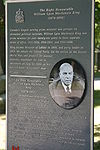 Mackenzie King died on July 22, 1950, at Kingsmere from pneumonia
, with his retirement plans to write his memoirs unfulfilled. He is buried in Mount Pleasant Cemetery
, Toronto. Unmarried, King is survived by relative Margery King.
His most famous quote was "A true man does not only stand up for himself, he stands up for those that do not have the ability to".
's play Rexy and Heather Robertson's trilogy Willie: A Romance (1983), Lily: A Rhapsody in Red (1986) and Igor: A Novel of Intrigue (1989).
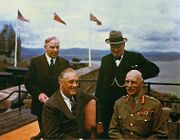
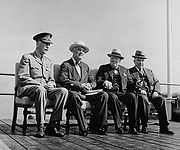
 In 1998, there was controversy over King's exclusion from a memorial to the Quebec Conference
, which was attended by King, Roosevelt, and Churchill. The monument was built by the sovereigntist Parti Québécois
government of Quebec
, which justified the decision on the basis that King was not important enough. Canadian federalists, however, accused the government of Quebec of trying to advance their own political agenda.
OC Transpo
has a Transitway station named Mackenzie King due to its location on the Mackenzie King Bridge
. It is located adjacent to the Rideau Centre
in downtown Ottawa
.
His likeness is on the Canadian fifty-dollar bill
.
King left no published political memoirs, although his private diaries were extensively detailed. His main published work remains his 1918 book Industry and Humanity.
Part of his country retreat, now called Mackenzie King Estate, at Kingsmere in the Gatineau Park
, near Ottawa
, is open to the public. The house King died in, called "The Farm
", is the official residence of the Speaker of the Canadian House of Commons
and is not part of the park.
The Woodside National Historic Site in Kitchener, Ontario
was the cherished boyhood home of William Lyon Mackenzie King. The estate has over 4.65 hectares of garden and parkland for exploring and relaxing, and the house has been restored to reflect life during King's era. There is a MacKenzie King Public School in the Heritage Park neighbourhood in Kitchener.
A high school was built in his honor in 2009 and was named William Lyon Mackenzie King Secondary School.
King was mentioned in the book Alligator Pie
by Dennis Lee
as the subject of a nonsensical
children's poem, which reads "William Lyon Mackenzie King / He sat in the middle and played with string / He loved his mother like anything / William Lyon Mackenzie King."
by the Governor General
:
Queen's Privy Council for Canada
The Queen's Privy Council for Canada ), sometimes called Her Majesty's Privy Council for Canada or simply the Privy Council, is the full group of personal consultants to the monarch of Canada on state and constitutional affairs, though responsible government requires the sovereign or her viceroy,...
, OM, CMG
Order of St Michael and St George
The Most Distinguished Order of Saint Michael and Saint George is an order of chivalry founded on 28 April 1818 by George, Prince Regent, later George IV of the United Kingdom, while he was acting as Prince Regent for his father, George III....
(December 17, 1874 – July 22, 1950) was the dominant Canadian
History of Canada
The history of Canada covers the period from the arrival of Paleo-Indians thousands of years ago to the present day. Canada has been inhabited for millennia by distinctive groups of Aboriginal peoples, among whom evolved trade networks, spiritual beliefs, and social hierarchies...
political leader from the 1920s through the 1940s. He served as the tenth Prime Minister of Canada
Prime Minister of Canada
The Prime Minister of Canada is the primary minister of the Crown, chairman of the Cabinet, and thus head of government for Canada, charged with advising the Canadian monarch or viceroy on the exercise of the executive powers vested in them by the constitution...
from December 29, 1921 to June 28, 1926; from September 25, 1926 to August 7, 1930; and from October 23, 1935 to November 15, 1948. A Liberal with 22 years in office, he was longest-serving Prime Minister in Canadian history. He is commonly known either by "William Lyon Mackenzie King" or as Mackenzie King. Trained in law and social work, he was keenly interested in the human condition (as a boy, his motto was "Help those that cannot help themselves"), and played a major role in laying the foundations of the Canadian welfare state
Welfare state
A welfare state is a "concept of government in which the state plays a key role in the protection and promotion of the economic and social well-being of its citizens. It is based on the principles of equality of opportunity, equitable distribution of wealth, and public responsibility for those...
.
According to his biographers, Mackenzie King lacked the typical personal attributes of great leaders, especially in comparison with Franklin D. Roosevelt
Franklin D. Roosevelt
Franklin Delano Roosevelt , also known by his initials, FDR, was the 32nd President of the United States and a central figure in world events during the mid-20th century, leading the United States during a time of worldwide economic crisis and world war...
of the U.S., Winston Churchill
Winston Churchill
Sir Winston Leonard Spencer-Churchill, was a predominantly Conservative British politician and statesman known for his leadership of the United Kingdom during the Second World War. He is widely regarded as one of the greatest wartime leaders of the century and served as Prime Minister twice...
of Great Britain, Charles de Gaulle
Charles de Gaulle
Charles André Joseph Marie de Gaulle was a French general and statesman who led the Free French Forces during World War II. He later founded the French Fifth Republic in 1958 and served as its first President from 1959 to 1969....
of France, or even Joey Smallwood
Joey Smallwood
Joseph Roberts "Joey" Smallwood, PC, CC was the main force that brought Newfoundland into the Canadian confederation, and became the first Premier of Newfoundland . As premier, he vigorously promoted economic development, championed the welfare state, and emphasized modernization of education and...
of Newfoundland
Newfoundland and Labrador
Newfoundland and Labrador is the easternmost province of Canada. Situated in the country's Atlantic region, it incorporates the island of Newfoundland and mainland Labrador with a combined area of . As of April 2011, the province's estimated population is 508,400...
. Voters did not love him. He lacked charisma, a commanding presence or oratorical skills; he did not shine on radio or in newsreels. His best writing was academic. Cold and tactless in human relations, he had allies but very few close personal friends; he never married and lacked a hostess whose charm could substitute for his chill. His allies were annoyed by his constant intrigues. He kept secret his beliefs in spiritualism and use of mediums to stay in contact with departed associates and particularly with his mother, and allowed his intense spirituality to distort his understanding of Adolf Hitler
Adolf Hitler
Adolf Hitler was an Austrian-born German politician and the leader of the National Socialist German Workers Party , commonly referred to as the Nazi Party). He was Chancellor of Germany from 1933 to 1945, and head of state from 1934 to 1945...
.
Historians conclude that Mackenzie King remained so long in power because he had developed wide-ranging, remarkable skills that were exactly appropriate to Canada's needs. He was keenly sensitive to the nuances of public policy; he was a workaholic with a shrewd and penetrating intelligence and a profound understanding of how society and the economy worked. He understood labour and capital. He had a pitch-perfect ear for the Canadian temperament and mentality, and was a master of timing. A modernizing technocrat who regarded managerial mediation as essential to an industrial society, he wanted his Liberal party to represent liberal corporatism to create social harmony. Mackenzie King worked tirelessly to bring compromise and harmony to many competing and feuding elements, using politics and government action as his great instrument. He led the Liberal party for 29 years, and established Canada's international reputation as a middle power
Middle power
Middle power is a term used in the field of international relations to describe states that are not superpowers or great powers, but still have large or moderate influence and international recognition. There is no single specific definition of which countries are middle powers.-Definition:There is...
fully committed to world order. A survey of scholars in 1997 by Maclean's magazine ranked Mackenzie King first among all Canada's prime ministers, ahead of Sir John A. Macdonald
John A. Macdonald
Sir John Alexander Macdonald, GCB, KCMG, PC, PC , QC was the first Prime Minister of Canada. The dominant figure of Canadian Confederation, his political career spanned almost half a century...
and Sir Wilfrid Laurier
Wilfrid Laurier
Sir Wilfrid Laurier, GCMG, PC, KC, baptized Henri-Charles-Wilfrid Laurier was the seventh Prime Minister of Canada from 11 July 1896 to 6 October 1911....
. As Granatstein (2004) notes, "the scholars expressed little admiration for King the man but offered unbounded admiration for his political skills and attention to Canadian unity."
Early life
King was born in Berlin, Ontario (now known as KitchenerKitchener, Ontario
The City of Kitchener is a city in Southern Ontario, Canada. It was the Town of Berlin from 1854 until 1912 and the City of Berlin from 1912 until 1916. The city had a population of 204,668 in the Canada 2006 Census...
) to John King and Isabella Grace Mackenzie. His maternal grandfather was William Lyon Mackenzie
William Lyon Mackenzie
William Lyon Mackenzie was a Scottish born American and Canadian journalist, politician, and rebellion leader. He served as the first mayor of Toronto, Upper Canada and was an important leader during the 1837 Upper Canada Rebellion.-Background and early years in Scotland, 1795–1820:Mackenzie was...
, first mayor of Toronto
Toronto
Toronto is the provincial capital of Ontario and the largest city in Canada. It is located in Southern Ontario on the northwestern shore of Lake Ontario. A relatively modern city, Toronto's history dates back to the late-18th century, when its land was first purchased by the British monarchy from...
and leader of the Upper Canada Rebellion
Upper Canada Rebellion
The Upper Canada Rebellion was, along with the Lower Canada Rebellion in Lower Canada, a rebellion against the British colonial government in 1837 and 1838. Collectively they are also known as the Rebellions of 1837.-Issues:...
in 1837. His father was a lawyer, later a professor at Osgoode Hall Law School
Osgoode Hall Law School
Osgoode Hall Law School is a Canadian law school, located in Toronto, Ontario, Canada and affiliated with York University. Named after the first Chief Justice of Ontario, William Osgoode, the law school was established by The Law Society of Upper Canada in 1889 and was the only accredited law...
. King had three siblings. He attended Berlin Central School (now Suddaby Public School
Suddaby Public School
Suddaby Public School, originally known as Central School, is a public elementary school in Kitchener, Ontario . It is located at 171 Frederick Street, in the city's downtown. It serves grades Junior Kindergarten through grade 6.The school building opened in January 1857, and its first principal...
) and Berlin High School (now Kitchener-Waterloo Collegiate and Vocational School
Kitchener-Waterloo Collegiate and Vocational School
Kitchener-Waterloo Collegiate and Vocational School, sometimes shortened to Kitchener Collegiate Institute and often abbreviated as KCI, is a public secondary school in Kitchener, Ontario, Canada. It is a member of the Waterloo Region District School Board. The school dates from 1855, making it...
). Tutors were hired to teach him more politics, science, math, English and French. His father was a lawyer with a struggling practice in a small city, and never enjoyed financial security; his parents lived a life of shabby gentility, employing servants and tutors they could scarcely afford. Mackenzie King became a life-long practising Presbyterian
Presbyterian Church in Canada
The Presbyterian Church in Canada is the name of a Protestant Christian church, of presbyterian and reformed theology and polity, serving in Canada under this name since 1875, although the United Church of Canada claimed the right to the name from 1925 to 1939...
with a dedication to applying Christian virtues to social issues in the style of the Social Gospel
Social Gospel
The Social Gospel movement is a Protestant Christian intellectual movement that was most prominent in the early 20th century United States and Canada...
. He never favoured socialism
Socialism
Socialism is an economic system characterized by social ownership of the means of production and cooperative management of the economy; or a political philosophy advocating such a system. "Social ownership" may refer to any one of, or a combination of, the following: cooperative enterprises,...
.
University
King earned five university degrees. He obtained three degrees from the University of TorontoUniversity of Toronto
The University of Toronto is a public research university in Toronto, Ontario, Canada, situated on the grounds that surround Queen's Park. It was founded by royal charter in 1827 as King's College, the first institution of higher learning in Upper Canada...
: B.A. 1895, LL.B. 1896 and M.A. 1897. While studying in Toronto he met a wide circle of friends, many of whom became prominent. He was an early member and officer of the Kappa Alpha Society
Kappa Alpha Society
The Kappa Alpha Society , founded in 1825, was the progenitor of the modern fraternity system in North America. It was the first of the fraternities which would eventually become known as the Union Triad...
, which included a number of these individuals (two future Ontario Supreme Court Justices and the future Chairman of the University itself) and served as a location for the debate of political ideas. He also met Arthur Meighen
Arthur Meighen
Arthur Meighen, PC, QC was a Canadian lawyer and politician. He served two terms as the ninth Prime Minister of Canada: from July 10, 1920 to December 29, 1921; and from June 29 to September 25, 1926. He was the first Prime Minister born after Confederation, and the only one to represent a riding...
, a future political rival; the two men did not get on especially well from the start.
King was especially concerned with issues of social welfare and was influenced by the settlement house movement pioneered by Toynbee Hall
Toynbee Hall
Toynbee Hall is a building in Tower Hamlets, East London which is the home of a charity working to bridge the gap between people of all social and financial backgrounds, with a focus on eradicating poverty and promoting social inclusion....
in London
London
London is the capital city of :England and the :United Kingdom, the largest metropolitan area in the United Kingdom, and the largest urban zone in the European Union by most measures. Located on the River Thames, London has been a major settlement for two millennia, its history going back to its...
. He played a central role in fomenting a students' strike at the university in 1895. He was in close touch, behind the scenes, with Vice-Chancellor William Mulock
William Mulock
Sir William Mulock, PC, KCMG, MP, QC, LL.D was a Canadian lawyer, businessman, educator, farmer, politician, judge, and philanthropist....
, for whom the strike provided a chance to embarrass his rivals Chancellor Blake and President Loudon. King failed to gain his immediate objective, a teaching position at the University, but earned political credit with the man who would invite him to Ottawa and make him a deputy minister only five years later. While studying at the University of Toronto, King also contributed to the campus newspaper The Varsity
The Varsity
The Varsity is a restaurant chain, iconic in the modern culture of Atlanta, Georgia. The main branch of the chain is the largest drive-in fast food restaurant in the world...
.
After studying at the University of Chicago
University of Chicago
The University of Chicago is a private research university in Chicago, Illinois, USA. It was founded by the American Baptist Education Society with a donation from oil magnate and philanthropist John D. Rockefeller and incorporated in 1890...
and working with Jane Addams
Jane Addams
Jane Addams was a pioneer settlement worker, founder of Hull House in Chicago, public philosopher, sociologist, author, and leader in woman suffrage and world peace...
at her settlement house, Hull House
Hull House
Hull House is a settlement house in the United States that was co-founded in 1889 by Jane Addams and Ellen Gates Starr. Located in the Near West Side of , Hull House opened its doors to the recently arrived European immigrants. By 1911, Hull House had grown to 13 buildings. In 1912 the Hull...
, Mackenzie King proceeded to Harvard University
Harvard University
Harvard University is a private Ivy League university located in Cambridge, Massachusetts, United States, established in 1636 by the Massachusetts legislature. Harvard is the oldest institution of higher learning in the United States and the first corporation chartered in the country...
. He earned an M.A. in political economy in 1898. In 1909 Harvard granted him a PhD
PHD
PHD may refer to:*Ph.D., a doctorate of philosophy*Ph.D. , a 1980s British group*PHD finger, a protein sequence*PHD Mountain Software, an outdoor clothing and equipment company*PhD Docbook renderer, an XML renderer...
for a dissertation based on his study of "Oriental Immigration to Canada." He is the only Canadian Prime Minister to have earned a PhD.
Civil servant, Minister of Labour
In 1900 Mackenzie King became a civil servant in Ottawa assigned to study labour issues. His reports covered a wide range of topics; a special concern was Japanese immigration to Canada and railways. In 1909, he became Canada's first Deputy Minister of LabourDeputy Minister (Canada)
In Canada, a deputy minister is the senior civil servant in a government department. He or she takes political direction from an elected minister. Responsibility for the department's day-to-day operations, budget and program development lie with the deputy minister...
, a civil service position.
In 1901, King's roommate and best friend, Henry Albert Harper
Henry Albert Harper
A Canadian journalist and civil servant, Henry Albert Harper was best known as a friend of future Prime Minister William Lyon Mackenzie King, and is commemorated by a statue on Parliament Hill....
, died heroically during a skating party when a young woman fell through the ice of the partly frozen Ottawa River
Ottawa River
The Ottawa River is a river in the Canadian provinces of Ontario and Quebec. For most of its length, it now defines the border between these two provinces.-Geography:...
. Harper dove into the water to try to save her, and perished in the attempt. King led the effort to raise a memorial to Harper, which resulted in the erection of the Sir Galahad statue on Parliament Hill
Parliament Hill
Parliament Hill , colloquially known as The Hill, is an area of Crown land on the southern banks of the Ottawa River in downtown Ottawa, Ontario. Its Gothic revival suite of buildingsthe parliament buildings serves as the home of the Parliament of Canada and contains a number of architectural...
in 1905. In 1906, King published a memoir of Harper, entitled The Secret of Heroism.
He was first elected to Parliament
Parliament of Canada
The Parliament of Canada is the federal legislative branch of Canada, seated at Parliament Hill in the national capital, Ottawa. Formally, the body consists of the Canadian monarch—represented by her governor general—the Senate, and the House of Commons, each element having its own officers and...
as a Liberal
Liberal Party of Canada
The Liberal Party of Canada , colloquially known as the Grits, is the oldest federally registered party in Canada. In the conventional political spectrum, the party sits between the centre and the centre-left. Historically the Liberal Party has positioned itself to the left of the Conservative...
in a 1908 by-election
By-election
A by-election is an election held to fill a political office that has become vacant between regularly scheduled elections....
, and was re-elected by acclamation in a 1909 by-election following his appointment as the first-ever Minister of Labour
Minister of Labour (Canada)
The Minister of Labour is the Minister of the Crown in the Canadian Cabinet who is responsible for setting national labour standards and federal labour dispute mechanisms...
.
King's term as Minister of Labour was marked by two significant achievements. He led the passage of the Industrial Disputes Investigation Act and the Combines Investigation Act, which he had shaped during his civil and parliamentary service. The legislation significantly improved the financial situation for millions of Canadian workers. He lost his seat in the 1911 general election
Canadian federal election, 1911
The Canadian federal election of 1911 was held on September 21 to elect members of the Canadian House of Commons of the 12th Parliament of Canada.-Summary:...
, which saw the Conservatives defeat his Liberals.
Industrial consultant
After his defeat Mackenzie King went on the lecture circuit on behalf of the Liberal Party. In June 1914 John D. Rockefeller, Jr.John D. Rockefeller, Jr.
John Davison Rockefeller, Jr. was a major philanthropist and a pivotal member of the prominent Rockefeller family. He was the sole son among the five children of businessman and Standard Oil industrialist John D. Rockefeller and the father of the five famous Rockefeller brothers...
hired him as a senior staff member of the Rockefeller Foundation
Rockefeller Foundation
The Rockefeller Foundation is a prominent philanthropic organization and private foundation based at 420 Fifth Avenue, New York City. The preeminent institution established by the six-generation Rockefeller family, it was founded by John D. Rockefeller , along with his son John D. Rockefeller, Jr...
in New York City, heading their new Department of Industrial Research. It paid $12,000 per year, compared to the meager $2,500 per year the Liberal Party was paying. He worked for the Foundation until 1918, forming a close working association and friendship with Rockefeller, advising him through the turbulent period of the 1914 strike and Ludlow massacre
Ludlow massacre
The Ludlow Massacre was an attack by the Colorado National Guard on a tent colony of 1,200 striking coal miners and their families at Ludlow, Colorado on April 20, 1914....
at a family-owned coal company in Colorado, which subsequently set the stage for a new era in labor management in America. King became one of the earliest expert practitioners in the emerging field of industrial relations.
King was not a pacifist, but he showed little enthusiasm for the Great War; he faced criticism for not serving in Canada's military and instead working for the Rockefellers. But he was nearly 40 years old when the war began, and was not in good physical condition. He never gave up his Ottawa home, and travelled to the United States on an as-needed basis, performing valuable service by helping to keep war-related industries running smoothly.
Wartime politics
In 1917 Canada was in crisis; Mackenzie King supported Liberal leader Sir Wilfrid LaurierWilfrid Laurier
Sir Wilfrid Laurier, GCMG, PC, KC, baptized Henri-Charles-Wilfrid Laurier was the seventh Prime Minister of Canada from 11 July 1896 to 6 October 1911....
in his opposition to conscription
Conscription
Conscription is the compulsory enlistment of people in some sort of national service, most often military service. Conscription dates back to antiquity and continues in some countries to the present day under various names...
, which was violently opposed in the province of Quebec. The Liberal party became deeply split, with most Anglophones joining in the pro-conscription Union government, a coalition controlled by the Conservatives under Prime Minister Sir Robert Borden
Robert Borden
Sir Robert Laird Borden, PC, GCMG, KC was a Canadian lawyer and politician. He served as the eighth Prime Minister of Canada from October 10, 1911 to July 10, 1920, and was the third Nova Scotian to hold this office...
. King returned to Canada to run in the 1917 election
Canadian federal election, 1917
The 1917 Canadian federal election was held on December 17, 1917, to elect members of the Canadian House of Commons of the 13th Parliament of Canada. Described by historian Michael Bliss as the "most bitter election in Canadian history", it was fought mainly over the issue of conscription...
, which focused almost entirely on the conscription
Conscription
Conscription is the compulsory enlistment of people in some sort of national service, most often military service. Conscription dates back to antiquity and continues in some countries to the present day under various names...
issue. Unable to overcome a landslide against Laurier, Mackenzie King lost in the constituency of North York, which his grandfather had once represented.
Liberal party leader
Mackenzie King was Laurier's chosen successor as leader of the Liberal Party, but it was deeply divided by Quebec's total opposition to conscription and the agrarian revolt in Ontario and the Prairies. When Laurier died in 1919, Mackenzie King was elected leader in the first Liberal leadership convention, defeating his four rivals on the fourth ballot. He won thanks to the support of the Quebec bloc, organized by his long-time lieutenant in Quebec, Ernest LapointeErnest Lapointe
Ernest Lapointe, PC was a Canadian lawyer and politician.-Education, early career:Lapointe earned his law degree from Laval University...
(1876–1941). Mackenzie King could not speak French and had minimal interest in Quebec, but in election after election for the next 20 years (save for 1930), Lapointe produced the critical seats to give the Liberals control of Commons.
Idealizes the Prairies
Once he became the Liberal leader in 1919 he paid closer attention to the PrairiesCanadian Prairies
The Canadian Prairies is a region of Canada, specifically in western Canada, which may correspond to several different definitions, natural or political. Notably, the Prairie provinces or simply the Prairies comprise the provinces of Alberta, Saskatchewan, and Manitoba, as they are largely covered...
, a fast-developing region. With a highly romanticized view he envisioned the pioneers as morally sound, hardworking individuals who lived close to nature and to God. The reform ferment in the region meshed with his self-image as a social reformer and fighter for the "people" against the "interests." Viewing a glorious sunrise in Alberta in 1920, he wrote in his diary, "I thought of the New Day, the New Social Order. It seems like Heaven's prophecy of the dawn of a new era, revealed to me." Pragmatism played a role as well, since his party depended for its survival on the votes of Progressive party
Progressive Party of Canada
The Progressive Party of Canada was a political party in Canada in the 1920s and 1930s. It was linked with the provincial United Farmers parties in several provinces and, in Manitoba, ran candidates and formed governments as the Progressive Party of Manitoba...
members of parliament who represented farmers in Ontario and the Prairies. He convinced many Progressives to return to the Liberal fold.
Prime Minister: first Parliament
Canadian federal election, 1921
The Canadian federal election of 1921 was held on December 6, 1921 to elect members of the Canadian House of Commons of the 14th Parliament of Canada. The Union government that had governed Canada through the First World War was defeated, and replaced by a Liberal government under the young leader...
, his party defeated Arthur Meighen
Arthur Meighen
Arthur Meighen, PC, QC was a Canadian lawyer and politician. He served two terms as the ninth Prime Minister of Canada: from July 10, 1920 to December 29, 1921; and from June 29 to September 25, 1926. He was the first Prime Minister born after Confederation, and the only one to represent a riding...
and the Conservatives
Progressive Conservative Party of Canada
The Progressive Conservative Party of Canada was a Canadian political party with a centre-right stance on economic issues and, after the 1970s, a centrist stance on social issues....
, and he became Prime Minister. King's Liberals originally had a bare majority position, however, since they had won 118 out of 235 seats, exactly the minimum for a majority. The Conservatives won 49, the newly-formed Progressive Party
Progressive Party of Canada
The Progressive Party of Canada was a political party in Canada in the 1920s and 1930s. It was linked with the provincial United Farmers parties in several provinces and, in Manitoba, ran candidates and formed governments as the Progressive Party of Manitoba...
won 58 (but declined to form the official Opposition), and the remaining ten seats went to fringe parties and Independents; most of these ten supported the Progressives. However, a series of resignations, defections to other parties, and by-elections early in the new parliamentary session reduced the Liberals to a minority position. This was the first minority government in Canadian history.
Balancing act
During his first term of office, from 1921 to 1925, Mackenzie King pursued a conservative domestic policy with the object of lowering wartime taxes and, especially, wartime ethnic tensions, as well as defusing postwar labour conflicts. "The War is over," he argued, "and for a long time to come it is going to take all that the energies of man can do to bridge the chasm and heal the wounds which the War has made in our social life." He sought a Canadian voice independent of LondonLondon
London is the capital city of :England and the :United Kingdom, the largest metropolitan area in the United Kingdom, and the largest urban zone in the European Union by most measures. Located on the River Thames, London has been a major settlement for two millennia, its history going back to its...
in foreign affairs. In 1923 the British Prime Minister, David Lloyd George
David Lloyd George
David Lloyd George, 1st Earl Lloyd-George of Dwyfor OM, PC was a British Liberal politician and statesman...
, appealed repeatedly to Mackenzie King for Canadian support in the Chanak crisis
Chanak Crisis
The Chanak Crisis, also called Chanak Affair in September 1922 was the threatened attack by Turkish troops on British and French troops stationed near Çanakkale to guard the Dardanelles neutral zone. The Turkish troops had recently defeated Greek forces and recaptured İzmir...
, in which a war threatened between Britain and Turkey
Turkey
Turkey , known officially as the Republic of Turkey , is a Eurasian country located in Western Asia and in East Thrace in Southeastern Europe...
. King coldly replied that the Canadian Parliament would decide what policy to follow, making clear it would not be bound by London's suggestions; the crisis soon dissipated, but the episode led to the downfall of Lloyd George.
Despite prolonged negotiations, King was unable to attract the Progressives into his government, but once Parliament opened, he relied on their support to defeat non-confidence motions from the Conservatives. King was opposed in some policies by the Progressives, who opposed the high tariff
Tariff
A tariff may be either tax on imports or exports , or a list or schedule of prices for such things as rail service, bus routes, and electrical usage ....
s of the National Policy
National Policy
The National Policy was a Canadian economic program introduced by John A. Macdonald's Conservative Party in 1876 and put into action in 1879. It called for high tariffs on imported manufactured items to protect the manufacturing industry...
. King faced a delicate balancing act of reducing tariffs enough to please the Prairie-based Progressives, but not too much to alienate his vital support in industrial Ontario and Quebec, which needed tariffs to compete with American imports. King and Conservative leader Arthur Meighen
Arthur Meighen
Arthur Meighen, PC, QC was a Canadian lawyer and politician. He served two terms as the ninth Prime Minister of Canada: from July 10, 1920 to December 29, 1921; and from June 29 to September 25, 1926. He was the first Prime Minister born after Confederation, and the only one to represent a riding...
sparred constantly and bitterly in Commons debates. The decades-long rivalry between the two was probably the nastiest in the history of Canadian politics. Despite their university-days acquaintance, their personalities and working methods contrasted enormously in almost every respect.
As King's term wore on, the Progressives gradually weakened. Their effective and passionate leader, Thomas Crerar
Thomas Crerar
Thomas Alexander Crerar, was a western Canadian politician and a leader of the short-lived Progressive Party of Canada. He was born in Molesworth, Ontario, and moved to Manitoba at a young age....
, resigned to return to his grain business, and was replaced by the more placid Robert Forke
Robert Forke
Robert Forke, PC was a Canadian politician. He was elected as Member of Parliament for Brandon in 1921. In 1922, he replaced Thomas Crerar as leader of the Progressive Party of Canada...
. The socialist reformer J.S. Woodsworth gradually gained influence and power, and King was able to reach an accommodation with him on policy matters, since the two shared many common ideas and plans.
City planning
MacKenzie King had a long-standing concern with city planning and the development of the national capital, since he had been trained in the settlement house movement and envisioned town planning and garden cities as a component of his broader program of social reform. He drew on four broad traditions in early North American planning: social planning, the Parks Movement, the City Scientific, and the City BeautifulCity Beautiful movement
The City Beautiful Movement was a reform philosophy concerning North American architecture and urban planning that flourished during the 1890s and 1900s with the intent of using beautification and monumental grandeur in cities. The movement, which was originally associated mainly with Chicago,...
. King's greatest impact was as the political champion for the planning and development of Ottawa, Canada's national capital. His plans, much of which were completed in the two decades after his death, was part of a century of federal planning that repositioned Ottawa as a national space in the City Beautiful style. Confederation Square
Confederation Square
Confederation Square is an urban square in Ottawa, Ontario, Canada, and is considered the second most important ceremonial centre in Canada's capital city, after Parliament Hill...
, for example, was initially planned to be a civic plaza to balance the nearby federal presence of Parliament Hill. The Great War monument was not installed until the 1939 royal visit, and Mackenzie King intended that the replanning of the capital would be the World War II memorial. However, the symbolic meaning of the World War II monument gradually expanded to become the place of remembrance for all Canadian war sacrifices.
Corruption scandals
King called an election in 1925Canadian federal election, 1925
The Canadian federal election of 1925 was held on October 29 to elect members of the Canadian House of Commons of the 15th Parliament of Canada. Prime Minister William Lyon Mackenzie King's Liberal Party formed a minority government. This precipitated the "King-Byng Affair".The Liberals under...
, in which the Conservatives
Conservative Party of Canada (historical)
The Conservative Party of Canada has gone by a variety of names over the years since Canadian Confederation. Initially known as the "Liberal-Conservative Party", it dropped "Liberal" from its name in 1873, although many of its candidates continued to use this name.As a result of World War I and the...
won the most seats, but not a majority in the House of Commons
Canadian House of Commons
The House of Commons of Canada is a component of the Parliament of Canada, along with the Sovereign and the Senate. The House of Commons is a democratically elected body, consisting of 308 members known as Members of Parliament...
. King held onto power with the support of the Progressives
Progressive Party of Canada
The Progressive Party of Canada was a political party in Canada in the 1920s and 1930s. It was linked with the provincial United Farmers parties in several provinces and, in Manitoba, ran candidates and formed governments as the Progressive Party of Manitoba...
. A corruption scandal discovered late in his first term involved misdeeds around the expansion of the Beauharnois Canal
Beauharnois Canal
The Beauharnois Canal is a Canadian canal located in southwestern Quebec. The canal is part of the St. Lawrence Seaway.Located in Beauharnois-Salaberry Regional County Municipality within the cities of Salaberry-de-Valleyfield, Beauharnois, Saint-Louis-de-Gonzague, and Saint-Stanislas-de-Kostka,...
in Quebec; this led to extensive inquiries and eventually a Royal Commission
Royal Commission
In Commonwealth realms and other monarchies a Royal Commission is a major ad-hoc formal public inquiry into a defined issue. They have been held in various countries such as the United Kingdom, Australia, Canada, New Zealand, and Saudi Arabia...
, which exposed the Beauharnois Scandal
Beauharnois scandal
The Beauharnois scandal was a Canadian political scandal around 1930. The Beauharnois Light, Heat and Power Company had given $700,000 to the ruling Liberal Party of Canada in the run-up to the 1930 federal election in exchange for the right to change the flow of the St...
. The resulting press coverage damaged King's party in the election. Early in his second term, another corruption
Corruption
Corruption usually refers to spiritual or moral impurity.Corruption may also refer to:* Corruption , an American crime film* Corruption , a British horror film...
scandal, this time in the Department of Customs, was revealed, which led to more support for the Conservatives and Progressives, and the possibility that King would be forced to resign, if he lost sufficient support in the Commons. King had no personal connection to this scandal, although one of his own appointees was at the heart of it. Opposition leader Meighen unleashed his fierce invective towards King, stating he was hanging onto power "like a lobster with lockjaw."`
King–Byng Affair
Mackenzie King advised the Governor GeneralGovernor General of Canada
The Governor General of Canada is the federal viceregal representative of the Canadian monarch, Queen Elizabeth II...
, Lord Byng, to dissolve Parliament and call another election, but Byng refused, the only time in Canadian history
History of Canada
The history of Canada covers the period from the arrival of Paleo-Indians thousands of years ago to the present day. Canada has been inhabited for millennia by distinctive groups of Aboriginal peoples, among whom evolved trade networks, spiritual beliefs, and social hierarchies...
that the Governor General has exercised such a power. Instead Byng called upon the Conservative Party leader, Arthur Meighen
Arthur Meighen
Arthur Meighen, PC, QC was a Canadian lawyer and politician. He served two terms as the ninth Prime Minister of Canada: from July 10, 1920 to December 29, 1921; and from June 29 to September 25, 1926. He was the first Prime Minister born after Confederation, and the only one to represent a riding...
, to form a government. Meighen attempted to do so, but was unable to obtain a majority in the Commons and he, too, advised dissolution, which this time was accepted.
Wins election
In the ensuing Canadian federal election, 1926Canadian federal election, 1926
The Canadian federal election of 1926 was held on September 14 to elect members of the Canadian House of Commons of the 16th Parliament of Canada. The election was called following an event known as the King-Byng Affair...
, Mackenzie King appealed for public support of the constitutional principle that the Governor General must accept the advice of his ministers, though this principle was at most only customary. The Liberals argued that the Governor General had interfered in politics and shown favour to one party over another. Mackenzie King and his party won the election and a clear majority in the Commons.
Extending Canadian autonomy
The constitutional crisis of 1926 provoked a consideration of the constitutional relations between the self-governing dominions and the British government. During the next five years the position of the Governor General of a Dominion was clarified; he ceased to be a representative of the British government and became a representative of The CrownThe Crown
The Crown is a corporation sole that in the Commonwealth realms and any provincial or state sub-divisions thereof represents the legal embodiment of governance, whether executive, legislative, or judicial...
. The independent position of the Dominions in the British Empire / Commonwealth
Commonwealth
Commonwealth is a traditional English term for a political community founded for the common good. Historically, it has sometimes been synonymous with "republic."More recently it has been used for fraternal associations of some sovereign nations...
and in the international community was put on a firm legal foundation by the Statute of Westminster
Statute of Westminster 1931
The Statute of Westminster 1931 is an Act of the Parliament of the United Kingdom. Passed on 11 December 1931, the Act established legislative equality for the self-governing dominions of the British Empire with the United Kingdom...
(1931).
King made use of the newly founded Department of External Affairs to further promote Canadian autonomy from Britain. The new department took some time to develop, but over time it significantly increased the reach and projection of Canadian diplomacy. Prior to this, Canada had relied on Britain for most of its international representation, and as little more than a strongly-aligned colony, was necessarily secondary to Britain's own plans, which would sometimes conflict strongly with Canada's own wishes. King recruited many high-calibre people for the new venture, including future prime minister Lester Pearson and influential career administrators Norman Robertson
Norman Robertson
Norman Alexander Robertson, CC was a Canadian diplomat and was one of Prime Minister Mackenzie King's advisers....
and Hume Wrong. This project was a key element of his overall strategy, setting Canada on a course independent of Britain, of former colonizer France
France
The French Republic , The French Republic , The French Republic , (commonly known as France , is a unitary semi-presidential republic in Western Europe with several overseas territories and islands located on other continents and in the Indian, Pacific, and Atlantic oceans. Metropolitan France...
, as well as of the neighbouring powerful United States.
Extends provincial powers
In domestic affairs Mackenzie King strengthened the Liberal policy of increasing the powers of the provincial governments by transferring to the governments of ManitobaManitoba
Manitoba is a Canadian prairie province with an area of . The province has over 110,000 lakes and has a largely continental climate because of its flat topography. Agriculture, mostly concentrated in the fertile southern and western parts of the province, is vital to the province's economy; other...
, Alberta
Alberta
Alberta is a province of Canada. It had an estimated population of 3.7 million in 2010 making it the most populous of Canada's three prairie provinces...
, and Saskatchewan
Saskatchewan
Saskatchewan is a prairie province in Canada, which has an area of . Saskatchewan is bordered on the west by Alberta, on the north by the Northwest Territories, on the east by Manitoba, and on the south by the U.S. states of Montana and North Dakota....
the ownership of the crown lands within those provinces, as well as the subsoil rights; these in particular would become increasingly important, as petroleum and other natural resources proved very abundant. In collaboration with the provincial governments, he inaugurated a system of old-age pensions based on need. In February 1930, he appointed Cairine Wilson
Cairine Wilson
Cairine Reay Mackay Wilson was Canada's first female senator.-Early life:Born Cairine Reay Mackay in Montreal, she was the daughter of Jane Mackay and Robert Mackay, a Liberal Senator and personal friend of Sir Wilfrid Laurier. She attended Elmwood School and was "head girl" in her graduating year...
as the first female senator in Canadian history.
Blunder forces then loses election
His government was in power during the beginning of the Great DepressionGreat Depression
The Great Depression was a severe worldwide economic depression in the decade preceding World War II. The timing of the Great Depression varied across nations, but in most countries it started in about 1929 and lasted until the late 1930s or early 1940s...
, but was slow to respond to the mounting crisis. Just prior to the election, Mackenzie King blundered badly by carelessly responding to criticism over his handling of the economic crisis; he stated that he "would not give a five-cent piece" to Tory provincial governments. This turned into the key election issue. The Liberals lost the election of 1930
Canadian federal election, 1930
The Canadian federal election of 1930 was held on July 28, 1930 to elect members of the Canadian House of Commons of the 17th Parliament of Canada...
to the Conservative Party, led by Richard Bedford Bennett. The popular vote was very close between the two parties, with the Liberals actually earning more votes, but the Conservatives used their votes much more efficiently to build a majority.
Opposition leader
After his loss, Mackenzie King stayed on as Opposition Leader, where it was his policy to refrain from offering advice or alternative policies. Indeed his policy preferences were not much different from Bennett's, and he let the Conservative government have its way. Though he gave the impression of sympathy with progressive and liberal causes, he had no enthusiasm for the New DealNew Deal
The New Deal was a series of economic programs implemented in the United States between 1933 and 1936. They were passed by the U.S. Congress during the first term of President Franklin D. Roosevelt. The programs were Roosevelt's responses to the Great Depression, and focused on what historians call...
of American President Franklin D. Roosevelt
Franklin D. Roosevelt
Franklin Delano Roosevelt , also known by his initials, FDR, was the 32nd President of the United States and a central figure in world events during the mid-20th century, leading the United States during a time of worldwide economic crisis and world war...
(which Bennett eventually tried to emulate, after floundering without solutions for several years), and he never advocated massive government action to alleviate depression in Canada.
Prime Minister: fourth Parliament
In 1935 the Liberals used the slogan "King or Chaos" to win a landslide in the 1935 electionCanadian federal election, 1935
The Canadian federal election of 1935 was held on October 14, 1935 to elect members of the Canadian House of Commons of the 18th Parliament of Canada. The Liberal Party of William Lyon Mackenzie King won a majority government, defeating Prime Minister R.B. Bennett's Conservative Party.The central...
. Promising a much-desired trade treaty with the U.S., the Mackenzie King government passed the 1935 Reciprocal Trade Agreement. It marked the turning point in Canadian-American economic relations, reversing the disastrous trade war of 1930-31, lowering tariffs, and yielding a dramatic increase in trade. More subtly, it revealed to the prime minister and
President Roosevelt that they could work together well.
The worst of the Depression had passed by 1935, and King implemented relief programs such as the National Housing Act and National Employment Commission. His government also made the Canadian Broadcasting Corporation
Canadian Broadcasting Corporation
The Canadian Broadcasting Corporation, commonly known as CBC and officially as CBC/Radio-Canada, is a Canadian crown corporation that serves as the national public radio and television broadcaster...
a crown corporation in 1936, created Trans-Canada Airlines (the precursor to Air Canada
Air Canada
Air Canada is the flag carrier and largest airline of Canada. The airline, founded in 1936, provides scheduled and charter air transport for passengers and cargo to 178 destinations worldwide. It is the world's tenth largest passenger airline by number of destinations, and the airline is a...
) in 1937, and formed the National Film Board of Canada
National Film Board of Canada
The National Film Board of Canada is Canada's twelve-time Academy Award-winning public film producer and distributor. An agency of the Government of Canada, the NFB produces and distributes documentary, animation, alternative drama and digital media productions...
in 1939. In 1938, he transformed the Bank of Canada
Bank of Canada
The Bank of Canada is Canada's central bank and "lender of last resort". The Bank was created by an Act of Parliament on July 3, 1934 as a privately owned corporation. In 1938, the Bank became a Crown corporation belonging to the Government of Canada...
from a private entity to a crown corporation.
After 1936 the prime minister lost patience when western Canadians preferred radical alternatives such as the CCF (Co-operative Commonwealth Federation
Co-operative Commonwealth Federation
The Co-operative Commonwealth Federation was a Canadian political party founded in 1932 in Calgary, Alberta, by a number of socialist, farm, co-operative and labour groups, and the League for Social Reconstruction...
) and Social Credit
Social Credit
Social Credit is an economic philosophy developed by C. H. Douglas , a British engineer, who wrote a book by that name in 1924. Social Credit is described by Douglas as "the policy of a philosophy"; he called his philosophy "practical Christianity"...
to his middle-of-the-road liberalism. Indeed, he came close to writing off the region with his comment that the prairie dust bowl was "part of the U.S. desert area. I doubt if it will be of any real use again." Instead he paid more attention to the industrial regions and the needs of Ontario and Quebec, particularly with respect to the proposed St. Lawrence Seaway project with the United States. As for the unemployed, he was hostile to federal relief, and only reluctantly accepted a Keynesian solution that involved federal deficit spending, tax cuts and subsidies to the housing market.
Germany
In March 1936, in response to the German remilitarization of the RhinelandRemilitarization of the Rhineland
The Remilitarization of the Rhineland by the German Army took place on 7 March 1936 when German military forces entered the Rhineland. This was significant because it violated the terms of the Locarno Treaties and was the first time since the end of World War I that German troops had been in this...
, King had the Canadian High Commissioner in London inform the British government that if Britain went to war with Germany over the Rhineland
Rhineland
Historically, the Rhinelands refers to a loosely-defined region embracing the land on either bank of the River Rhine in central Europe....
issue that Canada would remain neutral. In June 1937, during an Imperial Conference of all the Dominion Prime Ministers in London convened during the coronation of King George VI
George VI of the United Kingdom
George VI was King of the United Kingdom and the Dominions of the British Commonwealth from 11 December 1936 until his death...
, Mackenzie King informed British Prime Minister Neville Chamberlain
Neville Chamberlain
Arthur Neville Chamberlain FRS was a British Conservative politician who served as Prime Minister of the United Kingdom from May 1937 to May 1940. Chamberlain is best known for his appeasement foreign policy, and in particular for his signing of the Munich Agreement in 1938, conceding the...
that Canada would only go to war if Britain were directly attacked, and that if Britain were to become involved in a continental war then Chamberlain was not to expect Canadian support. Also during 1937, King visited Germany and met with Adolf Hitler
Adolf Hitler
Adolf Hitler was an Austrian-born German politician and the leader of the National Socialist German Workers Party , commonly referred to as the Nazi Party). He was Chancellor of Germany from 1933 to 1945, and head of state from 1934 to 1945...
, becoming the only North American head of government to do so.
Possessing a religious yearning for direct insight into the hidden mysteries of life and the universe, and strongly influenced by the opera
Opera
Opera is an art form in which singers and musicians perform a dramatic work combining text and musical score, usually in a theatrical setting. Opera incorporates many of the elements of spoken theatre, such as acting, scenery, and costumes and sometimes includes dance...
s of Richard Wagner
Richard Wagner
Wilhelm Richard Wagner was a German composer, conductor, theatre director, philosopher, music theorist, poet, essayist and writer primarily known for his operas...
(who was also Hitler's favourite composer), Mackenzie King decided Hitler was akin to mythical Wagnerian heroes within whom good and evil were struggling. He thought that good would eventually triumph and Hitler would redeem his people and lead them to a harmonious, uplifting future. These spiritual attitudes not only guided Canada's relations with Hitler but gave the prime minister the comforting sense of a higher mission, that of helping to lead Hitler to peace. King commented in his journal that "he is really one who truly loves his fellow-men, and his country, and would make any sacrifice for their good". He forecast that "the world will yet come to see a very great man–mystic in Hitler. [...] I cannot abide in Nazism -– the regimentation -– cruelty -– oppression of Jews -– attitude towards religion, etc., but Hitler, him –- the peasant -– will rank some day with Joan of Arc among the deliverers of his people."
In late 1938, during the great crisis in Europe over Czechoslovakia
Czechoslovakia
Czechoslovakia or Czecho-Slovakia was a sovereign state in Central Europe which existed from October 1918, when it declared its independence from the Austro-Hungarian Empire, until 1992...
that culminated in the Munich Agreement
Munich Agreement
The Munich Pact was an agreement permitting the Nazi German annexation of Czechoslovakia's Sudetenland. The Sudetenland were areas along Czech borders, mainly inhabited by ethnic Germans. The agreement was negotiated at a conference held in Munich, Germany, among the major powers of Europe without...
, Canadians were divided. Francophones insisted on neutrality, as did some top advisers like O.D. Skelton. Imperialists stood behind Britain and were willing to fight Germany. Mackenzie King, who served as his own secretary of state for external affairs (foreign minister), said privately that if he had to choose he would not be neutral, but he made no public statement. All of Canada was relieved that the British appeasement at Munich, while sacrificing the rights of the Czechs, seemed to bring peace.
Ethnic policies
While Minister of Labour, King was appointed to investigate the causes of and claims for compensation resulting from the 1907 Asiatic Exclusion LeagueAsiatic Exclusion League
The Asiatic Exclusion League, often abbreviated AEL, was a racist organization formed in the early twentieth century in the United States and Canada that aimed to prevent immigration of people of East Asian origin.-United States:...
riots in Vancouver's Chinatown and Japantown
Japantown
is a common name for official Japanese communities in big cities outside Japan. Alternatively, a Japantown may be called J-town, Little Tokyo, or Nihonmachi , the first two being common names for the Japanese communities in San Francisco and Los Angeles, respectively.-North America:Japantowns were...
. One of the claims for damages came from Chinese opium
Opium
Opium is the dried latex obtained from the opium poppy . Opium contains up to 12% morphine, an alkaloid, which is frequently processed chemically to produce heroin for the illegal drug trade. The latex also includes codeine and non-narcotic alkaloids such as papaverine, thebaine and noscapine...
manufacturers, which led King to investigate narcotics use in Vancouver
Vancouver
Vancouver is a coastal seaport city on the mainland of British Columbia, Canada. It is the hub of Greater Vancouver, which, with over 2.3 million residents, is the third most populous metropolitan area in the country,...
. King became alarmed upon hearing that white women were also opium users, not just Chinese men, and he then initiated the process that led to the first legislation outlawing narcotics in Canada.
Under King's administration, the Canadian government, responding to strong public opinion, especially in Quebec, refused to expand immigration opportunities for Jewish refugee
Refugee
A refugee is a person who outside her country of origin or habitual residence because she has suffered persecution on account of race, religion, nationality, political opinion, or because she is a member of a persecuted 'social group'. Such a person may be referred to as an 'asylum seeker' until...
s from Europe. In June 1939 Canada, along with Cuba
Cuba
The Republic of Cuba is an island nation in the Caribbean. The nation of Cuba consists of the main island of Cuba, the Isla de la Juventud, and several archipelagos. Havana is the largest city in Cuba and the country's capital. Santiago de Cuba is the second largest city...
and the United States, refused to allow entry for the 900 Jewish refugees aboard the passenger ship .
Prime Minister: fifth Parliament, Second World War
Asserts Canadian autonomy
Mackenzie King realized the likelihood of World War IIWorld War II
World War II, or the Second World War , was a global conflict lasting from 1939 to 1945, involving most of the world's nations—including all of the great powers—eventually forming two opposing military alliances: the Allies and the Axis...
before Hitler invaded Poland
Poland
Poland , officially the Republic of Poland , is a country in Central Europe bordered by Germany to the west; the Czech Republic and Slovakia to the south; Ukraine, Belarus and Lithuania to the east; and the Baltic Sea and Kaliningrad Oblast, a Russian exclave, to the north...
in 1939, and began mobilizing
Mobilization
Mobilization is the act of assembling and making both troops and supplies ready for war. The word mobilization was first used, in a military context, in order to describe the preparation of the Prussian army during the 1850s and 1860s. Mobilization theories and techniques have continuously changed...
on August 25, 1939, with full mobilization on September 1. Unlike World War I, however, when Canada was automatically at war as soon as Britain joined, King asserted Canadian autonomy
Autonomy
Autonomy is a concept found in moral, political and bioethical philosophy. Within these contexts, it is the capacity of a rational individual to make an informed, un-coerced decision...
by waiting until September 10, a full week after Britain's declaration, when a vote in the House of Commons took place, to support the government's decision to declare war.
Mobilization
Mackenzie King linked Canada more and more closely to the United States, signing an agreement with Roosevelt at Ogdensburg, New YorkOgdensburg, New York
Ogdensburg is a city in St. Lawrence County, New York, United States. The population was 11,128 at the 2010 census. In the late 18th century, European-American settlers named the community after American land owner and developer Samuel Ogden....
in August 1940 that provided for the close cooperation of Canadian and American forces, despite the fact that the U.S. remained officially neutral until the bombing of Pearl Harbor
Pearl Harbor
Pearl Harbor, known to Hawaiians as Puuloa, is a lagoon harbor on the island of Oahu, Hawaii, west of Honolulu. Much of the harbor and surrounding lands is a United States Navy deep-water naval base. It is also the headquarters of the U.S. Pacific Fleet...
on December 7, 1941. During the war the Americans took virtual control of the Yukon
Yukon
Yukon is the westernmost and smallest of Canada's three federal territories. It was named after the Yukon River. The word Yukon means "Great River" in Gwich’in....
and the then-British colony of Newfoundland
Dominion of Newfoundland
The Dominion of Newfoundland was a British Dominion from 1907 to 1949 . The Dominion of Newfoundland was situated in northeastern North America along the Atlantic coast and comprised the island of Newfoundland and Labrador on the continental mainland...
in building the Alaska Highway
Alaska Highway
The Alaska Highway was constructed during World War II for the purpose of connecting the contiguous U.S. to Alaska through Canada. It begins at the junction with several Canadian highways in Dawson Creek, British Columbia and runs to Delta Junction, Alaska, via Whitehorse, Yukon...
and major airbases.
Mackenzie King — and Canada — were largely ignored by Winston Churchill
Winston Churchill
Sir Winston Leonard Spencer-Churchill, was a predominantly Conservative British politician and statesman known for his leadership of the United Kingdom during the Second World War. He is widely regarded as one of the greatest wartime leaders of the century and served as Prime Minister twice...
, despite Canada's major role in supplying food, raw materials, munitions and money to the hard-pressed British economy, training airmen for the Commonwealth, guarding the western half of the North Atlantic Ocean against German U-boat
U-boat
U-boat is the anglicized version of the German word U-Boot , itself an abbreviation of Unterseeboot , and refers to military submarines operated by Germany, particularly in World War I and World War II...
s, and providing combat troops for the invasions of Italy
Italy
Italy , officially the Italian Republic languages]] under the European Charter for Regional or Minority Languages. In each of these, Italy's official name is as follows:;;;;;;;;), is a unitary parliamentary republic in South-Central Europe. To the north it borders France, Switzerland, Austria and...
, France
France
The French Republic , The French Republic , The French Republic , (commonly known as France , is a unitary semi-presidential republic in Western Europe with several overseas territories and islands located on other continents and in the Indian, Pacific, and Atlantic oceans. Metropolitan France...
and Germany in 1943-45. Mackenzie King proved highly successful in mobilizing the economy for war, with impressive results in industrial and agricultural output. The depression ended, prosperity returned, and Canada's economy expanded significantly. On the political side, Mackenzie King rejected any notion of a government of national unity. He held the Canadian federal election, 1940
Canadian federal election, 1940
The Canadian federal election of 1940 was the 19th general election in Canadian history. It was held March 26, 1940 to elect members of the Canadian House of Commons of the 19th Parliament of Canada...
as normally scheduled, despite the ongoing World War, unlike Britain, which formed a government of national unity and did not hold a wartime election.
To re-arm Canada he built the Royal Canadian Air Force
Royal Canadian Air Force
The history of the Royal Canadian Air Force begins in 1920, when the air force was created as the Canadian Air Force . In 1924 the CAF was renamed the Royal Canadian Air Force and granted royal sanction by King George V. The RCAF existed as an independent service until 1968...
as a viable military power, while at the same time keeping it separate from Britain's Royal Air Force
Royal Air Force
The Royal Air Force is the aerial warfare service branch of the British Armed Forces. Formed on 1 April 1918, it is the oldest independent air force in the world...
. He was instrumental in obtaining the British Commonwealth Air Training Plan
British Commonwealth Air Training Plan
The British Commonwealth Air Training Plan , known in some countries as the Empire Air Training Scheme , was a massive, joint military aircrew training program created by the United Kingdom, Canada, Australia and New Zealand, during the Second World War...
Agreement, which was signed in Ottawa in December, 1939, binding Canada, Britain, New Zealand
New Zealand
New Zealand is an island country in the south-western Pacific Ocean comprising two main landmasses and numerous smaller islands. The country is situated some east of Australia across the Tasman Sea, and roughly south of the Pacific island nations of New Caledonia, Fiji, and Tonga...
, and Australia
Australia
Australia , officially the Commonwealth of Australia, is a country in the Southern Hemisphere comprising the mainland of the Australian continent, the island of Tasmania, and numerous smaller islands in the Indian and Pacific Oceans. It is the world's sixth-largest country by total area...
to a program that eventually trained half the airmen from those four nations in the Second World War.
Expands scientific research
King's government greatly expanded the role of the National Research Council of CanadaNational Research Council of Canada
The National Research Council is an agency of the Government of Canada which conducts scientific research and development.- History :...
during the war, moving into full-scale research in nuclear physics and commercial use of nuclear power
Nuclear power
Nuclear power is the use of sustained nuclear fission to generate heat and electricity. Nuclear power plants provide about 6% of the world's energy and 13–14% of the world's electricity, with the U.S., France, and Japan together accounting for about 50% of nuclear generated electricity...
in the following years. King, with C.D. Howe acting as point man, moved the nuclear group from Montreal
Montreal
Montreal is a city in Canada. It is the largest city in the province of Quebec, the second-largest city in Canada and the seventh largest in North America...
to Chalk River, Ontario
Chalk River, Ontario
Chalk River is a Canadian rural community part of the Laurentian Hills municipality in Renfrew County, Ontario. It is located in the Upper Ottawa Valley along Highway 17 , 10 km inland from the Ottawa River, approximately 21 km northwest of Petawawa, and 182 km northwest of Ottawa...
in 1944, with the establishment of Chalk River Nuclear Laboratories and the residential town of Deep River, Ontario
Deep River, Ontario
Deep River is a town in Renfrew County, Ontario, Canada. Located along the Ottawa River, it lies about north-west of Ottawa on the Trans-Canada Highway...
. Canada became a world leader in this field, with the NRX
NRX
NRX was a heavy water moderated, light water cooled, nuclear research reactor at the Canadian Chalk River Laboratories, which came into operation in 1947 at a design power rating of 10 MW , increasing to 42 MW by 1954...
reactor becoming operational in 1947; at the time, NRX was the only operational nuclear reactor outside the United States.
The NRC also contributed to wartime scientific development in other ways during this period.
Conscription Crisis
King's promise not to impose conscription contributed to the defeat of Maurice DuplessisMaurice Duplessis
Maurice Le Noblet Duplessis served as the 16th Premier of the Canadian province of Quebec from 1936 to 1939 and 1944 to 1959. A founder and leader of the highly conservative Union Nationale party, he rose to power after exposing the misconduct and patronage of Liberal Premier Louis-Alexandre...
's Union Nationale Quebec provincial government in 1939 and Liberals' re-election in the 1940 election
Canadian federal election, 1940
The Canadian federal election of 1940 was the 19th general election in Canadian history. It was held March 26, 1940 to elect members of the Canadian House of Commons of the 19th Parliament of Canada...
. But after the fall of France in 1940, Canada introduced conscription for home service. Still, only volunteers were to be sent overseas. King wanted to avoid a repeat of the Conscription Crisis of 1917
Conscription Crisis of 1917
The Conscription Crisis of 1917 was a political and military crisis in Canada during World War I.-Background:...
. By 1942, the military was pressing King hard to send conscripts to Europe. In 1942, King held a national plebiscite on the issue, asking the nation to relieve him of the commitment he had made during the election campaign. In the House of Commons on 10 June 1942, he said that his policy was "conscription if necessary but not necessarily conscription ."
French Canadians voted against conscription, with over 70% opposed, but an overwhelming majority – over 80% – of English Canadians supported it. French and English conscripts were sent to fight in the Aleutian Islands in 1943 – technically North American soil and therefore not "overseas" – but the mix of Canadian volunteers and draftees found that the Japanese troops had fled before their arrival. Otherwise, King continued with a campaign to recruit volunteers, hoping to address the problem with the shortage of troops caused by heavy losses in the Dieppe Raid
Dieppe Raid
The Dieppe Raid, also known as the Battle of Dieppe, Operation Rutter or later on Operation Jubilee, during the Second World War, was an Allied attack on the German-occupied port of Dieppe on the northern coast of France on 19 August 1942. The assault began at 5:00 AM and by 10:50 AM the Allied...
in 1942, in Italy
Italy
Italy , officially the Italian Republic languages]] under the European Charter for Regional or Minority Languages. In each of these, Italy's official name is as follows:;;;;;;;;), is a unitary parliamentary republic in South-Central Europe. To the north it borders France, Switzerland, Austria and...
in 1943, and after the Battle of Normandy in 1944. In November 1944, the Government decided it was necessary to send conscripts to Europe. This led to a brief political crisis (see Conscription Crisis of 1944
Conscription Crisis of 1944
The Conscription Crisis of 1944 was a political and military crisis following the introduction of forced military service in Canada during World War II. It was similar to the Conscription Crisis of 1917, but was not as politically damaging....
) and a mutiny
Terrace Mutiny
The Terrace Mutiny was a revolt by Canadian soldiers based in Terrace, British Columbia during World War II. The mutiny, which began on November 24, 1944 and ended on November 29, 1944, was the most serious breach of discipline in Canadian military history...
by conscripts posted in British Columbia
British Columbia
British Columbia is the westernmost of Canada's provinces and is known for its natural beauty, as reflected in its Latin motto, Splendor sine occasu . Its name was chosen by Queen Victoria in 1858...
, but the war ended a few months later. Over 15,000 conscripts went to Europe, though only a few hundred saw combat.
Interns Japanese-Canadians
After the start of war with JapanJapan
Japan is an island nation in East Asia. Located in the Pacific Ocean, it lies to the east of the Sea of Japan, China, North Korea, South Korea and Russia, stretching from the Sea of Okhotsk in the north to the East China Sea and Taiwan in the south...
in December 1941 the government oversaw the Japanese-Canadian internment on Canada’s west coast, which sent 22,000 British Columbia residents of Japanese descent to relocation camps far from the coast. The reason was intense public demand for removal and fears of espionage or sabotage. Mackenzie King and his Cabinet ignored reports from the RCMP
Royal Canadian Mounted Police
The Royal Canadian Mounted Police , literally ‘Royal Gendarmerie of Canada’; colloquially known as The Mounties, and internally as ‘The Force’) is the national police force of Canada, and one of the most recognized of its kind in the world. It is unique in the world as a national, federal,...
and Canadian military that most of the Japanese were law-abiding and not a threat.
Canadian autonomy
Throughout his tenure, King led Canada from a colony with responsible government to an autonomous nation within the British Commonwealth. During the Chanak CrisisChanak Crisis
The Chanak Crisis, also called Chanak Affair in September 1922 was the threatened attack by Turkish troops on British and French troops stationed near Çanakkale to guard the Dardanelles neutral zone. The Turkish troops had recently defeated Greek forces and recaptured İzmir...
of 1922, King refused to support the British without first consulting Parliament, while the Conservative leader, Arthur Meighen
Arthur Meighen
Arthur Meighen, PC, QC was a Canadian lawyer and politician. He served two terms as the ninth Prime Minister of Canada: from July 10, 1920 to December 29, 1921; and from June 29 to September 25, 1926. He was the first Prime Minister born after Confederation, and the only one to represent a riding...
, supported Britain. The British were disappointed with King's response, but the crisis was soon resolved, as King had anticipated. After the King-Byng Affair, King went to the Imperial Conference of 1926 and argued for greater autonomy of the Dominion
Dominion
A dominion, often Dominion, refers to one of a group of autonomous polities that were nominally under British sovereignty, constituting the British Empire and British Commonwealth, beginning in the latter part of the 19th century. They have included Canada, Australia, New Zealand, Newfoundland,...
s. This resulted in the Balfour Declaration 1926
Balfour Declaration 1926
The Balfour Declaration of 1926, a report resulting from the 1926 Imperial Conference of British Empire leaders in London, was named after the British statesman Arthur Balfour, first Earl of Balfour, Lord President of the Council and a previous Prime Minister of the United Kingdom...
, which announced the equal status of all members of the British Commonwealth
Commonwealth of Nations
The Commonwealth of Nations, normally referred to as the Commonwealth and formerly known as the British Commonwealth, is an intergovernmental organisation of fifty-four independent member states...
(as it was known then), including Britain. This eventually led to the Statute of Westminster 1931
Statute of Westminster 1931
The Statute of Westminster 1931 is an Act of the Parliament of the United Kingdom. Passed on 11 December 1931, the Act established legislative equality for the self-governing dominions of the British Empire with the United Kingdom...
. The Canadian city of Hamilton
Hamilton, Ontario
Hamilton is a port city in the Canadian province of Ontario. Conceived by George Hamilton when he purchased the Durand farm shortly after the War of 1812, Hamilton has become the centre of a densely populated and industrialized region at the west end of Lake Ontario known as the Golden Horseshoe...
hosted the first Empire Games in 1930; this competition later became known as the Commonwealth Games
Commonwealth Games
The Commonwealth Games is an international, multi-sport event involving athletes from the Commonwealth of Nations. The event was first held in 1930 and takes place every four years....
, and is held every four years.
In the lead-up to World War II in 1939, King affirmed Canadian autonomy by saying that the Canadian Parliament would make the final decision on the issue of going to war. He reassured the pro-British Canadians that Parliament would surely decide that Canada would be at Britain's side if Great Britain was drawn into a major war. At the same time, he reassured those who were suspicious of British influence in Canada by promising that Canada would not participate in British colonial wars. His Quebec lieutenant, Ernest Lapointe
Ernest Lapointe
Ernest Lapointe, PC was a Canadian lawyer and politician.-Education, early career:Lapointe earned his law degree from Laval University...
, promised French-Canadians that the government would not introduce conscription; individual participation would be voluntary. In 1939, in a country which had seemed deeply divided, these promises made it possible for Parliament to agree almost unanimously to declare war.
King played two roles. On the one hand, he told English Canadians that Canada would no doubt enter war if Britain did. On the other hand, he and his Quebec lieutenant
Quebec lieutenant
In Canadian politics, a Quebec lieutenant is a politician, from Quebec, usually a francophone and most often a Member of Parliament or at least a current or former candidate for Parliament, who is selected by a senior politician such as the Prime Minister or the leader of a national federal party,...
Ernest Lapointe
Ernest Lapointe
Ernest Lapointe, PC was a Canadian lawyer and politician.-Education, early career:Lapointe earned his law degree from Laval University...
told French Canadians that Canada would only go to war if it was in the country's best interests. With the dual messages, King slowly led Canada toward war without causing strife between Canada's two main linguistic communities. As his final step in asserting Canada's autonomy, King ensured that the Canadian Parliament made its own declaration of war one week after Britain.
King's government introduced the Canadian Citizenship Act in 1946, which officially created the notion of "Canadian citizens
Canadian nationality law
Canadian citizenship is typically obtained by birth in Canada, birth abroad when at least one parent is a Canadian citizen and was born or naturalized in Canada, or by adoption abroad by at least one Canadian citizen. It can also be granted to a permanent resident who lives in Canada for three out...
". Prior to this, Canadians were considered British subjects living in Canada. On 3 January 1947, King received Canadian citizenship certificate number 0001.
Prime Minister: sixth Parliament, post-war Canada
With the War winding down, King held the Canadian federal election, 1945Canadian federal election, 1945
The Canadian federal election of 1945 was the 20th general election in Canadian history. It was held June 11, 1945 to elect members of the Canadian House of Commons of the 20th Parliament of Canada...
, and won the election, with a minority, but formed a functioning coalition to continue governing. The main opposition party Conservatives were weak for most of the two decades after R.B. Bennett lost the 1935 election, and King had virtually unchallenged power for much of his later years; this expanded still further during the War. He promoted American-born engineer
Engineer
An engineer is a professional practitioner of engineering, concerned with applying scientific knowledge, mathematics and ingenuity to develop solutions for technical problems. Engineers design materials, structures, machines and systems while considering the limitations imposed by practicality,...
C.D. Howe into positions of great power and influence during the War, but was hit hard by the 1940 air-crash death of key minister and protege Norman McLeod Rogers
Norman McLeod Rogers
Norman McLeod Rogers, PC was a Canadian lawyer and statesman. He served as the member of parliament for Kingston, Ontario, Canada and as a cabinet minister in the government of Prime Minister William Lyon Mackenzie King. He was also an early biographer of King.Rogers was born in Amherst, Nova...
. After this setback, and the 1941 death of his Quebec lieutenant Ernest Lapointe, King sought out the reluctant Louis St. Laurent
Louis St. Laurent
Louis Stephen St. Laurent, PC, CC, QC , was the 12th Prime Minister of Canada from 15 November 1948, to 21 June 1957....
, a leading Quebec lawyer, to take over Lapointe's role, and eventually persuaded St. Laurent to serve in government.
King helped found the United Nations
United Nations
The United Nations is an international organization whose stated aims are facilitating cooperation in international law, international security, economic development, social progress, human rights, and achievement of world peace...
in 1945 and attended the opening meetings in San Francisco. However, he became pessimistic about the organization's future possibilities. After the war, King quickly dismantled wartime controls. Unlike World War I, press censorship
Censorship
thumb|[[Book burning]] following the [[1973 Chilean coup d'état|1973 coup]] that installed the [[Military government of Chile |Pinochet regime]] in Chile...
ended with the hostilities. He began an ambitious program of social programs and laid the groundwork for Newfoundland and Labrador
Newfoundland and Labrador
Newfoundland and Labrador is the easternmost province of Canada. Situated in the country's Atlantic region, it incorporates the island of Newfoundland and mainland Labrador with a combined area of . As of April 2011, the province's estimated population is 508,400...
's entry into Canada; however, this did not take place until 1949, the year after King retired.
King moved Canada into the deepening Cold War
Cold War
The Cold War was the continuing state from roughly 1946 to 1991 of political conflict, military tension, proxy wars, and economic competition between the Communist World—primarily the Soviet Union and its satellite states and allies—and the powers of the Western world, primarily the United States...
in alliance with the U.S. and Britain. He dealt with the espionage
Espionage
Espionage or spying involves an individual obtaining information that is considered secret or confidential without the permission of the holder of the information. Espionage is inherently clandestine, lest the legitimate holder of the information change plans or take other countermeasures once it...
revelations of Soviet cipher clerk Igor Gouzenko
Igor Gouzenko
Igor Sergeyevich Gouzenko was a cipher clerk for the Soviet Embassy to Canada in Ottawa, Ontario. He defected on September 5, 1945, with 109 documents on Soviet espionage activities in the West...
, who defected in Ottawa in September, 1945, by quickly appointing a Royal Commission to investigate Gouzenko's allegations of a Canadian Communist spy-ring transmitting top-secret documents to the Soviet Union
Soviet Union
The Soviet Union , officially the Union of Soviet Socialist Republics , was a constitutionally socialist state that existed in Eurasia between 1922 and 1991....
. External Affairs minister Louis St. Laurent
Louis St. Laurent
Louis Stephen St. Laurent, PC, CC, QC , was the 12th Prime Minister of Canada from 15 November 1948, to 21 June 1957....
dealt decisively with this crisis, the first of its type in Canada's history. St. Laurent's leadership deepened King's respect, and helped make St. Laurent the next Canadian Prime Minister three years later.
On January 20, 1948, King called on the Liberal Party to hold its first national convention since 1919 to choose a leader. The August convention chose Louis St. Laurent as the new leader of the Liberal Party. Three months later, King retired after 22 years as prime minister. King also had the most terms (six) as Prime Minister. Sir John A. Macdonald was second-in-line, with 19 years, as the longest-serving Prime Minister in Canadian history (1867–1873, 1878–1891). Mackenzie King was not charismatic and did not have a large personal following. Only eight Canadians in 100 picked him when the Canadian Gallup (CIPO) poll asked in September, 1946, "What person living in any part of the world today do you admire?" Nevertheless, his Liberal Party was easily re-elected in the election of 1945
Canadian federal election, 1945
The Canadian federal election of 1945 was the 20th general election in Canadian history. It was held June 11, 1945 to elect members of the Canadian House of Commons of the 20th Parliament of Canada...
.
Personal life
King kept a very candid diary from 1893 until his death in 1950. One biographer called these diaries as "the most important single political document in twentieth-century Canadian history," for they explain motivations of the Canadian war effortsMilitary history of Canada during the Second World War
The Second World War officially began on September 1, 1939, with the German invasion of Poland. Britain and France declared war on the Nazi Third Reich on September 3, 1939...
and describe other events in detail.
Mackenzie King was a cautious politician who tailored his policies to prevailing opinions. "Parliament will decide," he liked to say when pressed to act and would often say "In times of need all nations face difficult decisions, Canada is not an exception".
Privately, he was highly eccentric with his preference for communing with spirits, including those of Leonardo da Vinci
Leonardo da Vinci
Leonardo di ser Piero da Vinci was an Italian Renaissance polymath: painter, sculptor, architect, musician, scientist, mathematician, engineer, inventor, anatomist, geologist, cartographer, botanist and writer whose genius, perhaps more than that of any other figure, epitomized the Renaissance...
, Sir Wilfrid Laurier, his dead mother, and several of his Irish Terrier
Irish Terrier
The Irish Terrier is a dog breed from Ireland, one of many breeds of Terrier.The Irish Terrier is an active and compactly sized dog that is suited for life in both rural and city environments. Its harsh red coat protects it from all kinds of weather....
dogs, all named Pat except for one named Bob. He also claimed to commune with the spirit of the late President Roosevelt. He sought personal reassurance from the spirit world, rather than seeking political advice. Indeed, after his death, one of his mediums said that she had not realized that he was a politician. King asked whether his party would win the 1935 election, one of the few times politics came up during his seances. His occult
Occult
The word occult comes from the Latin word occultus , referring to "knowledge of the hidden". In the medical sense it is used to refer to a structure or process that is hidden, e.g...
interests were kept secret during his years in office, and only became publicized later. Historians have seen in his occult activities a penchant for forging unities from antitheses, thus having latent political import. In 1953 Time
Time (magazine)
Time is an American news magazine. A European edition is published from London. Time Europe covers the Middle East, Africa and, since 2003, Latin America. An Asian edition is based in Hong Kong...
stated that he ownedand usedboth an Ouija board
Ouija
The Ouija board also known as a spirit/fire key board or talking board, is a flat board marked with the letters of the alphabet, the numbers 0-9, the words "yes", "no", "hello" and "goodbye", and other symbols and words are sometimes also added to help personalize the board...
and a crystal ball
Crystal ball
A crystal ball is a crystal or glass ball believed by some people to aid in the performance of clairvoyance. It is sometimes known as a shew stone...
.
King never married, but had several close women friends, including Joan Patteson, a married woman with whom he spent some of his leisure time.
Some historians have interpreted passages in his diaries as suggesting that King regularly had sexual relations with prostitutes. Others, also basing their claims on passages of his diaries, have suggested that King was in love with Lord Tweedsmuir, whom he had chosen for appointment as Governor General in 1935.
Death
Pneumonia
Pneumonia is an inflammatory condition of the lung—especially affecting the microscopic air sacs —associated with fever, chest symptoms, and a lack of air space on a chest X-ray. Pneumonia is typically caused by an infection but there are a number of other causes...
, with his retirement plans to write his memoirs unfulfilled. He is buried in Mount Pleasant Cemetery
Mount Pleasant Cemetery, Toronto
Mount Pleasant Cemetery is a cemetery located in Toronto, Ontario, Canada.In the early 19th century, the only authorized cemeteries within the city of Toronto were limited to the members of either the Roman Catholic Church or the Church of England...
, Toronto. Unmarried, King is survived by relative Margery King.
Legacy
King was ranked #1, or greatest Canadian Prime Minister, by a survey of Canadian historians.His most famous quote was "A true man does not only stand up for himself, he stands up for those that do not have the ability to".
Memory
Following the publication of King's diaries in the 1970s, several fictional works about him were published by Canadian writers. These included Elizabeth Gourlay's novel Isabel, Allan StrattonAllan Stratton
Allan Stratton is a Canadian playwright and novelist.Born in Stratford, Ontario, Stratton began his professional arts career began while he was still in high school, when James Reaney published his play The Rusting Heart in the literary magazine Alphabet. It was broadcast on CBC Radio in 1970. The...
's play Rexy and Heather Robertson's trilogy Willie: A Romance (1983), Lily: A Rhapsody in Red (1986) and Igor: A Novel of Intrigue (1989).
Quebec Conference, 1943
The First Quebec Conference was a highly secret military conference held during World War II between the British, Canadian and United States governments. The conference was held in Quebec City, August 17, 1943 – August 24, 1943. It took place at the Citadelle and at the Château Frontenac. The...
, which was attended by King, Roosevelt, and Churchill. The monument was built by the sovereigntist Parti Québécois
Parti Québécois
The Parti Québécois is a centre-left political party that advocates national sovereignty for the province of Quebec and secession from Canada. The Party traditionally has support from the labour movement. Unlike many other social-democratic parties, its ties with the labour movement are informal...
government of Quebec
Quebec
Quebec or is a province in east-central Canada. It is the only Canadian province with a predominantly French-speaking population and the only one whose sole official language is French at the provincial level....
, which justified the decision on the basis that King was not important enough. Canadian federalists, however, accused the government of Quebec of trying to advance their own political agenda.
OC Transpo
OC Transpo
OC Transpo is the urban transit service of the City of Ottawa, Ontario, Canada. An integrated hub-and-spoke system of services is available consisting of: regular buses travelling on fixed routes in mixed traffic, typical of most urban transit systems; a bus rapid transit system — a high...
has a Transitway station named Mackenzie King due to its location on the Mackenzie King Bridge
Mackenzie King Bridge
The Mackenzie King Bridge is a bridge in Ottawa, Ontario, Canada. Just a few blocks away from Parliament Hill, south of the Plaza Bridge, it runs in a generally east-west direction, with the east end at the Rideau Centre and Department of National Defence Headquarters. The west end runs between...
. It is located adjacent to the Rideau Centre
Rideau Centre
Rideau Centre is a three-level shopping centre on Rideau Street in Downtown Ottawa, Ontario, Canada. It borders on Rideau Street , the Rideau Canal, the Mackenzie King Bridge, and Nicholas Street....
in downtown Ottawa
Ottawa
Ottawa is the capital of Canada, the second largest city in the Province of Ontario, and the fourth largest city in the country. The city is located on the south bank of the Ottawa River in the eastern portion of Southern Ontario...
.
His likeness is on the Canadian fifty-dollar bill
Canadian fifty-dollar bill
The Canadian $50 bill is a banknote of the Canadian dollar. It is sometimes dispensed by ATMs, but not as commonly as the $20 bill.The current 50-dollar bill is predominantly red in colour. The front features a portrait of William Lyon Mackenzie King, the coat of arms, and a picture of the Peace...
.
King left no published political memoirs, although his private diaries were extensively detailed. His main published work remains his 1918 book Industry and Humanity.
Part of his country retreat, now called Mackenzie King Estate, at Kingsmere in the Gatineau Park
Gatineau Park
Gatineau Park is a park located in the National Capital Region, in Quebec's Outaouais region, just north of Ottawa, Ontario. Administered by the National Capital Commission, the park is a 361 km² wedge of land to the west of the Gatineau River...
, near Ottawa
Ottawa
Ottawa is the capital of Canada, the second largest city in the Province of Ontario, and the fourth largest city in the country. The city is located on the south bank of the Ottawa River in the eastern portion of Southern Ontario...
, is open to the public. The house King died in, called "The Farm
The Farm (Canada)
The Farm is the official residence of the Speaker of the Canadian House of Commons. It is located in Gatineau Park in the community of Kingsmere, part of Chelsea, Quebec, Canada, near the capital Ottawa....
", is the official residence of the Speaker of the Canadian House of Commons
Speaker of the Canadian House of Commons
The Speaker of the House of Commons of Canada is the presiding officer of the lower house of the Parliament of Canada and is elected at the beginning of each new parliament by fellow Members of Parliament...
and is not part of the park.
The Woodside National Historic Site in Kitchener, Ontario
Kitchener, Ontario
The City of Kitchener is a city in Southern Ontario, Canada. It was the Town of Berlin from 1854 until 1912 and the City of Berlin from 1912 until 1916. The city had a population of 204,668 in the Canada 2006 Census...
was the cherished boyhood home of William Lyon Mackenzie King. The estate has over 4.65 hectares of garden and parkland for exploring and relaxing, and the house has been restored to reflect life during King's era. There is a MacKenzie King Public School in the Heritage Park neighbourhood in Kitchener.
A high school was built in his honor in 2009 and was named William Lyon Mackenzie King Secondary School.
King was mentioned in the book Alligator Pie
Alligator Pie
Alligator Pie, first published in 1974, is a popular book of children's poetry written by Dennis Lee and illustrated by Frank Newfeld. It won the Book of the Year award from the Canadian Library Association in 1975....
by Dennis Lee
Dennis Lee (author)
Dennis Beynon Lee, OC, MA is a Canadian poet, teacher, editor, and critic born in Toronto, Ontario. He is also a children's writer, well known for his book of children's rhymes, Alligator Pie.-Life:...
as the subject of a nonsensical
Literary nonsense
Literary nonsense is a broad categorization of literature that uses sensical and nonsensical elements to defy language conventions or logical reasoning...
children's poem, which reads "William Lyon Mackenzie King / He sat in the middle and played with string / He loved his mother like anything / William Lyon Mackenzie King."
Supreme Court appointments
King chose the following jurists to be appointed as justices of the Supreme Court of CanadaSupreme Court of Canada
The Supreme Court of Canada is the highest court of Canada and is the final court of appeals in the Canadian justice system. The court grants permission to between 40 and 75 litigants each year to appeal decisions rendered by provincial, territorial and federal appellate courts, and its decisions...
by the Governor General
Governor General of Canada
The Governor General of Canada is the federal viceregal representative of the Canadian monarch, Queen Elizabeth II...
:
- Arthur Cyrille Albert MalouinArthur Cyrille Albert MalouinArthur Cyrille Albert Malouin was a Canadian lawyer, politician, and Puisne Justice of the Supreme Court of Canada....
(30 January 1924 – 1 October 1924) - Francis Alexander AnglinFrancis Alexander AnglinFrancis Alexander Anglin PC was Chief Justice of Canada from 1924 until 1933.Born in Saint John, New Brunswick, one of 9 children of Parliamentarian Timothy Anglin, and elder brother to the renowned stage actress, Margaret Anglin, he received a Bachelor of Arts degree from the University of...
(as Chief Justice, 16 September 1924 – 28 February 1933; appointed a Puisne JusticePuisne JusticeA Puisne Justice or Puisne Judge is the title for a regular member of a Court. This is distinguished from the head of the Court who is known as the Chief Justice or Chief Judge. The term is used almost exclusively in common law jurisdictions such as England, Australia, Kenya, Canada, Sri Lanka,...
under Prime Minister LaurierWilfrid LaurierSir Wilfrid Laurier, GCMG, PC, KC, baptized Henri-Charles-Wilfrid Laurier was the seventh Prime Minister of Canada from 11 July 1896 to 6 October 1911....
, 23 February 1909) - Edmund Leslie NewcombeEdmund Leslie NewcombeEdmund Leslie Newcombe, was a Canadian lawyer, civil servant, and Puisne Justice of the Supreme Court of Canada....
(September 16, 1924 – December 9, 1931) - Thibaudeau RinfretThibaudeau RinfretThibaudeau Rinfret, PC was a Canadian jurist and Chief Justice of Canada and acting Governor General of Canada in 1952.-Personal life:...
(October 1, 1924 – June 22, 1954; appointed as Chief Justice January 8, 1944) - John Henderson LamontJohn Henderson LamontJohn Henderson Lamont was a Canadian lawyer, politician, and Justice of the Supreme Court of Canada....
(April 2, 1927 – March 10, 1936) - Robert Smith (May 18, 1927 – December 7, 1933)
- Lawrence Arthur Dumoulin CannonLawrence Arthur Dumoulin CannonLawrence Arthur Dumoulin Cannon was a Canadian lawyer, politician, and Puisne Justice of the Supreme Court of Canada....
(January 14, 1930 – December 25, 1939) - Albert Blellock Hudson (March 24, 1936 – January 6, 1947)
- Robert TaschereauRobert TaschereauRobert Taschereau, CC, PC was a lawyer who became Chief Justice of the Supreme Court of Canada and who briefly served as acting Governor General of Canada following the death of Georges Vanier in 1967.-Biography:...
(February 9, 1940 – September 1, 1967) - Ivan RandIvan RandIvan Cleveland Rand, CC was a Canadian lawyer, politician, academic, and Justice of the Supreme Court of Canada....
(April 22, 1943 – April 27, 1959) - Roy Lindsay Kellock (October 3, 1944 – January 15, 1958)
- James Wilfred EsteyJames Wilfred EsteyJames Wilfred Estey was a Canadian lawyer, politician, and jurist.Born in Keswick Ridge, New Brunswick, the son of Byron Leslie Estey and Sarah Ann Kee, he received a Bachelor of Arts from the University of New Brunswick in 1910. In 1915, he received a Bachelor of Law from Harvard University in...
(October 6, 1944 – January 22, 1956) - Charles Holland Locke (June 3, 1947 – September 16, 1962)
Biographical
- Bliss, MichaelMichael BlissJohn William Michael Bliss, CM, FRSC is a Canadian historian and award-winning author. Though his early works focused on business and political history, he has written several important medical biographies, including of Sir William Osler...
. Right Honourable Men: The Descent of Canadian Politics from Macdonald to Mulroney (1994), pp. 123–184. - Courtney, John C. "Prime Ministerial Character: An Examination of Mackenzie King's Political Leadership," Canadian Journal of Political Science Vol. 9, No. 1 (Mar., 1976), pp. 77–100 in JSTOR.
- Dawson, R.M. William Lyon Mackenzie King: A Political Biography. Vol. 1: 1874-1923, (1958) online edition.
- English, John, and J.O. Stubbs, eds. Mackenzie King: Widening the Debate, (1977), 257pp; 11 essays by scholars.
- Esberey, Joy E. Knight of the Holy Spirit: A Study of William Lyon Mackenzie King. (1980). 245 pp. a psychobiography stressing his spirituality.
- Ferns, Henry, Bernard Ostry, and John Meisel. The Age of Mackenzie King (1976), 396pp; scholarly biography to 1919; excerpt and text search.
- Granatstein, J.L.. "King, (William Lyon) Mackenzie (1874–1950)", Oxford Dictionary of National Biography, online ed, Jan 2011 accessed 12 Sept 2011
- Granatstein, J.L.. Mackenzie King: His Life and World, (1977).
- Hutchison, BruceBruce HutchisonWilliam Bruce Hutchison, was a Canadian author and journalist.Born in Prescott, Ontario, Hutchison was educated in public schools in Victoria, British Columbia. He married Dorothy Kidd McDiarmid in 1925, around the same time that he began his journalism career as a political reporter in Ottawa...
. The Incredible Canadian. 1952, a controversial popular book. - McGregor, F.A. The Fall & Rise of Mackenzie King, 1911-1919 (1962) online edition.
- Neatby, H. Blair. "King, William Lyon Mackenzie," Dictionary of Canadian Biography Online.
- Neatby, H. Blair. William Lyon Mackenzie King, 1924-1932: The Lonely Heights (1963) standard biography, online edition.
- Neatby, H. Blair. William Lyon Mackenzie King: 1932-1939: the Prism of Unity (1976) standard biography online edition.
- Stacey, C.P. A Very Double Life: The Private World of Mackenzie King (1985) excerpt and text search.
- Wardhaugh, Robert A. "A Marriage of Convenience? Mackenzie King and Prince Albert Constituency," Prairie Forum 1996 21(2): 177-199. He represented the safe Saskatchewan district 1926-45; his goal was to disarm the Progressives.
- Whitaker, Reginald. "Political Thought and Political Action in Mackenzie King." Journal of Canadian Studies 1978-1979 13(4): 40-60. Issn: 0021-9495.
Scholarly studies
- Allen, Ralph. Ordeal by Fire: Canada, 1910–1945, (1961), 492pp online edition.
- Betcherman, Lita-Rose. Ernest Lapointe: Mackenzie King's Great Quebec Lieutenant. (2002). 435 pp.
- Cuff, R.D. and Granatstein, J.L. Canadian-American Relations in Wartime: From the Great War to the Cold War. (1975). 205 pp.
- Donaghy, Greg, ed. Canada and the Early Cold War, 1943-1957 (1998) online edition.
- Dziuban, Stanley W. Military Relations between the United States and Canada, 1939–1945 (1959) online edition.
- Eayrs James. In Defence of Canada. 5 vols. 1964-1983. the standard history of defense policy.
- Esberey, J.B. "Personality and Politics: A New Look at the King-Byng Dispute," Canadian Journal of Political Science vol 6 no. 1 (March 1973), 37-55.
- Granatstein, J. L.Jack GranatsteinJack Lawrence Granatstein, OC, FRSC is a Canadian historian who specializes in political and military history.-Education:Born in Toronto, Ontario, Granatstein received a graduation diploma from Le College militaire royal de Saint-Jean in 1959, his BA from the Royal Military College of Canada in...
Canada's War: The politics of the Mackenzie King government, 1939–1945 (1975) - Granatstein, J.L. Conscription in the Second World War, 1939–1945;: A study in political management (1969).
- Granatstein, J.L. and Norman HillmerNorman HillmerGeorge Norman Hillmer is a leading Canadian historian and teacher and is among the leading scholars on Canada-US relations....
. Prime Ministers: Ranking Canada's Leaders, 1999, pp. 83–101. - Macfarlane, John. "Double Vision: Ernest Lapointe, Mackenzie King and the Quebec Voice in Canadian Foreign Policy, 1935-1939," Journal of Canadian Studies 1999 34(1): 93-111; argues Lapointe guided the more imperialist Mackenzie King through three explosive situations: the Ethiopian crisis of 1935, the Munich crisis of 1938, and the formulation of Ottawa's 'no-neutrality-no-conscription' pact in 1939.
- Neatby, H. Blair. The Politics of Chaos: Canada in the Thirties (1972) online edition.
- Stacey, C. P.C. P. StaceyColonel Charles Perry Stacey, OC, OBE, CD, FRSC was a Canadian historian and university professor. He was the official historian of the Canadian Army in the Second World War, and has been published extensively on matters both military and political.-Early life, education:Stacey was born in...
Arms, Men and Governments: The War Policies of Canada, 1939–1945 (1970). - Stacey, C. P.C. P. StaceyColonel Charles Perry Stacey, OC, OBE, CD, FRSC was a Canadian historian and university professor. He was the official historian of the Canadian Army in the Second World War, and has been published extensively on matters both military and political.-Early life, education:Stacey was born in...
Canada and the Age of Conflict: Volume 2: 1921–1948; the Mackenzie King Era, University of Toronto Press 1981, ISBN 0-0820-2397-5. - Thompson, John H., and Allan Seager. Canada 1922-1939. (1985). standard scholarly survey. (Part of The Canadian Centenary SeriesThe Canadian Centenary SeriesThe Canadian Centenary Series is a nineteen volume authoritative history of Canada published between 1963 and 1986 as an extended Canadian Centennial project. The collection resulted from the initiative of W. L. Morton and D. G. Creighton....
.) - Whitaker, Reginald. The Government Party: Organizing and Financing the Liberal Party of Canada, 1930-1958 (1977).
Primary sources
- The Canadian Annual Review of Public Affairs (annual, 1901–1938), full text for 1920 online and downloadable.
- Mackenzie King, W. L. Industry and Humanity: A Study in the Principles Under-Lying Industrial Reconstruction (1918) online edition; also full text online and downloadable.
- The diaries of William Lyon Mackenzie King, 50,000 pages, typescript; fully searchable.
- Pickersgill, J.W., and Donald F. Forster, The Mackenzie King Record. 4 vols. Vol. 1: 1939-1944 and Vol. 2: 1944-1945 (University of Toronto Press, 1960); and Vol. 3: 1945-1946 online and Vol. 4: 1946-1947 online (University of Toronto Press, 1970). Edited from King's private diary.
- Hou, Charles, and Cynthia Hou, eds. Great Canadian Political Cartoons, 1915 to 1945. (2002). 244pp.
- Canadian Department of External Affairs, Documents on Canadian External Relations (Ottawa: Queen's Printer, 1967-). These cover the period 1909-1960. (Often referred to as DCER.)
Television series
- Brittain, DonaldDonald BrittainDonald Brittain, O.C. was a film director and producer with the National Film Board of Canada.Fields of Sacrifice is considered Brittain's first major film as director....
. The King Chronicles, National Film Board, 1988.
External links
- William Lyon Mackenzie King's Diary online
- Canadian Newspapers and the Second World War – William Lyon Mackenzie King
- For a visual chronology of King's life, see Life of William Lyon Mackenzie King at Wikimedia Commons.
- Mackenzie King declares war against Nazi Germany (.rm file)
- William Lyon MacKenzie King At Find A Grave
- CBC Digital Archives – Mackenzie King: Public Life, Private Man
- – Woodside National Historic Site page from Parks Canada website
- The secret of heroism : a memoir of Henry Albert Harper by William Lyon Mackenzie King at archive.org
- William Lyon Mackenzie King Estate Visitor's Information