


Buddhist art

Encyclopedia
Buddhist art originated on the Indian subcontinent
following the historical life of Siddhartha Gautama, 6th to 5th century BC, and thereafter evolved by contact with other cultures as it spread throughout Asia and the world.
Buddhist art followed believers as the dharma spread, adapted, and evolved in each new host country. It developed to the north through Central Asia
and into Eastern Asia to form the Northern branch of Buddhist art, and to the east as far as Southeast Asia
to form the Southern branch of Buddhist art. In India, Buddhist art flourished and even influenced the development of Hindu
art, until Buddhism nearly disappeared in India around the 10th century due in part to the vigorous expansion of Islam
alongside Hinduism
.
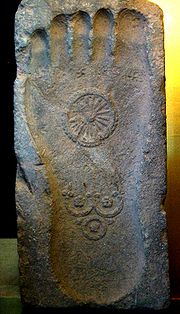 During the 2nd to 1st century BCE, sculptures became more explicit, representing episodes of the Buddha’s life and teachings. These took the form of votive tablets or frieze
s, usually in relation to the decoration of stupas.
Although India had a long sculptural tradition and a mastery of rich iconography, the Buddha was never represented in human form, but only through Buddhist symbolism
. This period may have been aniconic
.
This reluctance towards anthropomorphic representations of the Buddha, and the sophisticated development of aniconic symbols to avoid it (even in narrative scene where other human figures would appear). This tendency remained as late as the 2nd century CE in the southern parts of India, in the art of the Amaravati School (see: Mara's assault on the Buddha
).
It has been argued that earlier anthropomorphic representations of the Buddha may have been made of wood and may have perished since then. However, no related archaeological evidence has been found.
The earlist works of Buddhist art in India date back to the 1st century B.C. The
Mahabodhi Temple
at Bodh Gaya became a model for similar structures in Burma
and Indonesia. The frescoes at Sigiriya
are said to be even older than the
Ajanta Caves paintings.
in today’s North West Frontier Province, in Pakistan
, and the region of Mathura, in central northern India.
The art of Gandhara benefited from centuries of interaction with Greek culture since the conquests of Alexander the Great in 332 BC and the subsequent establishment of the Greco-Bactrian
and Indo-Greek Kingdom
s, leading to the development of Greco-Buddhist art
. Gandharan Buddhist sculpture displays Greek artistic
influence, and it has been suggested that the concept of the "man-god" was essentially inspired by Greek mythological
culture. Artistically, the Gandharan school of sculpture is said to have contributed wavy hair, drapery covering both shoulders, shoes and sandals, acanthus leaf decorations, etc.
The art of Mathura tends to be based on a strong Indian tradition, exemplified by the anthropomorphic representation of divinities such as the Yaksa
s, although in a style rather archaic compared to the later representations of the Buddha. The Mathuran school contributed clothes covering the left shoulder of thin muslin
, the wheel on the palm, the lotus seat, etc.
Mathura and Gandhara also strongly influenced each other. During their artistic florescence, the two regions were even united politically under the Kushans
, both being capitals of the empire. It is still a matter of debate whether the anthropomorphic representations of Buddha was essentially a result of a local evolution of Buddhist art at Mathura, or a consequence of Greek cultural influence in Gandhara through the Greco-Buddhist
syncretism
.
.jpg) This iconic art was characterized from the start by a realistic idealism, combining realistic human features, proportions, attitudes and attributes, together with a sense of perfection and serenity reaching to the divine. This expression of the Buddha as both man and God became the iconographic canon for subsequent Buddhist art.
This iconic art was characterized from the start by a realistic idealism, combining realistic human features, proportions, attitudes and attributes, together with a sense of perfection and serenity reaching to the divine. This expression of the Buddha as both man and God became the iconographic canon for subsequent Buddhist art.
It is interesting to note that the Buddha is an extensively used subject in plastic arts such as sculpture, paintings and literature, but not in music and dance.
Buddhist art continued to develop in India for a few more centuries. The pink sandstone
sculptures of Mathura evolved during the Gupta
period (4th to 6th century) to reach a very high fineness of execution and delicacy in the modeling. The art of the Gupta school was extremely influential almost everywhere in the rest of Asia. By the 10th century, Buddhist art creation was dying out in India
, as Hinduism
and Islam
ultimately prevailed. At the end of the 12th century A.D. Buddhism in its full glory came to be preserved only in the Himalayan regions in India. These areas, helped by their location, were in greater contact with Tibet and China - for example the art and traditions of Ladakh
bear the stamp of Tibetan and Chinese influence.
As Buddhism expanded outside of India from the 1st century AD, its original artistic package blended with other artistic influences, leading to a progressive differentiation among the countries adopting the faith.
 The Silk Road transmission of Buddhism
to Central Asia, China and ultimately Korea and Japan started in the 1st century CE with a semi-legendary account of an embassy sent to the West by the Chinese Emperor Ming (58-75 AD). However, extensive contacts started in the 2nd century CE, probably as a consequence of the expansion of the Kushan Empire
into the Chinese territory of the Tarim Basin
, with the missionary efforts of a great number of Central Asian Buddhist monks to Chinese lands. The first missionaries and translators of Buddhists scriptures into Chinese
, such as Lokaksema
, were either Parthia
n, Kushan, Sogdian
or Kuchean.
Central Asian missionary efforts along the Silk Road
were accompanied by a flux of artistic influences, visible in the development of Serindian art
from the 2nd through the 11th century AD in the Tarim Basin, modern Xinjiang
. Serindian art often derives from the Greco-Buddhist art
of the Gandhara
district of what is now Pakistan
, combining Indian, Greek and Roman
influences. Silk Road Greco-Buddhist artistic influences can be found as far as Japan to this day, in architectural motifs, Buddhist imagery, and a select few representations of Japanese gods
.
The art of the northern route was also highly influenced by the development of Mahāyāna
Buddhism, an inclusive branch of Buddhism characterized by the adoption of new texts, in addition to the traditional āgamas, and a shift in the understanding of Buddhism. Mahāyāna goes beyond the traditional Early Buddhist
ideal of the release from suffering (duḥkha
) of arhats, and emphasizes the bodhisattva
path. The Mahāyāna sutras elevate the Buddha to a transcendent and infinite being, and feature a pantheon of bodhisattvas devoting themselves to the Six Perfections
, ultimate knowledge (Prajñāpāramitā
), enlightenment, and the liberation of all sentient beings. Northern Buddhist art thus tends to be characterized by a very rich and syncretic Buddhist pantheon, with a multitude of images of the various buddhas
, bodhisattvas, and heavenly beings (devas
).
.jpg) Buddhist art in Afghanistan
Buddhist art in Afghanistan
(old Bactria
) persisted for several centuries until the spread of Islam in the 7th century. It is exemplified by the Buddhas of Bamyan
. Other sculptures, in stucco
, schist
or clay
, display very strong blending of Indian post-Gupta
mannerism and Classical influence, Hellenistic
or possibly even Greco-Roman.
Although Islamic rule was somewhat tolerant of other religions "of the Book
", it showed little tolerance for Buddhism, which was perceived as a religion depending on "idolatry
". Human figurative art forms also being prohibited under Islam, Buddhist art suffered numerous attacks, which culminated with the systematic destructions by the Taliban regime. The Buddhas of Bamyan, the sculptures of Hadda
, and many of the remaining artifacts at the Afghanistan museum have been destroyed.
The multiple conflicts since the 1980s also have led to a systematic pillage of archaeological sites apparently in the hope of reselling in the international market what artifacts could be found.
long played the role of a meeting place between China, India and Persia
. During the 2nd century BCE, the expansion of the Former Han
to the West led to increased contact with the Hellenistic civilizations of Asia, especially the Greco-Bactrian Kingdom
.
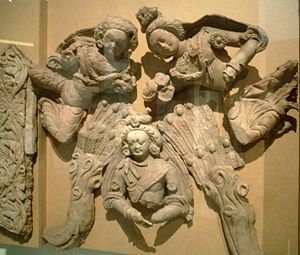 Thereafter, the expansion of Buddhism to the North led to the formation of Buddhist communities and even Buddhist kingdoms in the oasis of Central Asia. Some Silk Road
cities consisted almost entirely of Buddhist stupas and monasteries, and it seems that one of their main objectives was to welcome and service travelers between East and West.
The eastern part of Central Asia (Chinese Turkestan (Tarim Basin
, Xinjiang
) in particular has revealed an extremely rich Serindian art
(wall paintings
and relief
s in numerous caves, portable paintings on canvas, sculpture, ritual objects), displaying multiple influences from Indian and Hellenistic cultures. Works of art reminiscent of the Gandharan style, as well as scriptures in the Gandhari script Kharoshti have been found. These influences were rapidly absorbed however by the vigorous Chinese culture, and a strongly Chinese particularism develops from that point.
See also: Dunhuang
, Mogao Caves
, Kingdom of Khotan
, Silk Road
, Silk Road transmission of Buddhism
around the 1st century AD, and introduced new types of art into China, particularly in the area of statuary
. Receiving this distant religion, strong Chinese traits were incorporated into Buddhist art.
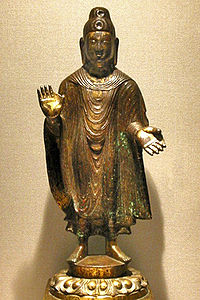 In the 5th to 6th centuries, the Northern Dynasties
, developed rather symbolic and abstract modes of representation, with schematic lines. Their style is also said to be solemn and majestic. The lack of corporeality of this art, and its distance from the original Buddhist objective of expressing the pure ideal of enlightenment in an accessible and realistic manner, progressively led to a change towards more naturalism and realism, leading to the expression of Tang Buddhist art.
Sites preserving Northern Wei Dynasty Buddhist sculpture:
, Buddhist sculpture of the Tang
evolved towards a markedly life-like expression. Because of the dynasty’s openness to foreign influences, and renewed exchanges with Indian culture due to the numerous travels of Chinese Buddhist monks to India, Tang dynasty Buddhist sculpture assumed a rather classical form, inspired by the Indian art of the Gupta period. During that time, the Tang capital of Chang'an
(today's Xi'an
) became an important center for Buddhism. From there Buddhism spread to Korea
, and Japanese missions to Tang China
helped it gain a foothold in Japan.
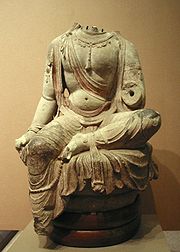 However, foreign influences came to be negatively perceived in China towards the end of the Tang dynasty. In the year 845, the Tang emperor Wuzong outlawed all "foreign" religions (including Christian Nestorianism
, Zoroastrianism
and Buddhism
) in order to support the indigenous religion, Taoism
. He confiscated Buddhist possessions, and forced the faith to go underground, therefore affecting the development of the religion and its arts in China.
Chán
Buddhism however, as the origin of Japanese Zen
, continued to prosper for some centuries, especially under the Song Dynasty
(960-1279), when Chan monasteries were great centers of culture and learning.
 Early paintings by Chán monks tended to eschew the meticulous realism of Gongbi
painting in favour of vigorous, monochrome paintings, attempting to express the impact of enlightenment through their brushwork.
The rise of Neo-Confucianism
under Zhu Xi
in the twelfth century resulted in considerable criticism of the monk-painters. Connected as they were with the then-unpopular school of Chan Buddhism, their paintings were discarded and ignored. Some paintings survived after being transported to Japan by visiting Zen monks, but the school of Chan painting gradually diminished.
, the so-called Four Monk painters (Zhu Da
, Shi Tao
, Kun Can
and Hong Ren
) used their paintings to convey their disapproval of the contemporary political climate. Although they used traditional forms, they moved away from the highly technical works popular at the time (exemplified by the Four Wangs
) and concentrated on expressive brush stokes and bold colours.
near Dunhuang
and the Bingling Temple
caves near Yongjing in Gansu
province, the Longmen Grottoes
near Luoyang
in Henan
province, the Yungang Grottoes
near Datong
in Shanxi
province, and the Dazu Rock Carvings
near Chongqing
municipality are among the most important and renowned Buddhist sculptural sites. The Leshan Giant Buddha
, carved out of a hillside in the 8th century during the Tang Dynasty
and looking down on the confluence of three rivers, is still the largest stone Buddha statue in the world.
n Buddhist art generally reflects an interaction between other Buddhist influences and a strongly original Korean culture. Additionally, the art of the steppes, particularly Siberian and Scythia
n influences, are evident in early Korean Buddhist art based on the excavation of artifacts and burial goods such as Silla
royal crowns
, belt buckles, daggers, and comma-shaped gogok
. The style of this indigenous art was geometric, abstract and richly adorned with a characteristic "barbarian" luxury. Although many other influences were strong, Korean Buddhist art, "bespeaks a sobriety, taste for the right tone, a sense of abstraction but also of colours that curiously enough are in line with contemporary taste" (Pierre Cambon, Arts asiatiques- Guimet).
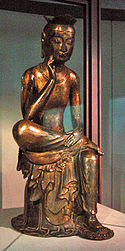 The first of the Three Kingdoms of Korea
to officially receive Buddhism was Goguryeo
in 372. However, Chinese records and the use of Buddhist motifs in Goguryeo murals indicate the introduction of Buddhism earlier than the official date. The Baekje
Kingdom officially recognized Buddhism in 384. The Silla
Kingdom, isolated and with no easy sea or land access to China, officially adopted Buddhism in 535 although the foreign religion was known in the kingdom due to the work of Goguryeo monks since the early 5th century. The introduction of Buddhism stimulated the need for artisans to create images for veneration, architects for temples, and the literate for the Buddhist sutras and transformed Korean civilization. Particularly important in the transmission of sophisticated art styles to the Korean kingdoms was the art of the "barbarian" Tuoba, a clan of non-Han Chinese Xianbei people who established the Northern Wei
Dynasty in China in 386. The Northern Wei style was particularly influential in the art of the Goguryeo and Baekje. Baekje artisans later transmitted this style along with Southern Dynasty elements and distinct Korean elements to Japan. Korean artisans were highly selective of the styles they incorporated and combined different regional styles together to create a specific Korean Buddhist art style.
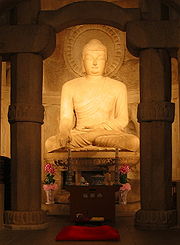 While Goguryeo Buddhist art exhibited vitality and mobility akin with Northern Wei prototypes, the Baekje Kingdom was also in close contact with the Southern Dynasties
of China and this close diplomatic contact is exemplified in the gentle and proportional sculpture of the Baekje, epitomized by Baekje sculpture exhibiting the fathomless smile known to art historians as the Baekje smile
. The Silla Kingdom also developed a distinctive Buddhist art tradition epitomized by the Bangasayusang
, a half-seated contemplative maitreya whose Korean-made twin, the Miroku Bosatsu, was sent to Japan as a proselytizing gift and now resides in the Koryu-ji Temple in Japan. Buddhism in the Three Kingdoms period stimulated massive temple-building projects, such as the Mireuksa
Temple in the Baekje Kingdom and the Hwangnyongsa
Temple in Silla. Baekje architects were famed for their skill and were instrumental in building the massive nine-story pagoda at Hwangnyongsa and early Buddhist temples in Yamato Japan such as Hōkō-ji
(Asuka-dera) and Hōryū-ji
. 6th century Korean Buddhist art exhibited the cultural influences of China and India but began to show distinctive indigenous characteristics. These indigenous characteristics can be seen in early Buddhist art in Japan and some early Japanese Buddhist sculpture is now believed to have originated in Korea, particularly from Baekje, or Korean artisans who immigrated to Yamato Japan. Particularly, the semi-seated Maitreya form was adapted into a highly developed Korean style which was transmitted to Japan as evidenced by the Koryu-ji Miroku Bosatsu and the Chugu-ji Siddhartha statues. Although many historians portray Korea as a mere transmitter of Buddhism, the Three Kingdoms, and particularly Baekje, were instrumental as active agents in the introduction and formation of a Buddhist tradition in Japan in 538 or 552.
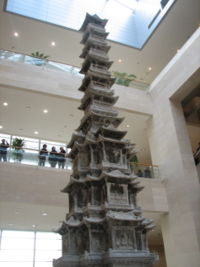 During the Unified Silla
period, East Asia
was particularly stable with China and Korea both enjoying unified governments. Early Unified Silla art combined Silla styles and Baekje styles. Korean Buddhist art was also influenced by new Tang Dynasty
styles as evidenced by a new popular Buddhist motif with full-faced Buddha sculptures. Tang China was the cross roads of East, Central, and South Asia and so the Buddhist art of this time period exhibit the so-called international style. State-sponsored Buddhist art flourished during this period, the epitome of which is the Seokguram
Grotto.
Dynasty in 918 indicates a new period of Korean Buddhist art. The Goryeo kings also lavishly sponsored Buddhism and Buddhist art flourished, especially Buddhist paintings and illuminated sutras written in gold and silver ink. http://www.metmuseum.org/toah/ht/07/eak/ht07eak.htm. The crowning achievement of this period is the carving of approximately 80,000 woodblocks of the Tripitaka Koreana
which was done twice.
actively suppressed Buddhism beginning in 1406 and Buddhist temples and art production subsequently decline in quality in quantity although beginning in 1549, Buddhist art does continue to be produced. http://books.google.com/books?vid=ISBN0300051670&id=wMK-Ba0-RG4C&pg=PA335&lpg=PA335&dq=korean+buddhist+art&sig=_kCe2AGEUno0itMIz1VXdKH5KOI.
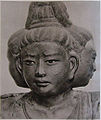 Before the introduction of Buddhism, Japan
had already been the seat of various cultural (and artistic) influences, from the abstract linear decorative art of the indigenous Neolithic Jōmon from around 10500 BC to 300 BC, to the art during the Yayoi and Kofun
periods, with developments such as Haniwa
art.
The Japanese discovered Buddhism in the 6th century when missionary monks travelled to the islands together with numerous scriptures and works of art. The Buddhist religion was adopted by the state in the following century. Being geographically at the end of the Silk Road
, Japan was able to preserve many aspects of Buddhism at the very time it was disappearing in India, and being suppressed in Central Asia and China.
 From 711, numerous temples and monasteries were built in the capital city of Nara
, including a five-story pagoda
, the Golden Hall of the Horyuji, and the Kōfuku-ji
temple. Countless paintings and sculptures were made, often under governmental sponsorship. Indian, Hellenistic, Chinese and Korean artistic influences blended into an original style characterized by realism and gracefulness. The creation of Japanese Buddhist art was especially rich between the 8th and 13th centuries during the periods of Nara
, Heian
and Kamakura
.
Japan developed an extremely rich figurative art for the pantheon of Buddhist deities, sometimes combined with Hindu
and Shinto
influences. This art can be very varied, creative and bold.
From the 12th and 13th, a further development was Zen
art, and it faces golden days in Muromachi Period
, following the introduction of the faith by Dogen
and Eisai
upon their return from China. Zen art is mainly characterized by original paintings (such as sumi-e) and poetry (especially haiku
s), striving to express the true essence of the world through impressionistic and unadorned "non-dualistic" representations. The search for enlightenment "in the moment" also led to the development of other important derivative arts such as the Chanoyu tea ceremony or the Ikebana
art of flower arrangement. This evolution went as far as considering almost any human activity as an art with a strong spiritual and aesthetic content, first and foremost in those activities related to combat techniques (martial arts).
Buddhism remains very active in Japan to this day. Still around 80,000 Buddhist temples are preserved. Many of them are in wood and are regularly restored.
 Tantric Buddhism started as a movement in eastern India around the 5th or the 6th century. Many of the practices of Tantric Buddhism are derived from Brahmanism (the usage of mantra
s, yoga
, or the burning of sacrificial offerings). Tantrism became the dominant form of Buddhism in Tibet
from the 8th century. Due to its geographical centrality in Asia, Tibetan Buddhist art received influence from Indian, Nepal
i, Greco-Buddhist and Chinese art.
One of the most characteristic creations of Tibetan Buddhist art are the mandala
s, diagrams of a "divine temple" made of a circle enclosing a square, the purpose of which is to help Buddhist devotees focus their attention through meditation and follow the path to the central image of the Buddha.
Artistically, Buddhist Gupta
art and Hindu art tend to be the two strongest inspirations of Tibetan art.
(Tonkin) between the 1st and 9th centuries, and Confucianism
and Mahayana Buddhism were prevalent. Overall, the art of Vietnam has been strongly influenced by Chinese Buddhist art.
In the south thrived the former kingdom of Champa
(before it was later overtaken by the Vietnamese from the north). Champa
had a strongly Indianized art, just as neighboring Cambodia
. Many of its statues were characterized by rich body adornments. The capital of the kingdom of Champa was annexed by Vietnam in 1471, and it totally collapsed in the 1720s, while Cham people remain an abundant minority across Southeast Asia
.
n empire in the Middle East
, an unvanquished enemy of Rome
, just as Romans were becoming extremely wealthy and their demand for Asian luxury was rising. This demand revived the sea connections between the Mediterranean Sea
and China, with India as the intermediary of choice. From that time, through trade connections, commercial settlements, and even political interventions, India started to strongly influence Southeast Asia
n countries. Trade routes linked India with southern Burma, central and southern Siam
, lower Cambodia
and southern Vietnam
, and numerous urbanized coastal settlements were established there.
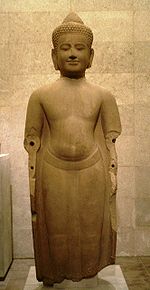 For more than a thousand years, Indian influence was therefore the major factor that brought a certain level of cultural unity to the various countries of the region. The Pali
and Sanskrit
languages and the Indian script, together with Mahayana
and Theravada
Buddhism, Brahmanism and Hinduism
, were transmitted from direct contact and through sacred texts and Indian literature such as the Ramayana
and the Mahabharata
. This expansion provided the artistic context for the development of Buddhist art in these countries, which then developed characteristics of their own.
Between the 1st and 8th centuries, several kingdoms competed for influence in the region (particularly the Cambodian Funan then the Burmese Mon kingdoms) contributing various artistic characteristics, mainly derived from the Indian Gupta
style. Combined with a pervading Hindu influence, Buddhist images, votive tablets and Sanskrit inscriptions are found throughout the area.
From the 9th to the 13th centuries, Southeast Asia had very powerful empires and became extremely active in Buddhist architectural and artistic creation. The Sri Vijaya Empire to the south and the Khmer Empire
to the north competed for influence, but both were adherents of Mahayana Buddhism, and their art expressed the rich Mahayana pantheon of the Bodhisattva
s.
The Theravada
Buddhism of the Pali canon was introduced to the region around the 13th century from Sri Lanka
, and was adopted by the newly founded ethnic Thai kingdom of Sukhothai
. Since in Theravada Buddhism of the period, Monasteries typically were the central places for the laity of the towns to receive instruction and have disputes arbitrated by the monks, the construction of temple complexes plays a particularly important role in the artistic expression of Southeast Asia from that time.
From the 14th century, the main factor was the spread of Islam
to the maritime areas of Southeast Asia, overrunning Malaysia, Indonesia
, and most of the islands as far as the Philippines
. In the continental areas, Theravada Buddhism continued to expand into Burma, Laos
and Cambodia.
(Burma) was naturally strongly influenced by the eastern part of Indian territory. The Mon
of southern Burma are said to have been converted to Buddhism around 200 BC under the proselytizing of the Indian king Ashoka
, before the schism between Mahayana
and Hinayana
Buddhism.
Early Buddhist temples are found, such as Beikthano in central Myanmar, with dates between the 1st and the 5th centuries. The Buddhist art of the Mons was especially influenced by the Indian art of the Gupta
and post-Gupta periods, and their mannerist style spread widely in Southeast Asia following the expansion of the Mon Empire between the 5th and 8th centuries.
Later, thousands of Buddhist temples were built at Bagan
, the capital, between the 11th and 13th centuries, and around 2,000 of them are still standing. Beautiful jeweled statues of the Buddha are remaining from that period. Creation managed to continue despite the seizure of the city by the Mongols
in 1287.
During the Ava period
, from the 14th to 16th centuries, the Ava (Innwa) style of the Buddha image was popular. In this style, the Buddha has large protruding ears, exaggerated eyebrows that curve upward, half-closed eyes, thin lips and a hair bun that is pointed at the top, usually depicted in the bhumisparsa mudra
.
During the Konbaung dynasty
, at the end of the 18th century, the Mandalay style of the Buddha image emerged, a style that remains popular to this day. There was a marked departure from the Innwa style, and the Buddha's face is much more natural, fleshy, with naturally-slanted eyebrows, slightly slanted eyes, thicker lips, and a round hair bun at the top. Buddha images in this style can be found reclining, standing or sitting. Mandalay-style Buddhas wear flowing, draped robes.
Another common style of Buddha images is the Shan style, from the Shan people, who inhabit the highlands of Myanmar. In this style, the Buddha is depicted with angular features, a large and prominently pointed nose, a hair bun tied similar to Thai styles, and a small, thin mouth.
was the center of the Funan kingdom, which expanded into Burma and as far south as Malaysia between the 3rd and 6th centuries CE. Its influence seems to have been essentially political, most of the cultural influence coming directly from India.
Later, from the 9th to 13th centuries, the Mahayana Buddhist and Hindu Khmer Empire
dominated vast parts of the Southeast Asian peninsula, and its influence was foremost in the development of Buddhist art in the region. Under the Khmer, more than 900 temples were built in Cambodia and in neighboring Thailand.
Angkor
was at the center of this development, with a Buddhist temple complex and urban organization able to support around 1 million urban dwellers. A great deal of Cambodian Buddhist sculpture is preserved at Angkor; however, organized looting has had a heavy impact on many sites around the country.
Often, Khmer art manages to express intense spirituality through divinely beaming expressions, in spite of spare features and slender lines.
See also: Khmer art
, Khmer sculpture
was first influenced by direct contact with Indian traders and the expansion of the Mon kingdom, leading to the creation of Hindu and Buddhist art inspired from the Gupta
tradition, with numerous monumental statues of great virtuosity.
From the 9th century, the various schools of Thai art then became strongly influenced by Cambodian Khmer
art in the north and Sri Vijaya art in the south, both of Mahayana faith. Up to the end of that period, Buddhist art is characterized by a clear fluidness in the expression, and the subject matter is characteristic of the Mahayana
pantheon with multiple creations of Bodhisattva
s.
From the 13th century, Theravada
Buddhism was introduced from Sri Lanka around the same time as the ethnic Thai kingdom of Sukhothai
was established. The new faith inspired highly stylized images in Thai Buddhism, with sometimes very geometrical and almost abstract figures.
During the Ayutthaya
period (14th-18th centuries), the Buddha came to be represented in a more stylistic manner with sumptuous garments and jeweled ornamentations. Many Thai sculptures or temples tended to be gilded
, and on occasion enriched with inlays.
See also: Thai art
, Buddha images in Thailand
 Like the rest of Southeast Asia, Indonesia
seems to have been most strongly influenced by India from the 1st century AD. The islands of Sumatra
and Java in western Indonesia were the seat of the empire of Sri Vijaya (8th-13th century CE), which came to dominate most of the area around the Southeast Asian peninsula through maritime power. The Sri Vijayan Empire had adopted Mahayana and Vajrayana Buddhism, under a line of rulers named the Sailendra
. Sri Vijaya spread Mahayana Buddhist art during its expansion into the Southeast Asian peninsula. Numerous statues of Mahayana Bodhisattva
s from this period are characterized by a very strong refinement and technical sophistication, and are found throughout the region.
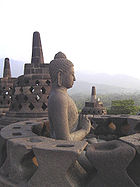
Extremely rich and refined architectural remains are found in Java and Sumatra. The most magnificent is the temple of Borobudur
(the largest Buddhist structure in the world, built around 780-850 AD). This temple is modelled after the Buddhist concept of universe, the Mandala
which counts 505 images of the seated Buddha and unique bell-shaped stupa that contains the statue of Buddha. Borobudur is adorned with long series of bas-reliefs narrated the holy Buddhist scriptures. The oldest Buddhist structure in Indonesia probably is the Batujaya
stupas at Karawang, West Java, dated from around 4th century CE. This temple is some plastered brick stupas. However, Buddhist art in Indonesia reach the golden era during the Sailendra
dynasty rule in Java. The bas-reliefs and statues of Boddhisatva, Tara
, and Kinnara
found in Kalasan, Sewu
, Sari
, and Plaosan
temple is very graceful with serene expression, While Mendut temple near Borobudur, houses the giant statue of Vairocana
, Avalokitesvara
, and Vajrapani
.
In Sumatra
Sri Vijaya probably built the temple of Muara Takus, and Muaro Jambi
. The most beautiful example of classical Javanese Buddhist art is the serene and delicate statue of Prajnaparamita
(the collection of National Museum Jakarta) the goddess of transcendental wisdom from Singhasari
kingdom. The Indonesian Buddhist Empire of Sri Vijaya declined due to conflicts with the Chola rulers of India, then followed by Majapahit empire, before being destabilized by the Islamic expansion from the 13th century.
, in his video installations, John Connell
, in sculpture., and Allan Graham
in his multi-media “Time is Memory”.
In the UK The Network of Buddhist Organisations
has interested itself in identifying Buddhist practitioners across all the arts. In 2005 it co-ordinated the UK-wide Buddhist arts festival, "A Lotus in Flower"; in 2009 it helped organise the two-day arts conference, "Buddha Mind, Creative Mind". As a result of the latter an association of Buddhist artists was formed.
Indian subcontinent
The Indian subcontinent, also Indian Subcontinent, Indo-Pak Subcontinent or South Asian Subcontinent is a region of the Asian continent on the Indian tectonic plate from the Hindu Kush or Hindu Koh, Himalayas and including the Kuen Lun and Karakoram ranges, forming a land mass which extends...
following the historical life of Siddhartha Gautama, 6th to 5th century BC, and thereafter evolved by contact with other cultures as it spread throughout Asia and the world.
Buddhist art followed believers as the dharma spread, adapted, and evolved in each new host country. It developed to the north through Central Asia
Central Asia
Central Asia is a core region of the Asian continent from the Caspian Sea in the west, China in the east, Afghanistan in the south, and Russia in the north...
and into Eastern Asia to form the Northern branch of Buddhist art, and to the east as far as Southeast Asia
Southeast Asia
Southeast Asia, South-East Asia, South East Asia or Southeastern Asia is a subregion of Asia, consisting of the countries that are geographically south of China, east of India, west of New Guinea and north of Australia. The region lies on the intersection of geological plates, with heavy seismic...
to form the Southern branch of Buddhist art. In India, Buddhist art flourished and even influenced the development of Hindu
Hinduism
Hinduism is the predominant and indigenous religious tradition of the Indian Subcontinent. Hinduism is known to its followers as , amongst many other expressions...
art, until Buddhism nearly disappeared in India around the 10th century due in part to the vigorous expansion of Islam
Islam
Islam . The most common are and . : Arabic pronunciation varies regionally. The first vowel ranges from ~~. The second vowel ranges from ~~~...
alongside Hinduism
Hinduism
Hinduism is the predominant and indigenous religious tradition of the Indian Subcontinent. Hinduism is known to its followers as , amongst many other expressions...
.
Pre-iconic phase (5th century - 1st century BCE)
Frieze
thumb|267px|Frieze of the [[Tower of the Winds]], AthensIn architecture the frieze is the wide central section part of an entablature and may be plain in the Ionic or Doric order, or decorated with bas-reliefs. Even when neither columns nor pilasters are expressed, on an astylar wall it lies upon...
s, usually in relation to the decoration of stupas.
Although India had a long sculptural tradition and a mastery of rich iconography, the Buddha was never represented in human form, but only through Buddhist symbolism
Buddhist symbolism
Buddhist symbolism is the use of Buddhist art to represent certain aspects of dhamma, which began in the 4th century BCE. Anthropomorphic symbolism appeared from around the 1st century CE with the arts of Mathura and the Greco-Buddhist art of Gandhara, and were combined with the previous symbols...
. This period may have been aniconic
Aniconism in Buddhism
Since the beginning of Buddhist art history in the 1890s, the earliest phase, lasting until the 1st century CE, has been described as aniconic; the Buddha was only represented through symbols such as an empty throne, Bodhi tree, a riderless horse , Buddha's footprints, and the dharma wheel...
.
This reluctance towards anthropomorphic representations of the Buddha, and the sophisticated development of aniconic symbols to avoid it (even in narrative scene where other human figures would appear). This tendency remained as late as the 2nd century CE in the southern parts of India, in the art of the Amaravati School (see: Mara's assault on the Buddha
Mara (demon)
In Buddhism, Māra is the demon that tempted Gautama Buddha by trying to seduce him with the vision of beautiful women who, in various legends, are often said to be Mara's daughters. In Buddhist cosmology, Mara personifies unwholesome impulses, unskillfulness, the "death" of the spiritual life...
).
It has been argued that earlier anthropomorphic representations of the Buddha may have been made of wood and may have perished since then. However, no related archaeological evidence has been found.
The earlist works of Buddhist art in India date back to the 1st century B.C. The
Mahabodhi Temple
Mahabodhi Temple
The Mahabodhi Temple is a Buddhist temple in Bodh Gaya, the location where Siddhartha Gautama, the Buddha, attained enlightenment. Bodh Gaya is located about from Patna, Bihar state, India. Next to the temple, to its western side, is the holy Bodhi tree...
at Bodh Gaya became a model for similar structures in Burma
and Indonesia. The frescoes at Sigiriya
Sigiriya
Sigiriya is a large stone and ancient rock fortress and palace ruin in the central Matale District of Sri Lanka, surrounded by the remains of an extensive network of gardens, reservoirs, and other structures...
are said to be even older than the
Ajanta Caves paintings.
Iconic phase (1st century AD – present)
Anthropomorphic representations of the Buddha started to emerge from the 1st century AD in Northern India. The two main centers of creation have been identified as GandharaGandhara
Gandhāra , is the name of an ancient kingdom , located in northern Pakistan and eastern Afghanistan. Gandhara was located mainly in the vale of Peshawar, the Potohar plateau and on the Kabul River...
in today’s North West Frontier Province, in Pakistan
Pakistan
Pakistan , officially the Islamic Republic of Pakistan is a sovereign state in South Asia. It has a coastline along the Arabian Sea and the Gulf of Oman in the south and is bordered by Afghanistan and Iran in the west, India in the east and China in the far northeast. In the north, Tajikistan...
, and the region of Mathura, in central northern India.
The art of Gandhara benefited from centuries of interaction with Greek culture since the conquests of Alexander the Great in 332 BC and the subsequent establishment of the Greco-Bactrian
Greco-Bactrian Kingdom
The Greco-Bactrian Kingdom was the easternmost part of the Hellenistic world, covering Bactria and Sogdiana in Central Asia from 250 to 125 BC...
and Indo-Greek Kingdom
Indo-Greek Kingdom
The Indo-Greek Kingdom or Graeco-Indian Kingdom covered various parts of the northwest regions of the Indian subcontinent during the last two centuries BC, and was ruled by more than 30 Hellenistic kings, often in conflict with each other...
s, leading to the development of Greco-Buddhist art
Greco-Buddhist art
Greco-Buddhist art is the artistic manifestation of Greco-Buddhism, a cultural syncretism between the Classical Greek culture and Buddhism, which developed over a period of close to 1000 years in Central Asia, between the conquests of Alexander the Great in the 4th century BCE, and the Islamic...
. Gandharan Buddhist sculpture displays Greek artistic
Art in Ancient Greece
The arts of ancient Greece have exercised an enormous influence on the culture of many countries all over the world, particularly in the areas of sculpture and architecture. In the West, the art of the Roman Empire was largely derived from Greek models...
influence, and it has been suggested that the concept of the "man-god" was essentially inspired by Greek mythological
Greek mythology
Greek mythology is the body of myths and legends belonging to the ancient Greeks, concerning their gods and heroes, the nature of the world, and the origins and significance of their own cult and ritual practices. They were a part of religion in ancient Greece...
culture. Artistically, the Gandharan school of sculpture is said to have contributed wavy hair, drapery covering both shoulders, shoes and sandals, acanthus leaf decorations, etc.
The art of Mathura tends to be based on a strong Indian tradition, exemplified by the anthropomorphic representation of divinities such as the Yaksa
Yaksa
Yaksa or Yaksha may refer to:* Yaksha , nature-spirit in Hindu, Jainishm, and Buddhism* Yaksha Kingdom, ancient kingdom in Indian epic literature* Yakkha, also called "Yaksa-sh"...
s, although in a style rather archaic compared to the later representations of the Buddha. The Mathuran school contributed clothes covering the left shoulder of thin muslin
Muslin
Muslin |sewing patterns]], such as for clothing, curtains, or upholstery. Because air moves easily through muslin, muslin clothing is suitable for hot, dry climates.- Etymology and history :...
, the wheel on the palm, the lotus seat, etc.
Mathura and Gandhara also strongly influenced each other. During their artistic florescence, the two regions were even united politically under the Kushans
Kushan Empire
The Kushan Empire originally formed in the early 1st century AD under Kujula Kadphises in the territories of ancient Bactria on either side of the middle course of the Oxus in what is now northern Afghanistan, Pakistan, and southern Tajikistan and Uzbekistan.During the 1st and early 2nd centuries...
, both being capitals of the empire. It is still a matter of debate whether the anthropomorphic representations of Buddha was essentially a result of a local evolution of Buddhist art at Mathura, or a consequence of Greek cultural influence in Gandhara through the Greco-Buddhist
Greco-Buddhism
Greco-Buddhism, sometimes spelled Graeco-Buddhism, refers to the cultural syncretism between Hellenistic culture and Buddhism, which developed between the 4th century BCE and the 5th century CE in the area covered by the Indian sub-continent, and modern Afghanistan, Pakistan and north-western...
syncretism
Syncretism
Syncretism is the combining of different beliefs, often while melding practices of various schools of thought. The term means "combining", but see below for the origin of the word...
.
It is interesting to note that the Buddha is an extensively used subject in plastic arts such as sculpture, paintings and literature, but not in music and dance.
Buddhist art continued to develop in India for a few more centuries. The pink sandstone
Sandstone
Sandstone is a sedimentary rock composed mainly of sand-sized minerals or rock grains.Most sandstone is composed of quartz and/or feldspar because these are the most common minerals in the Earth's crust. Like sand, sandstone may be any colour, but the most common colours are tan, brown, yellow,...
sculptures of Mathura evolved during the Gupta
Gupta Empire
The Gupta Empire was an ancient Indian empire which existed approximately from 320 to 550 CE and covered much of the Indian Subcontinent. Founded by Maharaja Sri-Gupta, the dynasty was the model of a classical civilization. The peace and prosperity created under leadership of Guptas enabled the...
period (4th to 6th century) to reach a very high fineness of execution and delicacy in the modeling. The art of the Gupta school was extremely influential almost everywhere in the rest of Asia. By the 10th century, Buddhist art creation was dying out in India
Decline of Buddhism in India
The decline of Buddhism in India, the land of its birth, occurred for a variety of reasons, and happened even as it continued to flourish beyond the frontiers of India. Buddhism was established in the area of ancient Magadha and Kosala by Gautama Buddha in the 6th century BCE, in what is now modern...
, as Hinduism
Hinduism
Hinduism is the predominant and indigenous religious tradition of the Indian Subcontinent. Hinduism is known to its followers as , amongst many other expressions...
and Islam
Islam
Islam . The most common are and . : Arabic pronunciation varies regionally. The first vowel ranges from ~~. The second vowel ranges from ~~~...
ultimately prevailed. At the end of the 12th century A.D. Buddhism in its full glory came to be preserved only in the Himalayan regions in India. These areas, helped by their location, were in greater contact with Tibet and China - for example the art and traditions of Ladakh
Ladakh
Ladakh is a region of Jammu and Kashmir, the northernmost state of the Republic of India. It lies between the Kunlun mountain range in the north and the main Great Himalayas to the south, inhabited by people of Indo-Aryan and Tibetan descent...
bear the stamp of Tibetan and Chinese influence.
As Buddhism expanded outside of India from the 1st century AD, its original artistic package blended with other artistic influences, leading to a progressive differentiation among the countries adopting the faith.
- A Northern route was established from the 1st century CE through Central AsiaCentral AsiaCentral Asia is a core region of the Asian continent from the Caspian Sea in the west, China in the east, Afghanistan in the south, and Russia in the north...
, TibetTibetTibet is a plateau region in Asia, north-east of the Himalayas. It is the traditional homeland of the Tibetan people as well as some other ethnic groups such as Monpas, Qiang, and Lhobas, and is now also inhabited by considerable numbers of Han and Hui people...
, BhutanBhutanBhutan , officially the Kingdom of Bhutan, is a landlocked state in South Asia, located at the eastern end of the Himalayas and bordered to the south, east and west by the Republic of India and to the north by the People's Republic of China...
, ChinaChinaChinese civilization may refer to:* China for more general discussion of the country.* Chinese culture* Greater China, the transnational community of ethnic Chinese.* History of China* Sinosphere, the area historically affected by Chinese culture...
, KoreaKoreaKorea ) is an East Asian geographic region that is currently divided into two separate sovereign states — North Korea and South Korea. Located on the Korean Peninsula, Korea is bordered by the People's Republic of China to the northwest, Russia to the northeast, and is separated from Japan to the...
, JapanJapanJapan is an island nation in East Asia. Located in the Pacific Ocean, it lies to the east of the Sea of Japan, China, North Korea, South Korea and Russia, stretching from the Sea of Okhotsk in the north to the East China Sea and Taiwan in the south...
and VietnamVietnamVietnam – sometimes spelled Viet Nam , officially the Socialist Republic of Vietnam – is the easternmost country on the Indochina Peninsula in Southeast Asia. It is bordered by China to the north, Laos to the northwest, Cambodia to the southwest, and the South China Sea –...
, in which MahayanaMahayanaMahāyāna is one of the two main existing branches of Buddhism and a term for classification of Buddhist philosophies and practice...
Buddhism prevailed. - A Southern route, where TheravadaTheravadaTheravada ; literally, "the Teaching of the Elders" or "the Ancient Teaching", is the oldest surviving Buddhist school. It was founded in India...
Buddhism dominated, went through MyanmarMyanmarBurma , officially the Republic of the Union of Myanmar , is a country in Southeast Asia. Burma is bordered by China on the northeast, Laos on the east, Thailand on the southeast, Bangladesh on the west, India on the northwest, the Bay of Bengal to the southwest, and the Andaman Sea on the south....
, Sri LankaSri LankaSri Lanka, officially the Democratic Socialist Republic of Sri Lanka is a country off the southern coast of the Indian subcontinent. Known until 1972 as Ceylon , Sri Lanka is an island surrounded by the Indian Ocean, the Gulf of Mannar and the Palk Strait, and lies in the vicinity of India and the...
, ThailandThailandThailand , officially the Kingdom of Thailand , formerly known as Siam , is a country located at the centre of the Indochina peninsula and Southeast Asia. It is bordered to the north by Burma and Laos, to the east by Laos and Cambodia, to the south by the Gulf of Thailand and Malaysia, and to the...
, CambodiaCambodiaCambodia , officially known as the Kingdom of Cambodia, is a country located in the southern portion of the Indochina Peninsula in Southeast Asia...
, and LaosLaosLaos Lao: ສາທາລະນະລັດ ປະຊາທິປະໄຕ ປະຊາຊົນລາວ Sathalanalat Paxathipatai Paxaxon Lao, officially the Lao People's Democratic Republic, is a landlocked country in Southeast Asia, bordered by Burma and China to the northwest, Vietnam to the east, Cambodia to the south and Thailand to the west...
.
Northern Buddhist art
Silk Road transmission of Buddhism
The Silk Road transmission of Buddhism to China is most commonly thought to have started in the late 2nd or the 1st century CE.The first documented translation efforts by Buddhist monks in China were in the 2nd century CE, possibly as a consequence of the expansion of the Kushan Empire into the...
to Central Asia, China and ultimately Korea and Japan started in the 1st century CE with a semi-legendary account of an embassy sent to the West by the Chinese Emperor Ming (58-75 AD). However, extensive contacts started in the 2nd century CE, probably as a consequence of the expansion of the Kushan Empire
Kushan Empire
The Kushan Empire originally formed in the early 1st century AD under Kujula Kadphises in the territories of ancient Bactria on either side of the middle course of the Oxus in what is now northern Afghanistan, Pakistan, and southern Tajikistan and Uzbekistan.During the 1st and early 2nd centuries...
into the Chinese territory of the Tarim Basin
Tarim Basin
The Tarim Basin is a large endorheic basin occupying an area of about . It is located in the Xinjiang Uyghur Autonomous Region in China's far west. Its northern boundary is the Tian Shan mountain range and its southern is the Kunlun Mountains on the northern edge of the Tibetan Plateau. The...
, with the missionary efforts of a great number of Central Asian Buddhist monks to Chinese lands. The first missionaries and translators of Buddhists scriptures into Chinese
Chinese language
The Chinese language is a language or language family consisting of varieties which are mutually intelligible to varying degrees. Originally the indigenous languages spoken by the Han Chinese in China, it forms one of the branches of Sino-Tibetan family of languages...
, such as Lokaksema
Lokaksema
Lokakṣema , born around 147 CE, was the earliest known Buddhist monk to have translated Mahayana sutras into the Chinese language and as such was an important figure in Buddhism in China. The name Lokakṣema means 'welfare of the world' in Sanskrit.-Origins:Lokaksema was a Kushan of Yuezhi ethnicity...
, were either Parthia
Parthia
Parthia is a region of north-eastern Iran, best known for having been the political and cultural base of the Arsacid dynasty, rulers of the Parthian Empire....
n, Kushan, Sogdian
Sogdiana
Sogdiana or Sogdia was the ancient civilization of an Iranian people and a province of the Achaemenid Empire, eighteenth in the list on the Behistun Inscription of Darius the Great . Sogdiana is "listed" as the second of the "good lands and countries" that Ahura Mazda created...
or Kuchean.
Central Asian missionary efforts along the Silk Road
Silk Road
The Silk Road or Silk Route refers to a historical network of interlinking trade routes across the Afro-Eurasian landmass that connected East, South, and Western Asia with the Mediterranean and European world, as well as parts of North and East Africa...
were accompanied by a flux of artistic influences, visible in the development of Serindian art
Serindian art
Serindian art is the art that developed from the 2nd through the 11th century C.E. in Serindia or Xinjiang, the western region of China that forms part of Central Asia....
from the 2nd through the 11th century AD in the Tarim Basin, modern Xinjiang
Xinjiang
Xinjiang is an autonomous region of the People's Republic of China. It is the largest Chinese administrative division and spans over 1.6 million km2...
. Serindian art often derives from the Greco-Buddhist art
Greco-Buddhist art
Greco-Buddhist art is the artistic manifestation of Greco-Buddhism, a cultural syncretism between the Classical Greek culture and Buddhism, which developed over a period of close to 1000 years in Central Asia, between the conquests of Alexander the Great in the 4th century BCE, and the Islamic...
of the Gandhara
Gandhara
Gandhāra , is the name of an ancient kingdom , located in northern Pakistan and eastern Afghanistan. Gandhara was located mainly in the vale of Peshawar, the Potohar plateau and on the Kabul River...
district of what is now Pakistan
Pakistan
Pakistan , officially the Islamic Republic of Pakistan is a sovereign state in South Asia. It has a coastline along the Arabian Sea and the Gulf of Oman in the south and is bordered by Afghanistan and Iran in the west, India in the east and China in the far northeast. In the north, Tajikistan...
, combining Indian, Greek and Roman
Roman art
Roman art has the visual arts made in Ancient Rome, and in the territories of the Roman Empire. Major forms of Roman art are architecture, painting, sculpture and mosaic work...
influences. Silk Road Greco-Buddhist artistic influences can be found as far as Japan to this day, in architectural motifs, Buddhist imagery, and a select few representations of Japanese gods
Kami
is the Japanese word for the spirits, natural forces, or essence in the Shinto faith. Although the word is sometimes translated as "god" or "deity", some Shinto scholars argue that such a translation can cause a misunderstanding of the term...
.
The art of the northern route was also highly influenced by the development of Mahāyāna
Mahayana
Mahāyāna is one of the two main existing branches of Buddhism and a term for classification of Buddhist philosophies and practice...
Buddhism, an inclusive branch of Buddhism characterized by the adoption of new texts, in addition to the traditional āgamas, and a shift in the understanding of Buddhism. Mahāyāna goes beyond the traditional Early Buddhist
Early Buddhist schools
The early Buddhist schools are those schools into which, according to most scholars, the Buddhist monastic saṅgha initially split, due originally to differences in vinaya, and later also due to doctrinal differences and geographical separation of groups of monks.The original saṅgha split into the...
ideal of the release from suffering (duḥkha
Dukkha
Dukkha is a Pali term roughly corresponding to a number of terms in English including suffering, pain, discontent, unsatisfactoriness, unhappiness, sorrow, affliction, social alienation, anxiety,...
) of arhats, and emphasizes the bodhisattva
Bodhisattva
In Buddhism, a bodhisattva is either an enlightened existence or an enlightenment-being or, given the variant Sanskrit spelling satva rather than sattva, "heroic-minded one for enlightenment ." The Pali term has sometimes been translated as "wisdom-being," although in modern publications, and...
path. The Mahāyāna sutras elevate the Buddha to a transcendent and infinite being, and feature a pantheon of bodhisattvas devoting themselves to the Six Perfections
Paramita
Pāramitā or pāramī is "perfection" or "completeness." In Buddhism, the pāramitās refer to the perfection or culmination of certain virtues...
, ultimate knowledge (Prajñāpāramitā
Prajnaparamita
Prajñāpāramitā in Buddhism, means "the Perfection of Wisdom." The word Prajñāpāramitā combines the Sanskrit words prajñā with pāramitā . Prajñāpāramitā is a central concept in Mahāyāna Buddhism and its practice and understanding are taken to be indispensable elements of the Bodhisattva Path...
), enlightenment, and the liberation of all sentient beings. Northern Buddhist art thus tends to be characterized by a very rich and syncretic Buddhist pantheon, with a multitude of images of the various buddhas
Buddhahood
In Buddhism, buddhahood is the state of perfect enlightenment attained by a buddha .In Buddhism, the term buddha usually refers to one who has become enlightened...
, bodhisattvas, and heavenly beings (devas
Deva (Buddhism)
A deva in Buddhism is one of many different types of non-human beings who share the characteristics of being more powerful, longer-lived, and, in general, living more contentedly than the average human being....
).
Afghanistan
Afghanistan
Afghanistan , officially the Islamic Republic of Afghanistan, is a landlocked country located in the centre of Asia, forming South Asia, Central Asia and the Middle East. With a population of about 29 million, it has an area of , making it the 42nd most populous and 41st largest nation in the world...
(old Bactria
Bactria
Bactria and also appears in the Zend Avesta as Bukhdi. It is the ancient name of a historical region located between south of the Amu Darya and west of the Indus River...
) persisted for several centuries until the spread of Islam in the 7th century. It is exemplified by the Buddhas of Bamyan
Buddhas of Bamyan
The Buddhas of Bamiyan were two 6th century monumental statues of standing buddhas carved into the side of a cliff in the Bamyan valley in the Hazarajat region of central Afghanistan, situated northwest of Kabul at an altitude of 2,500 meters...
. Other sculptures, in stucco
Stucco
Stucco or render is a material made of an aggregate, a binder, and water. Stucco is applied wet and hardens to a very dense solid. It is used as decorative coating for walls and ceilings and as a sculptural and artistic material in architecture...
, schist
Schist
The schists constitute a group of medium-grade metamorphic rocks, chiefly notable for the preponderance of lamellar minerals such as micas, chlorite, talc, hornblende, graphite, and others. Quartz often occurs in drawn-out grains to such an extent that a particular form called quartz schist is...
or clay
Clay
Clay is a general term including many combinations of one or more clay minerals with traces of metal oxides and organic matter. Geologic clay deposits are mostly composed of phyllosilicate minerals containing variable amounts of water trapped in the mineral structure.- Formation :Clay minerals...
, display very strong blending of Indian post-Gupta
Gupta Empire
The Gupta Empire was an ancient Indian empire which existed approximately from 320 to 550 CE and covered much of the Indian Subcontinent. Founded by Maharaja Sri-Gupta, the dynasty was the model of a classical civilization. The peace and prosperity created under leadership of Guptas enabled the...
mannerism and Classical influence, Hellenistic
Hellenistic civilization
Hellenistic civilization represents the zenith of Greek influence in the ancient world from 323 BCE to about 146 BCE...
or possibly even Greco-Roman.
Although Islamic rule was somewhat tolerant of other religions "of the Book
People of the Book
People of the Book is a term used to designate non-Muslim adherents to faiths which have a revealed scripture called, in Arabic, Al-Kitab . The three types of adherents to faiths that the Qur'an mentions as people of the book are the Jews, Sabians and Christians.In Islam, the Muslim scripture, the...
", it showed little tolerance for Buddhism, which was perceived as a religion depending on "idolatry
Idolatry
Idolatry is a pejorative term for the worship of an idol, a physical object such as a cult image, as a god, or practices believed to verge on worship, such as giving undue honour and regard to created forms other than God. In all the Abrahamic religions idolatry is strongly forbidden, although...
". Human figurative art forms also being prohibited under Islam, Buddhist art suffered numerous attacks, which culminated with the systematic destructions by the Taliban regime. The Buddhas of Bamyan, the sculptures of Hadda
Hadda
Hadda is a Greco-Buddhist archeological site located in the ancient area of Gandhara, near the Khyber Pass, ten kilometers south of the city of Jalalabad in today's eastern Afghanistan.-Background:...
, and many of the remaining artifacts at the Afghanistan museum have been destroyed.
The multiple conflicts since the 1980s also have led to a systematic pillage of archaeological sites apparently in the hope of reselling in the international market what artifacts could be found.
Central Asia
Central AsiaCentral Asia
Central Asia is a core region of the Asian continent from the Caspian Sea in the west, China in the east, Afghanistan in the south, and Russia in the north...
long played the role of a meeting place between China, India and Persia
Iran
Iran , officially the Islamic Republic of Iran , is a country in Southern and Western Asia. The name "Iran" has been in use natively since the Sassanian era and came into use internationally in 1935, before which the country was known to the Western world as Persia...
. During the 2nd century BCE, the expansion of the Former Han
Han Dynasty
The Han Dynasty was the second imperial dynasty of China, preceded by the Qin Dynasty and succeeded by the Three Kingdoms . It was founded by the rebel leader Liu Bang, known posthumously as Emperor Gaozu of Han. It was briefly interrupted by the Xin Dynasty of the former regent Wang Mang...
to the West led to increased contact with the Hellenistic civilizations of Asia, especially the Greco-Bactrian Kingdom
Greco-Bactrian Kingdom
The Greco-Bactrian Kingdom was the easternmost part of the Hellenistic world, covering Bactria and Sogdiana in Central Asia from 250 to 125 BC...
.
Silk Road
The Silk Road or Silk Route refers to a historical network of interlinking trade routes across the Afro-Eurasian landmass that connected East, South, and Western Asia with the Mediterranean and European world, as well as parts of North and East Africa...
cities consisted almost entirely of Buddhist stupas and monasteries, and it seems that one of their main objectives was to welcome and service travelers between East and West.
The eastern part of Central Asia (Chinese Turkestan (Tarim Basin
Tarim Basin
The Tarim Basin is a large endorheic basin occupying an area of about . It is located in the Xinjiang Uyghur Autonomous Region in China's far west. Its northern boundary is the Tian Shan mountain range and its southern is the Kunlun Mountains on the northern edge of the Tibetan Plateau. The...
, Xinjiang
Xinjiang
Xinjiang is an autonomous region of the People's Republic of China. It is the largest Chinese administrative division and spans over 1.6 million km2...
) in particular has revealed an extremely rich Serindian art
Serindian art
Serindian art is the art that developed from the 2nd through the 11th century C.E. in Serindia or Xinjiang, the western region of China that forms part of Central Asia....
(wall paintings
Cave painting
Cave paintings are paintings on cave walls and ceilings, and the term is used especially for those dating to prehistoric times. The earliest European cave paintings date to the Aurignacian, some 32,000 years ago. The purpose of the paleolithic cave paintings is not known...
and relief
Relief
Relief is a sculptural technique. The term relief is from the Latin verb levo, to raise. To create a sculpture in relief is thus to give the impression that the sculpted material has been raised above the background plane...
s in numerous caves, portable paintings on canvas, sculpture, ritual objects), displaying multiple influences from Indian and Hellenistic cultures. Works of art reminiscent of the Gandharan style, as well as scriptures in the Gandhari script Kharoshti have been found. These influences were rapidly absorbed however by the vigorous Chinese culture, and a strongly Chinese particularism develops from that point.
See also: Dunhuang
Dunhuang
Dunhuang is a city in northwestern Gansu province, Western China. It was a major stop on the ancient Silk Road. It was also known at times as Shāzhōu , or 'City of Sands', a name still used today...
, Mogao Caves
Mogao Caves
The Mogao Caves or Mogao Grottoes , also known as the Caves of the Thousand Buddhas , form a system of 492 temples southeast of the center of Dunhuang, an oasis strategically located at a religious and cultural crossroads on the Silk Road, in Gansu province, China...
, Kingdom of Khotan
Kingdom of Khotan
The Kingdom of Khotan was an ancient Buddhist kingdom that was located on the branch of the Silk Road that ran along the southern edge of the Taklamakan Desert in the Tarim basin. -Early names:-Capital:...
, Silk Road
Silk Road
The Silk Road or Silk Route refers to a historical network of interlinking trade routes across the Afro-Eurasian landmass that connected East, South, and Western Asia with the Mediterranean and European world, as well as parts of North and East Africa...
, Silk Road transmission of Buddhism
Silk Road transmission of Buddhism
The Silk Road transmission of Buddhism to China is most commonly thought to have started in the late 2nd or the 1st century CE.The first documented translation efforts by Buddhist monks in China were in the 2nd century CE, possibly as a consequence of the expansion of the Kushan Empire into the...
China
Buddhism arrived in ChinaChina
Chinese civilization may refer to:* China for more general discussion of the country.* Chinese culture* Greater China, the transnational community of ethnic Chinese.* History of China* Sinosphere, the area historically affected by Chinese culture...
around the 1st century AD, and introduced new types of art into China, particularly in the area of statuary
Statue
A statue is a sculpture in the round representing a person or persons, an animal, an idea or an event, normally full-length, as opposed to a bust, and at least close to life-size, or larger...
. Receiving this distant religion, strong Chinese traits were incorporated into Buddhist art.
Northern Dynasties
Northern dynasties
The Northern Dynasties included Northern Wei Dynasty, Eastern Wei Dynasty, Western Wei Dynasty, Northern Qi Dynasty, Northern Zhou Dynasty.Also see Southern and Northern Dynasties.-External links:*...
, developed rather symbolic and abstract modes of representation, with schematic lines. Their style is also said to be solemn and majestic. The lack of corporeality of this art, and its distance from the original Buddhist objective of expressing the pure ideal of enlightenment in an accessible and realistic manner, progressively led to a change towards more naturalism and realism, leading to the expression of Tang Buddhist art.
Sites preserving Northern Wei Dynasty Buddhist sculpture:
- Yungang GrottoesYungang GrottoesThe Yungang Grottoes are ancient Chinese Buddhist temple grottoes near the city of Datong in the province of Shanxi. They are excellent examples of rock-cut architecture and one of the three most famous ancient Buddhist sculptural sites of China...
, ShanxiShanxi' is a province in Northern China. Its one-character abbreviation is "晋" , after the state of Jin that existed here during the Spring and Autumn Period.... - Longmen GrottoesLongmen GrottoesThe Longmen Grottoes or Longmen Caves are one of the finest examples of Chinese Buddhist art. Housing tens of thousands of statues of Buddha and his disciples, they are located south of present day Luòyáng in Hénán province, Peoples Republic of China...
, HenanHenanHenan , is a province of the People's Republic of China, located in the central part of the country. Its one-character abbreviation is "豫" , named after Yuzhou , a Han Dynasty state that included parts of Henan... - Bingling TempleBingling TempleThe Bingling Temple is a series of grottoes filled with Buddhist sculpture carved into natural caves and caverns in a canyon along the Yellow River. It lies just north of where the Yellow River empties into the Liujiaxia Reservoir...
, GansuGansu' is a province located in the northwest of the People's Republic of China.It lies between the Tibetan and Huangtu plateaus, and borders Mongolia, Inner Mongolia, and Ningxia to the north, Xinjiang and Qinghai to the west, Sichuan to the south, and Shaanxi to the east...
Tang Dynasty
Following a transition under the Sui DynastySui
Sui can refer to:* Sui or mizu, 水, meaning "Water" in Japanese, one of the elements in the Japanese system of five elements and representing the fluid, flowing, formless things in the world....
, Buddhist sculpture of the Tang
Tang Dynasty
The Tang Dynasty was an imperial dynasty of China preceded by the Sui Dynasty and followed by the Five Dynasties and Ten Kingdoms Period. It was founded by the Li family, who seized power during the decline and collapse of the Sui Empire...
evolved towards a markedly life-like expression. Because of the dynasty’s openness to foreign influences, and renewed exchanges with Indian culture due to the numerous travels of Chinese Buddhist monks to India, Tang dynasty Buddhist sculpture assumed a rather classical form, inspired by the Indian art of the Gupta period. During that time, the Tang capital of Chang'an
Chang'an
Chang'an is an ancient capital of more than ten dynasties in Chinese history, today known as Xi'an. Chang'an literally means "Perpetual Peace" in Classical Chinese. During the short-lived Xin Dynasty, the city was renamed "Constant Peace" ; yet after its fall in AD 23, the old name was restored...
(today's Xi'an
Xi'an
Xi'an is the capital of the Shaanxi province, and a sub-provincial city in the People's Republic of China. One of the oldest cities in China, with more than 3,100 years of history, the city was known as Chang'an before the Ming Dynasty...
) became an important center for Buddhism. From there Buddhism spread to Korea
Korea
Korea ) is an East Asian geographic region that is currently divided into two separate sovereign states — North Korea and South Korea. Located on the Korean Peninsula, Korea is bordered by the People's Republic of China to the northwest, Russia to the northeast, and is separated from Japan to the...
, and Japanese missions to Tang China
Japanese missions to Tang China
Japanese missions to Tang China represent a lens for examining and evaluating the relationships between China and Japan in the 7th, 8th and 9th centuries...
helped it gain a foothold in Japan.
Nestorianism
Nestorianism is a Christological doctrine advanced by Nestorius, Patriarch of Constantinople from 428–431. The doctrine, which was informed by Nestorius's studies under Theodore of Mopsuestia at the School of Antioch, emphasizes the disunion between the human and divine natures of Jesus...
, Zoroastrianism
Zoroastrianism
Zoroastrianism is a religion and philosophy based on the teachings of prophet Zoroaster and was formerly among the world's largest religions. It was probably founded some time before the 6th century BCE in Greater Iran.In Zoroastrianism, the Creator Ahura Mazda is all good, and no evil...
and Buddhism
Buddhism
Buddhism is a religion and philosophy encompassing a variety of traditions, beliefs and practices, largely based on teachings attributed to Siddhartha Gautama, commonly known as the Buddha . The Buddha lived and taught in the northeastern Indian subcontinent some time between the 6th and 4th...
) in order to support the indigenous religion, Taoism
Taoism
Taoism refers to a philosophical or religious tradition in which the basic concept is to establish harmony with the Tao , which is the mechanism of everything that exists...
. He confiscated Buddhist possessions, and forced the faith to go underground, therefore affecting the development of the religion and its arts in China.
Chán
Chan
-People:* Chan Marshall, American musician better known as Cat Power* Chan , Chinese surname; Mandarin transcription of the same name is Chen ** Agnes Chan , Hong Kong singer, also famous in Japan...
Buddhism however, as the origin of Japanese Zen
Zen
Zen is a school of Mahāyāna Buddhism founded by the Buddhist monk Bodhidharma. The word Zen is from the Japanese pronunciation of the Chinese word Chán , which in turn is derived from the Sanskrit word dhyāna, which can be approximately translated as "meditation" or "meditative state."Zen...
, continued to prosper for some centuries, especially under the Song Dynasty
Song Dynasty
The Song Dynasty was a ruling dynasty in China between 960 and 1279; it succeeded the Five Dynasties and Ten Kingdoms Period, and was followed by the Yuan Dynasty. It was the first government in world history to issue banknotes or paper money, and the first Chinese government to establish a...
(960-1279), when Chan monasteries were great centers of culture and learning.
Gongbi
Gongbi is a technique in Chinese painting. The name is from the Chinese Gong chin meaning tidy . The technique uses highly detailed brushstrokes that delimits details very precisely and without independent or expressive variation. It is often highly coloured and usually depicts figural or...
painting in favour of vigorous, monochrome paintings, attempting to express the impact of enlightenment through their brushwork.
The rise of Neo-Confucianism
Neo-Confucianism
Neo-Confucianism is an ethical and metaphysical Chinese philosophy influenced by Confucianism, that was primarily developed during the Song Dynasty and Ming Dynasty, but which can be traced back to Han Yu and Li Ao in the Tang Dynasty....
under Zhu Xi
Zhu Xi
Zhū Xī or Chu Hsi was a Song Dynasty Confucian scholar who became the leading figure of the School of Principle and the most influential rationalist Neo-Confucian in China...
in the twelfth century resulted in considerable criticism of the monk-painters. Connected as they were with the then-unpopular school of Chan Buddhism, their paintings were discarded and ignored. Some paintings survived after being transported to Japan by visiting Zen monks, but the school of Chan painting gradually diminished.
Qing Dynasty
Early in the Qing DynastyQing Dynasty
The Qing Dynasty was the last dynasty of China, ruling from 1644 to 1912 with a brief, abortive restoration in 1917. It was preceded by the Ming Dynasty and followed by the Republic of China....
, the so-called Four Monk painters (Zhu Da
Zhu Da
Bada Shanren , born as Zhu Da , was a Chinese painter of shuimohua and a calligrapher. He was of noble lineage, being a descendant of the Ming dynasty prince Zhu Quan. Art historians have named him as a leading painter of the period....
, Shi Tao
Shi Tao
Shi Tao is a mainland Chinese journalist, writer and poet, who in 2005 was sentenced to imprisonment for 10 years for releasing a document of the Communist Party to an overseas Chinese democracy site after Yahoo! China provided his personal details to the Chinese government.-Brief history:Shi Tao...
, Kun Can
Kun Can
Kūn Cán was a Chinese painter from Hunan who spent most of his life in Nanjing. He became a Chan Buddhism monk at an early age and in Nanjing was abbot of a monastery on Niushou Shan. His style of landscape painting was influenced by Wang Meng and he is one of the Four Monk Masters in the early...
and Hong Ren
Hong Ren
Hong Ren, who is also known as Hongren, was an early Qing painter and a member of the Anhui school of painting. His birth name was Jiang Fang. After the fall of the Ming dynasty he became a monk, as did Zhu Da, Shitao, and Kun Can. They protested the fall of the Ming dynasty by becoming monks...
) used their paintings to convey their disapproval of the contemporary political climate. Although they used traditional forms, they moved away from the highly technical works popular at the time (exemplified by the Four Wangs
Four Wangs
The Four Wangs were four Chinese landscape painters in the 17th century, all called Wang . They are best known for their accomplishments in shan shui painting.-The painters:...
) and concentrated on expressive brush stokes and bold colours.
Legacy
The popularization of Buddhism in China has made the country home to one of the richest collections of Buddhist arts in the world. The Mogao CavesMogao Caves
The Mogao Caves or Mogao Grottoes , also known as the Caves of the Thousand Buddhas , form a system of 492 temples southeast of the center of Dunhuang, an oasis strategically located at a religious and cultural crossroads on the Silk Road, in Gansu province, China...
near Dunhuang
Dunhuang
Dunhuang is a city in northwestern Gansu province, Western China. It was a major stop on the ancient Silk Road. It was also known at times as Shāzhōu , or 'City of Sands', a name still used today...
and the Bingling Temple
Bingling Temple
The Bingling Temple is a series of grottoes filled with Buddhist sculpture carved into natural caves and caverns in a canyon along the Yellow River. It lies just north of where the Yellow River empties into the Liujiaxia Reservoir...
caves near Yongjing in Gansu
Gansu
' is a province located in the northwest of the People's Republic of China.It lies between the Tibetan and Huangtu plateaus, and borders Mongolia, Inner Mongolia, and Ningxia to the north, Xinjiang and Qinghai to the west, Sichuan to the south, and Shaanxi to the east...
province, the Longmen Grottoes
Longmen Grottoes
The Longmen Grottoes or Longmen Caves are one of the finest examples of Chinese Buddhist art. Housing tens of thousands of statues of Buddha and his disciples, they are located south of present day Luòyáng in Hénán province, Peoples Republic of China...
near Luoyang
Luoyang
Luoyang is a prefecture-level city in western Henan province of Central China. It borders the provincial capital of Zhengzhou to the east, Pingdingshan to the southeast, Nanyang to the south, Sanmenxia to the west, Jiyuan to the north, and Jiaozuo to the northeast.Situated on the central plain of...
in Henan
Henan
Henan , is a province of the People's Republic of China, located in the central part of the country. Its one-character abbreviation is "豫" , named after Yuzhou , a Han Dynasty state that included parts of Henan...
province, the Yungang Grottoes
Yungang Grottoes
The Yungang Grottoes are ancient Chinese Buddhist temple grottoes near the city of Datong in the province of Shanxi. They are excellent examples of rock-cut architecture and one of the three most famous ancient Buddhist sculptural sites of China...
near Datong
Datong
Datong is a prefecture-level city in northern Shanxi Province of North China, located a few hundred kilometres west by rail from Beijing with an elevation of...
in Shanxi
Shanxi
' is a province in Northern China. Its one-character abbreviation is "晋" , after the state of Jin that existed here during the Spring and Autumn Period....
province, and the Dazu Rock Carvings
Dazu Rock Carvings
The Dazu Rock Carvings are a series of Chinese religious sculptures and carvings, dating back as far as the 7th century AD, depicting and influenced by Buddhist, Confucian and Taoist beliefs. Listed as a World Heritage Site, the Dazu Rock Carvings are made up of 75 protected sites containing some...
near Chongqing
Chongqing
Chongqing is a major city in Southwest China and one of the five national central cities of China. Administratively, it is one of the PRC's four direct-controlled municipalities , and the only such municipality in inland China.The municipality was created on 14 March 1997, succeeding the...
municipality are among the most important and renowned Buddhist sculptural sites. The Leshan Giant Buddha
Leshan Giant Buddha
The Leshan Giant Buddha was built during the Tang Dynasty . It is carved out of a cliff face that lies at the confluence of the Minjiang, Dadu and Qingyi rivers in the southern part of Sichuan province in China, near the city of Leshan. The stone sculpture faces Mount Emei, with the rivers...
, carved out of a hillside in the 8th century during the Tang Dynasty
Tang Dynasty
The Tang Dynasty was an imperial dynasty of China preceded by the Sui Dynasty and followed by the Five Dynasties and Ten Kingdoms Period. It was founded by the Li family, who seized power during the decline and collapse of the Sui Empire...
and looking down on the confluence of three rivers, is still the largest stone Buddha statue in the world.
Korea
KoreaKorea
Korea ) is an East Asian geographic region that is currently divided into two separate sovereign states — North Korea and South Korea. Located on the Korean Peninsula, Korea is bordered by the People's Republic of China to the northwest, Russia to the northeast, and is separated from Japan to the...
n Buddhist art generally reflects an interaction between other Buddhist influences and a strongly original Korean culture. Additionally, the art of the steppes, particularly Siberian and Scythia
Scythia
In antiquity, Scythian or Scyths were terms used by the Greeks to refer to certain Iranian groups of horse-riding nomadic pastoralists who dwelt on the Pontic-Caspian steppe...
n influences, are evident in early Korean Buddhist art based on the excavation of artifacts and burial goods such as Silla
Silla
Silla was one of the Three Kingdoms of Korea, and one of the longest sustained dynasties in...
royal crowns
Crown of Silla
The crowns of Silla were made in the Korean kingdom of Silla approximately in the fifth and sixth centuries of the Common Era.These crowns were excavated in Gyeongju, the former capital of Silla, and are designated National treasures of South Korea....
, belt buckles, daggers, and comma-shaped gogok
Gogok
Gobeunok or Gogok is a Korean word for comma-shaped or curved beads and jewels, which originated and is found in Japan but later transferred to Korea...
. The style of this indigenous art was geometric, abstract and richly adorned with a characteristic "barbarian" luxury. Although many other influences were strong, Korean Buddhist art, "bespeaks a sobriety, taste for the right tone, a sense of abstraction but also of colours that curiously enough are in line with contemporary taste" (Pierre Cambon, Arts asiatiques- Guimet).
Three Kingdoms of Korea
Three Kingdoms of Korea
The Three Kingdoms of Korea refer to the ancient Korean kingdoms of Goguryeo, Baekje and Silla, which dominated the Korean peninsula and parts of Manchuria for much of the 1st millennium...
to officially receive Buddhism was Goguryeo
Goguryeo
Goguryeo or Koguryŏ was an ancient Korean kingdom located in present day northern and central parts of the Korean Peninsula, southern Manchuria, and southern Russian Maritime province....
in 372. However, Chinese records and the use of Buddhist motifs in Goguryeo murals indicate the introduction of Buddhism earlier than the official date. The Baekje
Baekje
Baekje or Paekche was a kingdom located in southwest Korea. It was one of the Three Kingdoms of Korea, together with Goguryeo and Silla....
Kingdom officially recognized Buddhism in 384. The Silla
Silla
Silla was one of the Three Kingdoms of Korea, and one of the longest sustained dynasties in...
Kingdom, isolated and with no easy sea or land access to China, officially adopted Buddhism in 535 although the foreign religion was known in the kingdom due to the work of Goguryeo monks since the early 5th century. The introduction of Buddhism stimulated the need for artisans to create images for veneration, architects for temples, and the literate for the Buddhist sutras and transformed Korean civilization. Particularly important in the transmission of sophisticated art styles to the Korean kingdoms was the art of the "barbarian" Tuoba, a clan of non-Han Chinese Xianbei people who established the Northern Wei
Northern Wei
The Northern Wei Dynasty , also known as the Tuoba Wei , Later Wei , or Yuan Wei , was a dynasty which ruled northern China from 386 to 534 . It has been described as "part of an era of political turbulence and intense social and cultural change"...
Dynasty in China in 386. The Northern Wei style was particularly influential in the art of the Goguryeo and Baekje. Baekje artisans later transmitted this style along with Southern Dynasty elements and distinct Korean elements to Japan. Korean artisans were highly selective of the styles they incorporated and combined different regional styles together to create a specific Korean Buddhist art style.
Southern dynasties
The Southern dynasties comprise the Liu Song, Southern Qi, Liang Dynasty and Chen Dynasty, whose capital were at Jiankang , and Emperor Yuan of Liang, as well as the later Western Liang emperors , also set their...
of China and this close diplomatic contact is exemplified in the gentle and proportional sculpture of the Baekje, epitomized by Baekje sculpture exhibiting the fathomless smile known to art historians as the Baekje smile
Baekje smile
The Baekje smile is a term art historians use to refer to the common smile motif found in Baekje sculpture and bas-relief. Baekje figures express a unique smile that has been described as both enigmatic and subtle...
. The Silla Kingdom also developed a distinctive Buddhist art tradition epitomized by the Bangasayusang
Bangasayusang
The Bangasayusang, or Geumdong Mireuk Bosal Bangasayusang , is a gilt-bronze statue of what is believed to be the Maitreya, the future Buddha, in a semi-seated contemplative pose. It is commonly referred to as the Contemplative Bodhisattva or Gilt-Bronze Seated Maitreya in English...
, a half-seated contemplative maitreya whose Korean-made twin, the Miroku Bosatsu, was sent to Japan as a proselytizing gift and now resides in the Koryu-ji Temple in Japan. Buddhism in the Three Kingdoms period stimulated massive temple-building projects, such as the Mireuksa
Mireuksa
Mireuksa was the largest Buddhist temple in the ancient Korean kingdom of Baekje. The temple was established in 602, by King Mu and is located 36.012083 N, 127.031028 E. This place depends nowadays from Iksan City . The site was excavated in 1980, disclosing many hitherto unknown facts about...
Temple in the Baekje Kingdom and the Hwangnyongsa
Hwangnyongsa
Hwangnyongsa, or Hwangnyong Temple, is the name of a former Buddhist temple in the city of Gyeongju, South Korea. Built in the 6th century, it was the center of state-sponsored Buddhism during the Silla and Unified Silla eras...
Temple in Silla. Baekje architects were famed for their skill and were instrumental in building the massive nine-story pagoda at Hwangnyongsa and early Buddhist temples in Yamato Japan such as Hōkō-ji
Asuka-dera
', also known as ', is a Buddhist temple in Asuka, Nara. Asuka-dera is regarded as one of the oldest in Japan.-Temple complex:A number of records refer to the origin of the temple, such as the Nihongi and Fusō-ryakuki...
(Asuka-dera) and Hōryū-ji
Hōryū-ji
is a Buddhist temple in Ikaruga, Nara Prefecture, Japan. Its full name is Hōryū Gakumonji , or Learning Temple of the Flourishing Law, the complex serving as seminary and monastery both....
. 6th century Korean Buddhist art exhibited the cultural influences of China and India but began to show distinctive indigenous characteristics. These indigenous characteristics can be seen in early Buddhist art in Japan and some early Japanese Buddhist sculpture is now believed to have originated in Korea, particularly from Baekje, or Korean artisans who immigrated to Yamato Japan. Particularly, the semi-seated Maitreya form was adapted into a highly developed Korean style which was transmitted to Japan as evidenced by the Koryu-ji Miroku Bosatsu and the Chugu-ji Siddhartha statues. Although many historians portray Korea as a mere transmitter of Buddhism, the Three Kingdoms, and particularly Baekje, were instrumental as active agents in the introduction and formation of a Buddhist tradition in Japan in 538 or 552.
Unified Silla
Unified Silla
Unified Silla or Later Silla is the name often applied to the Korean kingdom of Silla, one of the Three Kingdoms of Korea, when it conquered Baekje in 660 and Goguryeo in 668, unifying the southern portion of the Korean peninsula...
period, East Asia
East Asia
East Asia or Eastern Asia is a subregion of Asia that can be defined in either geographical or cultural terms...
was particularly stable with China and Korea both enjoying unified governments. Early Unified Silla art combined Silla styles and Baekje styles. Korean Buddhist art was also influenced by new Tang Dynasty
Tang Dynasty
The Tang Dynasty was an imperial dynasty of China preceded by the Sui Dynasty and followed by the Five Dynasties and Ten Kingdoms Period. It was founded by the Li family, who seized power during the decline and collapse of the Sui Empire...
styles as evidenced by a new popular Buddhist motif with full-faced Buddha sculptures. Tang China was the cross roads of East, Central, and South Asia and so the Buddhist art of this time period exhibit the so-called international style. State-sponsored Buddhist art flourished during this period, the epitome of which is the Seokguram
Seokguram
The Seokguram Grotto is a hermitage and part of the Bulguksa temple complex. It lies four kilometers east of the temple on Mt. Tohamsan, in Gyeongju, South Korea. It is classified as National Treasure No. 24 by the South Korean government and is located at 994, Jinhyeon-dong, Gyeongju-si,...
Grotto.
Goryeo Dynasty
The fall of the Unified Silla Dynasty and the establishment of the GoryeoGoryeo
The Goryeo Dynasty or Koryŏ was a Korean dynasty established in 918 by Emperor Taejo. Korea gets its name from this kingdom which came to be pronounced Korea. It united the Later Three Kingdoms in 936 and ruled most of the Korean peninsula until it was removed by the Joseon dynasty in 1392...
Dynasty in 918 indicates a new period of Korean Buddhist art. The Goryeo kings also lavishly sponsored Buddhism and Buddhist art flourished, especially Buddhist paintings and illuminated sutras written in gold and silver ink. http://www.metmuseum.org/toah/ht/07/eak/ht07eak.htm. The crowning achievement of this period is the carving of approximately 80,000 woodblocks of the Tripitaka Koreana
Tripitaka Koreana
The Tripitaka Koreana or Palman Daejanggyeong is a Korean collection of the Tripitaka , carved onto 81,258 wooden printing blocks in the 13th century...
which was done twice.
Joseon Dynasty
The Joseon DynastyJoseon Dynasty
Joseon , was a Korean state founded by Taejo Yi Seong-gye that lasted for approximately five centuries. It was founded in the aftermath of the overthrow of the Goryeo at what is today the city of Kaesong. Early on, Korea was retitled and the capital was relocated to modern-day Seoul...
actively suppressed Buddhism beginning in 1406 and Buddhist temples and art production subsequently decline in quality in quantity although beginning in 1549, Buddhist art does continue to be produced. http://books.google.com/books?vid=ISBN0300051670&id=wMK-Ba0-RG4C&pg=PA335&lpg=PA335&dq=korean+buddhist+art&sig=_kCe2AGEUno0itMIz1VXdKH5KOI.
Japan
Japan
Japan is an island nation in East Asia. Located in the Pacific Ocean, it lies to the east of the Sea of Japan, China, North Korea, South Korea and Russia, stretching from the Sea of Okhotsk in the north to the East China Sea and Taiwan in the south...
had already been the seat of various cultural (and artistic) influences, from the abstract linear decorative art of the indigenous Neolithic Jōmon from around 10500 BC to 300 BC, to the art during the Yayoi and Kofun
Kofun
Kofun are megalithic tombs or tumuli in Japan, constructed between the early 3rd century and early 7th century. They gave their name to the Kofun period . Many of the Kofun have a distinctive keyhole-shaped mound , unique to ancient Japan...
periods, with developments such as Haniwa
Haniwa
The are terracotta clay figures which were made for ritual use and buried with the dead as funerary objects during the Kofun period of the history of Japan....
art.
The Japanese discovered Buddhism in the 6th century when missionary monks travelled to the islands together with numerous scriptures and works of art. The Buddhist religion was adopted by the state in the following century. Being geographically at the end of the Silk Road
Silk Road
The Silk Road or Silk Route refers to a historical network of interlinking trade routes across the Afro-Eurasian landmass that connected East, South, and Western Asia with the Mediterranean and European world, as well as parts of North and East Africa...
, Japan was able to preserve many aspects of Buddhism at the very time it was disappearing in India, and being suppressed in Central Asia and China.
Nara, Nara
is the capital city of Nara Prefecture in the Kansai region of Japan. The city occupies the northern part of Nara Prefecture, directly bordering Kyoto Prefecture...
, including a five-story pagoda
Pagoda
A pagoda is the general term in the English language for a tiered tower with multiple eaves common in Nepal, India, China, Japan, Korea, Vietnam and other parts of Asia. Some pagodas are used as Taoist houses of worship. Most pagodas were built to have a religious function, most commonly Buddhist,...
, the Golden Hall of the Horyuji, and the Kōfuku-ji
Kofuku-ji
is a Buddhist temple in the city of Nara, Nara Prefecture, Japan. The temple is the national headquarters of the Hossō school and is one of the eight Historic Monuments of Ancient Nara inscribed on the UNESCO World Heritage List.-History:...
temple. Countless paintings and sculptures were made, often under governmental sponsorship. Indian, Hellenistic, Chinese and Korean artistic influences blended into an original style characterized by realism and gracefulness. The creation of Japanese Buddhist art was especially rich between the 8th and 13th centuries during the periods of Nara
Nara period
The of the history of Japan covers the years from AD 710 to 794. Empress Gemmei established the capital of Heijō-kyō . Except for 5 years , when the capital was briefly moved again, it remained the capital of Japanese civilization until Emperor Kammu established a new capital, Nagaoka-kyō, in 784...
, Heian
Heian period
The is the last division of classical Japanese history, running from 794 to 1185. The period is named after the capital city of Heian-kyō, or modern Kyōto. It is the period in Japanese history when Buddhism, Taoism and other Chinese influences were at their height...
and Kamakura
Kamakura period
The is a period of Japanese history that marks the governance by the Kamakura Shogunate, officially established in 1192 in Kamakura by the first shogun Minamoto no Yoritomo....
.
Japan developed an extremely rich figurative art for the pantheon of Buddhist deities, sometimes combined with Hindu
Hinduism
Hinduism is the predominant and indigenous religious tradition of the Indian Subcontinent. Hinduism is known to its followers as , amongst many other expressions...
and Shinto
Shinto
or Shintoism, also kami-no-michi, is the indigenous spirituality of Japan and the Japanese people. It is a set of practices, to be carried out diligently, to establish a connection between present day Japan and its ancient past. Shinto practices were first recorded and codified in the written...
influences. This art can be very varied, creative and bold.
From the 12th and 13th, a further development was Zen
Zen
Zen is a school of Mahāyāna Buddhism founded by the Buddhist monk Bodhidharma. The word Zen is from the Japanese pronunciation of the Chinese word Chán , which in turn is derived from the Sanskrit word dhyāna, which can be approximately translated as "meditation" or "meditative state."Zen...
art, and it faces golden days in Muromachi Period
Muromachi period
The is a division of Japanese history running from approximately 1336 to 1573. The period marks the governance of the Muromachi or Ashikaga shogunate, which was officially established in 1338 by the first Muromachi shogun, Ashikaga Takauji, two years after the brief Kemmu restoration of imperial...
, following the introduction of the faith by Dogen
Dogen
Dōgen Zenji was a Japanese Zen Buddhist teacher born in Kyōto, and the founder of the Sōtō school of Zen in Japan after travelling to China and training under the Chinese Caodong lineage there...
and Eisai
Eisai
Myōan Eisai was a Japanese Buddhist priest, credited with bringing the Rinzai school of Zen Buddhism and green tea from China to Japan. He is often known simply as Eisai Zenji , literally "Zen master Eisai"....
upon their return from China. Zen art is mainly characterized by original paintings (such as sumi-e) and poetry (especially haiku
Haiku
' , plural haiku, is a very short form of Japanese poetry typically characterised by three qualities:* The essence of haiku is "cutting"...
s), striving to express the true essence of the world through impressionistic and unadorned "non-dualistic" representations. The search for enlightenment "in the moment" also led to the development of other important derivative arts such as the Chanoyu tea ceremony or the Ikebana
Ikebana
is the Japanese art of flower arrangement, also known as .-Etymology:"Ikebana" is from the Japanese and . Possible translations include "giving life to flowers" and "arranging flowers".- Approach :...
art of flower arrangement. This evolution went as far as considering almost any human activity as an art with a strong spiritual and aesthetic content, first and foremost in those activities related to combat techniques (martial arts).
Buddhism remains very active in Japan to this day. Still around 80,000 Buddhist temples are preserved. Many of them are in wood and are regularly restored.
Tibet and Bhutan
Mantra
A mantra is a sound, syllable, word, or group of words that is considered capable of "creating transformation"...
s, yoga
Yoga
Yoga is a physical, mental, and spiritual discipline, originating in ancient India. The goal of yoga, or of the person practicing yoga, is the attainment of a state of perfect spiritual insight and tranquility while meditating on Supersoul...
, or the burning of sacrificial offerings). Tantrism became the dominant form of Buddhism in Tibet
Tibet
Tibet is a plateau region in Asia, north-east of the Himalayas. It is the traditional homeland of the Tibetan people as well as some other ethnic groups such as Monpas, Qiang, and Lhobas, and is now also inhabited by considerable numbers of Han and Hui people...
from the 8th century. Due to its geographical centrality in Asia, Tibetan Buddhist art received influence from Indian, Nepal
Nepal
Nepal , officially the Federal Democratic Republic of Nepal, is a landlocked sovereign state located in South Asia. It is located in the Himalayas and bordered to the north by the People's Republic of China, and to the south, east, and west by the Republic of India...
i, Greco-Buddhist and Chinese art.
One of the most characteristic creations of Tibetan Buddhist art are the mandala
Mandala
Maṇḍala is a Sanskrit word that means "circle". In the Buddhist and Hindu religious traditions their sacred art often takes a mandala form. The basic form of most Hindu and Buddhist mandalas is a square with four gates containing a circle with a center point...
s, diagrams of a "divine temple" made of a circle enclosing a square, the purpose of which is to help Buddhist devotees focus their attention through meditation and follow the path to the central image of the Buddha.
Artistically, Buddhist Gupta
Gupta Empire
The Gupta Empire was an ancient Indian empire which existed approximately from 320 to 550 CE and covered much of the Indian Subcontinent. Founded by Maharaja Sri-Gupta, the dynasty was the model of a classical civilization. The peace and prosperity created under leadership of Guptas enabled the...
art and Hindu art tend to be the two strongest inspirations of Tibetan art.
Vietnam
Chinese influence was predominant in the north of VietnamVietnam
Vietnam – sometimes spelled Viet Nam , officially the Socialist Republic of Vietnam – is the easternmost country on the Indochina Peninsula in Southeast Asia. It is bordered by China to the north, Laos to the northwest, Cambodia to the southwest, and the South China Sea –...
(Tonkin) between the 1st and 9th centuries, and Confucianism
Confucianism
Confucianism is a Chinese ethical and philosophical system developed from the teachings of the Chinese philosopher Confucius . Confucianism originated as an "ethical-sociopolitical teaching" during the Spring and Autumn Period, but later developed metaphysical and cosmological elements in the Han...
and Mahayana Buddhism were prevalent. Overall, the art of Vietnam has been strongly influenced by Chinese Buddhist art.
In the south thrived the former kingdom of Champa
Champa
The kingdom of Champa was an Indianized kingdom that controlled what is now southern and central Vietnam from approximately the 7th century through to 1832.The Cham people are remnants...
(before it was later overtaken by the Vietnamese from the north). Champa
Champa
The kingdom of Champa was an Indianized kingdom that controlled what is now southern and central Vietnam from approximately the 7th century through to 1832.The Cham people are remnants...
had a strongly Indianized art, just as neighboring Cambodia
Cambodia
Cambodia , officially known as the Kingdom of Cambodia, is a country located in the southern portion of the Indochina Peninsula in Southeast Asia...
. Many of its statues were characterized by rich body adornments. The capital of the kingdom of Champa was annexed by Vietnam in 1471, and it totally collapsed in the 1720s, while Cham people remain an abundant minority across Southeast Asia
Southeast Asia
Southeast Asia, South-East Asia, South East Asia or Southeastern Asia is a subregion of Asia, consisting of the countries that are geographically south of China, east of India, west of New Guinea and north of Australia. The region lies on the intersection of geological plates, with heavy seismic...
.
Southern Buddhist art
The orthodox forms of Buddhism, also known as Southern Buddhism are still practised in Sri Lanka, Myanmar (Burma), Thailand, Laos, and Cambodia. During the 1st century AD, the trade on the overland Silk Road tended to be restricted by the rise of the ParthiaParthia
Parthia is a region of north-eastern Iran, best known for having been the political and cultural base of the Arsacid dynasty, rulers of the Parthian Empire....
n empire in the Middle East
Middle East
The Middle East is a region that encompasses Western Asia and Northern Africa. It is often used as a synonym for Near East, in opposition to Far East...
, an unvanquished enemy of Rome
Roman Empire
The Roman Empire was the post-Republican period of the ancient Roman civilization, characterised by an autocratic form of government and large territorial holdings in Europe and around the Mediterranean....
, just as Romans were becoming extremely wealthy and their demand for Asian luxury was rising. This demand revived the sea connections between the Mediterranean Sea
Mediterranean Sea
The Mediterranean Sea is a sea connected to the Atlantic Ocean surrounded by the Mediterranean region and almost completely enclosed by land: on the north by Anatolia and Europe, on the south by North Africa, and on the east by the Levant...
and China, with India as the intermediary of choice. From that time, through trade connections, commercial settlements, and even political interventions, India started to strongly influence Southeast Asia
Southeast Asia
Southeast Asia, South-East Asia, South East Asia or Southeastern Asia is a subregion of Asia, consisting of the countries that are geographically south of China, east of India, west of New Guinea and north of Australia. The region lies on the intersection of geological plates, with heavy seismic...
n countries. Trade routes linked India with southern Burma, central and southern Siam
Thailand
Thailand , officially the Kingdom of Thailand , formerly known as Siam , is a country located at the centre of the Indochina peninsula and Southeast Asia. It is bordered to the north by Burma and Laos, to the east by Laos and Cambodia, to the south by the Gulf of Thailand and Malaysia, and to the...
, lower Cambodia
Cambodia
Cambodia , officially known as the Kingdom of Cambodia, is a country located in the southern portion of the Indochina Peninsula in Southeast Asia...
and southern Vietnam
Vietnam
Vietnam – sometimes spelled Viet Nam , officially the Socialist Republic of Vietnam – is the easternmost country on the Indochina Peninsula in Southeast Asia. It is bordered by China to the north, Laos to the northwest, Cambodia to the southwest, and the South China Sea –...
, and numerous urbanized coastal settlements were established there.
Páli
- External links :* *...
and Sanskrit
Sanskrit
Sanskrit , is a historical Indo-Aryan language and the primary liturgical language of Hinduism, Jainism and Buddhism.Buddhism: besides Pali, see Buddhist Hybrid Sanskrit Today, it is listed as one of the 22 scheduled languages of India and is an official language of the state of Uttarakhand...
languages and the Indian script, together with Mahayana
Mahayana
Mahāyāna is one of the two main existing branches of Buddhism and a term for classification of Buddhist philosophies and practice...
and Theravada
Theravada
Theravada ; literally, "the Teaching of the Elders" or "the Ancient Teaching", is the oldest surviving Buddhist school. It was founded in India...
Buddhism, Brahmanism and Hinduism
Hinduism
Hinduism is the predominant and indigenous religious tradition of the Indian Subcontinent. Hinduism is known to its followers as , amongst many other expressions...
, were transmitted from direct contact and through sacred texts and Indian literature such as the Ramayana
Ramayana
The Ramayana is an ancient Sanskrit epic. It is ascribed to the Hindu sage Valmiki and forms an important part of the Hindu canon , considered to be itihāsa. The Ramayana is one of the two great epics of India and Nepal, the other being the Mahabharata...
and the Mahabharata
Mahabharata
The Mahabharata is one of the two major Sanskrit epics of ancient India and Nepal, the other being the Ramayana. The epic is part of itihasa....
. This expansion provided the artistic context for the development of Buddhist art in these countries, which then developed characteristics of their own.
Between the 1st and 8th centuries, several kingdoms competed for influence in the region (particularly the Cambodian Funan then the Burmese Mon kingdoms) contributing various artistic characteristics, mainly derived from the Indian Gupta
Gupta Empire
The Gupta Empire was an ancient Indian empire which existed approximately from 320 to 550 CE and covered much of the Indian Subcontinent. Founded by Maharaja Sri-Gupta, the dynasty was the model of a classical civilization. The peace and prosperity created under leadership of Guptas enabled the...
style. Combined with a pervading Hindu influence, Buddhist images, votive tablets and Sanskrit inscriptions are found throughout the area.
From the 9th to the 13th centuries, Southeast Asia had very powerful empires and became extremely active in Buddhist architectural and artistic creation. The Sri Vijaya Empire to the south and the Khmer Empire
Khmer Empire
The Khmer Empire was one of the most powerful empires in Southeast Asia. The empire, which grew out of the former kingdom of Chenla, at times ruled over and/or vassalized parts of modern-day Laos, Thailand, Vietnam, Burma, and Malaysia. Its greatest legacy is Angkor, the site of the capital city...
to the north competed for influence, but both were adherents of Mahayana Buddhism, and their art expressed the rich Mahayana pantheon of the Bodhisattva
Bodhisattva
In Buddhism, a bodhisattva is either an enlightened existence or an enlightenment-being or, given the variant Sanskrit spelling satva rather than sattva, "heroic-minded one for enlightenment ." The Pali term has sometimes been translated as "wisdom-being," although in modern publications, and...
s.
The Theravada
Theravada
Theravada ; literally, "the Teaching of the Elders" or "the Ancient Teaching", is the oldest surviving Buddhist school. It was founded in India...
Buddhism of the Pali canon was introduced to the region around the 13th century from Sri Lanka
Sri Lanka
Sri Lanka, officially the Democratic Socialist Republic of Sri Lanka is a country off the southern coast of the Indian subcontinent. Known until 1972 as Ceylon , Sri Lanka is an island surrounded by the Indian Ocean, the Gulf of Mannar and the Palk Strait, and lies in the vicinity of India and the...
, and was adopted by the newly founded ethnic Thai kingdom of Sukhothai
Sukhothai kingdom
The Sukhothai Kingdom ) was an early kingdom in the area around the city Sukhothai, in north central Thailand. The Kingdom existed from 1238 till 1438...
. Since in Theravada Buddhism of the period, Monasteries typically were the central places for the laity of the towns to receive instruction and have disputes arbitrated by the monks, the construction of temple complexes plays a particularly important role in the artistic expression of Southeast Asia from that time.
From the 14th century, the main factor was the spread of Islam
Islam
Islam . The most common are and . : Arabic pronunciation varies regionally. The first vowel ranges from ~~. The second vowel ranges from ~~~...
to the maritime areas of Southeast Asia, overrunning Malaysia, Indonesia
Indonesia
Indonesia , officially the Republic of Indonesia , is a country in Southeast Asia and Oceania. Indonesia is an archipelago comprising approximately 13,000 islands. It has 33 provinces with over 238 million people, and is the world's fourth most populous country. Indonesia is a republic, with an...
, and most of the islands as far as the Philippines
Philippines
The Philippines , officially known as the Republic of the Philippines , is a country in Southeast Asia in the western Pacific Ocean. To its north across the Luzon Strait lies Taiwan. West across the South China Sea sits Vietnam...
. In the continental areas, Theravada Buddhism continued to expand into Burma, Laos
Laos
Laos Lao: ສາທາລະນະລັດ ປະຊາທິປະໄຕ ປະຊາຊົນລາວ Sathalanalat Paxathipatai Paxaxon Lao, officially the Lao People's Democratic Republic, is a landlocked country in Southeast Asia, bordered by Burma and China to the northwest, Vietnam to the east, Cambodia to the south and Thailand to the west...
and Cambodia.
Sri Lanka
According to tradition, Buddhism was introduced in Sri Lanka in the 3rd century BC by Indian missionaries under the guidance of Thera Mahinda, the son of the Mauryan Emperor Asoka. Prior to the expansion of Buddhism, the indigenous population of Sri Lanka lived in an animistic world full of superstition. The assimilation and conversion of the various pre-Buddhist beliefs was a slow process. In order to gain a foothold among the rural population, Buddhism needed to asimilate the various categories of spirits and other supernatural beliefs. The earliest monastic complex was the Mahāvihāra at Anurādhapura founded by Devānampiyatissa and presented to Mahinda Thera. The Mahāvihāra became the centre of the orthodox Theravāda doctrine and its supreme position remained unchallenged until the foundation of the Abhayagiri Vihāra around BC 89 by Vaţţagāmaņĩ. The Abhayagiri Vihāra became the seat of the reformed Mahāyāna doctrines. The rivalry between the monks of the Mahāvihāra and the Abhayagiri led to a further split and the foundation of the Jetavanarama near the Mahāvihāra. The main feature of Sinhala Buddhism was its division into three major groups, or nikāyas, named after the three main monastic complexes at Anurādhapura; the Mahāvihāra, the Abhayagiri, and the Jetavanārāma. This was the result in the deviations in the disciplinary rules (vinaya) and doctrinal disputes. All the other monasteries of Sri Lanka owed ecclesiastical allegiance to one of the three. Sri Lanka is famous for its creations of Buddhist sculptures made of stone and cast in bronze alloy.Myanmar
A neighbor of India, MyanmarMyanmar
Burma , officially the Republic of the Union of Myanmar , is a country in Southeast Asia. Burma is bordered by China on the northeast, Laos on the east, Thailand on the southeast, Bangladesh on the west, India on the northwest, the Bay of Bengal to the southwest, and the Andaman Sea on the south....
(Burma) was naturally strongly influenced by the eastern part of Indian territory. The Mon
Mon people
The Mon are an ethnic group from Burma , living mostly in Mon State, Bago Division, the Irrawaddy Delta, and along the southern Thai–Burmese border. One of the earliest peoples to reside in Southeast Asia, the Mon were responsible for the spread of Theravada Buddhism in Burma and Thailand...
of southern Burma are said to have been converted to Buddhism around 200 BC under the proselytizing of the Indian king Ashoka
Ashoka
Ashok Maurya or Ashoka , popularly known as Ashoka the Great, was an Indian emperor of the Maurya Dynasty who ruled almost all of the Indian subcontinent from ca. 269 BC to 232 BC. One of India's greatest emperors, Ashoka reigned over most of present-day India after a number of military conquests...
, before the schism between Mahayana
Mahayana
Mahāyāna is one of the two main existing branches of Buddhism and a term for classification of Buddhist philosophies and practice...
and Hinayana
Hinayana
Hīnayāna is a Sanskrit and Pāli term literally meaning: the "Inferior Vehicle", "Deficient Vehicle", the "Abandoned Vehicle", or the "Defective Vehicle". The term appeared around the 1st or 2nd century....
Buddhism.
Early Buddhist temples are found, such as Beikthano in central Myanmar, with dates between the 1st and the 5th centuries. The Buddhist art of the Mons was especially influenced by the Indian art of the Gupta
Gupta Empire
The Gupta Empire was an ancient Indian empire which existed approximately from 320 to 550 CE and covered much of the Indian Subcontinent. Founded by Maharaja Sri-Gupta, the dynasty was the model of a classical civilization. The peace and prosperity created under leadership of Guptas enabled the...
and post-Gupta periods, and their mannerist style spread widely in Southeast Asia following the expansion of the Mon Empire between the 5th and 8th centuries.
Later, thousands of Buddhist temples were built at Bagan
Bagan
Bagan , formerly Pagan, is an ancient city in the Mandalay Region of Burma. Formally titled Arimaddanapura or Arimaddana and also known as Tambadipa or Tassadessa , it was the capital of several ancient kingdoms in Burma...
, the capital, between the 11th and 13th centuries, and around 2,000 of them are still standing. Beautiful jeweled statues of the Buddha are remaining from that period. Creation managed to continue despite the seizure of the city by the Mongols
Mongols
Mongols ) are a Central-East Asian ethnic group that lives mainly in the countries of Mongolia, China, and Russia. In China, ethnic Mongols can be found mainly in the central north region of China such as Inner Mongolia...
in 1287.
During the Ava period
Ava Kingdom
The Ava Kingdom was the dominant kingdom that ruled upper Burma from 1364 to 1555. Founded in 1364, the kingdom was the successor state to the petty kingdoms that had ruled central Burma since the collapse of Pagan Empire in the late 13th century...
, from the 14th to 16th centuries, the Ava (Innwa) style of the Buddha image was popular. In this style, the Buddha has large protruding ears, exaggerated eyebrows that curve upward, half-closed eyes, thin lips and a hair bun that is pointed at the top, usually depicted in the bhumisparsa mudra
Mudra
A mudrā is a symbolic or ritual gesture in Hinduism and Buddhism. While some mudrās involve the entire body, most are performed with the hands and fingers...
.
During the Konbaung dynasty
Konbaung dynasty
The Konbaung Dynasty was the last dynasty that ruled Burma from 1752 to 1885. The dynasty created the second largest empire in Burmese history, and continued the administrative reforms begun by the Toungoo dynasty, laying the foundations of modern state of Burma...
, at the end of the 18th century, the Mandalay style of the Buddha image emerged, a style that remains popular to this day. There was a marked departure from the Innwa style, and the Buddha's face is much more natural, fleshy, with naturally-slanted eyebrows, slightly slanted eyes, thicker lips, and a round hair bun at the top. Buddha images in this style can be found reclining, standing or sitting. Mandalay-style Buddhas wear flowing, draped robes.
Another common style of Buddha images is the Shan style, from the Shan people, who inhabit the highlands of Myanmar. In this style, the Buddha is depicted with angular features, a large and prominently pointed nose, a hair bun tied similar to Thai styles, and a small, thin mouth.
Cambodia
CambodiaCambodia
Cambodia , officially known as the Kingdom of Cambodia, is a country located in the southern portion of the Indochina Peninsula in Southeast Asia...
was the center of the Funan kingdom, which expanded into Burma and as far south as Malaysia between the 3rd and 6th centuries CE. Its influence seems to have been essentially political, most of the cultural influence coming directly from India.
Later, from the 9th to 13th centuries, the Mahayana Buddhist and Hindu Khmer Empire
Khmer Empire
The Khmer Empire was one of the most powerful empires in Southeast Asia. The empire, which grew out of the former kingdom of Chenla, at times ruled over and/or vassalized parts of modern-day Laos, Thailand, Vietnam, Burma, and Malaysia. Its greatest legacy is Angkor, the site of the capital city...
dominated vast parts of the Southeast Asian peninsula, and its influence was foremost in the development of Buddhist art in the region. Under the Khmer, more than 900 temples were built in Cambodia and in neighboring Thailand.
Angkor
Angkor
Angkor is a region of Cambodia that served as the seat of the Khmer Empire, which flourished from approximately the 9th to 15th centuries. The word Angkor is derived from the Sanskrit nagara , meaning "city"...
was at the center of this development, with a Buddhist temple complex and urban organization able to support around 1 million urban dwellers. A great deal of Cambodian Buddhist sculpture is preserved at Angkor; however, organized looting has had a heavy impact on many sites around the country.
Often, Khmer art manages to express intense spirituality through divinely beaming expressions, in spite of spare features and slender lines.
See also: Khmer art
Khmer art
The history of Cambodian art stretches back centuries to ancient crafts. Traditional Cambodian arts and crafts include textiles, non-textile weaving, silversmithing, stone carving, lacquerware, ceramics, wat murals, and kite-making...
, Khmer sculpture
Khmer sculpture
Khmer sculpture refers to the stone sculpture of the Khmer Empire, which ruled a territory based on modern Cambodia, but rather larger, from the 9th to the 13th century...
Thailand
From the 1st to the 7th centuries, Buddhist art in ThailandThailand
Thailand , officially the Kingdom of Thailand , formerly known as Siam , is a country located at the centre of the Indochina peninsula and Southeast Asia. It is bordered to the north by Burma and Laos, to the east by Laos and Cambodia, to the south by the Gulf of Thailand and Malaysia, and to the...
was first influenced by direct contact with Indian traders and the expansion of the Mon kingdom, leading to the creation of Hindu and Buddhist art inspired from the Gupta
Gupta Empire
The Gupta Empire was an ancient Indian empire which existed approximately from 320 to 550 CE and covered much of the Indian Subcontinent. Founded by Maharaja Sri-Gupta, the dynasty was the model of a classical civilization. The peace and prosperity created under leadership of Guptas enabled the...
tradition, with numerous monumental statues of great virtuosity.
From the 9th century, the various schools of Thai art then became strongly influenced by Cambodian Khmer
Khmer Empire
The Khmer Empire was one of the most powerful empires in Southeast Asia. The empire, which grew out of the former kingdom of Chenla, at times ruled over and/or vassalized parts of modern-day Laos, Thailand, Vietnam, Burma, and Malaysia. Its greatest legacy is Angkor, the site of the capital city...
art in the north and Sri Vijaya art in the south, both of Mahayana faith. Up to the end of that period, Buddhist art is characterized by a clear fluidness in the expression, and the subject matter is characteristic of the Mahayana
Mahayana
Mahāyāna is one of the two main existing branches of Buddhism and a term for classification of Buddhist philosophies and practice...
pantheon with multiple creations of Bodhisattva
Bodhisattva
In Buddhism, a bodhisattva is either an enlightened existence or an enlightenment-being or, given the variant Sanskrit spelling satva rather than sattva, "heroic-minded one for enlightenment ." The Pali term has sometimes been translated as "wisdom-being," although in modern publications, and...
s.
From the 13th century, Theravada
Theravada
Theravada ; literally, "the Teaching of the Elders" or "the Ancient Teaching", is the oldest surviving Buddhist school. It was founded in India...
Buddhism was introduced from Sri Lanka around the same time as the ethnic Thai kingdom of Sukhothai
Sukhothai kingdom
The Sukhothai Kingdom ) was an early kingdom in the area around the city Sukhothai, in north central Thailand. The Kingdom existed from 1238 till 1438...
was established. The new faith inspired highly stylized images in Thai Buddhism, with sometimes very geometrical and almost abstract figures.
During the Ayutthaya
Ayutthaya kingdom
Ayutthaya was a Siamese kingdom that existed from 1350 to 1767. Ayutthaya was friendly towards foreign traders, including the Chinese, Vietnamese , Indians, Japanese and Persians, and later the Portuguese, Spanish, Dutch and French, permitting them to set up villages outside the walls of the...
period (14th-18th centuries), the Buddha came to be represented in a more stylistic manner with sumptuous garments and jeweled ornamentations. Many Thai sculptures or temples tended to be gilded
Gilding
The term gilding covers a number of decorative techniques for applying fine gold leaf or powder to solid surfaces such as wood, stone, or metal to give a thin coating of gold. A gilded object is described as "gilt"...
, and on occasion enriched with inlays.
See also: Thai art
Thai art
Traditional Thai art is primarily composed of Buddhist art. Traditional Thai sculpture almost exclusively depicts images of the Buddha. Traditional Thai paintings usually consist of book illustrations, and painted ornamentation of buildings such as palaces and temples.-Painting:Traditional Thai...
, Buddha images in Thailand
Buddha images in Thailand
A Buddha image in Thailand typically refers to three dimensional stone, wood, clay, or metal cast images of the Buddha. While there are such figures in all regions where Buddhism is commonly practiced, the appearance, composition and position of the images vary greatly from country to...
Indonesia
Indonesia
Indonesia , officially the Republic of Indonesia , is a country in Southeast Asia and Oceania. Indonesia is an archipelago comprising approximately 13,000 islands. It has 33 provinces with over 238 million people, and is the world's fourth most populous country. Indonesia is a republic, with an...
seems to have been most strongly influenced by India from the 1st century AD. The islands of Sumatra
Sumatra
Sumatra is an island in western Indonesia, westernmost of the Sunda Islands. It is the largest island entirely in Indonesia , and the sixth largest island in the world at 473,481 km2 with a population of 50,365,538...
and Java in western Indonesia were the seat of the empire of Sri Vijaya (8th-13th century CE), which came to dominate most of the area around the Southeast Asian peninsula through maritime power. The Sri Vijayan Empire had adopted Mahayana and Vajrayana Buddhism, under a line of rulers named the Sailendra
Sailendra
Sailendra is the name of an influential Indonesian dynasty that emerged in 8th century Java.The Sailendras were active promoters of Mahayana Buddhism and covered the Kedu Plain of Central Java with Buddhist monuments, including the world famous Borobudur.The Sailendras are considered to be a...
. Sri Vijaya spread Mahayana Buddhist art during its expansion into the Southeast Asian peninsula. Numerous statues of Mahayana Bodhisattva
Bodhisattva
In Buddhism, a bodhisattva is either an enlightened existence or an enlightenment-being or, given the variant Sanskrit spelling satva rather than sattva, "heroic-minded one for enlightenment ." The Pali term has sometimes been translated as "wisdom-being," although in modern publications, and...
s from this period are characterized by a very strong refinement and technical sophistication, and are found throughout the region.
Extremely rich and refined architectural remains are found in Java and Sumatra. The most magnificent is the temple of Borobudur
Borobudur
Borobudur, or Barabudur, is a 9th-century Mahayana Buddhist monument near Magelang, Central Java, Indonesia. The monument comprises six square platforms topped by three circular platforms, and is decorated with 2,672 relief panels and 504 Buddha statues...
(the largest Buddhist structure in the world, built around 780-850 AD). This temple is modelled after the Buddhist concept of universe, the Mandala
Mandala
Maṇḍala is a Sanskrit word that means "circle". In the Buddhist and Hindu religious traditions their sacred art often takes a mandala form. The basic form of most Hindu and Buddhist mandalas is a square with four gates containing a circle with a center point...
which counts 505 images of the seated Buddha and unique bell-shaped stupa that contains the statue of Buddha. Borobudur is adorned with long series of bas-reliefs narrated the holy Buddhist scriptures. The oldest Buddhist structure in Indonesia probably is the Batujaya
Batujaya Archaeological Site
Batujaya is an archeological site located in the village of Batujaya, Karawang in West Java, Indonesia. The site is five square kilometers in area and comprises at least 30 structural in what Sundanese call hunyur or unur...
stupas at Karawang, West Java, dated from around 4th century CE. This temple is some plastered brick stupas. However, Buddhist art in Indonesia reach the golden era during the Sailendra
Sailendra
Sailendra is the name of an influential Indonesian dynasty that emerged in 8th century Java.The Sailendras were active promoters of Mahayana Buddhism and covered the Kedu Plain of Central Java with Buddhist monuments, including the world famous Borobudur.The Sailendras are considered to be a...
dynasty rule in Java. The bas-reliefs and statues of Boddhisatva, Tara
Tara (Buddhism)
Tara or Ārya Tārā, also known as Jetsun Dolma in Tibetan Buddhism, is a female Bodhisattva in Mahayana Buddhism who appears as a female Buddha in Vajrayana Buddhism. She is known as the "mother of liberation", and represents the virtues of success in work and achievements...
, and Kinnara
Kinnara
In Buddhist mythology and Hindu mythology, a kinnara is a paradigmatic lover, a celestial musician, half-human and half-horse or half-bird...
found in Kalasan, Sewu
Candi Sewu
Sewu is an 8th-century Buddhist temple located 800 meters north of Prambanan in Central Java. Candi Sewu is actually the second largest Buddhist Temple in Central Java after Borobudur. Candi Sewu predates "Loro Jonggrang"...
, Sari
Candi Sari
Sari , is an 8th century Buddhist temple located at Dusun Bendan, Tirtomartani village, Kalasan, Sleman regency, Yogyakarta.It is located about 130 meters north east from Kalasan temple. This temple was a two story building with wooden beams, floors, stairs completed with windows and doors; all...
, and Plaosan
Candi Plaosan
Candi Plaosan, also known as the 'Plaosan Complex', is one of the Buddhist temples located in Bugisan village, Prambanan district, Central Java, Indonesia....
temple is very graceful with serene expression, While Mendut temple near Borobudur, houses the giant statue of Vairocana
Vairocana
Vairocana is a celestial Buddha who is often interpreted as the Bliss Body of the historical Gautama Buddha; he can also be referred to as the dharmakaya Buddha and the great solar Buddha. In Sino-Japanese Buddhism, Vairocana is also seen as the embodiment of the Buddhist concept of shunyata or...
, Avalokitesvara
Avalokitesvara
Avalokiteśvara is a bodhisattva who embodies the compassion of all Buddhas. He is one of the more widely revered bodhisattvas in mainstream Mahayana Buddhism....
, and Vajrapani
Vajrapani
' is one of the earliest bodhisattvas of Mahayana Buddhism. He is the protector and guide of the Buddha, and rose to symbolize the Buddha's power. Vajrapani was used extensively in Buddhist iconography as one of the three protective deities surrounding the Buddha...
.
In Sumatra
Sumatra
Sumatra is an island in western Indonesia, westernmost of the Sunda Islands. It is the largest island entirely in Indonesia , and the sixth largest island in the world at 473,481 km2 with a population of 50,365,538...
Sri Vijaya probably built the temple of Muara Takus, and Muaro Jambi
Muaro Jambi
Muaro Jambi might refer to:* Muaro Jambi Regency, a regency in Jambi province, Indonesia* Muaro Jambi Temple Compounds, an archaeological site consist of several buddhist temples...
. The most beautiful example of classical Javanese Buddhist art is the serene and delicate statue of Prajnaparamita
Prajnaparamita
Prajñāpāramitā in Buddhism, means "the Perfection of Wisdom." The word Prajñāpāramitā combines the Sanskrit words prajñā with pāramitā . Prajñāpāramitā is a central concept in Mahāyāna Buddhism and its practice and understanding are taken to be indispensable elements of the Bodhisattva Path...
(the collection of National Museum Jakarta) the goddess of transcendental wisdom from Singhasari
Singhasari
Singhasari was a kingdom located in east Java between 1222 and 1292. The kingdom succeeded Kingdom of Kediri as the dominant kingdom in eastern Java.-Foundation:...
kingdom. The Indonesian Buddhist Empire of Sri Vijaya declined due to conflicts with the Chola rulers of India, then followed by Majapahit empire, before being destabilized by the Islamic expansion from the 13th century.
Contemporary Buddhist art
Many contemporary artists have made use of Buddhist themes. Notable examples are Bill ViolaBill Viola
Bill Viola is a contemporary video artist. He is considered a leading figure in the generation of artists whose artistic expression depends upon electronic, sound, and image technology in New Media...
, in his video installations, John Connell
John Connell
John Connell was a contemporary American artist. His works included sculpture, painting, drawing, and writing....
, in sculpture., and Allan Graham
Allan Graham
Allan Graham, who sometimes uses the name Toadhouse, is a contemporary American artist based in New Mexico...
in his multi-media “Time is Memory”.
In the UK The Network of Buddhist Organisations
The Network of Buddhist Organisations
-Development:The Network of Buddhist Organisations was formed at a time when Buddhism had become consolidated in Britain, with a membership scattered over a large number of different bodies. They varied from traditional interpretations of the teaching dependent on Eastern monastics to popular and...
has interested itself in identifying Buddhist practitioners across all the arts. In 2005 it co-ordinated the UK-wide Buddhist arts festival, "A Lotus in Flower"; in 2009 it helped organise the two-day arts conference, "Buddha Mind, Creative Mind". As a result of the latter an association of Buddhist artists was formed.
See also
- BuddhismBuddhismBuddhism is a religion and philosophy encompassing a variety of traditions, beliefs and practices, largely based on teachings attributed to Siddhartha Gautama, commonly known as the Buddha . The Buddha lived and taught in the northeastern Indian subcontinent some time between the 6th and 4th...
- Buddhist architectureBuddhist architectureBuddhist religious architecture developed in South Asia in the 3rd century BC.Three types of structures are associated with the religious architecture of early Buddhism: monasteries , stupas, and temples ....
- Buddhist musicBuddhist musicBuddhist music is music created for or inspired by Buddhism and part of Buddhist art.-Honkyoku:Honkyoku are the pieces of shakuhachi or hocchiku music played by wandering Japanese Zen monks called Komuso. Komuso played honkyoku for enlightenment and alms as early as the 13th century...
- Buddhist symbolismBuddhist symbolismBuddhist symbolism is the use of Buddhist art to represent certain aspects of dhamma, which began in the 4th century BCE. Anthropomorphic symbolism appeared from around the 1st century CE with the arts of Mathura and the Greco-Buddhist art of Gandhara, and were combined with the previous symbols...
- BuddharupaBuddharupaBuddharūpa is the Sanskrit and Pali term used in Buddhism for statues or models of the Buddha.-Commonalities:...
- DaibutsuDaibutsuor 'giant Buddha' is the Japanese term, often used informally, for large statues of Buddha. The oldest is that at Asuka-dera and the best-known those of Tōdai-ji in Nara and Kōtoku-in in Kamakura , both National Treasures.- Examples :...
- BorobudurBorobudurBorobudur, or Barabudur, is a 9th-century Mahayana Buddhist monument near Magelang, Central Java, Indonesia. The monument comprises six square platforms topped by three circular platforms, and is decorated with 2,672 relief panels and 504 Buddha statues...
- Eastern art historyEastern art historyThe history of Eastern art includes a vast range of influences from various cultures and religions. Developments in Eastern art historically parallel those in Western art, in general a few centuries earlier...
Further reading
- Susan L. Huntington: "Early Buddhist art and the theory of aniconism", Art Journal, Winter 1990.
- D. G. Godse's writings in MarathiMarathi languageMarathi is an Indo-Aryan language spoken by the Marathi people of western and central India. It is the official language of the state of Maharashtra. There are over 68 million fluent speakers worldwide. Marathi has the fourth largest number of native speakers in India and is the fifteenth most...
. - von Schroeder, Ulrich. 1981. Indo-Tibetan Bronzes. (Hong Kong: Visual Dharma Publications, Ltd.).
- von Schroeder, Ulrich. 2001. Buddhist Sculptures in Tibet. Vol. One: India & Nepal; Vol. Two: Tibet & China. (Hong Kong: Visual Dharma Publications, Ltd.).
External links
- Buddhist Art at the Open Directory ProjectOpen Directory ProjectThe Open Directory Project , also known as Dmoz , is a multilingual open content directory of World Wide Web links. It is owned by Netscape but it is constructed and maintained by a community of volunteer editors.ODP uses a hierarchical ontology scheme for organizing site listings...
- The Herbert Offen Research Collection of the Phillips Library at the Peabody Essex Museum