
All Topics  
Haniwa

 
Haniwa

   Email Print
   Bookmark   Link


Haniwa


The are terra cotta
Terra cotta

Terra cotta, Terracotta or Terra-cotta is a clay-based unglazed ceramic. Its uses include vessels, water & waste water pipes and surface embellishment in building construction, along with sculpture such as the Terracotta Army and Greek terracotta figurines....
 clay figures which were made for ritual use and buried with the dead as funerary objects during the Kofun period
Kofun period

The is an era in the history of Japan from around 250 to 538. The word kofun is Japanese for the type of tumuluss dating from this era. The Kofun period follows the Yayoi period....
 (3rd to 6th century AD) of the history of Japan
History of Japan

The written history of Japan begins with brief references of Twenty-Four Histories, a collection of Chinese historical texts, in the 1st century AD....
.

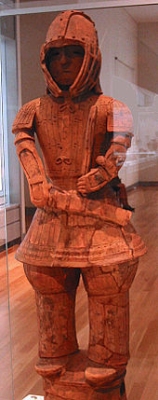
During the Kofun period, a highly aristocratic society with militaristic rulers developed. The cavalry
Cavalry

The Cavalry is the second oldest of the Combat Arms, and as soldiers or warriors who fought mounted on horseback in combat, it represents the mobility and offensive power of the armed forces....
 wore iron armor, carried sword
Sword

A sword is a long, edged piece of metal, used as a cutting, thrusting, and clubbing weapon in many civilizations throughout the world. The word sword comes from the Old English language wikt:sweord, cognate to Old High German swert, Middle Dutch swaert, Old Norse sver? Old Frisian and Old Saxon swerd and Dutch langua...
s and other weapons, and used advanced military methods like those of Northeast Asia. Many of them are represented in Haniwa figurines for funerary purposes.

The most important of the haniwa were found in southern Honshu
Honshu

or Honshu is the largest island of Japan. The nation's main island, it is south of Hokkaido across the Tsugaru Strait, north of Shikoku across the Inland Sea, and northeast of Kyushu across the Kanmon Strait....
—especially the Kinai region
Kansai

The or the lies in the southern-central region of Japan's main island Honshu. The region includes the prefectures of Nara Prefecture, Wakayama Prefecture, Kyoto Prefecture, Osaka Prefecture, Hyogo Prefecture, and Shiga Prefecture....
 around Nara
Nara Prefecture

is a Prefectures of Japan in the Kansai region on Honshu Island, Japan. The capital is the city of Nara, Nara....
—and northern Kyushu
Kyushu

or Kyushu is the third-largest island of Japan and most southwesterly of its Japanese Archipelago. Its alternate ancient names include Kyukoku , Chinzei , and Tsukushi-no-shima ....
.


Discussion
Ask a question about 'Haniwa'
Start a new discussion about 'Haniwa'
Answer questions from other users
Full Discussion Forum


Encyclopedia


The are terra cotta
Terra cotta

Terra cotta, Terracotta or Terra-cotta is a clay-based unglazed ceramic. Its uses include vessels, water & waste water pipes and surface embellishment in building construction, along with sculpture such as the Terracotta Army and Greek terracotta figurines....
 clay figures which were made for ritual use and buried with the dead as funerary objects during the Kofun period
Kofun period

The is an era in the history of Japan from around 250 to 538. The word kofun is Japanese for the type of tumuluss dating from this era. The Kofun period follows the Yayoi period....
 (3rd to 6th century AD) of the history of Japan
History of Japan

The written history of Japan begins with brief references of Twenty-Four Histories, a collection of Chinese historical texts, in the 1st century AD....
.

During the Kofun period, a highly aristocratic society with militaristic rulers developed. The cavalry
Cavalry

The Cavalry is the second oldest of the Combat Arms, and as soldiers or warriors who fought mounted on horseback in combat, it represents the mobility and offensive power of the armed forces....
 wore iron armor, carried sword
Sword

A sword is a long, edged piece of metal, used as a cutting, thrusting, and clubbing weapon in many civilizations throughout the world. The word sword comes from the Old English language wikt:sweord, cognate to Old High German swert, Middle Dutch swaert, Old Norse sver? Old Frisian and Old Saxon swerd and Dutch langua...
s and other weapons, and used advanced military methods like those of Northeast Asia. Many of them are represented in Haniwa figurines for funerary purposes.

The most important of the haniwa were found in southern Honshu
Honshu

or Honshu is the largest island of Japan. The nation's main island, it is south of Hokkaido across the Tsugaru Strait, north of Shikoku across the Inland Sea, and northeast of Kyushu across the Kanmon Strait....
—especially the Kinai region
Kansai

The or the lies in the southern-central region of Japan's main island Honshu. The region includes the prefectures of Nara Prefecture, Wakayama Prefecture, Kyoto Prefecture, Osaka Prefecture, Hyogo Prefecture, and Shiga Prefecture....
 around Nara
Nara Prefecture

is a Prefectures of Japan in the Kansai region on Honshu Island, Japan. The capital is the city of Nara, Nara....
—and northern Kyushu
Kyushu

or Kyushu is the third-largest island of Japan and most southwesterly of its Japanese Archipelago. Its alternate ancient names include Kyukoku , Chinzei , and Tsukushi-no-shima ....
. Haniwa grave offerings were made in numerous forms, such as horses, chickens, birds, fans, fish, houses, weapons, shields, sunshades, pillows, and male and female humans. Besides decorative and spiritual reasons of protecting the deceased in his afterlife, these figures also served as a sort of retaining wall for the burial mound
Tumulus

A tumulus is a mound of Soil and Rock s raised over a Grave or graves. Tumuli are also known as barrows, burial mounds, H?gelgrab or kurgans, and can be found throughout much of the world....
.

Because these haniwa display the contemporary clothing, hairstyle, farming tools, and architecture, these sculptures are important as a historical archive of the Kofun Period.

The origin of Haniwa

The origin of haniwa started during the latter part of the Yayoi Era around the Kibi region. During this time special earthenware figurines and bowls started to appear on top of the tombs of leaders. The early sculptures exceeded 1 meter (3 feet) in length. They consisted of a cylindrical portion which represented the torso, and a skirt-shaped portion at the base, which represented the legs. Many times a special insignia or pattern would be displayed on the torso. Sometimes an obi would be placed around the torso portion of the sculpture. These sculptures are thought to have been used as part of a funeral ritual. Other than the Kibi area, the only other place these sculptures were found was in the Izumo province
Izumo Province

Izumo was an Old provinces of Japan of Japan which today consists of the eastern part of Shimane Prefecture in the Chugoku region.It was one of the regions of ancient Japan where major political powers arose....
.

During the latter part of the 3rd century AD, these sculptures started to appear on top of the imperial grave mounds
Tumulus

A tumulus is a mound of Soil and Rock s raised over a Grave or graves. Tumuli are also known as barrows, burial mounds, H?gelgrab or kurgans, and can be found throughout much of the world....
 in the Kinai region
Kansai

The or the lies in the southern-central region of Japan's main island Honshu. The region includes the prefectures of Nara Prefecture, Wakayama Prefecture, Kyoto Prefecture, Osaka Prefecture, Hyogo Prefecture, and Shiga Prefecture....
. During this time more elaborate haniwa would appear along with earthenware bowls. It is believed that the movement of these sculptures and haniwa from the Kibi region to the Kinai region
Kansai

The or the lies in the southern-central region of Japan's main island Honshu. The region includes the prefectures of Nara Prefecture, Wakayama Prefecture, Kyoto Prefecture, Osaka Prefecture, Hyogo Prefecture, and Shiga Prefecture....
 is indicative of an increase in the importance.

Later development of the Haniwa

During the earlier part of the Kofun period
Kofun period

The is an era in the history of Japan from around 250 to 538. The word kofun is Japanese for the type of tumuluss dating from this era. The Kofun period follows the Yayoi period....
 (latter 3rd century A.D.) the only earthenware haniwa were of the cylindrical variety; however, towards early 4th century AD, shield and other tool-shaped haniwa started to appear. Additionally, during the middle Kofun period
Kofun period

The is an era in the history of Japan from around 250 to 538. The word kofun is Japanese for the type of tumuluss dating from this era. The Kofun period follows the Yayoi period....
 (mid-5th century C.E.) shrine maiden, horse, dog and other animal-shaped haniwa were introduced. As the practice of having ceremonial burial mounds
Tumulus

A tumulus is a mound of Soil and Rock s raised over a Grave or graves. Tumuli are also known as barrows, burial mounds, H?gelgrab or kurgans, and can be found throughout much of the world....
 declined in the mid 6th century C.E., haniwa became rarer in the Kinai region
Kansai

The or the lies in the southern-central region of Japan's main island Honshu. The region includes the prefectures of Nara Prefecture, Wakayama Prefecture, Kyoto Prefecture, Osaka Prefecture, Hyogo Prefecture, and Shiga Prefecture....
; however, the haniwa were still made in abundance in the Kanto region
Kanto region

The is a geographical area of Honshu, the largest island of Japan. The region encompasses seven Prefectures of Japan which overlaps the Greater Tokyo Area: Gunma Prefecture, Tochigi Prefecture, Ibaraki Prefecture, Saitama Prefecture, Tokyo, Chiba Prefecture, and Kanagawa Prefecture....
.

Significance of the Haniwa

Haniwahorse
Originally, the cylindrical type haniwa were set on top of the funeral mounds
Tumulus

A tumulus is a mound of Soil and Rock s raised over a Grave or graves. Tumuli are also known as barrows, burial mounds, H?gelgrab or kurgans, and can be found throughout much of the world....
, so it is believed that they had a purpose in funeral rituals; however, as the haniwa became more developed, they were set towards the outside of the grave area, and it is thought that they were used as boundary markers to mark the borders of the gravesite.

There is a theory that the soul of the deceased would reside in the haniwa, as the earlier haniwa were placed on top of the funeral mounds
Tumulus

A tumulus is a mound of Soil and Rock s raised over a Grave or graves. Tumuli are also known as barrows, burial mounds, H?gelgrab or kurgans, and can be found throughout much of the world....
. There are haniwa that are equipped with weapons and armor, and these are also thought to be containers for souls. The armor and weapons would serve the purpose of driving away evil spirits and protecting the buried ruler from calamity. Because the horse and animal shaped haniwa were normally neatly arranged into a line, it is believed that they were part of a sending-off ceremony.

Haniwa depictions in modern media

In many depictions in modern popular culture, the Haniwa (depicted as containing an actual sentient entity and not just as a empty sculpture) has found root. The most common depiction in these legends portrays the Haniwa in a rounded, pot-like shape, with two deep eyes, a wide mouth, and with two featureless "arms" on opposite sides of the "pot". The Yu-Gi-Oh trading card game has a card that depicts the Haniwa as shown in the picture. The aforementioned "gourd" has appeared in a significant number of anime produced locally in Japan. However, this depiction is not limited to national scope; well known internationally released media, such as video games including The Legend of Zelda
The Legend of Zelda

is a video game designed by Shigeru Miyamoto and developed and published by Nintendo. Set in the fantasy land of Universe of The Legend of Zelda#Hyrule, the plot centers on a boy named Link , the playable protagonist, who aims to rescue Princess Zelda from the primary antagonist, Ganon, by collecting eight fragments of the Universe of The Legend o...
, Final Fantasy
Final Fantasy

is a media franchise created by Hironobu Sakaguchi and owned by Square Enix that includes video games, motion pictures, and other merchandise. The series began in 1987 as an Final Fantasy console role-playing game video game developer by Square Co., spawning a video game series that became the central focus of the franchise....
, Kirby
Kirby

Kirby is a common place name, surname, and given name, derived from Old Norse, meaning church settlement. Other common uses include. Also the name Kirby is sweet and used often in family rituals where babies get named....
 and Animal Crossing series also contain this depiction. It should be noted that in these examples, with the exception of Animal Crossing, these depictions portray Haniwa as primarily malevolent, without expanding significantly upon the origins of the subject.