


Thai art

Encyclopedia
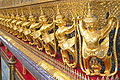
Buddhist art
Buddhist art originated on the Indian subcontinent following the historical life of Siddhartha Gautama, 6th to 5th century BC, and thereafter evolved by contact with other cultures as it spread throughout Asia and the world....
. Traditional Thai sculpture
Sculpture
Sculpture is three-dimensional artwork created by shaping or combining hard materials—typically stone such as marble—or metal, glass, or wood. Softer materials can also be used, such as clay, textiles, plastics, polymers and softer metals...
almost exclusively depicts images of the Buddha. Traditional Thai painting
Painting
Painting is the practice of applying paint, pigment, color or other medium to a surface . The application of the medium is commonly applied to the base with a brush but other objects can be used. In art, the term painting describes both the act and the result of the action. However, painting is...
s usually consist of book illustrations, and painted ornamentation of buildings such as palace
Palace
A palace is a grand residence, especially a royal residence or the home of a head of state or some other high-ranking dignitary, such as a bishop or archbishop. The word itself is derived from the Latin name Palātium, for Palatine Hill, one of the seven hills in Rome. In many parts of Europe, the...
s and temple
Temple
A temple is a structure reserved for religious or spiritual activities, such as prayer and sacrifice, or analogous rites. A templum constituted a sacred precinct as defined by a priest, or augur. It has the same root as the word "template," a plan in preparation of the building that was marked out...
s.
Painting
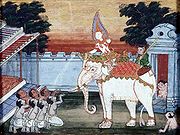
Dimension
In physics and mathematics, the dimension of a space or object is informally defined as the minimum number of coordinates needed to specify any point within it. Thus a line has a dimension of one because only one coordinate is needed to specify a point on it...
s without perspective
Perspective (graphical)
Perspective in the graphic arts, such as drawing, is an approximate representation, on a flat surface , of an image as it is seen by the eye...
. The size of each element in the picture reflected its degree of importance. The primary technique of composition
Composition (visual arts)
In the visual arts – in particular painting, graphic design, photography and sculpture – composition is the placement or arrangement of visual elements or ingredients in a work of art or a photograph, as distinct from the subject of a work...
is that of apportioning areas: the main elements are isolated from each other by space transformers. This eliminated the intermediate ground, which would otherwise imply perspective. Perspective was introduced only as a result of Western
Western world
The Western world, also known as the West and the Occident , is a term referring to the countries of Western Europe , the countries of the Americas, as well all countries of Northern and Central Europe, Australia and New Zealand...
influence in the mid-19th century.
The most frequent narrative subjects for paintings were or are: the Jataka
Jataka
The Jātakas refer to a voluminous body of literature native to India concerning the previous births of the Buddha....
stories, episodes from the life of the Buddha
Gautama Buddha
Siddhārtha Gautama was a spiritual teacher from the Indian subcontinent, on whose teachings Buddhism was founded. In most Buddhist traditions, he is regarded as the Supreme Buddha Siddhārtha Gautama (Sanskrit: सिद्धार्थ गौतम; Pali: Siddhattha Gotama) was a spiritual teacher from the Indian...
, the Buddhist heavens
Heavens
Heavens was an independent rock band featuring Matt Skiba of Alkaline Trio and Josiah Steinbrick. The duo signed to Epitaph Records and released their debut album, Patent Pending, on September 12, 2006....
and hell
Hell
In many religious traditions, a hell is a place of suffering and punishment in the afterlife. Religions with a linear divine history often depict hells as endless. Religions with a cyclic history often depict a hell as an intermediary period between incarnations...
s, and scenes of daily life.
Dvaravati period
The DvaravatiDvaravati
The Dvaravati period lasted from the 6th to the 13th centuries. Dvaravati refers to both a culture and a disparate conglomerate of principalities.- History :...
period lasted from the 6th until the 13th century. A number of temples and sculptures have survived from that period.
Lanna period
The Kingdom of LannaLanna
The Kingdom of Lanna was a kingdom centered in present-day northern Thailand from the 13th to 18th centuries. The cultural development of the people of Lanna, the Tai Yuan people, had begun long before as successive Tai Yuan kingdoms preceded Lanna...
was a state in what is now northern Thailand from the 13th to 18th centuries.
Sukhothai period
The Sukhothai period began in the 14th century in the Sukhothai kingdomSukhothai kingdom
The Sukhothai Kingdom ) was an early kingdom in the area around the city Sukhothai, in north central Thailand. The Kingdom existed from 1238 till 1438...
. Buddha images of the Sukhothai period are elegant, with sinuous bodies and slender, oval face
Face
The face is a central sense organ complex, for those animals that have one, normally on the ventral surface of the head, and can, depending on the definition in the human case, include the hair, forehead, eyebrow, eyelashes, eyes, nose, ears, cheeks, mouth, lips, philtrum, temple, teeth, skin, and...
s. This style emphasized the spiritual aspect of the Buddha, by omitting many small anatomical
Anatomy
Anatomy is a branch of biology and medicine that is the consideration of the structure of living things. It is a general term that includes human anatomy, animal anatomy , and plant anatomy...
details. The effect was enhanced by the common practice of casting images in metal
Metal
A metal , is an element, compound, or alloy that is a good conductor of both electricity and heat. Metals are usually malleable and shiny, that is they reflect most of incident light...
rather than carving them. This period saw the introduction of the "walking Buddha" pose.
Sukhothai artists tried to follow the canonical defining marks of a Buddha, as they are set out in ancient Pali
Páli
- External links :* *...
texts:
- SkinHuman skinThe human skin is the outer covering of the body. In humans, it is the largest organ of the integumentary system. The skin has multiple layers of ectodermal tissue and guards the underlying muscles, bones, ligaments and internal organs. Human skin is similar to that of most other mammals,...
so smooth that dust cannot stick to it - LegHuman legThe human leg is the entire lower extremity or limb of the human body, including the foot, thigh and even the hip or gluteal region; however, the precise definition in human anatomy refers only to the section of the lower limb extending from the knee to the ankle.Legs are used for standing,...
s like a deer - ThighThighIn humans the thigh is the area between the pelvis and the knee. Anatomically, it is part of the lower limb.The single bone in the thigh is called the femur...
s like a banyan tree - ShoulderShoulderThe human shoulder is made up of three bones: the clavicle , the scapula , and the humerus as well as associated muscles, ligaments and tendons. The articulations between the bones of the shoulder make up the shoulder joints. The major joint of the shoulder is the glenohumeral joint, which...
s as massive as an elephant's head - ArmArmIn human anatomy, the arm is the part of the upper limb between the shoulder and the elbow joints. In other animals, the term arm can also be used for analogous structures, such as one of the paired forelimbs of a four-legged animal or the arms of cephalopods...
s round like an elephant's trunk, and long enough to touch the knees - HandHandA hand is a prehensile, multi-fingered extremity located at the end of an arm or forelimb of primates such as humans, chimpanzees, monkeys, and lemurs...
s like lotuses about to bloom - Fingertips turned back like petals
- headHuman headIn human anatomy, the head is the upper portion of the human body. It supports the face and is maintained by the skull, which itself encloses the brain.-Cultural importance:...
like an egg - HairHairHair is a filamentous biomaterial, that grows from follicles found in the dermis. Found exclusively in mammals, hair is one of the defining characteristics of the mammalian class....
like scorpion stingers - ChinChinIn the human anatomy, the chin is the lowermost part of the face.It is formed by the lower front of the mandible.People show a wide variety of chin structures. See Cleft chin....
like a mango stone - NoseHuman noseThe visible part of the human nose is the protruding part of the face that bears the nostrils. The shape of the nose is determined by the ethmoid bone and the nasal septum, which consists mostly of cartilage and which separates the nostrils...
like a parrot's beak - EarlobeEarlobeThe human earlobe is composed of tough areolar and adipose connective tissues, lacking the firmness and elasticity of the rest of the pinna. Since the earlobe does not contain cartilage it has a large blood supply and may help to warm the ears and maintain balance. However earlobes are not...
s lengthened by the earrings of royalty - EyelashEyelashAn eyelash or simply lash is one of the hairs that grow at the edge of the eyelid. Eyelashes protect the eye from debris and perform some of the same function as whiskers do on a cat or a mouse in the sense that they are sensitive to being touched, thus providing a warning that an object is near...
es like a cow's - EyebrowEyebrowThe eyebrow is an area of thick, delicate hairs above the eye that follows the shape of the lower margin of the brow ridges of some mammals. Their main function is to prevent sweat, water, and other debris from falling down into the eye socket, but they are also important to human communication and...
s like drawn bows
Sukhothai also produced a large quantity of glaze
Ceramic glaze
Glaze is a layer or coating of a vitreous substance which has been fired to fuse to a ceramic object to color, decorate, strengthen or waterproof it.-Use:...
d ceramic
Ceramic
A ceramic is an inorganic, nonmetallic solid prepared by the action of heat and subsequent cooling. Ceramic materials may have a crystalline or partly crystalline structure, or may be amorphous...
s in the Sawankhalok style, which were traded throughout south-east Asia.
Ayutthaya period
The surviving art from this period was primarily executed in stone, characterised by juxtaposed rows of Buddha figures. In the middle period, Sukhothai influence dominated, with large bronzeBronze
Bronze is a metal alloy consisting primarily of copper, usually with tin as the main additive. It is hard and brittle, and it was particularly significant in antiquity, so much so that the Bronze Age was named after the metal...
or brick
Brick
A brick is a block of ceramic material used in masonry construction, usually laid using various kinds of mortar. It has been regarded as one of the longest lasting and strongest building materials used throughout history.-History:...
and stucco
Stucco
Stucco or render is a material made of an aggregate, a binder, and water. Stucco is applied wet and hardens to a very dense solid. It is used as decorative coating for walls and ceilings and as a sculptural and artistic material in architecture...
Buddha images, as well as decorations of gold leaf
Gold leaf
right|thumb|250px|[[Burnishing]] gold leaf with an [[agate]] stone tool, during the water gilding processGold leaf is gold that has been hammered into extremely thin sheets and is often used for gilding. Gold leaf is available in a wide variety of karats and shades...
in free-form designs on a lacquer
Lacquer
In a general sense, lacquer is a somewhat imprecise term for a clear or coloured varnish that dries by solvent evaporation and often a curing process as well that produces a hard, durable finish, in any sheen level from ultra matte to high gloss and that can be further polished as required...
background. The late period was more elaborate, with Buddha images in royal attire, set on decorative bases.
Bangkok period
This period is characterized by the further development of the Ayutthaya style, rather than by more great innovation. One important element was the Krom Chang Sip Mu (Organization of the Ten Crafts), originally founded in AyutthayaAyutthaya kingdom
Ayutthaya was a Siamese kingdom that existed from 1350 to 1767. Ayutthaya was friendly towards foreign traders, including the Chinese, Vietnamese , Indians, Japanese and Persians, and later the Portuguese, Spanish, Dutch and French, permitting them to set up villages outside the walls of the...
, which was responsible for improving the skills of the country's craftsmen. Paintings from the mid-19th century show the influence of Western art.
External links
- Rama IX Art Museum Virtual museum of Thai contemporary artists. Listings of museums, galleries, exhibitions and venues. Contains lots of information on Thai artists and art activities.
- Golden Triangle Art Introduction of contemporary art and artists living and working in Northern Thailand and Myanmar. Guide to art galleries, art News and exhibitions with focus on Chiang Mai.
- Thai Art Gallery