


Sailendra

Encyclopedia
Indonesia
Indonesia , officially the Republic of Indonesia , is a country in Southeast Asia and Oceania. Indonesia is an archipelago comprising approximately 13,000 islands. It has 33 provinces with over 238 million people, and is the world's fourth most populous country. Indonesia is a republic, with an...
n dynasty that emerged in 8th century Java
Java
Java is an island of Indonesia. With a population of 135 million , it is the world's most populous island, and one of the most densely populated regions in the world. It is home to 60% of Indonesia's population. The Indonesian capital city, Jakarta, is in west Java...
.
The Sailendras were active promoters of Mahayana Buddhism and covered the Kedu Plain
Kedu Plain
Kedu Plain is the fertile volcanic plain that lies between the volcanoes Mount Sumbing and Mount Sundoro to the west, and Mount Merbabu and Mount Merapi to the east on Central Java, Indonesia. The plain also bordering the Menoreh hills in the southwest and Prambanan Plain in the southeast...
of Central Java
Central Java
Central Java is a province of Indonesia. The administrative capital is Semarang. It is one of six provinces on the island of Java.This province is the province of high Human Development in Indonesia and its Points Development Index countries is equivalent to Lebanon. The province of Central Java...
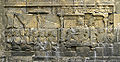
with Buddhist monuments, including the world famous Borobudur
Borobudur
Borobudur, or Barabudur, is a 9th-century Mahayana Buddhist monument near Magelang, Central Java, Indonesia. The monument comprises six square platforms topped by three circular platforms, and is decorated with 2,672 relief panels and 504 Buddha statues...
.
The Sailendras are considered to be a Thalassocracy
Thalassocracy
The term thalassocracy refers to a state with primarily maritime realms—an empire at sea, such as Athens or the Phoenician network of merchant cities...
and rule the maritime Southeast Asia, however they also rely of agriculture pursuit through intensive rice cultivation on Kedu Plain Central Java. The dynasty appeared to be the ruling family of both Medang Kingdom of Central Java for some period and Srivijaya
Srivijaya
Srivijaya was a powerful ancient thalassocratic Malay empire based on the island of Sumatra, modern day Indonesia, which influenced much of Southeast Asia. The earliest solid proof of its existence dates from the 7th century; a Chinese monk, I-Tsing, wrote that he visited Srivijaya in 671 for 6...
in Sumatra.
Primary sources
The earliest dated inscription in Indonesia in which the dynastic name Sailendra appears is the Kalasan inscriptionKalasan inscription
The Kalasan inscription is an inscription dated 700 Saka , discovered in Kalasan village, Sleman Regency, Yogyakarta, Indonesia. The inscription was written in Sanskrit with Pranagari script .-Contents:...
(778) of central Java, which commemorates the establishment of a Buddhist shrine for the Buddhist goddess Tara.
The name also appears in several other inscriptions like the Kelurak inscription
Kelurak inscription
The Kelurak inscription is an inscription dated 704 Saka , written in Sanskrit with Pranagari script, discovered near Lumbung temple in Kelurak village, located not far north of Prambanan temple, Central Java, Indonesia...
(782) and the Karangtengah inscription
Karangtengah inscription
Karangtengah inscription is the inscriptions written on five pieces of stones dated 746 Saka or 824 CE, discovered in Karangtengah hamlet, Temanggung Regency, Central Java, Indonesia. The inscription was written in ancient Javanese script in two languages; Old Javanese and Sanskrit...
(824). Outside Indonesia, the name Sailendra is to be found in the Ligor inscription (775) on the Malay peninsula and Nalanda inscription
Nalanda inscription
The Nalanda inscription is an inscription located Nalanda, Bihar, India, dated 860. The inscription mentioned about king Devapaladeva of Bengala had granted the request of Sri Maharaja of Suvarnadvipa, Balaputra, to build a Buddhist monastery near Bodh Gaya...
(860).
Origins
Although the rise of the Sailendra's occurred in Kedu PlainKedu Plain
Kedu Plain is the fertile volcanic plain that lies between the volcanoes Mount Sumbing and Mount Sundoro to the west, and Mount Merbabu and Mount Merapi to the east on Central Java, Indonesia. The plain also bordering the Menoreh hills in the southwest and Prambanan Plain in the southeast...
in the Javanese heartland, their origin has been the subject of discussion. Apart from Java itself; an earlier homeland in Sumatra, India or Cambodia has been suggested.
India
According to Majumdar; an Indian scholar, Sailendra dynasty that established themself in Indonesian archipleago, either the one that ruled SrivijayaSrivijaya
Srivijaya was a powerful ancient thalassocratic Malay empire based on the island of Sumatra, modern day Indonesia, which influenced much of Southeast Asia. The earliest solid proof of its existence dates from the 7th century; a Chinese monk, I-Tsing, wrote that he visited Srivijaya in 671 for 6...
or the ruler of Medang (Java) was originated from Kalinga (Southern India). This opinion also shared by Nilakanta Sastri and Moens. Moens further describes; Sailendra was originated in India and established themself in Palembang before the arrival of Dapunta Hiyang. In 683, Sailendra family moved to Java because being pushed by Dapunta Hiyang and his troops.
Cambodia
In 1934, the French scholar Coedes proposed a relation with the Funan kingdom in CambodiaCambodia
Cambodia , officially known as the Kingdom of Cambodia, is a country located in the southern portion of the Indochina Peninsula in Southeast Asia...
. Coedes believed that the Funanese rulers used similar sounding 'mountainlord' titles, but several Cambodia specialists have discounted this. They hold there is no historical evidence for such titles in the Funan period.
Sumatra
Other scholars hold that the Buddhist kingdom of SrivijayaSrivijaya
Srivijaya was a powerful ancient thalassocratic Malay empire based on the island of Sumatra, modern day Indonesia, which influenced much of Southeast Asia. The earliest solid proof of its existence dates from the 7th century; a Chinese monk, I-Tsing, wrote that he visited Srivijaya in 671 for 6...
was involved in the rise of the dynasty in Java. Supporters of this connection emphasize the shared Mahayana patronage; the intermarriages and the Ligor inscription. Also the fact that some of Sailendra's inscriptions were written in old Malay
Old Malay
The Old Malay language, also called Classical Malay, is the ancestor of the modern Malay language, including Indonesian and Malaysian. It developed in the now Melayu Kingdom of Sumatra. It was heavily influenced by Sanskrit and Kawi , and was grammatically quite similar to modern Malay.-Old...
, which suggested Srivijaya or Sumatran connections.
Java
Another theory suggested that Sailendra was a native Javanese dynasty, and Sanjaya dynastySanjaya Dynasty
The Sañjaya Dynasty was an ancient Javanese dynasty that ruled the Mataram kingdom in Java during first millennium CE. The dynasty was an active promoter of Hinduism in ancient Java.-Origin and formation:...
was actually a branch of Sailendra, since Sri Sanjaya
Sri Sanjaya
King Sri Sanjaya was the founder of Mataram Kingdom and also the Sanjaya Dynasty during the eighth century. His name was revealed in the AD 732 Sanskrit inscription carved in stone found at the foot of Ukir hill on the southern Kedu Plain in Central Java...
and his offsprings belongs to Sailendra family that initially the Shivaist ruler of Mataram Kingdom
Mataram Kingdom
The Medang or Mataram Kingdom was a Hindu-Buddhist kingdom that flourished between the 8th and 10th centuries CE. It was based in Central Java, and later in East Java. Established by King Sanjaya, the founder of the Sanjaya dynasty, the kingdom was ruled by the Sailendra and Sanjaya families...
. The association of Sailendra with Mahayana Buddhism began after the conversion Panaraban or Panangkaran to Buddhism. This theory based on Carita Parahyangan
Carita Parahyangan
Carita Parahyangan is a text contained in a single manuscript, registered as kropak 406 from the former collection of the Bataviaasch Genootschap voor Kunsten en Wetenschappen , now in the Perpustakaan National in Jakarta...
that mention about the ailing King Sanjaya ordered his son, Rakai Panaraban or Panangkaran, to convert to buddhism, because their Shivaistic faith was feared by the people, and in favour to the more pacifist buddhist faith.
Sailendras in Java

Srivijaya
Srivijaya was a powerful ancient thalassocratic Malay empire based on the island of Sumatra, modern day Indonesia, which influenced much of Southeast Asia. The earliest solid proof of its existence dates from the 7th century; a Chinese monk, I-Tsing, wrote that he visited Srivijaya in 671 for 6...
kingdom in Sumatra. For instance, Samaratungga
Samaratungga
Samaratungga was the head of the Sailendra dynasty who ruled Central Java and Srivijaya in the 8th and the 9th century. He was the successor of King Indra, and his name was mentioned in Karangtengah inscription dated 824 CE as the constructor of a sacred buddhist building called Venuvana to place...
married Dewi Tara, a daughter of Srivijayan maharaja Dharmasetu
Dharmasetu
Dharmasetu was an 8th century maharaja of Srivijaya. Under his reign, he successfully incorporated Pan Pan, a kingdom located in the north of the Malay Peninsula into Srivijayan sphere of influence before 775 AD....
. The mutual alliance between the two kingdoms ensured that Srivijaya had no need to fear the emergence of a Javanese rival and that the Sailendra had access to the international market.
Karangtengah inscription dated 824 mentioned about king Samaratungga. His daughter named Pramodhawardhani has inaugurated a Jinalaya, a sacred buddhist sanctuary. The inscription also mentioned a sacred buddhist building called Venuvana to place the cremated ashes of King Indra. The Tri Tepusan inscription
Tri Tepusan inscription
The Tri Tepusan inscription is an inscription discovered in Kedu Plain, Temanggung Regency, Central Java, Indonesia, dated from 842 CE. This inscription is linked with Borobudur buddhist monument.-Contents:...
dated 842 mentioned about the sima (tax free) lands awarded by Çrī Kahulunan (Pramodhawardhani, daughter of Samaratungga) to ensure the funding and maintenance of a Kamūlān called Bhūmisambhāra. Kamūlān itself from the word mula which means 'the place of origin', a sacred building to honor the ancestors. These findings suggested that either the ancestors of the Sailendras were originated from Central Java, or as the sign that Sailendra have established their holds on Java. Casparis suggested that Bhūmi Sambhāra Bhudhāra which in Sanskrit
Sanskrit
Sanskrit , is a historical Indo-Aryan language and the primary liturgical language of Hinduism, Jainism and Buddhism.Buddhism: besides Pali, see Buddhist Hybrid Sanskrit Today, it is listed as one of the 22 scheduled languages of India and is an official language of the state of Uttarakhand...
means "The mountain of combined virtues of the ten stages of Boddhisattvahood", was the original name of Borobudur
Borobudur
Borobudur, or Barabudur, is a 9th-century Mahayana Buddhist monument near Magelang, Central Java, Indonesia. The monument comprises six square platforms topped by three circular platforms, and is decorated with 2,672 relief panels and 504 Buddha statues...
.
The received version holds that the Sailendra dynasty existed next to the Sanjaya dynasty
Sanjaya Dynasty
The Sañjaya Dynasty was an ancient Javanese dynasty that ruled the Mataram kingdom in Java during first millennium CE. The dynasty was an active promoter of Hinduism in ancient Java.-Origin and formation:...
in Java. Much of the period was characterized by peaceful co-existence and cooperation but towards the middle of the 9th century relations had deteriorated. Around 852 the Sanjaya ruler Pikatan had defeated Balaputra, the offspring of the Sailendra monarch Samaratunga and princess Tara. This ended the Sailendra presence in Java and Balaputra retreated to the Srivijaya kingdom in Sumatra, where he became the paramount ruler.
Sailendras in Sumatra
After 824, there are no more references to the Sailendra house in the Javanese ephigraphic record. Around 860 the name re-appears in the Nalanda inscriptionNalanda inscription
The Nalanda inscription is an inscription located Nalanda, Bihar, India, dated 860. The inscription mentioned about king Devapaladeva of Bengala had granted the request of Sri Maharaja of Suvarnadvipa, Balaputra, to build a Buddhist monastery near Bodh Gaya...
in India. According to the text, the king Devapaladeva of Bengala (Pala Empire
Pala Empire
The Pāla Empire was one of the major middle kingdoms of India existed from 750–1174 CE. It was ruled by a Buddhist dynasty from Bengal in the eastern region of the Indian subcontinent, all the rulers bearing names ending with the suffix Pala , which means protector. The Palas were often described...
) had granted 'Balaputra, the king of Suvarna-dvipa' (Sumatra) the revenues of 5 villages to a Buddhist monastery near Bodh Gaya. Balaputra was styled a descendant from the Sailendra dynasty and grandson of the king of Java.
From Sumatra, the Sailendras also maintained overseas relations with the Chola kingdom in Southern India, as shown by several south Indian inscriptions. An 11th century inscription mentioned the grant of revenues to a local Buddhist sanctuary, built in 1005 by the king of the Srivijaya. In spite the relations were initially fairly cordial, hostilities had broken out in 1025. Nevertheless, amity was re-established between the two states, before the end of the 11th century. In 1090 a new charter was granted to the old Buddhist sanctuary (it is the last known inscription with a reference to the Sailendras).
Sailendras in Bali
Sri Kesari WarmadewaSri Kesari Warmadewa
Sri Kesari Warmadewa was the first king of Bali to leave a written inscription. He authored the inscription on the 914 CE Belanjong pillar in southern Sanur. The inscription It is written in both the Indian Sanskrit language and Old Balinese language, using two script, the Nagari script and the...
was said to be a Buddhist king of the Sailendra Dynasty, leading a military expedition, to establishing a Mahayana
Mahayana
Mahāyāna is one of the two main existing branches of Buddhism and a term for classification of Buddhist philosophies and practice...
Buddhist government in Bali. In 914, he left a record of his endeavour in the Belanjong pillar
Belanjong pillar
The Belanjong pillar, also Blanjong pillar , is a pillar established in 914 CE in the harbour of Belangong, in the southern area of Sanur in Bali....
in Sanur in Bali.