
All Topics  
Art in Ancient Greece

 
Art in Ancient Greece

   Email Print
   Bookmark   Link


Art in Ancient Greece


The arts of ancient Greece has exercised an enormous influence on the culture of many countries from ancient times until the present, particularly in the areas of sculpture
Sculpture

Sculpture is Three-dimensional space artwork created by shaping or combining hard and or plastic material, sound, and or text and or light, commonly Stone sculpture , metal, glass, or wood....
 and architecture
Architecture

The term architecture can refer to a process, a profession or documentation.As a process, architecture is the activity of designing and construction buildings and other physical structures by a person or a computer, primarily to provide shelter....
. In the West, the art of the Roman Empire
Roman Empire

The Roman Empire was the Roman Republic phase of the Ancient Rome, characterised by an autocracy form of government and large territorial holdings in Europe and around the Mediterranean....
 was largely derived from Greek models. In the East, Alexander the Great
Alexander the Great

Alexander the Great , also known as Alexander III of Macedon was an ancient Greeks King of Macedon . He was one of the most successful military commanders of all time and is presumed undefeated in battle....
's conquests initiated several centuries of exchange between Greek, Central Asian and India
India

India, officially the Republic of India , is a country in South Asia. It is the List of countries and outlying territories by total area country by geographical area, the List of countries by population country, and the most populous liberal democracy in the world....
n cultures, resulting in Greco-Buddhist art
Greco-Buddhist art

Greco-Buddhist art is the artistic manifestation of Greco-Buddhism, a cultural syncretism between the Classical Greek culture and Buddhism, which developed over a period of close to 1000 years in Central Asia, between the conquests of Alexander the Great in the 4th century BCE, and the Islamic conquests of the 7th century CE....
, with ramifications as far as Japan
Japan

Japan is an island country in East Asia. Located in the Pacific Ocean, it lies to the east of the Sea of Japan, People's Republic of China, North Korea, South Korea and Russia, stretching from the Sea of Okhotsk in the north to the East China Sea and Taiwan in the south....
.


Discussion
Ask a question about 'Art in Ancient Greece'
Start a new discussion about 'Art in Ancient Greece'
Answer questions from other users
Full Discussion Forum


Recent Posts


Encyclopedia


The arts of ancient Greece has exercised an enormous influence on the culture of many countries from ancient times until the present, particularly in the areas of sculpture
Sculpture

Sculpture is Three-dimensional space artwork created by shaping or combining hard and or plastic material, sound, and or text and or light, commonly Stone sculpture , metal, glass, or wood....
 and architecture
Architecture

The term architecture can refer to a process, a profession or documentation.As a process, architecture is the activity of designing and construction buildings and other physical structures by a person or a computer, primarily to provide shelter....
. In the West, the art of the Roman Empire
Roman Empire

The Roman Empire was the Roman Republic phase of the Ancient Rome, characterised by an autocracy form of government and large territorial holdings in Europe and around the Mediterranean....
 was largely derived from Greek models. In the East, Alexander the Great
Alexander the Great

Alexander the Great , also known as Alexander III of Macedon was an ancient Greeks King of Macedon . He was one of the most successful military commanders of all time and is presumed undefeated in battle....
's conquests initiated several centuries of exchange between Greek, Central Asian and India
India

India, officially the Republic of India , is a country in South Asia. It is the List of countries and outlying territories by total area country by geographical area, the List of countries by population country, and the most populous liberal democracy in the world....
n cultures, resulting in Greco-Buddhist art
Greco-Buddhist art

Greco-Buddhist art is the artistic manifestation of Greco-Buddhism, a cultural syncretism between the Classical Greek culture and Buddhism, which developed over a period of close to 1000 years in Central Asia, between the conquests of Alexander the Great in the 4th century BCE, and the Islamic conquests of the 7th century CE....
, with ramifications as far as Japan
Japan

Japan is an island country in East Asia. Located in the Pacific Ocean, it lies to the east of the Sea of Japan, People's Republic of China, North Korea, South Korea and Russia, stretching from the Sea of Okhotsk in the north to the East China Sea and Taiwan in the south....
. Following the Renaissance
Renaissance

The Renaissance was a cultural movement that spanned roughly the 14th to the 17th century, beginning in Italy in the late Middle Ages and later spreading to the rest of Europe....
 in Europe, the humanist
Humanism

Humanism is a broad category of ethics that affirm the dignity and worth of all people, based on the ability to determine right and wrong by appealing to universal human qualities, particularly rationalism, without resorting to the supernatural or alleged divine authority from religious texts....
 aesthetic and the high technical standards of Greek art inspired generations of European artists. Well into the 19th century, the classical tradition derived from Greece dominated the art of the western world.

The art of Ancient Greece is usually divided stylistically into four periods: the Geometric, Archaic, Classical, and Hellenistic. As noted above, the Geometric age is usually dated from about 1000 BC, although in reality little is known about art in Greece during the preceding 200 years (traditionally known as the Dark Ages
Greek Dark Ages

The Greek Dark Ages refers to Greek history from the presumed Dorian invasion and end of the Mycenaean civilization in the 12th century BC, to the first Ancient Greece poleiss in the 9th century BC....
), the period of the 7th century BC witnessed the slow development of the Archaic style as exemplified by the black-figure style of vase painting. The onset of the Persian Wars (480 BC to 448 BC) is usually taken as the dividing line between the Archaic and the Classical periods, and the reign of Alexander the Great
Alexander the Great

Alexander the Great , also known as Alexander III of Macedon was an ancient Greeks King of Macedon . He was one of the most successful military commanders of all time and is presumed undefeated in battle....
 (336 BC to 323 BC) is taken as separating the Classical from the Hellenistic periods.

In reality, there was no sharp transition from one period to another. Forms of art developed at different speeds in different parts of the Greek world, and as in any age some artists worked in more innovative styles than others. Strong local traditions, conservative in character, and the requirements of local cults, enable historians to locate the origins even of displaced works of art.

Survivals

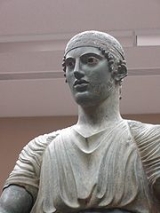
Charioteer of Delphi   Detail of Head
Ancient Greek art has survived most successfully in the forms of sculpture and architecture, as well as in such minor arts as coin
Coin

A coin is a piece of hard material, usually metal or a metallic material, usually in the shape of a Disk , and most often issued by a government....
 design, pottery
Pottery

Pottery is the ceramic ware made by potters. Major types of pottery include earthenware, stoneware, and porcelain. The places where such wares are made are called potteries....
 and gem
Gemstone

A gemstone or gem, also called a precious or semi-precious stone, is a piece of attractive mineral, which — when cut and polished — is used to make jewellery or other adornments....
 engraving. From the Archaic period a great deal of painted pottery survives, but these remnants give a misleading impression of the range of Greek artistic expression. The Greeks, like most European cultures, regarded painting as the highest form of art. The painter Polygnotus
Polygnotus

Polygnotus was an ancient Greek painter from the middle of the 5th century BC, son of Aglaophon. He was a native of Thasos, but was adopted by the Athenians, and admitted to their citizenship....
 of Thasos
Thasos

Thasos or Thassos is a Greece island in the northern Aegean Sea, close to the coast of Western Thrace and the plain of the river Mesta River but geographically part of Macedonia ....
, who worked in the mid 5th century BC, was regarded by later Greeks in much the same way that people today regard Leonardo
Leonardo da Vinci

Leonardo di ser Piero da Vinci was an Italy polymath, being a scientist, mathematician, engineer, inventor, anatomist, Painting, sculptor, architect, botanist, musician and writer....
 or Michelangelo
Michelangelo

Michelangelo di Lodovico Buonarroti Simoni , commonly known as Michelangelo, was an Italian Renaissance Painting, sculptor, architect, poet, and engineer....
, and his works were still being admired 600 years after his death. Today none survive, even as copies.

Even in the fields of sculpture and architecture, only a fragment of the total output of Greek artists survives. Many sculptures of pagan gods were destroyed during the early Christian era. When marble
Marble

Marble is a nonfoliated metamorphic rock resulting from the metamorphism of limestone, composed mostly of calcite . It is extensively used for Marble sculpture, as a architecture material, and in many other applications....
 is burned, lime is produced, and that was the unfortunate fate of the great bulk of Greek marble statuary during the Middle Ages
Middle Ages

File:Karl 1 mit papst gelasius gregor1 sacramentar v karl d kahlen.jpgThe Middle Ages of European history are a period in history which lasted for roughly a millennium, commonly dated from the fall of the Roman Empire in the 5th century to the beginning of the Early Modern Period in the 16th century, marked by the division of Western Christi...
. Likewise, the acute shortage of metal during the Middle Ages led to the majority of Greek bronze
Bronze

Bronze is a metal alloy consisting primarily of copper, usually with tin as the main additive, but sometimes with other chemical element such as phosphorus, manganese, aluminium, or silicon....
 statues being melted down. Those statues which survived did so primarily because they were buried and forgotten, or in the case of bronzes, lost in the sea.

The great majority of Greek buildings have not survived: they were either pillaged in war, looted for building materials or destroyed in Greece's many earthquakes. Much was systematically destroyed in the fourth and fifth centuries by fanatical Christians who resented the pagan associations of many buildings and shrines. Only a handful of temple
Temple

A temple is a structure reserved for religious or spiritual activities, such as prayer and sacrifice, or analogous rites. A ??templum?? constituted a sacred precinct as defined by a priest, or augur....
s, such as the Parthenon
Parthenon

The Parthenon is a Greek temple of the Greek gods Athena, built in the 5th century BC on the Acropolis of Athens. It is the most important surviving building of Classical Greece, generally considered to be the culmination of the development of the Doric order....
 and the Temple of Hephaestus
Temple of Hephaestus

The Temple of Hephaestus and Athena Ergane , also known as the Hephaisteion or Theseion , is the best preserved ancient Greek temple....
 in Athens
Athens

Athens , the Capital and largest city of Greece, dominates the Attica periphery; as one of the List of cities by time of continuous habitation, its recorded history spans around 3,400 years....
, have been spared. Of the five Wonders of the World created by Greeks (the Statue of Zeus at Olympia
Statue of Zeus at Olympia

The Statue of Zeus at Olympia was one of the Seven Wonders of the Ancient World. It was made by the Greek sculptor of the Classical Greece, Phidias, circa 432 BC on the site where it was erected in the temple of Zeus, Olympia, Greece....
, the Temple of Artemis
Temple of Artemis

The Temple of Artemis , also known less precisely as Temple of Diana , was a Greek temple dedicated to Artemis completed? in its most famous phase? around 550 BC at Ephesus under the Achaemenid Empire of the Persian Empire....
 at Ephesus
Ephesus

Ephesus was an ancient Greek city on the west coast of Anatolia, in the region known as Ionia during the period known as Classical Greece. It was one of the twelve cities of the Ionian League....
, the Colossus of Rhodes
Colossus of Rhodes

The Colossus of Rhodes was a statue of the Greek god Helios, erected on the Greece island of Rhodes by Chares of Lindos between 292 and 280 BC....
, the Mausoleum of Halicarnassus and the Lighthouse of Alexandria
Lighthouse of Alexandria

The Lighthouse of Alexandria was a tower built in the 3rd century BC on the island of Pharos in Alexandria, Egypt to serve as that port's landmark, and later, its lighthouse....
), only fragments survive.

From the Archaic period of Greek art, painted pottery and sculpture are almost the only forms of art which have survived in any quantity. Only very few examples of painting have survived from this period. Although coins were invented in the mid 7th century BC, they were not common in most of Greece until the 5th century.

The Greeks believed that “Man is the measure of all things” and sought to recognize this in every statue to capture the natural essence of humanity.

Pottery

See main article: Pottery of ancient Greece
Pottery of Ancient Greece

Thanks to its relative durability, pottery is a large part of the archaeological record of Ancient Greece, and because we have so much of it it has exerted a disproportionately large influence on our understanding of Greek society....


The Ancient Greeks made pottery for everyday use, not for display; the trophies won at games, such as the Panathenaic Amphorae
Panathenaic Amphorae

Panathenaic amphorae were the large ceramic vessels that contained the oil given as prizes in the Panathenaic Games. This olive oil came from the sacred grove of Athena at Akademia, the amphorae which held it had the distinctive form of tight handles, narrow neck and feet and decorated in a standard form using the black figure technique, a...
 (wine decanters), are the exception. Most surviving pottery consists of drinking vessels such as amphora
Amphora

An amphora is a type of ceramic vase with two handles and a long neck narrower than the body. The word amphora is Latin, derived from the Greek language amphoreus , an abbreviation of amphiphoreus , a compound word combining amphi- plus phoreus , from pherein , referring to the vessel's two carrying handles on opp...
e, krater
Krater

A krater was a vase used to mix wine and water. At a Greek symposium, kraters were placed in the center of the room. They were quite large, so they were not easily portable when filled....
s (bowls for mixing wine and water), hydria
Hydria

A hydria is a type of Pottery of Ancient Greece used for carrying water. The hydria has three handles. Two horizontal handles on either side of the body of the pot were used for lifting and carrying the pot....
 (water jars), libation bowls, jugs and cups. Painted funeral urns have also been found. Miniatures were also produced in large numbers, mainly for use as offerings at temples. In the Hellenistic period a wider range of pottery was produced, but most of it is of little artistic importance.

At the end of the Geometric phased, the Orientalizing phase of vase painting, saw the abstract geometric designs replaced by the more rounded, realistic forms of Eastern motifs, such as the lotus, palmette, lion, and sphinx. Ornament increased in amount and intricacy.

In earlier periods even quite small Greek cities produced pottery for their own locale. These varied widely in style and standards. Distinctive pottery that ranks as art was produced on some of the Aegean
Aegean Sea

The Aegean Sea is an elongated embayment of the Mediterranean Sea located between the southern Balkans and Anatolian peninsulas, i.e., between the mainlands of Greece and Turkey respectively....
 islands, in Crete
Crete

Crete is the largest of the Greek islands and the List of islands in the Mediterranean largest island in the Mediterranean Sea at 8,336 km? ....
, and in the wealthy Greek colonies of southern Italy and Sicily
Magna Graecia

Magna Graecia is the name of the area in Southern Italy and Sicily that was Colonies in antiquity#Greek colonies by Greek settlers in the eighth century BC, who brought with them the lasting imprint of their Hellenic civilization....
. By the later Archaic and early Classical period, however, the two great commercial powers, Corinth
Corinth

Corinth, or Korinth Corinth is now the capital of the Prefectures of Greece of Corinthia. The city is surrounded by the coastal townlets of Lechaio, Isthmia, Kechries, and the inland townlets of Examilia and the archaeological site....
 and Athens
Athens

Athens , the Capital and largest city of Greece, dominates the Attica periphery; as one of the List of cities by time of continuous habitation, its recorded history spans around 3,400 years....
, came to dominate. Their pottery was exported all over the Greek world, driving out the local varieties. Pots from Corinth and Athens are found as far afield as Spain
Spain

Spain or the Kingdom of Spain , is a country located in Southern Europe on the Iberian Peninsula.The Spanish constitution does not establish any official denomination of the country, even though Espa?a , Estado espa?ol and Naci?n espa?ola are used interchangeably....
 and Ukraine
Ukraine

Ukraine is a country in Eastern Europe. It is bordered by Russia to the east; Belarus to the north; Poland, Slovakia, and Hungary to the west; Romania and Moldova to the southwest; and the Black Sea and Sea of Azov to the south....
, and are so common in Italy
Italy

Italy , officially the Italian Republic , is a country located on the Italian Peninsula in Southern Europe and on the two largest islands in the Mediterranean Sea, Sicily and Sardinia....
 that they were first collected in the 18th century as "Etruscan vases". Many of these pots are mass-produced products of low quality. In fact, by the 5th century BC, pottery had become an industry and pottery painting ceased to be an important art form.

The history of Ancient Greek pottery is divided stylistically into periods:

  • the Protogeometric from about 1050 BC;
  • the Geometric from about 900 BC;
  • the Late Geometric or Archaic from about 750 BC;
  • the Black Figure from the early 7th century BC;
  • and the Red Figure from about 530 BC.


The range of colours which could be used on pots was restricted by the technology of firing: black, white, red, and yellow were the most common. In the three earlier periods, the pots were left their natural light colour, and were decorated with slip that turned black in the kiln.

The fully mature black-figure technique
Black-figure pottery

The black-figure pottery technique is a style of ancient Pottery of Ancient Greece painting in which the decoration appears as black silhouettes on a red background....
, with added red and white details and incising for outlines and details, originated in Corinth
Corinth

Corinth, or Korinth Corinth is now the capital of the Prefectures of Greece of Corinthia. The city is surrounded by the coastal townlets of Lechaio, Isthmia, Kechries, and the inland townlets of Examilia and the archaeological site....
 during the early 7th century BC and was introduced into Attica about a generation later; it flourished until the end of the 6th century BC. The red-figure technique
Red-figure pottery

Red-figure vase painting is one of the most important styles of figural Pottery of ancient Greece. It developed in Athens around 530 BC and remained in use until the late 3rd century BC....
, invented in about 530 BC, reversed this tradition, with the pots being painted black and the figures painted in red. Red-figure vases slowly replaced the black-figure style. Sometimes larger vessels were engraved as well as painted.

During the Protogeometric and Geometric periods, Greek pottery was decorated with abstract designs. In later periods, as the aesthetic shifted and the technical proficiency of potters improved, decorations took the form of human figures, usually representing the gods or the heroes of Greek history and mythology. Battle and hunting scenes were also popular, since they allowed the depiction of the horse, which the Greeks held in high esteem. In later periods erotic themes, both heterosexual and male homosexual, became common.

Greek pottery is frequently signed, sometimes by the potter or the master of the pottery, but only occasionally by the painter. Hundreds of painters are, however, identifiable by their artistic personalities: where their signatures haven't survived they are named for their subject choices, as "the Achilles Painter
Achilles Painter

The Achilles Painter, working from the 460s to the 420s BC, is the pseudonym of an ancient Attic Ancient Greece vase-painter of outstanding quality , whose refined figure of Achilles on a Red-figure pottery amphora of ca....
", by the potter they worked for, such as the Late Archaic "Kleophrades Painter
Kleophrades Painter

The "Kleophrades Painter" is the name given to an anonymous ancient Athenian vase painter flourishing between about 505 BCE and 475 BCE, whose work is considered to be amongst the finest of the red figure style....
", or even by their modern locations, such as the Late Archaic "Berlin Painter
Berlin Painter

The Berlin Painter is the conventional name given to an Attica Ancient Greece vase-painter who is widely regarded as a rival to the Kleophrades Painter among the most talented vase painters of the early 5th century BCE ....
".


Metal vessels

Especially during the Geometric and Archaic phases, the production of large metal vessels was an important expression of Greek creativity, and an important stage in the development of bronzeworking techniques, such as casting and repousse hammering. Early sanctuaries, especially Olympia
Olympia, Greece

Olympia , a sanctuary of ancient Greece in Elis, is known for having been the site of the Olympic Games in classical times, comparable in importance to the Pythian Games held in Delphi....
, yielded many hundreds of such vessels, deposited as votives. During the orientalising period, such tripods were frequently decorated with figural protome
Protome

Protome is an adornment on utensils or works of art in the form of a frontal view of an animal head or bust of a human. Protomes are often featured on ancient artefacts discovered in archaeological excavations....
s, in the shape of griffin
Griffin

The griffin is a fantasy creature with the body of a lion and the head and often wings of an eagle. As the lion was traditionally considered the king of the beasts and the eagle the king of the birds, the griffin was thought to be an especially powerful and majestic creature....
s, sphinx
Sphinx

A sphinx is a zoomorphic mythological figure which is depicted as a recumbent lion with a human head. It has its origins in sculpted figures of Old Kingdom Ancient Egypt, to which the ancient Greeks applied their own name for a female monster, the "strangler", an archaic figure of Greek mythology....
es and other fantastic creatures. Although large metal vessels became less important during the Archaic and Classical periods, their production did not cease entirely. The Vix crater
Vix Grave

The area around the village of Vix, C?te-d'Or in northern Burgundy, France is the site of an important prehistory complex from the Celts Late Hallstatt culture and Early La T?ne culture periods, comprising an important fortified settlement and several tumulus....
 is a famous example dating to circa 530 BC.

Figurines


Terracotta figurines

Bell Idol Louvre Ca 573
Clay is a material frequently used for the making of votive statuettes or idols, since well before Minoan civilization until the Hellenistic era and beyond. During the 8th century BC., in Boeotia, one finds manufactured "Bell Idols", female statuettes with mobile legs: the head, small compared to the remainder of the body, is perched at the end of a long neck, while the body is very full, in the shape of bell. At the beginning of 8th century BC., tombs known as "hero's" receive hundreds, even thousands of small figurines, with rudimentary figuration, generally representing characters with the raised arms, i.e. gods in apotheosis.

In later periods the terracotta figurines lose their religious nature, representing from then on characters from everyday life. With 4th and 3rd centuries BC., a type known as Tanagra figurine
Tanagra figurine

The Tanagra figurines were a mold-cast type of Greek terracotta figurines produced from the later fourth century BCE, primarily in the Boeotian town of Tanagra....
s shows a refined art. Tanagra figurines often preserve extensive traces of surface paint. At the same time, cities like Alexandria
Alexandria

Alexandria , with a population of 4.1 million, is the second-largest city in Egypt, and is the country's largest seaport, serving about 80% of Egypt's imports and exports....
, Smyrna
Smyrna

Smyrna is an ancient city in Izmir in Turkey. Located at a central and strategic point on the Aegean Sea coast of Anatolia and aided by its advantageous port conditions, its ease of defence and its good inland connections, Smyrna rose to prominence before the Classical Era....
 or Tarsus
Tarsus

Tarsus may refer to:*Tarsus , the skeletal region between the tibia and fibula and the metatarsus*Tarsus *The final segment of an arthropod leg...
 produced an abundance of grotesque figurines, representing individuals with deformed members, eyes bulging and contorting themselves. Such figurines were also made from bronze.

For painted architectural terracottas, see below, under "painting
Art in Ancient Greece

The arts of ancient Greece has exercised an enormous influence on the culture of many countries from ancient times until the present, particularly in the areas of sculpture and architecture....
"...

Metal figurines

Figurines made of metal, primarily bronze, are an extremely common find at early Greek sanctuaries like Olympia
Olympia, Greece

Olympia , a sanctuary of ancient Greece in Elis, is known for having been the site of the Olympic Games in classical times, comparable in importance to the Pythian Games held in Delphi....
, where thousands of such objects, mostly depicting animals, have been found. They are usually produced in the lost wax technique and can be considered the initials stage in the development of Greek bronze sculpture. The most common motifs during the Geometric period were horses and deer, but dogs, cattle and other animals are also depicted. Human figures occur occasionally. The production of small metal votives continued throughout Greek antiquity. In the Classical and Hellenistic periods, more elaborate bronze statuettes, closely connected with monumental sculpture, also became common.

Monumental Sculpture

Those who practiced the visual arts, including sculpture, were held in low regard in ancient Greece, viewed as mere manual labourers. Plutarch
Plutarch

Lucius Mestrius Plutarchus , c. AD 46 ? 120 ? commonly known in English as Plutarch ? was a Ancient Rome historian , biographer, essayist, and Middle Platonism....
 (Life of Pericles, II) said "we admire the work of art but despise the maker of it"; this was a common view in the ancient world. Ancient Greek art today is often categorised in three epochs: "Archaic", "Classical" and "Hellenic".

Materials, forms

Ancient Greek sculptures were mostly made of two types of material. Stone, especially marble
Marble

Marble is a nonfoliated metamorphic rock resulting from the metamorphism of limestone, composed mostly of calcite . It is extensively used for Marble sculpture, as a architecture material, and in many other applications....
 or other high-quality limestones was used most frequently and carved by hand with metal tools. Stone sculptures could be free-standing fully carved in the round (statues), or only partially carved relief
Relief

A relief is a sculptured artwork where a modelled form is raised, or in sunken-relief lowered, from a flatish background plane without being disconnected from it....
s still attached to a background plaque, for example in architectural frieze
Frieze

In architecture the frieze is the wide central section part of an entablature and may be plain or?in the Ionic order or Corinthian order?decorated with bas-reliefs....
s or grave stelai
Stele

A stele is a stone or wooden slab, generally taller than it is wide, erected for funerals or commemorative purposes, most usually decorated with the names and titles of the deceased or living ? inscribed, carved in relief , or painted onto the slab....
.

Bronze statues were of higher status, but have survived in far smaller numbers, due to the reusability of metals. They were usually made in the lost wax technique. Chryselephantine
Chryselephantine

Chryselephantine is the technical term given to a type of cult statue that enjoyed high status in Ancient Greece.Chryselephantine statues were built around a wooden frame, with thin carved slabs of ivory attached, representing the flesh, and sheets of gold leaf representing the garments, armour, hair, and other details....
, or gold-and-ivory, statues often adorned temples and were regarded as the highest form of sculpture, but virtually none have survived.

Terracotta was occasionally employed, for large statuary. Few examples of this survived, at least partially due to the fragility of such statues. The best known exception to this is a statue of Zeus
Zeus

Zeus in Greek mythology is the king of the gods, the ruler of Mount Olympus and the god of the sky father and List of thunder gods. His symbols are the thunderbolt, eagle, bull , and oak....
 carrying Ganymede
Ganymede (mythology)

In Greek mythology, Ganymede, or Ganymedes is a divine hero whose homeland was the Troad. He was a Troy prince, son of the eponym Tros of Dardania, and of Callirrhoe , and brother of Ilus and Assaracus....
 found at Olympia
Olympia, Greece

Olympia , a sanctuary of ancient Greece in Elis, is known for having been the site of the Olympic Games in classical times, comparable in importance to the Pythian Games held in Delphi....
, executed around 470 BC. In this case, the terracotta is painted.

Archaic

Ac
Sculpture is by far the most important surviving form of Ancient Greek art, although only a small fragment of Greek sculptural output has survived. Greek sculpture, often in the form of Roman copies, was immensely influential during the Italian Renaissance
Italian Renaissance

The Italian Renaissance began the opening phase of the Renaissance, a period of great cultural change and achievement in Europe that spanned the period from the end of the 13th century to about 1600, marking the transition between Medieval and Early Modern Europe....
, and remained the "classic" model for European sculpture until the advent of modernism
Modernism

Modernism, in its broadest definition, is modern thought, character, or practice. More specifically, the term describes both a set of cultural tendencies and an array of associated cultural movements, originally arising from wide-scale and far-reaching changes to Western culture in the late nineteenth and early twentieth century....
 in the late 19th century time period.

Inspired by the monumental stone sculpture of Egypt
Egypt

Egypt is a country mainly in North Africa, with the Sinai Peninsula forming a land bridge in Western Asia. Covering an area of about , Egypt borders the Mediterranean Sea to the north, the Gaza Strip and Israel to the northeast, the Red Sea to the east, Sudan to the south and Libya to the west....
 and Mesopotamia
Mesopotamia

Mesopotamia is the area of the Tigris-Euphrates river system, along the Tigris and Euphrates rivers, largely corresponding to modern Iraq, as well as some parts of northeastern Syria, some parts of southeastern Turkey, and some parts of the Khuzestan Province of southwestern Iran....
, during the Archaic period the Greeks began again to carve in stone. Free-standing figures share the solidity and frontal stance characteristic of Eastern models, but their forms are more dynamic than those of Egyptian sculpture, as for example the Lady of Auxerre
Lady of Auxerre

The small limestone Crete sculpture called the Lady of Auxerre, , at the Louvre Museum in Paris depicts an Archaic period in Greece Greek goddess of c....
 and Torso of Hera (Early Archaic period, c. 660-580 bc, both in the Louvre, Paris). After about 575 BC, figures, such as these, both male and female, wore the so-called archaic smile. This expression, which has no specific appropriateness to the person or situation depicted, may have been a device to give the figures a distinctive human characteristic.

Three types of figures prevailed—the standing nude youth (kouros), the standing draped girl (kore), and the seated woman. All emphasize and generalize the essential features of the human figure and show an increasingly accurate comprehension of human anatomy. The youths were either sepulchral or votive statues. Examples are Apollo (Metropolitan Museum of Art, New York), an early work; the Strangford Apollo
Strangford Apollo

The Strangford Apollo is an Ancient Greek sculpture kouros sculpture in marble of around 500 BC-490 BC. It is said to be from the island of Anafi, and is named after Percy Smythe, 6th Viscount Strangford, who once owned it....
 from Anafi
Anafi

Anafi is a Greece island Communities and Municipalities of Greece in the Cyclades. In 2001, it had a population of 273 inhabitants. Its land area is 40.370 km?....
 (British Museum, London), a much later work; and the Anavyssos Kouros (National Archaeological Museum of Athens
National Archaeological Museum of Athens

The National Archaeological Museum of Athens in Athens houses some of the most important artifacts from a variety of archaeological locations around Greece from prehistory to late antiquity....
). More of the musculature and skeletal structure is visible in this statue than in earlier works. The standing, draped girls have a wide range of expression, as in the sculptures in the Acropolis Museum of Athens. Their drapery is carved and painted with the delicacy and meticulousness common in the details of sculpture of this period.

The Greeks thus decided very early on that the human form was the most important subject for artistic endeavour. Seeing their gods as having human form, there was no distinction between the sacred and the secular in art—the human body was both secular and sacred. A male nude could just as easily be Apollo
Apollo

In Greek mythology and Roman mythology, Apollo , is one of the most important and many-sided of the Twelve Olympians. The ideal of the kouros , Apollo has been variously recognized as a god of light and the sun; truth and prophecy; archery; medicine and healing; music, poetry, and the arts; and more....
 or Heracles
Heracles

In Greek mythology, Heracles or Herakles meaning "glory of Hera", or "Glorious through Hera" Alcides or Alcaeus " was a hero, the son of Zeus and Alcmene, foster son of Amphitryon and great-grandson of Perseus....
 as that year's Olympic boxing champion. In the Archaic Period the most important sculptural form was the kouros
Kouros

A kouros is the modern term given to those representations of male youths which first appear in the Archaic period in Greece. The term kouros, meaning youth, was first proposed for what were previously thought to be depictions of Apollo by V....
 (plural kouroi), the standing male nude (See for example Biton and Kleobis
Kleobis and Biton

Kleobis and Biton is the name of two human brothers in Greek mythology. It is also the name conventionally given to a pair of lifesize Archaic Greek statues, or kouros, which are now in the Delphi Archaeological Museum, at Delphi Greece....
). The kore
Kore (sculpture)

Kore is the name given to a type of ancient Greek sculpture of the Archaic period in Greece.There are multiple theories on who they represent, and as to whether they represent mortals or deities - one theory is that they represent Persephone the daughter in the triad of the Mother Goddess cults or votary figures to attend the maiden godde...
 (plural korai), or standing clothed female figure, was also common, but since Greek society did not permit the public display of female nudity until the 4th century BC, the kore is considered to be of less importance in the development of sculpture.

As with pottery, the Greeks did not produce sculpture merely for artistic display. Statues were commissioned either by aristocratic individuals or by the state, and used for public memorials, as offerings to temples, oracle
Oracle

An oracle is a person or agency considered to be a source of wise counsel or prophecy opinion; an infallible authority, usually Spirituality in nature....
s and sanctuaries (as is frequently shown by inscriptions on the statues), or as markers for graves. Statues in the Archaic period were not all intended to represent specific individuals. They were depictions of an ideal — beauty, piety, honor or sacrifice. These were always depictions of young men, ranging in age from adolescence to early maturity, even when placed on the graves of (presumably) elderly citizens. Kouroi were all stylistically similar. Graduations in the social stature of the person commissioning the statue were indicated by size rather than artistic innovations.


Classical


In the Classical period there was a revolution in Greek statuary, usually associated with the introduction of democracy
Athenian democracy

Athenian democracy developed in the Ancient Greece city-state of Classical Athens, comprising the central city-state of Athens and the surrounding territory of Attica, around 500 BC....
 and the end of the aristocratic culture associated with the kouroi. The Classical period saw changes in the style and function of sculpture. Poses became more naturalistic (see the Charioteer of Delphi
Charioteer of Delphi

The Charioteer of Delphi, also known as Heniokhos , is one of the best-known statues surviving from Ancient Greece, and is considered one of the finest examples of ancient bronze statues....
 for an example of the transition to more naturalistic sculpture), and the technical skill of Greek sculptors in depicting the human form in a variety of poses greatly increased. From about 500 BC statues began to depict real people. The statues of Harmodius and Aristogeiton
Harmodius and Aristogeiton (sculpture)

A sculpture of the tyrannicides Harmodius and Aristogeiton is well-known in the ancient world from two major versions and Roman copies....
 set up in Athens to mark the overthrow of the tyranny
Tyrant

This article is about the political ruler. For other uses see Tyrant and Tyranny In modern usage, a tyrant is a single ruler holding absolute political power over a state or within an organization....
 were said to be the first public monuments to actual people.

At the same time sculpture and statues were put to wider uses. The great temples of the Classical era such as the Parthenon
Parthenon

The Parthenon is a Greek temple of the Greek gods Athena, built in the 5th century BC on the Acropolis of Athens. It is the most important surviving building of Classical Greece, generally considered to be the culmination of the development of the Doric order....
 in Athens, and the Temple of Zeus
Temple of Zeus

The Temple of Zeus at Olympia, built in 470-456 BCE, was the ancient Greek temple in Olympia, Greece, dedicated to the chief of the gods, Zeus....
 at Olympia, required relief sculpture for decorative frieze
Frieze

In architecture the frieze is the wide central section part of an entablature and may be plain or?in the Ionic order or Corinthian order?decorated with bas-reliefs....
s, and sculpture in the round to fill the triangular fields of the pediment
Pediment

A pediment is a classical architecture element consisting of the triangular section found above the horizontal structure , typically supported by columns....
s. The difficult aesthetic and technical challenge stimulated much in the way of sculptural innovation. Unfortunately these works survive only in fragments, the most famous of which are the Parthenon Marbles
Elgin Marbles

The Elgin Marbles, also known as the Parthenon Marbles, are a collection of classical Greek marble sculptures, inscriptions and architectural members that originally belonged to the Parthenon and other buildings on the Acropolis of Athens....
, half of which are in the British Museum
British Museum

The British Museum is a museum of human history and culture situated in London. Its collections, which number more than 7 million Object , are amongst the largest and most comprehensive in the world and originate from all continents, illustrating and documenting the story of human culture from its beginning to the present....
.

Funeral statuary evolved during this period from the rigid and impersonal kouros of the Archaic period to the highly personal family groups of the Classical period. These monuments are commonly found in the suburbs of Athens, which in ancient times were cemeteries on the outskirts of the city. Although some of them depict "ideal" types — the mourning mother, the dutiful son — they increasingly depicted real people, typically showing the departed taking his dignified leave from his family. They are among the most intimate and affecting remains of the Ancient Greeks.

In the Classical period for the first time we know the names of individual sculptors. Phidias
Phidias

Phidias or Pheidias; ; circa 480 BC 430 BC), was a Hellenic civilization sculptor, painter and architect, who lived in the Classical Greece, in the 5th century BC, and is commonly regarded as one of the greatest of all Classical sculptors....
 oversaw the design and building of the Parthenon
Parthenon

The Parthenon is a Greek temple of the Greek gods Athena, built in the 5th century BC on the Acropolis of Athens. It is the most important surviving building of Classical Greece, generally considered to be the culmination of the development of the Doric order....
. Praxiteles
Praxiteles

Praxiteles of Athens, the son of Cephisodotus the Elder, was the most renowned of the Attica sculptors of the 4th century BC. He was the first to sculpt the nude Woman in a life-size statue....
 made the female nude respectable for the first time in the Late Classical period (mid 4th century): his Aphrodite of Knidos
Aphrodite of Knidos

The Aphrodite of Cnidus was one of the most famous works of the ancient Greece Sculpture Praxiteles of Classical Athens . It and its copies are often referred to as the Venus Pudica type, on account of her covering her groin with her right hand....
, which survives in copies, was said by Pliny
Pliny the Elder

Gaius Plinius Secundus , better known as Pliny the Elder, was an ancient author, naturalist or natural philosopher and naval and military commander of some importance who wrote Natural History ....
 to be the greatest statue in the world.

The greatest works of the Classical period, the Statue of Zeus at Olympia
Statue of Zeus at Olympia

The Statue of Zeus at Olympia was one of the Seven Wonders of the Ancient World. It was made by the Greek sculptor of the Classical Greece, Phidias, circa 432 BC on the site where it was erected in the temple of Zeus, Olympia, Greece....
 and the Statue of Athena Parthenos (both chryselephantine
Chryselephantine

Chryselephantine is the technical term given to a type of cult statue that enjoyed high status in Ancient Greece.Chryselephantine statues were built around a wooden frame, with thin carved slabs of ivory attached, representing the flesh, and sheets of gold leaf representing the garments, armour, hair, and other details....
 and executed by Phidias or under his direction), are lost, although smaller copies (in other materials) and good descriptions of both still exist. Their size and magnificence prompted emperors to seize them in the Byzantine
Byzantine Empire

Byzantine Empire and Eastern Roman Empire are conventional names used to describe the Roman Empire during the Middle Ages, centered on its capital of Constantinople....
 period, and both were removed to Constantinople
Constantinople

Constantinople was the empire capital of the Roman Empire , the Byzantine Empire , the Latin Empire , and the Ottoman Empire . Strategically located between the Golden Horn and the Sea of Marmara at the point where Europe meets Asia, Byzantine Constantinople had been the capital of a Christendom empire, successor to ancient ancient Greece...
, where they were later destroyed in fire


Hellenistic

The transition from the Classical to the Hellenistic period occurred during the 4th century BC. Following the conquests of Alexander the Great
Alexander the Great

Alexander the Great , also known as Alexander III of Macedon was an ancient Greeks King of Macedon . He was one of the most successful military commanders of all time and is presumed undefeated in battle....
 (336 BC to 323 BC), Greek culture spread as far as India
India

India, officially the Republic of India , is a country in South Asia. It is the List of countries and outlying territories by total area country by geographical area, the List of countries by population country, and the most populous liberal democracy in the world....
, as revealed by the excavations of Ai-Khanoum
Ai-Khanoum

Ai-Khanoum or Ay Khanum , was founded in the 4th century BCE, following the conquests of Alexander the Great and was one of the primary cities of the Greco-Bactrian kingdom....
 in eastern Afghanistan
Afghanistan

Afghanistan , officially the Islamic republic of Afghanistan, is a landlocked country that is located approximately in the center of Asia....
, and the civilization of the Greco-Bactrians and the Indo-Greeks. Greco-Buddhist art
Greco-Buddhist art

Greco-Buddhist art is the artistic manifestation of Greco-Buddhism, a cultural syncretism between the Classical Greek culture and Buddhism, which developed over a period of close to 1000 years in Central Asia, between the conquests of Alexander the Great in the 4th century BCE, and the Islamic conquests of the 7th century CE....
 represented a syncretism between Greek art and the visual expression of Buddhism.

Gandharadonorfrieze2
Thus Greek art became more diverse and more influenced by the cultures of the peoples drawn into the Greek orbit. In the view of some art historians, it also declined in quality and originality; this, however, is a subjective judgement which artists and art-lovers of the time would not have shared. Indeed, many sculptures previously considered as classical masterpieces have turned out to be of the Hellenistic age. Also, the technical ability of the Hellenistic sculptors are clearly in evidence in such major works as the Winged Victory of Samothrace
Winged Victory of Samothrace

The Winged Victory of Samothrace, also called the Nike of Samothrace, is a third century B.C. marble Marble sculpture of the Greek mythology goddess Nike ....
, and the Pergamon Altar
Pergamon Altar

The Great Altar of Pergamon, a massive stone podium about one hundred feet long and thirty-five feet high, was originally built in the 2nd century BCE in the Ancient Greece city of Pergamon in north-western Anatolia, 25.74 kilometers from the Aegean Sea....
. New centres of Greek culture, particularly in sculpture, developed in Alexandria
Alexandria

Alexandria , with a population of 4.1 million, is the second-largest city in Egypt, and is the country's largest seaport, serving about 80% of Egypt's imports and exports....
, Antioch
Antioch

Antioch on the Orontes was an ancient city on the eastern side of the Orontes River. It is near the modern city of Antakya, Turkey.Founded near the end of the 4th century BC by Seleucus I Nicator, one of Alexander the Great's generals, Antioch eventually rivaled Alexandria as the chief city of the nearer East and was a cradle of gentile hi...
, Pergamum, and other cities. By the 2nd century the rising power of Rome
Ancient Rome

Ancient Rome was a civilization that grew out of a small agricultural community founded on the Italian Peninsula as early as the 10th century BC....
 had also absorbed much of the Greek tradition — and an increasing proportion of its products as well.

During this period sculpture became more and more naturalistic. Common people, women, children, animals and domestic scenes became acceptable subjects for sculpture, which was commissioned by wealthy families for the adornment of their homes and gardens. Realistic portraits of men and women of all ages were produced, and sculptors no longer felt obliged to depict people as ideals of beauty or physical perfection. At the same time, the new Hellenistic cities springing up all over Egypt
Egypt

Egypt is a country mainly in North Africa, with the Sinai Peninsula forming a land bridge in Western Asia. Covering an area of about , Egypt borders the Mediterranean Sea to the north, the Gaza Strip and Israel to the northeast, the Red Sea to the east, Sudan to the south and Libya to the west....
, Syria
Syria

Syria , officially the Syrian Arab Republic , is an Arab-majority country in Southwest Asia, bordering Lebanon and the Mediterranean Sea to the west, Israel to the southwest, Jordan to the south, Iraq to the east, and Turkey to the north....
, and Anatolia
Anatolia

Anatolia or Asia Minor is a region of Western Asia, comprising most of the modern Republic of Turkey. It is a geographic region bounded by the Black Sea to the north, the Caucasus to the northeast, the Aegean Sea to the west, the Mediterranean Sea to the south, and the Iranian plateau to the east and southeast....
 required statues depicting the gods and heroes of Greece for their temples and public places. This made sculpture, like pottery, an industry, with the consequent standardisation and some lowering of quality. For these reasons many more Hellenistic statues have survived than is the case with the Classical period.

Some of the best known Hellenistic sculptures are the Winged Victory of Samothrace
Winged Victory of Samothrace

The Winged Victory of Samothrace, also called the Nike of Samothrace, is a third century B.C. marble Marble sculpture of the Greek mythology goddess Nike ....
 (2nd or 1st century BC), the statue of Aphrodite
Aphrodite

Aphrodite is the classical Greek mythology goddess of love, sex, and beauty. According to Greek oral poet Hesiod, she was born when Uranus was castrated by his son Cronus....
 from the island of Melos known as the Venus de Milo
Venus de Milo

Aphrodite of Milos , better known as the Venus de Milo, is an Ancient Greece statue and one of the most famous works of Sculpture of Ancient Greece....
 (mid 2nd century BC), the Dying Gaul
Dying Gaul

The Dying Gaul is an ancient Ancient Rome marble copy of a lost Hellenistic sculpture that is thought to have been executed in bronze, which was commissioned some time between 230 BC and 220 BC by Attalos I of Pergamon to celebrate his victory over the Celtic Galatians in Anatolia....
 (about 230 BC), and the monumental group Laocoön and His Sons
Laocoön and his Sons

The statue of Laoco?n and His Sons, also called the Laoco?n Group, is a monumental marble sculpture now in the Vatican Museums, Rome....
 (late 1st century BC). All these statues depict Classical themes, but their treatment is far more sensuous and emotional than the austere taste of the Classical period would have allowed or its technical skills permitted.

Discoveries made since the end of the 19th century surrounding the (now submerged) ancient Egypt
Ancient Egypt

Ancient Egypt was an Ancient history civilization in eastern North Africa, concentrated along the lower reaches of the Nile in what is now the modern nation of Egypt....
ian city of Heracleum include a 4th century BC, unusually sensual, detailed and feministic (as opposed to deified) depiction of Isis
ISIS

ISIS is an industry standard interface for technologies, developed by Pixel Translations in 1990 .ISIS is an open standard for scanner control and a complete image-processing framework....
, marking a combination of Egyptian and Hellenistic forms beginning around the time of Egypt's conquest by Alexander the Great
Alexander the Great

Alexander the Great , also known as Alexander III of Macedon was an ancient Greeks King of Macedon . He was one of the most successful military commanders of all time and is presumed undefeated in battle....
.

Hellenistic sculpture was also marked by an increase in scale, which culminated in the Colossus of Rhodes
Colossus of Rhodes

The Colossus of Rhodes was a statue of the Greek god Helios, erected on the Greece island of Rhodes by Chares of Lindos between 292 and 280 BC....
 (late 3rd century), which was the same size as the Statue of Liberty
Statue of Liberty

The Statue of Liberty , or, more formally, Liberty Enlightening the World , was presented to the United States by the people of France in 1886....
. The combined effect of earthquakes and looting have destroyed this as well as other very large works of this period.


Architecture


See also: Greek temple
Greek temple

Greek temples were structures built to house deity statues within Greek sanctuaries in Greek paganism. The temples themselves did usually not directly serve a cult purpose, since the sacrifices and rituals dedicated to the respective deity took place outside them....


Architecture (building executed to an aesthetically considered design) was extinct in Greece from the end of the Mycenaean
Mycenaean Greece

Mycenaean Greece is a cultural period of ancient Greece taking its name from the archaeological site of Mycenae in northeastern Argolis, in the Peloponnese of southern Greece....
 period (about 1200 BC) until the 7th century, when urban life and prosperity recovered to a point where public building could be undertaken. But since most Greek buildings in the Archaic and Early Classical periods were made of wood or mud-brick, nothing remains of them except a few ground-plans, and there are almost no written sources on early architecture or descriptions of buildings. Most of our knowledge of Greek architecture comes from the few surviving buildings of the Classical, Hellenistic and Roman periods (since Roman architecture heavily copied Greek), and from late written sources such as Vitruvius
Vitruvius

File:Vitruvius.jpgMarcus Vitruvius Pollio was a Ancient Rome writer, architect and engineer , active in the 1st century BC. By his own description Vitruvius served as a Ballista , the third class of arms in the military offices....
 (1st century AD). This means that there is a strong bias towards temples, the only buildings which survive in any number.

The standard format of Greek public buildings is well known from surviving examples such as the Parthenon
Parthenon

The Parthenon is a Greek temple of the Greek gods Athena, built in the 5th century BC on the Acropolis of Athens. It is the most important surviving building of Classical Greece, generally considered to be the culmination of the development of the Doric order....
, and even more so from Roman buildings built partly on the Greek model, such as the Pantheon
Pantheon, Rome

The Pantheon is a building in Rome which was originally built as a temple to all the gods of Ancient Rome, and rebuilt circa 126 AD during Hadrian's reign....
 in Rome. The building was usually either a cube or a rectangle made from limestone
Limestone

File:Limestone Formation In Waitomo.jpgLimestone is a sedimentary rock composed largely of the mineral calcite . The deposition of limestone strata is often a by-product and indicator of biological activity in the geology record....
, of which Greece has an abundance, and which was cut into large blocks and dressed. Marble was an expensive building material in Greece: high quality marble came only from Mt Pentelus in Attica
Attica

Attica is a Peripheries of Greece in Greece, containing Athens, the capital of Greece. Attica is subdivided into the prefectures of Greece of Athens Prefecture, Piraeus Prefecture, East Attica and West Attica....
 and from a few islands such as Paros
Paros

Paros is an island of Greece in the central Aegean Sea. One of the Cyclades island group, it lies to the west of Naxos , from which it is separated by a channel about wide....
, and its transportation in large blocks was difficult. It was used mainly for sculptural decoration, not structurally, except in the very grandest buildings of the Classical period such as the Parthenon
Parthenon

The Parthenon is a Greek temple of the Greek gods Athena, built in the 5th century BC on the Acropolis of Athens. It is the most important surviving building of Classical Greece, generally considered to be the culmination of the development of the Doric order....
.

There were two main styles (or "orders") of Greek architecture, the Doric
Doric order

The Doric order was one of the Classical order of Architecture of Ancient Greece or classical architecture; the other two canonical orders were the Ionic order and the Corinthian order....
 and the Ionic
Ionic order

The Ionic order column forms one of the Classical order of classical architecture, the other two canonic orders being the Doric order and the Corinthian order....
. These names were used by the Greeks themselves, and reflected their belief that the styles descended from the Dorian and Ionian Greeks of the Dark Ages, but this is unlikely to be true. The Doric style was used in mainland Greece and spread from there to the Greek colonies in Italy
Italy

Italy , officially the Italian Republic , is a country located on the Italian Peninsula in Southern Europe and on the two largest islands in the Mediterranean Sea, Sicily and Sardinia....
. The Ionic style was used in the cities of Ionia (now the west coast of Turkey
Turkey

Turkey , known officially as the Republic of Turkey , is a Eurasian country that stretches across the Anatolian peninsula in southwest Asia and Thrace in the Balkans region of Southern Europe....
) and some of the Aegean islands. The Doric style was more formal and austere, the Ionic more relaxed and decorative. The more ornate Corinthian
Corinthian order

The Corinthian order is one of the Classical orders of Greece and Rome architecture, characterized by a slender Fluting column and an ornate capital decorated with acanthus leaves and scrolls....
 style was a later development of the Ionic. These styles are best known through the three orders of column capitals, but there are differences in most points of design and decoration between the orders. See the separate article on Classical orders.

Most of the best known surviving Greek buildings, such as the Parthenon
Parthenon

The Parthenon is a Greek temple of the Greek gods Athena, built in the 5th century BC on the Acropolis of Athens. It is the most important surviving building of Classical Greece, generally considered to be the culmination of the development of the Doric order....
 and the Temple of Hephaestus
Temple of Hephaestus

The Temple of Hephaestus and Athena Ergane , also known as the Hephaisteion or Theseion , is the best preserved ancient Greek temple....
 in Athens, are Doric. The Erechtheum
Erechtheum

The Erechtheum is an ancient Greek temple on the north side of the Acropolis, Athens of Athens in Greece....
, next to the Parthenon, however, is Ionic. The Ionic order became dominant in the Hellenistic period, since its more decorative style suited the aesthetic of the period better than the more restrained Doric. Some of the best surviving Hellenistic buildings, such as the Library of Celsus, can be seen in Turkey
Turkey

Turkey , known officially as the Republic of Turkey , is a Eurasian country that stretches across the Anatolian peninsula in southwest Asia and Thrace in the Balkans region of Southern Europe....
, at cities such as Ephesus
Ephesus

Ephesus was an ancient Greek city on the west coast of Anatolia, in the region known as Ionia during the period known as Classical Greece. It was one of the twelve cities of the Ionian League....
 and Pergamum. But in the greatest of Hellenistic cities, Alexandria
Alexandria

Alexandria , with a population of 4.1 million, is the second-largest city in Egypt, and is the country's largest seaport, serving about 80% of Egypt's imports and exports....
 in Egypt
Egypt

Egypt is a country mainly in North Africa, with the Sinai Peninsula forming a land bridge in Western Asia. Covering an area of about , Egypt borders the Mediterranean Sea to the north, the Gaza Strip and Israel to the northeast, the Red Sea to the east, Sudan to the south and Libya to the west....
, almost nothing survives.


Coin design


Coins were invented in Lydia
Lydia

Lydia was an Iron Age kingdom of western Asia Minor located generally east of ancient Ionia in the modern Turkey provinces of Manisa Province and inland Izmir Province....
 in the 7th century BC, but they were first extensively used by the Greeks, and the Greeks set the canon of coin design which has been followed ever since. Coin design today still recognisably follows patterns descended from Ancient Greece. The Greeks did not see coin design as a major art form, although some, especially outside Greece itself, among the Central Asian kingdoms and in Sicilian cities keen to promote themselves, were expensively designed by leading goldsmiths, but the durability and abundance of coins have made them one of the most important sources of knowledge about Greek aesthetics. Greek coins are, incidentally, the only art form from the ancient Greek world which can still be bought and owned by private collectors of modest means.

Greek designers began the practice of putting a profile portrait on the obverse of coins. This was initially a symbolic portrait of the patron god or goddess of the city issuing the coin: Athena
Athena

In Greek mythology, Athena is the shrewd companion of Hero and the goddess of Hero endeavour. She is the virgin patron of Athens, which built the Parthenon to worship her....
 for Athens
Athens

Athens , the Capital and largest city of Greece, dominates the Attica periphery; as one of the List of cities by time of continuous habitation, its recorded history spans around 3,400 years....
, Apollo
Apollo

In Greek mythology and Roman mythology, Apollo , is one of the most important and many-sided of the Twelve Olympians. The ideal of the kouros , Apollo has been variously recognized as a god of light and the sun; truth and prophecy; archery; medicine and healing; music, poetry, and the arts; and more....
 at Corinth
Corinth

Corinth, or Korinth Corinth is now the capital of the Prefectures of Greece of Corinthia. The city is surrounded by the coastal townlets of Lechaio, Isthmia, Kechries, and the inland townlets of Examilia and the archaeological site....
, Demeter
Demeter

File:Demeter in horse chariot w daughter kore 83d40m wikiC Tempio Y di Selinunte sec VIa.JPGDemeter , in Greek mythology, is the Goddess of cereal and fertility, the pure....
 at Thebes and so on. Later, heads of heroes of Greek mythology were used, such as Heracles
Heracles

In Greek mythology, Heracles or Herakles meaning "glory of Hera", or "Glorious through Hera" Alcides or Alcaeus " was a hero, the son of Zeus and Alcmene, foster son of Amphitryon and great-grandson of Perseus....
 on the coins of Alexander the Great
Alexander the Great

Alexander the Great , also known as Alexander III of Macedon was an ancient Greeks King of Macedon . He was one of the most successful military commanders of all time and is presumed undefeated in battle....
. The first human portraits on coins were those of Persian satraps in Asia Minor. Greek cities in Italy such as Syracuse
Syracuse, Italy

Syracuse is a historic city in southern Italy, the Capital of the province of Syracuse. The city is noted for its rich Greek history, culture, amphitheatres, architecture and association to Archimedes, playing an important role in ancient times as one of the top powers of the Mediterranean world; it is over 2,700 years old....
 began to put the heads of real people on coins in the 4th century BC, as did the Hellenistic successors of Alexander the Great in Egypt
Egypt

Egypt is a country mainly in North Africa, with the Sinai Peninsula forming a land bridge in Western Asia. Covering an area of about , Egypt borders the Mediterranean Sea to the north, the Gaza Strip and Israel to the northeast, the Red Sea to the east, Sudan to the south and Libya to the west....
, Syria
Syria

Syria , officially the Syrian Arab Republic , is an Arab-majority country in Southwest Asia, bordering Lebanon and the Mediterranean Sea to the west, Israel to the southwest, Jordan to the south, Iraq to the east, and Turkey to the north....
 and elsewhere. On the reverse of their coins the Greek cities often put a symbol of the city: an owl for Athens, a dolphin for Syracuse and so on. The placing of inscriptions on coins also began in Greek times. All these customs were later continued by the Romans.


Painting

There were several interconnected traditions of painting in ancient Greece. Due to their technical differences, they underwent somewhat differentiated developments. Not all painting techniques are equally well represented in the archaeological record.

Panel painting

The most respected form of art, according to authors like Pliny
Pliny

Pliny may refer to:*Pliny the Elder , ancient Roman nobleman, scientist and historian, author of Naturalis Historia, "Pliny's Natural History"...
 or Pausanias
Pausanias (geographer)

Pausanias was a Roman Greece traveller and geographer of the 2nd century AD, who lived in the times of Hadrian, Antoninus Pius and Marcus Aurelius....
, were individual, mobile paintings on wooden boards, technically described as panel painting
Panel painting

A panel painting is a painting on a panel made of wood, either a single piece, or a number of pieces joined together. Until canvas became the more popular support medium in the 16th century, it was the normal form of support for a painting not on a wall or on vellum, which was used for miniature in illuminated manuscripts and also for pa...
s. The techniques used were encaustic
Encaustic

Encaustic may refer to:*Encaustic painting*Encaustic tilePainted with wax colors filled with heat, or with any process in which colors are burned in....
 (wax) painting and tempera
Tempera

File:Duccio The-Madonna-and-Child-128.jpgTempera is a type of artist's paint and associated Art techniques and materials that were known from the classical world, where it appears to have taken over from encaustic painting and was the main medium used for panel painting and illuminated manuscripts in the Byzantine world and the Middle Ages...
. Such paintings normally depicted figural scenes, including portrait
Portrait

A portrait is a portrait painting, portrait photography, sculpture, or other artistic representation of a person, in which the face and its expression is predominant....
s and still-lifes; we have descriptions of many compositions. They were collected and often displayed in public spaces. Pausanias describes such exhibitions at Athens
Athens

Athens , the Capital and largest city of Greece, dominates the Attica periphery; as one of the List of cities by time of continuous habitation, its recorded history spans around 3,400 years....
 and Delphi
Delphi

Delphi is an archaeology site and a modern town in Greece on the south-western spur of Mount Parnassus in the valley of Phocis. Delphi was the site of the Pythia, the most important oracle in the classical Greek world, when it was a major site for the worship of the god Apollo after he slew the Python , a deity who lived there and protecte...
. We know the names of many famous painters, mainly of the Classical and Hellenistic periods, from literature (see expandable list to the right).

Unfortunately, due to the perishable nature of the materials used and the major upheavals at the end of antiquity, not one of the famous works of Greek panel painting has survived, nor even any of the copies that doubtlessly existed, and which give us most of our knowledge of Greek sculpture. The most important surviving Greek examples are the fairly low-quality Pitsa panels
Pitsa panels

The Pitsa panels or Pitsa tablets are a group of painted wooden tablets found near Pitsa, Corinthia . They are the earliest surviving examples of Ancient Greece panel painting....
 from
circa 530 BC, and a large group of much later Graeco-Roman archaeological survivals from the dry conditions of Egypt, the Fayum mummy portraits
Fayum mummy portraits

Mummy portraits or Fayum mummy portraits is the modern term for a type of realistic painted portraits on wooden boards attached to mummy from History of Roman Egypt ....
, together with the similar Severan Tondo
Severan Tondo

The Severan Tondo, from circa AD 200, is one of the few preserved examples of panel painting from Classical Antiquity. It is a tempera painting on a circular wooden panel , with a diameter of 30.5 cm....
. Byzantine
Byzantine

The word Byzantine may refer to:Topics directly related to the Byzantine Empire* A citizen of Byzantine Empire, or native Greeks during the Middle Ages ....
 icons are also derived from the encaustic panel painting tradition.

Wall painting

Symposiumnorthwall
The tradition of wall painting in Greece goes back at least to the Minoan
Minoan civilization

The Minoan civilization was a Bronze Age civilization which arose on the island of Crete. The Minoan culture flourished from approximately 27th century BC to 1450 BC; afterwards, Mycenaean Greece culture became dominant at Minoan sites in Crete....
 and Mycenaean
Mycenaean

Mycenaean may refer to:* Mycenae, coming from or belonging to this ancient town in Peloponnese in Greece* Mycenaean Greece, the Greek-speaking regions of the Aegean Sea as of the Late Bronze Age, named after the Mycenae of the Trojan War epics...
 Bronze Age
Bronze Age

The Bronze Age is, with respect to a given prehistory, the period in that society when the most advanced metalworking included smelting copper and tin from naturally-occurring outcroppings of copper and tin ores, creating a bronze alloy by melting those metals together, and casting them into bronze artifact s....
, with the lavish fresco decoration of sites like Knossos
Knossos

Knossos , also known as the Knossos Palace is the largest Bronze Age archaeological site on Crete and probably the ceremonial and political center of the Minoan civilization and culture....
, Tiryns
Tiryns

Tiryns is a Mycenaean civilization archaeological site in the Greece Prefectures of Greece of Argolis in the Peloponnese peninsula, some kilometres north of Nauplion....
 and Mycenae
Mycenae

Mycenae , is an archaeology in Greece, located about 90 km south-west of Athens, in the north-eastern Peloponnese. Argos is 6 km to the south; Corinth, 48 km to the north....
. It is not clear, whether there is any continuity between these antecedents and later Greek wall paintings.

Wall paintings are frequently described in Pausanias, and many appear to have been produced in the Classical and Hellenistic periods. Due to the lack of architecture surviving intact, not many are preserved. The most notable examples are a monumental Archaic 7th century BC scene of hoplite
Hoplite

The word hoplite derives from hoplon , meaning an item of armour or equipment, thus 'hoplite' may approximate to 'armoured man'. Hoplites were the citizen-soldiers of the Ancient Greece City-states....
 combat from inside a temple at Kalapodi (near Thebes
Thebes

Thebes may refer to one of the following places:* Thebes, Egypt – Thebes of the Hundred Gates; one-time capital of the New Kingdom of Egypt...
), and the elaborate frescoes from the 4th century "Grave of Phillipp" and the "Tomb of Persephone" at Vergina
Vergina

Vergina is a small town in northern Greece, located in the prefecture of Imathia Prefecture, Central Macedonia. The town became internationally famous in 1977, when the Greek archaeologist Manolis Andronikos unearthed what he claimed was the burial site of the kings of Macedon, including the tomb of Philip II of Macedon, father of Alexander...
 in Macedon
Macedon

Macedon or Macedonia was the name of a monarchy centred in the northernmost part of ancient Greece. The homeland of the ancient Macedonians, it was bordered by the kingdom of Epirus to the west and the region of Thrace to the east....
ia , sometimes suggested to be closely linked to the high-quality panel paintings mentioned above.

Greek wall painting tradition is also reflected in contemporary grave decorations in the Greek colonies in Italy
Italy

Italy , officially the Italian Republic , is a country located on the Italian Peninsula in Southern Europe and on the two largest islands in the Mediterranean Sea, Sicily and Sardinia....
, eg the famous Tomb of the Diver
Tomb of the Diver

The Tomb of the Diver is an important archaeological monument, found by the Italian archaeologist Mario Napoli, on 3 June 1968, during his excavations of a small necropolis about 1,5 Km south of the Ancient Greece city of Paestum in Magna Graecia, now Southern Italy....
 at Paestum
Paestum

Paestum is the classical Roman name of a major Graeco-Roman city in the Campania region of Italy. It is located in the north of Cilento, near the coast about 85 km SE of Naples in the province of Salerno, and belongs to the commune of Capaccio....
. Some scholars suggest that the celebrated Roman frescoes at sites like Pompeii
Pompeii

Pompeii is a ruined and partially buried Ancient Rome town-city near modern Naples in the Italy region of Campania, in the territory of the comune of Pompei....
 are the direct descendants of Greek tradition, and that some of them copy famous panel paintings.

Polychromy: painting on statuary and architecture

Much of the figural or architectural sculpture of ancient Greece was painted colourfully. This aspect of Greek stonework is described as polychrome
Polychrome

Polychrome is one of the terms used to describe the use of multiple colors in one entity. Most often, the term is used in conjunction with certain styles of architecture, pottery or sculpture in multiple colours....
 (from Greek
Greek language

Greek is an Indo-European languages native to the southern Balkan peninsula, the language of the Greek people. It forms an independent branch within Indo-European....
 
p??????µ?a, p??? = many and ???µa = colour). Due to intensive weathering, polychromy on sculpture and architecture has substantially or totally faded in most cases.
Architecture
Painting was also used to enhance the visual aspects of architecture. Certain parts of the superstructure of Greek temples were habitually painted since the Archaic period. Such architectural polychromy could take the form of bright colours directly applied to the stone (evidenced eg. on the Parthenon
Parthenon

The Parthenon is a Greek temple of the Greek gods Athena, built in the 5th century BC on the Acropolis of Athens. It is the most important surviving building of Classical Greece, generally considered to be the culmination of the development of the Doric order....
, or of elaborate patterns, frequently architectural members made of terracotta (Archaic examples at Olympia
Olympia, Greece

Olympia , a sanctuary of ancient Greece in Elis, is known for having been the site of the Olympic Games in classical times, comparable in importance to the Pythian Games held in Delphi....
 and Delphi
Delphi

Delphi is an archaeology site and a modern town in Greece on the south-western spur of Mount Parnassus in the valley of Phocis. Delphi was the site of the Pythia, the most important oracle in the classical Greek world, when it was a major site for the worship of the god Apollo after he slew the Python , a deity who lived there and protecte...
). Sometimes, the terracottas also depicted figural scenes, as do the 7th century BC terracotta metope
Metope

"Metope" might refer to the following:*metope , the space between two triglyphs of a Doric frieze*Metope , a river nymph in Greek mythology*Metope , electronic music producer Michael Schwanen...
s from Thermon
Thermos (Aetolia)

Thermos was an ancient Greece sanctuary, which served as the regular meeting place of the Aetolian League. Its focal point was the temple of Apollo Thermios famous for the archaic terra cotta Metope decorated with painted scenes from Greek mythology which are among the earliest examples of this art form in Greece....
.

Sculpture
Most Greek sculptures were painted in strong colors. The paint was frequently limited to parts depicting clothing, hair, and so on, with the skin left in the natural color of the stone, but it could also cover sculptures in their totality. The painting of Greek sculpture should not merely be seen as an enhancement of their sculpted form, but has the characteristics of a distinct style of art. For example, the pedimental sculptures from the Temple of Aphaia on Aegina
Aegina

Aegina is one of the Greek islands of Greece in the Saronic Gulf, 17 miles from Athens. Tradition derives the name from Aegina, the mother of Aeacus, who was born in and ruled the island....
 have recently been demonstrated to have been painted with bold and elaborate patterns, depicting, amongst other details, patterned clothing. The polychromy of stone statues was paralleled by the use of different materials to distinguish skin, clothing and other details in chryselephantine sculptures, and by the use of different metals to depict lips, nipples, etc, on high-quality bronzes like the Riace Warriors
Riace Warriors

The Bronzi di Riace are two famous full-size Greek bronzes of nude bearded warriors, cast about 460 - - 430 BC and currently housed by the Museo Nazionale della Magna Grecia in Reggio Calabria, Italy....
.

Vase painting

The most copious evidence of ancient Greek painting survives in the form of vase paintings. These are described in the "pottery
Art in Ancient Greece

The arts of ancient Greece has exercised an enormous influence on the culture of many countries from ancient times until the present, particularly in the areas of sculpture and architecture....
" section above. They give at least some sense of the aesthetics
Aesthetics

Aesthetics or esthetics is commonly known as the study of senses or sensori-emotional values, sometimes called judgments of sentiment and taste ....
 of Greek painting. The techniques involved, however, were very different from those used in large-format painting. The same probably applies to the subject matters depicted. It should be noted that strictly speaking, vase painting was a separate skill or art from potting. It should also be kept in mind that vase painting, albeit by far the most conspicuous surviving source on ancient Greek painting, was not held in the highest ever regard in antiquity, and is never mentioned in Classical literature.

See also

  • Classical architecture
    Classical architecture

    Classical architecture is the set of building styles and techniques of Classical Greece, as used in ancient Greece, the Hellenistic period, and the Roman empire....
  • Ancient Greek architecture
  • Culture of Greece
    Culture of Greece

    The Culture of Greece has evolved over thousands of years, beginning in Mycenaean Greece, continuing most notably into Classical Greece, through the influence of the Roman Empire and its Greek Eastern successor the Byzantine Empire....
  • Black-figure pottery
    Black-figure pottery

    The black-figure pottery technique is a style of ancient Pottery of Ancient Greece painting in which the decoration appears as black silhouettes on a red background....
  • Red-figure pottery
    Red-figure pottery

    Red-figure vase painting is one of the most important styles of figural Pottery of ancient Greece. It developed in Athens around 530 BC and remained in use until the late 3rd century BC....
  • Hellenistic art
  • National Archaeological Museum of Athens
    National Archaeological Museum of Athens

    The National Archaeological Museum of Athens in Athens houses some of the most important artifacts from a variety of archaeological locations around Greece from prehistory to late antiquity....


External links