
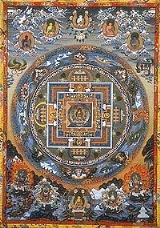
Maṇḍala is a
SanskritSanskrit , is a historical Indo-Aryan language and the primary liturgical language of Hinduism, Jainism and Buddhism.Buddhism: besides Pali, see Buddhist Hybrid Sanskrit Today, it is listed as one of the 22 scheduled languages of India and is an official language of the state of Uttarakhand...
word that means "circle". In the
BuddhistBuddhism is a religion and philosophy encompassing a variety of traditions, beliefs and practices, largely based on teachings attributed to Siddhartha Gautama, commonly known as the Buddha . The Buddha lived and taught in the northeastern Indian subcontinent some time between the 6th and 4th...
and
HinduHinduism is the predominant and indigenous religious tradition of the Indian Subcontinent. Hinduism is known to its followers as , amongst many other expressions...
religious traditions their
sacred artSacred art is imagery intended to uplift the mind to the spiritual. Sacred art involves the ritual and cultic practices and practical and operative aspects of the path of the spiritual realization within the bosom of the tradition in question....
often takes a mandala form. The basic form of most Hindu and Buddhist mandalas is a square with four gates containing a circle with a
center pointBindu is a Sanskrit term meaning "point" or "dot". The feminine case ending is bindi which denotes a small ornamental, devotional and/or mystical dot that is cosmetically applied or affixed to the forehead in Hinduism....
. Each gate is in the shape of a T.
These mandalas, concentric diagrams, have
spiritualSpirituality can refer to an ultimate or an alleged immaterial reality; an inner path enabling a person to discover the essence of his/her being; or the “deepest values and meanings by which people live.” Spiritual practices, including meditation, prayer and contemplation, are intended to develop...
and
ritualA ritual is a set of actions, performed mainly for their symbolic value. It may be prescribed by a religion or by the traditions of a community. The term usually excludes actions which are arbitrarily chosen by the performers....
significance in both
BuddhismBuddhism is a religion and philosophy encompassing a variety of traditions, beliefs and practices, largely based on teachings attributed to Siddhartha Gautama, commonly known as the Buddha . The Buddha lived and taught in the northeastern Indian subcontinent some time between the 6th and 4th...
and
HinduismHinduism is the predominant and indigenous religious tradition of the Indian Subcontinent. Hinduism is known to its followers as , amongst many other expressions...
. The term is of
HinduHinduism is the predominant and indigenous religious tradition of the Indian Subcontinent. Hinduism is known to its followers as , amongst many other expressions...
origin and appears in the Rig Veda as the name of the sections of the work, but is also used in other Indian religions, particularly
BuddhismBuddhism is a religion and philosophy encompassing a variety of traditions, beliefs and practices, largely based on teachings attributed to Siddhartha Gautama, commonly known as the Buddha . The Buddha lived and taught in the northeastern Indian subcontinent some time between the 6th and 4th...
. In the
TibetanTibetan Buddhism is the body of Buddhist religious doctrine and institutions characteristic of Tibet and certain regions of the Himalayas, including northern Nepal, Bhutan, and India . It is the state religion of Bhutan...
branch of
VajrayanaVajrayāna Buddhism is also known as Tantric Buddhism, Tantrayāna, Mantrayāna, Secret Mantra, Esoteric Buddhism and the Diamond Vehicle...
Buddhism, mandalas have been developed into
sandpaintingSandpainting is the art of pouring colored sands, powdered pigments from minerals or crystals, and pigments from other natural or synthetic sources onto a surface to make a fixed, or unfixed sand painting...
. They are also a key part of anuttarayoga tantra meditation practices.
In various spiritual traditions, mandalas may be employed for focusing attention of aspirants and adepts, as a spiritual teaching tool, for establishing a
sacred spaceTemenos is a piece of land cut off and assigned as an official domain, especially to kings and chiefs, or a piece of land marked off from common uses and dedicated to a god, a sanctuary, holy grove or holy precinct: The Pythian race-course is called a temenos, the sacred valley of the Nile is the ...
, and as an aid to
meditationMeditation is any form of a family of practices in which practitioners train their minds or self-induce a mode of consciousness to realize some benefit....
and
tranceTrance denotes a variety of processes, ecstasy, techniques, modalities and states of mind, awareness and consciousness. Trance states may occur involuntarily and unbidden.The term trance may be associated with meditation, magic, flow, and prayer...
induction. According to the psychologist
David FontanaProfessor David G. J. Fontana, Ph.D, FBPS was a British academic, psychologist and author. He was Professor of Psychology at the Cardiff University...
, its symbolic nature can help one "to access progressively deeper levels of the unconscious, ultimately assisting the meditator to experience a mystical sense of oneness with the ultimate unity from which the cosmos in all its manifold forms arises." The psychoanalyst
Carl JungCarl Gustav Jung was a Swiss psychiatrist and the founder of Analytical Psychology. Jung is considered the first modern psychiatrist to view the human psyche as "by nature religious" and make it the focus of exploration. Jung is one of the best known researchers in the field of dream analysis and...
saw the mandala as "a representation of the unconscious self," and believed his paintings of mandalas enabled him to identify emotional disorders and work towards wholeness in personality.
In common use, mandala has become a generic term for any plan, chart or geometric pattern that represents the
cosmosIn the general sense, a cosmos is an orderly or harmonious system. It originates from the Greek term κόσμος , meaning "order" or "ornament" and is antithetical to the concept of chaos. Today, the word is generally used as a synonym of the word Universe . The word cosmos originates from the same root...
metaphysically or symbolically, a
microcosmMacrocosm and microcosm is an ancient Greek Neo-Platonic schema of seeing the same patterns reproduced in all levels of the cosmos, from the largest scale all the way down to the smallest scale...
of the
UniverseThe Universe is commonly defined as the totality of everything that exists, including all matter and energy, the planets, stars, galaxies, and the contents of intergalactic space. Definitions and usage vary and similar terms include the cosmos, the world and nature...
from the human perspective.
Hinduism
Kolam
The term
KolamKolam is a form of painting that is drawn using rice powder. A Kolam is a geometrical line drawing composed of curved loops, drawn around a grid pattern of dots. In South India, it is widely practised by female Hindu family members in front of their homes.-Purpose:Kolams are thought to bestow...
normally refers to Hindu contexts and practices, while maṇḍala normally refers to Buddhist contexts and practices. Yet the terms are also used interchangeably, and maṇḍala is sometimes used as a cross-over term in Hindu contexts.
A yantra is a two- or three-dimensional geometric composition used in
sadhanaSādhanā literally "a means of accomplishing something" is ego-transcending spiritual practice. It includes a variety of disciplines in Hindu, Sikh , Buddhist and Muslim traditions that are followed in order to achieve various spiritual or ritual objectives.The historian N...
s, or meditative rituals. It is thought to be the abode of the deity. Each yantra is unique and calls the deity into the presence of the practitioner through the elaborate symbolic geometric designs. According to one scholar, “Yantras function as revelatory symbols of cosmic truths and as instructional charts of the spiritual aspect of human experience"
Many situate yantras as central focus points for Hindu tantric practice.Yantras are not representations, but are lived, experiential, nondual realities. As Khanna describes:
Despite its cosmic meanings a yantra is a reality lived. Because of the relationship that exists in the Tantras between the outer world (the macrocosm) and man’s [sic] inner world (the microcosm), every symbol in a yantra is ambivalently resonant in inner-outer synthesis, and is associated with the subtle body and aspects of human consciousness.
Note: maṇḍala is also the term used to describe any of the ten books of Rig Veda, a sacred Vedic and Hindu scripture (
sruti' , often spelled shruti or shruthi, is a term that describes the sacred texts comprising the central canon of Hinduism and is one of the three main sources of dharma and therefore is also influential within Hindu Law...
).
Buddhism
Early and Theravada Buddhism
The mandala can be found in the form of the
StupaA stupa is a mound-like structure containing Buddhist relics, typically the remains of Buddha, used by Buddhists as a place of worship....
and in the Atanatiya Sutta in the
Digha NikayaThe Digha Nikaya is a Buddhist scripture, the first of the five nikayas, or collections, in the Sutta Pitaka, which is one of the "three baskets" that compose the Pali Tipitaka of Theravada Buddhism...
, part of the
Pali CanonThe Pāli Canon is the standard collection of scriptures in the Theravada Buddhist tradition, as preserved in the Pāli language. It is the only completely surviving early Buddhist canon, and one of the first to be written down...
. This text is frequently chanted.
Tibetan Vajrayana
A kyil khor , Tibetan for mandala in
VajrayanaVajrayāna Buddhism is also known as Tantric Buddhism, Tantrayāna, Mantrayāna, Secret Mantra, Esoteric Buddhism and the Diamond Vehicle...
Buddhism usually depicts a landscape of the "
Buddha-landA pure land, in Mahayana Buddhism, is the celestial realm or pure abode of a Buddha or Bodhisattva. The various traditions that focus on Pure Lands have been given the nomenclature Pure Land Buddhism. Pure lands are also evident in the literature and traditions of Taoism and Bön.The notion of 'pure...
", or the enlightened vision of a Buddha, which inevitably represents the nature of experience and the intricacies of both the enlightened and confused mind, or
"a microcosm representing various divine powers at work in the universe." Such mandalas consist of an outer circular mandala
and an inner square (or sometimes circular) mandala with an ornately decorated mandala "palace" placed at the center. Any part of the inner mandala can be occupied by Buddhist glyphs and symbols, as well as by images of its associated deities, which "symbolise different stages in the process of the realisation of the truth."
Kværne (1975: p. 164) in his extended discussion of
sahajaSahaja is a term of some importance in Indian spirituality, particularly in circles influenced by the Tantric Movement...
, discusses the relationship of
sadhanaSādhanā literally "a means of accomplishing something" is ego-transcending spiritual practice. It includes a variety of disciplines in Hindu, Sikh , Buddhist and Muslim traditions that are followed in order to achieve various spiritual or ritual objectives.The historian N...
interiority and exteriority in relation to mandala thus:
"...external ritual and internal sadhana form an indistinguishable whole, and this unity finds its most pregnant expression in the form of the mandala, the sacred enclosure consisting of concentric squares and circles drawn on the ground and representing that adamant plane of being on which the aspirant to Buddha hood wishes to establish himself. The unfolding of the tantric ritual depends on the mandala; and where a material mandala is not employed, the adept proceeds to construct one mentally in the course of his meditation." [NB: gendered language repaired in square parenthesis; first example employed "him", the second example "his"]
Mandalas are commonly used by tantric Buddhists as an aid to meditation. More specifically, a Buddhist mandala is envisaged as a "sacred space," a "Pure Buddha Realm," and also as an abode of fully realised beings or deities. While on the one hand, the mandala is regarded as a place separated and protected from the ever-changing and impure outer world of
samsarathumb|right|200px|Traditional Tibetan painting or [[Thanka]] showing the [[wheel of life]] and realms of saṃsāraSaṅsāra or Saṃsāra , , literally meaning "continuous flow", is the cycle of birth, life, death, rebirth or reincarnation within Hinduism, Buddhism, Bön, Jainism, Sikhism, and other...
, and is thus seen as a "Buddhafield" or a place of Nirvana and peace, the view of Vajrayana Buddhism sees the greatest protection from samsara being the power to see samsaric confusion as the "shadow" of purity (which then points towards it). By visualizing "pure lands," one learns to understand experience itself as pure, and as the abode of enlightenment. The protection that we need, in this view, is from our own minds, as much as from external sources of confusion. In many tantric mandalas, this aspect of separation and protection from the outer samsaric world is depicted by "the four outer circles: the purifying fire of wisdom, the
vajraVajra is a Sanskrit word meaning both thunderbolt and diamond...
circle, the circle with the eight tombs, the lotus circle." The ring of vajras forms a connected fence-like arrangement running
around the perimeter of the outer mandala circle.
The mandala is also "a support for the meditating person," something to be repeatedly contemplated to the point of saturation, such that the image of the mandala becomes fully internalised in even the minutest detail and can then be summoned and contemplated at will as a clear and vivid visualized image. With every mandala comes what Tucci calls "its associated liturgy...contained in texts known as tantras," instructing practitioners on how the mandala should be drawn, built and visualised, and indicating the
mantraA mantra is a sound, syllable, word, or group of words that is considered capable of "creating transformation"...
s to be recited during its ritual use.
As a meditation on impermanence (a central teaching of
BuddhismBuddhism is a religion and philosophy encompassing a variety of traditions, beliefs and practices, largely based on teachings attributed to Siddhartha Gautama, commonly known as the Buddha . The Buddha lived and taught in the northeastern Indian subcontinent some time between the 6th and 4th...
), after days or weeks of creating the intricate pattern of a sand mandala, the sand is brushed together and placed in a body of running water to spread the blessings of the mandala.
A mandala can also represent the entire universe, which is traditionally depicted with Mount Meru as the
axis mundiThe axis mundi , in religion or mythology, is the world center and/or the connection between heaven and Earth. As the celestial pole and geographic pole, it expresses a point of connection between sky and earth where the four compass directions meet...
in the center, surrounded by the continents. A "mandala offering" in
Tibetan BuddhismTibetan Buddhism is the body of Buddhist religious doctrine and institutions characteristic of Tibet and certain regions of the Himalayas, including northern Nepal, Bhutan, and India . It is the state religion of Bhutan...
is a symbolic offering of the entire universe. Every intricate detail of these mandalas is fixed in the tradition and has specific symbolic meanings, often on more than one level.
The mandala can be shown to represent in visual form the core essence of the
VajrayanaVajrayāna Buddhism is also known as Tantric Buddhism, Tantrayāna, Mantrayāna, Secret Mantra, Esoteric Buddhism and the Diamond Vehicle...
teachings.
In the mandala, the outer circle of fire usually symbolises wisdom. The ring of 8
charnel groundCharnel ground is a very important location for sadhana and ritual activity for Indo-Tibetan traditions of Dharma particularly those traditions iterated by the Tantric view such as Kashmiri Shaivism, Kaula tradition, Esoteric Buddhism, Vajrayana, Mantrayana, Dzogchen, and the sadhana of Chöd, Phowa...
s represents the Buddhist exhortation to always be mindful of death, and the impermanence with which
samsarathumb|right|200px|Traditional Tibetan painting or [[Thanka]] showing the [[wheel of life]] and realms of saṃsāraSaṅsāra or Saṃsāra , , literally meaning "continuous flow", is the cycle of birth, life, death, rebirth or reincarnation within Hinduism, Buddhism, Bön, Jainism, Sikhism, and other...
is suffused: "such locations were utilized in order to confront and to realize the transient nature of life." Described elsewhere: "within a flaming rainbow nimbus and encircled by a black ring of dorjes, the major outer ring depicts the eight great charnel grounds, to emphasize the dangerous nature of human life."
Inside these rings lie the walls of the mandala palace itself, specifically a place populated by deities and Buddhas.
One well-known type of mandala, in Japan is the mandala of the "Five Buddhas", archetypal Buddha forms embodying various aspects of enlightenment. Such Buddhas are depicted depending on the school of
BuddhismBuddhism is a religion and philosophy encompassing a variety of traditions, beliefs and practices, largely based on teachings attributed to Siddhartha Gautama, commonly known as the Buddha . The Buddha lived and taught in the northeastern Indian subcontinent some time between the 6th and 4th...
, and even the specific purpose of the mandala. A common mandala of this type is that of the Five Wisdom Buddhas (a.k.a. Five Jinas), the Buddhas
VairocanaVairocana is a celestial Buddha who is often interpreted as the Bliss Body of the historical Gautama Buddha; he can also be referred to as the dharmakaya Buddha and the great solar Buddha. In Sino-Japanese Buddhism, Vairocana is also seen as the embodiment of the Buddhist concept of shunyata or...
, Aksobhya,
RatnasambhavaRatnasambhava is one of the Five Dhyani Buddhas of Vajrayana or Tantric Buddhism. Ratnasambhava's mandalas and mantras focus on developing equanimity and equality and, in Vajrayana buddhist thought is associated with the attempt to destroy greed and pride. His consort is Lochana and his mount is a...
,
AmitabhaAmitābha is a celestial buddha described in the scriptures of the Mahāyāna school of Buddhism...
and
AmoghasiddhiAmoghasiddhi is one of the Five Wisdom Buddhas of the Vajrayana tradition of Buddhism. he is associated with the accomplishment of the Buddhist path and of the destruction of the poison of envy. His name means He Whose Accomplishment Is Not In Vain. His Shakti/consort is Tara, meaning Noble...
. When paired with another mandala depicting the Five Wisdom Kings, this forms the
Mandala of the Two RealmsThe Mandala of the Two Realms , also known as the Mandala of the Two Divisions , is a set of two mandalas depicting both the Five Wisdom Buddhas of the Diamond Realm as well as the Five Wisdom Kings of the Womb Realm...
.
Offerings
Whereas the above mandala represents the pure surroundings of a Buddha, this mandala represents the universe. This type of mandala is used for the mandala-offerings, during which one symbolically offers the universe to the Buddhas or to one's teacher. Within Vajrayana practice, 100,000 of these mandala offerings (to create merit) can be part of the preliminary practices before a student even begins actual tantric practices. This mandala is generally structured according to the model of the universe as taught in a Buddhist classic text the Abhidharma-kośa, with Mount Meru at the centre, surrounded by the continents, oceans and mountains, etc.
Shingon Buddhism
The Japanese branch of Vajrayana Buddhism -- Shingon Buddhism—makes frequent use of mandalas in its rituals as well, though the actual mandalas differ. When Shingon's founder,
KukaiKūkai , also known posthumously as , 774–835, was a Japanese monk, civil servant, scholar, poet, and artist, founder of the Shingon or "True Word" school of Buddhism. Shingon followers usually refer to him by the honorific titles of and ....
, returned from his training in China, he brought back two mandalas that became central to Shingon ritual: the
Mandala of the Womb RealmIn Vajrayana Buddhism, the Womb Realm is the metaphysical space inhabited by the Five Wisdom Kings. The Womb Realm is based on the Mahāvairocana Sutra...
and the
Mandala of the Diamond RealmIn Vajrayana Buddhism, the Diamond Realm is a metaphysical space inhabited by the Five Wisdom Buddhas...
.
These two mandalas are engaged in the abhiseka initiation rituals for new Shingon students, more commonly known as the Kechien Kanjō (結縁灌頂). A common feature of this ritual is to blindfold the new initiate and to have them throw a flower upon either mandala. Where the flower lands assists in the determination of which
tutelary deityIn Vajrayana Buddhism, an Ishta-deva or Ishta-devata is a fully enlightened being who is the focus of personal meditation, during a retreat or for life. The term is often translated into English as tutelary deity, meditation deity, or meditational deity...
the initiate should follow.
Sand Mandalas, as found in Tibetan Buddhism, are not practiced in Shingon Buddhism.
Nichiren Buddhism
The mandala in
Nichiren BuddhismNichiren Buddhism is a branch of Mahāyāna Buddhism based on the teachings of the 13th century Japanese monk Nichiren...
is called a moji-mandala (文字曼陀羅) and is a paper
hanging scrollA hanging scroll is one of the many traditional ways to display and exhibit Chinese painting and calligraphy. Displaying the art in such way was befitting for public appreciation and appraisal of the aesthetics of the scrolls in its entirety by the audience. The traditional craft involved in...
or wooden tablet whose inscription consists of
Chinese charactersKanji are the adopted logographic Chinese characters hanzi that are used in the modern Japanese writing system along with hiragana , katakana , Indo Arabic numerals, and the occasional use of the Latin alphabet...
and medieval-Sanskrit script representing elements of the Buddha's enlightenment, protective Buddhist deities, and certain Buddhist concepts. Called the
GohonzonGohonzon , is the object of devotion in many forms of Japanese Buddhism. In Japanese, go is an honorific prefix indicating respect and honzon means object of fundamental respect, veneration, or devotion...
, it was originally inscribed by
NichirenNichiren was a Buddhist monk who lived during the Kamakura period in Japan. Nichiren taught devotion to the Lotus Sutra, entitled Myōhō-Renge-Kyō in Japanese, as the exclusive means to attain enlightenment and the chanting of Nam-Myōhō-Renge-Kyō as the essential practice of the teaching...
, the founder of this branch of Japanese Buddhism, during the late 13th Century. The Gohonzon is the primary object of veneration in some Nichiren schools and the only one in others, which consider it to be the supreme object of worship as the embodiment of the supreme
DharmaDharma means Law or Natural Law and is a concept of central importance in Indian philosophy and religion. In the context of Hinduism, it refers to one's personal obligations, calling and duties, and a Hindu's dharma is affected by the person's age, caste, class, occupation, and gender...
and Nichiren's inner enlightenment. The seven characters
Nam Myoho Renge KyoNam Myōhō Renge Kyō is a mantra that is chanted as the central practice of all forms of Nichiren Buddhism...
, considered to be the name of the supreme Dharma, as well as the
invocationAn invocation may take the form of:*Supplication or prayer.*A form of possession.*Command or conjuration.*Self-identification with certain spirits....
that believers chant, are written down the center of all Nichiren-sect Gohonzons, whose appearance may otherwise vary depending on the particular school and other factors.
Pure Land Buddhism
Mandalas have sometimes been used in
Pure Land BuddhismPure Land Buddhism , also referred to as Amidism in English, is a broad branch of Mahāyāna Buddhism and currently one of the most popular traditions of Buddhism in East Asia. Pure Land is a branch of Buddhism focused on Amitābha Buddha...
to graphically represent
Pure LandA pure land, in Mahayana Buddhism, is the celestial realm or pure abode of a Buddha or Bodhisattva. The various traditions that focus on Pure Lands have been given the nomenclature Pure Land Buddhism. Pure lands are also evident in the literature and traditions of Taoism and Bön.The notion of 'pure...
s, based on descriptions found in the Larger Sutra and the
Contemplation SutraThe Amitāyurdhyāna Sūtra , is one of the three major Buddhist sūtras found within the Pure Land branch of Mahāyāna Buddhism. Amitāyus is another name for the buddha Amitābha, the preeminent figure in Pure Land Buddhism, and this sūtra focuses mainly on meditations involving complex visualization...
. The most famous mandala in Japan is the
Taima MandalaThe Taima Mandala is a mandala in Japanese Pure Land Buddhism. The original copy of the mandala is still housed in the Taima-dera temple in Nara, Japan, and was woven approximately around 763. The mandala is appointed as a national treasure of Japan on April 27, 1961. Many copies have been made...
, dated to approximately 763 CE. The
Taima MandalaThe Taima Mandala is a mandala in Japanese Pure Land Buddhism. The original copy of the mandala is still housed in the Taima-dera temple in Nara, Japan, and was woven approximately around 763. The mandala is appointed as a national treasure of Japan on April 27, 1961. Many copies have been made...
is based upon the Contemplation Sutra, but other similar mandalas have been made subsequently. Unlike mandalas used in
VajrayanaVajrayāna Buddhism is also known as Tantric Buddhism, Tantrayāna, Mantrayāna, Secret Mantra, Esoteric Buddhism and the Diamond Vehicle...
Buddhism, it is not used as an object of meditation or for esoteric ritual. Instead, it provides a visual pictorial of the Pure Land texts, and is used as a teaching aid.
Also in
Jodo Shinshu, also known as Shin Buddhism, is a school of Pure Land Buddhism. It was founded by the former Tendai Japanese monk Shinran. Today, Shin Buddhism is considered the most widely practiced branch of Buddhism in Japan.-Shinran :...
Buddhism,
Shinranwas a Japanese Buddhist monk, who was born in Hino at the turbulent close of the Heian Period and lived during the Kamakura Period...
and his descendant,
Rennyo' was the 8th Monshu, or head-priest, of the Hongwanji Temple of the Jōdo Shinshū sect of Buddhism, and descendant of founder Shinran. Jodo Shinshu Buddhists often referred to as the restorer of the sect , and for this is also referred to as Rennyo Shonin...
, sought a way to create easily accessible objects of reverence for the lower-classes of Japanese society. Shinran designed a mandala using a hanging scroll, and the words of the nembutsu (南無阿彌陀佛) written vertically. This style of mandala is still used by some
Jodo Shinshu, also known as Shin Buddhism, is a school of Pure Land Buddhism. It was founded by the former Tendai Japanese monk Shinran. Today, Shin Buddhism is considered the most widely practiced branch of Buddhism in Japan.-Shinran :...
Buddhists in home altars, or
butsudanA butsudan is a shrine commonly found in temples and homes in Japanese Buddhist cultures. A butsudan is a wooden cabinet with doors that enclose and protect a gohonzon or religious icon, typically a statue or painting of a Buddha or Bodhisattva, or a "script" mandala scroll...
.
Christianity
Forms which are evocative of mandalas are prevalent in Christianity: the
celtic crossA Celtic cross is a symbol that combines a cross with a ring surrounding the intersection. In the Celtic Christian world it was combined with the Christian cross and this design was often used for high crosses – a free-standing cross made of stone and often richly decorated...
; the
rosaryThe rosary or "garland of roses" is a traditional Catholic devotion. The term denotes the prayer beads used to count the series of prayers that make up the rosary...
; the
haloA halo is a ring of light that surrounds a person in art. They have been used in the iconography of many religions to indicate holy or sacred figures, and have at various periods also been used in images of rulers or heroes...
; the aureole;
oculiAn Oculus, circular window, or rain-hole is a feature of Classical architecture since the 16th century. They are often denoted by their French name, oeil de boeuf, or "bull's-eye". Such circular or oval windows express the presence of a mezzanine on a building's façade without competing for...
; the
Crown of ThornsIn Christianity, the Crown of Thorns, one of the instruments of the Passion, was woven of thorn branches and placed on Jesus Christ before his crucifixion...
;
rose windowA Rose window is often used as a generic term applied to a circular window, but is especially used for those found in churches of the Gothic architectural style and being divided into segments by stone mullions and tracery...
s; the
Rosy CrossThe Rosy Cross is a symbol largely associated with the semi-mythical Christian Rosenkreuz, alchemist and founder of the Rosicrucian Order...
; and the dromenon on the floor of Chartres Cathedral. The dromenon represents a journey from the outer world to the inner sacred centre where the Divine is found.
Similarly, many of the Illuminations of Hildegard von Bingen can be used as mandalas, as well as many of the images of
esoteric ChristianityEsoteric Christianity is a term which refers to an ensemble of spiritual currents which regard Christianity as a mystery religion, and profess the existence and possession of certain esoteric doctrines or practices, hidden from the public but accessible only to a narrow circle of "enlightened",...
, as in
ChristianA Christian is a person who adheres to Christianity, an Abrahamic, monotheistic religion based on the life and teachings of Jesus of Nazareth as recorded in the Canonical gospels and the letters of the New Testament...
HermeticismHermeticism or the Western Hermetic Tradition is a set of philosophical and religious beliefs based primarily upon the pseudepigraphical writings attributed to Hermes Trismegistus...
,
ChristianA Christian is a person who adheres to Christianity, an Abrahamic, monotheistic religion based on the life and teachings of Jesus of Nazareth as recorded in the Canonical gospels and the letters of the New Testament...
AlchemyAlchemy is an influential philosophical tradition whose early practitioners’ claims to profound powers were known from antiquity. The defining objectives of alchemy are varied; these include the creation of the fabled philosopher's stone possessing powers including the capability of turning base...
, and Rosicrucianism.
Bora ring
A
Bora-Performers:* Bora, a Korean pop artist in the group Sistar* Bora Yoon, experimental sound artist and composer / performer based in NYC-Geography:...
is the name given both to an
initiationInitiation is a rite of passage ceremony marking entrance or acceptance into a group or society. It could also be a formal admission to adulthood in a community or one of its formal components...
ceremony of
Indigenous AustraliansIndigenous Australians are the original inhabitants of the Australian continent and nearby islands. The Aboriginal Indigenous Australians migrated from the Indian continent around 75,000 to 100,000 years ago....
, and to the site Bora Ring on which the initiation is performed. At such a site, young boys are transformed into men via
rites of passageRites of Passage is an African American History program sponsored by the Stamford, Connecticut US public schools. The program consists of an extra day of schooling on Saturday for 12 weeks, service projects, and a culminating educational trip to Gambia and Senegal. Gambia and Senegal are the...
. The word Bora was originally from South-East Australia, but is now often used throughout Australia to describe an initiation site or ceremony. The term "bora" is held to be etymologically derived from that of the belt or girdle that encircles initiated men. The appearance of a Bora Ring varies from one culture to another, but it is often associated with stone arrangements,
rock engravingsSydney rock engravings are a form of Australian Aboriginal Rock Art consisting of carefully drawn images of people, animals, or symbols, in the sandstone around Sydney, New South Wales, Australia...
, or other art works. Women are generally prohibited from entering a bora. In South East Australia, the Bora is often associated with the creator-spirit
BaiameIn Australian Aboriginal mythology Baiame was the Creator God and Sky Father in the dreaming of several language groups , of Indigenous Australians of South-East Australia....
.
Bora rings, found in South-East
AustraliaAustralia , officially the Commonwealth of Australia, is a country in the Southern Hemisphere comprising the mainland of the Australian continent, the island of Tasmania, and numerous smaller islands in the Indian and Pacific Oceans. It is the world's sixth-largest country by total area...
, are circles of foot-hardened earth surrounded by raised embankments. They were generally constructed in pairs (although some sites have three), with a bigger circle about 22 metres in diameter and a smaller one of about 14 metres. The rings are joined by a sacred walkway. Matthews (1897) gives an eye-witness account of a Bora ceremony, and explains the use of the two circles.
See also
- Rose window
A Rose window is often used as a generic term applied to a circular window, but is especially used for those found in churches of the Gothic architectural style and being divided into segments by stone mullions and tracery...
- Astrological symbols
Astrological symbols are images used in various astrological systems to denote relevant objects. A number of such images are shown below.-History and origin:...
- Architectural drawing
An architectural drawing or architect's drawing is a technical drawing of a building that falls within the definition of architecture...
- Bhavachakra
- Chakra
Chakra is a concept originating in Hindu texts, featured in tantric and yogic traditions of Hinduism and Buddhism. Its name derives from the Sanskrit word for "wheel" or "turning" .Chakra is a concept referring to wheel-like vortices...
- Dharmachakra
- Ganachakra
A gaṇacakra is also known as tsog, gaṇapuja, cakrapuja or gaṇacakrapuja. It is a generic term for various tantric assemblies or feasts, in which practitioners meet to chant mantra, enact mudra, make votive offerings and practice various tantric rituals as part of a sadhana, or spiritual practice...
- Gohonzon
Gohonzon , is the object of devotion in many forms of Japanese Buddhism. In Japanese, go is an honorific prefix indicating respect and honzon means object of fundamental respect, veneration, or devotion...
- Kalachakra
Kalachakra is a Sanskrit term used in Tantric Buddhism that literally means "time-wheel" or "time-cycles".The spelling Kalacakra is also correct....
- Mandala (Southeast Asian history)
Mandala is a Sanskrit word that means "circle". The mandala is a model for describing the patterns of diffuse political power in early Southeast Asian history when local power was more important...
- Namkha
Namkha , also known as De; is a form of yarn or thread cross composed traditionally of wool or silk and is metonymic of the Endless knot of the Ashtamangala. In certain rites, the Namkha becomes a pure land abode or temenos of a thoughtform...
- Quincunx
A quincunx is a geometric pattern consisting of five points arranged in a cross, that is five coplanar points, four of them forming a square or rectangle and a fifth at its center...
- Sacred art
Sacred art is imagery intended to uplift the mind to the spiritual. Sacred art involves the ritual and cultic practices and practical and operative aspects of the path of the spiritual realization within the bosom of the tradition in question....
- Sand mandala
The Sand Mandala is a Tibetan Buddhist tradition involving the creation and destruction of mandalas made from colored sand...
- Tantra
Tantra , anglicised tantricism or tantrism or tantram, is the name scholars give to an inter-religious spiritual movement that arose in medieval India, expressed in scriptures ....
- Thangka
A "Thangka," also known as "Tangka", "Thanka" or "Tanka" is a Tibetan silk painting with embroidery, usually depicting a Buddhist deity, famous scene, or mandala of some sort. The thankga is not a flat creation like an oil painting or acrylic painting...
- Yantra
Yantra is the Sanskrit word for "instrument" or "machine". Much like the word "instrument" itself, it can stand for symbols, processes, automata, machinery or anything that has structure and organization, depending on context....
External links