
Home      Discussion      Topics      Dictionary      Almanac
Signup       Login
Ikebana

Ikebana

Overview

Discussion
Ask a question about 'Ikebana'
Start a new discussion about 'Ikebana'
Answer questions from other users
Full Discussion Forum
 
Recent Discussions
Encyclopedia

is the Japanese art
Japanese art
Japanese art covers a wide range of art styles and media, including ancient pottery, sculpture in wood and bronze, ink painting on silk and paper and more recently manga, cartoon, along with a myriad of other types of works of art...

 of flower arrangement, also known as .

Etymology


"Ikebana" is from the Japanese and . Possible translations include "giving life to flowers" and "arranging flowers".

Approach


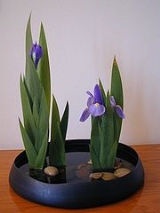
More than simply putting flowers in a container, ikebana is a disciplined art form in which nature and humanity are brought together. Contrary to the idea of floral arrangement as a collection of particolored or multicolored arrangement of blooms, ikebana often emphasizes other areas of the plant, such as its stems and leaves, and draws emphasis toward shape, line, form. Though ikebana is a creative expression, it has certain rules governing its form. The artist's intention behind each arrangement is shown through a piece's color combinations, natural shapes, graceful lines, and the usually implied meaning of the arrangement.

Another aspect present in ikebana is its employment of minimalism
Minimalism
Minimalism describes movements in various forms of art and design, especially visual art and music, where the work is set out to expose the essence, essentials or identity of a subject through eliminating all non-essential forms, features or concepts...

. That is, an arrangement may consist of only a minimal number of blooms interspersed among stalks and leaves. The structure of a Japanese flower arrangement is based on a scalene triangle delineated by three main points, usually twigs, considered in some schools to symbolize heaven
Heaven
Heaven, the Heavens or Seven Heavens, is a common religious cosmological or metaphysical term for the physical or transcendent place from which heavenly beings originate, are enthroned or inhabit...

, earth
Earth
Earth is the third planet from the Sun, and the densest and fifth-largest of the eight planets in the Solar System. It is also the largest of the Solar System's four terrestrial planets...

, and man
Human
Humans are the only living species in the Homo genus...

 and in others sun
Sun
The Sun is the star at the center of the Solar System. It is almost perfectly spherical and consists of hot plasma interwoven with magnetic fields...

, moon
Moon
The Moon is Earth's only known natural satellite,There are a number of near-Earth asteroids including 3753 Cruithne that are co-orbital with Earth: their orbits bring them close to Earth for periods of time but then alter in the long term . These are quasi-satellites and not true moons. For more...

, and earth
Earth
Earth is the third planet from the Sun, and the densest and fifth-largest of the eight planets in the Solar System. It is also the largest of the Solar System's four terrestrial planets...

. The container is a key element of the composition, and various styles of pottery may be used in their construction.

Spiritual aspects


The spiritual aspect of ikebana is considered very important to its practitioners. Silence is a must during practices of ikebana. It is a time to appreciate things in nature that people often overlook because of their busy lives. One becomes more patient and tolerant of differences, not only in nature, but also in general. Ikebana can inspire one to identify with beauty in all art forms. This is also the time when one feels closeness to nature which provides relaxation for the mind, body, and soul.

Origins


The truth about the origin of Ikebana is unidentified. But when the Buddhism reached Japan in the 7th century, it is thought to have come to Japan as part of Buddhist practice. The offering of flowers on the altar in honor of Buddha was part of worship. Ikebana evolved from the Buddhist ritual of offering flowers to the spirits of the dead. The first classical styles of Ikebana started in the middle of the fifteenth century; the first students and teachers of Ikebana were Buddhist priests and members. As time passed, other schools emerged, styles changed, and Ikebana became a custom among the Japanese society.

Origin of ikebana schools: Ikenobō


The history of ikebana dates back approximately 500 years ago and the history of Ikenobō
Ikenobo
Ikenobo is a school of Ikebana, or Japanese floral art.It is the oldest school of Ikebana in Japan, having been founded in the 15th century by the Buddhist monk Ikenobo Senno. The school, currently headed by its 45th generation Iemoto , Ikenobo Sen'ei, is based in the Rokkaku-dō Temple in Kyoto....

 — the oldest school of ikebana. The school dates its beginnings from a priest of the Rokkakudō Temple (六角堂) (the official name is Shiun-ji or Purple Cloud Temple 紫雲寺) in Kyoto
Kyoto
is a city in the central part of the island of Honshū, Japan. It has a population close to 1.5 million. Formerly the imperial capital of Japan, it is now the capital of Kyoto Prefecture, as well as a major part of the Osaka-Kobe-Kyoto metropolitan area.-History:...

 who was so skilled in flower arrangement that other priests sought him out for instruction. As he lived by the side of a lake, for which the Japanese word is 'Ikeno bō' "池坊", the name Ikenobō became attached to the priests there who specialized in these altar arrangements.

The Rokkakudō temple was erected in 587 by Prince Shōtoku
Prince Shotoku
, also known as or , was a semi-legendary regent and a politician of the Asuka period in Japan who served under Empress Suiko. He was a son of Emperor Yōmei and his younger half-sister Princess Anahobe no Hashihito. His parents were relatives of the ruling Soga clan, and was involved in the defeat...

 (聖徳太子). It is said that Prince Shōtoku was searching for materials to build the Shitenno-ji
Shitenno-ji
is a Buddhist temple in Osaka, Japan.Prince Shōtoku is said to have constructed this temple in 593. It is the first Buddhist and oldest officially administered temple in Japan, although the temple buildings have been rebuilt over the centuries. Most of the present structures are from when the...

 Temple (四天王寺). During his search, one day he went to bathe in a pond, where he hung a Buddhist amulet over a nearby tree. After his bath, he tried to remove the amulet, but he was unable to do so. That same night, the Prince saw the Buddha in his dream. The Buddha instructed him to erect a temple near the pond at the cedar tree under a purple cloud. From that cedar, Rokkakudō temple was built to house a Kannon (Guan-Yin) statue.

Evolution of styles


Patterns and styles evolved so that, by the late 15th century, arrangements were common enough that they were appreciated by ordinary people, not just the imperial family and its retainers.

Ikebana in the beginning was very simple, constructed only a very few stems of flowers and evergreen branches. This first form of ikebana is called Kuge (供華).

Styles of ikebana changed in the late 15th century and transformed into an art form with fixed instructions. Books were written and Sedensho is the oldest one, covering years 1443 to 1536. Ikebana became a major part of traditional festivals, and exhibitions were held occasionally.

The first styles were a tall, upright central stem that had to be accompanied by two shorter stems. During the Momoyama period, 1560–1600, splendid castles were constructed. Noblemen and royal retainers did large decorative Rikka floral arrangements that were the most appropriate decoration for the castles.

The Rikka (standing flowers) style was developed as a Buddhist expression of beauty of nature. It includes seven branches representing hills, waterfalls, valleys, and other objects of nature arranged in a specific way.

When the tea ceremony emerged, another style was introduced. The style used for tea ceremony rooms was called Chabana. The Chabana style is the opposite of Momoyama style which emphasized on rustic simplicity. The simplicity of the Chabana helped create the Nageire or “thrown-in” style.

Nageire is a non-structured design which led to the development of the Seika or Shoka style. The style is characterized by a tight bundle of stems that form a triangular three-branched asymmetrical arrangement which was considered classic.

Seika or Shōka style consists of only three main branches, known as 'ten' (heaven), 'chi' (earth), and 'jin' (human). It is a simple style that is designed to show the beauty and uniqueness of the plant itself.

Jiyūka is a free creative design. It is not confined to flowers; every material can be used.

Other common styles in the present


In the 20th century, with the advent of modernism
Modernism
Modernism, in its broadest definition, is modern thought, character, or practice. More specifically, the term describes the modernist movement, its set of cultural tendencies and array of associated cultural movements, originally arising from wide-scale and far-reaching changes to Western society...

, the three schools of ikebana partially gave way to what is commonly known in Japan as Free Style.


Moribana (upright style) is considered as the most basic structure in ikebana. Moribana literally means “piled-up flowers” that are arranged in a shallow vase or suiban, compote, or basket. Moribana is secured on kenzan
Kenzan
A kenzan, also called spiky frog, is a specific device used in the Japanese art of flower arrangement ikebana for fixing the flowers in the container. It consists of a heavy lead plate with erected brass needles where the stipes are fixed....

 or needlepoint holders, also known as metal frogs.

Moribana (slanting style) is the reversed arranging style that can be used depending on the placement of the display or shapes of the branches. Branches that look beautiful when slanted are mostly chosen for this arrangement. This style gives a softer impression than the upright style.

Nageire (upright style) is arranged in a narrow-mouthed, tall container without using kenzan or needlepoint holders. Nageire literally means "thrown in". This is a simple arrangement that can contain just one flower and does not use frogs to hold the flower(s).

Nageire (slanted style) presents a gentle touch and flexibility. It is ideal for ikebana beginners.

Nageire (cascading style) arrangements have the main stem hanging lower than the rim of the vase. A flexible material will create beautiful lines balancing with flowers.

Ikebana in contemporary Japanese culture


Ikebana remains one of the most distinct arts in Japanese culture. It is shown on television, taught in schools, and admired daily. An example of a television show that involves ikebana is Seikei Bijin (Artificial Beauty). The story incorporates the importance of natural
Natural
Natural is an adjective that refers to Nature.Natural may refer too:In science and mathematics:* Natural transformation, category theory in mathematics* Natural foods...

 beauty.

International Organizations


The oldest international organization, Ikebana International, was founded in 1956.

Further reading

  • Ember, M., & Ember, C. r. (2001). Countries and their Cultures. New York Pearson Education, Inc. Retrieved July 30, 2008, from NetLibrary (UMUC Database) .

  • Fairchild, C. (2006). "Keiko's Ikebana: A Contemporary Approach to the Traditional Japanese Art of Flower Arranging." Library Journal, 131(1), 111-113. Retrieved July 30, 2008 from Academic Search Premiere (UMUC Database) (AN 21303368).

  • Leaman, O. (2001). Encyclopedia of Asian Philosophy. London: New York Taylor & Francis Routledge. Retrieved July 30, 2008 from NetLibrary (UMUC Database).

External links


Organizations


Schools


Famous Individuals