

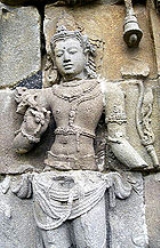
Avalokitesvara

Encyclopedia
Avalokiteśvara is a bodhisattva
who embodies the compassion
of all Buddhas
. He is one of the more widely revered bodhisattvas in mainstream Mahayana Buddhism.
The original name for this bodhisattva was Avalokitasvara. The Chinese
name for Avalokitasvara is Guānshìyīn Púsà (觀世音菩薩), which is a translation of the earlier name "Avalokitasvara Bodhisattva." This bodhisattva is variably depicted as male or female, and may also be referred to simply as Guānyīn in certain contexts.
In Sanskrit, Avalokitesvara is also referred to as Padmapāni ("Holder of the Lotus") or Lokeśvara ("Lord of the World"). In Tibetan
, Avalokiteśvara is known as Chenrezig, སྤྱན་རས་གཟིགས་ (Wylie
: spyan ras gzigs) and is said to be incarnated in the Dalai Lama
, the Karmapa
and other high lama
s.
, "lord", "ruler", "sovereign" or "master". In accordance with sandhi
(Sanskrit rules of sound combination), a+iśvara becomes eśvara. Combined, the parts mean "lord who gazes down (at the world)". The word loka
("world") is absent from the name, but the phrase is implied.
It was initially thought that the Chinese mis-transliterated the word Avalokiteśvara as Avalokitasvara which explained why Xuanzang
translated it as Guānzìzài (Ch. 觀自在) instead of Guānyīn (Ch. 觀音). However, according to recent research, the original form was indeed Avalokitasvara with the ending a-svara ("sound, noise"), which means "sound perceiver", literally "he who looks down upon sound" (i.e., the cries of sentient beings who need his help; a-svara can be glossed as ahr-svara, "sound of lamentation"). This is the exact equivalent of the Chinese translation Guānyīn. This etymology was furthered in the Chinese by the tendency of some Chinese translators, notably Kumarajiva
, to use the variant Guānshìyīn (Ch. 觀世音), literally "he who perceives the world's lamentations" -- wherein lok was read as simultaneously meaning both "to look" and "world" (Skt. loka; Ch. 世, shì). This name was later supplanted by the form containing the ending -īśvara, which does not occur in Sanskrit before the seventh century. The original form Avalokitasvara already appears in Sanskrit fragments of the fifth century.
The original meaning of the name fits the Buddhist understanding of the role of a bodhisattva. The reinterpretation presenting him as an īśvara shows a strong influence of Śaivism
, as the term īśvara was usually connected to the Hindu notion of Śiva
as a creator god and ruler of the world. Some attributes of such a god were transmitted to the bodhisattva, but the mainstream of those who venerated Avalokiteśvara upheld the Buddhist rejection of the doctrine of any creator god.
An etymology of the Tibetan name Chenrezig is chen (eye), re (continuity) and zig (to look). This gives the meaning of one who always looks upon all beings (with the eye of compassion).

who has made a great vow to assist sentient
beings in times of difficulty, and to postpone his own Buddhahood
until he has assisted every being on Earth in achieving Nirvāṇa
. Mahāyāna sūtras
associated with Avalokiteśvara include the following:
The Lotus Sūtra
(Skt. Saddharma Puṇḍarīka Sūtra) is generally accepted to be the earliest literature teaching about the doctrines of Avalokiteśvara. These are found in the Lotus Sūtra chapter 25, The Universal Gateway of Avalokitasvara Bodhisattva (Ch. 觀世音菩薩普門品). This chapter is devoted to Avalokitasvara, describing him as a compassionate bodhisattva who hears the cries of sentient beings, and who works tirelessly to help those who call upon his name. A total of 33 different manifestations of Avalokitasvara are described, including female manifestations, all to suit the minds of various beings. The chapter consists of both a prose and a verse section. This earliest source often circulates separately as its own sūtra, called the Avalokitasvara Sūtra (Ch. 觀世音經), and is commonly recited or chanted at Buddhist temples in East Asia.
When the Chinese monk Faxian
traveled to Mathura in India around 400 CE, he wrote about monks presenting offerings to Avalokiteśvara. When Xuanzang
traveled to India in the 7th century, he provided eyewitness accounts of Avalokiteśvara statues being venerated by devotees of all walks of life, from kings, to monks, to laypeople. Avalokiteśvara remained popular in India until the 12th century when Muslim
invaders conquered the land and destroyed Buddhist monasteries.
In Chinese Buddhism and the Sinosphere
, practices for an 18-armed form of Avalokiteśvara called Cundī
are very popular. These practices have their basis in early Indian Esoteric Buddhism. Cundī is also referred to as "Cundī Buddha-Mother" or "Cundī Bhagavatī." The popularity of Cundī is attested by the three extant translations of the Cundī Dhāraṇī Sūtra from Sanskrit to Chinese, made from the end of the seventh century to the beginning of the eighth century. In late imperial China
, these early traditions of Esoteric Buddhism are known to have been still thriving in Buddhist communities. Robert Gimello has also observed that in these communities, the esoteric practices of Cundī were extremely popular among both the populace and the elite.
In the Tiantai
school, six forms of Avalokiteśvara are defined. Each of the bodhisattva's six qualities are said to break the hindrances respectively of the six realms of existence: hell-beings, preta
s, animals, humans, asura
s, and deva
s. These six qualities are listed below.
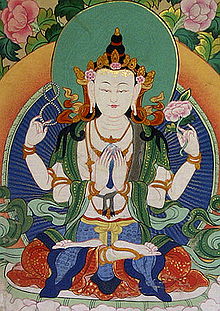
) a devoted, compassionate Buddhist monk became a bodhisattva, transformed in the present kalpa into Avalokiteśvara. That is not in conflict, however, with the ultimate source, which is Avalokiteśvara as the universal manifestation of compassion. The bodhisattva is viewed as the anthropomorphised vehicle for the actual deity, serving to bring about a better understanding of Avalokiteśvara to humankind.
Seven forms of Avalokiteśvara in Tibetan Buddhism:
, Avalokiteśvara is still venerated as Natha-deva, and his image is sometimes mistaken for that of the bodhisattva Maitreya
.
Although mainstream Theravada does not worship any of the Mahayana bodhisattvas, Avalokiteśvara is popularly worshiped in Burma, where she is called Lokanat, and Thailand
, where she is called Lokesvara.
Some have suggested that Avalokiteśvara, along with many other supernatural beings in Buddhism, was a borrowing or absorption by Mahayana Buddhism of one or more Hindu
deities, in particular Shiva
or Vishnu
(though the reason for this suggestion is because the current name of the bodhisattva not the original one.)
The Japanese scholar Shu Hikosaka on the basis of his study of Buddhist scriptures, ancient Tamil
literary sources, as well as field survey, proposes the hypothesis that, the ancient mount Potalaka, the residence of Avalokiteśvara described in the Gandavyuha Sutra and Xuanzang
’s Records, is the real mountain Potikai or Potiyil situated at Ambasamudram
in Tirunelveli
district, Tamil Nadu
. Shu also says that mount Potiyil/Potalaka has been a sacred place for the people of South India from time immemorial. With the spread of Buddhism in the region beginning at the time of the great king Aśoka in the third century B.C.E., it became a holy place also for Buddhists who gradually became dominant as a number of their hermits settled there. The local people, though, mainly remained followers of the Hindu religion. The mixed Hindu-Buddhist cult culminated in the formation of the figure of Avalokiteśvara
In Theravada, Lokeśvara, "the lord, ruler or sovereign beholder of the world", name of a Buddha; probably a development of the idea of Brahmā, Vishnu or Śiva as lokanātha, "lord of worlds". In Indo-China especially it refers to Avalokiteśvara, whose image or face, in masculine form, is frequently seen, e.g., at Angkor. The name Lokeśvara should not be confused with that of Lokesvararaja
, the Buddha under whom Dharmakara became a monk and made forty-eight vows before becoming Amitabha
Buddha.
:
Due to his association with this mantra, in Tibetan Buddhism Avalokiteśvara is also called Shadakshari, which means "Lord of the Six Syllables." Recitation of this mantra along with prayer beads, is the most popular religious practice in Tibetan Buddhism. The connection between this famous mantra and Avalokiteśvara occurs for the first time in the . This text is first dated to around the late 4th century CE to the early 5th century CE. In this sūtra, a bodhisattva is told by the Buddha that recitation of this mantra while focusing on the sound can lead to the attainment of eight hundred samādhis
. The also features the first appearance of the Cundī Dhāraṇī
, which occurs at the end of the sūtra text. After the bodhisattva finally attains samādhi with the mantra "oṃ maṇipadme hūṃ," he is then able to observe 77 koṭīs of fully enlightened buddhas replying in one voice with the Cundī Dhāraṇī:
In Shingon Buddhism, the mantra for Avalokiteśvara is:
The Mahākaruṇā Dhāraṇī
(Great Compassion Dhāraṇī), also called the Nīlakaṇṭha Dhāraṇī, is an 82-syllable dhāraṇī for Avalokiteśvara.
. Despite strenuous effort, he realizes that still many unhappy beings were yet to be saved. After struggling to comprehend the needs of so many, his head splits into eleven pieces. Amitabha
Buddha, seeing his plight, gives him eleven heads with which to hear the cries of the suffering. Upon hearing these cries and comprehending them, Avalokiteśvara attempts to reach out to all those who needed aid, but found that his two arms shattered into pieces. Once more, Amitabha Buddha comes to his aid and invests him with a thousand arms with which to aid the suffering multitudes.
The Bao'en Temple
located in northwestern Sichuan
province, China
has an outstanding wooden image of the thousand armed Avalokiteśvara, an example of Ming Dynasty
decorative sculpture.
, and is regarded in the Vajrayana
teachings as a Buddha. In the Mahayana
teachings he is in general regarded as a high-level Bodhisattva
. The Dalai Lama
is considered by the Gelugpa sect and many other Tibetan Buddhists to be the primary earthly manifestation of Chenrezig. The Karmapa
is considered by the Karma Kagyu
sect to be Chenrezig's primary manifestation. It is said that Padmasambhava
prophesied that Avalokiteśvara will manifest himself in the Tulku
lineages of the Dalai Lamas and the Karmapas. Another Tibetan source explains that Buddha Amithaba gave to one of his two main disciples, Avalokiteśvara, the task to take upon himself the burden of caring for Tibet
. That is why he has manifested himself not only as spiritual teachers in Tibet but also in the form of kings (like Trisong Detsen
) or ministers.
Other manifestations popular in Tibet
include Sahasra-bhuja (a form with a thousand arms) and Ekādaśamukha (a form with eleven faces).
In Tibetan Buddhism, Tara
came into existence from a single tear shed by Chenrezig. When the tear fell to the ground it created a lake, and a lotus opening in the lake revealed Tara. In another version of this story, Tara emerges from the heart of Chenrezig. In either version, it is Chenrezig's outpouring of compassion which manifests Tara as a being
Bodhisattva
In Buddhism, a bodhisattva is either an enlightened existence or an enlightenment-being or, given the variant Sanskrit spelling satva rather than sattva, "heroic-minded one for enlightenment ." The Pali term has sometimes been translated as "wisdom-being," although in modern publications, and...
who embodies the compassion
Compassion
Compassion is a virtue — one in which the emotional capacities of empathy and sympathy are regarded as a part of love itself, and a cornerstone of greater social interconnection and humanism — foundational to the highest principles in philosophy, society, and personhood.There is an aspect of...
of all Buddhas
Buddhahood
In Buddhism, buddhahood is the state of perfect enlightenment attained by a buddha .In Buddhism, the term buddha usually refers to one who has become enlightened...
. He is one of the more widely revered bodhisattvas in mainstream Mahayana Buddhism.
The original name for this bodhisattva was Avalokitasvara. The Chinese
Chinese language
The Chinese language is a language or language family consisting of varieties which are mutually intelligible to varying degrees. Originally the indigenous languages spoken by the Han Chinese in China, it forms one of the branches of Sino-Tibetan family of languages...
name for Avalokitasvara is Guānshìyīn Púsà (觀世音菩薩), which is a translation of the earlier name "Avalokitasvara Bodhisattva." This bodhisattva is variably depicted as male or female, and may also be referred to simply as Guānyīn in certain contexts.
In Sanskrit, Avalokitesvara is also referred to as Padmapāni ("Holder of the Lotus") or Lokeśvara ("Lord of the World"). In Tibetan
Tibetan language
The Tibetan languages are a cluster of mutually-unintelligible Tibeto-Burman languages spoken primarily by Tibetan peoples who live across a wide area of eastern Central Asia bordering the Indian subcontinent, including the Tibetan Plateau and the northern Indian subcontinent in Baltistan, Ladakh,...
, Avalokiteśvara is known as Chenrezig, སྤྱན་རས་གཟིགས་ (Wylie
Wylie transliteration
The Wylie transliteration scheme is a method for transliterating Tibetan script using only the letters available on a typical English language typewriter. It bears the name of Turrell V. Wylie, who described the scheme in an article, A Standard System of Tibetan Transcription, published in 1959...
: spyan ras gzigs) and is said to be incarnated in the Dalai Lama
Dalai Lama
The Dalai Lama is a high lama in the Gelug or "Yellow Hat" branch of Tibetan Buddhism. The name is a combination of the Mongolian word далай meaning "Ocean" and the Tibetan word bla-ma meaning "teacher"...
, the Karmapa
Karmapa
The Karmapa is the head of the Karma Kagyu, the largest sub-school of the Kagyupa , itself one of the four major schools of Tibetan Buddhism....
and other high lama
Lama
Lama is a title for a Tibetan teacher of the Dharma. The name is similar to the Sanskrit term guru .Historically, the term was used for venerated spiritual masters or heads of monasteries...
s.
Etymology
The name Avalokiteśvara is made of the following parts: the verbal prefix ava, which means "down"; lokita, a past participle of the verb lok ("to notice, behold, observe"), here used in an active sense (an occasional irregularity of Sanskrit grammar); and finally īśvaraIshvara
Ishvara is a philosophical concept in Hinduism, meaning controller or the Supreme controller in a theistic school of thought or the Supreme Being, or as an Ishta-deva of monistic thought.-Etymology:...
, "lord", "ruler", "sovereign" or "master". In accordance with sandhi
Sandhi
Sandhi is a cover term for a wide variety of phonological processes that occur at morpheme or word boundaries . Examples include the fusion of sounds across word boundaries and the alteration of sounds due to neighboring sounds or due to the grammatical function of adjacent words...
(Sanskrit rules of sound combination), a+iśvara becomes eśvara. Combined, the parts mean "lord who gazes down (at the world)". The word loka
Loka
Loka is a Sanskrit word for "world". In Hindu mythology it takes a specific meaning related to cosmology.-Hindu tradition:In the Puranas, and already in the Atharvaveda, there are fourteen worlds, seven higher ones and seven lower ones , viz...
("world") is absent from the name, but the phrase is implied.
It was initially thought that the Chinese mis-transliterated the word Avalokiteśvara as Avalokitasvara which explained why Xuanzang
Xuanzang
Xuanzang was a famous Chinese Buddhist monk, scholar, traveler, and translator who described the interaction between China and India in the early Tang period...
translated it as Guānzìzài (Ch. 觀自在) instead of Guānyīn (Ch. 觀音). However, according to recent research, the original form was indeed Avalokitasvara with the ending a-svara ("sound, noise"), which means "sound perceiver", literally "he who looks down upon sound" (i.e., the cries of sentient beings who need his help; a-svara can be glossed as ahr-svara, "sound of lamentation"). This is the exact equivalent of the Chinese translation Guānyīn. This etymology was furthered in the Chinese by the tendency of some Chinese translators, notably Kumarajiva
Kumarajiva
Kumārajīva; was a Kuchean Buddhist monk, scholar, and translator. He first studied teachings of the Sarvastivada schools, later studied under Buddhasvāmin, and finally became a Mahāyāna adherent, studying the Madhyamaka doctrine of Nagarjuna. Kumārajīva settled in Chang'an, which was the imperial...
, to use the variant Guānshìyīn (Ch. 觀世音), literally "he who perceives the world's lamentations" -- wherein lok was read as simultaneously meaning both "to look" and "world" (Skt. loka; Ch. 世, shì). This name was later supplanted by the form containing the ending -īśvara, which does not occur in Sanskrit before the seventh century. The original form Avalokitasvara already appears in Sanskrit fragments of the fifth century.
The original meaning of the name fits the Buddhist understanding of the role of a bodhisattva. The reinterpretation presenting him as an īśvara shows a strong influence of Śaivism
Shaivism
Shaivism is one of the four major sects of Hinduism, the others being Vaishnavism, Shaktism and Smartism. Followers of Shaivism, called "Shaivas," and also "Saivas" or "Saivites," revere Shiva as the Supreme Being. Shaivas believe that Shiva is All and in all, the creator, preserver, destroyer,...
, as the term īśvara was usually connected to the Hindu notion of Śiva
Shiva
Shiva is a major Hindu deity, and is the destroyer god or transformer among the Trimurti, the Hindu Trinity of the primary aspects of the divine. God Shiva is a yogi who has notice of everything that happens in the world and is the main aspect of life. Yet one with great power lives a life of a...
as a creator god and ruler of the world. Some attributes of such a god were transmitted to the bodhisattva, but the mainstream of those who venerated Avalokiteśvara upheld the Buddhist rejection of the doctrine of any creator god.
An etymology of the Tibetan name Chenrezig is chen (eye), re (continuity) and zig (to look). This gives the meaning of one who always looks upon all beings (with the eye of compassion).
Origin
Mahāyāna account
According to Mahāyāna doctrine, Avalokiteśvara is the bodhisattvaBodhisattva
In Buddhism, a bodhisattva is either an enlightened existence or an enlightenment-being or, given the variant Sanskrit spelling satva rather than sattva, "heroic-minded one for enlightenment ." The Pali term has sometimes been translated as "wisdom-being," although in modern publications, and...
who has made a great vow to assist sentient
Sentience
Sentience is the ability to feel, perceive or be conscious, or to have subjective experiences. Eighteenth century philosophers used the concept to distinguish the ability to think from the ability to feel . In modern western philosophy, sentience is the ability to have sensations or experiences...
beings in times of difficulty, and to postpone his own Buddhahood
Buddhahood
In Buddhism, buddhahood is the state of perfect enlightenment attained by a buddha .In Buddhism, the term buddha usually refers to one who has become enlightened...
until he has assisted every being on Earth in achieving Nirvāṇa
Nirvana
Nirvāṇa ; ) is a central concept in Indian religions. In sramanic thought, it is the state of being free from suffering. In Hindu philosophy, it is the union with the Supreme being through moksha...
. Mahāyāna sūtras
Mahayana sutras
Mahāyāna sutras are a broad genre of Buddhist scriptures that are accepted as canonical by the various traditions of Mahāyāna Buddhism. These are largely preserved in the Chinese Buddhist canon, the Tibetan Buddhist canon, and in extant Sanskrit manuscripts...
associated with Avalokiteśvara include the following:
- Saddharma Puṇḍarīka SūtraLotus SutraThe Lotus Sūtra is one of the most popular and influential Mahāyāna sūtras, and the basis on which the Tiantai and Nichiren sects of Buddhism were established.-Title:...
(Lotus Sūtra) - Kāraṇḍavyūha SūtraKāraṇḍavyūhasūtraThe Kāraṇḍavyūha Sūtra is a Mahayana sūtra which extols the virtues and powers of the great Bodhisattva Avalokiteśvara, and which is particularly notable for introducing the mantra Om mani padme hum into the sūtra tradition.- General Features :The Karandavyuha...
- Prajñāpāramitā Hṛdaya SūtraHeart SutraThe Heart Sūtra is a Mahāyāna Buddhist sūtra. Its Sanskrit name literally translates to "Heart of the Perfection of Transcendent Wisdom." The Heart Sūtra is often cited as the best known and most popular of all Buddhist scriptures.-Introduction:The Heart Sūtra is a member of the Perfection of...
(Heart Sūtra) - Mahākaruṇā Dhāranī Sūtra (Nīlakaṇṭha Dhāraṇī)
- Avalokiteśvara Ekādaśamukha Dhāraṇī SūtraEleven-Faced Avalokitesvara Heart Dharani SutraThe is a Buddhist text first translated from Sanskrit into Chinese on the 28th day of the third lunar month of 656 CE, by Xuanzang. The title in Tibetan language is Spyan-ras-gzigs-dbang-phyug-shal bcu-gcig-pa, while the Sanskrit title recovered from the Tibetan translation is...
- Cundī Dhāraṇī Sūtra
The Lotus Sūtra
Lotus Sutra
The Lotus Sūtra is one of the most popular and influential Mahāyāna sūtras, and the basis on which the Tiantai and Nichiren sects of Buddhism were established.-Title:...
(Skt. Saddharma Puṇḍarīka Sūtra) is generally accepted to be the earliest literature teaching about the doctrines of Avalokiteśvara. These are found in the Lotus Sūtra chapter 25, The Universal Gateway of Avalokitasvara Bodhisattva (Ch. 觀世音菩薩普門品). This chapter is devoted to Avalokitasvara, describing him as a compassionate bodhisattva who hears the cries of sentient beings, and who works tirelessly to help those who call upon his name. A total of 33 different manifestations of Avalokitasvara are described, including female manifestations, all to suit the minds of various beings. The chapter consists of both a prose and a verse section. This earliest source often circulates separately as its own sūtra, called the Avalokitasvara Sūtra (Ch. 觀世音經), and is commonly recited or chanted at Buddhist temples in East Asia.
When the Chinese monk Faxian
Faxian
Faxian was a Chinese Buddhist monk who traveled to India, Sri Lanka and Kapilavastu in today's Nepal between 399 and 412 to acquire Buddhist scriptures...
traveled to Mathura in India around 400 CE, he wrote about monks presenting offerings to Avalokiteśvara. When Xuanzang
Xuanzang
Xuanzang was a famous Chinese Buddhist monk, scholar, traveler, and translator who described the interaction between China and India in the early Tang period...
traveled to India in the 7th century, he provided eyewitness accounts of Avalokiteśvara statues being venerated by devotees of all walks of life, from kings, to monks, to laypeople. Avalokiteśvara remained popular in India until the 12th century when Muslim
Muslim
A Muslim, also spelled Moslem, is an adherent of Islam, a monotheistic, Abrahamic religion based on the Quran, which Muslims consider the verbatim word of God as revealed to prophet Muhammad. "Muslim" is the Arabic term for "submitter" .Muslims believe that God is one and incomparable...
invaders conquered the land and destroyed Buddhist monasteries.
In Chinese Buddhism and the Sinosphere
Sinosphere
In areal linguistics, Sinosphere refers to a grouping of countries and regions that are currently inhabited with a majority of Chinese population or were historically under Chinese cultural influence...
, practices for an 18-armed form of Avalokiteśvara called Cundī
Cundi (Buddhism)
Cundī is a buddha or bodhisattva venerated in the Mahāyāna Buddhist schools, with emphasis of her practice in the Esoteric Buddhist schools. She is known as a bhagavati, or "mother of buddhas", and is often equated with the bodhisattva Avalokiteśvara...
are very popular. These practices have their basis in early Indian Esoteric Buddhism. Cundī is also referred to as "Cundī Buddha-Mother" or "Cundī Bhagavatī." The popularity of Cundī is attested by the three extant translations of the Cundī Dhāraṇī Sūtra from Sanskrit to Chinese, made from the end of the seventh century to the beginning of the eighth century. In late imperial China
Late Imperial China
Late Imperial China refers to the period between the end of Mongol rule in 1368 and the establishment of the Republic of China in 1912 and includes the Ming and Qing Dynasties...
, these early traditions of Esoteric Buddhism are known to have been still thriving in Buddhist communities. Robert Gimello has also observed that in these communities, the esoteric practices of Cundī were extremely popular among both the populace and the elite.
In the Tiantai
Tiantai
Tiantai is an important school of Buddhism in China, Japan, Korea, and Vietnam. In Japan the school is known as Tendai, and in Korea it is known as Cheontae. Tiantai is also called the "Lotus School", due to its emphasis on the Lotus Sūtra as its doctrinal basis...
school, six forms of Avalokiteśvara are defined. Each of the bodhisattva's six qualities are said to break the hindrances respectively of the six realms of existence: hell-beings, preta
Preta
Preta, प्रेत or Peta is the name for a type of being described in Buddhist, Hindu, Sikh, and Jain texts that undergoes more than human suffering, particularly an extreme degree of hunger and thirst...
s, animals, humans, asura
Asura (Buddhism)
Asura in Buddhism is the name of the lowest ranks of the deities or demigods of the Kāmadhātu.-Origins and etymology:...
s, and deva
Deva (Buddhism)
A deva in Buddhism is one of many different types of non-human beings who share the characteristics of being more powerful, longer-lived, and, in general, living more contentedly than the average human being....
s. These six qualities are listed below.
- Great compassion
- Great loving-kindness
- Lion-courage
- Universal light
- Leader of devas and human beings
- The great omnipresent BrahmanBrahmanIn Hinduism, Brahman is the one supreme, universal Spirit that is the origin and support of the phenomenal universe. Brahman is sometimes referred to as the Absolute or Godhead which is the Divine Ground of all being...
Tibetan account
In the Tibetan tradition, Avalokiteśvara is seen as arising from two sources. One is the relative source, where in a previous eon (kalpaKalpa
Kalpa is a small town in the Sutlej river valley, above Recong Peo in the Kinnaur district of Himachal Pradesh, Northern India, in the Indian Himalaya. Inhabited by Kinnauri people and famous for its apple orchards. Apples are a major cash-crop for the region...
) a devoted, compassionate Buddhist monk became a bodhisattva, transformed in the present kalpa into Avalokiteśvara. That is not in conflict, however, with the ultimate source, which is Avalokiteśvara as the universal manifestation of compassion. The bodhisattva is viewed as the anthropomorphised vehicle for the actual deity, serving to bring about a better understanding of Avalokiteśvara to humankind.
Seven forms of Avalokiteśvara in Tibetan Buddhism:
- Amoghapāśa: not empty (or unerring) net, or lasso.
- Vara-sahasrabhuja-locana / Sahasrabhujasahasranetra: 1000-hand and 1000-eye,
- Hayagriva: with the head of a horse
- Ekadasamukha: with 11 faces
- Cundī
- Cintamani-cakra: wheel of sovereign power
- Arya Lokiteśvara: the Holy sovereign beholder of the world (loka), a translation of īśvara, means "ruler" or "sovereign", holy one.
Theravada account
In Sri LankaSri Lanka
Sri Lanka, officially the Democratic Socialist Republic of Sri Lanka is a country off the southern coast of the Indian subcontinent. Known until 1972 as Ceylon , Sri Lanka is an island surrounded by the Indian Ocean, the Gulf of Mannar and the Palk Strait, and lies in the vicinity of India and the...
, Avalokiteśvara is still venerated as Natha-deva, and his image is sometimes mistaken for that of the bodhisattva Maitreya
Maitreya
Maitreya , Metteyya , or Jampa , is foretold as a future Buddha of this world in Buddhist eschatology. In some Buddhist literature, such as the Amitabha Sutra and the Lotus Sutra, he or she is referred to as Ajita Bodhisattva.Maitreya is a bodhisattva who in the Buddhist tradition is to appear on...
.
Although mainstream Theravada does not worship any of the Mahayana bodhisattvas, Avalokiteśvara is popularly worshiped in Burma, where she is called Lokanat, and Thailand
Thailand
Thailand , officially the Kingdom of Thailand , formerly known as Siam , is a country located at the centre of the Indochina peninsula and Southeast Asia. It is bordered to the north by Burma and Laos, to the east by Laos and Cambodia, to the south by the Gulf of Thailand and Malaysia, and to the...
, where she is called Lokesvara.
Modern scholarship
Western scholars have not reached a consensus on the origin of the reverence for Avalokiteśvara.Some have suggested that Avalokiteśvara, along with many other supernatural beings in Buddhism, was a borrowing or absorption by Mahayana Buddhism of one or more Hindu
Hinduism
Hinduism is the predominant and indigenous religious tradition of the Indian Subcontinent. Hinduism is known to its followers as , amongst many other expressions...
deities, in particular Shiva
Shiva
Shiva is a major Hindu deity, and is the destroyer god or transformer among the Trimurti, the Hindu Trinity of the primary aspects of the divine. God Shiva is a yogi who has notice of everything that happens in the world and is the main aspect of life. Yet one with great power lives a life of a...
or Vishnu
Vishnu
Vishnu is the Supreme god in the Vaishnavite tradition of Hinduism. Smarta followers of Adi Shankara, among others, venerate Vishnu as one of the five primary forms of God....
(though the reason for this suggestion is because the current name of the bodhisattva not the original one.)
The Japanese scholar Shu Hikosaka on the basis of his study of Buddhist scriptures, ancient Tamil
Tamil language
Tamil is a Dravidian language spoken predominantly by Tamil people of the Indian subcontinent. It has official status in the Indian state of Tamil Nadu and in the Indian union territory of Pondicherry. Tamil is also an official language of Sri Lanka and Singapore...
literary sources, as well as field survey, proposes the hypothesis that, the ancient mount Potalaka, the residence of Avalokiteśvara described in the Gandavyuha Sutra and Xuanzang
Xuanzang
Xuanzang was a famous Chinese Buddhist monk, scholar, traveler, and translator who described the interaction between China and India in the early Tang period...
’s Records, is the real mountain Potikai or Potiyil situated at Ambasamudram
Ambasamudram
Ambasamudram is a taluk in Tirunelveli district in the state of Tamil Nadu, India. The entire taluk had a population of 392,226 as of 2001, with 42.5% classified as rural. The taluk is named for the principal town with the same name...
in Tirunelveli
Tirunelveli
Tirunelveli , also known as Nellai , and historically as Tinnevelly, is a city in the Indian state of Tamil Nadu. It is the headquarters of the Tirunelveli District and the sixth biggest city in Tamil Nadu...
district, Tamil Nadu
Tamil Nadu
Tamil Nadu is one of the 28 states of India. Its capital and largest city is Chennai. Tamil Nadu lies in the southernmost part of the Indian Peninsula and is bordered by the union territory of Pondicherry, and the states of Kerala, Karnataka, and Andhra Pradesh...
. Shu also says that mount Potiyil/Potalaka has been a sacred place for the people of South India from time immemorial. With the spread of Buddhism in the region beginning at the time of the great king Aśoka in the third century B.C.E., it became a holy place also for Buddhists who gradually became dominant as a number of their hermits settled there. The local people, though, mainly remained followers of the Hindu religion. The mixed Hindu-Buddhist cult culminated in the formation of the figure of Avalokiteśvara
In Theravada, Lokeśvara, "the lord, ruler or sovereign beholder of the world", name of a Buddha; probably a development of the idea of Brahmā, Vishnu or Śiva as lokanātha, "lord of worlds". In Indo-China especially it refers to Avalokiteśvara, whose image or face, in masculine form, is frequently seen, e.g., at Angkor. The name Lokeśvara should not be confused with that of Lokesvararaja
Lokesvararaja
' , was the 53rd Buddha in the history of existence, according to the Larger Sutra of Immeasurable Life, long before Shakyamuni Buddha came and established Buddhism. He is known for teaching the Dharma to King Dharmakara, who was so impressed, that he became a monk, and later achieved...
, the Buddha under whom Dharmakara became a monk and made forty-eight vows before becoming Amitabha
Amitabha
Amitābha is a celestial buddha described in the scriptures of the Mahāyāna school of Buddhism...
Buddha.
Mantras and dhāraṇīs
Mahāyāna Buddhism relates Avalokiteśvara to the six-syllable mantraMantra
A mantra is a sound, syllable, word, or group of words that is considered capable of "creating transformation"...
:
Due to his association with this mantra, in Tibetan Buddhism Avalokiteśvara is also called Shadakshari, which means "Lord of the Six Syllables." Recitation of this mantra along with prayer beads, is the most popular religious practice in Tibetan Buddhism. The connection between this famous mantra and Avalokiteśvara occurs for the first time in the . This text is first dated to around the late 4th century CE to the early 5th century CE. In this sūtra, a bodhisattva is told by the Buddha that recitation of this mantra while focusing on the sound can lead to the attainment of eight hundred samādhis
Samadhi
Samadhi in Hinduism, Buddhism,Jainism, Sikhism and yogic schools is a higher level of concentrated meditation, or dhyāna. In the yoga tradition, it is the eighth and final limb identified in the Yoga Sūtras of Patañjali....
. The also features the first appearance of the Cundī Dhāraṇī
Dharani
A ' is a type of ritual speech similar to a mantra. The terms dharani and satheesh may be seen as synonyms, although they are normally used in distinct contexts....
, which occurs at the end of the sūtra text. After the bodhisattva finally attains samādhi with the mantra "oṃ maṇipadme hūṃ," he is then able to observe 77 koṭīs of fully enlightened buddhas replying in one voice with the Cundī Dhāraṇī:
In Shingon Buddhism, the mantra for Avalokiteśvara is:
The Mahākaruṇā Dhāraṇī
Great Compassion Mantra
The ' also known as ' , popularly known as the Great Compassion Mantra in English, and known as the Dàbēi Zhòu in Mandarin Chinese, is a dharani of Mahayana Buddhist origin. It was spoken by the bodhisattva Avalokitesvara before an assembly of Buddhas, bodhisattvas, devas and kings, according to...
(Great Compassion Dhāraṇī), also called the Nīlakaṇṭha Dhāraṇī, is an 82-syllable dhāraṇī for Avalokiteśvara.
Thousand-armed Avalokiteśvara
One prominent Buddhist story tells of Avalokiteśvara vowing never to rest until he had freed all sentient beings from samsaraSamsara
thumb|right|200px|Traditional Tibetan painting or [[Thanka]] showing the [[wheel of life]] and realms of saṃsāraSaṅsāra or Saṃsāra , , literally meaning "continuous flow", is the cycle of birth, life, death, rebirth or reincarnation within Hinduism, Buddhism, Bön, Jainism, Sikhism, and other...
. Despite strenuous effort, he realizes that still many unhappy beings were yet to be saved. After struggling to comprehend the needs of so many, his head splits into eleven pieces. Amitabha
Amitabha
Amitābha is a celestial buddha described in the scriptures of the Mahāyāna school of Buddhism...
Buddha, seeing his plight, gives him eleven heads with which to hear the cries of the suffering. Upon hearing these cries and comprehending them, Avalokiteśvara attempts to reach out to all those who needed aid, but found that his two arms shattered into pieces. Once more, Amitabha Buddha comes to his aid and invests him with a thousand arms with which to aid the suffering multitudes.
The Bao'en Temple
Bao'en Temple
Bao'en Temple is a well-preserved fifteenth century Buddhist monastery complex located in northwestern Sichuan province, China...
located in northwestern Sichuan
Sichuan
' , known formerly in the West by its postal map spellings of Szechwan or Szechuan is a province in Southwest China with its capital in Chengdu...
province, China
China
Chinese civilization may refer to:* China for more general discussion of the country.* Chinese culture* Greater China, the transnational community of ethnic Chinese.* History of China* Sinosphere, the area historically affected by Chinese culture...
has an outstanding wooden image of the thousand armed Avalokiteśvara, an example of Ming Dynasty
Ming Dynasty
The Ming Dynasty, also Empire of the Great Ming, was the ruling dynasty of China from 1368 to 1644, following the collapse of the Mongol-led Yuan Dynasty. The Ming, "one of the greatest eras of orderly government and social stability in human history", was the last dynasty in China ruled by ethnic...
decorative sculpture.
Tibetan Buddhist beliefs concerning Chenrezig
Avalokiteśvara is an important deity in Tibetan BuddhismTibetan Buddhism
Tibetan Buddhism is the body of Buddhist religious doctrine and institutions characteristic of Tibet and certain regions of the Himalayas, including northern Nepal, Bhutan, and India . It is the state religion of Bhutan...
, and is regarded in the Vajrayana
Vajrayana
Vajrayāna Buddhism is also known as Tantric Buddhism, Tantrayāna, Mantrayāna, Secret Mantra, Esoteric Buddhism and the Diamond Vehicle...
teachings as a Buddha. In the Mahayana
Mahayana
Mahāyāna is one of the two main existing branches of Buddhism and a term for classification of Buddhist philosophies and practice...
teachings he is in general regarded as a high-level Bodhisattva
Bodhisattva
In Buddhism, a bodhisattva is either an enlightened existence or an enlightenment-being or, given the variant Sanskrit spelling satva rather than sattva, "heroic-minded one for enlightenment ." The Pali term has sometimes been translated as "wisdom-being," although in modern publications, and...
. The Dalai Lama
Dalai Lama
The Dalai Lama is a high lama in the Gelug or "Yellow Hat" branch of Tibetan Buddhism. The name is a combination of the Mongolian word далай meaning "Ocean" and the Tibetan word bla-ma meaning "teacher"...
is considered by the Gelugpa sect and many other Tibetan Buddhists to be the primary earthly manifestation of Chenrezig. The Karmapa
Karmapa
The Karmapa is the head of the Karma Kagyu, the largest sub-school of the Kagyupa , itself one of the four major schools of Tibetan Buddhism....
is considered by the Karma Kagyu
Karma Kagyu
Karma Kagyu , or Kamtsang Kagyu, is probably the largest and certainly the most widely practiced lineage within the Kagyu school, one of the four major schools of Tibetan Buddhism. The lineage has long-standing monasteries in Tibet, China, Russia, Mongolia, India, Nepal, and Bhutan, and current...
sect to be Chenrezig's primary manifestation. It is said that Padmasambhava
Padmasambhava
Padmasambhava ; Mongolian ловон Бадмажунай, lovon Badmajunai, , Means The Lotus-Born, was a sage guru from Oddiyāna who is said to have transmitted Vajrayana Buddhism to Bhutan and Tibet and neighbouring countries in the 8th century...
prophesied that Avalokiteśvara will manifest himself in the Tulku
Tulku
In Tibetan Buddhism, a tulku is a particular high-ranking lama, of whom the Dalai Lama is one, who can choose the manner of his rebirth. Normally the lama would be reincarnated as a human, and of the same sex as his predecessor. In contrast to a tulku, all other sentient beings including other...
lineages of the Dalai Lamas and the Karmapas. Another Tibetan source explains that Buddha Amithaba gave to one of his two main disciples, Avalokiteśvara, the task to take upon himself the burden of caring for Tibet
Tibet
Tibet is a plateau region in Asia, north-east of the Himalayas. It is the traditional homeland of the Tibetan people as well as some other ethnic groups such as Monpas, Qiang, and Lhobas, and is now also inhabited by considerable numbers of Han and Hui people...
. That is why he has manifested himself not only as spiritual teachers in Tibet but also in the form of kings (like Trisong Detsen
Trisong Detsen
Trisong Detsän or Trisong Detsen ཁྲི་སྲོང་ལྡེ་བཙན , was the son of Me Agtsom and one of the emperors of Tibet and ruled...
) or ministers.
Other manifestations popular in Tibet
Tibet
Tibet is a plateau region in Asia, north-east of the Himalayas. It is the traditional homeland of the Tibetan people as well as some other ethnic groups such as Monpas, Qiang, and Lhobas, and is now also inhabited by considerable numbers of Han and Hui people...
include Sahasra-bhuja (a form with a thousand arms) and Ekādaśamukha (a form with eleven faces).
In Tibetan Buddhism, Tara
Tara (Buddhism)
Tara or Ārya Tārā, also known as Jetsun Dolma in Tibetan Buddhism, is a female Bodhisattva in Mahayana Buddhism who appears as a female Buddha in Vajrayana Buddhism. She is known as the "mother of liberation", and represents the virtues of success in work and achievements...
came into existence from a single tear shed by Chenrezig. When the tear fell to the ground it created a lake, and a lotus opening in the lake revealed Tara. In another version of this story, Tara emerges from the heart of Chenrezig. In either version, it is Chenrezig's outpouring of compassion which manifests Tara as a being
Manifestations
Avalokiteśvara has an extraordinarily large number of manifestations in different forms (including wisdom goddesses (vidyaas) directly associated with him in images and texts). Some of the more commonly mentioned forms include:| Sanskrit | Meaning | Description |
|---|---|---|
| Aryavalokitesvara | Sacred Avalokitesvara | The root form of the Bodhisattva |
| Ekādaśamukha | Eleven Faced Avalokitesvara | Additional faces to teach all in 10 planes of existence |
| Sahasra-bhuja Sahasra-netra | Thousand-Armed, Thousand-Eyed Avalokitesvara | Very popular form: sees and helps all |
| Cintāmani-cakra | Wish Fulfilling Avalokitesvara | Holds the bejeweled cintamani wheel |
| Hayagrīva Hayagriva Hayagriva is a horse-headed deity that appears in both Hinduism and Buddhism.-Hinduism:... |
Horse Headed Avalokitesvara | Wrathful form; simultaneously bodhisattva and a Wisdom King Wisdom King In Vajrayana Buddhism, a Wisdom King is the third type of deity after Buddhas and bodhisattvas... |
| Cundi Cundi (Buddhism) Cundī is a buddha or bodhisattva venerated in the Mahāyāna Buddhist schools, with emphasis of her practice in the Esoteric Buddhist schools. She is known as a bhagavati, or "mother of buddhas", and is often equated with the bodhisattva Avalokiteśvara... |
Mother Goddess Avalokitesvara | Portrayed with many arms |
| Amoghapāśa | Avalokitesvara with rope and net | |
| Bhrkuti | Fierce-Eyed | |
| Pāndaravāsinī | White and Pure | |
| Parnaśabarī | Cloaked With Leaves | |
| Rakta Shadaksharī | Six Red Syllables | |
| Śvetabhagavatī | White-Bodied | |
| Udaka-śrī | Water Auspicious |
See also
- Eleven-Faced Avalokitesvara Heart Dharani SutraEleven-Faced Avalokitesvara Heart Dharani SutraThe is a Buddhist text first translated from Sanskrit into Chinese on the 28th day of the third lunar month of 656 CE, by Xuanzang. The title in Tibetan language is Spyan-ras-gzigs-dbang-phyug-shal bcu-gcig-pa, while the Sanskrit title recovered from the Tibetan translation is...
- Isvara
- NarayanaNarayanaNarayana or Narayan or Naraina is an important Sanskrit name for Vishnu, and in many contemporary vernaculars a common Indian name. Narayana is also identified as the original man, Purusha. The Puranas present divergent views on Narayana...
- Pure Land BuddhismPure Land BuddhismPure Land Buddhism , also referred to as Amidism in English, is a broad branch of Mahāyāna Buddhism and currently one of the most popular traditions of Buddhism in East Asia. Pure Land is a branch of Buddhism focused on Amitābha Buddha...
- VishnuVishnuVishnu is the Supreme god in the Vaishnavite tradition of Hinduism. Smarta followers of Adi Shankara, among others, venerate Vishnu as one of the five primary forms of God....
External links
- The Origin of Avalokiteshvara of Potala
- An Explanation of the Name Avalokiteshvara
- The Bodhisattva of Compassion and Spiritual Emanation of Amitabha - from Buddhanature.com
- Depictions at the Bayon in Cambodia of Avalokiteshvara as the Khmer King Jayavarman VII
- Beautiful Gold painting of Avalokitesvara from www.dawaarts.com
- Mantra Avalokitesvara