

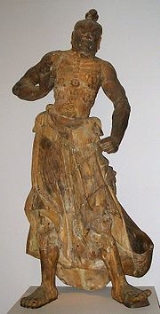
Kamakura period

Encyclopedia
The is a period of Japanese history
that marks the governance by the Kamakura Shogunate
, officially established in 1192 in Kamakura
by the first shogun
Minamoto no Yoritomo
.
The Kamakura period ended in 1333 with the destruction of the shogunate and the short reestablishment of imperial rule under Emperor Go-Daigo
by Ashikaga Takauji
, Nitta Yoshisada
, and Kusunoki Masashige
.
Once Minamoto Yoritomo had consolidated his power, he established a new government at his family home in Kamakura. He called his government a bakufu (幕府, tent government), but because he was given the ancient high military title Seii Tai-shōgun
by the Emperor, the government is often referred to in Western literature as the shogunate. Yoritomo followed the Fujiwara form of house government and had an administrative board , a board of retainers , and a board of inquiry (Monchūjo). After confiscating estates in central and western Japan, he appointed stewards
for the estates and constables
for the provinces. As shogun, Yoritomo was both the steward and the constable general. The Kamakura shogunate was not a national regime, however, and although it controlled large tracts of land, there was strong resistance to the stewards. The regime continued warfare against the Northern Fujiwara
, but never brought either the north or the west under complete military control. However, The 4th leader of the Northern Fujiwara Fujiwara no Yasuhira
was defeated by Yoritomo in 1189, and the 100-year long prosperity of the north disappeared. The old court resided in Kyoto
, continuing to hold the land over which it had jurisdiction, while newly organized military families were attracted to Kamakura.
 Despite a strong beginning, Yoritomo failed to consolidate the leadership of his family on a lasting basis. Intrafamily contention had long existed within the Minamoto, although Yoritomo had eliminated most serious challengers to his authority. When he died suddenly in 1199, his son Minamoto no Yoriie
became shogun and nominal head of the Minamoto, but Yoriie was unable to control the other eastern warrior families. By the early thirteenth century, a regency had been established for the shogun by Hōjō Tokimasa
—a member of the Hōjō clan
, a branch of the Taira that had allied itself with the Minamoto in 1180. The head of Hōjō was installed as the regent for the shogun is called the Shikken
in the period, although later positions were created with similar power such as Tokuso
and Rensho
. Often the Shikken was also the Tokuso and Rensho. Under the Hōjō, the shogun became a powerless figurehead.
With the protector of the Emperor (shogun) a figurehead himself, strains emerged between Kyoto and Kamakura, and in 1221 the Jōkyū War
broke out between the Cloistered Emperor Go-Toba
and the second regent Hōjō Yoshitoki
. The Hōjō forces easily won the war, and the imperial court was brought under the direct control of the shogunate. The shogun's constables gained greater civil powers, and the court was obliged to seek Kamakura's approval for all of its actions. Although deprived of political power, the court retained extensive estates.
Several significant administrative achievements were made during the Hōjō regency. In 1225 the third regent Hōjō Yasutoki
established the Council of State, providing opportunities for other military lords to exercise judicial and legislative authority at Kamakura. The Hōjō regent presided over the council, which was a successful form of collective leadership. The adoption of Japan's first military code of law—the Goseibai Shikimoku
—in 1232 reflected the profound transition from court to militarized society. While legal practices in Kyoto were still based on 500-year-old Confucian
principles, the new code was a highly legalistic document that stressed the duties of stewards and constables, provided means for settling land disputes, and established rules governing inheritance
s. It was clear and concise, stipulated punishments for violators of its conditions, and remained in effect for the next 635 years.
As might be expected, the literature of the time reflected the unsettled nature of the period. The Hōjōki
describes the turmoil of the period in terms of the Buddhist concepts of impermanence and the vanity of human projects. The Heike monogatari narrated the rise and fall of the Taira, replete with tales of wars and samurai deeds. A second literary mainstream was the continuation of anthologies of poetry in the Shin Kokin Wakashū, of which twenty volumes were produced between 1201 and 1205.
. Two new sects, Jōdo shū
and Zen
, dominated the period. The Mount Hiei
monasteries had become politically powerful but appealed primarily to those capable of systematic study of the sect's teachings, while the Shingon sect and its esoteric ritual continued to enjoy support largely from the noble families in Kyoto
. During this time, a number of monks who had left the Tendai
sect founded separate Buddhist sects of their own, including
The older Buddhist sects such as Shingon, Tendai
and the early schools of the Nara period
continued to thrive through the Kamakura period, and even experienced some measure of a revival. However, with the increasing popularity of the new Kamakura schools, the older schools partially eclipsed as the newer "Kamakura" schools found followers among the new Kamakura government, and its samurai
.
had been terminated in the mid-ninth century after the deterioration of late Tang Dynasty
China and the turning inward of the Heian court. Some commercial contacts were maintained with the Southern Song Dynasty of China in later centuries, but Japanese pirates
made the open seas dangerous. At a time when the shogunate had little interest in foreign affairs and ignored communications from China and the Goryeo
kingdom, news arrived in 1268 of a new Mongol regime in Beijing
. Its leader, Kublai Khan
, demanded that the Japanese pay tribute to the new Yuan Dynasty
and threatened reprisals if they failed to do so. Unused to such threats, Kyoto raised the diplomatic counter of Japan's divine origin, rejected the Mongol demands, dismissed the Korean messengers, and started defensive preparations.
After further unsuccessful entreaties, the first Mongol invasion took place in 1274. More than 600 ships carried a combined Mongol, Chinese, and Korean force of 23,000 troops armed with catapult
s, combustible missiles, and bows and arrows. In fighting, these soldiers grouped in close cavalry formations against samurai, who were accustomed to one-on-one combat. Local Japanese forces at Hakata
, on northern Kyūshū
, defended against the superior mainland force, which, after one day of fighting was destroyed by the onslaught of a sudden typhoon. Kublai realized that nature, not military incompetence, had been the cause of his forces' failure so, in 1281, he launched a second invasion. Seven weeks of fighting took place in northwestern Kyūshū before another typhoon struck, again destroying the Mongol fleet.
Although Shinto
priests attributed the two defeats of the Mongols to a "divine wind" or kamikaze
, a sign of heaven's special protection of Japan, the invasion left a deep impression on the shogunate leaders. Long-standing fears of the Chinese threat to Japan were reinforced. The Japanese victory, however, gave the warriors a sense of fighting superiority that remained with Japan's soldiers until 1945. The victory also convinced the warriors of the value of the shogunate form of government.
The Mongol war had been a drain on the economy, and new taxes had to be levied to maintain defensive preparations for the future. The invasions also caused disaffection among those who expected recompense for their help in defeating the Mongols. There were no lands or other rewards to be given, however, and such disaffection, combined with overextension and the increasing defense costs, led to a decline of the Kamakura bakufu. Additionally, inheritances had divided family properties, and landowners increasingly had to turn to moneylenders for support. Roving bands of ronin
further threatened the stability of the shogunate.
or junior line and the Northern Court or senior line—to alternate on the throne. The method worked for several successions until a member of the Southern Court ascended to the throne as Emperor Go-Daigo
. Go-Daigo wanted to overthrow the shogunate, and he openly defied Kamakura by naming his own son his heir. In 1331 the shogunate exiled Go-Daigo, but loyalist forces, including Kusunoki Masashige
, rebelled. They were aided by Ashikaga Takauji
, a constable who turned against Kamakura when dispatched to put down Go-Daigo's rebellion. At the same time, Nitta Yoshisada
, another eastern chieftain, rebelled against the shogunate, which quickly disintegrated, and the Hōjō were defeated.
In the swell of victory, Go-Daigo endeavored to restore imperial authority and tenth-century Confucian practices. This period of reform, known as the Kemmu restoration
, aimed at strengthening the position of the Emperor and reasserting the primacy of the court nobles over the warriors. The reality, however, was that the forces who had arisen against Kamakura had been set on defeating the Hōjō, not on supporting the Emperor. Ashikaga Takauji finally sided with the Northern Court in a civil war against the Southern Court represented by Go-Daigo. The long War Between the Courts lasted from 1336 to 1392. Early in the conflict, Go-Daigo was driven from Kyoto, and the Northern Court contender was installed by Ashikaga, who established a new line of shoguns.
History of Japan
The history of Japan encompasses the history of the islands of Japan and the Japanese people, spanning the ancient history of the region to the modern history of Japan as a nation state. Following the last ice age, around 12,000 BC, the rich ecosystem of the Japanese Archipelago fostered human...
that marks the governance by the Kamakura Shogunate
Kamakura shogunate
The Kamakura shogunate was a military dictatorship in Japan headed by the shoguns from 1185 to 1333. It was based in Kamakura. The Kamakura period draws its name from the capital of the shogunate...
, officially established in 1192 in Kamakura
Kamakura, Kanagawa
is a city located in Kanagawa Prefecture, Japan, about south-south-west of Tokyo. It used to be also called .Although Kamakura proper is today rather small, it is often described in history books as a former de facto capital of Japan as the seat of the Shogunate and of the Regency during the...
by the first shogun
Shogun
A was one of the hereditary military dictators of Japan from 1192 to 1867. In this period, the shoguns, or their shikken regents , were the de facto rulers of Japan though they were nominally appointed by the emperor...
Minamoto no Yoritomo
Minamoto no Yoritomo
was the founder and the first shogun of the Kamakura Shogunate of Japan. He ruled from 1192 until 1199.-Early life and exile :Yoritomo was the third son of Minamoto no Yoshitomo, heir of the Minamoto clan, and his official wife, a daughter of Fujiwara no Suenori, who was a member of the...
.
The Kamakura period ended in 1333 with the destruction of the shogunate and the short reestablishment of imperial rule under Emperor Go-Daigo
Emperor Go-Daigo
Emperor Go-Daigo was the 96th emperor of Japan, according to the traditional order of succession....
by Ashikaga Takauji
Ashikaga Takauji
was the founder and first shogun of the Ashikaga shogunate. His rule began in 1338, beginning the Muromachi period of Japan, and ended with his death in 1358...
, Nitta Yoshisada
Nitta Yoshisada
was the head of the Nitta family in the early fourteenth century, and supported the Southern Court of Emperor Go-Daigo in the Nanboku-chō period, capturing Kamakura from the Hōjō clan in 1333....
, and Kusunoki Masashige
Kusunoki Masashige
was a 14th century samurai who fought for Emperor Go-Daigo in his attempt to wrest rulership of Japan away from the Kamakura shogunate and is remembered as the ideal of samurai loyalty.-Tactician:...
.
Shogunate and Hōjō Regency
The Kamakura period marks the transition to land-based economies and a concentration of advanced military technologies in the hands of a specialized fighting class. Lords required the loyal services of vassals, who were rewarded with fiefs of their own. The fief holders exercised local military rule.Once Minamoto Yoritomo had consolidated his power, he established a new government at his family home in Kamakura. He called his government a bakufu (幕府, tent government), but because he was given the ancient high military title Seii Tai-shōgun
Shogun
A was one of the hereditary military dictators of Japan from 1192 to 1867. In this period, the shoguns, or their shikken regents , were the de facto rulers of Japan though they were nominally appointed by the emperor...
by the Emperor, the government is often referred to in Western literature as the shogunate. Yoritomo followed the Fujiwara form of house government and had an administrative board , a board of retainers , and a board of inquiry (Monchūjo). After confiscating estates in central and western Japan, he appointed stewards
Jito
were medieval land stewards in Japan, especially in the Kamakura and Muromachi Shogunates. Appointed by the shogun, jitō managed manors including national holdings governed by the provincial governor ....
for the estates and constables
Shugo
was a title, commonly translated as "Governor," given to certain officials in feudal Japan. They were each appointed by the shogun to oversee one or more of the provinces of Japan...
for the provinces. As shogun, Yoritomo was both the steward and the constable general. The Kamakura shogunate was not a national regime, however, and although it controlled large tracts of land, there was strong resistance to the stewards. The regime continued warfare against the Northern Fujiwara
Northern Fujiwara
The Northern Fujiwara were a Japanese noble family that ruled the Tōhoku region of Japan from the 12th to the 13th centuries as if it were their own realm. They succeeded the semi-independent Emishi families of the 11th century who were gradually brought down by the Minamoto clan loyal to the...
, but never brought either the north or the west under complete military control. However, The 4th leader of the Northern Fujiwara Fujiwara no Yasuhira
Fujiwara no Yasuhira
was the fourth ruler of Northern Fujiwara in Mutsu Province, Japan, the second son of Hidehira. Against his father's will, he first hid Yoshitsune in escape but later killed him, fearing the possibility of Yoritomo's intervention...
was defeated by Yoritomo in 1189, and the 100-year long prosperity of the north disappeared. The old court resided in Kyoto
Kyoto
is a city in the central part of the island of Honshū, Japan. It has a population close to 1.5 million. Formerly the imperial capital of Japan, it is now the capital of Kyoto Prefecture, as well as a major part of the Osaka-Kobe-Kyoto metropolitan area.-History:...
, continuing to hold the land over which it had jurisdiction, while newly organized military families were attracted to Kamakura.
Minamoto no Yoriie
was the second shogun of Japan's Kamakura shogunate, and the first son of first shogun Yoritomo.- Life :Born from Tokimasa's daughter Hōjō Masako at Hiki Yoshikazu's residence in Kamakura, Yoriie had as wet nurses the wives of powerful men like Hiki himself and Kajiwara Kagetoki, and Hiki's...
became shogun and nominal head of the Minamoto, but Yoriie was unable to control the other eastern warrior families. By the early thirteenth century, a regency had been established for the shogun by Hōjō Tokimasa
Hojo Tokimasa
was the first Hōjō shikken of the Kamakura bakufu and head of the Hōjō clan. He was shikken from the death of Minamoto no Yoritomo in 1199 until his abdication in 1205.- Background: The Hōjō Clan :...
—a member of the Hōjō clan
Hojo clan
See the late Hōjō clan for the Hōjō clan of the Sengoku Period.The in the history of Japan was a family who controlled the hereditary title of shikken of the Kamakura Shogunate. In practice, the family had actual governmental power, many times dictatorial, rather than Kamakura shoguns, or the...
, a branch of the Taira that had allied itself with the Minamoto in 1180. The head of Hōjō was installed as the regent for the shogun is called the Shikken
Shikken
The was the regent for the shogun in the Kamakura shogunate in Japan. The post was monopolized by the Hōjō clan, and this system only existed once in Japanese history, between 1203 and 1333...
in the period, although later positions were created with similar power such as Tokuso
Tokuso
Tokusō was the title held by the head of the mainline Hōjō clan, who monopolized the position of shikken of the Kamakura shogunate in Japan....
and Rensho
Rensho
The , literally “co-signatory”, was the assistant to the shikken of the Kamakura shogunate in Japan.The rensho placed his signature next to that of the shikken on official orders. In 1224 the third shikken Hōjō Yasutoki appointed Hōjō Tokifusa as the first rensho...
. Often the Shikken was also the Tokuso and Rensho. Under the Hōjō, the shogun became a powerless figurehead.
With the protector of the Emperor (shogun) a figurehead himself, strains emerged between Kyoto and Kamakura, and in 1221 the Jōkyū War
Jokyu War
', also known as the Jōkyū Disturbance or the Jōkyū Rebellion, was fought in Japan between the forces of Retired Emperor Go-Toba and those of the Hōjō clan, regents of the Kamakura shogunate, whom the retired emperor was trying to overthrow....
broke out between the Cloistered Emperor Go-Toba
Emperor Go-Toba
was the 82nd emperor of Japan, according to the traditional order of succession. His reign spanned the years from 1183 through 1198....
and the second regent Hōjō Yoshitoki
Hojo Yoshitoki
was the second Hōjō shikken of the Kamakura shogunate and head of the Hōjō clan. He was the eldest son of Hōjō Tokimasa and his wife Hōjō no Maki...
. The Hōjō forces easily won the war, and the imperial court was brought under the direct control of the shogunate. The shogun's constables gained greater civil powers, and the court was obliged to seek Kamakura's approval for all of its actions. Although deprived of political power, the court retained extensive estates.
Several significant administrative achievements were made during the Hōjō regency. In 1225 the third regent Hōjō Yasutoki
Hojo Yasutoki
Hōjō Yasutoki was the third shikken of the Kamakura shogunate in Japan. He strengthened the political system of the Hōjō regency.He was the eldest son of second shikken Yoshitoki...
established the Council of State, providing opportunities for other military lords to exercise judicial and legislative authority at Kamakura. The Hōjō regent presided over the council, which was a successful form of collective leadership. The adoption of Japan's first military code of law—the Goseibai Shikimoku
Goseibai Shikimoku
The Goseibai Shikimoku or the Formulary of Adjudications was the legal code of the Kamakura shogunate in Japan, promulgated by third shikken Hōjō Yasutoki in 1232. It is also called Jōei Shikimoku after the era name....
—in 1232 reflected the profound transition from court to militarized society. While legal practices in Kyoto were still based on 500-year-old Confucian
Confucianism
Confucianism is a Chinese ethical and philosophical system developed from the teachings of the Chinese philosopher Confucius . Confucianism originated as an "ethical-sociopolitical teaching" during the Spring and Autumn Period, but later developed metaphysical and cosmological elements in the Han...
principles, the new code was a highly legalistic document that stressed the duties of stewards and constables, provided means for settling land disputes, and established rules governing inheritance
Inheritance
Inheritance is the practice of passing on property, titles, debts, rights and obligations upon the death of an individual. It has long played an important role in human societies...
s. It was clear and concise, stipulated punishments for violators of its conditions, and remained in effect for the next 635 years.
As might be expected, the literature of the time reflected the unsettled nature of the period. The Hōjōki
Hojoki
, variously translated as "An Account of My Hut" or "The Ten Foot Square Hut", is an important short work of the Kamakura period in Japan by Kamo no Chōmei. Written in 1212, it describes disasters that befall the people of Kyoto from earthquakes to famine and fire...
describes the turmoil of the period in terms of the Buddhist concepts of impermanence and the vanity of human projects. The Heike monogatari narrated the rise and fall of the Taira, replete with tales of wars and samurai deeds. A second literary mainstream was the continuation of anthologies of poetry in the Shin Kokin Wakashū, of which twenty volumes were produced between 1201 and 1205.
Flourishing of Buddhism
In the time of disunity and violence, deepening pessimism increased the appeal of the search for salvation. Kamakura was the age of the great popularization of BuddhismBuddhism
Buddhism is a religion and philosophy encompassing a variety of traditions, beliefs and practices, largely based on teachings attributed to Siddhartha Gautama, commonly known as the Buddha . The Buddha lived and taught in the northeastern Indian subcontinent some time between the 6th and 4th...
. Two new sects, Jōdo shū
Jodo Shu
, also known as Jōdo Buddhism, is a branch of Pure Land Buddhism derived from the teachings of the Japanese ex-Tendai monk Hōnen. It was established in 1175 and is the most widely practiced branch of Buddhism in Japan, along with Jōdo Shinshū....
and Zen
Zen
Zen is a school of Mahāyāna Buddhism founded by the Buddhist monk Bodhidharma. The word Zen is from the Japanese pronunciation of the Chinese word Chán , which in turn is derived from the Sanskrit word dhyāna, which can be approximately translated as "meditation" or "meditative state."Zen...
, dominated the period. The Mount Hiei
Mount Hiei
is a mountain to the northeast of Kyoto, lying on the border between the Kyoto and Shiga prefectures, Japan.The temple of Enryaku-ji, the first outpost of the Japanese Tiantai sect of Buddhism, was founded atop Mount Hiei by Saichō in 788. Both Nichiren and Honen studied at the temple before...
monasteries had become politically powerful but appealed primarily to those capable of systematic study of the sect's teachings, while the Shingon sect and its esoteric ritual continued to enjoy support largely from the noble families in Kyoto
Kyoto
is a city in the central part of the island of Honshū, Japan. It has a population close to 1.5 million. Formerly the imperial capital of Japan, it is now the capital of Kyoto Prefecture, as well as a major part of the Osaka-Kobe-Kyoto metropolitan area.-History:...
. During this time, a number of monks who had left the Tendai
Tendai
is a Japanese school of Mahayana Buddhism, a descendant of the Chinese Tiantai or Lotus Sutra school.Chappell frames the relevance of Tendai for a universal Buddhism:- History :...
sect founded separate Buddhist sects of their own, including
- Hōnen, founder of Japanese Pure LandPure landA pure land, in Mahayana Buddhism, is the celestial realm or pure abode of a Buddha or Bodhisattva. The various traditions that focus on Pure Lands have been given the nomenclature Pure Land Buddhism. Pure lands are also evident in the literature and traditions of Taoism and Bön.The notion of 'pure...
Buddhism or Jōdo shūJodo Shu, also known as Jōdo Buddhism, is a branch of Pure Land Buddhism derived from the teachings of the Japanese ex-Tendai monk Hōnen. It was established in 1175 and is the most widely practiced branch of Buddhism in Japan, along with Jōdo Shinshū....
. - ShinranShinranwas a Japanese Buddhist monk, who was born in Hino at the turbulent close of the Heian Period and lived during the Kamakura Period...
, disciple of Hōnen and founder of Jōdo ShinshūJodo Shinshu, also known as Shin Buddhism, is a school of Pure Land Buddhism. It was founded by the former Tendai Japanese monk Shinran. Today, Shin Buddhism is considered the most widely practiced branch of Buddhism in Japan.-Shinran :...
sect. - IppenIppenIppen Shonin , also known as Zuien, was a Japanese Buddhist itinerant preacher who founded the Ji branch of Pure Land Buddhism....
, founder of the Ji sect, which emphasized devotion to Amida Buddha through an ecstatic dance. - DōgenDogenDōgen Zenji was a Japanese Zen Buddhist teacher born in Kyōto, and the founder of the Sōtō school of Zen in Japan after travelling to China and training under the Chinese Caodong lineage there...
, founder of the SōtōSotoSōtō Zen , or is, with Rinzai and Ōbaku, one of the three most populous sects of Zen in Japanese Buddhism.The Sōtō sect was first established as the Caodong sect during the Tang Dynasty in China by Dongshan Liangjie in the 9th century, which Dōgen Zenji then brought to Japan in the 13th century...
school of Zen. - EisaiEisaiMyōan Eisai was a Japanese Buddhist priest, credited with bringing the Rinzai school of Zen Buddhism and green tea from China to Japan. He is often known simply as Eisai Zenji , literally "Zen master Eisai"....
, founder of the RinzaiRinzai schoolThe Rinzai school is , one of three sects of Zen in Japanese Buddhism.Rinzai is the Japanese line of the Chinese Linji school, which was founded during the Tang Dynasty by Linji Yixuan...
school of Zen. - NichirenNichirenNichiren was a Buddhist monk who lived during the Kamakura period in Japan. Nichiren taught devotion to the Lotus Sutra, entitled Myōhō-Renge-Kyō in Japanese, as the exclusive means to attain enlightenment and the chanting of Nam-Myōhō-Renge-Kyō as the essential practice of the teaching...
, founder of the Nichiren SectNichiren BuddhismNichiren Buddhism is a branch of Mahāyāna Buddhism based on the teachings of the 13th century Japanese monk Nichiren...
, which emphasized devotion to the Lotus SutraLotus SutraThe Lotus Sūtra is one of the most popular and influential Mahāyāna sūtras, and the basis on which the Tiantai and Nichiren sects of Buddhism were established.-Title:...
itself.
The older Buddhist sects such as Shingon, Tendai
Tendai
is a Japanese school of Mahayana Buddhism, a descendant of the Chinese Tiantai or Lotus Sutra school.Chappell frames the relevance of Tendai for a universal Buddhism:- History :...
and the early schools of the Nara period
Nara period
The of the history of Japan covers the years from AD 710 to 794. Empress Gemmei established the capital of Heijō-kyō . Except for 5 years , when the capital was briefly moved again, it remained the capital of Japanese civilization until Emperor Kammu established a new capital, Nagaoka-kyō, in 784...
continued to thrive through the Kamakura period, and even experienced some measure of a revival. However, with the increasing popularity of the new Kamakura schools, the older schools partially eclipsed as the newer "Kamakura" schools found followers among the new Kamakura government, and its samurai
Samurai
is the term for the military nobility of pre-industrial Japan. According to translator William Scott Wilson: "In Chinese, the character 侍 was originally a verb meaning to wait upon or accompany a person in the upper ranks of society, and this is also true of the original term in Japanese, saburau...
.
Mongol Invasions
The repulsions of two Mongol invasions were momentous events in Japanese history. Japanese relations with ChinaChina
Chinese civilization may refer to:* China for more general discussion of the country.* Chinese culture* Greater China, the transnational community of ethnic Chinese.* History of China* Sinosphere, the area historically affected by Chinese culture...
had been terminated in the mid-ninth century after the deterioration of late Tang Dynasty
Tang Dynasty
The Tang Dynasty was an imperial dynasty of China preceded by the Sui Dynasty and followed by the Five Dynasties and Ten Kingdoms Period. It was founded by the Li family, who seized power during the decline and collapse of the Sui Empire...
China and the turning inward of the Heian court. Some commercial contacts were maintained with the Southern Song Dynasty of China in later centuries, but Japanese pirates
Wokou
Wokou , which literally translates as "Japanese pirates" in English, were pirates of varying origins who raided the coastlines of China and Korea from the 13th century onwards...
made the open seas dangerous. At a time when the shogunate had little interest in foreign affairs and ignored communications from China and the Goryeo
Goryeo
The Goryeo Dynasty or Koryŏ was a Korean dynasty established in 918 by Emperor Taejo. Korea gets its name from this kingdom which came to be pronounced Korea. It united the Later Three Kingdoms in 936 and ruled most of the Korean peninsula until it was removed by the Joseon dynasty in 1392...
kingdom, news arrived in 1268 of a new Mongol regime in Beijing
Beijing
Beijing , also known as Peking , is the capital of the People's Republic of China and one of the most populous cities in the world, with a population of 19,612,368 as of 2010. The city is the country's political, cultural, and educational center, and home to the headquarters for most of China's...
. Its leader, Kublai Khan
Kublai Khan
Kublai Khan , born Kublai and also known by the temple name Shizu , was the fifth Great Khan of the Mongol Empire from 1260 to 1294 and the founder of the Yuan Dynasty in China...
, demanded that the Japanese pay tribute to the new Yuan Dynasty
Yuan Dynasty
The Yuan Dynasty , or Great Yuan Empire was a ruling dynasty founded by the Mongol leader Kublai Khan, who ruled most of present-day China, all of modern Mongolia and its surrounding areas, lasting officially from 1271 to 1368. It is considered both as a division of the Mongol Empire and as an...
and threatened reprisals if they failed to do so. Unused to such threats, Kyoto raised the diplomatic counter of Japan's divine origin, rejected the Mongol demands, dismissed the Korean messengers, and started defensive preparations.
After further unsuccessful entreaties, the first Mongol invasion took place in 1274. More than 600 ships carried a combined Mongol, Chinese, and Korean force of 23,000 troops armed with catapult
Catapult
A catapult is a device used to throw or hurl a projectile a great distance without the aid of explosive devices—particularly various types of ancient and medieval siege engines. Although the catapult has been used since ancient times, it has proven to be one of the most effective mechanisms during...
s, combustible missiles, and bows and arrows. In fighting, these soldiers grouped in close cavalry formations against samurai, who were accustomed to one-on-one combat. Local Japanese forces at Hakata
Hakata-ku, Fukuoka
is one of the seven wards of Fukuoka City, Fukuoka Prefecture, Japan. It is best known as the location of Fukuoka's main train station, Hakata Station.-Geography:...
, on northern Kyūshū
Kyushu
is the third largest island of Japan and most southwesterly of its four main islands. Its alternate ancient names include , , and . The historical regional name is referred to Kyushu and its surrounding islands....
, defended against the superior mainland force, which, after one day of fighting was destroyed by the onslaught of a sudden typhoon. Kublai realized that nature, not military incompetence, had been the cause of his forces' failure so, in 1281, he launched a second invasion. Seven weeks of fighting took place in northwestern Kyūshū before another typhoon struck, again destroying the Mongol fleet.
Although Shinto
Shinto
or Shintoism, also kami-no-michi, is the indigenous spirituality of Japan and the Japanese people. It is a set of practices, to be carried out diligently, to establish a connection between present day Japan and its ancient past. Shinto practices were first recorded and codified in the written...
priests attributed the two defeats of the Mongols to a "divine wind" or kamikaze
Kamikaze (typhoon)
The Kamikaze , were two winds or storms that are said to have saved Japan from two Mongol fleets under Kublai Khan. These fleets attacked Japan in 1274 and again in 1281...
, a sign of heaven's special protection of Japan, the invasion left a deep impression on the shogunate leaders. Long-standing fears of the Chinese threat to Japan were reinforced. The Japanese victory, however, gave the warriors a sense of fighting superiority that remained with Japan's soldiers until 1945. The victory also convinced the warriors of the value of the shogunate form of government.
The Mongol war had been a drain on the economy, and new taxes had to be levied to maintain defensive preparations for the future. The invasions also caused disaffection among those who expected recompense for their help in defeating the Mongols. There were no lands or other rewards to be given, however, and such disaffection, combined with overextension and the increasing defense costs, led to a decline of the Kamakura bakufu. Additionally, inheritances had divided family properties, and landowners increasingly had to turn to moneylenders for support. Roving bands of ronin
Ronin
A or rounin was a Bushi with no lord or master during the feudal period of Japan. A samurai became masterless from the death or fall of his master, or after the loss of his master's favor or privilege....
further threatened the stability of the shogunate.
Civil War
The Hōjō reacted to the ensuing chaos by trying to place more power among the various great family clans. To further weaken the Kyoto court, the bakufu decided to allow two contending imperial lines—known as the Southern CourtSouthern Court
The were a set of four emperors whose legitimate claims were usurped during the Nanboku-chō period spanning from 1336 through 1392. In spite of the legitimacy of its claims to the throne, the Southern Court was permanently replaced in 1392 by the illegitimate Northern Court.-Nanboku-chō overview:...
or junior line and the Northern Court or senior line—to alternate on the throne. The method worked for several successions until a member of the Southern Court ascended to the throne as Emperor Go-Daigo
Emperor Go-Daigo
Emperor Go-Daigo was the 96th emperor of Japan, according to the traditional order of succession....
. Go-Daigo wanted to overthrow the shogunate, and he openly defied Kamakura by naming his own son his heir. In 1331 the shogunate exiled Go-Daigo, but loyalist forces, including Kusunoki Masashige
Kusunoki Masashige
was a 14th century samurai who fought for Emperor Go-Daigo in his attempt to wrest rulership of Japan away from the Kamakura shogunate and is remembered as the ideal of samurai loyalty.-Tactician:...
, rebelled. They were aided by Ashikaga Takauji
Ashikaga Takauji
was the founder and first shogun of the Ashikaga shogunate. His rule began in 1338, beginning the Muromachi period of Japan, and ended with his death in 1358...
, a constable who turned against Kamakura when dispatched to put down Go-Daigo's rebellion. At the same time, Nitta Yoshisada
Nitta Yoshisada
was the head of the Nitta family in the early fourteenth century, and supported the Southern Court of Emperor Go-Daigo in the Nanboku-chō period, capturing Kamakura from the Hōjō clan in 1333....
, another eastern chieftain, rebelled against the shogunate, which quickly disintegrated, and the Hōjō were defeated.
In the swell of victory, Go-Daigo endeavored to restore imperial authority and tenth-century Confucian practices. This period of reform, known as the Kemmu restoration
Kemmu restoration
The is the name given to both the three year period of Japanese history between the Kamakura period and the Muromachi period, and the political events that took place in it...
, aimed at strengthening the position of the Emperor and reasserting the primacy of the court nobles over the warriors. The reality, however, was that the forces who had arisen against Kamakura had been set on defeating the Hōjō, not on supporting the Emperor. Ashikaga Takauji finally sided with the Northern Court in a civil war against the Southern Court represented by Go-Daigo. The long War Between the Courts lasted from 1336 to 1392. Early in the conflict, Go-Daigo was driven from Kyoto, and the Northern Court contender was installed by Ashikaga, who established a new line of shoguns.
Events
- 1185: the rival Taira clan is defeated at sea at the Battle of Dannoura by Yoritomo's brother Minamoto Yoshitsune,
- 1192: The emperor appoints Yoritomo as shogunShogunA was one of the hereditary military dictators of Japan from 1192 to 1867. In this period, the shoguns, or their shikken regents , were the de facto rulers of Japan though they were nominally appointed by the emperor...
(military leader) with a residence in KamakuraKamakura, Kanagawais a city located in Kanagawa Prefecture, Japan, about south-south-west of Tokyo. It used to be also called .Although Kamakura proper is today rather small, it is often described in history books as a former de facto capital of Japan as the seat of the Shogunate and of the Regency during the...
, establishing the bakufu system of government - 1199: Minamoto Yoritomo dies
- 1207: Hōnen and his followers are exiled from Kyoto or executed. This inadvertently spread the Pure LandPure landA pure land, in Mahayana Buddhism, is the celestial realm or pure abode of a Buddha or Bodhisattva. The various traditions that focus on Pure Lands have been given the nomenclature Pure Land Buddhism. Pure lands are also evident in the literature and traditions of Taoism and Bön.The notion of 'pure...
doctrine to a wider audience. - 1221: The Kamakura army defeats the imperial army in the Jōkyū DisturbanceJokyu War', also known as the Jōkyū Disturbance or the Jōkyū Rebellion, was fought in Japan between the forces of Retired Emperor Go-Toba and those of the Hōjō clan, regents of the Kamakura shogunate, whom the retired emperor was trying to overthrow....
, thereby asserting the supremacy of the Kamakura shogunateKamakura shogunateThe Kamakura shogunate was a military dictatorship in Japan headed by the shoguns from 1185 to 1333. It was based in Kamakura. The Kamakura period draws its name from the capital of the shogunate...
(Hōjō regentsHojo clanSee the late Hōjō clan for the Hōjō clan of the Sengoku Period.The in the history of Japan was a family who controlled the hereditary title of shikken of the Kamakura Shogunate. In practice, the family had actual governmental power, many times dictatorial, rather than Kamakura shoguns, or the...
) over the emperor - 1227: The SōtōSotoSōtō Zen , or is, with Rinzai and Ōbaku, one of the three most populous sects of Zen in Japanese Buddhism.The Sōtō sect was first established as the Caodong sect during the Tang Dynasty in China by Dongshan Liangjie in the 9th century, which Dōgen Zenji then brought to Japan in the 13th century...
sect of Zen Buddhism is introduced to Japan by the monk Dōgen Zenji - 1232: The Jōei Shikimoku code of law is promulgated to enhance control by the Hōjō regents
- 1274: The MongolsMongolsMongols ) are a Central-East Asian ethnic group that lives mainly in the countries of Mongolia, China, and Russia. In China, ethnic Mongols can be found mainly in the central north region of China such as Inner Mongolia...
of Kublai KhanKublai KhanKublai Khan , born Kublai and also known by the temple name Shizu , was the fifth Great Khan of the Mongol Empire from 1260 to 1294 and the founder of the Yuan Dynasty in China...
try to invade Japan but are repelled by a typhoon. - 1274: NichirenNichirenNichiren was a Buddhist monk who lived during the Kamakura period in Japan. Nichiren taught devotion to the Lotus Sutra, entitled Myōhō-Renge-Kyō in Japanese, as the exclusive means to attain enlightenment and the chanting of Nam-Myōhō-Renge-Kyō as the essential practice of the teaching...
is banished to Sado Island - 1293: On May 27, a major earthquakeEarthquakeAn earthquake is the result of a sudden release of energy in the Earth's crust that creates seismic waves. The seismicity, seismism or seismic activity of an area refers to the frequency, type and size of earthquakes experienced over a period of time...
and tsunamiTsunamiA tsunami is a series of water waves caused by the displacement of a large volume of a body of water, typically an ocean or a large lake...
hit Sagami BaySagami BaySagami Bay , also known as the Sagami Gulf or Sagami Sea, lies south of Kanagawa Prefecture in Honshū, central Japan, contained within the scope of the Miura Peninsula, in Kanagawa, to the east, the Izu Peninsula, in Shizuoka Prefecture, to the west, and the Shōnan coastline to the north, while the...
and KamakuraKamakura, Kanagawais a city located in Kanagawa Prefecture, Japan, about south-south-west of Tokyo. It used to be also called .Although Kamakura proper is today rather small, it is often described in history books as a former de facto capital of Japan as the seat of the Shogunate and of the Regency during the...
, killing 23,034 people. It followed a 1241 and 1257 earthquake/tsunami in the same general area, which both were magnitude 7.0. - 1333: Nitta YoshisadaNitta Yoshisadawas the head of the Nitta family in the early fourteenth century, and supported the Southern Court of Emperor Go-Daigo in the Nanboku-chō period, capturing Kamakura from the Hōjō clan in 1333....
conquers and destroys Kamakura during the Siege of KamakuraSiege of Kamakura (1333)The 1333 siege of Kamakura was a battle of the Genkō War, and marked the end of the power of the Hōjō clan, which had dominated the regency of the Kamakura shogunate for over a century...
ending the Kamakura ShogunateKamakura shogunateThe Kamakura shogunate was a military dictatorship in Japan headed by the shoguns from 1185 to 1333. It was based in Kamakura. The Kamakura period draws its name from the capital of the shogunate...
.