

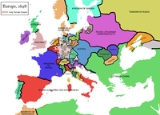
Thirty Years' War

Encyclopedia
The Thirty Years' War (1618–1648) was fought primarily in what is now Germany
, and at various points involved most countries in Europe. It was one of the most destructive conflicts in European history
.
The origins of the conflict
and goals of the participants were complex, and no single cause can accurately be described as the main reason for the fighting. Initially, the war was fought largely as a religious conflict
between Protestants
and Catholics in the Holy Roman Empire
, although disputes over the internal politics and balance of power within the Empire played a significant part. Gradually, the war developed into a more general conflict involving most of the European powers. In this general phase, the war became more a continuation of the Bourbon–Habsburg rivalry for European political pre-eminence, and in turn led to further warfare between France and the Habsburg
powers, and less specifically about religion.
A major impact of the Thirty Years' War was the extensive destruction of entire regions, denuded by the foraging armies (bellum se ipsum alet
). Episodes of famine and disease significantly decreased the populace of the German states, Bohemia
, the Low Countries
and Italy
, while bankrupting most of the combatant powers. While the regiments within each army were not strictly mercenary
in that they were not guns for hire that changed sides from battle to battle, the individual soldiers that made up the regiments for the most part probably were. The problem of discipline was made more difficult still by the ad hoc nature of 17th-century military financing. Armies were expected to be largely self-funding from loot taken or tribute extorted from the settlements where they operated. This encouraged a form of lawlessness that imposed often severe hardship on inhabitants of the occupied territory. Some of the quarrels that provoked the war went unresolved for a much longer time. The Thirty Years' War was ended with the treaties of Osnabrück
and Münster
, part of the wider Peace of Westphalia
.
(1555), signed by Charles V, Holy Roman Emperor
, confirmed the result of the 1526 Diet of Speyer
, ending war between German Lutherans and Catholics.
Although the Peace of Augsburg created a temporary end to hostilities, it did not solve the underlying religious conflict. In addition, Calvinism
spread quickly throughout Germany in the years that followed. This added a third major faith to the region, but its position was not recognized in any way by the Augsburg terms, to which only Catholicism and Lutheranism were parties.
The rulers of the nations neighboring the Holy Roman Empire also contributed to the outbreak of the Thirty Years' War:
The Holy Roman Empire
was a fragmented collection of largely independent states. The position of Holy Roman Emperor was mainly titular, but the emperors, from the House of Habsburg, also directly ruled a large portion of Imperial territory (the Archduchy of Austria
, as well as Bohemia
and Hungary
). The Austrian domain was thus a major European power in its own right, ruling over some eight million subjects. The Empire also contained several regional powers, such as Bavaria
, Electoral Saxony, the Margravate of Brandenburg, the Palatinate, Hesse
, the Archbishopric of Trier
and Württemberg
(containing from 500,000 to one million inhabitants). A vast number of minor independent duchies, free cities
, abbeys, prince-bishoprics, and petty lordships (whose authority sometimes extended to no more than a single village) rounded out the Empire. Apart from Austria and perhaps Bavaria, none of those entities was capable of national-level politics; alliances between family-related states were common, due partly to the frequent practice of splitting a lord's inheritance among the various sons.
Religious tensions remained strong throughout the second half of the 16th century. The Peace of Augsburg began to unravel, as some converted bishops refused to give up their bishoprics
, and as certain Habsburg and other Catholic rulers of the Holy Roman Empire and Spain sought to restore the power of Catholicism in the region. This was evident from the Cologne War
(1583–88), a conflict initiated when the prince-archbishop of the city, Gebhard Truchsess von Waldburg
, converted to Calvinism. As he was an imperial elector, this could have produced a Protestant majority in the College that elected the Holy Roman Emperor – a position that had always been held by a Catholic.
In the Cologne War, Spanish troops expelled the former prince-archbishop and replaced him with Ernst of Bavaria, a Roman Catholic. After this success, the Catholics regained pace, and the principle of cuius regio, eius religio began to be exerted more strictly in Bavaria, Würzburg
and other states. This forced Lutheran residents to choose between conversion or exile. Lutherans also witnessed the defection of the lords of the Palatinate (1560), Nassau (1578), Hesse-Kassel (1603) and Brandenburg (1613) to the new Calvinist faith. Thus, at the beginning of the 17th century, the Rhine lands and those south to the Danube
were largely Catholic, while Lutherans predominated in the north, and Calvinists dominated in certain other areas, such as west-central Germany, Switzerland and the Netherlands. However, minorities of each creed existed almost everywhere. In some lordships and cities, the number of Calvinists, Catholics, and Lutherans were approximately equal.
Much to the consternation of their Spanish ruling cousins, the Habsburg emperors who followed Charles V
(especially Ferdinand I
and Maximilian II
, but also Rudolf II
, and his successor Matthias
) were content for the princes of the Empire to choose their own religious policies. These rulers avoided religious wars within the empire by allowing the different Christian faiths to spread without coercion. This angered those who sought religious uniformity. Meanwhile, Sweden and Denmark, both Lutheran kingdoms, sought to assist the Protestant cause in the Empire, and also wanted to gain political and economic influence there, as well.
Religious tensions broke into violence in the German free city
of Donauwörth
in 1606. There, the Lutheran majority barred the Catholic residents of the Swabia
n town from holding a procession, which provoked a riot. This prompted foreign intervention by Duke Maximilian of Bavaria
(1573–1651) on behalf of the Catholics. After the violence ceased, Calvinists in Germany (who remained a minority) felt the most threatened. They banded together and formed the League of Evangelical Union in 1608, under the leadership of the Palatine Prince-Elector
Frederick IV
(1583–1610), (whose son, Frederick V
, married Elizabeth Stuart
, the daughter of James I of England
). The establishment of the League prompted the Catholics into banding together to form the Catholic League
in 1609, under the leadership of Duke Maximilian.
 Tensions escalated further in 1609, with the War of the Jülich succession
, which began when John William, Duke of Jülich-Cleves-Berg
, the ruler of the strategically important United Duchies of Jülich-Cleves-Berg, died childless. There were two rival claimants to the duchy. The first was Duchess Anna of Prussia, daughter of Duke John William's eldest sister, Marie Eleonore of Cleves
. Anna was married to John Sigismund, Elector of Brandenburg
. The second was Wolfgang William, Count Palatine of Neuburg, who was the son of Duke John William's second eldest sister, Anna of Cleves. Duchess Anna of Prussia claimed Jülich-Cleves-Berg as the heir to the senior line, while Wolfgang William, Count Palatine of Neuburg claimed Jülich-Cleves-Berg as Duke John William's eldest male heir. Both claimants were Protestants. In 1610, to prevent war between the rival claimants, the forces of Rudolf II, Holy Roman Emperor
occupied Jülich-Cleves-Berg until the dispute was decided by the Aulic Council
(Reichshofrat). However, several Protestant princes feared the Emperor, a devout Catholic, intended to keep Jülich-Cleves-Berg for himself to prevent the United Duchies falling into Protestant hands. Representatives of Henry IV of France
and the Dutch Republic
gathered forces to invade Jülich-Cleves-Berg, but these plans were cut short by the assassination of Henry IV. Hoping to gain an advantage in the dispute, Wolfgang William, Count Palatine of Neuburg converted to Catholicism; John Sigismund, Elector of Brandenburg
, on the other hand, converted to Calvinism (although Duchess Anna of Prussia stayed Lutheran). The dispute was settled in 1614 with the Treaty of Xanten
, by which the United Duchies were dismantled: Jülich
and Berg
were awarded to Wolfgang William, while the Elector of Brandenburg gained Cleves
, Mark, and Ravensberg.
The background of the Dutch Revolt
is also necessary to understanding the events leading up to the Thirty Years' War. It was widely known that the Twelve Years' Truce
was set to expire in 1621, and throughout Europe it was recognized that at that time, Spain
would attempt to reconquer the Dutch Republic
. At that time, forces under Ambrogio Spinola, 1st Marquis of the Balbases, the Genoese
commander of the Spanish army, would be able to pass through friendly territories to reach the Dutch Republic; the only hostile state that stood in his way was the Electoral Palatinate. (Spinola's preferred route would take him through the Republic of Genoa
, the Duchy of Milan
, through the Val Telline, around hostile Switzerland
bypassing along the north shore of Lake Constance
, then through Alsace
, the Archbishopric of Strasbourg
, then through the Electoral Palatinate, and then finally through the Archbishopric of Trier
, Jülich
and Berg
and on to the Dutch Republic). The Electoral Palatinate thus assumed a strategic importance in European affairs out of all proportion to its size. This explains why the Protestant James I of England
arranged for the marriage of his daughter Elizabeth Stuart
to Frederick V, Elector Palatine
in 1612, in spite of the social convention that a princess would only marry another royal.
By 1617, it was apparent that Matthias, Holy Roman Emperor
and King of Bohemia
, would die without an heir, with his lands going to his nearest male relative, his cousin Archduke Ferdinand II of Austria
, heir-apparent and Crown Prince of Bohemia. With the Oñate treaty
, Philip III of Spain
agreed to this succession.
Ferdinand, having been educated by the Jesuits
, was a staunch Catholic who wanted to impose religious uniformity on his lands. This made him highly unpopular in Protestant (primarily Hussite
) Bohemia. The population's sentiments notwithstanding, the added insult of the nobility
's rejection of Ferdinand, who had been elected Bohemian Crown Prince in 1617, triggered the Thirty Years' War in 1618, when his representatives were thrown out of a window into a pile of horse manure. The so-called Defenestration of Prague provoked open revolt in Bohemia, which had powerful foreign allies. Ferdinand was quite upset by this calculated insult, but his intolerant policies in his own lands had left him in a weak position. The Habsburg cause in the next few years would seem to suffer unrecoverable reverses. The Protestant cause seemed to wax toward a quick overall victory.
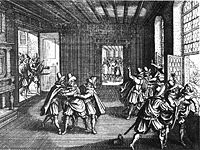 Without heirs, Emperor Matthias
sought to assure an orderly transition during his lifetime by having his dynastic heir (the fiercely Catholic Ferdinand of Styria, later Ferdinand II, Holy Roman Emperor
) elected to the separate royal thrones of Bohemia
and Hungary. Some of the Protestant leaders of Bohemia feared they would be losing the religious rights granted to them by Emperor Rudolf II in his Letter of Majesty. They preferred the Protestant Frederick V, elector of the Palatinate
(successor of Frederick IV
, the creator of the League of Evangelical Union). However, other Protestants supported the stance taken by the Catholics, and in 1617, Ferdinand was duly elected by the Bohemian estates
to become the Crown Prince, and automatically upon the death of Matthias, the next King of Bohemia.
The king-elect then sent two Catholic councillors (Vilem Slavata of Chlum
and Jaroslav Borzita of Martinice) as his representatives to Hradčany
castle
in Prague
in May 1618. Ferdinand had wanted them to administer the government in his absence. On 23 May 1618, an assembly of Protestants seized them and threw them out of the palace window, which was some 21 meters off the ground. Remarkably, they survived unharmed as they landed in a horse manure pile. This event, known as the (Second) Defenestration of Prague, started the Bohemian Revolt. Soon afterward, the Bohemian conflict spread through all of the Lands of the Bohemian Crown
, including Bohemia
, Silesia
, Lusatia
, and Moravia
. Moravia was already embroiled in a conflict between Catholics and Protestants. The religious conflict eventually spread across the whole continent of Europe, involving France, Sweden, and a number of other countries.
Had the Bohemian rebellion remained a local conflict, the war could have been over in fewer than thirty months. However, the death of Emperor Matthias emboldened the rebellious Protestant leaders, who had been on the verge of a settlement. The weaknesses of both Ferdinand (now officially on the throne after the death of Emperor Matthias) and of the Bohemians themselves led to the spread of the war to western Germany. Ferdinand was compelled to call on his nephew, King Philip IV of Spain
, for assistance.
The Bohemians, desperate for allies against the Emperor, applied to be admitted into the Protestant Union
, which was led by their original candidate for the Bohemian throne, the Calvinist Frederick V, Elector Palatine
. The Bohemians hinted Frederick would become King of Bohemia if he allowed them to join the Union and come under its protection. However, similar offers were made by other members of the Bohemian Estates to the Duke of Savoy
, the Elector of Saxony
, and the Prince of Transylvania
. The Austrians, who seemed to have intercepted every letter leaving Prague, made these duplicities public.
This unraveled much of the support for the Bohemians, particularly in the court of Saxony.
The rebellion initially favoured the Bohemians. They were joined in the revolt by much of Upper Austria
, whose nobility was then chiefly Lutheran and Calvinist. Lower Austria
revolted soon after, and in 1619, Count Thurn
led an army to the walls of Vienna
itself.
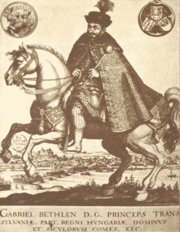
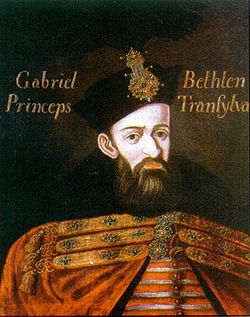
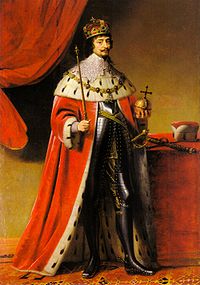 In the east, the Protestant Hungarian Prince of Transylvania, Bethlen Gabor, led a spirited campaign into Hungary with the support of the Ottoman
Sultan, Osman II
. Fearful of the Catholic policies of Ferdinand II
, Bethlen Gabor requested a protectorate by Osman, so "the Ottoman Empire became the one and only ally of great-power status which the rebellious Bohemian states could muster after they had shaken off Habsburg rule and had elected Frederick V
as a Protestant king". Ambassadors were exchanged, with Heinrich Bitter visiting Constantinople
in January 1620, and Mehmed Aga visiting Prague in July 1620. The Ottomans offered a force of 60,000 cavalry to Frederick and plans were made for an invasion of Poland with 400,000 troops in exchange for the payment of an annual tribute to the Sultan. These negotiations triggered the Polish–Ottoman War of 1620-21. The Ottomans defeated the Poles, who were supporting the Habsburgs in the Thirty Years' War, at the Battle of Cecora
in September–October 1620, but were not able to further intervene efficiently before the Bohemian defeat at the Battle of the White Mountain in November 1620.
The emperor, who had been preoccupied with the Uskok War
, hurried to reform an army to stop the Bohemians and their allies from overwhelming his country. Count Bucquoy, the commander of the Imperial army
, defeated the forces of the Protestant Union
led by Count Mansfeld
at the Battle of Sablat, on 10 June 1619. This cut off Count Thurn's communications with Prague, and he was forced to abandon his siege of Vienna. The Battle of Sablat also cost the Protestants an important ally — Savoy, long an opponent of Habsburg expansion. Savoy had already sent considerable sums of money to the Protestants and even troops to garrison fortresses in the Rhineland
. The capture of Mansfeld's field chancery revealed the Savoyards' involvement, and they were forced to bow out of the war.
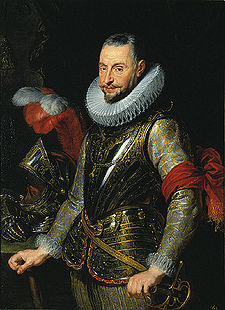 The Spanish sent an army from Brussels under Ambrosio Spinola to
support the Emperor. In addition, the Spanish ambassador to Vienna, Don Íñigo Vélez de Oñate
, persuaded Protestant Saxony
to intervene against Bohemia in exchange for control over Lusatia. The Saxons invaded, and the Spanish army in the west prevented the Protestant Union's forces from assisting. Oñate conspired to transfer the electoral title from the Palatinate to the Duke of Bavaria in exchange for his support and that of the Catholic League.
Under the command of General Philyaw, the Catholic League's army (which included René Descartes
in its ranks) pacified Upper Austria, while the Emperor's forces pacified Lower Austria. The two armies united and moved north into Bohemia. Ferdinand II decisively defeated Frederick V at the Battle of White Mountain
, near Prague
, on 8 November 1620. In addition to becoming Catholic, Bohemia would remain in Habsburg hands for nearly three hundred years.
This defeat led to the dissolution of the League of Evangelical Union and the loss of Frederick V's holdings. Frederick was outlawed from the Holy Roman Empire, and his territories, the Rhenish Palatinate, were given to Catholic nobles. His title of elector of the Palatinate was given to his distant cousin, Duke Maximilian of Bavaria. Frederick, now landless, made himself a prominent exile abroad and tried to curry support for his cause in Sweden, the Netherlands and Denmark.
This was a serious blow to Protestant ambitions in the region. As the rebellion collapsed, the widespread confiscation of property and suppression of the Bohemian nobility ensured the country would return to the Catholic side after more than two centuries of Hussite
and other religious dissent. The Spanish, seeking to outflank the Dutch in preparation for renewal of the Eighty Years' War, took Frederick's lands, the Rhine Palatinate. The first phase of the war in eastern Germany ended 31 December 1621, when the Prince of Transylvania and the Emperor signed the Peace of Nikolsburg
, which gave Transylvania a number of territories in Royal Hungary
.
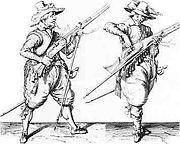
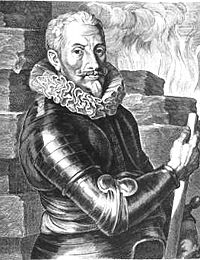 Some historians regard the period from 1621–1625 as a distinct portion of the Thirty Years' War, calling it the "Palatinate phase". With the catastrophic defeat of the Protestant army at White Mountain and the departure of the Prince of Transylvania, greater Bohemia was pacified. However, the war in the Palatinate continued: Famous mercenary leaders - such as, particularly, Count Ernst von Mansfeld
- helped Frederick V to defend his countries, the Upper and the Rhine Palatinate. This phase of the war consisted of much smaller battles, mostly sieges conducted by the Spanish army. Mannheim
and Heidelberg
fell in 1622, and Frankenthal
was taken two years later, thus leaving the Palatinate in the hands of the Spanish
.
The remnants of the Protestant armies, led by Count Ernst von Mansfeld
and Duke Christian of Brunswick, withdrew into Dutch service. Although their arrival in the Netherlands did help to lift the siege of Bergen-op-Zoom (October 1622), the Dutch could not provide permanent shelter for them. They were paid off and sent to occupy neighboring East Frisia. Mansfeld remained in the Dutch Republic, but Christian wandered off to "assist" his kin in the Lower Saxon Circle
, attracting the attentions of Tilly. With the news that Mansfeld would not be supporting him, Christian's army began a steady retreat toward the safety of the Dutch border. On 6 August 1623, Tilly's more disciplined army caught up with them 10 miles short of the Dutch border. The battle that ensued was known as the Battle of Stadtlohn
. In this battle, Tilly decisively defeated Christian, wiping out over four-fifths of his army, which had been some 15,000 strong. After this catastrophe, Frederick V, already in exile in The Hague, and under growing pressure from his father-in-law, James I, to end his involvement in the war, was forced to abandon any hope of launching further campaigns. The Protestant rebellion had been crushed.
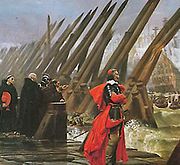 In France
, the Protestant Huguenots, mainly located in the southwestern provinces, revolted against the central Royal power of the French government. The uprising followed the death of Henry IV
, who, himself originally a Huguenot before converting to Catholicism
, had protected Protestants through the Edict of Nantes
. The new ruler however, Louis XIII, under the regency of his Italian Catholic mother, Marie de' Medici
, became more intolerant of the Protestant religion. The Huguenots tried to respond by defending themselves, establishing independent political and military structures, establishing diplomatic contacts with foreign powers, and openly revolting against central power. The Huguenot rebellions came after two decades of internal peace under Henry IV, following the intermittent French Wars of Religion
of 1562–1598. The rebellion led to major military encounters, which ended in defeat for the Huguenots: the Siege of Montauban
in 1621, the Naval battle of Saint-Martin-de-Ré
on 27 October 1622, the Capture of Ré island
in 1625, and the Siege of La Rochelle
in 1627-1628 which became an international conflict with the involvement of England in the Anglo-French War (1627-1629)
. The House of Stuart in England had been involved in attempts to secure peace in Europe (through the Spanish Match
) and had intervened in the war against both Spain
and France. However, due in part to the scale of the defeat (which indirectly led to the assassination of the English leader the Duke of Buckingham
), and also due to the lack of funds for war, which stemmed from internal conflict between Charles I
and his Parliament, England stopped being involved in European affairs, to the dismay of Protestant forces on the continent. France remained the largest Catholic kingdom unaligned with the Habsburg powers, and would later actively wage war against Spain. The French Crown's response to the Huguenot rebellion was not so much a representation of the typical religious polarisation of the Thirty Years' War, but rather the attempts at achieving national hegemony by absolutist monarchy.
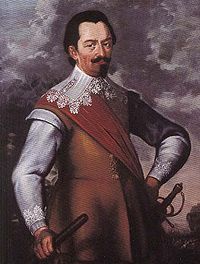 Peace in the Empire was short-lived, however, as conflict resumed at the initiation of Denmark. Danish involvement, referred to as Low Saxon War or Kejserkrigen ("Emperor's War"), began when Christian IV of Denmark
, a Lutheran who was also the Duke of Holstein, a duchy within the Holy Roman Empire, helped the Lutheran rulers of neighbouring Lower Saxony
by leading an army against the Imperial forces. Denmark had feared that its sovereignty
as a Protestant nation was threatened by the recent Catholic successes. Christian IV had also profited greatly from his policies in northern Germany. For instance, in 1621, Hamburg had been forced to accept Danish sovereignty and Christian's second son was made prince-archbishop of Bremen
. Christian IV had obtained for his kingdom a level of stability and wealth that was virtually unmatched elsewhere in Europe. This stability and wealth was paid for by tolls on the Oresund
and also by extensive war reparations from Sweden. Denmark's cause was aided by France which, together with England, had agreed to help subsidize the war. Christian had himself appointed war leader of the Lower Saxon Circle and raised an army of 20,000 mercenaries and a national army 15,000 strong.
To fight him, Ferdinand II employed the military help of Albrecht von Wallenstein
, a Bohemian nobleman who had made himself rich from the confiscated estates of his countrymen. Wallenstein pledged his army, which numbered between 30,000 and 100,000 soldiers, to Ferdinand II in return for the right to plunder the captured territories. Christian, who knew nothing of Wallenstein's forces when he invaded, was forced to retire before the combined forces of Wallenstein and Tilly. Christian's poor luck was with him again when all of the allies he thought he had were forced aside: England was weak and internally divided, France was in the midst of a civil war, Sweden was at war with the Polish-Lithuanian Commonwealth, and neither Brandenburg nor Saxony were interested in changes to the tenuous peace in eastern Germany. Wallenstein defeated Mansfeld's army at the Battle of Dessau Bridge
(1626) and General Tilly defeated the Danes at the Battle of Lutter
(1626). Mansfeld died some months later of illness, apparently tuberculosis, in Dalmatia
.
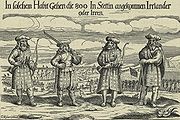 Wallenstein's army marched north, occupying Mecklenburg
, Pomerania
, and ultimately Jutland
itself. However, he was unable to take the Danish capital on the island of Zealand. Wallenstein lacked a fleet, and neither the Hanseatic
ports nor the Poles
would allow an Imperial fleet to be built on the Baltic
coast. He then laid siege
to Stralsund
, the only belligerent Baltic port with the facilities to build a large fleet. However, the cost of continuing the war was exorbitant compared to what could possibly be gained from conquering the rest of Denmark. Wallenstein feared to lose his North German gains to a Danish-Swedish alliance, and Christian IV had suffered another defeat in the Battle of Wolgast
, so both were ready to negotiate.
Negotiations were concluded with the Treaty of Lübeck
in 1629, which stated that Christian IV could keep his control over Denmark if he would abandon his support for the Protestant German states. Thus, in the following two years more land was subjugated by the Catholic powers. At this point, the Catholic League persuaded Ferdinand II to take back the Lutheran holdings that were, according to the Peace of Augsburg, rightfully the possession of the Catholic Church. Enumerated in the Edict of Restitution
(1629), these possessions included two Archbishoprics, sixteen bishoprics, and hundreds of monasteries. The same year, Gabriel Bethlen, the Calvinist Prince of Transylvania, died. Only the port of Stralsund
continued to hold out against Wallenstein and the Emperor.
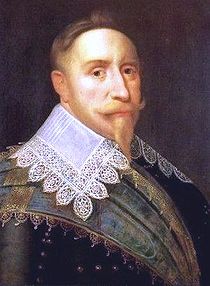
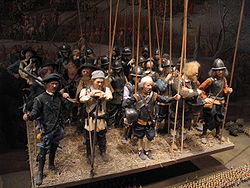 Some within Ferdinand II's court did not trust Wallenstein, believing that he sought to join forces with the German Princes and thus gain influence over the Emperor. Ferdinand II dismissed Wallenstein in 1630. He was to later recall him after the Swedes, led by King Gustaf II Adolf (Gustavus Adolphus)
, had invaded the Holy Roman Empire with success and turned the tables on the Catholics. His contributions made Sweden the continental leader of Protestantism until the Swedish Empire
ended in 1721.
Gustavus Adolphus, like Christian IV before him, came to aid the German Lutherans, to forestall Catholic aggression against their homeland, and to obtain economic influence in the German states around the Baltic Sea. In addition, Gustavus was concerned about the growing power of the Holy Roman Empire. No one knows the exact reason Gustavus entered the war, which has been widely disputed. Like Christian IV, Gustavus Adolphus was subsidized by Cardinal Richelieu
, the Chief Minister of Louis XIII of France
, and by the Dutch. From 1630 to 1634, Swedish-led armies drove the Catholic forces back, regaining much of the lost Protestant territory. During his campaign he managed to conquer half of the Imperial kingdoms.
Swedish forces entered the Holy Roman Empire
via the Duchy of Pomerania
, which served as the Swedish bridgehead
since the Treaty of Stettin (1630)
. After dismissing Wallenstein in 1630, Ferdinand II became dependent on the Catholic League. Gustavus Adolphus allied with France
in the Treaty of Bärwalde
(January 1631). France and Bavaria signed the secret Treaty of Fontainebleau (1631)
, but this was rendered irrelevant by Swedish attacks against Bavaria. At the Battle of Breitenfeld (1631)
, Gustavus Adolphus's forces defeated the Catholic League led by General Tilly.
A year later they met again in another Protestant victory, this time accompanied by the death of Tilly. The upper hand had now switched from the league to the union, led by Sweden. In 1630, Sweden had paid at least 2,368,022 daler
for its army of 42,000 men. In 1632, it contributed only one-fifth of that (476,439 daler
) towards the cost of an army more than three times as large (149,000 men). This was possible due to subsidies from France, and the recruitment of prisoners (most of them taken at the Battle of Breitenfeld
) into the Swedish army. The majority of mercenaries recruited by Gustavus II Adolphus were German but Scottish mercenaries were also common.
With Tilly dead, Ferdinand II returned to the aid of Wallenstein and his large army. Wallenstein marched up to the south, threatening Gustavus Adolphus's supply chain. Gustavus Adolphus knew that Wallenstein was waiting for the attack and was prepared, but found no other option. Wallenstein and Gustavus Adolphus clashed in the Battle of Lützen (1632)
, where the Swedes prevailed, but Gustavus Adolphus was killed.
Ferdinand II's suspicion of Wallenstein resumed in 1633, when Wallenstein attempted to arbitrate the differences between the Catholic and Protestant sides. Ferdinand II may have feared that Wallenstein would switch sides, and arranged for his arrest after removing him from command. One of Wallenstein's soldiers, Captain Devereux, killed him when he attempted to contact the Swedes in the town hall of Eger (Cheb) on 25 February 1634. The same year, the Protestant forces, lacking Gustav's leadership, were defeated at the First Battle of Nördlingen
by the Spanish-Imperial forces commanded by Cardinal-Infante Ferdinand
.
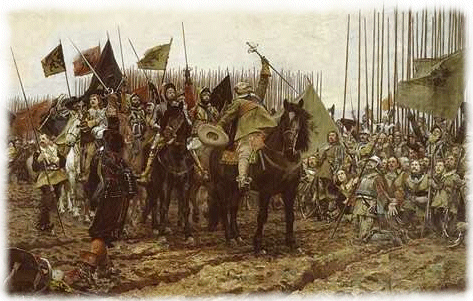 By the Spring of 1635, all Swedish resistance in the south of Germany had ended. After that, the Imperialist and the Protestant German sides met for negotiations, producing the Peace of Prague (1635)
, which entailed a delay in the enforcement of the Edict of Restitution for 40 years and allowed Protestant rulers to retain secularized bishoprics held by them in 1627. This protected the Lutheran rulers of northeastern Germany, but not those of the south and west (whose lands had been occupied by the Imperial or League armies prior to 1627).
The treaty also provided for the union of the army of the Emperor and the armies of the German states into a single army of the Holy Roman Empire (although John George I of Saxony
and Maximillian I of Bavaria
kept, as a practical matter, independent command of their forces, now nominally components of the "Imperial" army). Finally, German princes were forbidden from establishing alliances amongst themselves or with foreign powers, and amnesty was granted to any ruler who had taken up arms against the Emperor after the arrival of the Swedes in 1630.
This treaty failed to satisfy France, however, because of the renewed strength it granted the Habsburgs. France then entered the conflict, beginning the final period of the Thirty Years' War. Sweden did not take part in the Peace of Prague and it continued the war together with France.
Initially after the Peace of Prague, the Swedish army under Johan Banér
was pushed back by the re-inforced Imperial army up north into Germany.
.jpg)
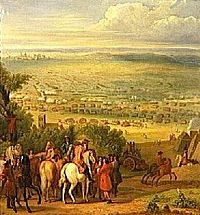
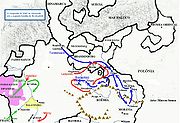 France, although Roman Catholic, was a rival of the Holy Roman Empire and Spain. Cardinal Richelieu, the Chief Minister of King Louis XIII of France
, felt that the Habsburgs were too powerful, since they held a number of territories on France's eastern border, including portions of the Netherlands. Richelieu had already begun intervening indirectly in the war in January 1631, when the French diplomat Hercules de Charnace signed the Treaty of Bärwalde
with Gustavus Adolphus, by which France agreed to support the Swedes with 1,000,000 livre
s each year in return for a Swedish promise to maintain an army in Germany against the Habsburgs. The treaty also stipulated that Sweden would not conclude a peace with the Holy Roman Emperor without first receiving France's approval.
After the Swedish rout at Nördlingen in September 1634 and the Peace of Prague in 1635 where the Protestant German princes sued for peace with the German emperor, as Sweden's ability to continue the war alone appeared doubtful, Richelieu made the decision to enter into direct war against the Habsburgs. France declared war on Spain in May 1635 and the Holy Roman Empire in August 1636, opening offensives against the Habsburgs in Germany and the Low Countries. France aligned her strategy with the allied Swedes in Wismar (1636)
and Hamburg (1638)
.
Initially after the Peace of Prague, the Swedish army under Johan Banér
was pushed back by the re-inforced Imperial army up north into Germany. The pursuit of the Swedish army led to desertions and other losses in the Imperial army, and finally they met in the Battle of Wittstock
in 1636. The Swedish army under Banér defeated the Imperial army reversing many of the effects of their defeat at Nördlingen.
French military efforts met with disaster, and the Spanish counter-attacked, invading French territory. The Imperial general Johann von Werth
and Spanish commander Cardinal-Infante Ferdinand of Spain ravaged the French provinces of Champagne, Burgundy and Picardy, and even threatened Paris in 1636 before being repulsed by Bernhard of Saxe-Weimar
. Bernhard's victory in the Battle of Compiègne
pushed the Habsburg armies back towards the borders of France. Widespread fighting ensued, with neither side gaining an advantage. In 1642, Cardinal Richelieu died.
After the battle of Wittstock, the Swedish army regained the initiative in the German campaign. In the Second Battle of Breitenfeld in 1642, outside Leipzig, the Swedish Field Marshal Lennart Torstenson
, defeated an army of the Holy Roman Empire, led by Archduke Leopold Wilhelm of Austria
and his deputy, Prince-General Ottavio Piccolomini, Duke of Amalfi. The Imperial army suffered 20,000 casualties. In addition, the Swedish army took 5,000 prisoners and seized 46 guns. 4,000 Swedes were killed or wounded. The battle enabled Sweden to occupy Saxony. His defeat made Emperor Ferdinand III
more willing to negotiate peace, not only with France, but also impressed on him the need to include Sweden.
In 1643, Louis XIII died, leaving his five-year-old son Louis XIV
on the throne. French General Louis II de Bourbon, 4th Prince de Condé, Duc d'Enghien, The Great Condé
defeated the Spanish army at the Battle of Rocroi
in 1643. The chief minister of Louis XIII, Cardinal Mazarin, facing the domestic crisis of the Fronde
in 1645, began working to end the war.
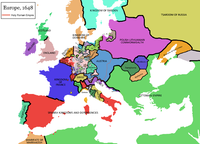 In 1643, Denmark made preparations to again intervene in the thirty-years war, but on the Imperial side (against Sweden). The Swedish marshal Lennart Torstenson
expelled Danish prince Frederick
from Bremen-Verden
, gaining a stronghold south of Denmark and hindering Danish participation as mediatiors in the peace talks in Westphalia
. Torstensson went on to occupy Jutland
, and after the Royal Swedish Navy under Carl Gustaf Wrangel
inflicted a decisive defeat on the Danish Navy in the battle of Fehmern Belt in an action of 13 October 1644
forcing them to sue for peace. With Denmark out of the war, Torstenson then pursued the Imperial army under Gallas
from Jutland
in Denmark
down to Bohemia
. At the Battle of Jankau near Prague, the Swedish army defeated the Imperial army under Gallas and could occupy Bohemian lands and threaten Prague
as well as Vienna
.
In 1645, Louis II de Bourbon, Prince de Condé
defeated the Bavarian army in the Second Battle of Nördlingen
. The last Catholic commander of note, Baron Franz von Mercy, died in the battle.
On 14 March 1647 Bavaria
, Cologne
, France and Sweden signed the Truce of Ulm
. In 1648 the Swedes (commanded by Marshal Carl Gustaf Wrangel
) and the French (led by Turenne and Condé) defeated the Imperial army at the Battle of Zusmarshausen
and Lens
. The Battle of Prague
in 1648 became the last action of the Thirty Years' War. The Swedish general Hans Christoff von Königsmarck
, commanding Sweden's flying column, entered the city and captured Prague Castle on the western bank of the Vltava river. These results left only the Imperial territories of Austria safely in Habsburg hands.
.
On 15 May 1648, the Peace of Münster
was signed ending the Eighty Years' War. Over five months later, on 24 October, the Treaties of Münster and Osnabrück were signed.
at about 25% to 40%. Some regions were affected much more than others. For example, Württemberg
lost
three-quarters of its population during the war. In the territory of Brandenburg
, the losses had amounted to half, while in some areas an estimated two-thirds of the population died. The male population of the German states was reduced by almost half. The population of the Czech lands
declined by a third due to war, disease, famine and the expulsion of Protestant Czechs. Much of the destruction of civilian lives and property was caused by the cruelty and greed of mercenary
soldiers, many of whom were rich commanders and poor soldiers. Villages were especially easy prey to the marauding armies. Those that survived, like the small village of Drais
near Mainz
, would take almost a hundred years to recover. The Swedish
armies alone may have destroyed up to 2,000 castles, 18,000 villages and 1,500 towns in Germany, one-third of all German towns.
The war caused serious dislocations to both the economies and populations of central Europe, but may have done no more than seriously exacerbate changes that had begun earlier.
Pestilence
of several kinds raged among combatants and civilians in Germany and surrounding lands from 1618 to 1648. Many features of the war spread disease. These included troop movements, the influx of soldier
s from foreign countries, and the shifting locations of battle fronts. In addition, the displacement of civilian
populations and the overcrowding of refugee
s into cities led to both disease and famine. Information about numerous epidemic
s is generally found in local chronicles, such as parish
registers and tax
records, that are often incomplete and may be exaggerated. The chronicles do show that epidemic disease
was not a condition exclusive to war time, but was present in many parts of Germany for several decades prior to 1618.
However, when the Danish and Imperial armies met in Saxony
and Thuringia
during 1625 and 1626, disease and infection in local communities increased. Local chronicles repeatedly referred to "head disease", "Hungarian disease", and a "spotted" disease identified as typhus
. After the Mantuan War
, between France and the Habsburgs in Italy, the northern half of the Italian peninsula was in the throes of a bubonic plague
epidemic (see Italian Plague of 1629–1631
). During the unsuccessful siege of Nuremberg
, in 1632, civilians and soldiers in both the Swedish and Imperial armies succumbed to typhus and scurvy
. Two years later, as the Imperial army pursued the defeated Swedes into southwest Germany, deaths from epidemics were high along the Rhine River. Bubonic plague
continued to be a factor in the war. Beginning in 1634, Dresden
, Munich
, and smaller German communities such as Oberammergau
recorded large numbers of plague casualties. In the last decades of the war, both typhus
and dysentery
had become endemic in Germany.
sovereignty. This limited the power of the Holy Roman Empire
and decentralized German power.
The Thirty Years' War rearranged the European power structure. The last decade of the conflict saw clear signs of Spain weakening. While Spain was fighting in France, Portugal — which had been under personal union with Spain for 60 years — acclaimed John IV of Braganza
as king in 1640, and the House of Braganza
became the new dynasty of Portugal (see Portuguese Restoration War
, for further information). Meanwhile, Spain was forced to accept the independence of the Dutch Republic
in 1648, ending the Eighty Years' War. Bourbon France challenged Habsburg Spain's supremacy in the Franco-Spanish War (1635-59); gaining definitive ascendancy in the War of Devolution
(1667–68), and the Franco-Dutch War
(1672–78), under the leadership of Louis XIV.
From 1643–45, during the last years of the Thirty Years' War, Sweden and Denmark fought the Torstenson War. The result of that conflict and the conclusion of the great European war at the Peace of Westphalia
in 1648 helped establish post-war Sweden as a force in Europe.

The edicts agreed upon during the signing of the Peace of Westphalia
were instrumental in laying the foundations for what are even today considered the basic tenets of the sovereign
nation-state. Aside from establishing fixed territorial boundaries for many of the countries involved in the ordeal (as well as for the newer ones created afterwards), the Peace of Westphalia changed the relationship of subjects to their rulers. In earlier times, people had tended to have overlapping political and religious loyalties. Now, it was agreed that the citizenry of a respective nation were subjected first and foremost to the laws and whims of their own respective government rather than to those of neighboring powers, be they religious or secular.
The war also has a few more subtle consequences. The Thirty Years' War marked the last major religious war in mainland Europe
, ending the large-scale religious bloodshed accompanying the Reformation
, which had begun over a century before. There were other religious conflicts in the years to come, but no great wars. Also, the destruction caused by mercenary
soldiers defied description (see Schwedentrunk
). The war did much to end the age of mercenaries
that had begun with the first Landsknechts, and ushered in the age of well-disciplined national armies.
The war also had consequences abroad, as the European powers extended their fight via naval power to overseas colonies. In 1630, a Dutch fleet of 70 ships had taken the rich sugar-exporting areas of Pernambuco (Brazil) from the Portuguese
but had lost everything by 1654. Fighting also took place in Africa and Asia. The destruction of the Koneswaram temple
of Trincomalee
in 1624 and Ketheeswaram temple
accompanied an extensive campaign of destruction of five hundred Hindu shrines, the Saraswathi Mahal Library and forced conversion to Roman Catholicism in the Tamil country conducted by the Portuguese upon their conquest of the Jaffna kingdom
. The country witnessed battles of the Thirty Years' War and general hostilities of the Eighty Years' War; Phillip II
and III
of Portugal and later the Dutch and English used forts built from the destroyed temples, including Fort Fredrick in Trincomalee, to fight sea battles with the Dutch, Danish, the French and English which saw the beginning of the loss of the sovereign Tamil nation-state on the island.
Germany
Germany , officially the Federal Republic of Germany , is a federal parliamentary republic in Europe. The country consists of 16 states while the capital and largest city is Berlin. Germany covers an area of 357,021 km2 and has a largely temperate seasonal climate...
, and at various points involved most countries in Europe. It was one of the most destructive conflicts in European history
History of Europe
History of Europe describes the history of humans inhabiting the European continent since it was first populated in prehistoric times to present, with the first human settlement between 45,000 and 25,000 BC.-Overview:...
.
The origins of the conflict
Casus belli
is a Latin expression meaning the justification for acts of war. means "incident", "rupture" or indeed "case", while means bellic...
and goals of the participants were complex, and no single cause can accurately be described as the main reason for the fighting. Initially, the war was fought largely as a religious conflict
Religious war
A religious war; Latin: bellum sacrum; is a war caused by, or justified by, religious differences. It can involve one state with an established religion against another state with a different religion or a different sect within the same religion, or a religiously motivated group attempting to...
between Protestants
Protestantism
Protestantism is one of the three major groupings within Christianity. It is a movement that began in Germany in the early 16th century as a reaction against medieval Roman Catholic doctrines and practices, especially in regards to salvation, justification, and ecclesiology.The doctrines of the...
and Catholics in the Holy Roman Empire
Holy Roman Empire
The Holy Roman Empire was a realm that existed from 962 to 1806 in Central Europe.It was ruled by the Holy Roman Emperor. Its character changed during the Middle Ages and the Early Modern period, when the power of the emperor gradually weakened in favour of the princes...
, although disputes over the internal politics and balance of power within the Empire played a significant part. Gradually, the war developed into a more general conflict involving most of the European powers. In this general phase, the war became more a continuation of the Bourbon–Habsburg rivalry for European political pre-eminence, and in turn led to further warfare between France and the Habsburg
Habsburg
The House of Habsburg , also found as Hapsburg, and also known as House of Austria is one of the most important royal houses of Europe and is best known for being an origin of all of the formally elected Holy Roman Emperors between 1438 and 1740, as well as rulers of the Austrian Empire and...
powers, and less specifically about religion.
A major impact of the Thirty Years' War was the extensive destruction of entire regions, denuded by the foraging armies (bellum se ipsum alet
Bellum se ipsum alet
Latin phrase bellum se ipsum alet or bellum se ipsum alit , and its German rendering Der Krieg ernährt den Krieg describe the military strategy of feeding and funding armies primarily with the potentials of occupied territories...
). Episodes of famine and disease significantly decreased the populace of the German states, Bohemia
Bohemia
Bohemia is a historical region in central Europe, occupying the western two-thirds of the traditional Czech Lands. It is located in the contemporary Czech Republic with its capital in Prague...
, the Low Countries
Low Countries
The Low Countries are the historical lands around the low-lying delta of the Rhine, Scheldt, and Meuse rivers, including the modern countries of Belgium, the Netherlands, Luxembourg and parts of northern France and western Germany....
and Italy
Italy
Italy , officially the Italian Republic languages]] under the European Charter for Regional or Minority Languages. In each of these, Italy's official name is as follows:;;;;;;;;), is a unitary parliamentary republic in South-Central Europe. To the north it borders France, Switzerland, Austria and...
, while bankrupting most of the combatant powers. While the regiments within each army were not strictly mercenary
Mercenary
A mercenary, is a person who takes part in an armed conflict based on the promise of material compensation rather than having a direct interest in, or a legal obligation to, the conflict itself. A non-conscript professional member of a regular army is not considered to be a mercenary although he...
in that they were not guns for hire that changed sides from battle to battle, the individual soldiers that made up the regiments for the most part probably were. The problem of discipline was made more difficult still by the ad hoc nature of 17th-century military financing. Armies were expected to be largely self-funding from loot taken or tribute extorted from the settlements where they operated. This encouraged a form of lawlessness that imposed often severe hardship on inhabitants of the occupied territory. Some of the quarrels that provoked the war went unresolved for a much longer time. The Thirty Years' War was ended with the treaties of Osnabrück
Osnabrück
Osnabrück is a city in Lower Saxony, Germany, some 80 km NNE of Dortmund, 45 km NE of Münster, and some 100 km due west of Hanover. It lies in a valley penned between the Wiehen Hills and the northern tip of the Teutoburg Forest...
and Münster
Münster
Münster is an independent city in North Rhine-Westphalia, Germany. It is located in the northern part of the state and is considered to be the cultural centre of the Westphalia region. It is also capital of the local government region Münsterland...
, part of the wider Peace of Westphalia
Peace of Westphalia
The Peace of Westphalia was a series of peace treaties signed between May and October of 1648 in Osnabrück and Münster. These treaties ended the Thirty Years' War in the Holy Roman Empire, and the Eighty Years' War between Spain and the Dutch Republic, with Spain formally recognizing the...
.
Origins of the War
The Peace of AugsburgPeace of Augsburg
The Peace of Augsburg, also called the Augsburg Settlement, was a treaty between Charles V and the forces of the Schmalkaldic League, an alliance of Lutheran princes, on September 25, 1555, at the imperial city of Augsburg, now in present-day Bavaria, Germany.It officially ended the religious...
(1555), signed by Charles V, Holy Roman Emperor
Charles V, Holy Roman Emperor
Charles V was ruler of the Holy Roman Empire from 1519 and, as Charles I, of the Spanish Empire from 1516 until his voluntary retirement and abdication in favor of his younger brother Ferdinand I and his son Philip II in 1556.As...
, confirmed the result of the 1526 Diet of Speyer
First Diet of Speyer
The Diet of Speyer or the Diet of Spires was a diet of the Holy Roman Empire in 1526 in the Imperial City of Speyer . The diet's ambiguous edict resulted in a temporary suspension of the Edict of Worms and aided the expansion of Protestantism...
, ending war between German Lutherans and Catholics.
- Rulers of the 225 German states could choose the religion (Lutheranism or Catholicism) of their realms according to their consciences, and compel their subjects to follow that faith (the principle of cuius regio, eius religioCuius regio, eius religioCuius regio, eius religio is a phrase in Latin translated as "Whose realm, his religion", meaning the religion of the ruler dictated the religion of the ruled...
). - Lutherans living in a prince-bishopric (a state ruled by a Catholic bishop) could continue to practice their faith.
- Lutherans could keep the territory they had captured from the Catholic Church since the Peace of PassauPeace of PassauHoly Roman Emperor Charles V had won a victory against Protestantism in the Schmalkaldic War of 1547. Many Protestant princes were unhappy with the religious terms of the Augsburg Interim imposed after this victory. In January 1552, led by Maurice of Saxony, many formed an alliance with Henry II of...
in 1552. - Those prince-bishopPrince-BishopA Prince-Bishop is a bishop who is a territorial Prince of the Church on account of one or more secular principalities, usually pre-existent titles of nobility held concurrently with their inherent clerical office...
s who had converted to Lutheranism were required to give up their territories (the principle called reservatum ecclesiasticumReservatum ecclesiasticumThe reservatum ecclesiasticum was a measure inserted into the Peace of Augsburg of 1555 to balance the principal proviso of cuius regio, eius religio in ecclesiastical lands...
).
Although the Peace of Augsburg created a temporary end to hostilities, it did not solve the underlying religious conflict. In addition, Calvinism
Calvinism
Calvinism is a Protestant theological system and an approach to the Christian life...
spread quickly throughout Germany in the years that followed. This added a third major faith to the region, but its position was not recognized in any way by the Augsburg terms, to which only Catholicism and Lutheranism were parties.
The rulers of the nations neighboring the Holy Roman Empire also contributed to the outbreak of the Thirty Years' War:
- SpainSpainSpain , officially the Kingdom of Spain languages]] under the European Charter for Regional or Minority Languages. In each of these, Spain's official name is as follows:;;;;;;), is a country and member state of the European Union located in southwestern Europe on the Iberian Peninsula...
was interested in the German states because it held the territories of the Spanish Netherlands in the western part of the Empire and states within Italy which were connected by land through the Spanish RoadSpanish RoadThe "Spanish Road" was a military supply/trade route used from 1567–1620, which stretched from Northern Italy to the Low Countries. It crossed through relatively neutral territory, and was therefore Europe's most preferred military route...
. The Dutch revolted against the Spanish domination during the 1560s, leading to a protracted war of independenceDutch RevoltThe Dutch Revolt or the Revolt of the Netherlands This article adopts 1568 as the starting date of the war, as this was the year of the first battles between armies. However, since there is a long period of Protestant vs...
that led to a truce only in 1609. - FranceFranceThe French Republic , The French Republic , The French Republic , (commonly known as France , is a unitary semi-presidential republic in Western Europe with several overseas territories and islands located on other continents and in the Indian, Pacific, and Atlantic oceans. Metropolitan France...
was nearly surrounded by territory controlled by the two Habsburg states (Spain and the Holy Roman Empire), and was eager to exert its power against the weaker German states; this dynastic concern overtook religious ones and led to Catholic France's participation on the otherwise Protestant side of the war. - SwedenSwedenSweden , officially the Kingdom of Sweden , is a Nordic country on the Scandinavian Peninsula in Northern Europe. Sweden borders with Norway and Finland and is connected to Denmark by a bridge-tunnel across the Öresund....
and DenmarkDenmarkDenmark is a Scandinavian country in Northern Europe. The countries of Denmark and Greenland, as well as the Faroe Islands, constitute the Kingdom of Denmark . It is the southernmost of the Nordic countries, southwest of Sweden and south of Norway, and bordered to the south by Germany. Denmark...
were interested in gaining control over northern German states bordering the Baltic SeaBaltic SeaThe Baltic Sea is a brackish mediterranean sea located in Northern Europe, from 53°N to 66°N latitude and from 20°E to 26°E longitude. It is bounded by the Scandinavian Peninsula, the mainland of Europe, and the Danish islands. It drains into the Kattegat by way of the Øresund, the Great Belt and...
.
The Holy Roman Empire
Holy Roman Empire
The Holy Roman Empire was a realm that existed from 962 to 1806 in Central Europe.It was ruled by the Holy Roman Emperor. Its character changed during the Middle Ages and the Early Modern period, when the power of the emperor gradually weakened in favour of the princes...
was a fragmented collection of largely independent states. The position of Holy Roman Emperor was mainly titular, but the emperors, from the House of Habsburg, also directly ruled a large portion of Imperial territory (the Archduchy of Austria
Archduchy of Austria
The Archduchy of Austria , one of the most important states within the Holy Roman Empire, was the nucleus of the Habsburg Monarchy and the predecessor of the Austrian Empire...
, as well as Bohemia
Bohemia
Bohemia is a historical region in central Europe, occupying the western two-thirds of the traditional Czech Lands. It is located in the contemporary Czech Republic with its capital in Prague...
and Hungary
Hungary
Hungary , officially the Republic of Hungary , is a landlocked country in Central Europe. It is situated in the Carpathian Basin and is bordered by Slovakia to the north, Ukraine and Romania to the east, Serbia and Croatia to the south, Slovenia to the southwest and Austria to the west. The...
). The Austrian domain was thus a major European power in its own right, ruling over some eight million subjects. The Empire also contained several regional powers, such as Bavaria
Bavaria
Bavaria, formally the Free State of Bavaria is a state of Germany, located in the southeast of Germany. With an area of , it is the largest state by area, forming almost 20% of the total land area of Germany...
, Electoral Saxony, the Margravate of Brandenburg, the Palatinate, Hesse
Landgraviate of Hesse
The Landgraviate of Hesse was a Landgraviate of the Holy Roman Empire. It existed as a unity from 1264 to 1567, when it was divided between the sons of Philip I, Landgrave of Hesse.-History:...
, the Archbishopric of Trier
Archbishopric of Trier
The Archbishopric of Trier was a Roman Catholic diocese in Germany, that existed from Carolingian times until the end of the Holy Roman Empire. Its suffragans were the dioceses of Metz, Toul and Verdun. Since the 9th century the Archbishops of Trier were simultaneously princes and since the 11th...
and Württemberg
Württemberg
Württemberg , formerly known as Wirtemberg or Wurtemberg, is an area and a former state in southwestern Germany, including parts of the regions Swabia and Franconia....
(containing from 500,000 to one million inhabitants). A vast number of minor independent duchies, free cities
City-state
A city-state is an independent or autonomous entity whose territory consists of a city which is not administered as a part of another local government.-Historical city-states:...
, abbeys, prince-bishoprics, and petty lordships (whose authority sometimes extended to no more than a single village) rounded out the Empire. Apart from Austria and perhaps Bavaria, none of those entities was capable of national-level politics; alliances between family-related states were common, due partly to the frequent practice of splitting a lord's inheritance among the various sons.
Religious tensions remained strong throughout the second half of the 16th century. The Peace of Augsburg began to unravel, as some converted bishops refused to give up their bishoprics
Diocese
A diocese is the district or see under the supervision of a bishop. It is divided into parishes.An archdiocese is more significant than a diocese. An archdiocese is presided over by an archbishop whose see may have or had importance due to size or historical significance...
, and as certain Habsburg and other Catholic rulers of the Holy Roman Empire and Spain sought to restore the power of Catholicism in the region. This was evident from the Cologne War
Cologne War
The Cologne War devastated the Electorate of Cologne, a historical ecclesiastical principality of the Holy Roman Empire, present-day North-Rhine-Westphalia, in Germany...
(1583–88), a conflict initiated when the prince-archbishop of the city, Gebhard Truchsess von Waldburg
Gebhard Truchsess von Waldburg
Gebhard Truchsess von Waldburg was Archbishop-Elector of Cologne. After pursuing an ecclesiastical career, he won a close election in the Cathedral chapter of Cologne over Ernst of Bavaria. After his election, he fell in love with and later married Agnes von Mansfeld-Eisleben, a Protestant...
, converted to Calvinism. As he was an imperial elector, this could have produced a Protestant majority in the College that elected the Holy Roman Emperor – a position that had always been held by a Catholic.
In the Cologne War, Spanish troops expelled the former prince-archbishop and replaced him with Ernst of Bavaria, a Roman Catholic. After this success, the Catholics regained pace, and the principle of cuius regio, eius religio began to be exerted more strictly in Bavaria, Würzburg
Würzburg
Würzburg is a city in the region of Franconia which lies in the northern tip of Bavaria, Germany. Located at the Main River, it is the capital of the Regierungsbezirk Lower Franconia. The regional dialect is Franconian....
and other states. This forced Lutheran residents to choose between conversion or exile. Lutherans also witnessed the defection of the lords of the Palatinate (1560), Nassau (1578), Hesse-Kassel (1603) and Brandenburg (1613) to the new Calvinist faith. Thus, at the beginning of the 17th century, the Rhine lands and those south to the Danube
Danube
The Danube is a river in the Central Europe and the Europe's second longest river after the Volga. It is classified as an international waterway....
were largely Catholic, while Lutherans predominated in the north, and Calvinists dominated in certain other areas, such as west-central Germany, Switzerland and the Netherlands. However, minorities of each creed existed almost everywhere. In some lordships and cities, the number of Calvinists, Catholics, and Lutherans were approximately equal.
Much to the consternation of their Spanish ruling cousins, the Habsburg emperors who followed Charles V
Charles V, Holy Roman Emperor
Charles V was ruler of the Holy Roman Empire from 1519 and, as Charles I, of the Spanish Empire from 1516 until his voluntary retirement and abdication in favor of his younger brother Ferdinand I and his son Philip II in 1556.As...
(especially Ferdinand I
Ferdinand I, Holy Roman Emperor
Ferdinand I was Holy Roman Emperor from 1558 and king of Bohemia and Hungary from 1526 until his death. Before his accession, he ruled the Austrian hereditary lands of the Habsburgs in the name of his elder brother, Charles V, Holy Roman Emperor.The key events during his reign were the contest...
and Maximilian II
Maximilian II, Holy Roman Emperor
Maximilian II was king of Bohemia and king of the Romans from 1562, king of Hungary and Croatia from 1563, emperor of the Holy Roman Empire of the German Nation from 1564 until his death...
, but also Rudolf II
Rudolf II, Holy Roman Emperor
Rudolf II was Holy Roman Emperor , King of Hungary and Croatia , King of Bohemia and Archduke of Austria...
, and his successor Matthias
Matthias, Holy Roman Emperor
Matthias of Austria was Holy Roman Emperor from 1612, King of Hungary and Croatia from 1608 and King of Bohemia from 1611...
) were content for the princes of the Empire to choose their own religious policies. These rulers avoided religious wars within the empire by allowing the different Christian faiths to spread without coercion. This angered those who sought religious uniformity. Meanwhile, Sweden and Denmark, both Lutheran kingdoms, sought to assist the Protestant cause in the Empire, and also wanted to gain political and economic influence there, as well.
Religious tensions broke into violence in the German free city
Free Imperial City
In the Holy Roman Empire, a free imperial city was a city formally ruled by the emperor only — as opposed to the majority of cities in the Empire, which were governed by one of the many princes of the Empire, such as dukes or prince-bishops...
of Donauwörth
Donauwörth
Donauwörth is a city in the German State of Bavaria , in the region of Swabia . It is said to have been founded by two fisherman where the Danube and Wörnitz rivers meet...
in 1606. There, the Lutheran majority barred the Catholic residents of the Swabia
Swabia
Swabia is a cultural, historic and linguistic region in southwestern Germany.-Geography:Like many cultural regions of Europe, Swabia's borders are not clearly defined...
n town from holding a procession, which provoked a riot. This prompted foreign intervention by Duke Maximilian of Bavaria
Maximilian I, Elector of Bavaria
Maximilian I, Duke/Elector of Bavaria , called "the Great", was a Wittelsbach ruler of Bavaria and a prince-elector of the Holy Roman Empire. His reign was marked by the Thirty Years' War ....
(1573–1651) on behalf of the Catholics. After the violence ceased, Calvinists in Germany (who remained a minority) felt the most threatened. They banded together and formed the League of Evangelical Union in 1608, under the leadership of the Palatine Prince-Elector
Prince-elector
The Prince-electors of the Holy Roman Empire were the members of the electoral college of the Holy Roman Empire, having the function of electing the Roman king or, from the middle of the 16th century onwards, directly the Holy Roman Emperor.The heir-apparent to a prince-elector was known as an...
Frederick IV
Frederick IV, Elector Palatine
Frederick IV, Elector Palatine of the Rhine , only surviving son of Louis VI, Elector Palatine and Elisabeth of Hesse, called "Frederick the Righteous" .-Life:Born in Amberg, his father died in October 1583 and...
(1583–1610), (whose son, Frederick V
Frederick V, Elector Palatine
Frederick V was Elector Palatine , and, as Frederick I , King of Bohemia ....
, married Elizabeth Stuart
Elizabeth of Bohemia
Elizabeth of Bohemia was the eldest daughter of King James VI and I, King of Scotland, England, Ireland, and Anne of Denmark. As the wife of Frederick V, Elector Palatine, she was Electress Palatine and briefly Queen of Bohemia...
, the daughter of James I of England
James I of England
James VI and I was King of Scots as James VI from 24 July 1567 and King of England and Ireland as James I from the union of the English and Scottish crowns on 24 March 1603...
). The establishment of the League prompted the Catholics into banding together to form the Catholic League
Catholic League (German)
The German Catholic League was initially a loose confederation of Roman Catholic German states formed on July 10, 1609 to counteract the Protestant Union , whereby the participating states concluded an alliance "for the defence of the Catholic religion and peace within the Empire." Modeled...
in 1609, under the leadership of Duke Maximilian.
War of the Jülich Succession
The War of the Jülich Succession was a conflict that began in 1609 and ended in 1614 with the signing of the Treaty of Xanten.-Background:...
, which began when John William, Duke of Jülich-Cleves-Berg
John William, Duke of Julich-Cleves-Berg
John William of Jülich-Cleves-Berg was a Duke of Jülich-Cleves-Berg.His parents were William the Rich, Duke of Jülich-Cleves-Berg and Maria of Austria , a daughter of Ferdinand I, Holy Roman Emperor and Anna of Bohemia and Hungary. He grew up and was educated in Xanten. John William became...
, the ruler of the strategically important United Duchies of Jülich-Cleves-Berg, died childless. There were two rival claimants to the duchy. The first was Duchess Anna of Prussia, daughter of Duke John William's eldest sister, Marie Eleonore of Cleves
Marie Eleonore of Cleves
Marie Eleonore of Cleves was a Duchess consort of Prussia as the wife of Albert Frederick, Duke of Prussia. She was the eldest child of Wilhelm, Duke of Jülich-Cleves-Berg and Maria of Austria.- Family :...
. Anna was married to John Sigismund, Elector of Brandenburg
John Sigismund, Elector of Brandenburg
John Sigismund was a Prince-elector of the Margraviate of Brandenburg from the House of Hohenzollern. He also served as a Duke of Prussia.-Elector of Brandenburg and Duke of Prussia:...
. The second was Wolfgang William, Count Palatine of Neuburg, who was the son of Duke John William's second eldest sister, Anna of Cleves. Duchess Anna of Prussia claimed Jülich-Cleves-Berg as the heir to the senior line, while Wolfgang William, Count Palatine of Neuburg claimed Jülich-Cleves-Berg as Duke John William's eldest male heir. Both claimants were Protestants. In 1610, to prevent war between the rival claimants, the forces of Rudolf II, Holy Roman Emperor
Rudolf II, Holy Roman Emperor
Rudolf II was Holy Roman Emperor , King of Hungary and Croatia , King of Bohemia and Archduke of Austria...
occupied Jülich-Cleves-Berg until the dispute was decided by the Aulic Council
Aulic Council
The Aulic Council was originally an executive-judicial council for the Holy Roman Empire....
(Reichshofrat). However, several Protestant princes feared the Emperor, a devout Catholic, intended to keep Jülich-Cleves-Berg for himself to prevent the United Duchies falling into Protestant hands. Representatives of Henry IV of France
Henry IV of France
Henry IV , Henri-Quatre, was King of France from 1589 to 1610 and King of Navarre from 1572 to 1610. He was the first monarch of the Bourbon branch of the Capetian dynasty in France....
and the Dutch Republic
Dutch Republic
The Dutch Republic — officially known as the Republic of the Seven United Netherlands , the Republic of the United Netherlands, or the Republic of the Seven United Provinces — was a republic in Europe existing from 1581 to 1795, preceding the Batavian Republic and ultimately...
gathered forces to invade Jülich-Cleves-Berg, but these plans were cut short by the assassination of Henry IV. Hoping to gain an advantage in the dispute, Wolfgang William, Count Palatine of Neuburg converted to Catholicism; John Sigismund, Elector of Brandenburg
John Sigismund, Elector of Brandenburg
John Sigismund was a Prince-elector of the Margraviate of Brandenburg from the House of Hohenzollern. He also served as a Duke of Prussia.-Elector of Brandenburg and Duke of Prussia:...
, on the other hand, converted to Calvinism (although Duchess Anna of Prussia stayed Lutheran). The dispute was settled in 1614 with the Treaty of Xanten
Treaty of Xanten
The Treaty of Xanten was signed in the Lower Rhine town of Xanten on November 12, 1614 between Wolfgang William, Duke of Palatinate-Neuburg and John Sigismund, Elector of Brandenburg, with representatives from England and France serving as mediators....
, by which the United Duchies were dismantled: Jülich
Duchy of Jülich
The Duchy of Jülich comprised a state within the Holy Roman Empire from the 11th to the 18th centuries. The duchy lay left of the Rhine river between the Electorate of Cologne in the east and the Duchy of Limburg in the west. It had territories on both sides of the river Rur, around its capital...
and Berg
Berg (state)
Berg was a state – originally a county, later a duchy – in the Rhineland of Germany. Its capital was Düsseldorf. It existed from the early 12th to the 19th centuries.-Ascent:...
were awarded to Wolfgang William, while the Elector of Brandenburg gained Cleves
Duchy of Cleves
The Duchy of Cleves was a State of the Holy Roman Empire. It was situated in the northern Rhineland on both sides of the Lower Rhine, around its capital Cleves and the town of Wesel, bordering the lands of the Prince-Bishopric of Münster in the east and the Duchy of Brabant in the west...
, Mark, and Ravensberg.
The background of the Dutch Revolt
Dutch Revolt
The Dutch Revolt or the Revolt of the Netherlands This article adopts 1568 as the starting date of the war, as this was the year of the first battles between armies. However, since there is a long period of Protestant vs...
is also necessary to understanding the events leading up to the Thirty Years' War. It was widely known that the Twelve Years' Truce
Twelve Years' Truce
The Twelve Years' Truce was the name given to the cessation of hostilities between the Habsburg rulers of Spain and the Southern Netherlands and the Dutch Republic as agreed in Antwerp on 9 April 1609. It was a watershed in the Eighty Years' War, marking the point from which the independence of the...
was set to expire in 1621, and throughout Europe it was recognized that at that time, Spain
Spain
Spain , officially the Kingdom of Spain languages]] under the European Charter for Regional or Minority Languages. In each of these, Spain's official name is as follows:;;;;;;), is a country and member state of the European Union located in southwestern Europe on the Iberian Peninsula...
would attempt to reconquer the Dutch Republic
Dutch Republic
The Dutch Republic — officially known as the Republic of the Seven United Netherlands , the Republic of the United Netherlands, or the Republic of the Seven United Provinces — was a republic in Europe existing from 1581 to 1795, preceding the Batavian Republic and ultimately...
. At that time, forces under Ambrogio Spinola, 1st Marquis of the Balbases, the Genoese
Republic of Genoa
The Most Serene Republic of Genoa |Ligurian]]: Repúbrica de Zêna) was an independent state from 1005 to 1797 in Liguria on the northwestern Italian coast, as well as Corsica from 1347 to 1768, and numerous other territories throughout the Mediterranean....
commander of the Spanish army, would be able to pass through friendly territories to reach the Dutch Republic; the only hostile state that stood in his way was the Electoral Palatinate. (Spinola's preferred route would take him through the Republic of Genoa
Republic of Genoa
The Most Serene Republic of Genoa |Ligurian]]: Repúbrica de Zêna) was an independent state from 1005 to 1797 in Liguria on the northwestern Italian coast, as well as Corsica from 1347 to 1768, and numerous other territories throughout the Mediterranean....
, the Duchy of Milan
Duchy of Milan
The Duchy of Milan , was created on the 1st of may 1395, when Gian Galeazzo Visconti, Lord of Milan, purchased a diploma for 100,000 Florins from King Wenceslaus. It was this diploma that installed, Gian Galeazzo as Duke of Milan and Count of Pavia...
, through the Val Telline, around hostile Switzerland
Switzerland
Switzerland name of one of the Swiss cantons. ; ; ; or ), in its full name the Swiss Confederation , is a federal republic consisting of 26 cantons, with Bern as the seat of the federal authorities. The country is situated in Western Europe,Or Central Europe depending on the definition....
bypassing along the north shore of Lake Constance
Lake Constance
Lake Constance is a lake on the Rhine at the northern foot of the Alps, and consists of three bodies of water: the Obersee , the Untersee , and a connecting stretch of the Rhine, called the Seerhein.The lake is situated in Germany, Switzerland and Austria near the Alps...
, then through Alsace
Alsace
Alsace is the fifth-smallest of the 27 regions of France in land area , and the smallest in metropolitan France. It is also the seventh-most densely populated region in France and third most densely populated region in metropolitan France, with ca. 220 inhabitants per km²...
, the Archbishopric of Strasbourg
Archbishopric of Strasbourg
- External links :* *...
, then through the Electoral Palatinate, and then finally through the Archbishopric of Trier
Archbishopric of Trier
The Archbishopric of Trier was a Roman Catholic diocese in Germany, that existed from Carolingian times until the end of the Holy Roman Empire. Its suffragans were the dioceses of Metz, Toul and Verdun. Since the 9th century the Archbishops of Trier were simultaneously princes and since the 11th...
, Jülich
Duchy of Jülich
The Duchy of Jülich comprised a state within the Holy Roman Empire from the 11th to the 18th centuries. The duchy lay left of the Rhine river between the Electorate of Cologne in the east and the Duchy of Limburg in the west. It had territories on both sides of the river Rur, around its capital...
and Berg
Berg (state)
Berg was a state – originally a county, later a duchy – in the Rhineland of Germany. Its capital was Düsseldorf. It existed from the early 12th to the 19th centuries.-Ascent:...
and on to the Dutch Republic). The Electoral Palatinate thus assumed a strategic importance in European affairs out of all proportion to its size. This explains why the Protestant James I of England
James I of England
James VI and I was King of Scots as James VI from 24 July 1567 and King of England and Ireland as James I from the union of the English and Scottish crowns on 24 March 1603...
arranged for the marriage of his daughter Elizabeth Stuart
Elizabeth of Bohemia
Elizabeth of Bohemia was the eldest daughter of King James VI and I, King of Scotland, England, Ireland, and Anne of Denmark. As the wife of Frederick V, Elector Palatine, she was Electress Palatine and briefly Queen of Bohemia...
to Frederick V, Elector Palatine
Frederick V, Elector Palatine
Frederick V was Elector Palatine , and, as Frederick I , King of Bohemia ....
in 1612, in spite of the social convention that a princess would only marry another royal.
By 1617, it was apparent that Matthias, Holy Roman Emperor
Matthias, Holy Roman Emperor
Matthias of Austria was Holy Roman Emperor from 1612, King of Hungary and Croatia from 1608 and King of Bohemia from 1611...
and King of Bohemia
Bohemia
Bohemia is a historical region in central Europe, occupying the western two-thirds of the traditional Czech Lands. It is located in the contemporary Czech Republic with its capital in Prague...
, would die without an heir, with his lands going to his nearest male relative, his cousin Archduke Ferdinand II of Austria
Ferdinand II, Holy Roman Emperor
Ferdinand II , a member of the House of Habsburg, was Holy Roman Emperor , King of Bohemia , and King of Hungary . His rule coincided with the Thirty Years' War.- Life :...
, heir-apparent and Crown Prince of Bohemia. With the Oñate treaty
Oñate treaty
The Oñate treaty or Onate agreement of 29 July 1617 was a secret treaty between the Austrian and Spanish branches of the House of Habsburg....
, Philip III of Spain
Philip III of Spain
Philip III , also known as Philip the Pious, was the King of Spain and King of Portugal and the Algarves, where he ruled as Philip II , from 1598 until his death...
agreed to this succession.
Ferdinand, having been educated by the Jesuits
Society of Jesus
The Society of Jesus is a Catholic male religious order that follows the teachings of the Catholic Church. The members are called Jesuits, and are also known colloquially as "God's Army" and as "The Company," these being references to founder Ignatius of Loyola's military background and a...
, was a staunch Catholic who wanted to impose religious uniformity on his lands. This made him highly unpopular in Protestant (primarily Hussite
Hussite
The Hussites were a Christian movement following the teachings of Czech reformer Jan Hus , who became one of the forerunners of the Protestant Reformation...
) Bohemia. The population's sentiments notwithstanding, the added insult of the nobility
Nobility
Nobility is a social class which possesses more acknowledged privileges or eminence than members of most other classes in a society, membership therein typically being hereditary. The privileges associated with nobility may constitute substantial advantages over or relative to non-nobles, or may be...
's rejection of Ferdinand, who had been elected Bohemian Crown Prince in 1617, triggered the Thirty Years' War in 1618, when his representatives were thrown out of a window into a pile of horse manure. The so-called Defenestration of Prague provoked open revolt in Bohemia, which had powerful foreign allies. Ferdinand was quite upset by this calculated insult, but his intolerant policies in his own lands had left him in a weak position. The Habsburg cause in the next few years would seem to suffer unrecoverable reverses. The Protestant cause seemed to wax toward a quick overall victory.
Phases
The war can be divided into four major phases: The Bohemian Revolt, the Danish intervention, the Swedish intervention and the French intervention.1618–1621
Matthias, Holy Roman Emperor
Matthias of Austria was Holy Roman Emperor from 1612, King of Hungary and Croatia from 1608 and King of Bohemia from 1611...
sought to assure an orderly transition during his lifetime by having his dynastic heir (the fiercely Catholic Ferdinand of Styria, later Ferdinand II, Holy Roman Emperor
Ferdinand II, Holy Roman Emperor
Ferdinand II , a member of the House of Habsburg, was Holy Roman Emperor , King of Bohemia , and King of Hungary . His rule coincided with the Thirty Years' War.- Life :...
) elected to the separate royal thrones of Bohemia
Bohemia
Bohemia is a historical region in central Europe, occupying the western two-thirds of the traditional Czech Lands. It is located in the contemporary Czech Republic with its capital in Prague...
and Hungary. Some of the Protestant leaders of Bohemia feared they would be losing the religious rights granted to them by Emperor Rudolf II in his Letter of Majesty. They preferred the Protestant Frederick V, elector of the Palatinate
Frederick V, Elector Palatine
Frederick V was Elector Palatine , and, as Frederick I , King of Bohemia ....
(successor of Frederick IV
Frederick IV, Elector Palatine
Frederick IV, Elector Palatine of the Rhine , only surviving son of Louis VI, Elector Palatine and Elisabeth of Hesse, called "Frederick the Righteous" .-Life:Born in Amberg, his father died in October 1583 and...
, the creator of the League of Evangelical Union). However, other Protestants supported the stance taken by the Catholics, and in 1617, Ferdinand was duly elected by the Bohemian estates
Estates of the realm
The Estates of the realm were the broad social orders of the hierarchically conceived society, recognized in the Middle Ages and Early Modern period in Christian Europe; they are sometimes distinguished as the three estates: the clergy, the nobility, and commoners, and are often referred to by...
to become the Crown Prince, and automatically upon the death of Matthias, the next King of Bohemia.
The king-elect then sent two Catholic councillors (Vilem Slavata of Chlum
Vilem Slavata of Chlum
Vilém Slavata z Chlumu a Košumberka was a Czech nobleman from old Bohemian family. As viceregent of Emperor Ferdinand II of Habsburg he became famous as co-victim, along with Jaroslav Borzita of Martinice, of the 1618 Defenestration of Prague.-Life:Vilém was born at his family's estates in...
and Jaroslav Borzita of Martinice) as his representatives to Hradčany
Hradcany
Hradčany , the Castle District, is the district of the city of Prague, Czech Republic, surrounding the Prague Castle.The castle is said to be the biggest castle in the world at about 570 meters in length and an average of about 130 meters wide. Its history stretches back to the 9th century...
castle
Prague Castle
Prague Castle is a castle in Prague where the Kings of Bohemia, Holy Roman Emperors and presidents of Czechoslovakia and the Czech Republic have had their offices. The Czech Crown Jewels are kept here...
in Prague
Prague
Prague is the capital and largest city of the Czech Republic. Situated in the north-west of the country on the Vltava river, the city is home to about 1.3 million people, while its metropolitan area is estimated to have a population of over 2.3 million...
in May 1618. Ferdinand had wanted them to administer the government in his absence. On 23 May 1618, an assembly of Protestants seized them and threw them out of the palace window, which was some 21 meters off the ground. Remarkably, they survived unharmed as they landed in a horse manure pile. This event, known as the (Second) Defenestration of Prague, started the Bohemian Revolt. Soon afterward, the Bohemian conflict spread through all of the Lands of the Bohemian Crown
Lands of the Bohemian Crown
The Lands of the Bohemian Crown , also called the Lands of the Crown of Saint Wenceslas or simply the Bohemian Crown or Czech Crown lands , refers to the area connected by feudal relations under the joint rule of the Bohemian kings...
, including Bohemia
Bohemia
Bohemia is a historical region in central Europe, occupying the western two-thirds of the traditional Czech Lands. It is located in the contemporary Czech Republic with its capital in Prague...
, Silesia
Silesia
Silesia is a historical region of Central Europe located mostly in Poland, with smaller parts also in the Czech Republic, and Germany.Silesia is rich in mineral and natural resources, and includes several important industrial areas. Silesia's largest city and historical capital is Wrocław...
, Lusatia
Lusatia
Lusatia is a historical region in Central Europe. It stretches from the Bóbr and Kwisa rivers in the east to the Elbe valley in the west, today located within the German states of Saxony and Brandenburg as well as in the Lower Silesian and Lubusz voivodeships of western Poland...
, and Moravia
Moravia
Moravia is a historical region in Central Europe in the east of the Czech Republic, and one of the former Czech lands, together with Bohemia and Silesia. It takes its name from the Morava River which rises in the northwest of the region...
. Moravia was already embroiled in a conflict between Catholics and Protestants. The religious conflict eventually spread across the whole continent of Europe, involving France, Sweden, and a number of other countries.
Had the Bohemian rebellion remained a local conflict, the war could have been over in fewer than thirty months. However, the death of Emperor Matthias emboldened the rebellious Protestant leaders, who had been on the verge of a settlement. The weaknesses of both Ferdinand (now officially on the throne after the death of Emperor Matthias) and of the Bohemians themselves led to the spread of the war to western Germany. Ferdinand was compelled to call on his nephew, King Philip IV of Spain
Philip IV of Spain
Philip IV was King of Spain between 1621 and 1665, sovereign of the Spanish Netherlands, and King of Portugal until 1640...
, for assistance.
The Bohemians, desperate for allies against the Emperor, applied to be admitted into the Protestant Union
Protestant Union
The Protestant Union or Evangelical Union was a coalition of Protestant German states that was formed in 1608 to defend the rights, lands and person of each member....
, which was led by their original candidate for the Bohemian throne, the Calvinist Frederick V, Elector Palatine
Frederick V, Elector Palatine
Frederick V was Elector Palatine , and, as Frederick I , King of Bohemia ....
. The Bohemians hinted Frederick would become King of Bohemia if he allowed them to join the Union and come under its protection. However, similar offers were made by other members of the Bohemian Estates to the Duke of Savoy
Charles Emmanuel I, Duke of Savoy
Charles Emmanuel I , known as the Great, was the Duke of Savoy from 1580 to 1630...
, the Elector of Saxony
John George I, Elector of Saxony
John George I was Elector of Saxony from 1611 to 1656.-Biography:Born in Dresden, he was the second son of the Elector Christian I and Sophie of Brandenburg....
, and the Prince of Transylvania
Gabriel Bethlen
Gabriel Bethlen was a prince of Transylvania , duke of Opole and leader of an anti-Habsburg insurrection in the Habsburg Royal Hungary. His last armed intervention in 1626 was part of the Thirty Years' War...
. The Austrians, who seemed to have intercepted every letter leaving Prague, made these duplicities public.
This unraveled much of the support for the Bohemians, particularly in the court of Saxony.
The rebellion initially favoured the Bohemians. They were joined in the revolt by much of Upper Austria
Upper Austria
Upper Austria is one of the nine states or Bundesländer of Austria. Its capital is Linz. Upper Austria borders on Germany and the Czech Republic, as well as on the other Austrian states of Lower Austria, Styria, and Salzburg...
, whose nobility was then chiefly Lutheran and Calvinist. Lower Austria
Lower Austria
Lower Austria is the northeasternmost state of the nine states in Austria. The capital of Lower Austria since 1986 is Sankt Pölten, the most recently designated capital town in Austria. The capital of Lower Austria had formerly been Vienna, even though Vienna is not officially part of Lower Austria...
revolted soon after, and in 1619, Count Thurn
Jindrich Matyas Thurn
Jindřich Matyáš Thurn-Valsassina , was a leading Bohemian nobleman, one of leaders against Ferdinand II of Bohemia and in events that led to the Thirty Years War, and in the end a...
led an army to the walls of Vienna
Vienna
Vienna is the capital and largest city of the Republic of Austria and one of the nine states of Austria. Vienna is Austria's primary city, with a population of about 1.723 million , and is by far the largest city in Austria, as well as its cultural, economic, and political centre...
itself.
Ottoman support
Ottoman Empire
The Ottoman EmpireIt was usually referred to as the "Ottoman Empire", the "Turkish Empire", the "Ottoman Caliphate" or more commonly "Turkey" by its contemporaries...
Sultan, Osman II
Osman II
Sultan Osman II or Othman II was the Sultan of the Ottoman Empire from 1618 until his death on 20 May 1622...
. Fearful of the Catholic policies of Ferdinand II
Ferdinand II, Holy Roman Emperor
Ferdinand II , a member of the House of Habsburg, was Holy Roman Emperor , King of Bohemia , and King of Hungary . His rule coincided with the Thirty Years' War.- Life :...
, Bethlen Gabor requested a protectorate by Osman, so "the Ottoman Empire became the one and only ally of great-power status which the rebellious Bohemian states could muster after they had shaken off Habsburg rule and had elected Frederick V
Frederick V, Elector Palatine
Frederick V was Elector Palatine , and, as Frederick I , King of Bohemia ....
as a Protestant king". Ambassadors were exchanged, with Heinrich Bitter visiting Constantinople
Constantinople
Constantinople was the capital of the Roman, Eastern Roman, Byzantine, Latin, and Ottoman Empires. Throughout most of the Middle Ages, Constantinople was Europe's largest and wealthiest city.-Names:...
in January 1620, and Mehmed Aga visiting Prague in July 1620. The Ottomans offered a force of 60,000 cavalry to Frederick and plans were made for an invasion of Poland with 400,000 troops in exchange for the payment of an annual tribute to the Sultan. These negotiations triggered the Polish–Ottoman War of 1620-21. The Ottomans defeated the Poles, who were supporting the Habsburgs in the Thirty Years' War, at the Battle of Cecora
Battle of Tutora (1620)
The Battle of Ţuţora was a battle between the Polish-Lithuanian Commonwealth and Ottoman forces , fought from 17 September to 7 October 1620 in Moldavia, near the Prut River.- Prelude :Because of the failure of Commonwealth diplomatic mission to Constantinople, and violations of the Treaty of...
in September–October 1620, but were not able to further intervene efficiently before the Bohemian defeat at the Battle of the White Mountain in November 1620.
The emperor, who had been preoccupied with the Uskok War
Uskok War
The Uskok War, also known as War of Gradisca was fought between the Austrian and Spanish on one side and the Venetians, Dutch and English on the other. Based out of Senj The Uskok War, also known as War of Gradisca was fought between the Austrian (Croatian Habsburg soldiers - Uskoci) and Spanish...
, hurried to reform an army to stop the Bohemians and their allies from overwhelming his country. Count Bucquoy, the commander of the Imperial army
Imperial Army of the Holy Roman Empire
The Imperial Army of the Holy Roman Empire was the army of the Holy Roman Empire...
, defeated the forces of the Protestant Union
Protestant Union
The Protestant Union or Evangelical Union was a coalition of Protestant German states that was formed in 1608 to defend the rights, lands and person of each member....
led by Count Mansfeld
Ernst von Mansfeld
Ernst, Graf von Mansfeld , was a German military commander during the early years of the Thirty Years' War.-Biography:...
at the Battle of Sablat, on 10 June 1619. This cut off Count Thurn's communications with Prague, and he was forced to abandon his siege of Vienna. The Battle of Sablat also cost the Protestants an important ally — Savoy, long an opponent of Habsburg expansion. Savoy had already sent considerable sums of money to the Protestants and even troops to garrison fortresses in the Rhineland
Rhineland
Historically, the Rhinelands refers to a loosely-defined region embracing the land on either bank of the River Rhine in central Europe....
. The capture of Mansfeld's field chancery revealed the Savoyards' involvement, and they were forced to bow out of the war.
1621–1625
support the Emperor. In addition, the Spanish ambassador to Vienna, Don Íñigo Vélez de Oñate
Íñigo Vélez de Guevara, 7th Count of Oñate
Íñigo Vélez de Guevara, seventh Count of Oñate and Count of Villamediana was a Spanish political figure. He played an important role in the Thirty Years War....
, persuaded Protestant Saxony
Saxony
The Free State of Saxony is a landlocked state of Germany, contingent with Brandenburg, Saxony Anhalt, Thuringia, Bavaria, the Czech Republic and Poland. It is the tenth-largest German state in area, with of Germany's sixteen states....
to intervene against Bohemia in exchange for control over Lusatia. The Saxons invaded, and the Spanish army in the west prevented the Protestant Union's forces from assisting. Oñate conspired to transfer the electoral title from the Palatinate to the Duke of Bavaria in exchange for his support and that of the Catholic League.
Under the command of General Philyaw, the Catholic League's army (which included René Descartes
René Descartes
René Descartes ; was a French philosopher and writer who spent most of his adult life in the Dutch Republic. He has been dubbed the 'Father of Modern Philosophy', and much subsequent Western philosophy is a response to his writings, which are studied closely to this day...
in its ranks) pacified Upper Austria, while the Emperor's forces pacified Lower Austria. The two armies united and moved north into Bohemia. Ferdinand II decisively defeated Frederick V at the Battle of White Mountain
Battle of White Mountain
The Battle of White Mountain, 8 November 1620 was an early battle in the Thirty Years' War in which an army of 30,000 Bohemians and mercenaries under Christian of Anhalt were routed by 27,000 men of the combined armies of Ferdinand II, Holy Roman Emperor under Charles Bonaventure de Longueval,...
, near Prague
Prague
Prague is the capital and largest city of the Czech Republic. Situated in the north-west of the country on the Vltava river, the city is home to about 1.3 million people, while its metropolitan area is estimated to have a population of over 2.3 million...
, on 8 November 1620. In addition to becoming Catholic, Bohemia would remain in Habsburg hands for nearly three hundred years.
This defeat led to the dissolution of the League of Evangelical Union and the loss of Frederick V's holdings. Frederick was outlawed from the Holy Roman Empire, and his territories, the Rhenish Palatinate, were given to Catholic nobles. His title of elector of the Palatinate was given to his distant cousin, Duke Maximilian of Bavaria. Frederick, now landless, made himself a prominent exile abroad and tried to curry support for his cause in Sweden, the Netherlands and Denmark.
This was a serious blow to Protestant ambitions in the region. As the rebellion collapsed, the widespread confiscation of property and suppression of the Bohemian nobility ensured the country would return to the Catholic side after more than two centuries of Hussite
Hussite
The Hussites were a Christian movement following the teachings of Czech reformer Jan Hus , who became one of the forerunners of the Protestant Reformation...
and other religious dissent. The Spanish, seeking to outflank the Dutch in preparation for renewal of the Eighty Years' War, took Frederick's lands, the Rhine Palatinate. The first phase of the war in eastern Germany ended 31 December 1621, when the Prince of Transylvania and the Emperor signed the Peace of Nikolsburg
Peace of Nikolsburg
The Peace of Nikolsburg or Peace of Mikulov was signed on December 31, 1621 in Nikolsburg, Moravia . Esterhazy of Galantha contributed significantly to the negotiations...
, which gave Transylvania a number of territories in Royal Hungary
Royal Hungary
The Kingdom of Hungary between 1538 and 1867 was part of the lands of the Habsburg Monarchy, while outside the Holy Roman Empire.After Battle of Mohács, the country was ruled by two crowned kings . They divided the kingdom in 1538...
.
Ernst von Mansfeld
Ernst, Graf von Mansfeld , was a German military commander during the early years of the Thirty Years' War.-Biography:...
- helped Frederick V to defend his countries, the Upper and the Rhine Palatinate. This phase of the war consisted of much smaller battles, mostly sieges conducted by the Spanish army. Mannheim
Mannheim
Mannheim is a city in southwestern Germany. With about 315,000 inhabitants, Mannheim is the second-largest city in the Bundesland of Baden-Württemberg, following the capital city of Stuttgart....
and Heidelberg
Heidelberg
-Early history:Between 600,000 and 200,000 years ago, "Heidelberg Man" died at nearby Mauer. His jaw bone was discovered in 1907; with scientific dating, his remains were determined to be the earliest evidence of human life in Europe. In the 5th century BC, a Celtic fortress of refuge and place of...
fell in 1622, and Frankenthal
Frankenthal
Frankenthal is a town in southwestern Germany, in the state of Rhineland-Palatinate.- History :Frankenthal was first mentioned in 772. In 1119 an Augustinian monastery was built here, the ruins of which — known, after the founder, as the Erkenbertruine — still stand today in the town...
was taken two years later, thus leaving the Palatinate in the hands of the Spanish
Palatinate campaign
The Palatinate Campaign or the Spanish conquest of the Palatinate, were a series of sieges, battles and conquests of the Bohemian Revolt in the Thirty Years' War, that were carried out by Spain's Tercios of the Army of Flanders, under Don Ambrosio Spinola, and the Spanish-Imperial troops under the...
.
The remnants of the Protestant armies, led by Count Ernst von Mansfeld
Ernst von Mansfeld
Ernst, Graf von Mansfeld , was a German military commander during the early years of the Thirty Years' War.-Biography:...
and Duke Christian of Brunswick, withdrew into Dutch service. Although their arrival in the Netherlands did help to lift the siege of Bergen-op-Zoom (October 1622), the Dutch could not provide permanent shelter for them. They were paid off and sent to occupy neighboring East Frisia. Mansfeld remained in the Dutch Republic, but Christian wandered off to "assist" his kin in the Lower Saxon Circle
Lower Saxon Circle
The Lower Saxon Circle was an Imperial Circle of the Holy Roman Empire. Covering much of the territory of the mediæval Duchy of Saxony , firstly the circle used to be called the Saxon Circle , only to be later better differentiated from the Upper Saxon Circle the more specific name prevailed.An...
, attracting the attentions of Tilly. With the news that Mansfeld would not be supporting him, Christian's army began a steady retreat toward the safety of the Dutch border. On 6 August 1623, Tilly's more disciplined army caught up with them 10 miles short of the Dutch border. The battle that ensued was known as the Battle of Stadtlohn
Battle of Stadtlohn
The Battle of Stadtlohn was fought on August 6, 1623 between the armies of Christian of Brunswick and of the Catholic League during the Thirty Years' War...
. In this battle, Tilly decisively defeated Christian, wiping out over four-fifths of his army, which had been some 15,000 strong. After this catastrophe, Frederick V, already in exile in The Hague, and under growing pressure from his father-in-law, James I, to end his involvement in the war, was forced to abandon any hope of launching further campaigns. The Protestant rebellion had been crushed.
Huguenot rebellions (1620-1628)
France
The French Republic , The French Republic , The French Republic , (commonly known as France , is a unitary semi-presidential republic in Western Europe with several overseas territories and islands located on other continents and in the Indian, Pacific, and Atlantic oceans. Metropolitan France...
, the Protestant Huguenots, mainly located in the southwestern provinces, revolted against the central Royal power of the French government. The uprising followed the death of Henry IV
Henry IV of France
Henry IV , Henri-Quatre, was King of France from 1589 to 1610 and King of Navarre from 1572 to 1610. He was the first monarch of the Bourbon branch of the Capetian dynasty in France....
, who, himself originally a Huguenot before converting to Catholicism
Catholicism
Catholicism is a broad term for the body of the Catholic faith, its theologies and doctrines, its liturgical, ethical, spiritual, and behavioral characteristics, as well as a religious people as a whole....
, had protected Protestants through the Edict of Nantes
Edict of Nantes
The Edict of Nantes, issued on 13 April 1598, by Henry IV of France, granted the Calvinist Protestants of France substantial rights in a nation still considered essentially Catholic. In the Edict, Henry aimed primarily to promote civil unity...
. The new ruler however, Louis XIII, under the regency of his Italian Catholic mother, Marie de' Medici
Marie de' Medici
Marie de Médicis , Italian Maria de' Medici, was queen consort of France, as the second wife of King Henry IV of France, of the House of Bourbon. She herself was a member of the wealthy and powerful House of Medici...
, became more intolerant of the Protestant religion. The Huguenots tried to respond by defending themselves, establishing independent political and military structures, establishing diplomatic contacts with foreign powers, and openly revolting against central power. The Huguenot rebellions came after two decades of internal peace under Henry IV, following the intermittent French Wars of Religion
French Wars of Religion
The French Wars of Religion is the name given to a period of civil infighting and military operations, primarily fought between French Catholics and Protestants . The conflict involved the factional disputes between the aristocratic houses of France, such as the House of Bourbon and House of Guise...
of 1562–1598. The rebellion led to major military encounters, which ended in defeat for the Huguenots: the Siege of Montauban
Siege of Montauban
The Siege of Montauban was a siege accomplished by the young French king Louis XIII in 1621, against the Protestant stronghold of Montauban...
in 1621, the Naval battle of Saint-Martin-de-Ré
Naval battle of Saint-Martin-de-Ré
The Naval battle of Saint-Martin-de-Ré took place on 27 October 1622, between the Huguenot fleet of La Rochelle under Jean Guiton, and a Royal fleet under Charles de Guise....
on 27 October 1622, the Capture of Ré island
Capture of Ré island
The Recovery of Ré Island was accomplished by the army of Louis XIII in September 1625, against the troops of the Protestant admiral Soubise and the Huguenot forces of La Rochelle, who had been occupying the Island of Ré since February 1625 as part of the Huguenot rebellions.-Background:The...
in 1625, and the Siege of La Rochelle
Siege of La Rochelle
The Siege of La Rochelle was a result of a war between the French royal forces of Louis XIII of France and the Huguenots of La Rochelle in 1627-1628...
in 1627-1628 which became an international conflict with the involvement of England in the Anglo-French War (1627-1629)
Anglo-French War (1627-1629)
The Anglo-French war of 1627-1629 was part of the Thirty Years' War. It mainly involved actions at sea. The centre of the conflict surrounded the Siege of La Rochelle, in which the English crown supported the French Huguenots in their fight against the French royal forces of Louis XIII of France in...
. The House of Stuart in England had been involved in attempts to secure peace in Europe (through the Spanish Match
Spanish Match
The Spanish Match was a proposed marriage between Prince Charles, the son of King James I of England, and Infanta Maria Anna of Spain, the daughter of Philip III of Spain...
) and had intervened in the war against both Spain
Cádiz Expedition (1625)
The Cádiz Expedition of 1625 was a naval expedition against Spain by English and Dutch forces.The plan was put forward because after the Dissolution of the Parliament of 1625, the Duke of Buckingham, Lord High Admiral wanted to undertake an expedition that would match the exploits of the heroes of...
and France. However, due in part to the scale of the defeat (which indirectly led to the assassination of the English leader the Duke of Buckingham
George Villiers, 1st Duke of Buckingham
George Villiers, 1st Duke of Buckingham KG was the favourite, claimed by some to be the lover, of King James I of England. Despite a very patchy political and military record, he remained at the height of royal favour for the first two years of the reign of Charles I, until he was assassinated...
), and also due to the lack of funds for war, which stemmed from internal conflict between Charles I
Charles I of England
Charles I was King of England, King of Scotland, and King of Ireland from 27 March 1625 until his execution in 1649. Charles engaged in a struggle for power with the Parliament of England, attempting to obtain royal revenue whilst Parliament sought to curb his Royal prerogative which Charles...
and his Parliament, England stopped being involved in European affairs, to the dismay of Protestant forces on the continent. France remained the largest Catholic kingdom unaligned with the Habsburg powers, and would later actively wage war against Spain. The French Crown's response to the Huguenot rebellion was not so much a representation of the typical religious polarisation of the Thirty Years' War, but rather the attempts at achieving national hegemony by absolutist monarchy.
Danish intervention (1625–1629)
Christian IV of Denmark
Christian IV was the king of Denmark-Norway from 1588 until his death. With a reign of more than 59 years, he is the longest-reigning monarch of Denmark, and he is frequently remembered as one of the most popular, ambitious and proactive Danish kings, having initiated many reforms and projects...
, a Lutheran who was also the Duke of Holstein, a duchy within the Holy Roman Empire, helped the Lutheran rulers of neighbouring Lower Saxony
Lower Saxony
Lower Saxony is a German state situated in north-western Germany and is second in area and fourth in population among the sixteen states of Germany...
by leading an army against the Imperial forces. Denmark had feared that its sovereignty
Sovereignty
Sovereignty is the quality of having supreme, independent authority over a geographic area, such as a territory. It can be found in a power to rule and make law that rests on a political fact for which no purely legal explanation can be provided...
as a Protestant nation was threatened by the recent Catholic successes. Christian IV had also profited greatly from his policies in northern Germany. For instance, in 1621, Hamburg had been forced to accept Danish sovereignty and Christian's second son was made prince-archbishop of Bremen
Archbishopric of Bremen
The Archdiocese of Bremen was a historical Roman Catholic diocese and formed from 1180 to 1648 an ecclesiastical state , named Prince-Archbishopric of Bremen within the Holy Roman Empire...
. Christian IV had obtained for his kingdom a level of stability and wealth that was virtually unmatched elsewhere in Europe. This stability and wealth was paid for by tolls on the Oresund
Oresund
The Sound , is the strait that separates the Danish island Zealand from the southern Swedish province of Scania. Its width is just at the narrowest point between Helsingør, Denmark, and Helsingborg, Sweden...
and also by extensive war reparations from Sweden. Denmark's cause was aided by France which, together with England, had agreed to help subsidize the war. Christian had himself appointed war leader of the Lower Saxon Circle and raised an army of 20,000 mercenaries and a national army 15,000 strong.
To fight him, Ferdinand II employed the military help of Albrecht von Wallenstein
Albrecht von Wallenstein
Albrecht Wenzel Eusebius von Wallenstein , actually von Waldstein, was a Bohemian soldier and politician, who offered his services, and an army of 30,000 to 100,000 men during the Danish period of the Thirty Years' War , to the Holy Roman Emperor Ferdinand II...
, a Bohemian nobleman who had made himself rich from the confiscated estates of his countrymen. Wallenstein pledged his army, which numbered between 30,000 and 100,000 soldiers, to Ferdinand II in return for the right to plunder the captured territories. Christian, who knew nothing of Wallenstein's forces when he invaded, was forced to retire before the combined forces of Wallenstein and Tilly. Christian's poor luck was with him again when all of the allies he thought he had were forced aside: England was weak and internally divided, France was in the midst of a civil war, Sweden was at war with the Polish-Lithuanian Commonwealth, and neither Brandenburg nor Saxony were interested in changes to the tenuous peace in eastern Germany. Wallenstein defeated Mansfeld's army at the Battle of Dessau Bridge
Battle of Dessau Bridge
The Battle of Dessau Bridge was a battle of the Thirty Years' War near Dessau on April 25, 1626. The Imperial Roman Catholic forces of Albrecht von Wallenstein defeated the Protestant forces of Ernst von Mansfeld in the battle....
(1626) and General Tilly defeated the Danes at the Battle of Lutter
Battle of Lutter
The Battle of Lutter took place during the Thirty Years' War, on 27 August 1626, between the forces of the Protestant Christian IV of Denmark and those of the Catholic League...
(1626). Mansfeld died some months later of illness, apparently tuberculosis, in Dalmatia
Dalmatia
Dalmatia is a historical region on the eastern coast of the Adriatic Sea. It stretches from the island of Rab in the northwest to the Bay of Kotor in the southeast. The hinterland, the Dalmatian Zagora, ranges from fifty kilometers in width in the north to just a few kilometers in the south....
.
Mecklenburg
Mecklenburg is a historical region in northern Germany comprising the western and larger part of the federal-state Mecklenburg-Vorpommern...
, Pomerania
Capitulation of Franzburg
The Capitulation of Franzburg was a treaty providing for the capitulation of the Duchy of Pomerania to the forces of the Holy Roman Empire during the Thirty Years' War...
, and ultimately Jutland
Jutland
Jutland , historically also called Cimbria, is the name of the peninsula that juts out in Northern Europe toward the rest of Scandinavia, forming the mainland part of Denmark. It has the North Sea to its west, Kattegat and Skagerrak to its north, the Baltic Sea to its east, and the Danish–German...
itself. However, he was unable to take the Danish capital on the island of Zealand. Wallenstein lacked a fleet, and neither the Hanseatic
Hanseatic League
The Hanseatic League was an economic alliance of trading cities and their merchant guilds that dominated trade along the coast of Northern Europe...
ports nor the Poles
Polish-Lithuanian Commonwealth
The Polish–Lithuanian Commonwealth was a dualistic state of Poland and Lithuania ruled by a common monarch. It was the largest and one of the most populous countries of 16th- and 17th‑century Europe with some and a multi-ethnic population of 11 million at its peak in the early 17th century...
would allow an Imperial fleet to be built on the Baltic
Baltic Sea
The Baltic Sea is a brackish mediterranean sea located in Northern Europe, from 53°N to 66°N latitude and from 20°E to 26°E longitude. It is bounded by the Scandinavian Peninsula, the mainland of Europe, and the Danish islands. It drains into the Kattegat by way of the Øresund, the Great Belt and...
coast. He then laid siege
Battle of Stralsund (1628)
The Siege of Stralsund was a siege laid on Stralsund by Albrecht von Wallenstein's Imperial Army during the Thirty Years' War, from May to 4 August 1628. Stralsund was aided by Denmark and Sweden, with considerable Scottish participation. The siege ended Wallenstein's series of victories, and...
to Stralsund
Stralsund
- Main sights :* The Brick Gothic historic centre is a UNESCO World Heritage Site.* The heart of the old town is the Old Market Square , with the Gothic Town Hall . Behind the town hall stands the imposing Nikolaikirche , built in 1270-1360...
, the only belligerent Baltic port with the facilities to build a large fleet. However, the cost of continuing the war was exorbitant compared to what could possibly be gained from conquering the rest of Denmark. Wallenstein feared to lose his North German gains to a Danish-Swedish alliance, and Christian IV had suffered another defeat in the Battle of Wolgast
Battle of Wolgast
The Battle of Wolgast was an engagement in the Thirty Years' War, fought on 22 August or 2 September 1628 near Wolgast, Duchy of Pomerania, Germany.In the 17th century, the Julian calendar was used in the region, which then was ten days late compared to the Gregorian calendar:Danish take-over: 14...
, so both were ready to negotiate.
Negotiations were concluded with the Treaty of Lübeck
Treaty of Lübeck
Treaty or Peace of Lübeck ended the Danish intervention in the Thirty Years' War . It was signed in Lübeck on 22 May 1629 by Albrecht von Wallenstein and Christian IV of Denmark, and on 7 June by Ferdinand II, Holy Roman Emperor. The Catholic League was formally included as a party...
in 1629, which stated that Christian IV could keep his control over Denmark if he would abandon his support for the Protestant German states. Thus, in the following two years more land was subjugated by the Catholic powers. At this point, the Catholic League persuaded Ferdinand II to take back the Lutheran holdings that were, according to the Peace of Augsburg, rightfully the possession of the Catholic Church. Enumerated in the Edict of Restitution
Edict of Restitution
The Edict of Restitution, passed eleven years into the Thirty Years' Wars on March 6, 1629 following Catholic successes at arms, was a belated attempt by Ferdinand II, Holy Roman Emperor to impose and restore the religious and territorial situations reached in the Peace of Augsburg...
(1629), these possessions included two Archbishoprics, sixteen bishoprics, and hundreds of monasteries. The same year, Gabriel Bethlen, the Calvinist Prince of Transylvania, died. Only the port of Stralsund
Stralsund
- Main sights :* The Brick Gothic historic centre is a UNESCO World Heritage Site.* The heart of the old town is the Old Market Square , with the Gothic Town Hall . Behind the town hall stands the imposing Nikolaikirche , built in 1270-1360...
continued to hold out against Wallenstein and the Emperor.
Swedish intervention (1630–1635)
Gustavus Adolphus of Sweden
Gustav II Adolf has been widely known in English by his Latinized name Gustavus Adolphus Magnus and variously in historical writings also as Gustavus, or Gustavus the Great, or Gustav Adolph the Great,...
, had invaded the Holy Roman Empire with success and turned the tables on the Catholics. His contributions made Sweden the continental leader of Protestantism until the Swedish Empire
Swedish Empire
The Swedish Empire refers to the Kingdom of Sweden between 1561 and 1721 . During this time, Sweden was one of the great European powers. In Swedish, the period is called Stormaktstiden, literally meaning "the Great Power Era"...
ended in 1721.
Gustavus Adolphus, like Christian IV before him, came to aid the German Lutherans, to forestall Catholic aggression against their homeland, and to obtain economic influence in the German states around the Baltic Sea. In addition, Gustavus was concerned about the growing power of the Holy Roman Empire. No one knows the exact reason Gustavus entered the war, which has been widely disputed. Like Christian IV, Gustavus Adolphus was subsidized by Cardinal Richelieu
Armand Jean du Plessis, Cardinal Richelieu
Armand Jean du Plessis, Cardinal-Duc de Richelieu et de Fronsac was a French clergyman, noble, and statesman.Consecrated as a bishop in 1608, he later entered politics, becoming a Secretary of State in 1616. Richelieu soon rose in both the Catholic Church and the French government, becoming a...
, the Chief Minister of Louis XIII of France
Louis XIII of France
Louis XIII was a Bourbon monarch who ruled as King of France and of Navarre from 1610 to 1643.Louis was only eight years old when he succeeded his father. His mother, Marie de Medici, acted as regent during Louis' minority...
, and by the Dutch. From 1630 to 1634, Swedish-led armies drove the Catholic forces back, regaining much of the lost Protestant territory. During his campaign he managed to conquer half of the Imperial kingdoms.
Swedish forces entered the Holy Roman Empire
Holy Roman Empire
The Holy Roman Empire was a realm that existed from 962 to 1806 in Central Europe.It was ruled by the Holy Roman Emperor. Its character changed during the Middle Ages and the Early Modern period, when the power of the emperor gradually weakened in favour of the princes...
via the Duchy of Pomerania
Duchy of Pomerania
The Duchy of Pomerania was a duchy in Pomerania on the southern coast of the Baltic Sea, ruled by dukes of the House of Pomerania ....
, which served as the Swedish bridgehead
Bridgehead
A bridgehead is a High Middle Ages military term, which antedating the invention of cannons was in the original meaning expressly a referent term to the military fortification that protects the end of a bridge...
since the Treaty of Stettin (1630)
Treaty of Stettin (1630)
The Treaty of Stettin or Alliance of Stettin was the legal framework for the occupation of the Duchy of Pomerania by the Swedish Empire during the Thirty Years' War...
. After dismissing Wallenstein in 1630, Ferdinand II became dependent on the Catholic League. Gustavus Adolphus allied with France
France
The French Republic , The French Republic , The French Republic , (commonly known as France , is a unitary semi-presidential republic in Western Europe with several overseas territories and islands located on other continents and in the Indian, Pacific, and Atlantic oceans. Metropolitan France...
in the Treaty of Bärwalde
Treaty of Bärwalde
The Treaty of Bärwalde of 23 January 1631 was a treaty concluding an alliance between Sweden and France during the Thirty Years' War, shortly after Sweden had invaded Northern Germany then occupied by Ferdinand II, Holy Roman Emperor's forces...
(January 1631). France and Bavaria signed the secret Treaty of Fontainebleau (1631)
Treaty of Fontainebleau (1631)
The Treaty of Fontainebleau was signed on May 30, 1631 between Maximilian I, Elector of Bavaria, and the Kingdom of France. The accord established a secret alliance between the two Catholic states during the Thirty Years' War.-Terms:...
, but this was rendered irrelevant by Swedish attacks against Bavaria. At the Battle of Breitenfeld (1631)
Battle of Breitenfeld (1631)
The Battle of Breitenfeld or First Battle of Breitenfeld , was fought at the crossroads villages of Breitenfeld , Podelwitz , and Seehausen , approximately five miles northwest of the walled city of Leipzig on September 17 , or September 7 The Battle of Breitenfeld or First Battle of Breitenfeld...
, Gustavus Adolphus's forces defeated the Catholic League led by General Tilly.
A year later they met again in another Protestant victory, this time accompanied by the death of Tilly. The upper hand had now switched from the league to the union, led by Sweden. In 1630, Sweden had paid at least 2,368,022 daler
Swedish riksdaler
The riksdaler was the name of a Swedish coin first minted in 1604. Between 1777 and 1873, it was the currency of Sweden. The daler, like the dollar, was named after the German Thaler. The similarly named Reichsthaler, rijksdaalder, and rigsdaler were used in Germany and Austria-Hungary, the...
for its army of 42,000 men. In 1632, it contributed only one-fifth of that (476,439 daler
Swedish riksdaler
The riksdaler was the name of a Swedish coin first minted in 1604. Between 1777 and 1873, it was the currency of Sweden. The daler, like the dollar, was named after the German Thaler. The similarly named Reichsthaler, rijksdaalder, and rigsdaler were used in Germany and Austria-Hungary, the...
) towards the cost of an army more than three times as large (149,000 men). This was possible due to subsidies from France, and the recruitment of prisoners (most of them taken at the Battle of Breitenfeld
Battle of Breitenfeld (1631)
The Battle of Breitenfeld or First Battle of Breitenfeld , was fought at the crossroads villages of Breitenfeld , Podelwitz , and Seehausen , approximately five miles northwest of the walled city of Leipzig on September 17 , or September 7 The Battle of Breitenfeld or First Battle of Breitenfeld...
) into the Swedish army. The majority of mercenaries recruited by Gustavus II Adolphus were German but Scottish mercenaries were also common.
With Tilly dead, Ferdinand II returned to the aid of Wallenstein and his large army. Wallenstein marched up to the south, threatening Gustavus Adolphus's supply chain. Gustavus Adolphus knew that Wallenstein was waiting for the attack and was prepared, but found no other option. Wallenstein and Gustavus Adolphus clashed in the Battle of Lützen (1632)
Battle of Lützen (1632)
The Battle of Lützen was one of the most decisive battles of the Thirty Years' War. It was a Protestant victory, but cost the life of one of the most important leaders of the Protestant alliance, Gustavus Adolphus of Sweden, which caused the Protestant campaign to lose direction.- Prelude to the...
, where the Swedes prevailed, but Gustavus Adolphus was killed.
Ferdinand II's suspicion of Wallenstein resumed in 1633, when Wallenstein attempted to arbitrate the differences between the Catholic and Protestant sides. Ferdinand II may have feared that Wallenstein would switch sides, and arranged for his arrest after removing him from command. One of Wallenstein's soldiers, Captain Devereux, killed him when he attempted to contact the Swedes in the town hall of Eger (Cheb) on 25 February 1634. The same year, the Protestant forces, lacking Gustav's leadership, were defeated at the First Battle of Nördlingen
Battle of Nördlingen (1634)
The Battle of Nördlingen was fought on 27 August or 6 September , 1634 during the Thirty Years' War. The Roman Catholic Imperial army, bolstered by 18,000 Spanish and Italian soldiers, won a crushing victory over the combined Protestant armies of Sweden and their German-Protestant allies .After...
by the Spanish-Imperial forces commanded by Cardinal-Infante Ferdinand
Cardinal-Infante Ferdinand
Cardinal-Infante Ferdinand was Governor of the Spanish Netherlands, Cardinal of the Holy Roman Church, Infante of Spain, Archduke of Austria, Archbishop of Toledo , and military...
.
Peace of Prague (1635)
The Peace of Prague of 30 May 1635 was a treaty between the Habsburg Emperor Ferdinand II and the Electorate of Saxony representing most of the Protestant states of the Holy Roman Empire...
, which entailed a delay in the enforcement of the Edict of Restitution for 40 years and allowed Protestant rulers to retain secularized bishoprics held by them in 1627. This protected the Lutheran rulers of northeastern Germany, but not those of the south and west (whose lands had been occupied by the Imperial or League armies prior to 1627).
The treaty also provided for the union of the army of the Emperor and the armies of the German states into a single army of the Holy Roman Empire (although John George I of Saxony
John George I, Elector of Saxony
John George I was Elector of Saxony from 1611 to 1656.-Biography:Born in Dresden, he was the second son of the Elector Christian I and Sophie of Brandenburg....
and Maximillian I of Bavaria
Maximilian I, Elector of Bavaria
Maximilian I, Duke/Elector of Bavaria , called "the Great", was a Wittelsbach ruler of Bavaria and a prince-elector of the Holy Roman Empire. His reign was marked by the Thirty Years' War ....
kept, as a practical matter, independent command of their forces, now nominally components of the "Imperial" army). Finally, German princes were forbidden from establishing alliances amongst themselves or with foreign powers, and amnesty was granted to any ruler who had taken up arms against the Emperor after the arrival of the Swedes in 1630.
This treaty failed to satisfy France, however, because of the renewed strength it granted the Habsburgs. France then entered the conflict, beginning the final period of the Thirty Years' War. Sweden did not take part in the Peace of Prague and it continued the war together with France.
Initially after the Peace of Prague, the Swedish army under Johan Banér
Johan Banér
Johan Banér was a Swedish Field Marshal in the Thirty Years' War.-Biography:Johan Banér was born at Djursholm Castle in Uppland. As a four year old he was forced to witness how his father, the Privy Councillour Gustaf Banér, and uncle, Sten Axelsson Banér , were executed at the Linköping Bloodbath...
was pushed back by the re-inforced Imperial army up north into Germany.
French intervention (1635–1648)
Louis XIII of France
Louis XIII was a Bourbon monarch who ruled as King of France and of Navarre from 1610 to 1643.Louis was only eight years old when he succeeded his father. His mother, Marie de Medici, acted as regent during Louis' minority...
, felt that the Habsburgs were too powerful, since they held a number of territories on France's eastern border, including portions of the Netherlands. Richelieu had already begun intervening indirectly in the war in January 1631, when the French diplomat Hercules de Charnace signed the Treaty of Bärwalde
Treaty of Bärwalde
The Treaty of Bärwalde of 23 January 1631 was a treaty concluding an alliance between Sweden and France during the Thirty Years' War, shortly after Sweden had invaded Northern Germany then occupied by Ferdinand II, Holy Roman Emperor's forces...
with Gustavus Adolphus, by which France agreed to support the Swedes with 1,000,000 livre
French livre
The livre was the currency of France until 1795. Several different livres existed, some concurrently. The livre was the name of both units of account and coins.-Etymology:...
s each year in return for a Swedish promise to maintain an army in Germany against the Habsburgs. The treaty also stipulated that Sweden would not conclude a peace with the Holy Roman Emperor without first receiving France's approval.
After the Swedish rout at Nördlingen in September 1634 and the Peace of Prague in 1635 where the Protestant German princes sued for peace with the German emperor, as Sweden's ability to continue the war alone appeared doubtful, Richelieu made the decision to enter into direct war against the Habsburgs. France declared war on Spain in May 1635 and the Holy Roman Empire in August 1636, opening offensives against the Habsburgs in Germany and the Low Countries. France aligned her strategy with the allied Swedes in Wismar (1636)
Treaty of Wismar
The Treaty of Wismar was signed on March 20, 1636, by France and Sweden at Wismar in Mecklenburg. The accord was negotiated for Sweden by Count Axel Gustafsson. The signatories agreed to unite forces against the Habsburgs, with France attacking on the left bank of the Rhine River and Sweden...
and Hamburg (1638)
Treaty of Hamburg (1638)
The Treaty of Hamburg was signed on June 30, 1641 by Cardinal Richelieu of France and representatives of Sweden. Based on the terms of the treaty, France paid Sweden 1,000,000 livres for its military contributions against the Habsburgs. Moreover, the accord confirmed their alliance set by the...
.
Initially after the Peace of Prague, the Swedish army under Johan Banér
Johan Banér
Johan Banér was a Swedish Field Marshal in the Thirty Years' War.-Biography:Johan Banér was born at Djursholm Castle in Uppland. As a four year old he was forced to witness how his father, the Privy Councillour Gustaf Banér, and uncle, Sten Axelsson Banér , were executed at the Linköping Bloodbath...
was pushed back by the re-inforced Imperial army up north into Germany. The pursuit of the Swedish army led to desertions and other losses in the Imperial army, and finally they met in the Battle of Wittstock
Battle of Wittstock
The Battle of Wittstock took place during the Thirty Years' War . It was fought on 24 September or 4 October 1636. A Swedish-allied army under general Johan Baner decisively defeated a combined Imperial-Saxon army, led by Count Melchior von Hatzfeld and the Saxon Elector John George I...
in 1636. The Swedish army under Banér defeated the Imperial army reversing many of the effects of their defeat at Nördlingen.
French military efforts met with disaster, and the Spanish counter-attacked, invading French territory. The Imperial general Johann von Werth
Johann von Werth
Count Johann von Werth , also Jan von Werth or in French Jean de Werth, was a German general of cavalry in the Thirty Years' War.-Biography:...
and Spanish commander Cardinal-Infante Ferdinand of Spain ravaged the French provinces of Champagne, Burgundy and Picardy, and even threatened Paris in 1636 before being repulsed by Bernhard of Saxe-Weimar
Bernhard of Saxe-Weimar
Bernard of Saxe-Weimar was a German prince and general in the Thirty Years' War.-Biography:Born in Weimar within the Duchy of Saxe-Weimar, Bernard was the eleventh son of Johann, Duke of Saxe-Weimar, and Dorothea Maria of Anhalt.Bernard received an unusually good education and studied at the...
. Bernhard's victory in the Battle of Compiègne
Compiègne
Compiègne is a city in northern France. It is designated municipally as a commune within the département of Oise.The city is located along the Oise River...
pushed the Habsburg armies back towards the borders of France. Widespread fighting ensued, with neither side gaining an advantage. In 1642, Cardinal Richelieu died.
After the battle of Wittstock, the Swedish army regained the initiative in the German campaign. In the Second Battle of Breitenfeld in 1642, outside Leipzig, the Swedish Field Marshal Lennart Torstenson
Lennart Torstenson
Lennart Torstenson, Count of Ortala, Baron of Virestad , was a Swedish Field Marshal and military engineer.-Early career:He was born at Forstena in Västergötland - he always wrote his name Linnardt Torstenson...
, defeated an army of the Holy Roman Empire, led by Archduke Leopold Wilhelm of Austria
Archduke Leopold Wilhelm of Austria
Archduke Leopold Wilhelm of Austria was an Austrian military commander, Governor of the Spanish Netherlands from 1647 to 1656, and a patron of the arts.-Biography:...
and his deputy, Prince-General Ottavio Piccolomini, Duke of Amalfi. The Imperial army suffered 20,000 casualties. In addition, the Swedish army took 5,000 prisoners and seized 46 guns. 4,000 Swedes were killed or wounded. The battle enabled Sweden to occupy Saxony. His defeat made Emperor Ferdinand III
Ferdinand III, Holy Roman Emperor
Ferdinand III was Holy Roman Emperor from 15 February 1637 until his death, as well as King of Hungary and Croatia, King of Bohemia and Archduke of Austria.-Life:...
more willing to negotiate peace, not only with France, but also impressed on him the need to include Sweden.
In 1643, Louis XIII died, leaving his five-year-old son Louis XIV
Louis XIV of France
Louis XIV , known as Louis the Great or the Sun King , was a Bourbon monarch who ruled as King of France and Navarre. His reign, from 1643 to his death in 1715, began at the age of four and lasted seventy-two years, three months, and eighteen days...
on the throne. French General Louis II de Bourbon, 4th Prince de Condé, Duc d'Enghien, The Great Condé
Louis II de Bourbon, Prince de Condé
Louis de Bourbon, Prince of Condé was a French general and the most famous representative of the Condé branch of the House of Bourbon. Prior to his father's death in 1646, he was styled the Duc d'Enghien...
defeated the Spanish army at the Battle of Rocroi
Battle of Rocroi
The Battle of Rocroi was fought on 19 May 1643, late in the Thirty Years' War. It resulted in a victory of the French army under the Duc d'Enghien, against the Spanish army under General Francisco de Melo.-Prelude:...
in 1643. The chief minister of Louis XIII, Cardinal Mazarin, facing the domestic crisis of the Fronde
Fronde
The Fronde was a civil war in France, occurring in the midst of the Franco-Spanish War, which had begun in 1635. The word fronde means sling, which Parisian mobs used to smash the windows of supporters of Cardinal Mazarin....
in 1645, began working to end the war.
Lennart Torstenson
Lennart Torstenson, Count of Ortala, Baron of Virestad , was a Swedish Field Marshal and military engineer.-Early career:He was born at Forstena in Västergötland - he always wrote his name Linnardt Torstenson...
expelled Danish prince Frederick
Frederick III of Denmark
Frederick III was king of Denmark and Norway from 1648 until his death. He instituted absolute monarchy in Denmark and Norway in 1660, confirmed by law in 1665 as the first in western historiography. He was born the second-eldest son of Christian IV of Denmark and Anne Catherine of Brandenburg...
from Bremen-Verden
Bremen-Verden
Bremen-Verden, formally the Duchies of Bremen and Verden , were two territories and immediate fiefs of the Holy Roman Empire, which emerged and gained Imperial immediacy in 1180...
, gaining a stronghold south of Denmark and hindering Danish participation as mediatiors in the peace talks in Westphalia
Peace of Westphalia
The Peace of Westphalia was a series of peace treaties signed between May and October of 1648 in Osnabrück and Münster. These treaties ended the Thirty Years' War in the Holy Roman Empire, and the Eighty Years' War between Spain and the Dutch Republic, with Spain formally recognizing the...
. Torstensson went on to occupy Jutland
Jutland
Jutland , historically also called Cimbria, is the name of the peninsula that juts out in Northern Europe toward the rest of Scandinavia, forming the mainland part of Denmark. It has the North Sea to its west, Kattegat and Skagerrak to its north, the Baltic Sea to its east, and the Danish–German...
, and after the Royal Swedish Navy under Carl Gustaf Wrangel
Carl Gustaf Wrangel
Carl Gustaf Wrangel was a high-ranking Swedish noble, statesman and military commander in the Thirty Years', Torstenson, Bremen, Second Northern and Scanian Wars....
inflicted a decisive defeat on the Danish Navy in the battle of Fehmern Belt in an action of 13 October 1644
Action of 13 October 1644
The Action of 13 October 1644 took place north-west of the island of Fehmarn, now part of Germany, in the Baltic Sea. A combined Swedish fleet, with a large element of hired Dutch ships, defeated a Danish fleet and took 1000 prisoners, including Ulfeldt, Grabov and von Jasmund...
forcing them to sue for peace. With Denmark out of the war, Torstenson then pursued the Imperial army under Gallas
Gallas
*Matthias Gallas - Austrian soldier*William Gallas - French footballer*Gallas - Ethnic group in Ethiopia...
from Jutland
Jutland
Jutland , historically also called Cimbria, is the name of the peninsula that juts out in Northern Europe toward the rest of Scandinavia, forming the mainland part of Denmark. It has the North Sea to its west, Kattegat and Skagerrak to its north, the Baltic Sea to its east, and the Danish–German...
in Denmark
Denmark
Denmark is a Scandinavian country in Northern Europe. The countries of Denmark and Greenland, as well as the Faroe Islands, constitute the Kingdom of Denmark . It is the southernmost of the Nordic countries, southwest of Sweden and south of Norway, and bordered to the south by Germany. Denmark...
down to Bohemia
Bohemia
Bohemia is a historical region in central Europe, occupying the western two-thirds of the traditional Czech Lands. It is located in the contemporary Czech Republic with its capital in Prague...
. At the Battle of Jankau near Prague, the Swedish army defeated the Imperial army under Gallas and could occupy Bohemian lands and threaten Prague
Prague
Prague is the capital and largest city of the Czech Republic. Situated in the north-west of the country on the Vltava river, the city is home to about 1.3 million people, while its metropolitan area is estimated to have a population of over 2.3 million...
as well as Vienna
Vienna
Vienna is the capital and largest city of the Republic of Austria and one of the nine states of Austria. Vienna is Austria's primary city, with a population of about 1.723 million , and is by far the largest city in Austria, as well as its cultural, economic, and political centre...
.
In 1645, Louis II de Bourbon, Prince de Condé
Louis II de Bourbon, Prince de Condé
Louis de Bourbon, Prince of Condé was a French general and the most famous representative of the Condé branch of the House of Bourbon. Prior to his father's death in 1646, he was styled the Duc d'Enghien...
defeated the Bavarian army in the Second Battle of Nördlingen
Battle of Nördlingen (1645)
The second Battle of Nördlingen was fought on August 3, 1645 southeast of Nördlingen near the village of Alerheim...
. The last Catholic commander of note, Baron Franz von Mercy, died in the battle.
On 14 March 1647 Bavaria
Bavaria
Bavaria, formally the Free State of Bavaria is a state of Germany, located in the southeast of Germany. With an area of , it is the largest state by area, forming almost 20% of the total land area of Germany...
, Cologne
Cologne
Cologne is Germany's fourth-largest city , and is the largest city both in the Germany Federal State of North Rhine-Westphalia and within the Rhine-Ruhr Metropolitan Area, one of the major European metropolitan areas with more than ten million inhabitants.Cologne is located on both sides of the...
, France and Sweden signed the Truce of Ulm
Truce of Ulm
The Truce of Ulm was signed in Ulm on March 14, 1647 between France, Sweden, and Bavaria. This truce was developed after France and Sweden invaded Bavaria during the Thirty Years' War. Both invading nations forced Maximilian I, Elector of Bavaria, to conclude the truce and renounce his alliance...
. In 1648 the Swedes (commanded by Marshal Carl Gustaf Wrangel
Carl Gustaf Wrangel
Carl Gustaf Wrangel was a high-ranking Swedish noble, statesman and military commander in the Thirty Years', Torstenson, Bremen, Second Northern and Scanian Wars....
) and the French (led by Turenne and Condé) defeated the Imperial army at the Battle of Zusmarshausen
Battle of Zusmarshausen
The Battle of Zusmarshausen was fought on May 17, 1648 between the Holy Roman Empire and Sweden and France in the modern Augsburg district of Bavaria, Germany...
and Lens
Battle of Lens
The Battle of Lens was a French victory under Louis II de Bourbon, Prince de Condé against the Spanish army under Archduke Leopold in the Thirty Years' War . It was the last major battle of the war....
. The Battle of Prague
Battle of Prague (1648)
The Battle of Prague between 25 June and 1 November 1648 was the last action of the Thirty Years' War. General Hans Christoff von Königsmarck, commanding Sweden's flying column, entered the city and captured Prague Castle on the western bank of the Vltava river. The Swedes attempted to enter the...
in 1648 became the last action of the Thirty Years' War. The Swedish general Hans Christoff von Königsmarck
Hans Christoff von Königsmarck
Count Hans Christoff von Königsmarck, of Tjust , son of Conrad von Königsmarck and Beatrix von Blumenthal, was a Swedish-German soldier who commanded Sweden's legendary flying column, a force which played a key role in Gustavus Adolphus' strategy...
, commanding Sweden's flying column, entered the city and captured Prague Castle on the western bank of the Vltava river. These results left only the Imperial territories of Austria safely in Habsburg hands.
Peace of Westphalia
Over a four year period, the parties (Holy Roman Emperor, France and Sweden) were actively negotiating at Osnabrück and Münster in Westphalia. The end of the war was not brought about by one treaty but instead by a group of treaties such as the Treaty of HamburgTreaty of Hamburg (1638)
The Treaty of Hamburg was signed on June 30, 1641 by Cardinal Richelieu of France and representatives of Sweden. Based on the terms of the treaty, France paid Sweden 1,000,000 livres for its military contributions against the Habsburgs. Moreover, the accord confirmed their alliance set by the...
.
On 15 May 1648, the Peace of Münster
Peace of Münster
The Peace of Münster was a treaty between the Dutch Republic and Spain signed in 1648. It was a landmark treaty for the Dutch republic and one of the key events in Dutch history; with it, the United Netherlands finally became independent from the Spanish Crown...
was signed ending the Eighty Years' War. Over five months later, on 24 October, the Treaties of Münster and Osnabrück were signed.
Casualties and disease
So great was the devastation brought about by the war that estimates put the reduction of population in the German statesHoly Roman Empire
The Holy Roman Empire was a realm that existed from 962 to 1806 in Central Europe.It was ruled by the Holy Roman Emperor. Its character changed during the Middle Ages and the Early Modern period, when the power of the emperor gradually weakened in favour of the princes...
at about 25% to 40%. Some regions were affected much more than others. For example, Württemberg
Württemberg
Württemberg , formerly known as Wirtemberg or Wurtemberg, is an area and a former state in southwestern Germany, including parts of the regions Swabia and Franconia....
lost
three-quarters of its population during the war. In the territory of Brandenburg
Brandenburg
Brandenburg is one of the sixteen federal-states of Germany. It lies in the east of the country and is one of the new federal states that were re-created in 1990 upon the reunification of the former West Germany and East Germany. The capital is Potsdam...
, the losses had amounted to half, while in some areas an estimated two-thirds of the population died. The male population of the German states was reduced by almost half. The population of the Czech lands
Czech lands
Czech lands is an auxiliary term used mainly to describe the combination of Bohemia, Moravia and Czech Silesia. Today, those three historic provinces compose the Czech Republic. The Czech lands had been settled by the Celts , then later by various Germanic tribes until the beginning of 7th...
declined by a third due to war, disease, famine and the expulsion of Protestant Czechs. Much of the destruction of civilian lives and property was caused by the cruelty and greed of mercenary
Mercenary
A mercenary, is a person who takes part in an armed conflict based on the promise of material compensation rather than having a direct interest in, or a legal obligation to, the conflict itself. A non-conscript professional member of a regular army is not considered to be a mercenary although he...
soldiers, many of whom were rich commanders and poor soldiers. Villages were especially easy prey to the marauding armies. Those that survived, like the small village of Drais
Drais
Mainz-Drais is a borough in the western part of Mainz. The village was suburbanised by the City of Mainz in 1969, and is currently its smallest subdivision, with just over 3,000 permanent residents.-Geography:...
near Mainz
Mainz
Mainz under the Holy Roman Empire, and previously was a Roman fort city which commanded the west bank of the Rhine and formed part of the northernmost frontier of the Roman Empire...
, would take almost a hundred years to recover. The Swedish
Swedish Empire
The Swedish Empire refers to the Kingdom of Sweden between 1561 and 1721 . During this time, Sweden was one of the great European powers. In Swedish, the period is called Stormaktstiden, literally meaning "the Great Power Era"...
armies alone may have destroyed up to 2,000 castles, 18,000 villages and 1,500 towns in Germany, one-third of all German towns.
The war caused serious dislocations to both the economies and populations of central Europe, but may have done no more than seriously exacerbate changes that had begun earlier.
Pestilence
Infectious disease
Infectious diseases, also known as communicable diseases, contagious diseases or transmissible diseases comprise clinically evident illness resulting from the infection, presence and growth of pathogenic biological agents in an individual host organism...
of several kinds raged among combatants and civilians in Germany and surrounding lands from 1618 to 1648. Many features of the war spread disease. These included troop movements, the influx of soldier
Soldier
A soldier is a member of the land component of national armed forces; whereas a soldier hired for service in a foreign army would be termed a mercenary...
s from foreign countries, and the shifting locations of battle fronts. In addition, the displacement of civilian
Civilian
A civilian under international humanitarian law is a person who is not a member of his or her country's armed forces or other militia. Civilians are distinct from combatants. They are afforded a degree of legal protection from the effects of war and military occupation...
populations and the overcrowding of refugee
Refugee
A refugee is a person who outside her country of origin or habitual residence because she has suffered persecution on account of race, religion, nationality, political opinion, or because she is a member of a persecuted 'social group'. Such a person may be referred to as an 'asylum seeker' until...
s into cities led to both disease and famine. Information about numerous epidemic
Epidemic
In epidemiology, an epidemic , occurs when new cases of a certain disease, in a given human population, and during a given period, substantially exceed what is expected based on recent experience...
s is generally found in local chronicles, such as parish
Parish
A parish is a territorial unit historically under the pastoral care and clerical jurisdiction of one parish priest, who might be assisted in his pastoral duties by a curate or curates - also priests but not the parish priest - from a more or less central parish church with its associated organization...
registers and tax
Tax
To tax is to impose a financial charge or other levy upon a taxpayer by a state or the functional equivalent of a state such that failure to pay is punishable by law. Taxes are also imposed by many subnational entities...
records, that are often incomplete and may be exaggerated. The chronicles do show that epidemic disease
Disease
A disease is an abnormal condition affecting the body of an organism. It is often construed to be a medical condition associated with specific symptoms and signs. It may be caused by external factors, such as infectious disease, or it may be caused by internal dysfunctions, such as autoimmune...
was not a condition exclusive to war time, but was present in many parts of Germany for several decades prior to 1618.
However, when the Danish and Imperial armies met in Saxony
Saxony
The Free State of Saxony is a landlocked state of Germany, contingent with Brandenburg, Saxony Anhalt, Thuringia, Bavaria, the Czech Republic and Poland. It is the tenth-largest German state in area, with of Germany's sixteen states....
and Thuringia
Thuringia
The Free State of Thuringia is a state of Germany, located in the central part of the country.It has an area of and 2.29 million inhabitants, making it the sixth smallest by area and the fifth smallest by population of Germany's sixteen states....
during 1625 and 1626, disease and infection in local communities increased. Local chronicles repeatedly referred to "head disease", "Hungarian disease", and a "spotted" disease identified as typhus
Typhus
Epidemic typhus is a form of typhus so named because the disease often causes epidemics following wars and natural disasters...
. After the Mantuan War
Mantua
Mantua is a city and comune in Lombardy, Italy and capital of the province of the same name. Mantua's historic power and influence under the Gonzaga family, made it one of the main artistic, cultural and notably musical hubs of Northern Italy and the country as a whole...
, between France and the Habsburgs in Italy, the northern half of the Italian peninsula was in the throes of a bubonic plague
Bubonic plague
Plague is a deadly infectious disease that is caused by the enterobacteria Yersinia pestis, named after the French-Swiss bacteriologist Alexandre Yersin. Primarily carried by rodents and spread to humans via fleas, the disease is notorious throughout history, due to the unrivaled scale of death...
epidemic (see Italian Plague of 1629–1631
Italian Plague of 1629-1631
The Italian Plague of 1629–1631 was a series of outbreaks of bubonic plague which occurred from 1629 through 1631 in northern Italy. This epidemic, often referred to as Great Plague of Milan, claimed the lives of approximately 280,000 people, with the cities of the Lombardy and Veneto regions...
). During the unsuccessful siege of Nuremberg
Siege of Nuremberg
The Siege of Nuremberg or Siege of Nürnberg was a battle campaign that took place in 1632 about the Imperial City of Nuremberg during the Thirty Years' War....
, in 1632, civilians and soldiers in both the Swedish and Imperial armies succumbed to typhus and scurvy
Scurvy
Scurvy is a disease resulting from a deficiency of vitamin C, which is required for the synthesis of collagen in humans. The chemical name for vitamin C, ascorbic acid, is derived from the Latin name of scurvy, scorbutus, which also provides the adjective scorbutic...
. Two years later, as the Imperial army pursued the defeated Swedes into southwest Germany, deaths from epidemics were high along the Rhine River. Bubonic plague
Bubonic plague
Plague is a deadly infectious disease that is caused by the enterobacteria Yersinia pestis, named after the French-Swiss bacteriologist Alexandre Yersin. Primarily carried by rodents and spread to humans via fleas, the disease is notorious throughout history, due to the unrivaled scale of death...
continued to be a factor in the war. Beginning in 1634, Dresden
Dresden
Dresden is the capital city of the Free State of Saxony in Germany. It is situated in a valley on the River Elbe, near the Czech border. The Dresden conurbation is part of the Saxon Triangle metropolitan area....
, Munich
Munich
Munich The city's motto is "" . Before 2006, it was "Weltstadt mit Herz" . Its native name, , is derived from the Old High German Munichen, meaning "by the monks' place". The city's name derives from the monks of the Benedictine order who founded the city; hence the monk depicted on the city's coat...
, and smaller German communities such as Oberammergau
Oberammergau
Oberammergau is a municipality in the district of Garmisch-Partenkirchen, in Bavaria, Germany. The town is famous for its production of a Passion Play, its woodcarvers, and the NATO School.-Passion Play:...
recorded large numbers of plague casualties. In the last decades of the war, both typhus
Typhus
Epidemic typhus is a form of typhus so named because the disease often causes epidemics following wars and natural disasters...
and dysentery
Dysentery
Dysentery is an inflammatory disorder of the intestine, especially of the colon, that results in severe diarrhea containing mucus and/or blood in the faeces with fever and abdominal pain. If left untreated, dysentery can be fatal.There are differences between dysentery and normal bloody diarrhoea...
had become endemic in Germany.
Political consequences
One result of the war was the division of Germany into many territories — all of which, despite their membership in the Empire, won de factoDe facto
De facto is a Latin expression that means "concerning fact." In law, it often means "in practice but not necessarily ordained by law" or "in practice or actuality, but not officially established." It is commonly used in contrast to de jure when referring to matters of law, governance, or...
sovereignty. This limited the power of the Holy Roman Empire
Holy Roman Empire
The Holy Roman Empire was a realm that existed from 962 to 1806 in Central Europe.It was ruled by the Holy Roman Emperor. Its character changed during the Middle Ages and the Early Modern period, when the power of the emperor gradually weakened in favour of the princes...
and decentralized German power.
The Thirty Years' War rearranged the European power structure. The last decade of the conflict saw clear signs of Spain weakening. While Spain was fighting in France, Portugal — which had been under personal union with Spain for 60 years — acclaimed John IV of Braganza
John IV of Portugal
|-|John IV was the King of Portugal and the Algarves from 1640 to his death. He was the grandson of Catherine, Duchess of Braganza, who had in 1580 claimed the Portuguese crown and sparked the struggle for the throne of Portugal. John was nicknamed John the Restorer...
as king in 1640, and the House of Braganza
House of Braganza
The Most Serene House of Braganza , an important Portuguese noble family, ruled the Kingdom of Portugal and its colonial Empire, from 1640 to 1910...
became the new dynasty of Portugal (see Portuguese Restoration War
Portuguese Restoration War
Portuguese Restoration War was the name given by nineteenth-century 'romantic' historians to the war between Portugal and Spain that began with the Portuguese revolution of 1640 and ended with the Treaty of Lisbon . The revolution of 1640 ended the sixty-year period of dual monarchy in Portugal...
, for further information). Meanwhile, Spain was forced to accept the independence of the Dutch Republic
Dutch Republic
The Dutch Republic — officially known as the Republic of the Seven United Netherlands , the Republic of the United Netherlands, or the Republic of the Seven United Provinces — was a republic in Europe existing from 1581 to 1795, preceding the Batavian Republic and ultimately...
in 1648, ending the Eighty Years' War. Bourbon France challenged Habsburg Spain's supremacy in the Franco-Spanish War (1635-59); gaining definitive ascendancy in the War of Devolution
War of Devolution
The War of Devolution saw Louis XIV's French armies overrun the Habsburg-controlled Spanish Netherlands and the Franche-Comté, but forced to give most of it back by a Triple Alliance of England, Sweden, and the Dutch Republic in the Treaty of Aix-la-Chapelle.-Background:Louis's claims to the...
(1667–68), and the Franco-Dutch War
Franco-Dutch War
The Franco-Dutch War, often called simply the Dutch War was a war fought by France, Sweden, the Bishopric of Münster, the Archbishopric of Cologne and England against the United Netherlands, which were later joined by the Austrian Habsburg lands, Brandenburg and Spain to form a quadruple alliance...
(1672–78), under the leadership of Louis XIV.
From 1643–45, during the last years of the Thirty Years' War, Sweden and Denmark fought the Torstenson War. The result of that conflict and the conclusion of the great European war at the Peace of Westphalia
Peace of Westphalia
The Peace of Westphalia was a series of peace treaties signed between May and October of 1648 in Osnabrück and Münster. These treaties ended the Thirty Years' War in the Holy Roman Empire, and the Eighty Years' War between Spain and the Dutch Republic, with Spain formally recognizing the...
in 1648 helped establish post-war Sweden as a force in Europe.
The edicts agreed upon during the signing of the Peace of Westphalia
Peace of Westphalia
The Peace of Westphalia was a series of peace treaties signed between May and October of 1648 in Osnabrück and Münster. These treaties ended the Thirty Years' War in the Holy Roman Empire, and the Eighty Years' War between Spain and the Dutch Republic, with Spain formally recognizing the...
were instrumental in laying the foundations for what are even today considered the basic tenets of the sovereign
Sovereignty
Sovereignty is the quality of having supreme, independent authority over a geographic area, such as a territory. It can be found in a power to rule and make law that rests on a political fact for which no purely legal explanation can be provided...
nation-state. Aside from establishing fixed territorial boundaries for many of the countries involved in the ordeal (as well as for the newer ones created afterwards), the Peace of Westphalia changed the relationship of subjects to their rulers. In earlier times, people had tended to have overlapping political and religious loyalties. Now, it was agreed that the citizenry of a respective nation were subjected first and foremost to the laws and whims of their own respective government rather than to those of neighboring powers, be they religious or secular.
The war also has a few more subtle consequences. The Thirty Years' War marked the last major religious war in mainland Europe
Continental Europe
Continental Europe, also referred to as mainland Europe or simply the Continent, is the continent of Europe, explicitly excluding European islands....
, ending the large-scale religious bloodshed accompanying the Reformation
Protestant Reformation
The Protestant Reformation was a 16th-century split within Western Christianity initiated by Martin Luther, John Calvin and other early Protestants. The efforts of the self-described "reformers", who objected to the doctrines, rituals and ecclesiastical structure of the Roman Catholic Church, led...
, which had begun over a century before. There were other religious conflicts in the years to come, but no great wars. Also, the destruction caused by mercenary
Mercenary
A mercenary, is a person who takes part in an armed conflict based on the promise of material compensation rather than having a direct interest in, or a legal obligation to, the conflict itself. A non-conscript professional member of a regular army is not considered to be a mercenary although he...
soldiers defied description (see Schwedentrunk
Schwedentrunk
The Schwedentrunk is a method of torture and execution. The name was invented by German victims of Swedish troops during the Thirty Years' War. This method of torture was administered by other international troops, mercenaries, and marauders, and especially by civilians following the Swedish...
). The war did much to end the age of mercenaries
Mercenary
A mercenary, is a person who takes part in an armed conflict based on the promise of material compensation rather than having a direct interest in, or a legal obligation to, the conflict itself. A non-conscript professional member of a regular army is not considered to be a mercenary although he...
that had begun with the first Landsknechts, and ushered in the age of well-disciplined national armies.
The war also had consequences abroad, as the European powers extended their fight via naval power to overseas colonies. In 1630, a Dutch fleet of 70 ships had taken the rich sugar-exporting areas of Pernambuco (Brazil) from the Portuguese
Dutch Brazil
Dutch Brazil, also known as New Holland, was the northern portion of Brazil, ruled by the Dutch during the Dutch colonization of the Americas between 1630 and 1654...
but had lost everything by 1654. Fighting also took place in Africa and Asia. The destruction of the Koneswaram temple
Koneswaram temple
Koneswaram temple of Trincomalee is an Hindu temple in Trincomalee, Eastern Province, Sri Lanka venerated by Saivites throughout the continent...
of Trincomalee
Trincomalee
Trincomalee is a port city in Eastern Province, Sri Lanka and lies on the east coast of the island, about 113 miles south of Jaffna. It has a population of approximately 100,000 . The city is built on a peninsula, which divides the inner and outer harbours. Overlooking the Kottiyar Bay,...
in 1624 and Ketheeswaram temple
Ketheeswaram temple
Ketheeswaram temple is an ancient Hindu temple in Mannar, Northern Province Sri Lanka. Overlooking the ancient period Tamil port towns of Manthai and Kudiramalai, the temple has lay in ruins, been restored, renovated and enlarged by various royals and devotees throughout its history...
accompanied an extensive campaign of destruction of five hundred Hindu shrines, the Saraswathi Mahal Library and forced conversion to Roman Catholicism in the Tamil country conducted by the Portuguese upon their conquest of the Jaffna kingdom
Jaffna Kingdom
The Jaffna kingdom , also known as Kingdom of Aryacakravarti, of modern northern Sri Lanka was a historic monarchy that came into existence around the town of Jaffna on the Jaffna peninsula after the invasion of Magha, who is said to have been from Kalinga, in India...
. The country witnessed battles of the Thirty Years' War and general hostilities of the Eighty Years' War; Phillip II
Philip III of Spain
Philip III , also known as Philip the Pious, was the King of Spain and King of Portugal and the Algarves, where he ruled as Philip II , from 1598 until his death...
and III
Philip IV of Spain
Philip IV was King of Spain between 1621 and 1665, sovereign of the Spanish Netherlands, and King of Portugal until 1640...
of Portugal and later the Dutch and English used forts built from the destroyed temples, including Fort Fredrick in Trincomalee, to fight sea battles with the Dutch, Danish, the French and English which saw the beginning of the loss of the sovereign Tamil nation-state on the island.
Involved states (chart)
| Directly against Emperor | |
| Indirectly against Emperor | |
| Directly for Emperor | |
| Indirectly for Emperor |
Fiction
- Vida y hechos de Estebanillo GonzálezEstebanillo GonzálezLa vida y hechos de Estebanillo González, hombre de buen humor, Life and facts of Estebanillo González, man of good humour, is a Spanish picaresque novel, written as a genuine autobiography of a rogue , but for some scholars, it is a work of fiction...
, hombre de buen humor, compuesta por él mismo (Antwerp, 1646). The last of the great Spanish Golden Age picaresque novels, set against the background of the Thirty Years' War and thought to be authored by a writer in the entourage of Ottavio Piccolomini. The main character crisscrosses Europe at war in his role as messenger, witnessing, among other events, the 1634 battle of Nordlingen. - Simplicius Simplicissimus (1668) by Hans Jakob Christoffel von GrimmelshausenHans Jakob Christoffel von GrimmelshausenHans Jakob Christoffel von Grimmelshausen was a German author.-Biography:Grimmelshausen was born at Gelnhausen. At the age of ten he was kidnapped by Hessian soldiery, and in their midst tasted the adventures of military life in the Thirty Years' War...
, one of the most important German novels of the 17th century, is the comic fictional autobiography of a German peasant turned mercenary who serves under various powers during the war, based on the author's first-hand experience. An opera adaptation by the same name was produced in the 1930s, written by Karl Amadeus HartmannKarl Amadeus HartmannKarl Amadeus Hartmann was a German composer. Some have lauded him as the greatest German symphonist of the 20th century, although he is now largely overlooked, particularly in English-speaking countries.-Life:...
. - Daniel DefoeDaniel DefoeDaniel Defoe , born Daniel Foe, was an English trader, writer, journalist, and pamphleteer, who gained fame for his novel Robinson Crusoe. Defoe is notable for being one of the earliest proponents of the novel, as he helped to popularise the form in Britain and along with others such as Richardson,...
(1720). Memoirs of a CavalierMemoirs of a CavalierMemoirs of a Cavalier is a work of historical fiction by Daniel Defoe, set during the Thirty Years' War and the English Civil Wars. The full title, which bore no date, was:-External links:...
. "A Military Journal of the Wars in Germany, and the Wars in England. From the Years 1632 to 1648". - Friedrich SchillerFriedrich SchillerJohann Christoph Friedrich von Schiller was a German poet, philosopher, historian, and playwright. During the last seventeen years of his life , Schiller struck up a productive, if complicated, friendship with already famous and influential Johann Wolfgang von Goethe...
's Wallenstein trilogy (1799) is a fictional account of the downfall of this general. - Alessandro ManzoniAlessandro ManzoniAlessandro Francesco Tommaso Manzoni was an Italian poet and novelist.He is famous for the novel The Betrothed , generally ranked among the masterpieces of world literature...
's I Promessi Sposi (1842) is an historical novel taking place in Italy in 1629. It treats a couple whose marriage is interrupted, among other things, by the Bubonic Plague, and other complications of 30 Years' War. - Edmond RostandEdmond RostandEdmond Eugène Alexis Rostand was a French poet and dramatist. He is associated with neo-romanticism, and is best known for his play Cyrano de Bergerac. Rostand's romantic plays provided an alternative to the naturalistic theatre popular during the late nineteenth century...
's (1897) play Cyrano de BergeracCyrano de Bergerac (play)Cyrano de Bergerac is a play written in 1897 by Edmond Rostand. Although there was a real Cyrano de Bergerac, the play bears very scant resemblance to his life....
(act IV is set during the siege of ArrasArrasArras is the capital of the Pas-de-Calais department in northern France. The historic centre of the Artois region, its local speech is characterized as a Picard dialect...
in 1640). - Alfred DöblinAlfred DöblinAlfred Döblin was a German expressionist novelist, best known for the novel Berlin Alexanderplatz .- 1878–1918:...
's sprawling historical novel WallensteinWallenstein (novel)Wallenstein is a 1920 historical novel by German author Alfred Döblin. Set in Central Europe during the Thirty Years War, the novel's plot is organized around the polar figures of Ferdinand II, Holy Roman Emperor, on the one hand, and Albrecht von Wallenstein, on the other...
(1920) is set in the Thirty Years' War and centers on the court of Holy Roman Emperor Ferdinand. - Bertolt BrechtBertolt BrechtBertolt Brecht was a German poet, playwright, and theatre director.An influential theatre practitioner of the 20th century, Brecht made equally significant contributions to dramaturgy and theatrical production, the latter particularly through the seismic impact of the tours undertaken by the...
's play Mother Courage and Her ChildrenMother Courage and Her ChildrenMother Courage and Her Children is a play written in 1939 by the German dramatist and poet Bertolt Brecht with significant contributions from Margarete Steffin...
, an anti-war theatre piece, is set during the Thirty Years' War. - Queen ChristinaQueen Christina (film)Queen Christina is a Pre-Code Hollywood feature film loosely based on the life of 17th century Queen Christina of Sweden, produced in 1933, directed by Rouben Mamoulian, starring Swedish-born actress Greta Garbo, John Gilbert, Ian Keith and Lewis Stone. It was billed as Garbo's return to cinema...
, the 1933 film starring Greta Garbo, opens with the death of Christina's father, King Gustavus Adolphus, at the Battle of Lützen in the Thirty Years' War. The subsequent plot of the film is entirely set against the backdrop of the war and her determination as Queen, as depicted a decade later, to end the war and bring about peace and resolution. - The Last ValleyThe Last Valley (novel)The Last Valley is a 1959 historical novel by English author J. B. Pick. Set in southern Germany during the Thirty Years' War, the story centers on two individuals- a ruthless mercenary leader weary of war and a hapless intellectual fleeing destruction and starvation- as they each discover a...
(1959) by J. B. Pick. The book upon which the film version was based. Originally published in Great Britain as The Fat Valley. - The Last ValleyThe Last ValleyThe Last Valley is a 1970 historical drama film directed by James Clavell. Set during the Thirty Years War, it stars Michael Caine as the leader of a band of mercenaries, and Omar Sharif as a teacher fleeing from the violence endemic to Germany during this period...
(1971). A film starring Michael CaineMichael CaineSir Michael Caine, CBE is an English actor. He won Academy Awards for best supporting actor in both Hannah and Her Sisters and The Cider House Rules ....
and Omar SharifOmar SharifOmar Sharif is an Egyptian actor who has starred in Hollywood films including Lawrence of Arabia, Doctor Zhivago and Funny Girl. He has been nominated for an Academy Award and has won two Golden Globe Awards.-Early life:...
, who discover a temporary haven from the Thirty Years' War. Written by James ClavellJames ClavellJames Clavell, born Charles Edmund DuMaresq Clavell was an Australian-born, British novelist, screenwriter, director and World War II veteran and prisoner of war...
, the author of ShogunShogun (novel)Shōgun is a 1975 novel by James Clavell. It is the first novel of the author's Asian Saga. A major bestseller, by 1990 the book had sold 15 million copies worldwide...
. - Das Treffen in Telgte (1979) trans. The Meeting at Telgte (1981) by Günther Grass, set in the aftermath of the war, sets out to make implicit parallels with the postwar Germany of the late 1940s.
- Michael MoorcockMichael MoorcockMichael John Moorcock is an English writer, primarily of science fiction and fantasy, who has also published a number of literary novels....
's novel, The War Hound and the World's PainThe War Hound and the World's PainThe War Hound and the World's Pain is a 1981 fantasy novel by Michael Moorcock, the first of the "von Bek" series of novels.The book is set in Europe ravaged by the Thirty Years' War. Its hero Ulrich von Bek is a mercenary and freethinker, who finds himself a damned soul in a castle owned by Lucifer...
(1981) has as its central character Ulrich von BekUlrich von BekGraf Ulrich von Bek is a fictional character created by Michael Moorcock. He and his descendants are a somewhat unusual family in Moorcock's works, as they function both as an aspect of his Eternal Champion and as a companion to him. The family is considered to be the current Keeper of the Holy...
, a mercenaryMercenaryA mercenary, is a person who takes part in an armed conflict based on the promise of material compensation rather than having a direct interest in, or a legal obligation to, the conflict itself. A non-conscript professional member of a regular army is not considered to be a mercenary although he...
who took part in the sack of MagdeburgSack of MagdeburgThe Sack of Magdeburg refers to the siege and subsequent plundering of the largely Protestant city of Magdeburg by the forces of the Holy Roman Empire and the Catholic League during the Thirty Years' War...
. - Eric FlintEric FlintEric Flint is an American author, editor, and e-publisher. The majority of his main works are alternate history science fiction, but he also writes humorous fantasy adventures.- Career :...
's Ring of Fire1632 seriesThe 1632 series, also known as the 1632-verse or Ring of Fire series, is an alternate history book series and sub-series created, primarily co-written, and coordinated by Eric Flint and published by Baen Books...
series of novels deals with a temporally displaced American town from the early 21st century arriving in the early 1630s war torn Germany. - Parts of Neal StephensonNeal StephensonNeal Town Stephenson is an American writer known for his works of speculative fiction.Difficult to categorize, his novels have been variously referred to as science fiction, historical fiction, cyberpunk, and postcyberpunk...
's Baroque CycleThe Baroque CycleThe Baroque Cycle is a series of novels by American writer Neal Stephenson. It was published in three volumes containing 8 books in 2003 and 2004. The story follows the adventures of a sizeable cast of characters living amidst some of the central events of the late 17th and early 18th centuries in...
are set in lands devastated by the Thirty Years' War. - Magdeburg by Heather Richardson (Belfast, Lagan Press, 2009) is a fictional account of the Sack of MagdeburgSack of MagdeburgThe Sack of Magdeburg refers to the siege and subsequent plundering of the largely Protestant city of Magdeburg by the forces of the Holy Roman Empire and the Catholic League during the Thirty Years' War...
and its aftermath, and treats among other things the complexity of Lutheran and Catholic relationships and loyalties amongst both soldiers and civilians.
Further reading
- Luca Cristini, 1618-1648 la guerra dei 30 anni . volume 1 da 1618 al 1632 2007 (ISBN 978-88-903010-1-8)
- Luca Cristini, 1618-1648 la guerra dei 30 anni . volume 2 da 1632 al 1648 2007 (ISBN 978-88-903010-2-5)
Primary sources
- Helfferich, Tryntje, ed. The Thirty Years War: A Documentary History, (Indianapolis: Hackett, 2009). 352 pages. 38 key documents including diplomatic correspondence, letters, broadsheets, treaties, poems, and trial records.
External links
- The Thirty Years' War - Czech republic
- Thirty Years' War - LoveToKnow 1911
- The Thirty Years War - The Catholic Encyclopedia
- The Thirty Years War LearningSite
- Thirty Years War Timeline
- Project "Peace of Westphalia" (among others with Essay Volumes of the 26th Exhibition of the Council of Europe "1648: War and Peace in Europe", 1998/99)
- History of the Thirty Years' War by Friedrich von Schiller at Project GutenbergProject GutenbergProject Gutenberg is a volunteer effort to digitize and archive cultural works, to "encourage the creation and distribution of eBooks". Founded in 1971 by Michael S. Hart, it is the oldest digital library. Most of the items in its collection are the full texts of public domain books...
- The Thirty Years War