

Edict of Restitution

Encyclopedia
.jpg)
Thirty Years' War
The Thirty Years' War was fought primarily in what is now Germany, and at various points involved most countries in Europe. It was one of the most destructive conflicts in European history....
s on March 6, 1629 following Catholic
Catholic League (German)
The German Catholic League was initially a loose confederation of Roman Catholic German states formed on July 10, 1609 to counteract the Protestant Union , whereby the participating states concluded an alliance "for the defence of the Catholic religion and peace within the Empire." Modeled...
successes at arms, was a belated attempt by Ferdinand II, Holy Roman Emperor
Ferdinand II, Holy Roman Emperor
Ferdinand II , a member of the House of Habsburg, was Holy Roman Emperor , King of Bohemia , and King of Hungary . His rule coincided with the Thirty Years' War.- Life :...
to impose and restore the religious
Religion
Religion is a collection of cultural systems, belief systems, and worldviews that establishes symbols that relate humanity to spirituality and, sometimes, to moral values. Many religions have narratives, symbols, traditions and sacred histories that are intended to give meaning to life or to...
and territorial situations reached in the Peace of Augsburg
Peace of Augsburg
The Peace of Augsburg, also called the Augsburg Settlement, was a treaty between Charles V and the forces of the Schmalkaldic League, an alliance of Lutheran princes, on September 25, 1555, at the imperial city of Augsburg, now in present-day Bavaria, Germany.It officially ended the religious...
(1555). From the pro-Catholic viewpoint, the "Ecclesiastical Reservation
Reservatum ecclesiasticum
The reservatum ecclesiasticum was a measure inserted into the Peace of Augsburg of 1555 to balance the principal proviso of cuius regio, eius religio in ecclesiastical lands...
" of the Augsburg treaty had impeded the secularization
Secularization
Secularization is the transformation of a society from close identification with religious values and institutions toward non-religious values and secular institutions...
of Catholic
Catholic
The word catholic comes from the Greek phrase , meaning "on the whole," "according to the whole" or "in general", and is a combination of the Greek words meaning "about" and meaning "whole"...
lands after 1555, so no further Catholic lands could be converted to Protestant control. However, over several decades of weak willed emperors the "Ecclesiastical Reservation" had not been enforced against the encroaching Protestants.
History Behind the Edict
This lack of decisive or effective authority along with the Protestant view of the legal interpretation as well as the value of the land and the characteristic dislike for all things Catholic led several princes to secularize the Catholic lands under the treaty established and customary practice of Cuius regio, eius religioCuius regio, eius religio
Cuius regio, eius religio is a phrase in Latin translated as "Whose realm, his religion", meaning the religion of the ruler dictated the religion of the ruled...
; this usually occurred when a Catholic head of the church converted to Lutheranism, so was seen (by some) still within the accords of the Peace of Augsburg.
The Peace of Augsburg
Peace of Augsburg
The Peace of Augsburg, also called the Augsburg Settlement, was a treaty between Charles V and the forces of the Schmalkaldic League, an alliance of Lutheran princes, on September 25, 1555, at the imperial city of Augsburg, now in present-day Bavaria, Germany.It officially ended the religious...
(1555), signed by Charles V, Holy Roman Emperor
Charles V, Holy Roman Emperor
Charles V was ruler of the Holy Roman Empire from 1519 and, as Charles I, of the Spanish Empire from 1516 until his voluntary retirement and abdication in favor of his younger brother Ferdinand I and his son Philip II in 1556.As...
, confirmed the result of the 1526 Diet of Speyer
First Diet of Speyer
The Diet of Speyer or the Diet of Spires was a diet of the Holy Roman Empire in 1526 in the Imperial City of Speyer . The diet's ambiguous edict resulted in a temporary suspension of the Edict of Worms and aided the expansion of Protestantism...
which had, by agreeing to disagree, ended with this principle as a prime result. With that principle confirmed by the Treaty at Augsburg, the violence of that earlier day between the Lutherans and the Catholics in Germany ended —at least for the generation, until renewed tensions brought about the Thirty Years' Wars.
Behind all this were the inheritance practices in Europe as a whole and in particular the German states within the Holy Roman Empire
Holy Roman Empire
The Holy Roman Empire was a realm that existed from 962 to 1806 in Central Europe.It was ruled by the Holy Roman Emperor. Its character changed during the Middle Ages and the Early Modern period, when the power of the emperor gradually weakened in favour of the princes...
. Land and control over it was a source of both power
Political power
Political power is a type of power held by a group in a society which allows administration of some or all of public resources, including labour, and wealth. There are many ways to obtain possession of such power. At the nation-state level political legitimacy for political power is held by the...
and wealth
Wealth
Wealth is the abundance of valuable resources or material possessions. The word wealth is derived from the old English wela, which is from an Indo-European word stem...
, and the noble families
Nobility
Nobility is a social class which possesses more acknowledged privileges or eminence than members of most other classes in a society, membership therein typically being hereditary. The privileges associated with nobility may constitute substantial advantages over or relative to non-nobles, or may be...
sought to control as much land within the extended family as was possible, for example by appointing younger sons prince-bishops or prince-abbots.
The Edict
The "Edict of Restitution" was an attempt to ensure that the "Ecclesiastical ReservationReservatum ecclesiasticum
The reservatum ecclesiasticum was a measure inserted into the Peace of Augsburg of 1555 to balance the principal proviso of cuius regio, eius religio in ecclesiastical lands...
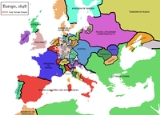
" of the Augsburg treaty was retroactively enforced. It had a tremendous polarizing effect causing the 1800 or so states of the Holy Roman Empire to shatter into disparate blocks of opposed interests.
If fully effected, it would have affected the already secularized archbishop
Archbishop
An archbishop is a bishop of higher rank, but not of higher sacramental order above that of the three orders of deacon, priest , and bishop...
rics of Bremen
Archbishopric of Bremen
The Archdiocese of Bremen was a historical Roman Catholic diocese and formed from 1180 to 1648 an ecclesiastical state , named Prince-Archbishopric of Bremen within the Holy Roman Empire...
and Magdeburg
Magdeburg
Magdeburg , is the largest city and the capital city of the Bundesland of Saxony-Anhalt, Germany. Magdeburg is situated on the Elbe River and was one of the most important medieval cities of Europe....
, 12 bishoprics and over 100 religious houses around the German states. The Edict resulted in a great transfer of power and property away from the Protestants to the Catholics, and in effect broadened a divisive religious struggle into that plus a dynastic struggle for power, as seen from the viewpoint of many smaller German princes, who might otherwise have stayed neutral.
Additionally, since the Edict discriminated against the free practice of the Protestant religion within the affected German states by authorizing attempts to forcibly convert Protestants back to Catholicism in direct contradiction to the Treaty of Augsburg, many Protestants felt threatened. Other states were greatly affected when the mercenary armies marched through neutral states or ravaged them in te course of their foraging expeditions. Thousands of Protestants fled to Protestant controlled states, generally broadening the war, and central Germany was ravaged repeatedly, by some estimates losing between 25–50% of its pre-war population because the competing armies continually took the food—the majority of civilian deaths being caused by the twin side-effects of famine, and deaths from endemic diseases under populations weakened by famine.
The greatest impact was in north-east Germany
Germany
Germany , officially the Federal Republic of Germany , is a federal parliamentary republic in Europe. The country consists of 16 states while the capital and largest city is Berlin. Germany covers an area of 357,021 km2 and has a largely temperate seasonal climate...
. It was here that Ferdinand’s power was at its weakest. Ferdinand appointed Imperial administrators to take over the secularized states and cities, re-establishing Imperial authority in an area that had been free of Imperial rule for nearly 100 years. Ferdinand's actions were not well received by the princes. It was a move that alarmed the French
France
The French Republic , The French Republic , The French Republic , (commonly known as France , is a unitary semi-presidential republic in Western Europe with several overseas territories and islands located on other continents and in the Indian, Pacific, and Atlantic oceans. Metropolitan France...
and led to the French intervention in the war.
The German princes could do nothing. They had seen the Coalition destroyed. Wallenstein had a massive army of 134,000 troops in the field to enforce Imperial authority.
Ironically, Wallenstein disliked the Edict as it trespassed into the region he considered his own but he played his part for the emperor to the full. He stated that "he would teach the Electors
Prince-elector
The Prince-electors of the Holy Roman Empire were the members of the electoral college of the Holy Roman Empire, having the function of electing the Roman king or, from the middle of the 16th century onwards, directly the Holy Roman Emperor.The heir-apparent to a prince-elector was known as an...
manners. They must be dependent on the emperor, not the emperor on them." The response of the princes was to rally behind Maximillian of Bavaria
Maximilian I, Elector of Bavaria
Maximilian I, Duke/Elector of Bavaria , called "the Great", was a Wittelsbach ruler of Bavaria and a prince-elector of the Holy Roman Empire. His reign was marked by the Thirty Years' War ....
to pressure Ferdinand into dismissing Wallenstein.
Their chance came in 1630 when Ferdinand called a meeting of the Electors in Regensburg
Regensburg
Regensburg is a city in Bavaria, Germany, located at the confluence of the Danube and Regen rivers, at the northernmost bend in the Danube. To the east lies the Bavarian Forest. Regensburg is the capital of the Bavarian administrative region Upper Palatinate...
because he wanted his son, Ferdinand III
Ferdinand III, Holy Roman Emperor
Ferdinand III was Holy Roman Emperor from 15 February 1637 until his death, as well as King of Hungary and Croatia, King of Bohemia and Archduke of Austria.-Life:...
, elected King of the Romans. According to the law, the emperor of the Holy Roman Empire
Holy Roman Empire
The Holy Roman Empire was a realm that existed from 962 to 1806 in Central Europe.It was ruled by the Holy Roman Emperor. Its character changed during the Middle Ages and the Early Modern period, when the power of the emperor gradually weakened in favour of the princes...
was selected by a vote from the Electorate of German princes. Therefore, Ferdinand needed their cooperation to approve his son as successor. Ferdinand also hoped to persuade the Electors to approve greater Imperial involvement in the European wars
Thirty Years' War
The Thirty Years' War was fought primarily in what is now Germany, and at various points involved most countries in Europe. It was one of the most destructive conflicts in European history....
.
John George I of Saxony and George William of Brandenburg (both Protestant) stayed away to protest the Edict of Restitution. Those Electors present realized that they had little to gain from additional involvement in the wars. However, Maximillian still asked Ferdinand for the dismissal of Wallenstein.
To win over the Electors, Ferdinand sacked Wallenstein on August 1630 though Wallenstein argued that he was allowed to resign to save face. The dismissal of the most powerful military figure in Europe was a major victory for the Electors and Regensburg must be seen as a defeat for Ferdinand.
All of this was overshadowed in July 1630 — Gustavus Adolphus landed in Pomerania
Pomerania
Pomerania is a historical region on the south shore of the Baltic Sea. Divided between Germany and Poland, it stretches roughly from the Recknitz River near Stralsund in the West, via the Oder River delta near Szczecin, to the mouth of the Vistula River near Gdańsk in the East...
with 4,000 men in response to the persecution of the Protestants. Without Wallenstein, Ferdinand had to turn to Maximillian and Tilly to stop the new threat.
In 1635 the Edict of Restitution was effectively revoked, with the terms of the Peace of Prague
Peace of Prague (1635)
The Peace of Prague of 30 May 1635 was a treaty between the Habsburg Emperor Ferdinand II and the Electorate of Saxony representing most of the Protestant states of the Holy Roman Empire...