

Operation Sealion

Encyclopedia
Operation Sea Lion was Germany
's plan to invade the United Kingdom
during the Second World War
, beginning in 1940. To have had any chance of success, however, the operation would have required air and naval supremacy over the English Channel
. With the German defeat in the Battle of Britain
, Sea Lion was postponed indefinitely on 17 September 1940 and never carried out.
had decided on forcing a decision in the West by invading Belgium
, the Netherlands
and France
. With the prospect of the Channel ports falling under Kriegsmarine
(German Navy) control and attempting to anticipate the obvious next step that might entail, Grand Admiral (Großadmiral) Erich Raeder
(head of the Kriegsmarine) instructed his Operations officer, Kapitän Hans Jürgen Reinicke, to draw up a document examining "the possibility of troop landings in England
should the future progress of the war make the problem arise." Reinicke spent five days on this study and set forth the following prerequisites:
In December 1939, the German Army
issued its own study paper (designated Nordwest) and solicited opinions and input from both the Kriegsmarine and Luftwaffe
(German Air Force). The paper outlined an assault on England's eastern coast between The Wash
and the River Thames
by troops crossing the North Sea
from Low Country
ports. Reichsmarschall Hermann Göring
, head of the Luftwaffe, responded with a single-page letter in which he stated: "...a combined operation having the objective of landing in England must be rejected. It could only be the final act of an already victorious war against Britain as otherwise the preconditions for success of a combined operation would not be met." The Kriegsmarine response was rather more restrained but equally focused on pointing out the many difficulties to be surmounted if invading England was to be a viable option.
On 16 July 1940, following Germany's swift and successful occupation of France and the Low Countries and growing impatient with Britain's indifference towards his recent peace overtures, Hitler issued Führer Directive No. 16, setting in motion preparations for a landing in Britain. He prefaced the order by stating: "As England, in spite of her hopeless military situation, still shows no signs of willingness to come to terms, I have decided to prepare, and if necessary to carry out, a landing operation against her. The aim of this operation is to eliminate the English Motherland as a base from which the war against Germany can be continued, and, if necessary, to occupy the country completely."
Hitler's directive set four conditions for the invasion to occur:
This ultimately placed responsibility for Sea Lion's success squarely on the shoulders of Raeder and Göring, neither of whom had the slightest enthusiasm for the venture and, in fact, did little to hide their opposition to it. Nor did Directive 16 provide for a combined operational headquarters under which all three service branches (Army, Navy, Air Force) could work together under a single umbrella organisation to plan, coordinate and execute such a complex undertaking (similar to the Allies' creation of SHAEF
for the later Normandy landings).
Upon hearing of Hitler's intentions, Italian dictator Benito Mussolini
, through his Foreign Minister Count Ciano
, quickly offered up to ten divisions and thirty squadrons of Italian aircraft for the proposed invasion. Hitler initially declined any such aid but eventually allowed a small contingent of Italian fighters and bombers, the Italian Air Corps (Corpo Aereo Italiano
or CAI), to assist in the Luftwaffe
's aerial campaign over Britain in October/November 1940.
) on targets throughout the British Isles
in an attempt to destroy the RAF (Royal Air Force) and establish air superiority over Great Britain
. The campaign later became known as the Battle of Britain
. However, the change in emphasis of the bombing from RAF bases to bombing London
turned Adler into a strategic bombing
operation. The impact of the switch in strategy is disputed. Some argue that the change in strategy lost the Luftwaffe the opportunity of winning the air battle, or air superiority. Others argue the Luftwaffe achieved little in the air battle and the RAF was not on the verge of collapse, as often claimed. Another perspective has also been put forward, which suggests the Germans could not have gained air superiority before the weather window closed. Others have pointed out that it was unlikely the Luftwaffe was ever able to destroy RAF Fighter Command
. If British losses became severe, the RAF could simply have withdrawn northward and regrouped. It could then deploy when, or if, the Germans launched an invasion. Some also venture to argue Sea Lion would have failed regardless because of the weaknesses of German sea power.
The view of those that believe, regardless of a potential German victory in the air battle, that Sea Lion was still not going to succeed included a number of German General Staff members. Grand Admiral Karl Dönitz
believed air superiority was "not enough". Dönitz stated, "we possessed neither control of the air or the sea; nor were we in any position to gain it". Erich Raeder
, commander-in-chief of the Kriegsmarine in 1940 argued:
When Franz Halder
, the Chief of the Army General Staff, heard of the state of the Kriegsmarine, and its plan for the invasion, he noted in his diary, on 28 July 1940; "If that [the plan] is true, all previous statements by the navy were so much rubbish and we can throw away the whole plan of invasion".
Alfred Jodl
, Chief of Operations in the OKW, argued, after Raeder argued that the Kriegsmarine could not meet the operational requirements of the Army; "then a landing in England must be regarded as a sheer act of desperation".
, despite eight weeks of continuous air supremacy
, the Luftwaffe sank only two British warships. The German aircrews were not trained or equipped to attack fast moving naval targets, particularly agile naval destroyers or motor torpedo boat
s (MTBs). The Luftwaffe also lacked armour-piercing bombs or aerial torpedo
capabilities that were essential to defeating larger warships. The Luftwaffe made 21 deliberate attacks on small torpedo boats during the Battle of Britain, sinking none. The British had between 700 and 800 of these vessels in service, making it a critical threat if the Luftwaffe could not deal with the force. Only nine MTBs were lost to air attack out of 115 sunk by various means throughout the Second World War. Only nine destroyers were sunk by air attack in 1940, out of a force of over 100 operating in British waters at the time. Five were sunk while evacuating Dunkirk despite large periods of German air superiority, thousands of sorties flown, and hundreds of tons of bombs dropped against them. The Luftwaffe's record against merchant shipping was also not impressive. It sank only one in every 100 British vessels passing through British waters in 1940. Moreover, most of this total was achieved using mines.
, had lost a sizable portion of its large modern surface units in April 1940 during the Norwegian Campaign
, either as complete losses or due to battle damage. In particular, the loss of two light cruisers and ten destroyers was crippling, as these were the very warships most suited to operating in the Channel narrows where the invasion would likely take place. Most U-boat
s, the most powerful arm of the , were built for use in the open ocean and simply not suitable for operations in the relatively shallow and restricted waters of the English Channel.
Although the Royal Navy could not bring to bear the whole of its naval superiority (most of the fleet was engaged in the Atlantic
and Mediterranean
), the British Home Fleet still had a very large advantage in numbers. It was debatable whether British ships were as vulnerable to enemy air attack as the Germans hoped. During the Dunkirk evacuation few warships were actually sunk, despite being stationary targets. The overall disparity between the opposing naval forces made the amphibious invasion plan risky, regardless of the outcome in the air. In addition, the Kriegsmarine had allocated its few remaining larger and modern ships to diversionary operations in the North Sea
.
The French fleet, one of the most powerful and modern in the world, might have tipped the balance against Britain. However, the preemptive destruction of the French fleet by the British by an attack on Mers-el-Kébir and the scuttling of the French fleet in Toulon
two years later ensured that this could not happen.
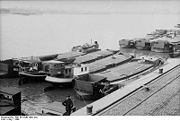
Even if the Royal Navy had been neutralised, the chances of a successful amphibious invasion across the Channel were remote. The Germans had no specialised landing craft, and had to rely primarily on river barge
s to lift troops and supplies for the landing. This would have limited the quantity of artillery and tank
s that could be transported and restricted operations to times of good weather. The barges were not designed for use in open sea and even in almost perfect conditions, they would have been slow and vulnerable to attack. There were also not enough barges to transport the first invasion wave nor the following waves with their equipment. The Germans would have needed to immediately capture a port, an unlikely circumstance considering the strength of the British coastal defences around the south-eastern harbours at that time. The British also had several contingency plans
, including the use of poison gas.
 In 1940 the German Navy was ill-prepared for mounting an amphibious assault the size of Operation Sea Lion. Lacking purpose-built landing craft and both doctrinal and practical experience with amphibious warfare, the Navy was largely improvising from scratch. Some efforts had been made during the inter-war years to investigate landing military forces by sea but inadequate funding severely limited any useful progress.
The Navy had taken some small steps in remedying the landing craft situation with construction of the Pionierlandungsboot 39 (Engineer Landing Boat 39), a self-propelled shallow-draft vessel which could carry 45 infantrymen, two light vehicles or 20 tons of cargo and land on an open beach, unloading via a pair of clamshell doors at the bow. But by late September 1940, only two prototypes had been delivered.
Recognising the need for an even larger craft capable of landing both tanks and infantry onto a hostile shore, the Navy began development of the 220-ton Marinefährprahm (MFP) but these too were unavailable in time for a landing on English soil in 1940, the first of them not being commissioned until April 1941.
Given barely two months to assemble a large sea-going invasion fleet, the Kriegsmarine opted to convert inland river barges into makeshift landing craft. Approximately 2,400 barges were collected from throughout Europe (860 from Germany, 1,200 from the Netherlands and Belgium and 350 from France). Of these, only about 800 were powered (some insufficiently). The rest required towing by tugs.
The aircraft engines were mounted on a platform supported by iron scaffolding at the aft end of the vessel. Cooling water was stored in tanks mounted above-deck. As completed, the Type AF had a speed of 6 knots and a range of 60 nautical miles (unless auxiliary fuel tanks were added). Disadvantages of this set-up included an inability to back the vessel astern, limited maneuverability and the deafening noise of the engines which would have made voice commands problematic.
By 1 October, 128 Type A barges had been converted to airscrew propulsion and, by the end of the month, this figure had risen to over 200.
The Kriegsmarine later used some of the motorized Sea Lion barges for landings on the Russian-held Baltic islands in 1941 and, though most of them were eventually returned to the inland rivers they originally plied, a reserve was kept for military transport duties and for filling out amphibious flotillas.
which, at 8.9 tons, was light enough to float with the attachment of long rectangular buoyancy boxes to either side of the tank's hull. The boxes were machined from aluminum stock and filled with Kapok sacks for added buoyancy. Motive power came from the tank's own tracks which were connected by rods to a propeller shaft running through each float. The Schwimmpanzer II could make 5.7 km/h in the water. An inflatable rubber hose around the turret ring created a waterproof seal between the hull and turret. The tank's 2cm gun and coaxial machinegun were kept operational and could be fired while the tank was still churning its way ashore. Because of the great width of the pontoons, Schwimmpanzer IIs were to be deployed from specially modified Type C landing barges, from which they could be launched directly into open water from a large hatch cut into the stern. The Germans converted 52 of these tanks to amphibious use prior to Sealion's cancelation.
or Panzer IV
medium tank with its hull made completely water-proof by sealing all sighting ports, hatches and air intakes with tape or caulk. The gap between the turret and hull was sealed with an inflatable hose while the main gun mantlet, commander’s cupola and radio operator’s machine gun were given special rubber coverings. Once the tank made it to shore, all covers and seals could be blown off via explosive cables, enabling normal combat operation.
Fresh air for both the crew and engine was drawn into the tank via an 18m long rubber hose to which a float was attached to keep one end above the water’s surface. A radio antenna was also attached to the float to provide communication between the tank crew and the transport barge. The tank’s engine was converted to be cooled with seawater and the exhaust pipes were fitted with over-pressure valves. Any water seeping into the tank’s hull could be removed via an internal bilge pump. Navigation underwater was accomplished using a directional gyro compass or by following instructions radioed from the transport barge.
Experiments conducted at the end of June and early July at Schilling, near Wilhelmshaven, showed that the submersible tanks functioned best when they were kept moving along the seabed as, if halted for any reason, they tended to sink into the sand. Obstacles such as underwater trenches or large rocks tended to stop the tanks in their tracks and it was decided for this reason that they should be landed at high tide so that any tanks so mired could be retrieved again at low tide. Submersible tanks could operate in water up to a maximum depth of 15 metres (49 ft).
The Kriegsmarine initially expected to use 50 specially-converted motor coasters to transport the submersible tanks. But actual testing with the coaster Germania showed this to be impractical due to the ballast needed to offset the weight of the tanks and the fact that the coasters had to be grounded in order to prevent them from capsizing as the tanks were transferred by crane onto the vessel’s wooden side ramps. These difficulties led to development of the Type B barge.
By the end of August, the Germans had converted 160 Panzer IIIs, 42 Panzer IVs and 52 Panzer IIs to amphibious use. This gave them a paper strength of 254 machines, about the equivalent of an armored division. The tanks were divided into four battalions or detachments labeled Panzer-Abteilung A, B, C and D. They were to carry sufficient fuel and ammunition for a combat radius of 200km.
(similar in function to later Allied Mulberry Harbour
s) were designed and built by Krupp Stahlbau and Dortmunder Union and successfully overwintered in the North Sea in 1941-42. Krupp's design won out, as it only required one day to install as opposed to twenty-eight days for the Dortmunder Union bridge. The Krupp bridge consisted of a series of 32m-long connecting platforms, each supported on the seabed by four steel columns. The platforms could be raised or lowered by heavy-duty winches in order to accommodate the tide. The German Navy initially ordered eight complete Krupp units composed of six platforms each. This was reduced to six units by the autumn of 1941, and eventually cancelled altogether when it became apparent Sea Lion would never take place.
In mid-1942, both the Krupp and Dortmunder prototypes were shipped to the Channel Islands
and installed together off Alderney
, where they were used for unloading materials needed to fortify the island. Referred to as the "German jetty" by local inhabitants, it remained standing for the next thirty-six years until demolition crews finally removed it in 1978-79, a testament to its durability.
The German Army developed a portable landing bridge of its own nicknamed Seeschlange (Sea Snake). This "floating roadway" was formed from a series of joined modules that could be towed into place to act as a temporary jetty. Moored ships could then unload their cargo either directly onto the roadbed or lower it down onto waiting vehicles via their heavy-duty booms. The Seeschlange was successfully tested by the Army Training Unit at Le Havre
in the autumn of 1941 and later slated for use in Operation Herkules
, the proposed Italo-German invasion of Malta
. It was easily transportable by rail.
Specialised vehicles slated for Sea Lion included the Landwasserschlepper
(LWS). Under development since 1935, this amphibious tractor was originally intended for use by Army engineers to assist with river crossings. Three of them were assigned to Tank Detachment 100 as part of the invasion and it was intended to use them for pulling ashore unpowered assault barges and towing vehicles across the beaches. They would also have been used to carry supplies directly ashore during the six hours of falling tide when the barges were grounded. This involved towing a Kässbohrer amphibious trailer (capable of transporting 10-20 tons of freight) behind the LWS. The LWS was demonstrated to General Halder on 2 August 1940 by the Reinhardt Trials Staff on the island of Sylt
and, though he was critical of its high silhouette on land, he recognised the overall usefulness of the design. It was proposed to build enough tractors that each invasion barge could be assigned one or two of them but the late date and difficulties in mass-producing the vehicle prevented implementation of that plan.
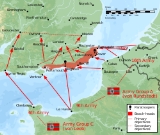
to Kent
. This was far in excess of what Kriegsmarine could supply, and final plans were more modest, calling for nine divisions
to make an amphibious landing
with around 67,000 men in the first echelon
and an airborne
division to support them. The chosen invasion sites ran from Rottingdean
in the west to Hythe
in the east.
The German Navy wanted a front as short as possible as they regarded this as more defensible. Admiral Raeder wanted a front stretching from Dover
to Eastbourne
, stressing that shipping between Cherbourg/Le Havre
and Dorset would be exposed to attacks from the Navy based in Portsmouth
and Plymouth
. General Halder rejected this, saying, "From the army`s point of view I regard it as complete suicide, I might just as well put the troops that have landed straight through the sausage machine."
The battle plan called for German forces to be launched from Cherbourg
to Lyme Regis
, Le Havre
to Ventnor
and Brighton
, Boulogne
to Eastbourne
, Calais
to Folkestone
, and Dunkirk and Ostend
to Ramsgate
. Fallschirmjägern (paratrooper
s) would land near Brighton and Dover
. Once the coast was secured, they would push north, taking Gloucester
and encircling London
. There is reason to believe that the Germans would not attempt to assault the city but besiege and bombard it. German forces would secure England up to the 52nd parallel
(approximately as far north as Northampton
), anticipating that the rest of the United Kingdom would then surrender.
to Royal Navy warships and merchant convoys by use of land-based heavy artillery became readily apparent, both to the German High Command and to Hitler. Even the Kriegsmarine’s Naval Operations Office deemed this a plausible and desirable goal, especially given the relatively short distance, 34 km (21.1 mi), between the French and English coasts. Orders were therefore issued to assemble and begin emplacing every Army and Navy heavy artillery piece available along the French coast, primarily at Pas-de-Calais. This work was assigned to Organisation Todt
and commenced on 22 July 1940.
By early August, four 28 cm (11 in) traversing turrets were fully operational as were all of the Army’s railway guns. Seven of the railway guns, six 28 cm K5 guns and a single 21 cm (8.3 in) K12 gun with a range of 115 km (71.5 mi), could only be used against land targets. The remainder, thirteen 28 cm guns and five 24 cm (9.4 in) guns, plus additional motorised batteries comprising twelve 24 cm guns and ten 21 cm guns, could be fired at shipping but were of limited effectiveness due to their slow traverse speed, long loading time and ammunition types.
Better suited for use against naval targets were the four heavy naval batteries installed by mid-September: Friedrich August with three 30.5 cm (12 in) guns; Prinz Heinrich with two 28 cm guns; Oldenburg with two 24 cm guns and, largest of all, Siegfried (later renamed Batterie Todt) with a pair of 38 cm (15 in) guns. Fire control for these guns was provided by both spotter aircraft and by DeTeGerät radar sets installed at Blanc Nez and Cap d’Alprech. These units were capable of detecting targets out to a range of 40 km (24.9 mi), including small British patrol craft inshore of the English coast. Two additional radar sites were added by mid-September: a DeTeGerät at Cap de la Hague and a FernDeTeGerät long-range radar at Cap d’Antifer near Le Havre
.
To strengthen German control of the Channel narrows, the Army planned to quickly establish mobile artillery batteries along the English shoreline once a beachhead had been firmly established. Towards that end, 16th Army’s Artillerie Kommand 106 was slated to land with the second wave to provide fire protection for the transport fleet as early as possible. This unit consisted of 24 15 cm (5.9 in) guns and 72 10 cm (3.9 in) guns. About one third of them were to be deployed on English soil by the end of Sea Lion’s first week.
The presence of these batteries was expected to greatly reduce the threat posed by British destroyers and smaller craft along the eastern approaches as the guns would be sited to cover the main transport routes from Dover to Calais
and Hastings
to Boulogne
. They could not entirely protect the western approaches, but a large area of those invasion zones would still be within effective range.
The British military was well aware of the dangers posed by German artillery dominating the Dover Strait and on 4 September 1940 the Chief of Naval Staff issued a memo stating that if the Germans "...could get possession of the Dover defile and capture its gun defences from us, then, holding these points on both sides of the Straits, they would be in a position largely to deny those waters to our naval forces". Should the Dover defile be lost, he concluded, the Royal Navy could do little to interrupt the flow of German supplies and reinforcements across the Channel, at least by day, and he further warned that "...there might really be a chance that they (the Germans) might be able to bring a serious weight of attack to bear on this country". The very next day the Chiefs of Staff, after discussing the importance of the defile, decided to reinforce the Dover coast with more ground troops.
s of 5-9 August, 2-7 September, 1-6 October, and 30 October-4 November as likely dates. On 17 September 1940, however, Hitler held a meeting with Reichsmarschall Hermann Göring
and Field Marshal Gerd von Rundstedt
during which he became convinced the operation was not viable. Control of the skies was lacking, and coordination among three branches of the armed forces was out of the question. Later that day, Hitler ordered the postponement of the operation. He ordered the dispersal of the invasion fleet in order to avert further damage by British air and naval attacks.
The postponement coincided with rumours that there had been an attempt to land on British shores on or about 7 September, which had been repulsed with large German casualties. The story was later expanded to include false reports that the British had set the sea on fire using flaming oil. Both versions were widely reported in the American press, and in William L. Shirer
's Berlin Diary
but officially denied by Britain and Germany. Author James Hayward has suggested that the whispering campaign around the 'failed invasion' was a successful example of British black propaganda
to bolster morale at home and in occupied Europe, and convince America that Britain was not a lost cause.
After the London Blitz, Hitler turned his attention to the Soviet Union
, and lapsed, never to be resumed. However, not until 13 February 1942, after the invasion of Russia
, were forces earmarked for the operation released to other duties.
asserts it would have only been possible if the Royal Navy had refrained from large scale intervention and the Germans had assaulted in July 1940 (although Macksey conceded they were unprepared at that time), while others such as Peter Fleming, Derek Robinson and Stephen Bungay
believe the operation would have most likely resulted in a disaster for the Germans. Len Deighton
and some other writers have called the German amphibious plans a "Dunkirk in reverse".
Adolf Galland
, commander of fighters at the time, claimed invasion plans were not serious and that there was a palpable sense of relief in the when it was finally called off. Field Marshal Gerd von Rundstedt
also took this view and thought that Hitler never seriously intended to invade Britain and the whole thing was a bluff, to put pressure on the British Government to come to terms. In fact in November 1939 the German Naval staff produced a study (on the possibility of an invasion of Britain) and concluded that it required two preconditions, air and naval superiority, neither of which Germany ever had.
The capture of Dover and its harbour facilities was expected to add another 800 tons per day, raising to 40% the amount of supplies brought in through ports, but this rested on the assumption of little or no interference from the Royal Navy and RAF with the German supply convoys shuttling between the Continent and the invasion beaches.
remained at less than 4, which, for the most part, it did. Winds for the remainder of the month were rated as "moderate" and would not have prevented the German invasion fleet from successfully depositing the First Wave troops ashore during the ten days needed to accomplish this. Beginning the night of 27 September, strong northerly winds prevailed, making passage more hazardous, but calm conditions returned on 11–12 October and again on 16–20 October. After 20 October, light easterly winds prevailed which would have actually assisted any invasion craft travelling from the Continent towards the invasion beaches. But by the end of October, according to British Air Ministry records, very strong southwest winds (force 8) would have prohibited any non-seagoing craft from risking a Channel crossing.
in 1974, which assumed the had not yet won air supremacy, the Germans were able to establish a beachhead in England by using a minefield
screen in the English Channel to protect the initial assault. However, the German ground forces were delayed at the "Stop Lines" (e.g. the GHQ Line
), a layered series of defensive positions that had been built, each a combination of Home Guard troops and physical barriers. At the same time, the regular troops of the British Army
were forming up. After only a few days, the Royal Navy was able to reach the Channel from Scapa Flow
, cutting off supplies and blocking further reinforcement. Isolated and facing regular troops with armour and artillery, the invasion force was forced to surrender
.
and Ireland
were to be divided into six military-economic commands, with headquarters in London, Birmingham, Newcastle
, Liverpool, Glasgow
and Dublin. Hitler decreed that Blenheim Palace
, the ancestral home of Winston Churchill
, was to serve as the overall headquarters of the German occupation government.
The OKW, RSHA and Foreign Ministry compiled lists of those they thought could be trusted to form a new government along the lines of that in occupied Norway. The list was headed by Oswald Mosley
. The RSHA also felt that Harold Nicolson
might prove useful in this role. OKW also expected to face armed civilian resistance.
After the war rumours also emerged about the selection of two candidates for the "viceregal
" office of Reichskommissar für Großbritannien (Reichskommissar
for Great Britain), which in other occupied territories (such as Norway
and the Netherlands
) actually entailed the granting of near-dictatorial powers to its officeholders (Josef Terboven
and Arthur Seyss-Inquart
, respectively). The first of these was Joachim von Ribbentrop
, the German Foreign Minister
and previously an ambassador
to Great Britain, and the second Ernst Wilhelm Bohle
, an undersecretary in the Foreign Office and the Gauleiter
of the NSDAP/AO
. However, no establishment by this name was ever approved by either Hitler or the Reich government during the Second World War, and was also denied by Bohle when he was interrogated by the victorious Allies (von Ribbentrop not having been questioned on the matter). After the Second Armistice at Compiègne with France, when he expected an imminent British capitulation, Hitler did however assure Bohle that he would be the next German ambassador to the Court of St. James's
"if the British behave[d] sensibly".
and inferences that 'some harm' might come to him otherwise) the former king had willingly allowed himself to be 'smuggled' (at personal risk) aboard a US warship to take up his new post as Governor of the Bahamas - and therefore beyond Hitler's reach. Despite rumours, the British Foreign Office later issued a statement to the effect that, "The Duke never wavered in his loyalty to Great Britain during the war".
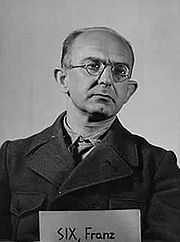 Had Operation Sea Lion succeeded, under Dr. Franz Six
were to follow the invasion force to Great Britain to establish the New Order
. Six's headquarters were to be in London, with regional task forces in Birmingham, Liverpool, Manchester
and Edinburgh
. They were provided with a list (known as The Black Book
) of 2,820 people to be arrested immediately. The Einsatzgruppen were also tasked with liquidating what remained of Britain's Jewish population, which numbered over 300,000. Six had also been entrusted with the task of securing "aero-technological research result and important equipment" as well as "Germanic works of art". There is also a suggestion that he toyed with the idea of moving Nelson's Column
to Berlin.
The RSHA planned to take over the Ministry of Information, to close the major news agencies and to take control of all of the newspapers. Anti-German newspapers were to be closed down.
It appears, based on the German police plans, that the occupation was to be only temporary, as detailed provisions for the post-occupation period are mentioned.
, directed that “The able-bodied male population between the ages of 17 and 45 will, unless the local situation calls for an exceptional ruling, be interned and dispatched to the Continent”. This represented about 25% of the surviving population.
The UK was then to be plundered for anything of financial, military, industrial or cultural value, and the remaining population terrorised. Civilian hostages would be taken, and the death penalty immediately imposed for even the most trivial acts of resistance.
The deported male population would have most likely been used as industrial slave labour in areas of the Reich such as the factories and mines of the Ruhr
and Upper Silesia
. Although they may have been treated less brutally than slaves from the East (whom the Nazis regarded as sub-humans, fit only to be worked to death), working and living conditions would still have been severe.
In late February 1943 Otto Bräutigam
of the Reich Ministry for the Occupied Eastern Territories
claimed he had the opportunity to read a personal report by General Wagner
about a discussion with Heinrich Himmler
, in which Himmler had expressed the intention to kill about 80% of the populations of France and England by special forces
of the SS
after the German victory. In an unrelated event, Hitler had on one occasion called the English lower classes "racially inferior".
).
These include:
Nazi Germany
Nazi Germany , also known as the Third Reich , but officially called German Reich from 1933 to 1943 and Greater German Reich from 26 June 1943 onward, is the name commonly used to refer to the state of Germany from 1933 to 1945, when it was a totalitarian dictatorship ruled by...
's plan to invade the United Kingdom
United Kingdom
The United Kingdom of Great Britain and Northern IrelandIn the United Kingdom and Dependencies, other languages have been officially recognised as legitimate autochthonous languages under the European Charter for Regional or Minority Languages...
during the Second World War
World War II
World War II, or the Second World War , was a global conflict lasting from 1939 to 1945, involving most of the world's nations—including all of the great powers—eventually forming two opposing military alliances: the Allies and the Axis...
, beginning in 1940. To have had any chance of success, however, the operation would have required air and naval supremacy over the English Channel
English Channel
The English Channel , often referred to simply as the Channel, is an arm of the Atlantic Ocean that separates southern England from northern France, and joins the North Sea to the Atlantic. It is about long and varies in width from at its widest to in the Strait of Dover...
. With the German defeat in the Battle of Britain
Battle of Britain
The Battle of Britain is the name given to the World War II air campaign waged by the German Air Force against the United Kingdom during the summer and autumn of 1940...
, Sea Lion was postponed indefinitely on 17 September 1940 and never carried out.
Background
By early November 1939, Adolf HitlerAdolf Hitler
Adolf Hitler was an Austrian-born German politician and the leader of the National Socialist German Workers Party , commonly referred to as the Nazi Party). He was Chancellor of Germany from 1933 to 1945, and head of state from 1934 to 1945...
had decided on forcing a decision in the West by invading Belgium
Belgium
Belgium , officially the Kingdom of Belgium, is a federal state in Western Europe. It is a founding member of the European Union and hosts the EU's headquarters, and those of several other major international organisations such as NATO.Belgium is also a member of, or affiliated to, many...
, the Netherlands
Netherlands
The Netherlands is a constituent country of the Kingdom of the Netherlands, located mainly in North-West Europe and with several islands in the Caribbean. Mainland Netherlands borders the North Sea to the north and west, Belgium to the south, and Germany to the east, and shares maritime borders...
and France
France
The French Republic , The French Republic , The French Republic , (commonly known as France , is a unitary semi-presidential republic in Western Europe with several overseas territories and islands located on other continents and in the Indian, Pacific, and Atlantic oceans. Metropolitan France...
. With the prospect of the Channel ports falling under Kriegsmarine
Kriegsmarine
The Kriegsmarine was the name of the German Navy during the Nazi regime . It superseded the Kaiserliche Marine of World War I and the post-war Reichsmarine. The Kriegsmarine was one of three official branches of the Wehrmacht, the unified armed forces of Nazi Germany.The Kriegsmarine grew rapidly...
(German Navy) control and attempting to anticipate the obvious next step that might entail, Grand Admiral (Großadmiral) Erich Raeder
Erich Raeder
Erich Johann Albert Raeder was a naval leader in Germany before and during World War II. Raeder attained the highest possible naval rank—that of Großadmiral — in 1939, becoming the first person to hold that rank since Alfred von Tirpitz...
(head of the Kriegsmarine) instructed his Operations officer, Kapitän Hans Jürgen Reinicke, to draw up a document examining "the possibility of troop landings in England
England
England is a country that is part of the United Kingdom. It shares land borders with Scotland to the north and Wales to the west; the Irish Sea is to the north west, the Celtic Sea to the south west, with the North Sea to the east and the English Channel to the south separating it from continental...
should the future progress of the war make the problem arise." Reinicke spent five days on this study and set forth the following prerequisites:
- Elimination or sealing off of Royal NavyRoyal NavyThe Royal Navy is the naval warfare service branch of the British Armed Forces. Founded in the 16th century, it is the oldest service branch and is known as the Senior Service...
forces from the landing and approach areas. - Elimination of the Royal Air ForceRoyal Air ForceThe Royal Air Force is the aerial warfare service branch of the British Armed Forces. Formed on 1 April 1918, it is the oldest independent air force in the world...
(RAF). - Destruction of all Royal Navy units in the coastal zone.
- Prevention of British submarineSubmarineA submarine is a watercraft capable of independent operation below the surface of the water. It differs from a submersible, which has more limited underwater capability...
action against the landing fleet.
In December 1939, the German Army
German Army
The German Army is the land component of the armed forces of the Federal Republic of Germany. Following the disbanding of the Wehrmacht after World War II, it was re-established in 1955 as the Bundesheer, part of the newly formed West German Bundeswehr along with the Navy and the Air Force...
issued its own study paper (designated Nordwest) and solicited opinions and input from both the Kriegsmarine and Luftwaffe
Luftwaffe
Luftwaffe is a generic German term for an air force. It is also the official name for two of the four historic German air forces, the Wehrmacht air arm founded in 1935 and disbanded in 1946; and the current Bundeswehr air arm founded in 1956....
(German Air Force). The paper outlined an assault on England's eastern coast between The Wash
The Wash
The Wash is the square-mouthed bay and estuary on the northwest margin of East Anglia on the east coast of England, where Norfolk meets Lincolnshire. It is among the largest estuaries in the United Kingdom...
and the River Thames
River Thames
The River Thames flows through southern England. It is the longest river entirely in England and the second longest in the United Kingdom. While it is best known because its lower reaches flow through central London, the river flows alongside several other towns and cities, including Oxford,...
by troops crossing the North Sea
North Sea
In the southwest, beyond the Straits of Dover, the North Sea becomes the English Channel connecting to the Atlantic Ocean. In the east, it connects to the Baltic Sea via the Skagerrak and Kattegat, narrow straits that separate Denmark from Norway and Sweden respectively...
from Low Country
Low Countries
The Low Countries are the historical lands around the low-lying delta of the Rhine, Scheldt, and Meuse rivers, including the modern countries of Belgium, the Netherlands, Luxembourg and parts of northern France and western Germany....
ports. Reichsmarschall Hermann Göring
Hermann Göring
Hermann Wilhelm Göring, was a German politician, military leader, and a leading member of the Nazi Party. He was a veteran of World War I as an ace fighter pilot, and a recipient of the coveted Pour le Mérite, also known as "The Blue Max"...
, head of the Luftwaffe, responded with a single-page letter in which he stated: "...a combined operation having the objective of landing in England must be rejected. It could only be the final act of an already victorious war against Britain as otherwise the preconditions for success of a combined operation would not be met." The Kriegsmarine response was rather more restrained but equally focused on pointing out the many difficulties to be surmounted if invading England was to be a viable option.
On 16 July 1940, following Germany's swift and successful occupation of France and the Low Countries and growing impatient with Britain's indifference towards his recent peace overtures, Hitler issued Führer Directive No. 16, setting in motion preparations for a landing in Britain. He prefaced the order by stating: "As England, in spite of her hopeless military situation, still shows no signs of willingness to come to terms, I have decided to prepare, and if necessary to carry out, a landing operation against her. The aim of this operation is to eliminate the English Motherland as a base from which the war against Germany can be continued, and, if necessary, to occupy the country completely."
Hitler's directive set four conditions for the invasion to occur:
- The RAF was to be "beaten down in its morale and in fact, that it can no longer display any appreciable aggressive force in opposition to the German crossing".
- The English Channel was to be swept of British mines at the crossing points, and the Strait of DoverStrait of DoverThe Strait of Dover or Dover Strait is the strait at the narrowest part of the English Channel. The shortest distance across the strait is from the South Foreland, 6 kilometres northeast of Dover in the county of Kent, England, to Cap Gris Nez, a cape near to Calais in the French of...
must be blocked at both ends by German mines. - The coastal zone between occupied FranceFranceThe French Republic , The French Republic , The French Republic , (commonly known as France , is a unitary semi-presidential republic in Western Europe with several overseas territories and islands located on other continents and in the Indian, Pacific, and Atlantic oceans. Metropolitan France...
and England must be dominated by heavy artillery. - The Royal Navy must be sufficiently engaged in the North SeaNorth SeaIn the southwest, beyond the Straits of Dover, the North Sea becomes the English Channel connecting to the Atlantic Ocean. In the east, it connects to the Baltic Sea via the Skagerrak and Kattegat, narrow straits that separate Denmark from Norway and Sweden respectively...
and the Mediterranean so that it could not intervene in the crossing. British home squadrons must be damaged or destroyed by air and torpedo attacks.
This ultimately placed responsibility for Sea Lion's success squarely on the shoulders of Raeder and Göring, neither of whom had the slightest enthusiasm for the venture and, in fact, did little to hide their opposition to it. Nor did Directive 16 provide for a combined operational headquarters under which all three service branches (Army, Navy, Air Force) could work together under a single umbrella organisation to plan, coordinate and execute such a complex undertaking (similar to the Allies' creation of SHAEF
Supreme Headquarters Allied Expeditionary Force
Supreme Headquarters Allied Expeditionary Force , was the headquarters of the Commander of Allied forces in north west Europe, from late 1943 until the end of World War II. U.S. General Dwight D. Eisenhower was in command of SHAEF throughout its existence...
for the later Normandy landings).
Upon hearing of Hitler's intentions, Italian dictator Benito Mussolini
Benito Mussolini
Benito Amilcare Andrea Mussolini was an Italian politician who led the National Fascist Party and is credited with being one of the key figures in the creation of Fascism....
, through his Foreign Minister Count Ciano
Galeazzo Ciano
Gian Galeazzo Ciano, 2nd Count of Cortellazzo and Buccari was an Italian Minister of Foreign Affairs and Benito Mussolini's son-in-law. In early 1944 Count Ciano was shot by firing squad at the behest of his father-in-law, Mussolini under pressure from Nazi Germany.-Early life:Ciano was born in...
, quickly offered up to ten divisions and thirty squadrons of Italian aircraft for the proposed invasion. Hitler initially declined any such aid but eventually allowed a small contingent of Italian fighters and bombers, the Italian Air Corps (Corpo Aereo Italiano
Corpo Aereo Italiano
The "Italian Air Corps" was an expeditionary force of the Italian Royal Air Force that participated in the Battle of Britain during the final months of 1940 during World War II. The CAI supported the German Air Force and flew against the British Royal Air Force...
or CAI), to assist in the Luftwaffe
Luftwaffe
Luftwaffe is a generic German term for an air force. It is also the official name for two of the four historic German air forces, the Wehrmacht air arm founded in 1935 and disbanded in 1946; and the current Bundeswehr air arm founded in 1956....
's aerial campaign over Britain in October/November 1940.
Battle of Britain
Beginning in August 1940, the German Luftwaffe began a series of concentrated aerial attacks (designated Unternehmen Adlerangriff or Operation Eagle AttackOperation Eagle Attack
Adlertag was the first day of Unternehmen Adlerangriff , which was the codename of a German military operation by the Luftwaffe to destroy the British Royal Air Force . By June 1940, the Allies had been defeated in Western Europe and Scandinavia...
) on targets throughout the British Isles
British Isles
The British Isles are a group of islands off the northwest coast of continental Europe that include the islands of Great Britain and Ireland and over six thousand smaller isles. There are two sovereign states located on the islands: the United Kingdom of Great Britain and Northern Ireland and...
in an attempt to destroy the RAF (Royal Air Force) and establish air superiority over Great Britain
Great Britain
Great Britain or Britain is an island situated to the northwest of Continental Europe. It is the ninth largest island in the world, and the largest European island, as well as the largest of the British Isles...
. The campaign later became known as the Battle of Britain
Battle of Britain
The Battle of Britain is the name given to the World War II air campaign waged by the German Air Force against the United Kingdom during the summer and autumn of 1940...
. However, the change in emphasis of the bombing from RAF bases to bombing London
The Blitz
The Blitz was the sustained strategic bombing of Britain by Nazi Germany between 7 September 1940 and 10 May 1941, during the Second World War. The city of London was bombed by the Luftwaffe for 76 consecutive nights and many towns and cities across the country followed...
turned Adler into a strategic bombing
Strategic bombing
Strategic bombing is a military strategy used in a total war with the goal of defeating an enemy nation-state by destroying its economic ability and public will to wage war rather than destroying its land or naval forces...
operation. The impact of the switch in strategy is disputed. Some argue that the change in strategy lost the Luftwaffe the opportunity of winning the air battle, or air superiority. Others argue the Luftwaffe achieved little in the air battle and the RAF was not on the verge of collapse, as often claimed. Another perspective has also been put forward, which suggests the Germans could not have gained air superiority before the weather window closed. Others have pointed out that it was unlikely the Luftwaffe was ever able to destroy RAF Fighter Command
RAF Fighter Command
RAF Fighter Command was one of three functional commands of the Royal Air Force. It was formed in 1936 to allow more specialised control of fighter aircraft. It served throughout the Second World War, gaining recognition in the Battle of Britain. The Command continued until 17 November 1943, when...
. If British losses became severe, the RAF could simply have withdrawn northward and regrouped. It could then deploy when, or if, the Germans launched an invasion. Some also venture to argue Sea Lion would have failed regardless because of the weaknesses of German sea power.
The view of those that believe, regardless of a potential German victory in the air battle, that Sea Lion was still not going to succeed included a number of German General Staff members. Grand Admiral Karl Dönitz
Karl Dönitz
Karl Dönitz was a German naval commander during World War II. He started his career in the German Navy during World War I. In 1918, while he was in command of , the submarine was sunk by British forces and Dönitz was taken prisoner...
believed air superiority was "not enough". Dönitz stated, "we possessed neither control of the air or the sea; nor were we in any position to gain it". Erich Raeder
Erich Raeder
Erich Johann Albert Raeder was a naval leader in Germany before and during World War II. Raeder attained the highest possible naval rank—that of Großadmiral — in 1939, becoming the first person to hold that rank since Alfred von Tirpitz...
, commander-in-chief of the Kriegsmarine in 1940 argued:
When Franz Halder
Franz Halder
Franz Halder was a German General and the head of the Army General Staff from 1938 until September, 1942, when he was dismissed after frequent disagreements with Adolf Hitler.-Early life:...
, the Chief of the Army General Staff, heard of the state of the Kriegsmarine, and its plan for the invasion, he noted in his diary, on 28 July 1940; "If that [the plan] is true, all previous statements by the navy were so much rubbish and we can throw away the whole plan of invasion".
Alfred Jodl
Alfred Jodl
Alfred Josef Ferdinand Jodl was a German military commander, attaining the position of Chief of the Operations Staff of the Armed Forces High Command during World War II, acting as deputy to Wilhelm Keitel...
, Chief of Operations in the OKW, argued, after Raeder argued that the Kriegsmarine could not meet the operational requirements of the Army; "then a landing in England must be regarded as a sheer act of desperation".
Limitations of the Luftwaffe
The track record of the Luftwaffe against naval combat vessels up to that point in the war was less than impressive. In the Norwegian CampaignNorwegian Campaign
The Norwegian Campaign was a military campaign that was fought in Norway during the Second World War between the Allies and Germany, after the latter's invasion of the country. In April 1940, the United Kingdom and France came to Norway's aid with an expeditionary force...
, despite eight weeks of continuous air supremacy
Air supremacy
Air supremacy is the complete dominance of the air power of one side's air forces over the other side's, during a military campaign. It is the most favorable state of control of the air...
, the Luftwaffe sank only two British warships. The German aircrews were not trained or equipped to attack fast moving naval targets, particularly agile naval destroyers or motor torpedo boat
Motor Torpedo Boat
Motor Torpedo Boat was the name given to fast torpedo boats by the Royal Navy, and the Royal Canadian Navy.The capitalised term is generally used for the Royal Navy boats and abbreviated to "MTB"...
s (MTBs). The Luftwaffe also lacked armour-piercing bombs or aerial torpedo
Torpedo
The modern torpedo is a self-propelled missile weapon with an explosive warhead, launched above or below the water surface, propelled underwater towards a target, and designed to detonate either on contact with it or in proximity to it.The term torpedo was originally employed for...
capabilities that were essential to defeating larger warships. The Luftwaffe made 21 deliberate attacks on small torpedo boats during the Battle of Britain, sinking none. The British had between 700 and 800 of these vessels in service, making it a critical threat if the Luftwaffe could not deal with the force. Only nine MTBs were lost to air attack out of 115 sunk by various means throughout the Second World War. Only nine destroyers were sunk by air attack in 1940, out of a force of over 100 operating in British waters at the time. Five were sunk while evacuating Dunkirk despite large periods of German air superiority, thousands of sorties flown, and hundreds of tons of bombs dropped against them. The Luftwaffe's record against merchant shipping was also not impressive. It sank only one in every 100 British vessels passing through British waters in 1940. Moreover, most of this total was achieved using mines.
Navy
The most daunting problem for Germany in protecting an invasion fleet was the small size of its navy. The Kriegsmarine, already numerically far inferior to Britain's Royal NavyRoyal Navy
The Royal Navy is the naval warfare service branch of the British Armed Forces. Founded in the 16th century, it is the oldest service branch and is known as the Senior Service...
, had lost a sizable portion of its large modern surface units in April 1940 during the Norwegian Campaign
Norwegian Campaign
The Norwegian Campaign was a military campaign that was fought in Norway during the Second World War between the Allies and Germany, after the latter's invasion of the country. In April 1940, the United Kingdom and France came to Norway's aid with an expeditionary force...
, either as complete losses or due to battle damage. In particular, the loss of two light cruisers and ten destroyers was crippling, as these were the very warships most suited to operating in the Channel narrows where the invasion would likely take place. Most U-boat
U-boat
U-boat is the anglicized version of the German word U-Boot , itself an abbreviation of Unterseeboot , and refers to military submarines operated by Germany, particularly in World War I and World War II...
s, the most powerful arm of the , were built for use in the open ocean and simply not suitable for operations in the relatively shallow and restricted waters of the English Channel.
Although the Royal Navy could not bring to bear the whole of its naval superiority (most of the fleet was engaged in the Atlantic
Atlantic Ocean
The Atlantic Ocean is the second-largest of the world's oceanic divisions. With a total area of about , it covers approximately 20% of the Earth's surface and about 26% of its water surface area...
and Mediterranean
Mediterranean Sea
The Mediterranean Sea is a sea connected to the Atlantic Ocean surrounded by the Mediterranean region and almost completely enclosed by land: on the north by Anatolia and Europe, on the south by North Africa, and on the east by the Levant...
), the British Home Fleet still had a very large advantage in numbers. It was debatable whether British ships were as vulnerable to enemy air attack as the Germans hoped. During the Dunkirk evacuation few warships were actually sunk, despite being stationary targets. The overall disparity between the opposing naval forces made the amphibious invasion plan risky, regardless of the outcome in the air. In addition, the Kriegsmarine had allocated its few remaining larger and modern ships to diversionary operations in the North Sea
North Sea
In the southwest, beyond the Straits of Dover, the North Sea becomes the English Channel connecting to the Atlantic Ocean. In the east, it connects to the Baltic Sea via the Skagerrak and Kattegat, narrow straits that separate Denmark from Norway and Sweden respectively...
.
The French fleet, one of the most powerful and modern in the world, might have tipped the balance against Britain. However, the preemptive destruction of the French fleet by the British by an attack on Mers-el-Kébir and the scuttling of the French fleet in Toulon
Scuttling of the French fleet in Toulon
The French fleet in Toulon was scuttled on 27 November 1942 on the order of the Admiralty of Vichy France to avoid capture by Nazi German forces during Operation Lila of the Case Anton takeover of Vichy France.- Context :...
two years later ensured that this could not happen.
Even if the Royal Navy had been neutralised, the chances of a successful amphibious invasion across the Channel were remote. The Germans had no specialised landing craft, and had to rely primarily on river barge
Barge
A barge is a flat-bottomed boat, built mainly for river and canal transport of heavy goods. Some barges are not self-propelled and need to be towed by tugboats or pushed by towboats...
s to lift troops and supplies for the landing. This would have limited the quantity of artillery and tank
Tank
A tank is a tracked, armoured fighting vehicle designed for front-line combat which combines operational mobility, tactical offensive, and defensive capabilities...
s that could be transported and restricted operations to times of good weather. The barges were not designed for use in open sea and even in almost perfect conditions, they would have been slow and vulnerable to attack. There were also not enough barges to transport the first invasion wave nor the following waves with their equipment. The Germans would have needed to immediately capture a port, an unlikely circumstance considering the strength of the British coastal defences around the south-eastern harbours at that time. The British also had several contingency plans
British anti-invasion preparations of World War II
British anti-invasion preparations of the Second World War entailed a large-scale division of military and civilian mobilisation in response to the threat of invasion by German armed forces in 1940 and 1941. The British army needed to recover from the defeat of the British Expeditionary Force in...
, including the use of poison gas.
Landing craft
The Navy had taken some small steps in remedying the landing craft situation with construction of the Pionierlandungsboot 39 (Engineer Landing Boat 39), a self-propelled shallow-draft vessel which could carry 45 infantrymen, two light vehicles or 20 tons of cargo and land on an open beach, unloading via a pair of clamshell doors at the bow. But by late September 1940, only two prototypes had been delivered.
Recognising the need for an even larger craft capable of landing both tanks and infantry onto a hostile shore, the Navy began development of the 220-ton Marinefährprahm (MFP) but these too were unavailable in time for a landing on English soil in 1940, the first of them not being commissioned until April 1941.
Given barely two months to assemble a large sea-going invasion fleet, the Kriegsmarine opted to convert inland river barges into makeshift landing craft. Approximately 2,400 barges were collected from throughout Europe (860 from Germany, 1,200 from the Netherlands and Belgium and 350 from France). Of these, only about 800 were powered (some insufficiently). The rest required towing by tugs.
Barge types
Two types of inland river barges were generally available in Europe for use in Sea Lion: the peniche, which was 38.5 metres long and carried 360 tons of cargo, and the Kampine, which was 50 metres long and carried 620 tons of cargo. Of the barges collected for the invasion, 1,336 were classified as peniches and 982 as Kampinen. For simplicity’s sake, the Germans designated any barge up to the size of a standard peniche as Type A1 and anything larger as Type A2.Type A
Converting the assembled barges into landing craft involved cutting an opening in the bow for off-loading troops and vehicles, welding longitudinal I-beams and transverse braces to the hull to improve seaworthiness, adding a wooden internal ramp and pouring a concrete floor in the hold to allow for tank transport. As modified, the Type A1 barge could accommodate three medium tanks while the Type A2 could carry four.Type B
This barge was a Type A altered to carry and rapidly off-load the submersible tanks (Tauchpanzers) developed for use in Sea Lion. They had the advantage of being able to unload their tanks directly into water up to 15 metres (49 ft) in depth, several hundred yards from shore, whereas the unmodified Type A had to be firmly grounded on the beach, making it more vulnerable to enemy fire. The Type B required a longer external ramp (11 metres) with a float attached to the front of it. Once the barge anchored, the crew would extend the internally-stowed ramp using block and tackle sets until it was resting on the water’s surface. As the first tank rolled forward onto the ramp, its weight would tilt the forward end of the ramp into the water and push it down onto the seabed. Once the tank rolled off, the ramp would bob back up to a horizontal position, ready for the next one to exit. The Navy High Command increased its initial order for 60 of these vessels to 70 in order to compensate for expected losses. A further 5 were ordered on 30 September as a reserve.Type C
The Type C barge was specifically converted to carry the Panzer II amphibious tank (Schwimmpanzer). Because of the extra width of the floats attached to this tank, cutting a broad exit ramp into the bow of the barge was not considered advisable as it would have compromised the vessel’s seaworthiness to an unacceptable degree. Instead, a large hatch was cut into the stern, thereby allowing the tanks to drive directly into deep water before turning under their own motive power and heading towards shore. The Type C barge could accommodate up to four Schwimmpanzers in its hold. Approximately 14 of these craft were available by the end of September.Type AS
During the planning stages of Sea Lion, it was deemed desirable to provide the advanced infantry detachments (making the initial landings) with greater protection from small-arms and light artillery fire by lining the sides of a Type A barge with concrete. Wooden slides were also installed along the barge’s hull to accommodate ten assault boats (Sturmbooten), each capable of carrying six infantrymen and powered by a 30hp outboard motor. The extra weight of this additional armor and equipment reduced the barge’s load capacity to just 40 tons. By mid-August, 18 of these craft, designated Type AS, had been converted and another 5 were ordered on 30 September.Type AF
The Luftwaffe had formed its own special command (Sonderkommand) under Major Fritz Siebel to investigate the production of landing craft for Sea Lion. Major Siebel proposed giving the unpowered Type A barges their own motive power by installing a pair of 600hp surplus BMW aircraft engines on them. The Navy was highly skeptical of this venture but the Army high command enthusiastically embraced the concept and Siebel proceeded with the conversions.The aircraft engines were mounted on a platform supported by iron scaffolding at the aft end of the vessel. Cooling water was stored in tanks mounted above-deck. As completed, the Type AF had a speed of 6 knots and a range of 60 nautical miles (unless auxiliary fuel tanks were added). Disadvantages of this set-up included an inability to back the vessel astern, limited maneuverability and the deafening noise of the engines which would have made voice commands problematic.
By 1 October, 128 Type A barges had been converted to airscrew propulsion and, by the end of the month, this figure had risen to over 200.
Performance
Overall, the converted invasion barges proved surprisingly seaworthy and did well even in 4 to 5 force winds, taking on little water and demonstrating adequate handling characteristics in the waves. During one exercise, held by General Herbert Loch’s 17th Division, only two barges suffered damage to their bow doors in 6 to 8 force winds.The Kriegsmarine later used some of the motorized Sea Lion barges for landings on the Russian-held Baltic islands in 1941 and, though most of them were eventually returned to the inland rivers they originally plied, a reserve was kept for military transport duties and for filling out amphibious flotillas.
Panzers ashore
Providing armor support for the initial wave of assault troops was a critical concern for Sea Lion planners and much effort was devoted to finding practical ways of rapidly getting tanks onto the invasion beaches. Though the Type A barges were capable of disembarking several medium tanks onto an open beach, this could be accomplished only at low tide when the barges were firmly grounded. The time needed for assembling the external ramps also meant that both the tanks and the ramp assembly crews would be exposed to close-quarter enemy fire for a considerable period of time. A safer and faster method was needed and the Germans eventually settled on providing some tanks with floats and making others fully submersible.Schwimmpanzer
The Schwimmpanzer II was a modified version of the Panzer IIPanzer II
The Panzer II was the common name for a family of German tanks used in World War II. The official German designation was Panzerkampfwagen II...
which, at 8.9 tons, was light enough to float with the attachment of long rectangular buoyancy boxes to either side of the tank's hull. The boxes were machined from aluminum stock and filled with Kapok sacks for added buoyancy. Motive power came from the tank's own tracks which were connected by rods to a propeller shaft running through each float. The Schwimmpanzer II could make 5.7 km/h in the water. An inflatable rubber hose around the turret ring created a waterproof seal between the hull and turret. The tank's 2cm gun and coaxial machinegun were kept operational and could be fired while the tank was still churning its way ashore. Because of the great width of the pontoons, Schwimmpanzer IIs were to be deployed from specially modified Type C landing barges, from which they could be launched directly into open water from a large hatch cut into the stern. The Germans converted 52 of these tanks to amphibious use prior to Sealion's cancelation.
Tauchpanzer
The Tauchpanzer or deep-wading tank (also referred to as the U-Panzer or Unterwasser Panzer) was a standard Panzer IIIPanzer III
Panzer III was the common name of a medium tank that was developed in the 1930s by Germany and was used extensively in World War II. The official German designation was Panzerkampfwagen III translating as "armoured battle vehicle". It was intended to fight other armoured fighting vehicles and...
or Panzer IV
Panzer IV
The Panzerkampfwagen IV , commonly known as the Panzer IV, was a medium tank developed in Nazi Germany in the late 1930s and used extensively during the Second World War. Its ordnance inventory designation was Sd.Kfz...
medium tank with its hull made completely water-proof by sealing all sighting ports, hatches and air intakes with tape or caulk. The gap between the turret and hull was sealed with an inflatable hose while the main gun mantlet, commander’s cupola and radio operator’s machine gun were given special rubber coverings. Once the tank made it to shore, all covers and seals could be blown off via explosive cables, enabling normal combat operation.
Fresh air for both the crew and engine was drawn into the tank via an 18m long rubber hose to which a float was attached to keep one end above the water’s surface. A radio antenna was also attached to the float to provide communication between the tank crew and the transport barge. The tank’s engine was converted to be cooled with seawater and the exhaust pipes were fitted with over-pressure valves. Any water seeping into the tank’s hull could be removed via an internal bilge pump. Navigation underwater was accomplished using a directional gyro compass or by following instructions radioed from the transport barge.
Experiments conducted at the end of June and early July at Schilling, near Wilhelmshaven, showed that the submersible tanks functioned best when they were kept moving along the seabed as, if halted for any reason, they tended to sink into the sand. Obstacles such as underwater trenches or large rocks tended to stop the tanks in their tracks and it was decided for this reason that they should be landed at high tide so that any tanks so mired could be retrieved again at low tide. Submersible tanks could operate in water up to a maximum depth of 15 metres (49 ft).
The Kriegsmarine initially expected to use 50 specially-converted motor coasters to transport the submersible tanks. But actual testing with the coaster Germania showed this to be impractical due to the ballast needed to offset the weight of the tanks and the fact that the coasters had to be grounded in order to prevent them from capsizing as the tanks were transferred by crane onto the vessel’s wooden side ramps. These difficulties led to development of the Type B barge.
By the end of August, the Germans had converted 160 Panzer IIIs, 42 Panzer IVs and 52 Panzer IIs to amphibious use. This gave them a paper strength of 254 machines, about the equivalent of an armored division. The tanks were divided into four battalions or detachments labeled Panzer-Abteilung A, B, C and D. They were to carry sufficient fuel and ammunition for a combat radius of 200km.
Specialised landing equipment
As part of a Navy competition, prototypes for a prefabricated "heavy landing bridge" or jettyJetty
A jetty is any of a variety of structures used in river, dock, and maritime works that are generally carried out in pairs from river banks, or in continuation of river channels at their outlets into deep water; or out into docks, and outside their entrances; or for forming basins along the...
(similar in function to later Allied Mulberry Harbour
Mulberry harbour
A Mulberry harbour was a British type of temporary harbour developed in World War II to offload cargo on the beaches during the Allied invasion of Normandy....
s) were designed and built by Krupp Stahlbau and Dortmunder Union and successfully overwintered in the North Sea in 1941-42. Krupp's design won out, as it only required one day to install as opposed to twenty-eight days for the Dortmunder Union bridge. The Krupp bridge consisted of a series of 32m-long connecting platforms, each supported on the seabed by four steel columns. The platforms could be raised or lowered by heavy-duty winches in order to accommodate the tide. The German Navy initially ordered eight complete Krupp units composed of six platforms each. This was reduced to six units by the autumn of 1941, and eventually cancelled altogether when it became apparent Sea Lion would never take place.
In mid-1942, both the Krupp and Dortmunder prototypes were shipped to the Channel Islands
Channel Islands
The Channel Islands are an archipelago of British Crown Dependencies in the English Channel, off the French coast of Normandy. They include two separate bailiwicks: the Bailiwick of Guernsey and the Bailiwick of Jersey...
and installed together off Alderney
Alderney
Alderney is the most northerly of the Channel Islands. It is part of the Bailiwick of Guernsey, a British Crown dependency. It is long and wide. The area is , making it the third-largest island of the Channel Islands, and the second largest in the Bailiwick...
, where they were used for unloading materials needed to fortify the island. Referred to as the "German jetty" by local inhabitants, it remained standing for the next thirty-six years until demolition crews finally removed it in 1978-79, a testament to its durability.
The German Army developed a portable landing bridge of its own nicknamed Seeschlange (Sea Snake). This "floating roadway" was formed from a series of joined modules that could be towed into place to act as a temporary jetty. Moored ships could then unload their cargo either directly onto the roadbed or lower it down onto waiting vehicles via their heavy-duty booms. The Seeschlange was successfully tested by the Army Training Unit at Le Havre
Le Havre
Le Havre is a city in the Seine-Maritime department of the Haute-Normandie region in France. It is situated in north-western France, on the right bank of the mouth of the river Seine on the English Channel. Le Havre is the most populous commune in the Haute-Normandie region, although the total...
in the autumn of 1941 and later slated for use in Operation Herkules
Operation Herkules
Operation Herkules was the German code-name given to a planned but never-executed Italo-German invasion of Malta during World War II...
, the proposed Italo-German invasion of Malta
Malta
Malta , officially known as the Republic of Malta , is a Southern European country consisting of an archipelago situated in the centre of the Mediterranean, south of Sicily, east of Tunisia and north of Libya, with Gibraltar to the west and Alexandria to the east.Malta covers just over in...
. It was easily transportable by rail.
Specialised vehicles slated for Sea Lion included the Landwasserschlepper
Landwasserschlepper
Landwasserschlepper was an unarmed amphibious tractor produced in Germany during World War II.-Origins and development:Ordered by the Heereswaffenamt in 1935 for use by German Army engineers, the Landwasserschlepper was intended as a lightweight river tug with some capacity to operate on...
(LWS). Under development since 1935, this amphibious tractor was originally intended for use by Army engineers to assist with river crossings. Three of them were assigned to Tank Detachment 100 as part of the invasion and it was intended to use them for pulling ashore unpowered assault barges and towing vehicles across the beaches. They would also have been used to carry supplies directly ashore during the six hours of falling tide when the barges were grounded. This involved towing a Kässbohrer amphibious trailer (capable of transporting 10-20 tons of freight) behind the LWS. The LWS was demonstrated to General Halder on 2 August 1940 by the Reinhardt Trials Staff on the island of Sylt
Sylt
Sylt is an island in northern Germany, part of Nordfriesland district, Schleswig-Holstein, and well known for the distinctive shape of its shoreline. It belongs to the North Frisian Islands and is the largest island in North Frisia...
and, though he was critical of its high silhouette on land, he recognised the overall usefulness of the design. It was proposed to build enough tractors that each invasion barge could be assigned one or two of them but the late date and difficulties in mass-producing the vehicle prevented implementation of that plan.
Broad vs. narrow front
The German Army High Command originally planned an invasion on a vast scale, extending from DorsetDorset
Dorset , is a county in South West England on the English Channel coast. The county town is Dorchester which is situated in the south. The Hampshire towns of Bournemouth and Christchurch joined the county with the reorganisation of local government in 1974...
to Kent
Kent
Kent is a county in southeast England, and is one of the home counties. It borders East Sussex, Surrey and Greater London and has a defined boundary with Essex in the middle of the Thames Estuary. The ceremonial county boundaries of Kent include the shire county of Kent and the unitary borough of...
. This was far in excess of what Kriegsmarine could supply, and final plans were more modest, calling for nine divisions
Division (military)
A division is a large military unit or formation usually consisting of between 10,000 and 20,000 soldiers. In most armies, a division is composed of several regiments or brigades, and in turn several divisions typically make up a corps...
to make an amphibious landing
Amphibious warfare
Amphibious warfare is the use of naval firepower, logistics and strategy to project military power ashore. In previous eras it stood as the primary method of delivering troops to non-contiguous enemy-held terrain...
with around 67,000 men in the first echelon
Echelon formation
An echelon formation is a military formation in which members are arranged diagonally. Each member is stationed behind and to the right , or behind and to the left , of the member ahead...
and an airborne
Airborne forces
Airborne forces are military units, usually light infantry, set up to be moved by aircraft and 'dropped' into battle. Thus they can be placed behind enemy lines, and have an ability to deploy almost anywhere with little warning...
division to support them. The chosen invasion sites ran from Rottingdean
Rottingdean
Rottingdean is a coastal village next to the town of Brighton and technically within the city of Brighton and Hove, in East Sussex, on the south coast of England...
in the west to Hythe
Hythe, Kent
Hythe , is a small coastal market town on the edge of Romney Marsh, in the District of Shepway on the south coast of Kent. The word Hythe or Hithe is an Old English word meaning Haven or Landing Place....
in the east.
The German Navy wanted a front as short as possible as they regarded this as more defensible. Admiral Raeder wanted a front stretching from Dover
Dover
Dover is a town and major ferry port in the home county of Kent, in South East England. It faces France across the narrowest part of the English Channel, and lies south-east of Canterbury; east of Kent's administrative capital Maidstone; and north-east along the coastline from Dungeness and Hastings...
to Eastbourne
Eastbourne
Eastbourne is a large town and borough in East Sussex, on the south coast of England between Brighton and Hastings. The town is situated at the eastern end of the chalk South Downs alongside the high cliff at Beachy Head...
, stressing that shipping between Cherbourg/Le Havre
Le Havre
Le Havre is a city in the Seine-Maritime department of the Haute-Normandie region in France. It is situated in north-western France, on the right bank of the mouth of the river Seine on the English Channel. Le Havre is the most populous commune in the Haute-Normandie region, although the total...
and Dorset would be exposed to attacks from the Navy based in Portsmouth
Portsmouth
Portsmouth is the second largest city in the ceremonial county of Hampshire on the south coast of England. Portsmouth is notable for being the United Kingdom's only island city; it is located mainly on Portsea Island...
and Plymouth
Plymouth
Plymouth is a city and unitary authority area on the coast of Devon, England, about south-west of London. It is built between the mouths of the rivers Plym to the east and Tamar to the west, where they join Plymouth Sound...
. General Halder rejected this, saying, "From the army`s point of view I regard it as complete suicide, I might just as well put the troops that have landed straight through the sausage machine."
The battle plan called for German forces to be launched from Cherbourg
Cherbourg-Octeville
-Main sights:* La Glacerie has a race track.* The Cité de la Mer is a large museum devoted to scientific and historical aspects of maritime subjects.* Cherbourg Basilica* Jardin botanique de la Roche Fauconnière, a private botanical garden.* Le Trident theatre...
to Lyme Regis
Lyme Regis
Lyme Regis is a coastal town in West Dorset, England, situated 25 miles west of Dorchester and east of Exeter. The town lies in Lyme Bay, on the English Channel coast at the Dorset-Devon border...
, Le Havre
Le Havre
Le Havre is a city in the Seine-Maritime department of the Haute-Normandie region in France. It is situated in north-western France, on the right bank of the mouth of the river Seine on the English Channel. Le Havre is the most populous commune in the Haute-Normandie region, although the total...
to Ventnor
Ventnor
Ventnor is a seaside resort and civil parish established in the Victorian era on the south coast of the Isle of Wight, England. It lies underneath St Boniface Down , and is built on steep slopes and cliffs leading down to the sea...
and Brighton
Brighton
Brighton is the major part of the city of Brighton and Hove in East Sussex, England on the south coast of Great Britain...
, Boulogne
Boulogne-sur-Mer
-Road:* Metropolitan bus services are operated by the TCRB* Coach services to Calais and Dunkerque* A16 motorway-Rail:* The main railway station is Gare de Boulogne-Ville and located in the south of the city....
to Eastbourne
Eastbourne
Eastbourne is a large town and borough in East Sussex, on the south coast of England between Brighton and Hastings. The town is situated at the eastern end of the chalk South Downs alongside the high cliff at Beachy Head...
, Calais
Calais
Calais is a town in Northern France in the department of Pas-de-Calais, of which it is a sub-prefecture. Although Calais is by far the largest city in Pas-de-Calais, the department's capital is its third-largest city of Arras....
to Folkestone
Folkestone
Folkestone is the principal town in the Shepway District of Kent, England. Its original site was in a valley in the sea cliffs and it developed through fishing and its closeness to the Continent as a landing place and trading port. The coming of the railways, the building of a ferry port, and its...
, and Dunkirk and Ostend
Ostend
Ostend is a Belgian city and municipality located in the Flemish province of West Flanders. It comprises the boroughs of Mariakerke , Stene and Zandvoorde, and the city of Ostend proper – the largest on the Belgian coast....
to Ramsgate
Ramsgate
Ramsgate is a seaside town in the district of Thanet in east Kent, England. It was one of the great English seaside towns of the 19th century and is a member of the ancient confederation of Cinque Ports. It has a population of around 40,000. Ramsgate's main attraction is its coastline and its main...
. Fallschirmjägern (paratrooper
Paratrooper
Paratroopers are soldiers trained in parachuting and generally operate as part of an airborne force.Paratroopers are used for tactical advantage as they can be inserted into the battlefield from the air, thereby allowing them to be positioned in areas not accessible by land...
s) would land near Brighton and Dover
Dover
Dover is a town and major ferry port in the home county of Kent, in South East England. It faces France across the narrowest part of the English Channel, and lies south-east of Canterbury; east of Kent's administrative capital Maidstone; and north-east along the coastline from Dungeness and Hastings...
. Once the coast was secured, they would push north, taking Gloucester
Gloucester
Gloucester is a city, district and county town of Gloucestershire in the South West region of England. Gloucester lies close to the Welsh border, and on the River Severn, approximately north-east of Bristol, and south-southwest of Birmingham....
and encircling London
London
London is the capital city of :England and the :United Kingdom, the largest metropolitan area in the United Kingdom, and the largest urban zone in the European Union by most measures. Located on the River Thames, London has been a major settlement for two millennia, its history going back to its...
. There is reason to believe that the Germans would not attempt to assault the city but besiege and bombard it. German forces would secure England up to the 52nd parallel
52nd parallel north
The 52nd parallel north is a circle of latitude that is 52 degrees north of the Earth's equatorial plane. It crosses Europe, Asia, the Pacific Ocean, North America, and the Atlantic Ocean....
(approximately as far north as Northampton
Northampton
Northampton is a large market town and local government district in the East Midlands region of England. Situated about north-west of London and around south-east of Birmingham, Northampton lies on the River Nene and is the county town of Northamptonshire. The demonym of Northampton is...
), anticipating that the rest of the United Kingdom would then surrender.
German coastal guns
With Germany's occupation of the Pas-de-Calais region in Northern France, the possibility of closing the Strait of DoverStrait of Dover
The Strait of Dover or Dover Strait is the strait at the narrowest part of the English Channel. The shortest distance across the strait is from the South Foreland, 6 kilometres northeast of Dover in the county of Kent, England, to Cap Gris Nez, a cape near to Calais in the French of...
to Royal Navy warships and merchant convoys by use of land-based heavy artillery became readily apparent, both to the German High Command and to Hitler. Even the Kriegsmarine’s Naval Operations Office deemed this a plausible and desirable goal, especially given the relatively short distance, 34 km (21.1 mi), between the French and English coasts. Orders were therefore issued to assemble and begin emplacing every Army and Navy heavy artillery piece available along the French coast, primarily at Pas-de-Calais. This work was assigned to Organisation Todt
Organisation Todt
The Todt Organisation, was a Third Reich civil and military engineering group in Germany named after its founder, Fritz Todt, an engineer and senior Nazi figure...
and commenced on 22 July 1940.
By early August, four 28 cm (11 in) traversing turrets were fully operational as were all of the Army’s railway guns. Seven of the railway guns, six 28 cm K5 guns and a single 21 cm (8.3 in) K12 gun with a range of 115 km (71.5 mi), could only be used against land targets. The remainder, thirteen 28 cm guns and five 24 cm (9.4 in) guns, plus additional motorised batteries comprising twelve 24 cm guns and ten 21 cm guns, could be fired at shipping but were of limited effectiveness due to their slow traverse speed, long loading time and ammunition types.
Better suited for use against naval targets were the four heavy naval batteries installed by mid-September: Friedrich August with three 30.5 cm (12 in) guns; Prinz Heinrich with two 28 cm guns; Oldenburg with two 24 cm guns and, largest of all, Siegfried (later renamed Batterie Todt) with a pair of 38 cm (15 in) guns. Fire control for these guns was provided by both spotter aircraft and by DeTeGerät radar sets installed at Blanc Nez and Cap d’Alprech. These units were capable of detecting targets out to a range of 40 km (24.9 mi), including small British patrol craft inshore of the English coast. Two additional radar sites were added by mid-September: a DeTeGerät at Cap de la Hague and a FernDeTeGerät long-range radar at Cap d’Antifer near Le Havre
Le Havre
Le Havre is a city in the Seine-Maritime department of the Haute-Normandie region in France. It is situated in north-western France, on the right bank of the mouth of the river Seine on the English Channel. Le Havre is the most populous commune in the Haute-Normandie region, although the total...
.
To strengthen German control of the Channel narrows, the Army planned to quickly establish mobile artillery batteries along the English shoreline once a beachhead had been firmly established. Towards that end, 16th Army’s Artillerie Kommand 106 was slated to land with the second wave to provide fire protection for the transport fleet as early as possible. This unit consisted of 24 15 cm (5.9 in) guns and 72 10 cm (3.9 in) guns. About one third of them were to be deployed on English soil by the end of Sea Lion’s first week.
The presence of these batteries was expected to greatly reduce the threat posed by British destroyers and smaller craft along the eastern approaches as the guns would be sited to cover the main transport routes from Dover to Calais
Calais
Calais is a town in Northern France in the department of Pas-de-Calais, of which it is a sub-prefecture. Although Calais is by far the largest city in Pas-de-Calais, the department's capital is its third-largest city of Arras....
and Hastings
Hastings
Hastings is a town and borough in the county of East Sussex on the south coast of England. The town is located east of the county town of Lewes and south east of London, and has an estimated population of 86,900....
to Boulogne
Boulogne-sur-Mer
-Road:* Metropolitan bus services are operated by the TCRB* Coach services to Calais and Dunkerque* A16 motorway-Rail:* The main railway station is Gare de Boulogne-Ville and located in the south of the city....
. They could not entirely protect the western approaches, but a large area of those invasion zones would still be within effective range.
The British military was well aware of the dangers posed by German artillery dominating the Dover Strait and on 4 September 1940 the Chief of Naval Staff issued a memo stating that if the Germans "...could get possession of the Dover defile and capture its gun defences from us, then, holding these points on both sides of the Straits, they would be in a position largely to deny those waters to our naval forces". Should the Dover defile be lost, he concluded, the Royal Navy could do little to interrupt the flow of German supplies and reinforcements across the Channel, at least by day, and he further warned that "...there might really be a chance that they (the Germans) might be able to bring a serious weight of attack to bear on this country". The very next day the Chiefs of Staff, after discussing the importance of the defile, decided to reinforce the Dover coast with more ground troops.
Cancellation
Both Britons and Americans believed during the summer of 1940 that a German invasion was imminent. They studied the forthcoming high tideHigh Tide
High Tide was a band formed in 1969 by Tony Hill , Simon House , Peter Pavli and Roger Hadden .-History:...
s of 5-9 August, 2-7 September, 1-6 October, and 30 October-4 November as likely dates. On 17 September 1940, however, Hitler held a meeting with Reichsmarschall Hermann Göring
Hermann Göring
Hermann Wilhelm Göring, was a German politician, military leader, and a leading member of the Nazi Party. He was a veteran of World War I as an ace fighter pilot, and a recipient of the coveted Pour le Mérite, also known as "The Blue Max"...
and Field Marshal Gerd von Rundstedt
Gerd von Rundstedt
Karl Rudolf Gerd von Rundstedt was a Generalfeldmarschall of the German Army during World War II. He held some of the highest field commands in all phases of the war....
during which he became convinced the operation was not viable. Control of the skies was lacking, and coordination among three branches of the armed forces was out of the question. Later that day, Hitler ordered the postponement of the operation. He ordered the dispersal of the invasion fleet in order to avert further damage by British air and naval attacks.
The postponement coincided with rumours that there had been an attempt to land on British shores on or about 7 September, which had been repulsed with large German casualties. The story was later expanded to include false reports that the British had set the sea on fire using flaming oil. Both versions were widely reported in the American press, and in William L. Shirer
William L. Shirer
William Lawrence Shirer was an American journalist, war correspondent, and historian, who wrote The Rise and Fall of the Third Reich, a history of Nazi Germany read and cited in scholarly works for more than 50 years...
's Berlin Diary
Berlin Diary
Berlin Diary is a first-hand account of the rise of the Third Reich and its road to war, as witnessed by the American journalist William L. Shirer...
but officially denied by Britain and Germany. Author James Hayward has suggested that the whispering campaign around the 'failed invasion' was a successful example of British black propaganda
Black propaganda
Black propaganda is false information and material that purports to be from a source on one side of a conflict, but is actually from the opposing side. It is typically used to vilify, embarrass or misrepresent the enemy...
to bolster morale at home and in occupied Europe, and convince America that Britain was not a lost cause.
After the London Blitz, Hitler turned his attention to the Soviet Union
Soviet Union
The Soviet Union , officially the Union of Soviet Socialist Republics , was a constitutionally socialist state that existed in Eurasia between 1922 and 1991....
, and lapsed, never to be resumed. However, not until 13 February 1942, after the invasion of Russia
Operation Barbarossa
Operation Barbarossa was the code name for Germany's invasion of the Soviet Union during World War II that began on 22 June 1941. Over 4.5 million troops of the Axis powers invaded the USSR along a front., the largest invasion in the history of warfare...
, were forces earmarked for the operation released to other duties.
Chances of success
The great majority of military historians believe Operation Sea Lion would not have succeeded. Kenneth MackseyKenneth Macksey
Kenneth John Macksey was a British author and historian who specialized in military history and military biography, particularly of World War II. Macksey was commissioned in the Royal Armoured Corps and served in World War II under the command of Percy Hobart, later writing the biography of...
asserts it would have only been possible if the Royal Navy had refrained from large scale intervention and the Germans had assaulted in July 1940 (although Macksey conceded they were unprepared at that time), while others such as Peter Fleming, Derek Robinson and Stephen Bungay
Stephen Bungay
Stephen Bungay is a British management consultant, historian and author who has made a special study of the Battle of Britain.He read Modern Languages at Oxford, where he received an MA with First Class Honours. He subsequently studied for a doctorate in philosophy at Oxford and the University of...
believe the operation would have most likely resulted in a disaster for the Germans. Len Deighton
Len Deighton
Leonard Cyril Deighton is a British military historian, cookery writer, and novelist. He is perhaps most famous for his spy novel The IPCRESS File, which was made into a film starring Michael Caine....
and some other writers have called the German amphibious plans a "Dunkirk in reverse".
Adolf Galland
Adolf Galland
Adolf "Dolfo" Joseph Ferdinand Galland was a German Luftwaffe General and flying ace who served throughout World War II in Europe. He flew 705 combat missions, and fought on the Western and the Defence of the Reich fronts...
, commander of fighters at the time, claimed invasion plans were not serious and that there was a palpable sense of relief in the when it was finally called off. Field Marshal Gerd von Rundstedt
Gerd von Rundstedt
Karl Rudolf Gerd von Rundstedt was a Generalfeldmarschall of the German Army during World War II. He held some of the highest field commands in all phases of the war....
also took this view and thought that Hitler never seriously intended to invade Britain and the whole thing was a bluff, to put pressure on the British Government to come to terms. In fact in November 1939 the German Naval staff produced a study (on the possibility of an invasion of Britain) and concluded that it required two preconditions, air and naval superiority, neither of which Germany ever had.
Logistics
British intelligence calculated that each German division landing on British soil would require a daily average of 300 tons of supplies. They further calculated that Folkestone, the largest harbour falling within the planned Geman landing zones, could handle 150 tons per day in the first week of the invasion (assuming all dockside equipment was successfully demolished and regular RAF bombing raids reduced capacity by 50%). Within seven days, maximum capacity was expected to rise to 600 tons per day once German shore parties made repairs to the quays and cleared the harbour of any obstacles and blockships. This meant that, at best, the nine German infantry and two airborne divisions slated for the initial landings would receive less than 20% of the 3300 tons of supplies they required each day through a port and would have to rely heavily on whatever else could be brought in directly over the beaches or air-dropped.The capture of Dover and its harbour facilities was expected to add another 800 tons per day, raising to 40% the amount of supplies brought in through ports, but this rested on the assumption of little or no interference from the Royal Navy and RAF with the German supply convoys shuttling between the Continent and the invasion beaches.
Weather
During the period 19–26 September 1940, sea and wind conditions on and over the Channel where the invasion was set to take place were good overall and a crossing (even using converted river barges) was feasible provided the sea stateSea state
In oceanography, a sea state is the general condition of the free surface on a large body of water—with respect to wind waves and swell—at a certain location and moment. A sea state is characterized by statistics, including the wave height, period, and power spectrum. The sea state varies with...
remained at less than 4, which, for the most part, it did. Winds for the remainder of the month were rated as "moderate" and would not have prevented the German invasion fleet from successfully depositing the First Wave troops ashore during the ten days needed to accomplish this. Beginning the night of 27 September, strong northerly winds prevailed, making passage more hazardous, but calm conditions returned on 11–12 October and again on 16–20 October. After 20 October, light easterly winds prevailed which would have actually assisted any invasion craft travelling from the Continent towards the invasion beaches. But by the end of October, according to British Air Ministry records, very strong southwest winds (force 8) would have prohibited any non-seagoing craft from risking a Channel crossing.
German intelligence
There were a number of errors in German intelligence, and whilst some of these might not have caused problems, there were others (such as the inclusion of bridges that no longer existed or misunderstanding the usefulness of minor British roads) that would have been detrimental to German operations, and would have only added to the confusion caused by the layout of Britain's cities and the removal of road signs.Post-war wargaming of the plan
In the wargame conducted at the Royal Military Academy SandhurstRoyal Military Academy Sandhurst
The Royal Military Academy Sandhurst , commonly known simply as Sandhurst, is a British Army officer initial training centre located in Sandhurst, Berkshire, England...
in 1974, which assumed the had not yet won air supremacy, the Germans were able to establish a beachhead in England by using a minefield
Naval mine
A naval mine is a self-contained explosive device placed in water to destroy surface ships or submarines. Unlike depth charges, mines are deposited and left to wait until they are triggered by the approach of, or contact with, an enemy vessel...
screen in the English Channel to protect the initial assault. However, the German ground forces were delayed at the "Stop Lines" (e.g. the GHQ Line
GHQ Line
The GHQ Line was a defence line built in the United Kingdom during World War II to contain an expected German invasion.The British Army had abandoned most of its equipment in France after the Dunkirk evacuation...
), a layered series of defensive positions that had been built, each a combination of Home Guard troops and physical barriers. At the same time, the regular troops of the British Army
British Army
The British Army is the land warfare branch of Her Majesty's Armed Forces in the United Kingdom. It came into being with the unification of the Kingdom of England and Scotland into the Kingdom of Great Britain in 1707. The new British Army incorporated Regiments that had already existed in England...
were forming up. After only a few days, the Royal Navy was able to reach the Channel from Scapa Flow
Scapa Flow
right|thumb|Scapa Flow viewed from its eastern endScapa Flow is a body of water in the Orkney Islands, Scotland, United Kingdom, sheltered by the islands of Mainland, Graemsay, Burray, South Ronaldsay and Hoy. It is about...
, cutting off supplies and blocking further reinforcement. Isolated and facing regular troops with armour and artillery, the invasion force was forced to surrender
Surrender (military)
Surrender is when soldiers, nations or other combatants stop fighting and eventually become prisoners of war, either as individuals or when ordered to by their officers. A white flag is a common symbol of surrender, as is the gesture of raising one's hands empty and open above one's head.When the...
.
Administration
According to the most detailed plans created for the planned post-invasion administration, BritainUnited Kingdom
The United Kingdom of Great Britain and Northern IrelandIn the United Kingdom and Dependencies, other languages have been officially recognised as legitimate autochthonous languages under the European Charter for Regional or Minority Languages...
and Ireland
Ireland
Ireland is an island to the northwest of continental Europe. It is the third-largest island in Europe and the twentieth-largest island on Earth...
were to be divided into six military-economic commands, with headquarters in London, Birmingham, Newcastle
Newcastle upon Tyne
Newcastle upon Tyne is a city and metropolitan borough of Tyne and Wear, in North East England. Historically a part of Northumberland, it is situated on the north bank of the River Tyne...
, Liverpool, Glasgow
Glasgow
Glasgow is the largest city in Scotland and third most populous in the United Kingdom. The city is situated on the River Clyde in the country's west central lowlands...
and Dublin. Hitler decreed that Blenheim Palace
Blenheim Palace
Blenheim Palace is a monumental country house situated in Woodstock, Oxfordshire, England, residence of the dukes of Marlborough. It is the only non-royal non-episcopal country house in England to hold the title of palace. The palace, one of England's largest houses, was built between...
, the ancestral home of Winston Churchill
Winston Churchill
Sir Winston Leonard Spencer-Churchill, was a predominantly Conservative British politician and statesman known for his leadership of the United Kingdom during the Second World War. He is widely regarded as one of the greatest wartime leaders of the century and served as Prime Minister twice...
, was to serve as the overall headquarters of the German occupation government.
The OKW, RSHA and Foreign Ministry compiled lists of those they thought could be trusted to form a new government along the lines of that in occupied Norway. The list was headed by Oswald Mosley
Oswald Mosley
Sir Oswald Ernald Mosley, 6th Baronet, of Ancoats, was an English politician, known principally as the founder of the British Union of Fascists...
. The RSHA also felt that Harold Nicolson
Harold Nicolson
Sir Harold George Nicolson KCVO CMG was an English diplomat, author, diarist and politician. He was the husband of writer Vita Sackville-West, their unusual relationship being described in their son's book, Portrait of a Marriage.-Early life:Nicolson was born in Tehran, Persia, the younger son of...
might prove useful in this role. OKW also expected to face armed civilian resistance.
After the war rumours also emerged about the selection of two candidates for the "viceregal
Vicegerent
Vicegerent is the official administrative deputy of a ruler or head of state: vice + gerere .-Related usage:*The Byzantine Emperors held as a title "God's Vicegerent on Earth"....
" office of Reichskommissar für Großbritannien (Reichskommissar
Reichskommissar
Reichskommissar , in German history, was an official gubernatorial title used for various public offices during the period of the German Empire and the Nazi Third Reich....
for Great Britain), which in other occupied territories (such as Norway
Norway
Norway , officially the Kingdom of Norway, is a Nordic unitary constitutional monarchy whose territory comprises the western portion of the Scandinavian Peninsula, Jan Mayen, and the Arctic archipelago of Svalbard and Bouvet Island. Norway has a total area of and a population of about 4.9 million...
and the Netherlands
Netherlands
The Netherlands is a constituent country of the Kingdom of the Netherlands, located mainly in North-West Europe and with several islands in the Caribbean. Mainland Netherlands borders the North Sea to the north and west, Belgium to the south, and Germany to the east, and shares maritime borders...
) actually entailed the granting of near-dictatorial powers to its officeholders (Josef Terboven
Josef Terboven
Josef Antonius Heinrich Terboven was a Nazi leader, best known as the Reichskommissar during the German occupation of Norway.-Early life:...
and Arthur Seyss-Inquart
Arthur Seyss-Inquart
Arthur Seyss-Inquart was a Chancellor of Austria, lawyer and later Nazi official in pre-Anschluss Austria, the Third Reich and for wartime Germany in Poland and the Netherlands...
, respectively). The first of these was Joachim von Ribbentrop
Joachim von Ribbentrop
Ulrich Friedrich Wilhelm Joachim von Ribbentrop was Foreign Minister of Germany from 1938 until 1945. He was later hanged for war crimes after the Nuremberg Trials.-Early life:...
, the German Foreign Minister
Minister for Foreign Affairs (Germany)
The Federal Minister for Foreign Affairs is the head of the Federal Foreign Office and a member of the Cabinet of Germany. The current office holder is Guido Westerwelle...
and previously an ambassador
Ambassador
An ambassador is the highest ranking diplomat who represents a nation and is usually accredited to a foreign sovereign or government, or to an international organization....
to Great Britain, and the second Ernst Wilhelm Bohle
Ernst Wilhelm Bohle
Ernst Wilhelm Bohle was the leader of the Foreign Organization of the German Nazi Party from 1933 until 1945.-Early life:...
, an undersecretary in the Foreign Office and the Gauleiter
Gauleiter
A Gauleiter was the party leader of a regional branch of the NSDAP or the head of a Gau or of a Reichsgau.-Creation and Early Usage:...
of the NSDAP/AO
NSDAP/AO
The NSDAP/AO was the Foreign Organization branch of the National Socialist German Workers Party . AO is the abbreviation of the German compound word Auslands-Organisation...
. However, no establishment by this name was ever approved by either Hitler or the Reich government during the Second World War, and was also denied by Bohle when he was interrogated by the victorious Allies (von Ribbentrop not having been questioned on the matter). After the Second Armistice at Compiègne with France, when he expected an imminent British capitulation, Hitler did however assure Bohle that he would be the next German ambassador to the Court of St. James's
Court of St. James's
The Court of St James's is the royal court of the United Kingdom. It previously had the same function in the Kingdom of England and in the Kingdom of Great Britain .-Overview:...
"if the British behave[d] sensibly".
British monarchy
A Channel 5 documentary broadcast on 16 July 2009 claimed that the Germans intended to restore Edward VIII to the throne in the event of a German occupation. Many senior Nazi officials believed the Duke of Windsor to be highly sympathetic to the Nazi government, a feeling that was reinforced by his and Wallis Simpson's 1937 visit to Germany. However, it was revealed that (despite German approachesOperation Willi
Operation Willi was the German code name for the unsuccessful attempt by the SS to kidnap Edward, Duke of Windsor in July 1940 and induce him to work with German dictator Adolf Hitler for either a peace settlement with Britain, or a restoration to the throne after the German conquest of Great...
and inferences that 'some harm' might come to him otherwise) the former king had willingly allowed himself to be 'smuggled' (at personal risk) aboard a US warship to take up his new post as Governor of the Bahamas - and therefore beyond Hitler's reach. Despite rumours, the British Foreign Office later issued a statement to the effect that, "The Duke never wavered in his loyalty to Great Britain during the war".
Security
Franz Six
Dr. Franz Alfred Six was a Nazi official who rose to the rank of SS-Brigadeführer. He was appointed by Reinhard Heydrich to head department Amt VII, Written Records of the Reichssicherheitshauptamt...
were to follow the invasion force to Great Britain to establish the New Order
New Order (political system)
The New Order or the New Order of Europe was the political order which the Nazis wanted to impose on Europe, and eventually the rest of the world, during their reign over Germany from 1933 to 1945...
. Six's headquarters were to be in London, with regional task forces in Birmingham, Liverpool, Manchester
Manchester
Manchester is a city and metropolitan borough in Greater Manchester, England. According to the Office for National Statistics, the 2010 mid-year population estimate for Manchester was 498,800. Manchester lies within one of the UK's largest metropolitan areas, the metropolitan county of Greater...
and Edinburgh
Edinburgh
Edinburgh is the capital city of Scotland, the second largest city in Scotland, and the eighth most populous in the United Kingdom. The City of Edinburgh Council governs one of Scotland's 32 local government council areas. The council area includes urban Edinburgh and a rural area...
. They were provided with a list (known as The Black Book
The Black Book
The Black Book was the post-war name given to the Sonderfahndungsliste G.B. , the list of prominent British to be arrested in the case of a successful invasion of Britain by Nazi Germany in World War II.-Background:The list was similar to earlier lists prepared by SS like the Special Prosecution...
) of 2,820 people to be arrested immediately. The Einsatzgruppen were also tasked with liquidating what remained of Britain's Jewish population, which numbered over 300,000. Six had also been entrusted with the task of securing "aero-technological research result and important equipment" as well as "Germanic works of art". There is also a suggestion that he toyed with the idea of moving Nelson's Column
Nelson's Column
Nelson's Column is a monument in Trafalgar Square in central London built to commemorate Admiral Horatio Nelson, who died at the Battle of Trafalgar in 1805. The monument was constructed between 1840 and 1843 to a design by William Railton at a cost of £47,000. It is a column of the Corinthian...
to Berlin.
The RSHA planned to take over the Ministry of Information, to close the major news agencies and to take control of all of the newspapers. Anti-German newspapers were to be closed down.
It appears, based on the German police plans, that the occupation was to be only temporary, as detailed provisions for the post-occupation period are mentioned.
Deportation
According to captured German documents, the commander-in-chief of the German Army, Walther von BrauchitschWalther von Brauchitsch
Heinrich Alfred Hermann Walther von Brauchitsch was a German field marshal and the Oberbefehlshaber des Heeres in the early years of World War II.-Biography:...
, directed that “The able-bodied male population between the ages of 17 and 45 will, unless the local situation calls for an exceptional ruling, be interned and dispatched to the Continent”. This represented about 25% of the surviving population.
The UK was then to be plundered for anything of financial, military, industrial or cultural value, and the remaining population terrorised. Civilian hostages would be taken, and the death penalty immediately imposed for even the most trivial acts of resistance.
The deported male population would have most likely been used as industrial slave labour in areas of the Reich such as the factories and mines of the Ruhr
Ruhr
The Ruhr is a medium-size river in western Germany , a right tributary of the Rhine.-Description:The source of the Ruhr is near the town of Winterberg in the mountainous Sauerland region, at an elevation of approximately 2,200 feet...
and Upper Silesia
Upper Silesia
Upper Silesia is the southeastern part of the historical and geographical region of Silesia. Since the 9th century, Upper Silesia has been part of Greater Moravia, the Duchy of Bohemia, the Piast Kingdom of Poland, again of the Lands of the Bohemian Crown and the Holy Roman Empire, as well as of...
. Although they may have been treated less brutally than slaves from the East (whom the Nazis regarded as sub-humans, fit only to be worked to death), working and living conditions would still have been severe.
In late February 1943 Otto Bräutigam
Otto Bräutigam
Otto Bräutigam was a German diplomat and lawyer, who worked for the Auswärtiges Amt as well as the Reich Ministry for the Occupied Eastern Territories of Alfred Rosenberg in Nazi Germany. In this position Bräutigam was involved in the holocaust...
of the Reich Ministry for the Occupied Eastern Territories
Reich Ministry for the Occupied Eastern Territories
The Reich Ministry for the Occupied Eastern Territories was created by Adolf Hitler on July 1941 and headed by the Nazi theoretical expert and Baltic German, Alfred Rosenberg. Alfred Meyer was Rosenberg's deputy. This ministry was created to control the vast areas captured by the Germans in...
claimed he had the opportunity to read a personal report by General Wagner
Eduard Wagner
General Eduard Wagner was a German Artillery officer who was the quartermaster-general of the German Army and a member of the resistance to Adolf Hitler....
about a discussion with Heinrich Himmler
Heinrich Himmler
Heinrich Luitpold Himmler was Reichsführer of the SS, a military commander, and a leading member of the Nazi Party. As Chief of the German Police and the Minister of the Interior from 1943, Himmler oversaw all internal and external police and security forces, including the Gestapo...
, in which Himmler had expressed the intention to kill about 80% of the populations of France and England by special forces
Einsatzgruppen
Einsatzgruppen were SS paramilitary death squads that were responsible for mass killings, typically by shooting, of Jews in particular, but also significant numbers of other population groups and political categories...
of the SS
Sicherheitsdienst
Sicherheitsdienst , full title Sicherheitsdienst des Reichsführers-SS, or SD, was the intelligence agency of the SS and the Nazi Party in Nazi Germany. The organization was the first Nazi Party intelligence organization to be established and was often considered a "sister organization" with the...
after the German victory. In an unrelated event, Hitler had on one occasion called the English lower classes "racially inferior".
In fiction
There is a large corpus of works set in an alternate history where the German invasion of Britain is attempted or successfully carried out (see also Axis victory in World War IIAxis victory in World War II
An Axis victory in World War II is a common concept in alternate history. World War II alternate histories are one of the two most popular points of divergence in the English language...
).
These include:
- Novels and short stories
- Against the Day, Through the Night and In the Morning by Michael Cronin
- CollaboratorCollaborator (novel)Collaborator is an alternate history novel by Murray Davies, published as a hardcover on 19 September 2003 and released in paperback in the United Kingdom and the United States in September 2004. The novel is set in a Nazi-occupied Great Britain in 1940 and 1941...
by Murray DaviesMurray Davies- Biography :Murray Davies was born into a mining family in South Wales. He won a scholarship to UCW Aberystwyth where he studied International Politics, followed by an MA in First World War poetry. He worked for the Daily Mail and Mirror Group as a reporter and feature writer. After twenty years... - SS-GBSS-GBSS-GB is an alternate history novel by Len Deighton, set in a United Kingdom fictionally conquered and occupied by Germany during World War II. The novel's title refers to the branch of the Nazi SS that controls Britain.-Plot summary:...
by Len DeightonLen DeightonLeonard Cyril Deighton is a British military historian, cookery writer, and novelist. He is perhaps most famous for his spy novel The IPCRESS File, which was made into a film starring Michael Caine.... - Invasion: Alternative History of the German Invasion of England, July 1940, by Kenneth MackseyKenneth MackseyKenneth John Macksey was a British author and historian who specialized in military history and military biography, particularly of World War II. Macksey was commissioned in the Royal Armoured Corps and served in World War II under the command of Percy Hobart, later writing the biography of...
- Weaver: Time's Tapestry, by Stephen BaxterStephen BaxterStephen Baxter is a prolific British hard science fiction author. He has degrees in mathematics and engineering.- Writing style :...
- Peace In Our TimePeace In Our Time (play)Peace In Our Time is a two-act play written in 1946 by Noel Coward. It has 8 scenes and a cast of 22 speaking roles. The play focuses on a small group of Londoners in a pub close to Sloane Square, in an alternate past where Germany won the Battle of Britain and successfully invaded and occupied...
(1946 - first performance 1947) by Noel CowardNoël CowardSir Noël Peirce Coward was an English playwright, composer, director, actor and singer, known for his wit, flamboyance, and what Time magazine called "a sense of personal style, a combination of cheek and chic, pose and poise".Born in Teddington, a suburb of London, Coward attended a dance academy... - C. S. ForesterC. S. ForesterCecil Scott "C.S." Forester was the pen name of Cecil Louis Troughton Smith , an English novelist who rose to fame with tales of naval warfare. His most notable works were the 11-book Horatio Hornblower series, depicting a Royal Navy officer during the Napoleonic era, and The African Queen...
's volume of short stories Gold from Crete (1971) includes If Hitler had invaded England. This follows the progress of a German invasion fleet from its embarkation in France to its destruction in the fields of Kent, and closely follows the sequence of events reported in the Sandhurst wargame three years later. - ResistanceResistance (Owen Sheers novel)Resistance is a novel by Welsh poet and author Owen Sheers. The plot centres around the inhabitants of a valley near Abergavenny in Wales in 1944–45, shortly after the failure of Operation Overlord and a successful German counter-invasion of Britain , and a group of German Wehrmacht soldiers who...
by Owen Sheers, which sets the successful invasion in 1944 after a failed invasion of Normandy rather than in 1940 - The Thursday NextThursday NextThursday Next is the main protagonist in a series of comic fantasy, alternate history novels by the British author Jasper Fforde. She was first introduced in Fforde's first published novel, The Eyre Affair, released on July 19, 2001 by Hodder & Stoughton. , the series comprises six books, in two...
novels by Jasper FfordeJasper FfordeJasper Fforde is a British novelist. Fforde's first novel, The Eyre Affair, was published in 2001. Fforde is mainly known for his Thursday Next novels, although he has written several books in the loosely connected Nursery Crime series and begun two more independent series: The Last Dragonslayer...
are set in an alternate universe in which Operation Sea Lion was successful. The German occupying force is eventually driven out, and by the time of The Eyre AffairThe Eyre AffairThe Eyre Affair is the first published novel by English author Jasper Fforde, released by Hodder and Stoughton in 2001. It takes place in alternative 1985, where literary detective Thursday Next pursues a master criminal through the world of Charlotte Brontë's Jane Eyre.-Plot summary:In a parallel...
EnglandEnglandEngland is a country that is part of the United Kingdom. It shares land borders with Scotland to the north and Wales to the west; the Irish Sea is to the north west, the Celtic Sea to the south west, with the North Sea to the east and the English Channel to the south separating it from continental...
is a republic.
- Film and television
- Bedknobs and BroomsticksBedknobs and BroomsticksBedknobs and Broomsticks is a 1971 musical film produced by Walt Disney Productions and released by Buena Vista Distribution Company which combines live action and animation and was released in North America on December 13, 1971...
(1971) - It Happened HereIt Happened HereIt Happened Here is a 1966 British film, directed by Kevin Brownlow and Andrew Mollo. It is set in an alternate history in which Nazi Germany successfully invades and occupies the United Kingdom during World War II.-Setting:...
(1966) - An Englishman's Castle
- When Hitler Invaded Britain (2004)
- Hitler's Britain (2002)
- Alberto CavalcantiAlberto CavalcantiAlberto de Almeida Cavalcanti was a Brazilian-born film director and producer.-Early life:Cavalcanti was born in Rio de Janeiro, the son of a prominent mathematician. He was a precociously intelligent child, and by the age of 15 was studying law at university. Following an argument with a...
's 1942 film Went the Day Well?Went the Day Well?"Went the Day Well?" is a British war film produced by Ealing Studios in 1942 as unofficial propaganda. It tells of how an English village is taken over by German paratroopers . Made during the war, it reflects the greatest potential nightmares of many Britons of the time, although the threat of...
is centred on a German radar-jamming mission for Sea Lion being eventually repulsed by the efforts of the civilian population of a remote village. - In the 1971 film Dad's ArmyDad's Army (film)Dad's Army is a 1971 feature film based on the BBC television sitcom Dad's Army. Directed by Norman Cohen, it was filmed between series three and four and was based upon material from the early episodes of the television series...
, German paratroopers with photographs vital to the invasion crash land in England. - Jackboots on WhitehallJackboots on WhitehallJackboots on Whitehall is a satirical film portraying an alternate history of the Second World War, in which Nazi Germany has seized London, causing the British to band together at Hadrian's Wall if they are to thwart the German invasion...
(2010)
- Bedknobs and Broomsticks
- Video and board games
- Axis & AlliesAxis & Allies (2004 video game)Axis & Allies , also called Axis & Allies RTS, is a real-time strategy World War II computer game developed by TimeGate Studios and published by Atari. The game was released on November 2, 2004. It is based on the popular board game Axis & Allies from Milton Bradley and also on TimeGate's Kohan...
: while playing as the Axis powers in campaign mode (which has the Axis powers winning the war), Operation Sea Lion is the mission following the failed invasion of Normandy. - Britain Stands Alone: Operation Sealion, 1940, GMT GamesGMT GamesGMT Games, probably the most prolific of the wargame companies in the 1990s and 2000s, was founded in 1990. The current management and creative team includes Tony Curtis, Rodger MacGowan, Mark Simonitch, and Andy Lewis...
(1994), boardgame - Empire Earth: the last mission of the German campaign is to carry out Operation Sea Lion
- Panzer GeneralPanzer GeneralPanzer General is a computer wargame published by Strategic Simulations in 1994 and set in World War II.- Overview:Panzer General is turn-based game, set on operational level hex maps. One plays lone scenarios from either Axis or Allied side and against a computer or human opponent...
, SSI (1994), video game; strategic simulation game: Sea Lion '40 and Sea Lion Plus (the latter with prestige points used to take over Gibraltar allowing Italian naval assistance) scenarios are available given major victories in early operations, or the Sea Lion '43 after initial delays and later major victories in North Africa or Russia. - Seelöwe, Simulations Publications, Inc. (1974), boardgame: featuring July/September scenarios (army and navy plans).
- Silent StormSilent StormSilent Storm is a tactical role-playing game for Microsoft Windows, developed by Russian developer Nival Interactive and published by JoWood in 2003. The game is set in World War II Europe. The player commands a team of up to six elite soldiers on the Axis or Allied side, undertaking a variety of...
- Their Finest Hour: The Battle of Britain and Operation Sea Lion, GDW (1982), boardgame: part of GDW's Europa system.
- Turning Point: Fall of Liberty
- War Front: Turning PointWar Front: Turning PointWar Front: Turning Point is an alternate reality real-time strategy computer game set in World War II. It was developed by Digital Reality, and published by CDV and released in the United States on 19 February and Europe on 23 March 2007 for the PC....
- Axis & Allies
See also
- British anti-invasion preparations of World War IIBritish anti-invasion preparations of World War IIBritish anti-invasion preparations of the Second World War entailed a large-scale division of military and civilian mobilisation in response to the threat of invasion by German armed forces in 1940 and 1941. The British army needed to recover from the defeat of the British Expeditionary Force in...
- RAF Fighter Command Order of Battle 1940RAF Fighter Command Order of Battle 1940This article lists the RAF Fighter Command order of battle at 15 September 1940, during the Battle of Britain.-Fighter Command:RAF Fighter Command Headquarters was located at RAF Bentley Priory, near Stanmore in North London. The Commanding Officer was Air Marshal Hugh C.T...
- Operation Sealion Order of BattleOperation Sealion order of battleThe German plan for a land invasion of England in 1940 was code-named Operation Sea Lion . This is the Operation Sea Lion order of battle for the modified German plan produced in August, 1940.-Heeresgruppe A:...
- Operation HerkulesOperation HerkulesOperation Herkules was the German code-name given to a planned but never-executed Italo-German invasion of Malta during World War II...
- The planned German invasion of MaltaMaltaMalta , officially known as the Republic of Malta , is a Southern European country consisting of an archipelago situated in the centre of the Mediterranean, south of Sicily, east of Tunisia and north of Libya, with Gibraltar to the west and Alexandria to the east.Malta covers just over in... - Operation TannenbaumOperation TannenbaumOperation Tannenbaum , known earlier as Operation Green, was a planned but cancelled invasion of Switzerland by Nazi Germany during World War II.-Background:...
- The planned German invasion of SwitzerlandSwitzerlandSwitzerland name of one of the Swiss cantons. ; ; ; or ), in its full name the Swiss Confederation , is a federal republic consisting of 26 cantons, with Bern as the seat of the federal authorities. The country is situated in Western Europe,Or Central Europe depending on the definition.... - Operation FelixOperation FelixOperation Felix was the codename for a proposed German seizure of Gibraltar during World War II. It never got beyond the staff study stage, even though planning continued into 1944, primarily because of Francisco Franco's reluctance to commit Spain to enter the war on the Axis...
- The planned German invasion of GibraltarGibraltarGibraltar is a British overseas territory located on the southern end of the Iberian Peninsula at the entrance of the Mediterranean. A peninsula with an area of , it has a northern border with Andalusia, Spain. The Rock of Gibraltar is the major landmark of the region... - Operation GrünOperation Green (Ireland)Operation Green often also referred to as Case Green or Plan Green , was a full scale operations plan for a German invasion of Ireland in support of Operation Sea Lion . Despite its detailed nature, Green is thought to have been designed only as a credible threat, a feint, not an actual operation...
- The planned German invasion of IrelandIrelandIreland is an island to the northwest of continental Europe. It is the third-largest island in Europe and the twentieth-largest island on Earth...
. - Alien space batsAlien space batsAlien space bats is a neologism for plot devices used in alternate history to create a point of divergence that would otherwise be implausible.-Definition:...
- a discussion how Operation Sea Lion relates to the plausibility of alternate histories
External links
- British Invasion Defences
- Why Sealion is not an option for Hitler to win the war (essay)
- Second Why Operation Sealion Wouldn't Work (essay)
- Sealion: an orthodox view (includes quotes from participants)
- Sea Lion vs. Overlord (comparison)
- Operation Sealion
- Operation Sealion
- historisches-marinearchiv.de Marinefährprähme (German)
- Kriegsmarine nautical charts, private collection (Italy)