


Fleet Air Arm

Encyclopedia
The Fleet Air Arm is the branch of the British Royal Navy
responsible for the operation of naval aircraft. The Fleet Air Arm currently operates the AgustaWestland Merlin, Westland Sea King
and Westland Lynx
helicopter
s. Helicopters such as the Lynx
and Westland Wasp
have been deployed on smaller vessels since 1964, taking over the roles once performed by biplane
s such as the Fairey Swordfish
.
The Fleet Air Arm was formed in 1924 as organizational unit of the Royal Air Force which was then operating the aircraft embarked on RN ships - the Royal Naval Aviation Service having been merged with the British Army's Royal Flying Corps in 1918 - and did not come under the direct control of the Admiralty until mid-1939. During the Second World War, the Fleet Air Arm operated both aircraft on ships and land-based aircraft that defended the Royal Navy's shore establishments and facilities.
for naval duties. In 1911 the Royal Navy graduated its first aeroplane pilots at the Royal Aero Club
flying ground at Eastchurch
, Isle of Sheppey
under the tutelage of pioneer aviator George Bertram Cockburn
, but in May 1912 naval and army aviation were combined to become the Royal Flying Corps
(RFC). The Naval Wing of the RFC lasted until July 1914 when the Royal Navy reformed its air branch, under the Air Department
of the Admiralty
, naming it the Royal Naval Air Service (RNAS).
By the outbreak of the First World War
, in August 1914, the RNAS had more aircraft under its control than the remaining RFC. The main roles of the RNAS were fleet reconnaissance, patrolling coasts for enemy ships and submarines, attacking enemy coastal territory and defending Britain from enemy air-raids, along with deployment along the Western Front. In April 1918 the RNAS, which at this time had 67,000 officers and men, 2,949 aircraft, 103 airships and 126 coastal stations, merged with the RFC to form the Royal Air Force
.
control under the "Inskip Award" (named after the Minister for Co-ordination of Defence who was overseeing Britain's re-armament programme)and renamed the Air Branch of the Royal Navy. At the onset of the Second World War, the Fleet Air Arm consisted of 20 squadrons with only 232 aircraft. By the end of the war the worldwide strength of the Fleet Air Arm was 59 aircraft carriers, 3,700 aircraft, 72,000 officers and men, and 56 Naval air stations.
Durign the war, the FAA operated fighters, torpedo bombers and reconnaisance aircraft. In the waters around the British Isles and out into the Atlantic Ocean, operations against enemy shipping and submarines in support of the RN were mounted by RAF Coastal Command
with large partol bombers and flying boats and land-based fighter-bombers.
The aircraft carrier
had replaced the battleship
as the Fleet's capital ship
and its aircraft were now strike weapons in their own right. The top scoring fighter ace
with 17 victories was Commander Stanley Orr
, the only Royal Marine ace was Ronald Cuthbert Hay
with 13 victories.
from their carriers. The jet aircraft of the era were considerably less effective at low speeds than propeller aircraft, but propeller aircraft could not effectively fight jets at the high speeds flown by jet aircraft. The FAA took on its first jet, the Sea Vampire
, in the late 1940s. The Sea Vampire was the first jet credited with taking off and landing on a carrier. The Air Arm continued with high-powered prop aircraft alongside the new jets resulting in the FAA being woefully outpowered during the Korean War
. Nevertheless, jets were not yet wholly superior to propeller aircraft and a flight of ground-attack Hawker Sea Furies
downed a MiG-15
and damaged others in an engagement.
As jets became larger, more powerful and faster they required more space to take off and land. The US Navy simply built much larger carriers. The Royal Navy had a few large carriers built and completed after the end of the war but another solution was sought. This was partly overcome by the introduction of a Royal Navy idea to angle the flight deck away from the centre line so that the aircraft landing had a clear run away from the usual forward deck park. An associated British invention, intended to provide more precise optical guidance to aircraft on final approaching the deck, was the Fresnel lens optical landing aid. Another Royal Navy invention was the use of a steam powered catapult to cater for the larger and heavier aircraft (both systems were adopted by the US Navy).
Defence cuts across the British armed forces during the 1960s
led to the withdrawal of existing carriers and cancellation of replacements including the CVA-01
design. A new series of small carriers, the Invincible class
anti-submarine warfare ships (known as "through deck cruisers") were built and equipped with the Sea Harrier
a derivative of the Hawker Siddeley Harrier VTOL
aircraft. These carriers incorporated an upswept forward section of the flight deck that deflected the aircraft upward on launch and permitted heavier loads to be carried by the Harrier, for example in weaponry, and the system was used extensively in the Falklands war. The Harrier went on to form the basis of the Royal Navy's fixed-wing strike forces.
Two new Queen Elizabeth class carriers able to operate the navalised version of the US Lockheed Martin F-35 Lightning II aircraft are under construction; it is not certain if both carriers will enter service no the number of aircraft that will be purchased.
Helicopter
s also became important combat vehicles starting in the 1960s. At first they were employed on the carriers alongside the fixed-wing aircraft, but later they were also deployed on most smaller ships. Today at least one helicopter is found on all ships of frigate
size or larger. Wasps
and Sea Harriers played an active part in the 1982 Falkland Islands conflict
, while Lynx
helicopters played an attack role against Iraqi patrol boats in the 1991 Gulf War
and Commando Sea King HC4s as well as the Lynx HMA Mk 8 from HMS Argyll, assisted in suppressing rebel forces in Sierra Leone
.
In 2000 the Sea Harrier force was merged with the RAF's
Harrier GR7 fleet to form Joint Force Harrier
. The Fleet Air Arm began withdrawing the Sea Harrier from service in 2004 with the disbandment of 800 NAS. 801 NAS
disbanded on 28 March 2006 at RNAS Yeovilton (HMS Heron). 800 and 801 NAS were then combined to form the Naval Strike Wing
, flying ex-RAF Harrier GR7 and GR9s. On 1 April 2010, NSW reverted to the identity of 800 Naval Air Squadron. The Harrier GR7 and GR9 retired from service in December 2010 following the 2010 SDSR.
The Fleet Air Arm has a museum
near RNAS Yeovilton (HMS Heron) in Somerset
, England
at which many of the great historical aircraft flown by the Service are on display, along with aircraft from other sources. There is also a Fleet Air Arm museum inside the Museum of Transport and Technology (MOTAT) in Auckland, New Zealand. On display there is a full-size replica Fairey Swordfish, along with historic items and memorabilia.
Chief of Staff (Aviation and Carriers) and Rear Admiral Fleet Air Arm
REAR ADMIRAL TOM CUNNINGHAM
April 2010-?
Squadrons active in the FAA are:
Note:
1. Designated 705 Squadron rather than a NAS due to being an integral part of the Defence Helicopter Flying School.
Culdrose (HMS Seahawk) is near Helston
in Cornwall
and Yeovilton (HMS Heron) is near Ilchester
in Somerset
. Their satellites or relief airfields are at Predannack
and Merryfield
respectively.
Squadrons that were active at some point can be found in the List of Fleet Air Arm aircraft squadrons.
. Thirty three unmarried men signed up for 18 months full-time flying training; however, before these first volunteers were able to gain their wings Britain was at war.
At the end of hostilities in 1945 the RNVR(A) was 46,000 strong, with over 8000 aircrew. Post war the RNVR(A) comprised 12 dedicated reserve squadrons, grouped regionally into Air Divisions. However, defence cuts in 1957 disbanded the five Air Divisions, and the following year the RNVR was merged with the RNR.
The RNR Air Branch was commissioned at RNAS Yeovilton on 16 July 1980, and shortly afterwards 38 ex-regular aircrew began refresher training. Today the Air Branch comprises approx 250 ex-regular service Officers and Ratings, covering all aviation trades, tasked to support the Fleet Air Arm.
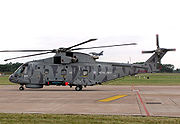
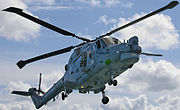
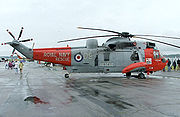 The FAA operates fixed-wing and rotary-wing aircraft. The FAA uses the same designation system
for aircraft as the RAF.
Three types of fixed-wing aircraft are operated by the FAA for training purposes: pilot training is carried out using the Grob Tutor while, from March 2011, observer training is done using four Beechcraft King Air 350s
. The third type is the Hawk T1
, which is used to simulate enemy aircraft for training purposes including AEW
Fighter Control, air-to-air combat and ship attack.
Today the larger section of the FAA is the rotary-wing part. Its aviators fly four types of helicopter, and within each type there are usually several marks/versions which carry out different roles.
Pilots designated for rotary wing service train at the Defence Helicopter Flying School
, RAF Shawbury. The School is a tri-Service organisation consisting of civilian and military instructors (including Naval instructors and a Naval Squadron) that take the student from basic flying through to more advanced flying such as instrument flying, navigation, formation and captaincy.
The oldest aircraft in the fleet is the Westland Sea King
, which performs missions in several versions. The Sea King HC4 serves as a medium-lifter and troop-transporter in support of the Royal Marines
. The HAS5U model operates in the search and rescue
and utility roles, while the Sea King HU5 is designed for search and rescue work (although the HAS5Us are often called HU5s as well). The HAS6C is used for assault transport training; and the ASaC7 operates in the AEW
role.
Intermediate in age is the Westland Lynx
. The Lynx AH7s serve the FAA in the observation and anti-armour helicopter roles, but are mainly a light-lift helicopter. Along with the Sea King HC4s, they are part of the Commando Helicopter Force
, which provides support to 3 Commando Brigade
of the Royal Marines.
The surface combatants of the Royal Navy have their helicopters provided for the most part by the Lynx HAS3 and HMA8 aircraft. These Lynxes have primarily an anti-submarine warfare role and anti-surface vessel role. They are able to fire the Sea Skua
anti-surface missile, which was used to combat the Iraqi navy in the 1991 Gulf War
. It can be armed with Stingray air-launched torpedoes and depth charges for anti-submarine warfare, as well as a machine gun. The Lynx was originally envisaged for surface combatants that were too small for the Sea King, but now equips most surface ships of the Royal Navy.
The newest helicopter in the FAA is the AgustaWestland Merlin HM1. This has now replaced the Sea King HAS6 in the Anti-Submarine Warfare (ASW) role, and is deployed on the various ships of the Royal Navy. The EH101 airframe is to replace the Sea King ASaC7s in the AEW role on Britain's planned new aircraft carriers.
Some 64 naval pilots and 9 observers have reached flag rank in the Royal Navy
and 4 Royal Marines
pilots general
rank in the Royal Marines. Four of these admirals with pilot's 'wings' were air engineering officers (test pilots) and two were supply officer
s; two of the non-executive officers reached four-star rank: a supply officer
, Admiral
Sir
Brian Brown (1934-), and a Royal Marine, General Sir Peter Whiteley
(1920-).
Royal Navy
The Royal Navy is the naval warfare service branch of the British Armed Forces. Founded in the 16th century, it is the oldest service branch and is known as the Senior Service...
responsible for the operation of naval aircraft. The Fleet Air Arm currently operates the AgustaWestland Merlin, Westland Sea King
Westland Sea King
The Westland WS-61 Sea King is a British licence-built version of the American Sikorsky S-61 helicopter of the same name, built by Westland Helicopters. The aircraft differs considerably from the American version, with Rolls-Royce Gnome engines , British made anti-submarine warfare systems and a...
and Westland Lynx
Westland Lynx
The Westland Lynx is a British multi-purpose military helicopter designed and built by Westland Helicopters at its factory in Yeovil. Originally intended as a utility craft for both civil and naval usage, military interest led to the development of both battlefield and naval variants...
helicopter
Helicopter
A helicopter is a type of rotorcraft in which lift and thrust are supplied by one or more engine-driven rotors. This allows the helicopter to take off and land vertically, to hover, and to fly forwards, backwards, and laterally...
s. Helicopters such as the Lynx
Westland Lynx
The Westland Lynx is a British multi-purpose military helicopter designed and built by Westland Helicopters at its factory in Yeovil. Originally intended as a utility craft for both civil and naval usage, military interest led to the development of both battlefield and naval variants...
and Westland Wasp
Westland Wasp
The Westland Wasp was a British small first-generation, gas-turbine powered, shipboard anti-submarine helicopter. Produced by Westland Helicopters, it came from the same P.531 programme as the British Army Westland Scout, and was based on the earlier piston-engined Saunders-Roe Skeeter...
have been deployed on smaller vessels since 1964, taking over the roles once performed by biplane
Biplane
A biplane is a fixed-wing aircraft with two superimposed main wings. The Wright brothers' Wright Flyer used a biplane design, as did most aircraft in the early years of aviation. While a biplane wing structure has a structural advantage, it produces more drag than a similar monoplane wing...
s such as the Fairey Swordfish
Fairey Swordfish
The Fairey Swordfish was a torpedo bomber built by the Fairey Aviation Company and used by the Fleet Air Arm of the Royal Navy during the Second World War...
.
The Fleet Air Arm was formed in 1924 as organizational unit of the Royal Air Force which was then operating the aircraft embarked on RN ships - the Royal Naval Aviation Service having been merged with the British Army's Royal Flying Corps in 1918 - and did not come under the direct control of the Admiralty until mid-1939. During the Second World War, the Fleet Air Arm operated both aircraft on ships and land-based aircraft that defended the Royal Navy's shore establishments and facilities.
Beginnings
British naval flying started in 1909, with the construction of an airshipAirship
An airship or dirigible is a type of aerostat or "lighter-than-air aircraft" that can be steered and propelled through the air using rudders and propellers or other thrust mechanisms...
for naval duties. In 1911 the Royal Navy graduated its first aeroplane pilots at the Royal Aero Club
Royal Aero Club
The Royal Aero Club is the national co-ordinating body for Air Sport in the United Kingdom.The Aero Club was founded in 1901 by Frank Hedges Butler, his daughter Vera and the Hon Charles Rolls , partly inspired by the Aero Club of France...
flying ground at Eastchurch
Eastchurch
Eastchurch is a village on the Isle of Sheppey, in the English county of Kent, two miles east of Minster.The village website claims "... it has a history steeped in stories of piracy and smugglers".- Aviation history :...
, Isle of Sheppey
Isle of Sheppey
The Isle of Sheppey is an island off the northern coast of Kent, England in the Thames Estuary, some to the east of London. It has an area of . The island forms part of the local government district of Swale...
under the tutelage of pioneer aviator George Bertram Cockburn
George Bertram Cockburn
George Bertram Cockburn OBE was a research chemist who became an aviation pioneer. He represented Great Britain in the first international air race at Rheims and co-founded the first aerodrome for the army at Larkhill. He also trained the first four pilots of what was to become the Fleet Air...
, but in May 1912 naval and army aviation were combined to become the Royal Flying Corps
Royal Flying Corps
The Royal Flying Corps was the over-land air arm of the British military during most of the First World War. During the early part of the war, the RFC's responsibilities were centred on support of the British Army, via artillery co-operation and photographic reconnaissance...
(RFC). The Naval Wing of the RFC lasted until July 1914 when the Royal Navy reformed its air branch, under the Air Department
Air Department
The Air Department of the British Admiralty was established prior to World War I by Winston Churchill. Its function was to foster naval aviation developments and later to oversee the Royal Naval Air Service . Its first director was Captain Murray Sueter...
of the Admiralty
Admiralty
The Admiralty was formerly the authority in the Kingdom of England, and later in the United Kingdom, responsible for the command of the Royal Navy...
, naming it the Royal Naval Air Service (RNAS).
By the outbreak of the First World War
World War I
World War I , which was predominantly called the World War or the Great War from its occurrence until 1939, and the First World War or World War I thereafter, was a major war centred in Europe that began on 28 July 1914 and lasted until 11 November 1918...
, in August 1914, the RNAS had more aircraft under its control than the remaining RFC. The main roles of the RNAS were fleet reconnaissance, patrolling coasts for enemy ships and submarines, attacking enemy coastal territory and defending Britain from enemy air-raids, along with deployment along the Western Front. In April 1918 the RNAS, which at this time had 67,000 officers and men, 2,949 aircraft, 103 airships and 126 coastal stations, merged with the RFC to form the Royal Air Force
Royal Air Force
The Royal Air Force is the aerial warfare service branch of the British Armed Forces. Formed on 1 April 1918, it is the oldest independent air force in the world...
.
Fleet Air Arm
On 1 April 1924, the Fleet Air Arm of the Royal Air Force was formed, encompassing those RAF units that normally embarked on aircraft carriers and fighting ships. On 24 May 1939 the Fleet Air Arm was returned to AdmiraltyAdmiralty
The Admiralty was formerly the authority in the Kingdom of England, and later in the United Kingdom, responsible for the command of the Royal Navy...
control under the "Inskip Award" (named after the Minister for Co-ordination of Defence who was overseeing Britain's re-armament programme)and renamed the Air Branch of the Royal Navy. At the onset of the Second World War, the Fleet Air Arm consisted of 20 squadrons with only 232 aircraft. By the end of the war the worldwide strength of the Fleet Air Arm was 59 aircraft carriers, 3,700 aircraft, 72,000 officers and men, and 56 Naval air stations.
Durign the war, the FAA operated fighters, torpedo bombers and reconnaisance aircraft. In the waters around the British Isles and out into the Atlantic Ocean, operations against enemy shipping and submarines in support of the RN were mounted by RAF Coastal Command
RAF Coastal Command
RAF Coastal Command was a formation within the Royal Air Force . Founded in 1936, it was the RAF's premier maritime arm, after the Royal Navy's secondment of the Fleet Air Arm in 1937. Naval aviation was neglected in the inter-war period, 1919–1939, and as a consequence the service did not receive...
with large partol bombers and flying boats and land-based fighter-bombers.
The aircraft carrier
Aircraft carrier
An aircraft carrier is a warship designed with a primary mission of deploying and recovering aircraft, acting as a seagoing airbase. Aircraft carriers thus allow a naval force to project air power worldwide without having to depend on local bases for staging aircraft operations...
had replaced the battleship
Battleship
A battleship is a large armored warship with a main battery consisting of heavy caliber guns. Battleships were larger, better armed and armored than cruisers and destroyers. As the largest armed ships in a fleet, battleships were used to attain command of the sea and represented the apex of a...
as the Fleet's capital ship
Capital ship
The capital ships of a navy are its most important warships; they generally possess the heaviest firepower and armor and are traditionally much larger than other naval vessels...
and its aircraft were now strike weapons in their own right. The top scoring fighter ace
Flying ace
A flying ace or fighter ace is a military aviator credited with shooting down several enemy aircraft during aerial combat. The actual number of aerial victories required to officially qualify as an "ace" has varied, but is usually considered to be five or more...
with 17 victories was Commander Stanley Orr
Stanley Orr
Stanley Gordon Orr DSC & Two Bars, AFC was the highest scoring fighter ace of the Royal Navy during the Second World War. Flying with the Fleet Air Arm he was credited with the destruction of 17 aircraft...
, the only Royal Marine ace was Ronald Cuthbert Hay
Ronald Cuthbert Hay
Ronald Cuthbert Hay DSO, DSC and Bar is the only Royal Marine fighter ace. He joined the Royal Marines just prior to the Second World War in 1935 and then served as an aviator with the Fleet Air Arm...
with 13 victories.
Post-war history
After the war the FAA needed to fly jet aircraftJet aircraft
A jet aircraft is an aircraft propelled by jet engines. Jet aircraft generally fly much faster than propeller-powered aircraft and at higher altitudes – as high as . At these altitudes, jet engines achieve maximum efficiency over long distances. The engines in propeller-powered aircraft...
from their carriers. The jet aircraft of the era were considerably less effective at low speeds than propeller aircraft, but propeller aircraft could not effectively fight jets at the high speeds flown by jet aircraft. The FAA took on its first jet, the Sea Vampire
De Havilland Vampire
The de Havilland DH.100 Vampire was a British jet-engine fighter commissioned by the Royal Air Force during the Second World War. Following the Gloster Meteor, it was the second jet fighter to enter service with the RAF. Although it arrived too late to see combat during the war, the Vampire served...
, in the late 1940s. The Sea Vampire was the first jet credited with taking off and landing on a carrier. The Air Arm continued with high-powered prop aircraft alongside the new jets resulting in the FAA being woefully outpowered during the Korean War
Korean War
The Korean War was a conventional war between South Korea, supported by the United Nations, and North Korea, supported by the People's Republic of China , with military material aid from the Soviet Union...
. Nevertheless, jets were not yet wholly superior to propeller aircraft and a flight of ground-attack Hawker Sea Furies
Hawker Sea Fury
The Hawker Sea Fury was a British fighter aircraft developed for the Royal Navy by Hawker during the Second World War. The last propeller-driven fighter to serve with the Royal Navy, it was also one of the fastest production single piston-engined aircraft ever built.-Origins:The Hawker Fury was an...
downed a MiG-15
Mikoyan-Gurevich MiG-15
The Mikoyan-Gurevich MiG-15 was a jet fighter developed for the USSR by Artem Mikoyan and Mikhail Gurevich. The MiG-15 was one of the first successful swept-wing jet fighters, and it achieved fame in the skies over Korea, where early in the war, it outclassed all straight-winged enemy fighters in...
and damaged others in an engagement.
As jets became larger, more powerful and faster they required more space to take off and land. The US Navy simply built much larger carriers. The Royal Navy had a few large carriers built and completed after the end of the war but another solution was sought. This was partly overcome by the introduction of a Royal Navy idea to angle the flight deck away from the centre line so that the aircraft landing had a clear run away from the usual forward deck park. An associated British invention, intended to provide more precise optical guidance to aircraft on final approaching the deck, was the Fresnel lens optical landing aid. Another Royal Navy invention was the use of a steam powered catapult to cater for the larger and heavier aircraft (both systems were adopted by the US Navy).
Defence cuts across the British armed forces during the 1960s
1966 Defence White Paper
The 1966 Defence White Paper was a major review of the United Kingdom's defence policy brought about by the Labour Party government under the Prime Minister Harold Wilson. The main author was the then Secretary of State for Defence, Denis Healey...
led to the withdrawal of existing carriers and cancellation of replacements including the CVA-01
CVA-01
The CVA-01 aircraft carrier was to be a class of at least two fleet carriers that would have replaced the Royal Navy's existing aircraft carriers, most of which had been designed prior to or during World War II....
design. A new series of small carriers, the Invincible class
Invincible class aircraft carrier
The Invincible class is a class of light aircraft carrier operated by the British Royal Navy. Three ships were constructed, , and . The vessels were built as aviation-capable anti-submarine warfare platforms to counter the Cold War North Atlantic Soviet submarine threat, and initially embarked...
anti-submarine warfare ships (known as "through deck cruisers") were built and equipped with the Sea Harrier
BAE Sea Harrier
The British Aerospace Sea Harrier is a naval VTOL/STOVL jet fighter, reconnaissance and attack aircraft, a development of the Hawker Siddeley Harrier. It first entered service with the Royal Navy in April 1980 as the Sea Harrier FRS1 and became informally known as the "Shar"...
a derivative of the Hawker Siddeley Harrier VTOL
VTOL
A vertical take-off and landing aircraft is one that can hover, take off and land vertically. This classification includes fixed-wing aircraft as well as helicopters and other aircraft with powered rotors, such as cyclogyros/cyclocopters and tiltrotors...
aircraft. These carriers incorporated an upswept forward section of the flight deck that deflected the aircraft upward on launch and permitted heavier loads to be carried by the Harrier, for example in weaponry, and the system was used extensively in the Falklands war. The Harrier went on to form the basis of the Royal Navy's fixed-wing strike forces.
Two new Queen Elizabeth class carriers able to operate the navalised version of the US Lockheed Martin F-35 Lightning II aircraft are under construction; it is not certain if both carriers will enter service no the number of aircraft that will be purchased.
Helicopter
Helicopter
A helicopter is a type of rotorcraft in which lift and thrust are supplied by one or more engine-driven rotors. This allows the helicopter to take off and land vertically, to hover, and to fly forwards, backwards, and laterally...
s also became important combat vehicles starting in the 1960s. At first they were employed on the carriers alongside the fixed-wing aircraft, but later they were also deployed on most smaller ships. Today at least one helicopter is found on all ships of frigate
Frigate
A frigate is any of several types of warship, the term having been used for ships of various sizes and roles over the last few centuries.In the 17th century, the term was used for any warship built for speed and maneuverability, the description often used being "frigate-built"...
size or larger. Wasps
Westland Wasp
The Westland Wasp was a British small first-generation, gas-turbine powered, shipboard anti-submarine helicopter. Produced by Westland Helicopters, it came from the same P.531 programme as the British Army Westland Scout, and was based on the earlier piston-engined Saunders-Roe Skeeter...
and Sea Harriers played an active part in the 1982 Falkland Islands conflict
Falklands War
The Falklands War , also called the Falklands Conflict or Falklands Crisis, was fought in 1982 between Argentina and the United Kingdom over the disputed Falkland Islands and South Georgia and the South Sandwich Islands...
, while Lynx
Westland Lynx
The Westland Lynx is a British multi-purpose military helicopter designed and built by Westland Helicopters at its factory in Yeovil. Originally intended as a utility craft for both civil and naval usage, military interest led to the development of both battlefield and naval variants...
helicopters played an attack role against Iraqi patrol boats in the 1991 Gulf War
Gulf War
The Persian Gulf War , commonly referred to as simply the Gulf War, was a war waged by a U.N.-authorized coalition force from 34 nations led by the United States, against Iraq in response to Iraq's invasion and annexation of Kuwait.The war is also known under other names, such as the First Gulf...
and Commando Sea King HC4s as well as the Lynx HMA Mk 8 from HMS Argyll, assisted in suppressing rebel forces in Sierra Leone
Sierra Leone
Sierra Leone , officially the Republic of Sierra Leone, is a country in West Africa. It is bordered by Guinea to the north and east, Liberia to the southeast, and the Atlantic Ocean to the west and southwest. Sierra Leone covers a total area of and has an estimated population between 5.4 and 6.4...
.
In 2000 the Sea Harrier force was merged with the RAF's
Royal Air Force
The Royal Air Force is the aerial warfare service branch of the British Armed Forces. Formed on 1 April 1918, it is the oldest independent air force in the world...
Harrier GR7 fleet to form Joint Force Harrier
Joint Force Harrier
Joint Strike Wing, previously known as Joint Force Harrier, was the British military formation which controlled the STOVL Harrier aircraft of the Royal Air Force and Fleet Air Arm...
. The Fleet Air Arm began withdrawing the Sea Harrier from service in 2004 with the disbandment of 800 NAS. 801 NAS
801 Naval Air Squadron
801 Naval Air Squadron was a Fleet Air Arm squadron of the Royal Navy formed in 1933 which fought in World War II, the Korean War and the Falklands War.- Fleet Air Arm of the Royal Air Force:...
disbanded on 28 March 2006 at RNAS Yeovilton (HMS Heron). 800 and 801 NAS were then combined to form the Naval Strike Wing
Naval Strike Wing
The Naval Strike Wing was a flying unit of the Fleet Air Arm of the Royal Navy. It was formed on 9 March 2007...
, flying ex-RAF Harrier GR7 and GR9s. On 1 April 2010, NSW reverted to the identity of 800 Naval Air Squadron. The Harrier GR7 and GR9 retired from service in December 2010 following the 2010 SDSR.
The Fleet Air Arm has a museum
Fleet Air Arm Museum
The Fleet Air Arm Museum is located north of Yeovil, and south of Bristol. It has an extensive collection of military and civilian aircraft, as well as models of Royal Navy ships, especially aircraft carriers. Some of the museum has interactive displays...
near RNAS Yeovilton (HMS Heron) in Somerset
Somerset
The ceremonial and non-metropolitan county of Somerset in South West England borders Bristol and Gloucestershire to the north, Wiltshire to the east, Dorset to the south-east, and Devon to the south-west. It is partly bounded to the north and west by the Bristol Channel and the estuary of the...
, England
England
England is a country that is part of the United Kingdom. It shares land borders with Scotland to the north and Wales to the west; the Irish Sea is to the north west, the Celtic Sea to the south west, with the North Sea to the east and the English Channel to the south separating it from continental...
at which many of the great historical aircraft flown by the Service are on display, along with aircraft from other sources. There is also a Fleet Air Arm museum inside the Museum of Transport and Technology (MOTAT) in Auckland, New Zealand. On display there is a full-size replica Fairey Swordfish, along with historic items and memorabilia.
The FAA today
The Fleet Air Arm has approximately 6,200 personnel, which is over 15% of the Royal Navy's total strength.Chief of Staff (Aviation and Carriers) and Rear Admiral Fleet Air Arm
REAR ADMIRAL TOM CUNNINGHAM
April 2010-?
Squadrons
Fleet Air Arm flying squadrons are formally named Naval Air Squadron (NASs), a title used as a suffix to the squadron number. The FAA assigns numbers in the 700-799 range to training and operational conversion squadrons and numbers in the 800-899 range to operational squadrons. During WWII the 1700 and 1800 ranges were also used for operational squadrons.Squadrons active in the FAA are:
| Squadron | Aircraft | Base | Role |
|---|---|---|---|
| 700W Naval Air Squadron | Lynx Wildcat | Yeovilton | Lynx Wildcat Trials unit |
| 702 Naval Air Squadron 702 Naval Air Squadron 702 Naval Air Squadron is a naval squadron of the Royal Navy's Fleet Air Arm. It is currently based at RNAS Yeovilton in Somerset. It is also the parent unit of the Royal Navy's Black Cats aerobatic Display Team.-Formation and WWII :... |
Lynx Westland Lynx The Westland Lynx is a British multi-purpose military helicopter designed and built by Westland Helicopters at its factory in Yeovil. Originally intended as a utility craft for both civil and naval usage, military interest led to the development of both battlefield and naval variants... |
Yeovilton | Training (Lynx) |
| 703 Naval Air Squadron 703 Naval Air Squadron 703 Naval Air Squadron of the Fleet Air Arm of the Royal Navy was formed as a long-range catapult squadron on 3 June 1942 at RNAS Lee-on-Solent. During the Cold War it was reformed as an experimental trials unit, and then as a helicopter training squadron... |
(G115 Tutor Grob G 115 |- Incidents and Accidents :*In February 2009, two RAF Tutors operating air experience flights from RAF St Athan collided in mid-air. All four occupants were killed, a pilot and a female Air Training Corps cadet in each aircraft. The two cadets killed were cousins Nikkita Marie Walters, 13, and... from November 2009) |
Barkston Heath RAF Barkston Heath RAF Barkston Heath is a Royal Air Force station near Grantham, Lincolnshire.RAF Barkston Heath is the home of the Defence Elementary Flying Training School which, for a period between approximately 1995-2010 operated the Slingsby T67M260 Firefly two seat trainer. The school now operates the Grob... |
Elementary flying training |
| 705 Squadron 705 Naval Air Squadron 705 Naval Air Squadron was first formed in 1936 from No 447 Flight Royal Air Force and operated Swordfish torpedo bombers from battlecruisers. It was disbanded in 1940, but was re-formed in 1947 as a Fleet Requirements Unit to evaluate naval use of helicopters... Note 1 |
Squirrel HT.1 and HT.2 | Shawbury RAF Shawbury RAF Shawbury is a Royal Air Force station by the village of Shawbury near Shrewsbury, Shropshire.The station at Shawbury was first used for military flying training in 1917 by the Royal Flying Corps, but it was returned to agricultural use in 1920. In 1938 it was reactivated as a training... |
Advanced helicopter training (DHFS Defence Helicopter Flying School The Defence Helicopter Flying School at RAF Shawbury, a Royal Air Force station near Shrewsbury, England, trains aircrew from all three of the Armed Forces.-Squadrons:The DHFS has three flying squadrons:... ) |
| 727 Naval Air Squadron 727 Naval Air Squadron 727 Naval Air Squadron is a squadron of the Royal Navy Fleet Air Arm. It was formed in 1943 as a Fleet Requirements Unit, being disbanded in December 1944. It was reformed twice in the 1940s and 1950s to provide flying experience for naval officers. The current squadron was created on 6 Dec 2001... |
Grob G 115 Tutor Grob G 115 |- Incidents and Accidents :*In February 2009, two RAF Tutors operating air experience flights from RAF St Athan collided in mid-air. All four occupants were killed, a pilot and a female Air Training Corps cadet in each aircraft. The two cadets killed were cousins Nikkita Marie Walters, 13, and... |
Yeovilton | Air Experience |
| 750 Naval Air Squadron 750 Naval Air Squadron The Royal Navy Observer School grew out of HM Naval Seaplane Training School at RNAS Lee-on-Solent as a result of a series of changes of identity and parent unit. From 1918 until 1939 the Royal Air Force was responsible for naval aviation, including training and provision of aircrew to the Royal... |
Beechcraft King Air 350ER | Culdrose | Observer training |
| 771 Naval Air Squadron | Sea King HAR.5 Westland Sea King The Westland WS-61 Sea King is a British licence-built version of the American Sikorsky S-61 helicopter of the same name, built by Westland Helicopters. The aircraft differs considerably from the American version, with Rolls-Royce Gnome engines , British made anti-submarine warfare systems and a... |
Culdrose | Search and Rescue |
| 792 Naval Air Squadron 792 Naval Air Squadron 792 Naval Air Squadron of the Fleet Air Arm of the Royal Navy was originally formed at St. Merryn in August 1939 as an Air Target Unit, equipped with six Blackburn Skuas. The squadron disbanded in 1945 and merged with 794 Naval Air Squadron.... |
Galileo Mirach 100 (aerial target) | Culdrose | Missile testing |
| 814 Naval Air Squadron 814 Naval Air Squadron 814 Naval Air Squadron is a squadron of the Royal Navy Fleet Air Arm. It was formed in December 1938 and has been disbanded and reformed several times. Its nickname is "the Flying Tigers", not to be confused with the American Volunteer squadron of WWII.... |
Merlin HM.1 AgustaWestland EH101 The AgustaWestland AW101 is a medium-lift helicopter for military applications but also marketed for civil use. The helicopter was developed as a joint venture between Westland Helicopters in the UK and Agusta in Italy... |
Culdrose | Anti-Submarine Warfare |
| 815 Naval Air Squadron 815 Naval Air Squadron 815 Naval Air Squadron is a squadron of the Fleet Air Arm, part of the Royal Navy. The squadron is currently based at RNAS Yeovilton in Somerset, United Kingdom and it is the Navy's front line Lynx Naval Air Squadron. It currently comprises more than 30 Lynx helicopters of various types... |
Lynx HAS.3/HMA.8 Westland Lynx The Westland Lynx is a British multi-purpose military helicopter designed and built by Westland Helicopters at its factory in Yeovil. Originally intended as a utility craft for both civil and naval usage, military interest led to the development of both battlefield and naval variants... |
Yeovilton | Small ship flights |
| 820 Naval Air Squadron 820 Naval Air Squadron 820 Naval Air Squadron is a Royal Navy Fleet Air Arm carrier based squadron formed in April 1933 with the transferral of the Fairey III aircraft from 405 Flight Royal Air Force to the Fleet Air Arm... |
Merlin HM.1 AgustaWestland EH101 The AgustaWestland AW101 is a medium-lift helicopter for military applications but also marketed for civil use. The helicopter was developed as a joint venture between Westland Helicopters in the UK and Agusta in Italy... |
Culdrose | Anti-Submarine Warfare |
| 824 Naval Air Squadron 824 Naval Air Squadron 824 Naval Air Squadron is a Royal Navy Fleet Air Arm squadron first formed on 3 April 1933, disbanding and reforming several times before assuming its current role at RNAS Culdrose as a training squadron.... |
Merlin HM.1 AgustaWestland EH101 The AgustaWestland AW101 is a medium-lift helicopter for military applications but also marketed for civil use. The helicopter was developed as a joint venture between Westland Helicopters in the UK and Agusta in Italy... (OCU) |
Culdrose | Training (Merlin) |
| 829 Naval Air Squadron 829 Naval Air Squadron 829 Naval Air Squadron is a squadron of the Royal Navy Fleet Air Arm. It operates the AgustaWestland EH101 Merlin HM1 helicopter.-1940–1942:829 Naval Air Squadron first formed on 15 June 1940 as a torpedo and reconnaissance squadron at Royal Naval Air Station Ford, Sussex and equipped with nine... |
Merlin HM.1 AgustaWestland EH101 The AgustaWestland AW101 is a medium-lift helicopter for military applications but also marketed for civil use. The helicopter was developed as a joint venture between Westland Helicopters in the UK and Agusta in Italy... |
Culdrose | Small ship flights |
| 845 Naval Air Squadron | Sea King HC.4/HC.4+ Westland Sea King The Westland WS-61 Sea King is a British licence-built version of the American Sikorsky S-61 helicopter of the same name, built by Westland Helicopters. The aircraft differs considerably from the American version, with Rolls-Royce Gnome engines , British made anti-submarine warfare systems and a... |
Yeovilton | Commando support |
| 846 Naval Air Squadron | Sea King HC.4/HC.4+ Westland Sea King The Westland WS-61 Sea King is a British licence-built version of the American Sikorsky S-61 helicopter of the same name, built by Westland Helicopters. The aircraft differs considerably from the American version, with Rolls-Royce Gnome engines , British made anti-submarine warfare systems and a... |
Yeovilton | Commando Support |
| 847 Naval Air Squadron | Lynx AH.7/9 Westland Lynx The Westland Lynx is a British multi-purpose military helicopter designed and built by Westland Helicopters at its factory in Yeovil. Originally intended as a utility craft for both civil and naval usage, military interest led to the development of both battlefield and naval variants... |
Yeovilton | Commando Support |
| 848 Naval Air Squadron | Sea King HC.4/HAS.6(CR) Westland Sea King The Westland WS-61 Sea King is a British licence-built version of the American Sikorsky S-61 helicopter of the same name, built by Westland Helicopters. The aircraft differs considerably from the American version, with Rolls-Royce Gnome engines , British made anti-submarine warfare systems and a... |
Yeovilton | Training (Sea King) |
| 849 Naval Air Squadron | Sea King ASaC.7 Westland Sea King The Westland WS-61 Sea King is a British licence-built version of the American Sikorsky S-61 helicopter of the same name, built by Westland Helicopters. The aircraft differs considerably from the American version, with Rolls-Royce Gnome engines , British made anti-submarine warfare systems and a... |
Culdrose | Training (Sea King ASaC) |
| 854 Naval Air Squadron 854 Naval Air Squadron 854 Naval Air Squadron was first formed on 1 January 1944, at Squantum Naval Air Station in the USA. It was later disbanded in December 1945. It was reformed December 2006 as a helicopter squadron designed for Airborne Surveillance and Control.- History :... |
Sea King ASaC.7 Westland Sea King The Westland WS-61 Sea King is a British licence-built version of the American Sikorsky S-61 helicopter of the same name, built by Westland Helicopters. The aircraft differs considerably from the American version, with Rolls-Royce Gnome engines , British made anti-submarine warfare systems and a... |
Culdrose | Airborne Surveillance |
| 857 Naval Air Squadron 857 Naval Air Squadron 857 Naval Air Squadron is a squadron of the Royal Navy Fleet Air Arm. It was first formed on 1 April 1944 at Squantum NAS in the USA as a Torpedo Reconnaissance unit with Avenger IIs. It reformed in its present state on 13 December 2006, when 849 NAS B Flight recommissioned as 857 Naval Air Squadron... |
Sea King ASaC.7 Westland Sea King The Westland WS-61 Sea King is a British licence-built version of the American Sikorsky S-61 helicopter of the same name, built by Westland Helicopters. The aircraft differs considerably from the American version, with Rolls-Royce Gnome engines , British made anti-submarine warfare systems and a... |
Culdrose | Airborne Surveillance |
| HMS Gannet SAR Flight HMS Gannet SAR Flight HMS Gannet SAR Flight is a Royal Navy Fleet Air Arm squadron based at RNAS Prestwick in Scotland. It operates three Sea King Mk5 helicopters in the military and civilian Search and Rescue role across Scotland, Northern England and Northern Ireland... |
Sea King HAR.5 Westland Sea King The Westland WS-61 Sea King is a British licence-built version of the American Sikorsky S-61 helicopter of the same name, built by Westland Helicopters. The aircraft differs considerably from the American version, with Rolls-Royce Gnome engines , British made anti-submarine warfare systems and a... |
Prestwick | Search and Rescue |
Note:
1. Designated 705 Squadron rather than a NAS due to being an integral part of the Defence Helicopter Flying School.
Culdrose (HMS Seahawk) is near Helston
Helston
Helston is a town and civil parish in Cornwall, England, United Kingdom. It is situated at the northern end of the Lizard Peninsula approximately 12 miles east of Penzance and nine miles southwest of Falmouth. Helston is the most southerly town in the UK and is around further south than...
in Cornwall
Cornwall
Cornwall is a unitary authority and ceremonial county of England, within the United Kingdom. It is bordered to the north and west by the Celtic Sea, to the south by the English Channel, and to the east by the county of Devon, over the River Tamar. Cornwall has a population of , and covers an area of...
and Yeovilton (HMS Heron) is near Ilchester
Ilchester
Ilchester is a village and civil parish, situated on the River Yeo or Ivel, five miles north of Yeovil, in the English county of Somerset. The parish, which includes the village of Sock Dennis and the old parish of Northover, has a population of 2,021...
in Somerset
Somerset
The ceremonial and non-metropolitan county of Somerset in South West England borders Bristol and Gloucestershire to the north, Wiltshire to the east, Dorset to the south-east, and Devon to the south-west. It is partly bounded to the north and west by the Bristol Channel and the estuary of the...
. Their satellites or relief airfields are at Predannack
Predannack Airfield
Predannack Airfield is situated near Mullion on Cornwall's Lizard Peninsula in the United Kingdom. The runways are operated by the Royal Navy and today it is used as a satellite airfield and relief landing ground for nearby RNAS Culdrose.-World War II:...
and Merryfield
RAF Merryfield
RAF Station Merryfield is a former Second World War airfield at the village of Ilton near Ilminster in southwest Somerset, England. The name comes from the ruins of Merryfield House. The airfield is located approximately north of Chard, about southwest of London...
respectively.
Squadrons that were active at some point can be found in the List of Fleet Air Arm aircraft squadrons.
Royal Naval Reserve Air Branch
In 1938, Admiralty Fleet Orders 2885 announced the formation of an Air Branch of the Royal Naval ReserveRoyal Naval Reserve
The Royal Naval Reserve is the volunteer reserve force of the Royal Navy in the United Kingdom. The present Royal Naval Reserve was formed in 1958 by merging the original Royal Naval Reserve and the Royal Naval Volunteer Reserve , a reserve of civilian volunteers founded in 1903...
. Thirty three unmarried men signed up for 18 months full-time flying training; however, before these first volunteers were able to gain their wings Britain was at war.
At the end of hostilities in 1945 the RNVR(A) was 46,000 strong, with over 8000 aircrew. Post war the RNVR(A) comprised 12 dedicated reserve squadrons, grouped regionally into Air Divisions. However, defence cuts in 1957 disbanded the five Air Divisions, and the following year the RNVR was merged with the RNR.
The RNR Air Branch was commissioned at RNAS Yeovilton on 16 July 1980, and shortly afterwards 38 ex-regular aircrew began refresher training. Today the Air Branch comprises approx 250 ex-regular service Officers and Ratings, covering all aviation trades, tasked to support the Fleet Air Arm.
Aircraft
British military aircraft designation systems
British military aircraft designations are used to refer to aircraft types and variants operated by the armed forces of the United Kingdom.Since the end of the First World War, aircraft types in British military service have generally been known by a name British military aircraft designations are...
for aircraft as the RAF.
Three types of fixed-wing aircraft are operated by the FAA for training purposes: pilot training is carried out using the Grob Tutor while, from March 2011, observer training is done using four Beechcraft King Air 350s
Beechcraft Super King Air
The Beechcraft Super King Air family is part of a line of twin-turboprop aircraft produced by the Beech Aircraft Corporation . The King Air line comprises a number of model series that fall into two families: the Model 90 series, Model 100 series , Model 200 series and Model 300 series...
. The third type is the Hawk T1
BAE Hawk
The BAE Systems Hawk is a British single-engine, advanced jet trainer aircraft. It first flew in 1974 as the Hawker Siddeley Hawk. The Hawk is used by the Royal Air Force, and other air forces, as either a trainer or a low-cost combat aircraft...
, which is used to simulate enemy aircraft for training purposes including AEW
Airborne Early Warning
An airborne early warning and control system is an airborne radar system designed to detect aircraft at long ranges and control and command the battle space in an air engagement by directing fighter and attack plane strikes...
Fighter Control, air-to-air combat and ship attack.
Today the larger section of the FAA is the rotary-wing part. Its aviators fly four types of helicopter, and within each type there are usually several marks/versions which carry out different roles.
Pilots designated for rotary wing service train at the Defence Helicopter Flying School
Defence Helicopter Flying School
The Defence Helicopter Flying School at RAF Shawbury, a Royal Air Force station near Shrewsbury, England, trains aircrew from all three of the Armed Forces.-Squadrons:The DHFS has three flying squadrons:...
, RAF Shawbury. The School is a tri-Service organisation consisting of civilian and military instructors (including Naval instructors and a Naval Squadron) that take the student from basic flying through to more advanced flying such as instrument flying, navigation, formation and captaincy.
The oldest aircraft in the fleet is the Westland Sea King
Westland Sea King
The Westland WS-61 Sea King is a British licence-built version of the American Sikorsky S-61 helicopter of the same name, built by Westland Helicopters. The aircraft differs considerably from the American version, with Rolls-Royce Gnome engines , British made anti-submarine warfare systems and a...
, which performs missions in several versions. The Sea King HC4 serves as a medium-lifter and troop-transporter in support of the Royal Marines
Royal Marines
The Corps of Her Majesty's Royal Marines, commonly just referred to as the Royal Marines , are the marine corps and amphibious infantry of the United Kingdom and, along with the Royal Navy and Royal Fleet Auxiliary, form the Naval Service...
. The HAS5U model operates in the search and rescue
Search and rescue
Search and rescue is the search for and provision of aid to people who are in distress or imminent danger.The general field of search and rescue includes many specialty sub-fields, mostly based upon terrain considerations...
and utility roles, while the Sea King HU5 is designed for search and rescue work (although the HAS5Us are often called HU5s as well). The HAS6C is used for assault transport training; and the ASaC7 operates in the AEW
Airborne Early Warning
An airborne early warning and control system is an airborne radar system designed to detect aircraft at long ranges and control and command the battle space in an air engagement by directing fighter and attack plane strikes...
role.
Intermediate in age is the Westland Lynx
Westland Lynx
The Westland Lynx is a British multi-purpose military helicopter designed and built by Westland Helicopters at its factory in Yeovil. Originally intended as a utility craft for both civil and naval usage, military interest led to the development of both battlefield and naval variants...
. The Lynx AH7s serve the FAA in the observation and anti-armour helicopter roles, but are mainly a light-lift helicopter. Along with the Sea King HC4s, they are part of the Commando Helicopter Force
Commando Helicopter Force
The Commando Helicopter Force is a part of the Fleet Air Arm, and is an element of the Joint Helicopter Command of the British Armed Forces; which provides Rotary-Wing support to 3 Commando Brigade Royal Marines and other elements...
, which provides support to 3 Commando Brigade
3 Commando Brigade
3 Commando Brigade is a commando formation of the British Armed Forces and the main manoeuvre formation of the Royal Marines. Its personnel are predominantly Royal Marines, supported by units of Royal Engineers, Royal Artillery, The Rifles, and the Fleet Air Arm, together with other Commando...
of the Royal Marines.
The surface combatants of the Royal Navy have their helicopters provided for the most part by the Lynx HAS3 and HMA8 aircraft. These Lynxes have primarily an anti-submarine warfare role and anti-surface vessel role. They are able to fire the Sea Skua
Sea Skua
The Sea Skua is a British lightweight short-range air-to-surface missile designed for use from helicopters against ships. It is primarily used by the Royal Navy on the Westland Lynx helicopter, although Kuwait uses it in a shore battery and on their Umm Al Maradem fast attack craft.The British...
anti-surface missile, which was used to combat the Iraqi navy in the 1991 Gulf War
Gulf War
The Persian Gulf War , commonly referred to as simply the Gulf War, was a war waged by a U.N.-authorized coalition force from 34 nations led by the United States, against Iraq in response to Iraq's invasion and annexation of Kuwait.The war is also known under other names, such as the First Gulf...
. It can be armed with Stingray air-launched torpedoes and depth charges for anti-submarine warfare, as well as a machine gun. The Lynx was originally envisaged for surface combatants that were too small for the Sea King, but now equips most surface ships of the Royal Navy.
The newest helicopter in the FAA is the AgustaWestland Merlin HM1. This has now replaced the Sea King HAS6 in the Anti-Submarine Warfare (ASW) role, and is deployed on the various ships of the Royal Navy. The EH101 airframe is to replace the Sea King ASaC7s in the AEW role on Britain's planned new aircraft carriers.
Notable members
- Vice-Admiral Richard Bell Davies (1886–1966) - the first naval aviator to receive the VCVictoria CrossThe Victoria Cross is the highest military decoration awarded for valour "in the face of the enemy" to members of the armed forces of various Commonwealth countries, and previous British Empire territories....
and the first naval aviator of the Fleet Air Arm to reach flag rank - Vice-Admiral Sir Lumley LysterLumley LysterVice Admiral Sir Arthur Lumley St George Lyster, KCB, CVO, CBE, DSO was a Royal Navy officer during the Second World War.-Naval career:...
(1888–1957) - drew up attack plan in 1935 that was used for the Battle of TarantoBattle of TarantoThe naval Battle of Taranto took place on the night of 11–12 November 1940 during the Second World War. The Royal Navy launched the first all-aircraft ship-to-ship naval attack in history, flying a small number of obsolescent biplane torpedo bombers from an aircraft carrier in the Mediterranean Sea...
five years later - AdmiralAdmiralAdmiral is the rank, or part of the name of the ranks, of the highest naval officers. It is usually considered a full admiral and above vice admiral and below admiral of the fleet . It is usually abbreviated to "Adm" or "ADM"...
Sir Reginald Portal (1894–1983) - naval aviator who was the younger brother of Marshal of the Royal Air ForceMarshal of the Royal Air ForceMarshal of the Royal Air Force is the highest rank in the Royal Air Force. In peacetime it was granted to RAF officers in the appointment of Chief of the Defence Staff, and to retired Chiefs of the Air Staff, who were promoted to it on their last day of service. Promotions to the rank have ceased...
Lord PortalCharles Portal, 1st Viscount Portal of HungerfordMarshal of the Royal Air Force Charles Frederick Algernon Portal, 1st Viscount Portal of Hungerford KG GCB OM DSO & Bar MC was a senior Royal Air Force officer and an advocate of strategic bombing...
(1893–1971) - Henry AllinghamHenry AllinghamHenry William Allingham was a British supercentenarian, First World War veteran and, for one month, the verified oldest living man in the world...
(1896–2009) - last survivor of Battle of JutlandBattle of JutlandThe Battle of Jutland was a naval battle between the British Royal Navy's Grand Fleet and the Imperial German Navy's High Seas Fleet during the First World War. The battle was fought on 31 May and 1 June 1916 in the North Sea near Jutland, Denmark. It was the largest naval battle and the only...
(Royal Naval Air Service then Royal Air Force, never a member of the Fleet Air Arm). - CaptainCaptain (Royal Navy)Captain is a senior officer rank of the Royal Navy. It ranks above Commander and below Commodore and has a NATO ranking code of OF-5. The rank is equivalent to a Colonel in the British Army or Royal Marines and to a Group Captain in the Royal Air Force. The rank of Group Captain is based on the...
Henry FancourtHenry FancourtCaptain Henry Lockhart St John Fancourt, DSO, RN was a pioneering naval aviator, and held important aviation commands with the Fleet Air Arm during the Second World War...
(1900–2004) - a pioneering aviator, he had a distinguished career in naval aviation until 1949. Worked for Short Bros and HartlandShort BrothersShort Brothers plc is a British aerospace company, usually referred to simply as Shorts, that is now based in Belfast, Northern Ireland. Founded in 1908, Shorts was the first company in the world to make production aircraft and was a manufacturer of flying boats during the 1920s, 1930s, and 1940s...
. - Ralph RichardsonRalph RichardsonSir Ralph David Richardson was an English actor, one of a group of theatrical knights of the mid-20th century who, though more closely associated with the stage, also appeared in several classic films....
(1902–1983) - English stage and screen actor, volunteered as a navy pilot during Second World War and rose to the rank of Lieutenant-Commander in the Air Branch - Admiral of the FleetAdmiral of the Fleet (Royal Navy)Admiral of the fleet is the highest rank of the British Royal Navy and other navies, which equates to the NATO rank code OF-10. The rank still exists in the Royal Navy but routine appointments ceased in 1996....
Sir Caspar JohnCaspar JohnAdmiral of the Fleet Sir Caspar John GCB was the British First Sea Lord from 1960 to 1963. He was pioneer in the Fleet Air Arm, and rose to become Vice-Chief of Naval Staff to Sea Lord Louis Mountbatten, 1st Earl Mountbatten of Burma in 1957 and subsequently First Sea Lord from 1960 to 1963.-Early...
(1903–1984) - First Sea LordFirst Sea LordThe First Sea Lord is the professional head of the Royal Navy and the whole Naval Service; it was formerly known as First Naval Lord. He also holds the title of Chief of Naval Staff, and is known by the abbreviations 1SL/CNS...
1960-63 and the first British naval aviator to reach the highest rank within the RN. - AdmiralAdmiralAdmiral is the rank, or part of the name of the ranks, of the highest naval officers. It is usually considered a full admiral and above vice admiral and below admiral of the fleet . It is usually abbreviated to "Adm" or "ADM"...
Sir Walter CouchmanWalter CouchmanAdmiral Sir Walter Thomas Couchman KCB CVO DSO OBE was a Royal Navy officer who went on to be Vice Chief of the Naval Staff.-Naval career:...
(1905–1981) - naval observerObserverObserver may refer to person who is observing. More specialised meanings follow.-Computer science and information theory:*In information theory, any system which receives information from an object....
who earned his pilot's wings too, he led the fly-past for the CoronationCoronationA coronation is a ceremony marking the formal investiture of a monarch and/or their consort with regal power, usually involving the placement of a crown upon their head and the presentation of other items of regalia...
Fleet Review in June 1953. - Laurence OlivierLaurence OlivierLaurence Kerr Olivier, Baron Olivier, OM was an English actor, director, and producer. He was one of the most famous and revered actors of the 20th century. He married three times, to fellow actors Jill Esmond, Vivien Leigh, and Joan Plowright...
(1907–1989) - English stage and screen actor and director, volunteered as a navy pilot during the Second World War and rose to the rank of Lieutenant in the Air Branch. - Lieutenant CommanderLieutenant CommanderLieutenant Commander is a commissioned officer rank in many navies. The rank is superior to a lieutenant and subordinate to a commander...
(A) Eugene EsmondeEugene EsmondeLieutenant Commander Eugene Esmonde VC DSO, F/Lt, RAF, Lt-Cdr RN was a distinguished pilot who was a posthumous recipient of the Victoria Cross, the highest and most prestigious award for gallantry in the face of the enemy awarded to members of Commonwealth forces...
(1909–1942) - posthumously awarded the Victoria CrossVictoria CrossThe Victoria Cross is the highest military decoration awarded for valour "in the face of the enemy" to members of the armed forces of various Commonwealth countries, and previous British Empire territories....
for leading 825 Naval Air Squadron825 Naval Air Squadron825 Naval Air Squadron was a Royal Navy Fleet Air Arm carrier-based squadron formed on 8 October 1934 from the aircraft and personnel of 824 Naval Air Squadron...
Swordfish torpedo bombersFairey SwordfishThe Fairey Swordfish was a torpedo bomber built by the Fairey Aviation Company and used by the Fleet Air Arm of the Royal Navy during the Second World War...
in an attack on German capital ships during the "Channel Dash". - Michael Horden (1911–1995) - actor, served as fighter controller during World War II.
- Kenneth MoreKenneth MoreKenneth Gilbert More CBE was a highly successful English film actor during the post-World War II era and starred in many feature films, often in the role of an archetypal carefree and happy-go-lucky middle-class gentleman.-Early life:Kenneth More was born in Gerrards Cross, Buckinghamshire, the...
(1914–1982) - actor, including films such as Reach for the SkyReach for the SkyReach for the Sky is a 1956 British biographical film of aviator Douglas Bader, based on the 1954 biography of the same name by Paul Brickhill. The film stars Kenneth More and was directed by Lewis Gilbert. It won the BAFTA Award for Best British Film of 1956.-Plot:In 1928, Douglas Bader, a...
and Sink the BismarckSink the Bismarck"Sink the Bismark" is a song, written by country music singer Johnny Horton and Tillman Franks, based on the pursuit and eventual sinking of the German battleship Bismarck in May 1941, during World War II. Horton released this song in 1960, where it reached #3 on the charts...
. - CommanderCommanderCommander is a naval rank which is also sometimes used as a military title depending on the individual customs of a given military service. Commander is also used as a rank or title in some organizations outside of the armed forces, particularly in police and law enforcement.-Commander as a naval...
Charles LambCharles Lamb (Royal Navy officer)Commander Charles Bentall Lamb DSO DSC Royal Navy was an officer in the Fleet Air Arm during World War II. He piloted a Fairey Swordfish torpedo strike reconnaissance aircraft at the Battle of Taranto, and later wrote a best selling book on his experiences called War in a Stringbag.-Early...
(1914–1981) - author of the Second World War Fleet Air Arm autobiographyAutobiographyAn autobiography is a book about the life of a person, written by that person.-Origin of the term:...
War in a Stringbag - Vice-Admiral Sir Peter CompstonPeter CompstonVice Admiral Sir Peter Maxwell Compston KCB was a Royal Navy officer who became Deputy Supreme Allied Commander Atlantic.-Naval career:...
(1915–2000) - served briefly in the British Army, then in the RAF for two years, before transferring as a pilot to the Royal Navy in 1938. - AdmiralAdmiralAdmiral is the rank, or part of the name of the ranks, of the highest naval officers. It is usually considered a full admiral and above vice admiral and below admiral of the fleet . It is usually abbreviated to "Adm" or "ADM"...
Sir (Leslie) Derek EmpsonDerek EmpsonAdmiral Sir Derek Empson GBE KCB was Commander-in-Chief Naval Home Command.-Naval career:Educated at Eastbourne College, Empson joined the Royal Navy as a pilot 1940. He served in the Fleet Air Arm during World War II....
(1918–1997) - naval pilot who joined the Royal NavyRoyal NavyThe Royal Navy is the naval warfare service branch of the British Armed Forces. Founded in the 16th century, it is the oldest service branch and is known as the Senior Service...
as a naval ratingNaval ratingA Naval Rating is an enlisted member of a country's Navy, subordinate to Warrant Officers and Officers hence not conferred by commission or warrant...
. In his flying career, executed 782 aircraft carrierAircraft carrierAn aircraft carrier is a warship designed with a primary mission of deploying and recovering aircraft, acting as a seagoing airbase. Aircraft carriers thus allow a naval force to project air power worldwide without having to depend on local bases for staging aircraft operations...
landings without a mishap. - Rear-Admiral Cedric Kenelm Roberts (1918-2011) - (always known as 'Chico') a distinguished naval pilot who joined the Royal NavyRoyal NavyThe Royal Navy is the naval warfare service branch of the British Armed Forces. Founded in the 16th century, it is the oldest service branch and is known as the Senior Service...
as a naval ratingNaval ratingA Naval Rating is an enlisted member of a country's Navy, subordinate to Warrant Officers and Officers hence not conferred by commission or warrant...
in 1940. He was personal pilot to Vice-Admiral Lumley LysterLumley LysterVice Admiral Sir Arthur Lumley St George Lyster, KCB, CVO, CBE, DSO was a Royal Navy officer during the Second World War.-Naval career:...
in 1943, commanded three Naval Air Squadrons and was shot down during the Korean War. Later, he commanded three Naval Air Stations and ended his naval flying career as Flag Officer Naval Flying Training 1968-71 Link to obituary, The Daily Telegraph, 5 September 2011. - Lieutenant-Commander Charles Wines ("Charlie Wines") (1917–1991) - joined the Royal NavyRoyal NavyThe Royal Navy is the naval warfare service branch of the British Armed Forces. Founded in the 16th century, it is the oldest service branch and is known as the Senior Service...
as a Supply Assistant, flew SwordfishFairey SwordfishThe Fairey Swordfish was a torpedo bomber built by the Fairey Aviation Company and used by the Fleet Air Arm of the Royal Navy during the Second World War...
torpedo bomberTorpedo bomberA torpedo bomber is a bomber aircraft designed primarily to attack ships with aerial torpedoes which could also carry out conventional bombings. Torpedo bombers existed almost exclusively prior to and during World War II when they were an important element in many famous battles, notably the...
as a rating pilot in the Second World War. Commissioned as a pilot in 1944 he later spent more than twenty years, in the same job as a serving and retired officer, as the FAA Drafting Officer and as such the career manager for thousands of FAA ratings. - Rear-Admiral Dennis Cambell (1919–2000) - inventor of the angled flight deckFlight deckThe flight deck of an aircraft carrier is the surface from which its aircraft take off and land, essentially a miniature airfield at sea. On smaller naval ships which do not have aviation as a primary mission, the landing area for helicopters and other VTOL aircraft is also referred to as the...
for aircraft carriers in 1951. - Rear-Admiral Nick GoodhartNicholas GoodhartRear Admiral Hilary Charles Nicholas 'Nick' Goodhart CB Legion of Merit FRAeS RN rtd was an engineer and aviator who invented the mirror-sight deck landing system for aircraft carriers. He was also a world champion and record breaker in gliding.-Early life:He was born at Inkpen, Berkshire, the son...
(1919-) - inventor of the mirror-sight deck landing system for aircraft carriers in 1951. - CaptainCaptain (Royal Navy)Captain is a senior officer rank of the Royal Navy. It ranks above Commander and below Commodore and has a NATO ranking code of OF-5. The rank is equivalent to a Colonel in the British Army or Royal Marines and to a Group Captain in the Royal Air Force. The rank of Group Captain is based on the...
Eric "Winkle" Brown (1919-) - holds the world record for the most types of aircraft flown by an individual (487 types). As a test pilotTest pilotA test pilot is an aviator who flies new and modified aircraft in specific maneuvers, known as flight test techniques or FTTs, allowing the results to be measured and the design to be evaluated....
he made the first ever a jet landing on an aircraft carrierAircraft carrierAn aircraft carrier is a warship designed with a primary mission of deploying and recovering aircraft, acting as a seagoing airbase. Aircraft carriers thus allow a naval force to project air power worldwide without having to depend on local bases for staging aircraft operations...
in December 1945. - Lieutenant CommanderLieutenant CommanderLieutenant Commander is a commissioned officer rank in many navies. The rank is superior to a lieutenant and subordinate to a commander...
John MoffatJohn Moffat (pilot)John William Charlton Moffat was a Royal Navy Fleet Air Arm pilot, famous for crippling the German battleship Bismarck during its Atlantic sortie, codenamed Operation Rheinübung on 26 May 1941, whilst flying a Fairey Swordfish biplane....
(1919-) - crippled the German battleship BismarckGerman battleship BismarckBismarck was the first of two s built for the German Kriegsmarine during World War II. Named after Chancellor Otto von Bismarck, the primary force behind the German unification in 1871, the ship was laid down at the Blohm & Voss shipyard in Hamburg in July 1936 and launched nearly three years later...
on 26 May 1941. - Admiral Sir John Treacher (1924-) - naval pilot who was promoted Rear-Admiral at the age of 45 and held four important flag appointments before leaving the Royal Navy in 1977, despite many expecting him to become First Sea LordFirst Sea LordThe First Sea Lord is the professional head of the Royal Navy and the whole Naval Service; it was formerly known as First Naval Lord. He also holds the title of Chief of Naval Staff, and is known by the abbreviations 1SL/CNS...
, for a career in business. Was at the helm of Westland during the political dramaWestland affairThe Westland affair was a political scandal for the British Conservative government of Margaret Thatcher in 1986. The argument was a result of differences of opinion within the government as to the future of the United Kingdom helicopter industry. The struggling Westland company, Britain's last...
of the 1980s. - Admiral Sir Ray LygoRaymond LygoAdmiral Sir Raymond Lygo KCB is a former Royal Navy officer who went on to be Vice Chief of the Naval Staff.-Naval career:...
(1924-) - naval pilot who joined the Royal NavyRoyal NavyThe Royal Navy is the naval warfare service branch of the British Armed Forces. Founded in the 16th century, it is the oldest service branch and is known as the Senior Service...
as a naval rating in 1942 and who reached First Sea LordFirst Sea LordThe First Sea Lord is the professional head of the Royal Navy and the whole Naval Service; it was formerly known as First Naval Lord. He also holds the title of Chief of Naval Staff, and is known by the abbreviations 1SL/CNS...
in 1978. led a successful career in industry and was Chief Executive and Deputy Chairman of British AerospaceBritish AerospaceBritish Aerospace plc was a UK aircraft, munitions and defence-systems manufacturer. Its head office was in the Warwick House in the Farnborough Aerospace Centre in Farnborough, Hampshire...
in the 1980s. - Sir George Martin (1926-) - record producer for The BeatlesThe BeatlesThe Beatles were an English rock band, active throughout the 1960s and one of the most commercially successful and critically acclaimed acts in the history of popular music. Formed in Liverpool, by 1962 the group consisted of John Lennon , Paul McCartney , George Harrison and Ringo Starr...
. - Admiral of the FleetAdmiral of the FleetAn admiral of the fleet is a military naval officer of the highest rank. In many nations the rank is reserved for wartime or ceremonial appointments...
Sir Ben Bathurst (1936-) - First Sea LordFirst Sea LordThe First Sea Lord is the professional head of the Royal Navy and the whole Naval Service; it was formerly known as First Naval Lord. He also holds the title of Chief of Naval Staff, and is known by the abbreviations 1SL/CNS...
1993-95 and the last Royal NavyRoyal NavyThe Royal Navy is the naval warfare service branch of the British Armed Forces. Founded in the 16th century, it is the oldest service branch and is known as the Senior Service...
officer to be promoted to five-star rank. - Rear-Admiral Sir Robert WoodardRobert WoodardRear Admiral Sir Robert Woodard, KCVO, DL is a former Commander of the Royal Yacht Britannia.-Naval career:Educated at Lancing College, the school founded by his great-grandfather, Rev Nathaniel Woodard, Woodard joined the Royal Navy and specialised in aviation...
KCVORoyal Victorian OrderThe Royal Victorian Order is a dynastic order of knighthood and a house order of chivalry recognising distinguished personal service to the order's Sovereign, the reigning monarch of the Commonwealth realms, any members of her family, or any of her viceroys...
(c.1939-) - naval aviator commanded two Naval Air Squadrons, two warships, a Naval Air StationNaval Air StationA Naval Air Station is a military airbase, and consists of a permanent land-based operations locations for the military aviation division of the relevant branch of their Navy...
, the Clyde submarine base and ended his career as the Flag Officer Royal Yachts 1990-95, the only aviator to command HM Royal Yacht Britannia. - Rear-Admiral Iain Henderson (c.1948-) - the first officer, and first naval officer, to hold the modern appointment of Air Officer CommandingAir Officer CommandingAir Officer Commanding is a title given in the air forces of Commonwealth nations to an air officer who holds a command appointment. Thus, an air vice marshal might be the AOC 38 Group...
3 Group 2000-01. - Vice-Admiral His ExcellencyExcellencyExcellency is an honorific style given to certain members of an organization or state.Usually, people styled "Excellency" are heads of state, heads of government, governors, ambassadors, certain ecclesiastics, royalty, aristocracy, and military, and others holding equivalent rank .It is...
Sir Adrian JohnsAdrian JohnsVice Admiral Sir Adrian James Johns KCB, CBE, KStJ, ADC is the current Governor of Gibraltar and a former senior officer in the Royal Navy. His most senior naval posting was as Second Sea Lord from 2005 to 2008.-Career:...
(c.1952-) is the first naval aviator to hold the post of Governor of GibraltarGovernor of GibraltarThe Governor and Commander-in-Chief of Gibraltar is the representative of the British monarch in the British overseas territory of Gibraltar. The Governor is appointed by the British Monarch on the advice of the British Government...
. - Sub-LieutenantSub-LieutenantSub-lieutenant is a military rank. It is normally a junior officer rank.In many navies, a sub-lieutenant is a naval commissioned or subordinate officer, ranking below a lieutenant. In the Royal Navy the rank of sub-lieutenant is equivalent to the rank of lieutenant in the British Army and of...
Prince Andrew, Duke of YorkPrince Andrew, Duke of YorkPrince Andrew, Duke of York KG GCVO , is the second son, and third child of Queen Elizabeth II and Prince Philip, Duke of Edinburgh...
(1960-) - served during the Falklands WarFalklands WarThe Falklands War , also called the Falklands Conflict or Falklands Crisis, was fought in 1982 between Argentina and the United Kingdom over the disputed Falkland Islands and South Georgia and the South Sandwich Islands...
1982 and for some years afterwards.
Some 64 naval pilots and 9 observers have reached flag rank in the Royal Navy
Royal Navy
The Royal Navy is the naval warfare service branch of the British Armed Forces. Founded in the 16th century, it is the oldest service branch and is known as the Senior Service...
and 4 Royal Marines
Royal Marines
The Corps of Her Majesty's Royal Marines, commonly just referred to as the Royal Marines , are the marine corps and amphibious infantry of the United Kingdom and, along with the Royal Navy and Royal Fleet Auxiliary, form the Naval Service...
pilots general
General
A general officer is an officer of high military rank, usually in the army, and in some nations, the air force. The term is widely used by many nations of the world, and when a country uses a different term, there is an equivalent title given....
rank in the Royal Marines. Four of these admirals with pilot's 'wings' were air engineering officers (test pilots) and two were supply officer
Supply Officer
Supply Officer was a specialisation in the British Royal Navy which has recently been superseded by the Logistics Officer, recognising the need to align with the nomenclature and function of similar cadres in the British Army and Royal Air Force...
s; two of the non-executive officers reached four-star rank: a supply officer
Supply Officer
Supply Officer was a specialisation in the British Royal Navy which has recently been superseded by the Logistics Officer, recognising the need to align with the nomenclature and function of similar cadres in the British Army and Royal Air Force...
, Admiral
Admiral
Admiral is the rank, or part of the name of the ranks, of the highest naval officers. It is usually considered a full admiral and above vice admiral and below admiral of the fleet . It is usually abbreviated to "Adm" or "ADM"...
Sir
Sir
Sir is an honorific used as a title , or as a courtesy title to address a man without using his given or family name in many English speaking cultures...
Brian Brown (1934-), and a Royal Marine, General Sir Peter Whiteley
Peter Whiteley (Royal Marines officer)
General Sir Peter John Frederick Whiteley GCB OBE is a former Commander-in-Chief Allied Forces Northern Europe.-Military career:Educated at Bembridge School, Peter Whiteley was commissioned as a Royal Marine during World War II....
(1920-).
- At least 21 naval air engineering officers have reached flag rank (including the four test pilots (see above).
See also
- Fleet Requirements and Aircraft Direction UnitFleet Requirements and Aircraft Direction UnitThe Fleet Requirements Air Direction Unit is operated by the contractor Serco Defence and Aerospace, using 13 Bae Hawk T1 advanced jet trainer aircraft on lease to the Royal Navy from the Royal Air Force and based at RNAS Culdrose in Cornwall...
- List of air stations of the Royal Navy
- List of Fleet Air Arm aircraft squadrons
- List of aircraft of the Fleet Air Arm
- Royal Australian Navy Fleet Air ArmFleet Air Arm (RAN)The Fleet Air Arm , known formally as the Australian Navy Aviation Group, is the division of the Royal Australian Navy responsible for the operation of aircraft. The FAA was founded in 1947 following the purchase of two aircraft carriers from the Royal Navy...
- List of active United Kingdom military aircraft
- Royal Air ForceRoyal Air ForceThe Royal Air Force is the aerial warfare service branch of the British Armed Forces. Formed on 1 April 1918, it is the oldest independent air force in the world...
- List of RAF stations
External links
- Fleet Air Arm website
- Fleet Air Arm archive
- RUM RATION - The unofficial Royal Navy forum - sister site to the famous ARRSE
- Fleet Air Arm Rating Aircrewmans Association
- Fleet Air Arm Association
- Fleet Air Arm Officers' Association
- Aircraft Handlers Association
- Telegraphist Air Gunners (TAGS) Association (Disbanded)
- Aircraft of the Fleet Air Arm Flight 1940.