


Swedish iron ore during World War II

Encyclopedia
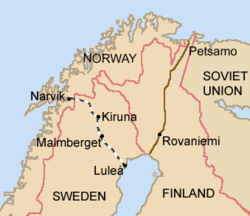
Swedish iron ore was an important economic factor in the European Theatre of World War II
. Both the Allies
and the Third Reich were keen on the control of the mining district in northernmost Sweden
, surrounding the mining towns of Gällivare
and Kiruna
. The importance of this issue increased after other sources were cut off from Germany by the British sea blockade during the Second Battle of the Atlantic
. Both the planned Anglo-French support
of Finland
in the Winter War
, and the following German occupation of Denmark
and Norway
(Operation Weserübung
) were to a large extent motivated by the wish to deny their respective enemies iron critical for wartime production of steel
.
Winston Churchill, then First Lord of the Admiralty was particularly concerned about Swedish exports of iron ore to Germany, and pushed for the British government to take military action to end the trade. From the beginning of the war Churchill tried to persuade his cabinet colleagues to send a British fleet into the Baltic Sea
to stop shipping reaching Germany from the two Swedish iron ore ports, Luleå and Oxelösund. The project was called Project Catherine
and was planned by Admiral of the Fleet
William Boyle, 12th Earl of Cork
. However, events overtook this project and it was canceled. Later, when the Baltic ports froze over and the Germans began shipping the iron ore from the Norwegian port of Narvik, Churchill pushed for the Royal Navy to mine the west coast of Norway to prevent the Germans travelling inside neutral territorial waters to escape Allied Contraband Control measures.
 Upon the beginning of hostilites on 3 September 1939, Britain and France enacted a repeat of the blockade system used to great effect throughout the previous war. They were able to do this because they had vastly more powerful naval forces at their disposal than Germany, a country lacking in natural resources and heavily reliant on large scale imports of a wide range of goods. Perhaps the material Germany needed above all others was iron ore, a steady supply of which was imperative in the creation of steel to sustain her war effort and general economy.
In the year before the war Germany received 22m tons of iron ore from various foreign sources. Although she was able to produce around 10m tons of her own iron ore each year , it was of low grade quality and needed to be mixed with high grade material from other countries such as Sweden, which annually supplied her with 9m tons (7m from Kiruna and Gällivare in Lapland and 2m from the central Swedish ore fields north-west of Stockholm.
With the declaration of war and the start of the blockade, many of these foreign supplies were lost to Germany, and although she retained access to 3 million tons per annum from neutral Norway and Luxembourg, together with the 10 million tons from Lorraine in France, the supplies from Morocco and Spain were lost to her, and so the remaining supplies from neutral Scandinavia became of crucial importance. Grand Admiral Raeder, head of the German navy, declared that it would be "utterly impossible to make war should the navy not be able to secure the supplies of iron-ore from Sweden"
Britain, who itself imported large quantities of iron ore, was fully aware of the Swedish exports to Germany and through its system of Contraband Control was routinely stopping ships of all nations to ensure they were not delivering important supplies to the enemy. Germany considered the allied blockade illegal, and to counter it embarked upon a system of unrestricted submarine warfare whereby enemy and neutral ships could be attacked without warning. As a result, during the first nine months of the war a large number of neutral ships were sunk with considerable loss of life.
While the allies were keen to maintain the moral high ground and stressed at every opportunity the difference in impact between their approach compared to their enemy’s, they were mindful that many neutral mariners relied upon the Germany trade for their livelihoods, and so during the opening stages of the war they were careful not to be too strict with non-combatant vessels for fear the blockade would alienate neutral nations into joining the war on the side of Germany.
The Anglo-German Naval Agreement
(AGNA) of 1935, concluded between Britain and Germany, seriously challenged the independence of Sweden and its long-standing policy of peaceful neutrality. Despite provisions in the Treaty of Versailles
, the AGNA allowed Germany to increase the size of its Kriegsmarine
to one-third the size of the Royal Navy
. At the same time, Britain agreed to withdraw its navy from the Baltic Sea
completely, making Germany the dominant power in the Baltic, and a potential threat to Sweden and the other countries in the region.
The Eastern Route
From May- November, ore from the Northern region was shipped from the port of Luleå down the Gulf of Bothnia to the German north Baltic ports at Lubeck, Swinemunde and Stettin. Outside these months, the Gulf of Bothnia froze over, severely restricting supplies, and although an alternate port was available at Oxelösund, south of Stockholm for the transport of iron ore from the mines in Bergslagen, this facility was unable supply the full amount required by Germany, and in any case froze over herself from January - March each year. Luleå remained outside the reach of Royal Navy s patrols but it was estimated that when Luleå and the Baltic ports of Oxelösund & Gävle were open it could only supply around 8m tons or less than half pre-war imports.
This meant that during the early winter months of the war, Germany had no choice than to transport the majority of its ore along the much further route down Norway’s heavily indented Western coast from Narvik
The Western Route (The ‘Norwegian Corridor’, Western Leads or Skjaergaard)
The port of Narvik, high above the Arctic Circle was open for iron ore shipments all year round. But the stormy Atlantic coast of Norway also provided another extremely useful geological feature for Germany in her attempts to continue shipping the ore and beating the allied blockade.
Immediately offshore from Norway’s western coast lies the Skjaergaard (Skjærgård), a continuous chain of some 50,000 glacially formed skerries
(small uninhabited islands) sea stacks and rocks running parallel to the shore. A partially hidden sea lane (which Churchill called the Norwegian Corridor) exists in the area between this rocky fringe and the coastal landmass proper. Inside this protected channel it is possible to navigate the entire 1,600 km length of the Norwegian coast from North Cape to Stavanger. Such coastlines, sometimes known as Leads - a rough English translation for the common Norwegian nautical term Ledene (shipping lane) are common around Scandinavia - Skjaergaard also exist along the Swedish and Finnish Baltic coasts and off Greenland
.
The Germans made great use of the Norwegian Corridor to avoid the attention of the always watching Royal Navy and RAF. In the winter of 1939–1940 a steady stream of their specially constructed iron ore vessels made the long trip south from Narvik, sometimes within the three mile curtilege of neutral Norwegian territorial waters, sometimes just outside if the way appeared hazardous or the sea particularly turbulent.
At the southnmost point the iron ore captains had to make a choice:
1) Follow the Skjaergaard around the coasts of Norway and Sweden, down through the Kattgat and finally into the north German N Baltic ports of
Lubeck and Stettin. This route was safer because it brought them much closer to the protection of the German naval patrols and Luftwaffe air cover but involved hauling the very bulky and heavy iron ore the long way overland to the industrial centres on the heavily overburdened German railway system
2) Leave the safety of the Skjaergaard and make a dash south across the Skagerrak, (the sea channel north of the Danish Jutland peninsula) and hurry down the west coast of Denmark to Hamburg and Bremen. This was the preferred route because it allowed the ore to be taken straight along the efficient inland waterways to the industrial heartlands of the Ruhr and the Rhineland where it could be processed. It was, however much more hazardous, putting the ships and their precious cargo at the mercy of the waiting allied submarines and patrolling destroyers of Contraband Control, and a number of German ships were sunk in this area.
It must be understood that an adequate supply of Swedish iron ore is vital to Germany…the effectual stoppage of the Norwegian ore supplies to Germany ranks as a major offensive operation of the war. No other measure is open to us for many months to come which gives so good a chance of abridging the waste and destruction of the conflict, or of perhaps preventing the vast slaughters which will attend the grapple of the main armies. The ore from Luleå (in the Baltic) is already stopped by the winter ice, which must not be broken by the Soviet ice-breaker, should the attempt be made. The ore from Narvik must be stopped by laying successively a series of small minefields in Norwegian territorial waters at the two or three suitable points on the coast, which will force the ships carrying ore to Germany to quit territorial waters and come on to the high seas, where, if German, they will be taken as prize, or, if neutral, subjected to our contraband control
Although in late 1939 many of Churchill’s cabinet colleagues agreed with the need to take action to disrupt the iron ore traffic, they decided against the use of mines. At the time negotiations into the British chartering of the entire Norwegian mercantile shipping fleet were at a delicate stage and the British Foreign Office made convincing arguments against breaking Norway’s neutrality. In 1915 (during WW1) Britain had been forced to apologise to Norway for the violation of her territorial waters by British warships following the seizure of a German steamer inside the three mile limit. Near the end of the First World War the British, Americans and French had induced the Norwegians to allow the Skjaergaard to be mined in order to prevent German ships and submarines from using their territorial waters as a way around the Great Northern Barrage
, a massive minefield laid from Scotland to Norway as part of the earlier allied blockade strategy.
Despite the ongoing diplomatic exchanges, Britain informed the Norwegians that the Skjaergaard was about to be mined in January 1940, but the plan was postponed following protests from both Norway and Sweden. Yet another diplomatic dispute over alleged abuse of Norway’s territorial waters broke out in February 1940 between the respective governments of Britain, Norway and Germany following the Altmark Incident
. A German tanker, attempting to return home via the cover of the Norwegian Corridor carrying British prisoners of war was spotted by British aircraft and pursued by destroyers, eventually being forced onto rocks.
On the evening of March 21, 1940 the British submarine HMS Ursula, (which sank the German cruiser Leipzig in Heligoland Bight
the previous December)intercepted the German iron ore ship Hedderheim, en route from Narvik, and sank her eight miles off the coast of Denmark, although the crew were all saved. At the time it was seen as an early indication that Britain was at last taking steps to end the iron trade and over the next few days several other German ships were sunk at the entrance to the Baltic. Following reports that strong British destroyer and submarine forces were stationed in the Skagerrak, Berlin ordered all her ships along the iron ore route to port immediately.
By now it was clear to all concerned that the Phoney War was about to end. Antagonised by the German mining of their own waters with deadly new magnetic mines and a general concern that Germany was managing to overcome the worst effects of the blockade, the Supreme War Council met in London on 28 March 1940 to discuss an intensification of the economic warfare strategy.
Finally, on 3 April the War Cabinet gave authorisation for the mining of the Skjaergaard. On the morning of Monday 8 April 1940 the British informed the Norwegian authorities of its intentions, and despite Norwegian protests and demands for their immediate removal, carried out Operation Wilfred
. However, by the time it took place German preparations for the German invasion of Norway were well under way and because of this only one minefield was actually laid, in the mouth of Vestfjord leading directly to Narvik.
Soon after the Germans fully occupied Norway they began pressing Sweden to allow unarmed German troops to travel on the Swedish railway system to and from Norway on leave. On June 18, 1940 an agreement was reached, however only 8 days later, the Germans began sending SS troops through Sweden to Narvik and the Norwegian province of Finnmark in direct violation of the agreement. In practice, there was little the Swedish government could do to prevent the traffic except to register a protest.
The supplies of iron ore continued to be shipped to Germany, often under Swedish naval protection through the Baltic and in some cases in Swedish transport ships. After the German invasion of Russia, Soviet
submarines attempted to sink iron ore ships in the Baltic sea, sinking the Swedish passenger liner, Hansa, on 24 November 1944, causing 84 deaths including children.
Sweden also sought to maintain its traditional ties with the Western democracies. The Allied blockade of Europe and the Germany counter blockade of the Baltic prevented all but the bare minimum of commodities such as oil reaching Sweden from the West, but despite the Allies sympathy with Sweden’s position, there was a general belief among the American and British economic warfare agencies that Sweden went too far in accommodating the Nazi regime.
The Allies believed that without the Swedish iron ore, the German war effort would grind to a halt because not only was the ore being sent in large quantities but it was also of very high quality, making German steel manufacture extremely efficient. The US military was also appalled at Sweden for escorting German ships, allowing use of its own ships to transport the ore and for its failure to stop the transit of German soldiers and war materials across its territory.
After America joined the blockade against the Axis forces and assisted in the Economic Warfare measures already being implemented by the British in early 1942, efforts were made to stop the Swedish iron ore trade and to reduce the practical help she was giving to Germany, although these attempts initially did nothing to reduce the German war effort.
After the tide of battle on the eastern front had irreversibly shifted following German defeats at Stalingrad and Kursk in the winter and summer of 1943, the Soviet Union, at the Moscow Conference of Foreign Ministers in October 1943, took the lead in suggesting a more active role for Sweden in the War, such as by allowing the establishment of Allied air bases in its territory. Although the Allies decided not to call on Sweden to declare war on Germany, Churchill believed that the War might be brought to an early end if Sweden (and Turkey who provided Germany with Chromite ore) entered it on the Allied side in order to confront Hitler on additional fronts.
Although Sweden did not enter the fight, she did later agree to cancel the transit of German military material and troops across Sweden, to further reduce iron ore exports, end Swedish naval escorting of German ships in the Baltic, and reduce ball-bearing exports. In exchange, Britain and the US agreed to a relaxation of the blockade to allow Sweden to import certain important commodities, including rubber and oil. The ongoing diplomatic pressure, together with the deteriorating German military position gradually persuaded Sweden to reduce and ultimately end its trade with Germany by November 1944.
World War II
World War II, or the Second World War , was a global conflict lasting from 1939 to 1945, involving most of the world's nations—including all of the great powers—eventually forming two opposing military alliances: the Allies and the Axis...
. Both the Allies
Allies
In everyday English usage, allies are people, groups, or nations that have joined together in an association for mutual benefit or to achieve some common purpose, whether or not explicit agreement has been worked out between them...
and the Third Reich were keen on the control of the mining district in northernmost Sweden
Sweden
Sweden , officially the Kingdom of Sweden , is a Nordic country on the Scandinavian Peninsula in Northern Europe. Sweden borders with Norway and Finland and is connected to Denmark by a bridge-tunnel across the Öresund....
, surrounding the mining towns of Gällivare
Gällivare
Gällivare is a locality and the seat of Gällivare Municipality in Norrbotten County, Sweden with 8,480 inhabitants in 2005. The town was founded in the 17th century...
and Kiruna
Kiruna
Kiruna is the northernmost city in Sweden, situated in Lapland province, with 18,154 inhabitants in 2005. It is the seat of Kiruna Municipality Kiruna (Northern Sami: Giron, Finnish: Kiiruna) is the northernmost city in Sweden, situated in Lapland province, with 18,154 inhabitants in 2005. It is...
. The importance of this issue increased after other sources were cut off from Germany by the British sea blockade during the Second Battle of the Atlantic
Second Battle of the Atlantic
The Battle of the Atlantic was the longest continuous military campaign in World War II, running from 1939 to the defeat of Germany in 1945. At its core was the Allied naval blockade of Germany, announced the day after the declaration of war, and Germany's subsequent counter-blockade. It was at its...
. Both the planned Anglo-French support
Franco-British plans for intervention in the Winter War
During the early stages of World War II, the British and French Allies made a series of proposals to send troops to fight against the Soviet Union, which had invaded Finland as a consequence of the Nazi-Soviet Pact...
of Finland
Finland
Finland , officially the Republic of Finland, is a Nordic country situated in the Fennoscandian region of Northern Europe. It is bordered by Sweden in the west, Norway in the north and Russia in the east, while Estonia lies to its south across the Gulf of Finland.Around 5.4 million people reside...
in the Winter War
Winter War
The Winter War was a military conflict between the Soviet Union and Finland. It began with a Soviet offensive on 30 November 1939 – three months after the start of World War II and the Soviet invasion of Poland – and ended on 13 March 1940 with the Moscow Peace Treaty...
, and the following German occupation of Denmark
Denmark
Denmark is a Scandinavian country in Northern Europe. The countries of Denmark and Greenland, as well as the Faroe Islands, constitute the Kingdom of Denmark . It is the southernmost of the Nordic countries, southwest of Sweden and south of Norway, and bordered to the south by Germany. Denmark...
and Norway
Norway
Norway , officially the Kingdom of Norway, is a Nordic unitary constitutional monarchy whose territory comprises the western portion of the Scandinavian Peninsula, Jan Mayen, and the Arctic archipelago of Svalbard and Bouvet Island. Norway has a total area of and a population of about 4.9 million...
(Operation Weserübung
Operation Weserübung
Operation Weserübung was the code name for Germany's assault on Denmark and Norway during the Second World War and the opening operation of the Norwegian Campaign...
) were to a large extent motivated by the wish to deny their respective enemies iron critical for wartime production of steel
Steel
Steel is an alloy that consists mostly of iron and has a carbon content between 0.2% and 2.1% by weight, depending on the grade. Carbon is the most common alloying material for iron, but various other alloying elements are used, such as manganese, chromium, vanadium, and tungsten...
.
Winston Churchill, then First Lord of the Admiralty was particularly concerned about Swedish exports of iron ore to Germany, and pushed for the British government to take military action to end the trade. From the beginning of the war Churchill tried to persuade his cabinet colleagues to send a British fleet into the Baltic Sea
Baltic Sea
The Baltic Sea is a brackish mediterranean sea located in Northern Europe, from 53°N to 66°N latitude and from 20°E to 26°E longitude. It is bounded by the Scandinavian Peninsula, the mainland of Europe, and the Danish islands. It drains into the Kattegat by way of the Øresund, the Great Belt and...
to stop shipping reaching Germany from the two Swedish iron ore ports, Luleå and Oxelösund. The project was called Project Catherine
Project Catherine
Operation Catherine was the name of a proposed Baltic Sea offensive by the Royal Navy of the United Kingdom to be undertaken in the spring of 1940. It aimed at interdicting German seaborne commerce with the Soviet Union, Sweden, Finland, Estonia and Latvia...
and was planned by Admiral of the Fleet
Admiral of the Fleet
An admiral of the fleet is a military naval officer of the highest rank. In many nations the rank is reserved for wartime or ceremonial appointments...
William Boyle, 12th Earl of Cork
William Boyle, 12th Earl of Cork
Admiral of the Fleet William Henry Dudley Boyle, 12th Earl of Cork, 12th Earl of Orrery GCB GCVO RN was a career Royal Navy officer who had achieved the rank of full Admiral before succeeding a cousin in 1934 to the family titles, chief of which is Earl of Cork...
. However, events overtook this project and it was canceled. Later, when the Baltic ports froze over and the Germans began shipping the iron ore from the Norwegian port of Narvik, Churchill pushed for the Royal Navy to mine the west coast of Norway to prevent the Germans travelling inside neutral territorial waters to escape Allied Contraband Control measures.
Background
In the year before the war Germany received 22m tons of iron ore from various foreign sources. Although she was able to produce around 10m tons of her own iron ore each year , it was of low grade quality and needed to be mixed with high grade material from other countries such as Sweden, which annually supplied her with 9m tons (7m from Kiruna and Gällivare in Lapland and 2m from the central Swedish ore fields north-west of Stockholm.
With the declaration of war and the start of the blockade, many of these foreign supplies were lost to Germany, and although she retained access to 3 million tons per annum from neutral Norway and Luxembourg, together with the 10 million tons from Lorraine in France, the supplies from Morocco and Spain were lost to her, and so the remaining supplies from neutral Scandinavia became of crucial importance. Grand Admiral Raeder, head of the German navy, declared that it would be "utterly impossible to make war should the navy not be able to secure the supplies of iron-ore from Sweden"
Britain, who itself imported large quantities of iron ore, was fully aware of the Swedish exports to Germany and through its system of Contraband Control was routinely stopping ships of all nations to ensure they were not delivering important supplies to the enemy. Germany considered the allied blockade illegal, and to counter it embarked upon a system of unrestricted submarine warfare whereby enemy and neutral ships could be attacked without warning. As a result, during the first nine months of the war a large number of neutral ships were sunk with considerable loss of life.
While the allies were keen to maintain the moral high ground and stressed at every opportunity the difference in impact between their approach compared to their enemy’s, they were mindful that many neutral mariners relied upon the Germany trade for their livelihoods, and so during the opening stages of the war they were careful not to be too strict with non-combatant vessels for fear the blockade would alienate neutral nations into joining the war on the side of Germany.
The Anglo-German Naval Agreement
Anglo-German Naval Agreement
The Anglo-German Naval Agreement of June 18, 1935 was a bilateral agreement between the United Kingdom and German Reich regulating the size of the Kriegsmarine in relation to the Royal Navy. The A.G.N.A fixed a ratio whereby the total tonnage of the Kriegsmarine was to be 35% of the total tonnage...
(AGNA) of 1935, concluded between Britain and Germany, seriously challenged the independence of Sweden and its long-standing policy of peaceful neutrality. Despite provisions in the Treaty of Versailles
Treaty of Versailles
The Treaty of Versailles was one of the peace treaties at the end of World War I. It ended the state of war between Germany and the Allied Powers. It was signed on 28 June 1919, exactly five years after the assassination of Archduke Franz Ferdinand. The other Central Powers on the German side of...
, the AGNA allowed Germany to increase the size of its Kriegsmarine
Kriegsmarine
The Kriegsmarine was the name of the German Navy during the Nazi regime . It superseded the Kaiserliche Marine of World War I and the post-war Reichsmarine. The Kriegsmarine was one of three official branches of the Wehrmacht, the unified armed forces of Nazi Germany.The Kriegsmarine grew rapidly...
to one-third the size of the Royal Navy
Royal Navy
The Royal Navy is the naval warfare service branch of the British Armed Forces. Founded in the 16th century, it is the oldest service branch and is known as the Senior Service...
. At the same time, Britain agreed to withdraw its navy from the Baltic Sea
Baltic Sea
The Baltic Sea is a brackish mediterranean sea located in Northern Europe, from 53°N to 66°N latitude and from 20°E to 26°E longitude. It is bounded by the Scandinavian Peninsula, the mainland of Europe, and the Danish islands. It drains into the Kattegat by way of the Øresund, the Great Belt and...
completely, making Germany the dominant power in the Baltic, and a potential threat to Sweden and the other countries in the region.
Iron ore routes
There were two main routes by which iron ore was shipped to Germany from SwedenThe Eastern Route
From May- November, ore from the Northern region was shipped from the port of Luleå down the Gulf of Bothnia to the German north Baltic ports at Lubeck, Swinemunde and Stettin. Outside these months, the Gulf of Bothnia froze over, severely restricting supplies, and although an alternate port was available at Oxelösund, south of Stockholm for the transport of iron ore from the mines in Bergslagen, this facility was unable supply the full amount required by Germany, and in any case froze over herself from January - March each year. Luleå remained outside the reach of Royal Navy s patrols but it was estimated that when Luleå and the Baltic ports of Oxelösund & Gävle were open it could only supply around 8m tons or less than half pre-war imports.
This meant that during the early winter months of the war, Germany had no choice than to transport the majority of its ore along the much further route down Norway’s heavily indented Western coast from Narvik
The Western Route (The ‘Norwegian Corridor’, Western Leads or Skjaergaard)
The port of Narvik, high above the Arctic Circle was open for iron ore shipments all year round. But the stormy Atlantic coast of Norway also provided another extremely useful geological feature for Germany in her attempts to continue shipping the ore and beating the allied blockade.
Immediately offshore from Norway’s western coast lies the Skjaergaard (Skjærgård), a continuous chain of some 50,000 glacially formed skerries
Skerry
A skerry is a small rocky island, usually defined to be too small for habitation. It may simply be a rocky reef. A skerry can also be called a low sea stack....
(small uninhabited islands) sea stacks and rocks running parallel to the shore. A partially hidden sea lane (which Churchill called the Norwegian Corridor) exists in the area between this rocky fringe and the coastal landmass proper. Inside this protected channel it is possible to navigate the entire 1,600 km length of the Norwegian coast from North Cape to Stavanger. Such coastlines, sometimes known as Leads - a rough English translation for the common Norwegian nautical term Ledene (shipping lane) are common around Scandinavia - Skjaergaard also exist along the Swedish and Finnish Baltic coasts and off Greenland
Skaergaard intrusion
The Skaergaard intrusion is a layered igneous intrusion in East Greenland. It comprises various rock types including gabbro, ferro diorite, anorthosite and granophyre.Discovered by Lawrence Wager...
.
The Germans made great use of the Norwegian Corridor to avoid the attention of the always watching Royal Navy and RAF. In the winter of 1939–1940 a steady stream of their specially constructed iron ore vessels made the long trip south from Narvik, sometimes within the three mile curtilege of neutral Norwegian territorial waters, sometimes just outside if the way appeared hazardous or the sea particularly turbulent.
At the southnmost point the iron ore captains had to make a choice:
1) Follow the Skjaergaard around the coasts of Norway and Sweden, down through the Kattgat and finally into the north German N Baltic ports of
Lubeck and Stettin. This route was safer because it brought them much closer to the protection of the German naval patrols and Luftwaffe air cover but involved hauling the very bulky and heavy iron ore the long way overland to the industrial centres on the heavily overburdened German railway system
2) Leave the safety of the Skjaergaard and make a dash south across the Skagerrak, (the sea channel north of the Danish Jutland peninsula) and hurry down the west coast of Denmark to Hamburg and Bremen. This was the preferred route because it allowed the ore to be taken straight along the efficient inland waterways to the industrial heartlands of the Ruhr and the Rhineland where it could be processed. It was, however much more hazardous, putting the ships and their precious cargo at the mercy of the waiting allied submarines and patrolling destroyers of Contraband Control, and a number of German ships were sunk in this area.
British attempts to disrupt German-Swedish trade
Since the beginning of the war, Winston Churchill had been expending considerable energies trying to persuade his colleagues in the British government to take action to stop the iron ore traffic. On 16 December 1939 he issued a memo to the cabinet;It must be understood that an adequate supply of Swedish iron ore is vital to Germany…the effectual stoppage of the Norwegian ore supplies to Germany ranks as a major offensive operation of the war. No other measure is open to us for many months to come which gives so good a chance of abridging the waste and destruction of the conflict, or of perhaps preventing the vast slaughters which will attend the grapple of the main armies. The ore from Luleå (in the Baltic) is already stopped by the winter ice, which must not be broken by the Soviet ice-breaker, should the attempt be made. The ore from Narvik must be stopped by laying successively a series of small minefields in Norwegian territorial waters at the two or three suitable points on the coast, which will force the ships carrying ore to Germany to quit territorial waters and come on to the high seas, where, if German, they will be taken as prize, or, if neutral, subjected to our contraband control
Although in late 1939 many of Churchill’s cabinet colleagues agreed with the need to take action to disrupt the iron ore traffic, they decided against the use of mines. At the time negotiations into the British chartering of the entire Norwegian mercantile shipping fleet were at a delicate stage and the British Foreign Office made convincing arguments against breaking Norway’s neutrality. In 1915 (during WW1) Britain had been forced to apologise to Norway for the violation of her territorial waters by British warships following the seizure of a German steamer inside the three mile limit. Near the end of the First World War the British, Americans and French had induced the Norwegians to allow the Skjaergaard to be mined in order to prevent German ships and submarines from using their territorial waters as a way around the Great Northern Barrage
Northern Barrage
The Northern Barrage was the name given to an extensive series of defensive minefields laid by the British during World War II in order to restrict German access to the Atlantic Ocean. The barrage stretched from the Orkney to the Faroe Islands and on toward Iceland...
, a massive minefield laid from Scotland to Norway as part of the earlier allied blockade strategy.
Despite the ongoing diplomatic exchanges, Britain informed the Norwegians that the Skjaergaard was about to be mined in January 1940, but the plan was postponed following protests from both Norway and Sweden. Yet another diplomatic dispute over alleged abuse of Norway’s territorial waters broke out in February 1940 between the respective governments of Britain, Norway and Germany following the Altmark Incident
Altmark Incident
The Altmark Incident was a naval skirmish of World War II between the United Kingdom and Nazi Germany, which happened on 16 February 1940. It took place in what were, at that time, neutral Norwegian waters...
. A German tanker, attempting to return home via the cover of the Norwegian Corridor carrying British prisoners of war was spotted by British aircraft and pursued by destroyers, eventually being forced onto rocks.
On the evening of March 21, 1940 the British submarine HMS Ursula, (which sank the German cruiser Leipzig in Heligoland Bight
Heligoland Bight
The Heligoland Bight, also known as Helgoland Bight, is a bay which forms the southern part of the German Bight, itself a bay of the North Sea, located at the mouth of the Elbe river...
the previous December)intercepted the German iron ore ship Hedderheim, en route from Narvik, and sank her eight miles off the coast of Denmark, although the crew were all saved. At the time it was seen as an early indication that Britain was at last taking steps to end the iron trade and over the next few days several other German ships were sunk at the entrance to the Baltic. Following reports that strong British destroyer and submarine forces were stationed in the Skagerrak, Berlin ordered all her ships along the iron ore route to port immediately.
By now it was clear to all concerned that the Phoney War was about to end. Antagonised by the German mining of their own waters with deadly new magnetic mines and a general concern that Germany was managing to overcome the worst effects of the blockade, the Supreme War Council met in London on 28 March 1940 to discuss an intensification of the economic warfare strategy.
Finally, on 3 April the War Cabinet gave authorisation for the mining of the Skjaergaard. On the morning of Monday 8 April 1940 the British informed the Norwegian authorities of its intentions, and despite Norwegian protests and demands for their immediate removal, carried out Operation Wilfred
Operation Wilfred
Operation Wilfred was a British naval operation during World War II that involved the mining of the channel between Norway and her offshore islands in order to prevent the transport of swedish iron ore through neutral Norwegian waters to be used to sustain the German war effort...
. However, by the time it took place German preparations for the German invasion of Norway were well under way and because of this only one minefield was actually laid, in the mouth of Vestfjord leading directly to Narvik.
After the invasion of Norway
Despite warnings from a number of Allied and neutral sources about the imminent invasion, the Norwegians were caught largely unprepared, and on 9 April the Germans began landing troops in the main Norwegian settlements of Stavanger, Oslo, Trondeim, Narvik and Bergen. The British and French made attempts to assist the Norwegians, landing considerable forces at Narvik on April 14 and fighting fierce naval engagements off the coast. Further Allied landings took place between April 18 and 23, but the Germans had already taken too firm a foothold, and the Norwegians surrendered on June 9, 1940.Soon after the Germans fully occupied Norway they began pressing Sweden to allow unarmed German troops to travel on the Swedish railway system to and from Norway on leave. On June 18, 1940 an agreement was reached, however only 8 days later, the Germans began sending SS troops through Sweden to Narvik and the Norwegian province of Finnmark in direct violation of the agreement. In practice, there was little the Swedish government could do to prevent the traffic except to register a protest.
The supplies of iron ore continued to be shipped to Germany, often under Swedish naval protection through the Baltic and in some cases in Swedish transport ships. After the German invasion of Russia, Soviet
Soviet Union
The Soviet Union , officially the Union of Soviet Socialist Republics , was a constitutionally socialist state that existed in Eurasia between 1922 and 1991....
submarines attempted to sink iron ore ships in the Baltic sea, sinking the Swedish passenger liner, Hansa, on 24 November 1944, causing 84 deaths including children.
The Swedish position
Sweden was able to remain neutral throughout the war. According to Erik Boheman, the Swedish secretary of state during the war, the main reasons were luck and the development of the war, in combination with the Swedish people's spirit to resist an invasion, and perhaps also some diplomatic skillfulness. But according to contemporary German sources, Hitler considered Swedish neutrality as beneficial to Germany, as he did not want to spare troops necessary for occupation and was afraid that Norwegian partisans and Allied special forces would cross into Sweden and attack mines and railroads. Another reason given was that the Swedish people were part of the Aryan race, but it seems likely that the Germans would have invaded Sweden from Norway if they had decided to withhold supplies of iron ore, and Sweden continued to make political and economic compromises with Germany in order to maintain its neutrality.Sweden also sought to maintain its traditional ties with the Western democracies. The Allied blockade of Europe and the Germany counter blockade of the Baltic prevented all but the bare minimum of commodities such as oil reaching Sweden from the West, but despite the Allies sympathy with Sweden’s position, there was a general belief among the American and British economic warfare agencies that Sweden went too far in accommodating the Nazi regime.
The Allies believed that without the Swedish iron ore, the German war effort would grind to a halt because not only was the ore being sent in large quantities but it was also of very high quality, making German steel manufacture extremely efficient. The US military was also appalled at Sweden for escorting German ships, allowing use of its own ships to transport the ore and for its failure to stop the transit of German soldiers and war materials across its territory.
After America joined the blockade against the Axis forces and assisted in the Economic Warfare measures already being implemented by the British in early 1942, efforts were made to stop the Swedish iron ore trade and to reduce the practical help she was giving to Germany, although these attempts initially did nothing to reduce the German war effort.
Later Allied pressure on Sweden
During the last half of 1943 and the early months of 1944, the United States sought to cripple Germany's ability to continue the war by carrying out a concentrated and costly bombing campaign against ball-bearing production in Germany combined with trade negotiations, including preclusive purchasing arrangements, intended to cut off Swedish ball-bearings to Germany. Despite the bombing, German industrial countermeasures and improvisations warded off any serious consequences, and an Allied agreement with Sweden in September 1943 to halt exports of ball-bearings neglected to impose restrictions on exports of the high-quality steel used in their manufacture. This allowed Sweden to continue to provide Germany with ball-bearing steel, largely offsetting the drop in the Swedish export of finished ball-bearings.After the tide of battle on the eastern front had irreversibly shifted following German defeats at Stalingrad and Kursk in the winter and summer of 1943, the Soviet Union, at the Moscow Conference of Foreign Ministers in October 1943, took the lead in suggesting a more active role for Sweden in the War, such as by allowing the establishment of Allied air bases in its territory. Although the Allies decided not to call on Sweden to declare war on Germany, Churchill believed that the War might be brought to an early end if Sweden (and Turkey who provided Germany with Chromite ore) entered it on the Allied side in order to confront Hitler on additional fronts.
Although Sweden did not enter the fight, she did later agree to cancel the transit of German military material and troops across Sweden, to further reduce iron ore exports, end Swedish naval escorting of German ships in the Baltic, and reduce ball-bearing exports. In exchange, Britain and the US agreed to a relaxation of the blockade to allow Sweden to import certain important commodities, including rubber and oil. The ongoing diplomatic pressure, together with the deteriorating German military position gradually persuaded Sweden to reduce and ultimately end its trade with Germany by November 1944.