
All Topics  
Torpedo tube

 
Torpedo Tube

   Email Print
   Bookmark   Link


Torpedo tube


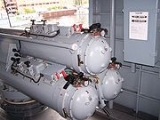
A torpedo tube is a device for launching torpedo
Torpedo

Note: Prior to 1900, in naval usage "torpedo" could also refer to what today is called a naval mine. For that usage, see naval mine.The modern torpedo is a self-propelled explosive projectile weapon, launched above or below the water surface, propelled underwater toward a target, and designed to detonate on contact or in proximity t...
es in a horizontal direction.

There are two main types of torpedo tube:

Some authorities prefer to reserve the term torpedo tube for submarine type torpedo tubes, referring to deck-mounted units as torpedo launchers, but the more general use has long been widespread among both lay people and arms manufacturers.

There are essential differences between the two types other than the obvious one of operating in air as opposed to water.


Discussion
Ask a question about 'Torpedo tube'
Start a new discussion about 'Torpedo tube'
Answer questions from other users
Full Discussion Forum


Recent Posts


Encyclopedia


A torpedo tube is a device for launching torpedo
Torpedo

Note: Prior to 1900, in naval usage "torpedo" could also refer to what today is called a naval mine. For that usage, see naval mine.The modern torpedo is a self-propelled explosive projectile weapon, launched above or below the water surface, propelled underwater toward a target, and designed to detonate on contact or in proximity t...
es in a horizontal direction.

Torpdorohr Eines Torpedoschnellbootes
Fs Redoutable Torpilles
There are two main types of torpedo tube:
  • Those designed to operate below water level, as fitted to submarine
    Submarine

    A submarine is a watercraft capable of independent operation below water. It differs from a submersible, which has only limited underwater capability....
    s and some surface ships
  • Deck-mounted torpedo launchers on surface ships only


Some authorities prefer to reserve the term torpedo tube for submarine type torpedo tubes, referring to deck-mounted units as torpedo launchers, but the more general use has long been widespread among both lay people and arms manufacturers.

There are essential differences between the two types other than the obvious one of operating in air as opposed to water. Deck-mounted launchers are normally designed for a specific munition, and often for a particular model of that munition. On the other hand, the torpedo tube is the submarine's general purpose launcher. In contrast, missile tubes and the newer vertical launchers are each loaded with a single round while in port.

The more recent designs of submarine torpedo tube may even be used for more than one size of torpedo, as well as other munitions including mines
Naval mine

A naval mine is a self-contained explosive device placed in water to destroy ships or submarines. Unlike depth charges, mines are deposited and left to wait until they are triggered by the approach of or contact with an enemy ship....
 and cruise missile
Cruise missile

A cruise missile is a guided missile missile that carries an explosive payload and uses a lifting wing and a propulsion system, usually a jet engine, to allow sustained flight; it is essentially a flying bomb....
s. Submarine tubes of greater than 21 inches in diameter are designed to accept the standard 21 inch heavy torpedo as well as larger munitions.

Some nuclear submarines, both US and Soviet, were fitted with two sizes of torpedo tube. On these boats a set of smaller tubes were dedicated to firing torpedoes, while the larger tubes were intended to fire a wide variety of munitions. This provided versatility and firepower while saving space, cost and complexity over an armament of all larger tubes.

On the older Soviet boats such as the Hotel class submarine
Hotel class submarine

The Hotel class is the general NATO reporting name for a type of nuclear marine propulsion ballistic missile submarine that was originally put into service by the Soviet Union around 1959....
, the smaller tubes were 16 inch, with the general purpose tubes being the standard 21 inch. On others, such as the Soviet Akula class submarine
Akula class submarine

Project 971 ????-? , is a Nuclear marine propulsion attack submarine first deployed by the Soviet Navy in 1986. The class is sometimes erroneously called the "Bars" class, after one of its members....
, the smaller tubes were 21 inch. More recently both navies appear to be returning to a smaller number of only 21 inch tubes.

See torpedo
Torpedo

Note: Prior to 1900, in naval usage "torpedo" could also refer to what today is called a naval mine. For that usage, see naval mine.The modern torpedo is a self-propelled explosive projectile weapon, launched above or below the water surface, propelled underwater toward a target, and designed to detonate on contact or in proximity t...
 for a list of torpedo sizes.

Submarine torpedo tube

A submarine torpedo tube is a more complex mechanism than a torpedo tube on a surface ship, because the tube has to accomplish the function of moving the torpedo from the normal atmospheric pressure within the submarine into the sea at the ambient pressure of the water around the submarine. Thus a submarine torpedo tube operates on the principle of an airlock
Airlock

An airlock is a device which permits the passage of people and objects between a pressure vessel and its surroundings while minimizing the change of pressure in the vessel and loss of air from it....
.

Torpedo tube operation

The accompanying diagram illustrates the operation of a submarine torpedo tube. The diagram is somewhat simplified but shows the workings of a submarine torpedo launch.

A torpedo tube has a considerable number of interlock
Interlock (engineering)

Interlocking is a method of preventing undesired states in a Finite state machine, which in a general sense can include any electrical, electronic, or mechanical device or system....
s for safety reasons. For example, an interlock prevents the breech door and muzzle door from opening at the same time. Also, the breech door cannot be opened when the tube is filled with water.

The following steps explain, in simplified form, the submarine torpedo launch sequence.

  1. Open the breech door in the torpedo room. Insert the torpedo into the tube.
  2. Hook up the wire-guide connection and the torpedo power cable.
  3. Shut and lock the breech door.
  4. Turn on power to the torpedo. A minimum amount of time is required for torpedo warmup. Fire Control programs are uploaded to the torpedo.
  5. Flood the torpedo tube. This may be done manually or automatically, from sea or from tanks, depending on the class of submarine. The tube must be vented during this process to allow for complete filling and eliminate air pockets which could escape to the surface or cause damage when firing.
  6. Open the equalizing valve to equalize pressure in the tube with ambient sea pressure.#Open the muzzle door. If the tube is set up for Impulse Mode the slide valve will open with the muzzle door. If Swim Out Mode is selected, the slide valve remains closed. The slide valve allows water from the Ejection Pump to enter the tube.
  7. When the launch command is given and all interlocks are satisfied, the water ram operates, thrusting a large volume of water into the tube at high pressure, which ejects the torpedo from the tube with considerable force. In fact, modern torpedoes have a safety mechanism that prevents activation of the torpedo unless the torpedo senses the required amount of G-force
    G-force

    The g-force of an object is its acceleration relative to free-fall. The unit of measure used is informally but commonly known as the "gee" , symbolized as g . An acceleration of 1 g is generally considered as equal to standard gravity , which is defined as precisely metre per second square...
    .
  8. The power cable is severed at launch however if a guidance wire is used, it remains connected through a drum of wire in the tube. Torpedo propulsion systems vary but electric torpedoes swim out of the tube on their own and are of a smaller diameter. 21" weapons with fuel-burning engines usually start outside of the tube.
  9. Once outside the tube the torpedo begins its run toward the target as programed by the fire control system. Attack functions are programmed but with wire guided weapons, certain functions can be controlled from the ship.
  10. For wire-guided torpedoes, the muzzle door must remain open because the guidance wire is still connected to the inside of the breech door to receive commands from the submarine’s fire-control system
    Fire-control system

    A fire-control system is a computer, often mechanical, which is designed to assist a weapon system in hitting its target. It performs the same task as a human gunner firing a weapon, but attempts to do so faster and more accurately....
    . A wire cutter on the inside of the breech door is activated to release the wire and its protective cable. These are drawn clear of the ship prior to shutting the muzzle door.
  11. The drain cycle is a reverse of the flood cycle. Water is returned to the ships tanks and can be moved as necessary. The tube must be vented to completely drain the tube since it is usually by gravity.
  12. Open the breech door and remove the remnants of the torpedo power cable and the guidance wire basket. The tube must be wiped dry to prevent a build up of slime. This process is called "diving the tube" and tradition dictates that 'ye who shoots, dives'.
  13. Shut and lock the breech door.


Spare torpedoes are stored behind the tube in racks. Various types of handling systems exist for loading torpedoes into the tubes but they are essentially hydraulic or manual. Prior to the Ohio class
Ohio class submarine

The Ohio class is a class of nuclear-powered submarines used by the United States Navy. The United States has 18 Ohio-class submarines:...
, U.S. SSBN's utilized a manual system of ropes, pulleys and such. About 15 minutes would be needed to reload a tube in this way. SSN's prior to the Seawolf class
Seawolf class submarine

The Seawolf class attack submarine was the intended successor to the Los Angeles class submarine, ordered at the end of the Cold War in 1989....
 used a hydraulic system that was much faster and safer in conditions where the ship needed to maneuver. It is important to remember that when handling ordnance, safety is more important than speed.

The German Type 212 submarine
Type 212 submarine

The Germany Type 212 is a highly advanced design of non-nuclear submarine developed by Howaldtswerke-Deutsche Werft AG for the German Navy. It features diesel propulsion and an additional air-independent propulsion system using Siemens AG proton exchange membrane hydrogen fuel cells....
 uses a new development of the water ram expulsion system, which ejects the torpedo with water pressure to avoid acoustic detection.

External links