
All Topics  
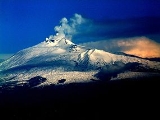
Mount Etna

 
Mount Etna

   Email Print
   Bookmark   Link


Mount Etna


Mount Etna (Aetna in Latin, also known as Muncibeddu in Sicilian
Sicilian language

Sicilian is a Romance language. Its dialects comprise the Italiano Meridionale-estremo language group, which are spoken on the island of Sicily and its satellite islands; in southern and central Calabria ; in the southern parts of Apulia, the Salento ; and Campania, on the Italian mainland, where it is called Cilentano ....
 and Mongibello in Italian
Italian language

Italian is a Romance languages spoken by about 63 million people as a first language, primarily in Italy. In Switzerland, Italian is one of four Linguistic geography of Switzerlands....
, a combination of Latin
Latin

Latin is an Italic language, historically spoken in Latium and Ancient Rome. Through the Military history of the Roman Empire, Latin spread throughout the Mediterranean and a large part of Europe....
 mons and Arabic gibel, both meaning mountain) is an active stratovolcano
Stratovolcano

A stratovolcano, sometimes called a composite volcano, is a tall, Volcanic cone volcano with many layers of hardened lava, tephra, and volcanic ash....
 on the east coast of Sicily
Sicily

Sicily is an Autonomous regions with special statute of Italy. Of all the regions of Italy, Sicily covers the largest land area at 25,708 km? and currently has just over five million inhabitants....
, close to Messina
Messina, Italy

Messina is the third largest city on the island of Sicily, Italy and the capital of the province of Messina. It has a population of c. 240,000 inhabitants in the city proper and about 500,000 in the metropolitan area....
 and Catania
Catania

Catania is an Italy city on the east coast of Sicily facing the Ionian Sea, between Messina and Syracuse, Sicily. It is the capital of the Province of Catania, and with 298,957 inhabitants it is the second-largest city on the island....
. Its Arabic name was Jebel Utlamat (the Mountain of Fire). It is the largest active volcano in Europe
Europe

Europe is, conventionally, one of the world's seven continents. Comprising the westernmost peninsula of Eurasia, Europe is generally divided from Asia to its east by the water divide of the Ural Mountains, the Ural , the Caspian Sea, and by the Caucasus Mountains to the southeast....
, currently standing high, though this varies with summit eruptions; the mountain is 21 m (69 ft) lower now than it was in 1981.


Discussion
Ask a question about 'Mount Etna'
Start a new discussion about 'Mount Etna'
Answer questions from other users
Full Discussion Forum


Recent Posts


Encyclopedia


Mount Etna (Aetna in Latin, also known as Muncibeddu in Sicilian
Sicilian language

Sicilian is a Romance language. Its dialects comprise the Italiano Meridionale-estremo language group, which are spoken on the island of Sicily and its satellite islands; in southern and central Calabria ; in the southern parts of Apulia, the Salento ; and Campania, on the Italian mainland, where it is called Cilentano ....
 and Mongibello in Italian
Italian language

Italian is a Romance languages spoken by about 63 million people as a first language, primarily in Italy. In Switzerland, Italian is one of four Linguistic geography of Switzerlands....
, a combination of Latin
Latin

Latin is an Italic language, historically spoken in Latium and Ancient Rome. Through the Military history of the Roman Empire, Latin spread throughout the Mediterranean and a large part of Europe....
 mons and Arabic gibel, both meaning mountain) is an active stratovolcano
Stratovolcano

A stratovolcano, sometimes called a composite volcano, is a tall, Volcanic cone volcano with many layers of hardened lava, tephra, and volcanic ash....
 on the east coast of Sicily
Sicily

Sicily is an Autonomous regions with special statute of Italy. Of all the regions of Italy, Sicily covers the largest land area at 25,708 km? and currently has just over five million inhabitants....
, close to Messina
Messina, Italy

Messina is the third largest city on the island of Sicily, Italy and the capital of the province of Messina. It has a population of c. 240,000 inhabitants in the city proper and about 500,000 in the metropolitan area....
 and Catania
Catania

Catania is an Italy city on the east coast of Sicily facing the Ionian Sea, between Messina and Syracuse, Sicily. It is the capital of the Province of Catania, and with 298,957 inhabitants it is the second-largest city on the island....
. Its Arabic name was Jebel Utlamat (the Mountain of Fire). It is the largest active volcano in Europe
Europe

Europe is, conventionally, one of the world's seven continents. Comprising the westernmost peninsula of Eurasia, Europe is generally divided from Asia to its east by the water divide of the Ural Mountains, the Ural , the Caspian Sea, and by the Caucasus Mountains to the southeast....
, currently standing high, though this varies with summit eruptions; the mountain is 21 m (69 ft) lower now than it was in 1981. It is the highest mountain in Italy south of the Alps
Alps

The Alps is the name for one of the great mountain range systems of Europe, stretching from Austria and Slovenia in the east; through Italy, Switzerland, Liechtenstein and Germany; to France in the west....
. Etna covers an area of 1,190 kmē (460 sq mi) with a basal circumference of 140 km. This makes it by far the largest of the three active volcanoes in Italy, being about two and a half times the height of the next largest, Mount Vesuvius
Mount Vesuvius

Mount Vesuvius is an stratovolcano east of Naples Italy. It is the only volcano on the European mainland to have erupted within the last hundred years, although it is not currently eruption....
.

Mount Etna is one of the most active volcanoes in the world and is in an almost constant state of eruption. The fertile volcanic soils support extensive agriculture
Agriculture

Agriculture refers to the production of food and goods through farming and forestry. Agriculture was the key development that led to the rise of civilization, with the animal husbandry of domestication animals and plants creating food surpluses that enabled the development of more Population density and Social stratification societies....
, with vineyard
Vineyard

A vineyard is a plantation of grape-bearing vines, grown mainly for winemaking, but also raisins, table grapes and non-alcoholic grape juice. The science, practice and study of vineyard production is known as viticulture....
s and orchard
Orchard

An orchard is an intentional planting of trees or shrubs maintained for food agriculture. Orchards comprise fruit tree or nut -producing trees grown for commercial production....
s spread across the lower slopes of the mountain and the broad Plain of Catania to the south. Due to its history of recent activity and nearby population, Mount Etna has been designated a Decade Volcano by the United Nations
United Nations

The United Nations is an international organization whose stated aims are to facilitate cooperation in international law, international security, economic development, Social change, human rights and achieving world peace....
.

Geological history

Volcanic activity at Etna began about half a million years ago, with eruptions occurring beneath the sea off the coastline of Sicily. 300,000 years ago, volcanism began occurring to the southwest of the present-day summit, before activity moved towards the present centre 170,000 years ago. Eruptions at this time built up the first major volcanic edifice, forming a strato-volcano in alternating explosive and effusive eruptions. The growth of the mountain was occasionally interrupted by major eruptions leading to the collapse of the summit to form caldera
Caldera

A caldera is a cauldron-like volcano feature usually formed by the collapse of land following a volcanic eruption such as the one at Yellowstone National Park....
s. From about 35,000 to 15,000 years ago, Etna experienced some highly explosive eruptions, generating large pyroclastic flow
Pyroclastic flow

A pyroclastic flow is a common and devastating result of some volcano. The flows are fast-moving currents of hot gas and rock , which travel away from the volcano at speeds generally as great as 450 mi/h ....
s which left extensive ignimbrite
Ignimbrite

Ignimbrite is a volcano pyroclastic rock, often of dacitic or rhyolitic composition."Ignimbrite" is the deposit of a pumice rich pyroclastic density current, or 'pyroclastic flow', a hot suspension of particles and gases that flows rapidly from a volcano, driven by a greater density than the surrounding atmosphere....
 deposits. Ash from these eruptions has been found as far away as Rome
Rome

Rome is the capital city of Italy and Lazio, and is Italy's largest and most populous city, with 2,724,347 residents in an urban area of some ....
, 800 km to the north.

Valle Del Bove
Thousands of years ago, the eastern flank of the mountain experienced a catastrophic collapse, generating an enormous landslide in an event similar to that seen in the 1980 eruption of Mount St. Helens
1980 eruption of Mount St. Helens

File:sthelens1.jpgThe 1980 eruption of Mount St. Helens, a stratovolcano located in Washington state, in the United States, was a major plinian eruption....
. The landslide left a large depression in the side of the volcano, known as 'Valle del Bove' (Valley of the Ox). Research published in 2006 suggests that this occurred around 6000 BC, and caused a huge tsunami
Tsunami

A is a series of ocean surface wave that is created when a large volume of a body of water, such as an ocean, is rapidly displaced. The Japanese term is literally translated into " harbor wave."...
 which left its mark in several places in the eastern Mediterranean
Mediterranean Sea

The Mediterranean Sea is a sea or Ocean off the Atlantic Ocean surrounded by the Mediterranean region and almost completely enclosed by land: on the north by Europe, on the south by Africa, and on the east by Asia....
. It may have been the reason that the settlement of Atlit Yam
Atlit Yam

Atlit Yam is an ancient submerged city off the coast of Atlit, Israel.Atlit-Yam provides the earliest known evidence for an agro-pastoral-marine subsistence system on the Levantine coast....
 (Israel
Israel

Israel officially the State of Israel , is a country in the Middle East located on the eastern shore of the Mediterranean Sea. It borders Lebanon in the north, Syria in the northeast, Jordan in the east, and Egypt on the southwest, and contains geographically diverse features within its relatively small area....
), now below sea level, was suddenly abandoned around that time.

The steep walls of the Valley have suffered subsequent collapse on numerous occasions. The strata
Stratum

In geology and related fields, a stratum is a layer of rock or soil with internally consistent characteristics that distinguishes it from contiguous layers....
 exposed in the valley walls provide an important and easily accessible record of Etna's eruptive history.

The most recent collapse event at the summit of Etna is thought to have occurred about 2,000 years ago, forming what is known as the Piano Caldera. This caldera has been almost entirely filled by subsequent lava eruptions, but is still visible as a distinct break in the slope of the mountain near the base of the present-day summit cone.

Historical eruptions

Eruptions of Etna are not all the same. Some occur at the summit, where there are currently (as of 2008) four distinct craters - the Northeast Crater, the Voragine, the Bocca Nuova, and the Southeast Crater. Other eruptions occur on the flanks, where there are more than 300 vents, ranging in size from small holes in the ground to large craters hundreds of meters across. Summit eruptions can be highly explosive and are extremely spectacular, but are rarely threatening for the inhabited areas around the volcano. On the contrary, flank eruptions can occur down to a few hundred meters altitude, close to or even well within the populated areas. Numerous villages and small towns lie around or on cones of past flank eruptions. Since the year 1600 A.D., there have been at least 60 flank eruptions and countless summit eruptions; nearly half of these have occurred since the start of the 20th century, and the 3rd millennium has seen five flank eruptions of Etna so far, in 2001, 2002-2003, 2004-2005,2007 and 2008.

The first known record of an eruption at Etna is that of Diodorus Siculus
Diodorus Siculus

Diodorus Siculus , was a Roman Greece historian who flourished in the 1st century BC. According to Diodorus' own work, he was born at Agira in Sicily ....
. The Roman poet Virgil
Virgil

Publius Vergilius Maro was a classical Roman poet, best known for three major works?the Bucolics , the Georgics and the Aeneid?although several Appendix Vergiliana are also attributed to him....
 gave what was probably a first-hand description of an eruption in the Aeneid
Aeneid

The Aeneid is a Latin Epic poetry written by Virgil in the late 1st century BC that tells the legendary story of Aeneas, a Troy who traveled to Italy, where he became the ancestor of the Rome....
:

(edition of Theodore C. Williams
Theodore Chickering Williams

Theodore Chickering Williams was an American Unitarianism pastor and hymnwriter, and from 1899 the first headmaster of the Hackley School in Tarrytown, New York....
, ca. 1908 [lines 569 - 579]) In 396 BC, an eruption of Etna is said to have thwarted the Carthaginians in their attempt to advance on Syracuse
Syracuse, Italy

Syracuse is a historic city in southern Italy, the Capital of the province of Syracuse. The city is noted for its rich Greek history, culture, amphitheatres, architecture and association to Archimedes, playing an important role in ancient times as one of the top powers of the Mediterranean world; it is over 2,700 years old....
 during the First Sicilian War
Carthage

Carthage refers both to an ancient city in present-day Tunisia, and a modern-day suburb of Tunis. The civilization that developed within the city's sphere of influence is referred to as Punic or Carthaginian....
.

A particularly violent explosive (Plinian) summit eruption occurred in 122 BC, and caused heavy tephra falls to the southeast, including the town of Catania, where many roofs collapsed. To help with reconstruction and dealing with the devastating effects of the eruption, the Roman government exempted the population of Catania from paying taxes for ten years.

Recent eruptions

Etna Eruption Seen From the International Space Station
Another large lava flow from an eruption in 1928 led to the first (and only) destruction of a population center since the 1669 eruption. The eruption started high on Etna's northeast flank on 2 November, then new eruptive fissures opened at ever lower elevation down the flank of the volcano. The third and most vigorous of these fissures opened late on 4 November at unusually low elevation (1200 m above the sea-level), in a zone known as Ripe della Naca. The village of Mascali
Mascali

Mascali is a comune in the Province of Catania in the Italy region Sicily, located about 170 km east of Palermo and about 30 km northeast of Catania....
, lying downslope of the Ripe della Naca, was obliterated in just two days, with the lava destroying nearly every building. Only a church and a few surrounding buildings survived in the north part of the village, called Sant'Antonino or "il quartiere". During the last days of the eruption, the flow interrupted the Messina-Catania railway line and destroyed the train station of Mascali. The event was used by Benito Mussolini
Benito Mussolini

Benito Amilcare Andrea Mussolini, Order of the Bath Sovereign Military Order of Malta Order of the Tower and Sword was an Italy politician who led the National Fascist Party and is credited with being one of the key figures in the creation of Fascism....
's Fascist regime
Italian Fascism

The term Italian Fascism denotes the Authoritarianism Nationalism Fascismo political movement that ruled Kingdom of Italy from 1922 until 1943 under leader Benito Mussolini....
 for propaganda
Propaganda

Propaganda is the dissemination of information aimed at influencing the opinions or behaviors of large numbers of people. As opposed to Objectivity providing information, propaganda in its most basic sense presents information in order to influence its audience....
 purposes, with the evacuation, aid and rebuilding operations being presented as models of fascist planning. Mascali was rebuilt on a new site, and its church contains the Italian fascist symbol of the torch, placed above the statue of Jesus Christ. In early November 2008, the town of Mascali commemorated the 80th anniversary of the eruption and destruction of the village with a number of public manifestations and conferences, where, amongst others, still living eyewitnesses of the eruptions recalled their impressions of that experience.

Other major 20th-century eruptions occurred in 1949, 1971, 1981, 1983 and 1991-1993. In 1971, lava buried the Etna Observatory (built in the late 19th century), destroyed the first generation of the Etna cable-car, and seriously threatened several small villages on Etna's east flank. In March 1981, the town of Randazzo on the northwestern flank of Etna narrowly escaped from destruction by unusually fast-moving lava flows - that eruption was remarkably similar to the one of 1928 that destroyed Mascali. The 1991-1993 eruption saw the town of Zafferana threatened by a lava flow, but successful diversion efforts saved the town with the loss of only one building a few hundred metres from the town's margin. Initially, such efforts consisted of the construction of earth barriers built perpendicularly to the flow direction; it was hoped that the eruption would stop before the artificial basins created behind the barriers would be completely filled. Instead, the eruption continued, and lava surmounted the barriers, heading directly toward Zafferana. It was then decided to use explosives near the source of the lava flow, to disrupt a very efficient lava tube system through which the lava traveled for up to 7 km without essentially losing heat and fluidity. The main explosion on 23 May 1992 destroyed the lava tube and forced the lava into a new artificial channel, far from Zafferana, and it would have taken months to re-establish a long lava tube. Shortly after the blasting, the rate of lava emission dropped and during the remainder of the eruption (until 30 March 1993) the lava never advanced close to the town again.

Following six years (1995-2001) of unusually intense activity at the four summit craters of Etna, the volcano produced its first flank eruption since 1991-1993 in July-August 2001. This eruption, which involved activity from seven distinct eruptive fissures mostly on the south slope of the volcano, was a mass-media eruption, because it occurred at the height of the tourist season and numerous reporters and journalists were already in Italy to cover the G8 summit in Genoa. It also occurred close to one of the tourist areas on the volcano, and thus was easily accessible. Part of the "Etna Sud" tourist area, including the arrival station of the Etna cable car, were damaged by this eruption, which otherwise was a rather modest-sized event for Etna standards.

In 2002-2003, a much larger eruption threw up a huge column of ash that could easily be seen from space and fell as far away as Libya
Libya

Libya , officially the Great Socialist People's Libyan Arab Jamahiriya , is a country located in North Africa. Bordering the Mediterranean Sea to the north, Libya lies between Egypt to the east, Sudan to the southeast, Chad and Niger to the south, and Algeria and Tunisia to the west....
, 600 km south across the Mediterranean Sea
Mediterranean Sea

The Mediterranean Sea is a sea or Ocean off the Atlantic Ocean surrounded by the Mediterranean region and almost completely enclosed by land: on the north by Europe, on the south by Africa, and on the east by Asia....
. Seismic activity in this eruption caused the eastern flanks of the volcano to slip by up to two metres, and many houses on the flanks of the volcano experienced structural damage. The eruption also completely destroyed the tourist station Piano Provenzana, on the northeastern flank of the volcano, and part of the tourist station "Etna Spud" around the Rifugio Sapienza on the south flank. Footage from the eruptions was recorded by Lucasfilm
Lucasfilm

Lucasfilm Limited is an United States film production company founded by George Lucas in 1971, based in San Francisco, California. Lucas is the company's current chairman, and Micheline Chau is the president and Chief operating officer....
 and integrated into the landscape of the planet Mustafar
Mustafar

Mustafar is a fictional planet in the Star Wars fictional universe. It is portrayed in Star Wars Episode III: Revenge of the Sith.The planet is covered by hundreds of volcanic caldera, most of which are in a state of constant eruption....
 in the 2005 film Star Wars Episode III: Revenge of the Sith
Star Wars Episode III: Revenge of the Sith

Star Wars Episode III: Revenge of the Sith is a 2005 science fiction film written and directed by George Lucas. It was the sixth film released in the Star Wars wiktionary:saga and the third in terms of the series' Dates in Star Wars....
. The Rifugio Sapienza is near the site of a cable car
Gondola lift

A gondola lift is a type of aerial lift, often called a cable car, which consists of a loop of steel Wire rope that is strung between two stations, sometimes over intermediate supporting towers....
 station which had previously been destroyed in the 1983 eruption; it has now been rebuilt. Following a rather silent, slow and non-destructive lava outflow on the upper southeastern flank between September 2004 and March 2005, intense eruptions occurred at the Southeast Crater in July-December 2006. These were followed by four episodes of lava fountaining, again at the Southeast Crater, on 29 March, 11 April, 29 April and 7 May 2007. Ash emissions and Strombolian explosions started from a vent on the eastern side of the Southeast Crater in mid-August 2007.
Aetna Haus
On 4 September 2007 Etna violently erupted at around 8:00 p.m. local time, spewing lava up to 400 m into the air along with strong winds that sent ash and smoke into the underlying towns. This Southeast Crater eruption was visible far into the plains of Sicily, ending the following morning between the hours of 5 to 7 am local time. Catania-Fontanarossa Airport
Catania-Fontanarossa Airport

Catania-Fontanarossa Airport is located 5 km /3 miles south of Catania, the second largest city on the Italy island of Sicily.It is the busiest airport in Sicily and the 5th busiest in Italy with 6,083,735 passengers in 2007, but in terms of domestic traffic it ranks at the 3rd place, after Leonardo da Vinci Airport and Linate Airport....
 shut down operations during the night for safety precautions. A similar paroxysm occurred during the night of 23-24 November 2007, lasting for 6 hours and causing ash and lapilli falls to the north of the volcano. Again, the source of the activity was the Southeast Crater. Following several months of rather minor activity from the Southeast Crater and flurries of seismic activity especially in the eastern sector of the mountain, a new powerful eruptive paroxysm occurred on the late afternoon of 10 May 2008. Due to bad weather, it was not possible to see much of the activity at the vent, but several branches of lava traveled down the eastern flank of the volcano, into the Valle del Bove depression. This latest paroxysm lasted about 4 hours, ending on the evening of 10 May 2008.

A new eruption started on the morning of 13 May 2008 immediately to the east of Etna's summit craters, accompanied by a swarm of more than 200 earthquakes and significant ground deformation in the summit area. On the afternoon of the same day, a new eruptive fissure opened at about 2800 m above sea-level, with a number of vents displaying Strombolian activity and emission of lava flows toward the Valle del Bove. During the following 24 hours the lava traveled approximately 6 km to the east, but thereafter its advance slowed and stopped, the most distant lava fronts stagnating about 3 km from the nearest village, Milo. Ash emissions became more frequent between 16 and 18 May and produced small but spectacular clouds, whereas the rate of lava emission showed a gradual diminution. During late May and the first week of June, the activity continued at low levels, with lava flows advancing only a few hundred meters from the vents as of 4 June. Four days later, on 8 June, there was a considerable increase in the vigor of Strombolian activity and lava output rate. During the following week, lava flows advanced up to 5 km from the source vents. In June and July, the eruption continued with mild Strombolian activity from two vents at about 2800 m elevation, and lava advancing up to 4 km eastward, remaining confined to the Valle del Bove collapse depression. Activity in mid-July produced loud detonations that were well audible in numerous population centers around the volcano. In late-July, explosive activity waned, but lava emission continued at a fairly low rate, feeding short lava flows that advanced little more than 1 km.

On 13 November 2008, six months after its onset, the 2008 flank eruption of Etna was continuing, at a relatively low rate, and it thus became the longest of the four flank eruptions of Etna so far in the 3rd millennium. Previous eruptions, in 2001, 2002-2003, and 2004-2005 had lasted 3 weeks, 3 months, and 6 months, respectively.

Unusual characteristics


In the 1970s Etna erupted smoke ring
Smoke ring

A smoke ring is a visible vortex ring formed by expelling smoke through an opening. It can be created by blowing smoke from the mouth, while smoking....
s, one of the first captured events of this type, which is extremely rare. This happened again in 2000.

See also

  • List of volcanoes in Italy
    List of volcanoes in Italy

    This is a list of active and extinct volcanoes in Italy.See also*Volcanism in ItalyReferences...
  • Volcanic Seven Summits
    Volcanic Seven Summits

    The Volcanic Seven Summits are the highest volcanoes on each of the seven continents, just as the Seven Summits are the highest peaks on each of the seven continents....
  • Mountaineering history & Mt Etna
    Mountaineering

    Mountaineering is the sport, hobby or profession of walking, hiking, trekking and climbing up mountains. It is also sometimes known as alpinism, particularly in Europe....


Footnotes


External links